CROP CIRCLES PREDICT FUTURE COMETS/ASTEROIDS
updated 7-7-08
THEY DIDN'T TELL US - AGAIN!!!!
compiled by Dee Finney
ANOTHER WARNING IN GERMANY AGAIN!!!
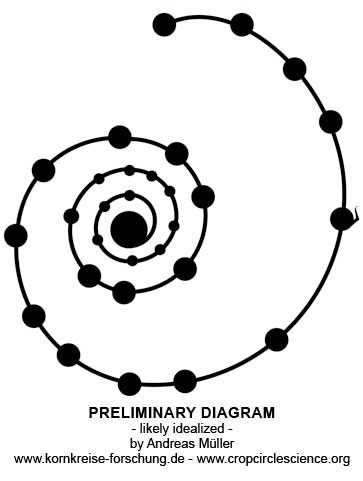
This crop circle appeared on July 4th, 2008
It is reminiscent of all the others that came before it -
like we are being reminded once again
of what is coming
No good photos are available, but here is the forum discussing
it
http://cropcircleconnector.com/forum/viewtopic.php?p=95531#95531
The spiral is 80 meters in diameter
This one appeared in 2007 at Yatesbury Field, England
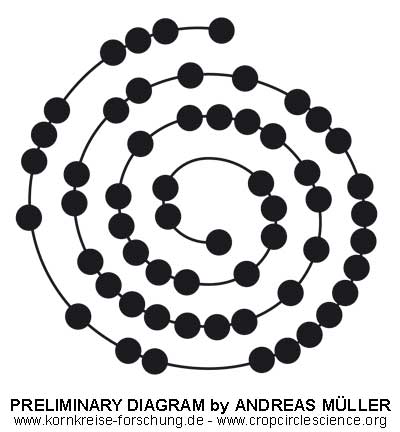
LUCY PRINGLE
ORIGINAL PHOTO
| Note from Dee: Richard Boylan sent out a notice about an
incoming asteroid. This one does not have a number attached to it,
so it is not a government/scientific known object.
7-29-08 -
ALERT FROM DR. RICHARD BOYLAN:
ASTEROID ON COLLISION COURSE WITH EARTH
Posted By: RumorMail
Date: Sunday, 27 July 2008, 5:21 p.m.
[DrRichBoylanReports] A Special Report: Incoming!
A Special Report: Incoming!
Friends,
The information I am about to share can be disturbing. Do
not jump out an upper story window or sell all your stocks. Please
read this report to the very end before drawing any conclusions
about an appropriate response.
This information is derived from the Zeta and other Star
Visitors who have been remote-viewing Earth’s very near future.
Their remote-viewing results were relayed to a Native
American friend of mine during a special close encounter briefing.
I assisted this Native American woman to recall every detail via
hypnotic regression. The accuracy of the details was later
corroborated to me by Star Nations. Additionally three other Star
Seeds received the same future vision.
There is no gentle way to say this so I will just lay it
out.
There is an asteroid headed on a collision course with
Earth. It is 8/10 of a mile long and 6/10 of a mile wide (1.4 km
long by 1 km wide).
On its current course it is due to impact in the North
Atlantic this year at about 2:30-3:00 pm. EDT on November 15,
2008.
The location of the impact zone is in the ocean at 36
degrees North Latitude and 65 degrees West Longitude,
(approximately 100 miles north of Bermuda and 750 miles east of
Cape Hatteras, North Carolina, [on the U.S. southeast coast].)
When the asteroid enters Earth’s atmosphere, it will be seen
as a large bright-green bolide. Atmospheric friction will create
an enormous dark reddish-orange glow in the air that will be
visible across eastern North America, such that a thousand miles
away from the Impact Zone, a reddish glow will backlight even the
Toronto skyline in Canada. Indeed, from Halifax, Nova Scotia to
Boston, Washington, DC, Miami, Cuba, Puerto Rico and Venezuela the
glow will be visible.
When this bolide plunges into the perhaps 10,000-feet- deep
ocean of the impact zone, it will create such a downward pressure
wave as to cause a major earthquake felt on land. The Star
Visitors told my Native American friend that people closer to the
Impact Zone are only going to be safe if they are 15 or more feet
underground (in a waterproof location).
It also suggests that there will be resultant tsunamis of
Biblical proportions.
An available comparative model developed by two geologists
on the BBC in order to measure effects of a volcanic eruption on
La Palma Island in the Canary Islands chain northwest of Africa
and its resultant earthquake [Day et al, 1999; Ward and Day,
2001], predicted that the volcano’s unstable western flank would
fall into the ocean, creating a tidal wave a half-mile (900
meters) high at the Canary Islands, and would radiate out across
the Atlantic and inundate the eastern seaboard of North America
including the American, Caribbean and northern coasts of South
America some six to eight hours later. They estimated that the
tsunami, upon reaching the North American and Latin American
coasts, would have waves possibly 300 feet (90 metres) or more
high, causing massive devastation along the coastlines. Modeling
suggests that the tsunami could inundate up to 15 miles (25 km)
inland - depending upon topography.
But the asteroid which will arrive November 15 has an impact
zone which is 2000 miles closer to the North American coastline
than the Canary Islands. Therefore the resultant tidal wave would
likely be much higher than 300 feet on the U.S.-Canadian-
Caribbean American coast. That means that tsunamis much higher
than 300 feet tall would crash on the shores of Halifax, N.S.,
Boston; New York City; Chesapeake Bay (Washington, DC); Norfolk,
VA; Charleston, SC; Savannah, GA, Jacksonville, FL; Miami, FL;
Cuba; Dominican Republic/Haiti; Puerto Rico; and Caracas,
Venezuela. And would surge inland possibly more than 15 miles.
Additionally, the Atlantic Coast of Europe and Africa is also
likely at risk.
It is perhaps instructive that 35 million years ago another
incoming asteroid, twice as big, impacted the U.S. coast near
Norfolk, Virginia and created a crater 39 miles wide and 2/3 of a
mile deep.
A remote-viewing psychic on my team saw that the Nov. 15
asteroid’s impact would create an extremely- powerful downward
pressure wave that would precipitate the eruption of a massive
volcano on the seabed floor which would grow to almost the ocean’s
surface, causing weather and ocean navigation challenges.
Some within the U.S. military are already aware of this
threat. My remote viewer saw that Cabal- controlled U.S. military
would field a huge submersible sea vessel which would break up
through the Arctic pack ice and surface to launch multiple
long-range missiles into space in an attempt to break up this
asteroid. But their efforts will be not precise, and they will
make things worse by breaking up the huge asteroid into
still-deadly gigantic parts, which then threaten an even wider
section of Earth. The Cabal deliberately will use conventional
warheads rather than nuclear ones in order to make sure that the
asteroid reaches Earth in salvageable pieces, because its surface
is made of a super-hard element unknown on Earth, and the Cabal
want to gather that element to fashion impregnable weaponry. While
a salvo of nuclear missiles might eliminate the asteroid threat,
the Cabal are more interested in weapons superiority from the
asteroid mineral than how many people on the ground would die from
asteroid pieces.
As this grim picture was presented, I determined that the
situation was beyond human capacity to remedy by ourselves in the
time available. I therefore made a formal request to Star Nations’
Council (as Councillor of Earth) to intervene to deflect this
asteroid from its foreseen impact course.
This request was agreed to by Star Nations with the proviso
that Humans had to ger involved too in the project to deflect this
asteroid.
And so it was decided that Humans would engage in a Joint
Psychic Project to utilize our collective telekinetic abilities to
exert together to deflect this asteroid from its collision course
with Earth. And Star Nations will join with us, utilizing both
their telekinetic powers, and any necessary advanced technology,
to redirect this asteroid safely away from Earth.
Everyone who reads this report therefore is invited to join
in an upcoming special Joint Psychic Exercise on November 15, time
TBA, most likely around 1:30 p.m., PST, (4:30 pm, EST), to unite
in exercise of telekinetic powers to redirect this asteroid safely
away from Earth before it travels into our atmosphere.
Be watching on my website or emailing lists for an update
and further details on this most important project as we get
closer to November 15th.
And recognize that through this Joint Exercise we are
entering yet more deeply into a collaborative Human-Star Nations
effort to help make sure that Humankind makes it to that future
point where we have advanced enough to be admitted into cosmic
citizenship as the newest inhabited planet to achieve an advanced
state of civilization.
Thank you.
in the light,
Richard Boylan, Ph.D.
Richard Boylan, Ph.D., LLC, Councillor President, Star Kids
Project, Ltd Email: drboylan@sbcglobal. net Website:
www.drboylan.
com
|
|
Joe Mason wrote about this one, feeling that it was about the Kundalini and
the Chakra system,
comparing it to ancient depictions of snakes in that same position.
http://www.greatdreams.com/crop/yates/yates_field_spiral.htm
It also looks like the Fibonaci spiral

http://www.greatdreams.com/fibonaci.htm
The Mandelbrot spirals and the new crop
formation appear to show depth, as if spiraling downward or upward.
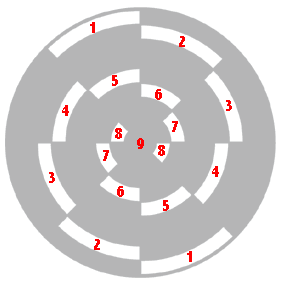
I got the same feeling from the ratchet formation that appeared around 17 April
2005 at Ripley –
http://www.greatdreams.com/crop/2005ccs/2005ccs2.htm
 |
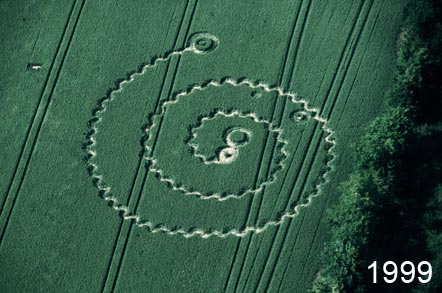 |
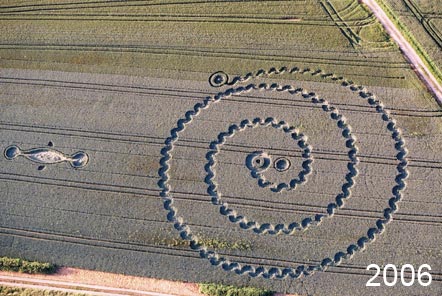
The
Reconstruction - made on June 21, 2006, at Dörnberg, near Kassel in
Hessen, Germany
Photo: Eckhard Weber
Editors note: The loop comes much closer to the orbit previous laid such
in 1999. |
The
Original - discovered on June 26, 1999, at Martinhagen in Hessen,
Germany.
Photo: Frank Laumen
Thanks: Eckhard
Weber, FGK,
Frank
Laumen, NASA
Copyright: Andreas Müller, 27.06.2006 |
July 21, 2007
MANIT SANUBBOON
Thailand will have a close encounter with an asteroid expected to
move closer to the Earth than the moon in the next 29 years,
according to a prominent astronomer Worawit Tanwutthibundit. The
asteroid, named 99942 Apophis, will come into close orbit with the
Earth 22 years from now and it will come by again, even closer,
seven years after that.
This has sparked fears over the possibility that it could
collide with the Earth.
Mr Worawit, an executive member of the Thai Astronomical
Society, said the asteroid will come within about 34,400 kilometres
of the Earth on April 13, 2029.
He cited a report released by the US National Aeronautics and
Space Administration (Nasa).
On that day, the asteroid will make its closest approach to
the Earth, about eleven times closer than the moon will pass by _
for the first time in 1,000 years, according to Mr Worawit.
The astronomer said the asteroid's visit on that day will
provide a basis for calculations about whether it could hit the
Earth in the future.
The same asteroid is predicted to pass by the Earth again on
April 13, 2036 and it will be even closer then, Mr Worawit said,
citing the Nasa report.
He said the calculations will determine whether the asteroid
would be on a collision course with the Earth in 2036 or not. ''If
it struck the Earth on that day (April 13, 2036), the possible
target would be the northern part of Mexico.
''The impact of the collision would be like the power of 870
megatonnes of TNT going off,'' Mr Worawit said.
Mr Worawit said 99942 Apophis is 320 metres in diameter, and
orbits the sun every 323 days.
On April 13, 2029, the asteroid will come into view at dusk at
a 42-degree angle in the western sky in the constellation Cancer, Mr
Worawit said.
It will be able to be observed in the Middle East, Europe,
Africa and Thailand.
The 99942 Apophis asteroid was discovered in June 2004. It was
then called 2004 MN4.
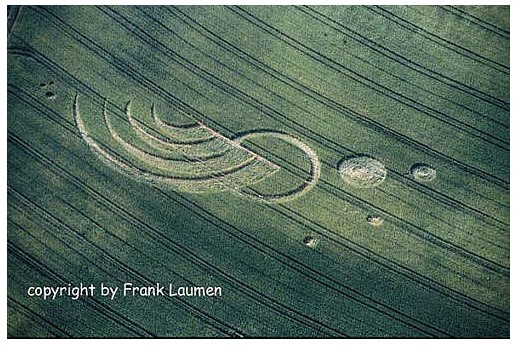
Kassel, Hessen, Germany crop circle reported June 26, 1999. If that doesn't
depict the Earth being slammed by asteroids I'll eat my hat! Noting that 4 major
planets will be involved in the Grand Cross, while Pluto and its two minor
asteroids won't.
Amazingly it seems as if this formation appeared in full daylight and within
a perfect view to the nearby road. Local CC-researcher W.Schöppe is sure that
it was not present at 8.00am on June 26, 1999. the formation was discovered the
same day just eight hours later at 4.00pm by CC-researcher E.Weber.
On June 26, 1999, a second formation was discovered in a field of rye between
Ehelen and Breitenbach in Hessen. The formation consist of a huge spiral made of
a meandering path created by numerous connected semi-rings - very similar to the
style of the outer ring in the formation at Dorla - and with several circles in
the standing crop between the flattened spiral-paths. The hosting field is
positioned just next to the field that hosted the beautiful double-spiral from
last year. The description sounds as if the aerial will provide an again a major
formation.
On June 26, 1999, local CC-researcher Wolfgang Schöppe discovered a huge
formation in a field of wheat next to the motorway A44 (but not visible from it
) at Ehlen in Hessen. It is very hard to describe what the formation look like
without giving an aerial or diagram. Basically it is a huge ring with a semi set
of four nested crescents, creating a claw.like feature. the whole thing is
surrounded by several (7 ) smaller circles. The overall look reminds me of
something like a phoenix or insectoid-larva coming out of an circular egg. main
body's axis is 68 m long and the overall size of the formation must be next to
100 m ( 330' ). A survey and photos, including aerial were taken - to be updated
soon as possible.
Andreas Müller
'I.C.C.A. - The International Crop Circle Archive'
Editor's note: To me, this looks like the Sun, earth, and moon and two
other space satellites of some kind, with 4 comets and their trails slamming
into the sun.
CLAIMS TO BE HOAX
FGK-PROJECT
"RECONSTRUCTION" (99/06)
Short
summary of the previous history
For
years the complete executive chairman-board of the "German Association For
Crop Circle Research (Forschungsgesellschaft Kornkreise e.V. - FGK)"
(Note:
This site - www.kornkreise-forschung.de / www.cropcirclescience.org is no member
of the FGK)
consisted of people that - secretly - preferred to make/hoax crop circles
instead of researching the phenomenon to test their own members and Non-FGK
researchers. Later they used their self-proclaimed
"socio-psychological" projects to debunk and discredit other
researchers as well as the FGK itself. After many years this secret behaviour
came to surface and bit by bit that chairmen and -women left the FGK.
In 2006 the latest "secret-hoaxer"-chairman was revealed and stepped
back from all of his positions within the FGK.
To test his claims, that he alone was responsible for some crop circle
formations in the Kassel-area in the past, the FGK created "Project
Reconstruction" in which this former chairman should demonstrate his
skills, reproducing a formation of 1999 at night.
The
FGK-Homepage
informs:
"Under the lead of researcher Eckhard Weber and in full agreement with
farmer Dieter Fröhlich the FGK commissioned the experimental making of a crop
circle formation in a field of wheat just outside the village of Dörnberg (near
Kassel in Hessen). The ambition of this experiment was the to have an object for
comparison in questions of quality and design, and the question if - as claimed
- a single person would be able to create a formation like the 1999er spiral
formation at night. (...) The whole process was observed and documented by
observing FGK-members.
Both, the farmer for his loss in crop as well as the maker of the crop circle
were paid for their service. The farmer gave a general permission to enter the
field and formation. (...)"
The
Result
The diameter of the new spiral measured ca. 63 meters, the uncoiled
spiral-path would have measured a length of 400 meters and was
"decorated" with 215 small and wave-like placed semi-circles. A small
dolphin-like formation of 23 meters length was made in a distance of about 30
meters in the same field.
The creation of the spiral-formation took 2 hours, beginning at 10:45pm -
00:45am.
The "Dolphin" was made in 30-45 minutes.
Both formations were made by a single person who used poles, ropes and the
classical "stomper" for the flattening of the crop.
The used technique to create the wave-like spiral in 2006 is based on a
previously marked spiral-path that was decorated on each side with semi-circles
shifted for half a radius each:
x 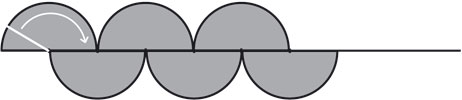
Fig. 1: How the "wave" pattern was constructed in 2006.
Graphic: Andreas Müller
TAKEN FROM: http://www.kornkreise-forschung.de/textFGKRekonstruktion06.htm
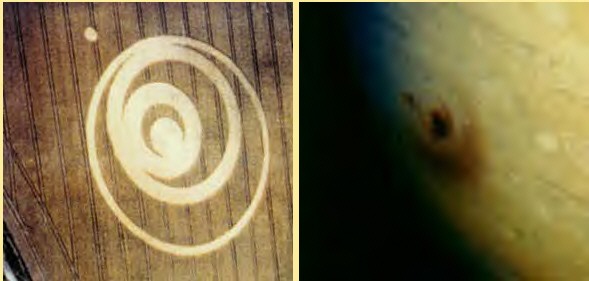
FROM: Ed
Sherwood
The Roundway (Oliver's Castle) Crop Circle Formation
Wiltshire UK - Discovered July 24th 1994
Photo 1994 Colin Andrews
'As above, So below'. As millions of people around the world received news
that for first time in human history an 'Earth killing' Comet would be witnessed
impacting a neighboring planet, sequential events mirroring those in space
began to appear in the crop fields of Wiltshire and Hampshire in 1994.
The 'G - Impact' Effect in the Atmosphere of Jupiter
Photo 1994 NASA/JPL Educational Services
Months later, in the 1994 November issue of Astronomy Magazine, a dramatic
image of Jupiter showing the impact effect of the largest Comet fragment:
the 'G-Impact' was discovered by Kris to bear an amazing resemblance to the
Roundway Crop Circle formation. In addition to impact 'crescents' the 1994
Roundway Crop Circle formation and Shoemaker/Levy 9 Comet G-Impact also shared
another detail in common: a small side circle!
Rotated circles and crescents defined and differentiated the 1994 pictogram
from the exact G-Impact image, but amazingly revealed yet another possible
related layer of meaning to the formation. Perturbing and consuming the orbiting
motion of asteroids, and Comets, including the Shoemaker/Levy 9 Comet, the
Sun and Jupiter are locked in an oscillating cycle known to astronomers as
the 'Solar Oscillation', or 'Jupiter Effect'. Basically, the Solar Oscillation
is the oscillating motion of the Sun through the 'Milky Way Galaxy', caused
by the 'alternating pattern of conjunctions and oppositions' between the
ever changing orbiting movements and positions of the more massive planets
in our solar system, particularly Jupiter. This cycle, I learned and began
disseminating in Autumn 1991 is, I think, a major aspect of the physics of
most non-manmade Crop Circle creation, and could explain why at Roundway
in 1994 the 'impact crescents' were rotated. Turned 90 degrees, three times,
they reflected, in my view, the fundamental force of rotation: angular momentum,
and by inference its counterpart: gravity; the two Cosmic forces that ultimately
sent the Shoemaker/Levy 9 Comet fragments crashing into Jupiter!
FROM:
http://www.barry.warmkessel.com/barry/1999PPaper.html
1. METEOR/COMET BOMBARDMENT - WHEN WILL THEY STRIKE?
1.1 THE 2007, 2033 OR 2039 STRIKE DATES
The original "Vulcan, Comets and the Impending Catastrophe" paper indicates
that Earth is periodically vulnerable to meteors/comets swarm strikes every
1,677 years.1 Long period comets, offering little warning time, may have
struck Earth 5,000 and 11,600 years ago causing Noah's flood and our current
interglacial period respectively. A similar event may soon happen again.
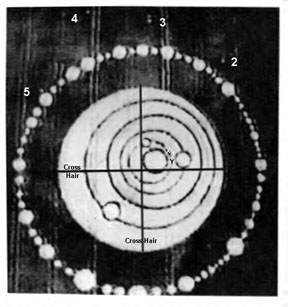
One strike date source is from "crop circle" T367 known as "The Solar System".
It was formed at Cheesefoot Head (on the old Longwood estate), England on
26 June 1995.2 Popular lore associates crop circles with extra-terrestrial
aliens and UFOs even though humans (Doug and Dave) have admitted making them
by stomping down crops using a rope, bar and center stake. But the Vulcan
paper's authors seemingly accept an alien presence since they consider Vulcan
to be present on the Hill star map derived from alien contact (Figures 3
and 4). They have patented an (AAD) Aerodynamic Augmentation Device (#5,797,563)
based on reported UFO data.3 It explains how both UFO related RF radiation,4
as intercepted at exactly 3.0 GHz by an RB 47 aircraft, and UFO associated
magnetic fields5are employed to ease the passage of saucers, or any aircraft,
through the atmosphere. Saucers have been video taped at speeds of 3,000+
mph with this radiation heating air and making it appear white (as is
characteristic of solar furnaces focused on small regions of the atmosphere).6
Twenty times the intercepted RF's value falls exactly in an oxygen absorption
band (60 GHz), producing ionized air.7 See Figure 1A. Tripling this RF,
postulated to be used on alien saucers, produces a RF exactly in the middle
of the second water absorption band (180 GHz). Beams transmitted at these
RFs (even from the same antennae8 could heat the stalks, briefly softening
them as if they had been steamed, and cause them to fall in a crop circle
image.9
While most crop circle messages are likely meaningless, the finely carved
crop circle T367 is an exception.10 See Figure 2A. It was quickly identified
as a depiction of our solar system's inner planets and their orbits. Mercury,
Venus, Mars and the asteroid belt are present, but Earth was missing from
its orbit. Small white spots, called "grape shot", were also present.
Vulcan's orbit would initiate two comet swarms in a resonant orbit, each
with a nominal 3,353-year period. See the Vulcan paper's "Impending Comet
Strike" section. It is postulated that extra-terrestrials would be keenly
aware of Vulcan. They could use this distant planet to slow their spaceships'
trajectory as they settle into an orbit within our solar system or sling-shot"
their spacecraft out of our system when they leave. Precise knowledge of
Vulcan's mass and orbit would be required for this maneuver. This, combined
with the localization of a comet swarm headed toward the inner solar system
by debris detection gear already postulated to be used by their spaceships,11
would permit them to precisely know when the Earth would be at risk. This
theory is supported by ten substantial abduction cases wherein aliens have
warned abductees of an impending catastrophe. Six of these warnings indicated
impending meteor or comet impacts.12
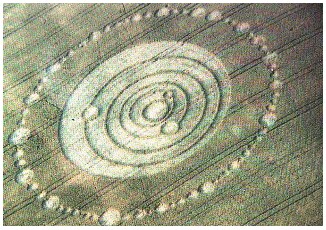 |
 |
| Longwood, UK 1995 |
Longwood, UK 1995- drawing |
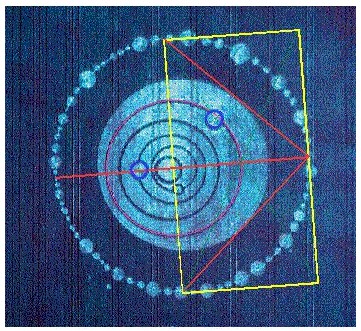
From Freddy Silva
Figure 2A. Crop Circle T367, The Solar System. Notice White Spots (grapeshot)
In The Upper Image. Mercury's Perihelion (77.2 degrees Heliocentric Longitude)
Is Nominally Placed; X For The 2007 Strike And Y For The 2033/2039/2101 Strike.
The Earth's Heliocentric/ Sun's Geocentric/ Moon's Geocentric Longitude Are
As Follows:
For: 2/25/2007: 156.7 degrees/336.7 degrees/084.0 degrees;
For: 09/01/2033: 339.6 degrees/161.3 degrees/244 degrees;
For: 03/15/2039: 175 degrees/355.5 degrees/241 degrees
Comet Event 1: 02/25/07, Other Comets At Heliocentric Longitudes: 2: 103.0
degrees; 3: 139 degrees; 4: 161.5 degrees; 5: 195.0 degrees
An alien warning is exactly what is depicted by T367. The planets are
disproportionately large but the orbits are to scale. The "small white spots"
(four objects, one broken in two - totaling five) called grapeshot are depictions
of meteors or comets. The "missing" Earth (its orbit is still depicted) signifies
its devastation by the anticipated strikes. The relative locations of the
planets and the precise location of their orbit's perihelia define the date
of this future event to within a few days. Dr. Robert H. Hadley, Prof. Hawkins
and this work have analyzed this crop circle in detail.13 Prof. Hawkins has
come up with three future dates represented by this alignment. See Table
1A. Hawkins measurements have been re- analyzed and only slightly different
results found.
TABLE 1A
Comet/Meteor Impact Dates Based On Crop Circle T367
| Event Date |
Mercury* |
Venus* |
Mars* |
Notes |
Previous T 367 Crop
Circle Analysis@ |
192 |
81 |
311 |
Not Attempted |
| 09/01/2033 |
192 |
80 |
316 |
08/28 - 09/01 |
| 03/15/2039 |
190 |
81 |
293 |
03/14 - 03/17 |
| 05/06/2101 |
192 |
84 |
309 |
Not Calculated |
This T 367 Crop
Circle Analysis# |
163.0+/-10 |
51.0+/-17 |
276 |
.0+/-12 |
| 02/25/2007# |
165.8 |
46.5 |
275.4 |
|
@Prof. Forbe's Analysis
#This Analysis (Vulcan's Location Pinpoints The Planets Heliocentric
Longitude)With Vulcan aligned Vulcan at 262.5 degrees.
*Heliocentric Longitude in Degrees
Dr. Hadley's analysis concludes that someone created this crop circle with
precise knowledge of our solar system and with a skill that permitted it
to be formed at an unusual hillside angle. Table 2A below compares the orbital
radii (in Astronomical Units = AU) and eccentrics of the image in T367 compared
to the actual values (n.c. = not calculated)
This crop circle has another unusual feature; an off-center cleared circle
containing the inner planets' orbits. Assuming this circle defines the centroid
of the Sun-Vulcan complex, then it is in the direction of Vulcan as of either
the date the T367 crop circle was formed or the date represented by the
configuration of the planets contained therein. As Vulcan is near aphelion,
both these values of its heliocentric longitude are nearly identical.
The analysis, presented in this work, first electronically manipulated the
crop circle image with word processing algorithms until the cleared circle
inside the asteroid belt was circular. See Figure 2A. The center of the circle
is defined by the cross hairs added to the T367 image. The miss-alignment
between the centroid and the Sun is presumed caused by the Sun-Vulcan center
of mass. It was found to be offset about 0.35 Earth Orbit radius from the
Sun. Vulcan's heliocentric longitude is 262.5 deg. on 02/25/2007. Heliocentric
longitudes of the planets were measured from this alignment and are different
from Hawkins analysis by about 30 deg. See X and Y on Figure 2A. Table 1A
lists the only solution found between 1998 and 2048 given the uncertainty
introduced from T367's planets diameter. The "grapeshot" heliocentric longitudes
are listed with Figure 2A.
T367 is interpreted as follows: The grapeshot represents the incoming comet
swarm originating from their resonant orbit position in Vulcan's orbit. The
configuration of the inner planets represents a date when we are (first?)
at risk of a comet or meteor impact (or near miss). The grapeshot indicates
how many comets threaten Earth. Will anybody listen? The appearance of the
comets will get our attention, but by then it would be too late to take effective
action.
TABLE 6A
Comet Swarm Strike Dates Vs. Event Timeline - Years Ago (YA)
YA/SWARM OBSERVED
EVENT
*5,000/A 4,998 Noah's flood
(Samaritan Pent.)
**10,000/B 10,550 Mini Ice Age Ends
**11,670/A# 11,560 Atlantis ends; high seas
" 11,564
Megafauna extinction
" 12,000
Allerod Warm Age Begins
13,330/B#
Cold/Warm transition in decades
15,000/A
Pruvial Lake Maximum
20,000/B
Coldest time in the Ice Age
25,000/A 25,000 Atlantis starts, low
seas
30,000/B
Neanderthals Disappear
35,000/A 34/35,000, Mu starts/Lunar cal.
40,000/B 40,000 Cold age starts
45,000/A 45,000 Warm age starts
50,000/B No Strike? Very Cold
55,000/A 57,824 Dawn Of Mankind
125,000/A
Last Interglacial Period
Freddy Silva states: Does this represent the sun and planets? The orbits
are exact circles with slighly different centers and diameters of 0.5, 0.7,
1.4, and 2.6. Mercury, Venus, Earth, Mars, and the Asteroids have actual
values of 0.4, 0.7, 1.5, and 2.8 --a pretty good fit. If so the nearest date
indicated is 11 July 1971. One of the next dates is 30 August 2033, years
away because we have to match the motion of three planets, Mercury, Venus,
and Mars. By computer graphic measurement the Asteroid circle and the edge-circle
beyond Mars give a diatonic ratio of 9/4, note D in the second octave. (See
CPRI Newsletter, Autumn/Winter 1995/1996, and 1996/1997).
In astronomy, angles are measured counterclockwise from the over-size Sun
at the center. The closest approach of Mercury to the Sun (perihelion) is
at 75 degrees, and the angles for Mercury, Venus, and Mars are 189 degrees,
76 degrees and 303 degrees. The Asteroid belt is symbolic and does not give
the position of any Asteroid in its orbit.
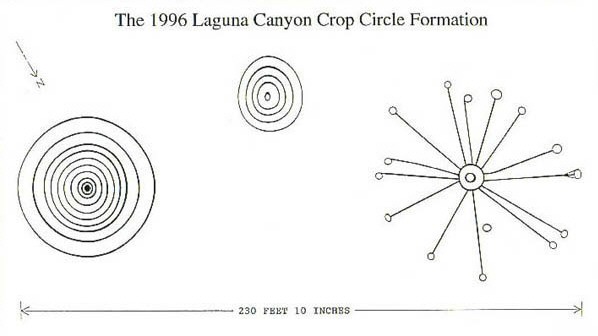
DRAWING FROM:
http://www.cropcircleanswers.com/laguna.htm
There are some interesting accounts of a Tongva hero by the name of
'Chingichnish',a spiritual leader said to have appeared hundreds of years
ago to teach people how to live in harmony with 'Nocuma' (the Great Spirit).
He said that Nocuma would give three warnings to people who failed to respect
the land, beyond that nature would take its course. This is the third crop
circle formation to appear in California and appeared at a site where there
has been considerable local protest against the toll road construction, making
a wide path through the last small piece of remaining wilderness of Laguna
Canyon. Another coincidence? We don't think so.
Its timing to the appearance in the mid March sky of the Comet Hyakutake
is interesting, which was most visible on the 25th of March from Southern
California.In 1995 in England we had crop circles in the form of our Solar
System, depicting the sun, planets, orbits and the Asteroid Belt. In 1994
we had the Shoemaker/LevyComet ('The String of Pearls') crashing into Jupiter
formations. It is interesting to see how past and present themes run together.
At Laguna Canyon, like in Hampshire 1995, we had many circles forming a ring
around a common center. We have a continuation of theme, Asteroids/Comet
, planets and orbits. Scientists warn usabout Asteroids colliding with Earth.
One of the 'Asteroid Belt' Crop formations of 1995 depicted the Earth missing
from its orbit. We showed a photograph of the Laguna Canyon formation to
a Chumash Elder who instantly recognized it from his own peoples rock art.
After looking at the spoked glyph he said, "Something within us is bringing
destruction from out there'' in space. Could this be the meaning behind theLaguna
Canyon formation? Could it be a warning, that we need to change, or change
will be brought to us?
The Laguna Canyon crop circle formation was the first genuine formation of
1996, to appear in the Northern Hemisphere, truly embodying the now familiar
characteristics of a genuine phenomena.
To conclude we would like to share some information concerning the possible
meaning behind this intriguing formation, that is very Native American looking
in its design.We have discovered that the indigenous people of the area,
the Gabrielino or Tongva,and their friendly northern neighbours the Chumash,
both have rock art (petroglyphs) and a sacred object known as a 'Sun Staff'
that are strikingly similar to the three glyphs. The sun staff is a steatite
stone surmounted on a stick often incised with rays or geometric designs
representing the declination of the sun, or the cardinal points of the Gabrielino
compass. Chumash shamans used these sun staffs in their all-important solstice
ceremony, were the shaman would tap the stone three times and then symbolically
pull the sun back in a northward direction, signifying the end of winterand
the beginning of the suns return. Suspecting the "spoked glyph" to represent
asun staff we measured the angles of the 14 spokes and discovered a spoke
aligned to each of the following: Winter Solstice Sunrise, Winter Solstice
Sunset, and Summer Solstice Sunrise.
A possible correlation of interest was the timing and design of the Laguna
Canyon pictogram to the appearance of Comet ‘Hyakutake’, in the
mid-March sky, a comet that was most visible from Southern California on
March 25th 1996. During the previous summer in Hampshire England, two crop
circle formations in particular seemed to depict our solar system,
with circles representing the sun, neighboring planets, their orbits, and
the ‘Asteroid Belt’. In 1994 the ‘Shoemaker-Levy 9’ Comet
crashed into Jupiter and was also depicted in a series of formations. It
was interesting to see how consecutive years formations and themes ran together.
At Laguna Canyon, like in England in 1995, many circles, in the form of rings
attached to spokes, formed a ‘ring’, not unlike a variation on
the theme of an asteroid belt, around a common center.
Since the impact of the Shoemaker/Levy 9 comet event 1994 a great many people
have become a lot more aware of the warnings of scientists and astronomers,
particularly through films and television documentaries, about the very real
danger posed by large Earth colliding asteroids and comets. In the crop fields
in England in 1995, one of the Hampshire ‘Asteroid Belt’ looking
crop circle formations even depicted the Earth ‘missing’ from its
orbit. Seeing a connection in the design of this formation, and an earlier
one that appeared near Alresford in Hampshire on June 18th 1995, to the Laguna
Canyon pictogram, we showed a photograph of the latter formation to a Chumash
Elder at a local native American gathering, to see if he could identify the
pictogram symbols. Not sharing what we had learned first he instantly confirmed
that he recognized the formation from his own peoples’ rock art. After
looking at the spoked glyph he pointed to the unattached circle between two
of the spokes and said “Something within us is bringing destruction
from out there” as he pointed up into space. Could this be one of the
meanings of the Laguna Canyon formation? Could it be a warning that we need
to change, or change will be brought to us?
| Tuesday, 24 February, 2004,
17:33 GMT
|
Earth almost put on impact alert
|
|
By Dr David Whitehouse
BBC News Online science editor
|
Astronomers have revealed how they came within minutes of alerting
the world to a potential asteroid strike last month.
Some scientists believed on 13 January that a 30m object, later
designated 2004 AS1, had a one-in-four chance of hitting the planet
within 36 hours.
It could have caused local devastation and the researchers
contemplated a call to President Bush before new data finally showed
there was no danger.
The procedures for raising the alarm in such circumstances are now
being revised.
At the time, the president's team would have been putting the final
touches to a speech he was due to make the following day at the
headquarters of Nasa, the US space agency.
In it he planned to reset the course of manned spaceflight, sending
it back to the Moon and on to Mars, but he could have had something very
different to say.
He could have begun by warning the world it was about to be hit by a
space rock.
Bush would not have known where it would impact - only somewhere in
the Northern Hemisphere. Experts would have been bouncing radar signals
off the huge rock as he spoke in order to get more information about its
trajectory.
At about 30m wide, the asteroid was cosmic small fry, not the type of
thing to wipe out the dinosaurs or threaten our species, but still big
enough to cause considerable damage after exploding in the atmosphere.
Potentially, the loss of life could have been much worse than 11
September.
In the end, Bush made no such announcement, but astronomers have
admitted they were on the verge of making the call.
Shall we call the President?
In a paper presented at this week's Planetary Protection conference
in California, veteran asteroid researcher Clark Chapman calls it a
"nine-hour crisis".
He explains how word reached the astronomical community of an
asteroid that had just been discovered by the twin optical telescopes of
the Linear automated sky survey in New Mexico.
The Minor Planet Center in Massachusetts - the clearing house for such
observations - posted details on the internet requesting attention from
astronomers, one of whom noticed something peculiar.
The object was expected to grow 40-times brighter in the next day - a
possible sign that it was getting closer, very rapidly.
But with data from just four observations available, the
uncertainties were large. There were many possible orbits the object
could be on, and the majority of them did not threaten the Earth.
What to do? Tell the world about the uncertain situation or wait for
more data?
For some astronomers, events reached a crescendo when Steven Chesley,
a researcher at Nasa's Jet Propulsion Laboratory, looked at the
available data and sent an e-mail saying the asteroid had a 25% chance
of striking the Earth's Northern Hemisphere in a few days.
It was then that astronomers Clark Chapman and David Morrison, chair
of the International Astronomical Union's Working Group on Near Earth
Objects, contemplated picking up the telephone to the White House.
'Jumped the gun'
But many astronomers did not agree that waking up President Bush
would have been wise.
"They completely misread the situation," said Benny Peiser
of Liverpool John Moores University in the UK. "There was plenty of
time to get other observers on the job."
Others also believe the call would have been premature.
"That would have jumped the gun before we knew much about the
object," said Brian Marsden, of the Minor Planet Center.
"I find it incredible that such action was contemplated on the
basis of just four observations. That is just not enough to yield a
sensible orbit.
"There was no need to panic as it was obvious that the situation
would have been resolved, one way or another, in another hour or
two," he told BBC News Online.
Fortunately for all concerned, shortly after the ominous Chesley
e-mail, an amateur astronomer managed to dodge the clouds and take a
picture of a blank patch of sky.
This was significant because if 2004 AS1 really was going to hit the
Earth, it would have been in the amateur's sights. The fact that it was
absent meant the rock would not strike us.
But Chapman says in his presentation that if it had been cloudy, and
no more observations could have been obtained at the time, he would have
raised the alarm.
Marsden disagrees. "If it had been cloudy and the call had been
made to the President it would have been disastrous."
Many astronomers recognise that they a false alarm could have brought
ridicule on their profession. They are calling for more planning and
less panic if it should happen for real next time.
And 2004 AS1? It turned out to be bigger than anyone had thought -
about 500m wide. It eventually passed the Earth at a distance of about
12 million km - 32 times the Earth-Moon distance, posing no danger to us
whatsoever.
|
LINEAR CENTER
|
Monday,
29 July, 2002, 11:51 GMT 12:51 UK
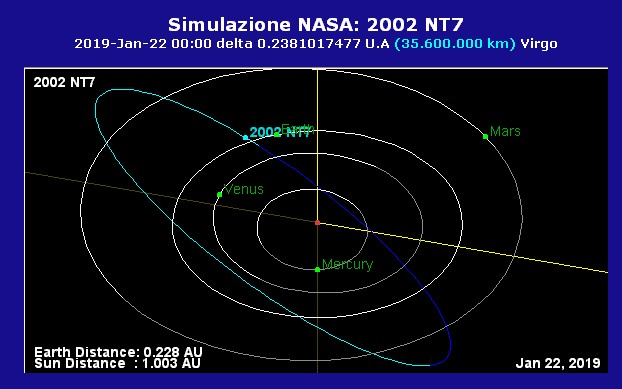
Asteroid to miss - this time around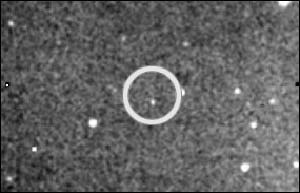
It has been called the most threatening
object in space
|
|
By Dr David Whitehouse
BBC News Online science editor |
|
Astronomers have ruled out an Earth impact from asteroid 2002
NT7 on 1 February 2019 - but they say, as yet, future
collisions have not been completely excluded.
2002 NT7, a two-kilometre-wide (1.4 miles) chunk of rock,
was discovered on 9 July. Initial estimates of its orbit
suggested there was a small chance of it colliding with our
planet in 17 years' time.
However, the latest observations accumulated over the last
few days have confirmed the asteroid will fly harmlessly by.
Dr Don Yeomans, of the US space agency's (Nasa) Jet
Propulsion Laboratory, said: "We can now rule out any
impact possibilities for 1 February 2019."
Uncharted space
But further work needs to be done to confirm that 2002 NT7
is not a threat further into the future.
Dr Yeomans added: "While we cannot completely rule out
an impact possibility for 1 February 2060, it seems very
likely that this possibility will soon be ruled out as
well."
Analysts expect that it will be several more weeks before
new observations allow a much better picture to emerge about
2002 NT7's future movements.
This is because no past observations - that could be used
to pinpoint its trajectory - have been found in astronomical
archives. This is because the asteroid's unusual orbit takes
it into regions of space that are seldom surveyed.
But astronomers say that their concern about 2002 NT7 has
not evaporated completely.
Media debate
According to Dr Benny Peiser, of Liverpool John Moores
University, UK, we should not be celebrating too quickly.
"It would be prudent to caution interested observers
that further observations in the near future could result in
new impact dates," he told BBC News Online.
"There is even a very small possibility that the next
set of observations may lead to new impact dates and a
prolonged period of fluctuating impact probabilities, before
the object will eventually be dropped," he said.
The intense worldwide interest in 2002 NT7 has prompted a
debate in the astronomical community.
Following the object's discovery, and the realisation that
it could strike the Earth in 2019, astronomers decided to make
no announcement whilst they monitored the situation.
Some astronomers have been unhappy with what they see as
alarmist reporting in the media, and they say that the policy
on public disclosure of such information should be reviewed.
Asteroid
ahoy: flight of the Falcon
Peter
Bond in London
Nov. 16, 2005. — Planetary scientists around the world are
watching enthralled as a dramatic saga unfolds in the depths
of space. More than 180 million miles from Earth, a small,
relatively inexpensive Japanese spacecraft named Hayabusa, or
Falcon, is attempting to make history by capturing samples of
a tiny asteroid.
In a $170m mission, Hayabusa is designed to become the first
craft to touch down on an asteroid, seize some fragments and
bring them back to Earth. However, such milestones are rarely
achieved without a few nerve-racking moments.
On 4 November, an unexpected “anomalous signal” brought
the dress rehearsal to a sudden halt. A second dry-run on
Saturday was rated a success — although a small lander,
Minerva, failed to reach its target, raising questions about
whether the Falcon has bitten off more than it can chew. So
what is Hayabusa doing up there? Samples of cosmic material
are not too hard to find.
Since time immemorial, people have been picking up meteorites
that have fallen from the sky. Most are unremarkable chunks of
stone or metal, although some of the rarer examples contain
organic compounds, water and tiny diamonds. In recent years, a
few dozen specimens that originated on the Moon and Mars have
also been recognised.
Unfortunately, although the ages and compositions of these
meteorites can be measured, there is no way to determine their
precise source regions on the Moon and Mars. They all seem to
be leftovers, billions of years old, from the formation of the
planets. Most of them are thought to be fragments of larger,
rocky bodies — asteroids — that have been chipped away
during innumerable collisions. But there is no solid proof
that this is the case.
The importance of the Hayabusa mission lies in its potential
to examine a particular asteroid from close range and then
bring back pieces for analysis in terrestrial laboratories.
Hayabusa is expected to stay at the asteroid until early
December, when its ion engine will fire once more to send the
spacecraft on a leisurely homeward journey.
— The Independent
Japanese space probe nears landing attempt on asteroid
Japan landing on an asteroid and bring pieces of it back to earth.
The Yomiuri ShimbunShigeo Nagashima, Steven Spielberg and thousands of others
are set to have their names left on an asteroid this weekend
as a Japanese space probe nears its landing attempt2
Hayabusa, a space probe launched by the Japan Aerospace
Exploration Agency, was to attempt to land on the asteroid
Itokawa sometime between late Saturday and early Sunday. The
probe is to collect rock samples from the asteroid.
Live pictures of JAXA's operations center in Sagamihara,
Kanagawa Prefecture, will be broadcast via the agency's Web
site (http://jaxa.tv) during the expected time of the landing.
To mark the landing, Hayabusa will drop a 10-centimeter
metal ball that contains the names of 880,000 people from 149
countries. The names, which are written in the people's native
languages, are of respondents to a worldwide offer made by the
agency three years ago.
Along with the names of the lifetime honorary manager of
the Yomiuri Giants and the U.S. film director, comic artist
Reiji Matsumoto and actor Paul Newman also are listed. A
special technique used in semiconductor manufacturing was used
to engrave the names on aluminum foil in the metal ball.
It is the second attempt to bring rocks back from any
celestial body other than Earth, following the moon rock
brought back under the U.S. National Aeronautics and Space
Administration's Apollo program. This time, the samples will
be taken from an asteroid located much further away than the
moon.
Nagashima said he was excited to witness the climax of the
spacecraft's magnificent journey.
"It [Hayabusa's mission] is a great undertaking in the
history of space research and development, and it could become
equally important as the Apollo program," he said.
(
Nov. 20, 2005
)
| Japan asteroid probe makes history
Nov. 27, 2005
TOKYO: A
Japanese space probe made history on Saturday when it landed on
an asteroid nearly 300 million km from Earth and collected rock
samples that could give clues to the origin of the solar system.
The probe, called Hayabusa—Japanese for
“falcon”—succeeded in its second attempt in a task which
scientists have likened to landing a jumbo jet in a moving Grand
Canyon.
“I am delighted to hear that it has collected the samples.
It is the world’s first such feat,” Science and Technology
Minister Iwao Matsuda said. —Reuters
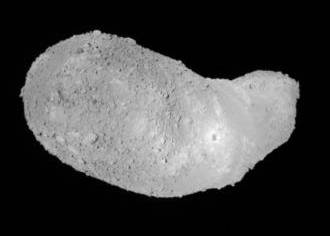
This view of the asteroid Itokawa was captured by
Japan's Hayabusa spacecraft on Saturday from a
distance of about 1,640 feet (500 meters). The
probe's shadow can be seen as a dark mark on the
asteroid's surface.
TOKYO - A Japanese spacecraft
showed signs of trouble Saturday after apparently
landing on an asteroid and collecting surface samples
in an unprecedented mission to bring the
extraterrestrial material back to Earth, officials
said.
The Hayabusa probe, hovering
about 3 miles (5 kilometers) from the asteroid,
appeared to be shaking due to a possible gas leak from
a thruster, said Atsushi Akoh, a spokesman for the
Japan Aerospace Exploration Agency, or JAXA.
JAXA will put Hayabusa into
"safety mode" — which stabilizes the probe
by turning its solar panels toward the sun — for two
to three days to investigate, Akoh said.
Probe lands on asteroid and collects samples
Hayabusa spacecraft gets ready for return to Earth
after two touchdowns
Updated: 12:46 p.m. ET Nov. 26, 2005
TOKYO - A Japanese space
probe made history on Saturday when it landed on
the surface of an asteroid and then collected rock
samples that could give clues to the origin of the
solar system.
The probe, called
Hayabusa — Japanese for "falcon" —
succeeded in the delicate task, which scientists
likened to landing a jumbo jet in a moving Grand
Canyon. It was its second and final attempt.
After analyzing data
transmitted from the unmanned probe, the Japan
Aerospace Exploration Agency, or JAXA, said
Hayabusa had touched down on the asteroid, nearly
190 million miles (300 million kilometers) from
Earth.
The probe then shot a
0.18-ounce (5-gram) metal ball towards the surface
at a speed of 670 mph (1,080 kilometers per hour),
collecting into a capsule the debris unleashed as
a result of the impact, JAXA officials said.
"I am delighted to
hear that it has collected the samples. It is the
world's first such feat and it will contribute
greatly to mankind's exploration of space,"
Science and Technology Minister Iwao Matsuda said
in a statement.
The United States and the
former Soviet Union have brought back samples from
the moon in the past, but this is the first time
that surface material from an asteroid has been
collected.
JAXA scientists at the
main space control center in western Tokyo smiled
and let out cheers after confirming the successful
landing.
Japan's space program has
had a shaky record and has recently been
overshadowed by China's success in carrying out
manned spaceflights — something Japan has never
attempted.
Last Sunday, after a
voyage of two and a half years, Hayabusa made its
first touchdown on the surface of the
1,798-foot-long (548-meter-long) potato-shaped
asteroid, named Itokawa.
It remained there for 30
minutes, but had failed to drop the equipment for
collecting surface material.
JAXA officials had said
Saturday's attempt would be the final one, as
Hayabusa did not have enough fuel for another
attempt and would have to head back to Earth.
The probe's capsule
containing the samples is due to land in the
Australian outback in June 2007.
Asteroids are believed to
contain rocks that have remained largely unchanged
since the early days of the solar system and could
thus offer valuable information about its origins.
Information about their structure could also be
vital if an asteroid were found to be on a
collision course with the earth.
The asteroid is named
after pioneering Japanese rocket scientist Hideo
Itokawa.
© 2005 The Associated Press. All rights
reserved.
Japanese space probe may have failed to
gather asteroid dust
Last Updated Wed, 07 Dec
2005 18:29:51 EST
A Japanese probe was likely unable to
collect the first dust samples from an
asteroid, the country's space agency said
Wednesday.
The Japan Aerospace Exploration Agency
said the Hayabusa probe landed Tuesday on
the potato-shaped asteroid called Itokawa.
However, it may have failed to shoot a small
metal ball into the surface to loosen the
dust samples.
"We have not been able to confirm
data that shows a projectile was normally
discharged," the agency said in a
statement on the Nov. 26 landing. "We
have found out that there is a high
possibility that the projectile was not
discharged."
 |
|
Artist's
rendition of Hayabusa probe. (AP
file photo/Japan Aerospace
Exploration Agency, HO)
|
There is still a "slight
possibility" the landing kicked up
enough dust to collect material, the agency
added.
Scientists hoped the material would yield
clues to the makeup of asteroids,
information that could help if one is headed
on a collision course with Earth.
Asteroids, unlike larger space bodies
such as the moon, are believed to contain
rocks that have remained largely unchanged
since the early days of the solar system.
Studying them would offer clues to the
origins of the solar system.
Hayabusa is scheduled to return to Earth
in mid-December, although it has a problem
with one of its thrusters.
It's
called Apophis. It's 390m wide. And it could hit
Earth in 31 years time
Scientists
call for plans to change asteroid's path
Developing technology could take decades
Alok
Jha
Wednesday December 7, 2005
The Guardian
 |

Artist's
impression of an asteroid heading for
Earth. Photograph: Frank Whitney/Getty
Images
|
In
Egyptian myth, Apophis was the ancient spirit
of evil and destruction, a demon that was
determined to plunge the world into eternal
darkness.
A fitting name, astronomers reasoned, for a
menace now hurtling towards Earth from
outerspace. Scientists are monitoring the
progress of a 390-metre wide asteroid
discovered last year that is potentially on a
collision course with the planet, and are
imploring governments to decide on a strategy
for dealing with it.
Nasa has estimated that an impact from
Apophis, which has an outside chance of
hitting the Earth in 2036, would release
more than 100,000 times the energy
released in the nuclear blast over
Hiroshima. Thousands of square kilometres
would be directly affected by the blast
but the whole of the Earth would see the
effects of the dust released into the
atmosphere.
And, scientists insist, there is
actually very little time left to decide.
At a recent meeting of experts in
near-Earth objects (NEOs) in London,
scientists said it could take decades to
design, test and build the required
technology to deflect the asteroid. Monica
Grady, an expert in meteorites at the Open
University, said: "It's a question of
when, not if, a near Earth object collides
with Earth. Many of the smaller objects
break up when they reach the Earth's
atmosphere and have no impact. However, a
NEO larger than 1km [wide] will collide
with Earth every few hundred thousand
years and a NEO larger than 6km, which
could cause mass extinction, will collide
with Earth every hundred million years. We
are overdue for a big one."
Apophis had been intermittently tracked
since its discovery in June last year but,
in December, it started causing serious
concern. Projecting the orbit of the
asteroid into the future, astronomers had
calculated that the odds of it hitting the
Earth in 2029 were alarming. As more
observations came in, the odds got higher.
Having more than 20 years warning of
potential impact might seem plenty of
time. But, at last week's meeting, Andrea
Carusi, president of the Spaceguard
Foundation, said that the time for
governments to make decisions on what to
do was now, to give scientists time to
prepare mitigation missions. At the peak
of concern, Apophis asteroid was placed at
four out of 10 on the Torino scale - a
measure of the threat posed by an NEO
where 10 is a certain collision which
could cause a global catastrophe. This was
the highest of any asteroid in recorded
history and it had a 1 in 37 chance of
hitting the Earth. The threat of a
collision in 2029 was eventually ruled out
at the end of last year.
Alan Fitzsimmons, an astronomer from
Queen's University Belfast, said:
"When it does pass close to us on
April 13 2029, the Earth will deflect it
and change its orbit. There's a small
possibility that if it passes through a
particular point in space, the so-called
keyhole, ... the Earth's gravity will
change things so that when it comes back
around again in 2036, it will collide with
us." The chance of Apophis passing
through the keyhole, a 600-metre patch of
space, is 1 in 5,500 based on current
information.
There are no shortage of ideas on how
to deflect asteroids. The Advanced
Concepts Team at the European Space Agency
have led the effort in designing a range
of satellites and rockets to nudge
asteroids on a collision course for Earth
into a different orbit.
No technology has been left
unconsidered, even potentially dangerous
ideas such as nuclear powered spacecraft.
"The advantage of nuclear propulsion
is a lot of power," said Prof
Fitzsimmons. "The negative thing is
that ... we haven't done it yet. Whereas
with solar electric propulsion, there are
several spacecraft now that do use this
technology so we're fairly confident it
would work."
The favoured method is also potentially
the easiest - throwing a spacecraft at an
asteroid to change its direction. Esa
plans to test this idea with its Don
Quixote mission, where two satellites will
be sent to an asteroid. One of them,
Hidalgo, will collide with the asteroid at
high speed while the other, Sancho, will
measure the change in the object's orbit.
Decisions on the actual design of these
probes will be made in the coming months,
with launch expected some time in the next
decade. One idea that seems to have no
support from astronomers is the use of
explosives.
Prof Fitzsimmons. "If you explode
too close to impact, perhaps you'll get
hit by several fragments rather than one,
so you spread out the area of
damage."
In September, scientists at Strathclyde
and Glasgow universities began computer
simulations to work out the feasibility of
changing the directions of asteroids on a
collision course for Earth. In spring next
year, there will be another opportunity
for radar observations of Apophis that
will help astronomers work out possible
future orbits of the asteroid more
accurately.
If, at that stage, they cannot rule out
an impact with Earth in 2036, the next
chance to make better observations will
not be until 2013. Nasa has argued that a
final decision on what to do about Apophis
will have to be made at that stage.
"It may be a decision in 2013
whether or not to go ahead with a
full-blown mitigation mission, but we need
to start planning it before 2013,"
said Prof Fitzsimmons. In 2029,
astronomers will know for sure if Apophis
will pose a threat in 2036. If the
worst-case scenarios turn out to be true
and the Earth is not prepared, it will be
too late. "If we wait until 2029, it
would seem unlikely that you'd be able to
do anything about 2036," said Mr
Yates.
Special report
Space
exploration
Interactive guides
Space
exploration: interactive guides
Future of Hayabusa Asteroid Probe
Looks Bleak
Posted by Hemos
on Monday December 12, @10:11AM
from the here's-to-hoping
dept.
mj_1903
writes "After landing, then not
landing, then potentially landing on an
asteroid it appears as though the Japanese
spacecraft may have collected specimens of
the asteroid. Unfortunately a
host of problems is continuing to
plague it including a lack of fuel, a
shutdown of part of the chemical
orientation system, a complete failure of
the flywheels and communication issues.
The Japanese team are however not giving
up on it and are still hopeful that they
can return it to the earth in June of
2007."
Japanese
asteroid probe apparently broken
posted
10:34am EST Thu Dec 08 2005 -
submitted by Joshua
NEWS
The Japanese Aerospace Exploration Agency (JAXA)
stated on Wednesday that the Hayabusa probe
(see our
previous coverage), which was sent to
investigate the Itokawa asteroid in May
2003, appears to have run into a snag in its
mission. The craft was designed to shoot a 5
gram metal ball into the surface of the
asteroid to collect some particles for later
delivery to Earth. JAXA reports that,
despite earlier reports that the ball had
been shot and samples collected, the latest data
appears to show that that has not happened.
Currently there is a "high
possibility" that the sample collection
has not been completed, but JAXA's
scientists are working hard to remedy the
situation.
The mission is not a complete waste even if
the samples are not sent back to Earth for
study, however, as Hayabusa successfully
landed on a Itokawa and has sent back images
and other useful data.
Find out more at Reuters
and on the Hayabusa
project page.
JOSHUA'S
OPINION
Japan has been battling for a higher spot in
the space race for many years, and Hayabusa
was said to be the up-and-coming star of the
show. If the probe actually does succeed in
collecting some asteroid dust and sending it
back to Earth, Japan will become the only
other space agency besides the U.S. and
Russia to bring back pieces of another body
in the solar system,
and the first to bring back asteroid pieces.
It has to be extremely frustrating to be
sitting there in a room looking at readouts
from the probe and not knowing what is going
on. There is no graphical interface
for talking with the asteroid probe on this
mission, and I suspect that the engineers
are getting antsy about the lack of proper
confirmation signals without a concrete idea
of what has happened to the probe.
USER COMMEN TS
space
race (10:37am EST Thu Dec 08 2005)
Why don't the japanese just stick to releasing PS3 and
revolution Earlier... - by ~ultima~ |
Use the
Toyota option (10:56am EST Thu Dec 08
2005)
They should have launched a toyota. It is much more
reliable. - by RCAman |
Send a
human! (11:10am EST Thu Dec 08 2005)
This is the argument for space exploration by humans. If
a person were on the asteroid, we'd know if the sample
was taken. And the best samples would have been taken.
Perhaps from various places, after having identified the
different kinds of rocks. Humans are much better than
robots at exploring.
- by SpaceMan |
itd' be
nice (11:12am EST Thu Dec 08 2005)
if nasa and jaxa and russia and europe think about
making some kind of base near the moon - by x-plattform |
Re:
Send a human (12:02pm EST Thu Dec 08
2005)
I agree. Problems like this never happen with people on
board. And we've got more people than robots so it's
much faster and cheaper to just send a person instead.
- by JQP |
very
difficult problem (12:05pm EST Thu
Dec 08 2005)
What they are trying to do is extremely difficult.
Some people will see this as a failure. But think about
it. NASA was proud to just collide with an asteroid. The
Japanese have actually landed a satellite on an
asteroid. That is nothing short of amazing. - by
space junkie |
All
space angency (12:27pm EST Thu Dec 08
2005)
are not planning to build large full scale space
station. They thought about building space station on
the moon.
If that happens, space truckers will be makin alot of
money delivering supplies to the moon from earth. - by
Stranger |
Asteroids
(12:37pm EST Thu Dec 08 2005)
Asteroids and there microgravity are not conducive to a
good work environment for humans.
We rely upon the effects of gravity to work.... go ahead
and pick up that rock on the asteroid. If you’re lucky
you may float back to the surface in about a week. For
every action there is an equal and opposite reaction. In
an asteroids microgravity that could be very slow or
absolutely catastrophic..
this aint Hollywood - by space spore |
Re JQP
(2:53pm EST Thu Dec 08 2005)
I agree its one of my pet peeves the dumbing down of
America or Canada or where ever.
I would guess the twits that write the scripts in
Hollywood would require far more intelligence and deep
thought than is currently required.
Its also the medias i.e. news services and the selective
news coupled with writing the news for a grade 8
audience...
if we don’t start using our brains they will atrophy
and evolution will make us stupid in a few
generations...it might happen.....
As for NASA they are fueled by buricratic stupidity and
the political adgenda of the day ..at the highest levels
this cancer exist.
fire the dweebs and let anyone applying for a top
possition at NASA requier an IQ greater than there shoe
size.
- by space spore |
Re:
space spore (3:48pm EST Thu Dec 08
2005)
I was skiing in Canada back in '86 when the Challenger
blew up. The local coverage was a real eye opener for
me. Not disrespectful in any way, actually quite
sympathetic. But at the same time, a more realistic and
honest assessment of the overall shuttle program than
what I was used to from the US media. - by JQP |
bureaucratic
(6:48pm EST Thu Dec 08 2005)
All older large organizations are bureaucratic including
companies. This happens because it is often useful to
set up processes and rules to get things done, but it is
more difficult, years later, to tear these processes
down. Also an infrastructure is built up to support the
organizations main goals, but these infrastructures take
on a life of their own and are difficult to shrink down.
See 'The Peter Principle'.
The way non-monopolistic companies get out of this rut
is competition. Young newer companies without the
bureaucracies and out-of-date processes can easily
out-design and underprice these companies, so the older
companies adjust or die. IBM is a good example of a
company that has adapted well.
Here is a case where we have global competition. When
someone like China lands someone on the moon, maybe this
country will wake up.
What helps large companies get out of this rut - by
manager |
Ignorance
(6:59pm EST Thu Dec 08 2005)
Anyone else reading this absolute crap from the geek
public?
1st of all, guy who mentioned gravity is partially
right, asteroids travel linearly as opposed to comets
that orbit. Linear acceleration has no gravitational
pull "downwards" towards the
"ground". You'll just fly off... HOWEVER,
asteroids are alot BIGGER than comets, the mass-mass
effect may be big enough to have a gravitational pull, i
wouldn't know, not about to run the numbers.
That's the first point, secondly, and more importantly,
it's alot cheaper and safer to send robots. It's cheaper
because the weight/fuel cost ratio, cost of
feeding/training a man ontop of the inherent flaw of man
that we're not perfect, not to also mention the fact
that robots have obviously more capabilities than
humans. When's the last time you shot a 5gm metal ball
into the Earth and then collected the particles?
Robots are more precise, more accurate, more capabale in
this instance.
- by Treatment X |
Hmm
(7:58pm EST Thu Dec 08 2005)
Success or failure??? I am leaning towards failure...
JAXA has had numerous embarassing failures in the past 5
years and this is just another one to go on that list...
Some mentioned how amazing it was that they *almost*
pulled of this mission... Well, what about NASA having
two robots fully operational on MARS for over a year??
THATS amazing, and THATS something that everyone is
taking for granted...
Also, please note that NASA and RUSSIA pioneered every
aspect of space flight and space technology. Any other
country should be able to copy us with reasonable
success. But it hasn't happened that way. For me, the
real amazing thing is that even after watching
NASA/RUSSIA and now the ESA make all the strides in
space exploration for the past half century, no one else
seems to be able to build on that success. That speaks
to how DIFFICULT it is to do this even when following in
someone elses footsteps...
Eventually I am sure the Japanese will figure things out
in space and start making real strides instead of
bumping into asteroids, but in the mean time, keep your
eyes on NASA, despite their shuttle woes theyre still
the only show worth watching outside of earth. - by
hodar-twin |
RE
Treatment X (8:18am EST Fri Dec 09
2005)
As far as i know Asteroids are made of rock dust and
very little ice, while comets are dirty snow balls. The
size and mass is relivent to the amount of gravity any
body in space has. There are small asteroids and large
asteroids as well as large comets and small comets.
As to the orbitital paths, some do follow normal orbits
haowever some do not. its the asteroids that do not
follow the orbital path of the other bodies in our solar
system that we need to worry about.
Between humans and robots there are reasons to send
humans one reason would be the speed of light..if your
signal takes several minutes to reach the robot you cant
realy oprerate it in real time.
RE JQP
I think the BBC has the best and less dumbed down news
of all. Canadian News can be pretty dry and they seem to
be dumbing it down lately.
can you - by space spore |
human
on asteroid (8:57am EST Mon Dec 12
2005)
have any of you thought to consider that not only is the
training of an astronaut more exspensive and time
consuming, but the fact that we would have to design,
build, and test a new spacecraft that could hold X
amount of astronauts PLUS the amount of food to get
there and back PLUS the amount of fuel to travel there
and back. also, I think that many of you have failed to
realize that the trip there and back would take over 6
years. the space craft would be bigger than the
asteroid!
GO ROBOTS! - by MR. Logical |
FROM:
http://www.geek.com/news/geeknews/2005Dec/gee20051208033679.htm
Hopes fade for troubled
Japanese asteroid probe
- 18:23 12 December 2005
- NewScientist.com news service
- Maggie McKee
Mission controllers have little hope the
spacecraft will make it home because of
continuing problems with its thrusters
(Image: artist's impression/JAXA)
Hope that Japan's Hayabusa spacecraft will
return to Earth is fading as mission controllers
remain unable to regain complete control of its
orientation.
The spacecraft was designed to bring the
first-ever asteroid samples back to Earth for
analysis. But recent data suggest that, during a
landing attempt on 26 November, it did not fire
metal pellets into the 600-metre-long asteroid
Itokawa to draw up material for collection.
Now mission controllers have little hope the
spacecraft will be able to get back to Earth -
even without its quarry - because of continuing
problems with its fuel thrusters.
"The situation is not optimistic,"
Hayabusa's project manager Jun'ichiro Kawaguchi
told New Scientist. The spacecraft was
supposed to begin its return journey by
mid-December to take advantage of an ideal
alignment between the Earth and the asteroid.
The next such alignment will not occur for
another three years.
Fuel thrusters
The fuel thrusters have been used to point
the spacecraft because two of its three
stabilising reaction wheels failed in July and
October 2005. But after the landing attempt on
26 November, one thruster on the spacecraft's
upper panel sprang a leak, forcing the craft
into an emergency shutdown of all its
non-essential systems.
As mission controllers worked to return the
craft to normal operations, other thrusters
failed - possibly because their valves got
locked shut or because their hydrazine fuel
froze.
As a result, ground controllers were not able
to accurately orient the spacecraft to ensure
its solar panels faced the Sun. Around 1
December, the resulting loss of battery power
forced most of the onboard instruments to shut
down or restart incompletely.
As an emergency measure to restore power,
ground controllers programmed the craft to vent
the xenon gas from its ion engines. These
engines - which use electric fields to
accelerate a beam of ions - were designed to
propel the craft on its 2 billion-kilometre
round trip to Itokawa.
Tricky feat
Firing the xenon thrusters successfully
pointed the craft's solar panels towards the Sun
on 5 December - when the least manoeuvring was
needed. But it was not an easy feat. Kawaguchi
says: "It is not a strong thruster and is
very easily subject to disturbance."
According to a recent mission status report,
there is enough xenon fuel both to point the
spacecraft and return it to Earth. But the ion
engines are currently off and it is not clear
how healthy the engines are. A plan to reignite
them on 14 December will likely be postponed,
says Kawaguchi.
"We are in a very tough spot," he
told New Scientist. "We are waiting
for what we can do next."
The mission has been plagued by problems,
including the loss of a robot that was due to
hop around and explore the asteroid. Mission
members say using commands from both human
ground controllers and the spacecraft's
autonomous landing protocols sent the robot into
space when it was too far away from the
asteroid.
Poor planning
Poor planning of spacecraft commands also
appears to have been responsible for the failure
to collect samples during the spacecraft's two
landings on 20 and 26 November.
During the first landing, Hayabusa bounced
twice on the asteroid then sat on its surface
for 30 minutes. But it did not fire a pellet -
apparently because two of its autonomous landing
systems sent it conflicting commands. One
detected a potentially damaging boulder on the
asteroid's surface and commanded the spacecraft
to rise away from the asteroid, while another
found that the spacecraft was not in the correct
orientation for an emergency ascent.
A similar problem may have occurred on 26
November, when the spacecraft touched the
asteroid for just one second. Telemetry sent
back just after the landing showed a command to
fire the pellets had been made. But other data
sent back on 6 December suggest the pellets'
control mechanism had been accidentally
"disarmed", preventing the pellets
from firing.
Monday,
December 12, 2005
Asteroid probe likely a
failure
A Japanese
spacecraft is likely to have failed in its
landmark mission to collect the first-ever
samples from an asteroid and faces trouble
returning to Earth. The Japan Aerospace
Exploration Agency had earlier said the
Hayabusa probe “most probably”
succeeded gathering dust from Itokawa
asteroid 290 million kilometers (180
million miles) from Earth in late
November. “But now we found that the
possibility is very high that a metal
bullet to collect samples was actually not
fired,” said an official of the agency,
which operates the probe. “And therefore
possibilities are also very high that
Hayabusa has failed to collect samples,”
the official said Wednesday.
The unmanned six-meter (20-foot) craft was
supposed to begin returning to Earth in
mid-December with samples, but has a
problem with one of its thrusters. The
space agency has to wait for another three
years if the probe misses a planned
departure time in mid-December, when a
distance between Earth and the asteroid is
ideal.
Even if the return trip can be attempted
again in three years, it is not certain if
the battery of Hayabusa can be still used,
officials said. Hayabusa was launched in
May 2003 with a budget of 12.7 billion yen
(just over $100m) and is scheduled to
return to Earth in June 2007. The mission
is aimed at helping scientists learn more
about how the solar system was created. It
could also provide information about
asteroids in case of the need to deflect a
celestial object on a collision course
with Earth. reuters
Taking out a killer
asteroid – with a tame one
- 17:38 26 April 2006
- NewScientist.com news service
- Maggie McKee
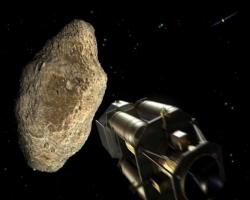
A spacecraft fired into a dangerous asteroid
could change the rock's orbit just enough to
prevent an impact with Earth (Image: ESA)
Related Articles
It sounds like a Hollywood blockbuster. A
potentially deadly asteroid is heading for
Earth, and scientists mount a mission to
intercept it – using another asteroid. But
that is exactly what two French researchers
propose in a plan to capture and
"park" a small asteroid near the Earth
for just such emergencies.
But a second group of researchers says
shooting a spacecraft into the asteroid would be
simpler and more effective. Other experts warn
that both plans risk having fragments of the
initial asteroid strike the planet, but say they
highlight the need for governments to devise
strategies to ward off such impacts.
Relatively small asteroids, about 100 metres
wide, are thought to hit the Earth every few
hundred years. But their effects could be
deadly. One such impact unleashed the force of
1000 atomic bombs when it struck an unpopulated
area of Siberia in 1908.
"Asteroid impacts are very rare but they
can potentially kill many, many people,"
says Dan Durda, a planetary scientist at the
Southwest Research Institute in Boulder,
Colorado, US. "And they are 100%
preventable."
Various plans have been put forward to
deflect incoming asteroids. For example, lasers
or giant space mirrors could evaporate ices on
their surfaces, creating jets that propel them
away from Earth. And half-painting an asteroid
could make it radiate heat differently on each
side, slowly nudging the object off course.
But many of these plans require several years
of advance warning in order to push the
asteroids into safe orbits. If an asteroid or
comet is found barrelling towards the planet
with a year or less to impact, "that's a
case where perhaps our only option is to attempt
a big kinetic kill", says Durda.
Parked space rock
Now, Didier Massonnet and Benoît Meyssignac
of France's National Centre for Space Studies
have come up with a new projectile to fire at
the asteroid in such a "kill". They
advocate capturing a small, 40 meter asteroid
and "parking" it a stable Lagrange
point 1.5 million kilometres from Earth, where
the gravity of the Earth and the Sun balance.
If a larger asteroid were then found to be on
a collision course with Earth, the small rock
could be moved into its path within eight
months, says the team. This "David's
stone" would be too puny to cause any
damage to Earth if things went awry, says the
team. "Such an asteroid capture would be
one of the most remarkable achievements of
mankind," they write in Acta
Astronautica.
But other experts say the plan is not
realistic. It relies on using a small hopping
robot to excavate tens of metres of rock per
second from the little asteroid in order to
provide the force to capture it and send it
towards the larger rock. The capture would take
a year of digging and would require the robot to
remove 66% of the small rock's mass.
"To have a mechanical device work all on
its own - without a person to kick it - in an
essentially unknown surface environment full of
dust and debris, is a very difficult thing to do
technically," Durda told New Scientist.
Gerhard Hahn and Ekkehard Kührt of the
German Aerospace Centre in Berlin agree.
"It sounds rather like
science-fiction," they told New
Scientist in an email.
Hit and run
But Dario Izzo, an aerospace engineer at the
European Space Agency's Advanced Concepts Team
in The Netherlands, says the capture is
technically feasible. "We can do it, but it
would be really expensive," he told New
Scientist.
Izzo worked with Massonnet and Meyssignac on
earlier plans to capture an asteroid into Earth
orbit. He is now working on a strategy based on
ESA's plans for its Don Quijote mission. That
mission is designed to put one spacecraft in
orbit around an asteroid to watch as another is
sent crashing into it. Don Quijote will be a
technology demonstration mission, but Izzo's
team has been working on ways to use just an
impactor spacecraft to deflect a dangerous
asteroid.
As a test case, the team used the orbital
parameters of Apophis, a 400-metre-wide asteroid
that will pass by Earth in 2029. During that
pass, it may change course enough to hit Earth
when it returns again in 2036 - a possibility
that now has a one in 5000 chance of happening.
The team developed formulae to find out how
much Apophis could be deflected by a 700
kilogram (1540 pound) spacecraft. "We found
there are loads of trajectories, of launch
windows, that would allow us to obtain a
deflection," Izzo says. If a spacecraft
were to launch by 2026, it could hit Apophis and
change its speed by 0.01 millimetres per second
– a tiny change, but enough to prevent it from
colliding with Earth a decade later, he says.
Gravity tractor
But NASA astronaut and physicist Ed Lu says
any plan that involves striking an asteroid
risks breaking it into fragments. Some fragments
would have their orbital periods unchanged, and
"any such debris will strike the
Earth," he told New Scientist.
"For any realistic scenario where the
Earth is threatened by an asteroid, would we
really choose a method that cannot guarantee
that it will not make the problem worse?"
he says. Lu has previously proposed a "gravity
tractor" plan to fly a spacecraft near
an asteroid and use its own gravity to pull it
off course.
But Durda, who is also president of the B612
Foundation, which aims to build a spacecraft to
test the gravity tractor idea, says it is
important to consider many different plans for
protecting the Earth from impacts. "We want
to have a lot of options at our beck and
call," he says. "Depending on the lead
time and properties of an asteroid, a technique
that might work very well in one circumstance
might not work at all in another."
Currently, the US government has not assigned
any agency responsibility for dealing with any
impact threat that may be identified. But NASA
is trying to identify what those threats are.
It is expected to finish a survey of
potentially dangerous asteroids larger than 1 km
across by 2008. But Durda says it has not yet
been funded to begin a congressionally mandated
programme to find all such space rocks larger
than 140 m across.
Journal reference: Acta Astronautica (DOI:
10.1016/j.actaastro.2006.02.030, DOI:
10.1016/j.actaastro.2006.02.002)
FROM: http://www.newscientistspace.com/article/dn9063-taking-out-a-killer-asteroid--with-a-tame-one.html
Asteroid Itokawa just a big lump of rubble
Not solid, as
previously thought
Published Friday 2nd June 2006 14:10 GMT
Security
White Papers - Download them free from Reg
Research
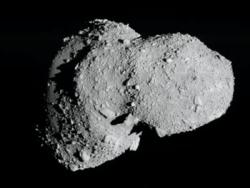
Asteroid Itokawa - subject of a 2005
visit by Japan's Hayabusa probe - is nothing
more than lump of rubble, new studies have
shown.
The fact that the 535-metre asteroid is
not solid as previously assumed has come as
a bit of a surprise to those examining the
Hayabusa data, New Scientist
reports. Photographs reveal the body's
surface "littered with boulders and
gravel" which suggest it's comprised of
the debris of an earlier asteroid collision.
Planetary scientist Erik Asphaug, of the
University of California in Santa Cruz,
said: "Five years ago, we thought that
we would see a big chunk of monolithic rock,
that something so small doesn't have the
ability to hold onto any pieces. Everything
we suspected about it turned out to be
wrong."
Other evidence backs up the photographs:
Hayabusa measurements of Itokawa's
gravitational field, with its size factored
in, reveal it's 40 per cent empty space.
Asphaug describes this porosity as
"astonishing", explaining:
"It's very hard to get porosities
greater than that. You've got to start
balancing things delicately, like you were
building a house of cards. The only way to
do it is to gently pack the stuff
together."
And therein lies the mystery, NS
notes. Given its age, Itokawa should have
become progressively less porous as repeated
impacts "tamped down" the loose
material. There's little evidence of impact
craters on the surface, but that's believed
to be because they're filled by gravel which
is shaken down into the crater by
post-impact vibration.
Hayabusa, meanwhile, is en route home -
albeit with a three year delay.
It successfully
landed on Itokawa but whether or not it
collected the intended samples remains
doubtful. There's a report on its current
status down at the Japan Aerospace
Exploration Agency website.
Huge
Asteroid to Fly Past Earth July 3
Space.com
| June 27 2006
An
asteroid possibly as large as a half-mile or
more in diameter is rapidly approaching the
Earth. There is no need for concern, for no
collision is in the offing, but the space
rock will make an exceptionally close
approach to our planet early on Monday, July
3, passing just beyond the Moon's average
distance from Earth.
Astronomers will attempt to get a more
accurate assessment of the asteroid's size
by “pinging” it with radar.
And skywatchers with
good telescopes and some experience just
might be able to get a glimpse of this
cosmic rock as it streaks rapidly past our
planet in the wee hours Monday. The closest
approach occurs late Sunday for U.S. West
Coast skywatchers.
The asteroid,
designated 2004 XP14, was discovered on Dec.
10, 2004 by the Lincoln Laboratory Near
Earth Asteroid Research (LINEAR), a
continuing camera survey to keep watch for
asteroids that may pass uncomfortably close
to Earth.
Although initially
there were concerns that this asteroid might
possibly impact Earth later this century and
thus merit special monitoring, further
analysis of its orbit has since ruled out
any such collision, at least in the
foreseeable future.
Size not known
Asteroid 2004 XP14 is
a member of a class of asteroids known as
Apollo, which have Earth-crossing orbits.
The name comes from 1862 Apollo, the first
asteroid of this group to be discovered.
There are now 1,989 known Apollos.
The size of 2004 XP
14 is not precisely known. But based on its
brightness, the diameter is believed to be
somewhere in the range of 1,345 to
3,018-feet (410 to 920 meters). That's
between a quarter mile and just over a
half-mile wide.
Due to the proximity
of its orbit to Earth [Map] and its
estimated size, this object has been
classified as a “Potentially Hazardous
Asteroid” (PNA) by the Minor Planet Center
in Cambridge, Massachusetts. There are
currently 783 PNAs.
The latest
calculations show that 2004 XP14 will pass
closest to Earth at 04:25 UT on July 3
(12:25 a.m. EDT or 9:25 p.m. PDT on July 2).
The asteroid's distance from Earth at that
moment will be 268,624-miles (432,308 km),
or just 1.1 times the Moon's average
distance from Earth.
Spotting 2004 XP14
will be a challenge, best accomplished by
seasoned observers with moderate-sized
telescopes.
On April 13, 2029,
observers in Asia and North Africa will have
a chance to see another asteroid, but
without needing a telescope. Asteroid 99942
Apophis, about 1,000 feet (300 meters) wide,
is expected to be visible to the naked eye
as it passes within 20,000 miles (32,000
km). Astronomers say an asteroid that large
comes that close about once every 1,500
years.
Observing plans
As 2004 XP14 makes
its closest approach to Earth, astronomers
will attempt to gauge its size and shape by
analysis of very high frequency radio waves
reflected from its surface.
Such radar
measurements of the exact distance and
velocity of the asteroid will allow for
precise information on its orbit. From this
scientists can also discern details of the
asteroid's mass, as well as a measurement of
its density, which is a very important
indicator of its overall composition and
internal structure.
Astronomers plan to
utilize NASA's 70-meter (230-foot) diameter
Goldstone radar, the largest and most
sensitive antenna in its Deep Space Network.
Located in California's Mojave Desert, the
Goldstone antenna has been used to bounce
radio signals off other Near-Earth asteroids
many times before, and it is now being
readied to “ping” 2004 XP14 on July 3, 4
and 5.
Augmenting the
Goldstone observations will be radar
observations scheduled at Evpatoria in the
Ukraine, commencing several hours prior to
the July 3 observations at Goldstone.
*******
Asteroid
has near-collision with Earth:
scientists
Jul 03
12:53 PM US/Eastern
|
|
An asteroid hurtling
through space came within a hair's breadth
-- in astronomical terms, at least -- of
crashing into the Earth early Monday, US
scientists have said.
Apollo Asteroid 2004 XP14 was discovered
by Lincoln Laboratory in Lexington,
Massachusetts, a research facility which
part of the Massachusetts
Institute of Technology, and which
claims the title of "the world's
principal detector of asteroids" said
Roger Sudbury, a spokesman for the lab.

"We were the discoverer" said
Sudbury of the Apollo Asteroid 2004 XP14,
which passed some 268,873 miles (432,000
kilometers) from the Earth at 0425 GMT.
The distance between the two bodies was
slightly greater than that between the Earth
and the moon -- a close shave in the
vastness of outer space.
Sudbury said the Cambridge,
Massachusetts-based Minor Planet Center,
which is affiliated with the Lincoln Lab,
had classified the body as a
"potentially hazardous asteroid,"
because of its proximity to Earth and, if it
hit, could have caused "significant
impact".
"Most of them that we discover are
in the main asteroid belt, which is between Mars
and Jupiter," Sudbury said.
"Most would just burn up upon
reentry into the atmosphere," he said.
"Some of them will have trajectories
that will at some point come into the
Earth's orbit.
"The question, of course," he
continued, "is, where the Earth as the
asteroid goes by?"
Sudbury said The Minor Planet Center has
established criteria in terms of size and
other factors to alert scientists and lay
observers "whether an asteroid could
actually penetrate the Earth's atmosphere
and do significant damage."
In the case of Monday's asteroid, he
said, scientists were able to reassure the
public that there was never any great risk,
but that it would stray off course and crash
into the Earth.
The spokesman told AFP that near-Earth
asteroids were once believed to be a rarity,
but recent scientific and technological
advances have allowed researchers to track
asteroids that previously escaped detection.
"In a few years we've detected more
than have ever been discovered in
history," Sudbury said.

Copyright AFP 2005,
Asteroid (2006 OK3) Just Flew By
'Too Close'
by Mitch Battros - ECM/ECTV
Asteroid - 2006 OK3 did not
get the recognition it
should have. Just yesterday
(July 24th) this 12 meteor
diameter rock came within .07
lunar distances from
Earth. The distance between the
Earth and Moon is
approximately 238,857 miles or
(384,403 kilometers).
This means asteroid �2006
OK3� came within 167,212
miles from a collision with our
home. In the
astronomical world this is a
razors hair in distance.
If this rock would have been
just a bit larger, all
hell would have broke loose.
The IAU Minor Planet Center
announced this intruder
just 3 days ago on Saturday July
22nd. Asteroid 2006
OK3 was discovered by the Siding
Spring Survey in
Australia at 1414 UT and was
confirmed by that
facility alone, which followed
it for the next 31
minutes.
As asteroids go, "small" is
defined as having an
absolute magnitude (brightness)
which converts very
roughly to a diameter under 135
meters. No matter how
close they come to the Earth,
the astronomical
community does not classify such
objects as
"potentially hazardous."
However, as demonstrated by
the mile wide (1.6 km.)
Barringer Crater in Arizona,
blasted out by a "small"
asteroid some 50,000 years
ago, there are asteroids too
small to be labeled
"potentially hazardous" that
actually could cause
severe local damage. These are
sometimes called
"Tunguska-class objects" (TCOs),
after the 1908 event
probably caused by a comet
fragment or asteroid too
small to be classified today as
hazardous but packing
enough wallop to flatten a
Siberian forest area the
size of a large city.
In December 2005 the NEO
division (near earth object)
changed its main �risk� page
to classify "Objects too
small to result in heavy damage
on the ground" as
having "absolute magnitude >
25," which corresponds to
perhaps 35 meters wide. And JPL
two months earlier
started flagging (with a blue
background) risk-listed
objects of an estimated diameter
50 meters or less as
"not likely to cause significant
damage in the event
of an impact, although impact
damage does depend
heavily upon the specific (and
usually unknown)
physical properties of the
object in question."
Small asteroids that come close
enough to Earth to be
seen have significant potential
for scientific study
today, and for exploration and
exploitation in the
future. They present a sampling
of distant asteroid
populations and a few may be
remnants of the event
that created the Earth-Moon
system.
Some of these objects are
discovered while close to
Earth moving across the sky
quite quickly, when they
are called "FMOs" or "VFMOs"
(very fast moving
objects). The discovery and
follow-up tracking of
asteroids with represents some
of the most difficult
and very best observing work
being done today by
amateur and professional
astronomers around the world.
Asteroid collision course sends UN
into frenzy
February 20, 2007
by Alex
Zaharov-Reutt
The possibility that an asteroid
will strike the Earth on Sunday, April 13
2036 has reverberated across the globe, with
the world’s citizens wondering what anyone
is doing about it with the UN at least two
years away from version 1 of an anti
asteroid plan.
|
Is an asteroid really coming
to hit the Earth and cause an
‘extinction level event’,
similar to that which wiped out
the dinosaurs? Scientists say it
just might happen, with an
Asteroid called Apophis having a
1 in 45,000 chance of impact.
Given that’s considerably
smaller than a 1 in a million
chance of happening, the UN is
worried enough that it will
begin planning on how Earth will
deal with an oncoming asteroid.
While conventional wisdom
is to blow it up with nuclear
weapons, as Bruce Willis did in
the movie ‘Armageddon’,
scientists say this could
backfire by splitting the
asteroid up into smaller pieces,
most of which are still on a
collision course with our small
blue planet.
One of the current plans
is to send out a spacecraft to
intercept the asteroid, and then
use the spacecraft’s
gravitational pull to shift the
asteroid’s course – just as a
small tug boat can pull an
aircraft carrier.
Thankfully, there’s still
plenty of time for us to truly
get prepared for the arrival of
Apophis, with the potential of
plenty of advancement in
spaceflight technologies. Were
the asteroid arriving next week,
our options would be much more
limited.
Still, it’s thanks to
modern technology that the
world’s scientists have been
able to scan the sky and look
for asteroids that could easily
end the world as we know it.
Let’s hope this genuine asteroid
scare unifies humanity in
accelerating spaceflight
technologies, not only so we can
protect ourselves from
cataclysmic asteroids impacts,
but colonize the moon, our solar
system, our galaxy and beyond as
it would seem we were meant to
do.
After all, there are so
many resources up there that are
just waiting for us to use.
While we’re in no danger of
running out immediately of any
of the resources we take for
granted, despite the recent oil
shocks and rises in commodity
prices, our own solar system is
a rich treasure trove of all the
resources and even living space
that we could possibly want for
the foreseeable future.
If a possible asteroid
impact dramatically speeds up
the development of the required
technology, turning science
fiction into science reality,
we’ll all be better off – and
who doesn’t want that?
FROM: http://www.itwaire.com/content/view/9748/1066/ |
Carolyn Heiman, Times Colonist staff
Published: Friday, June 01, 2007
Wanna see UVic? Look waaaaaay up.
UVic is the official name given to a minor planet,
or asteroid, discovered by astronomer Dave Balam, who
has worked at the University of Victoria for 31 years.
UVic -- the asteroid -- is about the size of Mount
Douglas, hurtling away from the sun, and about 416
million kilometres from Earth. That's just in case you
need directions.
News of the honour given to the university was
announced yesterday, yet the discovery is hardly new.
Balam found the object in the sky 11 years ago, but it
took until now to get the celestial object named.
That's because enough data had to be gathered to be
able to predict 100 years from now where the object
will be located in the sky, Balam explained.
At one point -- when UVic was hidden behind the sun
-- Balam had to wait a year and a half to get another
reading of its location.
So, did he get excited when he first saw the object
on Jan. 23, 1996?
"Definitely. But you have to remember that I'm
the guy sitting on a mountain top in the middle of the
night, listening to the sound of the dome, which is
like music. I'm feeling really tired, but that's
normal. Astronomers are always tired because we work
all night. And all of a sudden there is something new
on the screen."
While seeing it for the first time was thrilling,
naming minor planets is a little old hat for Balam
who's discovered 600, one comet and 1,000 supernovae.
Names have been put to 14 of the minor planets,
most of them for astronomers who have made an impact
on the field. But 150145 UVic -- the proper name of
this asteroid -- was picked to honour the university
that Balam calls a "fantastic place."
"We have a dynamic astronomy group," said
Balam, who ranks No. 1 in the country for finding new
celestial objects.
It comes with the turf. He was the former principal
observer of the university's Near-Earth object
tracking program, and is now a collaborator with the
Canada-France Legacy Survey, which has him using the
largest telescopes throughout the world. As a result,
his discovery rate has risen exponentially.
Only two astronomers, one in Australia and another
in Arizona, have made more discoveries.
Balam will soon be credited with naming two more
planets in the Minor Planet Circulars of the
International Astronomical Union, which formally
approves and registers newly discovered celestial
objects. "But I can't say any more about them. It
will be sprung on someone as a surprise."
A surprise that has been years in the making.
© Times Colonist (Victoria)
2007
|
|
|
Neha Kirpal
Sunday, June 3, 2007 (New
Delhi)
All the seven planets in the
Solar system and a few other
objects were visible
Saturday night in a rare
sight.
The planets were not in a
straight line, but
positioned in such a way
that they were visible at
different points in time.
But viewers had to spend at
least eight hours gazing at
the sky with or without a
telescope.
Over 200 people turned up at
the Nehru Planetarium in New
Delhi to see the planets.
As they gazed up at the sky
they watched in fascination
as seven planets and one
asteroid showed up one by
one.
''This is happening because
all the planets are at the
right distance from the Sun
and are positioned in such a
way at the moment that they
are all visible at different
points in time at night. But
they are not in a straight
line,'' Anurag Garg, the
educator at Nehru
Planetarium explained.
On the Western horizon,
Mercury appeared shaped
somewhat like a half moon,
between 7:45 pm - 8:15 pm.
Between 8:15 pm - 8:45 pm
Venus came into sight.
Saturn was visible between
10 pm - 10:30 pm.
Jupiter with its four
Galilean moons followed
between 11 pm - 11:30 pm.
Then from midnight to 12:30
am the asteroid Vesta which
was at its brightest in 18
years was visible through a
telescope.
From 2 to 2:30 am Neptune
appeared as a small, blue
point of light.
Between 2:30 and 3 am Uranus
appeared as a pale blue
disk. And finally between 3
am - 3:30 am Mars was
visible as an orangish disk.
''It was very nice, as I saw
Mercury, Venus, and
Saturn,'' said a child who
came to witness the event.
Another said, ''I saw Ursa
major which appeared like a
question mark. So it was a
great chance.''
The phenomenon will repeat
itself once again in the
month of September when
Mercury returns back to the
same position.
2036 possible asteroid collision with Earth
April 26, 2008
"If the asteroid strikes a satellite in 2029,
that will change its trajectory making it hit earth
on its next orbit in 2036.
Both NASA and Marquardt agree that if the
asteroid does collide with earth, it will create a
ball of iron and iridium 320 metres (1049 feet) wide
and weighing 200 billion tonnes, which will crash
into the
Atlantic Ocean.
The shockwaves from that would create huge
tsunami waves, destroying both coastlines and inland
areas, whilst creating a thick cloud of dust that
would darken the skies indefinitely.”
What a cheery bit of news, especially
considering that will be during my (assumed)
lifetime.
Awesome.
ASTEROID DATABASE
COMET DATABASE
DREAMS OF THE GREAT EARTHCHANGES - MAIN
INDEX
|
