|
6-12-00 - DREAM - |
SHOULD THE DEATH PENALTY BE ABOLISHED?
by Dee Finney
~~~~~~~~~~~~~~
updated 12-15-2004
"Justice will only be achieved when those who are not injured by crime
feel as indignant as those who are."
-- King Solomon
|
6-12-00 - DREAM - |
| 6-13-00 - I didn't have a clue as to what this was about,
so I watched for a coincidence that might tie into the subject. The
first clue was a news article on television about a man in Houston, Texas
who is scheduled to die in prison in 10 days.
There is a huge political controversy over the death penalty because so many people who have already been convicted of horrendous crimes may not actually be guilty of the crime to begin with. Others who are on death row awaiting their turn to die for horrendous crimes may be there because of poor witness testimony, poor defense, lying prosecution and various other reasons. Others may be there because they were mentally incapable of making proper decisions in their lives and should be in mental hospitals, not awaiting death. The fair thing to do is to present the cases as they stand, as it is not for me to decide what is right or wrong. None of this diminishes the pain of the victims families either. It is one thing to desire an 'eye for an eye' as the Bible states for fair punishment, but if the person is not mentally capable of deciding what he or she is doing, or isn't even guilty of the crime, then the blood is on 'our' collective hands. Is it better that Biblical justice is served in one fair case when hundreds of innocent men or mentally incapable men are put to death at the same time? This is for YOU to decide!!! ~~~~~~ 12-15-04 - VISION - I had a vision of Scott Peterson laying face down on top of Laci Peterson, who was laying face up under him with her eyes open. A voice over said, "And Scott Peterson will be reborn when he is 87 years old. See" SCOTT PETERSON DEATH PENALTY
|

MCVEIGH
THE MOST EVIL PERSON IN THE U.S.?
The Dreams:
3-15-95 - PREDICTION OF THE OKLAHOMA BOMBING
NOTE: I didn't know this until after the fact.
DREAM - I was standing on a road when three of my sons came down the road and I saw that they had very long unkempt hair. I was about to ask why they let their hair grow so long when their father came down the road. I saw that he too had let his hair grow long. (It was half way to his waist in back) He only said one word, "OKLAHOMA!"
DREAM 2: I was in a large house being used to house displaced persons or something. There were many foreigners with dark skin there who were learning to speak English. One very thin man who looked like a previous Pope sat at the dinner table. Suddenly he fell over and we saw blood gushing out of his head. I rushed over to help him. His head was split open like a cracked egg and inside his skull was wiring like a robot. He came back to life in my arms and said only one word, "OKLAHOMA!"
NOTE: After the bombing, I could see that Timothy McVeigh was the man in my dream. The memory of his face was that clear in my mind.
DREAM 3: I was living or visiting with my son Tom on 84th St. The phone rang. It was my ex-husband. (Same guy as dream #1) He arrived at the house then for a visit and I told them all the first dream. My ex-husband acted all disappointed and said, "I really wanted to go to Utah!"
End of dreams:
After reading lots of factual information about the bombing and the people involved, all of the above was true, except that the people were not my own family members. Interviews I've read show that many more people were in the planning of the bombing and McVeigh DID NOT do the job alone. He is protecting the others so that THEY can continue the war against the people who are in power at the top of this unholy political structure in this country.
If McVeigh had blown up the building during the night and not killed those babies, he might have been seen as a HERO!
Dee
~~~~~~~~~~~~~~~~~~~~~
Monday June 11 10:52 PM EDT
McVeigh: Soldier Turned Terrorist
By Geraldine Sealey ABCNEWS.com
Tim McVeigh was executed this morning, remaining stoic until the end. How did a young soldier who once fought for his country, become a man at war with the government?
Timothy McVeigh wasn't always at war with his government. Not too long ago, the quiet young man from upstate New York risked his life for his country, earning a Bronze Star in the Gulf War (news - web sites).
But when McVeigh took his final breath this morning on a prison gurney in Terre Haute, Ind., at the age of 33, he did so as a self-described "freedom fighter" in a lonely battle against the government. In the end, he expressed shades of regret for the 168 lives he took, but remained unrepentant for the bombing itself.
The admitted mastermind of the worst act of terrorism on U.S. soil made no final statement at his execution. But in recent letters to newspapers and statements to reporters, McVeigh expressed bedrock confidence in his belief that his murderous act was righteous, somehow.
In a particularly stunning passage from the book American Terrorist: Timothy McVeigh and The Oklahoma City Bombing, the bomber actually refers to the 19 children killed in the blast as "collateral damage."
In a letter printed on Saturday in his hometown newspaper, McVeigh described the bombing of the Alfred P. Murrah Building as a "legit tactic."
Placing blame for his horrific crime squarely on the federal government, McVeigh only managed a tinge of remorse.
"I am sorry these people had to lose their lives," McVeigh wrote to The Buffalo News. "But that's the nature of the beast. It's understood going in what the human toll will be."
After McVeigh's death by lethal injection today, his attorney Robert Nigh said McVeigh simply could not pretend he was sorry for what he did. "To the victims in Oklahoma City, I say that I am sorry that I could not successfully help Tim to express words of reconciliation that he did not perceive to be dishonest," Nigh said.
A Model Soldier
This chillingly indifferent Timothy McVeigh seems nothing less than a complete stranger to those who knew him growing up in his conservative, rural hometown of Pendleton, N.Y., near Buffalo.
Tim was the second of three children, born in 1968 to Bill and Mildred "Mickey" McVeigh. Like his father before him, Bill McVeigh worked at a local General Motors radiator factory. When Tim was just a boy, Mickey left home, taking his two sisters with her.
Young Tim stayed in Pendleton with his dad.
Former classmates and neighbors often describe McVeigh as quiet, withdrawn and a bright but not extraordinary student.
At 18, McVeigh enrolled in a computer school near Buffalo but dropped out after a few months. After a two-year stint doing odd jobs, McVeigh enrolled in the U.S. Army where he met and befriended Terry Nichols, who would later help McVeigh carry out the bombing of the federal building.
Former army colleagues describe both men as being absorbed in the mundane details of army life, from the polished boots to the pressed uniforms. McVeigh was in essence, a model soldier.
He was eventually promoted to the rank of sergeant and earned a Combat Infantry Badge and a Bronze Star for his service in the Persian Gulf War. After an unsuccessful attempt to join the elite Green Berets, however, McVeigh sought a discharge and returned home.
By all accounts, this failure was a turning point in McVeigh's life. He was becoming more isolated, extremist in his political views and obsessed with guns.
The Final Straw
By 1993, just two years before the Oklahoma City bombing, McVeigh had moved to Kingman, Ariz., where his Army buddy Michael Fortier lived. There, his fascination with extremist paramilitary groups grew.
Among his favorite reading material during this period was the novel The Turner Diaries. The book, widely disseminated on the Internet and written by a notorious neo-Nazi, describes a hero figure who loads a truck with explosives made of fertilizer and fuel and explodes it at FBI (news - web sites) headquarters.
McVeigh was angered by gun control legislation and incensed by the deadly 1992 raid on white supremacist Randy Weaver's cabin in Ruby Ridge, Idaho.
But it was the siege at Waco, Texas, on April 19, 1993, that burned in McVeigh's mind and fueled his twisted war against the federal government. When the Branch Davidians' compound burned after a standoff with federal agents, McVeigh's mission was clear.
He later told his father that Waco was "the final straw."
Around 9 a.m., two years to the day after 80 died at Waco, McVeigh parked a rented Ryder truck in front of the Murrah building and walked away shortly before it exploded with such force that it was felt 80 miles away.
Within 75 minutes of the blast, McVeigh was pulled over during a routine traffic stop and taken into custody. He had been driving without a license plate and was carrying a concealed firearm. His T-shirt that day was emblazoned with a quote from Thomas Jefferson: "The Tree of Liberty must from time to time be refreshed with the blood of patriots and tyrants."
In 1997, McVeigh was convicted in the bombing and sentenced to death. Nichols was later sent to prison for life for his role in the bombing. Fortier, who took a plea deal, is serving a 12-year prison term for providing assistance.
Now, McVeigh's personal war is over, and he leaves his victims' families, other survivors and his own grieving family to try to move on with their own lives. "We want Tim to know we love him very much, and many people have told us they will be praying for him in their churches, all over the country," his family said in a statement to the Buffalo News.
~~~~~~~~~~~~~~~~~~~
IB News Alert - McVeigh put to death - 6/11/2001
Date: 6/11/2001 7:42:43 AM Pacific Daylight Time
*** Timothy McVeigh put to death
TERRE HAUTE, Ind. (AP) - The government Timothy McVeigh so despised executed him by chemical injection Monday, taking his life in exchange for the 168 lives lost when he blew up the Oklahoma City federal building six years ago. He died silently, with his eyes open. Instead of making an oral statement, McVeigh, 33, issued a copy of the 1875 poem "Invictus," which concludes with the lines: "I am the master of my fate; I am the captain of my soul." He was pronounced dead at 8:14 a.m. ET by Warden Harley Lappin, becoming the first federal prisoner executed in 38 years. In Oklahoma City, 232 survivors and victims' relatives watched a closed-circuit TV broadcast of the execution, sent from Terre Haute in a feed encrypted to guard against interception. Others embraced each other at the memorial marking the bombing site. The lethal injection was administered to McVeigh's right leg.
Copyright 2001 The Associated Press. All rights reserved.
~~~~~~~~~~~~~~~~~~~~
McVeigh 'calm' in last hours before execution
Monday, 11 June 2001 1:12 (ET)
TERRE HAUTE, Ind., June 11 (UPI) -- Condemned Oklahoma City bomber Timothy McVeigh is "calm and ready to die" as he counted down his final hours Monday in an isolation cell before his scheduled execution by lethal injection, his lawyers said.
The 33-year-old Gulf War veteran will have a final statement, his lawyers said. His death by chemical injection will be witnessed by 10 survivors or relatives of victims of the 1995 bombing. Another 300 victims of the blast or family members and friends of those killed will be allowed to watch the execution by close-circuit television in Oklahoma City.
McVeigh ate two pints of ice cream as a final formal meal as he awaited his execution at 7 a.m. local time (8 a.m. EDT), Dan Dunn, a spokesman for the Federal Bureau of Prisons, said late Sunday.
Dunn said McVeigh spent Sunday sleeping normally, watching TV, meeting with his attorneys and with prison staff and talking with his family.
In excerpts of letters published Sunday in his hometown newspaper, The Buffalo News, McVeigh said he was "sorry these people had to lose their lives" -- a reference to the 168 people killed in the biggest mass killing on U.S. soil. But he defended the bombing as a "legit tactic," an act of war against what he considers an overbearing federal government. McVeigh will be the first federal prisoner executed since 1963.
An agnostic, he said he would "improvise, adapt and overcome" if it turned out that there was an afterlife and he found himself in heaven or hell, the Buffalo paper reported.
"If I am going to hell, I'm gonna have a lot of company," he said.
McVeigh wrote the letters to two Buffalo News reporters from his death row prison cell before and after the postponement of his original execution of May 16, in the wake of revelations by the FBI that it had failed to turn over more than 3,000 pages of documents to McVeigh's lawyers before his trial in 1997.
He wrote that his terrorist act was in defense of Americans' rights to personal freedom and was a response to controversial actions by federal law enforcement agents at Waco, Texas, and Ruby Ridge, Idaho.
The letters were sent to reporters Dan Herbeck and Lou Michel, co-authors of the book "American Terrorist: Timothy McVeigh and the Oklahoma City Bombing Conspiracy." They interviewed the decorated Gulf War veteran in prison after his conviction. McVeigh was convicted of the worst act of terrorism on U.S. soil, which took place exactly two years to the day after federal agents raided a compound in Waco occupied by members of the Branch Davidian cult. More than 50 people died in the shootout and fire that ensued there.
McVeigh's victims in Oklahoma City included 19 children, whom the bomber has referred to, in military parlance, as "collateral damage." While he acknowledges that millions of Americans despise him, the Buffalo newspaper reported, McVeigh wrote that he hoped his countrymen would eventually come to view him as a "freedom fighter' who died for his cause. He compared himself to John Brown, who protested slavery in the mid-1800s by leading raids that killed men, women and children.
In Washington, the Supreme Court rejected a request from lawyers for a Pennsylvania defendant who wanted to videotape McVeigh's execution in order to back up his contention that lethal injection is a form of cruel and unusual punishment, in violation of the Eighth Amendment of the Constitution.
The defendant, Joseph Minerd, is accused of murder and, if convicted, could face the same fate that awaits McVeigh. Without comment, the Supreme Court refused Minerd's request to overturn the decision of a federal district court in Pennsylvania to prohibit the taping.
Lawyers for McVeigh had said their client did not oppose being videotaped, but he was not a party to Minerd's request to the high court.
Early Sunday morning, McVeigh was moved from his cell on the Terre Haute prison's death row into a slightly larger one just a few steps from the room where he is scheduled to die.
"He is calm, he is prepared to go forward," McVeigh attorney Rob Nigh told reporters outside the prison after meeting with McVeigh. "Quite frankly, he is ready to die."
Nigh, who along with co-counsel Nathan Chambers will be allowed to visit their condemned client Monday morning, until two hours before the scheduled execution, said McVeigh had "struggled ... mightily" with the question of an apology to the loved ones of the 168 people, including 19 children, who died in the bombing of the Alfred P. Murrah Federal Building in Oklahoma City on April 19, 1995.
Amid recent court action in pursuit of a new trial, based on errors by the FBI in failing to turn over all documents in his case, McVeigh wrote that he was "shutting down operations" and "cutting off communications with all but a few people."
He wrote that he had turned down hundreds of reporters' requests for interviews and a request from the FBI for a "final debriefing" about his political views that led to the bombing, because he was concerned FBI agents would somehow use whatever information he gave them to hurt people who stood up against the government.
"I will not be doing a progressive (a k a repressive) interview with the FBI," McVeigh wrote. "I would hate for my insights to be used to kill more people, when they eventually abuse their power."
He wrote that he might have chosen another tactic for expressing his hatred for what he called an "out-of-control federal government" that has been bullying its citizens "like the Chinese and deployed tanks against its own citizens (in Waco, Texas)."
Copyright 2001 by United Press International.
All rights reserved.
~~~~~~~~~~~~~~~~~~~
June 10 2001 UNITED STATES
Oklahoma bomber to meet his fate armed with poem
Tony Allen-Mills, Washington
Defiant: Timothy McVeigh
THE last words of Timothy McVeigh, the Oklahoma bomber, before his execution tomorrow will include defiant lines from a little-known 19th-century English poem, his lawyers said yesterday.
Invictus, by William Ernest Henley, a Victorian critic and editor, ends with the words:
It matters not how strait the gate
How charged with
punishments the scroll
I am the master of my fate:
I am the captain of my soul.
Richard Burr, one of McVeigh's lawyers, confirmed that the bomber who killed 168 people in Oklahoma City in 1995 would exercise his right to a final statement before receiving a lethal injection at dawn.
Victims' families fear McVeigh might deliver a final tirade against the government he attacked in America's worst domestic terrorist outrage.
But McVeigh, 33, has indicated that he favours the words of the 1875 poem by Henley, an invalid who endured arthritis for most of his life. He wrote it in defiance of the disease that crippled him and led to a botched amputation of his left leg:
I thank whatever gods may be
For my unconquerable soul.
In the fell clutch of
circumstance
I have not winced nor cried
aloud
This year McVeigh told two authors from his former home town of Buffalo, New York, that he was particularly attracted to another line in the poem that refers to a "place of wrath and tears". He told Lou Michel and Dan Herbeck that many would view the line as "an apt description of Oklahoma City in the wake of the bombing".
The poem's emphasis on self-reliance echoes Mc-Veigh's repeated insistence on taking charge of his destiny. He has twice refused legal appeals that might have prolonged his life and he shunned the option of appealing to President George W Bush for clemency.
He was originally sentenced to die on May 11, but an FBI blunder over documents that should have been presented to McVeigh's lawyers at his trial resulted in a one-month delay.
Barring unforeseen developments, McVeigh will be moved this morning from his prison cell on death row at Terre Haute penitentiary in Indiana to a windowless, red-brick building that contains the execution chamber.
Killer's epitaph
I thank whatever gods may be
For my unconquerable soul.
In the fell clutch of circumstance
I have not winced nor cried aloud.
Under the bludgeonings of chance
My head is bloody, but unbowed.
It matters not how strait the gate,
How charged with
punishments the scroll,
I am the master of my fate:
I am the captain of my soul.
He will eat an early final meal and will then spend his last night in an 8ft by 10ft holding cell containing a narrow bunk, desk, lavatory and small black-and-white television set. An hour before the execution, scheduled for 1pm London time, he will be escorted to the chamber, where he will be injected with a lethal cocktail of sodium pentothal, pancuronium bromide and potassium chloride.
"He has said time and again he did not fear death," Burr said. "He is steeling himself against this moment and suppressing any fear that anybody would normally have . . . he is trying to have himself centred."
McVeigh has given no indication that he intends to apologise or repent. He recently referred to the children he killed as "collateral damage". His enthusiasm for Invictus suggests that Americans may be disappointed if they are hoping to witness a crack in the facade of the country's most inscrutable terrorist.
About 300 relatives and survivors of victims of the attack on the Alfred P Murrah federal building will watch the execution via closed-circuit television in Oklahoma City. Some hope it will provide a measure of "closure" and relief; others are resigned to continuing pain and incomprehension.
"We've already known that he doesn't care," said Randy Ledger, a government worker who lost two thirds of his blood as he lay in the rubble after the explosion.
Ken Thompson, whose mother died, said he was going to Las Vegas on holiday rather than having to worry about what McVeigh's last words might be. "The less I let Mr McVeigh affect me, the better my life is," he said.
By contrast, Paul Howell, whose 27-year-old daughter, Karan, was killed in the blast, is attending the execution as a witness. He said last week he wanted to "tell people there is someone who is going to watch the execution who is not afraid of McVeigh".
Despite a final boast about his "unconquerable soul", the last words McVeigh will hear will not be his. Harley Lappin, a prison warder, will read a short statement, concluding with: "We are ready."
~~~~~~~~~~~~~~~~~~
Death row diaries reveal McVeigh's goal of martyrdom
Inmates write about 'troubled' bomber
Julian Borger in Washington
Saturday June 9, 2001
The Guardian
As Timothy McVeigh approaches his day of execution this Monday, he has been dieting so that he will look like a "concentration camp victim" in postmortem photographs, according to jail diaries kept by his fellow inmates on death row in Indiana.
McVeigh's execution will be broadcast on closed-circuit television to about 300 survivors and relatives of victims in Oklahoma City. One fellow inmate and diarist, Paul Hammer, referred to the media event as "Bloodstock".
The event may also be videotaped after a federal judge in Pittsburgh granted a request to this effect yesterday by lawyers in an unrelated death penalty case who want to use the filmed record to support their argument that state execution contravenes the constitution because it is cruel and unusal punishment.
The Pittsburgh case involves Joseph Minerd, charged with rigging the pipe bomb that killed his former girlfriend and her daughter. Minerd was charged under the federal arson and bombing law that was also used to prosecute defendants including McVeigh in the Oklahoma City bombing.
A McVeigh lawyer said his client had no objection to a video, but justice department officials are appealing against the Pittsburgh ruling, citing a federal regulation that prohibits photographic, visual or audio recording of executions.
Light is thrown on the Oklahoma City bomber's state of mind and conditions in the federal death row buildings in the small Indiana town of Terre Haute by diary entries posted on a website that is called Death Row Speaks (www.deathrowspeaks.net).
Jeff Paul, 24, who is facing the death penalty for robbing and shooting dead an 82-year-old man on a mountain path in Arkansas, observed in an entry dated May 25 that the security precautions around McVeigh had been stepped up, with waste paper from his cell being shredded. "Apparently, a staff member was caught either smuggling things out of prison with his [McVeigh's] name on it or trying to sell some things of his on the internet. Tim [McVeigh] is not sure which but is interested in finding out," Paul wrote.
"They put him in a cell with constant video surveillance a while back and instituted a policy that anytime he comes out of his cell he'll have at least three officers present, on top of the handcuffs and chains."
Officials in charge at Terre Haute failed to return calls about the security precautions, but officials at the bureau of prisons said that they believed the Death Row Speaks diaries to be genuine.
The diaries consist mainly of the inmates' personal reflections on their past and their jail conditions, but two of them, Paul and David Hammer, make occasional observations about their notorious prison mate. Paul reported that "for a long time he [McVeigh] was on a vegetable diet that comes in a special tray. I asked him why and he said it was because he wanted to look like a concentration camp victim for the postmortem photos."
On May 30 he noted that McVeigh had started taking normal meals again, and Paul speculated this was because he believed his stay of execution, granted because of the belated discovery of evidence by the FBI, would last longer than the initial month, and that "he knows he's going to be around to lose [weight]" later.
But on Thursday, a federal appeal court upheld a district judge's decision to reject McVeigh's request for an extended stay of execution, on the grounds that there was no doubt about his guilt.
McVeigh, who has admitted bombing the Alfred P Murrah federal building on April 19 1995 - killing 168 people and injuring 500 - subsequently dropped his attempt to have the execution postponed.
The web diaries do not record these most recent events, as they have to be posted by conventional mail to the website organisers, Julie and Simon Whyte in Dorset, England.
Ms Whyte said yesterday that the three-month-old website was "an opportunity for inmates to show that they are human beings, with feeling and emotions like the rest of us. It gives an insight into their lives and, by understanding what the inmates have been through, maybe we can start trying to concentrate on the cause of violent behaviour rather than continuously having to execute people and achieving nothing."
In another entry, Paul Hammer also wrote: "My friend Tim is a troubled and misguided man. We disagree on most issues, but he is also a kind loving and caring person with a quick smile, keen wit and a sense of humour. I will miss him and I continue to pray for his soul."
~~~~~~~~~~~~~~~~~~~
Subj: McVeigh Prepares for Death
Date: 6/9/2001 2:15:13 AM
New York Times
June 9, 2001
McVeigh Prepares for Death
By JO THOMAS
ERRE HAUTE, Ind., June 8 - His appeals abandoned, Timothy J. McVeigh today awaited the move from his cell on death row at the federal penitentiary here to the building where he will be put to death on Monday for bombing the Federal Building in Oklahoma City, where 168 people died in 1995.
Mr. McVeigh, 33, is scheduled to die by lethal injection at 8 a.m. Eastern daylight time on Monday in the first execution by the federal government since 1963.
"I know Tim feels really strongly about preparing for death," said the Rev. Ron Ashmore, a Roman Catholic priest whose parish includes the penitentiary and who has corresponded with Mr. McVeigh. "For Tim, that means letting loose of all that is around him. We can't stop Tim McVeigh's execution now. We prepare with him for it in prayer."
Marybeth Cully, a spokeswoman for the Bureau of Prisons, said Mr. McVeigh would be moved to the building that houses the death chamber before 7 a.m. Sunday.
Mr. McVeigh was originally scheduled to die on May 16. His execution was postponed on May 11 by Attorney General John Ashcroft after the F.B.I. found thousands of pages of documents that had not been given to Mr. McVeigh's lawyers before trial. On Wednesday, a federal judge in Denver denied Mr. McVeigh's request for a stay of execution, and his decision was upheld on Thursday by the United States Court of Appeals for the 10th Circuit. Mr. McVeigh has said he will not try again to stop his execution.
With no further delays expected, Terre Haute picked up today where it left off a month ago. Officials at the penitentiary prepared piles of badges and credentials for 1,400 journalists, and trucks with satellite dishes lined up on the prison grounds.
For the second time, this city that calls itself the "Crossroads of America" arranged to close its libraries and its city and county offices. It postponed the opening of summer school until Tuesday. For the second time, Chief James Horrall of the Terre Haute police planned to bus demonstrators from two city parks to separate tents on the prison grounds, one for those who oppose the death penalty and one for those who favor it.
This weekend, Chief Horrall said, some of his officers would be at the World Police and Fire Games in Indianapolis, but he was borrowing extras from neighboring departments, along with 100 state troopers, 30 sheriff's officers and 300 federal officers from various agencies.
"We feel pretty good that it's going to be a peaceful demonstration," Chief Horrall said.
Sherry Bedwell, who was watching her children at Bogey's Fun Center, not far from the prison, said the prospect of an execution had affected everyone, whether or not they favored the death penalty. "I live over here, and I have to pass it every day," Mrs. Bedwell said.
Her children, ages 5 and 6, are too young to understand what is going on, she said, but her son in kindergarten "was very excited that school was going to be closed" on May 16, the original execution date.
At Body Art Ink, the downtown tattoo parlor that has sold 30 dozen T-shirts saying "Die! Die! Die!" for $21 each, Damon Thompson, 23, a tattoo artist, said he was tired of talking to visitors who have come from as far away as Australia.
"It's been a circus here," Mr. Thompson said, adding, "I just want his face off my TV. It should have been done and should have been a memory by now."
At the Saratoga Restaurant, the owner, George Azar, who is also president of the Terre Haute City Council, said, "I guess the second time around is a little easier to get prepared for." But he added, "I'll be glad to get back to normal."
~~~~~~~~~~~~~~~~~~~
Thursday June 7 1:10 PM ET
McVeigh Legal Team Races to Stop Execution
By Robert Boczkiewicz
DENVER (Reuters) - Lawyers for Oklahoma City bomber Timothy McVeigh (news - web sites) asked a three-judge appeals court panel on Thursday to stay his execution as they raced the clock to save the once model solder-turned terrorist from being put to death within days.
But legal experts said McVeigh's lawyers may have a hard time convincing the panel to delay the scheduled Monday execution of the man who admits to detonating the bomb that destroyed the Alfred P. Murrah federal building (news - web sites), killing 168 people and injuring 500 others on April 19, 1995 in the worst act of terrorism ever committed on American soil.
The appeal was filed with the 10th U.S. Circuit Court of Appeals (news - web sites) in Denver, which has promised to act quickly on the request -- and may even come down with a ruling by Thursday.
McVeigh lawyer Christopher Tritico said Denver Federal Court Judge Richard Matsch ``used the wrong standard'' when he ruled Wednesday that McVeigh's execution could go ahead as planned, even though the defense was still going through more than 4,000 pages of documents that had been withheld by the prosecution.
Matsch, who presided over McVeigh's 1997 trial, said that whatever the papers contained it did not alter the fact ``Timothy McVeigh was the instrument of death and destruction.''
But Tritico told reporters, ``What we're asking for right now is time. That's all we're asking for. All of us fully expected to get a stay yesterday.''
Lawyers for McVeigh say thousands of pages of FBI (news - web sites) documents not provided to the defense during his trial should be reviewed before their client is put to death in the first federal execution in 38 years.
JUDGE'S RULING
Matsch ruled the 4,000 FBI documents, turned over to McVeigh's lawyers just days before McVeigh was initially scheduled to die on May 16, did not prove his innocence and the jury verdict should stand.
``We have not been able to make a claim of actual innocence. What we are looking at right now is a denial of due process,'' Tritico said. ``What we feel is that Judge Matsch used the wrong standard when he made his ruling yesterday.''
The attorneys would not be making the filing if McVeigh did not want them to, he added.
One of McVeigh's attorneys, Nathan Chambers, was meeting simultaneously with McVeigh at the federal prison in Terre Haute, Indiana, where he is on death row.
The appeals court is ``prepared to act as quickly as possible in the interest of justice,'' court clerk Patrick Fisher said. He said judges assigned to McVeigh's appeal have had case documents from a lower court even before Thursday's filing was made.
A 17-page brief filed at the appeals court said, ''Irreparable harm will result if the stay is not granted because Mr. McVeigh will be executed on June 11, 2001, at 7 a.m.''
Tritico said no decision had yet been made on whether McVeigh will appeal to the U.S. Supreme Court (news - web sites) if the appeals court in Denver turns him down.
In his filing, McVeigh said he ``could establish a fraud upon the court'' if he is given ``a reasonable opportunity to utilize'' FBI reports that were only in recent weeks turned over to his defense team.
JUSTICE CONCESSION
The U.S. Justice Department (news - web sites) conceded several weeks ago that the newly disclosed FBI reports of the Oklahoma City bombing investigation should have been turned over to the defense lawyers for McVeigh and his co-conspirator Terry Nichols before their 1997 trials.
``This case tests us as people and as officers in a system bound to the ideals of justice,'' McVeigh's lawyers wrote in the brief. ``It is extremely hard not to be improperly influenced by the immense suffering and agony at the heart of this case.''
The court has not scheduled a hearing on the appeal and normally does not conduct hearings on emergency death penalty cases. Instead, a panel of judges operating behind the scenes make a decision based on filings.
``If we were allowed to conduct the complete investigation called for by the FBI's eleventh hour production of documents, it is reasonably likely, given what is now known, that we would be able to show that the FBI suppressed credible evidence that other people played a significant role in the bombing,'' the brief argued.
The lawyers also argued that ``the jury's assessment of Mr. McVeigh's role in and moral culpability for the bombing might well have changed had this evidence been presented.''
Although McVeigh claimed he only acted with the forced help of Nichols, his lawyers argue that he was part of a wider conspiracy.
In his ruling, Matsch said, ``I find there is no good cause to delay the execution. ... Whatever in time may be disclosed about the possible (actions) of others it will not change the fact that Timothy McVeigh was the instrument of death and destruction.''
McVeigh had abandoned all appeals last December and said he preferred to be executed rather than spend the rest of his life in prison without hope of release.
But he changed stance last week, telling his lawyers to seek a stay and arguing that the failure to disclose the FBI documents constituted a ``fraud on the court.''
~~~~~~~~~~~~~~~~~~~~
Thursday June 7 1:33 PM ET
McVeigh's Defense Files Appeal
By CATHERINE TSAI, Associated Press Writer
DENVER (AP) - Saying a federal judge ``succumbed to the human tragedy'' of the Oklahoma City bombing, Timothy McVeigh (news - web sites)'s attorneys on Thursday asked an appeals court to postpone his execution again.
The defense said it needs more time to review nearly 4,500 pages of FBI (news - web sites) material released in the past month.
A three-judge panel of the 10th U.S. Circuit Court of Appeals (news - web sites) was appointed to consider the appeal, court clerk Patrick Fischer said. He declined to identify the three.
He said he expected the panel to issue a written ruling without hearing oral arguments, but he did not know when it would be handed down.
Prosecutor Sean Connelly declined comment on the filing and said he had no plans to submit a response unless the court asked for it. ``I'll do what the court tells me to do,'' he said.
The defense brief argues that U.S. District Judge Richard Matsch used the wrong standard when ruling Wednesday that the execution should proceed next week, attorney Chris Tritico said.
``All we're asking for is time to do what we need to do,'' Tritico told reporters outside the courthouse.
If McVeigh is still executed at the conclusion of the process, he added, ``then we know the system works.''
Larry Pozner, former president of the Colorado Criminal Defense Bar, predicted the appeals court would uphold Matsch's ruling.
``It's all uphill after you've been convicted. It's even steeper now that Judge Matsch has added his ruling. At some point, the hill becomes 90 degrees. You just can't climb it any more,'' he said.
McVeigh, 33, is set to die by injection Monday morning at the federal prison in Terre Haute, Ind.
Another defense attorney, Nathan Chambers, met with McVeigh at the prison Thursday morning. Afterward, he said McVeigh was ``well'' and declined to answer questions.
He would not say if any decision had been made on whether to appeal to the Supreme Court if the appeals court rejected the argument.
The Supreme Court mostly has been unsympathetic to 11th-hour pleas for stays of execution. McVeigh's execution was delayed last month by Attorney General John Ashcroft (news - web sites) after the government found some documents hadn't been turned over to the defense, but Ashcroft opposes further delays.
``We've never had a doubt about the guilt of Timothy McVeigh,'' Ashcroft said Wednesday.
In the 18-page brief filed Thursday, attorney Rob Nigh asked the appeals judges to set aside their emotions while reviewing the arguments and the evidence.
``It is extremely hard not to be improperly influenced by the immense suffering and agony at the heart of this case. Being able to recognize and act upon the elemental demands of fairness in this case requires each of us to summon up the best in us,'' he wrote.
``We believe ... the district court succumbed to the human tragedy of this case and lost sight of the demands of fairness. We pray that this court not do the same.''
He said if attorneys had more time to review the newly released documents, he could show the FBI suppressed credible evidence that other people played a significant role in the bombing and that the jury might have been swayed not to sentence McVeigh to death.
During Wednesday's hearing, Matsch said he was shocked to learn of the newly released material, but he said the jury's verdict should stand.
``Whatever role others may have played, it's clear that Timothy McVeigh committed murder and mayhem as charged,'' the judge said. ``Whatever may in time (be) disclosed about possible involvement of others in this bombing, it will not change the fact that Timothy McVeigh was the instrument of death and destruction.''
McVeigh was convicted in 1997 of conspiracy, using a weapon of mass destruction and murdering eight federal law enforcement officers. The April 19, 1995, explosion at the Alfred P. Murrah Federal Building killed 168 people and was considered the deadliest act of terrorism on U.S. soil.
In seeking an execution delay, McVeigh accused the government of committing a ``fraud upon the court'' for failing to turn over all information before trial as Matsch had ordered. The Justice Department (news - web sites) presented the new documents to the defense six days before the original May 16 execution date.
Prosecutor Sean Connelly said the information in the documents was contained in FBI interview reports made available before trial. He noted that McVeigh had confessed to the bombing in a recent book.
In Oklahoma City, Martha Ridley, whose daughter Kathy died in the bombing, said: ``I just want to get this thing over with and be done with it. It's time for him to go.''
Jannie Coverdale, who lost two grandsons in the explosion, had hoped for a delay. She believes McVeigh and co-conspirator Terry Nichols, who is serving life in prison, didn't plan it alone.
``I'm wondering now that if Tim is executed, will we ever know?'' she asked.
In Pendleton, N.Y., McVeigh's father, Bill, wasn't surprised.
``He's going to get executed sooner or later,'' he said. ``Most people know he did it, so .... I think the longer he lives, the better. It's easiest on me. But, like I said, it's going to happen eventually.''
~~~~~~~~~~~~~~~~~~~~
Thursday June 7 12:28 PM ET
Timothy McVeigh Awaits Final Hours
By REX W. HUPPKE, Associated Press Writer
TERRE HAUTE, Ind. (AP) - With his request for a stay of execution denied, Timothy McVeigh (news - web sites) now sits alone in an 8-by-10 cell on federal death row, waiting.
He waits for guards to escort him off the row in shackles and take him to the windowless death house 500 yards away. He waits for his last meal, his last words, his last breath.
Outside the white steel walls and polished hallways of the unit that has housed the Oklahoma City bomber and the 19 other federal death row inmates since July 1999, the city of Terre Haute waits as well. It waits for the hype to end and for the national spotlight to move on.
``No more delays,'' cried Anne Campbell, a downtown coffee shop regular vigorously stirring the settled sugar in her iced tea. ``I will just be glad when it's over, because it's giving this town a bad rap. It's not our fault that we have a federal prison here.''
Few outside Indiana knew about the prison until the death chamber was built and McVeigh arrived, taking his place in line as the first federal prisoner to be executed since 1963. Now, more than 1,000 journalists will descend on this western Indiana city, and the eyes of the world will watch McVeigh's final hours down to his execution at 7 a.m. Monday (8 a.m. EDT).
On Thursday, McVeigh's attorneys asked a federal appeals court to postpone his execution to give them time to review recently released documents.
Attorney Chris Tritico said McVeigh gave lawyers permission to file the appeal and that attorney Nathan Chambers was meeting with McVeigh in prison on Thursday.
As early as Friday, the convicted bomber will be transferred from death row to his 9-by-14 holding cell in the execution facility. He'll be allowed to bring only a few items, including five unframed photographs and a paperback book.
His cell will contain a narrow bed mounted to the wall, a small metal table and a toilet. A guard will keep watch through a large cell window 24 hours a day.
At 7 a.m. Sunday, McVeigh will no longer be allowed to make personal calls. His only contact will be with his attorneys.
On the prison grounds outside, journalists will be directed into an area sectioned off with orange plastic fencing.
Across the street, Raoul David will keep his food market running around the clock, offering up what he calls a ``McVeigh Special'': shish-ka-bobs marinated in soy sauce.
``This'll mean big business,'' he said.
At 12:01 a.m. Monday, seven hours before the execution, death penalty advocates and protesters will be bused to the prison grounds, kept separate but allowed to voice their opinions. By mid-morning the trimmed green field in front of the fenced-in prison should be buzzing with activity.
McVeigh will see none of it.
If he sleeps at all, he'll be woken up well before the execution and instructed to change into prison-issue white briefs, khaki trousers, a white T-shirt, socks and slip-on shoes.
If he wants it, McVeigh will be allowed to take a sedative to calm his nerves.
Following a carefully timed and practiced routine, guards will come to McVeigh's holding cell, shackle him by the arms and legs and lead him a short distance to the death chamber, right in the center of the building.
He'll enter a room with a white-and-gray tile floor and dark curtains pulled across windows on three of the four walls. In the middle of the room is a T-shaped brown, padded gurney standing at a slight angle.
At the foot of the gurney, mounted on the green-tile wall, is a black-and-white clock that will tick off the minutes to 7 a.m., when the execution is to start, then register McVeigh's time of death.
Once strapped down, the curtains will be pulled to reveal 10 media witnesses, 10 witnesses who are either survivors of the bombing or family members of a victim, and five witnesses McVeigh selected. About 300 survivors of the 1995 federal building bombing and relatives of the 168 victims will watch by closed-circuit television under tight security in Oklahoma City.
The condemned bomber will have an opportunity to say his final words, phones will be checked for any last minute stays, and then, with a nod from U.S. Marshal Frank Anderson, the lethal chemicals will begin flowing into McVeigh's veins.
Prison officials say it should take about seven minutes before he is dead.
``This will be one of the last chapters in the Timothy McVeigh saga,'' said bombing survivor Paul Heath, who attended the court hearing Wednesday in which U.S. District Judge Richard Matsch refused to further delay McVeigh's execution.
``I hope for this survivor, from now on it will not be Timothy McVeigh. It will be, `Timothy Who?'''
~~~~~~~~~~~~~~~~~~~~~~
· McVeigh's Defense Files Appeal - AP (Jun 7, 2001)
· McVeigh attorneys ask for more time in appeal - CNN (Jun 7, 2001)
Thursday June 7 , 2001 11:33 AM ET
McVeigh Lawyers Appeal Stay of Execution Ruling
McVeigh's Attorneys Appealing for Another Stay of Execution - (WKMG)
By Robert Boczkiewicz
DENVER (Reuters) - Lawyers for Timothy McVeigh (news - web sites) said on Thursday they had appealed a ruling by U.S. District Judge Richard Matsch denying the Oklahoma City bomber a stay of execution.
The appeal was filed with the 10th U.S. Circuit Court of Appeals (news - web sites) in Denver, which has promised to act quickly on the request.
McVeigh lawyer Christopher Tritico said Matsch ``used the wrong standard'' when he issued his ruling on Wednesday denying McVeigh a stay.
``What we're asking for right now is time. That's all we're asking for,'' Tritico told reporters outside the court. ``All of us fully expected to get a stay yesterday.''
Lawyers for McVeigh say thousands of pages of FBI (news - web sites) documents not provided to the defense during his 1997 trial should be reviewed before their client is put to death in the first federal execution in 38 years.
McVeigh is scheduled to die by lethal injection on Monday for planting the bomb that killed 168 people at the Alfred P. Murrah Federal Building in 1995 -- the worst act of terrorism on American soil.
Matsch ruled the 4,000 FBI documents, turned over to McVeigh's lawyers five days before McVeigh was initially scheduled to die on May 16, did not prove his innocence and the jury verdict should stand.
``We have not been able to make a claim of actual innocence. What we are looking at right now is a denial of due process,'' Tritico said. ``What we feel is that Judge Matsch used the wrong standard when he made his ruling yesterday.''
The attorneys would not be making the filing if McVeigh did not want them to, he added.
One of McVeigh's attorneys, Nathan Chambers, was meeting simultaneously with McVeigh at the federal prison in Terre Haute, Indiana, where he is on death row.
The appeals court is ``prepared to act as quickly as possible in the interest of justice,'' court clerk Patrick Fisher said. He said judges assigned to McVeigh's appeal have had case documents from a lower court even before Thursday's filing was made.
Copyright © 2001 Reuters Limited.
~~~~~~~~~~~~~~~~~~~~~~~
Oklahoma City Bombing
Thursday June 7 11:00 AM ET
McVeigh's Attorneys File Appeal
McVeigh's Attorneys Appealing for Another Stay of Execution - (WKMG)
By CATHERINE TSAI, Associated Press Writer
DENVER (AP) - Lawyers for Timothy McVeigh say they've filed an appeal with a federal appeals court, hoping to delay McVeigh's Monday execution.
Attorney Christopher Tritico says he hopes the appeals court will see something that Judge Richard Matsch didn't see.
Matsch yesterday refused to delay the execution.
Tritico says McVeigh's lawyers need more time to look at the thousands of documents that were just recently made available by the FBI (news - web sites).
He says McVeigh's lawyers expected to get the stay yesterday, and did not expect that they'd have to go to the appeals court today.
~~~~~~~~~~~~~~~~~~~~~~
Thursday June 07 08:31 AM EDT
Judge Refuses McVeigh's Bid for a Reprieve
By DAVID JOHNSTON The New York Times
Despite the F.B.I.'s belated discovery of evidence, a federal judge rejected Timothy J. McVeigh's request to postpone his execution, which is set for Monday.
DENVER, June 6 The federal judge who presided over Timothy J. McVeigh's Oklahoma City bombing trial today rejected a plea by his lawyers to postpone his execution, even though the judge said he was shocked to learn recently about the F.B.I.'s belated discovery of evidence in the case.
After a hearing, the judge, Richard P. Matsch of Federal District Court, said the discovery of more than 4,000 pages of F.B.I. documents in the case did not mitigate Mr. McVeigh's guilt nor did it invalidate the jury's death sentence, which is scheduled to be carried out on Monday.
Mr. McVeigh's lawyers said they would appeal the ruling.
Speaking somberly, and at times passionately, from the bench in a marble-paneled courtroom at the federal courthouse here, Judge Matsch voiced contempt for Mr. McVeigh's crimes and surprised even some government lawyers who had predicted that he would grant Mr. McVeigh at least a short reprieve.
"The prescribed punishment for Timothy McVeigh (news - web sites)'s crimes includes death if all of the 12 jurors believe it is justified under all the circumstances and exercise their moral judgment as the conscience of the community," the judge said.
Addressing the tense and silent courtroom, Judge Matsch dismissed the contention of Mr. McVeigh's lawyers that the documents pointed to the involvement of other potential suspects, saying, "It will not change the fact that Timothy McVeigh was the instrument of death and destruction."
"For that he was sentenced to death by lethal injection, and I find that there is no good cause to delay the execution of that sentence," the judge said.
The ruling allowed the government to resume its preparations for Mr. McVeigh's execution at the federal prison in Terre Haute, Ind., where Mr. McVeigh is being held, including arrangements for survivors and victims' relatives to view the execution in Oklahoma City via closed circuit television.
But whether the death sentence would be carried out on schedule remained uncertain. After the ruling, Mr. McVeigh's lawyers said they would appeal the order to the United States Court of Appeals (news - web sites) for the Tenth Circuit here, but they did not say what grounds they believed they had for an appeal.
"We are extremely disappointed in the court's ruling today," said Robert Nigh Jr., one of Mr. McVeigh's lawyers. "We will file an appeal on Mr. McVeigh's behalf."
Attorney General John Ashcroft (news - web sites), who had said the government would fight Mr. McVeigh's effort to postpone his execution, said, "The ruling of the court in Denver today is a ruling for justice."
Mr. Ashcroft said it "makes unmistakably clear that we not only have a guilty defendant but that the fairness and innocence of the system is sufficient and is complete and that it merits the trust and confidence of the American people."
One of the bombing survivors, Paul Heath, said outside the courthouse after the ruling today that he was pleased by the judge's decision.
"At least today, I am reassured that the Constitution of the United States is still in place," Mr. Heath said. "It gave him every protection that it gives anybody accused, and he was found guilty."
During the hearing, Judge Matsch said he was surprised when he learned last month only days before Mr. McVeigh's original date of execution that thousands of pages of documents about the case had been discovered in F.B.I. offices. "It's a good thing I was in quiet chambers because my judicial temperament escaped me," he said. "It was shocking."
The F.B.I. documents included interview reports that investigators had prepared during the case, but had failed to turn over to defense lawyers as required.
The ruling suggested that the judge did not find that the late disclosure of the documents had damaged Mr. McVeigh's defense. The judge rejected the contention of defense lawyers that the withholding amounted to an intentional effort to defraud the court.
"There seems in my review of what's been submitted here no pattern of what was not disclosed that would suggest a scheme to keep away from the defense what they needed for trial, including the sentence hearing," the judge said.
In his ruling, the judge said it was not his role to hold the F.B.I. responsible for its failings. "It is the function of others to hold the F.B.I. accountable for its conduct here, as elsewhere," he said. "We're not here for the purpose of trying the F.B.I."
In issuing his order, Judge Matsch said that he had not publicly spoken of his thoughts about Mr. McVeigh's crimes at the time of the trial because he feared that they might have been viewed as damaging to Terry L. Nichols, who was tried separately after Mr. McVeigh and sentenced to life in prison for assisting in the bombing.
The judge said he felt he could comment now, saying that the evidence indicated Mr. McVeigh believed he was at war with the United States when he detonated the huge truck bomb on April 19, 1995, outside the Alfred P. Murrah Federal Building, killing 168 people and injuring many others.
"But the United States government is not some abstraction, not some alien force," the judge said. "It is the American people, people in the Murrah building who were there in service to their fellow citizens."
Mr. McVeigh had originally been scheduled for execution on May 16, but after the Justice Department (news - web sites) publicly disclosed the existence of the documents on May 11, Mr. Ashcroft ordered a one-month delay to allow lawyers time to review the documents.
The documents at issue in the hearing have never been made public because Judge Matsch ordered them sealed.
At the hearing, which lasted about 90 minutes, defense lawyers accused the F.B.I. of withholding potentially critical documents after prosecutors had assured the judge during the trial that they had provided all documents relevant to the defense.
Mr. Nigh told the judge, "The government wants you to let it proceed with Mr. McVeigh's execution five days from tomorrow and act as if nothing had happened." He said such a step would create "the Timothy McVeigh exception to the rule of law."
Referring to the documents obliquely, Mr. Nigh said that they contained references to witnesses who might have helped the defense establish one of their main theories in the case, that others may have helped Mr. McVeigh plan and carry out the bomb attack.
One document, he said, referred to an Oklahoma woman who was interviewed who might have supplied defense lawyers with leads to other suspects. Another, he said, contained information about an unidentified witness who made an allegation about the possible involvement of someone else, also unidentified.
Sean Connelly, special counsel to the attorney general, who represented the government at the hearing, said that while the documents had not been turned over, the information they contained had been fully known to the defense from other documents provided to them in the case.
"There is no evidence that could undercut the conviction of Timothy McVeigh," he said.
~~~~~~~~~~~~~~~~~~~~~
June 7, 2001
George Kochaniec Jr. © News
Robert Nigh, attorney for convicted Oklahoma City bomber Timothy McVeigh, leans toward the microphone Wednesday in front of the Denver federal courthouse as he answers reporters' questions after the judge's decision to deny his client a stay of execution.
McVeigh won't get delay
Defense plans appeals to save bomber's life
By Karen Abbott, News Staff Writer
Denver U.S. District Judge Richard Matsch refused Wednesday to delay Timothy McVeigh's execution, saying the evidence at his trial left no doubt that McVeigh bombed Oklahoma City's Alfred P. Murrah Federal Building in his war against the U.S. government.
A grim defense attorney Richard Burr of Houston, walking through the courthouse marble halls shaking his head, predicted appeals would last through the weekend as McVeigh's lawyers wage a last-ditch fight up to the U.S. Supreme Court to save him from death Monday morning in a Terre Haute, Ind., prison.
McVeigh's attorneys said they would file paperwork today in the Denver-based 10th U.S. Circuit Court of Appeals, which always has upheld Matsch in the bombing case.
They will contend justice demands they be granted more time to study newly disclosed FBI evidence that already has delayed McVeigh's death once.
"We have work to do," said defense lawyer Rob Nigh of Tulsa, Okla.
"Pretty surprising," McVeigh juror Fred Clarke of Parker said in reaction to Matsch's ruling.
"I thought for sure he was going to give them more time," Clarke said. "But if you look at the judge's rationale, McVeigh has been convicted and oh, by the way, he did admit it. Why does this require any further delay?"
The decision stunned Jeannine Gist of Oklahoma City, whose daughter, Karen Carr, 32, died in the bombing.
Gist scanned the TV channels when she woke up Wednesday, only to hear lawyers and others speculate that the judge would delay McVeigh's death.
"I'm just elated the judge denied the stay of execution," Gist said. "Time takes care of a lot of things, but until the day I die I'll miss her. You never expect to lose a child."
Legal experts had predicted Matsch would delay McVeigh's death. They thought the judge would rule, out of caution, to let defense lawyers study the newly disclosed FBI evidence and leave no nagging questions about McVeigh's responsibility for the April 19, 1995, terrorist bombing.
"In the court system you get so used to people getting short delays for small reasons that it's always a little surprising when such a request is denied," said Denver attorney Craig Silverman, who earlier had predicted Matsch probably would grant a stay but also had said it wasn't guaranteed.
On Wednesday, Silverman predicted McVeigh's appeals will fail. "Tim McVeigh should be thinking about his last meal this coming Sunday night," he said.
"Let's face it, Tim McVeigh has always been the ideal candidate for the first federal execution in modern times. His crime was unspeakably horrible. He is a white male, so there are no race or gender issues, and he was not sentenced to death in a bloodthirsty state," Silverman added.
"He is probably not going to be breathing, come Tuesday."
Only Matsch and the defense and prosecution teams have seen the nearly 4,500 pages and 11 CDs of newly disclosed FBI evidence.
Matsch said he sealed them to protect people who are named in them who possibly are accused of crimes.
Prosecutors insisted the new evidence was meaningless, but defense lawyers argued it was significant and could have changed the Colorado jury's decision that McVeigh should die.
But Matsch disagreed.
"Whatever may, in time, be disclosed about possible involvement of others in this bombing will not change the fact that Timothy McVeigh was the instrument of death and destruction," Matsch said.
"For that he was sentenced to death by lethal injection, and I find that there is no good cause to delay the execution of that sentence."
Matsch said he was shocked and angered to learn last month that the FBI had discovered wrongly withheld evidence, despite numerous orders from him to share all of it with the defense years ago.
But he rejected the defense argument that the government committed fraud on the court by withholding the evidence.
Nigh argued Wednesday that Matsch should delay McVeigh's death to protect the integrity of the justice system.
"If Mr. McVeigh is allowed to be executed five days from now, the integrity of the process will have been destroyed," Nigh said.
Even if the government is right that the new evidence is useless, refusing the defense time to study it will leave doubt, Nigh said.
"There will be no meaningful determination that the government was right," he said. "There will simply be the reality that the government has stormed forward without an objective and reasonable finding that their conduct was correct."
And if the defense study of the new documents did lead to a new, different sentence for McVeigh, "the most awful failure of the criminal justice system will have occurred" if McVeigh is executed, he said.
Matsch called that argument "forceful," but he turned it down in several scathing sentences directed at the FBI.
"There has to be drawn a distinction between the integrity of the Federal Bureau of Investigation and the integrity of the adjudicated process. . . . They are quite different things," Matsch said.
"There's a great deal of difference between an undisciplined organization, or an organization that is not adequately controlled or that can't keep track of its information -- those are not the questions here.
"It's not my purpose to try the FBI."
McVeigh, 33, originally was scheduled to die May 16, but U.S. Attorney General John Ashcroft, just days before that, postponed the execution until Monday after the surprise disclosure that the FBI had withheld evidence.
McVeigh's lawyers didn't contend he was innocent. McVeigh admitted the bombing in a recently published book by two New York journalists and wrote a letter to a Texas newspaper saying he acted alone.
But Matsch said the possible involvement of others didn't matter.
The jury convicted McVeigh not only of conspiring to bomb the Murrah Building, but also of specifically murdering eight federal law officers on duty there when the bomb went off, Matsch said.
He said the jury likely would have imposed a death sentence for the murders alone.
The judge also said McVeigh could have told his lawyers years ago about any other conspirators so jurors could hear evidence about them during his trial.
Defense lawyers also suggested in court papers filed Tuesday that even McVeigh may not have known everyone involved in the bomb plot and that the government might have possessed, but wrongly withheld, information about others in its zeal to convict McVeigh and have him executed.
Staff writer Lynn Bartels contributed to this report. Contact Karen Abbott at (303) 892-5188 or abbottk@RockyMountainNews.com, or Bartels at (303) 892-5405 or bartels@RockyMountainNews.com.
June 7, 2001
~~~~~~~~~~~~~~~~~~~~~~
Judge to consider McVeigh stay request Wednesday
June 5, 2001 Posted: 7:49 p.m. EDT (2349 GMT)
DENVER, Colorado (CNN) -- A federal judge will hear arguments Wednesday on whether to grant a stay of execution for convicted Oklahoma City bomber Timothy McVeigh.
McVeigh is scheduled to die Monday, June 11, by lethal injection for the April 19, 1995, bombing of the Alfred P. Murrah Federal Building in Oklahoma City, Oklahoma, that killed 168 people and wounded hundreds more.
His execution was scheduled for May 16, but U.S. Attorney General John Ashcroft ordered a 30-day delay after hundreds of pages of FBI documents were turned over to McVeigh's attorneys just days before his execution date.
McVeigh's attorneys said they need more time to evaluate the more than 4,400 pages of documents from the FBI's investigation.
A hearing will be held on the motion Wednesday morning before U.S. District Judge Richard Matsch, the judge who presided over McVeigh's trial.
In its motion for a stay, McVeigh's legal team argued the Justice Department committed a "fraud on the court" by failing to hand the documents over in time for McVeigh's trial.
They said the government's violation of its discovery rules for turning over evidence violated McVeigh's right to a fair trial and sentencing.
The latest paperwork was brought to the court by Chris Tritico, one of several attorneys for McVeigh. Tritico told CNN the question facing Matsch is not whether his client is innocent or guilty, but whether the Constitution was upheld and the government followed the orders of the court.
"If they didn't, then Mr. McVeigh may and probably is entitled to some relief. Then, after we have a ruling on that issue, we'll worry abut what the relief is."
Ashcroft has said he will oppose vigorously any attempt to further delay McVeigh's execution.
Federal prosecutors argued in papers filed with the court Monday that McVeigh had not shown that the newly discovered documents could prove "actual innocence" as required under the Antiterrorism and Effective Death Penalty Act of 1996.
"Timothy McVeigh does not, and could not, suggest that he is actually innocent of the charges of which the jury convicted him," prosecutor Sean Connelly wrote. "He does not, and could not suggest that the death penalty is unwarranted for his exceptionally aggravated crimes."
The government said it turned over more documents than required and that the failure to hand over the missing documents was an oversight, not intentional wrongdoing.
Connelly said McVeigh's attorneys had identified only about 20 pages of the new documents that could help the defense and that the information in those documents was duplicated.
~~~~~~~~~~~~~~~~~~~~~~~~
U.S. says McVeigh did not reach burden for delay
June 4, 2001
DENVER, Colorado (CNN) - The U.S. Department of Justice urged a federal court to deny Timothy McVeigh's motion for a stay of his scheduled June 11 execution for the bombing of the Murrah Federal Building in Oklahoma City.
In its response, filed Monday with the U.S. District Court in Denver, the government argued that McVeigh could not prove that newly discovered FBI documents turned over to his attorneys last month showed "actual innocence," as required under the Antiterrorism and Effective Death Penalty Act of 1996.
"Timothy McVeigh does not, and could not, suggest that he is actually innocent of the charges of which the jury convicted him," prosecutor Sean Connelly wrote. "He does not, and could not suggest that the death penalty is unwarranted for his exceptionally aggravated crimes."
Supplement to petition for stay
McVeigh's response to motion to clarify Documents in PDF format require Adobe Acrobat Reader for viewing.
McVeigh's attorneys argued in their motion for the stay that the government committed a "fraud on the court" by failing to turn over more than 4,400 pages of documents prior to his trial.
The government denied that claim, saying prosecutors turned over far more documents than discovery rules require and that McVeigh's attorneys could not prove any intent to withhold the documents.
The 27-page motion said McVeigh's claim relies on the statements of "four disgruntled FBI agents," three of whom played "insignificant roles" in the bombing investigation. The fourth agent blamed the failure to produce documents on negligence, not fraud.
The Justice Department said McVeigh's legal team had identified only nine new documents "totaling little more than 20 pages that he claims would have helped the defense."
The government dismissed the significance of those nine documents, saying "the same or similar information was disclosed prior to trial."
The government's response is not surprising. Attorney General John Ashcroft vowed last week to vigorously oppose any further delay in the execution.
In a hearing scheduled for Wednesday, federal district Judge Richard Matsch will hear arguments from the government insisting that nothing in the more than 4,400 new pages of material belatedly turned over by the FBI warrants further delay of his execution. Ashcroft postponed McVeigh's original execution date in May to June 11 to allow defense attorneys to review the material.
CNN has learned additional details about some of the newly turned-over documents.
One involves an interview with Indiana seed dealer David Shafer who, during a visit to the Michigan farm of Terry and James Nichols, said he remembered discussions of what he called a "superbomb."
According to two sources familiar with the documents, Shafer said he saw a diagram of what he later thought was the Oklahoma City federal building. A government source told CNN that Shafer had unspecified "credibility" problems.
Other documents allegedly included letters from McVeigh to his sister Jennifer while he served in the Persian Gulf War.
Another reportedly involves transcripts from the FBI's Los Angeles office from a cooperating witness -- a girlfriend of the brother of former McVeigh Army buddy Michael Fortier.
Fortier was convicted of making false statements to the FBI and subsequently testified against both McVeigh and convicted co-conspirator Terry Nichols.
Another previously disclosed document involves an interview with an Oklahoma newspaper reporter who told an FBI agent about a conversation he had with a New York Times reporter who said she had talked with someone who claimed that Dennis Mahon was involved in the bombing.
Mahon has been linked to a white supremacist group in Oklahoma and was well-known to the defense before trial. The FBI has said he had no role in the bombing.
The FBI interview with the Oklahoma reporter was done in connection with an investigation of Mahon, according to a government source.
The Justice Department has insisted the interview had nothing to do with the Oklahoma bombing and was not filed with other Oklahoma City bomb documents.
The defense charges the government intentionally filed the interview separately to keep the information from the defense.
Matsch now has all the materials subsequently turned over to the defense.
He will hear arguments at 9 a.m. Wednesday.
CNN correspondents Gina London and Susan Candiotti contributed to this report
~~~~~~~~~~~~~~~~~~~~~
WIRE: 05/31/2001
Oklahoma Bomber McVeigh
Seeks Execution Delay
By Nancy Mayfield
TERRE HAUTE, Ind. (Reuters) - Oklahoma City bomber Timothy McVeigh on Thursday sought a delay in his June 11 execution, accusing the U.S.government of fraud for failing to turn over evidence it had collected before his trial.
"This was not easy for Mr. McVeigh. He had prepared to die and he was ready to die on May 16," attorney Rob Nigh told reporters after meeting with his client for about two hours at a federal prison in Terre Haute, Indiana.
"He had previously indicated he preferred death to life in prison without the possibility for release," Nigh said. Instead, McVeigh would now seek a stay.
"He is convinced ... that the Department of Justice and the FBI will not otherwise be held to account unless he takes this action," Nigh said.
Nigh and colleague Richard Burr also suggested the government was hiding even more evidence, some of which may point to a wider conspiracy in the blast that killed 168 men, women and children -- the worst act of terrorism ever committed on U.S. soil.
Less than four hours later the request for a delay was formally filed in federal court in Denver, with U.S. District Judge Richard Matsch who presided over McVeigh's 1997 trial.
Attorney General John Ashcroft immediately reiterated the government would oppose any delay, saying: "No document in this case creates any doubt about McVeigh's guilt or establishes his innocence ... we know that he is responsible for this crime."
McVeigh's execution had originally been set for May 16 but was pushed back to June 11 by Ashcroft after the FBI documents surfaced.
He did not admit guilt during his trial but since then has said that anti-government rage, including retribution for a 1993 government raid on the Branch Davidian compound in Waco, Texas, where about 80 cult members died, motivated the bombing.
In Oklahoma City, the decision to seek the stay provoked anger and resignation. "Since when is Timothy McVeigh the watchdog of the government?" asked bombing survivor Fran Ferrari.
"He supposedly wants to maintain the integrity of this system, but those aren't the rules he wants to live by."
PROTECTIVE ORDER REQUESTED
Also on Thursday, lawyers for McVeigh asked Matsch to seal portions of their court filing and order the government not to "interfere" with a defense investigation. Matsch scheduled a hearing for later on Thursday to consider the request for a protective order, which prosecutors were expected to oppose.
"Based upon the FBI's conduct in the case we believe the current defense investigation may be thwarted and preempted by an FBI investigation if it is disclosed," McVeigh's attorneys wrote in their motion.
They added: "Counsel respectfully requests that the court enter a protective order directing the attorneys for the government not to reveal information contained within the under-seal portion of the brief ... to any party outside of the Department of Justice and that the government be ordered not to interfere with the defense investigation."
McVeigh, a 33-year-old Gulf War veteran, made the decision after meeting his lawyers at the federal prison near Terre Haute, Indiana. Ahead of his original execution date, he had declined to invoke his rights to appeal and appeared resigned to his fate.
The two attorneys told reporters their review of thousands of pages of FBI evidentiary documents recently turned over by the agency indicated the FBI still has other undisclosed information it did not make available.
They also said there may still be "credible evidence" in agency files that others besides McVeigh were involved in the bombing.
The only other person tried in the bombing case, Terry Nichols, was convicted of conspiring with McVeigh and was sentenced to life in prison on federal charges. Nichols faces a state trial on murder charges. If convicted in that case, he could face the death penalty.
A third person, McVeigh Army buddy Michael Fortier, pleaded guilty to failing to alert police to the plot and was sentenced to 12 years in jail.
~~~~~~~~~~~~~~~~~~~~
FBI source: McVeigh error known for months
May 12, 2001
From CNN Justice Correspondent Kelli Arena
WASHINGTON (CNN) -- At least one FBI field office suspected as early as January that some documents in the Timothy McVeigh case had not been entered into the agency's database system, an FBI source told CNN.
FBI Director Louis Freeh was not told of the problem -- which prompted Attorney General John Ashcroft to postpone the convicted Oklahoma City bomber's execution for a month -- until this week, the agency has acknowledged.
McVeigh lawyer Robert Nigh says his client will evaluate new information to decide whether he now wants fo fight execuition
• The Execution of Timothy McVeigh
Former McVeigh attorney: McVeigh protected others , McVeigh prosecutor: Newly disclosed documents won't prompt new trial
Archivists began compiling information about the convicted mass murderer last December, the source said. As early as March, a cross-check of paper documents with the central database confirmed the field office's January suspicions and showed that some documents had never been entered into the database, the source said.
It was only late last month, though, that it became clear the documents had never been turned over to lawyers for the prosecution or the defense, the source said.
More than 3,100 pages of documents and tapes had never been given to lawyers in the Oklahoma City bombing, the FBI discovered. Ashcroft announced Friday he was delaying McVeigh's execution until June 11 to give defense lawyers time to review the documents and take any action they felt was necessary.
They included documents from FBI field offices around the country. Agents at the Oklahoma City field office did not realize the magnitude of the oversight and waited until all the information had been gathered before alerting superiors at FBI headquarters last Tuesday, the source said. The FBI has said Freeh himself was not told about the omissions until Thursday.
McVeigh's former Army buddy Terry Nichols, who is serving a life prison sentence for conspiring to build the bomb and helping McVeigh, filed an appeal at 11:45 p.m. EDT Friday to the U.S. Supreme Court for a new trial as a result of new disclosures, according to his lawyer, Michael Tigar.
There was no timetable for the high court to consider his request. His previous bid for a new trial was rebuffed by the trial court and appeals courts.
McVeigh, 33, a decorated Gulf War Army veteran, had previously dropped all appeals in his case, saying he preferred to die rather than spend his life in prison. His attorney, Nathan Chambers, said "it is certainly possible" that McVeigh could reverse that decision after this week's disclosures.
Criticism of FBI record-keeping is not new. In 1999, the Justice Department's inspector general issued a report saying that, due to inadequate procedures at the FBI, it was impossible to tell by checking a central database whether it included all the information the agency had. And last month, Congress sent a letter to the FBI asking Freeh for an explanation of the computer systems.
"There is complete agreement within the bureau, the Department of Justice, the administration and Congress that the FBI's automated record system is antiquated and based on obsolete technology," FBI spokesman John Collingwood said Saturday.
"Congress has authorized and funded the bureau to address this problem. FBI Director Louis Freeh brought in a former IBM executive to deal with the issue of information technology. But, regarding the system, there is a total lack of internal confidence and a lack of ability to do basic data searches. This is an issue on which all parties agree."
But Chris Tritico, a former attorney for McVeigh, said the FBI's oversight was intentional.
"There have been too many documented cases dating back years where the FBI in cases of this magnitude comes up late in the game: 'Oh, here we didn't have this stuff, we never turned it over.' No, I don't believe this was an honest mistake."
Ashcroft ordered the department's inspector general to look into why the documents had not been given to the defense team ahead of McVeigh's 1997 trial. That review could result in disciplinary actions against some agents.
In addition, a member of the Senate Judiciary Committee plans to ask for hearings to investigate the incident. Sen. Dick Durbin, D-Illinois, also said he will propose legislation in the coming weeks to create an internal review body within the FBI.
~~~~~~~~~~~~~~~~~~~~~~~~
Skolnick - Oklahoma City
Bombings...A Split In The FBI?
By Sherman H. Skolnick
skolnick@ameritech.net
http://www.skolnicksreport.com/
5-11-1
A possible split in the Federal Bureau of Investigation, and other federal agencies, may open up various possiblities as to what really happened as to the bombings in Oklahoma City, April 19, 1995. And we use the term BOMBINGS in the plural advisedly, because some explosives experts contend fertilizer bombs in a front-of-the-building truck could not have wrecked the building pillars as occurred.
Background: President Clinton felt his power slipping away. The 1994 Congressional elections, considered by fellow Democrats as a Clinton-caused disaster, brought in a noisy GOP majority. In the spring of 1995, a small group of highly patriotic flag officers were plotting to arrest their Commander-in-Chief Clinton for giving military secrets to the Red Chinese, a sworn enemy of the U.S.; an arrest provided for and authorized under the military code. As titular head of both the U.S. civilian and military Establishment, Clinton, on the other hand, could have arrested the 24 Admirals and Generals for mutiny. If they were not assassinated, they intended to defend themselves with proof, such as Clinton giving, to the head of the Red Chinese Secret Police, in the White House and elsewhere, U.S. financial, industrial, and MILITARY secrets. Giving aid and comfort to a sworn enemy of the U.S., the classical definition of treason.
Clinton felt he could nevertheless control the situation, notwithstanding the plot against him. Just prior to the 1994 elections was appointed to investigate Bill and Hillary, a supposed "Independent Counsel", Kenneth W. Starr. But Starr had built-in conflicts of interest, as Clinton was aware. Starr had as a private law client, Wang Jun, head of the Red Chinese Secret Police. Wang Jun also headed a Red Chinese military-owned company that made and marketed AK-47 submachine guns, intended for shipment to U.S. inner-city narco-terrorist street gangs, for shoot-em-ups with big city police, to destabilize the U.S. government.
Moreover, Starr was reportedly the UNREGISTERED foreign lobbyist for the Red Chinese government. Starr was thus subject at any time, to Clinton Justice Department punishment.
On Monday, April 17, 1995, a military jet planeload of top military was enroute to Dallas. They had onboard what is not supposed to exist, an American prisoner-of-war, prepared to finger the Pentagon as perpetuated by Clinton, as continuing the POW/Missing in Action cover-up from the Viet Nam war. From sabotage, the plane blew up in the air, killing all onboard, near Alexander City, Alabama. The Pentagon made every effort to cover up what happened. Families of the victims were reportedly not permitted to have any possessions or details. There are strong reasons to believe the plane had a portion of a group of "Seven Days in May" style military officers plotting a coup against the White House. Thereafter, the small group of other flag officers, out of uniform, took up residence in a Paris suburb. A year later, the Chief of Naval Operations, Admiral Jeremy Boorda, apparently aware of the coup, was assassinated and covered up as a "suicide", a favorite whitewash by the monopoly press. And about the time of Boorda's murder, was assassinated William Colby, former Director of Central Intelligence. He reportedly was assisting the plotters with detailed data. Colby's death was explained by the pressfakers as a "boat accident", although his friends contend it was murder.
Clinton, as President, was fully aware that Oklahoma City had as residents, a large number of Iraqi military officers and their families, some officers of Iraqi Intelligence units, supposed defectors after the Persian Gulf War, 1991, brought into the U.S. by President George Herbert Walker Bush. Iraq, as Clinton knew, was planning a revenge terrorist attack against a federal office building in Oklahoma City, using U.S. dissidents as surrogates, but insulated from the actual Iraqi handlers. The FBI, the CIA, and other in the intelligence community, have pictures and records showing the Iraqi military officers supervising the Murrah Building bombings. [Local Oklahoma TV reporters confirming this in part were fired or otherwise punished.]
Little if at all publicized was that prior to the Timothy McVeigh trial, the head of his defense team, Stephen Jones, filed an extra-ordinary petition in the Federal Appeals court, called Petition for Mandamus. It sought to force the Denver trial judge who was set to hear the McVeigh murder case removed from Oklahoma City, to release certain secret documents possessed by various federal intelligence agencies. Referring to the secret as well as public court records, Jones' Petition pointed out that U.S. intelligence agencies were aware of Iraqi complicity in the Murrah Building bombing. For apparent reasons of "national security", a catch-all whitewash excuse, the federal appeals court rejected the Petition and the McVeigh murder trial, minus the revealing records, proceeded.
A U.S. Secret Service Agent, Witcher, in a position to finger Clinton on other matters, was steered into occupying an office in the Murrah Building. He died in the disaster. [We have one of the few pictures of him.] Clinton, apparently faking remorse, later attended a memorial for the agent. At the time of the bombings, the U.S. Treasury's Bureau of Alcohol, Tobacco & Fire-Arms, headquartered in the Murrah Building, was planning an exercise as to how to "sting" or flush out would-be domestic terrorists. Something went wrong with their "sting" operation. The BATF knew not to have their personnel in the Alfred Murrah Building on that Wednesday, April 19, 1995. A local fire official was likewise warned. So was a local judge in a nearby building, warned of an expected bombing that day.
Making a rare appearance on CBS' "Sixty Minutes" Program, Clinton described the tragedy as a "plot to overthrow the government". WIth his power and prestige waning prior to the bombings, Clinton with the complicity of the spy-riddled monopoly press, now urged the public to support and rally around their President. Clinton and the presswhores used the bombings as an excuse to want to punish and round-up U.S. domestic dissidents that were heckling the central government in Washington. [Similarly, when Adolph Hitler came to power, he had the German Parliament burned down and falsely blamed on dissidents, to consolidate his power and have an excuse to round-up opponents to the Nazi Party.]
Right before the scheduled execution of McVeigh, an apparent split has developed in the FBI. There is reason to believe the split is also in other intelligence agencies. The target of the divergence is both current alleged "President" or White House "resident" George W. Bush and former President Clinton. Through his father, George W. Bush is in a position to know, and want to cover up, the complicity of the Iraqi officers on U.S. soil in the Oklahoma City bombings. Also, former President Clinton, somewhere in the future, may well be subject to federal criminal prosecution for treason and the murder of the 168 who died in the Murrah Building bombings. Are other records about to be revealed? Some believe so.
Based on a little-known Federal case in Chicago, 1991, where I was the only spectator and journalist present, I did exclusive stories on how the Elder Bush in the decade of the 1980s, was a PRIVATE business partner of Iraqi strongman Saddam Hussein. Together, they shook down the weak sheikdoms in the Persian Gulf for billions and billions of dollars of oil kick-backs. The Persian Gulf War, in its simplest form, was merely two private business partners having a falling out and wanting to punish one another. Through foreign units of his firm, Halliburton, Vice President Richard Cheney has extensive business with Iraq on oil-country machinery and such. Prior to being Vice President, Cheney was CEO of Halliburton. Through Harken Energy, and a massive swindle, George W. Bush has extensive interests in the Persian Gulf and conflicts of interest as to Iraq as a so-called subdued "enemy" of the U.S.
Tell me if you can WHAT IS THE REASON NONE DARE CALL THIS TREASON?
More coming.
Stay tuned.
NEXUS MAGAZINE UK Office
55 Queens Road, East Grinstead, West Sussex, RH19 1BG, UK.
Tel: +44 (0)1342 322854; Fax: +44 (0)1342 324574
UK Office e-mail: nexus@ukoffice.u-net.com
Head Office e-mail (Australia): editor@nexusmagazine.com
website: http://www.nexusmagazine.com/
~~~~~~~~~~~~~~~~~~
May 12, 2001
From CNN Justice Correspondent Kelli Arena
WASHINGTON (CNN) -- At least one FBI field office suspected as early as January that some documents in the Timothy McVeigh case had not been entered into the agency's database system, an FBI source told CNN.
FBI Director Louis Freeh was not told of the problem -- which prompted Attorney General John Ashcroft to postpone the convicted Oklahoma City bomber's execution for a month -- until this week, the agency has acknowledged.
Archivists began compiling information about the convicted mass murderer last December, the source said. As early as March, a cross-check of paper documents with the central database confirmed the field office's January suspicions and showed that some documents had never been entered into the database, the source said.
It was only late last month, though, that it became clear the documents had never been turned over to lawyers for the prosecution or the defense, the source said.
More than 3,100 pages of documents and tapes had never been given to lawyers in the Oklahoma City bombing, the FBI discovered. Ashcroft announced Friday he was delaying McVeigh's execution until June 11 to give defense lawyers time to review the documents and take any action they felt was necessary.
They included documents from FBI field offices around the country. Agents at the Oklahoma City field office did not realize the magnitude of the oversight and waited until all the information had been gathered before alerting superiors at FBI headquarters last Tuesday, the source said. The FBI has said Freeh himself was not told about the omissions until Thursday.
McVeigh's former Army buddy Terry Nichols, who is serving a life prison sentence for conspiring to build the bomb and helping McVeigh, filed an appeal at 11:45 p.m. EDT Friday to the U.S. Supreme Court for a new trial as a result of new disclosures, according to his lawyer, Michael Tigar.
There was no timetable for the high court to consider his request. His previous bid for a new trial was rebuffed by the trial court and appeals courts.
McVeigh, 33, a decorated Gulf War Army veteran, had previously dropped all appeals in his case, saying he preferred to die rather than spend his life in prison. His attorney, Nathan Chambers, said "it is certainly possible" that McVeigh could reverse that decision after this week's disclosures.
Criticism of FBI record-keeping is not new. In 1999, the Justice Department's inspector general issued a report saying that, due to inadequate procedures at the FBI, it was impossible to tell by checking a central database whether it included all the information the agency had. And last month, Congress sent a letter to the FBI asking Freeh for an explanation of the computer systems.
"There is complete agreement within the bureau, the Department of Justice, the administration and Congress that the FBI's automated record system is antiquated and based on obsolete technology," FBI spokesman John Collingwood said Saturday.
"Congress has authorized and funded the bureau to address this problem. FBI Director Louis Freeh brought in a former IBM executive to deal with the issue of information technology. But, regarding the system, there is a total lack of internal confidence and a lack of ability to do basic data searches. This is an issue on which all parties agree."
But Chris Tritico, a former attorney for McVeigh, said the FBI's oversight was intentional.
"There have been too many documented cases dating back years where the FBI in cases of this magnitude comes up late in the game: 'Oh, here we didn't have this stuff, we never turned it over.' No, I don't believe this was an honest mistake."
Ashcroft ordered the department's inspector general to look into why the documents had not been given to the defense team ahead of McVeigh's 1997 trial. That review could result in disciplinary actions against some agents.
In addition, a member of the Senate Judiciary Committee plans to ask for hearings to investigate the incident. Sen. Dick Durbin, D-Illinois, also said he will propose legislation in the coming weeks to create an internal review body within the FBI.
~~~~~~~~~~~~~~~~~~~
Experts Predict Stay of McVeigh Execution
By JONATHAN D. SALANT
.c The Associated Press
WASHINGTON (May 11, 2001) - The latest in a string of FBI miscues likely will force a judge to delay Timothy McVeigh's execution, but there is little chance of reversing his conviction for the Oklahoma City bombing, legal experts said Thursday.
``Any responsible judge in a case like this, the first instinct is really to put a stay on the execution,'' said Michael Gerhardt, a professor of law at the College of William and Mary.
Gerhardt said any delay in the first use of the federal death penalty since 1963 would be used to let the court ``make sure that whatever's there isn't something that would have prejudiced his defense if he didn't have it. As they always say, death is different.''
But because McVeigh has openly admitted his role in the 1995 bombing that killed 168 at the Alfred P. Murrah Federal Building, the likelihood of reversal of his conviction is low, the experts cautioned. He is scheduled to be die by lethal injection next Wednesday.
``McVeigh has never contested that he did this,'' said Daniel Polsby, a George Mason University criminal law professor. ``If there were a guilt or innocence question, then there might be some serious re-examination, but McVeigh has admitted to doing this crime.''
``This is just a matter of procedure and delay,'' Polsby added.
Pepperdine University law professor Douglas Kmiec agreed. ``Even with an assumption that the documents are somehow central to the case, it is difficult to anticipate any type of reversal,'' he said.
The FBI's belated discovery that boxes of evidence from the case were withheld from McVeigh's defense during the trial nonetheless represents another big setback for America's premier law enforcement agency, which last week lost its leader of the last eight years - Louis Freeh.
``It obviously does not make the FBI look good,'' Gerhardt said. ``It's another black eye.''
The Justice Department inspector general and an expert panel led by former FBI and CIA director William Webster are looking into FBI security procedures after revelations that senior counterintelligence agent Robert Hanssen may have spied for Moscow undetected for 15 years. Hanssen has pleaded innocent.
Congress just finished hearings into another embarrassing case in which a Boston man, Joseph Salvati, spent 30 years in prison for a murder he did not commit even though the FBI had evidence all that time of his innocence.
A judge freed Salvati recently after concluding FBI agents hid testimony that would have proven Salvati and others innocent in order to protect an informant.
The bureau also faced sharp questioning after revelations it focused too narrowly on Los Alamos nuclear lab scientist Wen Ho Lee, suspecting he was a Chinese spy only to conclude he had not given America's prized nuclear secrets to Beijing. Years of investigation had to be re-evaulated to identify new suspects, and a judge admonished the government for keeping Lee in solitary confinement for nine months.
And Freeh endured very public differences with then-Attorney General Janet Reno over the government's investigation of the Democrats' fund raising during the 1996 presidential election. Freeh insisted that Reno should have asked for an outside counsel to investigate the allegations, but she declined to do so.
Freeh resigned last week, but a law enforcement official said the discovery of the documents came after his announcement. ``There's no connection between the two,'' said the official, speaking only on grounds of anonymity.
AP-NY-05-10-01 2102EDT
~~~~~~~~~~~~~~~~~
Bomb Survivors Dismayed by Evidence Twist
By Ben Fenwick
Reuters
OKLAHOMA CITY (May 10, 2001) - Survivors of the Oklahoma City bombing and victims' relatives on Thursday voiced anger and dismay at revelations the FBI had withheld evidence from the trial of condemned bomber Timothy McVeigh, raising questions about his conviction a week before his scheduled execution.
"I guarantee you, if this boy walks, some heads are going to roll," said Kathleen Treanor, whose daughter, Ashley Eckles, was one of 19 children among the 168 people killed by a truck bomb that gutted the Alfred P. Murrah Federal Building in 1995.
"If I have to quit my job and get to the bottom of it, I will. The FBI guys who investigated this knew how important it was. They shouldn't ever have let this happen," she said.
The Department of Justice earlier on Thursday delivered thousands of documents to McVeigh's lawyers after revealing that the FBI had not turned them over during the discovery phase of McVeigh's 1997 trial. It said the files, including records of witness interviews, were discovered by an FBI archivist compiling the bombing case records.
A justice department official said the government considered the documents would have had "no bearing" on McVeigh's conviction.
STUNNED SURVIVORS
McVeigh's lawyers said they were reviewing the possibility of seeking a stay of his execution, although McVeigh has insisted he does not want any more appeals against his death sentence.
"It's just another elephant in a three-ring circus," said Patti Hall, who was injured while working in the Federal Employees Credit Union in the Murrah building.
"I would imagine and expect that the people of Oklahoma City and especially the victims and survivors would be very angry about it. While I am just stunned, I have to say it makes the justice system seem inept."
Hall said she remains opposed to the execution of McVeigh and said this is a sign the judicial system cannot be trusted.
"I've been against the death penalty. I never dreamed it would end up something like this. Now, I'm shocked about all of this, just now coming out, a week before the execution," Hall said.
Calvin Moser, who was working on the 8th floor of the federal building when the bomb exploded, said the evidence should not postpone the execution scheduled for Wednesday at a federal prison in Terre Haute, Indiana.
"We know the evidence. We've already seen that he is guilty," Moser said. "He's admitted he was guilty. Let's just get on with it now."
Fran Ferrari, who was injured while at a meeting in the Journal Record newspaper building across the street when the bomb exploded, said she had a hard time believing the FBI could have made such an apparently large mistake.
"Part of me just thinks, 'OK, I've watched too many episodes of the X-Files'," she said. "People should be too smarter than to do stuff like that. You always went to the FBI as the standard that everybody else wanted to have."
23:33 05-10-01
~~~~~~~~~~~~~~~~~~
For FBI, Missing Evidence Is Latest in a Series of Embarrassments
By KAREN GULLO
.c The Associated Press
WASHINGTON (May 9, 2001) - For an agency still reeling from the discovery of an alleged spy in its ranks, the last thing the FBI needed was the disclosure that it withheld evidence from lawyers representing the man convicted of the worst act of domestic terrorism.
Timothy McVeigh was scheduled to be executed by lethal injection on Wednesday. Now his lawyers are weighing whether to seek a stay of the execution, which would have been the first federal death penalty sentence carried out since 1963.
The mishap comes a little more than a week after FBI Director Louis Freeh said he plans to retire in June - two years short of his 10-year term. Law enforcement officials familiar with the case said there was no connection between Freeh's decision to retire and the problem with the McVeigh documents.
The revelation shook the law enforcement establishment - and people waiting to see closure more than six years after a bomb destroyed the Alfred P. Murrah Federal Building in Oklahoma City, killing 168, including many women and children.
''I'm appalled,'' said Kathleen Treanor, who lost her 4-year-old daughter and her in-laws in the bombing. ''The FBI knew from the very beginning that this was a huge case. How could they have possibly made a mistake this huge?''
The documents mishap also follows the arrest in February of Robert Philip Hanssen, a 20-year veteran agent accused of selling national secrets to Moscow.
Hanssen, a counterintelligence agent with access to highly sensitive information, carried on his alleged spying activities for 15 years without being detected by his bosses. Investigations are underway to figure out why.
Other controversies, from a crime-lab scandal in the 1990s to the botched investigation last year of former Los Alamos scientist Wen Ho Lee, have dogged the FBI in recent years.
The revelation that some 3,135 investigation materials - including interview reports and physical evidence such as photographs, letters and tapes - were inadvertently withheld from McVeigh's attorneys is another embarrassment for the FBI.
Law enforcement officials familiar with the documents mishap, speaking only on condition of anonymity, said the mistake resulted from an antiquated records system. The FBI was in the routine process of gathering all documents from the Oklahoma City bombing investigation - numbering more than 1 million - from its bureaus when officials discovered that some pages had never been shared with defense lawyers.
''One thing that's overlooked here is that there were thousands and thousands of these statements that have to be stored and catalogued,'' said Andrew Cohen, a legal analyst who has followed the case. ''Certainly you don't want to encourage the government to lose this sort of thing, but in some ways it's a bit understandable.''
As soon as the mistake was discovered, the bureau acted quickly to turn the documents over, the sources said. The Justice Department received the documents Wednesday and sent McVeigh's attorneys copies of everything.
The department says none of the documents create any doubt about McVeigh's conviction or sentence. McVeigh's lawyers could still ask for stay of the execution so they can examine the materials.
''I think the FBI has given McVeigh the chance to delay his own execution,'' said Cohen.
Paul Heath, who was injured in the bombing, said he was taking a wait-and-see approach to the news.
''I'm convinced it wouldn't make any difference to Mr. McVeigh,'' said Heath. ''It does not upset me.''
Last year the FBI was stung by the case of Wen Ho Lee, a former Los Alamos scientist indicted on 59 criminal counts of mishandling nuclear weapons secrets. He spent nine months in solitary confinement in a New Mexico jail. All but one count was eventually dropped.
The FBI also suffered through an embarrassing investigation by the parent Justice Department of its world-renowned crime lab in the mid-1990s.
Spurred by allegations from Frederic Whitehurst, an FBI lab chemist, Justice Inspector General Michael Bromwich investigated the facility for 18 months. He subsequently blasted the FBI facility for flawed scientific work and inaccurate, pro-prosecution testimony in major cases including the Oklahoma City bombing.
The catastrophe at the Branch Davidian compound in Waco, Texas, that killed 80 people and a shoot-out with white separatists in Ruby Ridge, Idaho, also have dogged the FBI.
McVeigh has said he carried out the Oklahoma City bombing to avenge the deaths at Waco and Ruby Ridge.
AP-NY-05-11-01 0419EDT
~~~~~~~~~~~~~~~~~~~~~
The McVeigh Documents in Question
.c The Associated Press
(May 10, 2001) - According to the Justice Department, 3,135 documents from 46 FBI offices were turned over to Timothy McVeigh's lawyers this week that should have been disclosed before McVeigh's 1997 trial.
All the offices except one - Paris - were in the United States.
The number of documents retrieved from each office varied, from 446 in Los Angeles, 226 from Miami and 218 from Salt Lake City to seven documents from Anchorage, Alaska, and four from Knoxville, Tenn.
The department said the material includes investigation reports, interview notes called ''302s'' and ``physical evidence, such as photographs, written correspondence and tapes.''
Prosecutors also said much of the material involves interviews and information regarding persons ``whom at one time were thought to resemble the UNSUB (unidentified subjects) sketches.''
The withheld documents were brought to the department's attention by Danny Defenbaugh, FBI special agent who headed the Oklahoma City bombing investigation.
AP-NY-05-10-01 2201EDT
~~~~~~~~~~~~~~~~~~~~~~~~~
McVeigh's Lawyers Studying New FBI Papers
Late Release of Documents Sparks Shock, Outrage
By Judith Crosson
Reuters
DENVER (May 11) - Attorneys for Oklahoma City bomber Timothy McVeigh on Friday were sifting through hundreds of documents the U.S. government said the FBI did not provide to the defense, as the possibility loomed his scheduled execution next week would be halted.
The strange turn of events was set into motion on Thursday when the FBI handed over the documents to McVeigh's defense team, casting doubt over whether the execution by lethal injection would take place next Wednesday in a federal prison in Terre Haute, Indiana, and shocking victims of the blast.
The planned execution has put the international spotlight on America's use of the death penalty, and the latest disclosure was sure to raise the temperature in this already heated debate.
The Justice Department said the government considered the documents would have ''no bearing'' on McVeigh's conviction for the April 1995 bombing that killed 168 people and injured hundreds of others in what has been called the most heinous act of terrorism on U.S. soil.
But McVeigh's attorneys said they were shocked the material would show up so close to the execution date and were considering whether to ask for a stay of execution.
''We're considering all the options,'' McVeigh's Denver-based attorney Nathan Chambers told reporters. Other options include requesting a new trial, although seeking a stay of execution would likely be the first order of business, lawyers who follow the case said.
'ALL ROADS RUN THROUGH TERRE HAUTE'
While McVeigh's attorneys were scrambling to review the police interviews, photographs, written correspondence and tapes not provided during the discovery phase of the trial, nobody was expecting McVeigh to walk out of prison a free man.
In fact, his lawyers could only try to stop the execution if the 33-year-old former soldier wanted it stopped, legal analysts said.
''All roads run through Terre Haute,'' said Scott Robinson, a Denver attorney who followed McVeigh's 1997 trial in Denver. In December, McVeigh halted all his appeals and asked the court to set an execution date.
Robinson said a lot depended on what was contained in the new information. If it showed others identified as the bomber, it could go to a question of McVeigh's guilt.
But prosecutors could also point to McVeigh's reported confession of the bombing and his chilling referral in an interview to the deaths of 19 children in the blast as ''collateral damage,'' Robinson said.
But Robinson said a court would be hard-pressed to turn down a stay of execution now that the new documents had surfaced.
''McVeigh, the man on death row, now controls in many ways his own immediate fate. And the government which did so much to take that control away from him has intentionally or negligently given it right back to him,'' CBS legal analyst Andrew Cohen said.
A May 9 letter written by Justice Department attorney Sean Connelly to McVeigh's lawyers said the documents were discovered after an FBI archivist put out a request for all the material related to the case.
McVeigh was informed about the new documents, his lawyer said.
OUTRAGE IN OKLAHOMA
Oklahoma Gov. Frank Keating said reaction in Oklahoma City to the latest development in the McVeigh case was one of ''stunned disbelief.''
''Obviously, until we know why they weren't turned over, there is a big question mark over this whole proceeding, and that obviously causes all of us in this state, at least, real concern,'' the Republican governor said in a CNN interview.
People who lost relatives when the Alfred P. Murrah Federal Building blew up were beside themselves.
''I guarantee you, if this boy walks, some heads are going to roll,'' said Kathleen Treanor, whose daughter, Ashley Eckles, was one of the children killed in the building's day care center.
Justice Department spokeswoman Mindy Tucker said, ''While the department is confident the documents do not in any way create any reasonable doubt about McVeigh's guilt and do not contradict his repeated confessions of guilt, the department is concerned that McVeigh's attorneys were not able to review them at the appropriate time.''
The documents were also delivered to the attorney for Terry Nichols, McVeigh's former army buddy who is now serving a life sentence for planning the bombing.
''It's deeply disturbing that such a substantial amount of information that we were clearly entitled to and which the government admits should have been disclosed at the trial was not,'' attorney John Richilano said.
Reut05:53 05-11-01
~~~~~~~~~~~~~~~
May 11, 2001
WASHINGTON (CNN) -- U.S. Attorney General John Ashcroft Friday ordered a
one-month postponement of the
execution of Oklahoma City bomber Timothy McVeigh that was scheduled by lethal
injection for Wednesday, May 16, at the U.S. Penitentiary in Terre Haute,
Indiana.
Ashcroft set the new execution date as June 11. Ashcroft's action
came after revelations that the FBI failed to turn over a number of documents
to defense attorneys as possible evidence in McVeigh's trial. Ashcroft also
said he has asked the Justice Department's inspector general to investigate
why the FBI failed to turn over the documents.
In a related development, Terry Nichols, who is serving a life prison sentence
as McVeigh's co-conspirator in the bombing, was expected to ask the U.S.
Supreme Court to intervene in his case as a result of the new disclosures.
His previous bid for a new trial was rebuffed both by the trial court and
appeals courts.
In Oklahoma City, families of some of the 168 people killed in the April
19, 1995, truck bombing of the Murrah Federal Building expressed dismay at
the sudden turn of events.
"Extending this more just adds to the pain, it adds to the fury as far as
I'm concerned," said Kristi McCarthy who lost her father in the
bombing.
Jim Denny, whose two children were badly wounded but survived the terrorist
attack, said, "It's amazing that the same system he [McVeigh] says is cruel
to people and doesn't work is the system that probably is going to let him
live a little while longer."
A statement also was also expected from the lead investigator for the
FBI into the bombing on why the materials, including some 3,000 pages of
FBI forms on witness interviews and other documents, were withheld.
The prosecutor in McVeigh's 1997 trial, Patrick Ryan, said the FBI's failure
to turn over evidence to the defense team was "embarrassing" and "totally
unacceptable."
Ryan said the government should grant a stay of McVeigh's scheduled execution
next week if asked to do so by the defense.
McVeigh's attorney, Rob Nigh, began meeting with his client in prison to
discuss possible options Friday morning.
McVeigh, 33, a decorated Gulf War Army veteran, admitted in a recently published
biography that he was responsible for the April 19, 1995, bombing of the
Alfred P. Murrah federal building whose victims included 19
children.
McVeigh earlier waived his appeals, telling his attorneys he would rather
be put to death than spend his life in prison.
Richard Burr, a death penalty specialist who helped defend McVeigh and is
a consultant for his legal team, told CNN Friday a stay would not require
a court order because the execution was not court-ordered. The U.S. Bureau
of Prisons would make any decision on a delay, he said.
"The government is fully in charge of what happens," Burr said. "It ought
to withdraw the execution date ... Its hands are not tied by anything Tim
McVeigh wishes. He cannot make them kill him."
Stephen Jones, McVeigh's former trial attorney, predicted the release
of the documents will not affect proof of McVeigh's guilt.
"There's not much [McVeigh] can accomplish, because unfortunately, against
his lawyers' advice, he went public and said, 'I did it,'" Jones told CNN.
"Once he says that, then it's kind of hard for him to come back and say,
'Well, these documents may exonerate me,' because he's pulled the rug out
from under that argument."
Jones has long contended McVeigh is part of a larger conspiracy, and stated
his guilt to protect others. "Not everybody is locked up," he told CNN Friday.
"There are others still out there."
The U.S. attorney in Denver informed McVeigh's defense team Tuesday of what
the FBI called an oversight it only recently discovered -- that investigative
documents, including reports on FBI interviews, photographs, letters and
tapes were withheld from McVeigh's defense.
The materials included more than 3,100 pages of documents, audiotapes and
videotapes.
One source familiar with the case said the mistakenly withheld documents
also concern Terry Nichols and Michael Fortier. The source insisted the documents
contained no evidence that would have exonerated them.
McVeigh, Nichols and Fortier served together in the Army.
Nichols was convicted of helping to build the bomb and prepare for the attack.
He was sentenced to life in prison and still faces state charges.
Fortier, who knew of the bombing plan but did not alert authorities, testified
against McVeigh. He is serving a 12-year federal sentence for his
role.
The Justice Department said Thursday it had turned over the materials to
McVeigh's attorneys, and asked to be notified if the attorneys believe any
of them create doubt about McVeigh's guilt. But FBI and Justice officials
said the materials contained "nothing that could put McVeigh's conviction
in jeopardy."
But Burr said a stay was required simply to sort through the various
documents. "If there are witnesses the government interviewed who suggest
other people were involved or that Tim McVeigh was not involved, those
are critical matters that would have to be investigated."
Ryan said prosecutors too would scrutinize the material.
"One of the things that has been said over and over again since yesterday
afternoon is that the government failed to turn these materials over to the
defense," he said. "The point has not been made that the FBI didn't turn
these materials over to the prosecution either. These are not materials we're
familiar with either."
Justice officials said the documents -- which included some of the original
notes of FBI investigators which were never transcribed -- were discovered
by an FBI archivist as the materials in the case were compiled, and that
it was still unclear how the papers were missed.
Jones said McVeigh was probably elated by the document glitch. "There is
egg on the face of the FBI this morning," he said.
CNN Correspondents Charles Bierbauer in Washington, Gina London in Denver,
Susan Candiotti in Miami and Justice Department Producer Terry Frieden
contributed to this report.
Bombing
The Memorial
The Fence
Bombing Forum
Survivors Forum
Survivors,
victims' families pleased with Ashcroft's decision
2001-04-12
Survivors of the Oklahoma City bombing said
Thursday they are thankful they will be able to see Timothy McVeigh's execution
on closed-circuit television and that seeing it as a group will allow them
to support each other.
Ashcroft:
Victims to see McVeigh's execution
2001-04-12
Convicted bomber Timothy McVeigh's execution
will be shown to victims on closed-circuit television in Oklahoma City, U.S.
Attorney General John Ashcroft announced today.
Ashcroft
to allow execution telecast
2001-04-12
WASHINGTON — Attorney General John Ashcroft has decided to allow Oklahoma City bombing survivors and victims’ families to watch the execution of Timothy McVeigh on a closed-circuit telecast, a government official said Wednesday.
Survivors and families will be able to watch the telecast in Oklahoma
City, said the official, who spoke on condition of anonymity. Ashcroft was
expected to announce his decision today.
Lawmakers condemn McVeigh book
2001-04-11
The Legislature passed a resolution Tuesday
denouncing publication of a book about the 1995 bombing of the Alfred P.
Murrah Federal Building.
Prosecutors
seek McVeigh’s psychiatrist testimony
2001-04-11
Attorneys for Timothy McVeigh are fighting
a state subpoena to force McVeigh’s psychiatrist to testify in the murder
case against bombing conspirator Terry Nichols.
McVeigh
disappointed with parts of bombing book
2001-04-11
With a little more than a month to go before
his planned execution, Oklahoma City bomber Timothy McVeigh shows no signs
of interest in a last-minute appeal and feels somewhat slighted by a new
book about him, his attorneys say.
McVeigh
fights release of psychiatrist's notes
2001-04-10
Oklahoma City bomber Timothy McVeigh is
seeking to keep a psychiatrist's notes on his confession away from Terry
Nichols' prosecutors.
Ashcroft
to meet with bombing victims
2001-04-06
U.S. Attorney General John Ashcroft will
be in Oklahoma City on Tuesday to meet with bombing victims and tour the
Oklahoma City National Memorial.
McVeigh
psychiatrist says bomber envisioned dying in shootout
2001-04-05
NEW YORK - A psychiatrist who examined Timothy
McVeigh said Thursday that McVeigh thought he might die in a shootout with
police instead of surviving for years in custody after the Oklahoma City
bombing.
City
bookstores keeping attention off McVeigh book
2001-04-04
It seemed a typical day Tuesday at Borders
Books & Music on Northwest Expressway in Oklahoma City.
McVeigh
biography claims Nichols acted under duress
2001-04-03
Timothy McVeigh is claiming co-conspirator
Terry Nichols had no idea what time the Oklahoma City bomb would go off.
McVeigh
bio angers families
2001-04-03
Timothy McVeigh finally admitted he blew
up the Oklahoma City federal building.
Sales
of new book a low-key affair in city
2001-04-03
Roger Stroede bought the new book about
Oklahoma City bomber Timothy McVeigh, although he wasn’t exactly proud
of it.
Book:
McVeigh was prepared to die in bombing
2001-04-01
BUFFALO, N.Y. — Driving down a street
with fuses already lit and their smoke filling the cab of his rented Ryder
truck, Timothy McVeigh was prepared to crash his mobile bomb right into the
Oklahoma City federal building if necessary.
McVeigh’s
father plans to avoid son’s execution
2001-04-01
PENDLETON, N.Y. — The father of condemned
Oklahoma City bomber Timothy McVeigh says he will honor his son’s request
and stay away from his execution May 16.
McVeigh
attorney says Nichols hasn’t sought interview with
co-conspirator
2001-03-29
Terry Nichols’ defense attorneys have
not sought an interview with Timothy McVeigh about published comments in
which McVeigh admits his role in the Oklahoma City bombing, McVeigh’s
attorney said Thursday.
Relatives
of bombing victims lash out against authors, publisher of McVeigh
book
2001-03-29
Kathleen Treanor said she felt sick to her
stomach after reading excerpts from a new book about Timothy McVeigh and
the Oklahoma City bombing.
Judge
denies Nichols delay
2001-03-29
A judge refused Wednesday to postpone Terry
Nichols’ preliminary hearing while defense attorneys appeal a
ruling.
McVeigh
tells of bombing in biography
2001-03-29
In interviews for a biography, Timothy McVeigh
admitted making and setting off the Oklahoma City bomb.
Ashcroft
wants to meet with bombing victims
2001-03-28
U.S. Attorney General John Ashcroft said
Tuesday he wants to meet with bombing victims about witnessing Timothy
McVeigh’s execution.
Birth
rate rose after Murrah attack, researchers find
2001-03-28
NORMAN -- The metro area's birth rate began
increasing 10 months after the bombing of the Alfred P. Murrah Federal Building,
and two university researchers attribute the increase to a desire by people
to "replace" children killed in the explosion.
Magazine
to print McVeigh’s letters to former reporter
2001-03-27
Convicted bomber Timothy McVeigh wrote in
a 1998 letter that he had “nothing against the citizens of Oklahoma
except the continuing ‘woe-is-me’ crowd.”
Researchers
say birth rate increased after bombing
2001-03-27
NORMAN — Oklahoma City birth rates
began increasing 10 months after the bombing of the Alfred P. Murrah Federal
Building, and two university researchers attribute the increase to a desire
by people to “replace” children killed in the explosion.
McVeigh
correspondence in Esquire magazine offers glimpse of mass killer’s
personality
2001-03-26
Timothy McVeigh rants about life in his
cell, jokes about his favorite television shows and laments about the burned
babies of the Branch Davidian siege.
McVeigh
correspondence in Esquire magazine offers glimpse of mass killer’s
personality
2001-03-26
Timothy McVeigh rants about life in his
cell, jokes about his favorite television shows and laments about the burned
babies of the Branch Davidian siege.
McVeigh
ex-lawyer willing to testify
2001-03-25
Timothy McVeigh's lead trial attorney said
Saturday he is willing to testify in the state case against Terry Nichols
should McVeigh try to take sole blame for the bombing before his execution.
Nichols’
prosecution to proceed
2001-03-22
A judge Wednesday ruled Terry Nichols can
be prosecuted twice for the Oklahoma City bombing.
Nichols’
team wants more access to reports
2001-03-21
Terry Nichols’ judge heard defense
complaints Tuesday about lack of access to federal witnesses and missing
FBI reports.
McVeigh
trial marshal charged
2001-03-21
DENVER — The U.S. marshal in charge
of juror security during Timothy McVeigh’s trial was charged Tuesday
with lying to the bombing case judge by denying he had an affair with an
alternate juror.
Judge
backs accord to prevent autopsy
2001-03-20
DENVER — The judge who presided over
the bombing trials gave his blessing to, but withheld his signature from,
a deal intended to preclude an autopsy of Timothy McVeigh.
Nichols
claims prosecution is double jeopardy
2001-03-19
Attorneys for Terry Nichols say a judge
should dismiss state charges against him for the Oklahoma City bombing because
he has already been convicted and sentenced for the crime in federal court.
Judge
approves of McVeigh autopsy agreement
2001-03-19
DENVER - A judge said today he approves
of Timothy McVeigh's agreement with a coroner and the government that no
autopsy would be conducted after he is executed for the Oklahoma City
bombing.
Fortier
loses new appeal of sentence
2001-03-17
DENVER — Michael Fortier on Friday lost his latest appeal of his 12-year prison sentence for crimes tied to the Oklahoma City bombing.
Tenth
Circuit Court of Appeals decision
Terre
Haute to shut schools for execution
2001-03-16
Public schools in Terre Haute, Ind., and
the surrounding county will close May 16 because of the execution of Timothy
McVeigh.
McVeigh
to skip autopsy
2001-03-10
Timothy McVeigh has signed a deal with an Indiana coroner that will spare his body from an autopsy.
Media
‘city’ predicted at execution
2001-03-05
TERRE HAUTE, Ind. — The warden of the
federal prison where Timothy McVeigh is scheduled to be put to death in May
is warning county officials to brace for a media “city” outside
the prison.
Photo gallery
2-19
Photo gallery
2-16
Execution Information
Map of the execution building
Scanned image of McVeigh autopsy
agreement
Page 1 |
Page 2
Page 3 |
Page 4
Photos from the Federal Penitentiary

McVeigh letter to The Sunday
Oklahoman
Department of Justice letter to victims
Department of Justice statement
Transcript of McVeigh's remarks in December
Federal Bureau of Prisons news release about McVeigh's execution
Executions of Federal Prisoners since 1927 execution
Directions to Terre Haute, Ind.
News Item 10:; Capital punishment dead end:
February 6, 2001
USA — Despite the familiar “tough on crime” chants ringing
through Americans' ears, some are starting to rethink the effectiveness of
capital punishment. It is time for legislators to do the same.
The popularity of the death penalty is at a 19–year low just as President George W. Bush, the former Texas governor who allowed the most executions in one year in the United States, takes our highest office. The United States is one of the only major world powers that executes criminals. So far, 108 countries have outlawed the death penalty, including Canada, Australia, France and the United Kingdom.
The United States prides itself as a center for humanity, and Americans condemn other countries for inhumane acts. But we have to stop and look at what we are doing within our own country.
Proponents of the death penalty argue it acts as a crime deterrent. But how does this deterrent work? Ask the families of the Oklahoma City bombing victims if the thought of execution deterred Timothy McVeigh from killing 168 and injuring more than 500. McVeigh now is waiving his right to any appeals and is scheduled to die May 16. And the death penalty doesn't deter the everyday armed robber who needs money, gets spooked and kills someone instead of taking the money and running.
Criminals usually are not thinking about the consequences of their actions. They are not thinking they could be put to death if they kill someone; they commit crimes without any rational thought. Research shows most people who are on death row are there because they committed crimes of passion.
But when the government executes someone, months of hearings have gone behind the decision. It is not the government's place to make these decisions. According to the law, murder is illegal — so the government should follow the same guidelines. The United States is shaking its finger at murderers for killing people while another finger is lethally injecting them.
Besides being hypocritical, the death penalty is a final decision that never can be appealed once it is carried out. If a person is innocent and he or she is put to death, righting the wrong is impossible. Who has to die for the murder of that innocent person? It is impossible to know for certain if someone is guilty. Even DNA testing isn't an exact science — sometimes results are inconclusive. It is wrong and unfair to condemn someone to death because he or she might be guilty. Isn't it worth sparing murderers to keep from killing the innocent?
Putting someone to death is not less expensive than keeping them in prison for life. Because the stakes are so high, investigations including costly expert witnesses, scientific testing and numerous appeals have to be granted before someone can be executed.
At the very least, the government needs to enact a moratorium on the death penalty to determine if it is needed. More research must be done before another person is put to death. Legislators need to look at whether the death penalty is really being tough on crime or if it is an inhumane act that doesn't accomplish anything. They should find the latter is true.
(source: Staff Editorial; The Post, Ohio University)
~~~~~~~~~~~~~~~~~
Monday June 12, 2000
Texas Gov. Bush Urged to Stay Execution
By Jeff Franks
HOUSTON (Reuters) - A group whose work in finding flawed convictions contributed to a death penalty moratorium in Illinois urged Texas Gov. George W. Bush (news - web sites) on Monday to grant a reprieve to a man scheduled for execution in 10 days.
The Center for Wrongful Convictions at Northwestern University said Texas, which leads the nation in capital punishment, may kill an innocent man if Republican presidential hopeful Bush allows the June 22 execution of Gary Graham.
In a news conference, center legal director Lawrence Marshall said Graham, convicted in the 1981 robbery and shooting death of a man outside a Houston supermarket, was facing execution on ``the weakest evidence I've seen in 30 years.''
``Of the 684 men and women who have been executed in this country (since 1976) I am aware of none who was executed in the face of such overwhelming doubt of guilt,'' Marshall said.
In January, Illinois Gov. George Ryan, a Republican and capital punishment supporter, suspended executions in his state because of evidence that 13 men on death row had been wrongly convicted. In nine of those cases, the information was unearthed by students and professors at Northwestern.
Graham, now 38, was sentenced to die largely on the testimony of a single witness who picked him out of a police lineup.
Six other witnesses who have cast doubt on Graham's guilt either were not called to testify in his trial or have come forward since, Marshall said.
Graham has maintained his innocence in the crime, but pleaded guilty to 10 other aggravated robberies committed around the same time and is serving 20 years in prison.
Graham, whose case has attracted the support of celebrities such as actor Danny Glover, was granted a stay in 1993 by then Texas Gov. Ann Richards, a Democrat.
Bush spokesman Mike Jones said on Monday the governor would wait for the Texas Board of Pardons and Paroles recommendation on a clemency request from Graham before deciding what to do.
Bush, a death penalty supporter who became governor in January 1995, recommended his first stay of execution for a death row inmate two weeks ago in a case where the inmate said DNA tests could clear him in the rape and murder of his stepdaughter.
Texas, with 218 executions since a national death penalty ban was lifted in 1976, leads the nation in capital punishment. Under Bush, 131 people have been put to death by lethal injection, including 19 this year.
Three more Texas inmates are set to die this week.
~~~~~~~~~~~~~~~~~
Monday June 12, 2000
Texas Executes Man Who Killed Two
HUNTSVILLE, Texas (Reuters) - A man who murdered his mother-in-law and her mother in 1991 was put to death by lethal injection on Monday in a Texas prison.
Thomas Mason, 48, was the 20th convicted killer executed this year in Texas and the first of three men set to die this week in the nation's most active death-penalty state.
Mason was sentenced to death for shooting Marsha Brock, 55, and Sybil Dennis, 80, in Dennis' Whitehouse, Texas home on Oct. 2, 1991.
He apparently was angry with them because they were the mother and grandmother, respectively, of his estranged wife, police said.
In a final statement as he lay strapped to a gurney in the Texas death chamber, Mason said he had not had a fair trial.
``(They) did everything but make sure I got a fair trial to prove I was innocent,'' Mason said.
Before lapsing into unconsciousness, Mason complained that the injection of lethal chemicals had a ``bad taste to it.''
Mason was the 219th person executed in Texas since the state resumed capital punishment in 1982, six years after the U.S. Supreme Court lifted a national death penalty ban.
He was the 132nd person put to death since Texas Governor and presumptive Republican presidential nominee George W. Bush (news - web sites) took office in January 1995.
Condemned killer John Burks was set to die on Wednesday in Texas for a 1989 robbery and murder, followed on Thursday by Paul Nuncio, who raped and killed a woman in 1993.
~~~~~~~~~~~~~~~~~~
6-12-00 -HUNTSVILLE, Texas (CNN) -- Thomas Mason was put to death by lethal injection Monday night in Texas -- even as questions are raised about death penalty cases in the state, and a physicians group seeks a national moratorium on executions.
Mason, 48, received a lethal injection for the killings 81/2 years ago of his estranged wife's mother and grandmother.
A report released Monday found that two-thirds of death penalty cases that were appealed from 1973 through 1995 were successful, an indication that the nation's capital punishment system is "collapsing under the weight of its own mistakes."
A study of appeals during those years showed that most cases "are so seriously flawed that they have to be done over again," said Columbia University law professor James Liebman, the lead author.
Study: Death penalty appeals often succeed
The report examined 4,578 death penalty cases in which at least one round of appeals was completed. Of those cases, a state or federal court threw out the conviction or death sentence in 68 percent of the cases.
"It's not one case, it's thousands of cases. It's not one state, it's almost all of the states," Liebman said in an interview. "You're creating a very high risk that some errors are going to get through the process."
The Columbia study said only 5 percent of the 5,760 death sentences imposed from 1973 through 1995 were carried out.
It said the main reasons why death penalty convictions are thrown out appear to be incompetent defense lawyers and misconduct by prosecutors.
The findings come at a time of increased debate over capital punishment.
Earlier this year, Republican Governor George Ryan of Illinois imposed a moratorium on capital punishment in his state after 13 death row inmates were exonerated. Texas Gov. George W. Bush recently approved his first 30-day reprieve in a death penalty case -- to allow time for DNA testing -- after permitting 131 executions.
Texas, which executed 104 people during the study period, showed 52 percent of its death penalty cases reversed on appeal. Florida, which executed 36 people, had a 73 percent reversal rate.
On the other hand, Virginia, which executed 29 people, had a reversal rate of only 18 percent. The study suggested that may be partly due to Virginia's strict limits on appeals in death penalty cases and the overall low reversal rate in the 4th U.S. Circuit Court of Appeals, which hears appeals from that state.
Two more Texas inmates set to die this week
Mason is the 20th to be executed this year. Two other Texas inmates are set to die this week.
The Texas Court of Criminal Appeals -- the state's last resort for death row inmates -- has appointed attorneys with previous disciplinary records or little experience in handling capital cases and has affirmed an overwhelming majority of the death penalty cases that come before it, including ones with obvious flaws, the Chicago Tribune reported Monday.
The report is the second of a two-part series by the newspaper looking at how the death penalty has been administered since Bush took office in 1995.
The Tribune reported Sunday that dozens of inmates have been executed in Texas although their defenses were marred by unreliable evidence, disbarred or suspended defense attorneys and questionable psychiatric testimony.
Bush reacted Sunday by saying Texas has "adequately answered innocence or guilt" in its death penalty cases.
AMA may vote on execution ban
On the same day of Mason's execution in Texas, an American Medical Association conference in Chicago is being asked to consider recommending a national moratorium on the death penalty.
The American Association of Public Health Physicians argues all executions should be stopped until questions about the death penalty system -- including the availability of DNA evidence -- are resolved.
"The possibility exists that in several states innocent individuals may be executed because medical technology will not be made available in time to prevent their death," says an AAPHP resolution.
The proposal, being presented Monday to the policy-making arm of the AMA, the nation's largest doctors group, could be voted on by AMA delegates later in the week during their annual meeting.
~~~~~~~~~~~~~~~~
If you're looking for resources supporting the pro-death penalty position and the right to personal protection (the correct sides on these issues), check out:
~~~~~~~~~~~~~~~~~
Monday June 12 , 2000
Bush Defends Death Sentencing
By Carter M. Yang
ABCNEWS.com
George W. Bush is trying to present himself as “compassionate conservative” in his run for the White House. But critics prefer to paint the Texas governor as chief executioner, presiding over a reckless and overzealous system that executes more people than in any other state.
The presumptive Republican nominee vehemently defends the way his state metes out the death penalty, insisting that his critics have an anti-capital punishment agenda.
“I know there’s some in the country that don’t care for the death penalty,” he told reporters near the Bush family compound in Kennebunkport, Maine on Sunday. “But I believe … we’ve adequately answered innocence or guilt [in every case].”
“They’ve had full access to the courts and they’ve had full access to have a fair trial,” Bush said of the 131 convicted criminals executed in Texas since he took office in 1995.
Adequate Defense?
But a recent investigation by the Chicago Tribune found that 43 of those inmates were represented by defense attorneys who have been publicly sanctioned for misconduct. Forty others, the Tribune reported, had lawyers who presented no evidence or only one witness during the critical sentencing phase of their trials. And dozens of others reportedly were convicted with the help of unreliable physical evidence or the testimony of non-credible witnesses.
Bush’s aides insist that the media is whipping up a baseless frenzy over the issue and maintain that the death penalty will not be a decisive issue in the campaign.
Vice President Al Gore, Bush’s Democratic opponent, is not likely to make hay out of the issue, as he too supports capital punishment. And 64 percent of the public, according to an ABCNEWS.com poll taken earlier this year, feel the same way.
But, as one Bush campaign official conceded, voters might view Bush’s handling of life and death decisions as governor as a sign of how he would manage weighty decisions in the Oval Office. If his approach to society’s severest punishment were seen as careless or cavalier, it would be a political liability, particularly as the GOP candidate strives to appeal to traditionally Democratic constituencies such as women voters, who are evenly split on the question of capital punishment.
Death Penalty Under Scrutiny
The questions raised about executions in Texas come at a time when the death penalty is coming under increasing scrutiny nationwide. A new report released by the Columbia Law School today found that two-thirds of the capital sentences handed down between 1973 and 1995 were thrown out after judicial review due to “prejudicial errors,” such as incompetence of defense counsel or misconduct by police or prosecutors.
“The problem is this system is better at making mistakes than catching them,” says James S. Liebman, lead author of the report. “With this many mistakes, it’s almost inevitable that some of those mistakes won’t get caught and innocent people will be executed.”
Earlier this year, the Republican governor of Illinois, George Ryan, imposed a moratorium on all executions in the state, amid reports of egregious incompetence by public defenders and the widespread use of unreliable evidence.
On Tuesday, the Senate will hold public hearings on DNA testing for death row inmates. Concerns have been raised that the new technology is not being adequately employed in cases where new testing might help to disprove guilt.
With three more Texas inmates set to die this week, the Bush campaign is bracing for even more media attention on death row executions in Texas.
For his part, the governor continues to maintain not only that his state has never put an innocent man or woman to death under his leadership, but also that in “every case,” the person executed received adequate legal representation. This blanket defense of the system, campaign sources say, just increases the resolve of reporters to scrutinize the Texas capital punishment system.
The press “[seems] to have taken it on as a challenge,” remarked one Bush aide bitterly. Another aide acknowledged privately that the governor had no choice but to issue the blanket denial.
“What [else] is he supposed to say?” the aide asked. Were Bush to question the fairness of the system, it would “raise a dark cloud over every decision he has already made.”
~~~~~~~~~~~~~~~
June 9, 2000
Amnesty Condemns Florida Killer's Execution
MIAMI (Reuters) - The execution of a Florida killer who complained he was ``butchered'' by his executioners is compelling evidence that the United States should abolish the death penalty, Amnesty International USA said.
Bennie Demps, 49, was put to death on Wednesday at Florida State Prison near Starke for the fatal stabbing of a fellow prisoner. In a deathbed diatribe he blasted prison officials for their handling of his execution by lethal injection.
Florida's administration of capital punishment has come under heavy fire in the past and has been the subject of numerous court challenges. The state switched to lethal injection after several bloody or fiery executions in the state's electric chair.
Demps was the third Florida inmate to die by lethal injection since it was instituted this year.
``This case indicates ... that lethal injection is no less a human rights violation than electrocution,'' AIUSA executive director William Schulz said in a statement issued late Thursday. ``All execution methods are gruesome and can go awry.''
Florida prison officials have defended the execution, which was delayed for more than half an hour while medical personnel searched for a suitable vein to administer the lethal drugs.
``They butchered me back there. I was in a lot of pain,'' Demps told witnesses in the prison death chamber before executioners released the deadly dose.
His attorney, George Schaefer, said in a letter to local prosecutors that Demps complained the executioners had cut him in the groin and leg in their search for a vein.
Demps, who was serving a life sentence for a 1971 double shooting murder when he was sentenced to die in 1978 for the murder of Alfred Sturgis, was not pronounced dead until 6:53 p.m. EDT. The execution had been scheduled for 6 p.m.
Amnesty International USA called for an independent investigation of the execution, including an autopsy. Demps, a Muslim, had requested that no autopsy be performed because of his religion and the local state attorney's office said it did not plan an investigation.
State officials said on Thursday the execution was carried out according to protocol and said they did not plan a review.
Florida was roundly criticized for the bloody execution of Allen Lee Davis in July 1999. Witnesses heard muffled screams from the death chamber and blood flowed from the inmate's nose as a lethal jolt of electricity was applied.
In March 1997 flames shot from the head of inmate Pedro Medina, the second time an electrocution produced fire in the electric chair known as ``Old Sparky.''
The Medina execution prompted a year-long halt to executions while courts reviewed whether using the electric chair violated the U.S. constitutional ban on cruel and unusual punishment.
Although the courts ultimately upheld electrocution, Florida in January made lethal injection its primary method of execution with electrocution an option at the inmate's request.
Amnesty International said 108 nations have abolished the death penalty ``in law or practice.''
``At a time when the United States is scrutinizing the administration of the death penalty, an incident like this highlights Amnesty International's belief that the death penalty is the ultimate human rights violation,'' AIUSA southern region director Ajamu Baraka said.
~~~~~~~~~~~~~~~
Tuesday June 20 8:08 PM ET
Three Jurors Who Convicted Graham Urge New Trial
By Jeff Franks
HOUSTON (Reuters) - Three jurors who voted to convict Gary Graham of murder and give him the death penalty are now trying to help him get a new trial just two days before he is set to be executed, a lawyer for Graham said on Tuesday.
The jurors said in signed affidavits they would have voted differently had they heard all available evidence in the 1981 trial, attorney Jack Zimmerman said.
The affidavits were sent to the Texas Board of Pardons and Paroles as Graham supporters tried to save him from the executioner. The case has attracted the support of anti-capital punishment groups and a host of Hollywood celebrities.
Graham, now 38, is scheduled to die by lethal injection on Thursday at a state prison in Huntsville, Texas, for shooting Bobby Lambert to death while robbing him outside a Houston supermarket in 1981.
Graham was convicted largely on the testimony of a single witness who picked him out of a police lineup. Other witnesses who cast doubt on his guilt were not asked to testify, Zimmerman told Reuters.
The three jurors based their change of opinion on statements from two witnesses who said Graham did not match the description of the man they saw and on evidence that the lone witness to point the finger at Graham was shown a flawed lineup, Zimmerman said.
``You got two guys who say was a shorter guy. Ain't no way in the world I would have done that (found him guilty knowing that),'' one of the jurors, Bobby Pryor, told the Houston Chronicle.
Zimmerman said the jurors' affidavits could convince the Texas parole board to recommend that Texas Gov. George W. Bush (news - web sites) grant a reprieve or conditional pardon to allow time for a new trial.
``The first thing they would ask (about the new evidence) is what difference would it have made. Well, here's a quarter of the jury saying they would have voted differently. That's pretty significant,'' Zimmerman said.
The 18-member parole board, appointed by Bush, who is also the Republicans' presumptive presidential nominee, will vote privately on the clemency petition on Thursday. The board has recommended to commute a death sentence only once since Bush took office in 1995.
During that time, 134 people have been put to death in Texas, which leads the nation in executions.
Civil rights activist Jesse Jackson visited Graham on Tuesday at death row in Livingston, Texas, 70 miles (112 km) north of Houston. He said Graham had asked him to witness the execution and had also invited Bush, who Jackson urged to grant Graham a reprieve.
``If you (Bush) feel he must die, be a witness and see for yourself and feel good about the decision you made because it is your decision,'' Jackson said in a news conference.
Jackson said Vice President Al Gore (news - web sites), the Democrats' presumptive presidential nominee, should speak out for Graham. Gore thus far has said only that he favors capital punishment.
``While Mr. Bush must act, Mr. Gore must not be silent,'' Jackson said.
~~~~~~~~~~~~~~~~
Thursday June 22 , 2000
Barring Reprieve, Texas Inmate Graham Set to Die
By Jeff Franks
HUNTSVILLE, Texas (Reuters) - Death row inmate Gary Graham, convicted largely on the testimony of one eyewitness and whose case has sharpened a growing national debate on the death penalty, was set to die on Thursday night barring last-minute intervention by Texas officials.
Heavy security was in place outside the state prison where Graham, 38, was to receive a lethal injection shortly after 6 p.m. local time for a 1981 murder he said he did not commit.
Prison officials said they were expecting a potentially dangerous mix of demonstrators in Huntsville, including Ku Klux Klansmen who favor the execution and a gun-toting Black Panther group that protested Graham's death sentence last week outside the Texas Republican state convention in Houston.
One of Graham's last hopes to escape the executioner lay with the Texas Board of Pardons and Paroles, which was to decide by midday Thursday whether to recommend a reprieve that Texas Gov. George W. Bush (news - web sites) could accept or reject.
Bush, the presumptive Republican presidential candidate, said he cannot grant a reprieve on his own because Graham received a 1993 stay from then-Texas Gov. Ann Richards and Texas law allows only one unilateral gubernatorial intervention in capital cases.
If the 18-member board, which is appointed by Bush and makes its decisions in private, turns down Graham's clemency request, his attorneys have said they will seek an 11th-hour stay from the U.S. Supreme Court. The country's highest court rejected a similar motion from Graham last month.
Graham supporters, including civil rights activist Jesse Jackson and Amnesty International representative Bianca Jagger, are pressing for a new trial in the case.
They say Graham, convicted of shooting Bobby Lambert to death during a nighttime holdup outside a Houston supermarket, had incompetent legal counsel and that new witnesses could exonerate him. They question whether the lone witness to identify him, Bernadine Skillern, got a good look at the shooter.
Skillern, who said she has been harassed over the years by Graham supporters, insisted last week in a press conference that she was not mistaken.
While Graham said he did not kill Lambert, he pleaded guilty to 10 aggravated assaults that same week in which two victims were shot and another raped. He is nearing the end of a 20-year sentence for those crimes.
The case has become a major campaign issue for Bush, who has been dogged by demonstrators in recent days, including twice this week when shouting protesters disrupted fund-raising events in California.
On Wednesday, he told reporters he was studying the case closely and would ``follow the laws of the land.''
``If it costs me politically, it costs me politically,'' said Bush who, like a large majority of Americans, supports capital punishment. According to a recent Gallup Poll, 66 percent of people in the United States approve of capital punishment even though most believe that innocent people have been put to death.
Texas leads the nation in executions, with 221 people put to death since the state resumed capital punishment in 1982 following the lifting of a national death penalty ban by the U.S. Supreme Court. Of those, 134 have taken place under Bush.
Texas' liberal use of the death penalty has come under increasing scrutiny since Illinois Gov. George Ryan, a Republican who supports capital punishment, imposed a moratorium on executions in January because of evidence that 13 men on his state's death row had been wrongly convicted. A recent study showed that 70 percent of death penalty cases in the United States were legally flawed.
But Bush repeated on Wednesday his refusal to consider a moratorium in Texas.
``As far as I'm concerned there has not been one innocent person executed (in Texas) since I've been governor,'' he said. ''I believe the system is fair and just.''
Graham has been tried only once, but his case has been reviewed by more than 20 courts and 33 different judges, said Texas Attorney General John Cornyn.
Jackson, who met with Graham on Tuesday at death row in Livingston, Texas, said he would witness the execution and urged Bush to join him.
``Come witness your prey. Have the courage to pull the switch,'' he said.
Texas, Jackson said, had become ``a full-blown killing machine.''
~~~~~~~~~~~~~~~~
Thursday June 22, 2000
Death Row Inmate Fights With Guards
By MICHAEL GRACZYK, Associated Press Writer
HUNTSVILLE, Texas (AP) - Hours before his scheduled execution, Gary Graham refused meals and fought with guards as they moved him to the prison where he was to be put to death Thursday night, authorities said.
The fate of Graham, his court appeals exhausted, rested Thursday with the 18-member Texas Board of Pardons and Paroles, which could recommend that Gov. George W. Bush issue a 120-day reprieve, a commutation or a pardon.
His scheduled execution had drawn exceptional scrutiny, largely because of Bush's presidential bid, the national re-examination of capital punishment, and questions about the strength of the case against Graham.
Graham was moved Wednesday evening from death row, at a prison about 45 miles to the east, to the prison in downtown Huntsville where executions are carried out.
Graham, 36, had promised to ``fight like hell'' on the trip to the death chamber.
``As we went to cuff him at the wrist and put shackles to his ankles and waist, he resisted,'' Texas Department of Criminal Justice spokesman Larry Fitzgerald said. Several officers had to hold him down to apply the restraints.
Once at Huntsville, ``he slept through the night, he refused supper, refused breakfast but took some coffee today,'' prison spokesman Glen Castlebury said Thursday.
There's no question Graham was a street punk responsible for a crime spree 19 years ago. But he insists his weeklong rampage of robbery, rape and theft did not include the fatal shooting of an Arizona man outside a Houston supermarket.
The governor appoints the parole board, but is barred by law from halting the execution without a majority vote from the panel. The governor does have the power to grant a one-time 30-day reprieve in death penalty cases, but Graham already received one in 1993 from Bush's predecessor, Democrat Ann Richards.
``I'll treat this case no differently than any other case that has come across my desk,'' Bush told the National Association of Hispanic Journalists in Houston late Wednesday. ``I'll ask two questions: Innocence or guilt, and whether this person has had full access to the courts of law.''
Texas has executed 22 inmates this year and 134 during Bush's 51/2 years in office. The state has put more people to death in the last two decades than any other state.
Two years ago, Bush told the parole board to review the case of serial killer Henry Lee Lucas because of questions about the slaying for which Lucas was about to die. Lucas' death sentence eventually was commuted to life. And earlier this month, Bush authorized a reprieve for inmate Ricky McGinn pending DNA tests.
He has sent no similar messages about Graham's case.
The debate over Graham's case comes amid growing questions about the death penalty. Illinois Gov. George Ryan has placed a moratorium on state executions, and Bush and Vice President Al Gore (news - web sites) have been forced to deal with the issue as they campaign for president.
Graham's case has prompted the loudest protests since convicted pickax killer Karla Faye Tucker was executed in 1998, the first woman put to death in Texas since the Civil War era. Death penalty opponents have adopted Graham's claims of innocence and his contention that he was convicted unfairly, primarily because of testimony from a single eyewitness.
``The Gary Graham case is significant because if he is executed ... he will be the case that will be the most frail, the weakest evidence to justify any execution in the past 27 years,'' said Lawrence Marshall, legal director of the Center on Wrongful Convictions at Northwestern University School of Law.
Opponents also used the case to focus on capital punishment in Texas and their opposition to Bush, the presumptive GOP presidential nominee.
``I'm going to uphold the laws of the land,'' Bush said. ``If it costs me politically, it costs me politically.''
Attorney General John Cornyn noted that both state and federal courts have reviewed Graham's case.
``Gary Graham has had at least 20 appeals and his claims have been heard and rejected by at least 33 different judges,'' Cornyn said.
Graham was 17 when Bobby Lambert, 53, was slain on May 13, 1981.
Graham pleaded guilty to 10 aggravated robberies during the crime spree, but argued that the eyewitness at his trial was mistaken when she identified him as the gunman who struggled with Lambert before shooting him.
The witness, Bernadine Skillern, has been pressured over the years by Graham backers but has never wavered. In an interview Thursday on NBC's ``Today'' show, she insisted that she was correct in identifying Graham.
``There was never a doubt in my mind,'' Skillern said. ``Mr. Lambert was killed by Mr. Graham in the parking lot that night. ... There is not one scintilla of doubt in my mind.''
Graham also argued that his lawyer at trial, Ron Mock, was ineffective, but courts have rejected that claim. As for witnesses he wants heard, they initially told police they couldn't identify the killer, and prosecutors said they were not actual eyewitnesses.
Among other things, Mock - who has repeatedly been reprimanded or put on probation or suspension by the bar - rested his case during the guilt-or-innocence phase of the trial without calling any witnesses. But that strategy is not unheard of, and appeals courts have held that it is not necessarily grounds for a new trial.
Mock has said Graham gave him no names of alibi witnesses before the trial. The lawyer said Graham told him only that he had spent the evening with a girlfriend whose name, description and address he could not remember.
On the Net:
Death penalty links: http://www.clarkprosecutor.org/html/links/dplinks.htm
Supreme Court, Texas Board Won't Halt Execution
By MICHAEL GRACZYK
.c The Associated Press
HUNTSVILLE, Texas (June 22, 2000) - The U.S. Supreme Court and the Texas parole board refused to block the execution Thursday evening of Gary Graham in the most contentious death penalty case to confront Gov. George W. Bush since he announced his run for the White House.
Graham's lawyers filed last-minute appeals with the Supreme Court and the Texas Court of Criminal Appeals, but both turned him down. The Supreme Court voted 5-4 to deny his appeal.
Both courts had previously rejected Graham's arguments that he was convicted on shaky evidence from a single eyewitness and that his trial lawyer did a poor job.
There was no immediate comment from Bush after the court rulings.
Graham, 36, was convicted of killing a man in a holdup outside a Houston supermarket one night in 1981. He pleaded guilty to 10 robberies around the same time but said he was innocent of the murder.
''Because of human error and human frailty, we are about to put to death a man who is innocent,'' said Richard Burr, one of Graham's attorneys.
The Bush-appointed parole board, which has spared a prisoner only once during the Republican's tenure, could have granted a 120-day reprieve, a commutation to a lesser sentence, or a conditional pardon.
''I can say, unequivocally, that the board's decision not to recommend clemency was reached after a complete and unbiased review of the petition and evidence submitted,'' board chairman Gerald Garrett said, hours before the execution was to take place.
Immediately after the vote was announced, protesters outside the prison in Huntsville began chanting: ''Murderers, murderers.'' A woman who claimed to be Graham's daughter sobbed in the arms of a friend.
Hundreds of officers outnumbered protesters - most of them supporters of Graham - who gathered in stifling heat and humidity near the brick prison where 221 executions have been carried out since capital punishment resumed in Texas in 1982. The total is by far the highest in the nation.
Graham had vowed to ''fight like hell'' on the trip to the death chamber.
In the hours leading up to the execution, he refused meals but met for about an hour with the Rev. Jesse Jackson, whom he designated his spiritual adviser, his stepmother and Bianca Jagger of Amnesty International. Jackson said he and Graham talked and prayed.
''He was amazingly upbeat,'' Jackson said. ''There were no tears shed. He had a sense of inner peace. He feels he was being used as a kind of change agent to expose the system. With every passing hour ... there is mass education around the world about what is happening in Texas.''
Graham resisted when he was moved late Wednesday from death row to the death house in downtown Huntsville. Several officers had to hold Graham down to apply the restraints, said Larry Fitzgerald, Department of Criminal Justice spokesman.
Bush had no authority to halt the execution without a majority vote from the 18-member parole board. The governor does have the power to grant a one-time 30-day reprieve in death penalty cases, but Graham had already received one in 1993 from Bush's predecessor.
Bush had said he would treat the case no differently than any other he has considered. During the governor's 5 1/2 years in office, 132 men and two women were executed before Graham.
Two years ago, Bush told the parole board to review the case of serial killer Henry Lee Lucas because of questions about Lucas's conviction. His death sentence eventually was commuted to life. This month, Bush granted a condemned man a 30-day reprieve so that he could pursue DNA tests. The governor sent no similar messages about Graham's case.
The debate over Graham's case came amid growing questions about the death penalty. Illinois Gov. George Ryan has placed a moratorium on executions, and Bush and Vice President Al Gore have been forced to address the issue as they campaign for president.
Graham's case brought the loudest protests since pickax killer Karla Faye Tucker was executed in 1998, the first woman put to death in Texas since the Civil War era.
Six people were arrested outside the prison Thursday for breaking through police lines; other activists burned American flags. Another 150 people protested outside the governor's mansion in Austin.
No physical evidence tied Graham to the killing of 53-year-old Bobby Lambert, and ballistics tests showed that the gun he had when he was arrested was not the murder weapon. But the witness who identified him, Bernadine Skillern, has never wavered.
Skillern, who was waiting in her car outside the supermarket while her daughter ran inside, saw the holdup from about 30 feet away. She identified Graham as the shooter and said the lighting in the parking lot was adequate.
Graham has argued also that his lawyer during the trial, Ron Mock, should have introduced other witnesses who would say he was not the killer. But those witnesses initially told police they couldn't identify the killer, and prosecutors said they were not actual eyewitnesses.
AP-NY-06-22-00 1915EDT
~~~~~~~~~~~~~~~~~~
First black woman executed in U.S. since 1954
Allen was executed for killing a childhood friend and later her lesbian lover
January 12, 2001
McALESTER, Oklahoma (AP) -- Victims' family members said the execution of convicted killer Wanda Jean Allen brought them closure as they decried protesters who fought the nation's first execution of a black woman since 1954.
Allen, 41, raised her head and smiled, and a tear appeared in the corner of her eye before she received a lethal dose of drugs Thursday night at the Oklahoma State Penitentiary. "Father forgive them," she said, echoing Christ's words as he was crucified. "They know not what they do."
She was condemned for killing her lesbian lover, Gloria Leathers, whom she met in prison. She served two years for fatally shooting childhood friend Dedra Pettus in 1981.
"We're the victims, not Wanda Jean," said Leathers' daughter, LaToya Leathers. "We are the victims and justice has been served."
In the days before her death, Allen served as the rallying point for death penalty foes, including the Rev. Jesse Jackson, who was arrested along with two dozen other demonstrators Wednesday.
Gov. Frank Keating refused Allen's late request for a 30-day stay, and last-minute rejections by appeals courts cleared the way for the death sentence.
"This is not easy because I'm dealing with a fellow human being," said Keating, an ardent death penalty supporter. "This is not easy because I'm dealing with a fellow Oklahoman."
Outside the prison gates, death penalty supporters and opponents gathered in clusters, talking in low voices and shivering in the cold.
Ann Scott, whose daughter Elaine Marie Scott was killed in 1991, said she resented Jackson coming to Oklahoma to try to stop the execution.
Jackson is arrested Wednesday while protesting Allen's execution
"I highly resent his being here and teaching Oklahomans civil disobedience," she said. "I think the system works."
Ajamu Baraka, acting director of Amnesty International USA's Program to Abolish the Death Penalty, said Oklahoma had no business executing Allen.
"Any state that exercises this ultimate punishment against a person who is mentally impaired is acting not only immorally, but also irrationally and illegally," Baraka said.
Before Thursday, 44 women had been executed in the United States since 1900. The last execution of a black woman came in 1954, when Ohio electrocuted Betty Jean Butler.
The most recent woman to die was Christina Marie Riggs, 28, executed in Arkansas last May for smothering her two young children.
Keating considered giving Allen a stay based on the narrow issue of whether the Oklahoma Pardon and Parole Board had enough information regarding her education.
Allen's attorneys have pointed to her score, a 69, on an IQ test she took in the 1970s, arguing she is in the range of mental retardation.
Prosecutors said Allen testified during the penalty phase of her trial that she had graduated from high school and received a medical assistant certificate from a college.
But they said Allen dropped out of high school at 16 and never finished course work in the medical assistant program.
The execution was the second of eight planned in Oklahoma over the next four weeks.
Copyright 2001 The Associated Press. All rights reserved.
~~~~~~~~~~~~~~~~~~~~
Oklahoma set to start record execution month
January 9, 2001
OKLAHOMA CITY, Oklahoma (Reuters) -- An Oklahoma man convicted of raping and beating to death an 84-year-old woman was due to be executed later Tuesday, the first of a state record of seven executions scheduled in one month.
Eddie Leroy Trice, 48, was set to die by lethal injection at 10 p.m. EST in the Oklahoma death chamber in McAlester for the 1987 murder of Ernestine Jones during a $500 robbery.
The state's busy execution schedule this month has drawn fire from death penalty opponents, including the Rev. Jesse Jackson, who staged a series of protests and rallies calling for a state moratorium on capital punishment like one adopted by Illinois in 2000.
"In light of the U.S. Justice Department's findings released this past September, detailing disturbing racial and geographic disparities in the application of the federal death penalty, I urge you, as governor of Oklahoma, to examine these same questions as they apply to your state," Jackson wrote in a letter to Gov. Frank Keating.
Keating has repeatedly dismissed calls for a moratorium and told the Tulsa World newspaper this week that capital punishment "is a statement of moral outrage and justice sought and received."
Protesters have focused in particular on the case of Wanda Jean Allen, scheduled for execution Thursday as the first black woman put to death in the United States since 1954.
Her defenders say Allen, convicted of shooting her lover to death in 1988, should be spared because she is borderline retarded.
If all seven scheduled executions are carried out, Oklahoma will have executed the most inmates in one month in its history, surpassing its previous record of four in May 1933.
State officials have said the sudden cluster of executions was a coincidence caused by a backlog of death penalty cases stretching back into the 1980s that have finished the appeals process.
Neighboring Texas holds the U.S. record for most executions in a month at eight in both May and June of 1997. Oklahoma put 11 people to death in 2000, ranking only behind Texas, which set a U.S. record of 40 executions in a year.
Trice was convicted of raping and beating Ernestine Jones and beating her retarded son in a drug-induced rage while robbing her home in 1987. Jones later died of her injuries. Police said the take on the robbery was $500.
Department of Corrections spokesman Jerry Massie said Trice requested a last meal of fried chicken, potatoes with onions, sweet potato pie, hot rolls and a soft drink.
Copyright 2001 Reuters. All rights reserved.
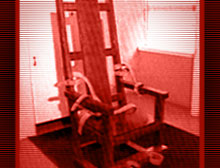 |
| Penry
v. Lynaugh (1989) [Rights of the Accused: Punishment] Was Penry's
sentence cruel and unusual punishment?
Thompson v. Oklahoma (1988) [Rights of the Accused: Punishment] Would the execution of a 15 year old violate the Eighth Amendment's prohibition against "cruel and unusual punishments"? Booth v. Maryland (1987) [Rights of the Accused: Punishment] Does the Eighth Amendment of the Constitution, which protects a defendant from cruel and unusual punishment, prohibit a jury from considering a victim impact statement during the sentencing phase of a capital murder trial? McCleskey v. Kemp (1987) [Discrimination: Race; Rights of the Accused: Punishment] Did the statistical study prove that McCleskey's sentence violated the Eighth and Fourteenth Amendments? Lockett v. Ohio (1978) [Due Process; Rights of the Accused: Punishment] Did the Ohio law violate the Eighth and Fourteenth Amendments by limiting the consideration of mitigating factors? Coker v. Georgia (1977) [Rights of the Accused: Punishment] Was the imposition of the death penalty for the crime of rape a form of cruel and unusual punishment forbidden by the Eighth Amendment? Gregg v. Georgia (1976) [Rights of the Accused: Punishment] Is the imposition of the death sentence prohibited under the Eighth and Fourteenth Amendments as "cruel and unusual" punishment? Louisiana v. Resweber (1947) [Due Process; Rights of the Accused: Punishment] Does the second attempted execution deny Francis due process of law because of double jeopardy guaranteed by the Fifth Amendment and because of cruel and unusual punishment of the Eighth Amendment? |
Stanford
v. Kentucky (1989) [Rights of the Accused: Punishment] Does the imposition
of the death sentence on convicted capital offenders below the age of 18
years old, violate the Eighth Amendment's protection against cruel and unusual
punishment?
Roberts v. Louisiana (1976) [Due Process; Rights of the Accused: Punishment] Does Louisiana's death-penalty sentencing scheme violate the Eighth and Fourteenth Amendments' safeguards against arbitrary and capricious death penalty impositions? Proffitt v. Florida (1976) [Due Process; Rights of the Accused: Punishment] Is the death penalty a "cruel and unusual" punishment? Is Florida's capital-sentencing procedure unconstitutional? Woodson v. North Carolina (1976) [Rights of the Accused: Punishment] Did the mandatory death penalty law violate the Eighth and Fourteenth Amendments? Jurek v. Texas (1976) [Rights of the Accused: Punishment] Is the death penalty a "cruel and unusual" punishment? Is Texas' capital-sentencing procedure unconstitutional? Furman v. Georgia (1972) [Rights of the Accused: Punishment] Does the imposition and carrying out of the death penalty in these cases constitute cruel and unusual punishment in violation of the Eighth and Fourteenth Amendments? Robinson v. California (1962) [Rights of the Accused: Punishment] Was the California law an infliction of cruel and unusual punishment prohibited by the Eighth Amendment?
|
The Pro Death Penalty
Website
Murder Victims Memorial Site
Justice for Officer Faulkner
Justice For All
Death Penalty News and
Updates
Lamp of Hope
Abolition of the Death
Penalty
| News Stories |
| - | |
| - | Death Sentence Not Always Fatal - CBS News (Jun 12, 2000) |
| - | Death-penalty trials rife with errors, study finds - Dallas Morning News (Jun 12, 2000) |
| - | |
| - | Study: Most Death Cases Have Significant Flaws - Chicago Tribune (Jun 12, 2000) |
| - | Prisoners pay with lives for legal errors - Sydney Morning Herald (Jun 12, 2000) |
| - | Incompetent defense, prosecutor misconduct mar process, study says - Detroit Free Press (Jun 12, 2000) |
| - | Dubya & The Death Penalty - CBS News (Jun 12, 2000) |
| Related Web Sites |
| - | Supreme Court Cases on Rights of the Accused - abstracts, written opinions, and RealAudio of the original oral arguments for cases on the death penalty and other criminal punishment issues. From the Oyez Project of Northwestern University. |
| - | |
| - | Amnesty USA: Death Penalty in the USA - archive of reports on the topic. |
| - | Decisions, Decisions: Death Penalty - teaching material for grades 5-10 that includes video of 4 "advisors" espousing 4 different points of view on the issue. Students print out advisor memos and vote in an online web poll. |
| - | John Stuart Mill: Speech in Favor of Capital Punishment - " I defend this penalty, when confined to atrocious cases, on the very ground on which it is commonly attacked--on that of humanity to the criminal; as beyond comparison the least cruel mode in which it is possible adequately to deter from the crime." |
| - | Pro Death Penalty Pages |
| - | SpeakOut.com: Death Penalty - includes issue briefs, timeline, and petitions. |
| - | The Justice Project - includes full text of the study A Broken System: Error Rates in Capital Cases, 1973-1995. |
| - | Death Row Roll Call - monthly list of U.S. death row inmates scheduled for execution; from The Nation. |
| - | Rights of the Victim - from the Executive Office of the Governor, Florida. |
| - | Death of Innocents - article on death row inmates who were later exonerated. Part of the Hartford Advocate's series on the failure of the criminal justice system. |
| - | Clark County Prosecuting Attorney: The Death Penalty - offers statistics and information on the death penalty in Indiana and factual and legal summaries of cases since 1977. |
| - | Death Penalty Update - capsule profile of captital punishment as exercised in the U.S. and around the world. |
| - | Capital Defender's Toolbox - death penalty legal news and tools for those defending the condemned and accused. |
| - | |
| Yahoo
Death Penalty Links
Capital Punishment - an essay on capital punishment, giving two arguments, one based on justice and one based on love. Both lead to opposition. Capital Punishment: The Ultimate Injustice - collection of links to anti-death penalty resources. Coloradans Against The Death Penalty (CADP) - nonprofit organization working to abolish the death penalty in Colorado. Death Penalty Focus of California Death Penalty Information - from the American Society of Criminology. Death Penalty Institute of Oklahoma - serves the media and the public with analysis and information on issues concerning capital punishment. Death Penalty Perspective, The - a view on capital punishment and the ramifications from a victim's point of view. Includes testimonials, witness accounts, and related links. Death Penalty USA Pages - includes news, statistics, links, and listings of death row inmates by state, sex, and age. Fight the Death Penalty in USA - articles and discussions. Friends Committee to Abolish the Death Penalty Friends For Life - working for the abolition of capital punishment. Individual cases, appeals for help, death penalty information. Journey of Hope in Virginia '96 - September 21 to October 6. Two weeks of education for alternatives to the death penalty. Massachusetts Death Penalty E-mail Network (MADPEN) - connects organizations and individuals working to keep the death penalty out of Massachusetts. Moratorium 2000 - not-for-profit, nonpolitical organization dedicated to obtaining a moratorium on the death penalty internationally. National Coalition to Abolish the Death Penalty - non-profit organization decicated to the complete abolition of the death penalty both in the United States and abroad. Nebraskans Against the Death Penalty Netmonkey's Death Penalty Page - article giving statistics, charts, and numerous reasons as to why killing is wrong. New Jerseyans for a Death Penalty Moratorium - dedicated to winning public and political support for an immediate suspension of all executions in New Jersey for a minimum of two years. New Mexcio Coaliton to Repeal the Death Penalty - with legislative, educational, faith, and media committees. New Yorkers Against the Death Penalty - statewide coalition of organizations and individuals committed to the abolition of capital punishment. Ohioans To Stop Executions - founded in 1987 to end the use of capital punishment in the state through education and activism. Oklahoma Coalition to Abolish the Death Penalty - consists of organizations, individuals, human rights groups, churches and other faith-based organizations. People of Faith Against the Death Penalty - committed to the education and mobilization of people of all faiths in North Carolina for the abolition of the death penalty. Stop the Death Penalty - online petition against the death penalty in the United States. Virginians for Alternatives to the Death Penalty
DREAMS OF THE GREAT EARTH CHANGES
|