Excerpted from ISIS UNVEILED
by Helena Blavatsky
VOL 2 - page 473
CHAPTER X.
"Get thee behind me, SATAN" (Jesus to Peter). -- Matt. xvi. 23.
"Such a deal of skimble-skamble stuff
As puts me from my faith. I tell you what --
He held me, last night, at least nine hours
In reckoning up the several devils' names." -- King Henry IV., Part i., Act iii.
"La force terrible et juste qui tue eternellement les avortons a ete nommee par les Egyptiens Typhon, par les Hebreux Samael; par les orientaux Satan; et par les Latins Lucifer. Le Lucifer de la Cabale n'est pas un ange maudit et foudroye; c'est l'ange qui eclaire et qui regenere en tombant." -- ELIPHAS LEVI: Dogme et Rituel.
"Bad as he is, the Devil may be abus'd,
Be falsely charg'd, and causelessly accus'd,
When Men, unwilling to be blam'd alone,
Shift off those Crimes on Him which are their Own." -- Defoe, 1726.
SEVERAL years ago, a distinguished writer and persecuted kabalist suggested a creed for the Protestant and Roman Catholic bodies, which may be thus formulated:
Protevangelium.
"I believe in the Devil, the Father Almighty of Evil, the Destroyer of all things, Perturbator of Heaven and Earth;
And in Anti-Christ, his only Son, our Persecutor,
Who was conceived of the Evil Spirit;
Born of a sacrilegious, foolish Virgin;
Was glorified by mankind, reigned over them,
And ascended to the throne of Almighty God,
From which he crowds Him aside, and from which he insults the living and the dead;
I believe in the Spirit of Evil;
The Synagogue of Satan;
The coalition of the wicked;
The perdition of the body;
And the Death and Hell everlasting. Amen."
Does this offend? Does it seem extravagant, cruel, blasphemous? Listen. In the city of New York, on the ninth day of April, 1877 -- that is to say, in the last quarter of what is proudly styled the century of discovery and the age of illumination -- the following scandalous ideas were broached. We quote from the report in the Sun of the following morning:
"The Baptist preachers met yesterday in the Mariners' Chapel, in Oliver Street. Several foreign missionaries were present. The Rev. John W. Sarles, of Brooklyn, read an essay, in which he maintained the proposition that all adult heathen, dying without the knowledge of the Gospel, are damned eternally. Otherwise, the reverend essayist argued, the Gospel is a curse instead of a blessing, the men who crucified Christ served him right, and the whole structure of revealed religion tumbles to the ground.
"Brother Stoddard, a missionary from India, indorsed the views of the Brooklyn pastor. The Hindus were great sinners. One day, after he had preached in the market place, a Brahman got up and said: 'We Hindus beat the world in lying, but this man beats us. How can he say that God loves us? Look at the poisonous serpents, tigers, lions, and all kinds of dangerous animals around us. If God loves us, why doesn't He take them away?'
"The Rev. Mr. Pixley, of Hamilton, N. Y., heartily subscribed to the doctrine of Brother Sarles's essay, and asked for $5,000 to fit out young men for the ministry."
And these men -- we will not say teach the doctrine of Jesus, for that would be to insult his memory, but -- are paid to teach his doctrine! Can we wonder that intelligent persons prefer annihilation to a faith encumbered by such a monstrous doctrine? We doubt whether any respectable Brahman would have confessed to the vice of lying -- an art cultivated only in those portions of British India where the most Christians are found.*
[[Footnote(s)]] -------------------------------------------------
* So firmly established seems to have been the reputation of the Brahmans and Buddhists for the highest morality, and that since time immemorial, that we find Colonel Henry Yule, in his admirable edition of "Marco Polo," giving the following testimony: "The high virtues ascribed to the Brahman and Indian merchants were, perhaps, in part, matter of tradition . . . but the eulogy is so constant among mediaeval travellers that it must have had a solid foundation. In fact, it would not be difficult to trace a chain of similar testimony from ancient times down to our own. Arrian says no Indian was ever accused of falsehood. Hwen T'sang ascribes to the people of India eminent uprightness, honesty, and disinterestedness. Friar Jordanus (circa 1330) says the people of Lesser India (Sindh and Western India) were true in speech and eminent in justice; and we may also refer to the high character given to the Hindus by Abul Fazl. But after 150 years of European trade, indeed, we find a sad deterioration. . . . Yet Pallas, in the last century, noticing the Bamyan colony at Astrakhan, says its members were notable for an upright dealing that made them greatly preferable to Armenians. And that wise and admirable public servant, the late Sir William Sleeman, in our own time, has said that he knew no class of men in the world more strictly honorable than the mercantile classes of India." (1)
The sad examples of the rapid demoralization of savage American Indians, as soon as they are made to live in a close proximity with Christian officials and missionaries, are familiar in our modern days.
-------------------------------------
(1) The "Book of Ser Marco Polo, the Venetian," translated by Colonel Henry Yule, vol. ii., p. 354.
[[Vol. 2, Page]] 475 THE DEVIL IN ALL HIS ASPECTS.
But we challenge any honest man in the wide world to say whether he thinks the Brahman was far from the truth in saying of the missionary Stoddard, "this man beats us all" in lying. What else would he say, if the latter preached to them the doctrine of eternal damnation, because, indeed, they had passed their lives without reading a Jewish book of which they never heard, or asked salvation of a Christ whose existence they never suspected! But Baptist clergymen who need a few thousand dollars must devise terrifying sensations to fire the congregational heart.
We abstain, as a rule, from giving our own experience when we can call acceptable witnesses, and so, upon reading missionary Stoddard's outrageous remarks, we requested our acquaintance, Mr. William L. D. O'Grady,* to give a fair opinion upon the missionaries. This gentleman's father and grandfather were British army officers, and he himself was born in India, and enjoyed life-long opportunities to learn what the general opinion among the English is of these religious propagandists. Following is his communication in reply to our letter:
"You ask me for my opinion of the Christian missionaries in India. In all the years I spent there, I never spoke to a single missionary. They were not in society, and, from what I heard of their proceedings and could see for myself, I don't wonder at it. Their influence on the natives is bad. Their converts are worthless, and, as a rule, of the lowest class; nor do they improve by conversion. No respectable family will employ Christian servants. They lie, they steal, they are unclean -- and dirt is certainly not a Hindu vice; they drink -- and no decent native of any other belief ever touches intoxicating liquor; they are outcasts from their own people and utterly despicable. Their new teachers set them a poor example of consistency. While holding forth to the Pariah that God makes no distinction of persons, they boast intolerably over the stray Brahmans, who, very much "off color," occasionally, at long intervals, fall into the clutches of these hypocrites.
"The missionaries get very small salaries, as publicly stated in the proceedings of the societies that employ them, but, in some unaccountable way, manage to live as well as officials with ten times their income. When they come home to recover their health, shattered, as they say, by their arduous labors -- which they seem to be able to afford to do quite frequently, when supposed richer people cannot -- they tell childish stories on platforms, exhibit idols as procured with infinite difficulty, which is quite absurd, and give an account of their imaginary hardships which is perfectly harrowing but untrue from beginning to end. I lived some years in India myself, and nearly all my blood-relations have passed or will pass the best years of their lives there. I know hundreds of British officials, and I never heard from one of them a single word in favor of the missionaries. Natives of any position look on them with the supremest contempt, although suffering chronic exasperation from their arrogant aggressiveness; and the British Government, which continues endowments to Pagodas, granted by the East India Company, and which supports unsectarian education, gives them no countenance whatever. Protected from personal violence, they yelp and bark at natives and Europeans alike, after the fashion of ill-conditioned curs. Often recruited from the poorest specimens of theological fanaticism, they are regarded on all sides as mischievous. Their rabid, reckless, vulgar, and offensive propagandism caused the great Mutiny of 1857. They are noisome humbugs.
[[Footnote(s)]] -------------------------------------------------
* At the present moment Mr. O'Grady is Editor of the "American Builder," of New York, and is well known for his interesting letters, "Indian Sketches -- Life in the East," which he contributed under the pseudonym of Hadji Nicka Bauker Khan, to the Boston "Commercial Bulletin."
"WM. L.D. O 'GRADY.
"NEW YORK, June 12, 1877."
The new creed therefore, with which we opened this chapter, coarse as it may sound, embodies the very essence of the belief of the Church as inculcated by her missionaries. It is regarded as less impious, less infidel, to doubt the personal existence of the Holy Ghost, or the equal Godhead of Jesus, than to question the personality of the Devil. But a summary of Koheleth is well-nigh forgotten. Who ever quotes the golden words of the prophet Micah, or seems to care for the exposition of the Law, as given by Jesus himself? The "bull's eye" in the target of Modern Christianity is in the simple phrase to "fear the Devil."
The Catholic clergy and some of the lay champions of the Roman Church fight still more for the existence of Satan and his imps. If Des Mousseaux maintains the objective reality of spiritual phenomena with such an unrelenting ardor, it is because, in his opinion, the latter are the most direct evidence of the Devil at work. The Chevalier is more Catholic than the Pope; and his logic and deductions from never-to-be and non-established premises are unique, and prove once more that the creed offered by us is the one which expresses the Catholic belief most eloquently.
"If magic and spiritualism," he says, "were both but chimeras, we would have to bid an eternal farewell to all the rebellious angels, now troubling the world; for thus, we would have no more demons down here. . . . And if we lost our demons, we would LOSE OUR SAVIOUR likewise. For, from whom did that Saviour come to save us? And then, there would be no more Redeemer; for from whom or what could that Redeemer redeem us? Hence, there would be no more Christianity!!" Oh, Holy Father of Evil; Sainted Satan! We pray thee do not abandon such pious Christians as the Chevalier des Mousseaux and some Baptist clergymen!!
[[Vol. 2, Page]] 477 A PERSONAL DEVIL INVOLVES POLYTHEISM.
For our part, we would rather remember the wise words of J. C. Colquhoun,* who says that "those persons who, in modern times, adopt the doctrine of the Devil in its strictly literal and personal application, do not appear to be aware that they are in reality polytheists, heathens, idolaters."
Seeking supremacy in everything over the ancient creeds, the Christians claim the discovery of the Devil officially recognized by the Church. Jesus was the first to use the word "legion" when speaking of them; and it is on this ground that M. des Mousseaux thus defends his position in one of his demonological works. "Later," he says, "when the synagogue expired, depositing its inheritance in the hands of Christ, were born into the world and shone, the Fathers of the Church, who have been accused by certain persons of a rare and precious ignorance, of having borrowed their ideas as to the spirits of darkness from the theurgists."
Three deliberate, palpable, and easily-refuted errors -- not to use a harsher word -- occur in these few lines. In the first place, the synagogue, far from having expired, is flourishing at the present day in nearly every town of Europe, America, and Asia; and of all churches in Christian cities, it is the most firmly established, as well as the best behaved. Further -- while no one will deny that many Christian Fathers were born into the world (always, of course, excepting the twelve fictitious Bishops of Rome, who were never born at all), every person who will take the trouble to read the works of the Platonists of the old Academy, who were theurgists before Iamblichus, will recognize therein the origin of Christian Demonology as well as the Angelology, the allegorical meaning of which was completely distorted by the Fathers. Then it could hardly be admitted that the said Fathers ever shone, except, perhaps, in the refulgence of their extreme ignorance. The Reverend Dr. Shuckford, who passed the better part of his life trying to reconcile their contradictions and absurdities, was finally driven to abandon the whole thing in despair. The ignorance of the champions of Plato must indeed appear rare and precious by comparison with the fathomless profundity of Augustine, "the giant of learning and erudition," who scouted the sphericity of the earth, for, if true, it would prevent the antipodes from seeing the Lord Christ when he descended from heaven at the second advent; or, of Lactantius, who rejects with pious horror Pliny's identical theory, on the remarkable ground that it would make the trees at the other side of the earth grow and the men walk with their heads downward; or, again, of Cosmas-Indicopleustes, whose orthodox system of geography is embalmed in his "Christian topography"; or, finally, of Bede, who assured the world that the heaven "is tempered with glacial waters, lest it should be set on fire" -- a benign dispensation of Providence, most likely to prevent the radiance of their learning from setting the sky ablaze!
Be this as it may, these resplendent Fathers certainly did borrow their notions of the "spirits of darkness" from the Jewish kabalists and Pagan theurgists, with the difference, however, that they disfigured and outdid in absurdity all that the wildest fancy of the Hindu, Greek, and Roman rabble had ever created. There is not a dev in the Persian Pandaimonion half so preposterous, as a conception, as des Mousseaux's Incubus revamped from Augustine. Typhon, symbolized as an ass, appears a philosopher in comparison with the devil caught by the Normandy peasant in a key-hole; and it is certainly not Ahriman or the Hindu Vritra who would run away in rage and dismay, when addressed as St. Satan, by a native Luther.
The Devil is the patron genius of theological Christianity. So "holy and
reverend is his name" in modern conception, that it may not, except occasionally
from the pulpit, be uttered in ears polite. In like manner, anciently, it
was not lawful to speak the sacred names or repeat the jargon of the Mysteries,
except in the sacred cloister. We hardly know the names of the Samothracian
gods, but cannot tell precisely the number of the Kabeiri. The Egyptians
considered it blasphemous to utter the title of the gods of their secret
rites. Even now, the Brahman only pronounces the syllable Om
in silent thought, and the Rabbi, the Ineffable Name,
 . Hence, we who exercise no such
veneration, have been led into the blunders of miscalling the names of HISIRIS
and YAVA by the mispronunciations, Osiris and Jehovah. A similar glamour
bids fair, it will be perceived, to gather round the designation of the dark
personage of whom we are treating; and in the familiar handling, we shall
be very likely to shock the peculiar sensibilities of many who will consider
a free mentioning of the Devil's names as blasphemy -- the sin of sins, that
"hath never forgiveness."**
. Hence, we who exercise no such
veneration, have been led into the blunders of miscalling the names of HISIRIS
and YAVA by the mispronunciations, Osiris and Jehovah. A similar glamour
bids fair, it will be perceived, to gather round the designation of the dark
personage of whom we are treating; and in the familiar handling, we shall
be very likely to shock the peculiar sensibilities of many who will consider
a free mentioning of the Devil's names as blasphemy -- the sin of sins, that
"hath never forgiveness."**
Several years ago an acquaintance of the author wrote a newspaper article to demonstrate that the diabolos or Satan of the New Testament denoted the personification of an abstract idea, and not a personal being. He was answered by a clergyman, who concluded the reply with the deprecatory expression, "I fear that he has denied his Saviour." In his rejoinder he pleaded, "Oh, no! we only denied the Devil." But the clergyman failed to perceive the difference. In his conception of the matter, the denying of the personal objective existence of the Devil was itself "the sin against the Holy Ghost."
[[Footnote(s)]] -------------------------------------------------
** Gospel according to Mark, iii. 29: "He that shall blaspheme against the Holy Ghost, hath never forgiveness, but is in danger of eternal damnation" ([[amartematos]], error).
[[Vol. 2, Page]] 479 "NO DEVIL, NO CHRIST!"
This necessary Evil, dignified by the epithet of "Father of Lies," was, according to the clergy, the founder of all the world-religions of ancient time, and of the heresies, or rather heterodoxies, of later periods, as well as the Deus ex Machina of modern Spiritualism. In the exceptions which we take to this notion, we protest that we do not attack true religion or sincere piety. We are only carrying on a controversy with human dogmas. Perhaps in doing this we resemble Don Quixote, because these things are only windmills. Nevertheless, let it be remembered that they have been the occasion and pretext for the slaughtering of more than fifty millions of human beings since the words were proclaimed: "LOVE YOUR ENEMIES."
It is a late day for us to expect the Christian clergy to undo and amend their work. They have too much at stake. If the Christian Church should abandon or even modify the dogma of an anthropomorphic devil, it would be like pulling the bottom card from under a castle of cards. The structure would fall. The clergymen to whom we have alluded perceived that upon the relinquishing of Satan as a personal devil, the dogma of Jesus Christ as the second deity in their trinity must go over in the same catastrophe. Incredible, or even horrifying, as it may seem, the Roman Church bases its doctrine of the godhood of Christ entirely upon the satanism of the fallen archangel. We have the testimony of Father Ventura, who proclaims the vital importance of this dogma to the Catholics.
The Reverend Father Ventura, the illustrious ex-general of the Theatins, certifies that the Chevalier des Mousseaux, by his treatise, Moeurs et Pratiques des Demons, has deserved well of mankind, and still more of the most Holy Catholic and Apostolic Church. With this voucher, the noble Chevalier, it will be perceived, "speaks as one having authority." He asserts explicitly, that to the Devil and his angels we are absolutely indebted for our Saviour; and that but for them we would have no Redeemer, no Christianity.
Many zealous and earnest souls have revolted at the monstrous dogma of John Calvin, the popekin of Geneva, that sin is the necessary cause of the greatest good. It was bolstered up, nevertheless, by logic like that of des Mousseaux, and illustrated by the same dogmas. The execution of Jesus, the god-man, on the cross, was the most prodigious crime in the universe, yet it was necessary that mankind -- those predestinated to ever lasting life -- might be saved. D'Aubignee cites the quotation by Martin Luther from the canon, and makes him exclaim, in ecstatic rapture: "O beata culpa, qui talem meruisti redemptorem!" O blessed sin, which didst merit such a Redeemer. We now perceive that the dogma which had appeared so monstrous is, after all, the doctrine of Pope, Calvin, and Luther alike -- that the three are one.
Mahomet and his disciples, who held Jesus in great respect as a prophet, remarks Eliphas Levi, used to utter, when speaking of Christians, the following remarkable words: "Jesus of Nazareth was verily a true prophet of Allah and a grand man; but lo! his disciples all went insane one day, and made a god of him."
Max Muller kindly adds: "It was a mistake of the early Fathers to treat the heathen gods as demons or evil spirits, and we must take care not to commit the same error with regard to the Hindu gods."*
But we have Satan presented to us as the prop and mainstay of sacerdotism -- an Atlas, holding the Christian heaven and cosmos upon his shoulders. If he falls, then, in their conception, all is lost, and chaos must come again.
This dogma of the Devil and redemption seems to be based upon two passages in the New Testament: "For this purpose the Son of God was manifested, that he might destroy the works of the Devil." "And there was war in heaven; Michael and his angels fought against the Dragon; and the Dragon fought, and his angels, and prevailed not; neither was their place found any more in heaven. And the great Dragon was cast out, that old serpent, called the Devil and Satan, which deceiveth the whole world." Let us, then, explore the ancient Theogonies, in order to ascertain what was meant by these remarkable expressions.
The first inquiry is whether the term Devil, as here used, actually represents the malignant Deity of the Christians, or an antagonistic, blind force -- the dark side of nature. By the latter we are not to understand the manifestation of any evil principle that is malum in se, but only the shadow of the Light, so to say. The theories of the kabalists treat of it as a force which is antagonistic, but at the same time essential to the vitality, evolving, and vigor of the good principle. Plants would perish in their first stage of existence, if they were kept exposed to a constant sunlight; the night alternating with the day is essential to their healthy growth and development. Goodness, likewise, would speedily cease to be such, were it not alternated by its opposite. In human nature, evil denotes the antagonism of matter to the spiritual, and each is accordingly purified thereby. In the cosmos, the equilibrium must be preserved; the operation of the two contraries produce harmony, like the centripetal and centrifugal forces, and are necessary to each other. If one is arrested, the action of the other will immediately become destructive.
[[Vol. 2, Page]] 481 THE TEMPTING SERPENT OF EDEN.
This personification, denominated Satan, is to be contemplated from three different planes: the Old Testament, the Christian Fathers, and the ancient Gentile altitude. He is supposed to have been represented by the Serpent in the Garden of Eden; nevertheless, the epithet of Satan is nowhere in the Hebrew sacred writings applied to that or any other variety of ophidian. The Brazen Serpent of Moses was worshipped by the Israelites as a god; being the symbol of Esmun-Asklepius the Phoenician Iao. Indeed, the character of Satan himself is introduced in the 1st book of Chronicles in the act of instigating King David to number the Israelitish people, an act elsewhere declared specifically to have been moved by Jehovah himself.** The inference is unavoidable that the two, Satan and Jehovah, were regarded as identical.
Another mention of Satan is found in the prophecies of Zechariah. This book was written at a period subsequent to the Jewish colonization of Palestine, and hence, the Asideans may fairly be supposed to have brought the personification thither from the East. It is well-known that this body of sectaries were deeply imbued with the Mazdean notions; and that they represented Ahriman or Anra-manyas by the god-names of Syria. Set or Sat-an, the god of the Hittites and Hyk-sos, and Beel-Zebub the oracle-god, afterward the Grecian Apollo. The prophet began his labors in Judea in the second year of Darius Hystaspes, the restorer of the Mazdean worship. He thus describes the encounter with Satan: "He showed me Joshua the high-priest standing before the angel of the Lord, and Satan standing at his right hand to be his adversary. And the Lord said unto Satan: 'The Lord rebuke thee, O Satan; even the Lord that hath chosen Jerusalem rebuke thee: is not this a brand plucked out of the fire?' "**
[[Footnote(s)]] -------------------------------------------------
* 2 Kings, xviii. 4. It is probable that the fiery serpents or
Seraphim mentioned in the twenty-first chapter of the book
of Numbers were the same as the Levites, or Ophite tribe. Compare Exodus
xxxii. 26-29 with Numbers xxi. 5-9. The names Heva,
 , Hivi or Hivite,
 , and Levi
 , all signify a serpent; and it is
a curious fact that the Hivites, or serpent-tribe of Palestine, like the
Levites or Ophites of Israel, were ministers to the temples. The Gibeonites,
whom Joshua assigned to the service of the sanctuary, were Hivites.
, all signify a serpent; and it is
a curious fact that the Hivites, or serpent-tribe of Palestine, like the
Levites or Ophites of Israel, were ministers to the temples. The Gibeonites,
whom Joshua assigned to the service of the sanctuary, were Hivites.
** 1 Chronicles, xxi. 1: "And Satan stood up against Israel and moved David to number Israel." 2d Samuel, xxiv. 1: "And again the anger of the Lord was kindled against Israel, and he moved David against them to say: 'Go, number Israel and Judah.' "
*** Zechariah iii. 1, 2. A pun or play on words is noticeable; "adversary"
is associated with "Satan," as if from  ,
to oppose.
,
to oppose.
We apprehend that this passage which we have quoted is symbolical. There
are two allusions in the New Testament that indicate
that it was so regarded. The Catholic Epistle of Jude refers
to it in this peculiar language: "Yet Michael the archangel, when contending
with the Devil, he disputed about the body of Moses, did not venture to utter
to him a reviling judgment ([[Krisin epenegkein
Blasphemias]]), but said, 'The Lord rebuke thee.' " The archangel
Michael is thus mentioned as identical with the
Lord, or angel of the Lord, of the
preceding quotation, and thus is shown that the Hebrew Jehovah had a twofold
character, the secret and that manifested as the angel of the Lord, or Michael
the archangel. A comparison between these two passages renders it plain that
"the body of Moses" over which they contended was Palestine, which as "the
land of the Hittites" was the peculiar domain of Seth, their tutelar god.
Michael, as the champion of the Jehovah-worship, contended with the Devil
or Adversary, but left judgment to his superior.
Belial is not entitled to the distinction of either god or devil. The term
 , BELIAL, is defined in the Hebrew
lexicons to mean a destroying, waste, uselessness; or the phrase
, BELIAL, is defined in the Hebrew
lexicons to mean a destroying, waste, uselessness; or the phrase
 AIS-BELIAL or Belial-man signifies
a wasteful, useless man. If Belial must be personified to please our religious
friends, we would be obliged to make him perfectly distinct from Satan, and
to consider him as a sort of spiritual "Diakka." The demonographers, however,
who enumerate nine distinct orders of daimonia, make him
chief of the third class -- a set of hobgoblins, mischievous and
good-for-nothing.
AIS-BELIAL or Belial-man signifies
a wasteful, useless man. If Belial must be personified to please our religious
friends, we would be obliged to make him perfectly distinct from Satan, and
to consider him as a sort of spiritual "Diakka." The demonographers, however,
who enumerate nine distinct orders of daimonia, make him
chief of the third class -- a set of hobgoblins, mischievous and
good-for-nothing.
Asmodeus is no Jewish spirit at all, his origin being purely Persian. Breal, the author of Hercule et Cacus, shows that he is the Parsi Eshem-Dev, or Aeshma-dev, the evil spirit of concupiscence, whom Max Muller tells us "is mentioned several times in the Avesta as one of the Devs,**** originally gods, who became evil spirits."
[[Footnote(s)]] -------------------------------------------------
** In the "Assyrian Tablets," Palestine is called "the land of the Hittites"; and the Egyptian Papyri, declaring the same thing, also make Seth, the "pillar-god," their tutelar deity.
*** Seth, Suteh, or Sat-an, was the god of the aboriginal nations of Syria. Plutarch makes him the same as Typhon. Hence he was god of Goshen and Palestine, the countries occupied by the Israelites.
**** "Vendidad," fargard x., 23: "I combat the daeva AEshma, the very evil." "The Yacnas," x. 18, speaks likewise of AEshma-Daeva, or Khasm: "All other sciences depend upon AEshma, the cunning." "Serv.," lvi. 12: "To smite the wicked Auramanyas (Ahriman, the evil power), to smite AEshma with the terrible weapon, to smite the Mazanian daevas, to smite all devas."
In the same fargard of the "Vendidad" the Brahman divinities are involved in the same denunciation with AEshma-daeva: "I combat India, I combat Sauru, I combat the Daeva Naonhaiti." The annotator explains them to be the Vedic gods, Indus, Gaurea, or Siva, and the two Aswins. There must be some mistake, however, for Siva, at the time the "Vedas" were completed, was an aboriginal or AEthiopian God, the Bala or Bel of Western Asia. He was not an Aryan or Vedic deity. Perhaps Surya was the divinity intended.
[[Vol. 2, Page]] 483 SAMAEL AND TYPHON ARE SATAN.
Samael is Satan; but Bryan and a good many other authorities show it to be the name of the "Simoun" -- the wind of the desert,* and the Simoun is called Atabul-os or Diabolos.
Plutarch remarks that by Typhon was understood anything violent, unruly, and disorderly. The overflowing of the Nile was called by the Egyptians Typhon. Lower Egypt is very flat, and any mounds built along the river to prevent the frequent inundations, were called Typhonian or Taphos; hence, the origin of Typhon. Plutarch, who was a rigid, orthodox Greek, and never known to much compliment the Egyptians, testifies in his Isis and Osiris, to the fact that, far from worshipping the Devil (of which Christians accused them), they despised more than they dreaded Typhon. In his symbol of the opposing, obstinate power of nature, they believed him to be a poor, struggling, half-dead divinity. Thus, even at that remote age, we see the ancients already too enlightened to believe in a personal devil. As Typhon was represented in one of his symbols under the figure of an ass at the festival of the sun's sacrifices, the Egyptian priests exhorted the faithful worshippers not to carry gold ornaments upon their bodies for fear of giving food to the ass!
Three and a half centuries before Christ, Plato expressed his opinion of evil by saying that "there is in matter a blind, refractory force, which resists the will of the Great Artificer." This blind force, under Christian influx, was made to see and become responsible; it was transformed into Satan!
His identity with Typhon can scarcely be doubted upon reading the account in Job of his appearance with the sons of God, before the Lord. He accuses Job of a readiness to curse the Lord to his face upon sufficient provocation. So Typhon, in the Egyptian Book of the Dead, figures as the accuser. The resemblance extends even to the names, for one of Typhon's appellations was Seth, or Seph; as Satan, in Hebrew, means an adversary. In Arabic the word is Shatana -- to be adverse, to persecute, and Manetho says he had treacherously murdered Osiris and allied himself with the Shemites (the Israelites). This may possibly have originated the fable told by Plutarch, that, from the fight between Horus and Typhon, Typhon, overcome with fright at the mischief he had caused, "fled seven days on an ass, and escaping, begat the boys Ierosolumos and Ioudaios (Jerusalem and Judea)."
Referring to an invocation of Typhon-Seth, Professor Reuvens says that the Egyptians worshipped Typhon under the form of an ass; and according to him Seth "appears gradually among the Semites as the background of their religious consciousness." The name of the ass in Coptic, AO, is a phonetic of IAO, and hence the animal became a pun-symbol. Thus Satan is a later creation, sprung from the overheated fancy of the Fathers of the Church. By some reverse of fortune, to which the gods are subjected in common with mortals, Typhon-Seth tumbled down from the eminence of the deified son of Adam Kadmon, to the degrading position of a subaltern spirit, a mythical demon -- ass. Religious schisms are as little free from the frail pettiness and spiteful feelings of humanity as the partisan quarrels of laymen. We find a strong instance of the above in the case of the Zoroastrian reform, when Magianism separated from the old faith of the Brahmans. The bright Devas of the Veda became, under the religious reform of Zoroaster, daevas, or evil spirits, of the Avesta. Even Indra, the luminous god, was thrust far back into the dark shadow** in order to show off, in a brighter light, Ahura-mazda, the Wise and Supreme Deity.
The strange veneration in which the Ophites held the serpent which represented Christos may become less perplexing if the students would but remember that at all ages the serpent was the symbol of divine wisdom, which kills in order to resurrect, destroys but to rebuild the better. Moses is made a descendant of Levi, a serpent-tribe. Gautama-Buddha is of a serpent-lineage, through the Naga (serpent) race of kings who reigned in Magadha. Hermes, or the god Taaut (Thoth), in his snake-symbol is Tet; and, according to the Ophite legends, Jesus or Christos is born from a snake (divine wisdom, or Holy Ghost), i.e., he became a Son of God through his initiation into the "Serpent Science." Vishnu, identical with the Egyptian Kneph, rests on the heavenly seven-headed serpent.
The red or fiery dragon of the ancient time was the military ensign of the Assyrians. Cyrus adopted it from them when Persia became dominant. The Romans and Byzantines next assumed it; and so the "great red dragon," from being the symbol of Babylon and Nineveh, became that of Rome.
The temptation, or probation,* of Jesus is, however, the most dramatic occasion in which Satan appears. As if to prove the designation of Apollo, AEsculapius, and Bacchus, Diobolos, or son of Zeus, he is also styled Diabolos, or accuser. The scene of the probation was the wilderness. In the desert about the Jordan and Dead Sea were the abodes of the "sons of the prophets," and the Essenes. These ascetics used to subject their neophytes to probations, analogous to the tortures of the Mithraic rites; and the temptation of Jesus was evidently a scene of this character. Hence, in the Gospel according to Luke, it is stated that "the Diabolos, having completed the probation, left him for a specific time, [[achri kairou]], and Jesus returned in the power of the Spirit into Galilee." But the [[diabolos]], or Devil, in this instance is evidently no malignant principle, but one exercising discipline. In this sense the terms Devil and Satan are repeatedly employed. Thus, when Paul was liable to undue elation by reason of the abundance of revelations or epoptic disclosures, there was given him "a thorn in the flesh, an angel of Satanas," to check him.
[[Footnote(s)]] -------------------------------------------------
**** The term [[teirasmos]] signifies a trial, or probation.
[[Vol. 2, Page]] 485 THE TEMPTATIONS OF JOB AND JESUS.
The story of Satan in the Book of Job is of a similar character. He is introduced among the "Sons of God," presenting themselves before the Lord, as in a Mystic initiation. Micaiah the prophet describes a similar scene, where he "saw the Lord sitting on His throne, and all the host of Heaven standing by Him," with whom He took counsel, which resulted in putting "a lying spirit into the mouth of the prophets of Ahab."* *** The Lord counsels with Satan, and gives him carte blanche to test the fidelity of Job. He is stripped of his wealth and family, and smitten with a loathsome disease. In his extremity, his wife doubts his integrity, and exhorts him to worship God, as he is about to die. His friends all beset him with accusations, and finally the Lord, the chief hierophant Himself, taxes him with the uttering of words in which there is no wisdom, and with contending with the Almighty. To this rebuke Job yielded, making this appeal: "I will demand of thee, and thou shalt declare unto me: wherefore do I abhor myself and mourn in dust and ashes?" Immediately he was vindicated. "The Lord said unto Eliphaz . . . ye have not spoken of me the thing that is right, as my servant Job hath." His integrity had been asserted, and his prediction verified: "I know that my Champion liveth, and that he will stand up for me at a later time on the earth; and though after my skin my body itself be corroded away, yet even then without my flesh shall I see God." The prediction was accomplished: "I have heard of thee by the hearing of the ear, but now mine eye seeth thee. . . . And the Lord turned the captivity of Job."
In all these scenes there is manifested no such malignant diabolism as is supposed to characterize "the adversary of souls."
[[Footnote(s)]] -------------------------------------------------
*** 2d Epistle of Paul to the Corinthians, xii. In Numbers xxii, 22 the angel of the Lord is described as acting the part of a Satan to Balaam.
**** 1 Kings, xxii. 19-23.
It is an opinion of certain writers of merit and learning, that the Satan of the book of Job is a Jewish myth, containing the Mazdean doctrine of the Evil Principle. Dr. Haug remarks that "the Zoroastrian religion exhibits a close affinity, or rather identity with the Mosaic religion and Christianity, such as the personality and attributes of the Devil, and the resurrection of the dead." The war of the Apocalypse between Michael and the Dragon, can be traced with equal facility to one of the oldest myths of the Aryans. In the Avesta we read of war between Thraetaona and Azhi-Dahaka, the destroying serpent. Burnouf has endeavored to show that the Vedic myth of Ahi, or the serpent, fighting against the gods, has been gradually euhemerized into "the battle of a pious man against the power of evil," in the Mazdean religion. By these interpretations Satan would be made identical with Zohak or Azhi-Dahaka, who is a three-headed serpent, with one of the heads a human one.**
Beel-Zebub is generally distinguished from Satan. He seems, in the Apocryphal New Testament, to be regarded as the potentate of the underworld. The name is usually rendered "Baal of the Flies," which may be a designation of the Scarabaei or sacred beetles.*** More correctly it shall be read, as it is always given in the Greek text of the Gospels, Beelzebul, or lord of the household, as is indeed intimated in Matthew x. 25: "If they have called the master of the house Beelzebul, how much more shall they call them of his household." He was also styled the prince or archon of daemons.
[[Footnote(s)]] -------------------------------------------------
** The "Avesta" describes the serpent Dahaka, as of the region of Bauri or Babylonia. In the Median history are two kings of the name Deiokes or Dahaka, and Astyages or Az-dahaka. There were children of Zohak seated on various Eastern thrones, after Feridun. It is apparent, therefore, that by Zohak is meant the Assyrian dynasty, whose symbol was the purpureum signum draconis -- the purple sign of the Dragon. From a very remote antiquity (Genesis xiv.) this dynasty ruled Asia, Armenia, Syria, Arabia, Babylonia, Media, Persia, Bactria, and Afghanistan. It was finally overthrown by Cyrus and Darius Hystaspes, after "1,000 years" rule. Yima and Thraetaona, or Jemshid and Feridun, are doubtless personifications. Zohak probably imposed the Assyrian or Magian worship of fire upon the Persians. Darius was the vicegerent of Ahura-Mazda.
*** The name in the Gospels is [[beelzeboul]], or Baal of the Dwelling. It is pretty certain that Apollo, the Delphian God, was not Hellenian originally, but Phoenician. He was the Paian or physician, as well as the god of oracles. It is no great stretch of imagination to identify him with Baal-Zebul, the god of Ekron, or Acheron, doubtless changed to Zebub, or flies, by the Jews in derision.
[[Vol. 2, Page]] 487 THE GREAT RED DRAGON.
Typhon figures in the Book of the Dead, as the Accuser of souls when they appear for judgment, as Satan stood up to accuse Joshua, the high-priest, before the angel, and as the Devil came to Jesus to tempt or test him during his great fast in the wilderness. He was also the deity denominated Baal-Tsephon, or god of the crypt, in the book of Exodus, and Seth, or the pillar. During this period, the ancient or archaic worship was more or less under the ban of the government; in figurative language, Osiris had been treacherously slain and cut in fourteen (twice seven) pieces, and coffined by his brother Typhon, and Isis had gone to Byblos in quest of his body.
We must not forget in this relation that Saba or Sabazios, of Phrygia and Greece, was torn by the Titans into seven pieces, and that he was, like Heptaktis of the Chaldeans, the seven-rayed god. Siva, the Hindu, is represented crowned with seven serpents, and he is the god of war and destruction. The Hebrew Jehovah the Sabaoth is also called the Lord of hosts, Seba or Saba, Bacchus or Dionysus Sabazios; so that all these may easily be proved identical.
Finally the princes of the older regime, the gods who had, on the assault of the giants, taken the forms of animals and hidden in AEthiopia, returned and expelled the shepherds.
According to Josephus, the Hyk-sos were the ancestors of the Israelites. This is doubtless substantially true. The Hebrew Scriptures, which tell a somewhat different story, were written at a later period, and underwent several revisions, before they were promulgated with any degree of publicity. Typhon became odious in Egypt, and shepherds "an abomination." "In the course of the twentieth dynasty he was suddenly treated as an evil demon, insomuch that his effigies and name are obliterated on all the monuments and inscriptions that could be reached."** In all ages the gods have been liable to be euhemerized into men. There are tombs of Zeus, Apollo, Hercules, and Bacchus, which are often mentioned to show that originally they were only mortals. Shem, Ham, and Japhet, are traced in the divinities Shamas of Assyria, Kham of Egypt, and Iapetos the Titan. Seth was god of the Hyk-sos, Enoch, or Inachus, of the Argives; and Abraham, Isaac, and Judah have been compared with Brahma, Ikshwaka, and Yadu of the Hindu pantheon. Typhon tumbled down from godhead to devilship, both in his own character as brother of Osiris, and as the Seth, or Satan of Asia. Apollo, the god of day, became, in his older Phoenician garb, no more Baal Zebul, the Oracle-god, but prince of demons, and finally the lord of the underworld. The separation of Mazdeanism from Vedism, transformed the devas or gods into evil potencies. Indra, also, in the Vendidad is set forth as the subaltern of Ahriman,* created by him out of the materials of darkness, together with Siva (Surya) and the two Aswins. Even Jahi is the demon of Lust -- probably identical with Indra.
[[Footnote(s)]] -------------------------------------------------
* "Against Apion," i. 25. "The Egyptians took many occasions to hate and envy us: in the first place because our ancestors (the Hyk-sos, or shepherds) had had the dominion over their country, and when they were delivered from them and gone to their own country, they lived there in prosperity."
** Bunsen. The name Seth with the syllable an
from the Chaldean ana or Heaven, makes the term
Satan. The punners seem now to have pounced upon it, as was
their wont, and so made it Satan from the verb
 Sitan, to oppose.
The several tribes and nations had their tutelar gods, and vilified those of inimical peoples. The transformation of Typhon, Satan and Beelzebub are of this character. Indeed, Tertullian speaks of Mithra, the god of the Mysteries, as a devil.
In the twelfth chapter of the Apocalypse, Michael and his angels overcame the Dragon and his angels: "and the Great Dragon was cast out, that Archaic Ophis, called Diabolos and Satan, that deceiveth the whole world." It is added: "They overcame him by the blood of the Lamb." The Lamb, or Christ, had to descend himself to hell, the world of the dead, and remain there three days before he subjugated the enemy, according to the myth.
Michael was denominated by the kabalists and the Gnostics, "the Saviour,"
the angel of the Sun, and angel of Light.
( , probably, from
 to manifest and
 God.) He was the first of the AEons,
and was well-known to antiquarians as the "unknown angel" represented on
the Gnostic amulets.
God.) He was the first of the AEons,
and was well-known to antiquarians as the "unknown angel" represented on
the Gnostic amulets.
The writer of the Apocalypse, if not a kabalist, must have been a Gnostic. Michael was not a personage originally exhibited to him in his vision (epopteia) but the Saviour and Dragon-slayer. Archaeological explorations have indicated him as identical with Anubis, whose effigy was lately discovered upon an Egyptian monument, with a cuirass and holding a spear, like St. Michael and St. George. He is also represented as slaying a Dragon, that has the head and tail of a serpent.***
[[Footnote(s)]] -------------------------------------------------
* "Vendidad," fargard x. The name Vendidad is a contraction of Vidaeva-data, ordinances against the Daevas.
** Bundahest, "Ahriman created out of the materials of darkness Akuman and Ander, then Sauru and Nakit."
*** See Lenoir's "Du Dragon de Metz," in "Memoires de l'Academie Celtique," i., 11, 12.
[[Vol. 2, Page]] 489 A NECESSARY AND LONG-DEFERRED EXPLANATION.
The student of Lepsius, Champollion, and other Egyptologists will quickly recognize Isis as the "woman with child," "clothed with the Sun and with the Moon under her feet," whom the "great fiery Dragon" persecuted, and to whom "were given two wings of the Great Eagle that she might fly into the wilderness." Typhon was red-skinned.*
The Two Brothers, the Good and Evil Principles, appear in the Myths of the Bible as well as those of the Gentiles, and Cain and Abel, Typhon and Osiris, Esau and Jacob, Apollo and Python, etc., Esau or Osu, is represented, when born, as "red all over like an hairy garment." He is the Typhon or Satan, opposing his brother.
From the remotest antiquity the serpent was held by every people in the greatest veneration, as the embodiment of Divine wisdom and the symbol of spirit, and we know from Sanchoniathon that it was Hermes or Thoth who was the first to regard the serpent as "the most spirit-like of all the reptiles"; and the Gnostic serpent with the seven vowels over the head is but the copy of Ananta, the seven-headed serpent on which rests the god Vishnu.
We have experienced no little surprise to find upon reading the latest European treatises upon serpent-worship, that the writers confess that the public is "still almost in the dark as to the origin of the superstition in question." Mr. C. Staniland Wake, M.A.I., from whom we now quote, says: "The student of mythology knows that certain ideas were associated by the peoples of antiquity with the serpent, and that it was the favorite symbol of particular deities; but why that animal rather than any other was chosen for the purpose is yet uncertain."**
Mr. James Fergusson, F.R.S., who has gathered together such an abundance of material upon this ancient cult, seems to have no more suspicion of the truth than the rest.***
Our explanation of the myth may be of little value to students of symbology, and yet we believe that the interpretation of the primitive serpent-worship as given by the initiates is the correct one. In Vol. i., p. 10, we quote from the serpent Mantra, in the Aytareya-Brahmana, a passage which speaks of the earth as the Sarpa Rajni, the Queen of the Serpents, and "the mother of all that moves." These expressions refer to the fact that before our globe had become egg-shaped or round it was a long trail of cosmic dust or fire-mist, moving and writhing like a serpent. This, say the explanations, was the Spirit of God moving on the chaos until its breath had incubated cosmic matter and made it assume the annular shape of a serpent with its tail in its mouth -- emblem of eternity in its spiritual and of our world in its physical sense. According to the notions of the oldest philosophers, as we have shown in the preceding chapter, the earth, serpent-like, casts off its skin and appears after every minor pralaya in a rejuvenated state, and after the great pralaya resurrects or evolves again from its subjective into objective existence. Like the serpent, it not only "puts off its old age," says Sanchoniathon, "but increases in size and strength." This is why not only Serapis, and later, Jesus, were represented by a great serpent, but even why, in our own century, big snakes are kept with sacred care in Moslem mosques; for instance, in that of Cairo. In Upper Egypt a famous saint is said to appear under the form of a large serpent; and in India in some children's cradles a pair of serpents, male and female, are reared with the infant, and snakes are often kept in houses, as they are thought to bring (a magnetic aura of) wisdom, health, and good luck. They are the progeny of Sarpa Rajni, the earth, and endowed with all her virtues.
[[Footnote(s)]] -------------------------------------------------
* Plutarch: "Isis and Osiris."
** "The Origin of Serpent Worship," by C. Staniland Wake, M.A.I. New York: J. W. Bouton, 1877.
*** "Tree and Serpent Worship," etc.
In the Hindu mythology Vasaki, the Great Dragon, pours forth upon Durga, from his mouth, a poisonous fluid which overspreads the ground, but her consort Siva caused the earth to open her mouth and swallow it.
Thus the mystic drama of the celestial virgin pursued by the dragon seeking to devour her child, was not only depicted in the constellations of heaven, as has been mentioned, but was represented in the secret worship of the temples. It was the mystery of the god Sol, and inscribed on a black image of Isis. The Divine Boy was chased by the cruel Typhon. In an Egyptian legend the Dragon is said to pursue Thuesis (Isis) while she is endeavoring to protect her son. Ovid describes Dione (the consort of the original Pelasgian Zeus, and mother of Venus) as flying from Typhon to the Euphrates, thus identifying the myth as belonging to all the countries where the Mysteries were celebrated. Virgil sings the victory:
"Hail, dear child of gods, great son of Jove!
Receive the honors great; the time is at hand;
The Serpent will die!"
It is pretty certain that whoever wrote the Pentateuch had this plan before him, as well as those who wrote the New Testament had become thoroughly well acquainted with Buddhistic ritualistic worship, legends and doctrines, through the Buddhist missionaries who were many in those days in Palestine and Greece.
But "no Devil, no Christ." This is the basic dogma of the Church. We must hunt the two together. There is a mysterious connection between the two, more close than perhaps is suspected, amounting to identity. If we collect together the mythical sons of God, all of whom were regarded as "first-begotten," they will be found dovetailing together and blending in this dual character. Adam Kadmon bifurcates from the spiritual conceptive wisdom into the creative one, which evolves matter. The Adam made from dust is both son of God and Satan; and the latter is also a son of God, according to Job.
Hercules was likewise "the First-Begotten." He is also Bel, Baal, and Bal, and therefore Siva, the Destroyer. Bacchus was styled by Euripides, "Bacchus, the Son of God." As a child, Bacchus, like the Jesus of the Apocryphal Gospels, was greatly dreaded. He is described as benevolent to mankind; nevertheless he was merciless in punishing whomever failed of respect to his worship. Pentheus, the son of Cadmus and Hermione, was, like the son of Rabbi Hannon, destroyed for his want of piety.
[[Footnote(s)]]--------------------------------------------------
* In the Secret Museum of Naples, there is a marble bas-relief representing the Fall of Man, in which God the Father plays the part of the Beguiling Serpent.
[[Vol. 2, Page]] 493 JOB EXPLAINED BY THE "BOOK OF THE DEAD."
The allegory of Job, which has been already cited, if correctly understood, will give the key to this whole matter of the Devil, his nature and office; and will substantiate our declarations. Let no pious individual take exception to this designation of allegory. Myth was the favorite and universal method of teaching in archaic times. Paul, writing to the Corinthians, declared that the entire story of Moses and the Israelites was typical; and in his Epistle to the Galatians, asserted that the whole story of Abraham, his two wives, and their sons was an allegory.** Indeed, it is a theory amounting to certitude, that the historical books of the Old Testament were of the same character. We take no extraordinary liberty with the Book of Job when we give it the same designation which Paul gave the stories of Abraham and Moses.
But we ought, perhaps, to explain the ancient use of allegory and symbology. The truth in the former was left to be deduced; the symbol expressed some abstract quality of the Deity, which the laity could easily apprehend. Its higher sense terminated there; and it was employed by the multitude thenceforth as an image to be employed in idolatrous rites. But the allegory was reserved for the inner sanctuary, when only the elect were admitted. Hence the rejoinder of Jesus when his disciples interrogated him because he spoke to the multitude in parables. "To you," said he, "it is given to know the mysteries of the Kingdom of Heaven, but to them it is not given. For whosoever hath, to him shall be given, and he shall have more abundance; but whosoever hath not, from him shall be taken away even that he hath." In the minor Mysteries a sow was washed to typify the purification of the neophyte; as her return to the mire indicated the superficial nature of the work that had been accomplished.
"The Mythus is the undisclosed thought of the soul. The characteristic trait of the myth is to convert reflection into history (a historical form). As in the epos, so in the myth, the historical element predominates. Facts (external events) often constitute the basis of the myth, and with these, religious ideas are interwoven."
[[Footnote(s)]] -------------------------------------------------
* First Epistle to the Corinthians, x. 11.: "All these things happened unto them for types."
** Epistle to the Galatians, iv. 24: "It is written that Abraham had two sons, the one by a bond-maid, the other by a freewoman . . . which things are an allegory."
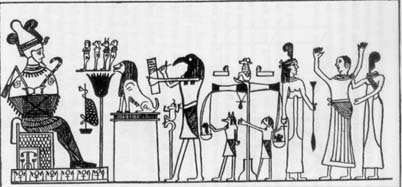
The whole allegory of Job is an open book to him who understands the picture-language of Egypt as it is recorded in the Book of the Dead. In the Scene of Judgment, Osiris is represented sitting on his throne, holding in one hand the symbol of life, "the hook of attraction," and in the other the mystic Bacchic fan. Before him are the sons of God, the forty-two assessors of the dead. An altar is immediately before the throne, covered with gifts and surmounted with the sacred lotus-flower, upon which stand four spirits. By the entrance stands the soul about to be judged, whom Thmei, the genius of Truth, is welcoming to this conclusion of the probation. Thoth holding a reed, makes a record of the proceedings in the Book of Life. Horus and Anubis, standing by the scales, inspect the weight which determines whether the heart of the deceased balances the symbol of truth, or the latter preponderates. On pedestal sits a bitch -- the symbol of the Accuser.
|
| The Great Hall of Truth or Judgment Seat of Osiris. Left to Right:
Osiris in judgment chair. A leopard skin, his banner. Four genii over closed
lotus flower, symbol of Mu. Great beast of Amenti. Thoth with Ibis head recording
history of the deceased. Anubis with jackal's head and Horus with hawk's
head weighing the heart in pair of scales against a feather. The deceased,
hands aloft exposing his heart, being led into the Hall of Truth by a feather
and being received by Maat, goddess of Truth. The bitch sits on top of the
balance scale...the accuser...later called Satan by the Christian church.
From the Egyptian "Book of the Dead". |
Initiation into the Mysteries, as every intelligent person knows, was dramatic representation of scenes in the underworld. Such was the allegory of Job.
Several critics have attributed the authorship of this book to Moses. But it is older than the Pentateuch. Jehovah is not mentioned in the poem itself; and if the name occurs in the prologue, the fact must be attributed to either an error of the translators, or the premeditation exacted by the later necessity to transform polytheism into a monotheistic religion. The plan adopted was the very simple one of attributing the many names of the Elohim (gods) to a single god. So in one of the oldest Hebrew texts of Job (in chapter xii. 9) there stands the name of Jehovah, whereas all other manuscripts have "Adonai." But in the original poem Jehovah is absent. In place of this name we find Al, Aleim, Ale, Shaddai, Adonai, etc. Therefore, we must conclude that either the prologue and epilogue were added at a later period, which is inadmissible for many reasons, or that it has been tampered with like the rest of the manuscripts. Then, we find in this archaic poem no mention whatever of the Sabbatical Institution; but a great many references to the sacred number seven, of which we will speak further, and a direct discussion upon Sabeanism, the worship of the heavenly bodies prevailing in those days in Arabia. Satan is called in it a "Son of God," one of the council which presents itself before God, and he leads him into tempting Job's fidelity. In this poem, clearer and plainer than anywhere else, do we find the meaning of the appellation, Satan. It is a term for the office or character of public accuser. Satan is the Typhon of the Egyptians, barking his accusations in Amenthi; an office quite as respectable as that of the public prosecutor, in our own age; and if, through the ignorance of the first Christians, he became later identical with the Devil, it is through no connivance of his own.
The Book of Job is a complete representation of ancient initiation, and the trials which generally precede this grandest of all ceremonies.
[[Vol. 2, Page]] 495 PERVERSIONS OF THE TEXT AND INTERPOLATIONS.
The neophyte perceives himself deprived of everything he valued, and afflicted with foul disease. His wife appeals to him to adore God and die; there was no more hope for him. Three friends appear on the scene by mutual appointment: Eliphaz, the learned Temanite, full of the knowledge "which wise men have told from their fathers -- to whom alone the earth was given"; Bildad, the conservative, taking matters as they come, and judging Job to have done wickedly, because he was afflicted; and Zophar, intelligent and skillful with "generalities" but not interiorly wise. Job boldly responds: "If I have erred, it is a matter with myself. You magnify yourselves and plead against me in my reproach; but it is God who has overthrown me. Why do you persecute me and are not satisfied with my flesh thus wasted away? But I know that my Champion lives, and that at a coming day he will stand for me in the earth; and though, together with my skin, all this beneath it shall be destroyed, yet without my flesh I shall see God. . . . Ye shall say: 'Why do we molest him?' for the root of the matter is found in me!"
This passage, like all others in which the faintest allusions could be found to a "Champion," "Deliverer," or "Vindicator," was interpreted into a direct reference to the Messiah; but apart from the fact that in the Septuagint this verse is translated:
"For I know that He is eternal
Who is about to deliver me on earth,
To restore this skin of mine which endures these things," etc.
In King James's version, as it stands translated, it has no resemblance whatever to the original. The crafty translators have rendered it, "I know that my Redeemer liveth," etc. And yet Septuagint, Vulgate, and Hebrew original, have all to be considered as an inspired Word of God. Job refers to his own immortal spirit which is eternal, and which, when death comes, will deliver him from his putrid earthly body and clothe him with a new spiritual envelope. In the Mysteries of Eleusinia, in the Egyptian Book of the Dead, and all other works treating on matters of initiation, this "eternal being" has a name. With the Neo-platonists it was the Nous, the Augoeides; with the Buddhists it is Aggra; and with the Persians, Ferwer. All of these are called the "Deliverers," the "Champions," the "Metatrons," etc. In the Mithraic sculptures of Persia, the ferwer is represented by a winged figure hovering in the air above its "object" or body. It is the luminous Self -- the Atman of the Hindus, our immortal spirit, who alone can redeem our soul; and will, if we follow him instead of being dragged down by our body. Therefore, in the Chaldean texts, the above reads, "My deliverer, my restorer," i.e., the Spirit who will restore the decayed body of man, and transform it into a clothing of ether. And it is this Nous, Augoeides, Ferwer, Aggra, Spirit of himself, that the triumphant Job shall see without his flesh -- i.e., when he has escaped from his bodily prison, and that the translators call "God."

|
Kali, the Goddess in her destructive
2:Shake yourself from the dust, arise, |
Not only is there not the slightest allusion in the poem of Job to Christ, but it is now well proved that all those versions by different translators, which agree with that of King James, were written on the authority of Jerome, who has taken strange liberties in his Vulgate. He was the first to cram into the text this verse of his own fabrication:
"I know that my Redeemer lives,
And at the last day I shall arise from the earth,
And again shall be surrounded with my skin,
And in my flesh I shall see my God."
All of which might have been a good reason for himself to believe in it since he knew it, but for others who did not, and who moreover found in the text a quite different idea, it only proves that Jerome had decided, by one more interpolation, to enforce the dogma of a resurrection "at the last day," and in the identical skin and bones which we had used on earth. This is an agreeable prospect of "restoration" indeed. Why not the linen also, in which the body happens to die?
And how could the author of the Book of Job know anything of the New Testament, when evidently he was utterly ignorant even of the Old one? There is a total absence of allusion to any of the patriarchs; and so evidently is it the work of an Initiate, that one of the three daughters of Job is even called by a decidedly "Pagan" mythological name. The name of Kerenhappuch is rendered in various ways by the many translators. The Vulgate has "horn of antimony"; and the LXX has the "horn of Amalthea," the nurse of Jupiter, and one of the constellations, emblem of the "horn of plenty." The presence in the Septuagint of this heroine of Pagan fable, shows the ignorance of the transcribers of its meaning as well as the esoteric origin of the Book of Job.
Instead of offering consolations, the three friends of the suffering Job seek to make him believe that his misfortune must have come in punishment of some extraordinary transgressions on his part. Hurling back upon them all their imputations, Job swears that while his breath is in him he will maintain his cause. He takes in view the period of his prosperity "when the secret of God was upon his tabernacles," and he was a judge "who sat chief, and dwelt as a king in the army, or one that comforteth the mourners," and compares with it the present time -- when vagrant Bedouins held him in derision, men "viler than the earth," when he was prostrated by misfortune and foul disease. Then he asserts his sympathy for the unfortunate, his chastity, his integrity, his probity, his strict justice, his charities, his moderation, his freedom from the prevalent sun-worship, his tenderness to enemies, his hospitality to strangers, his openness of heart, his boldness for the right, though he encountered the multitude and the contempt of families; and invokes the Almighty to answer him, and his adversary to write down of what he had been guilty.
[[Vol. 2, Page]] 497 JOB A SYMBOLICAL POEM UPON INITIATION.
To this there was not, and could not be, any answer. The three had sought to crush Job by pleadings and general arguments, and he had demanded consideration for his specific acts. Then appeared the fourth; Elihu, the son of Barachel the Buzite, of the kindred of Ram.
Elihu is the hierophant; he begins with a rebuke, and the sophisms of Job's false friends are swept away like the loose sand before the west wind.
"And Elihu, the son of Barachel, spoke and said: 'Great men are not always wise . . . there is a spirit in man; the spirit within me constraineth me. . . . God speaketh once, yea twice, yet man perceiveth it not. In a dream; in a vision of the night, when deep sleep falleth upon man, in slumberings upon the bed; then he openeth the ears of men, and sealeth their instruction. O Job, hearken unto me; hold thy peace, and I shall teach thee WISDOM.' "
And Job, who to the dogmatic fallacies of his three friends in the bitterness of his heart had exclaimed: "No doubt but ye are the people, and wisdom shall die with you. . . . Miserable comforters are ye all. . . . Surely I would speak to the Almighty, and I desire to reason with God. But ye are forgers of lies, ye are physicians of no value!" The sore-eaten, visited Job, who in the face of the official clergy -- offering for all hope the necessarianism of damnation, had in his despair nearly wavered in his patient faith, answered: "What ye know, the same do I know also; I am not inferior unto you. . . . Man cometh forth like a flower, and is cut down: he fleeth also as a shadow, and continueth not. . . . Man dieth, and wasteth away, yea, man giveth up the ghost, and where is he? . . . If a man die shall he live again? . . . When a few years are come then I shall go the way whence I shall not return. . . . O that one might plead for a man with God, as a man pleadeth for his neighbor!"
[[Footnote(s)]] -------------------------------------------------
* The expression "of the kindred of Ram" denotes that he was an Aramaean or Syrian from Mesopotamia. Buz was a son of Nahor. "Elihu son of Barachel" is susceptible of two translations. Eli-Hu -- God is, or Hoa is God; and Barach-Al -- the worshipper of God, or Bar-Rachel, the son of Rachel, or son of the ewe.
 and Ahriman
with the name of the gods of the land, Satan of the Hittites and diabolos,
or rather Diabolos, of the Greeks. The early Church, at least the Pauline
part of it, the Gnostics and their successors, further refined their ideas;
and the Catholic Church adopted and adapted them, meanwhile putting their
promulgators to the sword.
and Ahriman
with the name of the gods of the land, Satan of the Hittites and diabolos,
or rather Diabolos, of the Greeks. The early Church, at least the Pauline
part of it, the Gnostics and their successors, further refined their ideas;
and the Catholic Church adopted and adapted them, meanwhile putting their
promulgators to the sword.