|
This was a dream vision.
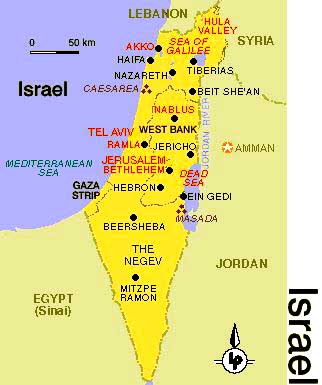
8-2-08 - I was looking at a map of Israel which was bright yellow.

I was lining up short little fat tubes across the center of the map.
(They looked like miniature salt shakers
and were colored pale yellow)
Over on the right side of Israel (along this line of tubes) in the
center just below where the name West Bank is and the cities of Jerusalem and Jericho
is, were splattered what looked like numerous pepper spots.
A floor hatch door was opened up in the middle of the map, along the center
line and two of the pale yellow tubes were put inside the hole below
and the floor hatch door closed again. This was done so that when the map was
turned upsidedown and shaken, no pepper would come out of those tubes.
Q. Were those tubes representing bombs?
Meditation: I asked for more information about my dream about Israel:
I saw a young woman in a party dress. She held up a glass to me (shaped like a
water glass)
that was 3/4 full of some kind of orangey/yellow liquid. She said,
"Come and help us
celebrate Thanksgiving".
Then I saw a group of people standing around in their pajamas and
bathrobes and all of
a sudden - the rug was pulled out from under them and they all fell
over.
end of visions
Q. When does Israel celebrate some kind of Thanksgiving?
http://www.youtube.com/watch?v=df2XzpVqzao video Israel
celebrates 60
http://www.youtube.com/watch?v=PpJGUDG1qPE&feature=related
video - The Birth of Israel
http://www.youtube.com/watch?v=L3sKCylTT74&feature=related
video - 1948 History of Israel - with
subtitles in English
http://www.youtube.com/watch?v=nNWgfei6wO8&feature=related
video May 14, 1948 - in English
|
|
FROM:
http://www.time.com/time/world/article/0,8599,1829750,00.html?imw=Y

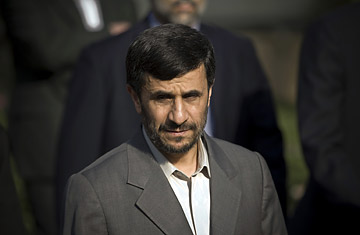
Iran's President Mahmoud Ahmadinejad
arrives at the
presidential office to attend a welcoming
ceremony for his
Syrian counterpart Bashar al-Assad in Tehran.
Morteza Nikoubazl / Reuters
When U.S. officials appeal to
the Iranian people over the heads
of its regime, they like to assume
that Tehran's defiance on the
nuclear issue reflects only the
extremist position of an
unrepresentative revolutionary
leadership. Plainly, they haven't
met Dr. Akbar Etemad, who ran the
nuclear program of the Shah's
regime, which was overthrown in
the Islamic Revolution of 1979.
The scientist who first launched
Iran's nuclear technology program
under a U.S.-backed regime in 1974
today urges the regime that
stripped him of his job to reject
any international demand that it
halt uranium enrichment.
Dr. Etemad told
an academic
conference in
Toronto last
weekend, "Iran
already stopped
nuclear enrichment
at the behest of
Europe for more than
a year [a reference
to Tehran's
suspension of
enrichment between
late 2003 and
mid-2005, to allow
negotiations with
the European Union].
And what happened?
Nothing."
Iran delivered
its response to the
latest Western offer
on the nuclear issue
to E.U. officials in
Brussels on Tuesday,
and reportedly
avoided any mention
of a freeze on
uranium enrichment.
Britain, France and
the U.S. have made
clear that the
consequence of Iran
turning down the
current offer will
be a push for
further U.N.
sanctions against
Tehran.
In an
interview with TIME,
the Swiss-educated
scientist who lives
in Paris and heads a
group of prominent
Iranian exiles that
lobby against a
military attack on
Iran, said the
solution to the
nuclear standoff lay
in re-establishing
relations between
Washington and
Tehran. Although a
senior U.S. diplomat
joined the
European-led
delegation that met
with Iranian
officials in Geneva
recently, Iran's
response to the
nuclear proposal may
make it difficult
for the Bush
Administration to
create a diplomatic
opening.
Surprising as
it may be to hear a
member of the Shah's
deposed regime
support the stance
of the Islamic
Republic in a
confrontation with
the West, there is
widespread concern
among Iran experts
that the current
Western strategy of
demanding that Iran
forego the right to
enrich uranium has
created a diplomatic
dead end.
Writing in the
International
Herald Tribune
last week, Trita
Parsi, President of
the National Iranian
American Council,
and analyst Anatol
Lieven, argued that
insisting Iran give
up its right to any
uranium enrichment
is untenable, and
instead suggested
that the Western
powers base their
demands on the
rights and
limitations of the
Nuclear
Non-Proliferation
Treaty — which would
allow the
international
community "to place
a verifiable cap on
Iranian enrichment
and other nuclear
capabilities well
short of
weaponization."
Dr. Etemad
agrees that the NPT,
which governs the
peaceful pursuit of
nuclear energy under
the supervision of
the U.N.'s
International Atomic
Energy Agency, holds
the key. "The
Americans, when they
need the NPT, they
talk about it; when
they don't need it,
they throw it away.
You don't do that
with an
international
treaty," he said.
Iran is a signatory
to the NPT, on the
basis of which it is
being held
accountable by the
United Nations
Security Council
over transparency
issues. But the NPT
allows signatories
the right to enrich
uranium, under IAEA
supervision, for
peaceful purposes.
The U.S. and its
allies fear that
even building a
peaceful enrichment
capability would
allow Iran to
covertly produce
weapons-grade
materiel, and have
argued that Tehran's
violations of
transparency and
disclosure
requirements of the
NPT should mean it
has forfeited its
right to enrich
uranium. But that
argument has so far
not been embraced by
the U.N. or the IAEA,
which reports there
is "no evidence that
Iran was working
actively to build
nuclear weapons."
Even though
Iran's known uranium
enrichment
activities occur
under the scrutiny
of IAEA inspectors,
the U.S. and its
European allies and
Israel suspect Iran
of pursuing nuclear
weapons capability.
The charge
infuriates Dr.
Etemad. "With the
Shah, we also came
to the conclusion
that Iran was in
great need of
nuclear energy
because our
population was
steadily growing and
our gas and oil will
run out. That's why
even though I was in
the old regime, I
should be fair to
the new regime
because they are
following the same
line. To speak
frankly, with its
bellicose behavior
the West is pushing
Iran towards nuclear
weapons, even if
they don't want them
now."
The latest
proposal from the
Western powers hoped
to break the
deadlock by
retreating from its
demand that Iran
shut down its
enrichment
activities as a
precondition for
talks. Instead, the
new proposal
suggests that Iran
simply refrain from
expanding its
current enrichment
program for six
weeks, during which
time the U.N.
Security Council
would refrain from
imposing new
sanctions. And in
that
"freeze-for-freeze"
interim, the two
sides would
negotiate a more
comprehensive deal.
But there's no sign
thus far that Tehran
is prepared to
accept even that
proposal.
"The Europeans
say stop enrichment
and we'll talk, but
the Iranians already
did that and nothing
happened," said Dr.
Etemad. "At the time
of the Shah, we
signed contracts
with both France and
Germany and even
then they didn't
deliver. If I were
in the current
regime, I wouldn't
trust the West. They
don't even give Iran
civilian airplane
parts, which is
costing hundreds of
lives; why should
they believe that
they will give them
enriched uranium?"
If that's the
position of a
liberal critic of
the regime, it's
likely that the
stance of the
current Iranian
leadership on the
nuclear issue enjoys
widespread support
among Iranians.
To be sure,
many Iranians also
fear the
consequences of
continued defiance.
"What if this hard
line means war?"
asked
daytime-mechanic,
nighttime-taxi
driver Bahram, 24,
in Tehran recently,
echoing concerns
heard from a number
of ordinary
Iranians.
"For years
now, they are
threatening us with
an attack," Dr.
Etemad said, adding,
"This is
humiliating. We are
not ants," referring
to an Esquire
interview with
Admiral William
Fallon about Iran
back in March, in
which he is reported
to have said, "These
guys are ants. When
the time comes, you
crush them."
"If you're
weak, they attack
you," says the
scientist. "If
you're not weak,
they won't attack
you. We have to be a
strong country and
end these
humiliating threats.
And being strong
means not listening
to the foreigners."
|
FROM:
http://www.fpif.org/fpiftxt/5445
The Iranian Chess Game Continues
William
O. Beeman | August 6, 2008
Editor: Erik Leaver
Foreign
Policy In Focus
Diplomacy between Iran and the United States has
entered the opening gambit stage and Iran appears to be
winning at this point.
The game began on July 19, when Iranian nuclear
negotiator, Saeed Jalili met with European negotiators
with an American diplomat, Under Secretary of State
William J. Burns, present for the first time at such a
meeting since the Iranian hostage crisis.
The presence of William J. Burns riled many
anti-Iranian forces resulting in a flurry of
pronouncements and articles about American "capitulation"
to Iran. The recriminations continued. Even now, on August
5, former U.N. Ambassador John Bolton, a notorious
anti-Iran detractor, wrote a fulminating article in the
Wall Street Journal entitled "While
Diplomats Dither, Iran Builds Nukes."
The Bush administration clearly found itself in a
difficult situation, needing to placate hawks like Bolton
and Vice-President Dick Cheney while seeming to allow
diplomacy to have a chance, so they made the talks not
about substance, but about power – which side could compel
the other to toe the line.
So the Bush administration started with a big lie. At
the time of the July meeting the press and the State
Department announced that Iran had a two-week deadline to
respond to the European proposals, (the exact details of
which remain secret, but which are presumed to include an
extensive basket of technology, economic, and trade
incentives).
There was no such deadline. It appears to have been a
fiction. However, this falsehood gave Washington and the
press the opportunity on August 2 to announce that Iran
had "rejected" the deadline. The
New York Times went so far as to call it an
"informal deadline," a head-scratching concept.
Iranian Foreign Minister, Manouchehr Mottaki was
reported by
Agence France Press to have said, "The language
of deadline-setting is not understandable to us. We gave
them our response within a month as we said we would, now
they have to reply to us."
Even the State Department itself had to back down from
the fictional deadline. State Department spokesman
Sean McCormack threatened further sanctions if Iran
did not respond on Wednesday, July 30. But he had changed
his tune on Saturday, August 2, the putative deadline. "I
didn't count the days. It's coming up soon," he said. And
when asked when Washington would pull incentives off the
table designed to persuade Iran to abandon its uranium
enrichment program, said "there is no indication of that.
So little happened at the July 19 meeting, it could
hardly be called a diplomatic encounter. In fact, Iran has
been pursuing a productive diplomatic course. Rather than
responding to deadlines and ultimatums, Iran has steadily
put forward proposals for resolving its differences with
the European and American governments over its nuclear
energy program. It is clear that Iran will not give up its
"inalienable right" to peaceful development of nuclear
energy, as enshrined in Article IV of the Nuclear
Non-Proliferation Treaty, to which it (but not India,
Pakistan or Israel) is a signatory. It seeks other means,
short of suspending uranium enrichment, to assure the
world that it has no active nuclear weapons program.
Iran's proposal for negotiations presented to the
European Nations is titled "The
Modality For Comprehensive Negotiations" and sets out
three stages of proceedings:
Preliminary Talks. Overall
determination of the negotiating timetable.
Start of Talks. Actions against Iran
would be suspended and common ground matters would be
discussed.
Negotiations. Actual negotiating
stage which the Iranians envision should last two
months, but could be extended by mutual consent.
Iran does not agree in this document to suspend uranium
enrichment. The document states in the negotiation stage
that determinations regarding Iran's compliance with the
Nuclear Non-proliferation treaty would be "concluded in
the UNSC [United Nations Security Council] and fully and
completely returned to the Agency [The International
Atomic Energy Agency]."
This is a reasonable blueprint for forward
negotiations, and it represents a real diplomatic effort
on Iran’s part. By contrast, the United States seems to
have acted with a combination of bluff and muscle, and has
gotten nowhere for their efforts.
This has not stopped the United States and its European
allies for
calling on August 4 for more sanctions based on Iran's
violation of the "informal deadline." This is an
astonishing exercise in diplomatic audacity – calling for
punishment where there could be no violation, there being
no mutual agreement of the conditions under which actions
would be declared a violation. Unfortunately, the
political climate against Iran being what it is, such an
unwarranted bellicose move will likely go unquestioned.
Except by Iran.
Iran had its own gambits in mind to retain control of
the process. After the accusations and the threats by the
European and U.S. consortium, they countered with a grim
reminder that they could close the Strait of Hormuz,
through which two-thirds of OPEC crude oil passes. They
tested some new conventional missiles. Then they
announced that they would indeed answer the European
proposals – but in their own time and on their own
timetable, according to their own agenda. They were
clearly working through their own negotiation plan step by
step, catching the United States off guard, and throwing
everyone in Washington off their game, leaving them to
continue their slow burn.
The question is whether, out of frustration or pique,
the impatient Washington detractors will upset the
table.
Foreign Policy In Focus
contributor William O. Beeman is professor and chair of
the department of anthropology at the University of
Minnesota, Minneapolis. He is president of the Middle East
Section of the American Anthropological Association and
the author, most recently, of The "Great Satan" vs. the
"Mad Mullahs": How the United States and Iran Demonize
Each Other.
|
|
Israel mulls military option for Iran nukes
By STEVEN GUTKIN, Associated Press Writer
8-6-08
JERUSALEM -
Israel is building up its strike capabilities
amid growing anxiety over
Iran's nuclear ambitions and appears confident
that a military attack would cripple Tehran's atomic
program, even if it can't destroy it.
Such talk could be more threat than reality.
However, Iran's refusal to accept Western conditions
is worrying Israel as is the perception that
Washington now prefers diplomacy over confrontation
with Tehran.
The Jewish state has purchased 90 F-16I fighter
planes that can carry enough fuel to reach Iran, and
will receive 11 more by the end of next year. It has
bought two new Dolphin submarines from Germany
reportedly capable of firing nuclear-armed warheads —
in addition to the three it already has.
And this summer it carried out air maneuvers in the
Mediterranean that touched off an international debate
over whether they were a "dress rehearsal" for an
imminent attack, a stern warning to Iran or a just a
way to get allies to step up the pressure on Tehran to
stop building nukes.
According to foreign media reports, Israeli
intelligence is active inside Iranian territory.
Israel's military censor, who can impose a range of
legal sanctions against journalists operating in the
country, does not permit publication of details of
such information in news reports written from Israel.
The issue of Iran's nuclear program took on new
urgency this week after U.S. officials rejected
Tehran's response to an incentives package aimed at
getting it to stop sensitive nuclear activity —
setting the stage for a fourth round of international
sanctions against the country.
Israel, itself an undeclared nuclear power, sees an
atomic bomb in Iranian hands as a direct threat to its
existence.
Israel believes Tehran will have enriched enough
uranium for a nuclear bomb by next year or 2010 at the
latest. The United States has trimmed its estimate
that Iran is several years or as much as a decade away
from being able to field a bomb, but has not been
precise about a timetable. In general U.S. officials
think Iran isn't as close to a bomb as Israel claims,
but are concerned that Iran is working faster than
anticipated to add centrifuges, the workhorses of
uranium enrichment.
"If Israeli, U.S., or European intelligence gets
proof that Iran has succeeded in developing nuclear
weapons technology, then Israel will respond in a
manner reflecting the existential threat posed by such
a weapon," said
Israeli
Deputy Prime Minister Shaul Mofaz, speaking at
a policy forum in Washington last week.
"Israel takes (Iranian President) Mahmoud
Ahmadinejad's statements regarding its destruction
seriously. Israel cannot risk another
Holocaust," Mofaz said.
The Iranian leader has in the past called for
Israel's elimination, though his exact remarks have
been disputed. Some translators say he called for
Israel to be "wiped off the map," while others say a
better translation would be "vanish from the pages of
time" — implying Israel would disappear on its own
rather than be destroyed.
Iran insists its uranium enrichment is meant only
for electricity generation, not a bomb — an assertion
that most Western nations see as disingenuous.
Israeli policymakers and experts have been debating
for quite some time whether it would even be possible
for Israel to take out Iran's nuclear program. The
mission would be far more complicated than a 1981
Israeli raid that destroyed Iraq's partially built
Osirak nuclear reactor, or an Israeli raid last year
on what U.S. intelligence officials said was another
unfinished nuclear facility in
Syria.
In Iran, multiple atomic installations are
scattered throughout the country, some underground or
bored into mountains — unlike the Iraqi and Syrian
installations, which were single aboveground
complexes.
Still, the Syria action seemed to indicate that
Israel would also be willing to use force preemptively
against Iran.
"For Israel this is not a target that cannot be
achieved," said Maj. Gen. Aharon Zeevi-Farkash, former
head of Israel's army intelligence.
However, it's unlikely Israel would carry out an
attack without approval from the United States.
Recent signs that Washington may be moving away
from a military option — including a proposal to open
a low-level U.S. diplomatic office in Tehran and a
recent decision to allow a senior U.S. diplomat to
participate alongside Iran in international talks in
Geneva — are not sitting very well with Israel.
That may help explain recent visits to
Jerusalem by Mike McConnell, the U.S. director
of national intelligence, and Adm.
Michael
Mullen,
chairman
of the Joint Chiefs of Staff, each of whom
delivered a message to Israel that it does not have a
green light to attack Iran at this time.
Senior Israeli officials, speaking on condition of
anonymity because they do not wish to appear at odds
with their most important ally, said they were
concerned about a possible softening of the U.S.
stance toward Iran.
Apparently to allay Israeli concerns, Bush
administration officials last week assured visiting
Israeli Defense Minister
Ehud Barak that the U.S. has not ruled out the
possibility of a military strike on Iran. And the
U.S., aware of Israel's high anxiety over Iran's
nukes, is also hooking Israel up to an advanced
missile detection system known as X-Band to guard
against any future attack by Iran, said a senior U.S.
defense official, who spoke on condition of anonymity
because the discussions over the issue have not been
made public.
With sanctions and diplomacy still the
international community's preferred method to get Iran
to stop building the bomb, an Israeli strike does not
appear imminent.
If it did attack, however, Israel would have to
contend with upgraded Iranian defense capabilities,
including 29 new Tor-M1
surface-to-air missile systems Iran purchased
from
Russia last year in a $700 million deal.
Russia has so far not gone through with a proposed
sale to Iran of S-300 surface-to-air missiles, an even
more powerful air defense system than the Tor-M1. An
Israeli defense official said the deal is still on the
table, however. This is a big source of consternation
for Israel because the system could significantly
complicate a pre-emptive Israeli assault on Iran.
Military experts say an Israeli strike would
require manned aircraft to bombard multiple targets
and heavy precision bombs that can blast through
underground bunkers — something Israel failed to do in
its 2006 war against Hezbollah. It's widely assumed
that Israel is seeking to obtain bunker buster bombs,
if it hasn't already done so.
Elite ground troops could also be necessary to
penetrate the most difficult sites, though Israeli
military planners say they see that option as perhaps
too risky.
America's ability to take out Iran's nuclear
facilities is far superior to Israel's.
Unlike Israel, the United States has cruise
missiles that can deliver high-explosive bombs to
precise locations and B-2 bombers capable of dropping
85 500-pound bombs in a single run.
Yet the cost of an attack — by the U.S., Israel or
both — is likely to be enormous.
Iran could halt oil production and shut down tanker
traffic in the strategic Strait of Hormuz, which could
send the price of crude skyrocketing and wreck Western
economies.
It could stir up trouble for the U.S. in
Iraq
by revving up Shiite militias there just as Washington
is showing some important gains in reining in Iraqi
chaos.
It could activate its militant proxies in both
Lebanon
and the
Gaza Strip, from where Israel could come under
heavy rocket attack. And it could strike Israel with
its arsenal of Shahab-3 long-range missiles —
something Israel is hoping to guard against through
its
Arrow missile defense system.
Perhaps most importantly, any strike on Iran —
especially if it's done without having exhausted all
diplomatic channels — could have the opposite of the
desired effect, "actually increasing the nationalist
fervor to build a nuclear weapon," said Meir
Javedanfar, an Iranian-born Israeli and expert on
Iranian affairs.
Whether an attack on Iran would be worth its cost
would depend on how long the nuclear program could be
delayed, said Chuck Freilich, a former Israeli deputy
national security adviser and now a senior fellow at
the
Harvard Kennedy School.
"A two, three-year delay is not worth it. For a
five to 10-year delay I would say yes," he said.
___
Associated Press Writers Anne Gearan and Lolita C.
Baldor contributed to this report from Washington.
|
08/05/08
FROM:
http://www.thepeoplesvoice.org/cgi-bin/blogs/voices.php/2008/08/05/we_re_all_in_the_same_boat_and_it_s_sink
We're all in the same boat and it's
sinking fast
Greg Bacon
Think the Bush/Cheney Junta only started its
illegal domestic spying program AFTER 9/11?
Wrong.
Project Groundbreaker began within weeks of Bush
assuming the purloined presidency, back in February
2001.
Washington, You're Fired
Still get misty-eyed when you hear someone sing
"God Bless America?" So do I, but not out of some
misguided sense of loyalty.
For, how can one have loyalty to a country, the
USA, that no longer exists?
Between the heinous "Patriot Act," the "Military
Commissions Act," the revised FISA law and the
numerous Presidential Executive Orders that are
eviscerating our freedoms,
we no longer have a functioning Bill of Rights.
And without a Bill of Rights, there is no longer
an "America the Beautiful."
What else can one say to
presidential decrees that can strip away the
rights enshrined in the Bill of Rights on one person's
dictate--Some Americans have already found out the
hard way that rights guaranteed to We the People by
the Constitution have been rescinded, one one man's
whim, to prosecute his ill-named "War on Terror."
The only war that is being waged is a war
against the Bill of Rights and our freedoms and so
far, the other side is batting a .1000.
We're one more false-flag event away from
completely losing the minuscule amount of freedoms the
Bush/Cheney Junta have allowed us to still retain.
"Anyone is only worth the price of one bullet"
Freedom from warrantless searches?
Gone.
Who knows, the government might have already
slipped in to your house, unknown and installed
spyware on your computer... Or worse, installed some
kind of child pornography that they will use later to
convict you of crimes you didn't commit, just to shut
you the hell up.
Freedom of Assembly?
Gone.
Unless you call being forced to protest a mile
away from your desired site and being shut up behind
barb wired enclosures, with heavily armed police goon
squads patrolling the perimeter, ready and waiting to
crack your skull for uttering such seditious chants as
"Give Peace a Chance."
Free to apply for a writ of habeas corpus?
Gone.
The Bush/Cheney Junta now have the
Congressionally mandated right to toss you into to
prison and deny you access to a lawyer and deny your
petition to be freed pending trial. Hell, they don't
even have to show you the evidence, since that is a
"national secret" that would impede the "War on
Terrror."
Freedom of religion?
Gone.
Unless you're a member of your local synagogue
or one of the knuckle-dragging, mouth breathers that
slavishly follow that "Man of God," John Hagee, whose
idea of spreading love is to drop a couple of 150
kiloton nukes on ME countries that he and Israel don't
like.
Freedom from excessive bail and cruel and
unusual punishments?
Gone.
Just ask Sami Al-Arian, now in his sixth year of a
hellish existence that has seen the feds go back on
deals and lie to get Mr. Al-Arian convicted by any
means.
His crime? He's a Muslim, and worse, a
Palestinian that has had some success in combating the
ignorance and prejudice in the ME debate.
Sami Al-Arain's main inquisitor? A federal
prosecutor by the name of KROMBERG. Go figure.
When that next MOSSAD/CIA false-flag hits
America--again--it will be goodbye to the Internet and
Hello to the American Gulag.
But, don't worry about the Bush/Cheney Junta
gang-raping the Bill of Rights.
Why, there's a special on Lindsey Lohan coming
up on CNN.
Don't concern yourself with the Bill of Rights
being used for toilet paper by the Boy King, Bush.
Why, I need to get to the store to buy the
latest copy of "National Enquirer."
When your front door gets kicked down at 3 am,
by machinegun wielding Blackwater thugs, don't worry.
After all, you're innocent, Right?
What if every email, every phone call; every time you
surfed the Internet, your private communications were
being siphoned into a gigantic dragnet funded by a
forty-five billion dollar budget and carried out in
cooperation with the FBI, AT&T, and Verizon?
“Washington, You’re Fired” presents compelling
first-hand testimony and whistleblower accounts,
punching holes in the official "war on terrorism"
excuse that has been used to dismantle the U.S. Bill
of Rights and tip the scales of executive checks and
balance in this country.
|
|
FROM:
http://online.wsj.com/article/SB121789278252611717.html?mod=googlenews_wsj
While Diplomats
Dither,
Iran Builds Nukes
By JOHN R. BOLTON
August 5, 2008
This weekend, yet another "deadline" passed
for Iran to indicate it was seriously ready to discuss ending
its pursuit of nuclear weapons. Like so many other deadlines
during these five years of European-led negotiations, this one
died quietly, with Brussels diplomats saying that no one
seriously expected any real work on a Saturday.
The fact that the Europeans are right -- this
latest deadline is not fundamentally big news -- is precisely
the problem with their negotiations, and the Bush
administration's acquiescence in that effort.
The rationality of continued Western
negotiations with Iran depends critically on two assumptions:
that Iran is far enough away from having deliverable nuclear
weapons that we don't incur excessive risks by talking; and
that by talking we don't materially impede the option to use
military force. Implicit in the latter case is the further
assumption that the military option is static -- that it
remains equally viable a year from now as it is today.
Neither assumption is correct. Can we believe
that if diplomacy fails we can still take military action "in
time" to prevent Iranian nuclear weapons? "Just in time"
nonproliferation assumes a level of intelligence certainty
concerning Iran's nuclear program that recent history should
manifestly caution us against.
Every day that goes by allows Iran to
increase the threat it poses, and the viability of the
military option steadily declines over time. There are a
number of reasons why this is so.
First, while the European-led negotiations
proceed, Iran continues both to convert uranium from a solid
(uranium oxide, U3O8, also called yellowcake) to a gas
(uranium hexafluoride, UF6) at its uranium conversion facility
at Isfahan. Although it is a purely chemical procedure,
conversion is technologically complex and poses health and
safety risks.
As Isfahan's continuing operations increase
both Iran's UF6 inventory and its technical expertise,
however, the impact of destroying the facility diminishes.
Iran is building a stockpile of UF6 that it can subsequently
enrich even while it reconstructs Isfahan after an attack, or
builds a new conversion facility elsewhere.
Second, delay permits Iran to increase its
stock of low-enriched uranium (LEU) -- that is, UF6 gas in
which the U235 isotope concentration (the form of uranium
critical to nuclear reactions either in reactors or weapons)
is raised from its natural level of 0.7% to between 3% and 5%.
As its LEU stockpile increases, so too does
Tehran's capacity to take the next step, and enrich it to
weapons-grade concentrations of over 90% U235 (highly-enriched
uranium, or HEU). Some unfamiliar with nuclear matters
characterize the difference in LEU-HEU concentration levels as
huge. The truth is far different. Enriching natural uranium by
centrifuges to LEU consumes approximately 70% of the work and
time required to enrich it to HEU.
Accordingly, destroying Iran's enrichment
facility at Natanz does not eliminate its existing enriched
uranium (LEU), which the IAEA estimated in May 2008 to be
approximately half what is needed for one nuclear weapon. Iran
is thus more than two-thirds of the way to weapons-grade
uranium with each kilogram of uranium it enriches to LEU
levels. Moreover, as the LEU inventory grows, so too does the
risk of a military strike hitting one or more UF6 storage
tanks, releasing potentially substantial amounts of
radioactive gas into the atmosphere.
Third, although we cannot know for sure,
every indication is that Iran is dispersing its nuclear
facilities to unknown locations, "hardening" against air
strikes the ones we already know about, and preparing more
deeply buried facilities in known locations for future
operations. That means that the prospects for success against,
say, the enrichment facilities at Natanz are being reduced.
Fourth, Iran is clearly increasing its
defensive capabilities by purchasing Russian S-300
antiaircraft systems (also known as the SA-20) directly or
through Belarus. In late July, Secretary of Defense Robert M.
Gates and his spokesman contradicted Israeli contentions that
the new antiaircraft systems would be operational this year.
Assuming the Pentagon is correct, its own assessment on timing
simply enhances the argument for Israel striking sooner rather
than later.
Fifth, Iran continues to increase the
offensive capabilities of surrogates like Syria and Hezbollah,
both of which now have missile capabilities that can reach
across Israel, as well as threaten U.S. troops and other U.S.
friends and allies in the region. It may well be Syria and
Hezbollah that retaliate initially after an Israeli strike on
Iran's nuclear facilities, thus making further strikes against
Iran more problematic, at least in the short run.
Iran is pursuing two goals simultaneously,
both of which it is comfortably close to achieving. The first
-- to possess all the capabilities necessary for a deliverable
nuclear weapon -- is now almost certainly impossible to stop
diplomatically. Thus, Iran's second objective becomes
critical: to make the risks of a military strike against its
program too high, and to make the likelihood of success in
fracturing the program too low. Time favors Iran in achieving
these goals. U.S. and European diplomats should consider this
while waiting by the telephone for Iran to call.
Mr. Bolton, a senior fellow at the
American Enterprise Institute, is the author of "Surrender Is
Not an Option: Defending America at the United Nations" (Simon
& Schuster, 2007).
|
We lie and bluster about our nukes - and then
wag our fingers at Iran
By failing to disarm and breaking the rules
when it suits, nuclear states are driving proliferation as much as
Ahmadinejad
The Guardian,
Tuesday July 29 2008
What is the Iranian government up to? For once the imperial
coalition, overstretched in Iraq and unpopular at home, is
proposing jaw, not war. The UN security council's offer was a good
one: if Iran suspended its uranium enrichment programme, it would
be entitled to legally guaranteed supplies of fuel for nuclear
power, assistance in building a light water reactor, foreign aid,
technology transfer and the beginning of the end of economic
sanctions. The US seems prepared, for the first time since the
revolution, to open a diplomatic office in Tehran. But in Geneva,
10 days ago, the Iranians filibustered until the negotiations
ended. On Saturday President Ahmadinejad announced that Iran has
now doubled the number of centrifuges it uses to enrich uranium. A
fourth round of sanctions looks inevitable.The
unequivocal statements Barack Obama and Gordon Brown made in
Israel last week about Iran's nuclear weapons programme cannot yet
be justified. Nor can the unequivocal statements by some anti-war
campaigners that Iran does not intend to build the bomb. Why would
a country with such reserves of natural gas and so great a
potential for solar power suffer sanctions and the threat of
bombing to make fuel it could buy from other states, if it
accepted the UN's terms?
Those who maintain that Iran's purposes are peaceful clutch
at the National Intelligence Estimate published by the US
government in November. While it judged that Iran had halted its
nuclear weapons programme in 2003, it saw the country's civilian
uranium programme as a means of developing "technical capabilities
that could be applied to producing nuclear weapons, if a decision
is made to do so". The latest report from the International Atomic
Energy Agency notes that no fissile material has been diverted
from Iran's stocks, but raises grave questions about some of the
documents it has found, which suggest research into bomb-making
(Iran says the papers are forgeries). Those of us who oppose an
attack on Iran are under no obligation to accept Ahmadinejad's
claims of peaceful intent.
Nor do we have to accept the fictions of our own
representatives. The security council's offer to Iran claimed that
resolving this enrichment issue would help to bring about a
"Middle East free of weapons of mass destruction". But like every
other such document, it made no mention of the principal owner of
weapons in the region: Israel. According to a leaked briefing by
the US Defence Intelligence Agency, Israel possesses between 60
and 80 nuclear bombs. But none of the countries demanding that
Iran scraps the weapons it doesn't yet possess are demanding that
Israel destroys the weapons it does possess.
This subject is the great political taboo. Neither Brown nor
Obama mentioned it last week. The US intelligence agencies provide
a biannual report to Congress on the weapons of mass destruction
developed by foreign states, which covers Iran, North Korea,
India, Pakistan and others, but not Israel. During a parliamentary
debate in March the British defence minister Bob Ainsworth was
asked whether he thought that Israel's nuclear weapons are "a
destabilising factor" in the Middle East. "My understanding," he
replied, "is that Israel does not acknowledge that it has nuclear
weapons." Does Mr Ainsworth really buy this nonsense? If so, can
we have a new minister? If Iran builds a bomb, it will do so for
one reason: that there is already a nuclear-armed state in the
Middle East, by which it feels threatened.
But we make the rules and we break them. The
non-proliferation treaty (NPT) obliges the five official nuclear
states, of which the UK is one, to work towards "general and
complete disarmament". On Friday, the Guardian published the notes
for a speech made last year by a senior civil servant, which
suggested that the decision to replace the UK's nuclear missiles
had already been made, in secret and without parliamentary
scrutiny. Since then defence ministers have told the Commons on
five occasions that the decision has not yet been made. They
appear to have misled the House.
At the Geneva conference on disarmament in February, one
delegate pointed out that the "chances of eliminating nuclear
weapons will be enhanced immeasurably" if non-nuclear states can
see "planning, commitment and action toward multilateral nuclear
disarmament by nuclear weapon states" like the UK. If the nuclear
states "are failing to fulfil their disarmament obligations",
other nations would use this as an excuse for maintaining their
weapons. Who was this firebrand? Des Browne, the secretary of
state for defence. A man of the same name is failing to fulfil our
disarmament obligations.
Browne claims that Britain must maintain its arsenal because
of proliferation elsewhere, just as those proliferating elsewhere
say that they must develop their arsenals because the official
nuclear nations aren't disarming. With the exception of France,
none of the other European states feels the need to deploy nukes.
But the UK keeps preparing for the last war. Of course, no one is
refusing to disarm; it's just that the task keeps getting pushed
into the indefinite future. Opponents of British nuclear weapons
maintain that a new generation of warheads would survive until
2055.
The permanent members of the UN security council draw a
distinction between their "responsible" ownership of nuclear
weapons and that of the aspirant powers. But over the past six
years, the UK, US, France and Russia have all announced that they
are prepared to use their nukes pre-emptively against a presumed
threat, even from states that do not possess nuclear weapons. In
some ways the current nuclear stand-off is more dangerous than the
tetchy detente of the cold war.
The danger has been heightened by the US government's
current offensive. Condoleezza Rice, the secretary of state, is
demanding that other countries accept her plans to destroy the
last remaining incentive for states to abide by the NPT. The
treaty grants countries which conform to it materials for nuclear
power on favourable terms. It's a flawed incentive - as the spread
of civil nuclear programmes makes the proliferation of military
material more likely - but an incentive nonetheless. Now Rice
insists that India should have special access to US nuclear
materials despite the fact that it has not signed the NPT and has
illegally developed nuclear weapons.
If she is successful, this effort - and the concomitant US
demand that India is recognised as an official nuclear power -
will blow the NPT to kingdom come. The treaty which survived the
cold war, and which remains the most important of the wilting
guarantees against global annihilation, is being nuked for the
sake of a few billion dollars of export orders.
Here's where it gets really depressing. The Bush
administration's proposal has been supported by both John McCain
and Barack Obama. The contrast between Obama's position on India
and his statements on Iran could not be greater, or more
destructive of the inflated hopes now vested in him.
Mahmoud Ahmadinejad's insistence that Iran enriches its own
fissile material, and the guessing game he is playing with Israel,
the atomic energy agency and the UN security council is
irresponsible and staggeringly dangerous. But if I were in his
position I might be tempted to do the same.
www.monbiot.com
|
|
FROM:
http://www.israelenews.com/view.asp?ID=2768
Faith,
nukes, and the Promised Land`s borders
Zionism - on Monday, July 28, 2008 -
By: Shoher,
Obadiah
Faith doesn’t require us to test God as Jews did at
Meribah, though with relative success. Rather, we should
expect that at some point God offers us an opportunity
which we must seize. Leftists believe in reforming
societies on grand scale; we, the true liberals, must be
on lookout for mini-opportunities to further the goals
supported by our faith.
It’s not a problem of Begin or Sharon. Jews just don’t
believe in the burning bush anymore. And without a
degree of faith the project of Israel is doomed. Secular
Jews don’t believe the land is ours. Haredi Jews
comfortably shrink into the prayer shawls and close
their eyes to the world outside.
Faith of some is the only barrier to assimilation of
all. Already in the eighteenth century – and probably
much earlier – Jewish communities of Russia were
striving for religious liberalization. Few people were
living according to the rigid Shulhan Aruch laws, and
observance was superficial for the most part. As a great
Jewish writer Sholom Aleichem recalls, his grandma
scolded his father for being irreligious even though he
wore long hair locks. But the communities were kept
Jewish by the immense spiritual power of a few rabbis.
What was that power?
I think I know it because I’ve met a handful of such
rabbis who made secular, even atheist Jews deeply
religious after talking with them for an hour or two on
unrelated subjects. It is faith. If the empty
ideological zeal of communist agitators was contagious,
faith is infinitely more so. People are not only bodies,
but also minds; not only individual, but also
collective.
In the age of fast-paced developments, when new orders
crumble almost as soon as they appear, people long for
simple and stable things. Faith is straightforward,
stable, and provides an excellent sense of communal
identity. No amount of extra-smart educational theories
and seminars on Jewishness would make the Jews Jewish.
By far the most rabbis – in fact, almost all of them –
have long lost the power of persuading their flock
because they are not persuaded themselves.
They just no longer believe in the simple truths that
God physically revealed himself on the Mount Sinai,
consumed animal sacrifices with fire, and commanded Jews
to fight for the Promised Land. Too many of them don’t
even believe in God as the super-intelligent being who
listens to our prayers.
The communal is inherently irrational. No rational
argument can convince people to stick with others whose
ancestors also happened to be Jewish, in the tiny speck
of endangered land among the sea of Muslim enemies.
Rational analysis surely suggests to move out, or not to
move in. No amount of rational argument, of books and
discourses would ever make the fledging Jews Jewish.
Only the personal touch of faith can do it, only the
personal communication with the very few true rabbis.
With every year, they are in lesser supply; the new
generation just doesn’t produce these eyes anymore,
these faces lighting with faith.
Salvation comes only through faith.
The opinions and views
articulated by the author do not necessarily reflect
those of Israel e News.
|
| Israel's Debate Over an Iran Strike
July 25, 2008
By TIM MCGIRK AND AARON J. KLEIN / JERUSALEM
Fri Jul 25, 2008
Despite
President Bush's insistence that the military option
remains "on the table" for dealing with
Iran's nuclear program, Israeli officials have
recognized that a U.S. air strike on Iranian nuclear sites is
increasingly unlikely in the waning days of the Bush
Administration. The Israelis, along with everyone else, are
now counting on European-led
diplomatic
efforts to persuade the Iranians to halt their
uranium-enrichment program. But they know diplomacy may fail,
which is why a debate now rages in the highest circles of
Israel's government and military: If the Europeans fail and
the Americans remain reluctant to launch another
war in the
Middle East, should
Israel strike alone against
Iran?
When President Bush visited Israel in mid-May,
senior Israeli leaders came away from talks
confident that the U.S. would attack Iran if it
refused to stop enriching uranium. Says one top
Israeli military planner privy to Israel's
discussions with the U.S. on Iran, "We were under
the illusion during Bush's last visit that he was
much more determined to order a military action."
No longer.
Last week's U-turn, in which the Bush
Administration sent a high-ranking State
Department official to
join
the European delegation meeting Iran's
top nuclear negotiator, and the proposal to open a
U.S. Interests Section to handle consular matters
in Tehran - which would be the first U.S.
diplomatic presence in Iran since its embassy was
stormed in 1979 - has stunned Israeli officials.
So dismayed were the Israelis by the latest U.S.
moves, one military source told TIME, that
Prime Minister Ehud Olmert wrote to Bush
complaining that Israel should have been
forewarned about the White House's abrupt change
of course towards Iran.
Just last month, Israel conducted a complex
military exercise involving over 150 aircraft
flying 900 miles over the Mediterranean Sea, that
was widely interpreted as a rehearsal for an air
strike against Iran's dozens of nuclear
facilities. A top former officer from Mossad, the
Israeli equivalent of the CIA, told TIME that
Israel is mindful that an air strike on Iran would
jolt
the U.S. presidential election -
probably rebounding badly on Republican contender
Senator John McCain. Sources say that
Israel sees a narrow "window of opportunity" for
military action opening up between November and
the swearing-in of the new American president next
January. "No Israel leader wants to be blamed for
destroying the Republican chances," says the
former Mossad officer.
But will Israel really go it alone and
attack Iran if talks break down, or is the threat
simply a bluff aimed at prompting the U.S. and
Europe to step up the pressure on Tehran? Until
now, Israel has been using a "hold me back, or
I'll do something crazy" tactic, concedes the ex-Mossad
officer.
The Israelis do believe time is short. An
Israeli military planner estimates that Iran will
reach "the point of no return" in developing the
capacity to build nuclear weapons by early 2009.
The U.S. sees things differently, he says,
calculating that Iran will have enriched enough
uranium to weapons-grade to be able to build a
bomb by mid-2010. Both scenarios, says the Israeli
planner, "give them some leeway for negotiations,
but not much."
Despite Israel's top-notch air force,
launching a long-range strike against a multitude
of hidden targets in Iran entails huge risks and
uncertain rewards. At most, say Israeli
intelligence sources, an attack - which Israel
would only undertake with a nod and perhaps
logistical support from the U.S. - is likely to
stall Iran's program by only a year or two. And
that makes the cost-benefit analysis weigh against
an air strike on Iran, according to some senior
Israeli officials who urge caution.
Active and retired Israeli intelligence
officials interviewed by TIME tended to dismiss
Iran's threats of retaliation against Israel and
the U.S. Ephraim Halevy, the previous Mossad chief
who now heads the Center for Strategic and Policy
Studies at Hebrew University in
Jerusalem, says, "Iran is not 10 feet
tall." Halevy contends that a barrage of Iran's
missiles on Israel would not do too much damage,
since dozens would be shot down by Israel's
advanced anti-missile system. (Iran staged a
missile test recently in which the published photo
had been doctored to hide the fact that one of the
fired missiles was a dud.) Halevy claims that "the
relative success" of the
U.S. military's surge in
Iraq has curtailed Iran's capacity for
mischief among its Shi'ite brethren in Iraq. He
also doubts that Iran's ally
Syria, which has long-range missiles, or
its
Hizballah and
Hamas allies would risk a major dust-up
merely to exact revenge on Iran's behalf. Still,
Halevy warns that the long-term effects of
attacking Iran could be devastating for Israel,
and the region. "This could have an impact on us
for the next 100 years," he says. "It will have a
negative effect on public opinion in the Arab
world, and we should only do [a strike on Iran] as
a last resort."
Meir Javedanfar a respected, Iranian-born
writer and analyst specializing in Israel-Iranian
relations, warns that an Israeli attack would
unite Iranians around their hawkish president,
Mahmoud Ahmadinejad. "This would guarantee that
Ahmadinejad wins next year's elections," says
Javendafari, who says that right now the
incumbent's reelection is in doubt because of the
economic hardship he has brought to Iran's middle
classes.
Whatever the real prospects for military
action, in the game of rhetorical brinksmanship,
Israel has matched every hot-headed statement from
Ahmadinejad with threats of its own. The Israeli
press often compares Iran's bellicose,
Holocaust-denying leader to Hitler. In the
past few months, rightwing Israeli politicians,
retired generals and pundits have ratcheted up
rhetoric calling on Olmert to quash the
"existential threat" from Iran. But lately, these
war cries have been toned down, in part, to
prepare the Israeli public for the possibility
that it will not attack Iran on its own.
Says one former senior Mossad officer who
served under Olmert, "Iran's achievement is
creating an image of itself as a scary superpower
when it's really a paper tiger." In Tehran,
meanwhile, more sober heads among the clerical
leadership whose authority is greater than that of
the president's are reining in Ahmadinejad, says
Javedanfar. After a public scolding in a
conservative newspaper by a top aide to the Iran's
Supreme Leader, Ayatollah Ali Khamenei,
Ahmadinejad several weeks ago publicly declared
that Iran has no intention of attacking Israel or
anyone else unless it was hit first. Halevy
concurs. "I don't detect an appetite among the
Iranians to bring about a catastrophe." But, he
cautions, "There's a narrowing gap of opportunity
for negotiations."
The danger remains in this high-stakes game
of brinksmanship that either Israel or the
Iranians could push the other too far. But the
Bush Administration's sudden overture towards
Iran, and moves towards engaging it diplomatically
in search of a solution to the nuclear impasse,
makes it more likely that Israel will follow
Washington's lead rather than striking out on its
own. View this article on
Time.com
Related articles on Time.com:
|
|
Friday, July 25, 2008
The Last Stand of the West
by Mary Katharine Ham
Note:
America—and the West as a
whole—cannot afford to ignore the
battles waged, lessons learned and
indignities suffered by the Israelis
who share our values and fight to
preserve them in the most
inhospitable of climates.The
following article is from the June
issue of Townhall Magazine. To
subscribe to twelve issues of
Townhall Magazine and receive a free
copy of Andrew Learsy's Over a
Barrel: Breaking Oil's Grip On Our
Future,
click here.
In the hilltop
neighborhood of Gilo in
south-western Jerusalem, the chilly
spring wind sweeps up through the
town of Beit Jala below, bringing
with it the stinging sands of the
West Bank.
An eight-foot-high wall takes the
brunt of the dusty breeze, as it
wings harmlessly up and over the
modern barriers of a conflict as
ancient as the sand it carries. The
wall was built in 2000 to protect
Israeli children in their schools
from sniper fire from the valley
just 100 yards below.
In the days of the second
intifada, Gilo was hit 400 times
over a two-year period by
Palestinian militants, injuring
residents and causing major property
damage. Palestinian terrorists,
moved by Yasser Arafat’s call to
arms, had forcibly overtaken the
homes and schools of Palestinian
Christians in the West Bank town of
Beit Jala to send terror into
Israel, as indiscriminately as the
desert winds that whisper through
the quiet valley.
Decorated by Israelis with
cartoon animals and idyllic family
scenes, the high, concrete sniper
wall of Gilo embodies the struggle
of a people to protect children
while preserving childhood. The wall
is a struggle to be both safe and
free.
The struggle is the same in
Metulla and Qiryat Shemona, where
the goal of the Israeli Defense
Forces’ Northern Command is to give
Israeli citizens near the Lebanon
border a “liveable life” within
sight of the bright yellow flag of
Hezbollah.
The struggle is in the small town
of Sderot in southern Israel, where
children play soccer on short
fields, the better to rush to a bomb
shelter. They have only 15 seconds
to run when a Code Red alarm warns
of another Qassam rocket from the
Gaza Strip.
It’s in Tel Aviv, where parents
let their children walk out the
door, hoping they don’t walk into a
club or a bus whose name will live
in infamy, such as the Dolphinarium
(21 dead, 100 injured in a suicide
bombing, 2001) or Bus 5 (22 dead, 50
injured in a suicide attack, 1994).
A Shared Enemy
It is easy in this, the 60th year
of Israel’s existence, to believe
blithely that the Middle East’s tiny
besieged bastion of Western thought
will continue to endure simply
because it always has. But, what
four hijacked American jetliners
brought home to the United States in
a horrific, towering blaze of
national tragedy on Sept. 11, 2001,
is that we are engaged in the same
struggle.
Radical Islamists had tried to
send the message before: when
Islamic Jihad bombed the U.S.
Embassy in Beirut in 1983, killing
63, and bombed a Marine barracks
killing 242; when Hezbollah killed
19 servicemen at Khobar Towers in
1996; when al Qaeda struck two U.S.
embassies in East Africa in 1998;
and when the same group drove a
dinghy into the U.S.S. Cole, killing
16 in 2000.
We neglected to draw the line
from Sayiid Qutb’s short educational
stint in Greeley, Colo., in 1948 to
the holy war waged against us in
2001. We did not see that the cranky
Egyptian scholar observed American
culture with disdain. It was, after
all, the year Israel won its
independence by defeating four
invading Arab armies—the Arabic word
for the war is “The
Catastrophe”—that Qutb first
developed his distaste for the West.
We did not know that his almost
comic dyspepsia would eventually
metastasize into a declaration of
all modern society as jahiliyya—the
unredeemed period of history before
the founding of Islam—making it open
season for jihad on Jews,
Christians, Westerners and even
secular Muslims complicit in the
maintenance of modernity itself.
Qutb’s “scholarship” boasted such
famous acolytes as Ayman al Zawahiri
and Osama bin Laden, and fueled the
Muslim Brotherhood in Egypt, a
branch of which now runs the Gaza
Strip after wresting it violently
from the more moderate Fatah party
of the Palestinian Authority in
summer 2007. That branch is Hamas,
and it now smuggles tons of
explosives per month into Gaza and
has shot more than 2,700 rockets
into the civilian population of
southern Israel since disengagement.
Ayatollah Khomeini, the other
father of radical Islamist thought
and Qutb’s Shia counterpart and
contemporary, founded an Islamic
state in Iran that now unites the
causes of extremist Islamists of all
sects by funding the wars of Hamas
and Hezbollah against Israel and the
terrorism of extremists in Iraq
against Iraqi and American forces.
This article is from the
June issue of Townhall Magazine.
To subscribe to twelve issues of
Townhall Magazine and receive a
free copy of Andrew Learsy's
Over a Barrel: Breaking Oil's Grip
On Our Future,
click here.
President Bush has always
advocated, wisely, taking terrorists
at their word, famously using Osama
bin Laden’s words in a 2005 speech
to stress that among terrorists
“there is no debate” about Iraq
being central to the War on Terror.
In that spirit, these are the
words of Hamas MP and Cleric Yunis
Al-Astal preached on Al-Aqsa TV in
April: “Very soon, Allah willing,
Rome will be conquered. … Today,
Rome is the capital of the Catholics
… this capital of theirs will be an
advanced post for the Islamic
conquests, which will spread through
Europe in its entirety, and then
will turn to the two Americas, and
even Eastern Europe.”
Make no mistake, it is the same
fight. From the craggy hills of the
West Bank to the lush heights of
Golan, Israel is a testing ground
for their tactics, a proving ground
for their martyrs and a potential
foothold for their bloody
philosophy. The West cannot afford
to ignore the battles waged, lessons
learned and indignities suffered by
those who share our values and fight
to preserve them in the most
inhospitable of climates.
Close Quarters, High
Stakes
As an American, standin |