updated 12-05
THE MYSTERY OF GLOBAL WARMING
Published by the Department of Navy |
|||||||
|
Major
temperature rise recorded in Arctic this year: German scientists
PARIS (AFP) Aug 27, 2004
http://www.spacedaily.com/2004/040827174145.s71k5at1.html
German scientists probing global warming said Friday they had detected a major temperature rise this year in the Arctic Ocean and linked this to a progressive shrinking of the region's sea ice. Temperatures recorded this year in the upper 500 metres (1,625 feet) of sea in the Fram Strait -- the gap between Greenland and the Norwegian island of Spitsbergen -- were up to 0.6 C (1.08 F) higher than in 2003, they said in a press release received here. The rise was detectable to a water depth of 2,000 metres (6,500 feet), "representing an exceptionally strong signal by ocean standards," it said. The experts, from the Alfred Wegener Institute for Polar and Marine Research in Bremerhaven, have been recording temperatures aboard a specialised vessel, Polarstern (Pole Star), for the past six weeks. The sampling has been taking place in the West Spitsbergen Current, which carries warm water from the Atlantic into the Arctic Ocean. The institute said water in the Fram Strait has been warming steadily since 1990 and over the past three years, satellite images had documented "a clear recession" of sea ice edges, both in the strait and the Barents Sea. The latest data "point towards a further warming tendency," the institute said. In June, a UN organisation announced that American scientists had detected an "alarmingly rapid growth" this year in airborne concentrations of carbon dioxide (CO2), the fossil-fuel pollutant blamed for global warming. CO2 levels recorded in March 2004 at Hawaii measured 379 parts per million (ppm), an increase of three ppm over the previous year. By comparison, there had been an annual increase of only 1.8 ppm over the past decade. Atmospheric concentrations of CO2 before the Industrial Revolution were 280 ppm. The June announcement was made at a conference on renewable energies in Bonn by Joke Waller-Hunter, executive secretary of the UN Framework Convention on Climate Change (UNFCCC) -- the United Nations' paramount environment accord. CO2 is the most important of the six "greenhouse" gases blamed for driving changes to the world's delicate climate system. These gases hang like an invisible shroud in the atmosphere, trapping the Sun's heat and inflicting what many scientists predict will be serious changes to icecaps, glaciers and weather patterns. In the Earth's distant past, climate change has occurred naturally, by emissions of CO2 disgorged by volcanoes and other phenomena. But the overwhelming majority of climate experts say CO2 levels are rising fast today because of the unbridled burning of oil, gas and coal. Opinions differ, though, as to how fast the effects will occur and how bad they will be.
|
|||||||
| 8-20-04
The Shrinking Arctic Sea Ice |
|||||||
Abrupt Climate Change: New Research Supports Hypothesis That Ocean Currents Redistributed Heat During Rapid Warming And CoolingA paper published this week in the journal Science supports the hypothesis that heat transfer by ocean currents – rather than global heating or cooling – may have been responsible for the global temperature patterns associated with the abrupt climate changes seen in the North Atlantic during the past 80,000 years. Authored by the University of Bremen's Frank Lamy and colleagues, the paper provides new evidence that Southern Hemisphere climate may not have changed in step with Northern Hemisphere climate. Though these new measurements of ocean surface temperature off Chile are consistent with information from Antarctic ice core samples, they still contradict measurements made on land in the Southern Hemisphere – suggesting additional research will be needed to resolve the issue. Scientists have found evidence of rapid and dramatic climate change that took place in a matter of decades during cool periods of the last 80,000 years in the North Atlantic. Knowing whether climate changes took place simultaneously in the Northern and Southern Hemispheres is vital to understanding the mechanism involved – and assessing whether similar abrupt climate change could be a threat today. "People are very interested in these dramatic climate changes because they occur on very human time scales," said Jean Lynch-Stieglitz, associate professor in the School of Earth and Atmospheric Sciences at the Georgia Institute of Technology and author of a "Perspectives" article accompanying the Lamy paper in Science. "It's really important to understand what is causing them and what conditions are necessary for the climate to rapidly transition from cold to warm and back again." To understand past climate conditions, scientists study ice cores taken from frozen areas such as Greenland and Antarctica, and sediment cores taken from the ocean floor. The Northern Hemisphere has been well studied, but comparatively little data exists about the Southern Hemisphere, which has more open ocean area which provides scant data. And the information that exists about the Southern Hemisphere is contradictory, with pollen samples and land-based data from southern Chile and New Zealand suggesting climate change synchronized with the Northern Hemisphere – and Antarctic ice cores suggesting the opposite. Lynch-Stieglitz, who co-authored an earlier paper based on less detailed South Atlantic data, believes the new paper represents progress toward understanding Southern Hemisphere climate change. "The real significance of this paper is that it gets us closer to understanding the mechanism causing these rapid climate changes," she said. "Earlier sediment core work at lower resolution has suggested that the Southern Hemisphere has been doing its own thing. The record from Antarctica is nicely resolved and shows that the Southern Hemisphere is not participating either in magnitude or timing with the climate changes that have occurred in the North Atlantic." The Lamy researchers studied sediment cores taken from a location off the coast of southern Chile where sediment builds up rapidly, providing detailed information about climate change with good time resolution. Their 50,000-year record is consistent with Antarctic ice core data showing that Southern Hemisphere climate change did not occur at the same or in the same magnitude as Northern Hemisphere change. "What this paper suggests is that that when it was really cold off Greenland in the North Atlantic, it was actually a bit warm off Chile," said Lynch-Stieglitz. "That's very similar to the record in Antarctica. The fact that the ocean off Chile looks so much like what has been going on in Antarctica gives us hope that there may be a consistent response throughout the Southern Hemisphere." Knowing what was happening in the Southern and Northern Hemispheres is important because the mechanisms that could have caused synchronized change differ dramatically from those that could have caused unsynchronized change. Both hemispheres warming and cooling at the same time would imply global changes caused by rising levels of greenhouse gases. But one hemisphere cooling while the other warmed would suggest simple heat transfer, accomplished by changes in ocean or atmospheric currents. "You can make the climate cool in certain places just by redistributing the heat through changes in ocean currents, atmospheric circulation or both," said Lynch-Stieglitz. "The most fully developed theory to account for these rapid climate changes is that they do represent changes in the transport of heat into the North Atlantic by what we call overturning circulation of the ocean." In that scenario, warm water flows northward from the Southern Hemisphere into the North Atlantic, where it gives up its heat. Being denser, the cooled water then sinks and flows back south. The scenario accounts for both heating in the north and cooling in the south. It's possible, Lynch-Stieglitz notes, that both global warming and changes in ocean heat transport occurred simultaneously, though records of carbon dioxide concentrations do not show concentration increases that would be enough by themselves to account for the climate change. The Lamy paper provides the best measurement yet of ocean surface temperature in the Southern Hemisphere, but its information alone will not resolve the question of whether synchronized climates changes have occurred. Ultimately, geologists will have to find other ocean locations with sufficient sedimentation to settle the issue. "Because so much of the Southern Hemisphere is open ocean, the sediments are accumulating very slowly in most locations," she added. "We've got to find other locations where sediments are accumulating rapidly." Editor's Note: The original news release can be found here. This story has been adapted from a news release issued by Georgia Institute Of Technology. |
|||||||
| Melting Ice 'Will Swamp Capitals'
12-6-03 (The Independent - UK) Measures to fight global warming will have to be at least four times stronger than the Kyoto Protocol if they are to avoid the melting of the polar ice caps, inundating central London and many of the world's biggest cities, concludes a new official report. The report, written by eight leading German professors, says that "dangerous climatic changes" will become "highly probable" if the world's average temperature is allowed to increase to more than 2 degrees centigrade above what it was before the start of the Industrial Revolution.
Beyond that level the West Antarctic ice sheet and the Greenland ice cap
would begin gradually to melt away, eventually raising sea levels world wide
by up to 30 feet, submerging vast areas of land and key cities worldwide.
London, New York, Miami, Bombay, Calcutta, Sydney, Shanghai, Lagos and Tokyo
would be among those largely submerged by such a rise. |
|||||||
No Doubts Global Warming Is Real Say US Experts 12-5-03 WASHINGTON (Reuters) There can be no doubt that global warming is real and is being caused by people, two top U.S. government climate experts said. Industrial emissions are a leading cause, they say -- contradicting critics, already in the minority, who argue that climate change could be caused by mostly natural forces. "There is no doubt that the composition of the atmosphere is changing because of human activities, and today greenhouse gases are the largest human influence on global climate," wrote Thomas Karl, director of the National Oceanic and Atmospheric Administration's National Climatic Data Center, and Kevin Trenberth, head of the Climate Analysis Section at the National Center for Atmospheric Research. "The likely result is more frequent heat waves, droughts, extreme precipitation events, and related impacts, e.g., wildfires, heat stress, vegetation changes, and sea-level rise,"* they added in a commentary to be published in Friday's issue of the journal Science. Karl and Trenberth estimate that, between 1990 and 2100, there is a 90 percent probability that average global temperatures will rise by between 3.1 and 8.9 degrees Fahrenheit (1.7 and 4.9 degrees Celsius) because of human influences on climate.
|
|||||||
| France braced for "floods of century"
12-3-03 LYON, France (Reuters) Torrential rain drenching parts of southeastern France threaten to worsen flash floods that have cost at least three lives and forced about 4,000 people to evacuate their homes. Flooding along the Rhone River from Lyon to Marseille was due to hit its peak during the day, while winds of up to 150 kph were expected to lash the Mediterranean coast, officials said. Heavy rain moving west also set off flood alerts reaching as far as the Pyranees Mountains. A spokeswoman for the government nuclear safety authority ASN said two reactors were shut early on Tuesday as a precaution after the heavy rains. She said the restarting of the reactors would depend on river levels. ... didn't we just have a 'flood of the century'? Global Warming 'Could Close Half Of Alpine Ski Resorts' The Telegraph - UK (12-3-3) More than half of all ski resorts in the Alps could be forced out of business in the next 50 years by rising temperatures, according to research published yesterday. Its predictions are based on scientific estimates that temperatures will increase by between 1.4C (2.5F) and 5.8C (10.4F)* during this century. This is expected to raise the snowline by up to 1,000ft, jeopardising the future of resorts below 5,900ft. Conversely, those above 6,500ft may fall victim to more avalanches. The research focused on Switzerland, where the loss of places such as Wildhaus and Unterwasser could cost the country £1 million a year through lost revenue. Already some European banks are refusing to lend money to low-level resorts. .
|
|||||||
| Oblivion threat to 12,000 species
11-18-03 (BBC) Another 2,000 species have been added to the annual Red List of the world's most endangered animals and plants. The "official" catalogue produced by IUCN-The World Conservation Union now includes more than 12,000 entries.
Among the countries with the highest numbers of threatened birds and animals
are Indonesia, India, Brazil, China and Peru. Plants are declining fast in
Ecuador, Malaysia, Indonesia, Brazil and Sri Lanka. |
|||||||
| Storm cuts world's biggest iceberg
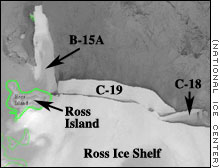
Wednesday, November 5, 2003 B15A and B15J broke apart in October, polar scientists said. WELLINGTON, New Zealand (AP) -- A powerful Antarctic storm has helped split apart an iceberg the size of Jamaica, a New Zealand scientist has said. The huge original iceberg, named B15 and measuring 11,000 square kilometers (4,400 square miles) broke into two pieces over the past month, according to data from satellites above the frozen southern continent. A jagged fracture spread across the iceberg, causing the split which "was expected eventually," said Mike Williams of New Zealand's National Institute of Water and Atmospheric research, on Tuesday. B15 had been grounded off the Ross Sea ice shelf coast of Antarctica for more than three years, pounded by storms and waves and tugged by coastal ocean currents. The two pieces, designated B15A and B15J by the U.S. National Ice Center in Maryland, are now slowly edging their way along the Ross Sea, he said. "They are still grounded on the Ross Sea floor by their weight," he said, adding there must have been "some inherent weakness" in the iceberg where it split in two. Eight other minor bergs have "calved" from B15 and drifted out of the Ross Sea region. The area is surrounded by the massive Ross ice shelf, a field of floating ice the size of France. U.S. iceberg researchers planted a global positioning system on B15A last week to track the movement of the giant ice block, the Antarctic Sun newspaper reported Sunday. It quoted Doug MacAyeal, a glaciologist at the University of Chicago working in Antarctica, as saying he wanted to track an iceberg through its phases until it disappears to write what he called a "users' guide to icebergs." The Ross Sea is on the Antarctic coast, 3,832 kilometers (2,395 miles) south of New Zealand. In March 2000, when B15 broke from the Ross Ice Shelf, it was identified as the longest known iceberg. While B15A remains immense, the title of iceberg king has passed to C19A, which is about 5,659 square kilometers (2,264 square miles), according to the Sun. Copyright 2003 The Associated Press. All rights reserved |
|||||||
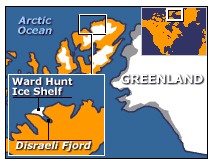
Tuesday, 23 September, 2003 Arctic ice shelf splits The largest ice shelf in the Arctic has fractured, releasing all the water from the freshwater lake it dammed. The Ward Hunt Ice Shelf is located on the north coast of Ellesmere Island in Canada's Nunavut territory. The huge mass of floating ice, which has been in place for at least 3,000 years, is now in two major pieces. The scientists who report the break-up in the journal Geophysical Research Letters (GRL) say it is further evidence of ongoing and accelerated climate change in the north polar region. The researchers - Warwick Vincent and Derek Mueller of Laval University in Quebec City, Canada; and Martin Jeffries of the University of Alaska Fairbanks, US - have been studying the shelf onsite and through satellite radar imagery and helicopter overflights. Lost water The Ward Hunt Ice Shelf, which is 443 square kilometres in size, now has a major crack that runs right through it from north to south. The scientists say the fracturing - which has been developing since the spring of 2000 - is the end result of a three-decade-long decline. "We're now seeing some very extensive fractures in it that extend many kilometres horizontally across the ice-shelf; and they extend all the way through from the top to the bottom, many tens of metres through the ice shelf. And we've never seen fractures like this," Dr Jeffries told the BBC. They warn that major free-floating ice islands could pose a danger to shipping and to drilling platforms in the Beaufort Sea. The immediate consequence of the rupture has been the loss of almost all of the freshwater from the Northern Hemisphere's largest epishelf lake (a body of mostly freshwater trapped behind an ice shelf). The freshwater lay in the 30-kilometre- [20-mile] long Disraeli Fiord. At its deepest, the freshwater measured 43 metres [140 feet], and sat atop 360 metres [1,200 feet] of denser ocean water. Other worlds The loss of fresh and brackish water has changed the environment for the microscopic animals and algae living in the area. "These are very rare and unusual ecosystems and they have been studied as possible analogues for life on a colder Earth and life on the planets," Dr Jeffries said. "And if we are losing them, we are losing the opportunity to study life earlier in Earth history and elsewhere in the Solar System." Scientists monitor continuously ice-shelf development in both the Arctic and the Antarctic. In the southern polar region, recent times have witnessed some dramatic changes. Last year, the 3,250-square-km Larsen B Ice Shelf on the Antarctic Peninsula shattered over a period of a month into thousands of icebergs. The peninsula is one of the three fastest-warming regions on Earth - temperatures have gone up 2.5 degrees in 50 years. Global change Mueller, Vincent, and Jeffries say their calculations suggest changes of a similar nature have been taking place in the Ellesmere Island area. A century ago, the entire northern coast of the island was reported to be fringed with a continuous ice shelf. About 90% of that ice area had been lost by 1982, the scientists say. The precise timing of the break-up of the remnant Ward Hunt Ice Shelf may have been influenced by freeze-thaw cycles, wind, and tides, they tell GRL. Other factors may include changes in Arctic Ocean temperature, salinity, and flow patterns, they add. "Computer models show quite convincingly that global climate change would be manifested first and amplified in the polar regions and in particular in the Arctic," Dr Jeffries said "Our observations at Ward Hunt Ice Shelf fit in with a broader picture of Arctic change which fits in with our understanding of how the Arctic climate would respond to global change."
|
|||||||
| 10-4-03
British deaths rose by 2,000 during heat wave by Emma Ross The Associated Press LONDON - About 2,000 more people than normal died during August's heat wave in England and Wales, the government reported Friday. Experts said the soaring temperatures most likely accelerated deaths that would have happened soon anyway. The estimates by the Office for National Statistics do not prove that the extra deaths were caused by the unusually hot weather; they identify a suspicious correlation. "There's a very convincing story that, in fact, the climate did cause excess deaths for a short period," said Dr. David Pencheon of the Institute of Public Health at Cambridge University in England. "There's no evidence that it kills off people who were not going to die in the next, say, two or three months," said Pencheon, who was nt connected with the report. "A lot of people at any one time are close to death. you only need a slight change for it to suddenly bunch together." Clare Griffiths, a senior mortality researcher at the Office for National Statistics, said that after a peak, deaths will dip lower than expected and then return to average. She said it was too soon to see whether that was true following the August heat wave. A study that examined deaths and temperatures from 1976 to 1996 in London found that deaths started to increase once the temperature reached 66 degrees. Still, the bunching effect, a well-known phenomenon of epidemiology, is much more pronounced in winter than in summer, experts say. The government statisticians noted that although deaths in August were higher than average, the peak number on Aug. 11 - right after the hottest day - was still lower than typical daily mortality in winter.
|
|||||||
| 160,000 Said Dying Yearly from Global Warming
By Alister Doyle MOSCOW (Reuters) - About 160,000 people die every year from side-effects of global warming (news - web sites) ranging from malaria to malnutrition and the numbers could almost double by 2020, a group of scientists said on Tuesday. The study, by scientists at the World Health Organization (news - web sites) (WHO) and the London School of Hygiene and Tropical Medicine, said children in developing nations seemed most vulnerable. "We estimate that climate change may already be causing in the region of 160,000 deaths...a year," Professor Andrew Haines of the London School of Hygiene and Tropical Medicine told a climate change conference in Moscow. "The disease burden caused by climate change could almost double by 2020," he added, even taking account of factors like improvements in health care. He said the estimates had not been previously published. Most deaths would be in developing nations in Africa, Latin America and Southeast Asia, which would be hardest hit by the spread of malnutrition, diarrhea and malaria in the wake o "These diseases mainly affect younger age groups, so that the total burden of disease due to climate change appears to be borne mainly by children in developing countries," Haines said. Milder winters, however, might mean that people would live longer on average in Europe or North America despite risks from heatwaves this summer in which about 15,000 people died in France alone. Haines said the study suggested climate change could "bring some health benefits, such as lower cold-related mortality and greater crop yields in temperate zones, but (that) these will be greatly outweighed by increased rates of other diseases." Russia is hosting a World Climate Change Conference this week to discuss how to rein in emissions of gases like carbon dioxide from factories and cars that scientists blame for blanketing the planet and nudging up temperatures. Russian President Vladimir Putin (news - web sites), who opened the conference on Monday, suggested in jest that global warming could benefit countries like Russia as people "would spend less money on fur coats and other warm things." But Putin also backed away from Russia's earlier pledge to swiftly ratify the key Kyoto pact on curbing global warming, a plan that will collapse without Moscow's backing. He told 940 delegates to the conference Russia was closely studying the issue of Kyoto. "A decision will be taken when this work is finished," he said, giving no timetable. Haines said small shifts in temperatures, for instance, could extend the range of mosquitoes that spread malaria. Water supplies could be contaminated by floods, for instance, which could also wash away crops. http://story.news.yahoo.com/news?tmpl=story&cid=570&ncid=753&e=1&u=/nm/20030930/sc_nm/environment_russia_health_dc ----------------------------------------------------------------------------------------------------------------------------- Russia Puts Global Climate Pact in Doubt By VLADIMIR ISACHENKOV Associated Press Writer MOSCOW (AP) -- A senior adviser to President Vladimir Putin outlined strong reservations Tuesday about ratifying the Kyoto Protocol, saying the pact to limit greenhouse gas emissions is not sufficiently grounded in science and would harm Russia's economic growth. Although Putin's economic adviser, Andrei Illarionov, stopped short of ruling out Russia's ratification of the protocol, which is necessary for it to take effect, his strong criticism of the agreement appeared to leave little hope for approval of the document. Illarionov, an influential adviser, spoke to reporters on the sidelines of the U.N. World Climate Change Conference. He made the remarks after Putin said Monday that his Cabinet hadn't yet made up its mind whether Russia would ratify the protocol. To go into effect, the 1997 protocol must be ratified by no fewer than 55 countries, accounting for at least 55 percent of global emissions in 1990. After the United States rejected the treaty, the minimum can be reached only with Russia's ratification. Illarionov said that the United States and Australia opted out of the protocol after deciding that compliance would be too expensive, and that it would be even less affordable for Russia, which has a much smaller economy. He elaborated on Putin's statement Monday that Russia could benefit from global warming, saying that warmer temperatures would help increase harvests, cut energy consumption and open ice-encrusted seas to navigation. "Public opinion was artificially focused on negative consequences of climate change, but there are also positive consequences for both our country and the planet as a whole," Illarionov said. Yuri Vorobyov, Russia's deputy minister for emergency situations, challenged Illarionov's optimism, telling the conference that warmer temperatures could increase the number of catastrophic floods and damage energy pipelines and other infrastructure in the north. Whatever the consequences, Illarionov voiced doubts about global warming being a stable trend, echoing Russian scientists who told the conference that the Kyoto protocol's advocates had failed to prove that emissions trigger global warming. They pointed at other factors, such as volcanic eruptions and the ocean's impact, saying they need to be more thoroughly analyzed. The Kyoto Protocol calls for countries to reduce their level of greenhouse-gas emissions to 1990 levels by 2012. If a country exceeds the emissions level, it could be forced to cut back industrial production. Russia's emissions have fallen by 32 percent since 1990 largely due to the post-Soviet industrial meltdown, but they have started to rise again as the economy revived. Illarionov said that the Kyoto Protocol would hamper Putin's goal of doubling Russia's gross domestic product in 10 years and the subsequent growth by requiring Russia to launch a costly overhaul of its industries in order to cut emissions. He said that doubling the GDP will bring Russia's emissions to 104 percent of their 1990 level, conflicting with the protocol. "But Russia isn't going to stop at this level, so the carbon dioxide level will be much higher," Illarionov said. He said that the United States, China and many other nations staying out of the protocol account for 68 percent of global emissions, making the document largely senseless. He said that Russia currently accounts for some 6 percent of global emissions compared to U.S. share of 25 percent and China's 13 percent. "We are facing a bizarre situation when Russia, which makes less emissions, must cut them, while nations which make much more, like the United States and China, won't curb them," Illarionov said. "That raises the question about the document's efficiency," he added. "No matter what sacrifice Russia makes, it won't bring us closer to the goal. It would be strange to undertake such obligations if they aren't universal."
|
|||||||
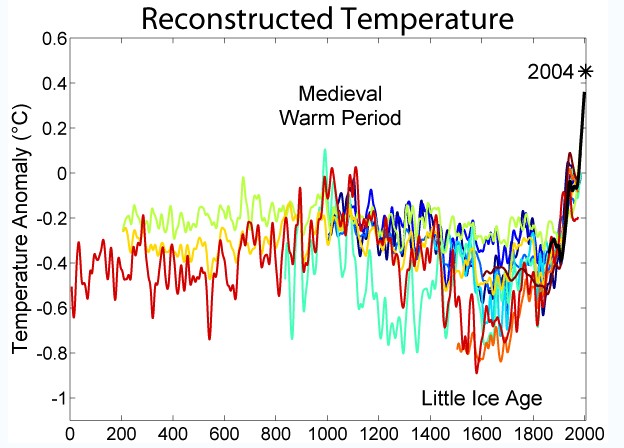
| Not just warmer: it's the hottest for 2,000 years
Widest study yet backs fears over carbon dioxide Ian Sample, science correspondent Monday September 1, 2003 <http://www.guardian.co.uk>The Guardian The earth is warmer now than it has been at any time in the past 2,000 years, the most comprehensive study of climatic history has revealed. Confirming the worst fears of environmental scientists, the newly published findings are a blow to sceptics who maintain that global warming is part of the natural climatic cycle rather than a consequence of human industrial activity. Prof Philip Jones, a director of the University of East Anglia's climatic research unit and one of the authors of the research, said: "You can't explain this rapid warming of the late 20th century in any other way. It's a response to a build-up of greenhouse gases in the atmosphere." The study reinforces recent conclusions published by the UN's intergovernmental panel on climate change (IPCC). Scientists on the panel looked at temperature data from up to 1,000 years ago and found that the late 20th century was the warmest period on record. But the IPCC's report was dismissed by some quarters in the scientific community who claimed that while the planet is undoubtedly warming, it was warmer still more than a thousand years ago. So warm, in fact, that it had spurred the Vikings to set up base in Greenland and led to northern Britain being filled with productive vineyards. To discover whether there was any truth in the claims, Prof Jones teamed up with Prof Michael Mann, a climate expert at the University of Virginia, and set about reconstructing the world's climate over the past 2,000 years. Direct measurements of the earth's temperature do not exist from such a long time ago, so the scientists had to rely on other indicators of how warm - or not - the planet was throughout the past two millennia. To find the answer, the scientists looked at tree trunks, which keep a record of the local climate: the rings spreading out from the centre grow to different thicknesses according to the climate a tree grows in. The scientists looked at sections taken from trees that had lived for hundreds and even thousands of years from different regions and used them to piece together a picture of the planet's climatic history. The scientists also studied cores of ice drilled from the icy stretches of Greenland and Antarctica. As the ice forms, sometimes over hundreds of thousands of years, it traps air, which holds vital clues to the local climate at the time. "Drill down far enough and you could use the ice to look at the climate hundreds of thousands of years ago, but we just used the first thousand metres," said Prof Jones. The scientists found that while there was not enough good data to work out what the climate had been like in the southern hemisphere over that period, they could get a good idea of how warm the northern hemisphere had been. "What we found was that at no point during those two millennia had it been any warmer than it is now. From 1980 onwards is clearly the warmest period of the last 2,000 years," said Prof Jones. Some regions may well have been fairly warm, especially during the medieval period, but on average, the planet was a cooler place, the study found. Looking back over a succession of earlier centuries, the temperature fluctuated slightly, becoming slightly warmer or cooler by 0.2C in each century. The temperature has increased by at least that amount in the past 20 or so years, the scientists report in the journal Geophysical Research Letters. "It just shows how dramatic the warming has been in recent years," said Prof Jones. Scientists who do not believe that carbon dioxide is driving climate change are unlikely to run up the white flag just yet, however. Dr Sallie Baliunas at the Harvard College Observatory in Massachusetts, for example, maintains that the recent warming could all be down to changes in the strength of sunlight falling on the planet. She concluded that during the 20th century, earth went through a cycle of natural climatic change. According to her data, from 1900 to 1940 the planet warmed slightly, then cooled from 1940 until 1970, then warmed up again from 1970 onwards. Given that 80% of the world's carbon dioxide emissions have been produced since 1940, the expected effect, if carbon dioxide was causing global warming, would be higher temperatures not lower, she said. Dr Baliunas's data also concluded that the period of warming between 1900 and 1940 must have been due to natural causes, most likely increased sunlight hitting the earth's surface, since carbon dioxide emissions were negligible at the time. The evidence, she said, pointed to variations in the sun's brightness being the cause of the planet's warming up, not carbon dioxide. But other climatologists have welcomed the new study as the most conclusive evidence to date that the increase in temperature is a result of human activity. "The importance of the finding is that it shows there's something going on in the climate system that's certainly unusual in the context of the last 2,000 years, and it's likely that greenhouse gases are playing the major role," said Prof Chris Folland of the Met Office's Hadley Centre. "If you look at the natural ups and downs in temperature, you'll find nothing remotely like what we're seeing now." Cold water on climate claims Not everyone agrees that climate change is largely driven by human activity. Some believe the warming the planet is experiencing now is part of a natural cycle. Historical anecdotes are sometimes used to support their case, but the new study debunks these claims. · There were vineyards in the north of Britain There were indeed vineyards in Britain in the 10th and 11th centuries, but only 50 to 60. There are now more than 350 in this country, with some as far north as Leeds. · The Vikings went to Greenland In AD 980, Erik the Red and his crew headed from Iceland to Greenland, but it wasn't for the good weather. Erik had been kicked out of Iceland for murder so he took his crew westward where, they were told, they would find land. · The Thames used to freeze over more often The river's tendency to freeze over frequently in the 16th and 17th centuries is often cited as evidence that the climate used to be more erratic. But, according to the new study, the major cause was the original London Bridge, completed in the 13th century, which had very small spans between its supports for the Thames to run through. The result was that the river was tidal only as far as the bridge, causing the water to freeze over. When the bridge was rebuilt to a different design in the 1820s, the water flowed more easily and therefore became less prone to ice. http://www.guardian.co.uk/climatechange/story/0,12374,1032984,00.html
|
|||||||
| Alaskan Warming is Disturbing Preview of What's to Come
Date: 9/3/2003 Alaskan Warming is Disturbing Preview of What's to Come, Scientists Say Knight Ridder Newspapers by Seth Borenstein http://www.commondreams.org/headlines03/0731-04.htm ANCHORAGE, Alaska - Alaska is melting. Global warming has caused the Columbia Glacier to retreat 7 miles in the last 20 years, leaving calves of ice in Prince William Sound. Seth Borenstein, KRT. Glaciers are receding. Permafrost is thawing. Roads are collapsing. Forests are dying. Villages are being forced to move, and animals are being forced to seek new habitats. What's happening in Alaska is a preview of what people farther south can expect, said Robert Corell, a former top National Science Foundation scientist who heads research for the Arctic Climate Impact Assessment team. "If you want to see what will be happening in the rest of the world 25 years from now, just look at what's happening in the Arctic," Corell said. Alaska and the Arctic are warming up fast, top international scientists will tell senior officials from eight Arctic countries at a conference in Iceland next week. They will disclose early, disturbing findings from a massive study of polar climate change. In Alaska, year-round average temperatures have risen by 5 degrees Fahrenheit since the 1960s, and average winter temperatures soared 8 degrees in that period, according to the federal government. The entire world is expected to warm by 2.5 to 10 degrees Fahrenheit by 2100, predict scientists at the International Panel on Climate Change. 2002 was the hottest year in Alaskan history, and this past winter was the second warmest on record, according to the National Climatic Data Center in Asheville, N.C., which found that Alaskan temperatures began to rise dramatically in 1976. This July, Anchorage recorded its second highest temperature ever as tourists got suntans. Deborah Williams, the executive director of the Alaska Conservation Foundation, used to take visitors from the Lower 48 to the famous Portage Glacier just outside Anchorage, where the $8 million Begich-Boggs visitor center opened in 1986. By 1993, the Portage glacier had receded so much that it no longer could be seen from the visitors' center. Williams still takes visitors to the site, seeing the glacier's retreat as a warning. "Alaska is the melting tip of the iceberg, the panting canary," said Williams, who was the chief Interior Department official for Alaska during the Clinton administration. Portage is "a glacier that's almost out of water; it's thinned dramatically," said U.S. Geological Survey geologist Bruce Molnia, the author of the book "Glaciers of Alaska." About 98 percent of Alaska's glaciers are retreating or stagnant, he said. Alaskan glaciers add 13.2 trillion gallons of melted water to the seas each year - the equivalent of more than 13 million Olympic-sized swimming pools, University of Alaska in Fairbanks scientists concluded after a decade of studying glaciers with airborne lasers. The rate of glacier run-off has doubled over just a few decades, they found. Alaska's melting glaciers are the No. 1 reason the oceans are rising, Molnia said. Another frozen staple of Alaska's northernmost lands - permafrost - is also thawing and "is probably the biggest problem on land," said Gunter Weller, director of the Center for Global Change and Arctic System Research at the University of Alaska in Fairbanks. Permafrost is land that stays frozen year-round. Villages rely on the hard permafrost to prevent beach erosion from violent ocean storms. Two Alaskan native villages, Shishmaref and Kivalina, must relocate because melting permafrost has caused beach erosion, leaving the towns vulnerable to severe storms. In 1986 the federal government built an $8 million visitors center here next to the Portage Glacier. The glacier is no longer visible from the visitors center. Seth Borenstein, KRT About 600 people live in 150 homes in Shishmaref, a centuries-old village on a barrier island just south of the Arctic Circle. On the island's northern edge, erosion is so severe that the village voted to move two years ago, but villagers haven't been able to find a new site or money to finance the massive undertaking, said Percy Nayokpuk, president of the Shishmaref Native Corporation. "It's a matter of safety," Nayokpuk said. "We're on this small low island. One bad storm could possibly wipe out the village. There is nowhere to run." Melting permafrost also means trouble for the oil industry. Oil companies build pipelines and roads on it to support drilling on the North Shore. To minimize damage to Arctic tundra, oil companies explore for oil on Alaska's North Slope only when roads are frozen with a foot of ice and six inches of snow. The ice-road season has dropped from 200 days a year in 1970 to 103 days in 2002, according to Alaska state documents. "It is unlikely the oil industry can implement successful exploration and development plans with a winter work season consistently less than 120 days," an Alaska Department of Natural Resources budget document said in March. While global warming is hurting oil drilling, it's the increased burning of fossil fuels such as oil that causes global warming. In June, the Department of Energy announced that it would spend $270,000 to help Alaska rewrite its rules about how thick ice roads should be. Permafrost lies under 166 Alaskan towns and 1,700 miles of Alaskan highways. Melting is causing whole chunks of the Alaska Highway to come apart, state officials said at a January global-warming conference. Permafrost is melting "under forests as well as under buildings and roads," said atmospheric scientist Michael MacCracken, who headed federal climate-change studies in the 1990s. So far, the greatest effect on forests has come from the spruce-bark beetle, according to Glenn Juday, a professor of forest ecology at the University of Alaska at Fairbanks. The beetle, which kills spruce trees, has long lived in Alaska's forests, but normally takes two years to grow and reproduce; cold spells cut their numbers. With global warming, however, the beetles now are damaging as many trees each year as they used to ruin in two, Juday said. More than 4 million acres of spruce - Alaska's predominant tree - have been killed, especially on the Kenai Peninsula. "It's the largest episode of insect-caused tree mortality ever recorded in North America," Juday said. The spruce-bark beetle isn't alone. Other tree-killing invaders made welcome by warmer weather include the larch soft fly, the aspen leaf miner and the birch leaf roller, Juday said. As Alaska's climate gets warmer and drier, Juday's studies indicate, black and white spruces, which make up 80 percent of the state's main forests, won't survive. By the turn of the next century, Alaska's forests will resemble the Aspen-treed grasslands along the northern edge of the Great Plains in North Dakota and Montana, Juday said. Some scientific reports also blame global warming for plummeting herring and salmon populations, Williams said. In the Yukon River, a warm-water parasite has infected salmon and herring, a key food source for marine mammals such as the stellar sea lion. Warm waters have made Alaska's Bristol Bay salmon runs occur earlier than normal, making it harder for the salmon to survive, said Alaska Department of Fish and Game biologist Slim Morstad. In addition, warm-weather wildlife, such as moose and beaver, are heading unusually far north, while species that require frigid weather "don't have anywhere to move to," said scientist MacCracken. Marine mammals such as walruses, ring seals and polar bears may soon see their numbers shrink along with the Arctic ice, Weller said. Copyright 2003 Knight-Ridder Newspapers
|
|||||||
| September 10, 2003
Toll from heat in france now 15,000 Pressure grows for health care reforms
by Joseph Coleman PARIS - France's leading undertaker estimated the country's death toll from the summer heat wave at 15,000 on Tuesday , far exceeding the official tally and putting further pressure on the government to improve its health care system. The estimate by the general Funeral Services included deaths from the second half of August, after the record-breaking temperatures of the first half of the month had abated, said company spokeswoman Isabelle Dubois-Costes. The bulk of the victims - many of them elderly - died during the height of the heat wave, which brought suffocating temperatures of up to 104 degrees in the country where air conditioning is rare. Others apparently were greatly weakened during the peak temperatures but did not die until days later. The government at the end of August announced a preliminary death toll of 11,435, but that figure was based only on deaths in the first two weeks of the month. The Health Surveillance Institute, which calculates the official toll for the government, would not comment on the undertaker estimate and said it would release updated figures for August at the end of September. The new estimate came after the government on Monday released a harshly worded report blaming the death son hospital understaffing during summer holidays, widespread failure among agencies and health services to coordinate efforts, and chronically insufficient care for the elderly. The report called on authorities to take bold steps, including the establishment of a health alert system to prevent a similar disaster. It was still unclear how the government planned to deal with the heat wave's fallout. While the government has been widely criticized for a slow response to the crisis, President Jacques Chirac's center-right government has suffered minimal political damage - thanks in large part to the disarray and lagging popularity of the opposition since Socialist Prime MInister Lionel Jospin fell from power last year. Many blame government Opposition lawmakers were eager to blame the government. "To listen to the government, everybody is responsible, except the government," Olivier Besancenot, a far-left politician who ran for president last year, told RTL radio on Tuesday in reaction to the government report. The most pervasive reaction among the french was shock at the increasing numbers. "There have never been so many deaths in August since the Liberation,' declared the front-page headline in Lemonde's early Wednesday edition, which came out Tuesday afternoon and contained detailed reports on methods of tallying the death toll. General Funeral Services has 25 percent of the funeral market in France, and compiled its tally by estimating the increased number of deaths it handled in August compared with last year, then multiplying the result by four to get an estimate for the whole country. The company was the first to come forward with a death estimate that registered the magnitude of the disaster when it announced in August that some 10,000 had died. The government at that time had put the figure at several thousand at the most. The heat baked many parts of Europe, killing livestock and fanning forest fires, but experts said the heat was more severe in France because temperatures did not drop at night, meaning those exhausted from the day time heat enjoyed no respite when the sun went down. The high death toll has triggered an angry debate in france over shortcomings of the health system. The government is considering eliminating a national holiday to raise revenues for elderly care. The French lifestyle has also come under scrutiny, since some of the elderly victims died alone in their homes while families were away on long August holidays. Authorities reportedly had difficulties making contact with survivors who were away on vacation.
|
|||||||
| French heat deaths not over yet
August 31, 2003 BY ELAINE GANLEY PARIS--France's health minister said in an interview to be published today that people have not stopped dying from the August heat wave that seared the country, and he predicted that the death toll will climb toward 12,000. But Jean-Francois Mattei resisted calls for his resignation because of what critics say was a slow response to the crisis by the center-right government. ''I have nothing to hide,'' Mattei said in an interview with the Sunday paper Le Journal du Dimanche made available Saturday evening. But Mattei refused to respond to direct criticism while investigations are in progress. On Friday, Mattei announced a provisional death toll of 11,435. ''It is true that we will still have 'deferred' deaths,'' he said in the newspaper interview, ''because organisms rendered fragile have used up all their strength to fight the extreme heat.'' Mattei initially estimated that the heat wave killed 1,500 to 3,000 people. France's largest undertaker later estimated that 10,000 people died. Government officials at first said that could be right but later suggested the number was inflated. Friday's figure came from the Health Surveillance Institute, which calculated the toll for the government. Mattei noted that other studies to determine the heat-related death toll were continuing. For Mattei, the number of deaths was only part of the drama. ''What is also unbearable is the brutal revelation of a social fracture, of the solitude and isolation of the aged,'' he was quoted as saying. ''I'm revolted by these cadavers that no one is claiming.'' Up to 400 bodies remained unclaimed last week in the Paris region, and city officials have said they would be interred in the Square of Indigents at the Thiais Cemetery, to be reburied elsewhere if families claim them. The minister vowed to implement measures to prevent a repeat of the summer catastrophe once conclusions were made by parliamentary and other investigations. ''We must give some sense to these deaths, that this leads us to take all needed measures,'' he said. The measures being floated include scrapping one of France's 11 annual holidays and using those tax receipts to finance health care for the elderly. AP
|
|||||||
| French heat toll 'could top 5,000'
Monday, August 18, 2003 PARIS, France -- The death toll from France's heat wave could be as high as 5,000, according to the country's health minister. Some leftist opposition politicians are demanding Jean-Francois Mattei to resign over the crisis, in which the government did not declare an emergency until a week into a nine-day desert-like weather pattern across France earlier this month. "The figure of 5,000 was mentioned yesterday," Mattei said in an RTL radio interview. "It's one hypothesis. It's plausible but it's just a hypothesis." Over the weekend, Mattei predicted between 1,600 and 3,000 deaths, but a doctors' group had estimated a toll of up to 5,000. Mattei has refused to step down and Prime Minister Jean-Pierre Raffarin has stood by his health minister. In an interview Sunday with the weekly newspaper Le Journal du Dimanche, Raffarin said he was "appalled" by calls by opposition Socialists and Greens for the resignation of his health minister, Jean-Francois Mattei. "All of this is ridiculous. Politics is not a permanent settlement of scores. Faced with such human tragedies, the time is for solidarity, not for sterile polemic," the conservative prime minister said. Victims were mainly elderly people with heat-related conditions. Many were found at home alone as the traditional August holiday exodus leaves city centers deserted. Raffarin cut short his vacation for an emergency meeting last Thursday to tackle the crisis after temperatures topped 40 C (104 F) in parts of the country. The government recalled medical staff from holidays under an emergency plan designed to deal with terrorist attacks, natural disasters or epidemics. Though the weather has cooled, hospitals remain on alert amid fears of a new spike in temperatures. As mortuaries and funeral parlours struggled to cope with an overflow of victims, health authorities took over a disused storeroom at a farmers' market on the outskirts of Paris where several hundred bodies lay awaiting burial. "Is this the result of a war? An earthquake? No, the consequence of the heat wave of the summer of 2003," Le Journal du Dimanche said in an editorial. Socialists have demanded an investigation into the conservative French government's handling of the crisis. -- CNN Correspondent Chris Burns contributed to this report.
|
|||||||
| Alaska warming is look at future
Seth Borenstein Knight Ridder Newspapers Aug. 10, 2003 12:00 AM ANCHORAGE, Alaska - Alaska is melting. Glaciers are receding. Permafrost is thawing. Roads are collapsing. Forests are dying. Villages are being forced to move, and animals are being forced to seek new habitats. What's happening in Alaska is a preview of what people farther south can expect, said Robert Corell, a former top National Science Foundation scientist who heads research for the Arctic Climate Impact Assessment team. "If you want to see what will be happening in the rest of the world 25 years from now, just look at what's happening in the Arctic," Corell said. In Alaska, year-round average temperatures have risen 5-degrees Fahrenheit since the 1960s, and winter temperatures soared 8 degrees in that period, according to the federal government. The entire world is expected to warm 2.5 to 10 degrees by 2100, predict scientists at the International Panel on Climate Change. Last year was the hottest year in Alaska history, and this past winter was the second warmest on record, according to the National Climatic Data Center in Asheville, N.C., which found that Alaska's temperatures began to rise dramatically in 1976. This July, Anchorage recorded its second-highest temperature ever. Deborah Williams, head of the Alaska Conservation Foundation, used to take visitors from the Lower 48 to the Portage Glacier outside Anchorage, where an $8 million visitor center opened in 1986. By 1993, glacier had receded so much that it no longer could be seen from the center. "Alaska is the melting tip of the iceberg, the panting canary," said Williams, who was the chief Interior Department official for Alaska during the Clinton administration. Portage is "a glacier that's almost out of water; it's thinned dramatically," said U.S. Geological Survey geologist Bruce Molnia, author of Glaciers of Alaska. About 98 percent of Alaska's glaciers are retreating or stagnant, he said. Alaskan glaciers add 13.2 trillion gallons of water to the seas each year, University of Alaska-Fairbanks scientists concluded after a decade of studying glaciers with airborne lasers. The rate of glacier run-off has doubled over just a few decades, they found. Alaska's melting glaciers are the No. 1 reason the oceans are rising, Molnia said. Another frozen staple of Alaska's northernmost lands, permafrost, is also thawing and "is probably the biggest problem on land," said Gunter Weller, director of the Center for Global Change and Arctic System Research at the University of Alaska-Fairbanks. Permafrost is land that stays frozen year-round. Villages rely on it to prevent beach erosion from violent ocean storms. Two Alaskan native villages, Shishmaref and Kivalina, must relocate because melting permafrost has caused beach erosion, leaving the towns vulnerable to storms. Melting permafrost also means trouble for the oil industry. Oil companies build pipelines and roads on it to support North Shore drilling. To minimize damage to Arctic tundra, oil companies explore for oil on Alaska's North Slope only when roads are frozen with a foot of ice and 6 inches of snow. The ice-road season has dropped from 200 days a year in 1970 to 103 days in 2002, according to state documents. Permafrost lies under 166 Alaskan towns and 1,700 miles of Alaskan highways. Melting is causing chunks of the Alaska Highway to come apart, state officials said at a January global-warming conference. Some scientific reports also blame global warming for plummeting herring and salmon populations, Williams said.
|
|||||||
| EUROPE'S WEIRD WEATHER WARMS DEBATE
By Nicola Jones http://www.newscientist.com/news/news.jsp?id=ns99994022 A scorching heat wave in Europe and a spate of forest fires has re-ignited the debate over whether global warming can be blamed for an apparent increase in the world's weird weather. Scientists agree that no one yet knows the answer to this question, but they point out that an increase in the number and severity of extreme events is exactly what their models of a warmer world predict. "The weather we've seen over the last few days is entirely consistent with what we're likely to see over the next few decades," says John Turnpenny, at the Tyndall Centre for climate change research in Norwich, UK. "We're likely to see such a heat spell in London every year." Extreme weather conditions are affecting all parts of Europe. In the UK, meteorologists predict a fair chance that the country will record 100°F (37.8°C) for the first time this week, beating the previous record of 98.8°F (37.1°C) from August 1990. In Portugal nine people have been killed in the worst wave of forest fires in recent history. Western North America is also facing another bad year for burning forests. In Switzerland, melting ice has contributed to a record number of climbing accidents in the Alps. The heat in Germany has already cost agriculture more than 2002's disastrous floods, while in Spain the price of chickens has soared as the heat reportedly killed more than a million birds. Such weather events fit in well with climate models that predict the effects of global warming driven by rising levels of atmospheric carbon dioxide. The UK's meteorological office, for example, says the UK is set to get warmer and drier. By 2080 there will be, at worst, 50 per cent less rain than there was in the 1990s. Average summer temperatures are set to rise by up to 3.5 degrees, while temperatures swings will be wilder, with the top 10 per cent of daily highs soaring as much as 7 degrees. Cause and effect But scientists caution that just because extreme weather fits with model predictions, that does not prove that global warming is the cause. "People lump extreme events into one basket and use it to strengthen their arguments about climate change. But you can't do that," says Simon Brown, a climate change expert at the UK's Hadley Centre in Bracknell, Berkshire. "We can't say that one causes the other. We're not at that point yet." In July, the World Meteorological Organization warned that "extreme weather events might increase". But Ken Davidson, director of the World Climate Program and a contributor to the statement, says media reports linking such weather to climate change were overblown. "It certainly isn't clear at this point," he told New Scientist . "We were very careful to use the word 'might'." It is even difficult for researchers to say that there are more extreme events now than there were in the past, because there is no agreed-upon definition for the word "extreme", notes Brown. This makes it hard to compile reliable statistics. Davidson adds that drawing up a list of weird weather events may look impressive, but must be carefully done to be meaningful: "There's always strange weather."
|
|||||||
| Swiss Alps Crumbling in Heat Wave; Climbers Evacuated, AFP Says
July 15, 2003 (Bloomberg) -- A heat wave in Europe is melting Switzerland's glaciers and causing chunks of the Swiss Alps to break off, prompting the evacuation of climbers and hikers, Agence France-Presse reported. In southern Switzerland, helicopters ferried about 70 people from the Matterhorn after a rock face on the 3,400-meter (11,155- foot) peak crumbled, AFP said. A portion of a glacier near the Alpine resort of Grindelwald also broke away and fell into the Luetschine river, causing a surge of water downstream. Police warned people several miles away to stay away from the river, AFP cited the Swiss news agency ATS as saying. Rescue services in Zermatt said no one was injured by the falling rubble, AFP reported. The evacuations were ordered as a precaution because unusually hot weather at high altitude has melted ice that normally binds the rock together, AFP reported. Daytime temperatures in most of Switzerland have stayed above 30 degrees centigrade (86 degrees Fahrenheit) for most of the past five weeks and June was the hottest month on record since weather observations began in 1864, AFP cited the Swiss weather agency, MeteoSuisse, as saying. Temperatures this week exceeded 32 degrees from London to Athens. ----------
RECORD EVENT REPORT ...RECORD HIGH TEMPERATURES OVER SOUTH CENTRAL ARIZONA AND SOUTH EASTERN CALIFORNIA FOR JULY 14 2003... ARIZONA... CITY HIGH PREVIOUS RECORD HIGH/YEAR BOISE 117 116 IN 1957 BUCKEYE 117 116 IN 1987 CAREFREE 111 110 IN 1970 COOLIDGE 116(TIE) 116 IN 1970 PARKER 121 118 IN 1913 PHOENIX DEER VALLEY 114 113 IN 1970 PHOENIX SKY HARBOR 116 115 IN 1989 WICKENBURG 115(TIE) 115 IN 1998 YOUNGTOWN 115 112 IN 1998
CALIFORNIA... BLYTHE 118 (TIE) 118 IN 1971 IMPERIAL 117 115 IN 1949
|
|||||||
| Reaping the whirlwind
Extreme weather prompts unprecedented global warming alert 03 July 2003 In an astonishing announcement on global warming and extreme weather, the World Meteorological Organisation signalled last night that the world's weather is going haywire. In a startling report, the WMO, which normally produces detailed scientific reports and staid statistics at the year's end, highlighted record extremes in weather and climate occurring all over the world in recent weeks, from Switzerland's hottest-ever June to a record month for tornadoes in the United States - and linked them to climate change. The unprecedented warning takes its force and significance from the fact that it is not coming from Greenpeace or Friends of the Earth, but from an impeccably respected UN organisation that is not given to hyperbole (though environmentalists will seize on it to claim that the direst warnings of climate change are being borne out). The Geneva-based body, to which the weather services of 185 countries contribute, takes the view that events this year in Europe, America and Asia are so remarkable that the world needs to be made aware of it immediately. The extreme weather it documents, such as record high and low temperatures, record rainfall and record storms in different parts of the world, is consistent with predictions of global warming. Supercomputer models show that, as the atmosphere warms, the climate not only becomes hotter but much more unstable. "Recent scientific assessments indicate that, as the global temperatures continue to warm due to climate change, the number and intensity of extreme events might increase," the WMO said, giving a striking series of examples. In southern France, record temperatures were recorded in June, rising above 40C in places - temperatures of 5C to 7C above the average. In Switzerland, it was the hottest June in at least 250 years, environmental historians said. In Geneva, since 29 May, daytime temperatures have not fallen below 25C, making it the hottest June recorded. In the United States, there were 562 May tornadoes, which caused 41 deaths. This set a record for any month. The previous record was 399 in June 1992. In India, this year's pre-monsoon heatwave brought peak temperatures of 45C - 2C to 5C above the norm. At least 1,400 people died in India due to the hot weather. In Sri Lanka, heavy rainfall from Tropical Cyclone 01B exacerbated wet conditions, resulting in flooding and landslides and killing at least 300 people. The infrastructure and economy of south-west Sri Lanka was heavily damaged. A reduction of 20-30 per cent is expected in the output of low-grown tea in the next three months. Last month was also the hottest in England and Wales since 1976, with average temperatures of 16C. The WMO said: "These record extreme events (high temperatures, low temperatures and high rainfall amounts and droughts) all go into calculating the monthly and annual averages, which, for temperatures, have been gradually increasing over the past 100 years. "New record extreme events occur every year somewhere in the globe, but in recent years the number of such extremes have been increasing. "According to recent climate-change scientific assessment reports of the joint WMO/United Nations Environmental Programme Intergovernmental Panel on Climate Change, the global average surface temperature has increased since 1861. Over the 20th century the increase has been around 0.6C. "New analyses of proxy data for the northern hemisphere indicate that the increase in temperature in the 20th century is likely to have been the largest in any century during the past 1,000 years." While the trend towards warmer temperatures has been uneven over the past century, the trend since 1976 is roughly three times that for the whole period. Global average land and sea surface temperatures in May 2003 were the second highest since records began in 1880. Considering land temperatures only, last May was the warmest on record. It is possible that 2003 will be the hottest year ever recorded. The 10 hottest years in the 143-year-old global temperature record have now all been since 1990, with the three hottest being 1998, 2002 and 2001. The unstable world of climate change has long been a prediction. Now, the WMO says, it is a reality.
|
|||||||
| Global warming 'threatens Earth with mass extinction'
June 20 2003 Global warming over the next century could trigger a catastrophe to rival the worst mass extinction in the history of the planet, scientists have warned. Researchers at Bristol University have discovered that a mere 6 degrees of global warming was enough to wipe out up to 95 per cent of the species which were alive on earth at the end of the Permian period, 250 million years ago. United Nations scientists from the Intergovernmental Panel on Climate Change predict up to 6 degrees of warming for the next 100 years if nothing is done about emissions of greenhouse gases, principally carbon dioxide, the chief cause of global warming. http://www.smh.com.au/articles/2003/06/19/1055828440526.html
|
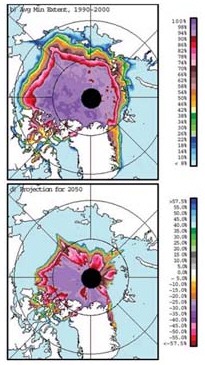
SPACEDAILY EXPRESS Arctic Sea Ice Could Be Gone By End Of The Century Top chart shows Average Perennial Ice Concentrations from 1990 to 2000 The lower chart represents the decadal average of the concentration of the perennial ice cover during the 2050s as projected from the current data set. This map was developed assuming a linear decline following the decadal change from the 1980s to the 1990s. Credit: J.C. Comiso, NASA/GSFC and Rob Gersten, SSAI. Greenbelt - Nov 29, 2002 A NASA study finds that perennial sea ice in the Arctic is melting faster than previously thought -- at a rate of 9 percent per decade. If these melting rates continue for a few more decades, the perennial sea ice will likely disappear entirely within this century, due to rising temperatures and interactions between ice, ocean and the atmosphere that accelerate the melting process. Perennial sea ice floats in the polar oceans and remains at the end of the summer, when the ice cover is at its minimum and seasonal sea ice has melted. This year-round ice averages about 3 meters (9.8 feet) in depth, but can be as thick as 7 meters (23 feet). The study also finds that temperatures in the Arctic are increasing at the rate of 1.2 degrees Celsius (2.2 Fahrenheit) per decade. Melting sea ice would not affect sea levels, but it could profoundly impact summer shipping lanes, plankton blooms, ocean circulation systems, and global climate. "If the perennial ice cover, which consists mainly of thick multi-year ice floes, disappears, the entire Arctic Ocean climate and ecology would become very different," said Josefino Comiso, a researcher at NASA's Goddard Space Flight Center, Greenbelt, Md., who authored the study. Comiso used satellite data to track trends in minimum Arctic sea ice cover and temperature over the Arctic from 1978 to 2000. Since sea ice does not change uniformly in terms of time or space, Comiso sectioned off portions of the Arctic data and carefully analyzed these sections to determine when ice had reached the minimum for that area each year. The results were compiled to obtain overall annual values of perennial sea ice. Prior to the complete data provided by satellites, most records came from sparsely located ocean buoys, weather stations, and research vessels. The rate of decline is expected to accelerate due to positive feedback systems between the ice, oceans and atmosphere. As temperatures in the Arctic rise, the summer ice cover retreats, more solar heat gets absorbed by the ocean, and more ice gets melted by a warmer upper water layer. Warmer water may delay freezing in the fall, leading to a thinner ice cover in the winter and spring, which makes the sea ice more vulnerable to melting in the subsequent summer. Also, the rise in summer ice temperatures by about 1.2 degrees Celsius (2.2 Fahrenheit) each decade could lengthen the summers, allowing earlier spring thaws and later freeze dates in the fall, causing further thinning and retreat of perennial ice. Comparing the differences between Arctic sea ice data from 1979 to 1989 and data from 1990 to 2000, Comiso found the biggest melting occurred in the western area (Beaufort and Chukchi Seas) while considerable losses were also apparent in the eastern region (Siberian, Laptev and Kara Seas). Also, perennial ice actually advanced in relatively small areas near Greenland. In the short term, reduced ice cover would open shipping lanes through the Arctic. Also, massive melts could increase biological productivity, since melt water floats and provides a stable layer conducive to plankton blooms. Also, both regional and global climate would be impacted, since summer sea ice currently reflects sunlight out to space, cooling the planet's surface, and warming the atmosphere. While the latest data came too late to be included in the paper, Comiso recently analyzed the ice cover data up to the present and discovered that this year's perennial ice cover is the least extensive observed during the satellite era. The study appears in the late October issue of Geophysical Research Letters, and was funded by NASA's Cryospheric Sciences Program and the NASA Earth Science Enterprise/ Earth Observing System Project. The mission of NASA's Earth Science Enterprise is to develop a scientific understanding of the Earth System and its response to natural or human-induced changes to enable improved prediction capability for climate, weather and natural hazards. ~~~~~~~~~~~~~~~~~~~~~` Arctic Summer Sea Lanes Open By 2015 Forecasts ONR "Although recent terrorist events keep our minds occupied elsewhere in the world, what a navigable Arctic means for our national security is significant," says Dr. Dennis Conlon, Program Manager for Arctic Science at the Office of Naval Research. "Geographical boundaries, politics, and commerce changes would all become issues." Washington - Feb 14, 2002 The Arctic ice cap is shrinking that much is known with certainty. Over the past century, the extent of the winter pack ice in the Nordic Seas has decreased by about 25%. Last winter the Bering Sea was effectively ice-free, which is unprecedented, and if this big melt continues, some say the formerly ice-locked Arctic will have open sea lanes as soon as 2015. By 2050, the summertime ice cap could disappear entirely. "Although recent terrorist events keep our minds occupied elsewhere in the world, what a navigable Arctic means for our national security is significant," says Dr. Dennis Conlon, Program Manager for Arctic Science at the Office of Naval Research. "Geographical boundaries, politics, and commerce changes would all become issues." In April 2001, the Office of Naval Research co-sponsored a meeting of Arctic subject matter experts from the U.S., Canada, and Great Britain in a preliminary attempt to address the capabilities that would be required for naval forces to operate in the Arctic. Their report has just been released, and it speaks to the national and strategic issues surrounding naval ship and aircraft operations in an ice-free Arctic, including policy, doctrine, and possible new systems and ship and aircraft designs. The potential implications of an ice-free Arctic are enormous. Both the Northern Sea Route (north of Russia) and the Northwest Passage (through the Canadian archipelago) provide far shorter routes from Europe to Asia, though both routes are claimed to be through national waters. An increased level of transnational activity might give rise to adversarial action, international criminal and terrorist elements, and environmental challenges. Disappearance of the ice canopy would eliminate a haven now provided to submarines, and the acoustic environment would drastically change. An ecological disruption due to climate and habitat changes would affect marine mammal populations, and this in turn would affect indigenous peoples. One significant conclusion was reached in the report: the U.S. Navy must rely on bilateral and multinational alliances, especially with Canada and Russia, in order to deal effectively and fairly with an ice-free Arctic. Ensuring access and stabilizing the global commons would be the most overriding reason for increased operations in what would remain a very hostile environment, ice or no ice. Naval Ice Center, the Oceanographer of the Navy, and the Arctic Research commission. Related Links
|
Subj: [SO] Fwd: NASA Study Finds Rapid Changes in Earth's Polar Ice Sheets
Date: 8/30/2002
From: skywatcher22@hotmail.com
Warning, warning, warning...
From: JPLNews@jpl.nasa.gov
Date: Fri, 30 Aug 2002
MEDIA RELATIONS OFFICE
JET PROPULSION LABORATORY
CALIFORNIA INSTITUTE OF TECHNOLOGY
NATIONAL AERONAUTICS AND SPACE ADMINISTRATION
PASADENA, CALIFORNIA 91109. TELEPHONE (818) 354-5011
http://www.jpl.nasa.gov
Contact: JPL/Alan Buis (818) 354-0474 August 30, 2002
NASA STUDY FINDS RAPID CHANGES IN EARTH'S POLAR ICE SHEETS
Recent NASA airborne measurements and a new review of space-based measurements of the thickness of Earth's polar ice sheets concludes they are changing much more rapidly than previously believed, with unknown consequences for global sea levels and Earth's climate.
Large sectors of ice in southeast Greenland, the Amundsen Sea Embayment in West Antarctica and the Antarctic Peninsula are changing rapidly by processes not yet well understood, said researchers Dr. Eric Rignot of NASA's Jet Propulsion Laboratory, Pasadena, Calif., and Dr. Robert Thomas of EG&G Services at NASA's Wallops Flight Facility, Wallops Island, Va. Their study, published this week in the journal Science, reviews progress in measuring changes in ice sheet thickness based upon technical advances and observations made over the past decade.
"Earth's polar ice sheets are changing over relatively short time scales, that is, decades versus thousands of years," Rignot said. Thomas added that today's more precise, widespread measurements tell us rapid changes are common. "These observations run counter to much accepted wisdom about ice sheets, which, lacking modern observational capabilities, was largely based on 'steady-state' assumptions," Thomas said.
"Remote sensing is allowing researchers to look at polar processes on continental scales and in greater detail than before," said Dr. Waleed Abdalati, Cryospheric Program manager, NASA Headquarters, Washington D.C. "Closer examination using even broader advanced remote sensing techniques, including NASA's upcoming Ice, Cloud and Land Elevation Satellite, the Gravity Recovery and Climate Experiment and Europe's planned Cryosat mission--combined with widespread interferometric synthetic aperture radar (InSAR) data, ice thickness surveys and ground-based measurements--will enable us to estimate ice sheet mass balance for Greenland and Antarctica even more precisely."
Rignot said understanding how polar ice sheets evolve is vital to society.
"The Antarctic and Greenland ice sheets together hold enough ice to raise sea level by 70 meters (230 feet)," he said. "Even a small imbalance between snowfall and discharge of ice and melt water from ice sheets into the ocean could be a major contributor to the current sea level rise rate of 1.8 millimeters (0.07 inches) a year and impact ocean circulation and climate. During past periods of rapid deglaciation, ice sheet melting raised sea level orders of magnitude faster than today. This is the real threat of the ice sheets."
Rignot and Thomas' review summarizes current progress for two methods of measuring changes in ice sheet thickness: the mass budget method, which compares losses by melting and ice discharge with total net input from snow accumulation; and measuring elevation changes over time. These methods use various space remote sensing resources, such as laser and radar altimetry, the Global Positioning System and InSAR.
The review reports Greenland's ice sheet is losing 50 cubic kilometers (12 cubic miles) of mass a year due to rapid thinning near its coasts. That's enough to raise sea level 0.13 millimeters (0.005 inches) annually. "Rapid coastal thinning cannot be explained by a few warm summers and is attributed to a dynamic ice sheet response," Rignot said. "A possible contributor to the observed trend is increased lubrication from additional surface melt water reaching glacier beds through crevasses and moulins."
Rignot says the mass balance in Antarctica is much harder to calculate because the ice sheet is far larger, more remote and not well covered by existing key satellites. The researchers calculated net ice gains or losses for 33 Antarctic glaciers, including 25 of the 30 largest ice producers.
The West Antarctic ice sheet was found to be thickening in the west, thinning rapidly in the north, and probably losing mass overall by roughly 65 cubic kilometers (roughly 15.5 cubic miles) a year, enough to raise sea level by about 0.16 millimeters (0.006 inches) a year. InSAR observations show several major glaciers that are accelerating and contributing to sea level rise.
Radar altimetry shows ice shelves in the Amundsen Sea Embayment are rapidly thinning, possibly in reaction to a warmer ocean, as suggested by recent oceanographic data. Melting of ice shelf bottoms is far larger than expected here due to intrusion of warm water on the continental shelf, implying a larger interplay of ice and ocean in ice sheet evolution.
Rignot said little is known about the mass balance of Antarctic Peninsula mountain glaciers, which receive a quarter of Antarctica's snow accumulation. The peninsula has warmed 2 to 3 degrees Celsius (3.6 to 5.4 degrees Fahrenheit) over the past 50 years, causing rapid thinning, enhanced melting and rapid disintegration of its ice shelves. The peninsula is a unique laboratory to determine whether retreating ice shelves can induce faster ice sheet flow and raise global sea level, a hypothesis formulated decades ago but still disputed. Recent results show large glacier acceleration in response to ice shelf collapse. If ice shelves do buttress glaciers, the Antarctic ice sheet's contribution to sea level rise could be much larger in the future than previously believed.
Illustrations related to this study may be viewed at: http://www.jpl.nasa.gov/images/earth/antarctica
JPL is a division of the California Institute of Technology in Pasadena.
##### 8-30-02 AB #2002-168
Alaska, No Longer So Frigid, Starts to Crack, Burn and Sag
6-17-02 ANCHOR POINT, Alaska, — To live in Alaska when the average
temperature has risen about seven degrees over the last 30 years means learning
to cope with a landscape that can sink, catch fire or break apart in the
turn of a season. In the village of Shishmaref, on the Chukchi Sea just south
of the Arctic Circle, it means high water eating away so many houses and
buildings that people will vote next month on moving the entire village inland.
In Barrow, the northernmost city in North America, it means coping with
mosquitoes in a place where they once were nonexistent, and rescuing hunters
trapped on breakaway ice at a time of year when such things once were unheard
of. _________________________________________________
From Fairbanks to the north, where wildfires have been burning off and on since mid-May, it means living with hydraulic jacks to keep houses from slouching and buckling on foundations that used to be frozen all year. Permafrost, they say, is no longer permanent. Here on the Kenai Peninsula, a recreation wonderland a few hours' drive from Anchorage, it means living in a four-million-acre spruce forest that has been killed by beetles, the largest loss of trees to insects ever recorded in North America, federal officials say. Government scientists tied the event to rising temperatures, which allow the beetles to reproduce at twice their normal rate. In Alaska, rising temperatures, whether caused by greenhouse gas emissions or nature in a prolonged mood swing, are not a topic of debate or an abstraction. Mean temperatures have risen by 5 degrees in summer and 10 degrees in winter since the 1970's, federal officials say.
Minnesota floods claim 300,000 acres of farmland 6-17-02 Flooding in northwest Minnesota has submerged at least 300,000 acres of cropland, a regional U.S. Department of Agriculture official"We estimate anywhere from about 300,000 to 500,000 acres are currently under water," said John Monson, director of the Minnesota office of the Farm Service Agency, a unit of the USDA. Overall, at least 1.9 million acres of farmland in an eight-county area were affected by excessive rains since last weekend. Crop losses on those acres range from 20 percent to 100 percent, Monson said in an telephone interview. Two of the hardest-hit counties, Norman and Kittson, were among the state's top producers of spring wheat and sugar beets in 1999 and 2000, according to the Minnesota Agricultural Statistics Service. said last week.
_______________________________________________
Satellites Show Alarming Retreat of Glaciers
By SPACE.com Staff
29 May 2002
Satellite Captures Antarctic Ice Shelf's Collapse
Enormous Icebergs Imperil Penguins Heading For Antarctica Breeding Grounds
U.N. Warns Global Warming Is Melting Arctic Soil
Meltdown: Satellites Show Accelerated Polar Ice Threat
Satellite Data Show Shrinkage of Polar Ice Sheet
Satellite imagery being presented today shows that the great majority of the world's glaciers are melting at rates equal to or greater than long-established trends, including some that are receding at alarming and accelerating paces.
If the climate warms at an accelerated rate over the next century, as some scientists predict, the glaciers would be adversely affected, scientists said.
Though most glaciers are receding, the joint study by NASA and the United States Geological Survey (USGS) found that a small minority of them are increasing their bulk. Early results of the project are being discussed today by Jeff Kargel, a USGS scientist, at the American Geophysical Union Spring Meeting in Washington, D.C.
The project, which involves scientists from 23 countries, uses satellites to map and examine glaciers throughout the world during the middle to latter part of the melt season when permanent ice is exposed. Current images are compared with older topographical maps and other records.
"Glaciers in most areas of the world are known to be receding," said Kargel, who heads up the project. "But glaciers in the Himalaya are wasting at alarming and accelerating rates, as indicated by comparisons of satellite and historic data, and as shown by the widespread, rapid growth of lakes on the glacier surfaces."
When ice melts and pools, the melt rate can increase dramatically. While ice reflects the Sun's rays, lake water absorbs and transmits heat more efficiently to the underlying ice, kicking off a feedback that creates further melting.
According to a 2001 report by the Intergovernmental Panel on Climate Change, scientists estimate that surface temperatures could rise by 1.4°C to 5.8°C by the end of the century. The researchers have found a strong correlation between increasing temperatures and glacier retreat.
Glacier changes in the next 100 years could significantly affect agriculture, water supplies, hydroelectric power, transportation, mining, coastlines, and ecological habitats, the research team predicts. Melting ice may cause both serious problems and, for the short term in some regions, helpful increases in water availability, but all these impacts will change with time, Kargel said.
For example, the Gangotri glacier between Kashmir and Nepal is retreating at an accelerated rate that cannot be accounted for by lingering effects from warming after the little ice age more than 200 years ago. The Gangotri glacier-and many others-feed the Ganges River Basin, upon which hundreds of millions of people, including those in New Delhi and Calcutta, depend for fresh water.
Kargel finds that over one percent of water in the Ganges and Indus Basins (South Asia) is currently due to runoff from wasting of permanent ice from glaciers. This contribution is expected to increase as melting rates accelerate, though ultimately the added runoff is predicted to disappear as glaciers decline many decades from now.
Such changes are important since water use in these basins is already approaching capacity as populations continue to grow, the researchers say. In drier parts of Asia, like in arid Western China, wasting glaciers currently account for over ten percent of fresh water supplies.
But the research finds positive aspects to glacier changes as well.
"It's not all doom and gloom," Kargel said. "Glaciers are wastelands, but as they recede the land underneath may become available for use."
The project primarily draws data from the ASTER (Advanced Spaceborne Thermal Emission and reflection Radiometer) instrument aboard the NASA's Earth Observing System (EOS) Terra spacecraft, launched in December 1999.
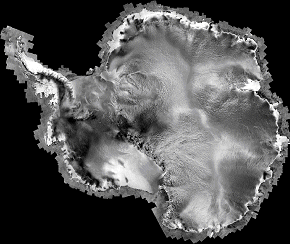
From: NASA NEWS
THE OVERALL EFFECTS OF GLOBAL WARMING
http://story.news.yahoo.com/news?tmpl=story&u=/ap/20020521/ap_on_re_us/new_iceberg_1
Iceberg Breaks Away From Antarctica
Tue May 21, 6:15 PM ET
By RANDOLPH E. SCHMID, Associated Press Writer
WASHINGTON (AP) - Another new iceberg has broken away from Antarctica, the
National Ice Center reported Tuesday.
The berg named D-17 broke off from the Lazarev Ice Shelf, a
large sheet of glacial ice and snow extending from the Antarctic mainland
into the southeastern Weddell Sea.
The new iceberg is 34.5 miles long and 6.9 miles wide, about the same size
as St. Lucia Island in the Caribbean Sea. It was observed on an image collected
by the Defense Meteorological Satellite Program.
Icebergs are named for the area quadrant of Antarctica where they appear.
D-17 is the 17th berg reported since record keeping began in 1976.
Just last week, an iceberg nearly as large as the Chesapeake Bay
called C-19 broke away from Antarctica, where it is late
summer.
In March, another giant berg broke free in an adjacent area. Named B-22,
it measured 2,120 square miles, bigger than the state of Delaware. Also in
March, a large floating ice shelf in Antarctica collapsed.
However, new measurements indicate the ice in parts of Antarctica is thickening,
reversing earlier estimates that the sheet was melting.
Scientists reported in January that new flow measurements for the Ross ice
streams indicate some of their movement has slowed or halted, allowing the
ice to thicken. Researchers don't know if the thickening is merely part of
some short-term fluctuation or represents a reversal of the ice's long
retreat.
That report, in the journal Science, came less than a week after a paper
in Nature reported that Antarctica's harsh desert valleys long
considered a
bellwether for global climate change have grown noticeably cooler
since the mid-1980s.
The National Ice Center, based in Suitland, Md., provides worldwide ice analyses
and tracking to assist the military and private shippers. It is a
joint operation of the Navy, National Oceanic and Atmospheric Administration
and Coast Guard.
___
On the Net: National Ice Center:
http://www.natice.noaa.gov
Image of D-17:
http://www.noaanews.noaa.gov/stories/images/iceberg-d17.jpg
|
||||||||
| New Antarctic iceberg bigger than Delaware May 15, 2002 SUITLAND, Maryland (CNN) -- Satellite images have detected another in a series of massive icebergs calving off the frozen continent of Antarctica, the latest one bigger than the entire state of Delaware. Dubbed iceberg C-19, the massive, rectangular ice block measures roughly 124 by 20 miles (198 by 32 kilometers), or 2,480 square miles (6,336 square kilometers) in surface area. While not quite the biggest iceberg to break away from Antarctica in recent years, C-19 is about 20 percent larger in area than the state of Delaware. Last week, another new berg broke free. It was dubbed C-18, and measured roughly 47 by 4.6 miles (75 by 7 kilometers), or just less than 10 times the area of Manhattan. C-18 and C-19 are adjacent to each other on the edge of the Ross Ice Shelf, a massive expanse of ice extending out from the continent in the portion of Antarctica that is nearest to New Zealand. National Oceanic and At mospheric Administration monitoring of satellite images from the U.S. Defense Meteorological Satellite Program detected the new bergs. In recent years, a series of increasingly larger icebergs breaking free from the continent have raised concerns that temperatures are on a steady warming trend in the Antarctic region. Such a trend, which many scientists believe may be an early sign of global warming, could have implications for climate changes over much of the planet's surface. Others have raised concerns that these massive icebergs -- some over 4,000 square miles (10,000 square kilometers) -- could pose hazards to shipping as they drift northward and break up. NOAA's National Ice Center monitors the locations of these traveling bergs, and in recent years its scientists have located icebergs within 1,000 miles of Cape Town, South Africa, and Christchurch, New Zealand. |
||||||||
|
||||||||
www.reuters.com/news_article.jhtml?type=topnews&StoryID=941443&fromEmail=true#
2002 'warmest for 1,000 years'
By Charles Clover, Environment Editor
(Filed: 26/04/2002)
THE first three months of this year were the warmest globally since records
began in 1860 and probably for 1,000 years, scientists said yesterday.
Dr Geoff Jenkins, director of the Meteorological Office's Hadley Centre,
said the record on land and sea was consistent with computer predictions
of the effects of man-made global warming.
The three months were about 0.71C warmer than the average for 1961 to 1990,
itself the warmest period for 1,000 years according to ice-core analysis,
he added.
The record warm period was the more remarkable because there was no sign
of the cyclical El Nino in the tropics, which has attended the succession
of record warmest years in the past decade.
The global record comes in the wake of observed changes in the British climate
since 1900: a lengthening of the growing season for plants by one month in
central England, a temperature increase of 1C, and a 10cm sea level
rise.
Margaret Beckett, the Environment, Food and Rural Affairs Secretary, said:
"In recent years more and more people have accepted that climate change is
happening and will affect the lives of our children and grandchildren. I
fear we need to start worrying about ourselves as well."
She was speaking at the publication of a report, The UK Climate Impacts
Programme, a joint venture between her department, the Hadley Centre, and
the Tyndall Centre for Climate Change Research at the University of East
Anglia.
Scientists, who compiled different scenarios for high, medium and low emissions
of greenhouse gases, predicted the following changes in the British climate
by 2080:
* A rise in average temperature of 2-3.5C, probably with
greater warming in the south and east. Generally, the climate will be like
Normandy, the Loire or Bordeaux, according to the amount of global
emissions.
* Hot days in summer will be more frequent, with some above
40C (104F) in lowland Britain under the high emissions scenario.
* Summer rainfall will decrease by 50 per cent and winter
rainfall increase by 30 per cent under the highest emissions projection.
* Snowfall will decrease throughout Britain, by 90 per
cent in Scotland according to the highest greenhouse gases scenario.
* Sea levels will rise by 26-86cm (10-34in).
* The probability of a storm surge regarded as extreme
will increase from one in 50 years to nine in 10 years under the high emissions
scenario.
A cooling of the British climate over the next 100 years because of changes
to the Gulf Stream is now considered unlikely.
Mrs Beckett said some of the predicted impacts were already irreversible,
but others could be slowed by international action under the Kyoto climate
treaty.
New iceberg breaks free in Antarctica
WASHINGTON (AP) - An iceberg larger than Delaware has broken off Antarctica.
The National Ice Center reported Monday that the berg, named B-22- (image), (B-22 image) broke free from an ice tongue in the Amundsen Sea, an area of Antarctica south of the Pacific Ocean.
The new iceberg is located at 74.56 south latitude and 107.55 west longitude.
It is 40 miles wide and 53 miles long, covering 2,130 square miles, slightly more than the 1,982 square mile area of Delaware.
The iceberg was discovered through photographs taken by Defense Meteorological Satellites.
Icebergs are named for the section of Antarctica where they are first sighted. The B designation covers the Amundsen and eastern Ross seas and the 22 indicates it is the 22nd iceberg sighted there by the Ice Center.
The center is a joint operation of the Navy, the National Oceanic and Atmospheric Administration and the Coast Guard.
National Ice Center: www.natice.noaa.gov
February 8, 2002
|
||||
SUITLAND, Maryland (CNN) -- A rectangular iceberg more than twice the size of New York's island of Manhattan broke free from an Antarctic glacier this week, adding to the already high number of giant icebergs in southern waters.
Dubbed Iceberg C-17, the 58-square-mile berg shook loose from the Matusevich Glacier in the Ross Sea, an area in the part of the continent closest to New Zealand that's largely covered by the Ross Ice Shelf.
Antarctic researchers have noted an increase in the number of massive icebergs calved from the continent in recent years, an indication of warming temperatures.
Many observers have worried that the apparent warming conditions could be an early sign of the impacts of global warming. But in recent weeks, seemingly contradictory announcements have appeared to support claims of both warming and cooling trends.
Scientists involved in the studies, however, say the results say virtually nothing about global warming. Instead, they say, they're indicative of regional conditions -- a possible warming trend in the part of Antarctica that includes the Ross Sea, and a possible cooling trend elsewhere on the continent.
Only long-term, worldwide studies can confirm global warming, its causes and likely effects, scientists say.
Released in recent weeks were:
- A report in the journal Science that chronicled rising temperatures in a series of lakes near Antarctica's Weddell Sea.
- A report in the journal Nature that documented cooling temperatures in the West Antarctic Ice Sheet.
- A report from the National Science Foundation that found a one-degree Centigrade fall in temperatures since the 1960s in dry valleys near McMurdo Sound.
- A report from meteorologists at the United States' McMurdo Research Station of an unprecedented summer heat wave in early January, including first-ever temperatures above 50 degrees Fahrenheit.
The C-17 iceberg, still close to the Antarctic shoreline, is to be monitored by satellite imaging as it moves and shrinks or breaks up in seawater. The shipping industry has expressed concern that the high number of large bergs in southern waters could eventually pose a navigational hazard.
The National Ice Center, an agency jointly sponsored by several U.S. government scientific and defense entities, currently is monitoring the location of more than 40 massive icebergs near the Antarctic continent; the largest of these is dubbed Iceberg B-15-B. At 1,080 square miles, it's slightly larger than the state of Rhode Island. The Ice Center chart places it about 800 miles south of New Zealand.
The most northerly of these giant bergs is A-22-C, roughly 42 square miles in size. It has drifted to a point about 650 miles south of Cape Town, South Africa.
Staggering end to Antarctic ice shelf
U.S., British researchers tie rapid collapse to warming trend
A NASA satellite image shows the thousands of icebergs created by the Larsen B ice shelf collapse. Brownish streaks are rocks and glacial debris exposed from the former underside and interior of the shelf.
March 19, 2002 — A massive Antarctic ice shelf has collapsed into the sea, shattering into thousands of icebergs and alarming researchers by the speed with which the process unfolded. Described by one researcher as “staggering,” the rapid collapse offered fuel for the debate over whether global warming is to blame.
scientist U.S. AND BRITISH government agencies confirmed the collapse of what’s known as the Larsen B ice shelf. Some 1,255 square miles of the ice shelf disintegrated between Jan. 31 and March 7, the U.S. National Snow and Ice Data Center reported Tuesday.
“The shattered ice formed a plume of thousands of icebergs adrift in the Weddell Sea,” the center said, adding that over the past five years, Larsen B lost nearly twice that amount and is now about 40 percent the size of what it used to be.
Before it broke apart, the shelf was 650 feet thick and about the size of Rhode Island.
Scientists with the British Antarctic Survey first predicted in 1998 that it would eventually collapse, and satellite images over the years suggested as much. The process accelerated over the last month, with the single largest piece calving on March 5.
720 BILLION TONS
David Vaughan, a glaciologist with the British Antarctic Survey, noted that since the 1998 prediction, “warming on the peninsula has continued and we watched as piece by piece Larsen B has retreated.”
“We knew what was left would collapse eventually,” he said in a statement, “but the speed of it is staggering.” It’s hard to believe, he said, that 720 billion tons “of ice sheet has disintegrated in less than a month.”
The U.S. center noted that 720 billion tons is enough ice for 290 trillion 5-pound bags.
The British Antarctic Survey said its scientists would be researching when such an event last happened and which ice shelves are threatened in the future. Earlier studies found four other ice shelves had been retreating in recent years.
The researchers emphasized that ice shelves themselves would not raise sea levels because they were already floating in water. However, because shelves hold back ice sheets on the continent, their collapse could allow ice on the ground to slowly move into the sea, thereby raising sea levels over time.
CLOSER TO THE LIMIT’
Ted Scambos, a glaciologist with the National Snow and Ice Data Center, said in a statement that the Larsen B collapse “gave us the information we need to reassess the stability of ice shelves around the rest of the Antarctic continent. They are closer to the limit than we thought.”
“Loss of ice shelves surrounding the Antarctic continent could have a major effect on the rate of ice flow off the continent,” Scambos added.
The center, located at the University of Colorado, noted that the next shelf to the south, the Larsen C, “is very near the stability limit, and may start to recede in the coming decade if the warming trend continues.”
“More importantly,” it said, is what might happen with the giant Ross Ice Shelf, the main outlet for several major glaciers draining the West Antarctic Ice Sheet — which is 6,000 feet thick, covers an area the size of Mexico and contains enough water to raise global sea levels by 15 feet.
“The warmest part of the giant Ross Ice Shelf is in fact only a few degrees too cool in summer presently to undergo the same kind of retreat process,” the center said.
GLOBAL WARMING DEBATE
Both the U.S. and British agencies attributed the collapse and other retreating shelves to warmer temperatures over the last half century.
That would fit in nicely with arguments made by environmentalists and many scientists that manmade emissions of greenhouse gases like carbon dioxide are causing global warming. Greenpeace, for one, called the collapse “a harbinger of global warming.”
The weakening of the Larsen B ice shelf was first noted in the late 1990s. This 1997 photo shows people dwarfed by one fissure.
Others, including some scientists, say it’s possible that any warming is due to natural shifts, not manmade causes, and that further studies are needed before taking global action to reduce emissions.
The agencies did not enter the debate over what has caused the warming around the Antarctic Peninsula.
The British Antarctic Survey limited its observation to earlier studies that found the peninsula has warmed by 4.5 degrees Fahrenheit over the last 50 years — much faster than global warming worldwide or even in other parts of Antarctica. The peninsula is the Antarctic area closest to southern Argentina and Chile.
The National Snow and Ice Data Center said studies had estimated that Larsen B had existed for at least 400 years and probably since before the end of the last major ice age 12,000 years ago.
“This is the largest single event in a series of retreats by ice shelves in the peninsula over the last 30 years,” the center said, attributing them to “a strong climate warming in the region.”
In comments to MSNBC.com, Scambos was careful not to tie the collapse to manmade emissions of greenhouse gases, and noted that computer models actually predicted different regional effects from those gases.
But he added that the collapse was so sudden in geological time that it’s not clear it was due to natural causes either.
What’s needed, he said, are improved computer models, more sampling of ice cores for climate changes and continued tracking of ice shelves and sea ice.
“The tools are there,” he said, “we need to apply them.”
COOLING IN SOME AREAS?
Other studies have actually suggested some Antarctic areas might be cooling.
One study reported new measurements showed the ice in West Antarctica was thickening, reversing earlier estimates that the sheet was melting. The Antarctica Peninsula extends from West Antarctica.
The researchers said the thickening, if not merely part of some short-term fluctuation, represented a reversal of the long retreat of the ice.
Another recent study concluded that Antarctica’s harsh desert valleys — long considered a bellwether for global climate change — have grown noticeably cooler since the mid-1980s.
Air temperatures recorded continuously over a 14-year period ending in 1999 declined by about 1 degree Fahrenheit in the polar deserts and across the White Continent, that paper said.
Scambos questioned that data but also acknowledged that “the only area showing an unambiguous warming trend is the Antarctic Peninsula.”
SEPARATE ICEBERG BREAKS
In another development on Antarctica, the National Ice Center on Monday confirmed reports that a mammoth iceberg — some 40 by 53 miles in size — had broken away from a section of the continent in the Amundsen Sea.
The iceberg was designated B-22 and is larger than the state of Delaware. It remained relatively close to the continent and was not described as an imminent threat to shipping.
Icebergs are named for the section of Antarctica where they are first sighted. The B designation covers the Amundsen and eastern Ross seas and the 22 indicates it is the 22nd iceberg sighted there by the National Ice Center.
Scambos said the B-22 was part of a regular cycle of iceberg creation off Antarctica, and not tied to warming. A much larger iceberg was created off the Ross ice shelf two years ago, he added.
The B-22 is likely to get grounded near the continent, Scambos said, but could last quite a few years.
The Associated Press contributed to this report.
2nd WARMEST YEAR ON RECORD
Date: 12/18/2001
http://www.abcnews.go.com/wire/US/reuters20011218_344.html
World Temperature Second Highest on Record
GENEVA (Reuters) - This year has been the second warmest on record and the
trend toward higher mean global temperatures looks set to continue, World
Meteorological Organization officials said Tuesday.
Compared with the 1961-1990 average used as the basis for comparison, officials
said the global temperature in 2001 rose a fraction of a degree Fahrenheit
to 57.2 F.
It is the 23rd year in succession that temperatures have been above the 1961-1990
mean.
The 2001 average temperature was second only to 1998 when temperatures
rose under the impact of La Nina, the sister phenomenon to El Nino, both
of which are caused by abnormal warming of surface water in the Pacific
Ocean.
"The expectation is for a continued gradual warming for the next years,"
Ken Davidson, director of the organization's World Climate Program, told
a news conference.
"If you look at the trend, you can see since the 1980s we have consistently
remained above normal, with the temperatures continuing to increase slowly.
So you would anticipate that this trend is most likely to continue," he
said.
World Meteorological Organization officials said the warming trend would
be accompanied by further cases of extreme weather conditions -- both flooding
and drought as well as sharp temperature variations. But it was not possible
to predict where the weather events would occur.
They noted the overall trend to higher mean temperatures did not mean that
some parts of the world would not experience extreme cold, as happened last
winter in Russia
Officials said the rising mean temperature and the frequency of extreme climatic
conditions, such as the devastating drought currently plaguing central Asia,
were consistent with a pattern of global warming.
The United Nations Intergovernmental Panel on Climate Change, a body of
international scientists, has warned that rising emissions of greenhouse
gases such as carbon dioxide as a result of human activities are at least
partially responsible for the temperature trend.
Leading industrialized countries, with the exception of the United States,
are committed under the Kyoto Treaty on climate change to limiting emissions
of greenhouse gases.
THE WARNING SIGNS 12 July 2001 * The Earth is warming faster that at any time in the past 1,000 years
* Levels of carbon dioxide (CO2) have risen by nearly a third over * The rate of increase in CO2 is the highest for at least 20,000 years
* Present concentrations of CO2 have not been exceeded for at * Average global temperatures could rise by 5.8C by 2100
* Predicted increases in global warming are without precedent during
* Existing man-made emissions of greenhouse gases will continue to
* The area of the northern hemisphere covered by ice and snow has * Arctic sea ice has thinned by about 40 per cent during late summer
* Three-quarters of the man-made emissions of carbon dioxide over |
Alaska Weather: The Highs and Lows Many weather-related myths surround Alaska’s climate. One of the most common is that summers in Alaska are cool. In fact, Alaska has four seasons like much of the rest of the United States and weather records at both ends of the thermometer. Alaska's summers are warm with highs that can reach into the 90s—Ft. Yukon holds the all-time record with a sizzling 100-degree temperature recorded in 1915. Many believe that the far northern part of Alaska would be the coldest. Actually, the record for Alaska (and the entire U.S. for that matter) was set in 1971 at Prospect Creek in the northern interior. When compared to high readings near 90 degrees, Alaska’s temperature range is an astonishing 170 degrees. The US Carbon Dioxide Information and Analysis Centre reports in its Winter 1993 newsletter that surface temperatures at nine stations north of the Arctic circles have increased by about 5.5 oC since 1968. In commenting on these observations CDIAC said that : "Although the observed increases in surface temperatures ... cannot at present be unequivocally related to increases in greenhouse gases, these data indicate that the boundary layer structure in polar regions may be especially sensitive to changes" in these gases. Surface temperature inversions in the Arctic were studied by R.S. Bradley, F.T. Keimig and H.Diaz from the US National Oceanographic and Atmosphere Administration from observations at nine stations north of Arctic circle. These show that surface temps have increased by 0.244 oC per year and that surface inversion depths have declined by 21m/year between 1968 to 1990. Longer records at at a station at Barrow in Alaska confirm this. The melting of large ice sheets causing an increase in ocean mass from the melting of land ice. In fact, many glaciologists fear that with a rise of approximately 4 degrees in global temperature, the West Antarctic Ice Sheet might collapse and slide into the ocean raising sea level worldwide. This process would take thousands of years to manifest but it would eventually cause the level to rise by 5 meters at a rate of 1 to 2 cm a year, which could be catastrophic to coastal communities in the long term. Another affect is the melting of alpine glaciers and small ice caps. These only make up for one percent of the total water reservoir on earth but they are the most sensitive to temperature changes. If the global mean temperature rises enough to melt all alpine glaciers and small ice caps this would contribute to a SLR of 0.3 to 0.6 meters. |
| LAPLAND
Lapland has warmed by 1.37°C (2.47°F) between 1860 and the present, according to the IPCC temperature data. Global warming supporters obviously would point to this long record as evidence in support of the numerical climate models’ predictions of warming in high-latitude land areas under increasing concentrations of greenhouse gases. However, there are two other lessons to be learned from the Lapland: (1) Closer inspection shows something strange about the warming over the past 140 years. All of it took place prior to 1950. There has been absolutely no warming over the past half-century, the time when greenhouse gases have increased most. No warming during the last fifty years hardly supports predictions from the General Circulation Models. |
| ALASKA VS CANADA
Good records of temperature and precipitation are available for the last 50 years, but data quantity and quality are diminished in prior years. It is clear that the Arctic has undergone significant change in the last 50 years, but the changes differ in different regions in the Arctic. For example, Alaska has experienced significant warming over the past 30 years, with average wintertime temperatures about 6 degrees warmer now than in the 1960's. In contrast, northeastern Canada has experienced a cooling trend over the same period. Such changes may be part of natural processes, but recent studies have shown links between the build-up of greenhouse gases and the changes, both warming and cooling, observed in the Arctic. Yet, there was a period of warming in Alaska in the 1920-1940 period that was less likely to have been caused by greenhouse gases. There are studies underway to discover the driving forces for this warming earlier in the 20th century. |
| ARCTIC
Building a history of Arctic climate from tree rings, ice cores, silt layers on lake bottoms, and tiny marine fossils, the researchers say that from 1840 to about 1950, the region warmed to its highest temperatures in 400 years. Natural factors account for warming during the early part of the 110-year period, say scientists. But during the second half, especially since 1920, natural factors fail to account for all the heating. This study supports other research showing rising temperatures in the Arctic region. At a conference in Anchorage, Alaska, earlier this year, scientists noted that Nome, now enjoys at least 10 more days each year of 70-degree temperature, compared with two or fewer days a year between 1915 and 1970. As a result, hardy willow-type plants are appearing for the first time in valleys in the Brooks Range, which spans the northern part of the state. Ice-free Arctic voyage fuels global warming fears A Canadian ship has completed a voyage through the North-West Passage without encountering any pack ice. Most of the passage lies north of the Arctic Circle and scientists say the absence of ice may be further evidence of global warming. The search for an ice-free route, linking the Atlantic and the Pacific, has been the goal of sailors for more than 400 years. Hundreds died in the quest for a shorter passage between Europe and the far east, before Norwegian Roald Amundsen successfully completed the journey, along the coast of Alaska and Canada, in 1906. That voyage took three years with two winters being spent stuck fast in the ice. But now a Canadian patrol boat has navigated the North-West Passage in just nine weeks without meeting any pack ice. Scientists, who have been monitoring the Arctic ice cap, say it is melting more and more each Summer and its size has been reduced by 6 per cent since 1980. |
| TEMPERATURE CHANGES
NOAA reports from 5400 observing stations around the world that the mean planetary temperature is trending hotter by +0.88C per 100 years. The trend for the minimum temperature is +1.86C per century. (Science, AAAS, July 18, 1997; Vol.277; pg.364) In addition the daily temperature range has been decreasing, probably as a result of increases in the moisture content of the air. * Ten of the hottest years on record have occurred since 1980. Also, 1996 was the hottest year on record --- in the US * Finnish meteorologists note the hottest year in recorded weather history in Finland; (30 days greater than 77 F). Population grumbles. * Continuous data from the 1930s in Wisconsin show a significant change in Pond-Thaw data. Ponds that historically became ice-free in late April to early May, are now becoming ice-free in March (Global Change Research Program - Speaker's Series) * Alaska: Melting permafrost damages roads, airports and building foundations. Dates of ice breaking up in the Tanana River each spring have been recorded for 80 years; three of the four earliest dates are in the 1990s. Records of warm summer days in Nome, Alaska show a sharp increase starting in the mid 1970s. "There is so much permafrost melting, I could not leave Fairbanks without going off the paved roads. I had to go around collapsed areas of pavement-in many places, I saw 10-15 foot holes. They looked like bomb craters.-Barry Rock University of New Hampshire." (Boston Globe 9.15.97/Science and Technology Section/p.C1 "Parts of Alaska starting to feel the heat") Similar situations have been reported in the Siberia and in the Canadian arctic. Mean annual temperatures a meter below the surface have risen by more than 1 degree C in the past decade in this far northern U.S. state, according to New Scientist, October 9th, edition reported in the Vancouver Sun. Lower lake levels, drought, forest fires, and some 2000 landslides caused by melting permafrost in Canada's north are the result of global warming says a recent Northwest Territories report. "The greatest thaw since the glacial epoch provokes special concern among researchers. For instance, the average temperature in the greater part of Siberia was by 3-5 degrees C higher over the past few years than at the start of the century. (TASS, "Russia pays greater attention to ecology than in the past", September 30, 1997) In parts of Alaska, warming has increased tree growth, reduced precipitation, or increased winds and insect pests. Tree ring studies show no comparable period of warming in a 400-year history. (New Scientist This Week, October 11, 1997, p4) * Heat wave in Brazil has thousands of people at the beach during the middle of the southern hemisphere winter. Temperatures as high as 108 degrees F(42.7 degrees C) have been recorded. * Soil samples and archeological data show that catastrophic El Ninos come on average every 500 years, reports the Dallas Morning News. Such evidence covers 5000 years (Shellfish growth rings from coastal Peru) and suggests that periodically the effects are so severe it has forced entire populations to abandon their homes and migrate. This one may be the warmest El Nino in 500 years. (The Tampa Tribune, October 15, 1997, final edition, Nation/World, p8) * The Farallon National Wildlife Refuge, a tiny archipelago of two islands and 10 seastacks is situated 27 nautical miles west of the Golden Gate Bridge. Bill Sydeman, director of marine studies for the bird observatory said "We know that the average mean temperature of the water around the Farallones has gone up five degrees F in the last twenty years. That's a huge jump -- and we don't know what the ultimate effects will be. Sardines are increasing as a result of the warmer water, but other species are decreasing. How it will all shake out for the birds and marine mammals is anybody's guess." (The San Francisco Chronicle, September 8, 1997, Monday, Final Edition, Section: News, pg A15) * Last year was the warmest year in Great Britain since 1659 and driest since about 1700. (Sunday Telegram, Worchester, MA, September 28, 1997, Local News, p B1) * This year (1997) is almost certain to be the warmest on record across the world, meteorologists are predicting. (New Scientist, This Week, Newswire, p27, October 18, 1997) * The Monterey Bay Aquarium, in California has had to add nutrients to its sea water intake to keep kelp healthy, and chill the water, as some species such as octopus could not stand the warmer water. (CNN Earth Matters, September 14, 1997, 5:30 AM EST) * Scientists say July 1997 ranks as the coldest July ever recorded at the South Pole, averaging minus 86.8 degrees F, which is 3.1 degrees below the old record. (Newsday, New York, September 16, 1997, Health and Discovery; pC 3) * This year's El Nino is the strongest ever recorded with ocean temperatures currently 9-15 degrees F greater than normal in parts of the Pacific. The anomaly is measured off the west coast of Peru and extends 6000 to 8000 miles into the Pacific. This El Nino achieved this record temperature in half of the time taken by the previous record holder in 1982-83. Albacore were caught off the central California coast in May. $13-25 billion in losses and 2000 deaths are attributable to the 1982-83 El Nino, when California received 240% of its normal precipitation. (The Fresno Bee, September 5th, 1997, Friday, Home Edition, Section:Telegraph page A1) * Nature magazine in its August 28th issue, reported that the area covered by Antarctic ice diminished by 25% in the period 1950-1970. Harvey Nichols of the University of Colorado also reports that the tree lines in the Canadian and Siberian arctic advanced toward the arctic circle by 60 miles, and that changes have occurred since the 1970's. Says researcher Robert Stewart of Canadian Forest Service, "We don't know what is causing this, but have clear evidence that the tree line and the permafrost are responding to warmer temperatures." (USA Today, September 9th 1997, Tuesday, Final Edition, Life Section, Page 6D) |
Global warming much worse than predicted, say scientists
By Michael McCarthy, Steve Connor, Richard Lloyd Parry and Stephen Castle
12 July 2001
Global warming is happening now, caused by human actions, and threatens the Earth with disaster, the world's leading atmospheric scientists insisted yesterday as politicians struggled to repair the Kyoto treaty on climate change which the United States torpedoed in March.
A 2,000-page UN report on the science and potential impacts of climate change gave the most authoritative statement yet that the Earth is warming rapidly, that the main cause is industrial pollution, and that the consequences for human society are likely to be catastrophic.
The report, from the Intergovernmental Panel on Climate Change (IPCC), made up of several hundred of the world's most distinguished meteorologists, including many Americans, is a substantial slap in the face for US President George Bush, whose unilateral abrogation of Kyoto has thrown the international effort to counter global warming into chaos. It comes on the eve of first big meeting, held in Bonn next week, to try to repair the treaty.
The president cited doubts about the science of climate change as the reason why he would not impose on the American economy the cuts in industrial gases which Kyoto requires – and which the US signed up to at the original treaty agreement in 1997.
But yesterday the IPCC scientists gave their unqualified support to the view that global warming is real. Furthermore, they said, since their last report was published six years ago, they found they had vastly underestimated the rate at which global temperatures are rising. They now believe they will rise by as much as 5.8C by the end of this century, almost twice the increase predicted in their 1995 report.
This is likely to lead to crop failures, water shortages, increased disease and disasters for towns and cities from flooding, landslides and sea storm surges, they believe, with the poor developing countries likely to be hit hardest. The crucial point that emerges from the report is that all these new stresses may be happening at the same time to a world already under great stain from massive population growth, poverty and pollution.
As the massive three-volume study was published yesterday (by Britain's Cambridge University Press), politicians across the globe were scrambling to put some sort of deal together at next week's Bonn conference, which will be attended by ministers and officials from more than 150 nations.
It is a resumption of the meeting on the Kyoto treaty which broke up acrimoniously in The Hague last November with a spectacular walk-out by Britain's Deputy Prime Minister John Prescott. But the argument then was over a technicality in the treaty and the Americans were still on board. Subsequently, Mr Bush has repudiated the treaty's basic principle – that the industrialised countries should cut their greenhouse gas emissions – and the chances of the Americans coming back on board are regarded as minimal.
Bizarrely, the Americans will be present in Bonn as negotiators on a treaty they have said they will have nothing to do with, as they are signed-up parties to the UN Framework Convention on Climate Change.
Diplomatic efforts were continuing yesterday to build alliances which might allow Kyoto to be repaired. Mr Prescott flew into Tokyo for meetings with the Japanese prime minister, Junichiro Koizumi, and his foreign and environment ministers, in an attempt to persuade the Japanese to join the European Union's plan to ratify the treaty without the Americans. But it looks increasingly likely that the Japanese will do nothing to upset the US, their main diplomatic and trading ally.
European leaders yesterday admitted that confidence in the Kyoto process may collapse if there is no breakthrough in next week's Bonn talks. Margot Wallström, European Commissioner for the Environment, conceded that negotiations in Japan and Australia had failed to win a pledge from the two governments to ratify the treaty without the involvement of the US.
"I clearly see the risk that the public and stakeholders lose confidence in the process if we do not make any steps in Bonn," Ms Wallström said. Olivier Deleuze, the energy minister of Belgium, which holds the EU's rotating presidency, added: "If nothing moves forward in Bonn then we will lose momentum and the process will sink."
Brussels has still not given up hope of progress and argues that Japan and Australia remain committed to the Kyoto objectives, and to the discussions in Bonn.
5-11-00 - GLOBAL WARMING
Early Warning Signs
Subj: Weather and Africa
Date: 2/19/2001
From: julie321@seanet.com (Alan Furford)
Earth is feeling the heat
Ice cap atop Mount Kilimanjaro may be a puddle within 15 years
Monday, February 19, 2001
SEATTLE POST-INTELLIGENCER NEWS SERVICES
The ice cap atop Mount Kilimanjaro, which for thousands of years has floated like a cool beacon over the shimmering equatorial plain of Tanzania, is retreating at such a pace that it will disappear in less than 15 years, according to new studies.
The vanishing of the seemingly perpetual snows of Kilimanjaro that inspired Ernest Hemingway, echoed by similar trends on ice-capped peaks from Peru to Tibet, is one of the clearest signs that a global warming in the past 50 years appears to have exceeded typical climate shifts and is at least partly caused by gases released by human activities, a variety of scientists say.
Measurements taken over the last year on Kilimanjaro show that its glaciers are not only retreating but rapidly thinning, with one spot having lost a yard of thickness since last February, said Lonnie Thompson, a senior research scientist at the Byrd Polar Research Center of Ohio State University.
Altogether, he said, the mountain has lost 82 percent of the ice cap it had when it was first carefully surveyed, in 1912.
Thompson presented the fresh data at the annual meeting of the American Association for the Advancement of Science in San Francisco.
Meanwhile, in Geneva yesterday, government experts completed a United Nations report on the results of extensive investigation into how global warming will affect different countries and regions of the world. The report, summarizing more than 1,000 pages of research conducted by about 700 scientists, was to be published today.
Poor countries, and above all small island states, will be hardest hit by global warming, while melting ice caps and other changes in polar regions likely will continue for centuries, the U.N. report says.
Even though the United States as a whole is less vulnerable, areas such as Florida are at great risk from rising sea levels, according to an initial draft of the report obtained by The Associated Press.
Given the political sensitivities of the climate debate, the report was subject to line-by-line scrutiny by government representatives during weeklong discussions prior to release.
The Geneva report, "Climate Change 2001: Impacts, Adaptation and Vulnerability," is one of a series of three.
A report released last month in Shanghai, China, predicted that global temperatures could rise by as much as 10.5 degrees over the next century. It said the increase was much higher than expected, and there was clear evidence that industrial pollution was to blame.
The third volume, on solutions, will be released in March.
For years now, scientists have been warning that global warming is likely to lead to an increase in freak weather conditions, with more floods, cyclones and droughts. They have predicted an upsurge in mosquito-borne illnesses such as malaria and extinction of plant and animal species because of habitat destruction.
What is significant about the new reports, however, is the degree of certainty about the extent of global warming and its effect.
The draft Geneva report gave a regional breakdown of what may lie ahead:
* Africa: Grain yields are expected to decrease, and there will be less water available. Desertification will be worsened by less average annual rainfall, especially in southern, North and West Africa. Coastal settlements in Nigeria, Senegal, Gambia, Egypt and along the east-southern African coast will be hit by rising sea levels and coastal erosion.
* Asia: High temperatures, drought, floods and soil degradation likely will diminish food production in arid and tropical parts of Asia. Northern areas may see an increase in productivity. Rises in the sea level and more intense tropical cyclones likely will displace tens of millions of people in low-lying coastal areas of temperate and tropical Asia.
* Europe: Southern Europe will become more prone to drought. In other areas, flood hazards will increase. Half of Alpine glaciers could disappear by the end of the 21st century.
Heat waves may change traditional summer tourist destinations and less reliable snow conditions may hurt winter tourism. Agricultural productivity may increase in northern Europe, but decrease in southern areas.
* Latin America: Floods and droughts will become more frequent. Yields of important crops likely will decrease in many parts of Latin America. Subsistence farming in northeastern Brazil could be threatened. Exposure to diseases such as malaria and cholera likely will increase.
* North America: Food production could benefit from modest warming, but there will be strong regional effects, such as declines in Canada's prairies and the U.S. Great Plains. Sea level rises could increase coastal erosion and flooding and lead to more storm surges, particularly in Florida and the Atlantic coast.
Diseases such as malaria, dengue fever and Lyme disease may expand their ranges in North America, and there likely will be more heat-related deaths.
* Polar: Climate change in polar regions is expected to be among the largest anywhere on Earth. Already, the extent and thickness of Arctic sea ice have decreased, permafrost has thawed, and the distribution and abundance of species has been affected. The trends may continue even long after greenhouse gas levels are stabilized and cause irreversible effects on ice sheets, global ocean circulation and sea levels.
* Small island states: A projected sea level rise of two-tenths of an inch per year for the next 100 years will increase coastal erosion, damage to ecosystems, loss of land and dislocation of people. Coral reefs will be damaged and fisheries harmed. Tourism -- an important source of income -- likely will face severe disruption from climate change and sea level rise.
This report includes information from The Associated Press and The New York Times.
xxxxxxxxxxxxxxxxxxxxxxxxxxxxxxxxxxxxxxxxxxxxxxxxxxxxxx
The last breaks down to 20 inches of sea level rise in 100 years and they skewed the data to the most conservative tongue in cheek figure they could. Keep in mind we have a new top line for solar flares, and the Navy raised the average sea temps two years ago, something both Stan Deyo and I caught. Like the ozone cover-up when the Phoenix sightings were going on some years back, falsified data then data removal, they are using smoke and mirrors again. Below is another story on the story...
~~~~~~~~~~~~~~~~~~~~
Scientists spell out risks from global warming
WebPosted Mon Feb 19 2001
GENEVA - An international panel of scientists from more than 100 countries says governments and citizens around the world should get prepared for more extreme weather patterns.
* INDEPTH: Weather Gone Wild
Scientists have been talking about the impact of global warming for years.
But this warning stands out because of its strong degree of certainty that we're already seeing big changes.
The UN's Intergovernmental Panel on Climate Change, which is releasing its report in Geneva Monday, says poor countries and small islands will be hardest hit by an increase in cyclones, droughts and flooding.
The financial cost of the upheaval is expected to rise dramatically. In the 1990s, severe weather caused about $40 billion in damage worldwide every year (a figure adjusted for inflation), compared to about $4 billion in the 1950s.
* FROM DEC. 24, 2000: World warming trend continuing - report
The report predicts that the biggest climate change will be at the Earth's poles. Sea ice is already thinning, permafrost is thawing, and wildlife is suffering.
* FEATURE: From The National: Is global warming coming faster than expected?
According to the panel, the Earth's temperature has risen half a degree Celsius in the last 100 years and may increase by as much as 5.8 degrees in the next century.
To some extent developed nations may be able to adapt to storm surges, erosion of coastlines and drought, says Klaus Toepfer, executive director of the United Nations Environment Program.
"Of course there's no doubt that theoretically, you can do everything with adaptation," Toepfer says.
But the world's poorest nations may not be able to cope. "But people in (countries such as) Bangladesh, they cannot," he adds. "They have not the resources. They will simply lose their homes."
~~~~~~~~~~~~~~~~~~
Now the report has been passed around by the major services but calls from other scientists to 10.5 degrees raise in temperature were to horrible to contemplate so the lowest figures were used. That data is also available. In every case the media for the most part cites 100 year history and an average, then bring in the last 10 years. Not one major media press writer has ever called them on the fact we have lost 1/2 of the arctic ice in 2 years with the bulk occuring in just 5 years. Normally the media tries for the great shaking "crisis" stories and beats them to death all across the "tube" and radio as we all know. Not this time for this subject.... We have watched the weather channel people back off, note most weather disasters are underplayed and some not mentioned, and when certain reports come out, they have to be translated by the masters to the general public just like the lawyers who propose to tell us only they can understand the Constitution of the United States when it was written very clearly. What I am trying to say in a nutshell is things are worse than most people can remotely realize, and the media is playing the game far more ignorant than it really is.
Allen Furford
GLO Industries Inc.
Forfjord Supply Inc.
Engineering
Phone: 206-784-8171
FAX 206-784-1501
~~~~~~~~~~~~~~~~~
Satellites reveal shrinkage of polar ice sheet
File image of antarctic ice
February 2, 2001
WASHINGTON (AP) -- Scientists have worried for decades that the Antarctic ice sheet was shrinking, threatening a global rise in sea level. Now, satellite studies show that about 7.5 cubic miles (12 cubic km) of ice have eroded from a key area in just eight years.
Melting of that much ice doesn't mean that it is time to get into boats, said one researcher, but the finding may be a "yellow warning flag" that confirms long-term changes are under way in the ice fields covering the South Polar region.
The British study, which appears Friday in the journal Science, involved altitude measurements of the West Antarctica Ice Sheet, the smaller of two major ice sheets. It covers 740,000 square miles (1,184,000 square km) of the frozen continent.
Based on satellite measurements, said Andrew Shepherd, a University College London geologist and first author of the study, it appears that since 1992 the ice sheet has lost ice principally through the speeded-up movement of the Pine Island Glacier, an ice stream that drains about a third of the ice sheet.
"The Pine Island Glacier is key," said Shepherd. "It is totally exposed to the sea, and people have identified it as the weak underbelly of the West Antarctica Ice Sheet."
Melting of the entire sheet theoretically could cause a global sea level rise of 25 to 45 feet (7.5 to 13.5 meters), but Shepherd said that at the present rate of change it would take centuries for the Pine Island Glacier, which is only about 10 percent of the ice sheet, to affect sea level seriously.
Jane Ferrigno, a U.S. Geologic Survey geologist and polar ice expert, said a speedup of the Pine Island Glacier, as reported by Shepherd and his co-authors, could foreshadow continuing changes of the West Antarctica Ice Sheet's ice levels.
The glacier "is moving faster than we thought," Ferrigno said. "This doesn't mean it could have an effect on coastal areas around the world within the next few decades, but this is a yellow warning flag. This is an area that should be watched carefully."
Shepherd said eight years of satellite data show a steady trend of ice-sheet shrinkage, with most of the decline coming in the Pine Island Glacier system, the largest in West Antarctica.
The Pine Island Glacier thinned by 30 to 36 feet (9 to 10.8 meters) during those eight years, and the glacier's grounding line _ the point where sea water undercuts the main stem of the glacier -- has pushed inland by about three miles.
"The thinning is 10 times greater than the rate of snowfall in the basin," said Shepherd. "The speed of the glacier means that much more mass is going out (through melting and breaking off of icebergs) than is coming in."
Shepherd said if the present rate of change continues, the main stem of the Pine Island Glacier will be undercut by the sea and lifted up in about 600 years. When the glacier floats, it would cause a dramatic shift in sea level, he said.
Understanding how fast the Pine Island Glacier is moving and the effect of this motion on the total West Antarctica Ice Sheet "is of considerable importance" in predicting what will happen to the ice in Antarctica, Ferrigno said. She said the work by Shepherd and his co-authors adds new data for an area of the polar continent that was virtually unknown before.
Antarctica contains about 7.2 million cubic miles (11.5 cubic km) of ice, about 84 percent of all the glacial ice on Earth, according to the USGS. Melting all the Antarctica ice would cause a global sea level rise of about 240 feet (72 meters). Such a rise would flood virtually all the world's coastal areas and drown many islands.
Copyright 2001 The Associated Press. All rights reserved. .
~~~~~~~~~~~~~~~~~~~
WINTER WARMTH SETS RECORD IN USA
05/19/00-
http://www.usatoday.com/weather/news/2000/wjanaprwrm.htm
By Chris Vaccaro, USATODAY.com
Received from Stan and Holly Deyo in Australia 5-23-00
January through April this year was the warmest such four-month period in the 106 years of reliable weather records, the National Oceanic and Atmospheric Administration (NOAA) told USATODAY.com Thursday.
In a report released Friday, NOAA said the USA's average temperature for the four months averaged 44.3 degrees, which is 0.3 degrees warmer than the previous record, which was set in 1990.
Preliminary data indicates that nearly 70% of the country was much warmer than normal, while less than 1% of the country was much cooler than normal, NOAA's figures show.
Although Friday's report shows a trend of warming temperatures, it's still uncertain whether we're seeing global warming caused by human activities.
"This past decade we've seen remarkable warmth," says Elbert W. "Joe" Friday Jr., retired head of the National Weather Service. "But we've been taking temperature measurements for only 150 years at best, and the data becomes increasingly unreliable as you go back."
In the USA, the December-through-February winter of 1999-2000 was the warmest on record. This year, January through March was the warmest such three-month period on record.
January through April this year was the warmest such four-month period in the 106 years of reliable record-keeping, weather officials will announce Friday. The USA's average temperature for those months averaged 44.3 degrees, 0.3 degrees above the previous record set in 1990. Nearly 70% of the country was much warmer than normal. Although Friday's report from the National Oceanic and Atmospheric Administration shows a trend of warming temperatures, the jury is still out on whether it represents global warming caused by human activities.
***************
KUWAIT TEMPERATURE HITS SPRINGTIME 45C RECORD
http://news.excite.com/news/r/000520/04/kuwait-heat
May 20, 2000
KUWAIT, May 20 (Reuters) - Temperatures in Kuwait rose to a record 45 C. (115 F.) in the shade this week and experts predicted a possible high of 53 (127.4 F.) in July, al-Qabas newspaper said on Saturday.
It quoted a meteorology official as saying that temperatures rose over the past three days above the record for this time of year. He said in July temperatures could exceed the previous record of 52 Celsius in the shade recorded two years ago.
Under the blazing sun, temperatures have been reported in the past to have reached into the 80s C. in exposed areas of the oil-rich, desert emirate.
Almost all buildings and vehicles in the Gulf Arab state are air-conditioned. But thousands of Western troops and United Nations peacekeepers are deployed in desert regions to monitor the border with former occupier Iraq.
**************
OCEANS HAVE HEATED SIGNIFICANTLY
The Charleston Gazette, Josef Hebert, AP
March 24, 2000, Friday
SECTION: News; Pg. P6A
WASHINGTON - Scientists have discovered a significant, even surprising, warming of the world's oceans over the past 40 years, providing new evidence that computer models may be on target when they predict the Earth's warming.
The broad study of temperature data from the oceans, dating to the 1950s, shows average temperatures have increased more than expected - about half a degree Fahrenheit closer to the surface, and one-tenth of a degree even at depths of up to 10,000 feet.
The findings, reported by scientists at the NOAA, also may explain a major puzzle in the global warming debate: why computer models have shown more significant warming than actual temperature data.
Global warming skeptics contend that if the computer models exaggerate warming that already has occurred, they should not be trusted to predict future warming. The models have shown higher temperatures than those found in surface and atmospheric readings. But now, the new ocean data may explain the difference, scientists said.
In the NOAA study, scientists for the first time have quantified temperature changes in the world's three major ocean basins and at such depths.
"We've known the oceans could absorb heat, transport it to subsurface depths and isolate it from the atmosphere. Now we see evidence that this is happening," said Sydney Levitus, chief of NOAA's Ocean Climate Laboratory and principal author of the study.
Levitus and fellow scientists, who have worked on the project for seven years, examined temperature data from more than 5 million readings at various depths in the Pacific, Atlantic and Indian oceans, from 1948 to 1996.
They found the Pacific and Atlantic oceans have been warming since the mid-1950s, and the Indian Ocean since the early 1960s, according to the study published in the journal Science on Friday.
The greatest warming occurred from the surface to a depth of about 900 feet, where the average heat content increased by 0.56 degrees Fahrenheit. Water as far down as 10,000 feet was found to have gained on average 0.11 degrees Fahrenheit.
"This is one of the surprising things. We've found half of the warming occurred below 1,000 feet," Levitus said. "We can no longer ignore the ocean."
The study did not pinpoint the cause of the warming trend over such a lengthy period, but said both natural and human-induced causes were likely.
Levitus discounted short-term climate phenomenon such as the El Nino effect as a significant factor. "We're seeing a 35-year warming trend and El Nino occurs on a time scale of two to seven years. There's something much more significant occurring than just short-term variability," he said.
Other scientists who have argued that the ocean has masked actual global temperature increases called the findings a major breakthrough.
"It confirms that the earth is heating up," said Jim Hansen, director of the National Aeronautics and Space Administration's Goddard Institute for Space Studies. He said a warming of the Earth from greenhouse gas emissions "would tend to give you a warming of the oceans of that magnitude."
Hansen is among the earliest proponents of the argument that heat-trapping manmade pollution - greenhouse gases, mainly carbon dioxide from burning fossil fuels - is causing the Earth's warming.
A U.N.-sponsored panel of more than 200 scientists has predicted that average global temperatures will increase 2 degrees to 6 degrees Fahrenheit by the end of the century if current greenhouse gas emissions are not curtailed.
Such warming is believed by many scientists to have broad economic and environmental impact including sea level rise as well as changes in agriculture and human health.
Critics of these predictions believe that global mean temperatures have increased only about 1 degree Fahrenheit over the past 100 years and that computer models used to predict future climate change are not reliable.
While the oceans overall still are becoming warmer, there is evidence that parts of the deep waters of the North Atlantic have begun to cool. "Which leaves the question, where is the heat going?" Levitus said.
Likely, it is going to the surface, If so, Levitus suggested the warmer ocean temperatures "may be an early indicator of the warming of surface, air and sea surface temperatures" a decade from now.
*****************
U.S. Records Warmest Winter on Record - NOAA
WASHINGTON (Reuters) - The winter of 1999-2000 was the warmest winter in the United States since the government began keeping records 105 years ago, the National Oceanic and Atmospheric Administration said on Friday.
This marked the third year in a row that record warmth was recorded in the United States during the winter months. Since 1980 more than two-thirds of U.S. winters have been warmer than average, NOAA said.
The average U.S. temperature from December to February was 38.4 degrees Fahrenheit, six-tenths of a degree warmer than the previous record set last year.
``During the past winter, every state in the continental United States was warmer than its long-term average, with 21 states from California to the Midwest ranked as much above average,'' NOAA said in a statement.
It was also the 16th driest on record, NOAA said.
The government blamed the warmer temperatures and lack of moisture on the La Nina weather phenomenon. During a La Nina period, sea surface temperatures are cooled, leading to lower rainfall in parts of the world, including in the United States.
La Nina also shifts the location of the jet stream, raising temperatures across the United States. The latest La Nina period began in mid-1998 and scientists predict it will continue well into 2000.
NOAA also said global warming, which most scientists believe is caused by human activities such as the burning of fossil fuels like coal and gas, was partly to blame for the temperature spike.
*****************
FOREST FIRES BLAMED ON GLOBAL WARMING
Copyright 2000 Canadian Broadcasting Corporation
April 5, 2000, Wednesday
GUEST: REG SHERREN, Reporter
DENNIS GILHOOLY, Fire fighter
BOB JOHNSON, Fire fighter
JOHN PARKER, Environment Canada
DAVID KEMP, Lakehead University
FRED HOPPER, Environment Canada
ANCHORS: PETER MANSBRIDGE
PETER MANSBRIDGE: Global warming is being blamed for another problem in Canada's north -- forest fires. Some are already burning in northern Ontario. And across the country firefighters are gearing up early. Here's Reg Sherren.
REG SHERREN: The Thunder Bay District Fire Centre is gearing up. With 11 fires across northwest Ontario already, veterans like Dennis Gilhooly have been brought in five weeks early.
DENNIS GILHOOLY / FIRE FIGHTER: It's probably the earliest start ever yet. The conditions warrant it.
SHERREN: Fire boss Bob Johnson hates to make predictions but he knows the odds are against him.
BOB JOHNSON / FIRE FIGHTER: Seven out of the 10 years in the last decade have been some of the worst fire seasons on record.
SHERREN: And there's no reason to think this year will be any different. The conditions from Thunder Bay across northwestern Ontario couldn't be much worse. They've had less than 50 percent of their normal amount of snowfall. The bush is tinder dry. And the situation across many parts of western Canada isn't much better.
JOHN PARKER / ENVIRONMENT CANADA: There's locations that have received only 30 to 50 percent of normal. So very dry in those areas. In the Hinton area of Alberta close to the Rockies north of Edmonton.
SHERREN: Right across the west fire crews are waiting for the inevitable. Fear of more grass fires like these in Alberta last year had crews start in that province the first of March. But if a big fire gets going there's a big problem. Most lakes are still frozen. So water bombers don't have easy access to water.In Manitoba there are plans to fill them at regional airports. In Ontario extra choppers are standing by. A recent study by the Canadian Forest Service warns the profound changes we are experiencing now won't stop any time soon. Climate experts agree. It's another symptom of global warming.
DAVID KEMP / LAKEHEAD UNIVERSITY: I think. Yeah for the next 10 or 15 years it's going to continue this way.
SHERREN: The experts say the trend will also result in more severe weather with more severe consequences. Perhaps as much as a 50 percent increase in the amount of forest burned.
FRED HOPPER / ENVIRONMENT CANADA: There's a greater likelihood for more serious, more severe thunderstorms that would provide the spark to ignite the dry fuel in the forest.
SHERREN: Making a bad situation even worse.
HOPPER: Quite a bit.
SHERREN: Dennis Gilhooly suspects the experts are right and that there are some very long, very hot days ahead. Reg Sherren, CBC News, Thunder Bay, Ontario.
**********
EL NINO'S VOLCANIC CONNECTIONS
Copyright 2000 Information Access Company, Kimbra Cutlip
March 1, 2000, No. 2, Vol. 53; Pg. 11
Large volcanic eruptions in the tropics over the past 400 years have often been followed by an El Nino pattern around the globe, according to a new climate data analysis at the National Center for Atmospheric Research.
Paleoclimate student Caspar Ammann used local eruption observations and ice-core data to track the years of major volcanic eruptions in the tropics.
He then used a data set based on tree rings and coral growth layers to arrive at a global picture of the Earth's climate the following year.
He found a tendency that major tropical eruptions tend to be followed by an El Nino-like pattern of temperature changes in the tropical waters of the eastern Pacific, Alaska, the southeastern United States, the tropical Atlantic, the Indian Ocean, and the western Pacific. He defined major eruptions as those powerful enough to eject sulfates into the stratosphere, where they would remain for several years.
"It appears that a major volcanic eruption in the tropics can somehow tweak the normal inter-annual cycle to favor an early onset of El Nino," says Ammann, "but we don't understand the mechanism." El Ninos tend to recur naturally every three to seven years. The next step is to model the climate over past centuries using the volcanic data to see if the relationship is reproduced, then investigate why it occurs.
************
DEYO COMMENTARY
Curious thing the way this old world works. . . when things happen, they create a domino effect with people often at the bottom of the heap. Another way to view it is circles within circles of causes and effects.
For example, earthquakes can trigger volcanic eruptions and vice versa. If enough debris is thrown from a volcano, it can help cool the planet - a nuclear winter. However, new data above shows eruptions can contribute to El Ninos which warms the planet. El Ninos, in turn, create more frequent and more severe storms, tornadoes and hurricanes which creates flooding which produces more mud- and landslides.
Solar activity, which includes a variety of events like sunspots, geomagnetic storms, flares and CMEs send off radiation and electrical energy that eventually warms the oceans and the cycle starts again with stronger El Ninos. Conversely, increased solar activity has the opposite effect on earthquakes. If you have "Dare To Prepare", the graph on page 97 shows quakes run inverse to high sunspot activity.
http://wwwneic.cr.usgs.gov/neis/eqlists/eqstats.html shows us how many quakes on the average one can expect annually for each magnitude. They have not posted these statistics to their site for 2000, but you can run your own statistics for 2000, or any time frame, at http://wwwneic.cr.usgs.gov/neis/epic/epic.html by entering the dates and magnitudes desired. For Jan. 1 through May 21 of 2000, here's how the numbers stack up:
| AVE. QUAKES | RICHTER | PER YEAR | 2000 | |
| 8 | 8.9 | 1 | 0 | |
| 7 | 7.9 | 18 | 6 | |
| 6 | 6.9 | 120 | 41 | |
| 5 | 5.9 | 800 | 337 | |
| 4 | 4.9 | 6200 | 1972 | |
| 3 | 3.9 | 49,000 | 1232 |
You can see we are holding to the pattern of decreased quake activity.
We nearly broke the all-time sunspot count of 355 set on December 24th and 25th in 1957 when on Wednesday spots reached an impressive 342. Already the sunspot count has dropped back to 271. It will be interesting to see how these raw numbers compare to NASA's smoothed (average) prediction of 160 for Solar Cycle 23.
With affection,
Holly and Stan, thinking, "Whew! 127 degrees in the Middle East! No wonder they're cranky!
~~~~~~~~~~~~~~~~~
5.3.00
Soaring Sea Temperatures Destroy Belize Coral
For those with their heads in the sand (or perhaps even somewhere not mentionable), here's the kind of evidence of global warming that is simply not contestable.
Drastically higher sea temperatures this year have caused a widespread, severe die-off of coral reefs near Belize, for the first time in OVER 3,000 YEARS.
Such major increases in ocean temperature are simply not explainable as other than irrefutable evidence of global climate change (see below).
For indigenous life forms like coral, as well as for frogs, dogs, whales, spider monkeys and--of course--PEOPLE, this is an issue of extreme importance and concern... obviously. That is, if we expect the human race continue to continue living on this planet.
You don't need to be an environmentalist to want yourself AND your kids to dwell on a planet which is, in fact, actually inhabitable and supportive of life.
WIRE:05/03/2000 14:15:00 ET
Soaring Sea Temperatures Destroy Belize Coral
LONDON (Reuters) - The highest sea temperatures ever recorded, which scientists suspect were caused by global warming and the El Nino weather phenomenon, have destroyed coral in Belize for the first time in 3,000 years.
American scientists, reporting in the science journal Nature Wednesday, said temperatures reaching up to 31.5 degrees Centigrade (88.7 F) bleached the Belizean barrier reef causing the coral to collapse and endangering the fragile marine environment.
"There is growing concern that global climate change is degrading coral reef ecosystems, with coral mortality increasing as a result of bleaching and emergent diseases: our results from Belize appear to justify this concern," said Richard Aronson of the Dauphin Island Sea Lab in Alabama.
Coral bleaching occurs when the single cell algae that give the reef its color have been forced out by rising sea temperatures or strong light.
Bleaching has been reported on Australia's Great Barrier Reef for the past 20 years and severe coral bleaching occurred there in 1998.
But Aronson and his colleagues said there was no record of mass bleaching along the Belizean barrier reef before an episode in 1995 when most coral colonies recovered.
But in 1998 sea temperatures in the central section of the reef, which rarely exceed 29 C (52.2 F) were greater than 30 C (86 F) for months.
Surveys done in 1999 and 2000 showed the most abundant coral on the reef, Agaricia tenuifolia, was killed and other species were also damaged.
When the researchers used radiocarbon dating on 12 cores from the reefs it showed nothing similar had happened for more than 3,000 years.
The loss of earlier coral species to disease and Agaricia to bleaching "were novel events on a time scale of millennia," the researchers added.
Scientists know that coral bleaching is caused by rising sea temperatures which they suspect are linked to global warming. Previous bleaching events in recent years in Australia have also been linked with El Nino.
~~~~~~~
March 23, 2000 — Scientists at NOAA have discovered that the world ocean has warmed significantly during the past 40 years. The largest warming has occurred in the upper 300 meters of the world ocean on average by 0.56 degrees Fahrenheit.
The water in the upper 3000 meters of the world ocean warmed on average by 0.11 degrees Fahrenheit.
These findings represent the first time scientists have quantified temperature changes in all of the world's oceans from the surface to 3000 meters depth.
http://www.noaanews.noaa.gov/stories/s399.htm
_______________________________________________________
...the argument that heat-trapping manmade pollution - greenhouse gases, mainly carbon dioxide from burning fossil fuels - is causing the Earth's warming.
A U.N.-sponsored panel of more than 200 scientists has predicted that average global temperatures will increase 2 degrees to 6 degrees Fahrenheit by the end of the century if current greenhouse gas emissions are not curtailed.
Such warming is believed by many scientists to have broad economic and environmental impact including sea level rise as well as changes in agriculture and human health.
http://fullcoverage.yahoo.com/fc/World/Global_Warming/
********************
Wednesday, February 16 10:52 AM SGT
Global sea-level rise to flood parts of Tuvalu this weekend
AUCKLAND, Feb 16, 2000 (AFP) -
Global warming and the associated sea-level rise will threaten residents of Tuvalu this weekend, with tides forecast to be higher than most of the islands they live on, a climate expert confirmed Wednesday.
Homes, offices and the airport could expect to be flooded, Hilia Vavae of the Tuvalu Meteorological Office told AFP by telephone.
Tuvalus main island and capital, Funafuti, will Saturday and Sunday afternoon receive spring tides of 3.2 metres (11 feet). No point of land in Tuvalu is more than 4.5 metres (15 feet) above mean sea level.
"The low lying areas of Funafuti will be flooded," Vavae said.
She said spring tides have been steadily getting higher, causing serious problems, and this month they will be their highest ever.
On overcrowed Funafuti, home to most of the 11,000 population, the groundwater has already become undrinkable thanks to sea-water intrusion, and often century-old pits used for growing the root crop taro are being flooded by sea-water.
"It is very hard here," she said.
Making matters even tougher is that much of Tuvalu is experiencing a heavy drought.
Weather forecasts for the weekend were not yet available, but the impact of the tide could be made even more dramatic if accompanied by winds or heavy seas.
Tuvalu has been outspoken in world forums on global warming, claiming its very existence is on the line.
Spring tides occur when the Moon aligns with the Sun at times of full or new moons, producing maximum tidal ranges.
The highest spring tides are at the equinoxes when the Sun is over the Equator.
Vavae said she expected Funafutis "lowlands", including much of the airfield, to be under water for up to six hours Saturday and Sunday. Some office buildings and homes are expected to be flooded too.
The spring ties are due at 5.03 p.m. Saturday (0503 GMT) and 5.44 p.m. (0544 GMT) Sunday.
People were calm and used to the spring tides although as they were getting higher the problems were getting more severe.
"They do not like the way the main road is blocked by the tides," Vavae said.
Tuvalu ("eight together"), formerly the Ellice Islands, is a group of nine Polynesian atolls, lying south of the equator. Funafuti is 1,046 kilometres (650 miles) north of Fiji. The country has only 26 square kilometressquare miles), although the atolls extend in a chain 595 kilometresmiles) long.
Around 40 percent of Funafuti is already uninhabitable because of pits and an airstrip dug out of the coral by American forces during World War II.
Previous Prime Minister Bikenibeu Paeniu spent many years warning the world his nation was in strife and in 1992 told a summit in Tahiti that Tuvalu, already suffering from isolation, was "the world's first victim of climate change."
"Our islands are experiencing frequent natural disasters like cyclones, tidal waves and droughts which are causing severe damage," he said.
During the El Nino weather phenomenon, Tuvalu become more exposed to cyclones and there was evidence land was slipping into the sea permanently.
"We do see the physical impact in Tuvalu, that is why we think of it as something more than a theory," he said.
"Our islands will disappear, we will have to find another home. But surely that is our last resort, we don't want to be displaced from our home, our motherland."
~~~~~~~~~~~~~~~~~
ENN: Early warning: Something big brewing in Pacific .
The Pacific Ocean may be undergoing a dramatic temperature change that could make the unusual weather patterns of the last 18 months the norm for the next 30 years, researchers say.
******************
Thursday January 20, 00
Pacific Temperatures Could Herald Climate Change
By Michael Miller
PASADENA, Calif. (Reuters) - Unusually warm waters in the western Pacific and colder than normal waters in the eastern Pacific could be part of wider long-lasting climate changes that could alter weather patterns around the world, scientists said on Thursday.
...new satellite pictures showed a giant horseshoe pattern of higher than normal sea-surface levels developing over the last year was beginning to dominate the entire western Pacific ocean.
At the same time, a wedge of cold water in the eastern Pacific has lowered the sea surface, producing La Nina conditions -- bringing dryer weather than normal to North America while rainfall increased in South America.
...a climate pattern that could last for a decade
Story
http://dailynews.yahoo.com/h/nm/20000120/sc/pacific_climate_1.html
************************************************************
Thursday January 20, 00
Researchers Warn on La Nina
By MATTHEW FORDAHL AP Science Writer
LOS ANGELES (AP) - The Pacific Ocean may be undergoing a dramatic temperature change that could make the unusual weather patterns of the last 18 months the norm for the next 30 years, researchers say.
Winters that are dry and warm in the Southwest, unusually frigid in the East and rainy in the Northwest are often associated with La Nina, a cooling in the Pacific near the equator.
Satellite data released Wednesday suggest that something bigger and longer-lasting is happening in the ocean that covers one-third of the Earth.
William Patzert believes the ocean-wide temperature changes indicate a natural shift that occurs every 20 to 30 years called the Pacific Decadal Oscillation.
Dominant warm or cool water flip-flops for reasons still unclear, changing weather worldwide.
...more likely the Pacific Northwest will be soaked while the Southwest is dry.
Story
http://dailynews.yahoo.com/h/ap/20000120/us/la_nina_2.html
~~~~~~~~~~~~~~~~~
Researchers Warn of Major Climate Shift
By MATTHEW FORDAHL
.c The Associated Press
LOS ANGELES (Jan. 20, 00) - The Pacific Ocean may be undergoing a dramatic temperature change that could make the unusual weather patterns of the last 18 months the norm for the next 30 years, researchers say.
Winters that are dry and warm in the Southwest, unusually frigid in the East and rainy in the Northwest are often associated with La Nina, a cooling in the Pacific near the equator. It is the opposite of El Nino, best known for bringing rain to California.
Satellite data released Wednesday suggest that something bigger and longer-lasting is happening in the ocean that covers one-third of the Earth. For the past 1 1/2 years, an area of warming is developing in the North, West and South Pacific. Wedged in between is the cooler water known as La Nina.
''The persistence of ... warmer and colder than average ocean temperatures, tells us there is much more than an isolated La Nina occurring in the Pacific Ocean,'' said William Patzert, an oceanographer at the NASA's Jet Propulsion Laboratory.
Patzert believes the ocean-wide temperature changes indicate a natural shift that occurs every 20 to 30 years called the Pacific Decadal Oscillation. Dominant warm or cool water flip-flops for reasons still unclear, changing weather worldwide.
One result of the shifts is that conditions favor either El Nino or La Nina. Since the 1970s, the ocean has been in what is called a positive phase, marked by warm surface water in the tropics and cooler water in the North Pacific, making El Ninos more common.
But many experts argue it's too early to make any conclusions. The unusual ocean temperatures may be from a lingering La Nina and not necessarily a sign the Pacific is entering a negative phase of cool tropical water and warm North Pacific temperatures.
''The point is it won't be for another 10 years before we can say with confidence that we've undergone a regime shift,'' said Wayne Higgins, senior meteorologist at the U.S. Climate Prediction Center in Camp Springs, Md.
David Battisti, atmospheric sciences professor at the University of Washington, agreed.
''It is not at all clear that the pattern that is seen this particular winter is part of a decadal change, he said.
The latest ocean surface temperature readings were taken from the French-U.S. satellite Topex-Poseidon, which measures sea-surface height used to calculate the temperature at the surface.
Unlike daily weather reports in newspapers and television, climate prediction is about long-range trends and probabilities. During a La Nina winter, for instance, it is more likely the Pacific Northwest will be soaked while the Southwest is dry.
Though far from precise, climate predictions can provide warning for farmers, water managers and emergency planners.
''For the last 20 years, California has had above-normal rainfall and Seattle has had milder weather and less rainfall,'' Patzert said. ''Now we're going back to the good old days when it was really dry in California and really stormy in Seattle.''
Patzert concedes that it is an early prediction, but one that benefits the public by starting the debate early. Sooner or later, the ocean is going to change.
''I think it's an interesting thing to put out for the American people to think about,'' he said. ''It's educational and everybody will definitely hear about it in the next year or two.''
AP-NY-01-20-00 0426EST
~~~~~~~~~~~~~~~
Thursday November 4 1:30 AM ET
Global Warming Said Taking Its Toll
By CLARE NULLIS Associated Press Writer
BONN, Germany (AP) - Drinking water has been contaminated. Once pristine beaches have been devastated by lashing waves and cyclones. Entire villages have been forced from their coastal homes.
Small island states in the Pacific...nightmarish scenarios are becoming reality.
``We ask that you consider our plight and act responsibly to give us a chance to start the new millennium on a happy note,'' said Pokotoa Sipeli, the minister of environment for Niue, a small island in the South Pacific with a population of 5,000.
He made his appeal to delegates from industrialized countries at a U.N. climate change conference in Bonn, adding: ``I sincerely hope that I won't have to wake up in the middle of the night in the middle of the ocean because you have failed to do your part.''
The Bonn meeting is debating technical measures to implement promises by industrialized countries to cut their emissions of greenhouse gases, like carbon dioxide, that are believed responsible for global warming.
The European Union wants rapid action, while the United States says it is committed to tackling climate change but will not be bound by artificial deadlines or limits. Big oil producers like Saudi Arabia, whose export earnings will likely slump if the world switches to cleaner forms of energy, are worried about the effect of even limited action.
The meeting is not expected to reach any concrete decisions. And it will take years before the impact of any measures is felt.
Many scientists agree that the melting of ice caps is likely to lead to a rise in sea levels in the coming years. They also predict that as global warming upsets the delicate balance of nature, there will be an increase in the number and severity of hurricanes and cyclones - of the type that devastated part of eastern India last week.
In Tonga, a collection of 175 small islands in the South Pacific, the rise in sea levels has already contaminated the drinking water supply of the central and northern islands. That, along with frequent drought, has required the shipment of drinking water to the islands for the past two years, said Tonga representative Taniella Tukia.
Strong winds and salt water spray have cut agricultural production and warming waters have affected fish supplies, he said.
``The erosion of our beaches are perhaps the most physical loss to our natural tourist amenities,'' he said.
Rising seas have covered low-lying coconut plantations in Vanuatu, while Palau's stunning coral reefs have been devastated, delegates said.
In Niue, breadfruit trees, which supply a staple food, once produced fruit for three months of the year. Now, however, they were developing fruit all year, but the immature fruit was dropping off the trees before it ripened, said Sipeli.
Karibaiti Toaoba of Kiribati said some villages had already been forced to move inland because of worsening coastal erosion.
``Time is running out for us,'' she said.
...melting of ice caps is likely to lead to a rise in sea levels in the coming years....an increase in the number and severity of hurricanes and cyclones - of the type that devastated part of eastern India last week.
...Tonga...in the South Pacific, the rise in sea levels has already contaminated the drinking water supply of the central and northern islands. That, along with frequent drought, has required the shipment of drinking water to the islands for the past two years...
~~~~~~~~~~~~~~~~~
Big Melt Not Warming’s Fault?
Antarctic Ice Shelf May be Vanishing for Other Reason
By Randolph E. Schmid
The Associated Press
W A S H I N G T O N, Oct. 7, 99 — The massive West Antarctic ice sheet may be headed for a complete meltdown in a process that a new study indicates was triggered thousands of years ago, not as a result of global warming.
As scientists have been increasingly able to document melting and the discovery of icebergs breaking off from Antarctica in recent years, concerns have risen that human-induced climate change could be damaging the Antarctic ice sheet.
But the future of the West Antarctic ice sheet “may have been predetermined when the grounding line retreat was triggered in early Holocene time,” about 10,000 years ago, a team of scientists led by Howard Conway of the University of Washington reports in Friday’s edition of the journal Science.
Line Between Ice Types
The grounding line is the boundary between floating ice and ice thick enough to reach the sea floor, and the scientists found that line has receded about 800 miles since the last ice age, withdrawing at an average of about 400 feet per year for the last 7,600 years.
“It seems like the rate (of melting) that been going since the early Holocene is similar to the rate right now,” Conway said in a telephone interview. “Collapse appears to be part of an ongoing natural cycle, probably caused by rising sea level initiated by the melting of the Northern Hemisphere ice sheets at the end of the last ice age.”
Continued shrinking of the ice sheet, perhaps even complete disintegration, “could well be inevitable,” the report concluded.
Sign of Sea Level Change
The ice sheet’s disappearance is of concern because of estimates that its complete melting could raise the global sea level by 15 to 20 feet, swamping low-lying coastal communities around the world. At the current rate of melting, that will take about 7,000 years, the researchers estimate. Conway said the melting annually contributes about 1 millimeter — nearly one-twenty-fifth of an inch — to sea-level rise.
While the study indicates global warming is not causing the melting, climate change remains a problem, Conway said: “Global warming could well speed the process. Our study doesn’t address that problem.” Environmentalists have grown concerned that industrial chemicals added to the atmosphere are trapping heat like a greenhouse, causing the Earth’s temperature to increase. There is disagreement, however, about the process and how great a hazard it may pose.
Focus on Ice Sheet
Conway’s report is one of three in this issue of Science focusing on the Antarctic ice sheet. In the others:
Scientists studying satellite-based measurements found a complex system of tributaries feeding major rivers of ice on the West Antarctic Ice Sheet. This web of tributaries forms a transition zone between the sluggish inland ice and the swiftly moving ice streams closer to the margins. Other researchers, using the ages of volcanic debris that erupted onto the ice sheet, reconstructed the past elevation of the West Antarctic Ice Sheet as it began to melt just after the end of the last ice age. They concluded the sheet was not the source of a massive flow of meltwater into the oceans 10,000 years ago.
West Antarctica is the section of the continent south of the tip of South America. It is covered by an ice sheet that extends about 360,000 square miles — close to the combined areas of Texas and Colorado.
Conway’s team calculated the movement of the grounding line using evidence gathered from raised beaches and radar imaging of subsurface ice structures. The timing of start of the melting was determined by carbon-14 dating of samples found on raised beaches.
Copyright 1999 The Associated Press. All rights reserved.
~~~~~~~~~~~~~~~
Gulf Stream Shifts Course But No New Ice Age Seen
ET October 2, 1999
COPENHAGEN (Reuters) - The Gulf Stream ocean current has changed course in the North Atlantic, but this shift did not necessarily herald a new Ice Age, a Danish oceanographer was quoted Friday as saying.
Stronger westerly winds over the North Atlantic in recent years provided the main factor in an eastward shift in the flow of the current, Erik Buch of the Danish meteorological institute, told Ingenioeren, a Danish specialist weekly for the engineering sector.
The change in the course of the current, which now runs closer to Norway, had not altered the volume of warm water carried into the North Atlantic by the Gulf Stream.
He said there were no signs that the climate in northern Europe was becoming colder because of a weaker Gulf Stream. "There is no indication that a new Ice Age is at hand," he added in the interview.
A full circle of the global conveyor belt of currents, of which the Gulf Stream is a part, is estimated by scientists to have a duration of between 500 and 1,000 years.
A phenomenon described by scientists as "the cold heart of the oceans," a huge underwater pump pulling some 30,000 cubic km of cold water to the bottom of the Greenland Sea every year and thus maintaining the Gulf Streams momentum, stopped in the early 1990s.
Some scientists say this stoppage might weaken the Gulf Stream, causing a new Ice Age in Europe as the flow of warm water into the North Atlantic ceases.
But new research showed that two similar pumps, one in the Arctic Ocean and another in the Labrador Sea, had replaced the now defunct Greenland pump, and the total volume of cold water pulled down to the bottom of the ocean was unchanged, Buch said.
He recently returned from an expedition to the North Atlantic made by a Danish ocean research ship.
The Greenland pump had apparently stopped because of the eastward shift in the course of the Gulf Stream.
Westerly winds over the North Atlantic had strengthened due to bigger differences between low-pressure weather fronts around Iceland and high-pressure areas near the Azores west of Portugal, Buch was quoted as saying.
"But why the difference between the low- and high-pressure fronts has increased is not yet fully understood," he added.
~~~~~~~~~~~~~~~
Scientists Mystified by Global Temperature Differences
The big difference between satellite and surface readings for global temperature over the last 20 years is worrying the scientific community, but they have no answers, only conjectures. A recent article in the Journal of Geophysical Research by prominent climate experts P. D. Jones, T. J. Osborn, T. M. L. Wigley, P. M. Kelly, and B. D. Santer, reviews the possible explanations then concludes that none is know to be true. With characteristic understatement, considering that the surface data is the underpinning for the Kyoto treaty, they suggest that more research is needed.
The surface data shows a distinct warming trend since 1979, with 1997 the warmest year on record. The satellite data shows no warming and 1997 a relatively mild year. The three obvious possibilities are discussed -- the surface data is wrong, the satellites are wrong , or what they measure is "not closely coupled". The latter is the most interesting because the satellites measure temperature in the troposphere, or lower atmosphere, which is where weather occurs. Climate change predictions are based on changes in the troposphere, not on the surface. If the troposphere is not warming, the climate is not warming.
As to surface data, the so-called "heat island effect" is rejected because there is a correction for it and, more importantly, because the temperature differences do not occur gradually, as they would if due to urban development. The data diverge, and sometimes converge, abruptly, with the oscillations that are characteristic of climate phenomena. The weakness in the satellite date is that both the satellites and their sensors have been changed over the period. Also, many correction factors are applied to the raw data, both surface and satellite, some of which are disputed by some scientists.
Natural effects such as major volcanoes and large El Ninos correspond roughly with the variations, but the authors point out that these effects should dissipate, not accumulate. Then there is the intriguing possibility of "unforced variation" or chaos in the underlying climate. In this case both records are correct and the troposphere has not warmed, only the surface.
They conclude that "determining which (if either) of the satellite and surface temperature records is in error is hampered by four factors: (1) the shortness of the period, (2) uncertainties regarding the level (and character) of natural (unforced) differential variability between the surface and lower troposphere; (3) uncertainties in the differential responses to anthropogenic and/or natural (e.g. volcanic) forcing; and (4) numerous potential... (problems with other instruments - ED) ...that might be used to validate the satellite data directly." Their final word is: "Climatologists seeking to improve our understanding of the climate system should be actively seeking the reasons for such a change." Oh my yes.
David E. Wojick, Ph.D., P.E.
540-858-3503
dwojick@shentel.net
PowervisioN
391 Flickertail Lane
Star Tannery, VA 22654
USA
=========================================================================
Subj: Meditation Focus #40: Global Warming is Real (Web posted on June 9, 2001 for the 2 consecutive weeks beginning Sunday, June 10, 2001) --- This material is also available at http://www.aei.ca/~cep/MeditationFocus40.htm
Date: 6/9/2001 1:47:20 PM Pacific Daylight Time
From: globalvisionary@cybernaute.com (jean hudon)
Hello
What follows is the 40th Meditation Focus suggested for the two consecutive weeks beginning Sunday, June 10, 2001.
GLOBAL WARMING IS REAL
1. Summary
2. Meditation times
3. More information on this Meditation Focus
4. Renewed Potential for Peace in Kashmir and a New Dialogue between India and Pakistan
5. Latest developments related to the ongoing Meditation Focus on the Middle East Crisis
-------
1. SUMMARY
According to a just released new study by the National Academy of Sciences global warming ``is real and particularly strong within the past 20 years''. A leading cause is emissions of carbon dioxide from burning fossil fuels. It also states that greenhouse gases are accumulating in the Earth's atmosphere as a result of ``human activities.'' The academy's report found that by the year 2100, temperatures are expected to increase between 2.5 degrees and 10.4 degrees Fahrenheit above those of 1990. This warming process has intensified in the past 20 years, accompanied by retreating glaciers, thinning arctic ice, rising sea levels, lengthening of the growing season in many areas, and earlier arrival of migratory birds. Based on the levels of carbon dioxide and methane found in air bubbles trapped in ice cores drilled miles deep in Antarctica and Greenland, carbon dioxide did not rise much above 280 parts per million by volume (ppmv) until the industrial revolution. By the end of the 20th century, it had reached 370 ppmv, with an average increase in the last two decades of 1.5 ppmv a year.
Both carbon dioxide and methane are more abundant in the atmosphere now than at any time during the 400,000-year ice core record. The resulting current climate change has the potential to radically damage entire ecosystems and render entire countries uninhabitable, and has been described as a ``full-blown planet-wide disaster of unprecedented proportions.''
The United States are responsible of 25% of carbon dioxide emissions, with only 5% of the world's population, and its government. which commissioned this study, is now faced with what has been described as ``a basis of sound science on which decisions can be made'' about global warming. This reality check is in direct conflict with its recent energy proposal, which relies heavily on increasing production of coal and oil refineries. Next week President Bush will have to spell out in Europe what measures its government intends to implement to counter the real and present danger of global warming. Most of the other governments of the world who have almost unanimously criticized the U.S. administration for refusing to sign the Kyoto Treaty -- which calls for limited greenhouse gases reductions but does not require developing countries to participate -- have not done much so far to actually begin reducing those emissions. The world therefore faces a run-away global warming and is in urgent need of a global mobilization to counter and alleviate a problem which can only make worse the equally critical problems engendered by global deforestation, biodiversity erosion, chemical and radioactive pollution, GMO-biocontamination, ozone layer depletion, coral reef bleaching and overfishing, as well as all the other life-threatening consequences of the encroachement and abuses of human beings upon the fragile Web of Life that sustains us all.
Please dedicate your prayers and meditation, as guided by Spirit, in the coming two weeks to help create in the hearts and minds of everyone on Earth the unflinching will to do whatever it takes to combat global warming and assist in the healing of our threatened Web of Life. Of special concern is the attitude of those who, for short-term, often selfish interests, still choose to deny the reality of this global phenomenon, as well as the lack of awareness of the vast majority of consumers who simply continue wasting finite resources and refuse to consider themselves responsible for the consequences of their proflifated lifestyle. Envision a global movement of awakening to our interconnected interdependency with each other and with all other lifeforms and to our infinite power to assist, through Love-filled compassion and conscious choices, to the healing of our living planet, for the Highest Good of All.
You may also review a previous Meditation Focus entitled "The Extremes in Global Weather: Famine, Floods and Wildfires" (Posted August 11, 2000) at http://www.aei.ca/~cep/MeditationFocus15.htm
-------
2. MEDITATION TIMES
i) Global Meditation Day: Sunday at 16:00 Universal Time (GMT) or at noon local time. Suggested duration: 30 minutes. Please dedicate the last few minutes of your Sunday meditation to the healing of the Earth as a whole. See the Earth as healthy and vibrant with life, and experience the healing of all relations as we awaken globally to the sacredness of all Life and to our underlying unity with All That Is.
ii) Golden Moment of At-Onement: Daily, at the top of any hour, or whenever it better suits you.
These times below are currently corresponding to 16:00 Universal Time/GMT:
Honolulu 6:00 AM -- Anchorage * 8:00 AM -- Los Angeles * 9:00 AM -- Mexico City, San Salvador & Denver * 10:00 AM -- Houston * & Chicago * 11:00 AM -- Santo Domingo, La Paz, Caracas, New York *, Toronto *. Montreal *, Asuncion & Santiago 12:00 AM -- Halifax *, Rio de Janeiro & Montevideo 1:00 PM -- Reykjavik & Casablanca 4 PM -- Lagos, Algiers, London *, Dublin * & Lisbon * 5:00 PM -- Jerusalem, Johannesburg, Geneva *, Rome *, Berlin *, Paris * & Madrid * 6:00 PM -- Ankara *, Athens *, Helsinki * & Istanbul * & Nairobi 7:00 PM -- Baghdad *, Moscow * 8:00 PM -- Tehran * 8:30 PM -- Islamabad 9:00 PM -- Calcutta & New Delhi 9:30 PM -- Dhaka 10:00 PM -- Rangoon 10:30 PM -- Hanoi, Bangkok & Jakarta 11:00 PM -- Hong Kong, Perth, Beijing & Kuala Lumpur +12:00 PM -- Seoul & Tokyo +1:00 AM -- Brisbane, Canberra & Melbourne +2:00 AM -- Wellington +4:00 AM
+ means the place is one day ahead of Universal Time/Greenwich Mean Time.
* means the place is observing daylight saving time (DST) at the moment.
You may also check at http://www.timeanddate.com/worldclock/full.html to find your current corresponding local time if a close by city is not listed above.
-------
3. MORE INFORMATION ON THIS MEDITATION FOCUS
This section is for those who wish to understand in more details the situation outlined in this Meditation Focus. For those who wish to read on, we would encourage you to view the following information from a positive perspective, and not allow the details to tinge the positive vision you wish to hold in meditation. Since what we focus on grows, the more positive our mindset, the more successful we will be in manifesting a vision of healing. We provide the details below because we recognize that the knowledge of what needs healing can assist us to structure our awareness to maximise our healing effect.
From: http://dailynews.yahoo.com/h/ap/20010607/sc/global_warming.html
Bush to Act on Global Warming (Thursday June 7)
WASHINGTON (AP) - President Bush now has ``a basis of sound science on which decisions can be made'' on global warming, his spokesman said Thursday, a day after the White House got a report concluding the phenomenon is a real problem and getting worse.
``The president is committed to reducing global warming,'' spokesman Ari Fleischer told reporters.
Asked if the United States bears special responsibility as the world's largest producer of heat-trapping greenhouse gases, Fleischer said, ``The president believes that all nations have a responsibility.''
Bush, who asked for the study by the National Academy of Sciences to help the administration decide what steps to take to combat climate change, now faces mounting pressure from critics at home and abroad who want the United States to enter a global warming treaty.
The study found global warming ``is real and particularly strong within the past 20 years'' and said a leading cause is emissions of carbon dioxide from burning fossil fuels. It also said that greenhouse gases are accumulating in the Earth's atmosphere as a result of ``human activities.''
``There's no question that part of the cause is human activity,'' Fleischer said Thursday. ``The question is how much of the cause is human activity.''
The academy's report found that by the year 2100, temperatures are expected to increase between 2.5 degrees and 10.4 degrees Fahrenheit above those of 1990.
---
From: http://www.nytimes.com/2001/06/08/politics/08WARM.html
In a Shift, White House Cites Global Warming as a Problem
(June 8, 2001)
WASHINGTON, June 7 - With a new scientific report in hand that reaffirms the reality of global warming, the Bush White House readily acknowledged today that climate change was a problem but gave little clue as to what it intended to do about it.
Ari Fleischer, the president's spokesman, told reporters that when President Bush heads for Europe next week: "He's going to tell the Europeans that he takes this issue very seriously, that global climate change is an issue that nations do need to deal with - all nations, industrialized nations, the United States, developing nations, as well. And that through technologies and through growth and through other measures, that the world has a responsibility to face up to this."
This is the strongest language the White House has used on the issue and a far cry from its earlier position that the science was too uncertain to proclaim global warming a problem.
Environmentalists say that the central argument in the White House is whether to require countries to live under mandatory emission limits or to allow them to comply voluntarily.
Mr. Fleischer declined today to specify what approaches the White House was considering but said that it was looking at a wide variety of proposals, "many with great specificity about what to do."
Another debate is over how much to rely on the framework of the Kyoto accord, with its market-based incentives, to draft a new proposal. Some administration officials contend that Kyoto, which required mandatory emission reductions, is something the president would never accept and that it would be bad for the American economy.
Eileen Claussen, president of the Pew Center on Global Climate Change, which represents several multinational corporations that favor the Kyoto accord as a basis for some kind of agreement, said: "Our companies are convinced this is a serious problem, convinced there will be an international agreement, and want the rules flexible and market based. And Kyoto has that framework." The companies represented by Pew include DuPont, the Enron Corporation and Alcoa.
Ms. Claussen said the Bush administration was trying to figure out what approach to take on emissions in the United States before agreeing with other countries on limiting emissions. "They are weighing very heavily what they are prepared to do at home before deciding what to do abroad," she said.
But that inevitably leads to a conflict with the administration's energy proposal, which relies heavily on increasing production of coal and oil refineries, a difficult position for the administration to advocate at the same time it advocated reduced emissions. The problem of global warming was given only glancing attention in the energy report released last month.
---
From:
http://www4.nationalacademies.org/onpi/webextra.nsf/web/climate?OpenDocument
A Closer Look at Global Warming
The warming of the Earth has been the subject of intense debate and concern for many scientists, policy-makers, and citizens for at least the past decade. Climate Change Science: An Analysis of Some Key Questions, a new report by a committee of the National Research Council, characterizes the global warming trend over the last 100 years, and examines what may be in store for the 21st century and the extent to which warming may be attributable to human activity. The committee was made up of 11 of the nation's top climate scientists, including seven members of the National Academy of Sciences, one of whom is a Nobel Prize winner.
Report
http://www.nap.edu/catalog/10139.html?onpi_webextra6
Press Release
http://www4.nationalacademies.org/news.nsf/(ByDocID)/854F0F191BB3912385256A6
300697720?OpenDocument
With regard to the basic question of whether climate change is occurring, the report notes that measurements show that temperatures at the Earth's surface rose by about 1 degree Fahrenheit (about .6 degrees Celsius) during the 20th century. This warming process has intensified in the past 20 years, accompanied by retreating glaciers, thinning arctic ice, rising sea levels, lengthening of the growing season in many areas, and earlier arrival of migratory birds.
The committee said the conclusion of the Intergovernmental Panel on Climate Change (IPCC) that the global warming that has occurred in the last 50 years is likely the result of increases in greenhouse gases accurately reflects the current thinking of the scientific community. However, it also cautioned that uncertainties about this conclusion remain because of the level of natural variability inherent in the climate on time scales from decades to centuries, the questionable ability of models to simulate natural variability on such long time scales, and the degree of confidence that can be placed on estimates of temperatures going back thousands of years based on evidence from tree rings or ice cores.
The greenhouse gas of most concern is carbon dioxide since the naturally occurring chemical also is generated by the continuing burning of fossil fuels, can last in the atmosphere for centuries, and "forces" more climate change than any other greenhouse gas, the committee said. Other significant greenhouse gases include methane, nitrous oxide, water vapor, tropospheric ozone, and chlorofluorocarbons (CFCs), which together have a "forcing" on climate change approximately equal to that of carbon dioxide. Man-made sources of methane, nitrous oxide, and ozone have resulted in substantially increased concentrations in the atmosphere in the 20th century, although each of these gases also has natural sources. CFCs are entirely synthetic compounds.
The best information about past climate variability comes from ice cores drilled miles deep in Antarctica and Greenland, which reveal that temperatures changed substantially over the past 400,000 years. Although most of these changes occurred over thousands of years, some rapid warmings took place over a period of decades.
The ice cores also trapped carbon dioxide and methane, which shows that the gases were present in the atmosphere at their lowest levels during cold eras and at higher levels during warm eras. Carbon dioxide did not rise much above 280 parts per million by volume (ppmv) until the industrial revolution. By the end of the 20th century, it had reached 370 ppmv, with an average increase in the last two decades of 1.5 ppmv a year. Both carbon dioxide and methane are more abundant in the atmosphere now than at any time during the 400,000-year ice core record.
OTHER MATERIAL AVAILABLE AT
http://www4.nationalacademies.org/onpi/webextra.nsf/web/climate?OpenDocument
The Evidence for Warming The scientific data that indicate the Earth's surface is getting significantly warmer.
Uncertainties in Climate Predictions Why some of the big questions remain unanswered.
Are We Changing the Climate? A look at how human activities might be contributing to global warming.
The Possible Consequences How climate change may affect the United States and the rest ofthe world.
Back to Basics Clearing up confusion over terminology and concepts.
Learn More About Global Warming and Climate Change Explore a collection of related reports from the National Academies.
---
From http://www.corpwatch.org/climate/
CAMPAIGNS: Climate Justice Initiative
Climate change has the potential to radically damage entire ecosystems and render entire countries uninhabitable. Changing the climate affects everyone and everything on Earth.
The ability of the individual consumer to influence climate is dwarfed by the impact of giant corporations, which explore for, extract, transport, refine and distribute oil, which is the primary source of carbon dioxide emissions -- by far the major greenhouse gas. Just 122 corporations account for 80% of all carbon dioxide emissions. And just five private global oil corporations -- Exxon Mobil, BP Amoco, Shell, Chevron and Texaco -- produce oil that contributes some ten percent of the world's carbon emissions.
While these five companies and their allies in Congress are busy blaming the American consumer for profligate energy consumption, or the "Developing World" for not taking adequate steps to curb global warming, the emissions from the fuel they produce exceed the total of all greenhouse gasses coming from Central America, South America and Africa combined.
Big Oil's profits depend upon the perpetuation of local environmental injustices along the global chain of production that reaches from extraction, to transportation, to refining, to distribution. These activities lead up to and contribute to climate change. In fact, the looming crisis of climate change represents the globalization of this chain of local ecological and human rights problems. In a sense, global warming is the explosion of these wide-ranging local problems into a full-blown planet-wide disaster of unprecedented proportions.
Since giant fossil fuel companies are the world's greatest contributors to global warming, communities hardest hit by the extraction, refining and distribution of fossil fuels are also some of the most severely impacted by climate change catastrophes. They are also some of the least capable of responding to them. A family displaced by Hurricane Mitch in Honduras, an elderly woman with breathing problems related to the air pollution from a nearby oil refinery in Richmond, California and a Nigerian man who lost a relative in the recent oil pipeline explosion share a common plight.
Within those communities, grassroots groups are battling the fossil fuel corporations almost exclusively on a local level. Gradually these communities are coming together to inject their voices into the larger framework of action countering climate change.
---
See also BBC News: Global Warming Summit at:
http://news.bbc.co.uk/hi/english/special_report/1998/10/98/global_warming/newsid_206000/206885.stm
CLIMATE CHANGE ACTION ALERT at: http://www.climateark.org/
Full coverage on Global Warming http://dailynews.yahoo.com/fc/World/Global_Warming/
-------
To subscribe to Conspiracy Theory Research List[CTRL] send email:
SUBSCRIBE CTRL [to:] LISTSERV@LISTSERV.AOL.COM
******************************************************
DISASTER-L email list on disaster preparedness, recovery, and survival.
To unsubscribe or subscribe: send "unsubscribe DISASTER-L" or "subscribe