North
Alabamians Can View Rare Comet May 12-13;
NASA
Astronomer to Discuss Best Viewing at May 10 Media
Briefing
Steve Roy
Marshall Space Flight Center, Huntsville, Ala.
(Phone: 256.544.0034)
Media advisory: 06-063
What: To preview a disintegrating comet
that will be viewable from North Alabama in
mid-May, NASA astronomer Bill Cooke from NASA's
Marshall Space Flight Center in Huntsville, Ala.,
will speak with the media May 10 about this unique
phenomenon. The 73P/Schwassmann-Wachmann 3 – the
73rd recognized periodic comet in our solar system
-- will be viewable to North Alabama residents
using a telescope or binoculars during the first
couple of weeks in May.
Discovered in 1930, the comet comes nearest to the
Earth every 5 years. In 1995, the comet began to
disintegrate. As of March 2006, at least 40
different fragments of the comet are known to be
flying through the solar system. These fragments
are expected to fly closest to the Earth around
May 12, at a distance of approximately 7.3 million
miles -- about 30 times the distance from Earth to
the moon.
Cooke and other astronomers will be watching the
bright comet fragments to calculate their various
trajectories for future years. The fragments can
be seen low in the northeastern sky beginning
around 11:30 p.m. CDT, Friday, May 12, with the
best viewing at 4 a.m., Saturday, May 13, in the
eastern sky, said Cooke.
Who: Bill Cooke, meteor shower forecaster
in the Marshall Center's Engineering Directorate
When: 10 a.m. CDT, Wednesday, May 10
Where: Marshall Center Bldg. 4200 Press
Room
To attend: News media interested in
covering the event should contact Steve Roy of the
Marshall Public and Employee Communications Office
at (256) 544-0034. Media must report to the
Redstone Joint Visitor Control Center at Gate 9,
Interstate 565 interchange at Rideout
Road/Research Park Boulevard. Vehicles are subject
to a security search at the gate. News media will
need two photo identifications and proof of car
insurance. Visitor parking is available in front
of Bldg. 4200 on the southwest side.
Space Weather News for May 10, 2006
http://spaceweather.com
HERE THEY COME: More than 60 fragments of dying comet 73P/Schwassmann-Wachmann 3
are racing toward Earth. There's no danger of a collision. At closest approach
on May 12th through 16th, the mini-comets will be 6 million miles away.
That is close enough, however, for a marvelous view through backyard telescopes.
Many of the fragments are themselves crumbling, producing clouds of gas and dust
mixed with boulder-sized debris. As some fragments fade, others brighten,
surprising onlookers. It's an amazing display.
Visit http://spaceweather.com for sky maps, updates and images from around the
world
Crumbling comet may spark future meteors
Astronomers study how Comet SW-3’s debris will affect show in 2022
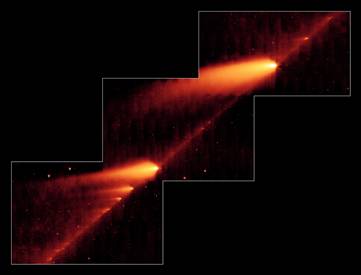
This infrared image of Comet 73P/Schwassman-Wachmann
3,
based on readings taken by NASA's Spitzer Space Telescope
from May 4 to 6, shows at least distinct 36 fragments
By Robert Roy Britt
Senior space writer
Updated: 3:48 p.m. ET May 10, 2006
A new and detailed view of a crumbling comet will help
astronomers figure out how strong a predicted meteor shower in 2022 will be.
Comet 73P/Schwassmann-Wachmann 3, or just SW-3, began
fracturing in 1995. The breakup has accelerated in recent weeks as the comet
again approaches the sun, as it does every 5.3 years.
Spitzer has returned an infrared
image of the scene, revealing three dozen chunks in addition to a broad
stripe in the sky created by smaller pebbles and dust. The material glows in
infrared because it is heated by the sun.
On each orbit around the sun, the comet lays down a new
debris stream along a slightly different path. Each stream spreads out over
time. When Earth passes near the comet's dusty trails every year, bits of debris
burn up in our atmosphere, creating a minor meteor shower called the Tau
Herculids.
In 2022, a recent study concluded, Earth is expected to
cross closer to the comet's main trails, potentially producing a heavier meteor
shower. Another spike could occur in 2049.
Caltech scientist William Reach, who led the Spitzer
observations, said they might change expectations for 2022.
Reach said it is unlikely the 2022 event will be a
major one like the spectacular Leonid
meteor showers in recent years.
"But the door's open," Reach said in a
telephone interview
He said the big chunks coming off the comet move
backward before dispersing, something that is not predicted in existing computer
models. So to forecast what Earth will plow through in 2022 will now require
some reworking of the models. Images and data of the comet provided
recently by the Hubble Space Telescope will also go into that effort, he
said.
It could take a year or more to do the detailed new
simulations, Reach said.
Meanwhile, backyard skywatchers have been tracking the
comet's disintegration, and there are a few days left to catch
the view.
© 2006 Space.com. All rights reserved. More
from Space.com.
Houston, she's breaking up
|
Larry O'Hanlon
|
Friday, 12 May 2006
|

|
|
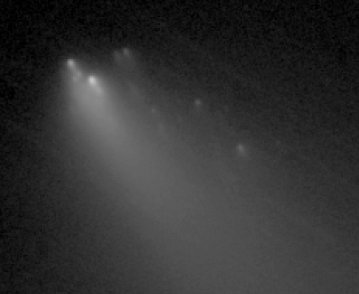
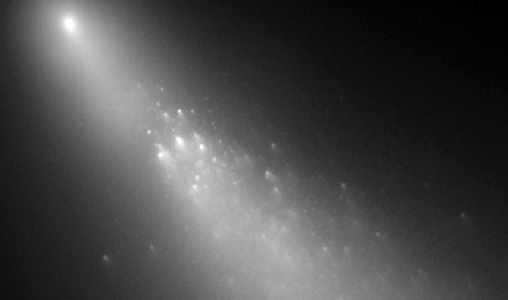
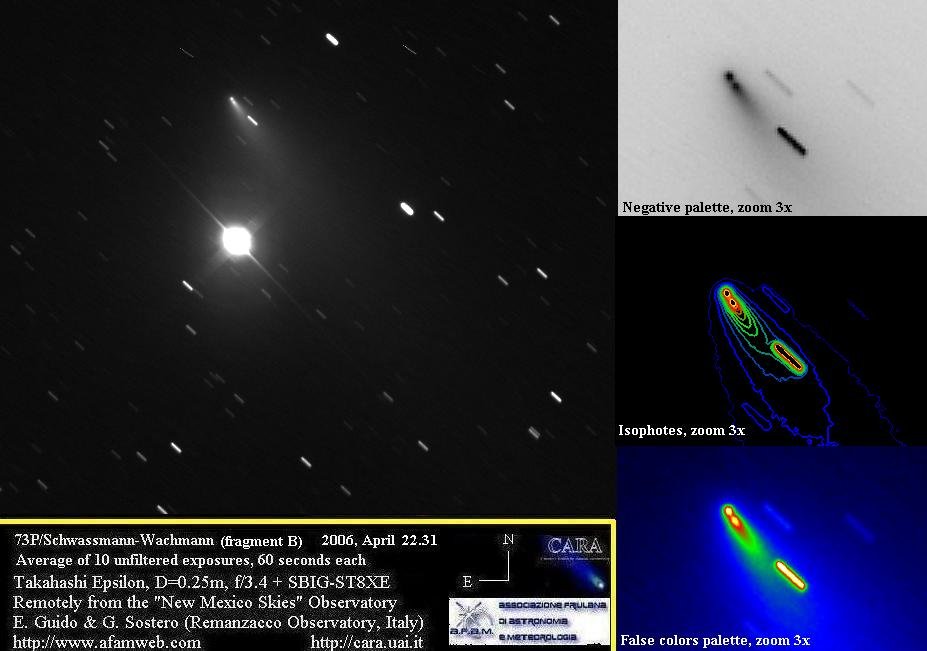
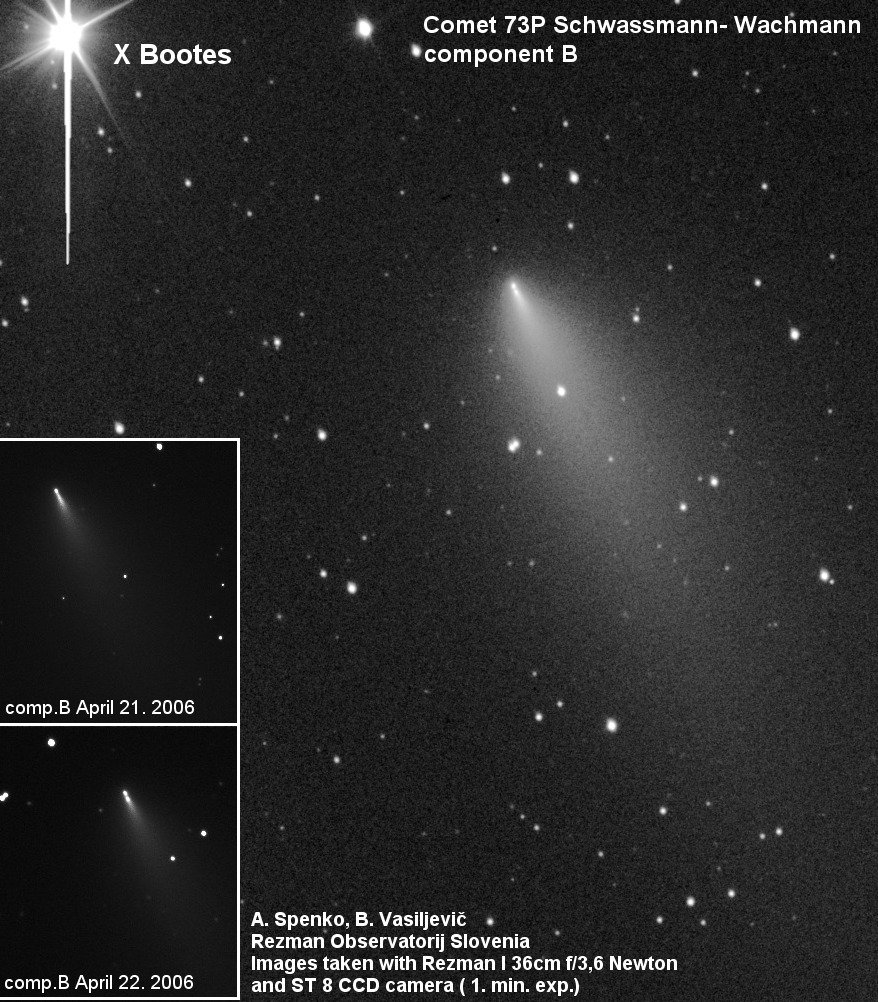
Fragment B of Comet 73P/ Schwassmann-Wachmann 3 and some of the
mini-comets that have broken off (Image: Subaru Telescope)
|
Giant telescopes around the world are capturing more spectacular views of
the near-Earth disintegration of Comet 73P/Schwassman-Wachmann 3.
The comet is now comprised of scores of fragments and zillions of tinier
pieces.
A new infrared image from the Spitzer
Space Telescope of the unfolding destruction captures what looks like a
line of steam engines following a common cosmic track.
Each 'engine' is a comet fragment boiling away plumes of dust and gas as they
are blasted by the solar wind.
The track the fragments are following is a line of Sun-warmed comet debris,
dust and fine sand, that the comet left in space on its previous 5.4-year
cycles around the Sun.
"We hadn't seen that with this comet," says astronomer Michael
Kelley, a doctoral student at the University
of Minnesota, Twin Cities, and member of the team that made the Spitzer
telescope observations.
"It's been suspected because it's associated with a meteor shower."
Comet debris streams linked to specific comets, like that seen in the
Spitzer image, are the cause of many regular, predictable meteor showers.
When Earth ploughs through the debris at the same point of its orbit each
year, the debris burns up in our atmosphere, creating a meteor shower.
Following the debris trail
The astronomers are hoping that by measuring the brightness of the extent
of the debris trail, which can't be see in visible light, they can find out
whether most of the comet vaporises from evaporating ice, the house-sized
chunks seen in recent Hubble
Space Telescope images, or by way of meteor-sized debris seen in the
Spitzer images.
"We suspect that every comet goes through an episode like this,"
says Kelley of those comets that don't die by plunging into the Sun or into a
planet.
It's the details that have been elusive, and why Comet 73P/Schwassman-Wachmann
3's break-up so conveniently near Earth is getting so much attention.
Yesterday, for instance, some brand new visible light images of the comet from
3 May were released by astronomers who caught the disintegration drama with
the 8.2-metre Subaru
Telescope in Hawaii.
"Compared to observations five days before by VLT [the Very Large
Telescope, in Chile], we see some more parts coming off," says Dr
Catherine Ishida of the National
Astronomical Observatory of Japan, which operates the Subaru Telescope on
Mauna Kea.
One Subaru close-up of the wake of the comet's 'Fragment B' shows distinct
miniature comets dropping away in the wake. Subaru astronomers have counted 13
such mini-comets.
Big telescopes will continue to take turns looking at the comet when there is
time and until the comet is too close to the Sun for the telescopes to look
without damaging their instruments.
Ishida says each new view tells another part of the story.
"The key thing is that the comet is changing rapidly," she says.
Related Stories
X-rays Fly as Cracking Comet
Streaks Across the Sky
PRESS RELEASE
Date Released: Friday, May 12, 2006
Source: Goddard Space Flight
Center
Scientists using NASA's Swift satellite have detected X-rays
from a comet that is now passing the Earth and rapidly disintegrating on what
could be its final orbit around the sun.
Swift's observations provide a rare opportunity to investigate
several ongoing mysteries about comets and our solar system, and hundreds of
scientists have tuned in to the event.
The comet, called 73P/Schwassmann-Wachmann 3, is visible with
even a small, backyard telescope. Peak brightness is expected next week, when it
comes within 7.3 million miles of Earth, or about 30 times the distance to the
Moon. There is no threat to Earth, however.
This is the brightest comet ever detected in X-rays. The comet
is so close that astronomers are hoping to determine not only the composition of
the comet but also of the solar wind. Scientists think that atomic particles
that comprise the solar wind interact with comet material to produce X-rays, a
theory that Swift might prove true.
Three world-class X-ray observatories now in orbit---NASA's
Chandra X-ray Observatory, the European-led XMM-Newton, and the Japanese-led
Suzaku---will observe the comet in the coming weeks. Like a scout, Swift has
provided information to these larger facilities about what to look for. This
type of observation can only take place in the X-ray waveband.
"The Schwassmann-Wachmann comet is a comet like no
other," said Scott Porter of NASA's Goddard Space Flight Center in
Greenbelt, Md., part of the Swift observation team. "During its 1996
passage it broke apart. Now we are tracking about three dozen fragments. The
X-rays being produced provide information never before revealed."
The situation is reminiscent of the Deep Impact probe, which
penetrated comet Tempel 1 about a year ago. This time, nature itself has broken
the comet. Because Schwassmann-Wachmann 3 is much closer to both the Earth and
the sun than Tempel 1 was, it currently appears about 20 times brighter in
X-rays. Schwassmann-Wachmann 3 passes Earth about every five years. Scientists
could not anticipate how bright it would become in X-rays this time around.
"The Swift observations are amazing," said Greg Brown
of Lawrence Livermore National Laboratory in Livermore, Calif., who led the
proposal for Swift observation time. "Because we are viewing the comet in
X-rays, we can see many unique features. The combined results of data from
several premier orbiting observatories will be spectacular."
Swift is primarily a gamma-ray burst detector. The satellite
also has X-ray and ultraviolet/optical telescopes. Because of its burst-hunting
ability to turn rapidly, Swift has been able to track the progress of the
fast-moving Schwassmann-Wachmann 3 comet. Swift is the first observatory to
simultaneously observe the comet in both ultraviolet light and X-rays. This
cross comparison is crucial for testing theories about comets.
Swift and the other three X-ray observatories plan to combine
forces to observe Schwassmann-Wachmann 3 closely. Through a technique called
spectroscopy, scientists hope to determine the chemical structure of the comet.
Already Swift has detected oxygen and hints of carbon. These elements are from
the solar wind, not the comet.
Scientists think that X-rays are produced through a process
called charge exchange, in which highly (and positively) charged particles from
the sun that lack electrons steal electrons from chemicals in the comet. Typical
comet material includes water, methane and carbon dioxide. Charge exchange is
analogous to the tiny spark seen in static electricity, only at a far greater
energy.
By comparing the ratio of X-ray energies emitted, scientists can
determine the content of the solar wind and infer the content of the comet
material. Swift, Chandra, XMM-Newton and Suzaku each provide complementary
capabilities to nail down this tricky measurement. The combination of these
observations will provide a time evolution of the X-ray emission of the comet as
it navigates through our solar system
Porter and his colleagues at Goddard and Lawrence Livermore
tested the charge exchange theory in an earthbound laboratory in 2003. That
experiment, at Livermore's EBIT-I electron beam ion trap, produced a complex
spectrograph of intensity versus X-ray energy for a variety of expected elements
in the solar wind and comet. "We are anxious to compare nature's laboratory
to the one we created," Porter said.
The German-led ROSAT mission, now decommissioned, was the first
to detect X-rays from a comet, from Hyakutake in 1996. This was a great
surprise. It took about five years before scientists had a suitable explanation
for X-ray emission. Now, ten years after Hyakutake, scientists could settle the
mystery.
For Swift images of comet 73P/Schwassmann-Wachmann 3, visit:
http://www.nasa.gov/swift
COMET
SIDEKICK:
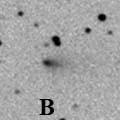
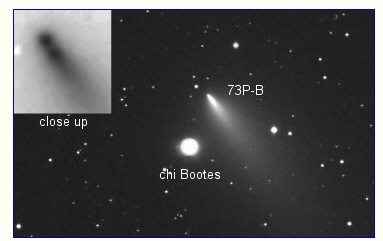
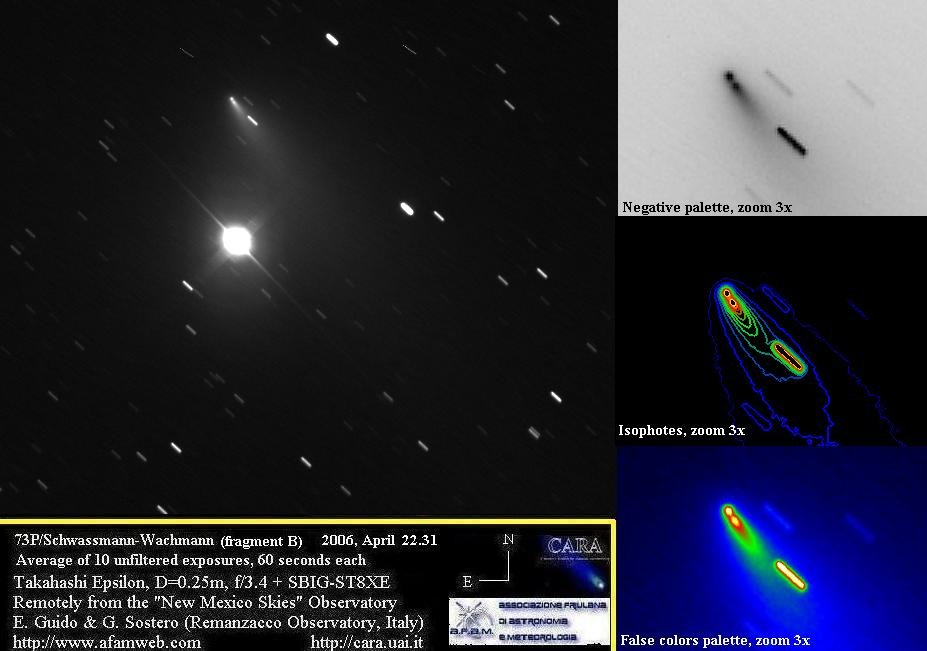
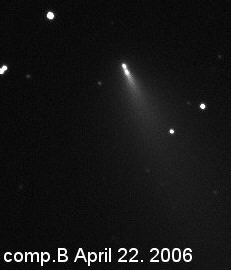
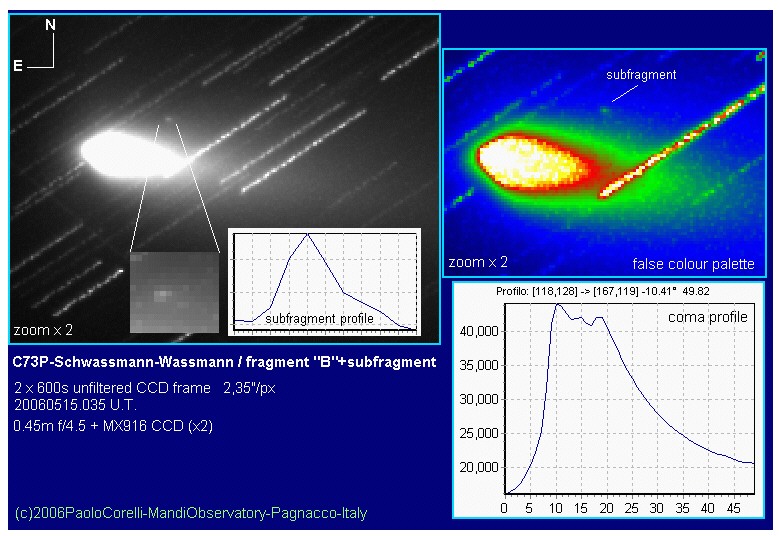
Fragment B of crumbling
comet 73P/Schwassmann-Wachmann 3 has a tiny sidekick, shown here in
images from astronomer Paolo Corelli
of the Mandi Observatory in Pagnacco, Italy:
The
"sidekick" is probably a chunk of dusty ice that broke away from
Fragment B, which has been crumbling
furiously for weeks. Comet 73P made its closest approach to Earth on May
14th. It is still nearby (6 million miles away) and an easy target for backyard
telescopes. Look for it around 4 o'clock in the morning in the
constellation Pegasus: sky
map.
more
images: from
Rudolf Dobesberger of Austria; from
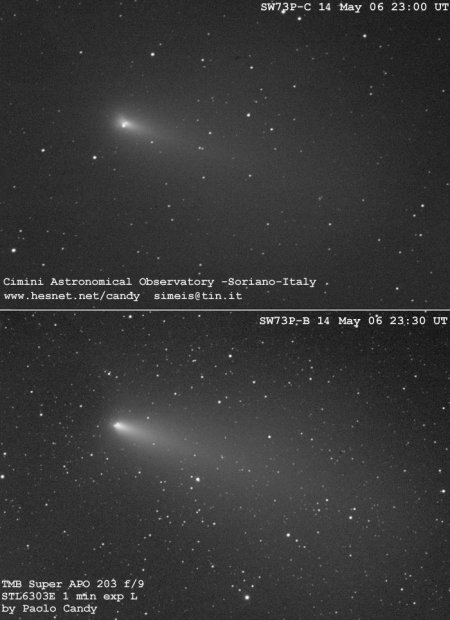
Paolo Candy in the Cimini Mountains of Italy.
Meteor
shower sparks alarm

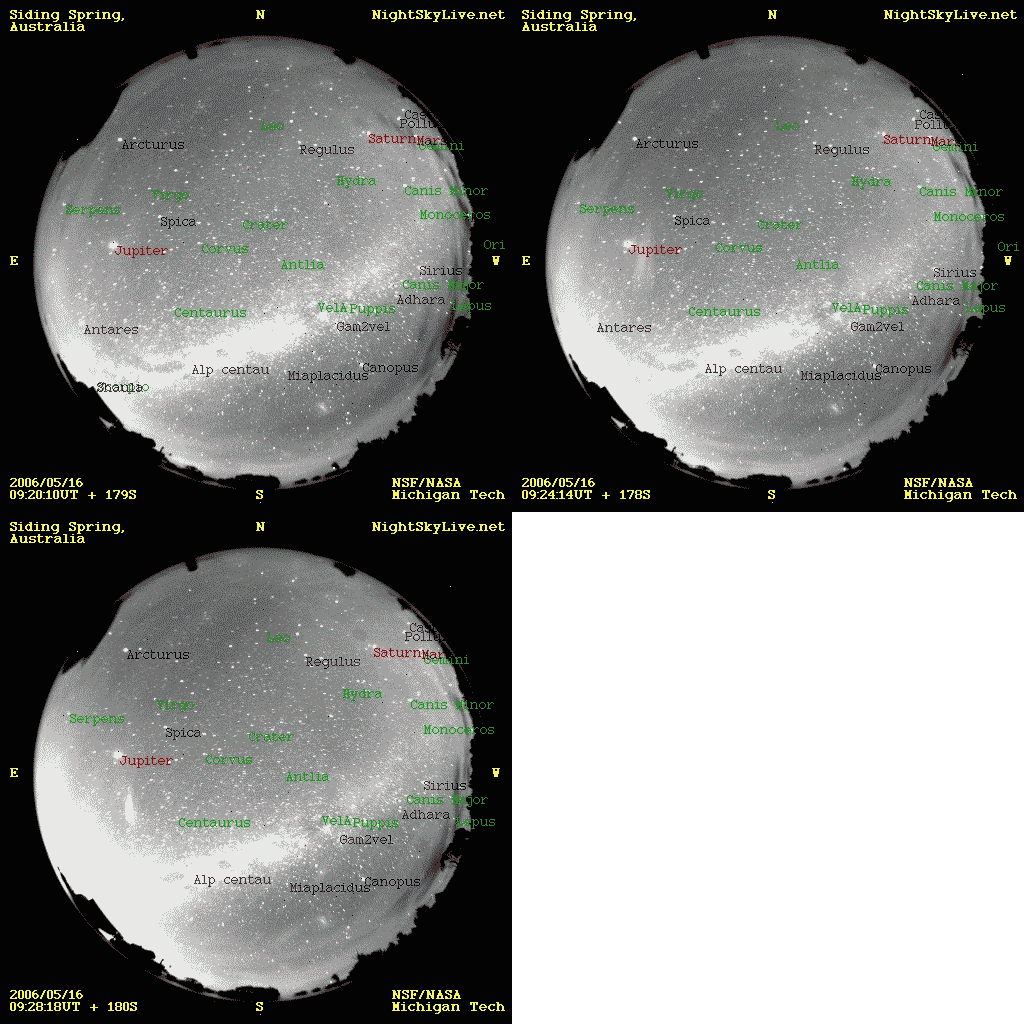
16may06
SOUTH-east Queensland residents have
been startled by a bright, green ball of streaking light that initially sparked
fears of a plane crash.
A police spokeswoman said the suspected meteor was seen travelling east to west
in the region from Bribie Island, across the Sunshine and Gold Coasts as far
inland as Warwick.
She said a Warwick farmer alerted police about 6.30pm (AEST)
of what he thought was a "fire ball" from a plane crashing on his
property.
A search of the area found nothing.
Police were then inundated by sightings of a "green ball
of light".
Andre Claydon of the Springbrook Observatory near the Gold
Coast said he had received scores of sightings of what he thought was a meteor
shower from across the region.
He said the meteor shower would have appeared much closer
than it actually was.
"As it comes in through our atmosphere we get a
magnification effect so it always looks a lot closer but it is probably 60 to
70km inside our atmosphere," he said on ABC Radio.
"I had a number of phone calls specifically from the
eastern part of Australia regarding a meteor shower that has come through and
broken up into a few pieces."
The Astronomical Association of Queensland's Peter Hall told
ABC Radio: "It sounds like a meteor to me.
"Most of them are the size of a grain of sand but this
one must have been
larger."
5-17-06
-
Comet's tail 'caused Qld light show'
Astronomers are predicting
Queenslanders could see more meteorites over the next few days, if last
night's spectacular light show was the result of a comet that passed by the
Earth over the weekend.
A bright green ball of light was seen
in many parts of Queensland about 6:30pm AEST.
Andre Claydon, from the Springbrook
Observatory, says the comet is the most likely explanation for the rare
phenomenon.
"There is a comet that has just
gone past and we're passing through the debris tail of this comet," he
said.
"This could be a fragment from the
comet itself.
"Over the next two or three days
we should see more of this happening, because the Earth is stilling passing
through the debris tail of this comet."
But a South Burnett astronomer says the
spectacle was probably the result of space junk entering the earth's
atmosphere.
Jim Barclay, from the Maidenwell
Observatory, says the light could not have been caused by a meteorite.
"Most meteors do not, and I
repeat, do not appear of the green-blue fluorescent colours that these people
described," he said.
"Metallic substances tend to burn
up and give you that greeny-blue fluorescent colours where meteors are
generally white in nature."
Green light
Paul, from Coolum on the Sunshine
Coast, says he was driving away from Brisbane when he saw the giant ball of
green light.
"One bloke just said, 'Wow, look
at that' and it was just right across the sky," he said.
"It was massive and it was green.
"At the main body of it, there
were actually parts of it falling down to the ground."
Steve, from the bayside suburb of
Birkdale, was travelling in a plane over Casino at 11,000 when he saw it break
up in front of him.
"It was just amazing," he
said.
"It just looked like it was just
in front of us.
"It was very white from up there -
just sort of went out in front of us and we saw ... red bits falling and then
it just went out."
Send us your pictures. Email your pictures and video to ABC
News Online or send them via MMS to 0448 859 894 (+61 448 859 894 if
you're overseas.) Email address: yourpics@your.abc.net.au
Comet debris turns on a spectacular
display in night sky
18.05.2006
| By WILL JACKSON
EVER wanted
to know what a fridge hurtling
through the atmosphere at
57,000km/h looks like?
Well, even
if you haven't,
watch the skies tonight and you
might be able to see.
The huge
fireball that swooped across the sky
about 6.20pm on Tuesday was actually
a refrigerator-sized
hunk of comet, astronomer Andre
Claydon said yesterday.
The Earth is
passing through debris left by Comet
73P/Schwassmann-Wachmann which has
broken up into about 64 pieces, said
the director of observation at the
Springbrook Observatory near the
Gold Coast.
Some of these pieces were hitting
the atmosphere and would continue to
create a spectacular light show for
another five days.
|
However,
they were unlikely to be quite as
incredible as Tuesday night's
meteor, which caused quite a stir
across the region.
A police
spokeswoman said it was seen
travelling west as far inland as
Warwick in Queensland.
She said a Warwick farmer alerted
police about 6.30pm of what he
thought was a fireball from a plane
crashing on his property.
However a search of the area found
nothing.
Police were then inundated by
sightings of a ˜green ball of light'
.
Andre said
the meteor shower would have
appeared much closer than it
actually was.
"As it comes in through our
atmosphere we get a magnification
effect, so it always looks a lot
closer, but it is probably 60 to
70km inside our atmosphere," he
said.
"I had a number of phone calls
specifically from the eastern part
of Australia regarding a meteor
shower that has come through and
broken up into a few pieces."
|
|
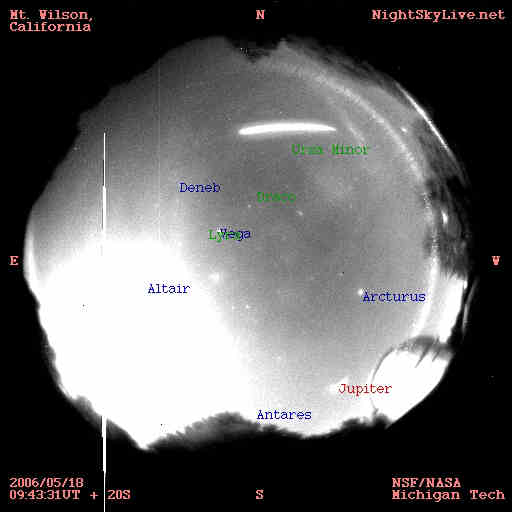
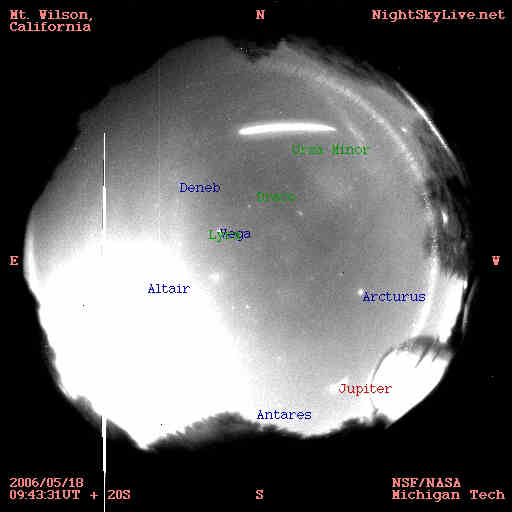
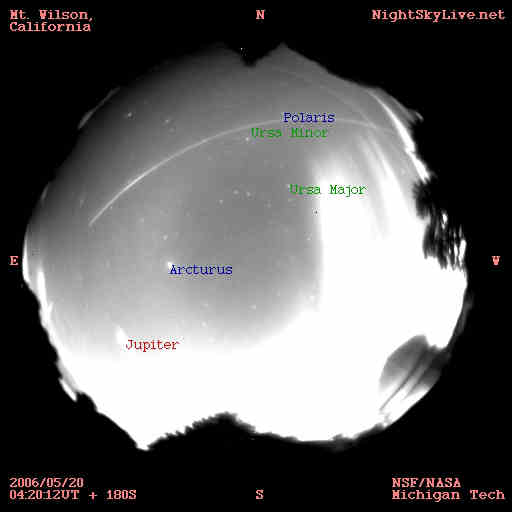
Fireball
over Texas Mt.
Wilson concam Forum
URGENT NOTE: As soon as a fireball is sighted PLEASE do
the concams immediately from the live data, otherwise it
takes a grueling and less certain search through archives.
Carry a personal camera everywhere! EMAIL
KENT-STEADMAN
Subject: Fireball sighted 5/20/2006
9:50:19 AM Pacific Daylight Time
I
was outside last night at midnight taking pictures of comet
fragments and debris (which is not hard to do anymore)
Jupiter, Vega etc. Clouds started rolling in and I was
getting ready to wrap it up when at 12:55 am this morning a
fireball came in above the clouds. I only caught a glimpse
of it, didn’t have the chance to take a pic but it lit up
the entire sky due NE of NE Philadelphia a bright greenish
and blue. It lasted about 4-5 seconds max. Unable to confirm
on the concams. I will report it to the fireball site. It
was the same color as the one over Australia but not quite
as big. I waited outside for another hour with the camera at
the ready, but nothing else came.
[seems to be a streak
on Mt. Wilson Cam, may not quite match loc/time]
|
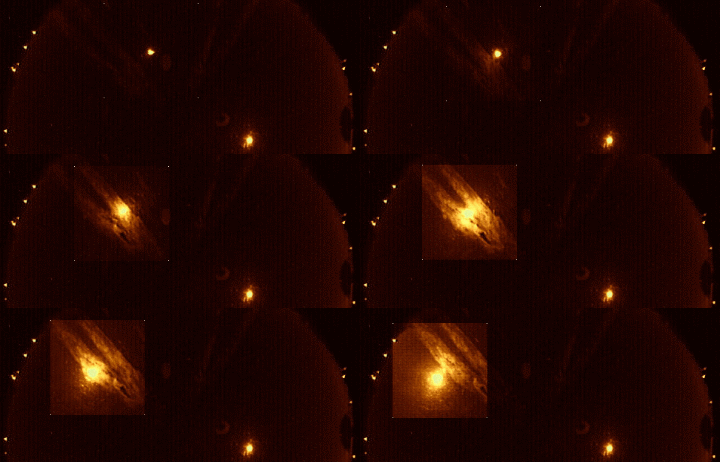
What it looks like:
FIREBALL
May 4, 2006, astronomer Jim Gamble caught one flying
over El Paso, Texas
The
May 4th bolide was different. It appeared at 9:45
p.m. local time, well before bedtime, over a
densely populated area. Thousands of people saw
it. Indeed, how could they miss it? It was
brighter than the Moon, which also appears in the
video--the stationary light at bottom-right.
Bolides:
another good reason to keep looking up.
|
Subject: Need to know your opinion 73 slowing down?
5/19/2006 6:55:00 AM Pacific Daylight
Time
Hi Kent, please take
a look this two different location of this comet please.
The drawnig was posted today on the spaceweather.com
and the picture starrynight.com
Forum
Exercise
Pacific Wave '06 <<careful these
reports are not to designate a comet impact, but
interesting!
NASA
to Look into NEO Threat Response Proposals Call
For Papers: Near-Earth Object Detection, Characterization,
and Threat Mitigation
A
light meteor shower should also occur starting
late next week as tiny bits of comet crash into the Earth's
atmosphere. For the best views, dodge city lights by driving
into the San Gabriel Mountains or heading for the desert.
Forum
Jack
Drummond of the Starfire Optical Range predicts that
debris shed by the comet many years ago (long before the
1995 breakup) could bring us a meteor shower on the night of
May 22–23
ALMOST
GONE:
Comet 73P/Schwassmann Wachmann 3 is receding from Earth
and about to disappear into the glare of the sun--but it's
not gone yet. Darrell
Spangler photographed two of the comet's fragments (B
and C) shining through the morning twilight of Drake,
Colorado, on May 21st:
"Clouds
and moon and sunrise, oh my!" says Spangler. "Talk
about challenging, but persistence paid off." No
telescope was required for the shot, only a Canon EOS 300D
camera and a good long exposure.
Ready
for the challenge? Load your camera and set your alarm for
4:30 in the morning. The crescent moon will guide you
straight to the comet: sky
map.
5/19/2006 9:00:00 AM
To: National and International desks
Contact: Craig Boswell of http://www.savelivesinmay.com,
832-252-6406, craigboswell@gmail.com
HOUSTON, May 19 /U.S. Newswire/ -- Eric Julien,
former military air traffic controller, twin engine jet
pilot and former instructor at astronaut Patrick Baudry's
Space Camp -- Discovery Shuttle flight -- has written four
articles covering the high probability of a giant tsunami
in the Atlantic Ocean caused by the impact of a comet
fragment near or on May 25.
Responding to NASA's press release stating the
innocuousness of the fragmented comet 73P-SW3 with regards
to the Earth, the French author of "The
Science of the Extraterrestrials" indicates that
numerous scientific data attest to a real danger as was
laid out starting with his first article of early April,
namely that a small-sized fragment, still unobservable and
distant from the principal fragments, could hit the
Atlantic Ocean, bringing about the awakening of the
volcanoes of the mid-Atlantic ridge, with these being the
origin of a possible tsunami with waves two hundred meters
high.
Beyond the accumulated scientific data, Julien has
drawn attention to the fact that FEMA, the American
organization that deals with disasters -- c.f. the Katrina
hurricane in Louisiana - - will proceed with a tsunami
alert exercise between the 23rd and 25th of May, at the
very same time that enormous human and logistical
resources will be required for the giant tsunami he is
announcing. He notes that such an exercise was scheduled
for September 11, 2001 in New York, date of the collapse
of the World Trade Center.
Julien declares that numerous prophecies, including
those of Nostradamus, Mother Shipton and of the Bible
Codes converge precisely towards this critical period of
the end of May 2006. Likewise, a great number of persons
have declared having experienced Atlantic tsunami dreams
prior to his first press release.
The major preoccupation of a growing number of
professionals is to preserve human lives by inviting the
media to play their role in alerting the public at large.
Julien declares: "the risk of planetary catastrophe
merits that precautions proportional to the stakes be
taken by the media and government authorities. The level
of alert adopted by each of these could be appreciated in
diverse fashions by the populations exposed to the
risk."
Articles and maps of the areas at risk are available
on http://www.savelivesinmay.com
and http://www.savelivesinmayforum.com
http://www.usnewswire.com/
-0-
/© 2006 U.S. Newswire 202-347-2770/
| Comet
73P/Schwassmann-Wachmann 3 has been passing
Earth all month as it approaches the point
nearest the sun in its orbit. Astronomers have
been observing this comet for more than 75
years, and its path around the sun is well
known. |
| The
comet's nucleus has broken into more than 40
fragments. None of the pieces will come closer
than 5.5 million miles to Earth during the
comet's closest approaches May 12-28.
Thankfully, neither the main comet nor any of
its pieces poses a danger to Earth.
The main fragment will
pass closest to Earth on May 12 at a distance of
7.3 million miles. It will be visible in small
telescopes during the hours before morning
twilight in the constellation Vulpecula.
|
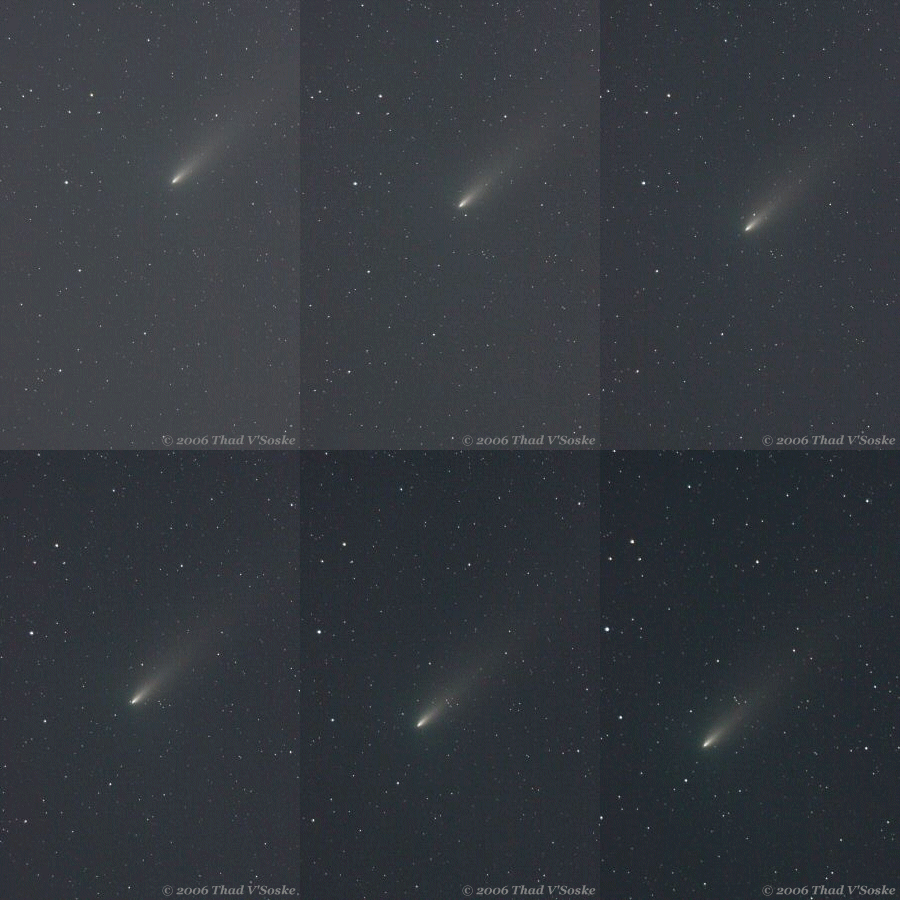
http://www.spaceweather.com
METEOR WATCH: On May
31st, Earth will pass about five million miles from the
dusty orbit of crumbling comet 73P/Schwassmann Wachmann 3.
The great distance means a meteor shower is unlikely; but
73P is such a strange comet that even the unlikely is
possible. Be alert for meteors slowly cutting across the
sky in the nights ahead.
INCOMING???
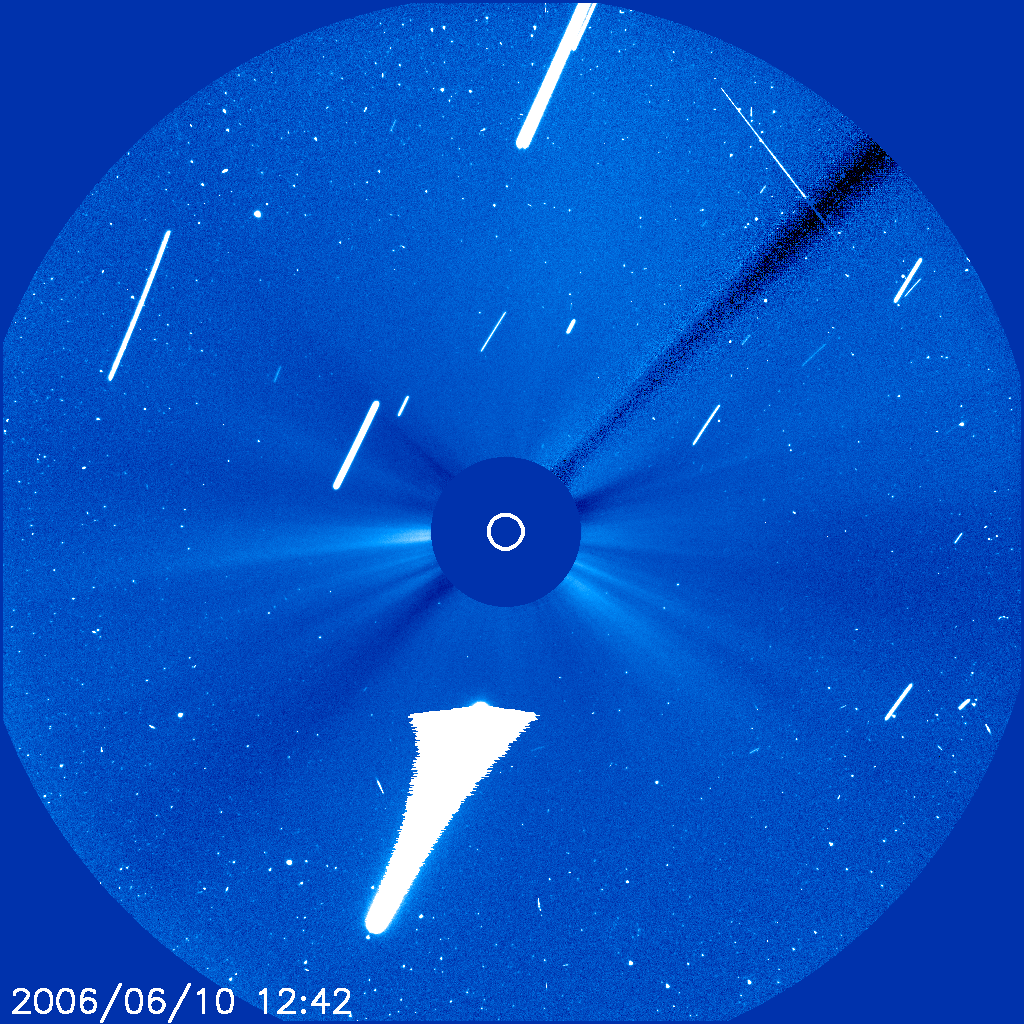
OTHER OBJECTS IN THE SKY THIS MONTH
|
May 24: An hour before
sunrise on Thursday, watch for a thin old
crescent Moon rising in the east-northeast, 16
degrees to the lower left of Venus.
May 25: On Friday
about 1-1/4 hours before sunrise, Venus is just
to the east of Jupiter in the west-southwest. A
very thin crescent Moon, just 19 hours 54
minutes before New, is visible in binoculars 29
degrees to the lower left of Venus and only two
degrees up in the east-northeast. If you spot
this hairline crescent on Friday morning, then
you've accomplished the first and more difficult
task in the rare sighting of a pair of opposing
lunar crescents on consecutive days. The second,
easier crescent can be spotted soon after sunset
on Saturday evening.
May 26: The Moon can't
be seen this evening, because it's New, nearly
between Earth and the Sun, at 11:26 p.m. local
time. Your next chance to see the Moon will be
early in evening twilight on Saturday if Arizona
City's skies are clear, it should be quite easy
to catch the young crescent within 24 hours
after New.
May 27: A very thin
crescent Moon is five degrees up in the
west-northwest. As an extra bonus, the planet
Mercury appears within three degrees to Luna's
lower left. As the sky darkens, both the Moon
and Mercury may become visible to the unaided
eye.
May 28: The Moon is an
easy sight low in the west-northwest with
Mercury within 11 degrees to its lower right.
Tonight the Moon sets farther north than on any
other night in this lunar cycle.
May 29: Forty-five
minutes after sunset, look for Mercury very low,
22 degrees to the lower right of the crescent
Moon in the west-northwest. Faint Mars is 14
degrees to the Moon's upper left. Saturn is now
within 10 degrees to the upper left of Mars.
May 30: Faint Mars is
about three degrees to the Moon's left, and the
Gemini Twins (Pollux and Castor) are a few
degrees to the Moon's right. Tonight these three
objects: Mars-Pollux-Castor, lie in a straight
line.
May 31: This evening
within an hour after sunset, five solar system
bodies: Mercury, Mars, Moon with Saturn and
Jupiter (in that order), span 135 degrees across
the sky from west-northwest to southeast. The
bright "star" below the Moon tonight
is Saturn.
Planetary Guide
The word planet
originates from the ancient Greek word "planetta,"
which literally translates to our word
"wanderer."
Mercury is hidden in
the glare of the Sun.
Venus is the bright
"Morning Star" low in the east at
dawn.
Mars glows orange-red
in the west near the Gemini Twins Pollux and
Castor.
Jupiter is by far the
brightest light in the southeast.
Ringed planet Saturn
shines pale yellow high in the west during the
evening hours this month, between the
constellations Gemini and Leo.
Uranus is low in the
east-southeast just before dawn.
Neptune is in the
southeast just before dawn.
Distant planet Pluto
is high in the south before dawn.
The tenth planet Xena,
officially known as 2003 UB313, is behind the
glare of the Sun. This is Earth's "tenth
planet," discovered just last year. Many
advanced amateurs with powerful (and expensive)
digital image capturing setups have imaged it.
Last October 9, amateur Keith Murdock of the
Rockland Astronomy Club (in NY) became the first
known human to see the tenth planet visually. He
was one of a group of amateurs using the large,
82-inch Otto Struve Telescope at the McDonald
Observatory in Texas.
Believe It Or Not!
The discovery team is
informally calling the object (and its moon)
Xena and Gabrielle respectively, for the TV
warrior princess and her companion. Official
names for them may be decided by the
International Astronomical Union in August 2006.
|
JUNE, 2006
Record meteorite hit Norway
As Wednesday morning
dawned, northern Norway was hit with an impact
comparable to the atomic bomb used on Hiroshima.
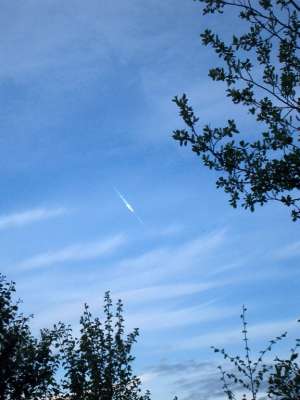
Peter Bruvold witnessed
the meteorite streaking across the night sky.
PHOTO:
PETER BRUVOLD
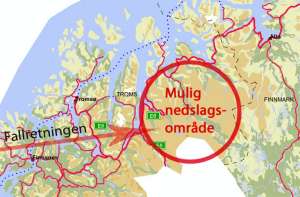
The map shows the
meteorite's direction of fall (the arrow) and
the possible impact area over Troms and
Finnmark counties.
|
At around 2:05 a.m. on Wednesday, residents of
the northern part of Troms and the western areas of
Finnmark could clearly see a ball of fire taking
several seconds to travel across the sky.
A few minutes later an impact could be heard and
geophysics and seismology research foundation NORSAR
registered a powerful sound and seismic disturbances
at 02:13.25 a.m. at their station in Karasjok.
Farmer Peter Bruvold was out on his farm in
Lyngseidet with a camera because his mare Virika was
about to foal for the first time.
"I saw a brilliant flash of light in the
sky, and this became a light with a tail of
smoke," Bruvold told Aftenposten.no. He
photographed the object and then continued to tend to
his animals when he heard an enormous crash.
"I heard the bang seven minutes later. It
sounded like when you set off a solid charge of
dynamite a kilometer (0.62 miles) away," Bruvold
said.
Astronomers were excited by the news.
"There were ground tremors, a house shook
and a curtain was blown into the house," Norway's
best known astronomer Knut Jørgen Røed Ødegaard
told Aftenposten.no.
Røed Ødegaard said the meteorite was visible
to an area of several hundred kilometers despite the
brightness of the midnight sunlit summer sky. The
meteorite hit a mountainside in Reisadalen in North
Troms.
"This is simply exceptional. I cannot
imagine that we have had such a powerful meteorite
impact in Norway in modern times. If the meteorite was
as large as it seems to have been, we can compare it
to the Hiroshima bomb. Of course the meteorite is not
radioactive, but in explosive force we may be able to
compare it to the (atomic) bomb," Røed Ødegaard
said.
The astronomer believes the meteorite was a
giant rock and probably the largest known to have
struck Norway.
"The record was the Alta meteorite that
landed in 1904. That one was 90 kilos (198 lbs) but we
think the meteorite that landed Wednesday was
considerably larger," Røed Ødegaard said, and
urged members of the public who saw the object or may
have found remnants to contact the Institute of
Astrophysics.
Aftenposten's Norwegian reporter
Nina
Lødemel
Aftenposten English Web Desk
Jonathan
Tisdall
|
MAY 25, 2006
- the Day of Destiny!
By Eric Julien -
April 11, 2006
.
What will occur on May 25, 2006?
Perhaps
a planetary catastrophe originating from the
Atlantic Ocean
due to a medium size impact event. On
this assumption, a series of giant waves, including one méga tsunami
almost two hundred meters in height, will be born from a succession of
underwater eruptions. These
watery giants, decreasing with distance, will touch the majority of the
Atlantic coasts; in particular, those most at risk lie between the
equator and the tropic of Cancer. The
victims of
May 25 2006
will be tens of millions. The devastated survivors will be more numerous
still. The economic losses
will be enormous, well beyond the scales of destruction hitherto tested
by our civilization. North
America and
Europe
will not be saved, but will be affected in less dramatic proportions.
By extension, other remote countries will be also affected.
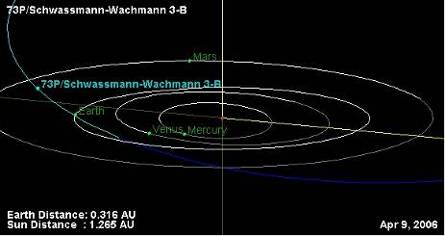
A
heavenly object, hardly larger than a truck, but animated by an enormous
kinetic energy - its speed will be approximately 40 kilometers/second -
will strike the Earth after having crossed the thick atmosphere of
80 kilometers
, then the oceanic depths of
1500 meters
at this place, to reach and shake the zone of the dorsal the
mid-Atlantic rift crossing from North to the South on the Atlantic ocean
floor. Currently, tens of underwater volcanoes lie largely dormant,
ejecting very small quantities of magma emerging from gigantic chambers.
They will break out, heating the sea water to a boiling point.
It is the vision that I had approximately three years ago.[i] It happened again on
April 7 2006
at
10 pm
while I meditated on the shores of the Pacific with two other people.
I received information supplementing this vision: the date,
MAY 25, 2006
!
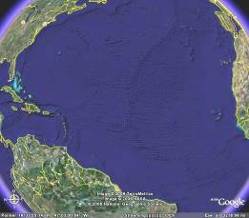
The
size of this space object will be too small for our telescopes since it
will be a small lagging fragment of a comet. Scientists will be
surprised by this object, having little time to see it coming, hardly a
few dozen hours. This
fragment will result most probably from the comet 73P
Schwassmann-Wachmann 3[ii] currently
designed to pass closest to the Earth on May 14, 2006; a little more
than ten million kilometers according to the simulation carried out by
NASA.[iii] That is 25 times the
distance separating the Earth from the moon.[iv] We see below the position
of the comet when it is closest to the Earth according to different
angles provided by the NASA simulation.
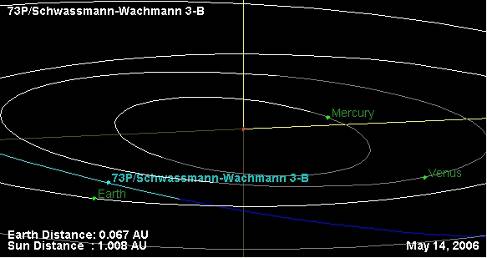
The last time that this
comet passed so close to the Earth by crossing the ecliptic plane was
on
MAY 25, 1947
! It is year zero of the
UFO era with the famous observations of Kenneth Arnold and the
Roswell
crash. This comet, which
spends five years in a plane orbiting the Earth, moves at its maximum
to a distance of 900 million kilometers (more than six times the
distance from the Earth to the sun) started to split up for
unexplainable reasons in 1995.
Imagine a heavenly object stable for centuries, even for millennia, which mysteriously explodes apart by chance a few months after the
launching of the American Star Wars program, intended for an enemy
originating from space. This heavenly object [the comet] transforms
itself then into a POTENTIAL PLANETARY WEAPON.
Imagine a crop circle showing the solar system, MISSING the EARTH
[i] which does not appear on its proper
orbit, a few weeks after this fragmentation.
Imagine that this crop circle shows the position of the planets
corresponding to the date
May 14, 2006
; the date of the closest approach of the comet, with the planet Mars
slightly later, to show that the best date is after May 14 contrary to
expectations.
Imagine another crop circle a few weeks later indicating the date of
September 6, 2003
; the date on which was received the extraterrestrial world message
"Do you wish us to Show Up?" A message spread in several
languages around the world, inviting the people of the Earth to peace
with extraterrestrials by accepting a public demonstration of their
presence.
Imagine that the individual that received this ‘World message’, as
well as the date of
MAY 25, 2006
, also received a scientific solution to the UFO mystery and of the
fundamental motivation of the extraterrestrial visitors. Two
impenetrable enigmas until the present.
You will then have an idea of what is at stake with this article.
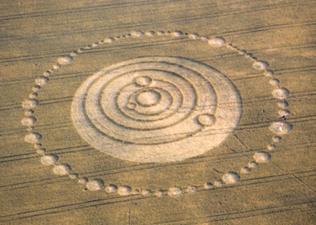
Above is the 1995 crop
circle called “Missing Earth”. It shows the solar system out to
the asteroid belt. The
Earth is missing in its orbit which, as is illustrated here, is
suggesting the extinction of human civilization.
The message here
cannot be more clear!
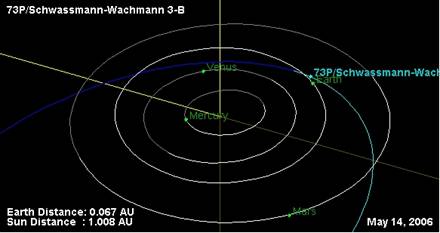
Moving now to the date of the
planetary simulation for
May 14, 2006
; for centuries the comet Schwassmann-Wachmann
has made hundreds of revolutions around the sun while remaining whole.
Since the beginning of its fragmentation in 1995, it has made
two elliptic revolutions around the sun.
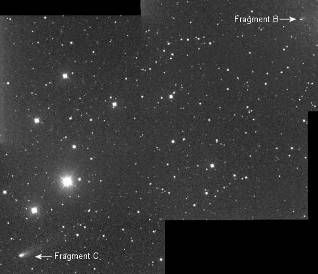
This is why the fragments have had time to deviate from/to each
other as the photograph below shows.
At the time of its passage in 2001, at the same place on the
ecliptic, the Earth was almost contrary to its current position.
This year 2006, on the other hand, the Earth and the comet
coincide in their orbits perfectly.
The figures are based on NASA space simulations in this article
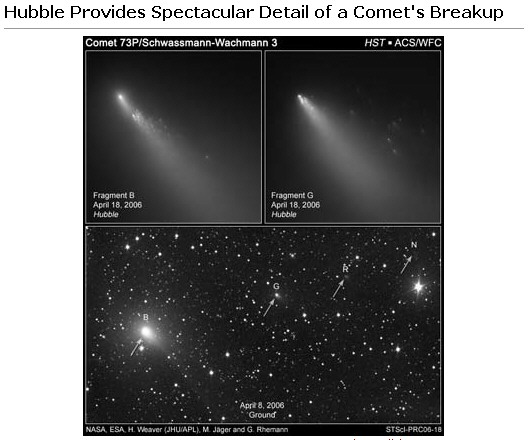
only show us the largest of the fragments, fragment B, the current
count of the known fragments goes to the letter N.
We find today the comet, eleven
years after this incomprehensible fragmentation, in an
unverifiable state of dispersion.
We do not know the exact number of fragments.
They are furthermore of variable sizes.
The closer the fragmented comet approaches the Earth, there
will be more fragments. You
can note the distance that separated the two fragments, B and C,
February 6, 2006
in the photo below.[i]
In the same way, eleven
days after the closest approach on
May 14, 2006
, the comet, or rather fragment
B, will cross the ecliptic plane exactly on
MAY 25, 2006
! But the comet
travels faster than the Earth, and because it follows a parallel
trajectory, any danger will seem isolated.
It should be up to seventeen million kilometers in front of the
Earth when it crosses the ecliptic path of our planet around the sun.
It is a little like a
bullet train that overtakes us as we travel parallel to it on the
road. Our ways will cross,
but not having the same speed, the train will be far in front of us at
the time when we get to the level crossing.
But - there is a big ‘but’ here – all the train coaches
will perhaps not have passed on
May 25, 2006
. The characteristic of
this comet is the low luminous magnitude of its fragments, barely that
of faint stars. The alarm
notice is thus likely to be three days, even only a few hours.
The images below show, according to two different angles, the
position of the comet compared to the Earth at the date,
MAY 25, 2006
. One sees in the second
image, the comet perfectly on the ecliptic plane of the Earth.
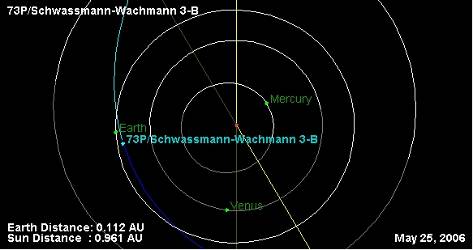
We see above that the
fragment B of the comet will be in the field of the ecliptic exactly
on
MAY 25, 2005
, up to 17 million kilometers in front.
But imagine a lagging fragment attracted by terrestrial gravity
and according to a trajectory deviated by the energy of the original
bursting apart by several tens of million kilometers, i.e. there are
two revolutions around the sun by the comet.
Impossible?
The scientific community will affirm that there is no danger.
Really none. It is
what it has announced to us already.
[i] Thus, for the scientific community,
nothing will occur on
MAY 25, 2006
. In the current state of
the data available, it is right! It is my wish that it is so, since the contrary case
will be dramatic, really dramatic.
But then why pose a problem which "does not exist"?
I am aware of the heavy
responsibility which this article implies.
At best, I am wrong and I will pass for a bird of ill omen. In
the worst case, the world opinion will be deeply upset, not only by
the physical effects and psychological devastators that such an event
will involve, but also, and especially, for the reasons which I call
upon here. In
truth, as we will understand it, the heavy responsibility for this
possible event falls on each one!
You need to know that up to recently, before I discovered what you have
just read on this fragmented comet, I received on
April 7, 2006
a telepathic message from extraterrestrial friends. According to them,
a méga-tsunami in the
Atlantic Ocean
I had experienced in a lucid dream three years ago, would occur around
MAY 25, 2006
. Perhaps two or three days
before or after. I have two witnesses who will confirm the chronology
of the facts that I describe here, but especially tens of readers on
Internet and a deposit of copyright concerning my lucid dream three
years earlier.
Then only a few hours after
receiving this telepathic reception giving the date of May 25, 2006;
an individual informed me on a forum[ii]
the existence of the comet 73P Schwassmann-Wachmann 3, and of its
characteristics. Imagine my surprise and my astonishment when I discovered that a comet
was really going to pass close to the Earth in May 2006; and more
astonishing still, that it would cross the plane of the ecliptic of
the Earth at the date of
MAY 25, 2006
, the date received by telepathy!
Knowing that, what would you have done in my place?
You can conceal this because there is nothing one can do to
change destiny? Or to take
your responsibility to inform others?
I chose to speak as you would have done.
Read
now why.
***
For sixty years the world
ufological community has raised many questions about mysterious
Unidentified Flying Objets, or UFOs.
Thousands of people throughout the world, and among them
scientists of great reputation, have studied and reflected on the
nature and the origin of these UFOs, observed by hundreds of thousands
of witnesses.
If modern science readily
accepts the very strong probability of the existence of
extraterrestrial forms of life in the universe, and even from highly
developed civilizations; it dismisses more easily the idea that they
are able to come to us, in the name of dogmatic scientific principles
only one hundred years of age. But
beyond the "false" scientific obstacles to such visitation,
arises the difficulty of discerning the motivation of these
extraterrestrial visitors which seem to not want to come into contact
with us, while violating our airspace on board their vessels.
It is not now at all a
question of belief, but of data giving extensive detailed reports,
that demonstrate certainty in the UFO phenomena.
If, according to fixed
opinion, you do not believe the UFO data, it is simply because you
were not informed, or did not take time to be; please take it that
"Somebody" did not do his/her work.
You are, like many of us, largely under-informed, or even dis-informed
well beyond your imagination. The
evidence of this assertion is supported by many thousands of cases.
In 60 years, the scientific
question over the motivation of extraterrestrials was never studied by
the ufological community. One
of the principal reasons is the role played by those which withdrew
the evidence of the existence of extraterrestrials from the sight of
all. These ‘shadowy’
men today are highly structured and powerful.
They are some of the most powerful on Earth.
This network bears a name:
the international military-industrial complex.
What apparently faces this "monster" without face?
In 1995, the year of the
mysterious fragmentation of the comet 73P Schwassmann-Wachmann 3,
whose break up I clearly attribute to malevolent extraterrestrials, a
crop circle, appeared in
Tichborne
,
England
. It represented the
configuration of interior planets of the solar system at the date of
September 6, 2003
,[i]
that is to say 8 years later
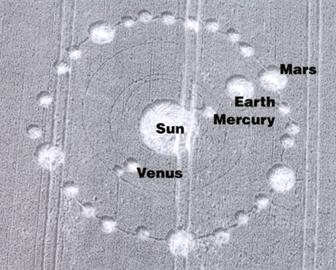
What was the meaning of
this orbital configuration registered in the corn and distributed on a
worldwide scale through the Internet?
The crop circle and scientific specialists did not have any
answer. So while certain
crop circles are the result of jokers or artists, an appreciable
number of crop circles are clearly of unknown origin.
Indeed, the scientific experts of the question of origins
conclude them to have characteristics impossible to reproduce
together: bursting or
swelling of the cereal nodes, microwave radiation, speed of execution,
crossing of the stems, nausea, insects or animals dying, speed of
growth of the germs, and even presence of moving balls of light.
But the pin pointing of this date of
September 6, 2003
by means of the representation of the solar system in corn is not what
is the challenge; but how to connect this crop circle indicating
September 6, 2003
with what is being announced in this article.
An invaluable marker speaks
for itself in the crop circle. We
see that there is an intruder beside Venus. This planet does not have
the moon as we have one. What
is remarkable is the EXACT
POSITION of the intruder, which is waiting in ambush to cross our
planet on its orbit.
We see clearly that the point is slightly inside the circle,
just like will be the time the comet crosses the plane of the ecliptic
on
MAY 25, 2006
. Thus, the crop circle
registered that the carrier of information on the danger of comet
would be the same one as that of the world message of
September 6, 2006
. The simulation of the
orbits of the simulator of NASA confirms the perfect correlation of
this date of
September 6, 2003
drawn from the site swirlednews.com.[i]
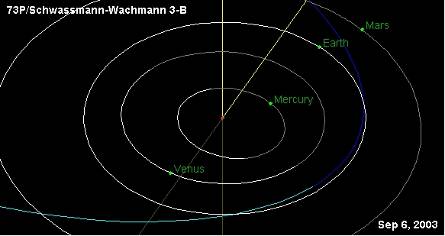
Did the crop circle have any significance for September 6, 2003?
Nothing!
Nothing occurred on
September 6, 2003
, except for the reception of the message of the extraterrestrial
world referendum "Do you
wish us to Show Up?” which
circulated around the world in more than fifteen languages and more
than one hundred countries.[i]
Hundreds of thousands of people answered in the silence of
their interior this planetary call. Hundreds of Internet sites relayed
this message of eleven pages translated spontaneously by unknown
individuals. From where did this message come?
I received this telepathic
message under conditions which I present in my second book "Children of Stars".[ii] I describe there my contact experiments with
extraterrestrial visitors[iii] and the major motivation which animated our
celestial neighbors when they appeared in mass at the end of the
1940s, namely the nuclear
weapon!
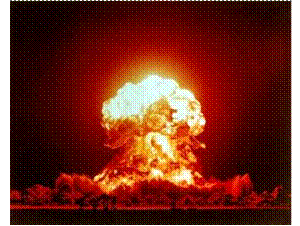
In a recent article,[i]
I show the close link which exist between the use of the nuclear
weapons during the atomic tests - nearly 2500 between 1945 and 1998 -
and the physical appearance of UFO, confirmed by the radars and
sightings of air controllers and pilots, who occupied positions in
civilian or military aviation. This relation is also confirmed by the
reports of accidents of UFO reported by various sources.[ii]
This correlation is explained scientifically in my first book
"The Science of
Extraterrestrial."[iii].
This book describes in
layman’s terms the reasons from our fundamental scientific errors
and proposes a new paradigm – fractal time - upsetting in-depth our
comprehension of reality. The theory of Absolute
Relativity solves, not only all of the UFO phenomena and
of paranormal events, such as
the formation of the crop circles referred to above, but also the
great scientific, as well macroscopic and microscopic enigmas.
Whereas I am not a scientist, what I have written comes from
many personal reflections and the information delivered by a group of
extraterrestrial that I call the "blue beings”. They are not
the source of the fragmentation of the comet Schwassmann-Wachmann.
They are small, long limbed and graceful. They have a large
brain, very large dark eyes and remarkable blue skin.
Of their body, as their eyes, emanates a strange light, as if a
sun lived inside their body and that their skin was perforated by a
myriad of shining lights. Their movements are slow and very flexible.
They are logical, generous and joyful beings. The drawing[i]
below gives an idea of their appearance.

But this allied
extraterrestrial race is far from being the only one to visit us,
and to supervise us like neurotic children.
There are other benevolent races but also malevolent races.
The difficulty of comprehension comes from the fact that
these races are, for the majority, immaterial (luminous or
invisible); except when atomic weapon detonate upon Earth, thereby
materializing their vessels, and destroying the spirits of Nature
existing in another reality.
According to any
probability, the majority will cease reading this text starting from
this line. My
reflections will seem to you to be delirious. If I announce to you
that the military industrial complex directs your country under one
form or another, and that this same complex is covertly influenced
by malevolent
extraterrestrial that seek total domination of humanity after having
partially destroyed it, that will seem to be a conspiracy theory
from some cheap tabloid.
What is delirious, actually, is the cover up of silence and
misinformation that has prevailed for sixty years on the
extraterrestrial subject. What is
delirious is the nuclear war that certain leaders, or advisers of
leaders, prepare us for, in the name of peace!
One coldly announces a preventive
war with the atomic weapon to us, by standardizing this one with
the row of conventional weapons, to
fight against the spread of atomic
weapons!
Consequently, the preventive attack seems to be the option chosen by
certain extraterrestrials by means of a heavenly object,
mysteriously burst asunder in 1995, to minimize its own devastating
effects on Earth. Schwassmann-Wachmann
should strike the Earth around
MAY 25, 2006
as a public warning. Except
if, of course, the leaders go into reverse.
That enormously will depend on you, of the actions that you
will take to convince them of their folly!
What occured for extraterrestrials, as I suspect it,
to transform in
1995 a
comet into a weapon of massive super destruction?
1994 is the year that saw an upsurge of interest in
the UFO Roswell crash, but also, to choke this, there was a hoaxed
film of an alien autopsy; importantly, the
United States of America
decides behind the scenes to implement the National Missile
Defense, i.e. the Star Wars
program! This
program cannot objectively be intended for a terrestrial potential
enemy as claimed by the government.
The enemy was
extraterrestrial!
We see here that the government secrecy policy combined with the
aggressive behavior of the military were enough for some
extraterrestrials to prepare a preemptive shot at the Earth. In the
next few days, we are precisely facing important strategic decisions
for the fate of the world.
Consequently, vis-a-vis the
nuclear armada created by humanity, vis-a-vis the laser program of
directed energy weapons, certain ‘star visitors’ have taken
"convincing" measures and decided on the use of a first
public warning for MAY 25, 2006, a
few weeks before the launching of the nuclear offensive against
Iran, involving an escalating potential for planetary atomic war which,
I point out it, would destroy whole or part of the planes of
existence, invisible in our eyes, where the ‘star visitors’
live.
Events accelerate but the
consciousness of individuals remain deadened.
We are in the ignorance of the danger that the scientists and
the soldiers, the politicians and the religious orders have
consciously created here for nearly sixty years.
They knew of this connection between UFOs and nuclear weapons.
If it were not so, they would not have manufactured 4000
times the nuclear capacity needed for the destruction of two
sub-continents. The
danger is imminent today because, for
the first time in human history, a war with destructive atomic
weapons is marked on the calendar for 2006.
This war - as any other in
the history - constitutes a real danger to our extraterrestrial
neighbors. Failing to
take these remarks seriously, they will let us brutally know it.
But we can react while letting our extraterrestrial allies
know that we understand what’s at stake.
By circulating as widely as possible, even on a purely
anonymous basis, the World Referendum "Do you wish us to Show Up?", perhaps we will increase the
chances of a peaceful resolution of the extraterrestrial question.
The era of human fraternity would become thus a reality.
The enemies of humanity are
human and extraterrestrial, just as extraterrestrials are also
humanity’s allies. Our
remaining time is but a few days.
If we alert our
leaders and our fellow-citizens by widely diffusing the
extraterrestrial message[i] and this article that each one is
free to translate and make known, the worst should be avoided.
The comet fragment, probably
still invisible for our measuring instruments, would then be
destroyed by the extraterrestrial ones which can protect
its trajectory, as has already occurred in the past.
Sooner or later, one always
meets one more extreme than oneself.
Better it is then to build peace within our civilization,
before it takes-off into space.
After this possible public warning of
MAY 25, 2006
, the next projectile could be much larger and infinitely more
destructive to the point of eliminating the human race from the
surface of the Earth as suggested in the crop circle "Missing Earth".
The logic of the highest bidder is extremely likely to took
us towards the worst outcome. It is thus now, I
believe, we should choose to act!
Perhaps you can personally save a few million lives...
Notes
More
graphics of the near-miss
[1]
http://www.exopoliticsinstitute.org/Eric-Julien-extrait-Montagne.doc
[1]
http://science.nasa.gov/headlines/y2006/24mar_73p.htm
[1]
http://neo.jpl.nasa.gov/cgi-bin/db?rec=900444
[1]
1 AU = 1 Astronomical
Unit =
149 597 871
kilometers
[1]
http://www.swirlednews.com/article.asp?artID=659
[1]
http://science.nasa.gov/headlines/y2006/24mar_73p.htm
[1]
http://science.nasa.gov/headlines/y2006/24mar_73p.htm
[1]
http://www.objetvolant.com/html/modules.php?name=Forums&file=viewtopic&t=5755#53816
[1]
http://www.swirlednews.com/article.asp?artID=673
[1]
http://www.swirlednews.com/
[1]
http://www.etreferendum.com/
[1]
Enfants des Etoiles,
Désirez-vous nous voir apparaître ?, éditions JMG, avril
2006
[1]
http://www.exopoliticsinstitute.org/EricJulien-EDE-extraits.doc
[1]
http://www.exopoliticsinstitute.org/Journal-vol-1-3-Julien.doc
[1]
Ryan Wood, Majic Eyes Only:
Earth’s Encounters with Extraterrestrial Technology (Wood
Enterprises 2005).
[1]
La
Science des Extraterrestres,
éditions JMG, juillet 2005.
[1]
Drawing by Elaine Thompson.
[1]
http://www.etreferendum.com/
[i]
http://www.etreferendum.com/
[i]
Drawing by Elaine Thompson.
[i]
http://www.exopoliticsinstitute.org/Journal-vol-1-3-Julien.doc
[ii]
Ryan Wood, Majic Eyes Only:
Earth’s Encounters with Extraterrestrial Technology (Wood
Enterprises 2005).
[iii]
La
Science des Extraterrestres,
éditions JMG, juillet 2005.
[i]
http://www.etreferendum.com/
[ii]
Enfants des Etoiles,
Désirez-vous nous voir apparaître ?, éditions JMG,
avril 2006
[iii]
http://www.exopoliticsinstitute.org/EricJulien-EDE-extraits.doc
[i]
http://www.swirlednews.com/
[i]
http://www.swirlednews.com/article.asp?artID=673
[i]
http://science.nasa.gov/headlines/y2006/24mar_73p.htm
[ii]
http://www.objetvolant.com/html/modules.php?name=Forums&file=viewtopic&t=5755#53816
[i]
http://science.nasa.gov/headlines/y2006/24mar_73p.htm
[i]
http://www.swirlednews.com/article.asp?artID=659
[iv]
1 AU = 1 Astronomical
Unit =
149 597 871
kilometers
Article #2
Translated from
the French:
This night meditation of April 7, 2006 thus led me to receive
on behalf of creatures which I earlier describe as
extratemporelles [extraterrestrials] a date - that of MAY
25, 2006 - dependent on an extremely lucid vision of giant
catastrophe three years ago. I duly consigned this vision, like
others to come, in a ouvrage[1] published recently. ,
Then, having spoken about this communication in a forum
français, I learned that a split up comet, 73P/Schwassmann-Wachmann 3
(SW-3), was precisely to pass very close from the Earth in May
2006, and that 25 this month precisely corresponded to the
crossing, by split up comet, of the plane of the ecliptic on
which the Earth is.
This surprising "coincidence", of which the
probability borders a chance on a few million, must be
examined in detail. Let us recall that the fragmentation of
comet SW-3 took place in 1995 under strange conditions and
that only three fragments were seen. Since this date the comet
carried out two elliptic revolutions around the sun.
Here is a comment of Philippe Morel of the Astronomical
Company of France: "On June 6, 2006 it will enter again
the very restricted circle of the comets whose distance
nearest to the Earth will be lower than 15 million
kilometers. Accustomed to passages closer to the Earth than comet Schwassmann-Wachmann 3 (SW3) had approached us
with the Astronomical distance from 0.0617 Unit (UA) in
1930. "
List passages of 73P/S-W 3,
period 1925-2011
|
| Date du Périhélie
|
Périgée
|
Distance
|
Remarque
|
Désignation
|
|
1925 Janvier 15.217
|
|
|
|
|
|
1930 Juin 14.198
|
31.75 Mai 1930
|
0.0617 UA
|
fort périgée
découverte
|
1930 VI
|
| 1935 Novembre 08.016
|
|
|
inobservée
|
|
| 1941 Avril 06.053
|
|
|
inobservée
|
|
|
1946 Septembre 07.972
|
|
|
inobservée
|
|
|
1952 Février 15.823
|
|
|
inobservée
passe à 0.744 UA de Jupiter le 17
Octobre 1953
|
|
|
1957 Septembre 22.717
|
|
|
inobservée
|
|
|
1963 Mai 15.434
|
|
|
inobservée
|
|
|
1968 Octobre 23.803
|
|
|
inobservée
passe à 0.283 UA de Jupiter le 20
Novembre 1965
|
|
|
1974 Avril 05.110
|
12 Mars 1974
|
1.1089 UA
|
inobservée
|
|
|
1979 Septembre 02.780
|
30 Septembre 1979
|
1.0504 UA
|
redécouverte
|
1979 VIII
|
|
1985 Janvier 11.420
|
06 Janvier 1985
|
1.8774 UA
|
inobservée
|
|
|
1990 Mai 19.302
|
17 Avril 1990
|
0.3668 UA
|
|
1990 VIII
|
|
1995 Septembre 22.890
|
17 Octobre 1995
|
1.3131 UA
|
fragmentation
|
1994w
|
|
2001 Janvier 27.716 *
|
18 Janvier 2001
|
1.7978 UA
|
|
|
|
2006 Juin 06.957 *
|
12 Mai 2006
|
0.07863 UA
|
fort périgée
|
|
|
2011 Octobre 16.756 *
|
|
|
|
|
|
* Fragment C
|
There are 175 comets referred as short period, of which
the most famous is Halley's Comet. The table above shows the
passages closer than comet SW-3. Having been
discovered in 1930 by Arnold Schwassmann and Arno Arthur
Wachmann in May 1930, it is seen indeed that it passed nearest in 1930.
But in May 2006, the passage is closer in, for the
fragment S which will interest us, estimated at 0,0487
UA (7,3 million kilometers). It is true that the
majority of the fragments should pass on average to
0,065 UA, but it is enough for ONLY ONE FRAGMENT to start
a major event. What to thus say this restricted circle of
comets is less than 8 million kilometers?
Only two passages to 0,03 UA for Halley (837 after JC),
and 0,04 UA for C/1132 T1 (1132) did better than the
fragment S of SW-3! But they were not fragmented, and
thus not likely to deviate, by gravitation, towards the
Earth.
In May 2006, SW-3 will be not only among the rare
ones to also approach close to the Earth, but also
among comets having known the greatest magnitude
ever reached. This is the first time that a
fragmented comet crosses our road at such a short
distance.
It is thus the first time in the known history
which such an event will have taken place. The
predictions of the astronomers are not thus
founded on any historical scientific asset in the
very precise case which occupies us.
More and more, one evokes the probability of a
rain of meteorites at the end of May, at the
beginning of June 2006. Curious... In 1930, with the
passage of SW-3, however much further into mid-May, and without the fragmentation which we know
today, the Earth had over 70 fragments per hour. They
were enough small to burn in the upper atmosphere.
There is a comet having known a fragmentation and
being transformed into swarms of meteorites: 3d/Biela.
It was in 1852 that it was observed for the last
time. It separated into two visible fragments for
three months in 1846. The moment most favorable
for its observation was the year 1865 at a
distance of 0,481 UA is TEN TIMES FURTHER that the
fragment S from SW-3!
In connection with 3d/Biela, one knows today that:
"in 1872, the year corresponding to a new return,
a new swarm of meteorites, Andomédides, made its
appearance (3.000 meteorites per hour on November
27). Calculations showed its affiliation with the
Biela comet. The swarm appeared again in 1885
(15.000 météores/heure), in 1892 (6.000 météores/heure),
then in 1899 (150 météores/heure).
150, 3000, 6000 and even 15000 meteorites per
hour! A starry sky in one full day! What do we say
meteorites of SW-3 ten times closer? Let us
indicate that this comet SW-3, of the family of
Jupiter comets, was the object of great
interest by the international scientific
community, in particular in December 1994 since
it was among the rare objectives of the
programme of prospection of the probe of Rosetta
exploration of the ESA. A series of monthly
stereotypes were produced until June 1995
It is precisely on 25 June 1995 that a crop
circle appeared, or rings phenomenon, called
"missing Ground" with Longwood
Warren in the County of Hampshire in England.
This gigantic crop circle matched the interior
solar system, to the belt of asteroids, less
the Earth. Let us note, for the skeptics, that
amateurs of hoax had tried to reproduce identically the this circle of culture without
reaching that point.
Knowing that the planets, as well as comet,
turn in the direction reverses needles of a
watch on these drawings, this agroglyphe seems
to refer to the situation of the solar system
on MAY 14, 2006 at the time of the passage to
more close to comet SW-3.
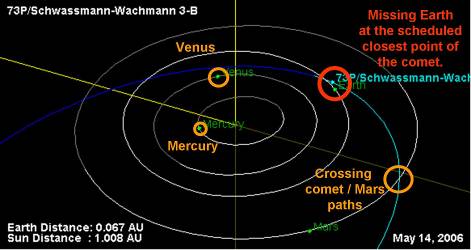
But what the creators of this crop circle seem
to want to say is that this date precedes in
fact the good date since Mars, whose orbit is
the first visited by the geocroisor, is
upstream of its position at the time of the
impact which the "missing Earth
suggests".
After the appearance of the circle of culture
at the end of June 1995, SW-3 will be seen for
the last time in its normal state by an
astronomer Japanese amateur on August 20,
1995. It is at the beginning of September, two
months only after the appearance of the crop
circle "Ground Missing", that SW-3
is taken of abrupt and violent one start,
precisely at the time to pass the plan of the
ecliptic of the Earth.
A press release of January 1996
announced that the observatory of Paris Meudon,
using the radio telescope of Nancay, made a
series of measurements on the emission by comet
of molecules of hydroxyl from the 8 to September
12, 1995. The values were completely abnormal at
the time when SW-3 crossed our plan of the
ecliptic
In a round of almost 2,5 billion kilometers,
it is in the vicinity of the terrestrial orbit
- in an interval representing less than 1% of
its trajectory - that SW-3 was broken, before
illuminating the sky and pointing out
themselves...
Chance? This luminous start will reach a
magnitude a thousand times higher than the
normal in October 1995, after having passed by
its perihelion and to have sailed in parallel
during several million kilometers to the
terrestrial orbit. Isn't a comet breaking at
the time of its virtual passage closer
to the Earth an explicit symbol? Wouldn't this
be a message exopolitic of a great clearness?
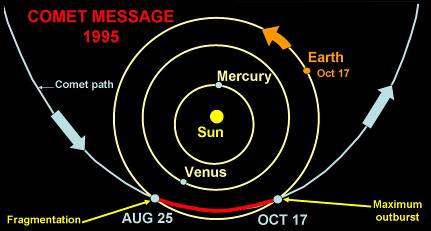
Curiously, an Internet site teaches us that,
"the comet was one of the targets of
the mission Contour (Comet Nucleus Tour),
scheduled for July 2002. The probe was to
leave in direction 3 comets (overflight of
2P/Encke in November 2003, 73P/Schwassmann-Wachmann
3 in June 2006, and of 6P/d' Arrest in
August 2008) to analyze them and compare
them. Unfortunately, a technical failure
caused the destruction of the probe little
after its take-off ". A technical
failure?
To today anybody does not have final
explanation on this cometary start, and
this fragmentation of SW-3. The comet
consisting of ice, the sun vaporizes a
part of its surface to the approach of the
perihelion - not nearest to the center of
revolution, i.e. sun - and equips it with
a tail with light But since centuries SW-3
turned around the sun according to the
same trajectory without disintegrating!
The c?ur of a comet remains basically
rigid and extremely cold. The only
acceptable explanation, for the scientific
community, is thus the collision of SW-3
with a small asteroid. But this
explanation poses many problems. And it is
an euphemism
The mysterious comet is, at the moment
of this start, hundreds of million
kilometers of the belt of asteroids.
Which are the chances of a collision
between two small insulated objects, in
the interplanetary vacuum, without real
respective gravitational influence?
Almost null!
Imagine two billiard balls launched by
chance on a large table like the
United States. They are likely more to
enter in collision than SW-3 with an
improbable vagrant did not have any.
The idea will be opposed that there
exists nearly 800 qualified objects of
Potentially Hazardous Asteroids
(potentially dangerous asteroids). But
the chances of such a collision in a
given segment - that which is shown in
red in the diagram above - are very
close to zero
To suppose that such a collision took
place all the same a miracale, how
to explain such a magnitude for so
"a small" object?
One needed a
colossal energy to deploy a value
thousand times higher than the normal.
Of course, fragmentation, in oneself
extremely rare, temporarily supported a
greater luminous magnitude with the
approach of the sun, but certainly not
in the evoked values. The press release
of the European Space Agency in January
1996 is clear
"Only some rare comets made the
experiment of an increase in so large
and unexpected luminosity. At the time
of this event, SW-3 just came to pass
its perihelion after having crossed the
terrestrial orbit in its trajectory of
distance.
The distance separating it
from the Earth was close to 200 million
kilometers ".
If this fragmentation were only due to
the sun we would have, among 175
existing comets, a majority of them in a
normal state of fragmentation. They
would thus not live centuries, and even
of the millenia. However, the fragmented
comets are very rare. The fragmentation
of SW-3 "was thus facilitated"
in an artificial way, just like it was
probably the case of 3d/Biela having
known exactly the same conditions of
destruction near the terrestrial orbit.
3d/Biela was probably destroyed because
it represented a danger in the future.
It was potentially to pass to nearest in
December 1905 (0,0616 UA).
This possible
collision would have come too much early
in our history, in particular in the
history of the atomic weapon, at the
moment when we had not made a decisive
choice yet. It probably acted of a work
"creature of habit" of
celestial cleaning on behalf of our
"gardeners" extraterrestrial
presence, since contrary are extraterrestrials of
the new era UFO begun in 1945.
Was the activity of the sun exceptional
in the phase of the perihelion to
produce or support this bursting of
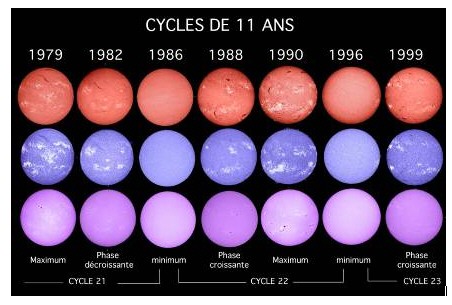
SW-3? Not, on the contrary! We are
during the most stable time and without
solar flare, at the end of the eleven
years cycle started in 1986 and
finishing in 1996. It is in the medium
of the cycles that the solar flares are
most intense, as shows it below the
graph in various wavelengths. Contrary
to the generally accepted ideas, the
enigma is thus far from being
commonplace. It is an unfathomable
mystery.
This cometary start, for me and in
accordance with my communications with
it, was caused by an advanced
intelligence having a perfect knowledge
of the celestial mechanics and voyage in
time. This intelligence literally put
comet into pieces, by heating it
artificially, and after having been
informed of one's future become extremely
probably, namely the accession with the
capacity of the leaders, and advisers of
leaders, currently in office.
The extraterrestrial beings have the
capacity to go and come in time when
they reach the temporal high
densities. I explain the principle of
time fractal in my first literary
contribution. This faculty is also
shared by the authentic indicators,
like each one among us at the time of
the premonitory dreams.
The current
leaders prepare to make a massive use
of the nuclear weapons to which these
intelligences are opposite for reasons
of safety
In the temporal high densities,
occupied by the extraterrestrial
ones, the atomic weapons produce
devastating effects until hundreds
of light-years.
The energy which is
propagated in our material world, at
the time of a thermonuclear
explosion, is recovered of a space
time to which the macroscopic
universe in which we live does not
have normally access.
And since we have just spoken about
the sun, will know that an emergent
scientific battle makes rage to
determine the true nature of the
solar activity which one thought
hitherto thermonuclear.
For a reason a priori
incomprehensible, the temperature of
the solar crown is much higher - 2
million degrees - than the
temperature of surface - 6000
Kelvins degrees. However, the theory
would like that it is the star
which is extremely hot by
gravitational compression,
generating a nuclear fusion. But we
do not have any formal and
direct proof of it. We have even
strong indices of the opposite. Why
speak about the nature of the sun
whereas we are worried by a méga
tsunami on Earth having to occur on
next 25 May?
If there are no thermonuclear
explosions in the sun then our own
atomic tests, spread out over fifty
years, had and will have a
considerable incidence on the other
space times of the universe, in
other realities of the world. Then
imagine the systematic use of
nuclear weapons in the war that
certain governments prepare.
The extraterrestrails are our
neighbors, not just of space, but of the
space time. It is perhaps complex to
understand but it is a reality that
the best physicists of this small
and fragile blue planet will not be
able to draw aside from a reverse of
hand. They know on the end of the
fingers the theoretical limits of
the current scientific models. Now,
we are not any more in the theory
but in the real world.
It is absolutely not a question here
preferably cultural, nor of
political choice in favour. It is a
question of a planetary
civilization, ours, in contradiction
with the principles of interference
with respect to other worlds. It is
not them which interfere while
coming to see us, but we who
interfere by materializing them, by
means of the nuclear tests in
particular, in our physical world!
I hear here and there that the
"Galactic Confederation"
would never authorize an aggression
of extraterrestrial against the
Earth, nor... a direct intervention
of our extraterrestrial allies in
the name of a law of noninterference
engraved in the marble of the
evolution.
[Editors note: The Galactic
Confederation is a channeled term,
not one that the greys recognize.]
Which vision anthropocentric! But
especially there isn't there a major
paradox? We are, I fear it, the
invaders of advanced stellar
civilizations, but also of purely
spiritual worlds. While exploding
the atomic weapons, we cause a
form of temporal hurricane
whose?il would swallow the world
of the hearts. If we launch the
bombs, they will launch comets.
Indeed, space is inhabited
infinitely more than the Earth.
We will understand it ourselves
once we actually get there!
Perhaps we would make the same
decisions that they do. It is not a war between
extraterrestrial and human, but
between ExtraTemporels and
Materialized Consciences, even
materialists. Perhaps our clear
thinkings, where they are, would
be more favorable to this brutal answer.
90% of the population of this
planet believe in the existence
of a life after death. But not
1% do not know what it
resembles. I believe useful that
we engrave this in our reports.
How will
fragmented comet SW-3 behave?
Here is a table of figures
which I carried out on the
basis of simulation of
trajectories and positions
accessible on Internet site
from Near Earth Objects
Program. One finds there
primarily information of
distances and dates. The lines
in red indicate the four
"groups" of
fragments.
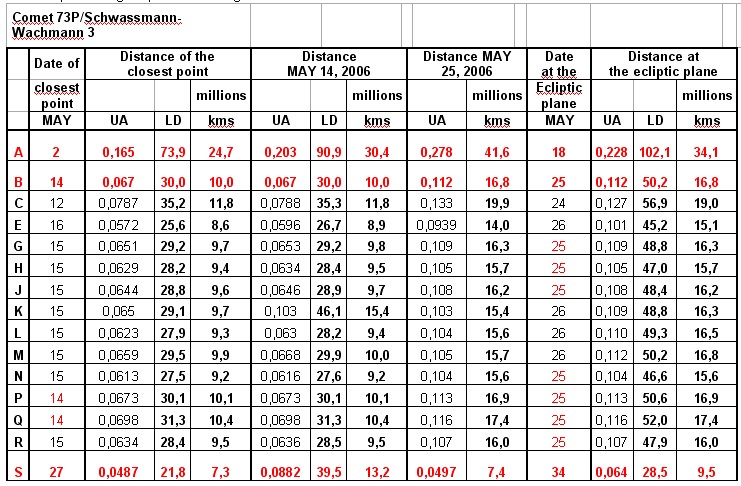
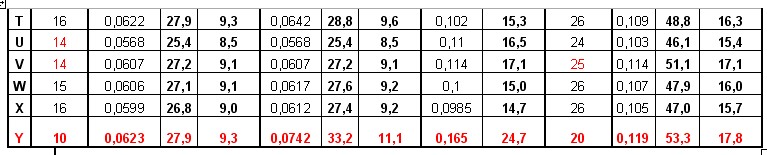
On the date of May 14,
2006, we should see the
configuration indicated below.
The figures which follow are a
reconstitution which I
realized by systematic
pointing to synthesize the
relative positions of the
fragments
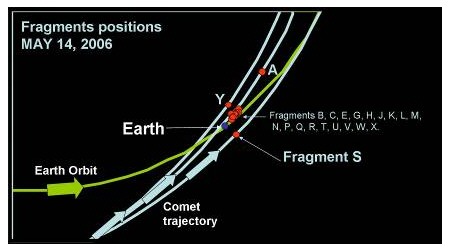
What do we see in the
remarkable one? Three
essential elements appear clearly for our
comprehension of the stake.
What is striking initially is
the existence of three
different cometary
trajectories. Then, we see
four "groups" of
objects: With, Y, B-X and S.
Enfin, the distances between
"groups" are very
large. For example, 25
million kilometers separate
fragment A from the fragment
S. It should be indicated
that at the date of April 18
a twenty-second fragment
appeared, fragment Z. It is
not mentioned here but
belongs to the group of B
with X. In the same way,
April 19, thirteen other
fragments, noted AA with AM,
made their appearance while
resulting from this same
group B-X.
I call the fragments A, Y
and S "groups
fragments" for two
reasons. Initially parce we
are unaware of the existence
of inobservable fragments
bus too small around these
principal fragments. Then
because while approaching
the Earth, these fragments
A, Y and S doubtless will
split up themselves.
Indeed, the heat of the sun
will act on comet as on an
ice floe which melts slowly
in water glass. It will
split up early or late.
Nevertheless, the year 2006
is one period particularly
calm for the solar activity
since we are in the medium
of the eleven years cycle.
The solar flares will be
non-existent. Vaporization
will remain relatively slow.
On another side, smaller,
inobservable fragments for
the moment, will also be
able perdurer until the
perihelion of comet being
well after the Earth. Except
if, of course, one of them
runs up against our planet.
It is precisely the
scenario of my vision.
Gift Yeomans, Chief of
Near Earth Objects Program
with NASA, affirmed in an
interview March 24, 2006:
"It is a rare
advisability of observing
a comet with the anguish -
at a very short distance.
There is no danger of
collision. My God, not.
The fragment nearest will
be to six million miles
from there (9,7 million
kms) - or twenty-five
times further that the
moon ".
However, at the time even
where this interview was
given, the fragment S was
observed on March 24, 2006
with the Mount Lemmon
Survey. It is estimated to
pass to 7,3 million
kilometers as the table
shows it above, and not to
10 million kilometers as
announced everywhere. It
is probable that at the
moment when I write this
article of other fragments
are estimated at a weaker
distance still. If it is
not already done, it will
be soon the case.
The problem is that we
discover the fragments of
more low size only at the
last time under the terms
of a principle easy to
include/understand. The
luminous magnitude of an
object increases as it
approaches us. Thus, the
smallest objects, hitherto
invisible, are observed
only a few days, even a
few hours before they do
not cross us. Often,
moreover, they enter our
atmosphere. But they are
too small and disintegrate
in high altitude. It is
the principle even rains
of meteorites.
In the case which
interests us when we deal with
the comet. It is a fast
object, thus having a
great energy. We see in
the table of NASA below
that relative speeds of
approach are about 15
kilometers a second for
SW-3 (73P/Schwassmann-Wachmann
3). If the fragment is
sufficiently large, its
inertia will be large and
the terrestrial attraction
will have only one weak
influence, in particular
if it is far as it is the
case of group B-X. On the
other hand, if it is
rather small, the Earth
will attract it towards
it. It is the case of the
vision which I had.
By observing the table of
the closest objects
attentively - visible
table on the site of NASA
- we see the already last
objects - in the first
table the objects move
away from us - and to come
- in the second table the
objects approach us. The
asteroids 2006 HG and 2006
GB1 of the second table
for example, of an
approximate size of 50
meters, are announced only
little time before
crossing. The more one
goes far in the future
(second table), the more
the objects are large,
with some rare exceptions.
But these two objects HG
and GB1 have only one
speed from approximately 5
km/s. No danger.
In the same way, it is not
astonishing to see in the
close past (first table)
much more small objects
(2006 GU2, EY, FH, GC).
But that does not mean
however that we saw all
the objects having crossed
very close the Earth! This
is why the astronomers
often announce dangerous
crossings afterwards!
RECENT APPROACHES TO
EARTH
1
AU
= ~150 million kilometers
1 LD = Lunar Distance =
~384,000 kilometers
Object
Name
|
Close
Approach
Date |
Miss
Distance
(AU) |
Miss
Distance
(LD) |
Estimated
Diameter |
Relative
Velocity
(km/s) |
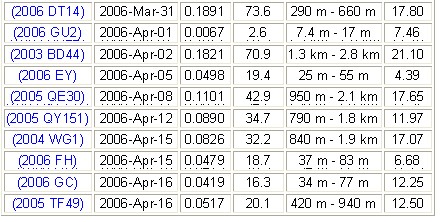
*
Diameter estimates
based on the object's absolute
magnitude
UPCOMING CLOSE APPROACHES
TO EARTH
1
AU
= ~150 million kilometers
1 LD = Lunar Distance =
~384,000 kilometers
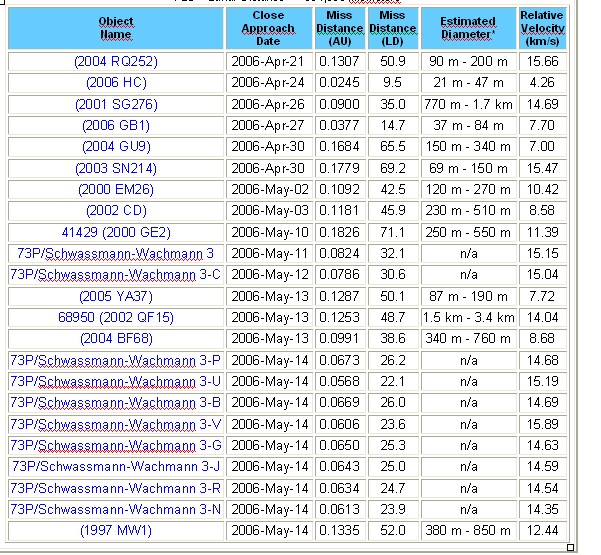
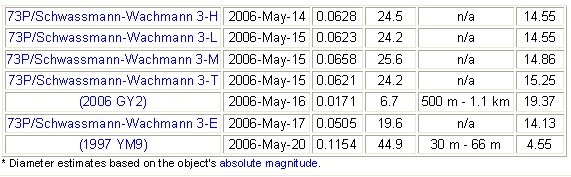
Much noted is the presence of
the asteroid 2006 GY2
having to pass to more
close to the Earth on MAY
16, 2006 to 0,0171 UA,
that is to say to
approximately 2,6 million
kilometers in the medium
of the swarm of fragments
SW-3. The size (500/1000
m) and the speed (20 km/s)
of the racing car have
what to impress. We will
return there.
The size of the fragments
of comet 73P/SW-3 is not
communicated to us. But no
fragment of less than
fifty meters will be seen
before May 15, even on May
20. What to say of an
object 20 meters in
diameter, of a weight of
15 tons launched to 54 000
kilomètres/heure (15
km/s)? What to say if this
object is accelerated by
terrestrial gravity under
the terms of an almost
parallel trajectory on
million kilometers? Could
it reach 40 km/s, as I
indicated in my first
article, and to have the
power of a few hundreds of
atomic bombs to shake the
Atlantic dorsal médio?
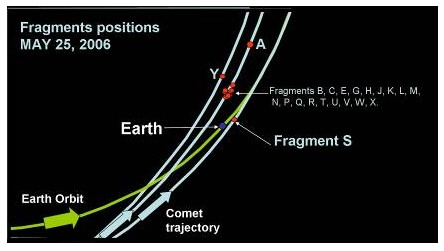
We immediately see in
the figure above that it
does not act at all of a
"collar of
pearls" as
announced here and
there. With the origin,
in 1995, the astronomers
saw four fragments then
three (A, B, C), the
fourth having been
vaporized and/or made
invisible by its size.
Taking into account the
distance separating the
groups between them we
let us deduce an
"abnormal"
activity from it.
Indeed, the three
fragments of origin (A,
B, C) are in front of,
on the trajectory of
fragment A. Something
thus slowed down the
fragment S, either in a
small explosion having
moved away in direction
opposed Y and S, or by a
voluntary braking. In
both cases, there is no
reason so that there are
not other fragments
around, and especially
behind S.
We see that the fragment
S is an extremely
serious candidate for a
collision with the
Earth. If it is not the
fragment S, it can be a
fragment, still
inobservable per hour
when I write, being with
the back of this one.
Let us observe the
alignment of the
"collar of
pearls". The plan
of the ecliptic is
represented below by a
green straight line.
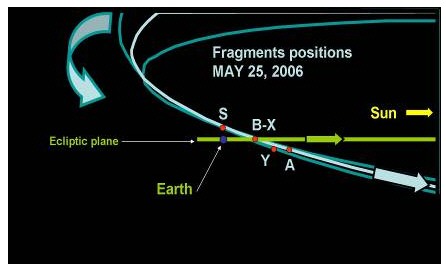
In the two following
diagrams we visualize
the trajectory that the
fragment S, or another
resulting from S, can
borrow. Seen top (first
appears below) the
trajectory of collision
is registered perfectly
between the extremes.
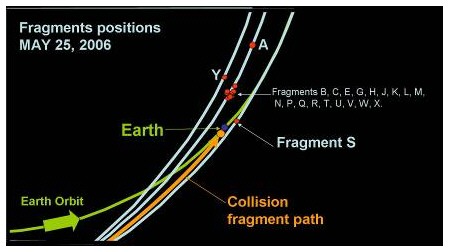
In the same way, taking
into account the
variations of distance
in height in a sight
"of profile",
it is not improbable
that a fragment moves
towards the Earth on a
trajectory
"parallel"
with the others (see
below). The angular
difference between the
blue and orange slopes
is only of 5°,
identical to the
difference between the
trajectories
"known" after
the plan of the ecliptic
(represented here by a
green straight line)
In other words,
there is, there too, no
heresy to consider the
deviation of a fragment
towards the Earth, the
more so as the solar
billion wind, made up
matter particles, makes
appreciably derive the
smallest fragments towards
our planet, as a balloon
in a morning breeze
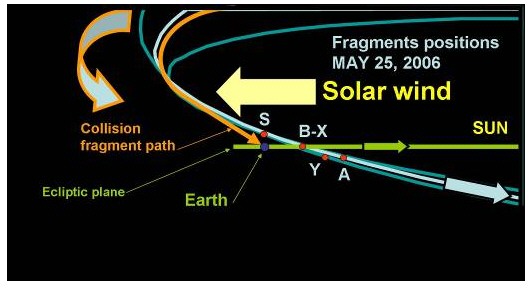
I recall that I was
unaware of the
existence of this comet
when I received the date
of MAY 25, 2006 for the
realization of my
visions of catastrophe
in the Atlantic? It is
important to take some
precautions on the
assumption that some
would affirm that it was
obvious that such an
event was to occur. It
is thanks to
extraterrestrial that I
learned much on the
man...
Actually, in spite of
appearances, the
OBJECTIVE chances of a
catastrophe are
statistically very mean.
This is why, when that
arrives, the reasons of
this one, the
intervention of
extraterrestrial for
reason of nuclear
weapons, will remain
engraved in the memory
of the people because
such an intervention is
necessary!
To be complete on the
question, we must
present an alternative
to the scenario which I
presented. You will find
below the trajectories
relative (sight of top
and profile) of three
groups of objects for
the dates of 1st, 5, MAY
15, and 25 2006. These
three groups are the
group of fragments B-X,
S and the asteroid 2006
GY2 about which I spoke
higher. At the three
dates indicated taken
independently, there is
no risk, as indicates it
clearly the figures. On
left the sights of top
are, on the right the
sights of profile. The
asteroid 2006 GY2 is in
is a potential danger
with its point with more
close to the Earth of
0,0171 UA (MAY 16,
2006), a diameter from
500 to 1000 meters and a
speed of relative
approach compared to the
Earth of 20 km/s.
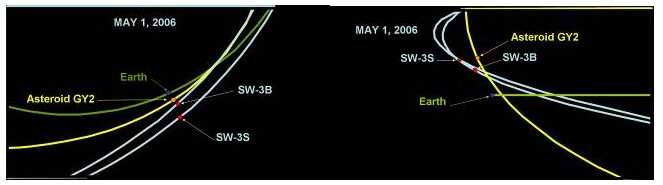
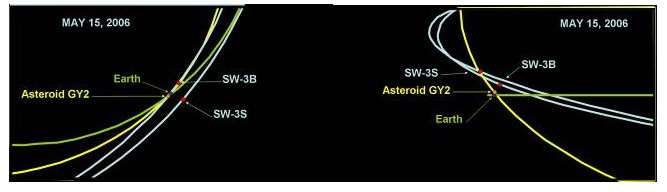
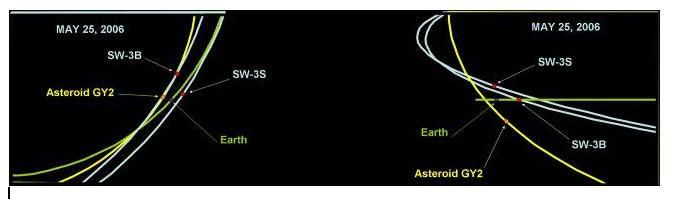
But the true danger is
perhaps indirect.
Indeed, this asteroid
2006 GY2 will pass in
the medium of the group
of fragments SW-3B-X
which forms in fact a
swarm much larger than
on the figures (see the
figures of the preceding
pages). This danger
comes at the same time
from its convergent
trajectory at worst the
moment (approach with
more), of its one
kilometer broad size and
its relative speed of 5
km/s (20 km/s (asteroid)
less 15 km/s (comet))
accounting for 18000 all
the same kilomètres/heure,
eighteen times speed of
sound. This speed of
approach constitutes a
very great danger to the
Earth because the struck
fragments would be not
only deviated towards
the Earth, but, would
have moreover acquired
an increased speed of
collision, increasing
terribly the power of
striking of the object.
May 5, 2006
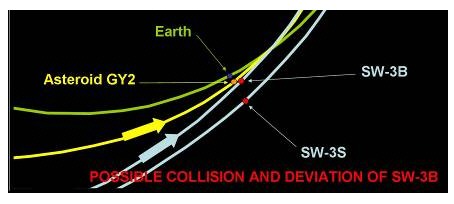
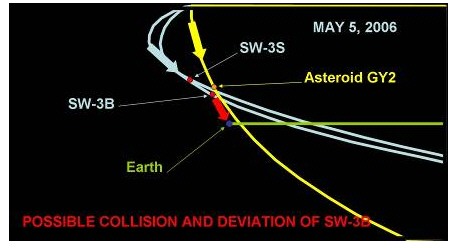
SW-3B represents here
a group of 40 fragments!
End of article #2
TO
UNDERSTAND THE TSUNAMI
OF MAY 25, 2006.
By
Eric Julien, MAY 3,
2006.
This
is the third article on
my prediction of huge
tsunami in the Atlantic
Ocean on MAY 25, 2006.
It aims first of all at
safeguarding the lives
of the coastal
populations around the
Atlantic Ocean where a
fragment from comet SW-3
will impact, involving a
brutal awakening of
underwater volcanoes.
We
will reveal aspects
which were not covered,
until now, in the
preceding articles –
namely, the
direct and indirect incidences
of the impact of a comet
fragment. We will
highlight, in a
forthcoming article,
the major reasons (beyond
natural appearances)
which may generate this
major catastrophe so
that, in the immediate
future, we may manifest
our collective destiny
as well as possible. Of
course, I will approach
the concrete
consequences for the
populations.
Let
us initially point out
the essential facts
which pushed me to spend
a very great amount of
energy to communicate
with the public on this
future event,
considering that I've
earnestly made
affirmations that we
are protected from the
main comet
fragments. Last
April 7th, I received
the telepathic message
of extraterrestrial
entities indicating that
the vision of a giant
tsunami received three
years earlier was going
to occur on MAY 25,
2006. I then learned of
the existence of a
fragmented comet, which
not only passed more
closer to Earth in MAY
2006, but which was to
pass through the
ecliptic plane on MAY
25! I have the
retrospective proof of
my vision substantiated
by the registered
copyright of my second
book who presents it.
It's
a one-in-a-million
chance that such a
fortuitous
“coincidence” took
place! Similarly,
it is more
“improbable” that my
contacts had also given
me the information on
the earthquake of Bam in
Iran at the end of 2003.
Furthermore, the
principles of the 'Science
of the Extraterrestrials',
having been accepted by
many scientists, also
allowed them the
incredible exploits by
hundreds observing
thousands of UFO in the
past. Additionally,
since my first article
on this event, I have
received many
testimonies of people
having had the same
vision of giant waves in
the Atlantic,
particularly for the end
of MAY 2006.
Therefore,
I invite each one to
request for a happy end,
to visualize a future
free from misfortunes.
By doing this, I'm
acting on my affirmation.
It is necessary for all
to warn our
fellow-citizens about
the risk of large wave -
possibly 200 meters in
the most exposed areas -
around May 25, 2006 (the
Ascension Day for
Christians). The
majority of them are
precisely around the
Atlantic. By chance?
To
avoid any panic by
relying on the
assumption of timely,
forthcoming alert, the
precautions to be taken
are very simple: Move
away from the coasts and
to go up on the heights
sufficiently early, and
even the day before.
Remember
that those which declare
that no impact will
occur on May 25, 2006
will not be there to
provide you shelter at
the proper time, nor
your beloved ones.
You will be surprised,
alone and without help
from them. Warn people
around you. Save
lives at the end of May
2006 !
It
is not “The End Of The
World!” being
considered here.
It is only an
application of PRUDENCE
regarding the potential
of a major catastrophe
of which we must
minimize the effects on
the lives that are at
risk.
Some
reminders.
Astronomers
are informed of the
existence of a certain
number of comet
fragments but are
technically incapable of
counting them all. A
great number of them
could drastically
threaten the Earth
without ANYBODY knowing
anything about it until
a few days, or even
hours before impact.
This is an
irrefutable scientific
fact!
One
will be able to confuse
you with statistical
conjectures about the
probability of such an
event, but in the
balance, the factors
will equally bear the
same weight as the
opposing assumptions. It
is a scientific fact,
especially considering
the crash landing of two
space shuttles was a
scientific fact. They
belonged to NASA, which
implies that previously
withheld vital
information on this
comet of was used to
support claims that the
comet fragments do not
represent a danger. In
statistical terms, two
out of four represents a
50% error in accuracy by
NASA. Historical
patterns support this
conclusion.
Astronomers
remembered the asteroid
2002 MN, a hundred
meters wide, which they
could detect only AFTER
it had passed within
less 120,000 kilometres
of Earth, a third of the
distance between the
Earth and the Moon.
Also, let's speak about
2004 FH, about 30 m in
diameter, located only three
days before it
passed to 43,000
kilometres of our
planet. These are FACTS.
Similarly,
NO ONE on this planet
understands the reasons
of the fragmentation of
the comet 73P/SW-3 in
1995 in the first place!
I still consider the
relevance of the two crop
circles of
extraordinary importance
for our common destiny
that appeared two months
later. Let's initially
recall that a crop
circle called
"galaxy" had
forewarned, only five
years earlier, one of
the greatest solar flare
periods of our history.
This suggests that the
authors of this
geometric language, the
extraterrestrials, have
the capacity to travel
in or envision the
future. The crop
circles of which I
speak, "Asteroid"
and "Missing
Earth", were
adequately detailed in
my preceding article.
Let us suggest that
these are proof that
these advanced
intelligences, cloaked
behind the event of MAY
25 2006, have envisaged,
and caused, long in
advance, the scenario
that proceeds in this
event.
After
a long period of cold
war between
extraterrestrial and
human, concurrently
evidenced by abductions
and nuclear tests comes
a precursor, what is
more accurately called
the Apocalypse (i.e.
the Revelation of their
existence in the world),
generated by a
“premeditated” major
catastrophe. This
upheaval does not
constitute the end of
the world but is a
warning intended to
prohibit the use of our
nuclear weapons (which
attack them in their
plane of existence).
Works of an Italian
physicist
, Gorgio Fontana,
offers precise
conclusions in support
of the scientific
contribution (Absolute
Relativity) by my
extraterrestrial
contacts (Science of the
Extraterrestrials), who
wrote to me recently:
"Absolute
Relativity is a real
variant of Special
Relativity!!! (...) It
may happen that the
effect of nuclear
explosions can affect
millions of parallel
worlds, which we cannot
see."
There
are two extraterrestrial
factions. One of them is
opposed to this comet
striking. It is that
which I consider by
ethical principle. The
following image
synthesizes the normal
path of this comet,
fragmented in 1995 in an
unexplainable way.
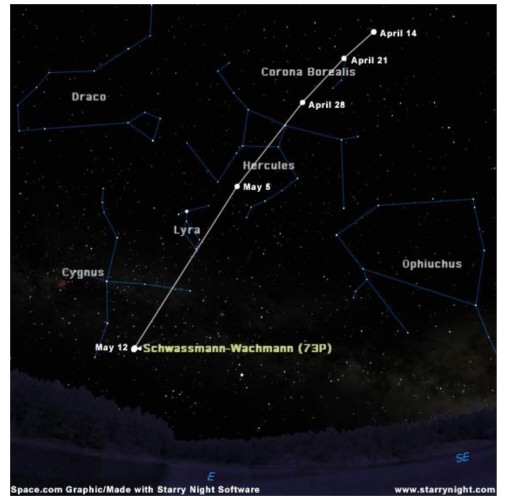
The
figures hereafter point
out the conditions of
approach of the
fragments of the comet
73P/Schwassmann-Wachmann
3, being concurrent with
this article are already
61. These figures result
from the data obtained
by the site of the Near
Earth Object Program
within NASA
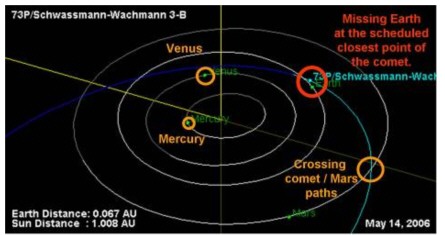
The
representation above is
a "photograph"
provided May 14, 2006, a
date on which the most
important fragments,
whose fragment B
indicated here, gain
critical global
attention for
astronomical projections
regarding their
proximity to the Earth
(red circle).
This
second illustration
shows the relative
“top view” position
of the fragments. We
clearly see
that the orange
trajectory of one
“identified” comet
fragment, unobservable
at the moment, is
perfectly between the
most extreme parameters
(trajectories of the
fragments Y and S).
The
perspective of the same
fragments above implies
a weak angular
difference between the
“officially” located
fragments and another
possible deviation in
fragment trajectory.
Below, the figure
represents the
orientation of the comet
tail compared to the
trajectory of the core
(fragment B and C
mainly). This
orientation is primarily
due to solar wind. In
the case of SW-3, the
tail will be also made
up of abnormally large
fragments. The Earth
will cross this tail
approximately MAY 24,
2006. The risks
of MAY 25 are
substantial.
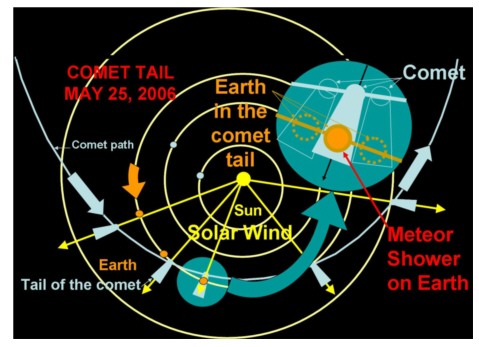
A
deep study on comet SW-3
was published... one
year ago, in May 2005.
It shows that the Earth
would be swept by a
meteor shower in May
2006 named Tau Herculids,
precisely coming from
comet SW-3. Many comets
have a long plume that
the sun creates or
facilitates. This plume
widens under, more or
less, due to strong
influence of the
gravitation of other
planets, in particular,
Jupiter, which is the
largest planet of the
solar system.
Originally, it appeared
that the comet had a
size of 1.5 kilometres.
The study estimates
64,000 small pieces were
released by SW-3!
However,
between the end of 2002
and mid-2003, when SW-3
had its slowest speed,
Jupiter and Saturn
influenced the
previously fragmented
comet. The relative
positions of these
planets tended to cause
the fragments to deviate
towards the outside of
the elliptic orbit of
the comet. In
other words, this
gravitational action
strongly supported
trajectories of
collision with the
Earth.
Knowing
that speeds of ejection
can reach a hundred
meters a second due to
the exceptional outburst
which SW-3 experienced,
one can imagine that
fragments are very
dispersed. For example,
the ejection speed of 30
meters a second, due to
the worsening
gravitational influence
evidenced above since
the beginning of the
fragmentation of SW-3,
represents more than 10
million kilometres
between the main core
and ejected fragments.
The principal fragments
will pass between 9 and
12 million kilometres of
us. This results
in our being exactly in
the middle of the meteor
cloud!
In
spite of the empirical
data provided in the
aforementioned study,
calculated by a Gaussian
distribution of the
fragments around the
principal core, many
unknown factors remain,
particularly the
fragmentation of SW-3.
Fragment S is an obvious
example. All the
scientific debate about
the collision, pro and
con, of a fragment with
the Earth comes from
primitive evaluations,
as the study referred to
above reveals.
In short, my critics
assure safety, bolstered
by press releases,
predicated upon a
hypothesis eclipsed by
an enormous unknown
factor that they prefer
to evade.
This
unknown factor is
extraterrestrial
intervention. Of course,
no astro-mathematical
model applies to
extraterrestrial
intervention! This is
what I recently
explained to a physicist
who clings to Newtonian
Physics. The safety of
millions of people rests
in the hands of very
questionable theoretical
study based on a
traditional model for
ejection of comet
fragments whereas the
original circumstances
of these ejections were
not traditional.
Regardless
of counterclaims,
accelerated
fragmentations of B and
G at the end of April
2006 has startled
astronomers. It gets
even better, NASA's
deceiving
“short-sightedness”
was revealed in
"convenient”
updating of data! More
than disconcerting, it
is highly suspect.
NASA's press
release on my collision
alert of May 25, 2006
was disseminated on an
international scale,
after my interview had
taken place on April 24
on the main stream Coast
to Coast AM radio show
with George Noory, NASA
sent out a press release
on April 27th
reassuring the public
about the unpredictable
character of this comet.
It directly coincided
with my prediction! It
was not uplifting for
me, but instilled
greater doubt and
distrust. I benefited by
checking the data of the
fragments on NASA's Near
Earth Object Program
after Elder Hale
informed me that George
Noory had expressed new
concerns during a later
broadcast which
referenced NASA's Near
Earth Object Program,
revealing new,
disconcerting data.
“Imagine
my surprise” - of
course I expected the
news about fragment S,
having previously
emphasized its
dangerously abnormal
character. NASA's
auspicious press release
served to increase
support my recent
warnings. And not just a
little: More than
1.5 million kilometres!
This suggested to me
that this could be
expected, so I later
checked NASA's belated
data on fragments M, N,
P, Q, and R at
the same time as the
fragment S, referenced
March 24th -
No notable change!
Happily, I kept the
proof of this likely
deception, as
illustrated by the
figure of the fragment S
below. It will probably
remain archived.
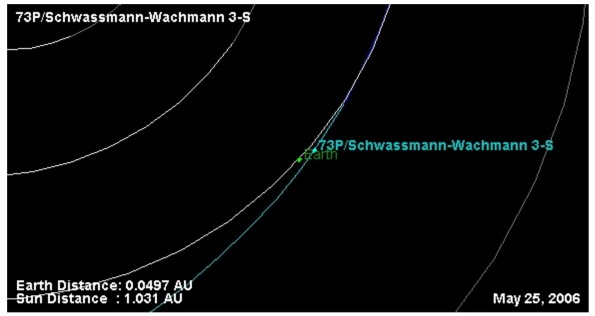
One
sees well in bottom on
the left a distance of
0,0497 Astronomical
Unit. Today, it is
around 0.0750 AU, that
is to say close to 1.5
million kilometres of
additional distance
according to NASA's
spurious distortion of
astrophysics. Two
assumptions: Either it
is an error which one
corrected, (and that
means that NASA can
still make errors) or,
NASA's uncertain! The
assertions of NASA on
April 27th
were premature at best.
Either
there is INFORMATION
HIDDEN FROM THE PUBLIC
in connection with
certain fragments, or it
is even more serious!
In both cases, my vision
seriously gains credit
from a purely scientific
point of view. The
continuation will
confirm it.
Still
recently (checked at the
date of this article),
extremely curious data
appeared on the table of
short distances objects
of the Near Earth Object
Program :
The
posted distances are
0.04 Lunar Distance or
0.00010 Astronomical
Unit. This fragment
SW-3BD would thus pass
infinitely closer than
the other fragments
hitherto identified,
since it should be at
the date of MAY 11,
2006, with the third of
the distance Earth -
Moon. Two details raise
the doubt. It appears
with the first line on a
list of 70 heavenly
objects to be noticed!
Particularly, it will
pass to 21h53
(2+1+5+3=11) more or
less 11H11. This last
figure is esoterically
known to imply
“synchronicity”.
It would appear that
the person who wrote the
data within NASA's Near
Earth Object Program
wants to “reveal” a
message to the world
saying : "It is
a deliberate error
exposing that this table
is false!". If
it is false, my
hypothesis is plausible,
and especially the worst
of it.
Impact
in the Atlantic.
In
the images below, I
endeavored to visualize
the trajectory of a
hypothetical piece of
comet. By doing this, I
wanted to check if my
vision of eruption of
underwater volcanoes,
after noon, in the
middle of the Atlantic
Ocean, and close to the
tropic of Cancer,
corresponded to the
available scientific
data. Then I
reproduced the spinning
angle of the Earth
coinciding to the most
probable trajectory of a
fragment in direction of
the Earth.
Visualizing
that night has just
fallen in Western
Africa, the
trajectory of the
fragment would be
precisely the middle of
the Atlantic Ocean,
close to the tropic of
Cancer! Of
course, the precision of
the point of impact is
impossible to determine
in the current state of
the available data
(until the last moment).
The remarkable fact
is that the conjunction
of the slopes (Earth +
comet fragment)
significantly
substantiates my vision.
However, we cannot
confirm that it is the
Atlantic Ocean which
will face the fragment
supposed to strike us,
presently. A thing is
certain: The fragment,
attracted by terrestrial
gravity (represented by
a cone in the images
below) will fall close
to the tropic of Cancer!
Its trajectory will pass
by the center of the
Earth as the laws of the
gravitation require it.
The direction of the
movement of the
celestial bodies in the
figures below go from
right-hand side and to
the left, upwards.
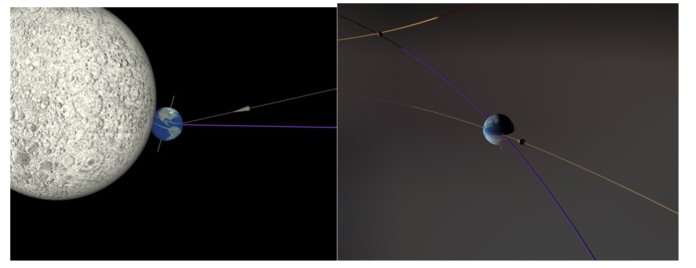
The
sun is on the far left
in the above image: The
trajectory of the
fragment in the shape of
cone crosses the
ecliptic plane of the
Earth, on the trajectory
of the latter, at the
time when our planet is
there.
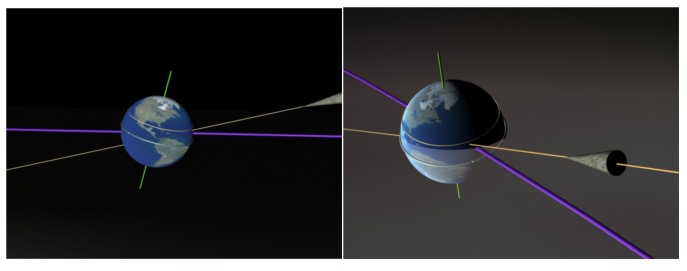
The
purple line represents
the trajectory of the
Earth around the sun,
which is virtually
behind us (on the first
image above). The yellow
trajectory is that of
the collision fragment.
One sees, in contrast,
the ecliptic plane.
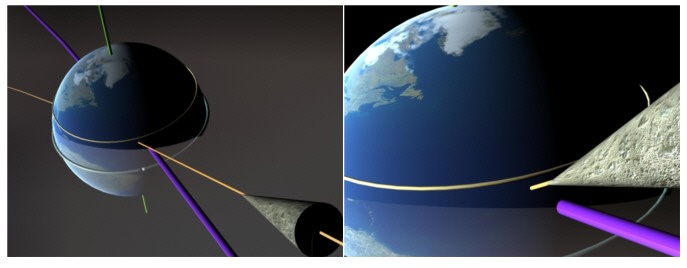
One
of the obvious aspects
is that this cometary
trajectory is direct,
i.e. almost
perpendicular to the
surface of the Earth,
implying minimal
breaking through the
atmosphere, and
continuing
through the ocean
before running up
against the ocean bottom.
Its energy will be
enormous.
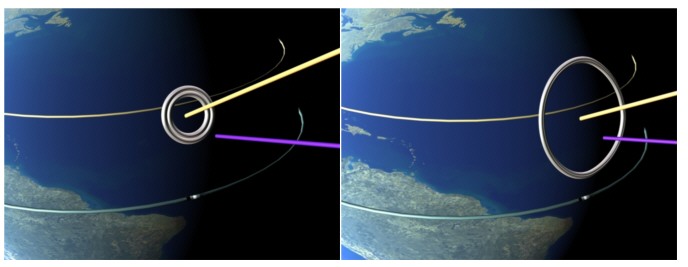
In
comparison to the last
images, the concentric
wave may not be
exclusively generated
directly by the impact
of the cometary
fragment, but by the
explosive eruption of
underwater volcanoes on
the mid-Atlantic dorsal
having suffered the
shock wave of the
cometary fragment. It
may be that a long
period exists between
impact and eruption,
even one day or two. It
was the case for the
tsunami of Sumatra.
Seven days before an
asteroid hit Indonesia.
In addition, the moon
will be between Earth
and Sun, attracting
strongly the magma in
the upper areas. This
configuration was seen
in different major
catastrophes like the
Sumatra, Iran and San
Francisco big
earthquakes. Remember
that the last eclipse
occurred in the Atlantic
Ocean MARCH 29, 2006!
Just two months before
the event, i.e. the same
time between the “Missing
Earth” crop circle
appearance and the SW-3
fragmentation.
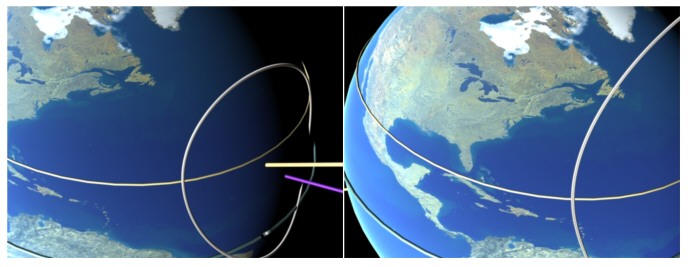
The
concentric circle
causing the tsunami
enlarges in a
predictable way, but
calculate the distance
of the huge wave towards
the African, American,
and European coasts. On
the day side, in South
America, Central America
and North America, the
inhabitants will see the
wave arriving. But in
Africa, as in Europe, it
will grow dark. It is
even probable that the
tsunami will touch the
French and British
coasts on MAY 26, 2006 a
little after midnight.
Let us remember that the
tsunami of Sumatra took
220,000 victims in 11
nations. Calculations
suggest 58 million
victims in around fifty
countries.
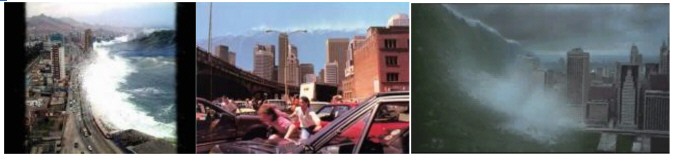
In
the table below, we can
evaluate the power of a
comet fragment according
to its size
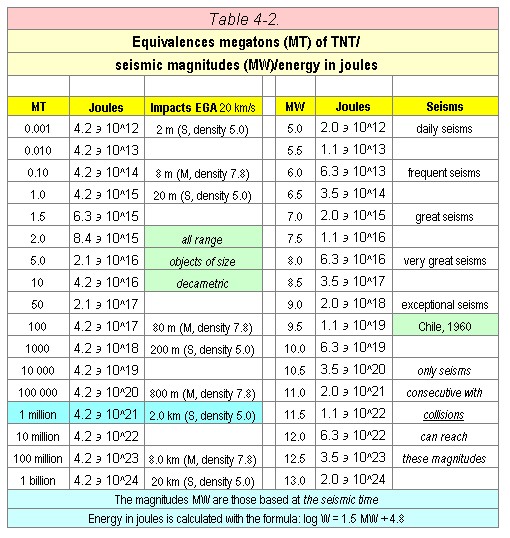
The
fragment should produce
the minimum of one
megaton (that is to say
50 times Hiroshima
atomic explosion),
producing 10 megatons
(500 times Hiroshima)
and causing a very great
seismic reading at a
magnitude between 8 and
9. But the true danger
comes from the unique
configuration of
the mid-Atlantic dorsal.
Indeed, it is the zone
of the world where the
magma is the closest to
the Earth's crust. In
other words, any shock
wave will produce a
compression of the
magma, which under the
intense pressure, will
explode with an enormous
outburst. This
vertical plunge will
involve moisture above
the surface of the ocean
if the ocean floor
relatively close to the
ocean surface, producing
an explosion similar to
a spark-ignition engine
which violently pushes
back the piston by the
expansion of gases.
It
is auspicious to note
that the Tropic of
Cancer (located at 23°
Northern), where the
comet fragment would
likely strike the ocean,
is not very far from a
particular site: Lost
City on the Atlantis
fault. In addition to
the particularity of
this mythical name
(Atlantis), and of this
unusually auspicious
location (Lost City),
this point is only 700
meters in depth! A comet
fragment striking at the
mid-Atlantic dorsal with
a sufficient energy
could awaken the chain
of the underwater
volcanoes there. Hardly
600 kilometres separate
Lost City from the
tropic of Cancer. In
other words, it's a very
tender zone for an
impact.
The
mid-Atlantic dorsal is a
long line of mountains
extending 65,000
kilometres and composed
of very many volcanoes.
The more closer to
surface, the more
explosive the eruption
that will produce
spectacular effects,
especially near the Lost
City,
a site discovered very
recently (2001), not
very deep (700 m), and
which offers a
particularly unique
geochemical anomaly,
according to data
completed by IFREMER at
the time of the EXOMAR
marine exploration.
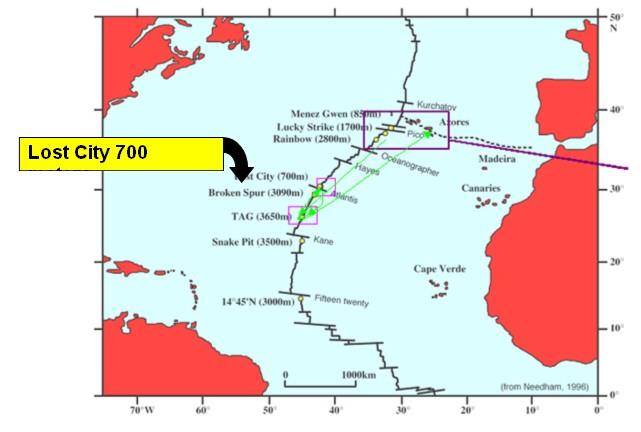
It
is speculative to
predict that the comet
fragment will fall
precisely near the
Atlantis fault.
Nevertheless, this
probability is far from
being null and is very
likely to occur if the
volcanoes are
significantly shaken in
order to activate them
as my vision suggested.
There exists more than
300,000 underwater
volcanoes on Earth,
including one
substantial part on this
dorsal. The precision of
the impact is not
imperative to create
substantial waves,
though extremely likely
as several volcanoes
will be become active
the same day, creating a
series of waves.
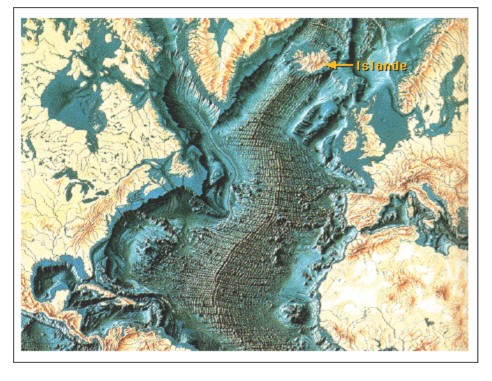
The
figures above and below
show the continental
shelves bordering the
emerged crusts in light
colours. They will
escalate the waves
approaching the coasts.
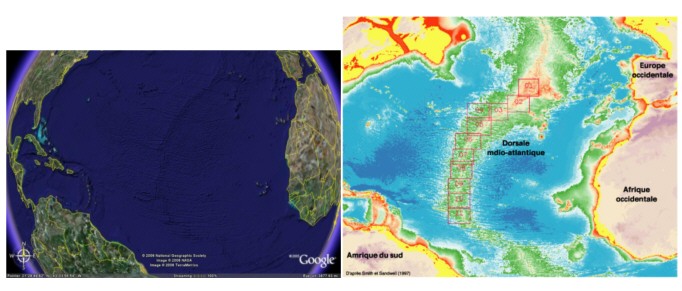
A
cursory investigation
gives rise to a
certainty of the most
probable scenario.
Accordingly, the
meteorite fragment
considered in the event
of MAY 25, 2006 will
strike the mid-Atlantic
dorsal, but will not be
able, in any case, to
generate, by impact
alone, the giant tsunami
in my vision. It remains
that it is likely
that no one locally will
see the fragment
striking ground since it
will fall into an
oceanic desert. The
huge wave could be only
the product of an
explosive eruption of
one or more underwater
volcanoes, which under
the enormous pressure
exerted by the shock
wave of the fragment
will expel a great
quantity of lava upwards
and creating a rise in
ocean water, as well as
a correlative
depression.
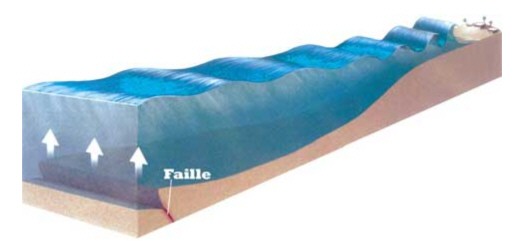
The
waves of tsunami are
propagated out of deep
water with a speed which
can exceed 800 km/h.
Their wavelength from
peak to peak goes from
several tens to several
hundreds of kilometres
and a wave height from a
few centimetres to
several centimetres,
so that they are undetectable
on board boats. When
they reach shallow
depths, the waves are
slowed down, which
causes the formation of
a destroying
"wall". A wave
of one meter can then
become a 16 meter wave.
According
to the site Futura-Science,
"25
Member States take part
in the alarm system to
the tsunami (T.W.S. =
Tsunami Warning System)
in the Pacific, which
supervises the seismic
and maregraphic stations
distributed in the
Pacific Ocean in order
to evaluate the
potentials tsunamigenic
of the seisms and to
diffuse alarm with the
tsunami".
In
other words, we
do not have ANY
MONITORING for the
Atlantic Ocean. The
times of alarm will be
reduced to very little
time. As I indicated it
in a previous article,
only MEASUREMENTS OF
PRECAUTION - to
move away from the
coasts or to go up on
the heights -
BEFORE the EVENT will
allow to save lives.
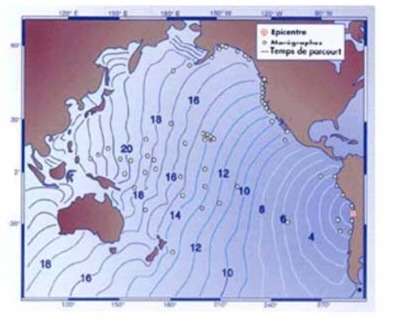
The
last largest tsunami
which caused a quantity
of casualties and damage
throughout the Pacific
was generated by a seism
located at the
broadening of the
Chilean coast in 1960.
This tsunami caused
human and material
devastations not only on
the coasts of Chile, but
also with Hawaii and
further still in Japan.
We see above the time
lines, i.e. the position
of the wave according to
previous time.
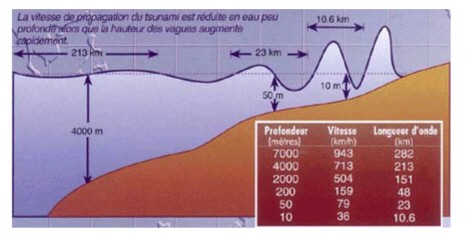
The
figure above shows the
relation existing
between the depth of the
oceanic bottom, the
speed of the wave, and
its size. A wave slows
down with the approach
to the coasts, but, and
that is quite
disturbing, grows
enormously bigger while
arriving on the
coastline. That means
clearly that only a
preventive alarm for MAY
25, 2006 will come from
the measurement of a seism
whose epicenter will be
located on the Atlantic
dorsal, EVEN IF THE
SEISM IS APPARENTLY
WEAK.
What
could cause the tsunami
could be the eruption
itself, and not the wave
of the seism. The tragic
irony of this is that
the International
Oceanographic Commission
of UNESCO, subservient
to its Member States,
begins its FIRST TEST OF
TSUNAMI ALARM... in the
Pacific: Pacific Wave
06. This test,
meeting the requirements
to evaluate the
reactivity of those
countries, will take
place on MAY 16, 2006,
the period of the
closest passage of comet
SW3. The commission
reminds us: "It
will be clearly
indicated that it is a
test and not a real
alarm".
Alarm
will be given by the
location at Hawaii. (It
is precisely where I
live!) In addition, the
exact day when I
finished this article, a
REAL SEISM OCCURRED IN
THE PACIFIC OCEAN, with
a real tsunami! It is
PRUDENT to pay attention
to the indicator signs
and go ahead with
precautions. I believe
that fate is made of
very “synchronistic”
signs.
The
images below summarize
the probable scenario of
the tsunami in the
ATLANTIC that I predict.
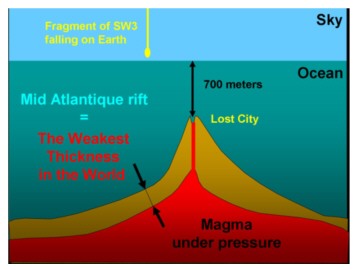
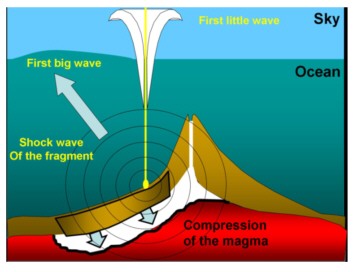
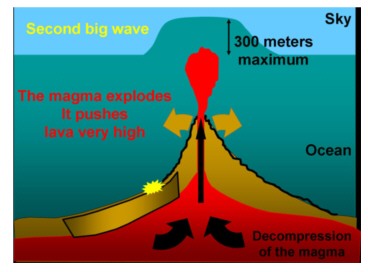
Although
diagrammatic, these
figures describe the
specificity of the
event. To create waves
of 200 meters on the
coasts, a wave located
in the middle of the
ocean should be enough.
The impact need not be
very powerful. Indeed,
the shallowness of the
Earth's crust will
easily transmit the
shock wave of the
cometary fragment to the
magma, which under the
combined effect of the
shock wave and the
displacement of the weak
mountainous buttress,
will be crushed in its
housing. Afterwards,
by excessive pressure, a
violent magmatic
explosion will open the
mountain and expunge the
lava at very high speeds
towards oceanic surface.
An enormous wave will be
formed.
A
research shows, indeed,
that the volcanism of a
dorsal, particularly in
the central rift, is
very close to the broad
magmatic pockets, where
the mantle is partially
fused. In other words, a
sufficiently severe
shock wave would be
capable of generating a
chain reaction. The
explosion of the Mount
St. Helens in the USA in
1980 was equivalent to
27,000 atomic bombs.
Krakatoa projected 50
million tons of ashes in
the atmosphere in 1883.
In February 1953, a
major eruption of an
underwater volcano,
accompanied by
pyroclastic bursts, a
hundred meters high,
near the Lopévi islands
in the Pacific was
reported.
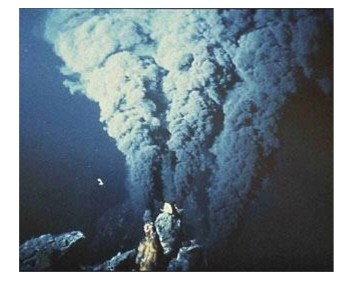
The
French site 'Futura-sciences'
indicates that " the
tsunamis, called
sometimes seismic
oceanic waves or
incorrectly tidal waves
are generated mainly by
seisms, sometimes by
underwater landslides,
more rarely by volcanic
eruptions and
exceptionally by the
impact of a large
meteorite in the ocean.
The underwater volcanic
eruptions can produce
really impressive waves
of tsunami. The great
eruption of the Krakatoa
volcano in 1883 have
generated gigantic waves
reaching 40 meters above
the sea level, killing
out of the thousands of
people and devastating
many coastal
villages".
A
second phenomenon will
make the situation quite
worse. The awakening of
the underwater volcanoes
will inevitably be
accompanied by a great
earthquake, perhaps
about 8 or 9 on the
Richter scale.
This earthquake will
inevitably have many
counterparts. It will
create other seisms in
extremely distant areas.
Very recently, Russia
and South America
experienced two great
seisms in the magnitude
of 7-8 on the Richter
scale. But we are likely
to experience what is
called a "tsunami
earthquake," i.e. a
seism which produces an
abnormally powerful
tsunami compared to the
magnitude of the seism.
The
"tsunami
earthquakes" are
characterized by ripples
from far ocean bottoms,
faults of a few meters
and smaller fault
surfaces in comparison
with a traditional
seism. They are also
slow seisms with a slip
along the fault below
the underwater bottom
slower than at the time
of a traditional seism.
Two other catastrophic
tsunamis originating
from a "tsunami
earthquake" took
place in Java in
Indonesia (on June 2,
1994) and in Peru (on
February 21, 1996). The
Atlantic dorsal very
regularly experiences
weak earthquakes. One
sees on the image below
this characteristic
pattern.
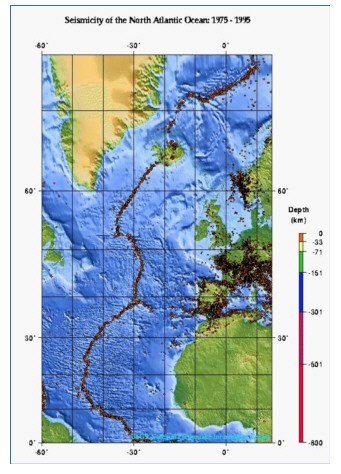
This
next seism in the middle
of the Atlantic Ocean
will probably be
contagious, and will
affect the whole of the
dorsal, in particular
the zone of the Azores.
But this seismic
activity could also
shake the zone of the
Canaries, that which
researchers of Benfield
Hazard Research Center
studied carefully. It
could cause a very large
wave, due to the
collapse of a whole side
of the Mt. La Palma .
The height of the wave
created depends on many
parameters. It
could, in the worst case
scenario, reach 600
meters when arriving on
the shores.
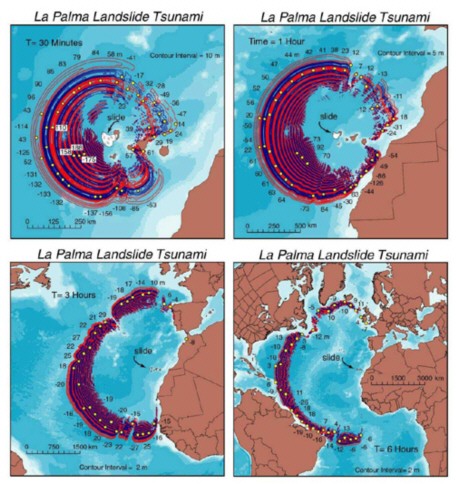
One
clearly sees by the
figures above that the
giant tsunami would
reach the coasts of the
American continent in
six hours. But in the
case of an underwater
volcanic eruption, this
time is reduced to
approximately three to
four hours. In my
next article I will
focus on what it is
advisable to do to
protect oneself
according to the zones
and countries.
Do
not miss it on the site www.savelivesinmay.com
, your life, and that of
your family or friends,
is concerned.
Also
see:
[1]
Enfants des Etoiles,
Eric Julien, Editions
JMG, Avril 2006. English
re-editing, Elder Hale
[2]
La Science des
Extraterrestres,
Eric Julien, Editions
JMG, Juillet 2005.
[3]
http://www.ing.unitn.it/~fontana/
[4]
http://arxiv.org/abs/physics/0410054
et http://arxiv.org/abs/physics/0511157
[5]
La Science des
Extraterrestres,
Eric Julien, Editions
JMG, Juillet 2005.
[6]
http://www.space.com/php/multimedia/imagedisplay/
img_display.php?pic=060414_comet_map_02.jpg&cap=
Sky+Map%3A+The+positions+of+comet+SW-3+at+one-
week+intervals+as+of+1+a.m.+local+time+from+mid-northern+latitudes
[7]
http://neo.jpl.nasa.gov/cgi-bin/db_shm?sstr=73P
[8]
http://adsabs.harvard.edu/abs/2005MNRAS.361..638W
[9]
http://neo.jpl.nasa.gov/cgi-bin/neo_ca?type=NEO;hmax=
all;tlim=recent_future;dmax=0.1AU;max_rows=200;action=
Display%20Table;show=1&sort=dist_min&sdir=ASC
[10]
http://astrosurf.com/macombes/tableau%204-2.htm
[11]
http://www.ifremer.fr/
[12]
http://www.futura-sciences.com/comprendre/d/dossier514-2.php
[13]
http://www.ggl.ulaval.ca/personnel/bourque/s1/volcans.html
[14]
http://www.futura-sciences.com/comprendre/d/dossier473-8.php
[15]
http://www.futura-sciences.com/comprendre/d/dossier514-3.php
[16]
http://www-sdt.univ-brest.fr
[17]
http://www.benfieldhrc.org/tsunamis
|
Orbital
elements of broken
comet
In
1995, Comet 73P/Schwassmann-Wachmann
3 did something
unexpected: it
fell apart.
For
no apparent
reason, the
comet's nucleus
split into at
least three "mini-comets"
flying single file
through space.
Astronomers
watched with
interest, but the
view was blurry
even through large
telescopes. The
comet was a
hundred and fifty
million miles
away.
We're
about to get a
much closer look.
In May 2006 the
fragments are
going to fly past
Earth closer than
any comet has come
in almost eighty
years.
"This
is a rare
opportunity to
watch a comet in
its death
throes—from very
close range,"
says Don Yeomans,
head of NASA's
Near Earth Object
Program at JPL.
There's
no danger of a
collision.
"Goodness,
no," says
Yeomans. "The
closest fragment
will be about six
million miles
away--or
twenty-five times
farther than the
Moon." That's
close without
actually being
scary.
The
flyby is a big
deal. "The
Hubble Space
Telescope will be
watching,"
says Yeomans.
"Also, the
giant Arecibo
radar in Puerto
Rico will 'ping'
the fragments to
determine their
shape and
spin."
Even
backyard
astronomers will
be able to take
pictures as the
mini-comets file
through the
constellations
Cygnus and Pegasus
on May
12, 13
and 14.
Ironically,
despite being so
close, these
comets will not be
very bright. The
largest fragments
are expected to
glow like 3rd or
4th magnitude
stars, which are
only dimly visible
to the unaided
eye.
"Remember,"
says Yeomans,
"these are mini-comets."
They're
not like the Great
Comets Hayutake
and Hale-Bopp of
1996 and 1997.
Those could be
seen with the
naked eye from
light-polluted
cities. The
fragments of 73P,
on the other hand,
are best viewed
from the
countryside—and
don't forget your
binoculars.
The
number of
fragments is
constantly
changing. When the
breakup
began in 1995
there were only
three: A, B and C.
Astronomers now
count at least
eight: big
fragments B and C
plus smaller
fragments G, H, J,
L, M and N.
"It
looks as though
some of the
fragments are
themselves forming
their own
sub-fragments,"
says Yeomans,
which means the
number could
multiply further
as 73P approaches.
No knows how long
the "string
of pearls"
will be when it
finally arrives.
This
is very uncertain;
indeed,
forecasters
consider it
unlikely. But an
expanding cloud of
dust from the 1995
break-up of the
comet could brush
past Earth in May
2006 producing a
display of
meteors.
"We
believe the cloud
is expanding too
slowly to reach
Earth only eleven
years after the
break-up,"
said astronomer
Paul Wiegert at
the University of
Western Ontario.
"but it all
depends on what
caused the comet
to fly apart—and
that we don't
know.
"The
most likely
explanation is
thermal stress,
with the icy
nucleus cracking
like an ice cube
dropped into hot
soup: the comet
broke apart as it
approached the Sun
after a long
sojourn the frigid
outer solar
system," he
explains. "If
this is truly what
happened, then the
debris cloud
should be
expanding slowly,
and there will be
no strong meteor
shower."
On
the other hand,
what if "the
comet was
shattered by a hit
from a small
interplanetary
boulder?" A
violent collision
could produce
faster-moving
debris that would
reach Earth in
2006.
Wiegert
expects to see
nothing, but he
encourages sky
watchers to be
alert. It wouldn't
be the first time
a dying comet
produced a meteor
shower:
"One
outstanding
example is comet
Biela, which was
seen to split in
1846, and had
completely broken
apart by
1872," he
says. "At
least three very
intense meteor
showers
(3000-15000
meteors per hour)
were produced by
this dying comet
in 1872, 1885 and
1892."
Assuming
a thermal breakup
for 73P, Wiegert
and colleagues
have calculated
the most likely
trajectory of its
dust cloud. Their
results: dust
should reach Earth
in 2022,
"producing a
minor meteor
shower--nothing
spectacular.
However," he
adds, "the
ongoing splitting
of the comet means
new meteoroids are
being sent in new
directions, so a
future strong
meteor shower from
73P remains a real
possibility."
The
watch begins on
May 12th.
From:
spaceweather.com
|
|
WHAT
ABOUT THE
MOON?
The
Sky is Falling
NASA
researchers are
mining old Apollo
seismic data for
clues to lunar
meteoroid impacts
By:
Dr. Tony
Phillips
and Dave
Dooling,
Science@NASA
Published:
Apr 29,
2006 at
07:01
|
 |
| The
Moon's
surface is
peppered
with
impact
craters. |
Up on the Moon,
the sky is
falling.
"Every day,
more than a metric
ton of meteoroids
hits the
Moon," says
Bill Cooke of the
Marshall Space
Flight Center's
Meteoroid
Environment
Office. They
literally fall out
of the sky, in all
shapes and sizes,
from specks of
comet dust to
full-blown
asteroids,
traveling up to a
hundred thousand
mph. And when they
hit, they do not
disintegrate
harmlessly in the
atmosphere as most
would on Earth. On
the airless Moon,
meteoroids hit the
ground.
Apollo astronauts
were never
bothered by these
projectiles. The
Moon has a surface
area roughly equal
to the continent
of Africa.
"If you
spread the impacts
over so much
terrain, the
probability of
being hit is very
low," says
Cooke. It helped
that the
astronauts didn't
stay long: Adding
all Apollo
missions together,
they were on the
lunar surface less
than two weeks.
"The odds of
being hit during
such a short time
were, again, very
low."
But what about
next time?
Following the
Vision for Space
Exploration, NASA
is sending
astronauts back to
the Moon to stay
longer and build
bigger bases
(read: bigger
targets) than
Apollo astronauts
ever did. The odds
of something
precious being hit
will go up. Should
NASA be worried?
That's what Cooke
and MSFC colleague
Anne Diekmann are
trying to find
out.
The truth is,
"we really
don't know how
many meteoroids
hit the Moon every
day," he
says. "Our
best estimates
come from the
'Standard
Meteoroid Model,'
which NASA uses to
evaluate hazards
to the space
station and the
space
shuttle."
Problem: The
Standard Model is
based mainly on
Earth-data, e.g.,
satellite
observations of
meteoroids hitting
Earth’s upper
atmosphere and
human observations
of meteors
flitting across
the night sky.
"The Standard
Model may not work
well for the
Moon."
For lunar
purposes, "we
need more
data," says
Cooke.
Fortunately, there
are more data. It
comes from Apollo:
Clues to how often
and how hard the
Moon is hit lie in
data from four
seismometers
placed on the Moon
by the Apollo 12,
14, 15, and 16
missions during
1969-72. They
operated until
NASA turned them
off in 1977. For
years, the
seismometers
recorded all
manner of tremors
and jolts,
including almost
3000 moonquakes,
1700 meteoroid
strikes, and 9
spacecraft
deliberately
crashed into the
Moon. All these
data were
transmitted to
Earth for
analysis.
 |
| Buzz
Aldrin
deploys a
seismometer
in the Sea
of
Tranquillity. |
"Here's
what's
interesting,"
says Cooke.
"Of some
12,000 events
recorded by the
seismometers, less
than half have
been explained by
known phenomena.
There are
thousands of
tremors caused by
... no one knows
what."
He has a hunch:
"Many of them
may be meteoroid
impacts."
"Apollo
scientists were
very bright,"
says Cooke,
"but they
didn't have the
benefit of modern
computers. We
do." Cooke
and Diekmann are
now loading the
old seismic data
into machines at
the MSFC where
they can perform
digital
calculations at
speeds impossible
30 years ago,
rapidly trying new
algorithms to find
previously
unrecognized
impacts.
Critical to the
analysis are nine
man-made impacts.
"NASA
deliberately
crashed some
spacecraft into
the Moon while the
seismometers were
operating,"
he explains.
"They were
the empty ascent
stages of four
lunar modules
(Apollo 12, 14, 15
and 17) and the
SIV-B stages of
five Saturn
rockets (Apollo
13, 14, 15, 16 and
17)." Their
seismic waveforms
tell researchers
what an impact
should look like.
 |
| A
seismic
waveform
recorded
when
Apollo
12's lunar
ascent
module
crashed
into the
Moon on
Nov. 20,
1969. |
Also, in 1972, a
1,100 kg (2,400
lb) asteroid hit
the Moon just
north of Mare
Nubium, the Sea of
Clouds. It was a
major impact
recorded at all
four seismic
stations.
"When we look
at the seismic
waveform of that
asteroid,"
says Cooke,
"we see that
it has the same
characteristics as
the man-made
impacts—a good
sign that we know
what we’re
doing."
Cooke and Diekmann
will hunt for
impacts in the
Apollo seismic
records using
these known
waveforms as a
reference. In
theory, they
should be able to
pick out tremors
from objects as
small as 10
centimeters (4
inches), weighing
as little as 1 kg
(2.2 lb).
"Four inches
doesn't sound like
much, but
traveling at
cosmic velocities,
a four-inch
meteoroid can
blast a crater as
wide as your
desk."
According to the
Standard Model,
such meteoroids
hit the Moon
approximately 400
times a
year—more than
once a day.
(Picture a map of
Africa stuck with
400 pushpins.) The
Apollo seismic
dataset can test
that prediction
and many others.
The analysis is
just beginning.
"We hope to
find many
impacts," he
says. Regardless
of the final
numbers, however,
their work will
have value.
"We're
developing new
algorithms to find
meteoroid impacts
in seismic
data."
Eventually, Cooke
believes,
next-generation
seismometers will
be placed on the
Moon and Mars to
monitor quakes and
impacts, and when
the data start
pouring in,
"we'll be
ready."
29 April 2006
THAT'S COMET
SENSE..
NASA rap doom
scare
By Stephen
White
SPACE
agency NASA have
rubbished claims
the Earth will be
destroyed in less
than a month.
A
former air traffic
controller has
predicted a comet
fragment is
heading straight
for us.
But
NASA have rejected
Eric Julien's
predictions, which
he says came to
him in visions and
were confirmed by
messages from
aliens.
Julien
says the world
will end on May 25
when a chunk of
the comet
Schwassmann-Wachmann
3 ploughs into the
Atlantic Ocean.
He
believes it will
cause a gigantic
tsunami 200 yards
high and the comet
will trigger
eruptions in
underwater
volcanoes, causing
the sea to boil.
Julien,
a former air
traffic controller
in Rheims, France,
and senior manager
at Paris's Orly
airport, put his
vision on the
internet, where it
sparked panic.
Message'
sparks tsunami
panic
Thursday
25 May 2006, 13:15
Makka Time, 10:15
GMT
|
Julien
claims
to
have
received
the
warning
psychically
|
|
|
|
A
website warning of
a tsunami has
spread panic in
Morocco, despite the
government's assertion
that the alert was
merely rumour -
and the dubious
nature of its
source.
The
Ufological
Research Centre said
on its website
last week that a
tsunami could hit
the Atlantic after
a comet passes
close to earth on
Thursday, May 25.
Eric
Julien, author of
La Science Des
Extraterrestres
(Science of
Aliens), claimed
that the impact of
a comet fragment
would trigger
powerful volcanoes
in the Atlantic
and generate a
giant tsunami that
would be
destructive across
the coasts of
several countries,
including Morocco.
Julien,
who claimed
to have
received the
information
psychically, said
that waves up to
200 metres high
will reach
coastlines of countries
bordering the
Atlantic.
The
alert caused fear
and panic among
Moroccan citizens,
though the
Moroccan meteorological
office dismissed
it on Monday as
insignificant.
The
Moroccan news
agency MAP quoted
Mustafa Janah, the
head of the
Meteorological
Office, as saying
the comet would
pass earth at a
distance of about
10 million
kilometres.
Citing
the US space
agency, Nasa, he ruled
out any risk
of a tsunami in
the Atlantic
Ocean.
Janah
also said that "the
Ufological
Research Centre
does not have
technical
means" to
observe this kind
of phenomenon.
But
despite all the
assurances, many
Moroccan coastal
residents have
abandoned their
homes and moved to
higher ground,
anxiously awaiting
May 25.
Memories
remain of the
tsunami that hit
Asia in 2004 and
left up to
232,000 people
dead or missing
across large parts
of the continent.
Less well
known, however, is
the track record
of Eric Julien
who, according to
the Morocco Times,
claimed in May
2004 to have been
abducted by aliens
who wanted to
teach him to drive
UFOs.
An
article purporting
to be Eric
Julien's warning
is available here
- http://exodus2006.com/cometfrags/Eric-Julien-25-MAY.htm -
under a banner for
the "Exopolitics
Institute,
political analysis
and activism in
extraterrestrial
affairs".
Less
sensational
information and
news about the
comet is provided
here - http://www.physorg.com/news67263241.html -
in an article on
PhysOrg.com from
May 19.
| |
|
6/6/2006
6:06:00
AM
To:
National
Desk
Contact:
Craig
Boswell,
832-252-6406
or craig@savelivesinmay.com
HOUSTON,
June 6
/U.S.
Newswire/
-- Eric
Julien
declares
that his
alert of
a giant
tsunami,
triggered
by
volcanic
eruptions
in the
Atlantic
Ocean
which
were to
have
followed
the
impact
of
fragments
of comet
SW-3,
these
fragments
generated
in 1995
by the
intervention
of a
hostile
extraterrestrial
civilization,
brought
forth
the
success
of the
greatest
exopolitical
operation
in
history.
The
forerunner
signs of
this
possible
event
were
numerous,
and were
secretly
taken
into
account
by
various
government
administrations.
A NOAA
official
issued a
warning
on CNN
May 23rd
about a
new type
of
"hurricane"
which
threatened
in short
order
the
entire
east
coast of
the
United
States,
including
those
areas
normally
spared
by
hurricanes.
He named
this
curious
phenomenon
the
"splosh
model".
On May
25th,
members
of the
U.S.
Congress
received
a memo
for an
evacuation
exercise
to be
held
later
that
day.
Likewise,
FEMA --
organization
which
handles
natural
disasters
- had
planned
a
tsunami
alert
exercise
for May
23rd -
25th.
Contrary
to the
declarations
of NASA,
fragments
of comet
SW-3 did
indeed
strike
the
Atlantic
Ocean,
as
Julien
forecast
in his
article
published
last
April
11th.
Despite
the
appearance
of a
series
of waves
of
unprecedented
height -
up to 80
meters
high
when the
known
record
was 34
meters -
no
tsunami
struck
the
Atlantic
coastlines.
The
alert of
the
former
twin-engine
jet
pilot
was
actually
conditional.
From
his very
first
article
on the
subject
(see http://www.savelivesinmay.com
) Julien
gave the
basic
reason
for his
alert,
namely
the
planned
use of
nuclear
weapons
-
affecting
the
planes
in which
ET's
exist -
in a
possible
war
against
Iran.
The link
between
nuclear
weapons
and the
presence
of space
civilizations
on Earth
has been
clearly
established
by the
author
of
"The
Science
of the
Extraterrestrials".
Yet
on May
25th,
2006,
the U.S.
government
unexpectedly
delayed
its
"Divine
Strake"
test
which
was to
have
played a
role in
the
delivery
of
pre-emptive
strikes
against
the
nuclear
installations
in Iran.
Since
May
25th,
relations
between
Iran and
the
United
States
have
thus
miraculously
improved.
The
specter
of a
third
world
war has
momentarily
pulled
back,
and tens
of
millions
of lives
have
been
spared
thanks
to this
program
of
information.
The
threat
of a
giant
tsunami
by
reportedly
hostile
extraterrestrials,
relayed
by the
world
media,
had thus
for
effect
the
appeasement
of
international
tensions.
A
well-meaning
extraterrestrial
civilization,
according
to
Julien,
intervened
to
minimize
the
awaited
effects
of the
alert.
However,
the
danger
has not
yet been
set
aside.
Eric
Julien
declares:
"A
catastrophe
of an
unprecedented
size,
stemming
from
so-called
natural
causes,
may
occur in
the
coming
days if
the
media of
the
entire
world
does not
inform
the
public
immediately
of the
reality
of the
presence
of
extraterrestrials
on
Earth,
in a
documented
and
objective
fashion,
with an
open-mindedness
worthy
of
advanced
civilizations
in order
to raise
the
public
consciousness."
http://www.usnewswire.com
/©
2006
U.S.
Newswire
202-347-2770/
|
|
Ragnar
Martinsen
had a close
encounter
with a
meteorite
while seated
in his
outhouse
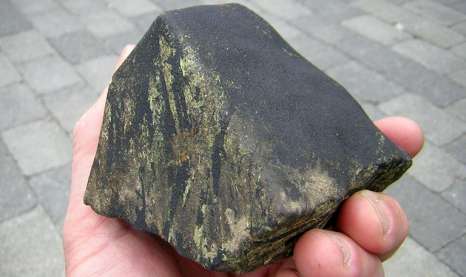
Meteorite in Moss
For the first time since 1969 a meteorite has gone through a European roof
|
The object was found last week after a water leak appeared in a warehouse.
"It must have had incredible speed and force, and had made a hole in a steel plate in the roof. People from a firm we hired in to find the reason for the leak found a black stone in the roof construction," Norgesgruppen press contact Per Roskifte told Aftenposten.no.
Today Astronomer Knut Jørgen Røed Ødegaard from the Astrophysics Institute and Natural History Museum director Elen Roaldset were present to accept the Norgesgruppen meteorite.
"It has been a fantastic meteorite summer. This is a very rare meteorite, a so-called carbon meteorite, and it will get a fine spot amongst our others at the museum," said geologist Roaldset.
"This is an exceptional find! This is the first time since 1969 that a meteorite has gone through a roof anywhere in Europe. The meteorite is a so-called carbon - CO-meteorite. Previously only five falls of CO-meteorites have been observed on Earth, and the last one occurred in Russia in 1937," said an enthusiastic Ødegaard.
On July 14 a huge fireball flared across the sky in the southeast part of eastern Norway. Witnesses spread across a large area could observe the object while it roared and thundered across from a distance of up to 300 kilometers. The Norgesgruppen meteorite is part of this object that broke up over eastern Norway.
Bus driver Ragnar Martinsen was sitting in his cabin outhouse when he heard the noise.
"I thought it was an exercise at Rygge Air Station. The bang and rumbling in the air over the cabin was terrible," Martinsen told Aftenposten on July 16. A small, 35-gram piece of stone hit the ground a few meters away from him, an extremely rare sighting of impact.
Two days later a new and much larger piece of the meteorite was found in a garden near Moss. This 750-gram chunk hit a plum tree, breaking off three branches before burying itself seven centimeters (3 inches) deep in the lawn. The rock was found after the Johansen family returned from their holiday and tried to mow the lawn.
These three finds are the only pieces of the July 14th sighting found so far - and Ødegaard urges people in the area to keep looking for more.
Aftenposten's Norwegian reporter
Rolf L. Larsen
Aftenposten English Web Desk
Jonathan Tisdall
GSI, PRL get only crumbs from meteorite shower
Raheel Dhattiwala
[ 9 Aug, 2006 2105hrs ISTTIMES NEWS NETWORK ]
AHMEDABAD: The Geological Survey of India (GSI) was shocked to find that most of the meteorite fragments it collected from villagers through state authorities, were fake.
Apparently, most of the meteorite fragments that fell in and around Kutch last month are either up for sale or remain undisclosed as curious by local residents and officials.
On August 1, the GSI team collected meteorite pieces from Kutch and Saurashtra given to them by the respective authorities. However, after examination of the pieces, only about 80 gm have been found to be genuine meteorite.
This, experts say is insufficient for radiation studies. At least 500 gm of meteorite sample is required. Because of the lack of sufficient quantity of material, the Physical Research Laboratory (PRL) was sent only 5 gm of sample on Tuesday.
"For radiation studies, at least half-a-kilogram of the sample is required. A 5-gm sample is useful only after preliminary studies are done," a senior scientist at PRL said.
Confirming that a large part of the material was "pseudo-meteorite", ZG Gevariya, director, GSI Gandhinagar said that only a small part of sample could, therefore, be sent for analysis to GSI, Jaipur and to PRL.
"Localites collected the material and it is likely they may have mistaken a large part of it to be meteorite," he said. Of the 2.5 kg material collected in Kutch, 1.5 kg turned out to be fake.
However, experts at PRL and GSI suspect that genuine samples were most likely cornered by local residents or government authorities. "People have pocketed most of the samples — localites, to earn money and officials as a souvenir," said a senior geologist at GSI.
This, he said, is "nothing new" and happens every time there is a meteorite fall. A member of the Kutch Astronomers' Club told TOI, "One piece was recently offered as sale to a geologist friend of mine in Morbi for Rs 20,000."
During the Kendrapara meteorite fall in Orissa in 2003, meteorite pieces weighing a few g were sold to tourists for $100 each. Dr SK Bhattacharya, dean of PRL told TOI that during meteorite falls in remote places, it becomes essential to send search teams to "build confidence among localites and coax them into handing over the pieces to scientists".
"This happened during the Dhajala meteorite fall in 1976 also when localites refused to part with samples because they wanted to sell or worship them," he said. But Gevariya said that the department had not come across any reports of people selling meteorite pieces.
|
|
|
|