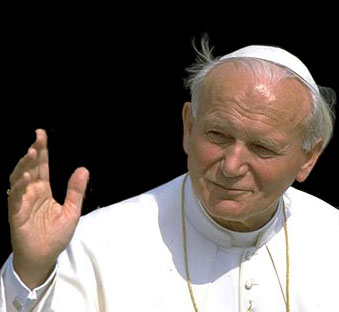
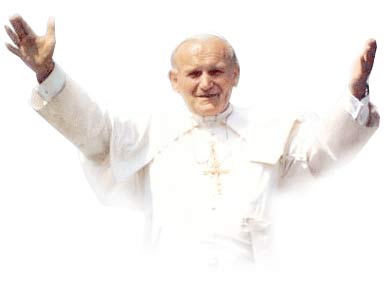
POPE PREPARES FOR DEATH

DEATH - 4-2-05
2:37 p.m. EST
age 84

compiled by Dee Finney

POPE JOHN PAUL II

POPE PASSED ON AT 2:37 PM  EST.

  Pope John Paul is Dead - Vatican
      Saturday 02 April 2005

    Vatican City - Pope John Paul II died on Saturday, the Vatican announced. The 84-year-old Pontiff, who had headed the Roman Catholic Church for 26 years, died at 9:37 p.m. (2:37 p.m. EST), a statement said.

    "The Holy Father died this evening at 21.37 in his private apartment," the statement said.

    The news was immediately announced to huge crowds gathered in St Peter's Square.

    John Paul will be remembered for his role in the collapse of communism in Europe and his unyielding defense of traditional Vatican doctrines as leader of the world's 1.1 billion Catholics.

    Huge crowds had staged a tearful vigil in St. Peter's Square, praying for a man already being dubbed by some Catholics as "John Paul the Great."


Vatican: Pope John Paul II has high fever
Updated: 4/2/2005 2:05 PM

The Vatican has released an update on the condition of Pope John Paul II.

Aides said the Pope has developed a high fever and that his condition remains very serious.

Pope John Paul II suffered blood poisoning from a urinary tract infection on Thursday.

His breathing is said to be shallow and his heart and kidneys are failing.

Despite that, this latest statement said the Pope is responsive, and responds "correctly" when aids speak to him.
~~~~~~~~~~~~~~~~~~

Pope suffers heart attack
Peceives last rites as his health deteriorates – Vatican

    
VATICAN CITY (AFP, Reuters) — Pope John Paul II is struggling between life and death after suffering a heart attack, the Vatican said yesterday after the pontiff’s condition deteriorated dramatically and he received communion for the dying.

"This morning the health of the Holy Father is very serious," Vatican spokesman Joaquin Navarro-Valls said. "Following a urinary tract infection, a septic shock with a cardio-circulatory collapse occurred."

The 84-year-old Pontiff is "conscious, lucid and serene. At 19:17 (1717 GMT) yesterday he received the Saint Viaticum," the spokesman said, referring to the rites administered to the ill when approaching death.

The Pope was immediately given "the appropriate cardio-respiratory assistance," he said. It was not clear if the Pope had been connected to a life-support machine.

It was highly unusual for the Vatican to reveal such details of the Pope’s condition, a signal that it was preparing the world’s 1.1 billion Roman Catholics for the demise of John Paul II.

The Polish-born Pope is being treated by medical staff at the Vatican and refused to return to Rome’s Gemelli clinic where he was hospitalized twice in the past two months.

"The Holy Father’s wish to remain in his home was respected, where complete and efficient medical assistance was assured," said the spokesman.

The statement came after a dramatic night in which conflicting reports emerged on the pope’s condition, with the Vatican Radio saying his condition had stabilized while some Italian television stations reported him on his deathbed.

As news of the Pope’s crisis spreads, hundreds of followers gathered near the Vatican, some praying, some crying. Authorities had sealed off St. Peter’s square but the faithful filled the surrounding streets.

"I am scared that that’s it . . . maybe he’s dead, maybe he’s dying," said Jennifer Cole of Los Angeles in tears. "It doesn’t matter if he’s already dead, I wanted to be here anyway."

Vatican admitted Wednesday that the Pope was making a "slow" recovery following a throat operation on Feb. 24 and had to be fed through a nasal tube. Vatican sources said the Pontiff, who suffers from Parkinson’s disease, had lost some 19 kilograms (42 pounds) since his operation.

The Pope reportedly has insisted that he wants to die at the Vatican.

"It was the last wish of Pope John Paul II: to not die. . . in the entrance hall of a hospital, but to end his days in dignity as a Roman pontiff, in his room overlooking St. Peter’s," daily La Repubblica wrote Friday.

Italian Cardinal Achille Silvestrini underlined Friday that the previous day’s announcement by the Vatican — which usually refrains from making alarming statements — "means that there is really a lot of fear and that maybe they want us to understand to prepare for the worst."

In an ominous sign, the lights of the Pope’s apartment were turned on and later switched off and only the lights of the papal infirmary were on early Friday.

In churches in Krakow, Poland, where the Pope studied and served as archbishop, there were at least twice the usual number of faithful attending early morning Mass on Friday.

"I didn’t sleep at all last night and I decided to come and pray again this morning before I went to work," said Teresa Ptak, about 60 years old, at St. Florian’s church, where the young Karol Wojtyla did his first pastoral work.

"He has done so much for us that I wanted to do something for him. Today only our prayers can help him," said Ptak.

At the Vatican, a handful of pilgrims gathered beneath the Apostolic Palace, which contains the papal apartments, offering up silent prayers for his health.

GMA expresses sadness over Pope’s health

By GENALYN D. KABILING

President Arroyo yesterday expressed sadness over reports Pope John Paul II appeared close to death and had received the last rites.

"We’re all very sad about his failing health. We really are very grateful to the Lord that for all those many, many years He gave us the wonderful leadership of the Pope in our Church," she said in a press conference in Zamboanga City.

The President had repeatedly called on Filipinos to pray for the ailing 84-year old Pontiff after he was hospitalized in February.

President Arroyo, a devout Catholic, made a momentous courtesy call on the Pope during a visit in Rome two years ago.

During the ten-minute visit of Arroyo and the First Family, the Pope extended his love for the Philippines and the Filipinos, and even recalled his 1995 visit in the Philippines for the World Youth Day that drew a huge emotional crowd of some five million.

The Pope was originally scheduled to make another visit to Manila in 2003 for the World Meeting of Families but the trip was canceled due to health reasons. Around 83 percent of Filipinos are Roman Catholics.

Prayers from world’s Catholics for ailing pope

ROME (AFP) — Faithful from around the world prayed for Pope John Paul II as the one-billion strong Roman Catholic community awoke Friday to alarming news of the 84-year-old Pontiff’s rapidly deteriorating health.

Several hundred worshippers gathered at St. Peter’s Square under heavy police presence to await news of the pope, who received the rites administered to the ill when approaching death after his health took a dramatic turn for the worse.

"I’m in anguish going through this. I learned that the pope was very sick during the night, while I was at work, and I came straight here," said a Roman citizen in his 50s.

"I’m not a believer but I felt the need to come here anyway, in the face of so much suffering," said another young man.

Special masses were scheduled across the Philippines, local bishops said, as Cardinal Jaime Sin, the most influential clergyman in the Philippines, urged people to pray for the ailing spiritual leader.

"Let us entrust our Holy Father to the Lord of life," Sin said in a statement.

"We pray for God’s guidance and strength in this difficult time. We continue to pray for the Pope," said Sin, who has been struggling with his own kidney-related health problems in recent years.

Other bishops in the Philippines said they would offer masses for the pope.

In France, the Archbishop of Paris Andre Vingt-Trois called on all parishes to pray for the Pontiff.

"This morning we have learned of a serious aggravation of the Pope’s condition. As John Paul II made a pilgrimage last summer to Lourdes, we entrust him to the intervention of Our Lady of Lourdes," Vingt-Trois said.

Mexico’s Catholic bishops said in a statement that "the traveling Pope . . . is ready to take the most important trip of his pontificate, the trip to the home of the Holy Father."

Reports were so pessimistic that the Mexican Senate, acting on erroneous information that the Pope had died, held a minute of silence Thursday in honor of the Pontiff.

"The floor of the Mexican Senate expresses its sorrow to the world," Senate President Diego Fernandez de Cevallos said, announcing the minute of silence.

He later informed the senators of the mistake.

Churches stayed open late into the night in the Pope’s native Poland as news of the crisis swept the overwhelmingly Catholic country.

Religious leaders in Poland urged the faithful not to "be overcome by dark thoughts," with Bishop Tadeusz Pieronek saying: "Let’s not panic. Let’s remain calm."

Jozef Zycinski, the archbishop of the southeast Polish town of Lublin, said: "When we think of all he has accomplished, we have more than one reason to be happy."

In the United States, followers flocked to St. Patrick’s Cathedral, the Roman Catholic bastion in New York.

"I think he is a very special man, not only for the Church but for the world. I am very saddened," said Aedmar Kelly, who attended one early evening mass and said she would return later in the night to pray for the Pope.

Father Eugene Kiely, who was visiting New York from County Kerry in Ireland, said: "We should all be praying for him, for all he has done and for his inspiration."

A leading Catholic clergyman in Peru, Juan Jose Larraneta, urged Catholics to "come together in prayer for Pope John Paul II, who is living the final stage of his life."

Asian Catholics pray for ailing Pope

MANILA (Reuters) — Millions of Roman Catholics in Asia packed churches and held vigils on Friday to pray for Pope John Paul as the Vatican said the ailing Pontiff’s condition was "very grave."

"He is getting worse, we have to face it," said Rey Caluba, the parish priest of the Redemptorist Church in Manila.

"We are praying for his health in these days of illness. But we are prepared for the worst."

The Vatican said the 84-year-old Pope was in a "very grave" condition on Friday and appeared close to death after suffering heart failure.

His health deteriorated sharply on Thursday, suffering a very high fever caused by a urinary infection.

In Australia, home to about five million Catholics, people gathered across the country, including several hundred at Sydney’s St. Mary’s Cathedral.

"Pope John Paul is one of the great men of our time, and we are praying for him as his health continues to cause concern," said Bishop Julian Porteous of the Archdiocese of Sydney.

On Nias island, devastated by a massive earthquake that hit northwestern Indonesia on Monday, the area’s mainly Christian residents were cut off from news about the Pope’s condition as they struggled to cope with the disaster.

"I am sure he is praying for us too," said Richard Hulu, a Catholic brother in a nation that is mostly Muslim.

Church officials in South Korea said there were no plans on the national level for vigils by the country’s 4.5 million Catholics, but some parishes were holding prayer sessions.

Father Surachai Chumsriphan, secretary of the Bangkok Archdiocese, said the 300,000 Catholics in largely Buddhist Thailand shared the concerns of the faithful around the world.

"We respect him as the representative of God and we are upset about his health," he said.

In communist Vietnam, many of the eight million Catholics who make up the second-largest community in Asia after the Philippines were following news closely about the Pope.

"We call on our Christians to pray for him," said Archbishop Monsignor Joseph Ngo Quang Kiet of the Hanoi Archdiocese.

Catholic faithful enjoined to pray fervently

By LESLIE ANN G. AQUINO

The Catholic faithful were yesterday enjoined by church leaders in the Philippines to pray more fervently for the Holy Father after the Pontiff’s condition was said to have worsened.

Reports from the wires yesterday disclosed that the Pope’s condition, was "very grave" after he was said to have suffered from cardiocirculatory collapse and septic shock.

Earlier, the Pope was also said to have received the sacrament of the anointing of the sick formerly known as extreme unction, the sacrament given to patients who are seriously ill and are near death.

As expected, such reports elicited concern in different parts of the world including that of the very influential Catholic Church leaders in the Philippines.

"We entrust the Pope whom Filipinos love with special affection to the will of God. The sufferings he patiently undertook are most valued as he united his pain with the Paschal Mystery of Christ for the Catholic flock and the rest of the world," Monsignor Hernando Coronel, Catholic Bishops’ Conference of the Philippines (CBCP) spokesman said.

"We enjoin all to be vigilant and watchful, offering prayers for the Pope we care for," he said.

Manila Archbishop Gaudencio Rosales said the prayers that the faithful are offering for the Pope are an expression of their deep love for the Holy Father.

"We all love the Holy Father and we, Filipinos, have a very special place in his heart," he said.

"Let this be an expression of our deep love for the Holy Father and for the Church he has generously and courageously guided and served," the prelate added.

Jaime Cardinal Sin, one of the cardinals who elected the Pontiff in 1978, also gave his message yesterday.

Sin urged the faithful to entrust the Holy Father to the Lord of life.

"We pray for God’s guidance and strength at this difficult time. We continue to pray for the Pope," he said.

With the summons from the bishops and priests, different parishes and religious organizations are currently holding prayer vigils and holy hours for the Pope’s intention.

Such activities are expected to go on until news that the Pope’s condition has finally improved.

The third longest serving Pope in the Catholic Church, Pope John Paul II has visited the country twice — in 1981 for the beatification of San Lorenzo Ruiz and in 1995 for the World Youth Day.

These are really unforgettable moments for the Filipino people because these are times wherein the nation was able to show to the whole world how much they love the now 84-year-old Pontiff.

This is no longer surprising since 80 five percent of the country’s population is Roman Catholic.

At present, many still await the news on the latest development on the Holy Father’s condition.

From Poland to RP, faithful united in prayer

By KRZYSZTOF KOPACZ

WADOWICE, Poland (AP) — Tearful Roman Catholics across the world, from blue-collar workers in Poland to monks in the Norwegian Arctic and parishioners in the Philippines, prayed Friday for Pope John Paul II amid fading hopes that he would recover.

In Wadowice, the southern Polish town where the Pope grew up, people abandoned school and work to pray in the town’s church after the health of the nation’s best-known son took a dramatic turn for the worse.

"The only way we can help him is by prayer," said 17-year-old Danuta Chowaniec, one of the worshippers at St. Mary’s Church, where the Pope — Karol Wojtyla — was baptized. "In spite of these alarming statements from the Vatican, that he is really worse, I still hope he improves."

Krystian Zajac, 47, a plumbing company employee, came to the church in tears.

"This situation is so difficult. I took time off from work to come and pray," he said. "This is the will of God, we just have to pray, everything is in the hands of God."

The Vatican said the 84-year-old Pontiff suffered heart failure during treatment for a urinary tract infection and was in "very serious" condition. However, the Vatican denied an Italian news agency’s report that he was in a coma.

At a tiny cloister on the Lofoten Islands, off northwestern Norway and about 180 kilometers (110 miles) north of the Arctic Circle, three Polish monks prayed for the Pope.

"We pray for him as we do every day," said Dariusz Banasiak, superior of the Cister Monastery near Stamsund on the islands. "Our prayers are more intense today, with what we feel in our hearts. We pray that the will of God is carried out."

The strong emotional bond between the Pope and his compatriots also was in evidence in Warsaw, where worshippers streamed in and out of churches.

"I never cried before. I don’t go to church, I don’t believe in priests or in God in the way he is presented," said Wojtek Wisniewski, an unemployed 40-year-old, as he left Warsaw’s All Saint’s Church. "But I believe in the Pope. I love him. He is a saint. He understands people like me and speaks to us. There will never be another person like him."

Sympathy crossed religious boundaries for John Paul, who has worked for better relations with both Jews and Muslims. Muslims in France were praying for the Pontiff, leading French Muslim Dalil Boubakeur said, describing him as a "man of peace."

"For us Muslims, he is a man of God, a man who wanted to serve God by serving humanity," said Boubakeur, who is president of the French Council of the Muslim Faith.

In London, Cardinal Cormac Murphy-O’Connor, the archbishop of Westminster, reflected on the "extraordinary papacy" of John Paul.

"In some way he’s moved the role of ... his ministry very much, not just for Roman Catholics, not even for fellow Christians ... but other faiths, indeed the whole world," Murphy-O’Connor told reporters. "He’s been a moral voice, and in that sense I think the papacy and what it represents has an even more significant role in the world than it ever had before."

In the Philippines’ capital, Manila, Linda Nicol had tears streaming down her face after she and her husband, Romy, said prayers.

"Hopefully he can be given a longer life. He is really well-loved by the people," Nicol said.

In Los Angeles, parishioners at a Polish parish that the Pope visited in 1976 — two years before he was elected pope — prayed for a quick recovery and reminisced about his appearance as an energetic cardinal.

The Rev. Bogdan Molenda, pastor of Our Lady of the Bright Mount, recalled being blessed by the Pope in 1983 while he was a deacon at the Polish archdiocese Poznan.

"I feel the same as if my own father was sick," Molenda said as he prepared for a Mass. "We are all praying, but our trust is in God’s hands


Pope Said Conscious, in Grave Condition

3-31-05


By VICTOR L. SIMPSON, Associated Press Writer

VATICAN CITY - Pope John Paul II suffered heart failure and is in "very grave" condition, the Vatican said Friday, but it said he was lucid and spent the morning celebrating Mass and receiving top aides, asking one to read him the biblical account of Christ's crucifixion and burial.
Photo
AP Photo
Reuters Photo
Reuters
Slideshow Slideshow: Pope John Paul II


Spokesman Joaquin Navarro-Valls choked up with tears as he told reporters about the pope's worsening condition. He said the 84-year-old pontiff had been "informed of the gravity of his situation" and decided to remain in his apartment overlooking St. Peter's Square, where thousands of pilgrims gathered to pray for him.

John Paul participated in Mass and received some top aides Friday morning, Navarro-Valls said.

"The pope is still lucid, fully conscious and extraordinarily serene," Navarro-Valls said. He said the pope had unstable blood pressure and remained in "very grave" condition.

The critically ill pope appointed a large number of bishops and other church officials, the Holy See said in an afternoon statement that gave no new information about his condition.

Among the top church officials who gathered at his bedside was Archbishop Paolo Sardi, the Vatican vice chamberlain who runs the Holy See between the death of a pope and the election of a new one.

Thousands stood vigil on the square outside, many tearfully gazing up at his third-floor window, and millions more around the world paused to pray for him.

In Wadowice, Poland, people left school and work early and headed to church to pray for their native son.

"I want him to hold on, but it is all in God's hands now," said 64-year-old Elzbieta Galuszko at the church where the pope was baptized in Wadowice, southern Poland. "We can only pray for him so he can pull through these difficult moments."

In the Philippines, tears streamed down the face of Linda Nicol as she and her husband asked God to grant John Paul "a longer life." Muslims in France were praying for the pontiff because he was a "man of peace," said Dalil Boubakeur, president of the French Council of the Muslim Faith.

Navarro-Valls said John Paul asked aides to read him the biblical passage describing the final stage of the Way of the Cross, the path that Christ took to his crucifixion. In that stage, according to the Bible, Christ's body was taken down from the cross, wrapped in a linen shroud and placed in his tomb.

Navarro-Valls said the pope followed attentively and made the sign of the cross.

"This is surely an image I have never seen in these 26 years," Navarro-Valls said. Choking up, he walked out of the room.

John Paul's health declined sharply Thursday when he developed a high fever brought on by the infection.

On Thursday afternoon, the pope suffered heart failure and a condition called "septic shock" during treatment for the infection, the Vatican said Friday, but it denied an Italian news report that he was in a coma.

The pope received the sacrament for the sick and dying on Thursday evening. Formerly called the last rites, the sacrament is often misunderstood as signaling imminent death. It is performed both for patients at the point of death and for those who are very sick — and it may be repeated.

The Rome daily La Repubblica reported Friday that the sacrament was administered by John Paul's closest aide, Polish Archbishop Stanislaw Dziwisz, who serves as his private secretary. Dziwisz had given the pontiff the same sacrament on Feb. 24 just before the pope underwent a tracheotomy to insert a breathing tube in his throat at the Gemelli Polyclinic, the newspaper said.

Italy's Apcom news agency reported Friday morning that the pontiff had fallen into a coma, but the Vatican dismissed the report.

Among the aides John Paul received Friday were Secretary of State Cardinal Angelo Sodano, the Vatican's No. 2 official; Undersecretary of State Archbishop Leonardo Sandri; the pope's vicar for Rome, Cardinal Camillo Ruini; his doctrinal chief, Cardinal Joseph Ratzinger; the Vatican foreign minister, Archbishop Giovanni Lajolo; and American Cardinal Edmund Szoka, the governor of Vatican City.

The pontiff was attended to in his apartment by the Vatican medical team, and provided with "all the appropriate therapeutic provisions and cardio-respiratory assistance," the Holy See said.

It said the pope was being helped by his personal doctor, two intensive care doctors, a cardiologist, an ear, nose and throat specialist and two nurses.

Heart failure occurs when the heart no longer has the strength to pump blood through the body, and is a sign that the body's cardiac system is failing.

Dr. Paolo Nardini, a Rome physician who is not part of the pope's team, said a heart attack affects only the heart, while heart failure signals a "breakdown of the entire system, basically uncurable."

Dr. Peter Weissberg, medical director of the British Heart Foundation, said septic shock "puts a phenomenal strain on the heart."

In a statement Friday, Weissberg said that "those already suffering from heart disease — including those with heart failure — are even more susceptible to septic shock. Infection triggers a profound loss of blood pressure, depriving organs around the body of their vital blood supply and putting an enormous strain on the heart."

Even the fittest patients need special care and medicine to survive, he said.

Ruini said he visited John Paul early Friday and found him "profoundly serene and fully lucid."

"I prayed with him for a moment which profoundly moved me. Certainly the pope has completely left himself in God's hands. I invite all Romans and Italians to intensify prayers for him in this moment," Ruini told private TG5 television.

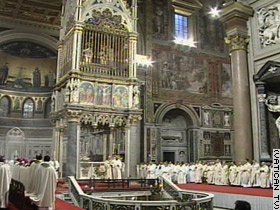
He asked Italians to pray for John Paul, and said a special Mass for the pope would be held at 7 p.m. at the basilica of St. John Lateran in Rome. The patriarch of Venice, Cardinal Angelo Scola, also planned a Mass in St. Mark Basilica at the same time.

Hospitalized twice last month following two breathing crises, and fitted with a breathing tube and a feeding tube, John Paul has become a picture of suffering.

His 26-year papacy has been marked by its call to value the aged and to respect the sick, subjects the pope has turned to as he battles Parkinson's disease and crippling knee and hip ailments.

It is not clear who would be empowered to make medical decisions for an unconscious pope. The Vatican has officially declined to comment whether John Paul has left written instructions.

Pope takes turn for the worst
31/03/2005 23:17  - (SA)  

Related Articles

Vatican City - Pope John Paul II has a high fever caused by an infection in his urinary tract, Vatican spokesperson Joaquin Navarro-Valls said on Thursday.

"The Holy Father has been struck during the day by a high fever caused by an infection of the urinary tract," he said.

"He is being treated with an appropriate therapy based on anti-biotics. His clinical state is being very closely controlled by the medical team of the Vatican which is treating him," it said.

Earlier the Italian news agency Ansa said the Pope's health had worsened over the past few hours and that he had a high fever and low blood pressure.

Earlier on Thursday the Vatican said the 84-year-old Polish-born pontiff had lost 19kg in a few weeks and there is great concern over his chances of recovery after undergoing a throat operation on February 24.

The Pope also suffers from Parkinson's disease.


**PROPHECY FROM FATHER WINGATE**


**There is to be a war/invasion of Italy after wars or disturbances have been started in Turkey and Greece, Yugoslavia with Slovakia and Austria, and Egypt with Saudi Arabia, all the different countries along the Baltic and even in Georgia, and also including Lebanon, Israel, Syria and other countries.

**When this breaks out into continuous wars, Italy will be invaded in a matter of a few days. You will know the invasion of Italy is coming when a gang-type war breaks out in Northern Italy. The gang type war is needed to have a military success. It is part civil war, and part invasion caused by outsiders who want the Italian government overthrown. The purpose is to make it easier to invade the Vatican, at which time the Pope flees, and we will be told that he is dead. So there will be no declaration that he has fled. This is where the people who are following the messages have to realize this is the time we follow from point to point what we have been told in faith, because the publicly released facts will contain many errors.


**When the Holy Father flees, he will go through Belgium, France, and into Canada. From Canada he will bi-locate into other countries. He will mostly stay in exile in a remote part of Canada. His stay will be in a part of Canada that
will be "passed over" during the invasion of Canada and the United States.

**The president of France will be assassinated, and also the leader of Germany.

**The U.S. will be invaded and occupied for a period of six to seven months. {See:  WARNINGS- 2-18-05} It will not exceed 7 months. At the end of this 6 - 7 month time period is when the Great Warning comes. (The Warning is used by God, to stop a Third World War.) Over a third of the United States will be occupied by a foreign force (and as much as a third of the population may be dead). The foreign force will actually be NATO and the United Nations. The U.N. will invade the United States as peacekeepers! The United Nations will be a united communist force, stating that they have come into the U.S. to liberate the Americans from an occupying force. This is their plan.

They will invade us, just as we have invaded other countries, including the former Yugoslavian nations. We have gone in there as a peace keeping force to make them and their own countries stop fighting. We went in there with our blue helmets and blue berets and everybody backed off. We went there to liberate that country from it's own occupation. This is exactly the same way that they will invade the United States. Obviously racial wars will be an excellent opportunity for the foreign invasion to take place.


**In 1997, Our Lady allowed me to see a vision. I saw military aircraft (belonging to other governments) flying over different countries in populated areas of Canada, the United States, Mexico, Europe, and many nations of Africa. They were spraying fumes into the air. Our Lord told me that this is an attempt to decrease the number of the population. These are chemical warfare gases that will kill thousands of people, thousands upon thousands of people and yet some people wonder why we are being told to store water and food, to stay in our homes, and to use sacramentals.

**The United States will be involved in three foreign wars when we are invaded. We are already involved in two wars now.

**We already know that Heaven has warned us that the United States must give "political recognition in hypocrisy to three nations" that it would not recognize otherwise. Those three nations are China, Vietnam, and Cuba. They are communist nations that are all against the U.S.A. and what our society is supposed to stand for. Even the U.S.A. will give them recognition and preference over other countries.

When Heaven was giving information concerning the invasion of our country, details were given concerning various parts that would suffer the most.


**Florida has already been partially invaded in preparation for the full military force that will arrive at a later date. There are many areas of our country that have already been prepared for the overthrow of our government. The majority of these people reside within about a 30 mile radius of the military installations that our country keeps armed and ready with various military personnel and military armament. These individuals have been in our country for as long as 40 years in some cases.

**Heaven has reiterated several times that our country is to expect an invasion force to enter our country during the Thanksgiving to New Year's holidays. This timeline has been determined by several factors that have been made very clear by Heaven. One of them being a clearly stated time when the military conflict will be brought to an end. That is to be in the late Spring to early Summer. In other words, between the month of May and July. We know this because heaven has said that the occupation will last approximately six months, not to exceed seven. We also know that the sign given by God to stop this war , as well as all other wars, will be given in the late Spring. Therefore, the duration of the military occupation and its conflict will be for approximately six months.

**The majority of the invading military will come through the state of Texas. {See link above}

**As for the East and West coasts: Florida and southern California are the areas intended to have the next largest infiltration of military forces. Due to our military's quick response in the state of California, there will not be an occupying force in California, as much as there will be in other parts of our country.

**Florida will not fare as well. Florida's suffering will begin the very first day of the invasion, and will be overrun and completely occupied in a short period of time by the communist forces intent on overthrowing our government. Due to this circumstance our government will decide to amputate Florida from the rest of the country, and eliminate this area from remaining as an area of massive buildup for our enemies. Our military will totally destroy the areas extending south from Mobile, Alabama to the Florida Keys. This will occur approximately two weeks after the initial invasion. It will be the great remorse that this action will be taken, but consider it an absolute necessity because of the vast numbers of individuals coming into the area for reinforcement of the military occupational forces.

In an effort to make things clearer, I do want to emphasize that the destruction I refer to is mostly the loss of human life. This is because our government will use neutron bombs on the state of Florida. And this will happen not once, but twice in some areas.

**In the southern and central part of Texas, our government will use neutron bomb's in the attempt to stop the military forces that are occupying that area, with as little physical destruction as possible. The forces of the invasion will continue northward up the central part of United States forming a line of separation between the free America and the occupied America until the Great Warning comes to stop all the wars around the world.

**This is not an event that people can blame on God and say that God is doing this to punish mankind. All of these occurrences are because of events that have already occurred that are making this possible. This is a punishment that our country is bringing upon itself because of its messages and radio programs. All of these things can be lessened by the true conversion of the American people by returning as one nation under God. And for this to happen, the American public must return to obedience to God first, and above and beyond any worldly gains. This includes the awakening of the American public to the great atrocity of abortion, and invalid and immoral laws that have been passed permitting immorality to have civil protection in our society.


People must understand that evil does not have a right to be protected. Just because people may enjoy or prefer an evil, does not mean that these evils have a right to exist in our country much less to be considered as a moral good. One of the main reasons why we are going to suffer as a nation is because our leaders have failed to lead our citizens as a nation under God. This is the very first and main reason. The next is, that the citizens have not demanded that our leaders abandon their immoral ways for the glory of God and the salvation of our nation.

**When the Warning comes, it will stop all the wars. I will go into detail about the Warning later. But for now, know that the Warning will stop all the fighting. Scripture refers to the "turning swords into plowshares.” Mankind will put down its guns and immediately and impulsively begin to rebuild. They will leave the cities by the millions and go into the countryside and build hamlets upon hamlets. The only thing, is that until they have the wisdom that is given to them at the time of the Second Pentecost, they will not completely understand all truths and Christ's Teachings.

**A month AFTER the Great Warning, there will be a HUGE earthquake in Italy that will affect three areas. The area around Rome, Pompeii, and at the base of the Alps which will cause terrible destruction to Venice, as well as affecting Greece and the Yugoslavia/Bosnia area. It is a punishment from God because they have given so little respect from having the "Capital of God's Church", the The Seat of Peter, so close to them.

**After that is when miracles are given to prove that John Paul II IS alive, prove who his successor is, that there IS an anti-Pope in Rome, and identify the Apostles of the End Times.

~~~~~~~~~

From a radio interview Father Wingate, on March 16, 2005, stated that the election of a new Pope will be set up in advance and held by FAX, since the Cardinals will not be able to get to the Vatican.  The new Pope will be called 'The Anti-Prophet".  He will be aware that this is illegal and part of the prophecy. It will be like a coup.

After he will be healed of his illness as a sign from God, there will be a short time before he has to flee. 

When the Vatican is invaded after the wars mentioned above, they will try to assassinate him. 

He will go into exile and be declared dead. He will be in exile for 8 to 10 months.  The successor will be illegally appointed against the rulings already set up.  They will set up an empty closed coffin to tell the people he is dead.

Several places are already set up to receive the Pope when this prophecy comes to pass. The Pope will use bi-location to appear in various places around the world to show he is alive. 

The Office of the Pope will no longer be valid when this happens and comes to pass.


Pope Rushed to Hospital With Flu Relapse
2-24-05
By VICTOR SIMPSON, Associated Press Writer

VATICAN CITY - Pope John Paul (news - web sites) II was rushed to the hospital in an ambulance for the second time in a month Thursday after suffering fever and congestion from a recurrence of the flu, the Vatican (news - web sites) said.

The 84-year-old pontiff had the same symptoms of the breathing crisis that sent him to Gemelli Polyclinic on Feb. 1, a Vatican official said on condition of anonymity. On Wednesday, the pope made his longest public appearance since being discharged from the clinic two weeks ago.

Papal spokesman Joaquin Navarro-Valls said the pope was taken to the Rome hospital for "necessary specialized assistance and further tests." He was taken by ambulance at 10:45 a.m., officials said.

Vatican officials played down the seriousness of the hospitalization, saying a patient of the pope's age is always at risk from the flu. The pope also has Parkinson's disease (news - web sites) and crippling knee and hip ailments.

But aides said the pope had a fever, congestion and had suffered a recurrence of breathing problems.

Medical experts who have not examined the pope but are familiar with elderly Parkinson's patients say his symptoms appeared to be consistent with pneumonia.

"It appears the pope is suffering from pneumonia, likely a bacterial pneumonia, a serious problem for a man of his age with Parkinson's," said Dr. Barbara Paris, chairwoman of geriatrics and vice-chairwoman of Medicine at Maimonides Medical Center in New York.

The Italian news agency ANSA reported that the pope arrived conscious at Gemelli in a private ambulance. He was taken inside in a stretcher, the report said, and quoted people who saw him enter the hospital as saying his face looked "quite relaxed." The news agency said he did not need a tube inserted into his windpipe to assist breathing.

A medical health bulletin was to be issued Friday morning, and no details on the pope's health were expected to be released before that, the Vatican said. Thursday's hospitalization was the pope's eighth since his election in 1978.

The pope's illness drew concern around the world.

The U.S. administration wished him a speedy recovery.

"We hope the pope recovers as soon as possible. He's in our thoughts and prayers," White House spokesman Fred Jones said.

In the pope's hometown of Wadowice, in southern Poland, worshippers offered prayers at an afternoon Mass in St. Mary's church, where the young Karol Wojtyla was baptized.

"This is very emotional moment for me," said Zdzislaw Szczur, 54, the head of the Wadowice branch of Solidarity, the trade union best known abroad for its struggle in the 1980s to bring down communism. "His suffering really moves me. It's all God's providence now."

Tourists and pilgrims in St. Peter's Square expressed alarm.

"I'm sure he wants to return to the Vatican because he has spent so much time there," said Ornella Lisandrello, 29, an Italian physician. "I'm sure he would like to die at the Vatican."

The pope's breathing problems can complicate the swallowing difficulties characteristic of Parkinson's disease. The lack of coordination of the muscles involved make it easy for food or saliva to get into the lungs. That can cause pneumonia and is one of the most common causes of death among Parkinson's patients.

Doctors sometimes bypass the throat by inserting a feeding tube directly into the stomach, both to help patients who have difficulty eating and to help prevent food going down to the lungs.

The muscle problems and the pope's stooped posture also could make it difficult for him to head off infections by mustering a powerful enough cough to shake mucus out of the lungs.

Rome has been particularly cold, wet and windy in recent days. The pope has twice appeared at his open studio window to address crowds in St. Peter's Square since his Feb. 10 discharge from the hospital, where he had been treated for breathing difficulties following a bout with the flu.

But the pope failed to show up Thursday morning for a scheduled meeting on new candidates for sainthood. No explanation was given for his absence and the ceremony went ahead, presided by the Vatican's No. 2 official, Cardinal Angelo Sodano.

The Vatican released a letter the pope had sent for the canonization ceremony, saying that "for reasons of caution," he had been advised to follow it from his apartment by closed-circuit television — an indication that the decision to take him to the hospital was made suddenly.

The pope had been convalescing after his hospitalization but had appeared to be making a rebound. At each new public appearance, he appeared stronger, more alert, and his voice was clearer.

On Wednesday, the pope wheezed and looked gaunt but managed to make his longest public appearance since leaving the hospital.

The Vatican originally had planned for the frail pontiff to address pilgrims in St. Peter's Square from his apartment window but decided instead on a video hookup because of the rain and winds.

In all, the pope followed the audience for 30 minutes — the most he has appeared in public since returning from the hospital. Fully alert, he waved and gave his blessing at the end.

When John Paul was discharged from the hospital, the Vatican made clear he would decide on his schedule in consultation with his doctors.

Because of his ailments, there has long been speculation that John Paul might consider resigning. That debate was fueled during his earlier hospitalization when Cardinal Sodano declined to rule out that possibility, saying it was up to the pope's "conscience."

The Gemelli Polyclinic has taken in John Paul so often that it has been dubbed by the Italian press as "The Third Vatican," after the seat of the Holy See on St. Peter's Square and the pope's summer residence in the town of Castel Gandolfo.

The hospital has a suite on the 10th floor that includes a chapel, kitchen and sleeping quarters for his longtime aide.

In 1981, the pope was shot in the abdomen and hand in a shooting attack by Turkish gunman Mehmet Ali Agca in St. Peter's Square. He spent 20 days at Gemelli after undergoing surgery.

The Gemelli clinic was under tight security Thursday.


Pope Has Tracheotomy to Help Breathing

By VICTOR L. SIMPSON, Associated Press Writer

VATICAN CITY - Pope John Paul (news - web sites) II underwent a successful operation to insert a tube in his throat to relieve his breathing problems, hours after he was rushed back to the hospital Thursday for the second time in a month with flu-like symptoms of fever and congestion, the Vatican (news - web sites) said.

Spokesman Joaquin Navarro-Valls said the tracheotomy lasted 30 minutes and the outcome was "positive." The pope had approved the procedure, which the Vatican characterized as elective.

The frail, 84-year-old pontiff, who was taken to the hospital shortly before 11 a.m. in an ambulance, will be spending the night in the hospital, Navarro-Valls said.

But the tracheotomy may require a longer hospital stay and have serious consequences for the pope's abilities to carry out his duties since he will not be able to speak while the breathing tube is in his throat.

Before the tracheotomy, outside medical experts had said John Paul may have pneumonia. But Navarro-Valls' statement made no reference to pneumonia, saying the pope suffered a narrowing of his larynx.

The pope's sudden turn for the worse alarmed the faithful from Nigeria to the Philippines to St. Peter's Square, and raised more doubts about his ability to carry on.

"We have prayed for the pope to live as long as possible so we can still share our joy with him," said Zofia Gebala, a 73-year-old retiree, as she left a church in Wadowice, the pope's birthplace in southern Poland. "We are praying for him every day, for his well-being. But it's all in God's hands now."

John Paul, who suffers from Parkinson's disease (news - web sites), had greeted pilgrims twice at the window of his studio at St. Peter's Square since his release from Gemelli Polyclinic Hospital on Feb. 10. On Wednesday, he made his longest public appearance — 30 minutes — since he fell ill more than three weeks ago.

With each successive appearance, he seemed a little stronger, a little more alert, and his voice rang out with greater clarity.

That made Thursday's reversal all the more shocking for the faithful.

"We are so scared because he has been sick in the past," said Vanessa Animo Bono, 32, a Roman Catholic being treated at Gemelli. "He is one of the few popes who is actually able to listen to people."

Earlier Thursday, Vatican officials said the pope was suffering breathing problems similar to those that sent him to Gemelli on Feb. 1, and Italian news reports said the latest respiratory crisis was more severe than the first.

Papal officials played down the seriousness of the hospitalization, saying a patient of the pope's age is always at risk from the flu. Vatican aides, speaking on condition of anonymity, said the pope had a fever and congestion in addition to the breathing problems.

ANSA reported the pope was conscious when he arrived at Gemelli and that he was sitting upright in a stretcher. According to the report, people who saw him enter the hospital said his face looked "quite relaxed."

Vatican officials had said the pope suffered from a "syndrome of influenza."

Chile's ambassador to the Holy See, Maximo Pacheco, told The Associated Press that the pope suffered a "bad relapse," citing a conversation he had with the Vatican's secretary of state, Cardinal Angelo Sodano.

But outside experts said people don't get a relapse of influenza itself. Instead, flu can lead to a bacterial infection such as pneumonia or bronchitis, which is an inflammation of the tubes that carry air into the lungs, or to congestive heart failure, a treatable condition in which the heart is unable to pump enough blood to meet the body's needs.
 

It's also possible that the pope's earlier illness was not influenza but a flu-like infection, or that John Paul has caught a cold or genuine influenza if he didn't have it before or if he encountered a different strain of influenza virus.

Thursday's hospitalization was the pope's eighth since his election in 1978.

The pope's common touch and his willingness to travel to remote places, despite serious health problems that include knee and hip ailments, make him much loved among Catholics.

As with the previous hospitalization, which lasted 10 days, the latest was certain to fuel speculation about whether he could continue as pope, and what would happen if he was incapacitated.

In the clearest sign that the Vatican may be taking the eventuality of papal resignation seriously, Vatican No. 2 Cardinal Angelo Sodano declined to rule out the possibility during John Paul's first hospitalization this month, saying it was up to the pope's conscience.

The news spread quickly, with the pope's illness flashed on television just as news shows were ending in the Philippines. Church officials relayed a prayer request to the faithful by text message on their cell phones.

Brigid Nolan, 73, saw the news on television in Dublin, Ireland, and walked to St. Columba's church. She lit a candle and offered a five-minute prayer for the pope and her own struggle with Parkinson's.

"I do draw inspiration from his own fight for life," she said. "He is suffering, but he's surviving, and more power to him. I get angry when people say he should quit. He should keep going for every minute God gives him."

Tourists and pilgrims in St. Peter's Square expressed alarm.

"I'm sure he wants to return to the Vatican because he has spent so much time there," said Ornella Lisandrello, 29, an Italian physician. "I'm sure he would like to die at the Vatican."

In the pope's hometown of Wadowice, worshippers offered prayers at St. Mary's church, where the young Karol Wojtyla was baptized.

"This is a very emotional moment for me," said Zdzislaw Szczur. "His suffering really moves me. It's all God's providence now."


Pope Rushed to the Hospital With Flu

Pope John Paul II, Suffering From Breathing Problems and the Flu, Is Rushed to a Rome Hospital

By VICTOR L. SIMPSON Associated Press Writer

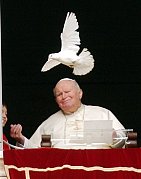
Pope John Paul II looks at a white dove freed at the end of the Angelus prayer in St. Peter's square, at the Vatican, Sunday, Jan. 30, 2005. According to a report on French radio, the Pontiff was taken to hospital, Tuesday Feb. 1, 2005.(AP Photo/Plinio Lepri)

ROME Feb 1, 2005 — Pope John Paul II, suffering from breathing problems and the flu, was rushed to the hospital Tuesday night, Vatican officials said.

The 84-year-old pope has been suffering from the flu since Sunday and apparently suffered a "breathing crisis," a Vatican official told The Associated Press on condition of anonymity.

Earlier, a close member of the pope's staff, American Archbishop James Harvey, said he didn't know the pope had gone to the hospital but knew that the pope had congestion and a slight fever during the day.

The Vatican planned to issue a communique toward midnight Tuesday. In the meantime, cars with Vatican license plates were speeding toward to Rome's Gemelli Polyclinic Hospital where the pope had been taken, according to an AP correspondent at the scene.

Copyright 2005 The Associated Press. All rights reserved


Pope underwent “respiratory assistance”, condition stable: Vatican
(AFP)

2 February 2005

ROME - Pope John Paul II was given “respiratory assistance” overnight but was in a stable condition Wednesday in Rome’s Gemelli hospital where he was preparing to say mass, Vatican spokesman Joaquin Navarro-Valls announced.

“During the night, he underwent respiratory assistance,” which helped stabilize his condition after he was rushed to hospital with breathing difficulties, Navarro-Valls told reporters outside the hospital.

He gave no details of what such assistance entailed.

The 84-year-old pope slept “for a few hours” during the night, and had “very little fever,” he added, in the first medical bulletin on the pope’s condition for more than 12 hours.

“When I left him the pope was preparing to celebrate mass with his secretary,” Monsignor Staneslaw Zewesz, the spokesman said.

He denied suggestions that the pope had to undergo a tracheotomy to help him breathe, and added that he did not undergo a CAT scan, as reported by Italian media.

In a previous statement late Tuesday, the Vatican said Pope John Paul had suffered “acute” inflammation of the larynx and a ”laryngo-spasm” -- a condition where one cannot catch one’s breath.

Laryngo-spasm is a medical term for the sudden closure of the larynx that blocks the passage of air to the lungs. In severe cases, it can require a tracheotomy to be performed.

Feb. 6, 2005 - Report: Pope near death when taken to hospital.

ROME: A U.S. religious affairs magazine, 'Inside the Vatican', reported that when Pope John Paul II was rushed to the hospital last week, he was gasping for breath and would have died within 10 minutes if not hospitalized. A Vatican official confirmed that the situation was "serious", very serious... If it were controllable, he would have been taken to the hospital the next morning."  Also Monday, the Vatican said the pope will stay longer in the hospital as a precaution. Papal spokesman Joaquin Navarro-Valls said the pope continues to get better, but that 'his doctors have advised him to stay a few more days." The 84 year old pope also is weakened by Parkinson's disease.

Feb. 7. 2005 - Ailing Pope speaks from Hospital Window

by Victor L. Simpson (The Associated Press)

VATICAN CITY - Pope John Paul II blessed the faithful from his hospital window Sunday, looking frail and speaking with difficulty but determined to show he can still lead the Roman Catholic Church.

The 10-minute appearance at an open window gave the public its first glimpse of the 84-year old Pontiff since his hospitalization, which rekindled questions about his ability to carry on.

He looked rested and alert, and a message read for him by an Argentine archbishop standing beside him seemed designed to quell doubts about the pope's ability to lead the church. 

"In this hospital, in the middle of other sick people to whom my affectionate thoughts go out, I can continue to serve the church and the entire humanity," the message said.

As teary well-wishers gazed at his 10th floor window, John Paul gave a brief blessing. But his words, in a gravelly voice, were barely understandable.

"I think it's very touching because the Holy Father is not doing well and seeing his will to appear is moving," said Daniela Sgro, a 25-year old Italian.

The pope, who has Parkinson's disease and hip and knee ailments, was rushed Tuesday to Rome's Gemelli Polyclinic with breathing trouble brought on by the flu. The Vatican has said he is steadily improving. 

A few miles away on St. Peter's Square, where several thousand people gathered to see the pope on four giant video screens, cheers went up as he appeared.

"To all and each of you I assure you of my gratitude, which is translated into a constant invocation of the Lord according to your intentions as also for the needs of the church and the great issues of the world," the pope said in remarks read by the Archbishop Leonardo Sandri. 

Feb. 9, 2005 - Pope will miss his first Ash Wednesday

VATICAN CITY  - Pope John Paul II's extended  hospital stay has produced a wistful first for his 26-year papacy - missing the public Ash Wednesday prayers that usher in the solemn and sacred Lenten season.

American Cardinal James Stafford will preside over today's service at St. Peter's Basilica - an unavoidable substitution for a pope deeply stirred by the traditional period of penitence, sacrifice and reflection.

The Vatican did not say whether the 84-year old pope plans anything special in his room at Rome's Gemelli Polyclinic hospital to mark Ash Wednesday.

Officials said the pontiff has been holding Mass regularly for doctors and nurses treating him since he was rushed to the clinic Feb. 1 with breathing spasms and the flu.

The pope's struggle with Parkinson's disease and crippling hip and knee ailments have many questioning how long he can serve.

Tuesday, the prefect of a Vatican tribunal said the pope will be able to run the church even if he becomes unable to speak.

"It is sufficient that one's will be expressed and he expressed in a clear way," Cardinal Marlo Francesco Pompedda told the newspaper La Stampa. "It can be expressed very well through writing, and in any case can be expressed also with clear and significant gestures."

The Vatican said the pope's health is improving, but his doctors persuaded him to prolong his hospital stay. He is expected to remain hospitalized at least until Thursday.

Ash Wednesday begins a few week's reflection for the pope before the taxing Holy Week services, which end with Easter on March 27.

HindustanTimes.com 
Will the Pope resign?

Vijay Dutt

London, February 8, 2005

A close aide of the ailing Pope, his second-in-command, has fuelled worlwide speculation that the pontiff might resign. A magazine reported that he had come within minutes of death when he was rushed to hospital last week and that his condition was much worse than what the Vatican had been saying. 
 
Cardinal Angelo Sodano, the Vatican secretary of state, said, "Let's leave this hypothesis up to the Pope's conscience. We must have great faith in the Pope. He knows what to do," when asked if the Pope had thought of resging. 

 
Under the Church's Canon Law, Popes can resign but cannot be forced to do so. Pope John Paul II, 84, has so far displayed determination to remain in the high post despite debilitating arthritis and Parkinson's disease. 
 
Cardinal Sodano however, also spoke of the Pope's longevity and prayed that he would continue in office for many years. 
 
In his message on Sunday during his ten-minute appearance at an open window in the hospital he is admitted to, the Pope implied that he would not step down and he could continue, even from hospital, to serve " the Church and the humanity".


        Pope John Paul II          

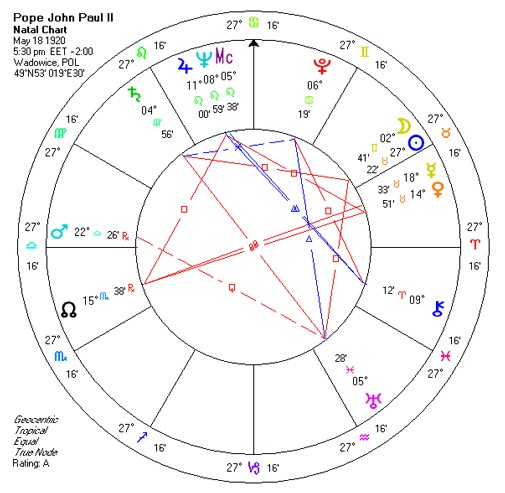
Karol Wojtyla, who is now Pope John Paul, was born in Wadowice, Poland. on May 18,1920.

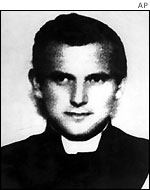
Photo of Karol Wojtyla at his ordination on 1946.

He became the Archbishop of Krakow on December 30, 1963.On October 16, 1978, Archbishop Wojtyla became the first non-Italian pope since HadrianVI (1522-3).

Polish Cardinal Karol Wojtyla was elected successor to Pope John Paul I on Oct. 16, 1978, the 264th pope of the Catholic Church, and took the name John  Paul II.
He took the name of his predecessors (John, Paul, John Paul) to emphasis his desire to continue the reforms of the Council. Pope John Paul II is the most traveled pope in the history of the papacy, having visited nearly every country in the world which would receive him. It is his custom to kiss the earth of each land he visits as soon as he puts his feet to that country.

At age 61 he suffered serious wounds during an assassination attempt.

Biography

04/15/03

Friends,

Tonight I heard from Native American shaman Nestor NightOwl. Spirit had directed him to call me and share a vision he received a week ago.

In this vision the Pope (John Paul II), dressed in his formal stiff gold-brocaded altar vestments, approached him, and called Nestor by his birth name, which he has not heard in 20 years. Nestor has never been Catholic, and was surprised by the Pope's choosing him to visit (astrally). Nestor said the Pope was a clear as day, that he could see every fine detail of his face, to the level of the hairs on his nose.

The Pope gave Nestor to understand that he (the Pope) will be dead shortly. Nestor got that it would be in weeks, not months from now.

The Pope stated that he has come to a new understanding of things, and that many ideas he has held for a lifetime are wrong: such things as the existence of a Hell or Purgatory. Pope John Paul said he was ready to let go of this life.

Pope John Paul told Nestor that the prophecies given by the figure the faithful know as the Virgin Mary are about to come to pass: those she gave to simple peasant children decades ago: the Prophecies of Fatima, Portugal, of Lourdes, France, of Medjugorje, Bosnia-Herzogovina. These prophecies have to do with End Times events, and resemble what in modern metaphysical lore are called Earth Changes; and what the Hopi Prophecies call the Times of Tribulation.

The Pope did not put an exact date on when these Prophecies will manifest, but Nestor got the impression that it would be rather soon. Nestor felt that these were connected with current world events unfolding, such as the War on Iraq, etc. The Pope said that these unfortunate events must play themselves out, that events have to unfold as they are set; that they will usher in an era such as the world has never experienced before.

Nestor got the strong impression that out of the world-events tumult would arise the circumstance in which the presence of the Star Visitors here would become so manifest that even the most hardened scoffer could no longer deny their reality. And that such would bring in an era unlike any previously known.

The Pope also told Nestor that people have to pay attention now to the slightest intuition or other psychic indication they get, that it will be important to do so.

Nestor was reminded of indicator signs which a Navajo Elder passed on to him, as told by the Old Ones. These signs that the Times of Tribulation are upon us will be three:

1) when one hears a low moaning outside,

2) when there is a fine red dust in the air, and

3) when a person while walking feels themself tilting some to one side.

Nestor believes that he will be drawn back soon to the U.S. Mainland from Kauaii, and hopes to be able to attend and speak at the Star Knowledge Conference May 23-25 in Colorado Springs. He feels that by that date "big things will be happening."

Nestor was puzzled as to why he was directed to bring his vision to me. But I was not. For in so doing, his vision will be spread areound the world. And since I and my associate, investigator Paola Harris, are friends with Monsignor Corrado Balducci, the Vatican's tacit point-man on Star Visitor matters, that Nestor's message would be shared with him as well.

I thanked Nestor for sharing his vision and message, and secured his permission to share them publicly. And so you have this guidance to add to what vision he previously got about May, as well as the predictions of Dr. Leo Sprinkle's Guides, John Kimmey, and Marian MacNeil's Star Visitor contact "Neuman". We are in for some changing times, and apparently not far off.

Richard Boylan, Ph.D.

1-31-03 - VISION - I was already awake and thinking about the dream I had just had, and suddenly had a vision of a newspaper front page.

The headline was:  POPE PREPARES FOR DEATH AND SMOOTH TRANSITION

Under the headline was a photo and article about the Pope preparing for his own death. The photo was of the Pope sitting on his throne with his papal guards on both sides of him.

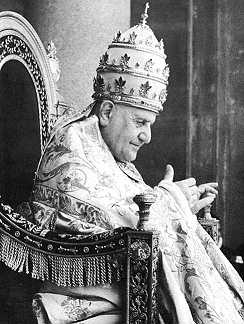
PHOTOS OF POPES ON THE THRONE


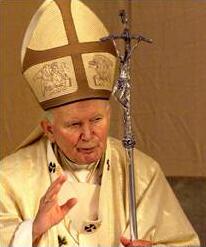
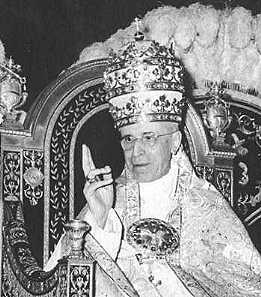
POPE JOHN PAUL II - POPE PIUS XII

The Papal Tiara is a crown symbolizing the threefold authority of the Supreme Pontiff: Universal Pastor, Universal Ecclesiastical Jurisdiction and the Temporal Power (bottom). Of this last, only the Vatican City State remains from the papal territories, which in past ages secured the autonomy of the Vicar of Christ from the princes of this world.

The triple tiara can also be understood to have a spiritual interpretation, the three-fold office of Christ, Who is Priest, Prophet and King. The Lord communicated these offices to the Apostles, and in a particular way to Peter, that they could sanctify, teach and govern in His name and by His authority (Mt 16:13-18, Mt 18:18, Mt 28:18-20, Lk 22:31-32, John 21:15-17 (See below) Pope Paul VI was the last pontiff to wear the papal tiara. At the end of the Second Vatican Council, Pope Paul VI descended the steps of the papal throne in St Peter's Basilica and laid the tiara on the altar in a dramatic gesture of humility and as a sign of the renunciation of human glory and power in keeping with the renewed spirit of the Second Vatican Council. This last tiara was then given to benefit the poor, but remains as a symbol in the papal crest."

Photos of the Triple Tiara


The throne is the chair of state or the seat of a high dignitary. The throne was at first a stool or bench and later became an ornate armchair, usually raised on a dais and surmounted by a canopy. Often lavishly decorated, thrones have been made of a variety of materials, including wood, stone, ivory, and precious metals. Ancient Greek thrones were simple in form, with rectangular or curving legs and rosette adornments; they were adapted by the Etruscans, who made them more comfortable, and also by the Romans, who made them more ornate. The thrones of the East were usually more elaborate and fantastic in conception than those of Europe. In ancient times the Indian throne was a combined throne-altar, serving both a royal and a religious purpose. Thrones of the Renaissance in Europe were heavily ornamented with precious stones. Napoleon’s throne was a gilded chair displaying eagles, lions, and other symbols. The throne of Great Britain is an oak chair in the House of Lords. At St. Peter’s in Rome is the bronze papal throne designed by Bernini. The throne of a bishop is called a cathedra and the church in which it is maintained is thus a cathedral.

Matthew 16:13-18 :

When Jesus went into the region of Caesarea Philippi he asked his disciples, "Who do people say that the Son of Man is?" [14] They replied, "Some say John the Baptist, others Elijah, still others Jeremiah or one of the prophets." [15] He said to them, "But who do you say that I am?" [16] Simon Peter said in reply, "You are the Messiah, the Son of the living God." [17] Jesus said to him in reply, "Blessed are you, Simon son of Jonah. For flesh and blood has not revealed this to you, but my heavenly Father. [18] And so I say to you, you are Peter, and upon this rock I will build my church, and the gates of the netherworld shall not prevail against it.

Matthew 18:18:

Amen, I say to you, whatever you bind on earth shall be bound in heaven, and whatever you loose on earth shall be loosed in heaven.

Matthew 28:18-20 :

Then Jesus approached and said to them, "All power in heaven and on earth has been given to me. [19] Go, therefore, and make disciples of all nations, baptizing them in the name of the Father, and of the Son, and of the holy Spirit, [20] teaching them to observe all that I have commanded you. And behold, I am with you always, until the end of the age."

Luke 22:31-32 :

"Simon, Simon, behold Satan has demanded to sift all of you like wheat, [32] but I have prayed that your own faith may not fail; and once you have turned back, you must strengthen your brothers."

John 21:15-17 :

When they had finished breakfast, Jesus said to Simon Peter, "Simon, son of John, do you love me more than these?" He said to him, "Yes, Lord, you know that I love you." He said to him, "Feed my lambs." [16] He then said to him a second time, "Simon, son of John, do you love me?" He said to him, "Yes, Lord, you know that I love you." He said to him, "Tend my sheep." [17] He said to him the third time, "Simon, son of John, do you love me?" Peter was distressed that he had said to him a third time, "Do you love me?" and he said to him, "Lord, you know everything; you know that I love you." (Jesus) said to him, "Feed my sheep."

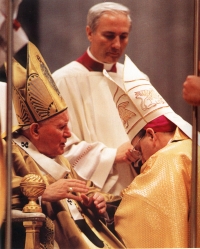
On the Feast of the Epiphany, Pope John Paul II consecrates priests to the episcopate. Here the Pope vests a new bishop with the mitre. His Holiness wears a pontiff-design gold mitre, the pallium, the papal ring, and gold chasuble. Two croziers can be partially seen in the background. The Pope's master of ceremonies, Bishop Piero Marini, then a monsignor, is seen in violet cassock and Vatican-style surplice.
The mitre is the common headdress of bishops, worn at liturgical functions. It is either precious, golden (orphreyed), or simple (simplex).The precious mitre is worn by celebrants, the simple by concelebrants, and the golden by the celebrant at an ordination. All cardinals wear a damasked mitre (simplex) in presence of the Pope. It is very tall, and is made of layered white damask silk.

The origins of the mitre can be found in pre-Christian Greece in the cap worn by Greek athletes. The infulae, or ribbons, of the mitre actually pre-date the hat. These ribbons would be tied around the forehead, and the winner of an athletic competition would be presented with a laurel wreath, which circled the head. The hat was made taller and more ornamented by the early Christian hierarchy, and became papal vesture during the time of Pope Leo VIII. It wasn't universally allowed to bishops until the 11th century.

More photos

The Pope's day begins while Rome still sleeps, around 5:30, and does not end until 11:30 p.m. By 6:15 he is in his private chapel, praying and meditating before its altar, over which hangs a large bronze crucifix. Within sight is a copy of Poland's most cherished icon, the Black Virgin of Czestochowa, from whose image Poles historically drew strength as they battled against their oppressors.

The testimony is universal that prayer, more than food or liquid, is the sustaining force of this Pope's life. He makes decisions "on his knees," says Monsignor Diarmuid Martin, secretary of the Vatican's Justice and Peace Commission. Sometimes John Paul will prostrate himself before the altar. At other times he will sit or kneel with eyes closed, his forehead cradled in his left hand, his face contorted intensely, as if in pain. At this time, too, he brings to his God the prayer requests of others. His prie-dieu, at the front center of the chapel, has a padded armrest. It lifts up, and underneath there is a small container for a couple of prayer books and a big stack of intentions, written on yellow sheets. Last month the stack was 200 sheets thick, and the one on the top had nine different names written on it, including that of a 17-year-old Italian boy with cancer, an Italian mother of three who was very sick and an American child.

The prayers nowadays may also concern the decline of his own health, the result of age and the lingering effects of wounds suffered in the 1981 assassination attempt by Mehmet Ali Agca. John Paul has written an apostolic letter on the supernatural value of human suffering in which he teaches, "Each man, in his suffering, can also become a sharer in the redemptive suffering of Christ." Though he does not mortify his flesh with a hair shirt - as Paul VI sometimes did - he clearly sees his own physical ailments in this light.

"The Pope's youth wasn't happy," says Father Joseph Vandrisse, a former French missionary in the Middle East who now covers the Vatican for the French daily Le Figaro. Wojtyla lost his mother when he was nine, his father when he was 21, and his only brother, a doctor, died during a scarlet-fever epidemic. "He has meditated a lot on the meaning of suffering. Now that he is weakened in a world that is horrified by sickness and death, he thinks that the image of someone who is suffering is important for the church." To the sick whom he visits, the Pope has a request: "Pray for me. Pray for me." Still, his friend and confidant, Jean-Marie Cardinal Lustiger of Paris, advises the Pope's critics not to underestimate the aging Pontiff: "This is perhaps the most decisive moment of the whole pontificate."

Says Navarro, the papal spokesman and confidant: "If you say, 'Holy Father, did you enjoy your lunch?' he will say yes. But if you ask him what he just ate, he couldn't tell you." John Paul is often too engrossed in talk and thought to pay attention to food. Amid intense conversation, he may push his plate away and fiddle with the cutlery, eyes closed, while concentrating on the speaker's words. He listens and responds. At lunch one day, some of the Pope's advisers started talking about the violence of the Serbs in Bosnia. The Pope interjected: "And the Croats - you think they're angels?"

Fluent in eight languages, the Pope chooses his idiom to suit his dinner companions. Says a Vatican aide: "He listens, talks directly, asks questions, puts you at ease. After five minutes you forget you are talking to the Pope." For visiting bishops with problems to share, he can turn on the charm, singing and joking - although his humor runs more to irony and good-natured kidding. After the dissident Swiss theologian Hans Kung was censured for a book questioning papal infallibility, John Paul commented, without malice, "And I'm sure Kung wrote that infallibly."

The Pope has two modes of decision making: quick and slow. On large strategic issues, he can be instantly decisive, since he has invariably thought through what he wants to do beforehand. But if he is unhappy with options proposed by the Curia on a tricky problem, he will put the issue aside for weeks or even months. When he brings up the problem again, startled aides have discovered, he will not have forgotten a detail. His aides attest that John Paul has immense powers of concentration and - his health problems notwithstanding - a virtually photographic memory for names and details.

And with so much less time to do what he believes must be accomplished. The Pope, under strict orders from his physician, must take a half-hour after-lunch nap. After that he exercises by walking along the Apostolic Palace's rooftop terrace while reciting the rosary and reading his breviary.

He chafes under the burden of his infirmities. His image has always been of the robust mountain climber, swimmer, skier, soccer goalkeeper. Once in the high Dolomites, the Pope, determined to reach a cross planted on a peak far ahead, walked so far that his aides became worn out and could go no farther. He agreed that all his staff could rest and wait for him, but he insisted that the fit and trim Joaquin Navarro continue with him. It took another three hours to reach the cross. The Pope was dressed in hiking togs - one of those rare moments when he has been seen publicly in mufti. On the way up, they passed a group of German hikers descending the slope. John Paul greeted the group briefly in German and walked on. When the tourists were about 30 yards down the mountain, Navarro heard one of the women shriek, "Gott im Himmel! It was the Pope!"

John Paul was skiing as recently as March, 1994. But he will never ski again. He now has an artificial femur and must walk with a cane. "He doesn't know how to use it," says Navarro. "He was operated on the right hip and holds the cane in his left hand. The recovery is not as fast as hoped, because he didn't spend enough time in physiotherapy." When, impatiently, he tries to move without a cane, he often falls on a companion for support. The appearance of weakness has prompted rumor and speculation: bone cancer, Parkinson's disease, a series of small strokes. All are denied by the Vatican.

The depth of the Pope's disappointment over Crotia was apparent when he visited the country on Sept. 10, 1994. He walked unsteadily and gasped for breath, leading to rumors that he might be near death. What may have troubled the Pope more than physical discomfort was a fear that his mission as priest and prophet would end prematurely. Five days later, John Paul summoned senior Curia officers to his summer retreat at Castel Gandolfo. "He was tired," said an official, "and obviously suffering with his hip." And then the Pope surprised his aides by declaring once again, "I have to go to Sarajevo. We must find some way to make these people stop killing each other." So much to do, so little time.

More from 1994

From:  http://www.astrodatabank.com/NM/PopeJohnPaul.htm

Man who shot pope pardoned in Italy

June 13, 2000

ROME -- Mehmet Ali Agca, the man who tried to assassinate Pope John Paul II in 1981, will be extradited to Turkey after Italy's president issued a pardon on Tuesday for the papal shooting.

Agca will serve the remainder of a 10-year sentence in Turkey for the murder of newspaper editor Abdi Ipekci. He shot the pope after escaping from jail while being held on charges of murdering Ipekci and was later sentenced to death in absentia by his native country.

A 1991 amnesty reduced the Turkish death sentence to 10 years in prison.

"This morning the president of the republic signed the clemency decree for Mehmet Ali Agca, and simultaneously the Justice Minister signed an extradition decree which will send him back to Turkey," a spokesman for Italian President Carlo Azeglio Ciampi said on Tuesday.

The pope, who met Agca in prison, publicly forgave him three days after the May 13, 1981, shooting, which occurred as the pope rode in an open car across St. Peter's Square. Agca, now 43 years old, shot the pope point-blank and was captured immediately.

Chief Vatican spokesman Joaquin Navarro-Valls said John Paul was satisfied with Ciampi's action.

"As you know, John Paul II immediately pardoned his attacker and for some time now the pope had told Italian authorities that he was in favor of an act of clemency if Italian law permitted it," Navarro-Valls said. "He has been insisting on this for some time. We are not surprised. We are very happy."

Agca's attorneys reported that their client thanked the pope and the Vatican when told the news.

"This is a dream. I cannot believe it," news reports quoted the gunman as saying in comments relayed by his lawyer.

Pope credits miraculous recovery

Hit in the abdomen, left hand and right arm, the pontiff was critically wounded in the 1981 assassination attempt. Doctors were able to save the pope's life largely because Agca's bullets missed any vital organs.

The pope credits his survival to the intervention of the Virgin Mary of Fatima, Portugal.

John Paul visited Fatima last month, revealing that the attempt on his life was the last of three secrets revealed to three Portuguese shepherd children who saw the Virgin's apparition in 1917. The other two secrets had been long since revealed, but the Vatican had held tightly to the third.

The shooting occurred less than three years after John Paul ascended the papal throne.

Agca has served more than 19 years of a life sentence.

No proof of conspiracy

Agca, a member of the militant right-wing Grey Wolves group in Turkey, gave several conflicting reasons through the years for his attack on the pope, but prosecutors were never able to prove that he had not acted alone.

At a second trial after Agca's original conviction, prosecutors tried to link the attack to the growing democracy movement -- very much alive in Pope John Paul's native Poland at the time -- that would eventually lead to the downfall of communism.

The pontiff was a staunch supporter of Poland's Solidarity union and is believed to have been instrumental in the chain of events that led to the Eastern Bloc's first freely elected government.

The theory speculated that Bulgarian secret service agents had hired Agca on behalf of the Soviet Union.

Prosecutor Rosario Priore, who investigated the alleged conspiracy, said that while he's convinced the whole truth has never come out, the pardon was "a wise decision."

"It's the only possible act to take," he said. "You can't keep people in prison just to make them talk."

But another prosecutor, Antonio Marini, said that Agca's extradition to Turkey "extinguishes the last hope of reaching the truth."

The Associated Press and Reuters contributed to this report.


Pope John Paul II Crys Tears of Joy After Finding His Missing Hat

by Elroy Willis

VATICAN CITY (EAP) -- Amid the recent talk of Pope John Paul II stepping down come rumors of not only failing health, but of a failing memory as well.

Most recently, he was seen bent over in frustration as he felt on top of his head and realized that he'd misplaced his hat.

"I don't remember where I put my hat," he was recently heard mumbling to himself over and over as he wandered around looking for his favorite Holy Headwear.

Papal aides say the Pope offered two days off with pay and promised to put in a good word to God for anyone who could locate his missing hat.

"It was like a treasure hunt," said 42-year-old Joseph Castillo, Vatican chef, who found the hat in the back of a freezer behind a carton of peach sherbet.

"I think maybe he snuck down to the kitchen to have a snack and for some reason he put his hat in the freezer. Or maybe someone was playing a joke on him," Castillo said.

Overjoyed by the return of his hat, he broke down into tears and cried like a baby.

Seen at left, wearing the missing hat and clutching a hankey, it's obvious that it was a very emotional experience for the aging Pope.

"He hugged me and said 'God Bless You' over and over," Castillo said. "I'm looking forward to my two days off, and thank God that I was the one who found the Holy hat."

Vatican officials say that they're relieved to have this missing hat incident over with. "We were worried that some Pope-Groupie might've stolen the hat," they said.

Sunday, September 28th, 2003

Pope sets stage for succession

By LOS ANGELES TIMES

Pope John Paul II appointed 31 new cardinals Sunday, enlarging the body that will produce his successor and further solidifying his conservative influence on the Roman Catholic Church and its powerful hierarchy.

Pope John Paul II reads the names of new cardinals Sunday from the window of his Vatican study. (ASSOCIATED PRESS)

John Paul, 83 and in poor health, will elevate the new cardinals, bestowing upon them their trademark scarlet birettas, on Oct. 21 in a ceremony known as a consistory. It will wrap up a week of celebrations marking the pontiff’s 25 years in office, one of the longest reigns in modern history.

The men named Sunday will become members of the College of Cardinals. Those under the age of 80 are eligible to take part in the election — almost always from within their own ranks — of a new pope upon the death of a sitting pontiff.

The new “princes of the Church,” as the cardinals are known, included only one U.S.prelate — Los Angeles-born Justin Rigali, archbishop of Philadelphia — and one each from Mexico, Guatemala and Brazil. Six are Italians and one was appointed “in pectore,” or “close to the heart,” meaning his name will not be revealed because of religious persecution in his home nation.

Rigali, 68, is considered a conservative who is loyal to the pope and his traditional doctrines, including staunch opposition to abortion.

Report: Pope's Health 'In a Bad Way'

Pope John Paul II Is 'In a Bad Way,' Cardinal Ratzinger Tells German Magazine

The Associated Press

VATICAN CITY Sept. 30, 2003 — Ailing Pope John Paul II is "in a bad way," one of his closest advisers said in an interview published Tuesday, calling on the faithful to pray for him.

An aide to Cardinal Joseph Ratzinger, however, told The Associated Press that the comments in no way indicated John Paul's health had worsened in recent days. Instead, they reflected concern about John Paul's frailty, the aide said.

The Polish-born pontiff, who was elected as pope in 1978, is 83 and suffers from Parkinson's disease.

"He is in a bad way," Ratzinger told the German weekly Bunte, which said its correspondent spoke with him at the Vatican on Sept. 22. "We should pray for the pope."

Those comments to some degree only confirm what's been obvious in John Paul's recent appearances, but also raised concerns the pope's health might have deteriorated beyond what has visible to all.

However, Ratzinger's aide, the Rev. Georg Gaenswein, said Ratzinger's remarks did not mean John Paul's health had worsened in recent days. He said Ratzinger's remarks came in response to a request by a group of visiting German brewers to have an audience with the pontiff while they were in Rome.

"They were told, 'Unfortunately, this is not possible. The pope's health doesn't allow him to make a lot of physical effort,'" Gaenswein recalled.

Gaenswein noted that conserving strength was particularly important in the run-up to a heavy schedule John Paul has given himself for the month of October, including celebrations of his 25th anniversary as pope.

On Sept. 23, the pontiff came down with an intestinal ailment that caused him to skip his weekly general audience the next day.

Asked whether Ratzinger's comments indicated any change in the pope's condition, the Vatican press office replied by noting that John Paul would resume the general audience on Wednesday.

The pope will also celebrate a Mass on Sunday on the steps of St. Peter's Basilica to raise three churchmen to sainthood, the Vatican announced Tuesday. Canonization ceremonies generally last about two hours, an indication that the pope's doctors think he has the stamina for the appearance.

The Vatican recently also announced that the pope is forging ahead with plans to visit a Marian sanctuary in Pompeii, southern Italy, on Oct. 7.

On Sunday, John Paul spoke with great difficulty and stopped to catch his breath several times as he announced the appointments of 31 new cardinals from his studio window overlooking St. Peter's Square.

Asked whether the pope is taking on too much given his state of health, Ratzinger was quoted as telling Bunte that "that is very probably the case." But, pressed as to whether he could dissuade the ailing pontiff from loading himself with duties, he added: "that's something other people must do."

Bunte described the cardinal as speaking in an interview, but Gaenswein denied that a formal interview had been granted.

The magazine quoted Gaenswein as saying of the pope: "He cannot walk and stand any more, but for the faith