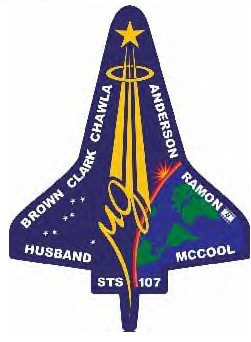
|
12-31-2002 - DREAM - I was looking at a sheet of paper or a computer
screen - that had 11 lines on it.
The first 10 lines each had two
Barbie Doll dresses on it. No two were the same - each dress was of a
different color.
Then I saw the 11th line, and instantly had a vision of two
astronauts close up - from the eyebrows up - and their heads
were full
of smeared dirt. One of the men had light sandy-brown hair.
End
I thought this would happen in November - so my counting was
off....
This is sooo sad.
Another dream from a reader:
Date: 2/1/2003 3:51:49 PM Pacific Standard Time
From: northsun@xxx
To: Dee777@aol.com
Dee~Thanks for putting this together.
Feb.1,2003-dream
I had dozed off asleep this morn around 4:45am AST(7:45amCST). I
dreamed of a large JET airplane pulling up. It was rather dim light. I saw
an 'old' man pilot. I and another shadowed person knew we were to get on
this jet. I wondered at the time if this old guy could fly this plane well
enough. We took off and had a short ride when I heard a loudspeaker
saying, "There is an emergency and we'll have to land." I thought, "Oh
boy.. there's no place to land this big plane.." but the pilot said,
"Don't worry, I'll get it down."
We started a fast descent and suddenly I found myself standing free
on top of the plane as it whooshed down .. arms in the air and feeling
elated.. I could feel the wind whooshing by me,but I remained still with
nothing holding me there. I looked down and saw a very narrow strip of
green land.. between trees and highways, but watched as that pilot brought
this big plane right down on a cushy, soft, gentle landing. It was
amazing.
I popped wide awake about 5:30am(8:30amCentral) I turned on the news
and they were announcing the loss of communication with the shuttle. I
hadn't even remembered it was due to land this morn.. and then remembered
my dream,s ynching with this event. It was of another dimension, for sure,
but I saw a padded safe landing for the astronauts, wherever they are now.
They are all ok.
Love,Jan
Date: 2/2/2003 3:09:53 PM Pacific Standard Time
From: northsun@xxx
To: Dee777@aol.com
Thanks, Dee. I saw you posted my dream. The 'nauts had a destiny to
bravely fulfil. I remember seeing the "Challenger" crew of 7 at that time.
They also were protected and 'taken home' in a similar manner. At that
time I was given that they were an ancient spaceship crew come to earth in
Lemurian time and agreed to leave earth together. I get a similar feeling
of this Columbia crew of 7. They were 'lured' to be together again for
this event. It may not be 'written in stone', but they knew it was a
possible outcome and are given all credit and love. They all are the
'Magnificent 7s' in our time. A lot of good things will come forth from
their sacrifice. It does bring attention to needed changes.
I went outdoors around 1am on Feb.2,2003.. Alaska standard time..
and just in time to see the most intense and magnificent aurora begin. It
shot huge arcs, circles words and waves right overhead at my place in
Anchorage. It was awesome and like a ray of hope and promise of much
greater things at work. I gave a prayer of thanks for this sign in the
heavens.
Today on Feb.2 is the 2nd anniversary of my beloved hubby, Bruce's
departure from earth. He is a great energy and is in contact with all on
that realm that works with us here in form.
There was a lot of number symbology on 2/1/03..a #8 day. It was
17yrs.since Challenger event..#8. Groups of #7 left earth with the
Challenger and Columbia. On the same day we lost #7 teens in an avalanche.
They were a part of a party of #17 people..#8 again.
I'm sure there are more significant nos. and events, but these stood
out. #8 represents the power, money, responsibility.. management of the
vehicles and tech stuff..#7 is the groups of souls that left and were of
this 'mystical' realm. They were all 'the good guys'.. in essenc. It's a
kind of twisted fate.. but always for learning and aiding for others in
this process.
Love and Peace.. The Dove is en flight!
Jan
|
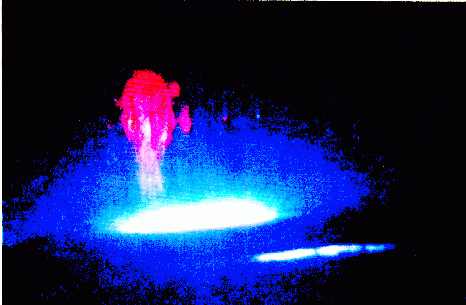
EARTH: CAPE
CANAVERAL, Fla. (Reuters) - Astronauts videotaping thunderstorms from
the space shuttle Columbia captured what scientists said on Thursday was a
never-before-seen red glowing arc of light paralleling the curve of the
Earth.
| .............SPRITES, below
|
Cool
Description, er...electrical anomalies:
Scientists were excited by the news that
astronauts on Sunday captured the first-ever pictures of elves taken
from space with a calibrated camera. The shuttle and its
seven-member crew, which includes Israel's first astronaut, Ilan
Ramon, are on a 16-day science mission that began on Jan.
16. |
TimelineAt approximately 05:53 PST (13:53 UTC) sensors on
Columbia begin showing indications of trouble. A San Francisco
astronomer snapped photos of the shuttle just before its
disintegration, which depicts a "mysterious purple streak" later
judged by investigators to be a camera artifact.
At about 05:54 PST
(13:54 UTC), a California news photographer observed pieces breaking away
from Columbia as it passed overhead, as well as a red flare coming
from the shuttle itself.
At about 06:00 PST (14:00 UTC) on
February 1, 2003 NASA's Mission
Control at Lyndon
B. Johnson Space Center in Houston, Texas lost with the space shuttle Columbia.
NASA's Space Shuttle Program Manager, Ron Dittemore, reported that "The first indication was loss
of temperature sensors and hydraulic systems on the left wing. They were
followed seconds and minutes later by several other problems, including
loss of tire pressure indications on the left main gear and then
indications of excessive structural heating."
Analysis of 31 seconds of telemetry data which had initially been
filtered out because of data corruption within it showed the shuttle
fighting to maintain its orientation, eventually using maximum thrust from
its reaction control system jets.
Still shots were taken from a video on a
documentary on the National Geographic Channel presented 9-12-04
The 8
second time exposed photo was taken by an Amateur Astronomer who wishes to
remain unidentified despite being on television on the documentary on the
National Geographic Channel and has asked his name to be removed from this
page
and images deleted despite the fact that they are available by watching
the video.
The lightning bolt hit the shuttle 2 seconds before it started
breaking up.
The shuttle exploded 6 minutes later.
NASA sent
an agent to pick up the film and the camera from the photographer and forbid him
to publish it.
NASA calls this a camera wobble or a ghost or artifact
in the camera.
They prefer to blame the missing piece of insulating
foam for the accident.
The "mysterious purple streak"
The San Francisco Chronicle reported on February 5, 2003, that an unnamed amateur
San Francisco astronomer had imaged Columbia with a
Nikon 880 digital camera at around the time the shuttle
first started showing indications of trouble, at an altitude of some 40
miles. The Chronicle reported that "in the critical shot, a glowing purple
rope of light corkscrews down toward the plasma trail, appears to pass
behind it, then cuts sharply toward it from below. As it merges with the
plasma trail [produced by the shuttle], the streak itself brightens for a
distance, then fades." This photograph was shown on the National
Geographic Program on 9-12-04. The camera in question was sent to Houston for further
investigation by NASA. The Columbia Accident Investigation Board
subsequently concluded that this was an artifact caused by a faulty
camera. Nikon has said that the model of camera used is known to
occasionally produce a purple fringe on photographs as a result of "color
interpolation combined with chromatic aberration", an effect that has been
reproduced by independent reviewers. Purple fringing is a problem with many types of
digital camera - not just the Nikon 880 - as a result of the optical
phenomenon of chromatic aberration.
However, some have suggested that the United States Air Force shot the craft down with a
laser (accidentally or deliberately). This explanation has
attracted little mainstream support and is generally regarded as a fringe
conspiracy theory. It would also not explain the image
captured by the San Francisco astronomer, as the beam of the high-energy
Chemical Oxygen Iodine Laser (COIL) system used by the Air Force operates
at the infrared wavelength and so is not visible in visible light.
[4] (Link)
It has also been proposed that this streak may have been a bolt of
positive lightning; NASA has discounted this possibility.
Positive
lightning is not the ordinary type of lightning that regularly hits
airplanes, its much more powerful and lasts up to 10 or more seconds with
a heat that is hotter than the sun . In conjunction with the damage done
to Columbia on lift off... it contributed to the disaster. A photo on a
documentary on the History Channel showing a purple colored lightning bolt
intercepting Columbia's plasma trail. There was a sound in Columbia's
flight path that was picked up by sensitive equipment and it has the same
profile of a certain type of lightning the positive charged lightning bolt
that is part of the sprite.
Positive lightning makes up less than 5% of all lightning. It occurs
when the stepped leader forms at the positively charged cloud tops, with
the consequence that a positively charged streamer issues from the ground.
The overall effect is a discharge of positive charges to the ground.
Research carried out after the discovery of positive lightning in
the 1970s showed that positive lightning bolts are typically six to ten
times more powerful than negative bolts, last around ten times longer, and
can strike several miles distant from the clouds. During a positive
lighting strike, huge quantities of ELF and VLF radio waves are
generated.
NOTE: 10-18-07 - David Sereda requested my captured
photographs which I retrieved from a National Geographic video approximately
2005.
I had originally published them on this page, and was forced to remove both
the photographs and the photographers name from this page when they were
discovered here. The You Tube video by David Sereda below is
based on the photographs I sent him earlier this year in 2007.
|
| EXOPOLITICS REPORTS ON FINDINGS:
10-18-07
Photographic Analysis Confirms that Space Shuttle
Columbia was Destroyed by a Plasma Beam Weapon - Exopolitics
Comment #59
Further photographic analysis has recently been completed on a
series of five photos taken by an amateur astronomer on a San
Francisco hill at 5:53 am on February 1, 2003, showing the Space
Shuttle Columbia being hit by what appears to be a lighting bolt
shortly before it crashed seven minutes later. According to David
Sereda, who conducted the photographic analysis, the length of the
five exposures conclusively show that it was not a form of 'super'
lightning that hit the Columbia, but an advanced plasma beam weapon
of some kind. Sereda documented his analysis in a recently released
video,
From Here to Andromeda, extracts of which were uploaded this
week to
YouTube. The series of five photos were originally submitted to
NASA to help it in its investigation of the Columbia tragedy by the
astronomer who chose to remain anonymous. His submission of the
photos to NASA was covered by a reporter from the
San Francisco Chronicle and appeared in a story on February 5, 2003.
The reporter claimed: "In the critical shot, a glowing purple rope
of light corkscrews down toward the plasma trail, appears to pass
behind it, then cuts sharply toward it from below. As it merges with
the plasma trail, the streak itself brightens for a distance, then
fades."
Continued at:
http://exopolitics.org/Exo-Comment-59.htm
|
| HSF - STS
107 scheduled landing - 2-1-2003 - broke up and
crashed on landing
 

The space shuttle Columbia broke up today as it descended
over central Texas toward a planned landing at Kennedy Space Center in
Florida. Seven crew members were aboard. A Bush administration spokesman
said the shuttle's altitude -- over 200,000 feet -- made it "highly
unlikely" that the shuttle fell victim to a terrorist act.

Space Shuttle Apparently Disintegrates
Space Shuttle Columbia Apparently Disintegrates in Flames
Over Texas Minutes Before Scheduled Landing
The Associated Press
CAPE CANAVERAL, Fla. Feb. 1, 2003 —
Space shuttle Columbia apparently disintegrated in flames
over Texas on Saturday minutes before it was to land in Florida. TV video
showed what appeared to be falling debris, as NASA declared an emergency
and warned residents to beware of falling objects.
Six Americans and Israel's first astronaut were on
board.

In north Texas, people reported hearing "a big bang" at
about 9 a.m., the same time all radio and data communication with the
shuttle was lost.
Television stations showed what appeared to be flaming
debris falling through the sky, and NASA warned Texas residents to beware
of any falling objects. NASA also announced that search and rescue teams
were being mobilized in the Dallas and Fort Worth areas.
Inside Mission Control, flight controllers hovered in
front of their computers, staring at the screens. The wives, husbands and
children of the astronauts who had been waiting at the landing strip were
gathered together by NASA and taken to secluded place.
"A contingency for the space shuttle has been declared,"
Mission Control repeated over and over as no word or any data came from
Columbia.
In 42 years of U.S. human space flight, there had never
been an accident during the descent to Earth or landing. On Jan. 28, 1986,
space shuttle Challenger exploded shortly after liftoff.
On Jan. 16, shortly after Columbia lifted off, a piece of
insulating foam on its external fuel tank came off and was believed to
have struck the left wing of the shuttle. Leroy Cain, the lead flight
director in Mission Control, assured reporters Friday that engineers had
concluded that any damage to the wing was considered minor and posed no
safety hazard.
Columbia had been aiming for a landing at 9:16 a.m.
Saturday.
It was at an altitude of 207,000 feet over north-central
Texas at a 9 a.m., traveling at 12,500 mph when Mission Control lost
contact and tracking data.
Gary Hunziker in Plano said he saw the shuttle flying
overhead. "I could see two bright objects flying off each side of it," he
told The Associated Press. "I just assumed they were chase jets."
"I was getting ready to go out and I heard a big bang and
the windows shook in the house," Ferolito told The AP. "I thought it was a
sonic boom."
Security had been tight for the 16-day scientific
research mission because of the presence of Ilan Ramon, the first Israeli
astronaut.
Ramon, a colonel in Israel's air force and former fighter
pilot, became the first man from his country to fly in space, and his
presence resulted in an increase in security, not only for Columbia's
launch, but also for its planned landing. Space agency officials feared
his presence might make the shuttle more of a terrorist target.
Israeli Prime Minister Ariel Sharon's office said it had
no immediate comment.
Columbia's crew had completed 80-plus scientific research
experiments during their time in orbit.
Just in the last week, NASA observed the anniversary of
its only two other space tragedies, the Challenger explosion, which killed
all seven astronauts on board, and Apollo space craft fire that killed
three on Jan. 27, 1967.
PALESTINE, TEXAS
The City of Palestine is a progressive and diverse
community offering its 18,000 residents a high quality of life in a
semi-rural setting. Palestine, the county seat of Anderson County, is
located in the central part of East Texas, 108 miles south of Dallas, 150
miles north of Houston and 180 miles northeast of Austin. Principal
highways leading to Palestine include US 79, 84 and 287; Interstate 45 is
35 miles to the west. The City is served by rail carriers and has a
municipal general aviation airport. Other East Texas communities in the
region include Tyler, Nacogdoches and Kilgore
"On Saturday, shocked Israelis wondered if fate could
have anything worse in store for them as they tuned in to watch the
disaster broadcast live on local television channels, instead of the
landing which had been scheduled at 9:16 a.m. EST.
Their disbelief deepened as newscasters reported the
shuttle crash was first heard over a town in Texas named Palestine, a
bitter irony lost on no one."
The irony of having a Texas president about to go to war
is not lost on Americans either. Will America itself crash and burn this
year?
|
| NASA: Shuttle Lost Over Texas
Columbia Apparently Disintegrates Over Texas
Saturday, February 1, 2003; 10:17 AM
Space shuttle Columbia apparently disintegrated in flames over Texas
on Saturday minutes before it was to land in Florida. TV video showed what
appeared to be falling debris, as NASA declared an emergency and warned
residents to beware of falling objects.
Six Americans and Israel's first astronaut were on board.
NASA announced that search and rescue teams were being mobilized in
Dallas and Fort Worth areas.
Columbia was at an altitude of 200,700 feet over north-central Texas
at a 9 a.m., traveling at 12,500 mph when mission control lost contact and
tracking data.
NASA warned that any debris found in the area should be avoided and
could be hazardous. There were reports of debris seen falling.
Residents of north Texas heard "a big bang" Saturday about the time
the space shuttle Columbia disappeared on its way to a landing at Cape
Canaveral.
"It was like a car hitting the house or an explosion. It shook that
much," said John Ferolito, 60, of Carrolton, north of Dallas.
Gary Hunziker in Plano said he saw the shuttle flying overhead. "I
could see two bright objects flying off each side of it," he told The
Associated Press. "I just assumed they were chase jets."
"I was getting read to go out and I heard a big bang and the windows
shook in the house," Ferolito told The Associated Press. "I was getting
ready to go out and I heard a big bang and the windows shook in the house.
I thought it was a sonic boom."
Bob Multer of Palestine, Texas, told CNN he saw what looked like a
high-flying jet and heard a noise.
"It would be very similar to a tornado, it was very loud and
intense," Multer said. "It was loud enough and it was low enough that it
shook the building."
In 42 years of human space flight, NASA has never lost a space crew
during landing or the ride back to orbit. In 1986, space shuttle
Challenger exploded shortly after liftoff.
Security had been tight for the 16-day scientific research mission
that included the first Israeli astronaut.
The astronauts had conducted more than 80 experiments on behalf of
NASA and the European, Japanese, German and Canadian space agencies, as
well as numerous student and commercial investigations. The shuttle did
not visit the International Space Station on this trip.
Ilan Ramon, a colonel in Israel's air force and former fighter
pilot, became the first man from his country to fly in space, and his
presence resulted in an increase in security, not only for Columbia's Jan.
16 launch, but also for its landing.
On launch day, a piece of insulating foam on the external fuel tank
came off during liftoff and was believed to have struck the left wing of
the shuttle.
Leroy Cain, the lead flight director in Mission Control, had assured
reporters Friday that engineers had concluded that any damage to the wing
was considered minor and posed no safety hazard.
Columbia is NASA's oldest shuttle and first flew in 1981.
© 2003 The Associated Press
|
| NASA: Fuel-Line Cracks Affect Entire Shuttle Fleet
Wednesday, July 10, 2002
CAPE CANAVERAL, Fla. — NASA discovered a fuel-line crack in its
newest space shuttle Wednesday, the same potentially dangerous problem
affecting the rest of the fleet.
The small crack was found in the metal liner of a hydrogen-fuel line
inside Endeavour, which returned from orbit just last month. Similar
cracks have been found in the same parts on the three other shuttles,
Atlantis, Discovery and Columbia.
Engineers are still inspecting Endeavour, which first flew in 1992,
and more cracks are anticipated.
"We've got it on the other three, so we're not necessarily surprised
to see that Endeavour has cracks, too," said NASA spokesman Bruce
Buckingham.
Buckingham said there is no way to know, with certainty, when or how
the cracks occurred. "But I think a reasonable person can assume we've
been flying with these cracks," he added.
The problem was first detected three weeks ago on Atlantis.
Inspections quickly turned up cracks on Discovery and then Columbia. The
work on Endeavour had to wait until the shuttle returned from Edwards Air
Force Base in California, where it landed June 19 following a space
station visit.
Columbia's science research flight with the first Israeli astronaut,
which had been scheduled for a July 19 liftoff, is on indefinite hold. The
launch dates of all other shuttle flights this year are also in question.
The concern is not that the 12-inch-diameter fuel lines might leak,
but that the cracks might grow and that metal chips might break off and
end up in an engine. That could lead to an engine shutdown during launch,
with possibly catastrophic results.
The cracks are up to three-tenths of an inch in length and are
located in liners used to direct the flow of hydrogen fuel to the main
engines.
Buckingham said NASA does not consider the shuttle fleet grounded —
at least not yet. There is a possibility that engineers may conclude that
the spaceships can fly safely with the cracks and that no repairs are
needed, he said. But if the cracked liners need to be replaced, it could
take months to manufacture new parts.
Seven engineering teams, involving workers around the country, are
working practically nonstop to determine the severity of the problem and
devise possible ways to fix it.
Despite the problem, NASA is still working toward a late August
launch of Atlantis and an October launch of Endeavour. Both are space
station missions.
|
| Residents Find Shuttle Debris in Texas
By PAM EASTON
Associated Press Writer
Published February 1, 2003, 1:15 PM CST
NACOGDOCHES, Texas -- Bits of machinery and pieces of metal were
found strewn across a wide area of east Texas after the space shuttle
Columbia broke apart. One piece crashed through the roof of a dentist's
office.
Police and NASA officials warned residents the debris could be toxic
and should not be touched. The Environmental Protection Agency prepared to
coordinate a cleanup, and the Army's 1st Cavalry Division deployed a task
force -- including helicopters and military police -- to help search for
wreckage.
"It's all over Nacogdoches," said James Milford, owner of a barber
shop in downtown. "There are several little pieces, some parts of
machinery ... there's been a lot of pieces about 3 feet wide."
On the edge of downtown Nacogdoches, 135 miles northeast of Houston,
a National Guardsman stood watch over a steel rod with silver bolts that
landed in the grass outside a yard. People streamed up to take photos of
the debris.
NASA lost communication with Columbia as the ship soared across
Texas at an altitude of about 200,000 feet.
Debris was reported in several east Texas counties and along the
Texas-Louisiana border. A fisherman from DeRidder, La., Elbie Bradley,
reported hearing a falling object splash into the Toledo Bend reservoir,
which straddles the border.
"I thought it was an airplane that hit the lake," he said. "Before
the piece came down, it sounded like the start of a big motor without an
exhaust on it."
In Nacogdoches, Jeff Hancock, a 29-year-old dentist, said he found a
chunk of debris in his office.
"There's actually a piece in my office. It came through the roof of
my office. It's about a footlong metal bracket," he said.
Ed Rohner, Nacogdoches airport manager, said some type of tank ended
up on a runway.
"We have one large, several foot in diameter, some type of tank that
was in the middle of a runway," Rohner said. "We've got pieces of debris
all along the entrance road to the airport," Rohner said.
R.T. Gregory, a waiter at Aubrey's Cafe in Nacogdoches said he and
about 50 other people gathered around a taped-off piece of metal debris in
the parking lot of the Commercial Bank of Texas. He said the debris was
about 4 feet long and 4 feet wide.
Nacogdoches Fire Chief Thomas Lambert told Dallas-Fort Worth
television WFAA he found a half-moon shaped piece, 5 to 5 1/2 feet long.
"This piece I'm looking at does have severe burn marks on it, like
you take a blow torch and put it on metal until it turns a kind of a
bluish-greenish color," he said.
Authorities were investigating what they thought could be a piece of
the shuttle next to the driveway to Rice High School along busy Interstate
45.
"It looks like a piece of tile, said Rice Police Chief James
McDuffie. Rice is located just north of Corsicana.
Authorities ordered people to stay 100 yards away from the debris
because of contamination fears. However, a number of Nacogdoches residents
were picking up pieces and turning them in to law enforcement officers,
authorities said.
The Cherokee County Sheriff's Office had received more than 30
confirmed reports of fallen debris, Campbell said. The items ranged in
size from small pieces of tile to 2-by-2 foot pieces of metal.
"We've had people bring pieces of it up here to the office," said
Sheriff James Campbell. "We certainly want to discourage that.
Cherokee County is in East Texas, about halfway between Tyler and
Lufkin.
Residents in southern Arkansas also were warned to stay away from
any debris, although there were no confirmed reports of any falling there.
Copyright © 2003, The Associated Press
|
| Space shuttle Columbia, crew lost
Crew of seven dead
Craft disintegrates in flames over Texas
Residents warned of falling debris

NOAA map of debris area
A trail of debris was visible from space shuttle Columbia over
Texas. ((AP Photo/WFAA-TV))
Bush says 'no survivors' from shuttle accident
Debris Falling Over Texas
By Mike Cabbage
Sentinel Staff Writer
Published February 1, 2003, 1:38 PM CST
Shuttle Columbia disintegrated during its return to Earth today,
killing seven astronauts and dealing a stunning blow to America’s space
program.
President Bush said "there are no survivors" from the loss of the
space shuttle Columbia. He called it "terrible news and great sadness to
our country."
Almost three hours after the accident, the White House confirmed the
shuttle was lost. Witnesses in Central Texas reported hearing a loud
explosion and seeing trails of flaming debris falling along the shuttle's
flight path as Columbia traveled 38 miles high at six times the speed of
sound en route to a planned 9:16 a.m. landing at Kennedy Space Center.
“We ran out and started looking around,” said Benjamin Laster of
Kemp, Texas. “I saw a puff of vapor and smoke and saw a big chunk of
material fall.”
"Sadly, from the video that's available, it does not appear that
there were any survivors," said Bill Readdy, NASA's associate
administrator for space flight.
Readdy said it was too early to speculate about the exact cause.
NASA Administrator Sean O'Keefe said the accident was not caused by
anything or anyone on the ground.
O'Keefe said President Bush was speaking to the families of the
astronauts.
"We trust the prayers of the nation will be with them and with their
families. A more courageous group of people you could not have hoped to
know," O'Keefe said.
All appeared normal as Columbia fired its thrusters at 8:17 a.m. EST
to leave orbit and land at KSC. For much of the fiery reentry through
Earth's atmosphere, communications between the ground and the shuttle
routinely are lost. But when contact with Columbia was scheduled to resume
about 9 a.m., ground controllers heard nothing but silence.
“Search and rescue teams in the Dallas-Fort Worth area have been
alerted,” said James Hartsfield, a spokesman for the National Aeronautics
and Space Administration. “Any debris located in the Dallas-Fort Worth
area should be avoided. It may be hazardous.”
Speculation immediately focused on damage to Columbia's protective
heat tiles that the ship suffered during launch from KSC on Jan. 16.
Launch pad cameras detected a piece of insulating foam from the shuttle's
external fuel tank breaking off and striking Columbia's left wing.
Minor tile damage during launch is not unusual. Leroy Cain, NASA's
flight director for Columbia's return home, said Friday that the wing
damage was not considered serious and no unusual precautions were being
taken.
“We can't say with great detail the degree of the damage other than
all of the analysis suggests that it would be very minor in terms of the
amount of tile that might actually be missing,” Cain said Friday. “The
analysis says that we have plenty of margin in those areas in that regard
and that the impact could not have been ..... enough to take out any
significant amount of tile.”
Columbia's crew consists of the commander, Air Force Col. Rick
Douglas Husband; the co-pilot, Navy Cmdr. William C. McCool; mission
specialists Kalpana Chawla; Navy Capt. David M. Brown; Air Force Lt. Col.
Michael P. Anderson; Navy Cmdr. Laurel Blair Salton Clark; and Israeli Air
Force Col. Ilan Ramon, Israel's first astronaut.
Columbia was coming home from a successful mission to do science
research in weightlessness 170 miles above Earth. During the shuttle's 16
days in space, the crew split into two shifts to work around the clock on
80 or so physical, materials and life science experiments. Their
laboratory was a 20-foot by 14-foot pressurized aluminum module inside
Columbia's cargo bay that the astronauts accessed through a tunnel from
the crew compartment. NASA officials were elated the flight - the
shuttle's 113th - had accomplished all of its major goals.
“This has been a very successful mission,” Cain said Friday. “It's
far exceeded folks' expectations from a science standpoint so we are very
pleased.”
The landing was the first time behind the controls for astronaut
Husband, a 45-year-old former Air Force test pilot assigned to command
Columbia after copiloting a previous shuttle flight. It was co-pilot
McCool's first landing. The accident appeared to be the U.S. space
program's third fatal accident involving astronauts. Apollo 1 caught fire
on the launch pad, killing its three-man crew during a countdown test in
1967. Shuttle Challenger exploded shortly after launch in January 1986,
killing seven astronauts.
After the Challenger accident, most of NASA's attention was focused
on safety issues surrounding the shuttle's launch. Landing was considered
less risky.
“I worry a lot less during this [landing] than the launch,” said
veteran NASA shuttle manager Wayne Hale, who supervised many launches and
landings. “There are just fewer ways of getting in trouble during entry.”
An automated landing system never is used, however, making touchdown
subject to human error. If trouble occurs, there aren't many options.
Because the shuttle lands without power, it glides steeply out of orbit
after circling a quarter of the way around the globe.
“It is the one task that the pilots train most extensively for as
far as the hands-on flying,” former astronaut Richard Covey said. “There
is no margin for error in the landing sequence.”
Unlike the pilot of a powered airplane, a shuttle commander can't
open the throttle, pull up and circle around to try again. Once the
shuttle fires its engines to leave orbit and re-enter Earth's atmosphere,
it's committed to coming down.
Today's landing attempt was the 62nd for a shuttle at KSC, compared
with 49 at Edwards Air Force Base and one at White Sands Space Harbor in
New Mexico. Nineteen were night landings, 14 of which have been at KSC.
The other five were at Edwards.
The accident occurred during Columbia's 28th flight. It was the 88th
mission since Challenger's 1986 explosion. That disaster, NASA's first
accident in flight, sidelined the space agency for 32 months.
With more than two dozen additional space station assembly flights
scheduled aboard the shuttle during the next five years, the future of the
station, as well as the shuttle program itself, could be in jeopardy.
The influential chairman of the House Science Committee, Rep. James
Sensenbrenner, R-Wisconsin, recently said the loss of another orbiter
could set human spaceflight back for years.
“If we do lose another orbiter, we can't replace it as quickly as we
replaced Challenger,” Sensenbrenner said. “We also are considerably behind
as the result of some management failures and some funding failures to go
to the next stage for a new reusable launch vehicle that could have human
beings on board.”
Columbia's mission was the first of six scheduled for 2003. The next
scheduled shuttle flight is a mission to the international space station
aboard Atlantis in early March. But NASA's three other orbiters -
Atlantis, Endeavour and Discovery - likely will be grounded pending a
review of Columbia's accident.
NASA won't have a vehicle other than the shuttle capable of carrying
people into space until at least the end of the decade. However, this
morning's accident could accelerate efforts to find a replacement.
In 1996, President Clinton directed NASA to find a successor vehicle
that was 10 times cheaper and 100 times safer. However, the space agency
pulled the plug in March 2001 on the $1.3 billion X-33 program, the
best-known effort to develop a prototype for a next-generation
spacecraft.
Aerospace giant Lockheed Martin hoped to use X-33 as a steppingstone
to a new full-scale reusable launch vehicle dubbed VentureStar. But the
program was stalled by a series of engineering problems. With the project
hopelessly behind schedule and over budget, additional government funding
was cut off.
As a result, there is no viable alternative to the shuttle on the
horizon. Much of the funding for developing a possible replacement was
shifted last year to development of a small orbital spaceplane that would
serve as a crew escape ship for the station.
One option being considered would launch the spaceplane with
station-bound crew and cargo on U.S. expendable rockets in 10 years or
so.
Copyright © 2003, Orlando Sentinel
|
| Photos show odd images near shuttle
2-2-03
David Perlman, Chronicle Science Editor
A San Francisco amateur astronomer who photographs the space
shuttles whenever their orbits carry them over the Bay Area has captured
five strange and provocative images of the shuttle Columbia just as it was
re-entering the Earth's atmosphere before dawn Saturday.
The pictures, taken with a Nikon 8 camera on a tripod, reveal what
appear to be bright electrical phenomena flashing around the track of the
shuttle's passage, but the photographer, who asked not to be identified,
will not make them public immediately.
"They clearly record an electrical discharge like a lightning bolt
flashing past, and I was snapping the pictures almost exactly . . . when
the Columbia may have begun breaking up during re-entry," he said.
The photographer invited The Chronicle to view the photos on his
computer screen Saturday night, and they are indeed puzzling.
They show a bright scraggly flash of orange light, tinged with pale
purple, and shaped somewhat like a deformed L. The flash appears to cross
the Columbia's dim contrail, and at that precise point, the contrail
abruptly brightens and appears thicker and somewhat twisted as if it were
wobbling.
"I couldn't see the discharge with own eyes, but it showed up clear
and bright on the film when I developed it," the photographer said. "But
I'm not going to speculate about what it might be."
E-mail David Perlman at dperlman@sfchronicle.com.
http://www.sfgate.com/cgi-bin/article.cgi?f=/c/a/2003/02/02/MN221641.DTL
|
| Sensors showed rising temperatures on Columbia
NASA: Remains of all seven astronauts found
Sunday, February 2, 2003 Posted: 8:18 PM EST (0118 GMT)
JOHNSON SPACE CENTER, Texas (CNN) -- In the final minutes before the
space shuttle Columbia fell apart over east Texas Saturday, something
occurred on the craft's left side -- events significant enough to make the
space craft roll to the right in an effort to keep Columbia on an even
keel, a NASA official said Sunday.
Computers monitoring the craft's progress as it sped from California
toward Texas indicated that temperatures on Columbia's left-side
mid-fuselage increased four times faster than temperatures on the craft's
right-hand side, said Ron Dittemore, speaking at a news conference Sunday
afternoon.
According to monitoring devices, the temperature on the left side
increased by 60 degrees Fahrenheit during five minutes, said Dittemore,
NASA's top shuttle program manager. During the same time, temperatures on
the right went up by 15 degrees.
Moments later, he said, instruments noted an increase in drag on
Columbia's left side. As it headed into west Texas, the drag was so
pronounced that the craft's right ailerons tried to correct its flight,
working to roll Columbia to the right, Dittemore said.
"Soon after, we had loss of signal," Dittemore said.
NASA officials also revealed that remains of all seven of the
astronauts had been recovered.
Director of flight crew operations Bob Cabana declined to give
further details out of respect for the families but said that the remains
were being treated with the greatest respect. We are honoring our
fellow crew mates," said Cabana.
A massive investigation involving federal, state and local
authorities was underway Sunday to try to solve the mystery of what caused
the fatal tragedy.
At the same time, plans for a memorial began taking shape to honor
the seven astronauts killed Saturday morning.
The accident strew thousands of pieces of debris across a wide area
of east Texas and Louisiana. NASA investigation teams have been dispatched
to coordinate the recovery of physical evidence.
Pieces of the Columbia -- up to about eight feet in length -- have
been found at more than 1,000 sites around Nacogdoches County, Texas,
Sheriff Thomas Kerss said on Sunday.
Meanwhile, the White House said President Bush, who spoke to family
members of the crew by telephone Saturday, will attend a memorial service
Tuesday in Houston along with first lady Laura Bush.
Immediately after the craft was lost, NASA instituted its
investigation protocols, which meant that all data relating to the flight
was impounded, Dittemore told reporters.
Investigators were expected to arrive Sunday at a Lockheed Martin
plant in New Orleans where the 154-foot external fuel tanks are built. The
company already has impounded records pertaining to the tank's production,
a spokesman said.(Investigation)
Authorities warned residents not to touch any pieces of the
spacecraft since they could be contaminated with toxic residue from the
spacecraft's fuel system and could be crucial to determine what happened
to Columbia.
In Nacogdoches County, at least 70 people concerned that they may
have touched debris had gone to area hospitals by Sunday morning, but none
showed any injuries, said county emergency management director Sue
Kennedy.
The process of recovering the debris may be a lengthy one,
investigators warned.
'Weeks or months' to complete search
"We have a vast amount of forest and timberland within our county.
Some of these areas may not receive coverage for weeks or months," Kerss
said.
In Hemphill, about 180 miles southeast of Dallas, authorities found
numerous fragments of the spacecraft and human remains believed to be from
its crew. The FBI is investigating four reports of human remains found in
the surrounding county, and a piece of debris the size of a compact car
landed in a pond near Hemphill, authorities said.
"The FBI has informed us that ... is federal property," said
Kennedy. "They will pursue legal action and prosecute if necessary to get
that back."
"We owe it to them every single second of the day to be sure we
dedicate ourselves to finding out what went wrong," NASA Administrator
Sean O'Keefe said Sunday. "We're going to find out what caused this, we're
going to make sure we correct it and we're going to make sure this never
happens again."
NASA officials said the shuttle's left wing lost hydraulic sensors,
lost tire pressure readings and then registered intense heat before
breaking apart. Officials also said they would take another look at an
incident during Columbia's January 16 launch in which a piece of
insulation struck the left wing.
In addition to NASA's internal probe, an independent investigation
will be led by retired Navy Adm. Harold Gehman, who headed the probe of
the October 2000 attack on the USS Cole in Yemen.
'A man of God'
The shuttle crew was remembered during Sunday church services. In
Amarillo, Texas, at shuttle commander Rick Husband's church, family friend
Patty Ragan remembered Husband as "a man of God" who "put himself into
everything he did with a full heart."
In Racine, Wisconsin, friends and family members mourned mission
specialist Laurel Clark at Olympia Brown Unitarian Universalist Church.
"Laurel was a very intense person who would set goals and would go
for them," Clark's brother, Daniel Salton, said Sunday. "And I think
that's a great role model for kids today. ... You can do great things for
humanity if you just set some small goals and always go for the next thing
and set your sights higher."
The seven astronauts killed in the disaster were Husband, Clark,
pilot William McCool, payload commander Michael Anderson, mission
specialists David Brown and Kaplana Chawla, and Israel's first astronaut,
Ilan Ramon.
A NASA official said the shuttle's altitude made it "highly
unlikely" that it was a victim of a terrorist act. FBI officials quickly
discounted the possibility of foul play or terrorism.
Space shuttle flights have been put on hold until NASA can learn
what caused the disaster. NASA said the international space station, where
two astronauts and a cosmonaut remain, has enough supplies to last the
crew until June. An unmanned Russian supply ship was launched to the space
station on Sunday.
The next shuttle flight had been scheduled for March 1.
Officials asked anyone who finds debris to call (281) 483-3388.
Columbia was lost less than a week after the anniversaries of two
other deadly space program disasters -- the 17th anniversary on January 28
of the explosion of the shuttle Challenger in 1986 and the 36th
anniversary on January 27 of a launch pad fire that killed three Apollo
astronauts in 1967.
List of shuttle debris found
Highlights of the hundreds of reports of debris from the explosion
of the space shuttle Columbia.
Texas
• Remains that a hospital employee identified as charred torso,
thigh bone and skull on a rural road near other unspecified debris in
Hemphill, east of Nacogdoches.
• Remains identified as a charred human leg on a farm in Sabine
County, about 50 miles east of Nacogdoches.
• Intact, charred helmet and astronaut's patch in San Augustine
County.
• A rounded piece of what appeared to be metal, about 4 feet by 5
feet, found on a rural highway in Neches.
• Foot-long metal bracket that smashed through roof of dentist's
office in Nacogdoches.
• Half-moon-shaped metal piece, about 5 feet long, in front yard in
Nacogdoches, described as jagged with severe burn marks.
• V-shaped chunk of metal in the median of U.S. 79 just northeast of
Palestine, in Anderson County. More unspecified debris found at nearby
Pert.
• 2-foot square pieces of metal, small pieces of tile in Cherokee
County, just west of Nacogdoches, and in Rusk County, just to the north.
• A 5- to 6-foot-long object that looks like part of the landing
gear found 12 miles south of San Augustine, with a piece that looks like
part of a radio, with wires hanging out, found half a mile away.
• 300 pieces, including one that would be difficult to fit into a
pickup truck, found in Cherokee County.
• 25 pieces found on a 20-acre campus of the Douglas Independent
School District in Nacogdoches. Possible 5- by 5-inch piece of tile in
front of Rice High School in Rice, in Navarro County.
• Tank, about 3 feet in diameter, on a runway at the A.L. Mangham
Jr. Regional Airport in Nacogdoches.
• 3- by 3-foot piece of metal in a bank parking lot in Nacogdoches,
and 1-foot diameter piece of gray metal in front of the courthouse.
• Curved piece of metal, about 5 feet in diameter, in highway median
in Anderson County, west of Nacogdoches.
• 7- to 8-foot door-like fragment and a piece of debris resembling
part of a windshield found in Cherokee County.
• Dented metal object about the size of a beach ball in the front
yard of a home in Bronson, southeast of Nacogdoches near the Louisiana
line. The object has bolts and nodules attached.
• 3-foot-by-3-foot cylindrical object at National Guard Armory in
Nacogdoches.
Louisiana
• Smoldering bundle of wires in a front yard in Shreveport.
• Compact-car sized piece reported splashing into Toledo Bend
Reservoir on Texas-Louisiana state line.
|
| Text of NASA statement
The Associated Press
Published February 1, 2003
Text of a statement from NASA after the loss of communication
Saturday with the space shuttle Columbia:
A space shuttle contingency has been declared in mission control
Houston as a result of the loss of communication with the Space Shuttle
Columbia at approximately 9 a.m. EST Saturday as it descended toward a
landing at the Kennedy Space Center, Fla. It was scheduled to touch down
at 9:16 am EST. Communication and tracking of the shuttle was lost at 9
a.m. EST at an altitude of about 203,000 feet in the area above
north-central Texas. At the time communications were lost, the shuttle was
traveling approximately 12,500 miles per hour (MACH 18). No communication
and tracking information were received in mission control after that
time.
Search and rescue teams in the Dallas-Forth Worth and in portions of
East Texas have been alerted. Any debris that is located in the area that
may be related to the space shuttle contingency should be avoided and may
be hazardous as a result of toxic propellants used aboard the shuttle. The
location of any possible debris should immediately reported to local
authorities.
Flight controllers in Mission Control have secured all information,
notes and data pertinent to today's entry and landing by space shuttle
Columbia and continue to methodically proceed through contingency plans.
More information will be released as it becomes available.
Copyright © 2003, The Associated Press
|
| Space Shuttle Apparently Disintegrates
By MARCIA DUNN
.c The Associated Press
CAPE CANAVERAL, Fla. (AP) - Space shuttle Columbia apparently
disintegrated in flames over Texas on Saturday minutes before it was to
land in Florida. TV video showed what appeared to be falling debris, as
NASA declared an emergency and warned residents to beware of falling
objects.
Six Americans and Israel's first astronaut were on board.
In north Texas, people reported hearing ``a big bang'' at about 9
a.m., the same time all radio and data communication with the shuttle was
lost.
Television stations showed what appeared to be flaming debris
falling through the sky, and NASA warned Texas residents to beware of any
falling objects. NASA also announced that search and rescue teams were
being mobilized in the Dallas and Fort Worth areas.
Inside Mission Control, flight controllers hovered in front of their
computers, staring at the screens. The wives, husbands and children of the
astronauts who had been waiting at the landing strip were gathered
together by NASA and taken to secluded place.
``A contingency for the space shuttle has been declared,'' Mission
Control repeated over and over as no word or any data came from
Columbia.
In 42 years of U.S. human space flight, there had never been an
accident during the descent to Earth or landing. On Jan. 28, 1986, space
shuttle Challenger exploded shortly after liftoff.
On Jan. 16, shortly after Columbia lifted off, a piece of insulating
foam on its external fuel tank came off and was believed to have struck
the left wing of the shuttle. Leroy Cain, the lead flight director in
Mission Control, assured reporters Friday that engineers had concluded
that any damage to the wing was considered minor and posed no safety
hazard.
Columbia had been aiming for a landing at 9:16 a.m. Saturday.
It was at an altitude of 207,000 feet over north-central Texas at a
9 a.m., traveling at 12,500 mph when Mission Control lost contact and
tracking data.
Gary Hunziker in Plano said he saw the shuttle flying overhead. ``I
could see two bright objects flying off each side of it,'' he told The
Associated Press. ``I just assumed they were chase jets.''
``I was getting ready to go out and I heard a big bang and the
windows shook in the house,'' Ferolito told The AP. ``I thought it was a
sonic boom.''
Security had been tight for the 16-day scientific research mission
because of the presence of Ilan Ramon, the first Israeli astronaut.
Ramon, a colonel in Israel's air force and former fighter pilot,
became the first man from his country to fly in space, and his presence
resulted in an increase in security, not only for Columbia's launch, but
also for its planned landing. Space agency officials feared his presence
might make the shuttle more of a terrorist target.
Israeli Prime Minister Ariel Sharon's office said it had no
immediate comment.
Columbia's crew had completed 80-plus scientific research
experiments during their time in orbit.
Just in the last week, NASA observed the anniversary of its only two
other space tragedies, the Challenger explosion, which killed all seven
astronauts on board, and Apollo space craft fire that killed three on Jan.
27, 1967.
02/01/03 10:11 EST
Copyright 2003 The Associated Press.
|
| Remains thought to be those of Columbia crew
NASA vows to find cause of shuttle disaster
Saturday, February 1, 2003 Posted: 9:59 PM EST (0259 GMT)
Investigators bow their heads in prayer before moving human remains
found in a debris field in Hemphill, Texas. (They found a
torso, leg, and head - but not the rest of the body)
HOUSTON, Texas (CNN) -- Human remains found in a field in Texas late
Saturday are being treated as if they are those of some of the seven
astronauts who perished aboard space shuttle Columbia when it
disintegrated nearly 40 miles above the Earth.
Along with the remains, a charred NASA patch and a flight helmet
were found on a rural road in Hemphill, east of Nacogdoches, Texas,
according to The Associated Press. (Full story)
FBI agents in Texas are helping local authorities recover shuttle
debris, FBI Dallas field office spokeswoman Lori Bailey told CNN.
Streaking through the atmosphere at 18 times the speed of sound,
Columbia disintegrated Saturday morning about 15 minutes before its
scheduled landing at the Kennedy Space Center in Florida. (Disaster
timeline)
Those killed on the ill-fated shuttle flight were commander Rick D.
Husband; pilot William C. McCool; payload commander Michael P. Anderson;
mission specialists David M. Brown, Kalpana Chawla and Laurel Clark; and
Israel's first astronaut, Ilan Ramon.
"Columbia's lost. There are no survivors," a grim-faced President
Bush later said in an address to the American people. "These astronauts
knew the dangers and they faced them willingly, knowing they had a high
and noble purpose in life." (Full story)
With their voices sometimes threatening to break, NASA officials
vowed they would find the cause of the disaster so their colleagues'
sacrifice would not be in vain.
The Federal Emergency Management Agency, assisted by military forces
from Fort Hood, Texas, have begun collecting debris from Columbia. People
were urged not to go near the debris because it could contain toxic
substances from the shuttle fuel.
To assist the recovery effort, the Federal Aviation Administration
prohibited aircraft from flying below 3,000 feet in an area 160 miles long
and 40 miles wide extending from Cedar Creek, Texas to Fort Polk,
Louisiana. The FAA also urged pilots and airlines to be alert to a debris
cloud in the area -- 95 miles long and more than 22 miles wide -- that
could create a "visibility issue" for pilots.
Witnesses in Texas reported debris falling from the sky, accompanied
by a cascade of thunder.
"When it got nearer, we could see flecks or pieces coming off of
it," said Linda Steed, who lives near Nacogdoches, Texas. She said the
sound "reverberated" for several minutes, "like a rolling thunder."
"I'm devastated. It's unbelievable. It makes me so sad," she said.
(Witness reports)
Heat-detecting weather radar showed a bright red streak moving
across the wide Texas sky.
Reports of charred debris stretched from Corsicana, southeast of
Dallas, into Louisiana, and could turn up as far east as Arkansas and as
far west as Arizona and New Mexico. More on debris found)
Officials asked anyone who finds shuttle debris to call (800)
525-5555.
Questions raised about foam piece that fell during launch
Even as they mourn for their seven friends and colleagues killed in
the shuttle disaster, NASA has begun the search for answer as to why
Columbia broke into pieces.
"My promise to the crew and to the crew families is that the
investigation that we have just launched will find the cause, we'll fix it
and then we'll move on. We can't let their sacrifice be in vain," said
NASA associate Administrator Bill Readdy, a veteran of two shuttle
flights. (Transcript)
Shuttle Program Manager Ron Dittemore said the first indication of
trouble was loss of temperature sensors on the left wing. "They were
followed seconds and minutes later by several other problems, including
loss of tire pressure indications on the left main gear and then
indications of excessive structural heating."
Officials said they will take another look at a piece of foam that
came off during takeoff.
The fact that the foam struck the left wing, site of some of the
sensors that failed Saturday, means that the incident will need to be
investigated further, NASA chief flight director Milt Heflin said.
But Dittemore cautioned against jumping to conclusions, saying what
looks like "the smoking gun" many times turns "out not even to be close."
"Is that the smoking gun?" he said. "It is not. We don't know enough
about it. A lot more analysis and evidence needs to come to the table."
(More on investigation)
An administration official said the shuttle's altitude made it
"highly unlikely" it fell victim to a terrorist act. FBI officials also
quickly discounted the possibility of foul play or terrorism.
Space shuttle flights have been put on hold until NASA can learn
what caused the disaster. NASA says the international space station, where
two astronauts and a cosmonaut remain, has enough supplies to last the
crew until June.
The next shuttle flight had been scheduled for March 1.
Columbia is the oldest of NASA's shuttle fleet, first launched in
1981. It was on its 28th mission. The shuttle underwent an extensive,
17-month overhaul that began in September 1999. (Columbia history)
It rejoined the shuttle fleet in February 2001 and flew its first
mission after the upgrades in March 2002.
Columbia was lost less than a week after the anniversaries of two
other deadly space program disasters -- the 17th anniversary of the
explosion of the shuttle Challenger on January 28 and the 36th anniversary
of a launchpad fire that killed three Apollo astronauts January 27.
(Challenger disaster)
Copyright 2003 CNN. All rights reserved. |
| Nasa chiefs 'repeatedly ignored' safety warnings
Peter Beaumont
Sunday February 2, 2003
The Observer
Fears of a catastrophic shuttle accident were raised last summer
with the White House by a former Nasa engineer who pleaded for a
presidential order to halt all further shuttle flights until safety issues
had been addressed.
In a letter to the White House, Don Nelson, who served with Nasa for
36 years until he retired in 1999, wrote to President George W. Bush
warning that his 'intervention' was necessary to 'prevent another
catastrophic space shuttle accident'.
During his last 11 years at Nasa, Nelson served as a mission
operations evaluator for proposed advanced space transportation projects.
He was on the initial design team for the space shuttle. He participated
in every shuttle upgrade until his retirement.
Listing a series of mishaps with shuttle missions since 1999, Nelson
warned in his letter that Nasa management and the Aerospace Safety
Advisory Panel have failed to respond to the growing warning signs of
another shuttle accident. Since 1999 the vehicle had experienced a number
of potentially disastrous problems:
· 1999 - Columbia's launch was delayed by a hydrogen leak and
Discovery was grounded with damaged wiring, contaminated engine and dented
fuel line;
· January 2000 - Endeavor was delayed because of wiring and computer
failures;
· August 2000 - inspection of Columbia revealed 3,500 defects in
wiring;
· October 2000 - the 100th flight of the shuttle was delayed because
of a misplaced safety pin and concerns with the external tank;
· April 2002 - a hydrogen leak forced the cancellation of the
Atlantis flight;
· July 2002 - the inspector general reported that the shuttle safety
programme was not properly managed;
· August 2002 - the shuttle launch system was grounded after fuel
line cracks were discovered.
White House officials rejected Nelson's plea for a moratorium. He
tried to talk again to Nasa's administration about his worries in October
but was again rebuffed.
Yesterday Nelson told The Observer that he feared the Columbia
disaster was the culmination of 'disastrous mismanagement' by Nasa's most
senior officials and would inevitably lead to the moratorium he was
calling for.
'I became concerned about safety issues in Nasa after Challenger. I
think what happened is that very slowly over the years Nasa's culture of
safety became eroded.
'But when I tried to raise my concerns with Nasa's new
administrator, I received two reprimands for not going through the proper
channels, which discouraged other people from coming forward with their
concerns. When it came to an argument between a middle-ranking engineer
and the astronauts and administration, guess who won.
'One of my biggest complaints has been that we should have been
looking for ways to develop crew escape modules, which Nasa has constantly
rejected.'
His claims emerged against a background of growing concern over the
management of safety issues by Nasa.
They followed similar warnings last April by the former chairman of
the Aerospace Safety Advisory panel, Richard Bloomberg, who said: 'In all
of the years of my involvement, I have never been as concerned for space
shuttle safety as now.'
Bloomberg blamed the deferral or elimination of planned safety
upgrades, a diminished workforce as a result of hiring freezes, and an
ageing infrastructure for the advisory panel's findings.
His warning echoed earlier concern about key shuttle safety issues.
In September 2001 at a Senate hearing into shuttle safety, senators and
independent experts warned that budget and management problems were
putting astronauts lives at risk. At the centre of concern were claims
that a budget overspend of almost $5 billion (£3bn) had led to a culture
in Nasa whereby senior managers treated shuttle safety upgrades as
optional.
Among those who spoke out were Democratic Senator Bill Nelson of
Florida, who warned: 'I fear that if we don't provide the space shuttle
programme with the resources it needs for safety upgrades, our country is
going to pay a price we can't bear.
'We're starving Nasa's shuttle budget and thus greatly increasing
the chance of a catastrophic loss.'
Although Nasa officials said that improvements were being made they
admitted that more needed to be done.
A year earlier, a General Accounting Office report had warned that
the loss of experienced engineers and technicians in the space shuttle
programme was threatening the safety of future missions just as Nasa was
preparing to increase its annual number of launches to build the
International Space Station.
The GAO cited internal Nasa documents showing 'workforce reductions
are jeopardising Nasa's ability to safely support the shuttle's planned
flight rate'.
Space agency officials discovered in late 1999 that many employees
didn't have the necessary skills to properly manage avionics, mechanical
engineering and computer systems, according to the GAO report.
The GAO assembled a composite portrait of the shuttle programme's
workforce that showed twice as many workers over 60 years of age than
under 30. It assessed that the number of workers then nearing retirement
could jeopardise the programme's ability to transfer leadership roles to
the next generation to support the higher flight rate necessary to build
the space station.
|
| 'Aerodynamics May Explain Space Shuttle Breakup'
TIME science correspondent Jeffrey Kluger examines the possible
causes and consequences of the Columbia disaster
Saturday, Feb. 01, 2003
Seven astronauts, including the first Israeli in space, were lost
Saturday when the space shuttle Columbia broke apart in the skies of
Texas. The incident occurred at an altitude of some 200,000 feet, shortly
after reentry and 15 minutes before Columbia had been scheduled to land at
Cape Canaveral. TIME science correspondent Jeffrey Kluger explains some of
the possible causes and consequences of the accident:
TIME.com: What are the possible scenarios that could have caused
this disastrous accident on the shuttle's reentry into the Earth's
atmosphere?
Jeffrey Kluger: There are three possible scenarios that explain this
event. The first, which I believe is the likeliest explanation, would be
an aerodynamic structural breakup of the shuttle caused by it rolling at
the wrong angle. Remember, after reentry, the shuttle is descending
without power, which means astronauts at the controls can't compensate for
a loss of attitude by using the engines, they can only do so using the
flaps. And that's extremely hard. Astronauts describe piloting the shuttle
on reentry as like trying to fly a brick with wings. It's very difficult
to operate, and even more so to correct any problems.
A second explanation might be a loss of tiles leading to a
burn-through. (The shuttle is covered with heat-resistant tiles to protect
the craft and those inside it from burning up in the scorching
temperatures caused by the friction of reentry.) But I think that
explanation is unlikely, because the tile-loss would have had to have been
quite substantial for that to become possible. You'll hear a lot in the
next few days about things falling off the shuttle during liftoff. But it
often happens that they lose a few tiles, and I'd be surprised if it
happened on a scale that could make an accident of this type possible.
The last option is some kind of engine failure leading to fuel
ignition. Although the main tanks are mostly empty, there should still be
fuel left in the maneuvering tanks. But probably not enough for an
explosion that could have caused this breakup. And just in case anybody
was wondering, you can almost certainly rule out terrorism as a cause.
This incident occurred well above the range of shoulder-fired missiles.
And it would probably be easier to sneak a bomb onto Air Force One than to
get one onto the shuttle.
TIME.com: So is reentry the Achilles heel of the shuttle program?
JK: No, the Achilles heel has always been liftoff, and the dangers
posed by massive fuel load involved. Reentry has, of course, always been a
difficult part of the space program. But this is, in fact, our first fatal
accident on reentry. Apollo 13 is remembered as our most difficult ever
reentry, but the ship and crew survived. The Soviets lost a crew on
reentry in 1970 after an oxygen leak that caused the cosmonauts to
suffocate on the way down. Reentry is a very difficult process, but the
Russians mastered it in 1961 and we did the same a few years later.
TIME.com: Are shuttle crews trained to respond to the scenarios
you've described?
JK: Yes, they're trained to deal with loss of attitude on reentry,
and a range of other emergencies. But astronauts are not trained to deal
with situations that result in certain death, because that would be a bit
like training for what you might do if your car went over a cliff — in
some situations there simply isn't anything you can do. One irony, though,
is that NASA hadn't trained astronauts to deal with the sort of quadruple
failure that occurred in Apollo 13, because they assumed that such a
scenario would result in certain death. But the astronauts survived.
TIME.com: What are the immediate implications for the space program
of Saturday's disaster?
JK: Following the precedent of the Challenger disaster in 1986, it's
unlikely that NASA will undertake any further shuttle missions or any
other manned space flights for the next two years. One immediate problem,
though, is the International Space Station, which currently has a crew of
three on board. They might consider one further flight to bring that crew
home — the other option would be for them to return aboard a Russian Soyuz
craft, which isn't the most comfortable or the safest ride. Beyond that,
however, the space station is likely to be left unoccupied for a long
time. NASA won't want to use the shuttle again until it can establish the
cause of today's accident, and fix it. Now that we've lost two shuttles
out of a fleet of five, it's even conceivable that the shuttle won't fly
again. The shuttle was built as a space truck, and then the International
Space Station was built to give it something to do. Both programs are
likely to suffer as a result of this disaster.
|
|
According to a recording released of the last minutes of Columbia by
NASA, Columbia's radio operator did not seem to know that anything was
wrong until a split second before disaster struck. The radio operator's
last words were "Roger ... uh!", which shows how unsuspecting the crew
were. This suggests that (a) the crew were not as observant of the
shuttle's flight performance as they should have been, and (b) they did
not have immediate access to the temperature and other data monitored by
sensors placed all over the craft, in spite of the data being radioed back
to Mission Control. There was something very wrong there, in that way.
John W.
NASA Warns Public Not to Sell Debris
By PAM EASTON
.c The Associated Press
NACOGDOCHES, Texas (AP) - NASA warned members of the public Sunday
against trying to sell purported Columbia debris on eBay, as local
law enforcement agencies struggled to cordon off and protect the hundreds
of pieces of wreckage.
``People should not be collecting that at all. It's all government
property,'' said NASA spokesman Bruce Buckingham.
Hours after the shuttle broke up Saturday over Texas, raining
smoking debris over the countryside, listings for pieces began appearing
on the Internet auction site. The items were quickly removed by eBay.
Buckingham said he was stunned.
``We live in an evil world, and there are people that will do those
types of things,'' he said at Kennedy Space Center in Florida.
NASA does not know whether the items are authentic, but ``even
someone pretending to sell something that came from Columbia is still
bad,'' Buckingham said.
The range of the debris field - hundreds of square miles - strained
the resources of sheriffs and police officers. Officers used horses,
four-wheel-drive vehicles and satellite tracking devices to search for
pieces, and then had to find ways to protect them until they were
collected for analysis.
Some looting was reported in Nacogdoches County, where dozens of
pieces of debris have been found, Sheriff Thomas Kerss said. The FBI was
investigating, he said, but there were no immediate arrests.
No injuries were reported when the debris smashed through a roof,
splashed into a reservoir and dropped amid farms, homes and
businesses.
However, Sue Kennedy, emergency management coordinator for
Nacogdoches County, said 70 people had gone to two hospitals because they
had touched debris and were worried. NASA has warned members of the public
not to touch any of the debris because it may contain toxic
substances.
Across the city of Nacogdoches and the surrounding piney woods,
residents found chunks of debris. A small tank rested on a runway. A steel
rod with silver bolts was roped off behind yellow police tape in a yard. A
piece of metal rested in a bank parking lot.
Debris covered a terrain that ranged from the urban prairie
flatlands near Dallas to the hilly pine woods of Louisiana, mostly turning
up in tiny blue-collar towns that survive on farming and timber. A piece
of tile fell within 75 miles of President Bush's ranch in Crawford.
In Hemphill, near the Louisiana state line, hospital employee Mike
Gibbs reported finding what appeared to be a charred torso, thigh bone and
skull on a rural road near what appeared to be other debris. Billy Smith,
an emergency coordinator for three East Texas counties, confirmed the
find.
``I wouldn't want anybody seeing what I saw,'' Gibbs said. ``It was
pretty gruesome.''
On a farm, also in Sabine County, two boys found a charred human
leg, The Dallas Morning News reported Sunday. ``From the hip to the foot,
it's all there, scorched from the fire,'' said their father, Bob
White.
Debris has been tracked in a 500-square-mile area but could be
spread over a region three times that, said James Kroll, director of the
Emergency Geospacial Mapping Center at Stephen F. Austin State University
in Nacogdoches.
Jim Stutzman of Nacogdoches - 135 miles northeast of Houston - found
a 9-inch long, 2-inch wide piece of metal in his yard. ``It has heat
burns, melted metal and some of the grass burned into it when it fell,''
he said.
Debris found in San Augustine County about 140 miles northeast of
Houston included a charred astronaut's patch and a flight helmet.
Debris also fell in western Louisiana, including a smoldering bundle
of wires in a Shreveport front yard and pieces that reportedly dropped
into Toledo Bend Reservoir on the Texas line. One of the pieces that fell
into the reservoir was the size of a compact car, said Sheriff Tom
Maddox.
NASA phone number for people who find debris: 281-483-3388.
02/02/03 13:53 EST
Copyright 2003 The Associated Press |
| Iraqis Call Shuttle Disaster God's Vengeance
Sat February 1, 2003 03:24 PM ET
BAGHDAD (Reuters) - Immediate popular reaction in Baghdad on
Saturday to the loss of the U.S. space shuttle Columbia and its
seven-member crew -- including the first Israeli in space -- was that it
was God's retribution.
"We are happy that it broke up," government employee Abdul Jabbar
al-Quraishi said.
"God wants to show that his might is greater than the Americans.
They have encroached on our country. God is avenging us," he said.
Iraqis are braced for a possible U.S.-led war to rid their country
of any chemical, biological or nuclear weapons it may possess. Iraq denies
it has such weapons.
Car mechanic Mohammed Jaber al-Tamini noted Israeli air force
Colonel Ilan Ramon was among the dead when the shuttle broke up over the
southwestern United States 16 minutes before its scheduled landing.
The 48-year-old Israeli astronaut was a fighter pilot in the Israeli
air force. He was the youngest pilot in a team that bombed Iraq's nuclear
reactor in 1981. Israel said the reactor was intended to develop nuclear
weapons.
"Israel launched an aggression on us when it raided our nuclear
reactor without any reason, now time has come and God has retaliated to
their aggression," Tamini said.
There were no such signs of jubilation over the shuttle disaster in
any of the Palestinian territories. The official response from the
Palestinians was one of condolence.
"President (Yasser) Arafat and the Palestinian Authority offer their
condolences to the six American families and the Israeli family who lost
their loved ones in the catastrophe," Saeb Erekat, a senior Palestinian
official and spokesman, told Reuters.
Erekat said Arafat had sent President Bush a message of condolences
over the loss of the NASA space agency's shuttle. The United States,
Israel's closest ally, is the chief Middle East peace broker.
|
|

Pics Show Shuttle Left Wing Damaged On Lift-Off
From IZAKOVIC
dragutin.izakovic@ri.tel.hr
2-2-3
Here is a link to thread on Timebomb2000.com that
contains 6 still shots that were captured from video posted at Florida
Today site.
They show a chunk of insulation that broke off the
external fuel tank, apparently of a size of a concrete block or larger,
hitting a left wing at the bottom, and producing a huge cloud of the dust
whose size was 1/3 to 1/2 of the size of the wing itself.
Video grabs by 'Rattlehead' as posted on message board Timebomb2000.com
http://www.timebomb2000.com/vb/showthread.php?s=459fa3f2b5f6b43a4c0073cf2a06
5b7f&threadid=57121
Video (Flash required) http://www.floridatoday.com/columbia/debrisvideo.htm
It was reported on NASA news conference yesterday that on
the re-entry, during a period of several minutes, 8 thermal and pressure
sensors at that area went down, off the scale, while the shuttle was still
performing well.
Then the shuttle started to break apart.
The flight was doomed from the launch and NASA knew it.
They cold do nothing about it.
At the same conference it was said that similar chunk of
insulation broke off during the precedent launch. This they knew also.
IZAKOVIC http://www.deepspace4.com
Florida Today article on left wing investigation: http://www.floridatoday.com/columbia/columbiastory2A42501A.htm
|
| From: http://www.reuters.com/newsArticle.jhtml?type=topNews&storyID=2158359
Report: NASA Removed Advisers Who Warned on Safety
Mon February 3, 2003 09:03 AM ET
NEW YORK (Reuters) - After an expert panel warned that its space
shuttles were facing safety troubles if the agency's budget was not
raised, NASA removed five of the panel's nine members and two consultants
in what some of them said was a move to suppress their criticism, The New
York Times reported on Monday.
The incident was recalled after the space shuttle Columbia broke up
over Texas on Saturday, killing all seven astronauts aboard.
Retired Adm. Bernard Kauderer, was so upset at the firings that he
quit NASA's Aerospace Safety Advisory Panel, a group of experts charged
with monitoring safety at the space agency, the newspaper said.
NASA conceded the individuals were forced out, but told the Times it
changed the charter of the group so that new members who were younger and
more skilled could be added. "It had nothing to do with shooting the
messenger," a NASA spokeswoman told the newspaper.
NASA Administrator Sean O'Keefe said he was surprised by the report
and that each member of the panel head served out his full term.
"There's no abnormality I'm aware of, but I'll certainly look into
it and see if we can satisfy ourselves that there's no other intrusion
involved," he told CNN.
The panel's most recent report, which came out last March and
included analyzes by the six departed members, warned that work on
long-term shuttle safety "had deteriorated," the article said. Tight
budgets, the panel report said, were forcing an emphasis on short-term
planning and adding to a backlog of planned improvements.
"I have never been as worried for space shuttle safety as I am right
now," Dr. Richard D. Blomberg, the panel's chairman, told Congress in
April. "All of my instincts suggest that the current approach is planting
the seeds for future danger," the Times reported.
His worry was "not for the present flight or the next or perhaps the
one after that." He added, "One of the roots of my concern is that nobody
will know for sure when the safety margin has been eroded too far," the
newspaper said.
Members of Congress who heard testimony from the panel last spring
told the Times that they would re-examine whether budget constraints had
undermined safety, but several said they doubted it.
O'Keefe said Blomberg "was concerned about the future process at
that time, of exactly what would be the upgrades as well as the safety
modifications necessary. We took those ideas aboard."
President Bush will propose a nearly $470 million boost in NASA's
budget for fiscal 2004, an administration official said on Sunday,
promising investigators would look into whether past cutbacks played any
part in the Columbia disaster.
|
| Shuttle crew knew debris hit Columbia
By Frank J. Murray
THE WASHINGTON TIMES
Columbia's crew was aware through most of its 16-day flight that
debris that hit the underside of the space shuttle's left wing at launch
posed a danger, but it never mentioned it during public transmissions,
NASA said yesterday.
NASA officials yesterday abandoned the theory of insulation foam
hitting wing tiles as the cause of the disaster. Earlier this week, NASA
had called the launch mishap "the leading candidate" for what caused the
shuttle to break apart upon re-entry to the atmosphere.
Eliezer Wolferman, father of Israeli astronaut Col. Ilan Ramon, said
he was told that the crew had 60 to 90 seconds to react to the shuttle's
re-entry problem before the craft shattered.
But nothing said by spacecraft commander Col. Rick D. Husband
matched Apollo 13 astronaut James A. Lovell Jr.'s classic, "Houston, we've
got a problem." This time, Houston declared the problem, and a calm
"Roger" was all that came back from Columbia.
The astronauts knew of the potential for "anomalies" during
re-entry, but the crew said nothing about it, even during the final 10
minutes, when the astronauts would have been aware that the spacecraft was
pulling to the left.
"Of course they're attentive. They're focused on it," said a NASA
worker in Houston.
Col. Husband "had a lot to do [during re-entry]. I think it would be
natural to ask questions if he was uncomfortable, but I think he was
satisfied with the information," shuttle program manager Ron Dittemore
told reporters yesterday.
Remains of all seven astronauts were received with honors yesterday
at the specialized Dover Air Force Base mortuary in Delaware.
Other officials said the crew had confidence in what the National
Aeronautics and Space Administration called "the engineering truth" — that
the launch-day collision would not cause a fatal accident. Yesterday Mr.
Dittemore re-adopted that theory.
"We don't believe it's this chunk of foam. It's got to be something
else that we don't know about yet," Mr. Dittemore said, holding high a
suitcase-sized block of foam during a briefing at Johnson Space Center in
Houston.
"As you focus your attention on the debris, we're focusing our
attention on what we didn't see," he told reporters as he distributed the
16-by-20-by-6-inch foam blocks so they could get a feel for the size and
mass of the material involved.
"Right now it just does not make sense to us that a piece of debris
could be the root cause for the loss of Columbia and its crew. There's got
to be another reason," Mr. Dittemore said, suggesting that the shuttle
disaster was caused by "another event" that escaped detection.
He did not say what that other event might have been as he
contradicted his own early suggestions that the hardened foam broke loose
and dislodged protective tiles from a vulnerable spot beneath the
wing.
Mr. Dittemore, in Houston, and his boss, Deputy Associate
Administrator Michael Kostelnik, in Washington, rejected published reports
that undetected ice that somehow became embedded in the foam made it a
more potent force than engineers assumed in declaring it was not a threat
to the spacecraft.
"It might be obvious to some where the problem occurred. It's
certainly not clear to us," said Gen. Kostelnik, who is retired from the
Air Force.
Both men said the crew was kept informed of engineering discussions
about the left wing.
"Our policy is we tell the crew everything. We don't hold anything
back from the commander on the scene," said Mr. Dittemore, who said the
shuttle commander hears the facts and rationale for a decision but would
be too busy to discuss it by radio or in television interviews.
"You would feel comfortable, and you would get on with the work at
hand, because he was a busy camper. He had a lot to do. I think it would
be natural to ask questions if he was uncomfortable, but I think he was
satisfied with the information," Mr. Dittemore said.
He said Col. Husband would have known fellow astronauts were
involved in the assessment of the potential damage. Mr. Dittemore's
comment was the first time NASA has disclosed that astronauts were
involved in the evaluation. The decision was made that the incident posed
no risk to the Columbia's safe return.
"He knew that his people, his astronaut friends, were involved in
the analysis," Mr. Dittemore said. "We also give him the opportunity to
talk to the ground. If he doesn't think he has enough information, we
would be glad to provide him anything he desired."
"Nothing was kept from them. They knew," Gen. Kostelnik said.
Despite the daily engineering reports evaluating the insulation's
impact on heat-shield tiles in a particularly vulnerable spot under the
left wing, there is no evidence that Col. Husband ever questioned the
finding.
His last radio transmission acknowledged the NASA ground controller
who didn't understand Col. Husband's reply to a warning that temperatures
in his left wheel well were rising fast.
"Roger, uh, buh ..."
From there, only static was heard, along with the steady voice of a
Houston controller, at first confident that the silence was caused by
normal electronic interference during the heat of re-entry.
"Columbia, Houston. Comm check," the controller said repeatedly.
There was no further reply.
NASA officials rejected suggestions that ice reinforced the
relatively fragile foam, adding weight that increased the mass when the
insulation broke loose from the fuel tank at more than 1,200 miles per
hour.
"I don't think it's ice. I don't think there's an embedded-ice
question here," Mr. Dittemore said.
"Ice was not an issue on this launch on that day," Gen. Kostelnik
said. In discussing the problem, however, he focused on the current
weather and said there was no rain around launch day.
Gen. Kostelnik rejected new suggestions that a month of rain caused
ice to build up within a particularly thick portion of fuel-tank
insulating foam.
In another development yesterday, Mr. Dittemore rejected as
"impossible" the claim by astronaut David M. Brown's brother that the crew
was so concerned about the damaged left wing that astronauts took photos
of it. The claim was relayed by Sen. George Allen, Virginia Republican, in
a Senate floor speech Tuesday. Mr. Dittemore said the wing is not visible
from the shuttle windows. |
|
|

HSF -
STS 107 CREW INTERVIEWS
Profiles of Space Shuttle Columbia Crew
FOX News | 2/01/03 | AP
Commander Rick Husband has just one other spaceflight under his belt
and already he's flying as commander. That's a rarity.
"I think a lot of it has to do with being in the right place at the
right time, for starters," says Husband, 45, an Air Force colonel from
Amarillo, Texas.
The former test pilot was selected as an astronaut in 1994 on his
fourth try. He made up his mind as a child that that was what he was going
to do with his life.
"It's been pretty much a lifelong dream and just a thrill to be able
to get to actually live it out," he says.
Another lifelong passion: singing.
Husband, a baritone, has been singing in church choirs for years. He
used to sing in barbershop quartets, back during his school days.
------
Pilot William McCool says one of the most nerve-racking parts of
training for this scientific research mission was learning to draw blood
-- from others.
Columbia's two pilots are exempted from invasive medical tests in
orbit, like blood draws. That means he and his commander have to draw
blood from their crewmates.
McCool felt bad practicing on NASA volunteers.
"I didn't want to inflict pain," he recalls. "We weren't really
gathering science, so everything that they were going through was for my
benefit, and I guess I felt bad a little bit."
The 41-year-old Navy commander, a father of three sons, graduated
second in his 1983 class at the Naval Academy. He went on to test pilot
school and became an astronaut in 1996. This is his first spaceflight.
McCool grew up in Lubbock, Texas.
------
Payload commander Michael Anderson loves flying, both in aircraft
and spacecraft, but he dislikes being launched.
It's the risk factor. "There's always that unknown," he says.
Anderson, 43, the son of an Air Force man, grew up on military
bases.
"I was always fascinated by science-fiction shows, shows like 'Star
Trek' and 'Lost in +Space+,"' he says. "And going out of your house and
looking up and seeing jets fly by, that seemed like another very exciting
thing to do. So I knew I wanted to fly airplanes, and I knew I wanted to
do something really exciting, and I always had a natural interest in
science.
"So it all kind of came together at a very young age, and I thought
being an astronaut would be the perfect job."
Anderson was flying for the Air Force when NASA chose him in 1994 as
one of only a handful of black astronauts. He traveled to Russia's Mir
space station in 1998.
He is now a lieutenant colonel and in charge of Columbia's dozens of
science experiments. His home is Spokane, Wash.
------
When Kalpana Chawla emigrated to the United States from India in the
1980s, she wanted to design aircraft. The space program was the furthest
thing from her mind.
"That would be too far-fetched," says the 41-year-old engineer. But
"one thing led to another," and she was chosen as an astronaut in 1994
after working at NASA's Ames Research Center and Overset Methods Inc. in
Northern California.
On her only other spaceflight, in 1996, Chawla made a pair of
mistakes that sent a science satellite tumbling out of control. Two other
astronauts had to go out on a spacewalk to capture it.
"I stopped thinking about it after trying to figure out what are the
lessons learned, and there are so many," she says. "After I had basically
sorted that out, I figured it's time to really look at the future and not
at the past."
She realizes some may see this flight as her chance to redeem
herself.
------
David Brown is a Navy novelty: He's both a pilot and a doctor. He's
also probably the only NASA astronaut to have worked as a circus
performer.
Brown was a varsity gymnast at the College of William and Mary when
he got a phone call one day: Would he like to join the circus? So during
the summer of 1976, he was an acrobat, tumbler, stilt walker and 7-foot
unicycle rider.
"What I really learned from that, and transfers directly to what I'm
doing on this crew, is kind of the team work and the safety and the
staying focused, even at the end of a long day when you're tired and
you're doing some things that may have some risk to them."
He joined the Navy after his medical internship and went on to fly
the A-6E Intruder and F-18. His current rank is captain.
NASA chose him as an astronaut in 1996. This is his first
spaceflight; he will help with all the experiments.
Brown, 46, is taking up a flag from Yorktown High School in
Arlington, Va., his alma mater, that another graduate took up Mount
Everest. "I'm going to get it a little bit higher up, but I won't have to
walk as far to get it there."
------
Laurel Clark, a Navy physician who worked undersea, likens the
numerous launch delays to a marathon in which the finish line keeps moving
out five miles.
"You've got to slow back down and maintain a pace," she says.
The 41-year-old Clark was a diving medical officer aboard submarines
and then a naval flight surgeon. She became an astronaut in 1996.
Her family, including her 8-year-old son, worry sometimes about her
being an astronaut. But she tells everyone "what an aggressive safety
program we have."
"To me, there's a lot of different things that we do during life
that could potentially harm us and I choose not to stop doing those
things," she notes. "They've all come to accept that it's what I want to
do."
She will help with Columbia's science experiments, which should have
flown almost two years ago.
Her home is Racine, Wis.
------
Ilan Ramon, a colonel in Israel's air force, is the first Israeli to
be launched into space.
"For Israel and for the Jewish community, it's
something beyond being in space," he says. "It's a very symbolic
mission."
His mother and grandmother survived the Auschwitz death camp, and
his father was a Zionist who fought for Israel's statehood alongside his
own father. The astronaut also fought for his country, in the Yom Kippur
War in 1973 and the Lebanon War in 1982.
"I was born in Israel as an Israeli, so I'm kind
of a dream fulfillment for all this last-century generation," he
says.
Ramon, 48, served as a fighter pilot during the 1970s, 1980s and
early 1990s, flying F-16s and F-4s. He was promoted in 1994 to lead
Israel's department of operational requirement for weapon development and
acquisition. He was selected as his country's first astronaut in 1997 and
moved to Houston in 1998 to train for a shuttle flight.
He and his wife, Rona, have four children and call Tel Aviv
home.
NOTE: Ramon's name seems to mean RA=SUN - MON=MOON
How ironic that the space capsule crashed in the area of Palestine,
Texas
|
| EXPERIMENTS ON BOARD THE SHUTTLE
A Flame Ball Named Kelly
Flame balls onboard the space shuttle Columbia (STS-107) have been
doing some strange and wonderful things.
January 31, 2003: They're creatures of space: tiny flames that curl
into balls and flit around like UFOs. They burn using almost no fuel at
all, dim and often hard to see. Yet they have plenty of personality.
"[I'm calling this one] Howard," deadpanned astronaut Dave Brown
onboard the space shuttle Columbia (STS-107) this week. He had been
filming the tiny flames for some time, watching them roam around their
test chamber in a lifelike search of food (fuel), when the idea popped
into his head. These flame balls needed names.
"After that everyone started naming them," says USC engineering
professor Paul Ronney who designed the experiment. "It was fun. It also
helped us keep track of some of the strange things we saw." For example,
two flame balls flew around in a spiral pattern like DNA. "We called them
Crick and Watson."
It's more than just fun, though. These flame ball
experiments--called SOFBALL, short for Structure of Flame Balls at Low
Lewis number--are serious investigations into the physics of fire.
Unlike flames on Earth, which have a tear drop shape caused by air
rising in a gravitational field, flames in space break apart into spheres
a few millimeters in diameter. A typical floating flame ball produces 1 to
2 watts of thermal power--much less than, say, a 50 watt birthday candle.
"We created some flame balls on STS-107 that emitted only 0.5 watts--a
record low," he says.
Flame balls are "lean" burners; they don't need much fuel to keep
going. Engineers would love to duplicate their efficiency in the engines
of automobiles, "but first we have to understand how flame balls work,"
says Ronney.
That's the goal of SOFBALL.
SOFBALL is a chamber about the size of an office trash can filled
with combustible gases: "a little bit of hydrogen or methane (the fuel),
some oxygen (the oxidant), and a lot of inert gas (e.g., helium or
nitrogen) to dilute the mixture until it is barely flammable," says
Ronney. The experiment rides in the shuttle's cargo bay inside a rack
called the Combustion Module. Astronauts simply press a button to spark
the mixture and voila ... flame balls. Their temperature, brightness, heat
loss, and the composition of their gaseous byproducts are all monitored by
built-in instruments. SOFBALL was built and tested at NASA's Glenn
Research Center under the guidance of project scientist Karen Weiland and
project manager Ann Over.
Above: The SOFBALL Experiment Mounting Structure (EMS) has a
built-in spark ignitor, temperature sensors, a radiometer and more.
This is SOFBALL's second flight; the first was in 1997, also onboard
Columbia (STS-83). In those days the experiment ran for only 8 minutes.
"We didn't think flame balls could last more than a few minutes," explains
Ronney, "but we were wrong. Many of them were still burning when SOFBALL's
control computer automatically ended the test. We needed more time."
So, during STS-107, SOFBALL has operated for periods as long as
three hours. And "we've seen some extraordinary things," says Ronney.
Crick and Watson are examples. Ronney says he has no idea what would
make a flame ball fly around in a spiral. "Flame balls move for two
reasons," he explains. "First, when they exhaust the fuel in their
vicinity, they drift toward regions with more. They follow the fuel like a
little organism. Second, they can drift due to slight accelerations of the
shuttle." Neither of these effects would produce a corkscrew flight
path.
Left: A spiraling flame ball. Image credit: Paul Ronney and the crew
of the space shuttle Columbia (STS-107). [more video]
Howard is another example of something Ronney had never seen before.
"Howard was suicidal," he says. Instead of following the fuel like a flame
ball should, Howard headed straight for the walls of the chamber--a
fuel-poor region. "He promptly went out. We saw several more flame balls
like this, too." It's another mystery.
The SOFBALL experiment also produced the biggest and the smallest
flame balls ever recorded--ranging from 2 mm to 15 mm across. "We named
one of the biggest ones 'Zeldovich' after the Russian physicist who
predicted flame balls in 1944." A well-meaning astronaut named one of the
flame balls 'Paul Ronney,' "but it turned out to be small and
short-lived--a wimp," Ronney laughed.
Oscillating flame balls were another first. "About 15 years ago John
Buckmaster at the University of Illinois and Guy Joulin of CNRS in
Poitiers, France, predicted that flame balls about to run out of fuel
should oscillate. You've probably seen something like this in low burning
candle flames, which jump up and down in a rhythmic pattern just before
they go out. We had never observed these oscillations in flame balls
before, but now we have--in two flame balls named Buckmaster and Joulin."
The period and duration of the pulsations reveal a great deal about the
inner workings of flame balls, adds Ronney. It's a very important
result.
Ronney's favorite flame ball, though, is Kelly. "Before the mission
began I said I wanted to send a flame ball around the world. Kelly almost
made it." The shuttle circles Earth once every 90 minutes; Kelly burned
for 81 minutes--the longest-lasting flame ball ever recorded.
"Kelly's experience is a fascinating example of group dynamics among
flame balls," says Ronney. "She was created, one of nine flame balls, in a
gaseous mixture of hydrogen, oxygen and sulfur hexaflouride (the inert
filler). All the others began drifting around the chamber, looking for
food, competing with one other, while Kelly remained motionless at the
center. Before long, the others were exhausted; they had drifted too close
to the walls and winked out. Kelly was left all alone with a chamber full
of fuel."
"It pays to be patient," notes Ronney. And he should know. Ronney
discovered flame balls in 1984 in a drop tower at NASA-Glenn in Ohio where
the weightless lifetime of a flame ball is only a few seconds. He's been
waiting almost 20 years for data like this....
There's a sign in Ronney's office: When the Gods want to punish you
they answer your prayers. "It's going to take us years to analyze all
these results!"
He's delighted.
Editor's note: Astronauts ignited and filmed 55 flame balls during
the STS-107 mission (which is still ongoing as this story is being
published); 33 of them received names after trend-setter Dave Brown
christened one of his "Howard."
Click HERE
for photos and videos
|
| * Searchers Find Shuttle Nose Cone in Texas
http://www.space.com/missionlaunches/columbia_nosecone_030204.html
Searchers Find Shuttle Nose Cone in Texas
By Joel Anderson
Associated Press
05 February 2003
HEMPHILL, Texas (AP) -- Investigators have made an important
discovery in their hunt for rubble from space shuttle Columbia, locating
the spacecraft's nose cone in a heavily wooded area of eastern Texas.
A crew was to return to the site Tuesday to excavate the cone, which
was found partially buried in a hole described by state troopers as 20
feet wide.
"It's basically the front of the nose cone,'' said Warren Zehner, an
Environmental Protection Agency senior on-scene coordinator. ``It's
reasonably intact.''
The nose cone represents one of the biggest findings to date.
Although the search for debris has turned up thousands of tiny shuttle
pieces, the cone is one of the largest and most recognizable parts and
could potentially provide insight into how the shuttle disintegrated over
Texas on Saturday, killing all seven astronauts aboard.
The shattered shuttle was effectively being reconstructed from an
area larger than West Virginia. That includes the massive Toledo Bend
Reservoir on the Texas-Louisiana state line, where divers using sonar
equipment are searching for what authorities believe is a car-size chunk.
Some 12,000 pieces of debris had been collected in the region by
late Monday afternoon. Although the search was grisly at times, with human
remains reportedly found at 15 locations in Nacogdoches County alone, law
officers were satisfied with the results.
"It was a very, very good day,'' Billy Smith, emergency management
coordinator for three Texas counties, said Monday. ``This was probably one
of the best days we've had.''
The cone was found a few miles from Hemphill, a town of about 1,200
people that has become a focus of the search. Hemphill is 130 miles
northeast of Houston and Johnson Space Center.
State troopers near the site were stationed at a roadway to keep
media and others from the area. Embedded in a tree near the nose cone was
what appeared to be a black tile.
About 10 searchers emerged from the woods with bags full of debris,
including metal objects. They filled a bed of a pickup truck with shuttle
fragments.
The EPA, which is overseeing debris collection, has been using an
airplane equipped with infrared sensors that can spot fragments that might
be tainted with hazardous chemicals.
Using pushpins to mark debris sites, an independent investigative
team headed by retired Adm. Harold W. Gehman Jr. and NASA examiners have
set up a command post at Louisiana's Barksdale Air Force Base, where some
body parts and shuttle fragments were being collected.
NASA shuttle program manager Ron Dittemore said NASA was
particularly interested in any pieces that may have fallen from Columbia
as far west as New Mexico, Arizona or California. The FBI was checking
reports of possible debris in Arizona.
"It's like looking for a needle in a haystack,'' Dittemore said,
referring to tracking bits of the 6-by-6 inch thermal tiles that covered
Columbia. ``But that is not going to keep us from looking for it.''
The recovery effort is daunting due to the size and scope of the
debris field. It stretched west to east 380 miles from Eastland, Texas, to
Alexandria, La., and north-south 230 miles from Sulphur Springs, Texas, to
metropolitan Houston.
Louisiana state police confirmed more than two dozen chunks of
debris in 11 different parishes. Authorities recovered a 3-by-4-foot metal
panel with small holes from a thicket in Sabine Parish, on the Texas
border. Vernon Parish chief deputy Calvin Turner said four chunks of metal
were found in the parish
"We'll be finding stuff months down the road. I'd say hunting season
is when people will be picking stuff up, or we'll never find it at all,''
Turner said.
Milton Breaux, a house painter from Scott, La., said he and a friend
were fishing in a boat at 8 a.m. Saturday morning on the Toledo Bend
Reservoir when they heard something hitting the water. He said he heard
six to 10 splashes in three or four minutes.
"It made kind of a singing or sizzling sound when it was coming
down,'' he said. "What I guess were the smaller things made a sound like a
rifle firing when they hit the water. The bigger ones sounded more like a
shotgun blast hitting.''
* The Investigation: NASA to Re-Examine Debris Impact from Columbia
Launch
http://www.space.com/missionlaunches/sts107_updateAM_030204.html
The Investigation: NASA to Re-Examine Debris Impact from Columbia
Launch
By Jim Banke
Senior Producer, Cape Canaveral Bureau
04 February 2003
CAPE CANAVERAL, Fla. -- Shuttle engineers plan to repeat from
scratch their analysis of the damage a piece of falling debris from
Columbia's external tank might make on the orbiter's heat protection
tiles, program chief Ron Dittemore said Monday.
Captured on film some 80 seconds after the Jan. 16 launch of
Columbia, a small chunk of insulating foam could be seen breaking loose of
the orange tank and hitting the orbiter’s left wing. This has become the
center of attention for the investigation into what happened in the skies
high over Texas on Saturday.
Initial studies of the incident during the days following liftoff
came to the conclusion that Columbia and its crew were in no grave danger,
a fact that was shared with the seven astronauts during the flight.
"The conclusion was that the debris that impacted the vehicle did
not represent a threat to the safety of the crew or the vehicle,"
Dittemore said.
NASA managers have admitted as early as the first press briefing on
Saturday that they could have been wrong, and since the link between the
falling debris and damage to heat protection tiles followed by loss of
vehicle and crew is so great, they want to take another look.
"Although that may, in fact, wind up being the cause -- it may
certainly be the leading candidate right now -- we have to go through all
the evidence and then rule things out very methodically in order to arrive
at the cause," William Readdy, NASA's top spaceflight manager, said
Monday.
But first the NASA space community at Johnson Space Center in
Houston will take Tuesday off to celebrate the lives of Rick Husband,
Willie McCool, Kalpana Chawla, Laurel Clark, Mike Anderson, David Brown
and Israel's Ilan Ramon -- and to mourn their loss.
"We're going to pause and reflect upon the crew of Columbia, their
lives, their contributions, their memory and although we can not stop our
investigation and the recovery effort, we will pause in this location to
take the time to reflect upon their lives and their sacrifice," Dittemore
said.
The private ceremony is scheduled to begin at 1 p.m. EST (1800 GMT)
Tuesday and will be attended by NASA Administrator Sean O'Keefe,
dignitaries from Israel, family members of the crew lost in the 1986
Challenger disaster and many others who work at the space center.
President and Mrs. Bush are scheduled to participate. President
George Bush senior and his wife Barabara visited JSC on Monday and also
took time to speak with the Expedition Six crew aboard the International
Space Station.
Another memorial service is planned in Washington, D.C. at the
National Cathedral on Thursday, and here at the Cape officials are putting
together plans for a service at the Shuttle Landing Facility Friday
morning at the hour Columbia was due at the runway.
New data
Dittemore added new information about the timeline of events the led
to Columbia's loss on Saturday.
At 8:52 a.m. EST (1352 GMT), one minute earlier than the start of
events previously discussed, three sensors in the left-hand wheel well --
where the main landing gear is stowed during the mission -- detected a
rise in temperature.
"This was the first event, the first occurrence of a significant
thermal event in the wheel well on the left-hand side," Dittemore
said.
At 8:53 a.m. EST (1353 GMT), two wheel well sensors previously
mentioned as detecting a rise in temperature of 20 to 30 degrees
Fahrenheit in five minutes are now believed to have seen a rise of 30 to
40 degrees.
At 8:55 a.m. EST (1355 GMT), a fifth sensor in the landing gear area
showed an unusual temperature rise.
At 8:57 a.m. EST (1357 GMT), two sensors on the left wings upper and
lower skin failed.
At 8:59 a.m. EST (1359 GMT), in addition to the left wing's flap
moving to help steer the shuttle back on course due to increasing drag
from the left wing's surface, Columbia's nose steering jets automatically
fired for 1.5 seconds to help with the correction.
"The aero surfaces were doing what they needed to do to counteract
the drag on the left side of the vehicle. The right yaw jets had to kick
in to help the aero surfaces and it appears that we were losing ground as
far as the rate of attitude excursion. It was not long after that point
that we lost all data and communication with the crew," Dittemore
said.
He also mentioned that an additional 32 seconds of computer data
that may be available is taking more time to retrieve and process than
first thought. It will likely require specialists making a trip to White
Sands, N.M. to the communications ground station there to get at the
originally-recorded data and make sense of it.
Debris details
Dittemore reviewed the process by which NASA engineers and managers
examined the debris falling from the external tank and determined it would
not be a mission-threatening deal.
First, the timeline: Launch was on Jan. 16, the first film reviews
were on Jan. 17 and the first engineering meetings were on Jan. 20.
Initial results were reported on Jan. 21, final engineering reviews took
place Jan. 23 and 24, and reports to the senior Mission Management Team
were made on Jan. 24 and 27.
"Both those times reporting to the Mission Management Team the
conclusion was that the debris that impacted the vehicle did not represent
a threat to the safety of the crew or the vehicle," Dittemore said.
Second, the assumptions the analysis was based on: The size of the
debris was 20 inches by 16 inches by 6 inches, and the weight was 2.67
pounds. The size was based on examining the launch films and previous
experience with foam detaching from the tank.
Using a computer model developed through the years for this very
purpose, engineers studied how the tiles might be damaged depending upon
the angle the debris hit -- estimated to be between 10 and 16 degrees --
and with varying weights of debris.
After crunching the numbers, the worst case scenario was that either
one tile near the left-hand landing gear door would be completely broken
free of the orbiter, or several tiles would be grazed, their top layers
shaved off in an area roughly 32 inches long and seven inches wide.
It has generally been believed in the past that any significant
damage to the black heat protection tiles on the belly of the shuttle
could, at the very least, cause some melting of the structure immediately
underneath -- if not the complete loss of vehicle and crew.
Dittemore said that was not the conclusion they reached.
"Even though you might have localized structural damage, you would
not have damage sufficient to cause a catastrophic event, nor impact the
flying qualities of the vehicle," he said.
|
| Could Crew have been Rescued? Options were Limited
By Marcia Dunn
Associated Press Aerospace Writer
02 February 2003
CAPE CANAVERAL, Fla. (AP) -- If liftoff damage to Columbia's thermal
tiles caused the disaster, was the crew doomed from the very start?
Or could NASA have saved all or some of the seven astronauts by
trying some Hollywood-style heroics -- a potentially suicidal spacewalk,
perhaps, or a rescue mission by another shuttle?
Some of the ideas that have been suggested would have been highly
impractical, dangerous and perhaps futile.
The shuttle does not carry spare tiles, and NASA insists there was
nothing on board that the crew could have used to repair or replace
missing or broken ones. In any case, the space agency believed at the time
that the tile damage was nothing to worry about and thus nothing worth
risking a life over.
Still, as James Oberg, a former shuttle flight controller and author
who has been bombarded by ``Armageddon''-type rescue ideas via e-mail,
said Sunday: ``They may be implausible, but not by much.'' He added:
``There's always the question of miracles.''
NASA knew from Day Two of Columbia's 16-day research mission that a
piece of the insulating foam on the external fuel tank peeled off just
after liftoff and struck the left wing, possibly ripping off some of the
tiles that keep the ship from burning up when it re-enters Earth's
atmosphere.
A frame-by-frame analysis of launch video and film clearly showed a
clump of something streaking away from Columbia 80 seconds into the
flight.
Engineers spent days analyzing the situation and concluded that
there was no reason for concern. The flight director in charge of
Columbia's Jan. 16 launch and Saturday's descent from orbit, Leroy Cain,
assured reporters as much on Friday.
But hours after the disaster, shuttle program manager Ron Dittemore
acknowledged that NASA might have been wrong and that wing damage on
launch day might have contributed to or even caused Columbia to
disintegrate on re-entry.
"It's one of the areas we're looking at first, early, to make sure
that the investigative team is concentrating on that theory or that set of
facts as we are starting to unfold,'' NASA Administrator Sean O'Keefe said
Sunday.
Dittemore himself said: ``My thoughts are on what we missed, what I
missed, to allow this to happen.''
Some facts remain:
NASA did not attempt to examine Columbia's left wing with
high-powered telescopes on the ground, 180 miles below, or with spy
satellites. The last time NASA tried that, to check Discovery's drag-chute
compartment during John Glenn's shuttle flight in 1998, the pictures were
of little use, Dittemore said. Besides, he said, ``there was zero we could
have done about it.''
Similarly, NASA did not ask the crew of international space station
to use its cameras to examine the wing when the two ships passed within a
few hundred miles of each other several times over the past two weeks.
NASA did not consider a spacewalk by the crew to inspect the left
wing. The astronauts are not trained or equipped to repair tile damage
anywhere on the shuttle, least of all on a relatively inaccessible area
like the underside of a wing, Dittemore said.
Could NASA have sent another shuttle to rescue Columbia's five men
and two women?
In theory, yes.
Normally, it takes four months to prepare a shuttle for launch. But
in a crisis, shuttle managers say they might be able to put together a
launch in less than a week if all testing were thrown out the window and a
shuttle were already on the pad.
Columbia had enough fuel and supplies to remain in orbit until
Wednesday, and the astronauts could have scrimped to stay up another few
days beyond that. With shuttle Atlantis ready to be moved to its pad, it
theoretically could have been rushed into service, and Columbia's
astronauts could have climbed aboard in a series of spacewalks. If
Atlantis flew with the minimum crew of two, it could have accommodated
seven more astronauts.
Could Columbia's astronauts have abandoned ship and climbed aboard
the international space station?
Because Columbia was in an entirely different orbit than the space
station, it did not have enough fuel to fly to the orbiting outpost. Even
if the shuttle could have limped there, it could not have docked. Columbia
was not equipped with a docking ring since it was never meant to go there.
So the shuttle astronauts would have had to float over in spacesuits to
get there.
Could Columbia's astronauts have gone out on a spacewalk to inspect
and perhaps repair their own ship?
That assumes, first of all, that the astronauts could have rigged up
something, ``Apollo 13''-style, to replace the missing tiles. But there
was nothing on board, according to Dittemore and others. Back in the early
shuttle days, NASA considered a tile-patching kit that was essentially a
caulking gun, but the gunk undermined the performance of the tiles and
never flew.
Two of Columbia's astronauts, Michael Anderson and David Brown, were
trained to do a spacewalk, and they had the suits to do it. But neither
was trained to do anything more than a relatively simple emergency repair,
like freeing a stuck radio antenna or fixing a jammed latch that could
cause the ship to burn up during re-entry.
Moreover, a spacewalk to reach the underside of the wings could have
been suicidal, because there is nothing to hold on to, and the astronauts
did not have mini-jetpacks to propel themselves. The astronauts could have
floated off and never gotten back to the shuttle.
Anderson theorized just last summer on how he would go about
reaching a trapdoor on the belly of the shuttle that was stuck open, in
order to close it. He would have had to rig a 60-foot tether to a weighted
bag, lasso it over one of the wings, and then crawl along the line hand
over hand to reach the jammed trapdoor.
The chance of all this working, within the eight-to-nine-hour limit
of a spacewalk, is practically zilch. The spacewalkers probably would not
have had enough oxygen to make it back inside.
And Dittemore said Sunday they could easily have worsened the
situation anyway. ``Just the nature of them trying to position themselves
in space underneath the vehicle could cause more damage than what we were
trying to fix,'' he said.
In theory, NASA could have had the shuttle descend through the
atmosphere at a much shallower angle of entry in hopes of relieving the
heat on the ship. But that could have life-threatening dangers, too. That
kind of a flight profile almost certainly would have had the shuttle
coming in too fast to make a safe landing.
If it was determined that there was no way Columbia and crew could
survive an re-entry, and another spacecraft could not reach them in time,
they would have been stuck in orbit for a couple of months before being
dragged down through the atmosphere in a fireball.
"It would be visible at dawn and dusk and that would be pretty
creepy,'' Oberg said. ``But on the other hand, that would be also a
memorial. It would be a Viking funeral."
|
| Columbia Probe: Major Parts Found; Search Expanded to California,
Arizona
David McAlary
VOA NEWS Washington
05 Feb 2003, 01:18 UTC
The length of the debris strewn from the ill-fated space shuttle
Columbia Saturday could be much longer than previously thought. The
U.S. space agency, NASA, says it has reports that the shuttle may have
begun disintegrating as early as California, thousands of kilometers west
of Texas, where most of it dispersed.
NASA has sent search teams to the far western U.S. states of
California and Arizona to check reports that pieces of Columbia fell there
as the orbiter was on its doomed return to Earth.
Most of the debris landed in central Texas, with some in neighboring
Louisiana to the east.
A top NASA official, Michael Kostelnik, said the California and
Arizona debris reports are credible and important. "Certainly, early
debris early in the flight path would be critical because, obviously, that
material would be near the start of the events. It would clearly be very
important to see the material earliest in the sequence," he explained.
If the reports are confirmed, that would mean the disintegration
spread shuttle parts across two-thirds of the continental United
States.
"It's a very long, unprecedented track to deal with. So there really
are few contingencies that you could compare this with. There is not a lot
of experience," explained Mr. Kostelnik.
He added that the reported pieces in California and Arizona might be
wing parts or insulating tiles that protect shuttles against searing
re-entry heat of temperatures of 1,500 degrees Celsius or more. If so,
they could help investigators determine if critical damage occurred during
launch when a piece of hard foam insulation flew off a booster rocket and
hit the shuttle's left wing and tiles.
The tiles and left wing have become the early focus of the accident
investigation after NASA engineers found that the shuttle's left side
heated to unusually high temperatures as it flew over California. That
might be because of possible damage to or loss of tiles.
NASA mission control learned that foam struck the wing by viewing
launch films the day after takeoff. Space agency technicians conducted an
exhaustive analysis into whether wing or tile damage could have occurred.
They concluded while Columbia was still in orbit that it would not affect
flight safety. But they have begun to question their original finding and
re-analyze their data.
Mr. Kostelnik said search teams are also in the process of
recovering large, dense pieces of the shuttle that fell in Louisiana,
including one or more of the engines.
So far, about 12,000 shuttle pieces have been located. The NASA
official said the priority is to remove debris that might be a public
hazard and to find the rest of the remains of the seven astronauts killed
in the disaster. The goal, he noted, is to find all the large parts and a
high percentage of the rest.
"We will do the best we can with the resources, and I think
it will take weeks rather than months to get this job done," said
Mr. Kostelnik.
Earlier Tuesday, a Russian rocket docked with the international
space station, carrying new supplies for the three U.S. and Russian
crewmembers aboard. The maneuver would normally be of little general
interest, but the moratorium on shuttle flights during the Columbia probe
means that supplying and switching station crews depends completely on
Russian spacecraft, and that construction is on hold.
A key question is how and when to carry out the next crew exchange,
which was scheduled for March. Mr. Kostelnik said a fresh team could go up
in April on a Soyuz rocket, a mission that had already been scheduled to
replace an existing Soyuz escape vehicle at the station. The current crew
could return on the older Soyuz. But he points out that no decisions have
yet been made.
|
|

Camera catches electric bolt striking shuttle
FEBRUARY 05, 2003 03:23:39 PM ]
WASHINGTON: There is probably more besides what has been said about
possible reasons for the Columbia disaster last weekend.
The investigators are said to be analysing a startling photograph --
taken by an amateur astronomer from a San Francisco hillside -- that
apparently shows a purplish electric bolt striking the space shuttle as it
streaked across the California sky.
The digital image is one of five snapped by the shuttle buff at
roughly 5:53 am on Saturday as sensors on the doomed orbiter began showing
the first indications of trouble. Seven minutes later, the craft broke up
in flames over Texas.
The photographer requested anonymity, saying he would not release
the image to the public until Nasa experts had time to examine it,
according to SFGate.com.
On Tuesday, Nasa dispatched former shuttle astronaut Tammy Jernigan,
now a manager at Lawrence Livermore Laboratories, to the San Francisco
home of the astronomer to examine his digital images and to take the
camera itself to Mountain View, where it was to be transported by a Nasa
T-38 jet to Houston.
Jernigan questioned the photographer on the aperture of the camera,
the direction he faced and the estimated exposure time -- about four to
six seconds on the automatic Nikon 880 camera. It was mounted on a tripod,
and the shutter was triggered manually.
The report says that in the critical shot, a glowing purple rope of
light corkscrews down toward the plasma trail, appears to pass behind it,
then cuts sharply toward it from below. As it merges with the plasma
trail, the streak itself brightens for a distance, and then fades.
It was an astounding day for the San Francisco photographer, who
said he had not had any success in reaching Nasa through its published
telephone hot lines. He ultimately reached investigators through a
connection with a relative who attends the same church as former astronaut
Jack Lousma, who flew 24 million miles in the Skylab 3 mission in 1973.
Lousma put him in direct touch with Ralph Roe Jr., chief engineer
for the shuttle programme at the Johnson Space Flight Center in Houston,
the report added.
After a series of telephone conversations on Tuesday afternoon, the
photographer had a veteran shuttle mission specialist knocking at his door
by dinnertime. Within hours, he was left with a receipt, and his camera
was on its way to Houston.
~~~~~~~~~~~~~~~~~~~~~~~~~~~~~~~~~~~~~~~~~~~~
Thursday, February 6, 2003
Shuttle photo shows purplish bolt in sky
Amateur astronomer gives up his camera for investigation
By SABIN RUSSELL
SAN FRANCISCO CHRONICLE
Top investigators of the Columbia space shuttle disaster are
analyzing a startling photograph -- snapped by an amateur astronomer from
a San Francisco hillside -- that appears to show a purplish electrical
bolt striking the craft as it streaked across the California sky.
The digital image is one of five snapped by the shuttle buff at 5:
53 a.m. Saturday as sensors on the doomed orbiter began showing the first
indications of trouble. Seven minutes later, the craft broke up in flames
over Texas.
The photographer requested that his name not be used and said he
would not release the image to the public until NASA experts had time to
examine it.
Although there are several possible benign explanations for the
image -- such as a barely perceptible jiggle of the camera as it took the
time exposure -- NASA's zeal to examine the photo demonstrates the lengths
to which the agency is going to tap the resources of ordinary Americans in
solving the puzzle.
Late Tuesday, NASA dispatched former shuttle astronaut Tammy
Jernigan, now a manager at California's Lawrence Livermore Laboratories,
to the San Francisco home of the astronomer to examine his digital images
and to take the camera itself to Mountain View, Calif., where it was to be
transported by a NASA T-38 jet to Houston.
A San Francisco Chronicle reporter was present when the astronaut
arrived. First seeing the image on a large computer screen, she had one
word: "Wow."
Jernigan quizzed the photographer on the aperture of the camera, the
direction he faced and the estimated exposure time -- about four to six
seconds on the automatic Nikon 880 camera. It was mounted on a tripod, and
the shutter was triggered manually.
In the critical shot, a glowing purple rope of light corkscrews down
toward the plasma trail, appears to pass behind it, then cuts sharply
toward it from below.
As it merges with the plasma trail, the streak itself brightens for
a distance, then fades.
"It certainly appears very anomalous," said Jernigan. "We sure will
be very interested in taking a very hard look at this."
Jernigan flew five shuttle missions herself during the 1990s,
including three on Columbia. On her last flight, the pilot of the craft
was Rick Husband, who was at the controls when Columbia perished.
|
| NASA Engineer Foresaw Shuttle Disaster
Wreckage Arrives in Florida
Feb. 13, 2003 — Two days before the end of the U.S. space shuttle
Columbia, a NASA engineer raised the possibility of a catastrophe caused
by the overheating of landing gear, which he said was likely to result in
a potentially disastrous tire blowout while the spacecraft was re-entering
the Earth's atmosphere.
In an internal memorandum dated Jan. 30 and titled "Main Gear Breach
concerns," made public late Wednesday by NASA, the engineer, Robert
Daugherty, considered the possibility that debris that some believe
damaged the left wing of Columbia during takeoff could have also seriously
damaged the door of the wheel well.
Eighty seconds after Columbia's launch on Jan. 16, a chunk of
insulating foam separated from the central external fuel tank located
under the belly of the shuttle. The foam struck protective tiles under the
left wing of Columbia.
Between Jan. 20 and Jan. 27, engineers held a series of meetings to
evaluate the extent of the damage to the tiles caused by the debris. On
Jan. 28, flight managers concluded the impact had not hurt the shuttle to
the point endangering its re-entry into the atmosphere.
But two days later, Daugherty, whose opinion had been requested,
shared his concern with the flight managers. The foam, he explained, could
have damaged the door of the wheel well, thus exposing the landing gear
made of aluminum to enormous outside temperatures.
"The reason might be that ... the wheel (aluminum) will lose
material properties as it heats up and the tire pressure will increase,"
he wrote. "At some point the wheel could fail and send debris everywhere."
Daugherty suggested that the wheel might degrade in strength enough
and burst. "It seems to me that with that much carnage in the wheel well,
something could get screwed up enough to prevent deployment (of the
wheel), and there you are in a world of hurt," he pointed out, raising the
possibility of the shuttle crash landing on its belly.
Daugherty also suggested that overheating could set off small
explosive charges designed to help deploy the landing gear in the event of
it getting stuck, and damage other parts such as hydraulic systems.
David Lechner of United Space Alliance, a NASA subcontractor, to
whom the e-mail was addresses, gave the following response: "I really
appreciate your candid remarks... Your input is beneficial. Like everyone,
we hope that the debris impact analysis is correct and all this discussion
is moot."
NASA did not make any comment as it released the document. But it is
possible to say its publication at this stage of the investigation was
certainly not accidental because the scenario it paints sends chills down
the spine. According to NASA, the first anomalies leading to the shuttle's
disintegration were reported in the wheel well as Columbia hurtled towards
the Earth at the speed of more than 21,000 kilometers (12,600 miles) an
hour.
Mission control in Houston detected abnormal variations of
temperatures in the hydraulic systems of the left landing gear, then a
sudden loss of data from all of the wing. At that same moment, an alarm
went off on the screen in front of Columbia's commander, Rick Husband,
apparently indicating problems with tire pressure.
He pushed a button, indicating he had taken note of it, a signal
that was immediately relayed to ground control. At this moment, a
controller in Houston called the shuttle acknowledging the message on the
pressure of the tires.
Husband started to respond but then radio went silent.
Testifying to a congressional committee meeting on the Columbia
disaster on Wednesday, NASA chief Sean O'Keefe said no problem had been
detected on the doomed shuttle during its 16-day space flight.
"If something had been really wrong, it would have showed up during
the 16-day mission," he told the panel comprising members of both House
and Senate. "There are more than 4,000 sensors on board the shuttle."
Columbia disintegrated over Texas Feb. 1 shortly after re-entering
the earth's atmosphere and minutes prior to its scheduled landing at Cape
Canaveral, Fla., killing all seven astronauts aboard.
"All the information we now have do not show anything," said the
administrator of the National Aeronautics and Space Administration. "Based
on our assessment there was no systemic failure."
He did not rule out the possibility that Columbia's age -- it was
the first of five US space shuttles to be deployed in the early 1980s --
could have been a factor, but said the quality of NASA's maintenance of
the shuttle fleet made that unlikely. Columbia, like all the shuttles, was
completely dismantled, tested and upgraded every eight to ten flights,
O'Keefe said. It had recently been overhauled and its final flight was
only the second since the latest upgrade, he said.
"We will find the problem that caused the loss of Columbia and its
crew, we will fix it, and we will return to flight operations that are as
safe as humanly possible in pursuit of knowledge," O'Keefe told the panel.
Meanwhile, a group of NASA experts are expected in Moscow this week
for talks with Russian officials on future flights to the International
Space Station (ISS), Russia's Rosaviakosmos space agency said Wednesday.
"They will discuss the make-up of future crews and the timetable for
the launch of (Russian) spacecraft towards the ISS," space agency
spokesman Sergei Gorbunov told AFP. "Final decisions on these questions
must be taken by the heads of all the space agencies which are
participating in the ISS project," Gorbunov added.
Canada, the European Space Agency, Japan, Russia and the United
States are involved in the 16-nation project.
|
|
|
Wing piece is from left side: NASA
February 11, 2003
BY MARCIA DUNN
SPACE CENTER, Houston--After three days of uncertainty, NASA said
Monday a piece of broken wing found last week was from space shuttle
Columbia's left side--where all the problems appear to have begun in the
doomed flight.
The fragment includes a 2-foot piece of carbon composite, a material
that covered the leading edge of the wing, and a 1-1/2-foot piece of the
wing itself. Engineers are not yet certain where the piece fits.
It could be extremely important, given that the trouble apparently
originated in the left wing during the final minutes before the Feb. 1
flight broke up above Texas, killing all seven astronauts aboard.
Barely a minute after liftoff Jan. 16, a piece of insulating foam
from Columbia's external fuel tank broke off and slammed into the ship's
left wing.
The impact by the flyaway foam--exonerated by the National
Aeronautics and Space Administration from having caused serious
damage--remains a central part of the investigation. In the final minutes
of flight, some sensors in the left wing and in the left wheel well showed
unusual spikes in temperature.
After the wing fragment was found last Friday, NASA's deputy
associate administrator for spaceflight, Michael Kostelnik, called it ''a
significant recovery.''
NASA was checking the carbon panel and the silica glass-fiber
thermal tiles for evidence of burning, either from the intense heat of
re-entry or from something else.
''That's something that the engineers would be looking for,''
Kostelnik said.
NASA said it also has found the cover of one of the two landing gear
compartments, another potentially critical piece because a temperature
surge inside the left wheel well was the first sign of trouble. But
officials do not know whether it's from the right or left side.
Another incident highlighted confusion among top NASA officials as
to what wreckage is being found--and where.
Bill Readdy, NASA's top spaceflight official, said one of the
shuttle's main computers had been found in a Texas field ''apparently in
fairly good condition.'' He later said he was told it was an avionics
box--one of more than 300 on the spacecraft.
AP
|
|
Web Sites With Shuttle Information
Jet Propulsion Laboratory: http://www.jpl.nasa.gov/
NASA Shuttle: http://spaceflight.nasa.gov/shuttle/
Space.com: http://www.space.com/
Kennedy Space Center: http://www.ksc.nasa.gov/
Houston Space Center: http://www.spacecenter.org/
NASA Multimedia Gallery: http://www.nasa.gov/gallery/index.html
WFAA debris video: http://www.wfaa.com/watchvideo/index.jsp?SID=3680341
NASA Shuttle Launches: http://science.ksc.nasa.gov/shuttle/missions/missions.html
Goddard Space Flight Center in Maryland: http://www.gsfc.nasa.gov/
Marshall Space Flight Center in Huntsville, Ala.: http://www.msfc.nasa.gov/
|
| A VERY STRANGE COMMENT:
Date: 2/1/2003 5:07:58 PM Pacific Standard Time
From: earthchanges@earthlink.net
Is Nasa In "Lock Down"?...02/01/03
by Mitch Battros (ECTV)
Before I get into several issues of speculation, on behalf of the
Earth Changes TV staff, I give our heart felt condolences to the seven
shuttle crew members, their family, and the many support staff who worked
closely with them. It is nothing less than a tragedy with innocent lives
lost.
I have received unconfirmed reports that Nasa is in "lock down". No
one is allowed in or out. An intense and personal investigation is
currently taking place. CIA, NSA, FBI, and other government agencies are
involved. The reason for this may be due to speculation of foul play. It
has been documented that last word made by a Columbia shuttle crew member,
thought to be Colonel Rick Husband, was "buh". This has led some to
believe the word was "bomb".
I know many Nasa employee's and contractors monitor the ECTV site.
If you are one, please send as much information as you can officially or
unofficially.
Support for this scenario is the fact Nasa lost contact for a short
period, then regained transmission and heard the last word to be "buh".
There is also speculation surrounding Israel's first spaceman Ilan
Ramon, a former fighter pilot and weapons specialist, fought in the
1973 Yom Kippur War and in the 1982 war in Lebanon. In 1981, he was a
member of the mission to bomb the Iraqi nuclear reactor before it became
online.
Why Was FEMA Put In Charge?
Here is an email I received from Dr. Bruce Cornet. The letter is
from a colleague of his, and has asked to seek help in distributing his
message.
Bruce: spread to all of your contacts, PLEASE: I have been
interviewed by CBS channel 11 Dallas, and will soon call a 'Press
Conference' here in Cleburne, regarding the 'air borne' dangers of
'T.P.S.', which is Polymeric Isocyanade (sp) I have ALL of my NASA
training booklets and IDs, that the public is not being warned about this.
This by-product is used in the insulation of the external tank, as well as
the tiles on the shuttle. Once blown apart: the particles become as air
borne as dust from a window drape. I know. I worked in 'Final Testing' as
you know. I have samples of T.P.S., which I will show to the news people
who do show up. We need your help. I only have the one phone line that I
am keeping open for the TV news people, so tell all you can. The debris
area is the focal point, and the prevailing winds. Should moisture hit
even a particle of TPS: it will break apart further by hundreds . . . More
later . . .
God Bless . . .
Jason ("Jason Leigh" <jasonsos@digitex.net>)
In addition to Jason Leigh's alarming letter, the following is
posted on the CNN website:
"If you find Debris Johnson Space Center officials asked those who
find debris, call 281 483-3388"
For The Esoterically Minded
The following is a email sent by Deb Huglin giving a astrological
perspective:
Dear Mitch,
I was busy this morning. About the Space Shuttle: I just had a look
at the 90-degree stuff.
A) The problem started at about 6:24 AM Central Time.
B) One or more of the Shuttle Crew had Saturn at 12 Aquarius, 12
Scorpio, 12 Taurus or 12 Leo.
C) That one or both the women on board got agitated about the
situation on board as the Sun became conjunct with the Ascendant, and was
midpoint between moon/Neptune (as well as being within 2 degrees of each
of them.)
D) That the Crew mistakenly thought they had it under control at the
same time, because Jupiter is opposite the Sun (1 degree orb) and in 90
degrees also midpoint between Moon/Saturn as well as being opposite the
Asc.
E) C & D occurred at about 7:25 AM CST.
F) At 8:00 AM CST I bet they saw the tiles peeling off and flying by
the windshield…possibly even the cause of the crash…superheat and
windshield damage.
The old Shuttle had problems with the heat reflecting tiles coming
loose right from the start of it’s career new. We need new shuttles with
porcelain mesh casings instead of glued and screwed tiles. The technology
is there.
I think I will post this over on the Syzygy site if I can find a
place...just to see where it goes.
Deb (deb_huglin@hotmail.com)
Watch for more information as it unfolds...
http://www.earthchangestv.com/newsletter.htm
Mitch Battros
Producer - Earth Changes TV
http://www.earthchangestv.com
HOW STUFF
WORKS - THE SHUTTLE
MISSION
EVENTS SUMMARY
SPACE
SHUTTLE SIMULATION
THE
MISSION OF COLUMBIA
THE
SHUTTLE EXTERNAL TANK
PREVIOUS PROBLEMS (From 2000 - The Flight of Discovery)
Space shuttle launch postponed until Monday
Special report: space exploration
Friday October 6, 2000
Space shuttle Discovery's flight to the international space station
has been postponed until next week because of a sluggish valve and suspect
bolts.
Nasa called off last night's launch because of last-minute concerns
over bolts on the external fuel tank. A valve problem found later in the
shuttle's main propulsion system delayed liftoff until at least Monday.
The valve, which controls the flow of fuel, appeared to be sluggish
during routine operations. Workers will have to enter Discovery's engine
compartment to check the valve; to replace it, if necessary, will take
three days.
This 100th space shuttle flight is a crucial space station
construction mission. Nasa, however, is in no rush.
"We think it's prudent to stand down," shuttle manager James Halsell
said. "In other words, we do not want to get 'go fever."'
Before launching Discovery, Nasa also wants to understand what
caused a bolt malfunction on the last space shuttle flight. The problem
occurred during Atlantis' liftoff on September 8, but was discovered only
Wednesday.
While analysing film returned to Earth aboard Atlantis two weeks
ago, engineers noticed that one of the three bolts between Atlantis and
the external fuel tank did not retract properly eight minutes into the
flight. Photographs showed some of the bolt sticking out on the tank.
Nasa wants to determine, among other things, whether the bolt
malfunction poses a danger. At worst, a protruding bolt could cause the
separated tank to tumble and slam into the shuttle.
"I think the word you use would be 'catastrophic,"' said Halsell,
himself a shuttle pilot. "I would not want to expose astronauts to that
risk."
Halsell said Nasa remains committed to launching space shuttles
seven or eight times a year. Next time, though, the space agency may try
to analyse the film more quickly, he noted.
The troublesome bolt from Atlantis is at the bottom of the Atlantic,
along with what is left of the rest of the external fuel tank. The
153-foot, rust-coloured tank is jettisoned once the shuttle reaches orbit.
There is evidence of bolt problems on previous flights, including
Endeavour's launch in February, said launch manager Bill Gerstenmaier. But
the bolts have never protruded like this, he said.
Nasa would not speculate on how long it would take to replace or fix
the bolts on Discovery's fuel tank, if that became necessary.
"We hold out all hope that through analysis... we can make ourselves
feel comfortable that we're safe to go fly," Halsell said. "I also want to
say our minds are wide open; to the possibility of a lengthy delay, he
added.
Discovery holds two new segments for the international space
station, a girderlike truss and a docking port for future shuttle
visits.
Nasa wants these parts installed before the first permanent crew
lifts off at the end of the month.
Nasa usually has more time between flights to review all the data
from the previous mission, but has quickened its launch pace to build the
international space station.
The minimum number of days allowed between shuttle launches is 21.
This gap would have been 27 days if Discovery had soared Thursday.
THE COLUMBIA
IN 1995 - |
| SYMBOLISM OF THE SHUTTLE COLUMBIA
Today is a sad day; another shuttle disaster and seven brave people
died. But this event has some possible symbolic meanings and I feel that I
should make this post.
The name of the shuttle was "Columbia", which according to the
Webster's New World Revised Dictionary is: (old poetry) the U.S.
personified as a woman.
Now, observers saw fragments or tiles from the shuttle coming off
over the Owens Valley in California. The explosion occurred over the
central part of Texas, which is the state our President was born in. The
event as shown by one camera was a brilliant flash followed by a long
debris tail, some of which fell near Palestine, Texas. An Israeli colonel
was on the shutle, as was an Indian woman (now U.S. citizen).
I feel that this has dire implications for the future status of this
country and for Israel and Palestine.
FROM: http://www.syzygyjob.net/dreams/messages/14762.shtml |
| MORE SYMBOLISM
Forwarded Message:
Subj: Fwd: Re: number 7 signifigance
Date: 2/1/2003 5:41:04 PM Pacific Standard Time
--- In Premonitions@yahoogroups.com, "bouddhaus
<lipikar@XXX..>"
Without coming to this site, here is what I posted at another
site...
Columbia and numbers
This is my first note about the Space Shuttle Columbia. This note is
about numbers.
The Shuttle was launched on January the 16th, and it crashed 16
minutes before landing, on the 16th and last day of its journey.
That`s 3 rounds of 16 and not just 2, which is what I usually pick
up…twos of everything. <snip> Note also that the name Columbia
consists of 8 letters, exactly half of 16, and there were 7 crew members
on board (1+6).
|
| ANOTHER DREAM FROM A READER
1-24-2003 - DREAM - I was working with some people and seeing
what they were going through, yet looking at it from afar like I was
hovering above it.
I was looking down on a large area of the U.S. like it was a 3D map.
My perspective was such that I was like in the Seattle area, looking
southeast.
There were pegs/posts embedded on this map, equally spaced over the
entire U.S.
Each peg/post had a number similar to a zip code.
At the number 8090, which looked like it was on the Gulf coast of
Texas, the wind was so strong, it was whipping up the waves of the ocean
so that they were coming half way up the sides of the buildings that lined
the shore.
My sight zoomed in so I was with the people. The wind was so strong,
they could barely stand up against it. The people tried to put up long
tunnel-like barricades against the wind, but it was impossible to work in
such conditions.
Again, I was looking at the map from afar and I saw the peg/post
number 4090, which again was by the ocean shore in the area of Alabama or
Northern Florida where it stretches along the coast.
Here I saw the white Dove of Peace come flying in to land amongst
the people.
LETTER FROM A READER:
Subj: Re: [earthchanges] An Important Dream 1-24-2003
Date: 1/24/2003 8:33:55 AM Pacific Standard Time
From: newagesister@xxx
Dee,
I do dream interpretations for people and I must tell you that this
dream sounds more like a vision to me. A prophetic one. Here is a possible
meaning of 4090: The earth, unity and beginnings, the end of one cycle and
the beginning of another, followed by unity and beginnings again.
And if my numerology isn't wrong 4090 breaks down in the number 4
meaning Earth. Which is almost like this is a meaning within a
meaning.
8090 could mean Death, resurrection, beginnings, end of one cycle
and the beginning of another, followed by new beginnings again. The
numerology break down of this one would be 8 which is a number of death in
dream interpretations.
Don't forget this dream, Dee. I think it is prophetic. Note how your
mind picked numbers that seemed to fit with the events that you were
seeing.
In peace,
NewAgeSister (Cami)
Just heard on CNN that there is debris as far east as Lousiana, so
this also fits with my last posting about the numbers.
Re: [greatdreams-forum] Shuttle STS107
Date: 2/1/2003 2:46:55 PM Pacific Standard Time
From: sheila@xxx
Reply-to: greatdreams-forum@yahoogroups.com
We were listening to Bill Handel (on KFI radio) this morning and he
goes into depth on news stories with details to "get a handle on the news"
and he mentioned that the shuttle has to TURN AROUND and enter and then it
turns around again and reenters the atmosphere BACKWARDS. I didn't know
that -- how did my dream character know that? Also, the second clip from
my dream-- about the B52 type fins and the black paint -- the shuttle is a
glider.... there were also about 7 black birds in sillouette flying away
from the shuttle. I think even if we dream about this too late to save
them -- obviously they were already in the air on 1/31/03 -- we can at
least try to piece together the story of what really happened to them so
that they aren't swept under the rug or forgotten.
My dream from 1/31/03 -- I date my dreams from the night before and
they end on the morning of the date, so this was the dream of the morning
of 1/31/03: Then we tunnel very fast horizontally (the previous tunnels
were verticle) and end up in Madison County, Iowa. I drive and start down
the highway north towards Interstate 80 on Highway 169 but after I drive
absent mindedly for awhile I see that I'm on a highway with no curbs,
2-lane, and the passenger says, "why did you take this road?" This road
goes east west and leads to Clark Tower outside Winterset (where Oprah
went on-site for one show). I say sheepishly that I'll have to try to turn
around and go back but when I look in the rear view and see a lot of cars
behind me and there are soft shoulders I am at a loss momentarily and
start to look for a sideroad to turn on. As soon as I see a side road, fog
closes in and I can't see anything and I panic on the unfamiliar road but
the fog clears again and I see that the pavement ends entirely and it
becomes a dirt road. I look in the rear view again and the other cars have
disbursed and maybe I can make a U-turn at the end of the pavement and go
back but the passenger grabs the wheel and I have to back up twice to get
turned around and end up continuing on in the same direction I was going
before down the dirt road. My leg is so tired I can barely lift it to step
on the brake so I'm afraid of backing into the ditch as usual. I decide to
just see where the dirt road goes and right away come to water,
Then I decide to write the dream down and get out my dream notebook
in the dream and open it to find some pages are blank that I accidentally
skipped in the middle. I flip a few pages and the first page I look at has
a drawing of an airplane. It's solid black, can't tell if it's shiny or
flat black in texture and the wings are filled in like bat wings but the
plane from the side looks like a B-52 or other WW II plane. I flip thru a
few more pages and there are more pictures of the plane from different
angles and when I see the top view I see the bat shaped wings -- not
straight out like a B-52 but it's not wide like a Stealth Bomber either.
It sort of looks like a Corvette or sports car. The third picture is of it
up in the sky with a flock of birds sillouetted so that they look like
they're black like the plane. The plane gives the impression of an eagle
and old cars with fins.
Also, I've dreamed of fog twice before. Once I was in a "car" lost
in fog with JFK, JR and a blond woman and I was in the backseat sitting on
their luggage and he asked if I could drive -- we were "sideswiped" by a
big black bull and passed men standing over a down red bull I thought was
a cow having a calf along the road. This was before I had dreamed very
often about stuff on the news and I was amazed that I could do it! In
another dream with fog I drove off the edge of the USA into the Pacific
Ocean and there were cars from Japan or somewhere west jumping off the
ships and then jumping up on the shore in Long Beach like seals do. The
dream below I also dreamed of a bull on two legs with no fur standing next
to a matador on one side of the centerfold in the National Geographic and
on the other side a planet viewed from outer space. Note the bull in both
dreams -- I hope this is not just to make the stock market go up....
|
| Date: 2/3/2003
From: zedek@xxx
To: earthchanges@yahoogroups.com
When I saw the images of the shuttle breaking up I remembered my
dream on 1/30/03.
I was in a city, felt like Dallas Tx, with my wife between two large
business buildings when I saw two huge pieces coming straight for us. I
thought they were meteors that had finally gotten through. They were on
fire and trailed by that white smoke we saw following the shuttle on
Saturday. I pushed my wife to my right and thought that I would get hit no
matter what and didn't care, I know what happens after I leave this body.
Then I jumped to my right and I woke up.
People are waking up and feeling the future before it happens...
z
|
| Subj: again, look
Date: 2/2/2003 5:15:43 AM Pacific Standard Time
From: chamish@netvision.net.il
To: Dee777@aol.com
ONE THING WE AREN'T BEING TOLD ABOUT THE COLUMBIA EXPLOSION
by Barry Chamish
So the Space Shuttle on its 113th mission, carrying Israel's first
astronaut, explodes on the Sabbath over Palestine, Texas. Too unbelievable
to be accidental, right? Well, maybe it isn't. We will return.
I had prepared my usual report from Israel and it was chock full of
powerful eye-witness evidence. It was that sort of week. Now who will give
a hoot about last week's news? So let's summarize what I won't report in
depth and get it over with.
* We were going to start by asking why, if two/thirds of Israel's
Jewish voters chose parties from the Right, is it that Sharon is forming a
coalition with the Left, guaranteeing that Peres will be back in the
cabinet? And our conclusion was, obviously, that the voters wasted their
time voting.
* Then we were going to present eye-witnesses that the Green Leaf
Party, which all polls showed winning 2-4 seats, lost because of mass
ballot destruction. And something similar took place to Herut, before the
vote counting began.
* Like mother, like daughter. Dahlia Pelosoff Rabin is sick with
cancer and not telling anyone. A close friend of hers contacted me with
the information.
* My last article included an interview with an associate of Rabin's
personal bodyguard, who was called away for an overseas assignment a week
before the assassination. I was told, "You got that story right. What you
missed is he wasn't the only one called away on the night of the rally.
Practically the whole Shabak protection unit was called to a gathering in
Mishmar Hashiva that evening when we should have been on duty."
Back to NASA, once again an acronym for Need Another Seven
Astronauts. Obviously, it's too early to make a claim for sabotage, but
there are some signs to look for and one powerful piece of evidence
unknown outside Israel. The easy way out is to observe that just when an
Israeli is on board, the shuttle disintegrates. Two of the 113 shuttle
flights ended in disaster, so Ilan Ramon, we calculate after the fact, had
a 1 in 56.5 chance of not returning or a 1 in 112 chance before boarding.
These are high but not unlikely odds. That there were Jewish astronauts on
both shuttle disasters, (a distant relative of mine, Judy Resnick died in
the 1986 conflagration), is entirely explainable by coincidence.
So let's increase the chances of improbability by noting that Ramon
was in the Air Force squadron which bombed the Iraqi nuclear reactor in
1982, and he was on the craft on the eve of an American invasion of Iraq.
There are several thousand Israeli Air Force pilots who weren't on the
Iraqi mission, so Ramon's choice as the country's astronaut may not have
been entirely coincidental. The Columbia explosion has the grand potential
of rallying Americans against Iraq either way. Sabotage would be fine for
that purpose but the images of rejoicing in Baghdad are useful as well.
THEN, that the first explosion reported was over Palestine, Texas
gets a bit spooky already. Which brings us to a peculiar NASA reaction.
The space agency initially insisted that no explosion was heard from the
Shuttle by anyone . What people thought was an explosion was actually
debris hitting the ground.
A few hours of TV watching proved that to be untrue. All kinds of
witnesses saw the vapor trail and heard the explosion. They included a
Texas senator and ordinary people like Randy Hendricks and Kim
Dornak-Anderson, both interviewed on Fox News. Yet NASA continued to
insist the Shuttle broke up, not exploded. The final proof of this false
contention came from the Shreveport, Louisiana weather station, which
taped the explosion on its radar screen.
So why was NASA denying that there was an explosion? The only answer
anyone should come up with is that an explosion means possible sabotage.
There is another reason not to dismiss that option; the reaction of the
astronauts themselves. The last radio transmission proves that the crew
didn't suspect anything was wrong. Then came the end of transmission,
suddenly. There was not a moment of fire or smoke within the cabin. No one
saw a wing in jeopardy. No one felt a sudden jolt. And those are the
telltale human signs of an immediate and highly traumatic blast. I'm not
an aeronautical engineer and I'm sure there are lots of reasons why the
Columbia could have exploded. However, I know that no engines were ignited
because the ship was in a gliding mode. So, with no motors running and no
fuel being sparked, what precisely exploded the whole ship in one gigantic
blast?
Which leads me to one concrete piece of evidence that should be very
closely examined. The Israeli TV Channel Two, had a reporter and
crew inside the NASA Control Center. Ilan Ramon's landing was being
carried live from a number of sites and Channel Two's reporter was in the
right place to hear the REAL last transmissions from Columbia. And they
are not even close to what the rest of the world is being told.
According to the reporter, one NASA message to the crew was most
significant. A few moments before the end, NASA broadcast the following
message. Now there is some Hebrew translation involved, so there are going
to be some differences in the actual message; But the Channel Two reporter
heard, "Rick, you're going to be surprised. We're starting the D-Orbit
burn now."
The reporter wisely asked why the commander of the mission was going
to be surprised and concluded that the message could lead in all kinds of
suspicious directions. It was the only blatant talk of alternative
suspicion that I heard all night. I waited for hours through five TV
networks and not once did I hear this conversation. All I heard was a
warning about tire pressure, an acknowledgement, then nothing. But
something very odd preceded the final words NASA agreed to release. And it
IS a reason not to dismiss sabotage. And that may go a ways to explaining
why the Homeland Security division of FEMA was placed in charge of
collecting debris, backed by a beaut of a scare campaign for what will
become of all who hold on to Shuttle souvenirs. Now for me, here's the
clincher. NASA stressed that it had no idea what caused the tragedy and
even noted that they may never know. However, they have totally discarded
terrorism as a cause of the "accident." So, if NASA doesn't know what
caused the disaster and may never know, how exactly do they know with such
concrete certainty that it wasn't sabotage?
end
My new book Save Israel, is available by writing this author at
chamish@netvision.net.il
|
|
THE BIBLE CODE
FROM KATHLEEN KEATING
http://www.finalwarningthebook.com/perspective.shtml

02/01/2003
It begins again. We knew 2003 was going to be a rough year. The loss
of the Space Shuttle Columbia was tragic and came as a surprise to many of
us, but some aeronautical officials were not surprised, particularly the
one who wrote me shortly after the accident. Perhaps NASA will take
several steps back and take a hard look at their operations. Hopefully
gross negligence was not the cause.
For the past three years, I've discussed "accidents" that are not
accidents. We have heard that remark time and time again. As of today, it
doesn't appear that terrorism played any part in this tragedy and the fact
that an Israeli astronaut was on board may not have been significant to
the tumultuous end of this mission.
Another hole has been torn into our hearts and the end-time
tapestry, causing the rest of the fabric to weaken. Life will go on. It
always does. Yet, this catastrophic loss will alter our future.
I firmly believe that these things happen for a reason, a reason
that perhaps we will never fully understand. We can understand and
hopefully grasp that there are 11 months left in what could prove to be a
very rough year. Certainly without prayer, many more tragedies will
occur.
Ironically, earlier this week, NASA marked the anniversaries of the
Challenger and Apollo tragedies. I believe that the Challenger explosion
in 1986 was a pivotal milestone, signifying a beginning of the
chastisements for the United States.
Then, as now, God got our attention. Did today's news affect you in
the same way as the Challenger story? Are we a little more jaded or
perhaps numbed since September 11th?
Many more events are in our future and the fallout from those events
is directly proportional to prayer. How much are we willing to suffer
before we turn back to God?
Hopefully today's sad loss knocked each one of us off center enough
to see what we could be in store for, to see that many more people will
die.
There are more indications that the sand in the hourglass is just
about to run out.
The end of Columbia's flight over Texas could be a specific sign for
President Bush, one that should be given careful consideration. There is
no such thing as a coincidence.
We are on the verge of war and America's Heavenly protection is now
very thin, if it exists at all. Only a fool would blame God for removing
His hand of Divine Guardianship from our country. Our record in the past
30 to 40 years speaks for itself. God didn't cause September 11th or the
loss of Columbia, but He did allow it to jolt us awake before it is too
late.
I think today was a severe wake-up call before an even larger event.
NASA has announced that there is a screwball comet on the horizon,
exhibiting strange behavior. The comet is called NEAT. Scientists feel the
comet will be clearly visibly in the evening sky and could be bright
enough to be seen in broad daylight.
Another sign? I think so. God is drawing our attention to the skies
as a twofold reminder: to be aware of future monumental events, and for us
to look up to Heaven, "from whence cometh our help," if we are smart
enough to ask for it.
There is also the comet Kelly, a real fireball that reminds us of
the great Ball of Redemption. Time isn't what we think it is. We do not
have long to ponder about our future or what will be. Heaven has always
told us. We know time is short. We know it is going to be a lot rougher.
Brace yourselves.
With the latest appearance of the antichrist's promoter on the radio
this past week, it seems there has been a paradigm shift. If you didn't
experience it yet, don't worry. You will.
As we mourn the loss of the seven crewmembers and remember their
families suffering, please pray for their souls. Their deaths will not
have been in vain if we honor their deaths by changing our lives and
getting back to God.
We ran Columbia in the Bible Code and here are the results.
May the souls of the faithful departed through the Mercy of God rest
in peace and may perpetual light shine upon them.
May God also have mercy on those of us who will be next.
By Kathleen Keating
© 2003 Kathleen Keating. All rights reserved
|
| Date: 2/2/2003 12:11:42 AM Pacific Standard Time
From: alta@futurenet.co.za
Dear All
This is a general mailer to my e-mail and other friends. I would
like to share this message received today, 2 February 2003, triggered by
the Columbia space shuttle tragedy on 1 February 2003. For those of you to
whom I have not spoken to for a while, please forgive me, for I have been
somewhat out of e-mail circulation for various reasons.
It was sent to the GlobalPsychics website, on which the periodic
Gaia insights are posted. Their URL is http://globalpsychics.com.
Feel free to share, ignore or delete if you wish. But whatever you
do, please do not shoot the messenger!
Much love
Alta from South Africa
-----------------------------------------------------
Dear Ones
Humanity, as the dominant species on this planet is known, in its
present civilisation and stage of evolution within it, will not be
permitted to leave this Earth to inhabit others. They would first, as a
collective, have to achieve the stage of enlightenment and vibration at
which the inhabitants of other worlds function. They need to rehabilitate
their own World and restore it to the Heaven that it is meant to be on
Earth before they may set foot again on others, so that the same fate may
not befall those Worlds. It has been done before by incarnate Beings and
shall not be done again. This Age may also be the last stand or existence
of Humanity in its current form, depending on the choices that are made,
for the gift of Free Will and path to higher consciousness still remains
with them.
Whatever choices are made and whatever happens in the time to come,
in this your year of 2003, let it be known that the Creator Source and the
Council who oversee this sector of the Universe, will NOT, through Gaia
and Her resources, allow Her - this Earth - including Her Keepers, those
humans of all races and creeds who are of Good Heart, and the myriad other
species who are part of Her, to be destroyed. The Great Balancing and
Purification will continue in order that the objective of Heaven on Earth
may be reached. The Great Experiment shall not fail.
Therefore be at rest my Dear Ones who hold the Good Heart, for as
the Christian Book says, it is the meek who will inherit this Earth. Hold
your Hearts, strive for others to find their Hearts, pay attention and
observe the Great Play. Let destiny unfold and allow the cycle to reach
its completion. If you wish to pray, pray that the Good and One Heart may
prevail, for only through that will the Peace that you seek come.
In deepest Love
Our Lady Gaia
2 February 2003
|
| From: Jen P
city=Nogales, AZ
DATE=2003
Thursday, January 30, I found a vacancy annoucement for the position
as a educator astronaught for the space program. I was very excited and
planned to apply for the position on the following Monday. Friday night I
went to sleep and had a dream where I was in a room with several other
people who were engaged in a mission in space. We were in the process of
re-entering, happy about a good mission when the flight crew said
something had gone wrong. Everything went black and I heard screams. I
awoke terrified and breathing hard. The next day I went to work, not
having watched the news that day. (I rarely do anyway) and I mentioned to
a coworker that I had found a great position in the space program. He said
that there would be a few more positions opening and I asked why. That is
when I learned that the space shuttle Columbia had exploded. I immediatly
ran into our office and looked up the news to learn it was true. I still
plan to pursue the position, but I still wonder if I was getting a warning
of the future and if what I saw has yet to come. I submit this account
because the timing of the dream and the event were too close to each
other.
|
| Date: 2/2/2003 9:58:53 AM Pacific Standard Time
From: MK
To: Dee777
Hi Dee:
You haven't heard from me in a while but thought I'd run a few
observations by you today. Spent Friday night with friend Terry as we
planned on attending a breakfast early Saturday morn. When she mentioned
it was already Feb. 1, I responded by noting that it was the feast day of
one of my favorite saints, St. Brigid and how she is often depicted as a
shepardess and is associated with the birthing of lambs. Well, this AM I
decided to do a little web searching for further info on Brigid and came
across a couple of little, eerie coincidences. First, check out this page,
and see whose picture is immediately to the right of St. Brigid on the
page:
saints

Well I thought that was curious enough, but I went to the next
result in my web search and came across this article:
APOCALYPTIC
IMPLICATIONS
In light of the shuttle's breakup over "Palestine, TX", I marveled
at this article's allusions to Jerusalem and the apocalypse and also the
reference to Isaiah in light of G. W.'s comments yesterday which also
included a reference to Isaiah. This is all too strange.
Blessings,
Marion K
xxxxxx
NOTE FROM DEE: Amazingly enough, after looking at St. Columba,
I noted that he was called "The Dove of the Church".
The coincidence is to the dream I had of the posts in Texas and
Louisiana. The destruction in Texas with the waves coming up to the
shore can represent waves of emotion - and note that in Louisiana, I saw
the Dove of Peace coming down to land amonst the people. Amazing
coincidence here. |
| The Space Shuttle Must Be Stopped
It's costly, outmoded, impractical and, as we've learned again,
deadly
By GREGG EASTERBROOK
Sunday, Feb. 02, 2003
A spacecraft is a metaphor of national inspiration: majestic,
technologically advanced, produced at dear cost and entrusted with
precious cargo, rising above the constraints of the earth. The spacecraft
carries our secret hope that there is something better out there—a world
where we may someday go and leave the sorrows of the past behind. The
spacecraft rises toward the heavens exactly as, in our finest moments as a
nation, our hearts have risen toward justice and principle. And when, for
no clear reason, the vessel crumbles, as it did in 1986 with Challenger
and last week with Columbia, we falsely think the promise of America goes
with it.
Unfortunately, the core problem that lay at the heart of the
Challenger tragedy applies to the Columbia tragedy as well. That core
problem is the space shuttle itself. For 20 years, the American space
program has been wedded to a space-shuttle system that is too expensive,
too risky, too big for most of the ways it is used, with budgets that suck
up funds that could be invested in a modern system that would make space
flight cheaper and safer. The space shuttle is impressive in technical
terms, but in financial terms and safety terms no project has done more
harm to space exploration. With hundreds of launches to date, the American
and Russian manned space programs have suffered just three fatal losses in
flight—and two were space-shuttle calamities. This simply must be the end
of the program.
Will the much more expensive effort to build a manned International
Space Station end too? In cost and justification, it's as dubious as the
shuttle. The two programs are each other's mirror images. The space
station was conceived mainly to give the shuttle a destination, and the
shuttle has been kept flying mainly to keep the space station serviced.
Three crew members—Expedition Six, in NASA argot—remain aloft on the space
station. Probably a Russian rocket will need to go up to bring them home.
The wisdom of replacing them seems dubious at best. This second shuttle
loss means NASA must be completely restructured—if not abolished and
replaced with a new agency with a new mission.
Why did NASA stick with the space shuttle so long? Though the space
shuttle is viewed as futuristic, its design is three decades old. The
shuttle's main engines, first tested in the late 1970s, use hundreds more
moving parts than do new rocket-motor designs. The fragile
heat-dissipating tiles were designed before breakthroughs in materials
science. Until recently, the flight-deck computers on the space shuttle
used old 8086 chips from the early 1980s, the sort of pre-Pentium
electronics no self-respecting teenager would dream of using for a video
game.
Most important, the space shuttle was designed under the highly
unrealistic assumption that the fleet would fly to space once a week and
that each shuttle would need to be big enough to carry 50,000 lbs. of
payload. In actual use, the shuttle fleet has averaged five flights a
year; this year flights were to be cut back to four. The maximum payload
is almost never carried. Yet to accommodate the highly unrealistic initial
goals, engineers made the shuttle huge and expensive. The Soviet space
program also built a shuttle, called Buran, with almost exactly the same
dimensions and capacities as its American counterpart. Buran flew to orbit
once and was canceled, as it was ridiculously expensive and impractical.
Capitalism, of course, is supposed to weed out such inefficiencies.
But in the American system, the shuttle's expense made the program
politically attractive. Originally projected to cost $5 million per flight
in today's dollars, each shuttle launch instead runs to around $500
million. Aerospace contractors love the fact that the shuttle launches
cost so much.
In two decades of use, shuttles have experienced an array of
problems—engine malfunctions, damage to the heat-shielding tiles—that have
nearly produced other disasters. Seeing this, some analysts proposed that
the shuttle be phased out, that cargo launches be carried aboard by far
cheaper, unmanned, throwaway rockets and that NASA build a small "space
plane" solely for people, to be used on those occasions when men and women
are truly needed in space.
Throwaway rockets can fail too. Last month a French-built Ariane
exploded on lift-off. No one cared, except the insurance companies that
covered the payload, because there was no crew aboard. NASA's insistence
on sending a crew on every shuttle flight means risking precious human
life for mindless tasks that automated devices can easily carry out. Did
Israeli astronaut Ilan Ramon really have to be there to push a couple of
buttons on the Mediterranean Israeli Dust Experiment, the payload package
he died to accompany to space?
Switching to unmanned rockets for payload launching and a small
space plane for those rare times humans are really needed would cut costs,
which is why aerospace contractors have lobbied against such reform.
Boeing and Lockheed Martin split roughly half the shuttle business through
an Orwellian-named consortium called the United Space Alliance. It's a
source of significant profit for both companies; United Space Alliance
employs 6,400 contractor personnel for shuttle launches alone. Many other
aerospace contractors also benefit from the space-shuttle program.
Any new space system that reduced costs would be, to the
contractors, killing the goose that lays the golden egg. Just a few weeks
ago, NASA canceled a program called the Space Launch Initiative, whose
goal was to design a much cheaper and more reliable replacement for the
shuttle. Along with the cancellation, NASA announced that the shuttle
fleet would remain in operation until 2020, meaning that Columbia was
supposed to continue flying into outer space even when its airframe was
more than 40 years old! True, B-52s have flown as long. But they don't
endure three times the force of gravity on takeoff and 2000*none on
re-entry.
A rational person might have laughed out loud at the thought that
although school buses are replaced every decade, a spaceship was expected
to remain in service for 40 years. Yet the "primes," as NASA's big
contractors are known, were overjoyed when the Space Launch Initiative was
canceled because it promised them lavish shuttle payments indefinitely. Of
course, the contractors also worked hard to make the shuttle safe. But
keeping prices up was a higher priority than having a sensible launch
system.
Will NASA whitewash problems as it did after Challenger? The
haunting fact of Challenger was that engineers who knew about the
booster-joint problem begged NASA not to launch that day and were ignored.
Later the Rogers Commission, ordered to get to the bottom of things,
essentially recommended that nothing change. No NASA manager was fired; no
safety systems were added to the solid rocket boosters whose explosion
destroyed Challenger; no escape-capsule system was added to get astronauts
out in a calamity, which might have helped Columbia. In return for
failure, the shuttle program got a big budget increase. Post-Challenger
"reforms" were left up to the very old-boy network that had created the
problem in the first place and that benefited from continuing high costs.
Concerned foremost with budget politics, Congress too did its best
to whitewash. Large manned-space-flight centers that depend on the shuttle
are in Texas, Ohio, Florida and Alabama. Congressional delegations from
these states fought frantically against a shuttle replacement. The result
was years of generous funding for constituents—and now another tragedy.
The tough questions that have gone unasked about the space shuttle
have also gone unasked about the space station, which generates billions
in budget allocations for California, Texas, Ohio, Florida and other
states. Started in 1984 and originally slated to cost $14 billion in
today's dollars, the space station has already cost at least $35
billion—not counting billions more for launch costs—and won't be finished
until 2008. The bottled water alone that crews use aboard the space
station costs taxpayers almost half a million dollars a day. (No, that is
not a misprint.) There are no scientific experiments aboard the space
station that could not be done far more cheaply on unmanned probes. The
only space-station research that does require crew is "life science," or
studying the human body's response to space. Space life science is useful
but means astronauts are on the station mainly to take one another's
pulse, a pretty marginal goal for such an astronomical price.
What is next for America in space? An outsider commission is needed
to investigate the Columbia accident—and must report to the President, not
Congress, since Congress has shown itself unable to think about anything
but pork barrel when it comes to space programs.
For 20 years, the cart has been before the horse in U.S. space
policy. NASA has been attempting complex missions involving many
astronauts without first developing an affordable and dependable means to
orbit. The emphasis now must be on designing an all-new system that is
lower priced and reliable. And if human space flight stops for a decade
while that happens, so be it. Once there is a cheaper and safer way to get
people and cargo into orbit, talk of grand goals might become reality.
New, less-expensive throwaway rockets would allow NASA to launch more
space probes—the one part of the program that is constantly
cost-effective. An affordable means to orbit might make possible a return
to the moon for establishment of a research base and make possible the
long-dreamed-of day when men and women set foot on Mars. But no grand goal
is possible while NASA relies on the super-costly, dangerous shuttle.
In 1986 the last words transmitted from Challenger were in the
valiant vow: "We are go at throttle up!" This meant the crew was about to
apply maximum thrust, which turned out to be a fatal act. In the coming
days, we will learn what the last words from Columbia were. Perhaps they
too will reflect the valor and optimism shown by astronauts of all
nations. It is time NASA and the congressional committees that supervise
the agency demonstrated a tiny percentage of the bravery shown by the men
and women who fly to space—by canceling the money-driven shuttle program
and replacing it with something that makes sense.
Gregg Easterbrook is a senior editor of the New Republic and a
visiting fellow of the Brookings Institution. Five years before
Challenger, he wrote in the Washington Monthly that the shuttles' solid
rocket boosters were not safe.
http://www.time.com/time/magazine/article/0,9171,1101030210-418518,00.html
|
| Date: 2/2/2003 7:49:08 AM Pacific Standard Time
From: ofo@xxx
To: dee777@aol.com
------- Forwarded message follows -------
Date sent: Sun, 2 Feb 2003 06:32:14 -0800 (PST)
From: Michael Senton
Subject: Re: Shuttle Nightmares
From what I have read, the parts that came loose during launch and
struck the left wing most likely damaged the heat protection tiles and
possibly the control surfaces. While these wings and flaps are not used
during launch, they are critical during landing since the shuttle lands
without power. It is just a big glider. The 5 on board computers control
all the wing surfaces enabling it to land. If the wing's tiles were
scrapped off or the flap controls damaged, then the computers cannot
control the craft and the rapid build up of heat leaks into the cabin.
Fortunately, the end of the astronauts came very quick.
The real question is why did those initial parts come loose during
launch? Sabotage (i.e. loosening of fasteners). Small bomb? I just hope
that it was all an accident.
Mike
ofo@xxx wrote:
http://www.greatdreams.com/shuttle-STS107.htm
What a sad day for the Brotherhood of Humanity. 2/1/2003
Palestine, Texas, USA
After this event, my internet email not working for 3 hours. Some
phone calls could not be placed.....
Some believe that an instrument was hidden inside to explode and
others saw a plane nearby to blow it up, if the instrument was not set
ahead of time to explode at the moment. 21 Texans went to the hospital.
Some houses on fire.
Explosion heard in Dallas and all over East Texas.
Too much evil......
Let Humanities love for each other over power the dark side.
|
| From: SHall@xxx
Date: Sun, 2 Feb 2003 06:22:53 EST
Subject: Shuttle Explosion
Dear Friends of the One Heart,
Even though I had been shown a couple months ago that this tragedy
would occur, I am as stunned and saddened as you are.
I mention this for one reason alone...understanding.
Precise, Technicolor prophetic visions of world interest have been
given to me on a regular basis during the last several years. I usually do
not mention the prophetic visions because prayer cannot neutralize or stop
them from occurring like clockwork. Why?
There are many events collectively and individually that occur due
to a mental thought form that has been created and must be brought into
visible form. The happenings must manifest to bring the necessary order
into the souls involved in the event.
What happened yesterday to the shuttle Columbia happened to each and
every one of us.
World, outside events of this nature, is an area I have never wished
to enter. My gut feeling is that I have been given this insight actually
for usefulness to help us at a later date for more personal purposes.
Whatever, there is no satisfaction in crossing off another tragedy that
came true. We are living in a time of constant change. More visions will
come true.
In the 1980s, the Circle of Light spiritual awareness organization
that I founded had a quarterly newsletter. I was the conduit for The Call
messages from the Central Sun, the Council of the Sun, the Golden One
urging us to prepare for the present time period and future. I wonder how
many souls took to heart the messages that were offered in love.
It is becoming more and more obvious that each one of us is a part
of the Whole and we are responsible for our own God Realization. We can
never have peace on earth until we are peaceful/balanced within our own
consciousness. We no longer have the luxury to 'play' at soul
awareness/progression.
I love you very much
In Cosmic Harmony
Shin |
| Subj: Fw: Columbia Disaster and Illuminati numerical symbolism
Date: Tue Feb 4, 2003 4:39 pm
From: Cyberspaceorbit website
Columbia Disaster--Major Global Ceremony! February 1, 2003
On 02-01-03, the space shuttle Columbia was destroyed as it
completed its mission and returned to Cape Canaveral. There is such a huge
amount of symbolic, ritual evidence that I have listed it below for
you to assimilate. Keep Illuminati numerical symbolism in mind as you read
the following:
This was the 113th space shuttle flight.
Columbia has been flying for 22 years (twinning).
The shuttle took off on 01-16-2003, which equals a number 13.
Ft. Hood, Texas, is sending a recovery team, calling it a 24/7
operation, which equals a number 13.
CNN used a local station "13" in Florida to cover Cape
Canaveral.
The runway to which it was heading is Runway #33, which is 3 miles
long.
02-01-03 leaves 333 days in this year.
The event took place on the exact anniversary week of the Challenger
accident in 1986.
The event took place on the date of the Chinese New Year.
The event took place on the date of a New Moon.
Challenger exploded while taking off; Columbia exploded while
landing--a completion cycle.
Columbia exploded over Palestine, Texas, with an Israeli astronaut
on board.
The Israeli astronaut fought in the Yom Kippur War and was on the
mission in 1981 to destroy the Iraqi nuclear facility.
The name "Columbia" is derived from "Columbus" which comes from the
word "Calumba." This is the name of an Illuminati cult of the White
Dove--a UN/Reptilian image, i.e., white, winged Reptilian descendents.
Both the states of Florida and Texas are involved; both are
politically connected to the Bush clan.
Florida is the Sunshine State. Texas is the Lone Star State. The sun
is our star. This is symbolic of Texas and Florida being twin stars, a
reference to a binary star system.
The space shuttle was launched on the 16th (7) for a 16-day mission
(7) with (7) astronauts aboard. There are (3) 7s. There are 7 Reptilian
species; all worship a 3-horned god.
On board was an African-American, an Asian-American, a Jew, and two
descendents of Committee of 300 families--Blair/Clark and Brown.
The astronaut McCool is a name that shows double twinning
symbology--"cc" and "oo."
An Indian and Israeli were both on board; both from nations with
major issues against Muslims.
Witnesses reported seeing "spirals in the sky" with a rumbling hum;
evidence of a particle beam accelerator weapon?
A 5.5 magnitude quake occurred approximately one hour after the
event in Chiapas, Mexico, directly south of the explosion.
http://www.cyberspaceorbit.com/Colimbia-explosion.html
Shuttle a Satanic sacrifice?
My 2-1-03 guest on my radio program,"The Larry Jamison Show",Zeph
Daniel, a MK-ULTRA survivor, sees the Columbia disaster as another page in
the "Global Truman Show" ...probably even a satanic sacrifice.Think about
it..a Israeli is killed pretty much over Palestine, Texas...a bright flash
of light was recorded prior to break-up by a amateur photographer and then
there is that pesky red streak captured on the radar map. Just maybe that
was the heat signature of the missle that hit the Columbia. The name
Columbia is also Illuminati big time. Columbus did not "discover America,"
..he had a map from bloodline sources, and then there is the Columbine
school shooting. Michael Moore´s film "Bowling for Columbine" even
captured what looks like Monarch butterflies in the linoleum tile...(a
MK-ULTRA program is named Monarch. Nuf said
|
| Subj: [SaSekhemSahu] an omen for armageddon, parts one and two
Date: 2/7/2003
From: abooks@xxx
Reply-to: SaSekhemSahu@yahoogroups.com
An Omen for Armageddon
Part One - Signs and portents in the sky
I am a child of the space age, starry eyed and wonder fuelled on all
the science fiction archetypes a 1950s childhood could produce. To me, it
was always obvious that we were living in mythological times.
Last Saturday morning, February 1st, 2003, at just after 9 AM
eastern time, our space age aspirations created a mythic event with cosmic
ramifications, visible in the skies as a comet-like arrow of fire
exploding and dissolving into a rain of death. Our collective unconscious,
numbed by the impending rush to what could be an apocalyptic conflict in
the Middle East, has yet to absorb the implications of what we all
witnessed via television. The mythic symbol is so powerful we feel an
innate taboo against talking about it directly. And so it seeps deeper and
deeper into the unconsciousness of us all.
By Monday, some folks out there, from very different perspectives,
were beginning to suspect that there was indeed a mythic level to the
space shuttle disaster:
"It is time for the American people to begin meditating about what
USA policies in the Middle East are doing to the Palestinian people and
about what George Bush is about to do to Iraqi civilians. There is a
God!
Many call him Dios and others call him Allah. Dios, Allah and God is
the one supreme universal being, Creator of the entire universe. He does
from time to time intervene in our affairs. He works in mysterious ways
but always He gives signs.
"The brilliant Jewish (sic) "explorer of inner space" Carl Jung
wrote of synchronicities in the lives of human beings and of the
"collective unconscious". Synchronicities, according to Jung, are those
pesky little "meaningful coincidences" that often occur during times of
crisis. Perhaps the "meaningful coincidence" involving the Jewish
astronaut and Palestine, Texas is a way of God talking to us." (Ernesto
Cienfuegos - La Voz de Aztlan, 2/3/03)
And later that day, John Hogue, one of the world's foremost
Nostradamus scholars, chimed in with this:
"It is my belief that last Saturday's space shuttle disaster (1
February.) is the first illumination of a succession of events coming in
the next few months concerning Century 2 Quatrain 62."
"Nestled in the grass in a field in eastern Texas, lies a mission
patch from the fallen space shuttle Columbia. It somehow had miraculously
survived its fiery fall out of the morning sky. The names of the seven
heroic astronauts who died make an outline of their space shuttle. A
glowing trail like a comet's tale streaks through the shuttle's outline
ending in a many-pointed star. It is a star very similar to that filmed by
a hundred amateur video cameras across Texas as it fell to earth like a
flaming comet. Mabus will soon die, then will come, A horrible undoing of
people and animals... when the comet will pass.
"Has the comet just passed?
"Is this the chilling portent of things to come for America if they
should hurry off to war?
"Destiny holds it breath as America primes its war machine."
(John Hogue, email from Hogue Prophecy Bulletin, 2/3/03)
Interesting isn't it, that such different perspectives and ways of
organizing the synchronistic component of the archetypal event could
arrive at basically the same conclusion? It is a bad omen, an ill augury,
for America and its on-rushing charge to war.
Last fall, just after the equinox, I wrote an article entitled
"After Judgment Day." I planned to post it on the follow up page to the
Djed Raising event, but kept hesitating. Now, I think I know why…
Here's the relevant section:
In the spring of 1999, soon after I returned from a research trip in
France, I followed and matched events in the Balkans to Nostradamus'
quatrains and thereby had a revelation. The quatrains were not designed to
predict events, but to point to places and events where the larger forces
that drive history took one path rather than another. Which path was which
could be determined by studying the events in terms of the prophetic
pattern of possible futures laid out by Nostradamus.
Nostradamus then was giving us a blueprint to the convergence points
of possible histories. By being aware of which events described in the
quatrains actually occurred, it should be possible to determine which
stream of the future we were heading down. The Balkan conflict was a key
switch point, and as the events played out, we could see the range of
possible future actions taking shape around us. Nostradamus' "fantasy "of
a possible world conflict erupting from the Middle East was rapidly
becoming more and more a reality.
It was also not lost on me that the only two numerical dates given
by Nostradamus, 1792 and 1999, were significant in the pattern we had
uncovered. The first date, 1792, is very close, just slightly more than
1/36th of a degree, to the point where the galactic meridian and the
zenith/nadir of the sky at the latitude of Cairo began to align. This
would be easily discernable with a good armillary sphere and so within the
reach of Nostradamus or any other astronomer. The second, 1999, no matter
how we count it, falls within the critical period described by Fulcanelli
as the season of the catastrophe. If we consider that the MABUS archetype,
Nostradamus' Third Anti-Christ, is a contraction of the names of the three
principle players, OsaMA, SaddAM and BUSh, then the events of 9/11/2001
and afterward indicate that the future is collapsing into the very dire
pattern glimpsed by Nostradamus.
Adding to this is the fact of America's emergence as a new imperial
power on a level that goes far beyond anything ever seen before. By
considering a pre-emptive strike on a sovereign nation because it might,
at some future point threaten the country's security, America reveals
itself as just another power hungry Empire as morally bankrupt as it is
politically corrupted. And this action of course appears destined to bring
on the global conflict with Islam foreseen by Nostradamus. Some of the
worst-case scenarios for our unilateral action against Iraq read much like
the worst future described by Nostradamus' quatrains. Is this accident,
synchronicity, or what?
Nostradamus however does give us a few clues, signposts to watch out
for as the momentum for war builds. In Century II, Quatrain 62, the
quatrain where Nostradamus dubs the Third Anti-Christ Mabus, we are given
a sequence. First a "comet" then the death of Mabus triggers a grisly
vengeance. This suggests Century VII, Quatrain 77, where the death of the
Third Anti-Christ either ends or provokes a 27 year long Armageddon.
MABUS, our unholy trinity of protagonists, appears to be
intrinsically linked. The death of any one of them, or at least the sudden
death of either Bush or Saddam, might just provoke a vengeful cataclysmic
confrontation that would end in the very worst of all Nostradamus'
possible futures. The "comet" could be the leading edge of the galactic
superwave, or it could be a missile attack on Bagdad or Jerusalem, or
perhaps, even Washington…
But this is not the only quatrain about a "comet." One of the most
interesting such quatrains, and one that perhaps dates the comet referred
to in II/62, is Century II, Quatrain 46 (46-62 inclusive = 17). It speaks
directly of renewing the "great motor" of the centuries, a reference to
the equinox and the galactic alignment, and says that after a cycle of
great misery, an even greater one approaches. Blood, iron and
milky-looking toxic materials will rain down as a fire is seen streaking
across the sky with a blazing trail of sparks. This clearly suggests a
rocket, and even the number of the quatrain, 46, points to 1946, the year
America appropriated Von Braun and the German V-2 program, the precursor
of both the ICBM and the Atlas V.
Therefore, Nostradamus is presenting a schema or template for the
immediate future. A sign or portent in the sky will signal the beginning
of the Final Crusade, our ill-conceived aggressive war on Iraq and its
consequences. Perhaps it will be the close approach of a comet, or even
more likely it will be a missile strike launched by one side or the other
that leads to the death of Mabus and the resulting terrible consequences.
Quatrain II/46 suggests that it will happen soon, perhaps, given the
necessities of war in the region, in January or February…
If, as John Hogue speculates, the space shuttle disaster was the
"comet," which seems likely given II/46, then sometimes in the next
hundred days or so (02/01/03 to 05/10/030), we can expect that one of the
three Mabuses will die, and that the resulting vengeance will touch off
the catastrophe of the Final Crusade, Armageddon itself. A chilling
thought to be sure…
However, the symbolic harbinger of that approaching disaster is in
its way a message. The space shuttle disaster happened for reasons that we
may never fully understand, but the event itself crystallized a pattern of
synchronistic occurrences, facts, numbers, connections and connotations,
that gave it a mythic proportion in and of itself. Nostradamus used, in
his cryptic way, this mythic dimension to mark an unmistakable turning
point in human existence. As we live through it, we could not help but be
aware of the meaning of the "comet." This, Nostradamus considered, could
only help us understand, and perhaps avoid, the cataclysm so quickly
approaching on its heels.
The hidden 17 connecting the two quatrains in Century II
demonstrates that Nostradamus had an eerie degree of insight, or a
powerful sense of synchronicity. By following this strange numerical clue,
and others like it, we can unravel the mythic meanings behind the space
shuttle Columbia's explosive end between Palestine and Tyler, Texas. And
by doing so we find echoes and symbolic reflections of all the forces at
work in the approaching Armageddon.

Part Two – The unique creation, strange life and sudden death of the
goddess Columbia
Almost from the moment the New World was discovered, it was seen in
mythological terms as an exotic goddess, an Indian Queen dressed in
feathers and furs ridding an exotic beast like an armadillo and armed with
a tomahawk. She summed up the desires of the 16th and 17th century
European conquerors for adventure and strangeness, and of course, freedom
and eroticism unavailable at home. The wealth and power created by the
conquest of this New World Goddess would first enrich the Old World and
then turn it upside down, generating a series of world conflicts,
beginning in the mid 18th century, that continues in the confrontations of
today.
The Catholic south adapted the idea of the Goddess of the New World
into the ever-expanding hagiology of the Catholic Church. The Virgin of
Guadalupe allowed the archetype to become personal, a connection to the
land and its ancestors, while joining a larger universalist vision inside
the Church. In the largely Protestant north, things went quite
differently.
The 17th century's Indian Goddess became a tamer Indian Princess,
modelled on the archetypal story of Pocahontas. This version, while
remaining exotic, was accessible and nubile, open to the embraces of the
conqueror. As the 18th century passed, and America grew more developed and
its people more educated, the Indian princess gained a touch of Greek
elegance. "By the late 1790s," folk-art historian Nancy Jo Fox comments,
"it was not clear whether a feathered Indian Princess had changed into a
Greek goddess or whether a Greek goddess had placed feathers or plumes in
her hair."
This transformation coincided with the revolution in America. As a
new kind of society in the New World struggled for its life against the
power of the Old World, a new archetypal goddess figure emerged in the
American collective unconscious. This transformation was guided and shaped
by the esoteric awareness shared by the core group of the Founding
Fathers.
The occult history of the American Revolution has yet to be written,
but there was indeed a preponderance of "Masons" involved on both sides of
the conflict (Washington, Lafayette and Cornwallis for instance all
belonged to the same regimental Masonic lodge).
These esoterically minded Founding Fathers saw "America" as a kind
of magical future for the human race, when the archetypes that had in the
past been mediated by King and Church would be democratically available to
all citizens. This would in fact create, if successful, a kind of psychic
protection against "tyranny." No king or demagogue could grab the symbolic
current of a freely archetypal democracy and make it subservient to his
will. Or so they thought…
The archetype of a new goddess of liberty first emerged in relation
to George Washington. In 1775, Phyllis Wheatley, a slave in New England,
wrote a poem praising George Washington as a true son of the goddess of
Freedom. In the early years of the revolution, this Lady Liberty meshed
with the Indian Princess and the Greek goddess Athena, patron of the
classical models of democracy such as the city-state of Athens to become,
in the poetry of Phillip Freneau, the synthomorphic goddess Columbia.
This new image of the goddess Liberty struck a responsive chord in
the collective unconsciousness, both in America and in Europe. France
would eventually reply with her own version of the new goddess,
monumentally mounted in New York Harbour as the Statue of Liberty, with
smaller versions in Manhattan and Paris. This Liberty has a torch, a stone
tablet and a halo of sun spikes echoing the Apollonian Colossus of Rhodes
that inspired it. It is a very classical Liberty, with few attributes
specific to the New World.
But the American view of Lady Freedom, the new goddess Columbia,
retained a more deliberate kind of synthetic form. The ideas that animated
Columbia can be seen in her attributes, that is the objects or symbols
that are displayed with her. She is most often shown with an eagle, broken
chains and pottery, a cornucopia, images of George Washington, a laurel
wreath, a liberty pole and cap, a liberty tree, an olive branch, a
rattlesnake, a shield and a stone tablet. The statue of Columbia behind
the speaker's chair in the House of Representatives is a fine example. In
this one we see the Eagle, and on the other side a snake coiled around a
Greek column.
By the 1850s, the archetype of Lady Freedom, the synthetic goddess
Columbia, had come to represent America itself. As the designs were
finalized for the new dome of the Capitol Building, the new temple of
democracy, the architect, Thomas U. Walker, included a monumental statue
of the goddess Columbia to cap the dome. Thomas Crawford, a classically
trained American sculptor living in Italy, submitted a design for "Freedom
triumphant in War and Peace" which, after modification by then Secretary
of War Jefferson Davis, was accepted. Crawford's original design included
a Phyrgian cap worn by freed Roman slaves, and the very idea of freed
slaves was hard for Davis to swallow. Crawford changed it to a Roman
helmet, crested with eagle feathers, thereby retaining some of the
original native flavour of the Indian Goddess.
A full size plaster model was finished just before Crawford died in
1857. The model's subsequent adventures before arriving in Washington are
nothing short of miraculous, surviving shipwrecks and other disasters.
Work on the casting of the statue began as the United States lurched
unevenly toward civil war. Halted in 1861 as war erupted, the casting was
completed by late 1862. Work on the Capitol Dome was finished enough to
allow its erection on top of the dome to be symbolically completed at 12
noon on December 2nd, 1863.
A quick glance at the astrology of that moment in time explains why
it was so carefully chosen and orchestrated. At that moment, a grand
square is formed of the Moon, the North and South Moon nodes and the
ascendant, all falling on the proper kerubic signs to form the cube of
space of the galactic alignment, the cusps of Aquarius/Pisces, Leo/Virgo,
Sagittarius/ Scorpio, and Gemini/Taurus, and highlighting, with the head
and tail of the dragon, the Moon nodes, the dragon axis of the galaxy.
Overlaid on this is a grand trine of Venus, Uranus and the ascendant.
This strange arrow shaped telelscoping of seven points into six is
echoed in the odd shape of the neo-Roman headdress on the statue, and at
noon on December 2nd 1862, as the head was being bolted in place facing
east toward the ascendant horizon, this shape was mirrored in the stars.
To the east lay the rising cusp of Aquarius/Pisces, symbol of the new age,
the new aeon.
Above, at its zenith, was the Sun, conjunct with Mercury, combining
power with wisdom. Behind to the west was the waning Moon, just on the
horizon at the cusp of Leo/Virgo. And just in case we didn't completely
understand the metaphor, the rising horizon of the new age, the ascendant,
is tied in to the trine of Venus and Uranus, saying that this moment is
the dawn of the goddess, Venus, of the new age, Uranus, discovered in 1782
just as the Revolution in America was won.
This synchronicity could hardly have been an accident, yet who could
have planned it, and who chose the exact time, is lost in the bureaucratic
mists of time. Keep it in mind though, because it is a strangely
synchronous symbolic code for the moment in time when Columbia would begin
to awaken… and perhaps for the moment of her sacrificial destruction.
In the late 19th and early 20th centuries, Columbia became more of
an icon than an archetype; her form graced everything from political
cartoons to flatware. As late as the 1940s, Columbia was still a viable
symbol of America, used on coins and in official art. In the post-war
world, it was Columbia's eagle that faced down the Communist bear and won
both the space race and the Cold War, while Columbia herself became ever
more remote and removed from the world.
This was symbolized in 1981 when the first of the new fleet of
reusable space shuttles was christened "Columbia." The goddess of Freedom,
"triumphant in peace and war," became the new symbol of our military and
commercial exploitation of space. The Newer World was out there, in space,
just waiting for a new generation of conquistadors to discover it.
Columbia, as a symbol, had come full circle.
The space shuttle Columbia performed flawlessly, flying the first
five missions and alternating thereafter with the newer craft as they came
on line. She was on her 28th flight when she exploded, completing as it
were a moon cycle of missions, remaining a goddess to the very end.
But, a few months before her fiery end over Texas, the goddess had
begun to awaken, at least on an astral level…
Over the fall equinox of 2002, Fulcanelli's mid point of the season
of the catastrophe and Nostradamus' turning of the great motor of the
centuries, a mystic by the name of Steve Prellwitz had an encounter with
the newly awakened goddess Columbia. Mr. Prellwitz, whose work can only be
found in the most obscure lacunae of the Internet, is completely sincere
and apparently honest in his reporting of his experiences.
Here's his encounter with the goddess:
"Who is She?" I spoke out loud to my other self.
COLUMBIA, came the reply.
This suddenly made complete sense to me, as I remembered that the
city of Washington DC was in fact constructed as an energy grid designed
to give birth to the sleeping Goddess, Columbia, who was to be the new
consciousness of the Earth itself.
"So that was the whole point of the Djed Ceremony?" I asked. "To
awaken Columbia?" [The Djed Ceremony was the Equinox Event, see http://vincentbridges.com/RaisingtheDjed.htm
YES. IT IS OUR DESTINY TO DO SO.
I came to the bottom of the steps and found myself in a large
circular chamber. The floor was a huge map of the stars, laid out to
express the galactic center alignment now occurring. The light within the
torch was now blazing like a star, and the third frequency of my
perceptions was filling almost all of my mind's eye.
THE VIRGO CLUSTER, my voice within the light said. STAND OVER
IT.
Even though I was not exactly clear on where that would be, the
torch seemed to be pulling me to the right spot.
INVOKE THE GODDESS.
Again I was fed the strange words of an unknown tongue. As I spoke
them the figure of a beautiful naked woman appeared on the floor next to
me. She had long blonde hair, which seemed to glow of if it were really
made of light.
CALL HER NAME.
"Columbia!" I said forcefully. As I spoke, that weird third level of
my awareness ceased, faded away, and she opened her magnificent blue
eyes.
The Goddess rose and stretched, Her bare breasts a sight of perfect
beauty too wonderful to describe. Light glowed from Her head, Her pubic
region and under Her arms, casting Her form in a soothing aura. As I stood
there in awe, She smiled.
"America," She said in soft, musical voice. Then She came to me and
grasped the torch. Her hands closed over my own and we shared a moment of
silent communion. Inside the light, my second self seemed more real to me.
I was more looking at Steve than looking AS Steve.
Columbia took the torch from me. I made no effort to resist. In
the light, the other me knew that it was the right thing to do.
She held it in Her right hand, raising it above Her head. As She did
this, a book appeared in her other hand. It was silver and had the year
2002 written on its cover in gold.
"Liberty and light to all," She said.
Then I heard a tortured, frantic scream from above. Adam Weishaupt
fell from the darkness and landed in a confused heap next to us. He
writhed on the floor, hissing and spitting, as he metamorphosed into his
evil reptilian form, which resembled a velociraptor.
Columbia looked down, as the light from Her torch flowed out and
then engulfed him. As She continued to smile the light increased, causing
the raptor-thing to squirm even more, fighting for his life against the
powers of the awakened Goddess. Then there was a startling explosion as
the reptilian creature split from its human host. The soul of President
Weishaupt, looking again like his normal form, was separated from the
raptor, which melted into a heap of goo.
"Free at last!" he screamed with joy, and turned to Columbia,
kneeling at her feet.
"Liberty and light to all," She repeated.
As the goddess noted to Steve, the fall equinox of 2002, with its
galactic cube alignments, acted as the trigger to release the sleeping or
imprisoned goddess. Remember, the moment of her binding to the US Capitol
dome marked a lunar arrangement of the cube of space, over laid by a
Venus/Uranus trine with the ascendant. The fall equinox marked a solar
alignment of the cube, thus signalling a transition from passive binding
to active engagement. The key feature, astrologically, of the fall equinox
was the double grand trine in Air and Fire forming a near perfect
hexagram. Between two points of the hexagram, Venus formed a square aspect
with Neptune and Jupiter, key planets in the double trine. This reproduces
the arrangement at Columbia's installation, except instead of the
ascendant as the central point, signifying a focus on the future, the
focus here is on Venus, the goddess herself.
The ascendant on the equinox was also important to the Columbia
arrangement. The alignment of Moon nodes, head and tail of the dragon,
also falls along the galactic axis, but on the fall equinox, the
alignments are reversed in both orientation and alignment from the moment
of Columbia's installation. We can think of this as turning a key in a
lock… The astrology, even in this simplistic way, clearly shows that the
moment of the archetype's activation, its release from bondage, was keyed
to a reversal of the energetic pattern of its binding.
But there was a disquieting note. On the fall equinox, Pluto was
conjunct the south Moon node in almost the same position the Sun/Mercury
conjunction occupied in the installation chart. This signals a cautionary
note; the next Venus/Pluto conjunction could be very bad for the newly
emerging goddess… Such a conjunction occurred on January 23, 2003, one
week after the shuttle was launched.
The moment the space shuttle Columbia reached orbit, calculated as
midnight, January 17th, GMT, the astrology eerily echoed the moment of the
monument's installation. A grand trine of the ascendant, Uranus and Saturn
formed, overlaid by the grand square of Sun, Moon, the asteroid Lillith
and the ascendant. The major shift falls in the grand trine. Uranus and
Venus trine symbolized the goddess in service to the new age, "novus ordo
seclorum," but Uranus and Saturn trine can be seen as a sign that the
karma of that New World Order is about to come due.
And so it does. The astrology for the moment of the space shuttle
Columbia's fiery end shows the signs of disaster when related to the
moment of Columbia's installation. First Mars in fiery Sagittarius falls
on the installation's conjunction of Sun, Mid-Heaven and Mercury, directly
pointing to a disaster to the symbolic reality of Columbia. In the
original grand trine, Venus and Saturn have traded places with Uranus,
indicating a sacrificial quickening of karma. And most unsettling of all,
Venus had almost passed the conjunction with Pluto, which occurred on the
23rd of January and was linked to Pluto only by their mutual conjunction
to the Mid-Heaven. We can perhaps think of this last connection as putting
a stop or an end to the transit itself; and also bringing the end of the
shuttle Columbia, and perhaps, the archetype from which it was drawn.
Since the instant of the disaster also sported a conjunction of
Sun, Moon and Neptune, we can see how it had such a deep and
universal impact. Our conscious and unconscious minds are both
engaged, and joined at that instant to the mass consciousness of
the planet. The destruction of the space shuttle Columbia could not
fail to have vast and long reaching consequences on the psyche of
humanity. It was foreshadowed in its stars.
|
Air Force imagery confirms Columbia wing
damaged
BY CRAIG
COVAULT
AVIATION WEEK & SPACE
TECHNOLOGY/aviationnow.com
PUBLISHED HERE WITH
PERMISSION
Posted: February 7, 2003
High-resolution images taken from a ground-based Air Force
tracking camera in southwestern U.S. show serious structural damage
to the inboard leading edge of Columbia's left wing, as the crippled
orbiter flew overhead about 60 sec. before the vehicle broke up over
Texas killing the seven astronauts on board Feb. 1.
According to sources close to the investigation, the images,
under analysis at the Johnson Space Center in Houston, show a jagged
edge on the left inboard wing structure near where the wing begins
to intersect the fuselage. They also show the orbiter's right aft
yaw thrusters firing, trying to correct the vehicle's attitude that
was being adversely affected by the left wing damage. Columbia's
fuselage and right wing appear normal. Unlike the damaged and jagged
left wing section, the right wing appears smooth along its entire
length. The imagery is consistent with telemetry.
The ragged edge on the left leading edge, indicates that
either a small structural breach -- such as a crack -- occurred,
allowing the 2,500F reentry heating to erode additional structure
there, or that a small portion of the leading edge fell off at that
location.
Either way, the damage affected the vehicle's flying qualities
as well as allowed hot gases to flow into critical wing structure --
a fatal combination.
It is possible, but yet not confirmed, that the impact of foam
debris from the shuttle's external tank during launch could have
played a role in damage to the wing leading edge, where the
deformity appears in USAF imagery.
If that is confirmed by the independent investigation team, it
would mean that, contrary to initial shuttle program analysis, the
tank debris event at launch played a key role in the root cause of
the accident.
Another key factor is that the leading edge of the shuttle
wing where the jagged shape was photographed transitions from black
thermal protection tiles to a much different mechanical system made
of reinforced carbon-carbon material that is bolted on, rather than
glued on as the tiles are.
This means that in addition to the possible failure of black
tile at the point where the wing joins the fuselage, a failure
involving the attachment mechanisms for the leading edge sections
could also be a factor, either related or not to the debris impact.
The actual front structure of a shuttle wing is flat. To provide
aerodynamic shape and heat protection, each wing is fitted with 22
U-shaped reinforced carbon-carbon (RCC) leading-edge structures. The
carbon material in the leading edge, as well as the orbiter nose
cap, is designed to protect the shuttle from temperatures above
2,300F during reentry. Any breach of this leading-edge material
would have catastrophic consequences.
The U-shaped RCC sections are attached to the wing "with a
series of floating joints to reduce loading on the panels due to
wing deflections," according to Boeing data on the attachment
mechanism.
"The [critical heat protection] seal between each wing
leading-edge panel is referred to as a 'tee' seal," according to
Boeing, and are also made of a carbon material.
The tee seals allow lateral motion and thermal expansion
differences between the carbon sections and sections of the orbiter
wing that remain much cooler during reentry.
In addition to debris impact issues, investigators will likely
examine whether any structural bending between the cooler wing
structure and the more-than-2,000F leading edge sections could have
played a role in the accident. There is insulation packed between
the cooler wing structure and the bowl-shaped cavity formed by the
carbon leading-edge sections.
The RCC leading-edge structures are bolted to the wing using
Inconel fittings that attach to aluminum flanges on the front of the
wing.
The initial NASA Mission Management Team (MMT) assessment of
the debris impact made Jan. 18, two days after launch, noted "The
strike appears to have occurred on or relatively close to the "wing
glove" near the orbiter fuselage.
The term "wing glove" generally refers to the area where the
RCC bolt-on material is closest to the fuselage. This is also the
general area where USAF imagery shows structural damage.
The second MMT summary analyzing the debris hit was made on
Jan. 20 and had no mention of the leading-edge wing glove area. That
report was more focused on orbiter black tiles on the vehicle's
belly. The third and final summary issued on Jan. 27 discusses the
black tiles again, but also specifically says "Damage to the RCC
[wing leading edge] should be limited to [its] coating only and have
no mission impact." Investigators in Houston are trying to match the
location of the debris impact with the jagged edge shown in the Air
Force imagery.
Columbia reentry accident investigators are also trying to
determine if, as in the case of the case of Challenger's accident 17
years ago, an undesirable materials characteristic noted on previous
flights -- in this case the STS-112 separation of external tank
insulation foam debris -- was misjudged by engineers as to its
potential for harm, possibly by using analytical tools and
information inadequate to truly identify and quantify the threat to
the shuttle. As of late last week, NASA strongly asserted this was
not the case, but intense analysis on that possibility
continues.
The shuttle is now grounded indefinitely and the impact on
major crew resupply and assembly flights to the International Space
Station remain under intense review.
Killed in the accident were STS-107 Mission Commander USAF
Col. Rick Husband; copilot Navy Cdr. William McCool; flight
engineer, Kalpana Chawla; payload commander, USAF Lt. Col. Michael
Anderson; mission specialist physician astronauts Navy Capt. Laurel
Clark and Navy Capt. David Brown and Israeli Air Force Col. Ilan
Ramon.
"We continue to recover crew remains and we are handling that
process with the utmost care, the utmost respect and dignity," said
Ronald Dittemore, shuttle program manager.
No matter what the investigations show, there are no apparent
credible crew survival options for the failure Columbia experienced.
With the ISS out of reach in a far different orbit, there were no
credible rescue options if even if wing damage had been apparent
before reentry -- which it was not.
If, in the midst of its 16-day flight, wing damage had been
found to be dire, the only potential -- but still unlikely -- option
would have been the formulation over several days by Mission Control
of a profile that could have, perhaps, reduced heating on the
damaged wing at the expense of the other wing for an unguided
reentry, with scant hope the vehicle would remain controllable to
about 40,000 ft., allowing for crew bailout over an ocean.
Reentry is a starkly unforgiving environment where three out
of the four fatal manned space flight accidents over the last 35
years have occurred.
These include the Soyuz 1 reentry accident that killed
cosmonaut Vladimir Komarov in 1967 and the 1971 Soyuz 11 reentry
accident that killed three cosmonauts returning after the first
long-duration stay on the Salyut 1 space station.
The only fatal launch accident has been Challenger in 1986,
although Apollo astronauts Gus Grissom, Ed White and Roger Chaffee
were killed when fire developed in their spacecraft during a launch
pad test not involving launch.
No other accident in aviation history has been seen by so many
eyewitnesses than the loss of Columbia -- visible in five
states.
Telemetry and photographic analysis indicate the breakup of
the historic orbiter took place as she slowed from Mach 20-to-18
across California, Nevada, Arizona and New Mexico with the loss of
structural integrity 205,000 ft. over north central Texas where most
of the debris fell.
The science-driven STS-107 crew was completing 16 days of
complex work in their Spacehab Research Double module and were 16
min. from landing at Kennedy when lost. Landing was scheduled for
8:16 a.m. CST.
Abnormal telemetry events in the reentry began at 7:52 a.m.
CST as the vehicle was crossing the coast north of San Francisco at
43 mi. alt., about Mach 20.
The orbiter at this time was in a 43-deg. right bank
completing its initial bank maneuver to the south for initial energy
dissipation and ranging toward the Kennedy runway still nearly 3,000
mi. away.
That initial bank had been as steep as about 80 deg. between
Hawaii and the California coast, a normal flight path angle for the
early part of the reentry. The abnormal events seen on orbiter
telemetry in Houston indicate a slow penetration of reentry heat
into the orbiter and damage on the wing, overpowering the flight
control system. Key events were:
- 7:52 a.m. CST: Three left main landing gear brakeline
temperatures show an unusual rise. "This was the first occurrence
of a significant thermal event in the left wheel well," Dittemore
said. Engineers do not believe the left wheel well was breached,
but rather that hot gasses were somehow finding a flow path within
the wing to reach the wheel well.
7:53 a.m. CST: A fourth
left brakeline strut temperature measurement rose significantly --
about 30-40 deg. in 5 min.
7:54 a.m. CST: With the orbiter
over eastern California and western Nevada, the mid-fuselage mold
line where the left wing meets the fuselage showed an unusual
temperature rise. The 60F rise over 5 min. was not dramatic, but
showed that something was heating the wing fuselage interface area
at this time. Wing leading edge and belly temperatures were over
2,000F. While the outside fuselage wall was heating, the inside
wall remained cool as normal.
7:55 a.m. CST: A fifth left
main gear temperature sensor showed an unusual rise.
7:57
a.m. CST: As Columbia was passing over Arizona and New Mexico, the
orbiter's upper and lower left wing temperature sensors failed,
probably indicating their lines had been cut. The orbiter was also
rolling back to the left into about a 75-deg. left bank angle,
again to dissipate energy and for navigation and guidance toward
Runway 33 at Kennedy, then about 1,800 mi.
away.
7:58 a.m. CST: Still over New Mexico, the
elevons began to move to adjust orbiter roll axis trim, indicating
an increase in drag on the left side of the vehicle. That could be
indicative of "rough tile or missing tile but we are not sure,"
Dittemore said. At the same time, the elevons were reacting to
increased drag on the left side of the vehicle, the left main
landing gear tire pressures and wheel temperature measurements
failed. This was indicative of a loss of the sensor, not the
explosion or failure of the left main gear tires, Dittemore
believes. The sensors were lost in a staggered
fashion.
7:59 a.m. CST: Additional elevon motion is
commanded by the flight control system to counteract right side
drag. The drag was trying to roll the vehicle to the left, while
the flight control system was commanding the elevons to roll it
back to the right.
But the rate of left roll was beginning to overpower the
elevons, so the control system fired two 870-lb. thrust right yaw
thrusters to help maintain the proper flight path angle. The firing
lasted 1.5 sec. and, along with the tire pressure data and elevon
data, would have been noted by the pilots.
At about this time, the pilots made a short transmission that
was clipped and essentially unintelligible
In Mission Control, astronaut Marine Lt. Col. Charles Hobaugh,
the spacecraft communicator on reentry flight director Leroy Cain's
team, radioed "Columbia we see your tire pressure [telemetry[
messages and we did not copy your last transmission."
One of the pilots then radioed "Roger," but appeared to be cut
off in mid transmission by static. For a moment there was additional
static and sounds similar to an open microphone on Columbia but no
transmissions from the crew.
All data from the orbiter then stopped and the position plot
display in Mission Control froze over Texas, although an additional
30 sec. of poor data may have been captured.
Controllers in Mission Control thought they were experiencing
an unusual but non-critical data drop out. But they had also taken
notice of the unusual buildup of sensor telemetry in the preceding
few minutes.
About 3 min. after all data flow stopped, Hobaugh in mission
control began transmitting in the blind to Columbia on the UHF
backup radio system. "Columbia, Houston, UHF comm. check" he
repeated every 15-30 sec., but to no avail. In central Texas,
thousands of people at that moment were observing the orbiter break
up at Mach 18.3 and 207,000 ft.
Milt Heflin, Chief of the Flight Director's office said he
looked at the frozen data plots. "I and others stared at that for a
long time because the tracking ended over Texas. It just stopped. It
was was then that I reflected back on what I saw [in Mission
Control] with Challenger."
The loss of Challenger occurred 17 years and four days before
the loss of Columbia.
"Our landscape has changed," Heflin said. "The space flight
business today is going to be much different than yesterday.
"It was different after the Apollo fire, it was different
after Challenger."
Columbia, the first winged reusable manned spacecraft first
launched in April 1981, was lost on her 28th mission on the 113th
shuttle flight. |
Large piece of space shuttle Columbia foundLast Updated Thu, 16 Sep 2004 14:00:09 EDT
LUFKIN, TEXAS - A 1.8-metre-long piece of the space shuttle Columbia
was recently found in Texas, according to NASA.
The shuttle broke up over the state on Feb. 1, 2003, killing all
seven astronauts on board. Debris was scattered over Texas and
Louisiana.
Two weeks ago, a wildlife official discovered a new piece of the
crew compartment in southeast Texas, police said.
The type of debris was confirmed on Wednesday by Bruce Buckingham, a
spokesperson at the Kennedy Space Center in Florida.
The space agency has not yet claimed the piece, which has moss
growing over part of its hinged window.
Accident investigators concluded a suitcase-sized chunk of foam tore
a hole in Columbia's left wing 82 seconds after liftoff. The gap allowed
hot gases to enter the orbiter two weeks later during re-entry, causing
the crash.
Written by CBC News Online staff
|
Prof says life
seeds survived Columbia
Web Posted: 03/05/2006
12:00 AM CST
Roger Croteau
Express-News Staff Writer
Imagine this: Billions of years ago, in a solar system hundreds of
light years away, a huge meteor crashed on a planet not unlike our own.
The explosion flung hundreds of rocks covered with primitive
microbes out of that planet's atmosphere into space, where they drifted
for millions of years — the seeds of life frozen in the rocks.
Eventually, one of those rocks was caught by the gravity of our own
planet and crashed to the ground, where the warmth and water revived the
microorganisms, bringing life and the start of the evolutionary process to
Earth.
The space shuttle Columbia disaster three years ago has provided
evidence that such a scenario could have happened, according to a Texas
State University-San Marcos professor.
His findings will be published in the March edition of the
scientific journal Icarus, the official publication of the Division for
Planetary Sciences of the American Astronomical Society.
Microbiologist Robert McLean assumed his experiment aboard the
shuttle was lost when Columbia broke apart upon re-entering the Earth's
atmosphere Feb. 1, 2003.
But its container was found intact in a convenience store parking
lot in Nacogdoches, and while the original experiment was destroyed, the
leftovers held new evidence to support the theory of "panspermia,"
the idea that microbes can hitchhike on meteorites from one planet to
another, seeding the universe with life.
"The key thing we learned through the tragedy was that we had
an organism that survived re-entry and the crash to Earth," McLean
said. "The results we ended up with are potentially way more exciting
than what we started out trying to learn."
The original experiment was to investigate the interactions of three
bacterial species in microgravity. When McLean pried open the plastic
container that held his experiment, he found the three strains of bacteria
had died.
However, a stowaway strain that had contaminated the experiment
before launch survived.
"This organism appears to have survived an atmospheric passage,
with the heat and the force of impact," McLean said. "That's
only about a fifth of the speed that something on a real meteorite would
have to survive, but is at least five or six times faster than what has
been tested before.
"This is important for panspermia, because if something
survives space travel, it eventually has to get down to the Earth and
survive passage through the atmosphere and impact," he said.
"This doesn't prove anything, it just contributes evidence to the
plausibility of panspermia. Realistically, that is all it can do. Out of
respect for the seven people who gave their lives for this research, I
feel it's very important these results don't get lost."
The theory of panspermia dates to the 1800s and British physicist
Lord Kelvin, but it eventually fell out of acceptance. It did not regain
much credence until just the past few years.
"It has a long and checkered history," said Jay Melosh,
professor of theoretical geophysics at the University of Arizona. "A
lot of people you would describe as somewhat nutty are working on it. It
was regarded as pretty wild in the past, but it has become more and more
center-stage. It's not a wild and crazy idea anymore, but there is no
proof."
Of course, there is no proof that microbes exist anywhere but on
Earth. But scientists are still intrigued by the panspermia theory.
Recent experiments and meteorite discoveries have shown that meteor
impacts can eject rocks and debris off planets and into space, potentially
starting the process. Other experiments have shown bacteria, encased in
amber for perhaps millions of years, can be revived. And other experiments
have shown bacteria have survived re-entry on rockets shot as high as 200
miles up, all lending plausibility to the theory.
However, Melosh said he would "not conclude a lot," from
McLean's findings.
"Obviously the bacteria was shielded by other materials,
including the shuttle itself," he said. "It was a completely
uncontrolled experiment. We don't know the temperatures or forces it was
subjected to."
John Rummel, planetary protection officer with NASA, agreed that
panspermia is gaining a lot more interest from the scientific community.
He noted that many meteorites that fall to Earth, while too hot for
bacteria to survive on the surface, could easily harbor live microbes deep
within, where they often remain frozen while entering the atmosphere.
He would not comment on McLean's findings without reading his paper,
but said the shuttle disaster "is completely different than a natural
event."
Michael Mautner, a chemistry professor at Virginia Commonwealth
University, said McLean's finding is "interesting, but in terms of
supporting panspermia, it does not add a lot."
Mautner said: "It was probably in a less-protected environment
than if it was inside a frozen piece of rock. So if the bacteria survived
that kind of re-entry, it could certainly survive inside a frozen
meteorite."
While re-entering an atmosphere cocooned inside a meteorite would
not be much of a challenge, the millions of years it could take for a rock
to make the trip and the radiation of space would be bigger challenges,
said Matthew Genge, a geologist from Imperial College in London.
"One thing is sure, if bacteria can survive the trip between
planets, then microbes regularly hitch a lift from planet to planet,"
he said.
rcroteau@express-news.net
|