|
GIANTS
ji'-ants The word appears in the King James Version as the translation
of the Hebrew words nephilim (
Gen 6:4; Num 13:33
); repha'im (
Deut 2:11,20; 3:11,13; Jos 12:4
, etc.); rapha' (
1Chron 20:4,6,8
), or raphah (
2Sam 21:16, 18, 20, 22
); in one instance of gibbor, literally, "mighty one" (
Job 16:14
).
In the first two cases the Revised Version (British and American)
changes "giants" into the Hebrew words "Nephilim,"
nephilim, and "Rephaim," repha'im, respectively. The "Nephilim
of
Gen 6:4
are not to be confounded with the "mighty men" subsequently
described as the offspring of the unlawful marriages, of "the sons
of God" and "the daughters of men." It is told that they
overspread the earth prior to these unhallowed unions. That the word,
whatever its etymology, bears the sense of men of immense stature is
evident from the later passages;
Num 13:33
. The same is true of the "Rephaim," as shown by the instance
of Og (
Deut 3:11; Jos 12:4
). There is no doubt about the meaning of the word in the ease of the
giants mentioned in
2Sam 21
and
1Chron 20
.
When did Giants live?
Anthropologists have found evidence of humanoid giants existing into the
far distant past, over 1 million years ago (see Gigantopithecus). Since
then it is possible that numerous civilizations, troupes and tribes of
human and human-like giants lived and perished across planet earth.
Those mentioned in the Bible, Nephilim, Emim and Anakim, may have been a
tiny element of a once expansive human giant civilization, especially
before the Great Flood of the Bible, and other sources.
Giants (1.) Heb. nephilim , meaning
"violent" or "causing to fall" (Gen
6:4). These were the violent tyrants of those days, those who fell
upon others. The word may also be derived from a root signifying
"wonder," and hence "monsters" or
"prodigies." In Num
13:33 this name is given to a Canaanitish tribe, a race of large
stature, "the sons of Anak." The Revised Version, in these
passages, simply transliterates the original, and reads "Nephilim."
(2.) Heb. rephaim , a race of giants (Deu
3:11) who lived on the east of Jordan, from whom was descended. They
were probably the original inhabitants of the land before the
immigration of the Canaanites. They were conquered by Chedorlaomer (Gen
14:5), and their territories were promised as a possession to
Abraham (Gen
15:20). The Anakim, Zuzim, and Emim were branches of this stock. In Job
26:5 (R.V., "they that are deceased;" marg., "the
shades," the "Rephaim") and Isa
14:9 this Hebrew word is rendered (A.V.) "dead." It means
here "the shades," the departed spirits in Sheol. In Sam2
21:16, Sam2
21:18, Sam2
21:20, 33, "the giant" is (A.V.) the rendering of the
singular form ha raphah, which may possibly be the name of the father of
the four giants referred to here, or of the founder of the Rephaim. The
Vulgate here reads "Arapha," whence Milton (in Samson
Agonistes) has borrowed the name "Harapha." (See also Ch1
20:5, Ch1
20:6, Ch1
20:8; Deu
2:11, Deu
2:20; Deu
3:13; Jos
15:8, etc., where the word is similarly rendered "giant.")
It is rendered "dead" in (A.V.) Psa
88:10; Pro
2:18; Pro
9:18; Pro
21:16 : in all these places the Revised Version marg. has "the
shades." (See also Isa
26:14.) (3.) Heb. 'Anakim (Deu
2:10, Deu
2:11, Deu
2:21; Jos
11:21, Jos
11:22; Jos
14:12, Jos
14:15; called "sons of Anak," Num
13:33; "children of Anak," Num
13:22; Jos
15:14), a nomad race of giants descended from Arba (Jos
14:15), the father of Anak, that dwelt in the south of Palestine
near Hebron (Gen
23:2; Jos
15:13). They were a Cushite tribe of the same race as the
Philistines and the Egyptian shepherd kings. David on several occasions
encountered them (Sam2
21:15). From this race sprung Goliath (Sa1
17:4). (4.) Heb. 'emin , a warlike tribe of the ancient Canaanites.
They were "great, and many, and tall, as the Anakims" (Gen
14:5; Deu
2:10, Deu
2:11). (5.) Heb. Zamzummim (q.v.), Deu
2:20 so called by the Amorites. (6.) Heb. gibbor (Job
16:14), a mighty one, i.e., a champion or hero. In its plural form (gibborim)
it is rendered "mighty men" (2 Sam. 23:8-39; Kg1
1:8; 1 Chr. 11:9-47; Ch1
29:24.) The band of six hundred whom David gathered around him when
he was a fugitive were so designated. They were divided into three
divisions of two hundred each, and thirty divisions of twenty each. The
captains of the thirty divisions were called "the thirty," the
captains of the two hundred "the three," and the captain over
the whole was called "chief among the captains" (Sam2
23:8). The sons born of the marriages mentioned in Gen
6:4 are also called by this Hebrew name.
|
Rephaim, or Giants:
| |
(r f f ´ ´ m) (KEY) ,
in the Bible. 1 Pre-Israelite race of giants. They were
also referred to simply as “giants.” m) (KEY) ,
in the Bible. 1 Pre-Israelite race of giants. They were
also referred to simply as “giants.”
Rephaim - from the root rapha = spirits, shades Gen. 14:5
Anakim - race of giants Num. 13:33 descendents of Nephilim Emim
- the proud deserters, terrors, race of giants Gen. 14:5
Zuzim- the evil ones, roaming things Gen. 14:5 Zamzummims - the
evil plotters, Deut. 2:20 Zophim - watchers, angels who
descended Num. 23
Sepherim - the many.
Nephilim - According to
Micah 3, God used the Nephilim Giants to punish Israel. They
are hidden but will soon return during the "Tribulation" to lead
the nations against Israel. This will be the taller ones.
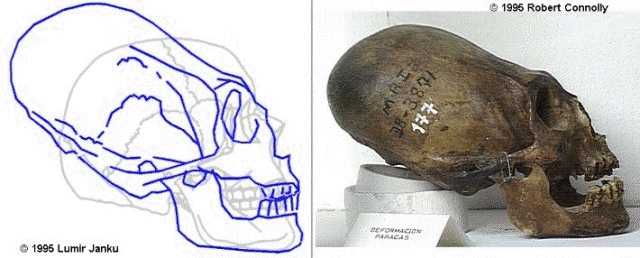
The "Gold Museum" of Peru has displays of Giant skulls and
mummies who were evidently Royalty, according to the clothing and
artifacts they had with them.
|
Glenn Kimball reports:
GLENN’S EXPERIENCE WITH THE GIANTS
Glenn photographed the mummies of two of these giant men in Lima Peru in
1969. These giants are still in the gold museum in Lima Peru today and can
be seen by anyone who visits. They were mummified because their golden
robes are prominently on display. Their crowns could fit around Glenn’s
waist. Their golden gloves have fingers ten inches long. Their mummies can
be measured with a tape and they were both around nine and a half feet
tall. There were other personal items fit for a giant king, that wouldn’t
have been useful to a man of normal size. The actual bodies are there
incased in glass for all to see. The news media has never photographed
anyone nine and a half feet tall.
These were not mutations. A mutation is something that happens once in a
“blue moon”. There were two giants in Peru side by side from successive
generations. What makes the story even stranger is that the average height
of the Peruvians, both now and historically, is well under six feet high.
This isn’t the only time Giants were mentioned by prominent people who
visited South America. Don Cieza de Leon and Agustin de Zarate published
texts on South American Giants in 1553 AD and 1555 respectively. These
books came just after the arrival of the conquistadores and were published
within twenty years of Pizarro. They said that the native traditions told
the incoming Spanish that the giants came to the Americas on raft-like
boats. Some of these men were so tall that from the knee down they were as
big as a man. Their eyes were the size of plates. Some were clad in skins
and others were mostly naked. They said that there were no women on these
boats, which was strange indeed. These giants dug deep wells for water
that still exist today through solid rock. Cieza de Leon said that when
Don Antonio de Mendoza went to Cuzco Peru in 1560 that he found tombs with
extremely large bones, similar to the ones that were already found in
Mexico City at the time of Montezuma. Padre Acosta found similar large
bones in 1560 in Manta Peru where they later found similar bones in 1928
when constructing the railroad to Ecuador. They were hidden behind
stalagmites in caves.
When Diego de Ordaz climbed to the high volcano of Popocatepetl, near
Mexico City, according to Las Casas, he found a giant thigh bone that he
sent to the Vatican. When Cortez invaded Mexico his men found living
giants in this region and reported them. In their written testimonies they
tore a few ribs from the dead bodies of these giants and brought them back
to Spain with them.
In the summer of 1931 Monsignor F. Lunadi organized an expedition into the
jungles of San Agustin. He found traces of a very ancient South American
empire known to the old British buccaneers of the seventeenth century.
These men were giants who had knowledge of electricity which they used in
various forms.
This race of ancient white giant men with beards was called the Viracochas.
Pedro Cieza de Leon said that they came long before the Incas began to
reign. The Indians also called these white men Titicaca, like Lake
Titicaca today located high in the mountains between Bolivia and Peru.
Glenn Lived in Juliaca Peru on the sores of Lake Titicaca, very close to
the ancient city of Tiauanacu where there are huge statues to the giants
with six fingers and toes to this day. On the door to the sun, the main
entrance to their temple, is carved the image of Viracoca, the creator of
not only their civilization, but the white bearded God who created the
whole world. This temple has many similarities to the Masonic temples of
our day.
At the ruins of Pachacamac where US and British archeologists and the
Carnegie Institution are working today, the giants are mentioned. It is
said that they built large beautiful temples with iron tools around 500
BC. The tradition has it that these giant men had no women in their group
and were later consumed in fire from heaven. It is interesting that the
stories of these giants quasi-parallels the story of the Watchers married
the Daughters of Eve. The daughters of Eve bore the watchers giant
children, but nothing is mentioned that these giants themselves had
children. The stories of the Giants often ends in a single generation,
though the Giants lived a very long time.
These giants were granted a state of quasi-unprotected immortality by
deity. They could be killed, but did live long periods of time if they
weren’t deliberately killed and for the most part couldn’t bare children.
According to Hesiod these “Watchers”, one of the parents of the giants,
were men from the four former epochs of human existence prior to the
coming of Adam and Eve. Adam wasn’t the first man on the earth. He was the
patriarch of the final epoch of time. How else could their have already
been men of old and men of renown when Adam and Eve had their first
children? That is exactly what it says in Genesis chapter six. The four
previous epochs of time rose in culture and science, but were exterminated
because they violated the laws of the earth and deity. We are headed for a
similar cataclysm in our day because of our rejection of deity. A human
remnant of the four epochs survived because of their valiant nature and
those people, numbering in the thousands, were called the “Watchers”.
Hesiod suggests that this remnant numbered in the thousands.
These immortals who survived the cataclysms of the four previous epochs of
time were also called angels because they were allowed to pass from the
realm of Deity to mortality seamlessly. They were allowed to pass between
the heavens and the earth because they were given the assignment by deity
to watch over mortals. This is another reason they lived so long and
paradoxically the reason they were commanded not to have children. Their
job wasn’t to interfere with men unless directly commanded. These Watchers
weren’t classic disembodied spirits, as is the case with classic angels.
Most of the evidence and history of the Watchers is included in the audio
class “Daniel and the Watchers”. In essence the Watchers were
noble-immortal men who have yet to die; a status granted them by deity
because of their righteousness.
Two hundred some odd of these watchers, because they were still in the
flesh, found the daughters of Eve attractive and violated their agreements
with deity not to intervene in the lives of men. That is why they are
often called “Fallen Angels”. They bore children to mortal women which was
against their agreement with God. They were angels because of the status
deity gave them and fallen because they violated the agreement. However,
not all the watchers violated the agreement with deity and remain men of
old and men of renown who come and go at the behest of deity. These are
the ones who still appear today during a moment in crisis, effect rescues
and give important messages and then are gone. Most of us have either had
a first hand encounter with one of them at a moment in crisis, or have
heard of the stories from our friends.
Daniel met some of them. Moses is said to have translated the book of
Jubilees as dictated by one of them. Even Mohammed is said to have been
dictated the Quran by one of them. Millions of people have reported a
stranger appearing at the moment of crisis and then vanishing without a
trace. Others have reported these Watchers coming to them during moments
of crisis and giving them critical pieces of advice about subjects they
could not have otherwise known. After they left their message they were
nowhere to be found. Truly these beings watch over the affairs of men and
perform rescues of many kinds, as if they were sent from deity.
The important thing about the giants is that they are children of a small
segment of the Watchers and the daughters of Eve. Since one of the parents
of the Giants was immortal, these giants often lived a very long time.
The North American Indians believed that the first race of human beings
were giants. In the autobiography of William "Buffalo Bill" Cody, Cody
writes that while camping on the South Platte, a Pawnee Indian came into
the camp with what the army surgeon pronounced to be a giant thigh bone of
a human being. When Cody asked about where such a bone might have come
from, the Indian replied that long ago a race of giants had lived in the
area. This race of men had been three times larger than normal men and
able to out-run a buffalo and even carry it in one hand. Cody wrote:
“These giants denied the existence of a Great Spirit, so he caused a
great rain storm to come, and the water kept rising higher and higher so
that it drove these proud, and conceited giants from the low ground to the
hills, and thence to the mountains, but at last even the mountain tops
were submerged and then those mammoth men were all drowned. After the
flood had subsided, the Great Spirit came to the conclusion that he had
made man too large and powerful, and that he would therefore, correct the
mistake by creating a race of men of smaller size and less strength. This
is the reason, say the Indians, that modern men are small and not like the
giants of old, and they claim that this story is a matter of Indian
history, which has been handed down among them from time immemorial.”
The bones that were in the possession of Buffalo Bill were given to the
museum, that promptly hid them. They continue to be lost to us today,
though many saw them at the time.
Brazilian Giants
William Turner, the naturalist and dean of Wells (d. 1568), mentions that
on the coast of Brazil, near the river Polata, he saw a tribe of very
gigantic naked savages, one of whom he estimated to be twelve feet tall.
While in Brazil, Knyvet several times saw an Indian who, though still a
youth, towered to a height of thirteen spans. Since thirteen spans equals
nine feet, nine inches, this would have made the giant about the same size
as Goliath.
Chile's Giants
Reaveneau de Lussan reported contact with natives of Chile that were of
enormous bulk and stature. Frezier also relates that natives of the coast
of Chile told him that some of the Indians living inland stood nine feet
high.
Captain George Shelvock, on his voyage in 1719 to the Island of Chiloe off
the coast of Chile, saw Indians which stood nine to ten feet high.
Cocopa Giants
Soon after Maldonado discovered the Seri giants, Captain Melchior Diaz
came across another tribe of huge Indians while searching farther up the
coast for the ships carrying supplies for Coronado's 1540 expedition.
Pedro de Castaneda reported that, “After going about 150 leagues, they
came to a province of exceedingly tall and strong men-like giants.”
Evidently, these were the Cocopa, a Yuman tribe who also inhabited the
lower Rio Colorado, which the Indians called Rio del Tison.
MAGELLAN
Antonio Francesco Pigafetta, chronicler of Magellan's circumnavigation of
the world: “We had been two whole months in this harbor without
sighting anyone when one day (quite without warning) we saw on the shore a
huge giant, who was naked, and who danced, leaped and sang, all the while
throwing sand and dust on his head. Our Captain ordered one of the crew to
walk towards him, telling this man also to dance, leap and sing as a sign
of friendship. This he did, and led the giant to a place by the shore
where the Captain was waiting. And when the giant saw us, he marveled and
was afraid, and pointed to the sky, believing we came from heaven. He was
so tall that even the largest of us came only to midway between his waist
and his shoulder; 621 yet with all he was well proportioned. He had a
large face, painted round with red; his eyes were ringed with yellow and
in the middle of his cheeks were painted two hearts. He had hardly any
hair on his head, what little he had being painted white....”
Rupert Gould said in his book Enigmas in 1945, included another
quote about Magellan’s voyage and added, This man was so tall that our
heads scarcely came up to his waist, and his voice was like that of a
bull.
Many of the other natives in this region were also very tall; this would
lead to the naming of those in the region the "Patagonian Giants",
Patagonian meaning "people of the long feet."
P. Joseph Tarrubia wrote in his Gianthologia, published in Madrid in 1761,
that some utensils found in South America were of such enormous size that
they could only have been used by giants. He also noted that several
Spanish settlers told of having seen monstrous men, ranging from nine to
ten feet in height, when they sometimes strayed from their wild retreats
verging toward the Straits of Magellan. Tarrubia further related that: “…the
South Americans had a body of soldiers, consisting of about four hundred
men, the shortest of whom was not shorter than nine feet and the tallest
about eleven feet.”
Twenty years before Magellan came, Amerigo Vespucci and some fellow
sailors sighted several giants off the coast of Venezuela. Amerigo, for
whom approximately one-third of the world was later named, recounted this
experience: “Thus sailing along, we came upon an island [Curasao] which
was situated fifteen leagues from the mainland. At our arrival, since we
saw no people and the island looked favorable to us, we decided to explore
it, and eleven of us landed. We discovered a trail and set ourselves to
walk on it two leagues and a half inland; we met with a village of twelve
houses in which we did not find anyone except seven women. They were of
such great stature that there was not one of them who was not taller than
every one of us by a span and a half [about 19 inches]. When they saw us
they were very much afraid of us. The chief one of them, who was certainly
a discreet woman, by signs hauled us up to a house and made them give us
refreshments. When we saw such noble women, we determined to carry off two
of them, who were young women fifteen years of age, and make a present of
them to the king. They were creatures whose stature was certainly above
that of average men. While we were thus plotting, thirty-six men arrived,
who entered the house where we were drinking, and they were of such lofty
stature that each of them was taller when upon his knees than I was when
standing erect. They were of the stature of giants in their great size and
in the proportion of their bodies, which corresponded with their height.
When the men entered, some of our fellows were so frightened that at the
moment they thought they were done for. The warriors had bows and arrows
and tremendous oar blades, finished off like swords. When they saw our
small stature, they began to converse with us to learn who we were and
whence we came. We gave them soft words for the sake of amity and replied
to them in sign language that we were men of peace and that we were out to
see the world. In fact, we judged it wise to part from them without
controversy, and so we went by the same trail by which we had come. They
stuck with us all the way to the sea and until we embarked.
GIANTS ALL OVER THE PLACE AND RIGHT UNDER OUR NOSE
Critics have long suggested that the stories from South America are just
too incredible to be true. They have openly asked why there aren’t stories
of giants in the North America. Nothing could be farther from the truth.
Again we are people who run from subjects that don’t neatly conform to
what we believe.
The stories of the giants are located in every state in the union and are
beyond the scope of a single class. However, to illustrate this point we
choose Ohio.
The History of Marion County, Ohio (1883)
A picture of a skull from 1996, taken by J.C. Chatters of Kennewick Man,
Washington State is that of a giant. Giants were also found when removing
the gravel bluffs for the construction and repairs of roads.
The History of Brown County, Ohio (1883)
Mastodonic remains are occasionally unearthed and from time to time;
discoveries of the remains of Indian settlements. Among the ruins are
gigantic skeletons with high cheek bones, powerful jaws and massive frames
peculiar to the Red man.
Now and Long Ago: A History of the Marion County Ohio Area
Satterfield, a justice of the peace, said that three giant skeletons were
found at the mouth of the Paw Paw Creek. Jim Dean and others found the
bones while digging a bridge foundation. She said it was Dr. Kidwell, of
Fairmont, who examined them and said they were very old, perhaps thousands
of years old. She said that when the skeletons were exposed to the weather
for a few days, their bones turned black and began to crumble. All these
skeletons, she said, were measured and found to be about eight feet long.
MORE HISTORICAL INFORMATION AT:
http://www.stevequayle.com/Giants/articles/giants.Kimball.html
There Were Giants in
the Earth in Those Days
And it came to pass, when men began to multiply on the face of the
earth, and daughters were born unto them,
That the sons of God saw the daughters of men that they were fair; and
they took them wives of all which they chose.
And the Lord said, My spirit shall not always strive with man, for
that he also is flesh: yet his days shall be an hundred and twenty
years.
There were giants in the earth in those days; and also after that,
when the sons of God came in unto the daughters of men, and they bare
children to them, the same became mighty men which were of old, men of
renown.
-- Genesis 6: 1-4 (KJV)
The phrase 'and also afterwards' is a later addition in an attempt
to harmonize the Genesis account with the book of Numbers and Samuel,
for reasons which will become obvious. These giants appear to be an
ancient Hebrew equivalent to the Greek myth of Hercules or Cyclops.
Shortly thereafter everyone on earth, including all the giants, called
Nephilim, perish in the flood, with the exception of Noah and his
family.
"And all flesh died that moved upon the earth, birds, cattle,
beasts, all swarming creatures that swarm upon the earth, and every
man; everything on the dry land in whose nostrils was the breath of
life died. He blotted out every living thing that was upon the face of
the ground, man and animals and creeping things and birds of the air;
they were blotted out from the earth. Only Noah was left, and those
that were with him in the ark." (Genesis
Chapter 7 verse 21)
Since Noah was of a stock of smaller people, most of his
descendants were of his stature. However, some of the genes to produce
giants survived through the wife of Ham, one of Noah's sons.
Therefore, a number of the sons of Canaan (one of Ham's sons) were
giants (Numbers
13:1-2, 32-33). In Deuteronomy
2:19-21, Moses records that God destroyed the giants who dwelt in
Ammon so that the children of Lot could possess the land. Those
giants—who apparently descended from Canaan through a man named Anak—eventually
became extinct. King Og of Bashan was the last of them to inhabit
Palestine east of Jordan (Deuteronomy
3:11).
- Subdued by Chedorlaomer
(Genesis
14:5)
Genesis 14
5 In the fourteenth year, Kedorlaomer and the kings
allied with him went out and defeated the Rephaites in Ashteroth
Karnaim, the Zuzites in Ham, the Emites in Shaveh Kiriathaim 6
and the Horites in the hill country of Seir, as far as El Paran near
the desert. 7 Then they turned back and went to En
Mishpat (that is, Kadesh), and they conquered the whole territory of
the Amalekites, as well as the Amorites who were living in Hazazon
Tamar. The
War of Sodom and Gomorrah
"In the fourteenth year Chedorlaomer and the kings who were
with him came and subdued the Rephaim" (Genesis 14:5 RSV)
Emim
The Emim were a warrior tribe of giants who were defeated by
Chedorlaomer and his allies. Around the time of Abraham,
they lived east of the Jordan.
"In the fourteenth year Chedorlaomer and the kings who were
with him came and subdued the Rephaim in Ashterothkarnaim, the
Zuzim in Ham, the Emim in Shavehkiriathaim" (Genesis 14:5
RSV)
-
Anakim
The Anakim lived in the south, near Hebron. They were defeated by
the Israelites under Joshua.
Joshua 11
6 The LORD said to Joshua, "Do not be afraid of them, because
by this time tomorrow I will hand all of them over to Israel, slain.
You are to hamstring their horses and burn their chariots."
7 So Joshua and his whole army came against them suddenly
at the Waters of Merom and attacked them, 8 and the LORD
gave them into the hand of Israel. They defeated them and pursued
them all the way to Greater Sidon, to Misrephoth Maim, and to the
Valley of Mizpah on the east, until no survivors were left. 9
Joshua did to them as the LORD had directed: He hamstrung their
horses and burned their chariots.
10 At that time Joshua turned back and captured Hazor and
put its king to the sword. (Hazor had been the head of all these
kingdoms.) 11 Everyone in it they put to the sword. They
totally destroyed [2]
them, not sparing anything that breathed, and he burned up Hazor
itself.
"And Joshua came at that time, and wiped out the Anakim
from the hill country, from Hebron, from Debir, from Anab, and
from all the hill country of Judah, and from all the hill country
of Israel; Joshua utterly destroyed them with their cities."
(Joshua 11:21 RSV)
21 At that time Joshua went and destroyed the
Anakites from the hill country: from Hebron, Debir and Anab, from
all the hill country of Judah, and from all the hill country of
Israel. Joshua totally destroyed them and their towns.
The
Lord tells Joshua to Kill the Enemy
Joshua.12:4
"And the coast of Og king of Bashan, which was of the remnant
of the giants."
1 These are the kings of the land whom the
Israelites had defeated and whose territory they took over east of
the Jordan, from the Arnon Gorge to Mount Hermon, including all
the eastern side of the Arabah:
2 Sihon king of the Amorites, who reigned in Heshbon.
He ruled from Aroer on the rim of the Arnon Gorge-from the middle
of the gorge-to the Jabbok River, which is the border of the
Ammonites. This included half of Gilead. 3 He also
ruled over the eastern Arabah from the Sea of Kinnereth [1]
to the Sea of the Arabah (the Salt Sea [2]
), to Beth Jeshimoth, and then southward below the slopes of
Pisgah.
4 And the territory of Og king of Bashan, one of the
last of the Rephaites, who reigned in Ashtaroth and Edrei. 5
He ruled over Mount Hermon, Salecah, all of Bashan to the border
of the people of Geshur and Maacah, and half of Gilead to the
border of Sihon king of Heshbon.
6 Moses, the servant of the LORD , and the Israelites
conquered them. And Moses the servant of the LORD gave their land
to the Reubenites, the Gadites and the half-tribe of Manasseh to
be their possession.
7 These are the kings of the land that Joshua and the
Israelites conquered on the west side of the Jordan, from Baal Gad
in the Valley of Lebanon to Mount Halak, which rises toward Seir
(their lands Joshua gave as an inheritance to the tribes of Israel
according to their tribal divisions- 8 the hill
country, the western foothills, the Arabah, the mountain slopes,
the desert and the Negev-the lands of the Hittites, Amorites,
Canaanites, Perizzites, Hivites and Jebusites):
The
Battles of Moses and Joshua
Og the king of Bashan had reigned in Ashtaroth and Edrei and had
survived as one of the last of the Rephaites. Moses had defeated
them and taken over their land. 13 But the Israelites did
not drive out the people of Geshur and Maacah, so they continue to
live among the Israelites to this day.
(Joshua
13:12)
The
Land that was given by the Lord to the Israelites
- THE VALLEY OF THE GIANTS - Joshuah's
allotment
- A border of Judah
(Joshua
15:8)
- Then it ran up the Valley of Ben Hinnom along the southern
slope of the Jebusite city (that is, Jerusalem). From there it
climbed to the top of the hill west of the Hinnom Valley at the
northern end of the Valley of Rephaim. 9 From the
hilltop the boundary headed toward the spring of the waters of
Nephtoah, came out at the towns of Mount Ephron and went down
toward Baalah (that is, Kiriath Jearim).
Dwelt in Canaan - Manneseh's
Allotment
(Joshua
17:15)
(Said to Joseph) 15 "If you are
so numerous," Joshua answered, "and if the hill country of
Ephraim is too small for you, go up into the forest and clear land
for yourselves there in the land of the Perizzites and Rephaites."
- Jos.18:16
"The valley of the son of Hinnom, and which is in the
valley of the giants."
16 The boundary went down to the foot of the hill
facing the Valley of Ben Hinnom, north of the Valley of Rephaim.
It continued down the Hinnom Valley along the southern slope of
the Jebusite city and so to En Rogel.
(Isaiah
17:5)
It will be as when a reaper gathers the standing grain and
harvests the grain with his arm-
as when a man gleans heads of grain in the Valley of Rephaim.
David &
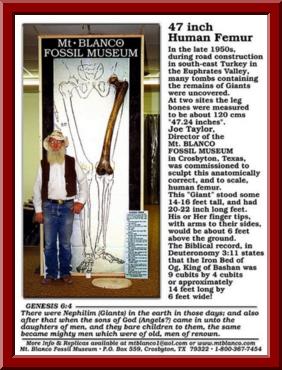
Goliath: 1 Sam.17:4 "Goliath, of Gath, whose height was six
cubits and a span....."
4 A champion named Goliath, who was from Gath, came out of
the Philistine camp. He was over nine feet [1]
tall. 5 He had a bronze helmet on his head and wore a coat of
scale armor of bronze weighing five thousand shekels [2]
; 6 on his legs he wore bronze greaves, and a bronze javelin
was slung on his back. 7 His spear shaft was like a weaver's
rod, and its iron point weighed six hundred shekels. [3]
His shield bearer went ahead of him.
- The last of, destroyed by David and his warriors
(1
Samuel 17:4,49,50; 2 Samuel 21:15-22)
- 48 As the Philistine moved closer to attack him, David
ran quickly toward the battle line to meet him. 49
Reaching into his bag and taking out a stone, he slung it and struck
the Philistine on the forehead. The stone sank into his forehead,
and he fell facedown on the ground.
50 So David triumphed over the Philistine with a sling
and a stone; without a sword in his hand he struck down the
Philistine and killed him.
"And there came out from the camp of the Philistines a champion
named Goliath, of Gath, whose height was six cubits and a span [i.e.
about 9 feet / 3 meters]. He had a helmet of bronze on his head, and he
was armed with a coat of mail, and the weight of the coat was five
thousand shekels [i.e. about 125 pounds / 57 kilograms] of bronze. And
he had greaves of bronze upon his legs, and a javelin of bronze slung
between his shoulders. And the shaft of his spear was like a weaver's
beam, and his spear's head weighed six hundred shekels [i.e. about 15
pounds / 7 kilograms] of iron; and his shield-bearer went before
him." (1 Samuel 17:4-7 RSV) (see David
And Goliath)
The biblical giant Goliath of Gath (or "the Gittite"), whom
the teenage David killed with a sling stone (I Samuel 17). Goliath's
brother and sons were also men of great stature, and the Bible
explicitly mentions that David and his men killed them all (II
Samuel 21:15-22; I
Chronicles 20:4-8).
Both before and after the Flood, God was directly involved in the
destruction of those giant men. The reason for their destruction is not
stated directly, but like Goliath, those men seemed always to be in
opposition to God and to His people Israel.
- David obtained victories over the Philistines in
(2
Samuel 5:18,25)
18 Now the Philistines had come and spread out in the
Valley of Rephaim; 19 so David inquired of the LORD ,
"Shall I go and attack the Philistines? Will you hand them
over to me?"
The LORD answered him, "Go, for I will surely hand the
Philistines over to you."
20 So David went to Baal Perazim, and there he
defeated them. He said, "As waters break out, the LORD has
broken out against my enemies before me." So that place was
called Baal Perazim. [4]
21 The Philistines abandoned their idols there, and
David and his men carried them off.
22 Once more the Philistines came up and spread out
in the Valley of Rephaim; 23 so David inquired of the
LORD , and he answered, "Do not go straight up, but circle
around behind them and attack them in front of the balsam trees.
24 As soon as you hear the sound of marching in the
tops of the balsam trees, move quickly, because that will mean
the LORD has gone out in front of you to strike the Philistine
army." 25 So David did as the LORD commanded
him, and he struck down the Philistines all the way from Gibeon [5]
to Gezer.
Nephilim
Although their origin has been interpreted various ways, the Nephilim
existed very early in human history. Independent Egyptian records of
about 2000 BC also record their existence.
"The Nephilim were on the earth in those days, and also
afterward, when the sons of God came in to the daughters of men, and
they bore children to them. These were the mighty men that were of
old, the men of renown." (Genesis 6:4 RSV)
"‘And there we saw the Nephilim (the sons of Anak, who come
from the Nephilim); and we seemed to ourselves like grasshoppers, and
so we seemed to them.' Then all the congregation raised a loud cry;
and the people wept that night." (Numbers
Chapter 13 verse 33)
SEE: NEPHILIM
Rephaim
The Rephaim occupied the land prior to the Canaanites, but were
eventually defeated. The Anakim, Zuzim, and Emim people were related.
"The Emim formerly lived there, a people great and many, and
tall as the Anakim." (Deuteronomy 2:10 RSV)
Dt.2:10-11
"The Emims dwelt therein in times past, a people great, and many,
and tall, as the Anakims; Which also were accounted giants."
Dt.2:20-21
"That also was accounted a land of giants: giants dwelt therein in
old time.... A people great, and many, and tall, as the Anakims; but the
LORD destroyed them."
"For only Og the king of Bashan was left of the remnant of the
Rephaim; behold, his bedstead was a bedstead of iron; is it not in
Rabbah of the Ammonites? Nine cubits [i.e. about 13 feet / 4 meters] was
its length, and four cubits its breadth, according to the common
cubit." (Deuteronomy 3:11 RSV)
|