The following file is courtesy of HUFON REPORT,
the newsletter of the Houston UFO Network.
THE 12th PLANET - by Zecharia Sitchin Reviewed by Vince Johnson In
his book "The 12th Planet," Zecharia Sitchin presents
evidence not only of contact by extraterrestrial beings thousands of
years ago, but that these beings genetically engineered Homo Sapiens
to serve them.
Sitchin began his inquiry when he came across the
term Nefilim during Talmudic study as a boy. His teacher explained
that the word meant "giants" when describing the
"sons of the deities" who married the daughters of Man,
although the literal Hebrew translation of Nefilim was "those
who were cast down."
Sitchin never accepted the "giants"
explanation, and his curiosity about the Nefilim was the impetus for
"The 12th Planet." The book begins with a short
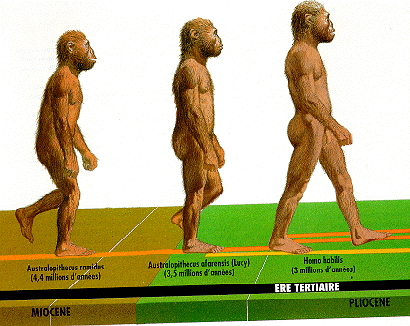
anthropological history of Man, starting with Australopithecus some
two million years ago. Six hundred thousand years later came the
Neanderthal, who, according to Sitchin, used the same tools as his
more primitive ancestors (although the latest findings indicate
Neanderthals were more sophisticated than Sitchin describes). Then,
a mere 35,000 years ago, Homo Sapiens appears. The author quotes a
Dr.T. Dobzhansk, "Modern Man has many fossil collateral
relatives, but no progenitors; the derivation of Homo Sapiens then
becomes a puzzle."
As far as current archaeological knowledge can
reveal, the first true civilization arose in Mesopotamian Sumer,
located in present-day Iraq, at least 6,000 years ago. Sumerian
culture exploded onto the scene virtually overnight, the cradle of
human civilization. A description of Sumer is a list of
"firsts" for the human race. Among these
"firsts" are: the first schools, the first historian, the
first method of writing, the first library, the first doctors and
pharmacopoeia, the first agriculture (and first "farmers'
almanac"), the first musical notation, the first bicameral
legislature, and the first taxes. The Sumerian legal code (also a
first) included protection for divorced women and price controls on
foodstuffs and wagon rentals. Their religion influenced all that
followed, with elements of the Sumerian creation epic filtered
through the ages into the Old Testament (the garden of Eden, the
evil serpent, the great flood, etc.). But Sitchin's analysis of
Sumerian astronomy and cosmology is of most interest. It is
Sitchin's belief that astronomical knowledge actually declined from
the Sumerian period, with much of the Sumerian astronomical
knowledge only rediscovered during the Copernican revolution. To
support this thesis, the author describes the astronomical knowledge
of the ancient Greeks, who came more than 3,000 years after the
Sumerians. It is historical fact that the Greeks not only understood
that the Earth was a sphere, but had calculated its size to amazing
accuracy. The Greek, Hipparchus, knew of the heliocentric
(sun-centered) astronomical system. Hipparchus was also aware of the
phenomenon known as precession of the equinoxes, a cyclical wobble
of Earth's axis that takes 2,160 years to complete.
To understand this phenomenon one would assume
that Hipparchus had to draw upon astronomical data at least that
old. Two hundred years before Hipparchus, Eudoxes of Cnidus designed
a celestial sphere representing the constellations and attributed
their zodiacal designations to "men of yore." Sitchin
writes, "Were the early Greek astronomers living in Asia Minor
better informed than their successors because they could draw on
Mesopotamian sources?"
Sumerian astronomy and the required mathematics used
to describe and predict celestial events were remarkably advanced.
They utilized a unit of measure called dub, which has been
translated to mean both the 360 degree circumference of the Earth,
and the "arch of the heavens." Not only were the Sumerians
aware of the spherical nature of the world, they used the concepts
of the equator, poles, and lines of longitude and latitude. Also,
the apparent retrograde motions of the planets (due to differences
in orbital radii) were understood 6,000 years before renaissance-era
astronomers would solved the puzzle. An accurate Sumerian calendar
dating back to 4400bc acknowledged the precessional shift from 2,160
years before.
The Sumerians used a 12-based numbering system
which still influences numbering today; numbers 1-12 have individual
names while subsequent numbers are contractions. The number 12 was
very significant to the Sumerians, representing the number of their
principle gods which were synonymous with the planets known to them
(they included the Moon and the Sun in their count). Does this mean
that the Sumerians were aware of all of the planets known to us
today, or was it just coincidence?
Sitchin describes numerous cylinder seals showing
what he interprets to be schematic diagrams of the solar system.
These diagrams often show a planet larger than Earth between the
orbits of Mars and Jupiter. These diagrams, along with Sumerian,
Babylonian, and Akkadian creation epics lead Sitchin to believe that
a collision of planets occurred early in the history of the solar
system. Certain aspects of these ancient texts can support Sitchin's
theory, for instance: the "gods" (planets) have
"destinies" (orbits) and "cast out their nets"
(gravitational attraction). According to Sitchin, the 12th planet,
Marduk, while making its approach to the sun (in a highly elliptical
orbit) interacted with the other planets of the solar system,
flinging Pluto into its current peculiar orbit. Marduk, or one of
its satellites, then collided with a planet called Tiamat, which
occupied an orbit between Mars and Jupiter. The Sumerians described
it like this: Tiamat and Marduk, the wisest of gods, Advanced
against one another; They pressed on to single combat, They
approached for battle. After he had slain Tiamat, the leader, Her
band was broken, her host broken up, The gods, her helpers who
marched at her side, Trembling with fear, Turned their backs about
so as to save and preserve their lives.
Sitchin interprets "the host, the helper
gods" to be the moons of Tiamat which "turned their
backs" or changed orbital motions. He suggests that the
"shattered band" became the comets and the asteroid belt.
But of most importance, the bulk of Tiamat's debris fell into a new
orbit and would become Earth. The Hebrew texts mirror the Sumerian
in several respects. In Genesis, the Lord hovers over Tehom (the
Hebrew version of Tiamat), and the lightning of the Lord (Marduk in
Babylonian) lit the darkness as it hit and split Tiamat, creating
the Earth and the "hammered bracelet" Raika (the asteroid
belt). In the Akkadian version, Marduk creates the "hammered
bracelet" by stretching out Tiamat's "lower part"
into a great circle. Such is the Sumerian story of creation. Since
these events presumably occurred before the dawn of Man, how do the
Sumerians come by this account? Sitchin believes it was the Nefilim
who told the story to the Sumerians.
According to Sitchin's theory, the Nefilim were
engaged in mining operations on the Earth. To support this, he
presents evidence of mining activity in Africa (through carbon-14
dating) 100,000 years ago. To further support this notion, Sitchin
presents a Sumerian carving showing the god of mining, Ea, emerging
from a mine pit. Lightning-type rays are emitted by the god,
servants are seen holding up shields between themselves and Ea.
Texts refer to "blue stones that cause ill," which Sitchin
interprets as radioactive cobalt. The texts refer to the underworld
as Kur.Nu.Gi.A, "the land where gods who work in deep tunnels
pile up the ores."
Ultimately, the Nefilim miners mutinied against
their masters, declaring: Excessive toil has killed us, Our work is
heavy, the distress much... While the Birth Goddess is present, Let
her create a Primitive Worker, Let him bear the yoke... Let him
carry the toil of the gods! Marduk responds: I will produce a lowly
primitive; Man shall be his name, I shall create a Primitive Worker;
He will be charged in the service of the gods that they might have
their ease. It is Sitchin's theory that a mutiny of the Nefilim led
to the creation of Mankind. The Nefilim genetically altered a
hominid with some of their own DNA, producing a useful hybrid - Man.
To support this, he quotes a Babylonian text: Let one god be bled..
From his flesh and blood, Let Ninti mix the clay.. The newborn's'
fate thou shalt pronounce; Ninti would fix upon it the image of the
gods; And what it will be is Man.
The god chosen to provide the blood was named
TE.E.MA, which translates to "that which houses that which
binds the memory," which could be interpreted as an allegorical
pre-technological description of "genes." Furthermore, the
Akkadian term for clay is 'tit' in Hebrew, which is synonymous with
bos (mud) and shares a linguistic root with bisa (marsh) and,
interestingly, besa (egg).
To further support the notion that Mankind was
created to serve the Nefilim, Sitchin submits that the Hebrew term
used to describe Man's relationship to the gods was not
"worship" but avod (work). Ancient Man did not worship the
Nefilim, he worked for them. Sitchin's theory could explain the
rapid rise and technical prowess of Sumerian civilization. But what
became of the Nefilim? The author suggests that they either became
aware of, or were the cause of, the coming flood.
The Nefilim blasted off, leaving the Earth to Man, or
at least the few that would survive the coming catastrophe. All
evidence of the Nefilim's existence was buried under tons of mud.
While The 12th Planet does present some interesting data, there are
some weaknesses in Sitchin's theory. For instance, he believes the
Nefilim came from Marduk, the 12th planet. One would have to wonder
how life could have evolved on a planet with an orbit that took it
far beyond the orbit of Pluto. Sitchin also describes Nefilim space
technology with a decidedly Apollo-era slant (the book was written
in 1976). He produces evidence for the idea that the Nefilim used
LEM (Lunar Excursion Module) style landers, and that they also
"splashed-down" in the Indian Ocean.
He even goes so far as to suggest that the reason
the Nefilim chose Mesopotamia for their colony was the availability
of fossil fuels. If the Nefilim came from Marduk, a planet
presumably locked in a permanent deep-freeze, they would probably
have had much more efficient means of energy generation than burning
oil. Sitchin also makes many unqualified declarations regarding the
goings-on in ancient Sumer. To be objective when dealing with
subject matter as speculative as this, he should have incorporated
terms like "could, might" and "possibly" rather
than making unqualified statements of fact. That being said, Sitchin
does present a mystery; how could the Sumerians have so rapidly
achieved such a high level of civilization with no predecessors to
draw on? That they received instruction from alien beings which they
regarded as gods is no more implausible than any other
explanation.
EOF
This article originally appeared in the October
1991 edition of HUFON REPORT.
|
New models developed for understanding primate behavior can now be applied
to the hard evidence of our ancestors to help us understand how our brains have
enlarged three-fold since early hominid Lucy,
four million years ago.
Mitochondrial DNA
(mtDNA) has become very relevant to paleoanthropology since the first Neandertal
mtDNA sequence was discovered in 1997. Bryan Sykes' book The Seven
Daughters of Eve is an excellent book for popular audiences which
explains the science behind mtDNA and why it is so useful for investigating
population histories. It also provides a good look at the way science is
conducted, the conflicts and rivalries that occur, and contains diversions into
fascinating topics such as the Iceman, golden hamsters, and the disappearance of
the Russian royal family including Princess Anastasia. The book is somewhat
Eurocentric, since most of Sykes' data (and the 'seven daughters') come from
Europe, but a section at the back of the book discusses some of what is known
about the worldwide distributions of mtDNA sequences.
 Scientific American has released a new special edition issue devoted to
paleoanthropology: New
Look at Human Evolution. It contains a number of updated reprints of
article about human evolution that have appeared in Scientific American over the
last decade or so. The articles cover topics such as the Out of Africa and
Multiregional models of human evolution, recent fossil discoveries such as Sahelanthropus
and Orrorin,
neandertals, mtDNA, cannibalism, and the evolution of bipedality and skin color.
Scientific American has released a new special edition issue devoted to
paleoanthropology: New
Look at Human Evolution. It contains a number of updated reprints of
article about human evolution that have appeared in Scientific American over the
last decade or so. The articles cover topics such as the Out of Africa and
Multiregional models of human evolution, recent fossil discoveries such as Sahelanthropus
and Orrorin,
neandertals, mtDNA, cannibalism, and the evolution of bipedality and skin color.
Three fossil skulls
discovered at Dmanisi in Georgia, in the ex-USSR, between 1999 and 2001 were
a big surprise to the paleoanthropological community. Not only were they the
oldest and most primitive hominid skulls ever found outside of Africa, in both
brain size and anatomy they seemed intermediate between Homo habilis and Homo
erectus fossils, and their finders classified them as a new species, Homo
georgicus.
Now a similar skull has apparently been found in Africa by Meave Leakey's
team. This new skull, 1.55 million years old, was found in Kenya in 2000, and
announced at the April 2003 meeting of the American Association of Physical
Anthropologists. (Science, 300:893, 9 May 2003) The same report also noted that
many of the scientists at the meeting were skeptical of the validity of Homo
georgicus as a separate species. H. erectus expert Philip Rightmire
is quoted as believing that the Dmanisi skulls are erectus. Finally, a
fourth and more robust skull, along with some skeletal bones, has been
discovered at Dmanisi.
Tim White argues in a recent paper (Early hominids - diversity or
distortion? Science 299:1994, March 28 2003) that maybe too many new fossil
hominid species are being named. He lists 4 recently-named species as examples.
Curiously, two of these are ones for which he was a coauthor. However, he takes
particular aim at Kenyanthropus
platyops, named in 2001 from a fossil skull found by Meave Leakey's
team. White argues that it is so severely distorted that it cannot be
confidently identified, and may just be a Kenyan variant of Australopithecus
afarensis. White is, by all accounts, both widely recognized as a superb
anatomist and feared for the sharpness of both his pen and his tongue. To see
why, read this paper (A
view on the science: Physical anthropology at the millennium, American
Journal of Physical Anthropology 2000), which contains scathing verdicts on many
claims from other scientists
The latest fossil from Olduvai Gorge, OH
65, is a fossil upper jaw with part of the lower face. It was discovered in
1995, but was not made public until 2003 (Blumenschine et al. 2003, Science
299:1217-21 with a commentary by Phillip Tobias in the same issue). Based on its
similarities with both OH 7 (the type specimen of H. habilis) and ER
1470, Blumenschine and his colleagues suggest that 1470 is therefore a
member of habilis, making rudolfensis an invalid species.
Naturally, nothing is ever that simple in paleoanthropology. Another
scientist I spoke to thought that OH 65 differed from both OH 7 and another
couple of fossils that may be rudolfensis jaws. Anatomist Bernard Wood, a
major proponent of rudolfensis in the last decade, is another scientist
unlikely to accept the demise of that species. So the conclusion of Blumenschine
and his colleagues will certainly not go unchallenged.
Tobias' commentary article notes that the number of hominid species and even
genera has taken off in recent years. I had noticed the same phenomenon myself:
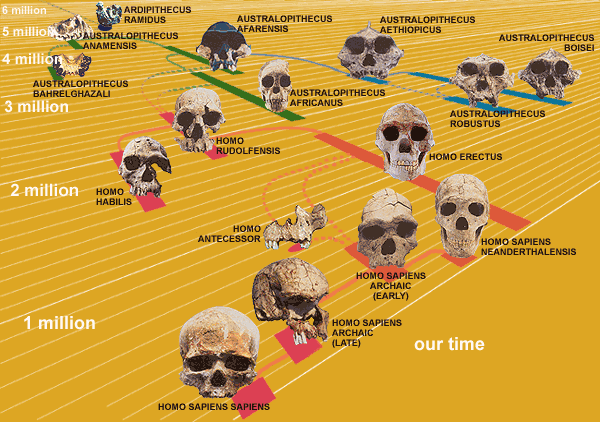
since 1994, we have seen the naming of A. anamensis, Ar. ramidus, A.
garhi, A. bahrelghazali, K. platyops, O. tugenensis, S.
tchadensis, and H. antecessor. That's 8 new species, and 4 new
genera, in less than a decade.
A similar explosion of species and genera occurred in the first half of the
20th century. Scientists and discoverers of fossils cheerfully created new names
for just about every significant fossil that was found. This burst of naming had
very little to do with biological reality (most specimens weren't very different
from existing species), and probably a lot to do with ego-tripping and a desire
to leave their mark on science. Happily, most of these names were thrown out in
a great rationalization in the 1950's, leaving only a handful of generally
accepted taxa remaining.
It wouldn't be surprising if some of the new species named in the past decade
also failed to survive the test of time. However, many of them could survive -
the recent increase in named species may well be a real phenomenon, caused by
the fact that more people are searching for hominid fossils in more places than
ever before.
http://news.independent.co.uk/world/science_medical/story.jsp?story=492123
Did Neanderthals breed with humans?
By Steve Connor, Science Editor, in Seattle
17 February 2004
Fossilized human faeces tens of thousands of years old are helping scientists
answer one of the most intriguing questions in anthropology: did early humans
interbreed with the Neanderthals?
Researchers are sifting through the detritus of two Stone-Age cave sites in
Israel to find samples of human excrement that could be analyzed for DNA and
point to signs that Neanderthals and anatomically modern humans had children
together.
The thick-set Neanderthals seem to have almost disappeared by the time that the
first modern humans - Cro-Magnons - arrived in Europe and the Middle East some
50,000 years ago. But there has been intense speculation about whether the
Neanderthals died out completely or left some hybrid descendants.
Henrik Poinar, of McMaster University in Ontario, Canada, said that a project to
analyse the genetic material of human coprolites - fossilised stools - could
help to solve the mystery by looking for hybrid Cro-Magnon and Neanderthal DNA
from the same individual. Dr Poinar said: "I take Cro-Magnon DNA and probe
for Neanderthal DNA. If they interbred, and the [DNA] is from Neanderthal, I'll
pick it up as obvious interbreeding."
Palaeontologists know from bones and artefacts that the Israeli caves were
inhabited almost certainly at the same time by Cro-Magnons and Neanderthals, so
it is an obvious place to look for signs of interbreeding, Dr Poiner said.
"When you take sediments from a cave ... the majority are faeces that have
just been trampled in over time," he said.
Bibliography:
Zeitlyn, D. 1993. Names for things
or ideas? Mambila masks, museums, CmedicinesD and the meaning of Sùàgà
Paper presented at: 8African Studies Association Conference9. Boston. Source:
printed biblio from Zeitlyn 1994
Zeitlyn, D. 1994. Sua in Somié.
Mambila Traditional Religion Sankt Augustin: Academia Verlag. Source: BIDS-IBSS
AFRICAN SOCIETIES
The culture of the peoples of Mediterranean
Africa, the Sahara, the Ethiopian Highlands and the Horn of Africa differs markedly
from that of the peoples further south. In this course the emphasis is on that southern
area, the Sub-Saharan African Major Cultural Region, to give it a formal label. The
aim throughout is to improve your detailed knowledge of the societies of this major
region during the period since c1890, and to sharpen your judgement of how these
societies differ from each other, and from European societies of the same period.
Particularly important is the need to focus on the images of 'Africa' which people
in Britain have, and to test these against the evidence available on this course.
For instance, some people in Britain see Sub-Saharan Africa as covered with wet equatorial
forest (which they call 'jungle'), Most of it is not!
There is no textbook fully suitable
to the course, and the lectures are designed to provide a framework, and also a commentary
on the more important features. However, it is possible to provide a list of books
for background reading, covering all the major region or parts of it:-
Allen, Chris and Gavin Williams (eds.),
'Sociology of "Developing Countries"' in Subsaharan Africa, Macmillan.
Birmingham, D. 1995. The decolonisation
of Africa London: UCL Press.
Birmingham, D., & Martin, P.
M. (eds.) 1983. History of Central Africa. 2 vols. London: Longmans.
Fage, J.D., A History of Africa,
Hutchinson.
Davidson, B. 1992. The Black Man's
Burden: Africa and the Curse of the Nation-State London: James Curry.
Iliffe, John, The Emergence of
African Capitalism (Anstey Memorial Lectures, 1982), Macmillan.
Mair, Lucy, African Kingdoms,
Oxford.
Mair, Lucy, African Societies,
Cambridge.
Mair, Lucy, Primitive Government,
Scolar.
Rodney, Walter, How Europe Underdeveloped
Africa, East Africa Publishing House.
.You may like to read what is happening
south of the Sahara while this course is going on. A useful source is The Economist
or Focus on Africa (per DT 1.F6). You should, however, note that for The
Economist , and all British journalists, Africa is a Cinderella area, and does
not receive the refined attention devoted to Europe and the United States.
African societies become less baffling
when you know some of the peoples in detail. It is worth choosing three peoples,
and absorbing each of them thoroughly.
Eades, J.S., The Yoruba Today
NB an electronic verion of this is available: http://lucy.ukc.ac.uk/YorubaT/yt.html
Heald, S. 1989. Controlling
anger : the sociology of Gisu violence (International African library ; 6). Manchester:
Manchester University Press for the International African Institute.
Leakey, L.S.B., The Southern
Kikuyu Before 1903 (This is in three volumes. You may like to concentrate on
one)
Bowen, E.S. 1956. Return to
Laughter . London: Readers Union.
Caplan, P. 1997. African Voices,
African Lives. Personal narratives from a Swahili village . London: Routledge.
AFRICAN SOCIETIES- Introduction:
Society, Culture and the Physical Environment
Climate and vegetation. Types of
subsistence activity and their distribution. Population distribution. Main linguistic
and cultural boundaries.
Fage, J.D., A History of Africa,
chapter 1.
Forde, D., "The cultural map
of West Africa" (photocopy in Short Loan).
Hopkins, A., An Economic History
of West Africa, chapter 1.
Mabogunje, A.L., "The land and
peoples of West Africa" in J.F.A. Ajayi and M. Crowder (eds.), History of
West Africa, vol.1.
Politics and Social Control in Stateless Societies
States and stateless societies. Definitional
problems. Bands, segmentary lineages and age-sets. Social order and dispute settlement.
Fortes, M., and E.E. Evans-Pritchard,
"Introduction" in Fortes and Evans-Pritchard (eds.), African Political
Systems.
Horton, R., "Stateless societies
in the history of West Africa" in J.F.A. Ajayi and M. Crowder (eds.), A History
of West Africa, vol.1.
Mair, Lucy, Primitive Government,
part 1, chapters 1-4.
Obayemi, A., "The Yoruba and
Edo-speaking peoples and their neighbours before 1600" in Ajayi and Crowder
(eds.), History of West Africa, vol.1 (2nd edition only).
Shorter, A., East African Societies,
chapter 4.
Anigbo, O.A.C. 8Commensality as Cultural
Performance: the struggle for leadership in an Igbo Village9, in The Politics
of Cultural Performance , edited by David Parkin, Lionel Caplan and Humphrey
Fisher, 101-14. (Oxford: Berghahn Books, 1996).
Stevenson, Robert F., Populations
and Political Systems in Tropical Africa.
Further Case Studies
Bohannan, Paul, "Political aspects
of Tiv social organisation" in J. Middleton and D. Tait (eds.), Tribes Without
Rulers.
Fortes, M., "The political system
of the Tallensi" in M. Fortes and E.E. Evans-Pritchard (eds.), African Political
Systems.
Gibbs, J.L. (ed.), Peoples of
Africa, chapters on Igbo, Fulani, Tiv.
Mair, Lucy, African Societies,
chapters 3, 10, 11, 16.
Gibbs, J.L. (ed.), Peoples of
Africa, chapters on Jie, Somali, Bantu Tiriki.
Gulliver, P., Social Control in
an African Society.
Hunters and Gatherers
Foraging techniques. Social structure
of hunting and gathering bands. Foraging and the environment. Relations with outsiders.
Sedentarisation.
Kalahari Bushmen
Barnard, A. "Kalahari Bushmen settlement
patterns" in P. Burnham and R.F. Ellen (eds.), Social and Ecological Systems.
Lee, Richard B., "!Kung Bushman
subsistence" in A. Vayda (ed.), Environment and Cultural Behaviour.
Lee, Richard B., "The !Kung Bushmen
of Botswana" in M.G. Bicchieri (ed.), Hunters and Gatherers Today.
Lee, R.B. and I. De Vore (eds.),
Kalahari Hunter-Gatherers.
Marshall, Lorna, The !Kung of
Nyae Nyae.
Marshall, L. "The !Kung Bushmen
of the Kalahari" in J.L. Gibbs (ed.), Peoples of Africa.
Shostak, M. 1981. Nisa. The life
and Words of a !Kung Woman . Harmondsworth: Penguin.
Katz, R. 1982. Boiling energy
: community healing among the Kalahari Kung . Cambridge, Mass.; London: Harvard
University Press.
Hadza
Woodburn, J., "An introduction
to Hadza ecology" in Lee, R.B. and De Vore (eds.), Man the Hunter.
Woodburn, J., "Residential stability"
in Lee and De Vore (eds.) op.cit.
Woodburn, James. "Egalitarian
societies", Man (N.S.) 17 (1982), 431-51.
Mbuti
Turnbull, Colin, "The Mbuti pigmies
of the Ituri forest" in J.L. Gibbs (ed.), Peoples of Africa.
Turnbull, C., The Forest People.
Turnbull, C., Wayward Servants.
Pastoralism
Dyson-Hudson, N., "Subsistence
herding in Uganda" (photocopy in Short Loan).
Monod, T. (ed.), Pastoralism in
Tropical Africa, "Introduction" and papers by Baxter, Gulliver and
Lewis.
Swift, J., "Sahelian pastoralists:
underdevelopment, desertification and famine", Annual Review of Anthropology,
6, 1977, 457-78.
Further Case Material
Frantz, C., "The open niche, pastoralism
and sedentarization in the Mambila grasslands of Nigeria" in P. Salzman (ed.),
When Nomads Settle.
Gibbs, J.L. (ed.), Peoples of
Africa, Chapters on Jie, Karimojong, Somali, Fulani.
Gulliver, P., The Family Herds.
Mair, Lucy, African Societies,
chapter 3.
Monod, T. (ed.), Pastoralism in
Tropical Africa, select from papers by Baker, Frantz, Horowitz, Jacobs, Swift.
Spencer, P. 1965. The Samburu,
a study of gerontocracy in a nomadic tribe . London: Routledge & Kegan Paul.
Spencer, P. 1988. The Maasai of
Matapato, a study of rituals of rebellion . Bloomington: Indiana University Press.
Stenning, Derrick J. Savannah
Nomads. A study of the Wodaabe Pastoral Fulani of Western Bornu Province, Northern
Region, Nigeria . (London: O.U.P., 1959).
Riesman, Paul, Freedom in Fulani
Social Life.
West Africa
Goody, J., Technology, Tradition
and the State in Africa.
Law, R., "Oyo: a West African cavalry
state" in Journal of African History, 1975.
MacGaffey, W. 1970. The Religious
Commissions of the Bakongo. Man (n.s.) 5.1, 27-38.
Morton-Williams, P. 1960. The Yoruba
Ogboni cult in Oyo. Africa 30, 362-374.
Smaldone, J., Warfare in the Sokoto
Caliphate.
Wilks, I., "Ashanti in the 19th
century" in D. Forde and P. Kaberry (eds.), West African Kingdoms in the
19th Century.
Wilks, I., "Land, labour, capital
and the forest kingdom of Asante" in J. Friedman and M. Rowlands (eds.), The
Evolution of Social Systems.
East Africa
Gibbs, J.L. (ed.), Peoples of Africa,
chapter on Ganda, Rwanda.
Mair, Lucy, African Societies, chapters
12-14.
Mair, Lucy, Primitive Government,
part II, chapters 5-10.
Shorter, A., East African Societies,
chapter 5.
Concepts of the tribe
Freid 'The notion of tribe.'
Southall, A. 1970. 'The illusion
of tribe', Journal of Asian and African Studies 5(1-2), 28-50.
this is in the library as a BOOK:
The passing of tribal man in Africa, ed. Peter C.W. Gutkind .
Kopytoff, I. 1987. The Internal African
Frontier: the making of African political culture. In The African Frontier: the
reproduction of traditional African societies (ed.) I. Kopytoff. Bloomington:
Indiana University Press.
Peel, J. D. Y. 1989. The cultural
work of Yoruba ethnogenesis. In History and ethnicity (eds.) E. Tonkin, M.
McDonald, & M. Chapman. London: Routledge.
Davidson 'Blackman's Burden' chapter
4
Case studies:
1) The Tikar
Jeffreys, M. D. W. 1964. Who are
the Tikar? African Studies 23(3/4), 141-153.
Chilver, E. M., & Kaberry, P.
M. 1971. The Tikar problem: a non-problem. Journal of African Languages 10(2),
13-14.
Price, D. 1979. Who are the Tikar
now? Paideuma 25, 89-98.
Fowler, I. & D. Zeitlyn. 1997.
Introductory Essay: the Grassfields and the Tikar. In African Crossroads: intersections
of history and anthropology in Cameroon (eds) I. Fowler & D. Zeitlyn. Oxford:
Berghahn. In Short-term loan and also available electronically at
http://lucy.ukc.ac.uk/dz/xroads/intro.html
Slaves and the Slave Trade
Domestic slavery in Africa. Slaves and
political systems. Warfare and the production of slaves. The Atlantic slave trade.
Impact on African societies. Abolition and the growth of legitimate trade: effects
on domestic slavery.
Inikori, J., "Introduction"
in Inikori (ed.), Forced Migration.
Fage, J.D., "Slavery and the slave
trade in the context of West African history" in Inikori (ed.)
Kopytoff, I. & S. Miers. 1977.
African "slavery" as an institution of marginality. In Slavery in Africa:
Historical and Anthropological Perspectives (eds) I. Kopytoff & S. Miers.
Madison: University of Wisconsin Press.
Lovejoy, P., "Slavery in the
context of ideology" in Lovejoy (ed.), The Ideology of Slavery in Africa.
Law, R. (ed.) 1995. From slave
trade to 'legitimate' commerce. The commercial transition in nineteenth-century West
Africa . Cambridge: Cambridge University Press.
Further Discussion
Curtin, Philip D., "The Atlantic
slave trade 1600-1800" in J.F.A. Ajayi and Michael Crowder (eds.), History
of West Africa, vol.1.
Fage, J.D., A History of Africa,
chapters 9-11.
Hopkins, A.G., An Economic History
of West Africa, chapter 2.
Iliffe, J., The Emergence of African
Capitalism, chapter 1.
Inikori, J. (ed.), Forced migration,
papers by Fage, Rodney, van Dantzig, Alpers.
Lovejoy, P. (ed.), The Ideology
of Slavery in Africa, select from papers by Northrup, Agiri, Klein, Lovejoy and
Cooper.
Rodney, W., How Europe Underdeveloped
Africa, chapters 2-4.
Burnahm and Goody chapters in Watson,
J. L. (ed.) 1980. Asian and African systems of slavery Oxford: Blackwell.
Longer Case Studies
Akinjogbin, I.A., Dahomey and
Its Neighbours.
Law, R., The Oyo Empire.
Rodney, W., A History of the Upper
Guinea Coast.
Meillassoux, C. 1991. The anthropology
of slavery: the womb of iron and gold London: Athlone.
Descent: lineal and cognatic
The distribution of kinship systems
in Africa. The influence of environment on kinship structure. Patrilineal, Matrilineal,
double unilineal and cognatic procedures: definitional problems. Kinship and changing
economic conditions.Residential flexibility and organisation. Impact on matrilineal
procedures of economic change and social mobility.
General
Lewis, I.M., "Problems in the comparative
study of unilineal descent groups" in M. Banton (ed.), The Relevance of Models
for Social Anthropology.
James, W. 1993 (1978). 'Matrifocus on
African Women,' in S. Ardener (ed.) Defining Females , pp.140-62 Oxford: Berg.
Barber, K. 1991. I could speak
until tomorrow: Oriki, Women and the Past in a Yoruba Town Edinburgh: Edinburgh
University Press for the I.A.I. Chapter 5 'Oriki of Origin' on Kinship and ile.
Classic Unlineal Systems
Fortes and Evans-Pritchard (eds.), African
Political Systems, chapters on Nuer and Tallensi.
Gough, K., "Nuer kinship: a
re-examination" in T.O. Beidelman (ed.), The Translation of Culture.
Mair, L., Peoples of Africa, chapters
5, 10 (Nuer and Tallensi).
Worsley, P., "The kinship system
of the Tallensi: a re-evaluation", Journal of the Royal Anthropological Institute,
86, 1956, 37-75.
Douglas, M., "Is matriliny doomed
in Africa?" in M. Douglas (ed.), Man in Africa.
Fortes, M., "Kinship and marriage
among the Ashanti" in A.R. Radcliffe-Brown and D. Forde (eds.), African Systems
of Kinship and Marriage.
Fortes, M., "Time and social
structure" in Time and Social Structure and Other Essays.
Fortes, M., Kinship and the Social
Order, chapters 9 and 10.
Longer Monographs
Evans-Pritchard, E., The Nuer.
Evans-Pritchard, E., Kinship and
Marriage Among the Nuer.
Agnatic or Cognatic?
Bender, D.R., "Agnatic or cognaticD",
Man, 1970.
Eades, J.S., The Yoruba Today, chapter
3.
Lloyd, P., "Agnatic and cognatic
descent among the Yoruba", Man, 1966.
Cognatic Systems
Goody, Esther, Contexts of Kinship.
Smith, M.G., "The Hausa" in
Gibbs (ed.), Peoples of Africa.
Double Descent Systems
Forde, D., "Kinship and marriage
among the Yako" in , op.cit.
Goody, J., "The fission of domestic
groups among the LoDagaba" in J. Goody (ed.), The Developmental Cycle in
Domestic Groups.
Marriage
Husbands and wives in a polygynous society.
Bridewealth. Terminal separation and divorce. Marriage, class and social mobility.
Alternatives to marriage.
Radcliffe-Brown, A. R. 1950. Introduction.
In African Systems of Kinship & Marriage (eds.) A. R. Radcliffe-Brown,
& D. Forde. Oxford: OUP.
All the chapters in African Systems
of Kinship & Marriage (eds.) A. R. Radcliffe-Brown, & D. Forde. Oxford:
OUP. are recommended.
Goody, J. R., & Tambiah, S. J.
1973. (eds.) Bridewealth and dowry Cambridge: Cambridge University Press.
Several chapters are good including Goody
Bohannan, Paul 'The impact of money
on an African subsistence economy'. Journal of Economic History 19
, 491-503 (1959) reprinted in ed Dalton CTribal and Peasant economiesD
Marriage Presentations
Evans-Pritchard, E., Kinship and
Marriage Among the Nuer.
Gray, R., "Sonjo brideprice"
in LeClair and Schneider (eds.), Economic Anthropology.
Goody, E.N. & J.R. Goody. 1967.
The Circulation of Women and Children in Northern Ghana. Man (N.S.) 2(2),
226-248.
The Economic Role of Women
Allen, C. and G. Williams (ed.),
'Sociology of "Developing Countries"' in Subsaharan Africa, section
2.
Hafkin, Nancy and Edna Bay (eds.),
Women in Africa, read "Introduction" and select from other papers.
Schildkrout, E., "Dependency
and autonomy" in C. Oppong (ed.), Male and Female in West Africa.
Schlegel, Alice, Sexual Stratification,
papers by Smock and Lewis.
Sudarkasa, N., Where Women Work.
Alternatives to Marriage
Cohen, A., Custom and Politics
in Urban Africa, chapter 2.
Dinan, C., "Pragmatists or feminists?
The professional single women in Accra" in Cahiers d'Etudes Africaines, 65,
1977, 155-76.
Dinan, C., "Sugar daddies and
gold diggers: the white-collar single women in Accra" in C. Oppong (ed.), Female
and Male in West Africa.
Pitten, R., "Houses of women:
a focus on alternative life-styles in Katsina City" in C. Oppong (ed.), Female
and Male in West Africa.
Social Mobility and Marriage
Harrell-Bond, B., Modern Marriage
in Sierra Leone.
Oppong, C., Marriage Among a Matrilineal
Elite.
African Worlds
God and the cosmos. Interpretation of
ritual and symbolism.
Cosmic Structure and Social Structure
Douglas, Mary, Natural Symbols.
Evans-Pritchard, E., Nuer Religion.
Horton, R., "The Kalabari world
view" Africa, 1962.
Lienhardt, G., Divinity and Experience,
especially Part I.
Morton-Williams, P., "An outline
of the cosmology and cult organisation of the Oyo Yoruba" Africa, 1964.
The Interpretation of Symbols
Sperber, Dan, Rethinking Symbolism.
Turner, V., The Ritual Process.
Turner, V., The Forest of Symbols.
Wescott, Joan and P. Morton-Williams,
"The symbolism and ritual context of the Yoruba laba Shango " in
Journal of the Royal Anthropological Institute, 1962.
Religion and the Social Order: Social Control and the Explanation of Misfortune
The explanation of misfortune. Divination
and sacrifice. Witches and ancestors. Ritual in politics and social control.
The Explanation of Misfortune
Bascom, W.R., "The sanctions
of Ifa divination" in Journal of the Royal Anthropological Institute, 1941,
43-51.
Evans-Pritchard, E., Witchcraft,
Oracles and Magic Among the Azande.
Horton, R., "African traditional
thought and western science" in Africa, 1967, also in M. Marwick (ed.),
Witchcraft and Sorcery, and in B. Wilson (ed.), Rationality.
Mendonsa, E., "Etiology and
divination among the Sisala of Ghana" (photocopy in Short Loan).
Zeitlyn, D. 1990. 'Professor Garfinkel
visits the Soothsayers. Ethnomethodology and Mambila Divination', Man (n.s.) 25(4),
654-66.
Zeitlyn, D. 1995. 'Divination as
Dialogue: the negotiation of meaning with random responses,' in E. N. Goody (ed.)
Social Intelligence and Interaction , pp. 189-205. Cambridge: Cambridge University
Press.
Zeitlyn, D. 1993. 'Spiders in and
out of Court or "the long legs of the law." Styles of spider divination
in their sociological contexts.', Africa 63(2), 219-240.
Indigenous Healing
Prince, R., "Curse, invocation
and mental health among the Yoruba" (photocopy in Short Loan).
Prince, R., "Indigenous Yoruba
psychiatry" (photocopy in Short Loan).
Maclean, U., Magical Medicine.
Turner, V., The Forest of Symbols,
chapters 9-10.
Turner, V., The Drums of Affliction.
Ancestors and Witches
Kopytoff, I. 1971.'Ancestors as Elders',
Africa 41, 129-42.
Calhoun, C. J. 1980. 'The authority
of ancestors: a sociological reconsideration of Fortes's Tallensi in response to
Fortes's critics', Man (n.s.) 15(2), 304-319. and the ensuing correspondence with
Kopytoff in Man: 16(1), 135-138; 17(3), 548 etc
Fortes, M., "Pietas and ancestor
worship" in Journal of the Royal Anthropological Institute, 1961.
Gluckman, M. 1937. Mortuary customs
and the belief in survival after death among the South-Eastern Bantu. Bantu Studies
11, 117-36.
Mambila avatars and the ancestor
cult: Problems of History and Interpretation.
Bradbury, R., "Fathers, elders
and ghosts in Edo religion" in M. Banton (ed.), Anthropological Approaches
to the Study of Religion.
Goody, J., Death, Property and
the Ancestors.
Goody, E., "Legitimate and illegitimate
aggression in a West African state" in M. Douglas (ed.), Witchcraft Confessions
and Accusations.
Middleton, J., "Witchcraft and
sorcery in Lugbara" in J. Middleton and E. Winter (eds.), Witchcraft and
Sorcery in East Africa.
Middleton, J., Lugbara Religion.
Gender issues and possession
Possession, trance and mediumship. Gender
roles, politics and the coneption of selfhood.
Boddy J. 1988, Spirits and Selves
in Northern Sudan: the Cultural therapeutics of Possession and Trance. In American
Ethnologist 15(1):4-27.
Boddy J. 1989, Wombs and Alien Spirits:
Women, Men and the Zar Cult in Northern Sudan. Madison, University of Wisconsin Press.
Boddy J. 1994, Spirit Possession
Revisited: Beyond Instrumentality. In Annual Review of Anthropology 23:407-434.
Bourguignon E. (ed.), 1973 Religion,
Altered States of Consciousness and Social Change. Columbus, Ohio, Ohio State University
Press.
Constantinides 1985, Women Heal Women:
Spirit Possession and Segregation in a Muslim Society. In Social Science and Medicine
21(6):685-692.
Corin E. 1979, A Possession Psychotherapy
in an Urban Setting: Zebola in Kinshasa. In Social Science and Medicine 13(B):327-338.
Crapanzano V. 1977, Introduction.
In Crapanzano V. and Garrison V. (eds.), Case Studies in Spirit Possession. London,
Wiley Inter-Science Publications.
Crapanzano V. 1980, Tuhami: Portrait
of a Moroccan. Chicago, Chicago University Press.
Csordas T. J. 1987, Health and the
Holy in African and Afro-American Spirit Possession. In Social Science and Medicine
24(1):1-11.
Gussler J. 1973, Social Change, Ecology
and Spirit Possession among South African Nguni. In Bourguignon E. (ed.), Religion,
Altered States of Consciousness and Social Change. Columbus, Ohio, Ohio State University
Press.
Kramer F. 1993, The Red Fez: Art
and Spirit Possession in Africa. London, Verso.
Lambek M. 1980, Spirits and Spouses:
Possession as a System of Communication among the Malagasy Speakers of Mayotte. In
American Ethnologist 7(2):318-331
Lambek M. 1981, Human Spirits: A
Cultural Account of Trance in Mayotte. Cambridge, Cambridge University Press.
Lambek M. 1988, Spirit Possession,
Spirit Succession: Aspects of Social Continuity among Malagasy Speakers in Mayotte.
In American Ethnologist 15(4):710-731.
Lambek M. 1989, From Disease to Discourse:
Remarks on the Conceptualization of trance and Spirit Possession. In Ward C. A. (ed.)
Altered States of Consciousness and Mental Health: a Cross-Cultural Perspective.
Newbury Park, London and New Delhi, Sage Publications.
Lévy R. I., Mageo J. M. and
Howard A. 1996, Gods, Spirits and History: a Theoretical Perspective. In Mageo J.
M. and Howard A. (eds.), Spirits in Culture, History and Mind. New York and London,
Routledge.
Lewis I. M. 1971, Ecstatic Religion.
Harmondsworth, Penguin Books.
Lewis I.M., El Safi A. and Hurreiz
S., 1991. Women's Medicine: the Zar-Bori in Africa and Beyond. Edinburgh University
Press for the International African Institute.
Lovell N. I. 1997, Unleashing Spirits
and Unbouding Gender: Vocal Gods and Polyvalent Discourse in Watchi possession. In
Ethnos, October 1997,3-4.
Zempléni A. 1977, From Symptom
to Sacrifice: the Story of Khady Fall. In Crapanzano V. and Garrison V. (eds.), Case
Studies in Spirit Possession. London, Wiley Inter-Science Publications.
To find these books, check with your local library or
amazon.com OR bn.com
|
MORE PAGES ABOUT AFRICA
ON THIS SITE
RELIGIONS
AND CULTURES OF MOON WORSHIP
... Among the Baganda of central Africa
it was customary for a mother to bathe her newborn child by the
light of the first full moon. ...
www.greatdreams.com/moon/moon_worship.htm
THE
TRUTH ABOUT "SARS"
... WHO, as you may recall, is a UN
sponsored organization that is rumored to have helped spread
AIDS to Africa by way of contaminated hepatitis B and/or
polio ...
www.greatdreams.com/sars.htm
MYTHOLOGY
... NEAR EAST [For Egypt, see under AFRICA]
Mythology --This is an extensive site with lots of useful
information. Assyro-Babylonian ...
www.greatdreams.com/myth.htm
MY
FATHER COMES TO VISIT - A DREAM AND PROPHECY- 5-30-99
... While EA/EN.KI was in the south of Africa
working the gold mines, EN.LIL took over the command of the
seven Cities of Gods in the E.DIN ("Home of the Righteous ...
www.greatdreams.com/father.htm
TERRORISM
- WORLD TRADE CENTER - DAY 2 - 9-12-2001
... organisations. He is wanted by a US
court for masterminding the bombing in 1998 of two US embassies
in East Africa in which 224 people died. ...
www.greatdreams.com/trade_day2.htm
THE
MARS/MOON/ANCIENT SITES CONNECTIONS
... Sister,The Zulu Tribe in Africa
believes in the coming change.
www.greatdreams.com/mars.htm
THE
MOON IS TOO TOO BRIGHT - BACTERIA ON THE MOON
... east, and the eastern Indian Ocean;
the end visible in Australia, Antarctica, New Zealand, Asia
except extreme northern part, eastern Africa, western
Pacific ...
www.greatdreams.com/moon/bacteria.htm
THE
SYMBOLISM AND SPIRITUAL SIGNIFICANCE OF THE NUMBER 72
... there aree two sets of standards and
72 = 75 and is regarded to be the same) http://www.greatdreams.com/gem1.htm
...CHANNELED MESSAGE - DANGER IN SOUTH AFRICA. ...
www.greatdreams.com/72.htm
BLACK
AND WHITE - TWO TIMELINES - IS IT TIME TO MERGE?
... 1787 - Philadelphia’s Free Africa
Society organized. ... 1820 - First organized emigration
of US Blacks back to Africa, from New York to Sierra
Leone. ...
www.greatdreams.com/blkwht.htm
GENEALOGY
- HOLOGRAMS
... In the hologram appeared a scene of Africa
and coming across the Savannah grass were two ... http://www.greatdreams.com/io.htm.
maitreya.htm. ... ...
www.greatdreams.com/genealogy.htm
A
PROPHET IN OUR OWN TIME - DR. JOHN COLEMAN
... He has written a book titled
"The Committee of 300", along with others, lectured on
South Africa and the Boer War, and the butchery done on
those people by ...
www.greatdreams.com/coleman.html
ELEPHANTS
IN CAPTIVITY
... Origin : Africa and South of
Sahara. ... Human populations in Africa and Asia
have quadrupled
since the turn of the century, the fastest growth rate on the
planet. ...
www.greatdreams.com/eeyore/elecruel.htm
UPLIFTING
WOMEN - CRIMES OF VIOLENCE AGAINST WOMEN AROUND THE ...
... Africa is a continent with
rich cultural traditionÆbut one ancient ritual has wounded an
estimated 130 million girls. ... Mary" is from West Africa.
...
www.greatdreams.com/uplifting.htm
DAVID
WILCOCK - PART VIII - The Breath of the Divine and “ ...
... The woman told him that it was really
a water buffalo, and that it was one of the three deadliest
animals in their section of Africa. ...
www.greatdreams.com/chap8.htm
DREAM
OF THE BEAUTIFUL MAN AND THE TRAP
... lined, however, Celtic or ancient
Aryan-speaking tribes were predated by the Iberians over Great
Britain, Ireland, France, Spain, North Africa, South
Italy and ...
www.greatdreams.com/et.htm
A
NEW IDEA - A DREAM
A NEW IDEA. A DREAM. AND. A THOUSAND POINTS OF
LIGHT. WHAT MAKES A GREAT MAN?????
www.greatdreams.com/newidea.htm
THE
HOLLOW EARTH - DREAMS AND VISIONS
... I hope I'm wrong. SOUTH AMERICA - 0
TO 10 DEGREES NORTH LATITUDE. AFRICA - 0 TO 10 DEGREES
NORTH LATITUDE. INDIA AND ASIA - 0 T 10 DEGREES NORTH LATITUDE. ...
www.greatdreams.com/holwdrms.htm
DNA
- PAST AND FUTURE
... The backbreaking work in the gold
mines, in southeast Africa, had become unbearable. ...
Neanderthals
thrive in Africa. They migrate to Europe and Asia. ...
www.greatdreams.com/dna_past_future.htm
BERMUDA
TRIANGLE STARGATE? A CONNECTION TO ATLANTIS?
... There was an island opposite the
strait which you call the Pillars of Hercules (Straits
of Gibraltar), an island larger than Libya (Africa) and
Asia combined ...
Description: A German historian/scuba
diver has recorded the exact location and value of deviations in
magnetic...
www.greatdreams.com/bermuda.htm
FREQUENCY
SICKNESS - WHAT ARE THE CAUSES AND THE SYMPTOMS?
... The battle for your brain has arrived
in South Africa as an international campaign over health
fears linked to cellphone use begins to target local consumers. ...
www.greatdreams.com/antenna.htm
YEAR
2000 - HURRICANE SEASON
This is Google's cache of http://www.greatdreams.com/hurr2000.htm.
... 170 miles south-southwest
of the Cape Verde Islands off the west coast of Africa at
latitude ...
www.greatdreams.com/hurr2000.htm
POPULATION
EXPLOSION - A PROBLEM TO SURVIVAL OF HUMAN EXISTENCE
... Tracing it to the green monkey in the
wilds of Africa, was just one instance. ...
Ekwowusi writes from Lagos. The Massacres in Africa ...
www.greatdreams.com/population.htm
MESSAGE
FROM DRUNVALO ABOUT THE POLE SHIFT
The Hopi - The White Brother/Sister,The
Zulu Tribe in Africa believes in
www.greatdreams.com/drun.htm
POTENTIALLY
HAZARDOUS NEAR EARTH OBJECTS COMING TO YOUR ...
... UK co-operation with other countries
in many space science missions, and in ground-based
astronomical facilities in Australia, South Africa,
Hawaii and La Palma ...
www.greatdreams.com/near.htm
CHANTING
... Mozarabic, and Ambrosian; three
Eastern forms, the Byzantine (see: Hesychasm), Syrian,
and Armenian; and the Coptic and Ethiopian chants of northern Africa.
...
www.greatdreams.com/chanting.htm
CHIMPANZEES
ARE AN ENDANGERED SPECIES
... Life expectancy still falling in Africa
Aids, wars and poverty are blamed for driving down the life
expectancy of Africans by 15 years within the past two ...
www.greatdreams.com/eeyore/goodall.htm
CORPORAL
PUNISHMENT IN SCHOOLS
... AFRICA FROM http://www.teacher.co.za/9903/cane.html.
Johannesburg, South Africa. March, 1999. MEC fuels debate
about corporal punishment. ...
www.greatdreams.com/corporal.htm
John
Mack - Interview with SciFi.com
... What I know is that we've seen cases
in South America., Australia. Turkey, Africa. ...
The
core expereince seem similar whether in Africa, or
Brazil, or New York. ...
www.greatdreams.com/john-mack.htm
GREATDREAMS
- EARTHCHANGES - NEWS OF TERRORISM
... The 14 are believed to have ties to
bin Laden, who is alleged by US officials to have masterminded
the bombing of two US embassies in Africa last year. ...
www.greatdreams.com/terrsm.htm
DAVID
ICKE RESPONDS TO CHARGES IN CANADA - 10-10-99
... In South Africa in August, I
was subjected to an onslaught of attacks in the national media
owned by Illuminati frontman, Tony O'Reilly, friend of Henry ...
www.greatdreams.com/icke.htm
DINOSAURS
LIVED WITH MAN
... This creature was more massive than
even the robustus australopithecine who were discovered in
southern Africa. ... http://www.greatdreams.com/lecerta.htm.
...
www.greatdreams.com/dinosaur-man.htm
MAGELLAN
- THE WORLD TRAVELER - THE DREAM AND THE REALITY
... We Are The World. USA For Africa.
There comes ... amorric,". ~~~. More Explorers.
Chinese sailors made it all the way to Africa in 1424.
Cortez ...
www.greatdreams.com/magellan/magellan.htm
Sylvester
the Cat and Speedy Gonzales - May 5, 2003
... asteroids dislodged will travel to
Earth and strike in the South Atlantic Ocean between lower Africa
and lower ... http://www.greatdreams.com/eleven/num11.htm.
...
www.greatdreams.com/sylvester.htm
A
CHANNELED MESSAGE - DANGER IN SOUTH AFRICA
A CHANNELED MESSAGE - DANGER IN SOUTH AFRICA.
by Dee - 3-17-98. In 1972,
in Southern Africa, 'Me he ki he de' was given a message
from spirit. ...
www.greatdreams.com/chn31798.htm
POLAR
MOTION - A PROPHECY - THE SCIENCE
... around local midnight. [NOAA
geomagnetic latitude maps: N. America, Eurasia, S. Africa
& Australia]. GEOSTORMS: Earth's magnetic ...
www.greatdreams.com/motion.htm
ALL
ABOUT 2012
... the Ancient Knowledge. Webtrance :
Rare downloadable McKenna video footage shot in South Africa.
What happens in 2012? The Solar ...
www.greatdreams.com/2012.htm
POLE
SHIFT - CATACLYSMS
... *****. 6-7-90 Meditation: I saw a map
of Africa on the Indian Ocean side. ... The
vision narrowed in on the southeast portion of Africa. ...
www.greatdreams.com/lostland/pole2.htm
THEBES
- RAMESSES III - THE LAST GREAT PHAROAH
... EGYPT AND THE SINAI: Egypt,
officially known as the Arab Republic of Egypt, is located in
northeastern Africa and includes in its domain the Sinai
Peninsula. ...
www.greatdreams.com/thebes/ramiii.htm
The
Bleeding Heart of Jesus - My Funny Nose -
... In this last category, Coon lumped
together southern tribes, like the Bushmen and Hottentots, and
some tribes from eastern Africa who had dark skin but did
not ...
www.greatdreams.com/sacred/jesus_heart.html
Florida's
Hurricane History: September 1935
... Voodoo (or Voudoun, Vodou, Vaudoun,
Vadu) is an religion based on the beliefs of Africans brought
from West Africa to Haiti as slaves. ...
www.greatdreams.com/1935.html
NUMBERS
132 AND 248 - THE SECOND COMING AND FINAL JUDGMENT
... was considered 3/4 god as 3 of his
grandparents were extraterrestrials which could not die if they
ate a certain plant from off the coast of Africa, and one
...
www.greatdreams.com/sacred/132.htm
EARTH
CHANGES
... Institutions in Africa, Asia
and Oceania. ... South Africa Geological Survey of
South Africa, Seismic Research Unit http://www.geoscience.org.za/seismo.
...
www.greatdreams.com/earth.htm
THE
MYSTERY OF GLOBAL WARMING
... Most deaths would be in developing
nations in Africa, Latin America and Southeast Asia,
which would be hardest hit by the spread of malnutrition,
diarrhea and ...
www.greatdreams.com/warming.htm
THE
JUDGEMENT AND KARMA
... The same symbols type that were (or
are) on the fishing canoes of the ( Nubians ) on the shores of
WEST AFRICA and other shores of Africa. ...
www.greatdreams.com/karma_judging.htm
THE
BLACK SUN
.. There was a time when Asia, Europe, Africa,
and America were covered with the temples sacred to the sun ...
http://www.greatdreams.com/crop/mexsun.gif (Tablet
988 ...
www.greatdreams.com/solar/black-sun.htm
TE
Lawrence (Lawrence of Arabia) | British Soldier and Author
... - Uprooted weapon scientists from
Iraq, Russia and South Africa are hunting for new jobs
and spreading germ secrets. ..
www.greatdreams.com/political/lawrence.htm
STRUGGLING
WITH 11:11 - THE ROD OF AARON
... comments, "They were seized by
the Vandals and taken to North Africa in 455 ...
King Arthur
and the Holy Grail http://www.greatdreams.com/arthur.htm
Shroud of Turin ...
www.greatdreams.com/aarons-rod.htm
THE
BEARS AND THE SHEPHERD -
... Thus, the central source which
supplied the lands of Africa as well as the ...
the Egyptians
www.greatdreams.com/constellations/ursas-bootes.htm
IO/ISIS
... hologram picture. In the hologram
appeared a scene of Africa and coming across the Savannah
grass were two huge patriarchal lions.
www.greatdreams.com/io.htm
4
COUNTRIES - BIRTHS OF ROYALTY
... Mohamedans and regains Holy land and
Holy city; Muslims are driven out to the far east and North Africa
and converted 34 .
www.greatdreams.com/4countries.htm
STRUGGLING
WITH 11:11 and LIFE BEYOND
... world/articles/rwanda_wrs98.htm Life
After Death: Suspicion and Reintegration in Post-Genocide Rwanda
by Jeff Drumtra Jeff Drumtra is USCR Africa Policy
Analyst ...
www.greatdreams.com/life-beyond.htm
FUTURE
PLANETARY ALIGNMENT
... the light (the divine wisdom or
intelligence) in the other old countries (India, China, Islamic
Nations, Africa). ...
www.greatdreams.com/alignment.htm
THE
BELIEVERS - THE DREAM AND THE REALITY - A STUDY IN CULTS
... When hundreds of thousands of members
of the Yoruba people were brought as slaves
from Eastern Africa (mostly modern ... See:
http://www.greatdreams.com/koresh.txt. ...
www.greatdreams.com/believrs.htm
THE
STARCHILD DEBATE
... the first 18 months. Cases have been
reported from archeological sites in Europe, North Africa,
and South America. One adult case ...
www.greatdreams.com/starchld.htm
ARE
YOU GIVING UP YOUR FREEDOMS FOR SECURITY?
... Commission on Sustainable Development
Sessions and Earth Summit 2002 (officially
the World Summit on Sustainable Development, Johannesburg, South
Africa, Sept. ...
www.greatdreams.com/security.htm
ALL
ABOUT SOYBEANS
... Some researchers believe the rapid
increase in liver and pancreatic cancer in Africa is due
to the introduction of soy products there. ...
www.greatdreams.com/soybeans.htm
Constellation
Eridanus -Is it connected to Eridu - the first city ...
... we learn from The Eridu Lament, flew
away from her city to a safe haven in Africa: "Ninki,
its ... NOTE: See this page: http://www.greatdreams.com/dogstar.htm.
... ...
www.greatdreams.com/eridanus.htm
SIRIUS
- THE DOG STAR - THE LOST AND MISSING STAR
... NOTE: See this page: http://www.greatdreams.com/dogstar.htm.
... The content of the map
was amazing: it focuses on the western coast of Africa,
the eastern coast of ...
www.greatdreams.com/dogstar.htm -
THE
TURTLE ISLAND - THE DREAM - THE MYTHOLOGY - THE REALITY
... In W. Africa's tribes the
Turtle originated ju-ju and appears in Fertility rites,
representing the feminine to the serpent's masculine power. ...
www.greatdreams.com/lessons/turtle.htm
THE
NEW WORLD ORDER - A GOOD THING?
... To the aid of this small country came
nations from North America and Europe, from Asia and South
America, from Africa and the Arab world, all united
against ...
www.greatdreams.com/nwo_good.htm
DEES
DREAMS AND VISIONS - MARCH, 1998
... http://www.greatdreams.com/creation.htm.
VISION: I saw white kittens playing. ... 3-17-98 - 42707
- DREAM - I was in Africa observing a mating ritual
dance. ...
www.greatdreams.com/mar98.htm
THE
AIR YOU BREATHE IS MAKING YOU SICK
... In sub-Saharan Africa the
estimate is 300,000-500,000 excess deaths. ... Dust from
northern Africa, coming across the Atlantic Ocean, has
been found in Texas. ...
www.greatdreams.com/air_you_breathe.htm
D-DAY
- HISTORICAL OR FUTURE?
... thanks. You are the finest regiment
in our army. I know your record from the day you landed in North
Africa, and through Sicily. I ...
www.greatdreams.com/d-day.htm
THE
TEACHER
... Datta Peetham - Mysore, India. Divine
Life Society - Rishikesh, Disseminating the teachings of Sri
Swami Sivananda. Divine Life Society - South Africa. ...
www.greatdreams.com/teacher.htm
THE
SACRED BIRDS
... The festival of Kavady is celebrated
at scores of temples in South Africa and Asia during
January and February to honour the Hindu god of healing, Lord
Muruga. ...
www.greatdreams.com/alex/sacred-birds.htm
THE
TUNING AND OUR PART IN IT
... In the largest patch, beneath the
southern tip of Africa, the magnetic field is pointing
towards the centre of the Earth, instead of outwards. ...
www.greatdreams.com/tuning.htm
COLOR
ENERGIES AND HEALING
... Bushmen in Africa used Topaz
in healing ceremonies and rituals to connect with ancestral
spirits. MORE. ... http://www.greatdreams.com/rainbow.htm.
and. ...
www.greatdreams.com/color-energies.htm
US
and Islamic Holidays 2002 - 2004 - Dream of Terrorism
... Commonly a 4 day holiday. Known as
Kurban Bayram in Turkish, Hari Raya Hajj in South East Asia and
Tabaski in parts of Africa. As ...
www.greatdreams.com/holidays_2002_2004.htm
DEES
DREAMS AND VISION - JUNE, 1990
. 6-7-90 Meditation: I saw a map of Africa
on the Indian Ocean side. ... The vision narrowed
in on the southeast portion of Africa. ...
www.greatdreams.com/jun90.htm
ON
SHAMANS
... A gift highly developed in Africa
is that of divination, using techniques such as reading patterns
revealed by a casting of cowrie shells. ...
www.greatdreams.com/shamans.htm
EXTREME
WEATHER - SUMMER 2000 - A New Prophecy by Edgar Cayce - A ...
... droughts and wildfire in Mexico,
Indonesia and Brazil; devastating floods in South America; and
massive coral bleaching from Panama to Africa to
Australia's ...
www.greatdreams.com/weather.htm
DREAMS
AND VISIONS OF EARTHCHANGES
... A voice said, "Regarding the
oceans" . The vision narrowed in on the southeast portion
of Africa. ...
www.greatdreams.com/erthdrms.htm
Prophecies
on the end of the millennium - on 1999-2000
... atomic bombs. Europe will be a vast
cemetery. Asia and Africa will be true deserts. Part of
America will be horribly destroyed. The ...
www.greatdreams.com/prophen2.htm
DIASPORA
and RACE RIOTS
... market. They formed the nucleus of
settlements in Africa, Italy, Spain, and Gaul. ...
Essequibo. 1640 - Slaves arrive in the colonies from Africa.
...
www.greatdreams.com/diaspora.htm
WEAVING
- THE MYTHOLOGY AND THE REALITY
... Weaver birds are found in Africa,
South America, Asia, and here in the United States. ...
These species live in Africa and South America. ...
www.greatdreams.com/myth/weaving.html
DREAMS
OF JESUS IN HIS FIRST COMING
... It said, "Let us introduce Jesus
Christ. On the side it said, "Africa
Presents.". by Dee. ... With all the love.
http://www.greatdreams.com/warnings.htm. ...
www.greatdreams.com/jesus3.htm
NATIONAL
SECURITY - HOLIDAY TERRORISM
... WASHINGTON -- The bombings of two US
Embassies in Africa, as bad as they were, pale against
the kinds of terrorist threats envisioned by US officials. ...
www.greatdreams.com/wacovst.htm
THE
FLOOD - AN END TIME PROPHECY
... exploded, resulting in positive
change in the Southern Hemisphere: democracy and economic
improvement in South America, and positive change in South Africa).
...
www.greatdreams.com/end_time_flood.htm
MAY,
2003, THINGS TO WATCH FOR THIS SUMMER
... However, one of the sizeable
asteroids dislodged will travel to Earth and strike in the South
Atlantic Ocean between lower Africa and lower South
America. ...
www.greatdreams.com/may-2003.htm
DEES
DREAMS AND VISIONS - MARCH , 2001
... [NOAA geomagnetic latitude maps: N.
America, Eurasia, S. Africa & Australia]. ...
See:
http://www.greatdreams.com/lessons/schldays.htm.
*****. ...
www.greatdreams.com/mar2001.htm
Getting
Ready for Impact with 1998 OX4? - Now also 2001PM9
... Evidence from South Africa's
Karoo region suggests strongly that many species of plants
disappeared at the end of the Permian period, along with oceans
teeming ...
www.greatdreams.com/1998ox4.htm
SMALL
POX - THE DREAM AND THE REALITY
... The last reported case was in Africa
about 5-6 years ago. You do not need to take any precautions
since it does not exist(in the wild). ...
www.greatdreams.com/smallpox.htm
TESTIMONY
TO TRUTH
... for the Roman Catholic Church to rise
to power; and three of these tribes (which established
themselves in Europe and the North of Africa) were
eventually ...
www.greatdreams.com/sacred/testimony.htm
DARWINISM
VS CREATIONISM
... When the task of creating the Adamu
was complete, the first of them were put to work in the Lower
World of deep, hot mineshafts in southern Africa,
where—not ...
www.greatdreams.com/essay.htm
DIRE
MESSAGES FROM JESUS
... areas. Note: The first time I was
shown an "explosion", was over a map of Africa
a few months before the genocide in Rwanda. The ...
www.greatdreams.com/sacred/dire_jesus5.htm
ET
Government Considering "Major or Epic Land Shift"
... and Boeing, who built the aircraft
for Hitler (wherein they were shipped to several locations as
passenger aircraft and were then retooled in Africa as
bombers ...
www.greatdreams.com/etgov.htm
DREAMS
- SNAKES
... I believe this is a calling for the
truth. However the black history extends far beyond Africa.
... That many of them survived on earth upon the
continent Africa. ...
www.greatdreams.com/snakes2.htm
DEES
DREAMS AND VISIONS -MARCH, 1999
... http://www.greatdreams.com/gem1.htm.
... He said, "Let's not forget the men in Africa and
Australia." He closed their book and said, "thank you,
thank you!". ...
www.greatdreams.com/mar99.htm
DREAMS
AND VISIONS OF WAR
... by Bryon Smith. *****.
11-21-97 - I saw a map of the Middle East which included Africa
and India. ... www.greatdreams.com/war.htm
WJKM
AM 1090 / CMR - BLASTED OFF THE AIR
... Further, in the same month, US
nuclear warning Vela satellites detected a "nuclear
flash" over the South Atlantic, off the coast of Africa.
...
www.greatdreams.com/1090wjkm.htm
Lucid
Visit to the Great Hall and Dreams of Fire
... 3-17-98 - 42708 - CHANNELED -
"In 1972 - in Southern Africa, Me He Ki He Da, spoke
to his people and told them of a great travesty coming. ...
www.greatdreams.com/hallfire.htm
THE
SAFE HOUSE - HOLOGRAMS
... At the time of the fourth initiation
and the Solar Eclipse over Southern Africa, you corrected
the spatial rift in the Time Space Continuum created in the ...
www.greatdreams.com/holograms.htm
Reptilians
- The Connection to Dulce - by Branton
... and races. Whole civilizations based
upon the worship of these false gods rose and fell in Asia, Africa,
and South America. The ...
www.greatdreams.com/reptilian-humanoids.htm
DEES
DREAMS AND VISIONS - FEBRUARY, 2002
... I went outside then and saw that I
was on the porch of an old dilapidated cabin and I was in Africa.
...
www.greatdreams.com/feb2002.htm
DIRE
MESSAGES FROM JESUS AND HIS MOTHER MARY
... Pray for the immediate conversion of
these souls. A few countries in Africa will also be
assailed by murderous storms. Lightning ...
www.greatdreams.com/sacred/dire_jesus.htm
The
Changing of the Guard: Part V: The Oracle
... such as Dr. Len Horowitz, that the
AIDS virus was deliberately created by the Illuminati for
population control, specifically in Africa through
inoculation of ...
www.greatdreams.com/political/media05.html
DREAMS
OF JESUS - HIS SECOND COMING
... *****. 9-13-98 - DREAM - A web page
came up. It said, "Let us introduce Jesus Christ. On the
side it said, "Africa Presents.". ***. ...
www.greatdreams.com/jesus4.htm
DEE'S
SPECIAL DREAMS AND VISIONS - 1989
... +++++. 6-11-89 - Dream: I was shown
the world hanging in the sky. A zoom camera showed Africa,
then 2 small countries in southern Africa at war. ...
www.greatdreams.com/1989.htm
THE
GRAND AGES AND THE COMING OF AQUARIUS
... Adolph Hitler [Germany], Joseph
Stalin [Russia], Pol Pot [Cambodia], Radovan Karadzic [Bosnia],
genocide in AFRICA and the infamous Spanish Inquisition
have ...
www.greatdreams.com/ages.htm
DREAMS
OF LIONS
... Rare white lions born in South Africa
... Alex Larenty holds triplet cubs, including two rare
white lions, born at The Lion Park near Johannesburg, South Africa.
...
www.greatdreams.com/cats/liondrms.htm
THE
BLUE MAN
... early descendants of Adam (and most
of the later ones) exhibited little desire to admix with the
darker colored peoples, whether in India, Africa, or
elsewhere ...
www.greatdreams.com/myth/blue_man.htm
DREAM
- THE KEEPER OF THE TRUMPETS
... It said, "Let us introduce Jesus
Christ. On the side it said, "Africa Presents.".
10-30-98 - DREAM - (I had this exact same dream twice). ...
www.greatdreams.com/trumpets.htm
DAVID
WILCOCK - PART XIII - Global Grid Part Two: Putting it All ...
... The main grid line passing through
Gizeh also obviously has similar power, as it might be
responsible for centering the entire landmass of Africa. ...
www.greatdreams.com/chap13.htm
DREAM
- THE PANTHER SINGS TO US
... Black Panther Photo Archive. Black
Panther - A Dream. Black Leopard/Panthera Physical Data. Out of Africa
- Always Wild. Panthera. ~~~~~. ...
www.greatdreams.com/panther.htm
Uganda
- Patricia McFadden, The Challenges and Prospects for the ...
... Uganda is a landlocked country
situated in East Africa south of Sudan and north of
Tanzania, while to the east lays Kenya and to the west is the
Democratic ...
www.greatdreams.com/uganda-women.htm
THOMAS
JEFFERSON - THE DREAM AND THE REALITY
... of the forests into the Stony
mountains"; the same would be true of Canada after the
conquest he envisioned, while all blacks would be removed to Africa
or the ...
www.greatdreams.com/jeffersn.htm
Thoth
Identity
... Africa=Kundalini Egypt=Crown
Seal of Kundalini Eurasia=Solar Plexus/Liver Middle East=mental
capacity of Eurasia Australia=Heart Seal Sth America=Throat Seal
...
www.greatdreams.com/masters/thoth.htm
DEES
DREAMS AND VISIONS - JANUARY , 2001
... large number of tribes in a primitive
area. It seemed like Africa but also Native American. The
water system was provided by the ...
www.greatdreams.com/jan2001.htm
Ascended
Masters - Who They Are
... It was Rechung who recorded in detail
the incidents of Milarepa's life for posterity. Afra - Afra is
the patron of Africa and of the black race. ...
www.greatdreams.com/masters/ascended-masters.htm
PLATE
TECTONICS
... show that subduction is merely a
feature of the Pacific and that it does not really exist
anywhere else where Plate Tectonics demands it should be (eg Africa).
...
www.greatdreams.com/hpch18.htm
DEE'S
DREAMS AND VISIONS - NOVEMBER, 1997
... 11-21-97 - I saw a map of the Middle
East which included Africa and India. The oceans were
blue like in a National Geographic or Atlas map. ...
www.greatdreams.com/1197.htm
COMET
ENCKE AND THE TAURID STREAM
... 1999: Peak date / time, November 18,
0150 UTC. Most favored areas: Eastern Atlantic, Europe, Africa,
Asia. Moon phase: Waxing Gibbous Moon, 9 days. . ...
www.greatdreams.com/encke.htm
SPIRIT
MESSAGE 15 - THE TUNING
... If man had remained in the primitive
state, such as some tribes in Africa and South America
still are, which are hidden from the rest of humanity, there
would ...
www.greatdreams.com/spirit_message15.htm
DEES
DREAMS AND VISIONS - JULY, 1999
... The giant elephant came out of the
jungle and I was shown the word 'EXITATIONS' in the center of
the page. NOTE: In one area in Africa... ...
www.greatdreams.com/jul99.htm
Indonesia
Earthquake - 5-26-03
... Elsewhere around the globe this past
few days, quakes in the 4.5 to 5.9 range have struck at
key plate junction points, Africa, Eurasia, Carib, Alaska
- much ...
www.greatdreams.com/indonesia-quake-5-26-03.htm
India
- A Quilted Nation
... can the terrorists come from?'' he
said. ``They are not coming here from Kenya or Africa.
They're from Pakistan.'' Syed Salahuddin ...
www.greatdreams.com/india.htm
THE
TRIBE OF JOSEPH - MARY AND THE SOFA - A DREAM AND MYSTICAL ...
... The English name "Egypt"
comes from the Greek word aegyptos, not from Arabic or Hebrew. The
descendants of Ham gradually populated Africa and are
Hamitic. ...
www.greatdreams.com/sacred/mary-sofa.htm
STOP
PRESS
... It was only in the 1970's that French
scientists in Gabon, Africa, discovered the first evidence
of a nuclear reaction which had occurred on the surface of the ...
www.greatdreams.com/hpch20.htm
THE
INNER SUN
... In the 1970's, French scientists
discovered a site at Oklo, Gabon, Africa, where a nuclear
fission reaction had taken place millions of years ago. ...
www.greatdreams.com/hpch09.htm
DEES
DREAMS AND VISION - SEPTEMBER, 1998
... 9-13-98 - DREAM - A web page came up.
It said, "Let us introduce Jesus Christ. On the side it said,
"Africa Presents.". 9-13-98 - DREAM - I was in my
16th St. ...
www.greatdreams.com/sept98.htm
DREAMS OF THE GREAT
EARTHCHANGES MAIN INDEX
|