|
Nostradamus Century II-46
The man handed me a special mesh-webbed headgear to wear for the event. I took off my baseball cap to put on the headgear. It was shaped rather like a baseball cap on top, but had a tightly woven mesh face mask over it like more or less like a welder's mask except that it had a narrow slit in front of the eyes to see the comet through and not get pocked in the face by the debris that was expected to be accompanying the comet flyby. There had been 7 comets previous to this comet and comets ARE dangerous! SEE: James McCanney http://www.jmccanneyscience.com/
C10: Q67
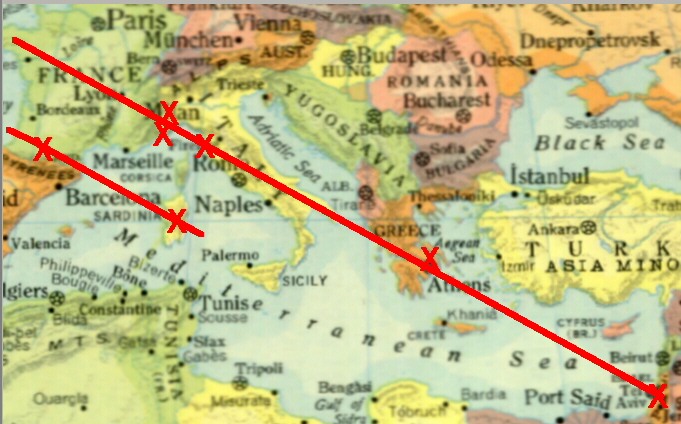
France, raining debris on the Earth below for three
nights. But the nucleus of the comet is headed for the Aegean area after
flashing directly over Rome (as seen in later quatrains). Though the
comet's coma will inflict damage on France, much worse is to befall the
Greeks. The trembling of the earth obviously refers to the impact of the
comet's head, which will be the energy equivalent to hundreds or
thousands of nuclear bombs.
|
|||||||||||||
|
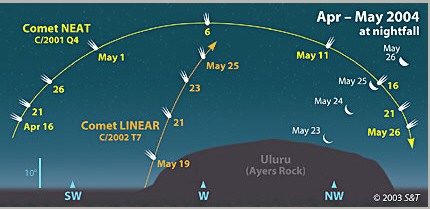
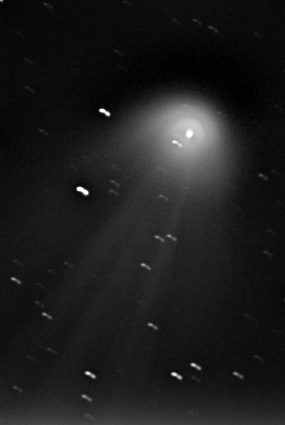
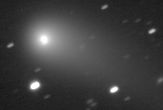
This is Comet #1- C/2002 T7 (LINEAR) Researchers at Gunma Astronomical Observatory in Gunma Prefecture have successfully detected ice particles coming from Comet Linear, which will be visible with the naked eye from the end of April, according to The Astrophysical Journal. As a comet approaches the sun, ice on its surface begins to melt, making observations difficult. Observations in 1997 of Comet Hale-Bopp previously were the only successful studies on record. The researchers' findings were published in the journal, which is the official publication of the American Astronomical Society. Using the National Astronomical Observatory of Japan's giant Subaru Telescope in Hawaii in September, the researchers were able to observe Linear as it passed between Jupiter and Mars. They were able to confirm the presence of ice particles as small as 10 microns emitted from the comet's nucleus. The particles were found in the coma, which is made up of dust and ice containing water and carbon dioxide. The ice is not made of crystals that form on the surface of the nucleus, but instead is amorphous, forming in temperatures minus 150 C or lower. The researchers, led by Hideyo Kawakita, also say there was a possibility the ice particles also contained ammonia. Comet Linear is approaching the sun from the outer edge of the solar system and will reach its closest point on April 23, when it will be 90 million kilometers from the star. Observers in the Southern Hemisphere will be able to see the comet in mid-April, while observers in Japan can expect to see the comet between about May 25 and the end of June in the southwestern skies just after sunset. |
|||||||||||||
|
Landing on a Comet
| |||||||||||||

Image credit: ESA |
Rosetta’s lander Philae will do something never before
attempted: land on a comet. But how will it do this, when the
kind of surface it will land on is unknown? With the surface composition and condition largely a mystery, engineers found themselves with an extraordinary challenge; they had to design something that would land equally well on either solid ice or powder snow, or any state in between. In the tiny gravitational field of a comet, landing on hard icy surface might cause Philae to bounce off again. Alternatively, hitting a soft snowy one could result in it sinking. To cope with either possibility, Philae will touch as softly as possible. In fact, engineers have likened it more to docking in space. Landing on a comet is nothing like landing on a large planet, you do not have to fight against the pull of the planet’s gravity, and there is no atmosphere. The final touching velocity will be about one metre per second. That is near a walking pace. However, as anyone who has walked into a wall by mistake will tell you, it is still fast enough to do some damage. So, two other strategies have been implemented. Firstly, to guard against bouncing off, Philae will fire harpoons upon contact to secure itself to the comet. Secondly, to prevent Philae from disappearing into a snowy surface, the landing gear is equipped with large pads to spread its weight across a broad area – which is how snowshoes work on Earth, allowing us to walk on powdery falls of snow. When necessity forced Rosetta’s target comet to be changed in Spring 2003 from Comet Wirtanen to Comet 67P/Churyumov-Gerasimenko, the landing team re-analysed Philae’s ability to cope. Because Comet Churyumov-Gerasimenko is larger than Wirtanen, three times the radius, it will have a larger gravitational field with which to pull down Philae. In testing it was discovered that the landing gear is capable of withstanding a landing of 1.5 metres per second – this was better than originally assumed. In addition, Rosetta will gently push out the lander from a low altitude, to lessen its fall. In the re-analysis, one small worry was that Philae might just topple, if it landed on a slope at high speed. So the lander team developed a special device called a ‘tilt limiter’, and attached it to the lander before lift-off, to prevent this happening. In fact, the unknown nature of the landing environment only serves to highlight why the Rosetta mission is vital in the first place. Astronomers and planetary scientists need to learn more about these dirty snowballs that orbit the Sun. FROM: http://www.universetoday.com/am/publish/how_philae_land_comet.html?3032004 Original Source: ESA News Release Posted 3/19/2004 12:09 PM
Spot a comet from your
backyard
By Joe Rao, SPACE.com's Night Sky Columnist
Interest will run high during the next couple of
months with the prospects of viewing not just one,
but two potentially bright, naked-eye comets.
Both are by-products of systematic searches for asteroids that might closely approach the Earth. One was discovered on Oct. 14, 2002 by the Lincoln Laboratory Near-Earth Asteroid Research survey and was hence christened with the acronym "LINEAR." The other was found on Aug. 24, 2001 by the Near-Earth Asteroid Tracking program and goes by the acronym "NEAT." Today we know comets to be composed primarily of frozen gases that are heated as they approach the Sun and are made to glow by the Sun's light. As the gases warm and expand, the solar winds blow the expanding material out into the comet's beautiful tail. To observers of antiquity, the tail suggested a trail of long hair, so they called comets "hairy stars." Professional astronomers can observe anywhere from half a dozen to a dozen comets on any given night. But comets bright enough to excite those of us without big telescopes are relatively rare, perhaps appearing on an average of one or two every ten to fifteen years. The last time we saw a truly bright and spectacular naked-eye comet was seven years ago, during the early spring of 1997: Comet Hale-Bopp. Just how well you might see Comets LINEAR and NEAT depends strongly on where you live. Interestingly, Southern Hemisphere observers will have a decided advantage over their northern counterparts, being blessed with not one, but two unusual opportunities to see both comets in the sky at the same time! Through most of April, they will be in the morning sky and then from late May into early June, they'll again be visible simultaneously in the evening sky, possibly even for a brief time to northerners as well. Below are capsule summaries of what you should expect to see. Note that astronomers measure brightness of objects on an inverted scale. The dimmest objects visible in the night sky, under perfect conditions away from city lights, are around magnitude 6.5. The brightest stars are around magnitude 1 or 2. Negative magnitudes are reserved for the very brightest objects. Comet LINEAR Presently this comet (cataloged C/2002 T7) is a fifth magnitude object in the constellation of Pisces, the Fishes, but it's much too close to the Sun to be visible. That will pretty much be the story through the first week of April. Thereafter, comet LINEAR will begin to slowly emerge from the bright solar glare and into the morning sky. The comet should slowly brighten as it approaches both the Sun and the Earth. It will arrive at perihelion – its closest point to the Sun – on April 23, at a distance of 57 million miles (92 million kilometers). After it moves around the Sun, it should continue to noticeably brighten as it approaches the Earth. Unfortunately, for those in the Northern Hemisphere, comet LINEAR will be quite difficult to see, since it will hover very low near the eastern horizon about an hour before sunrise right on through the balance of April and on into the beginning of May. Northern observers might catch only a fleeting glimpse of LINEAR, possibly as bright as second or even first magnitude, in the brightening dawn twilight at the end of April or very beginning of May. Objects this bright can be visible almost until the Sun actually rises. Thereafter, the comet will no longer be able to be seen, moving too far to the south to be visible from northern latitudes. The situation for Southern Hemisphere viewers, in contrast, will be far better. While Comet LINEAR will probably not become readily visible to most until mid-April, thereafter it will appear to climb progressively higher each morning in the east-northeast sky. During the first ten days of May, the comet should be an easy target for observers south of the equator, rising about 2 to 3 hours before sunrise. But then, because the comet will be rapidly approaching its closest point to the Earth, its viewing aspect will also change rapidly. During the middle part of May, the comet will make the transition from a morning to an evening object. On May 19, it will be closest to Earth, just under 25 million miles (40 million kilometers) away. Located in the winding constellation of Eridanus, the River, Comet LINEAR will be well placed in the southwest sky right after sunset, perhaps appearing as bright as zero magnitude. In the following days as the comet recedes from the Earth, it should fade quickly, dropping to third magnitude by the end of May and fifth magnitude by mid-June. In the final days of May and at the very beginning of June, there is a possibility that observers in the Northern Hemisphere will again have a chance to sight Comet LINEAR, very low near the southwest horizon as darkness falls. But unless the comet ends up brighter than is expected now, it won't be as easy task. Comet NEAT
Also known as C/2001 Q4, comet NEAT has been a solely a Southern Hemisphere object since its discovery in August 2001. Currently it resides in the far-southern constellation of Tucana, the Toucan, and shines at sixth magnitude. For those at far-southerly latitudes, this comet will be available as both a morning and evening object through late April, appearing in the south-southwest sky for a few hours after sundown, then reappearing above the southeast horizon a few hours before sunrise. As it approaches both the Sun and Earth, the comet should brighten accordingly, perhaps reaching third magnitude by mid-April. But its availability to early morning viewers will also be diminishing rapidly as it gets progressively lower in the south-southeast sky and rises closer to sunrise. Conversely, at the same time, comet NEAT will be getting noticeably higher and more favorably placed for evening visibility. As the comet starts moving swiftly northward, two things will happen by the end of April: It will finally relinquish its morning visibility and it will begin to become accessible as an evening object for those in the Northern Hemisphere. During the first week of May, most northern observers will anxiously be awaiting darkness to fall, straining for clear, unobstructed views toward the southwest horizon for their first sighting of Comet NEAT. Probably the first good opportunity for most will come on the evening of May 5, approximately an hour after sunset. Look low in the southwest for blue-white Sirius, the Dog Star, the brightest star in the night sky. Comet NEAT should be hovering about 10 degrees to the left of Sirius (your clinched fist, held at arm's length, is roughly equal to 10 degrees). The comet will be passing closest to the Earth on the following evening, just under 30 million miles (48 million kilometers) away. In the nights that follow, Comet NEAT — perhaps as bright as first or second magnitude – will be getting progressively higher up in the southwest sky and correspondingly, easier to see. On May 13, a line drawn from Castor to Pollux (in Gemini) and extended out three times the distance between these two stars will bring you to Comet NEAT. On May 15, the comet will reach its closest point to the Sun, just over 89 million miles (142 million kilometers) away. It should then fade rapidly from view as it moves away from both Sun and Earth, moving into Ursa Major by month's end. A final bit of caution Both of these comets appear capable of reaching first magnitude. That's the good news. The bad news is that both are apparently making their very first approach to the vicinity of the Sun, and history has shown that most "first-timers" usually fall far short of brightness expectations and instead end up appearing faint and unimpressive. Since all new comets are notoriously unpredictable, we can only guess just how bright LINEAR and NEAT will get and how long their respective tails will be. We're just going to have to wait and see. Night Sky Friday will keep you posted on their development in the coming weeks. Stay tuned! Inc. ALL RIGHTS RESERVED. Comet #3 Posted 4/13/2004 3:26 PM
By Joe Rao, SPACE.com
A newly discovered comet should soon be visible to armchair astronomers via images posted to the Internet from the Solar and Heliospheric Observatory (SOHO) spacecraft. Later this month, sharp-eyed observers may also spot the comet in the morning sky. The comet, named Bradfield, is racing through the inner solar system at a time when two other comets are expected to become visible to the naked eye, providing a rare trio of opportunities this spring. However, comets are unpredictable and casual observers may find it challenging to see any of the objects. Retired but working The newest comet was discovered by William Bradfield of Yankalilla, South Australia, while the object was in the constellation Cetus. Bradfield first spotted it low in the western evening sky with his 10-inch telescope on March 23 and again on March 24. Then lost sight of it until April 8. Daniel Green of the Central Bureau for Astronomical Telegrams announced the find on Monday. The 76-year-old Bradfield is credited with 17 other comet discoveries dating back to his very first on March 12, 1972. Born in New Zealand, Bradfield worked many years for the Australian government as a research scientist on rocket-propulsion systems before retiring in the late 1980s. All 18 of Bradfield's discoveries bear his name alone, which means he spotted and reported them well ahead of any other observer. (Some comets are found by two or more observers at roughly the same time.) By having access to stars and constellations visible only at far southerly latitudes, Bradfield can carefully examine regions of the sky that are unavailable to Northern Hemisphere observers. Eighteen comets over a 32-year time span comes out to an average of one new discovery about every 21 months. But it has been nine years since Bradfield made his last discovery (an object catalogued as C/1995 Q1). What to expect Green's calculations show that the comet will continue to approach the Sun in the coming days. It should reach perihelion (its closest approach to the Sun) on April 17, when it will be just 0.169 astronomical unit (15.7 million miles, or 25.2 million kilometers) from the solar system's central star. This is well inside the orbit of the planet Mercury. The projected brightness of this comet is somewhat uncertain, although right now predictions indicate that it could get as bright as 2nd magnitude. That would be easily seen with the naked eye. However, because of its very close proximity to the Sun, the comet will be impossible to observe for a week or more. As it dashes past the Sun however, comet Bradfield will be visible to those using computers and accessing near-live images from the SOHO Web site (sohowww.nascom.nasa.gov), primarily in images from the LASCO C3 instrument. The comet should be within range of the SOHO imagery from about April 17 through April 19. It will appear to pass closest to the Sun — 2.6 degrees from its center — on April 18. Last year, the public was captivated by a similar scenario when SOHO photographed a comet rounding the Sun. Hundreds of otherwise unknown comets have actually been first detected in SOHO imagery, generating a competition among a handful of armchair astronomers. Just last week, SOHO officials reported the 750th discovery of a comet using the spacecraft's imagery. Skywatching opportunity Because it will appear to move rapidly northward after perihelion, comet Bradfield will ultimately emerge into the morning sky for observers in mid-northern latitudes during the final week of April. Beginning April 23rd, skywatchers should concentrate on the east-northeast horizon beginning about 90 minutes before sunrise. Unfortunately, the comet is expected to fade quickly down to 4th or 5th magnitude as it recedes from both the Sun and Earth. On this astronomer's scale, larger numbers represent dimmer objects. The brightest objects are zero of first magnitude, with superbright objects such as Venus achieving negative magnitudes. Binoculars will aid observers in sighting comet Bradfield, as well as any tail that might appear to protrude upwards from the horizon.
Copyright 2004, SPACE.com
Inc. ALL RIGHTS RESERVED.
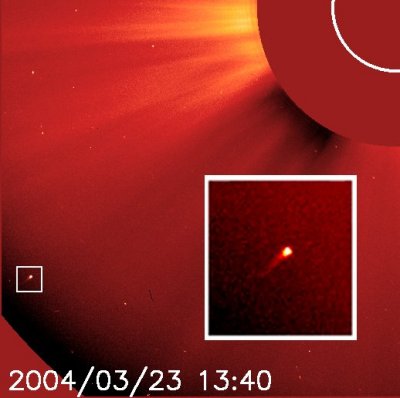
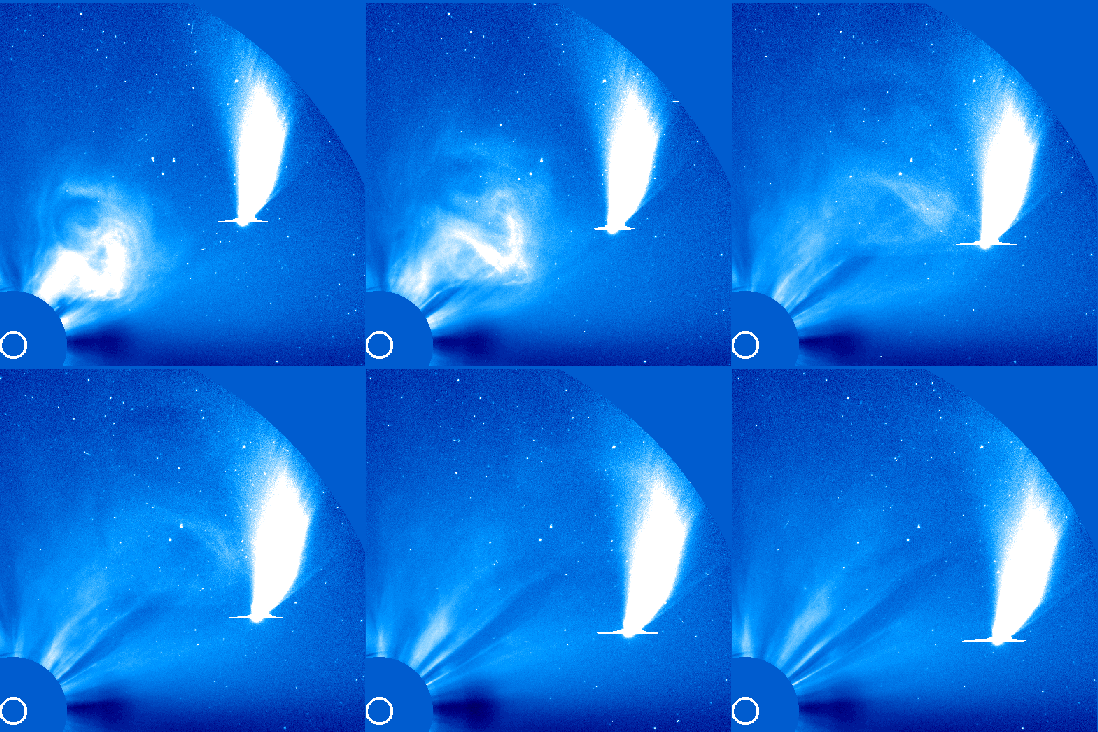
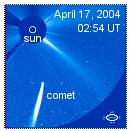
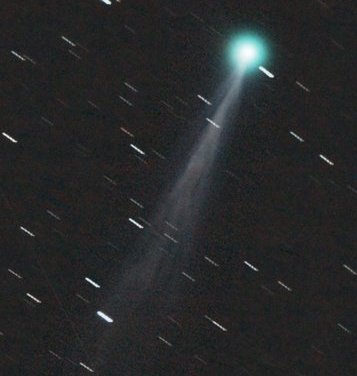
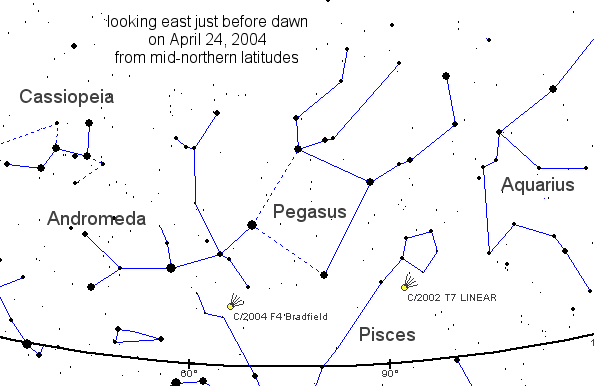
4-17-04 - COMET BRADFIELD: Comet Bradfield (C/2004 F4) is swinging by the sun today. At a distance of 0.17 AU, it's even closer to the sun than Mercury (0.39 AU). The comet is vaporizing furiously and leaving a bright tail of dust and gas behind it. Telescopes on Earth can't see the comet because of the sun's glare. But the orbiting Solar and Heliospheric Observatory (SOHO) can. Coronagraphs onboard SOHO block the sun's glare to reveal nearby stars, planets and comets. This image (right) shows the comet approaching the sun on April 17th; click for current images. Sungrazing comets sometimes break apart or dissolve. If Comet Bradfield survives, northern sky watchers can see it beginning April 24th when it emerges from the glare of the sun. It will join Comet LINEAR (C/2002 T7) in the constellation Pisces just above the eastern horizon at dawn. Both comets could be visible to the unaided eye. [sky map]
|
||||||||||||
|
REVELATION: CHAPTER 8 7 The first angel sounded, and there followed hail and fire mixed with blood, and they were cast on the earth. And the third part of trees was burned up, and all green grass was burned up.
|
|||||||||||||
|
ED DAMES INTERVIEW WITH ART BELL - 4-10-04 Major Ed Dames was interviewed by Art Bell on the evening of 11-10-04 These are notes, excerpted from their conversation over 2 hours. Some of the comments are paraphrased to save space. Art began by talking about the X-45 CME from the sun, almost hitting the earth on November 4th, 2003. This is what Ed Dames had earlier called, "The Shot Across the Bow" What this event is now called is the "Kill Shot". Which means it is actually going to hit the earth. Art says: The sun could kill us!" Ed begins by saying that we should watch for the 'harbinger'. The events will happen AFTER we see the harbinger. The 'harbinger' will be 'our space shuttle going into space and being forced to return before the end of its journey because of a predicted meteor shower'. This is not one of the normal meteor showers. This is an unprecedented event. A global killshot will effect everyone on the earth. It will occur in our lifetime. We have narrowed it down to 2005. It deals with the sun. This harbinger will pop up in people's dreams. The coming global superstorm will begin this year. It is already beginning now. It will not just happen in Ohio. It will happen everywhere. A series of solar flares will hit the earth. When you see one of our space shuttles forced down because of a meteorite shower - that is the harbinger. [Editor's note: Here is the space shuttle schedule. The first
one is scheduled for March 5, 2005. Beginning in 2005, there will be earthquakes worldwide. There will be intense meteor showers - coming down to the deck. Then there will be no more time for predictions. There will be no more time left. This will cause the earth to wobble. The solar flares will hit the earth while our electromagnetic shields are down. There will be a passing earthbody. It will cause massive waves on the ocean over 2,000 feet high. The fast melting of the ice at the poles and the heat all over the world will cause great devastation. This is what causes the earth to wobble. Many people all over the world will die because of dehydration - no fresh water. We need: Below ground protection We may end up with a new Pole Star Even so, even after its over, there will be radiation everywhere from broken nuclear reactors. There will be winds in some places over 300 miles per hour. The CME killshots will shut down all communications - but it is the passing space body itself - Planet X - will cause the great devastation. It is not a comet. It is a planet size - like Pluto or Charon . It will pass us twice as it comes in and goes around the sun. We will probably have about 3 months warning. This will end life as we know it. Resources will be tough to come by, but some parts of the world will be worse than others. Satellites will be gone. They will come down with the meteorites. We will have to rebuild and we will, but that will take time. The nations that will be survivable are not technologically at the top of the heap: example: China All the power grids will come down. There will be no
electricity. The passing planetary body will cause the CMEs. Being underground will be necessary for a few weeks because of the winds of 250 to 300 MPH. Looking at a poleshift of 12 degrees. The earth's axis will actually wobble this much. About 2 days later, the winds will pick up in belts - but not everywhere at the same time. Because there is no precedent of this event, our scientists will not be able to 'know' how it will effect us. The planet is now dark and cannot be seen. Until the sun starts to reflect off of it, it won't be seen. From a professional point of view, the liklihood of this happening is 100%. Eight people worked on remote viewing this event for 6 months. ALIENS: There will be no intervention, but afterwards, another race will be here to help us rebuild. Free will is always in evidence. They can't help us beforehand. [Editor's note: They are helping with the warnings of what is coming. ] These aliens will look very much like us, but sturdier and features more chisled than us. ED DAMES REMOTE VIEWING: 1-866-607-8439
|
|||||||||||||
|
David Booth - proven psychic- had a vision in March of
2003. He saw himself in space,
looking down on the earth. He saw a dark, planetary object
coming from the south end
of earth - out of the southern Hemisphere. As this
planetary object came past earth, the size of which would fit between the earth and the moon - he saw the western end of the U.S. blow up with fire and blasts of smoke and ash. From there, the whole earth rippled. Yellowstone had blown up. Gordon Michael Scallion (psychic)- on March 16, 2003 - had a vision that two lightbeings showed him that Wyoming and Utah were glowing red. The lightbeings said, "This will change the world in 18 months." (18 months from March 16, 2003 = September, 2004) From: jmccanneyscience.com March 23, 2004 7PM CST
special emergency update ... word just came in from a private David Booth and Wayne Green were kicked off of the Coasttocoastam.com
show on 3-18-04 for not revealing what the Nun (Sister Lucy) who gave
the Fatima prophecies had said to him in a private meeting. David DID say that it
was said, "The New Star will soon shine." CHERNOBYL IS UKRAINIAN FOR WORMWOOD But, to notice them, we need to stay awake. Howling all day and night, I remain, your spiritual brother, Joe Mason NOTE: Comets are frequently responsible for causing
weather anomalies like El Nino and |
|||||||||||||
|
Syzygy Dreams
[ Syzygy Dreams ] [Previous Message] [Next Message] Date: May 29, 2004 at 08:27:13From: kiva traveler, Subject: Big bolides URL: asteroid impact calculator For years I and my family had dreams of a coming natural destruction of America. I generally tried to interpret these dreams as being symbolic. But one night my young daughter's dream made it plain that they were not symbolic, but were instead literal. On 11-17-94 I prayed to God saying that I could not believe that so many small children and innocent people were to be killed. That very night I dreamed I was in Japan. I was in a city that had been hit by a great earth quake. I saw ruined buildings, bridges and such like. I said to myself that 'Japan can ill afford this!' I saw a small car trapped on a small section of raised road next to a pillar of concrete. then I woke up. 2 months to the very day on 1-17-95 Kobe Japan was struck by a large quake. Over 6000 innocent people died (actual final toll 6308). In one of the pictures I saw the small car trapped on the raised road I had dream about. I knew then what the answer was to my doubts expressed in prayer. In 2000 I was shown what will cause the devastation of America - a set of twin asteroids (mainly made of nickle-iron that are in a binary orbit with one another) both the same size and both very large (interestingly many months after I had this dream scientists discovered that such twin asteroids in binary orbits do actually exist). I believe one will fall into the Atlantic - I believe it is the asteroid described in such detail in Revelation 8:8 - the burning mountain that falls into the sea. The other one breaks up and later returns to produce the other massive meteors [such as the great, i.e. massive, falling star(bolide) burning like a lamp]described in Rev. chapter 8:7- and 9:1-4. Iron asteroids pack a far greater punch than stony asteroids. The asteroids will be somewhere between 3 to 10 miles in diameter. Many other people have had like dreams and have seen the TWO incoming objects - some times they are described as twin suns, twin comets, or twin asteroids.note: scientists do not accurately calculate the full effects of LARGE asteroid impacts at sea. They typically treat such impacts as if they were the same as impacts on land - other than that they depict the creation of a tsunami wave. The problem IS, that the thickness of the earth's hard crust is on average 20 to 30 miles thick on land (continents). BUT, the hard crust under the oceans is typically only about 4 miles thick. A large asteroid (a few miles in diameter) can puncture this thinner crust and thereby expose the hot magma layers. Thus you will note at the http://janus.astro.umd.edu/astro/impact.html 'asteroid calculator' that the results of an impact in the ocean creates a far wider and DEEPER crater - in some cases 50 to 90 miles deep. Scientists typically FAIL to include the effects of such a crater at sea. Yes, the water at the impact site does vaporize on impact. BUT, the surrounding ocean water soon fills this cavity. When vast amounts of sea water pour into a large chamber of magna the result is a series of steam explosions. I studies small steam explosions in the Miocene Yakima Basalts of Washington State when I was in my 20s. But when we are talking about a crater tens of miles wide, and tens of miles deep, what will be created is not a tsunami - but a vast wave train of continuous tsunamis. The steam explosions (which together can rival the energy of the asteroid impact itself)will further weaken and break up the earth's crust around the crater. These deep craters are short lived, in that the magma will well up to fill them - BUT, they are also filled in by giant crustal slides from the sides of the crater itself too. These create massive quakes and further tsunamis. The upshot is that a continuous train of giant waves can overwhelm nearby continents under deep flooding.] COMET #4 - VENUS TAIL Mon, 07 Jun 2004 16:17:31 -0400From: "Dr. Byron Weeks" <cyberdoc9@ida.net>
Poisons
in the comet's tail
from June 8-11 may
touch the earth...
Aha!
So we weren't so far
out after all...Eyes
will burn and tear if
acid present. Advise
soda bicarb solution
[baking sods is safe
in any dilution] on
hand to neutralize
sulphuric acid for
skin and face. Eye
wash as needed.. Avoid
going outside, but
cover skin and use gas
mask if this can't be
avoided. Surgical
masks not
effective. Seal
windows and doors in a
safe room with duct
tape. When the air
gets stale after 5-6
hours, open up a
crack here and
there. Use a dilute
soda spray bottle around
openings. Have enough
food and water on hand
for 3-4 days.
People with asthma, emphysema and bronchitis should seek a physician's counsel. Many of these sufferers will die if not protected.
Byron
Weeks, MD
Sent: Monday,
June 07, 2004 1:35
PM
Subject: Venus
Various sources,
mainstream and net
June 7, 2004 Scientists around the world are warning people to stay indoors for up to three days following the June 8 Venus Transit. The tail of Venus, which resembles that of a comet, will be blown in the direction of earth by solar winds as it eclipses the sun. The tail is comprised mainly of ammonia, sulphuric acid and other substances harmful to man. Sulphuric acid fumes can burn the skin, cause blindness and lead to suffocation in people with compromised lungs. Experts advise that the whiplash effect of the tail on planet earth will subside after three days, making it safe to venture outdoors once more.
|
|||||||||||||
|
PLANET X: Logic - Analysis -
Speculation
Meteorite sighted in NSW June 17, 2004 A METEORITE reportedly the size of a house fell on the NSW south coast overnight, exploding in a bright flash, police said today. A driver on the Hume Highway shortly after 9pm (AEST) near Menangle reported an object the size of a house falling from the sky. The object fell east of the Hume Highway, possibly in an escarpment near the top of a hill at Bulli, police were told. The meteorite was described as glowing silver in colour and similar to an artillery shell when it exploded with a bright flash on impact. Workers at the Sydney Airport Tower said they saw a meteorite about 9pm, police said. No other reports were received by police and extensive police patrols of the area did not turn up the space debris. AAP This morning (Thursday June 17th) there has been news on two different fronts. Queensland has been hit with unseasonable weather with Stanthorpe hitting minus 3 Centigrade (other report stated minus 5 centigrade) A headline report on our local news radio just stated that an object the size of a car (yes car) came down close to a town called Bullia in NSW Last week a meteorite weighing 6 LBS went through the roof of a house in New Zealand and was shown ion the news. At this time details on the car size object have been limited to the radio report and I hope to hear ,more on this evenings news. Any feedback welcome. Keep well Philip | |||||||||||||
|
COMET #5 - C/2004 Q2
Comet
c/2004 Q2 (Machholz) was photographed on Sept. 14 by Gianluca Masi and
Franco Mallia, Donald
Machholz of Colfax, California, an optician who has been interested in
astronomy since age eight, discovered nine comets from 1978 through
1994. He has since spent 1,457 hours scanning the skies for other
comets, without any luck. But his luck
changed on the morning of Aug. 27, when he swept up his tenth comet. It could
become the fourth comet this year to excite backyard astronomers. After a treat
of three comets in the spring -- NEAT, LINEAR and Bradfield -- the
first indications suggest Machholz's discovery will become easily
visible in binoculars and small telescopes this winter and possibly to
the unaided eye. Comet
brightness is notoriously difficult to predict, however, and it is too
early to know whether this one will put on a memorable show. The discovery When Machholz
first picked up the comet – officially designated c/2004 Q2 – it
was a fuzzy 11th-magnitude object in the constellation Eridanus and
drifting slowly southeast in the direction of the constellation Lepus.
On this astronomer's scale, larger numbers represent dimmer objects.
Under the darkest skies, the typical observer can spot with the
unaided eye objects of magnitude 6.5 and brighter. Machholz
spotted the comet through the 30X eyepiece of his 6-inch f/8 Criterion
Dynascope Newtonian reflector, a vintage telescope that was a mainstay
among amateur astronomers during the 1960s and 70s. Machholz had
purchased his back in 1968. Several hours
after Machholz's spotted
the comet, Australian observers Gordon Garradd and Robert McNaught
confirmed the discovery, capturing the comet in photographs using
telescopes from Siding Spring Mountain. These CCD ("Charged
Coupled Devices") images also showed a short, faint tail. From 38
observations over a four-day period, Brian Marsden at the Minor Planet
Center in Cambridge, Mass. calculated an orbit for the new Comet
Machholz. It is on its way toward the vicinity of the Earth and the
Sun, and during October and November, its projected path will appear
to describe a small loop taking it into the constellations Lepus,
Columba and Caelum. Since it will still be relatively far from both
the Sun and Earth, its apparent motion -- in relation to the stars
from night to night -- will be quite slow. At the
beginning of December it will return to Eridanus, at which point the
comet’s motion across the sky will abruptly turn northward and
rapidly increase, making the comet well placed for Northern Hemisphere
observers by the last week of December. How bright? According to
Marsden's calculations, Comet Machholz could become as bright as
fourth magnitude. It could possibly hover around at this brightness
for about a month beginning right after Christmas. During this
interval, the comet will move north of the celestial equator, tracking
from southern Taurus on up into the constellation Perseus. Fourth
magnitude means that the comet should at be at least dimly visible to
the naked eye in dark skies, though better seen in binoculars or
telescopes. Urban skywatchers would not be able to see it without
optical aids. That kind of
brightness would still make Machholz a very fine comet from the
viewpoint of an amateur astronomer, especially in early January, when
it will be approaching the Earth and will be well placed for viewing
-- high in a dark sky. Given current information, it doesn’t appear
that this comet will become the kind of spectacle that Comet Hale-Bopp
was in grabbing the public’s attention. Hard to predict And although the script is still being written concerning
Machholz's upcoming performance, be advised that comets are
notoriously bad actors. As
an example, the first brightness estimates for Comet NEAT had it
possibly becoming as bright as first magnitude -- easily visible even
from cities. Ultimately it became only as bright as third magnitude at
best. Comet
Machholz could brighten up and give us a real surprise. Comets have
surprised on the bright side before. Yet few celestial events have
greater false-alarm potential than these interplanetary vagabonds. The comet is
predicted to come closest to Earth on the night of Jan. 5-6, 2005,
when it will be just 32 million miles (51 million kilometers) away. On
the evening of Jan. 7, it will conveniently pass just a couple of
degrees to the west of the famous Pleiades star cluster. Comet
Machholz will reach perihelion -- its point closest to the Sun -- on
Jan. 24, when it will be just under 112 million miles (179 million
kilometers) from that blazing furnace. The comet will be more or less
opposite the Sun all during this "flyby", and thus should be
easily visible in a dark sky from Earth. By Robert Roy Britt Senior Science Writer posted: 07 December 2004 A comet discovered earlier this year has now moved close enough to be visible without binoculars or telescopes by experienced observers under dark skies. It is expected to put on a modest show this month and into January. Comet Machholz will be at its closest to Earth Jan. 5-6, 2005, when it will be 32 million miles (51 million kilometers) away. People with dark rural skies and a good map should be able to find it on Moon-free nights now into January. Backyard astronomers have been watching Machholz for months through telescopes. It was spotted by naked-eye observers for the first time about three weeks ago from the Southern Hemisphere, said Donald Machholz, who discovered the frozen chunk of rock and ice in August. "I saw it last night for the first time with the naked eye," Machholz told SPACE.com Friday. Comets are made of rocky material and icy mixtures of water and various other chemicals. As a comet approaches the Sun, the surface is heated and essentially boils off. Scientists call the process sublimation. The gas and dust creates a head, also called a coma, and sometimes a tail. Sunlight reflects off the material, making some comets visible from Earth. Comet Machholz, officially named c/2004 Q2, is not expected to produce the sort of spectacular display put on by comet Hale-Bopp in 1997 or the periodically stunning Halley's comet. Astronomers cannot say exactly how bright Machholz will get, because it is notoriously difficult to predict the behavior of comets making their first observed close trip around the Sun. Scientists don't fully understand the composition of comets, nor their variety, so they don't know how much stuff will sublimate nor how fast.  The position of comet Machholz at 9 p.m. local time from mid-northern latitudes on various nights. Machholz is expected to reach magnitude 4.0, based on an early estimate. On this astronomers' scale, smaller numbers represent brighter objects. The dimmest things visible under perfectly dark skies are around magnitude 6.5. The brightest star, Sirius, is magnitude minus 1.42. Recent observations suggest Machholz will do at least as well as first predicted. "The comet is doing better than expected and is about 0.5 magnitudes brighter than expected," Machholz said. "So it will probably get brighter than the Andromeda Galaxy, brighter than magnitude 4.0." The Andromeda Galaxy is the furthest object visible to the unaided human eye under dark skies. It is a magnitude 3.4 object. If the comet were to become roughly magnitude 3.0, it would still appear common among the sea of stars available to dark-sky observers. City and suburban dwellers would likely not find it without optical aid. In either case, binoculars or a small telescope might reveal the comet as more of a fuzzy patch, and if it develops a significant tail, that could be visible too. Machholz, who has found nine other comets, suggests looking for his latest discovery when the Moon is out of the picture, such as around Dec. 11 when it will be at its New phase. "The comet can still be seen when the Moon is out, but it will be difficult," he said by email. "Use binoculars or a wide-field (low power) telescope, and/or get to a dark site." The comet is low on the horizon now, where the atmosphere makes for poor viewing. By early January, the comet will be much higher in the sky, improving viewing conditions. COMET MACHHOLZ Posted By: ArchAngel_Michael <Send
E-Mail>
COMET #6 - VENUS - James McCanney reported on his radio show on March 5th, that Venus went comet as it went behind the sun earlier this month. http://www.jmccanneyscience.com/comet%20solar%20flare%20movie%2001072004.mpeg This video is from 2002 - to show you how it works. On the topic of changing weather patterns, James
McCanney noted that Earth is "relaxing from a major event;"
namely the passing of a celestial body (Venus), which
temporarily blocked the sun's radiation and brought about the ice age.
The electrical fields coming from the sun and weather on the sun
itself also greatly affect Earth's conditions, he said. He believes
that a number of weather manipulation methods are being tried out
on our planet, but so far only over small regions. COMET #7Comet put on list of potential Earth impactors
Related Articles
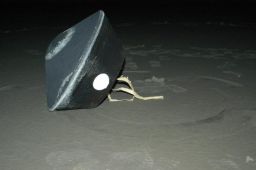
Web LinksA comet has been added to the list of potentially threatening near-Earth objects maintained by NASA's Jet Propulsion Laboratory. Comet Catalina 2005 JQ5 is the largest - and therefore most potentially devastating - of the 70 objects now being tracked. However, the chances of a collision are very low. The listing of Comet Catalina underscores the uncertainty in the knowledge of whether comets or asteroids pose a greater threat to Earth. Previous estimates of the proportion of the impact risk posed by comets have varied widely, from 1% to 50%, with most recent estimates at the lower end. But comets are larger and faster-moving, on average, so their impacts could be a significant part of the overall risk to human life. And, unlike asteroids, they lie on randomly-oriented and usually highly elongated orbits. This makes them much more likely to remain undiscovered until they are very close to Earth. Comet Catalina was found by the Catalina Sky Survey, one of the six current, large-scale and automated search programmes for near-Earth asteroids. It was initially designated as an asteroid when first spotted on May 6. But was reclassified as a comet when observers saw characteristic fuzziness in the image, indicating ice and dust streaming off. Its size is estimated at about 1 kilometre but Steve Chesley of JPL told New Scientist that this "could be off by a factor of a few" in either direction. If there is enough dusty coma to increase its brightness significantly, the nucleus itself might only be a few hundred metres across. But if there is very little dust, then because comets are quite dark, the nucleus could be larger than estimated, perhaps a few kilometres across, Chesley said. "So 1 kilometre is pretty much in the middle of the reasonable range." Collision course?On 26 May, JPL's unique orbital calculation software determined that Comet Catalina was on what could possibly be a collision course with Earth, though the odds of such an impact were small: just 1 chance in 300,000 of a strike on June 11, 2085. Based on the 1 kilometre size estimate, that would produce a 6-gigaton impact - equivalent to 6 billion tonnes of TNT. Astronomers expect the addition of further observations to the calculations to rule out any possibility of a collision, as happens with most newly- seen objects. But that has not quite happened yet. With an extra week of data, the comet's predicted pathway actually drew even closer to making a perfect bull’s-eye with the Earth - its predicted path passes within 400 kilometres of where the centre of our 12,700-km-diameter planet will be around that time. However, uncertainty in the exact timing of the comet’s pass through the line of Earth’s orbit dropped the odds of an impact to about 1 in 120 million. That is very low, but the observations so far cannot categorically rule a collision out. Forceful outgassingChesley adds that even the slim 1 in 120 million odds are an overestimate, because comets, unlike asteroids, can move in unpredictable ways because of the forceful outgassing that creates their dusty comas and tails. The odds therefore might be wrong "by a factor of two or so" he said. The cut-off for inclusion on the list is 1 in 10 billion. The only other comet placed on the JPL list of near-Earth objects with possible collision paths was added in 2003. But additional observations ruled out a possible impact - that comet was removed from the list after less than a week. Just one other comet, Swift-Tuttle, has been recorded with a non-zero possibility of impact. It was rediscovered in 1992 - after more than a century's absence - before the JPL list was created. Additional observations during Swift-Tuttle’s passage, thanks to the publicity surrounding the possible impact, made it possible to rule out the possibility of an Earth impact anytime in this millennium. However, Swift-Tuttle is on an orbit that will almost certainly cause it to crash into the Earth or the moon eventually. THIS IS COMET #8 - MENTIONED IN THE NEWS Capsule Carrying Interstellar Samples Lands SafelyA spacecraft that could be a time capsule carrying the history of the solar system made a predawn landing in a muddy Utah desert yesterday, completing a seven-year journey of almost three billion miles with a fiery, pinpoint descent to Earth. The craft, a 100-pound sample container jettisoned from the Stardust explorer and bearing comet and star dust, landed at the Utah Test and Training Range of the Air Force, southwest of Salt Lake City, at 5:10 a.m. Eastern time after the sequential deployment of its two parachutes. There was no initial indication that a small stabilizing chute had deployed after the container's flaming re-entry into the atmosphere, causing a few tense moments among the scientists and engineers awaiting the Stardust's return in the landing area and at mission control at the Jet Propulsion Laboratory of NASA in Pasadena, Calif. When the main parachute opened on time at an altitude of 10,000 feet, however, it could be seen by long-range infrared cameras and some ground observers, resulting in applause and cheers among flight controllers. "All stations, we have touchdown," announced Thomas Duxbury, the mission project manager. Mr. Duxbury said at a later news conference: "This thing went like clockwork. To see that thing in one piece on the floor of the desert is very moving." The landing was particularly tense because of memories of an earlier National Aeronautics and Space Administration probe, the Genesis, which crashed in the same area in 2004 when its parachutes failed to open. Both craft shared similar design and landing systems. The Genesis' collector plates, which trapped solar particles during the craft's two-year mission, were shattered and contaminated, but scientists remain hopeful they can salvage some of the science. After the Stardust touched down on the salt flats of the Utah desert, a recovery helicopter flew to its location but could not immediately find the capsule in the early morning darkness. The sample vessel, however, was found shortly before 6 a.m., and recovery teams on two other helicopters swooped in to help secure it. Technicians lifted the capsule into a transport cradle and enclosed it in two bags before the lead helicopter flew it to nearby Michael Army Air Field, where a "clean room" was set up in a hangar to reduce the chance of contamination. There, masked and suited workers opened the capsule and began preparing it for transport later this week to a laboratory at the Johnson Space Center in Houston. At the news conference, elated engineers and scientists said it was hard to describe their feelings now that the sample capsule was safely back on Earth. "Inside this thing is our treasure, our sample of the edge of the solar system that truly contains star dust," said Donald Brownlee of the University of Washington, the mission's principal investigator. "We visited a comet, grabbed a piece of it and it landed here this morning," Dr. Brownlee said. "It's an incredible thrill." Scientists believe that about a million samples of comet and interstellar dust, most of them less than one-tenth the width of a human hair, are locked inside the capsule. Researchers around the world are awaiting the samples, hoping they will provide clues to the origin of the planets and other bodies in the solar system. The grains are believed to be pristine remains of the birth of the solar system some 4.6 billion years ago. Studying comets not only provides clues to how the solar system was formed but also could help explain how certain materials and conditions combined to form life, researchers said. Scientists said the capsule would be cleaned of contamination, including mud and salt from the landing area, and opened in a couple of days to remove the samples for initial examination before they are shipped to Houston. Mr. Duxbury said the Genesis experience was "a blessing" for the latest mission because it forced the team to re-examine everything about the Stardust's design and testing, and draft strategies for dealing with a possible mishap. "We take our hats off to Genesis for making us much, much smarter," he said. This final stage of the $212 million Stardust mission began four hours before landing, when the main spacecraft released the sample capsule thousands of miles from Earth, severing cables and using a spring device to push it free. Later, the mother craft fired rockets that pulled it away and placed it into a new orbit around the Sun. The canister entered the Earth's atmosphere at a speed of 28,800 miles per hour, the fastest speed any human-made object has achieved entering the atmosphere, causing it to reach peak temperatures around 4,900 degrees Fahrenheit. After its launching in 1999, the Stardust circled the Sun three times and even flew by the Earth in 2001 for a gravity boost to rendezvous with the comet Wild 2 near Jupiter. The spacecraft came within 149 miles of the comet on Jan. 2, 2004, deploying shields to protect itself from cometary dust while extending a collector filled with a material called aerogel. This low-density silicon material, called "glass smoke" because it is composed of 99.8 percent air, gently slowed and trapped particles without significantly altering or damaging them. During its long cruise periods, the Stardust also spent 195 days collecting the particles from stars that constantly flow through the solar system from far out in space. "This has been a fantastic opportunity to collect the most primitive material in the solar system," Dr. Brownlee said. "We fully expect some of the comet particles to be older than the Sun." ~~~~~~~ Stardust: Comet “Treasure” is Retrieved By A.J.S. RaylJanuary 15, 2006
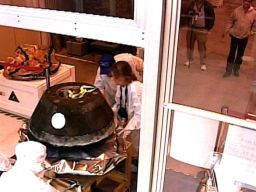
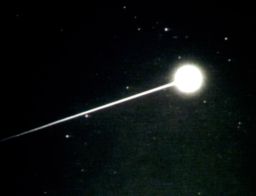
The Stardust capsule – which holds the world’s first samples from a comet ever returned to Earth – has been retrieved and is now in a clean room inside a hangar at the Michael Army Air Field. The capsule, which was reported to have bounced five times before it settled down near the middle of its landing ellipse early this morning on the Air Force’s Utah Test & Training Range, appeared to be in excellent shape, although the recovery crew did find pieces of the heat shield nearby. The salt and mud the capsule picked up on landing and any other possible contamination will be cleaned off. Then, at some point in the next day or two, technicians will open the capsule and remove the samples for a cursory examination before they are packed for shipment Tuesday to a special repository at the Johnson Space Center (JSC). “It’s hard to describe what it feels like to be at this point,” said Stardust principal investigator Don Brownlee at a post-landing press conference in Utah. “The most spectacular part of this mission for me happened about 5 minutes before it landed. We snuck outside and went down to the end of the fence, which is pretty far down range . . . and then we saw something up there and it looked like Mars, it was bright and a reddish color, but it was get brighter and moving . . . the Moon was up in the sky, a ghostly white color . . . but this other object was red by contrast . . . a meteor flying through the sky . . . and from our view, even though we knew this was coming from space it looked like it was climbing in the sky – and then we saw this glowing trail behind it.” Nodding to the video of the recovery team walking around the capsule at the landing site that playing on the monitors, Brownlee, of the University of Washington, Seattle, continued: “Inside this thing is our treasure – our sample from the early solar system, that truly contains stardust,” “We traveled almost 3 billion miles in space. We visited a comet, grabbed a piece of it, and it landed here this morning. It’s an incredible thrill.” At JSC, the team will further analyze, verify, and section the cosmic dust particles, which will be housed in the same building as the only other samples that we have brought back from another body – the Moon rocks, and other meteorites.
Since Wild 2 is believed to hail from the Kuiper belt, way out there close to the edge of the solar system, the comet samples are the world's first preserved samples of the fundamental building blocks of our solar system that formed 4.6 billion years ago. Unique chemical and physical data that may hold the record of the formation of the planets and the materials from which they were made are locked within these particles. “We will open capsule in two days and remove first samples a couple of days later,” Brownlee said. “What we want to compare [the samples] to most is the dirt that created meteorites . . . comparing the ones at edge of solar system and least changed to those that have come inside the solar system and have been modified by various processes. Here we’ve got samples for a comet that is least changed . . . it is a treasure . . . all the atoms in our bodies and Earth were in stardust before solar system formed . . . we are stardust . . . we’re still amazed.” All told, team members expect, if they’re lucky, they will get at least a thimbleful of the cosmic dust from the 101-pound capsule that is now the star of this $212 million dollar NASA Discovery mission. It sounds like an incredibly small amount, but inside that thimble-full the scientists are expecting to have about one million samples, most of them 10 to 20 microns in size. The scientists believe that in-depth terrestrial analyses of these samples will reveal not only a lot about comets, but about the earliest history of the solar system, and, perhaps -- because “we are all stardust” – a little something about ourselves. Once the sample processing procedures are completed, a small number of the samples will be isolated for a preliminary study, and the rest to be made available to scientists around the world for research. __________
The Stardust return capsule landed in pre-dawn darkness and windy conditions on the salt flats of the Utah range this morning at 3:10 a.m. local or Mountain Standard Time (MST) / 2:10 a.m. Pacific Standard Time (PST), two minutes early and intact. “All stations, we have touchdown,” announced Stardust Project Manager Tom Duxbury. You could hear the sighs of relief as they rippled out along the airwaves via the Internet and NASA TV. It was the conclusion of a 7-year, 4.63 billion kilometer (2.88 billion mile) round-trip journey to comet Wild 2 (pronounced Vilt two), which took Stardust around the Sun three times, beyond Mars and the asteroid belt -- as far out as half-way to Jupiter, and back in time 4.5 billion years to gather its precious treasure from the comet’s nucleus. At other points during its long cruise phases, Stardust spent 195 days collecting interstellar dust samples, particles from stars that flow from outer space into the solar system. The most intense moments during Stardust’s descent came when the instruments seemed not to show any indication that the stabilizing or drogue parachute opened when it should have at 32 kilometers (105,000 feet) – and no doubt minds raced back to September 2004 when Stardust’s sister mission, Genesis, crash landed because its parachutes failed to deploy. Stardust was literally on fire when it re-entered the Earth’s atmosphere. Traveling at 12.8 kilometers or 8 miles per second, more than 10 times faster than a speeding bullet or fast enough to go from San Francisco to Los Angeles in one minute, at a velocity greater than any human-made object on record, the comet chaser reached peak temperatures of around 4,900 degrees Fahrenheit and set a new record as the fastest returning spacecraft. Any fears that Stardust might also crash land, however, were laid to rest just minutes later when the main parachute opened on time at an altitude of about 3 kilometers (10,000 feet). The capsule’s dramatic slow down – and the chute -- could be seen via the long-range infrared cameras, as well as some of the ground observers. “All stations, the main chute is open. We’re coming down slowly,” announced Stardust Project Manager Tom Duxbury. At the landing area in Utah, and at the mission control room at the Jet Propulsion Laboratory (JPL) the cheers and applause drown the nominal silence. [As it turned out, later examination of the infrared video did clearly seem to clearly indicate the drogue chute had opened.]
“Genesis was a big blessing for us,” Duxbury said later at the press conference. “Based on Genesis’ experience, we re-examined everything, looked at all designs and testing and verified for ourselves that everything was working. We take our hats off to Genesis for making us much smarter, and much more sure when we came in.” The first of three helicopters was sent in moments after Stardust landed to begin the recovery operation of the return capsule. Despite having the coordinates, infrared instruments to scan the desert floor, and on and off beacon contact with the capsule, recovery operations crew members had some difficulty homing in on it. The range is large and the capsule small, but within 30 minutes they had locked on to the spacecraft, and landed. The second helicopter followed minutes later and the third followed suit minutes after that and the recovery was in full swing. The recovery team circled the capsule on foot, and visually examined it, then wrapped up or “bagged” it, lifted it onto a spacecraft gurney, and flew it to the clean room at the Michael Army Air Field, taking whatever precautions they could to reduce contamination. In the clean room, technicians were still examining the capsule when the press conference began. Now that the team has the comet and interstellar dust samples, they are going to have to search the grids for the comet and interstellar dust particles before they can analyze them. But the grains are so few and so tiny that the scientists expect that they will be completely lost within the cracked and imperfect surface of the aerogel collector that has spent 7 years in space. In fact, they expect they will be so embedded that the scientists are asking for the public's help to search for the interstellar dust via an Internet-based project called Stardust@home, inspired by the long-running Seti@home.
Stardust@home will be a hands-on activity, however, unlike SETI@home where one’s computer processed all the data. Scientists at the Space Sciences Laboratory at the University of California at Berkeley (UCB) will create "movies" of each tiny section of the aerogel collectors -- 1.6 million movies in all. Each of these movies will be sent electronically to volunteers around the world, who will inspect them for the telltale signs of interstellar dust particles. Since no one knows exactly what these dust tracks will look like, the human eye – and good old-fashioned human intelligence – will be better at spotting them than a computer program. Therefore, each volunteer scanner will need to pass a test by spotting tracks made in test samples. The Stardust@home team will also keep scanners vigilant by occasionally throwing into the mix a “ringer” – an artificially made track – to see if the volunteer scanners find it. As an official collaborator in the project, The Planetary Society has put out an all-call to recruit users. To be part of be part of Stardust@home, you will need an easily downloadable "virtual microscope" and some basic online training, and a desire to really do the research, according to Bruce Betts, the Society’s director of projects. The public can begin signing up with Stardust@home in mid-March. Meanwhile, the Stardust “mothership,” which performed a divert burn maneuver about 15 minutes after releasing the return capsule late Saturday night, is now in an orbit going around the Sun. Along for that ride is a microchip that contains the names of all Planetary Society members from around the world at the time of the mission’s launch, the first such collection of names from the public to have made a round trip to space and back. While that could be the end of it, the Stardust mothership could, theoretically, go back into the field and work some more, Duxbury and Brownlee said. Designed in the late 1980s, it features two complete sets of electronics – and, according to Duxbury, “probably has many years left.” It’s also still got 17 kilograms of propellant and thus could spend a lot of time in cruise mode, although it could not bring anything back because it’s used the one return capsule. Its fate rests in the hands of NASA. No matter what happens now, Stardust has met its mission objectives and delivered the bounty, an example, said Duxbury “of what a lot of hard work and a little luck” can achieve. It’s impossible at this point to truly understand the significance of these samples, but, as Brownlee noted, comets are “libraries” that store information. “And I expect textbooks in the future will have a lot more information on the formation of the solar system because of these samples.” FROM: http://www.planetary.org/news/2006/0116_Stardust_Treasure_is_Retrieved.html COMET #9 C/2006 A1 (Pojmanski)Orbital ElementsThe following orbital elements are taken from MPC 55982:C/2006 A1 (Pojmanski)
T 2006 Feb. 22.1810 TT MPC
q 0.555403 (2000.0) P Q
Peri. 351.1865 -0.8401857 -0.1554298
Node 211.3418 -0.4164482 -0.4287357
e 1.0 Incl. 92.7398 -0.3473599 +0.8899591
From 121 observations 2006 Jan. 4-Feb. 17.
An
explanation of the orbital elements is available.
See: http://cfa-www.harvard.edu/iau/Ephemerides/Comets/2006A1.html This comet is seen near Mercury near sunset.
During the next couple of weeks skywatchers will be turning their attention to a newly discovered comet that has just swept past the Sun and will soon cruise past Earth on its way back out toward the depths of the outer solar system. Astronomers, who attempt to forecast the future characteristics and behavior of these cosmic vagabonds, have found this new object to be a better-than-average performer. The comet is now visible with a simple pair of binoculars, and it's also dimly visible to the naked eye if you know precisely where to look. The discoveryThe first word about this new comet (catalogued as C/2006 A1) came from the Smithsonian Astrophysical Observatory, Cambridge, Massachusetts, which serves as the clearinghouse in the United States for astronomical discoveries. The SAO also serves in that capacity as an agency of the International Astronomical Union. On Jan. 2, Grzegorz Pojmanski at the Warsaw University Astronomical Observatory discovered a faint comet on a photograph that was taken on New Year's Day from the Las Campanas Observatory in La Serena, Chile, as part of the All Sky Automated Survey (ASAS). A confirmation photograph was taken on Jan. 4. Later a prediscovery image of the comet dating back to Dec. 29, 2005 was also found. Interestingly, about seven hours after Pojmanski detected the comet, another astronomer, Dr. Kazimieras Cernis at the Institute of Theoretical Physics and Astronomy at Vilnius, Lithuania, spotted it on ultraviolet images taken a few days earlier from the SOHO satellite. Despite this, however, the comet bears only Pojmanski's name. Getting closer A preliminary orbit for the new comet was quickly calculated. At the time of its discovery, the comet was about 113 million miles (181 million kilometers) from the Sun. But orbital elements indicated that on Feb. 22 it would be passing closest to the Sun (called "perihelion") at a distance of 51.6 million miles—not quite half the Earth's average distance from the Sun. At the time of its discovery, the comet shone at a feeble magnitude of roughly 11 to 12, which is about 100 times dimmer than the faintest stars that can be perceived with the unaided eye. In addition, Comet Pojmanski was buried in the deep southern part of the sky, among the stars of the constellation of Indus (the Indian), and accessible only to observers in the Southern Hemisphere. But since its discovery, the comet has steadily been progressing on a northward path. Finally, the comet is becoming poised for visibility for Northern Hemisphere skywatchers, and it is expected to put on its best showing during the last days of February and the first week of March in the dawn morning sky. What to expect Preliminary predictions indicated that the comet would dutifully brighten as it approached the Sun. At perihelion, the most optimistic forecasts had Comet Pojmanski attaining a magnitude of +6.5 (generally considered the threshold of naked-eye visibility). The comet had other plans, however, and has been increasing in brightness at a much faster pace. On Feb. 7, Andrew Pearce, observing from Nedlands in Western Australia, caught the comet already shining at magnitude +6.4. "This comet appears to be brightening rapidly," noted Mr. Pearce, adding that a faint tail was also becoming visible. Twelve days later, the comet had brightened nearly a full magnitude, according to Mr. Pearce, reaching +5.4. On February 20, Luis Mansilla at the Canopus Observatory in Rosario, Argentina was able to see the comet in 7x50 binoculars despite interference from the Moon and haze near the horizon. He estimated its brightness at +5.3. Currently, Comet Pojmanski is shining at around magnitude 5, which is roughly about the same brightness as the faintest star in the bowl of the Little Dipper. Sharp-eyed observers in a dark, clear sky can actually glimpse it without any optical aid. The comet is located in the zodiacal constellation of Capricornus, the Sea Goat. Beginning Feb. 27, skywatchers in the Northern Hemisphere can try locating it, very low above the horizon, somewhat south of due east about 90 minutes before sunrise. You can use Venus as a guide on this morning: the comet will be situated roughly 7 degrees to the left and slightly below the brilliant planet (the width of your fist held at arm's length and projected against the sky is roughly equal to 10 degrees). As viewed from midnorthern latitudes, Comet Pojmanski will be positioned a little higher above the horizon each morning at the start of morning twilight. While it's only 5 degrees high on Feb. 27, this quickly improves to 10 degrees by March 2; 16 degrees by March 5 and 22 degrees (more than "two fists" up from the horizon) by March 9. What you can see In the early morning sky it can be readily picked up in binoculars looking like a small, circular patch of light with a bluish-white hue and an almost star-like center. The comet will passing closest to Earth on March 5, when it be 71.7 million miles (115.4 million kilometers) away. In small telescopes the comet's gaseous head or "coma" should appear roughly 1/6 of the Moon's apparent diameter as seen from Earth (an actual linear diameter of 209,000 miles or 335,000 kilometers). It will also likely display a short, faint narrow tail composed chiefly of ionized gases. Well-known comet expert, John E. Bortle of Stormville, New York compares the view of Comet Pojmanski to that of an "apple on a stick; typical of dust-poor comets." After March 5, the comet will be receding from both the Sun and Earth and rapidly fade as it heads back out into space, beyond the limits of the outer solar system. Basic Sky Guides
Joe Rao serves as an instructor and guest lecturer at New York's Hayden Planetarium. He writes about astronomy for The New York Times and other publications, and he is also an on-camera meteorologist for News 12 Westchester, New York.
COMET #10 Space Weather News for April 7, 2006 SEE INDIVIDUAL PAGE - COMET 73-P COMET #11 INCOMING COMET 2006 (October 28, 2006)
COMET #12 New Comet Discovered by Slooh.com SkyGuide David Levy - Live Broadcast of the Comet & Special Edition of 'David Levy's Sky' Monday 10/9
| |||||||||||||