2006
4-29-06
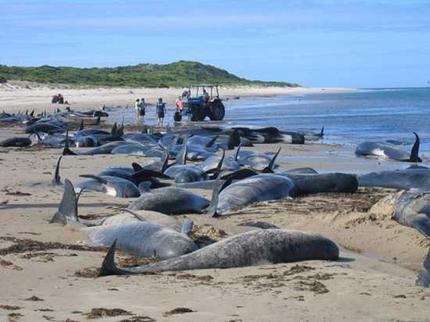
400 Dolphins
Wash Up Dead Off African Coast
By ALI SULTAN,
AP
ZANZIBAR,
Tanzania (April 29, 2006) - Scientists
tried to discover Saturday why
hundreds of dolphins washed up dead
on a beach popular with tourists on
the northern coast of Zanzibar.
Among
other possibilities, marine
biologists were examining whether
U.S. Navy sonar threw the animals
off course.
Villagers
and fishermen were burying the
remains of the roughly 400
bottlenose dolphins, which normally
live in deep offshore waters but
washed up Friday along a 2 1/2-mile
stretch of coast in Tanzania's
Indian Ocean archipelago.
The
animals may have been disturbed by
some unknown factor, or poisoned,
before they became stranded in
shallow waters and died, said
Narriman Jiddawi, a marine biologist
at the Institute of Marine Science
of the University of Dar es Salaam.
Experts
planned to examine the dolphins'
heads to assess whether they had
been affected by military sonar.
Some
scientists surmise that loud bursts
of sonar, which can be heard for
miles in the water, may disorient or
scare marine mammals, causing them
to surface too quickly and suffer
the equivalent of what divers call
the bends - when sudden
decompression forms nitrogen bubbles
in tissue.
A
U.S. Navy task force patrols the
coast of East Africa as part of
counterterrorism operations. A Navy
official was not immediately
available for comment, but the
service rarely speaks about the
location of submarines at sea.
A
preliminary examination of their
dolphins' stomach contents failed to
show the presence of squid beaks or
other remains of animals hunted by
dolphins.
That
was an indication that the dolphins
either had not eaten for a long time
or had vomited, Jiddawi said.
Their
general condition, however, appeared
to show that they had eaten
recently, since their ribs were not
clearly visible under the skin, she
said.
Although
Jiddawi said Friday that poisoning
had been ruled out, experts were
preparing to further examine the
dolphins' stomachs for traces of
poisonous substances such as toxic
"red tides" of algae.
Zanzibar's
resorts attract many visitors who
come to watch and swim with wild
humpback dolphins, which generally
swim closer to shore than the
Indo-Pacific bottlenose.
The
humpbacks, bottlenose, and spinner
dolphins are the most common species
in Zanzibar's coastal waters.
The
most conclusive link between the use
of military sonar and injury to
marine mammals was observed from the
stranding of whales in 2000 in the
Bahamas. The U.S. Navy later
acknowledged that sonar likely
contributed to the stranding of the
extremely shy species.
"These
animals must have been disoriented
and ended up in shallow waters,
where they died," Abdallah Haji,
a 43-year-old fisherman, said
Saturday as he helped bury the
dolphins near the bloodied beach.
Residents
had cut open the animals' bellies to
take their livers, which they use to
make waterproofing material for
boats.
"We
have never seen this type of dolphin
in our area," said Haji, who
said he has fished in Zanzibar's
waters for more than two decades.
04/29/06 16:37
EDT
Copyright 2006
The Associated Press.
Mass dolphin and
whale beaching in Australia
Take a look at this
article from the Sydney
Morning Herald:
Whale
toll rises: second pod found
dead
97 whales and dolphins
have beached themselves in
the past 24 hours. What could
cause something like this??
A second pod of whales
offshore from the site of a mass
beaching on King Island in Bass
Strait has died, officials said.
The 17 pilot whales were
confirmed dead by wildlife
officers this morning, taking to
total toll of dead whales and
dolphins to 97 in the past 24
hours, Tasmanian Department of
Primary Industry, Water and
Environment spokesman Warwick
Brennan said.
A mixed pod of long-finned
pilot whales and bottle-nosed
dolphins beached on the remote Sea
Elephant Beach, north of Naracoopa,
yesterday.
Rescuers counted the bodies
of 55 whales and 25 dolphins by
this morning.
There were no further
survivors in the area, Mr Brennan
said.
Meanwhile, 50 pilot whales
have reportedly beached on Maria
Island off Tasmania's east coast,
a government spokesman said.
Rescuers were on their way
to the area, the spokesman said.
The cause of the strandings was
not known.
AAP
Right
after this event, the tsunami in
Sri Lanka occurred on December 26,
2004.
See:
TSUNAMI
IN OUR FUTURE
Sunday,
December 26, 2004. Tidal
waves, or tsunami, often
set off by undersea
earthquakes, have caused
several major disasters in
coastal communities over
...
www.greatdreams.com/weather/tsunami_in_our_future.htm |
EARTHQUAKE
IN SRI LANKA
29
December 2004. The death
toll in the tsunami
disaster soared past
100000 today - and is set
to climb higher. Look here
too. • Gallery: sorrow
and relief ...
www.greatdreams.com/sri-lanka.htm
December 16, 2006 - Fungal
Infection Killed 2,500
Mallard Ducks in Idaho.
Some
of the 2,500 mallard ducks
that died
between December 8 and 13,
2006, along Land Creek
Springs
near Oakley, Idaho. Photo
courtesy Idaho Fish and
Game.
|
"We've
never seen anything
like this - ever. In
doing some research,
we can’t find any
other die-offs of
this magnitude with
mallard ducks
in the United
States."
- David
Parrish, Idaho Dept.
of Fish and Game |
|
In a six day period
between December 8 and
December 13, 2006, the Idaho
Fish and Game Department
received reports of dead
mallard ducks on the Land
Creek Springs waterway near
Oakley in the Sawtooth
National Forest region of
south central Idaho. By
December 13th, the death
count was up to 2,500 ducks,
unprecedented in Idaho
wildlife history. By
December 14, the first
laboratory results from
several agencies are
expected and I talked about
the unprecedented die-off
with David Parrish, Magic
Valley Regional Supervisor
in the Idaho Department of
Fish and Game where he has
been employed for twenty-six
years.
"Ducks
Died of Fungal
Infection
State and federal
officials have
confirmed that
about 2,500
mallard ducks
found dead
southeast of
Burley, died of an
acute fungal
infection.
The official cause
of death is acute
aspergillosis, a
respiratory tract
infection caused
by a fungus
commonly found in
soil, dead leaves,
moldy grain,
compost piles, or
in other decaying
vegetation.
Test results from
University of
Idaho’s Caine
Veterinary
Teaching Center in
Caldwell confirmed
the presence of
the fungus in
tissue samples
taken from the
ducks this week.
The results
confirm
preliminary
diagnoses at two
other wildlife
health labs in
Washington and
Wisconsin.
The fungus can
cause respiratory
tract infections
in birds that
inhale the spores.
The most likely
source of the
spores for these
ducks is moldy
grain, but no
specific site has
been found as the
source.
Waterfowl die-offs
are common and
many happen in the
United States
every year. During
the past six
months, 16 events
each involving
more than 1,000
birds occurred.
Testing for
diseases is a
routine part of
the investigation
of waterfowl
die-offs.
The first dead
ducks were found
by a hunter
Friday, December
8, along Land
Creek Springs near
Oakley. Idaho
Department of Fish
and Game was
notified, and
conservation
officers found 10
dead ducks near
the spring and
along the stream’s
edge.
Officers returned
to the area on
December 10 to
find more than 500
dead ducks. By the
end of clean-up
operations
Thursday morning,
the number had
grown to about
2,500. Though a
small proportion
of the duck
population in
Idaho or the
United States, the
number of dead
birds in this
die-off is unusual
for Idaho.
Officials
initially
considered it
unlikely that
avian influenza
was the cause of
this die-off.
Widespread testing
of waterfowl in
fall of 2006 has
not found the
highly pathogenic
avian influenza
strain H5N1 in the
United States.
Tissue samples
from dead birds
were not
consistent with
avian influenza,
but as a
precaution samples
were sent to U.S.
Geological
Survey’s National
Wildlife Health
Center in
Wisconsin for
testing.
Results from the
first two groups
of ducks tested
confirmed that
they did not have
the highly
pathogenic avian
influenza strain
H5N1 that is
currently of
concern in Asia,
Europe, the Middle
East and Africa.
Results from
additional tests
are pending.
The Idaho
Department of
Environmental
Quality,
Department of
Agriculture and
the U.S. Fish and
Wildlife Service
helped with the
investigation of
this outbreak.
Hunters are
advised not to
kill any obviously
sick animals,
including ducks
and other
waterfowl."
David
Parrish, Magic
Valley Regional
Supervisor, Idaho
Department of Fish
and Game (employed
for 26 years),
Jerome, Idaho:
"We first
got a report of
waterfowl mortality
on the site back on
Friday, December 8,
2006. We had a
conservation officer
dispatched to the
area and he found 10
dead ducks. We
cleaned those up.
We got another
call from a hunter
on Sunday afternoon,
Dec. 10, about dead
ducks in the same
general area. We
dispatched an
officer again. At
that point in time,
he found about 500
mallard ducks that
were dead.
By Monday
morning, December
11, we sent staff
out on site. We
found roughly 1500
dead mallards and by
yesterday afternoon
after we picked up
all of the
carcasses, the count
was up to about 2500
mallard ducks.
|
We have
never seen a
die-off like
this before
in Idaho. In
doing some
research, we
can’t find
any other
die-offs of
this
magnitude
with mallard
ducks in the
United
States. We
have a
number of
agencies
that are
investigating
the cause of
death and
looking at
potential
mortality
factors. We
have our
Dept. of
Environmental
Quality (DEQ),
the South
Central
District
Health
Office, the
Idaho Dept.
of
Agriculture.
At the
federal
level, we
have the
Dept. of
Homeland
Security
involved.
There are a
number of
agencies and
they are all
looking at a
number of
potential
factors. DEQ
has taken
water and
soil samples
from the
area. The
Dept. of
Agriculture
has taken
pesticide
samples. Our
agency is
taking
tissue
samples and
has sent
them off to
a number of
labs. |
|
But the ducks
that we’ve done
necropsies on have
shown abscesses on
the lungs, which
could be causing the
respiratory
distress. According
to our veterinarian,
Dr. Mark Drew, at
our health lab, he
said that the ducks
he has looked at
have not shown the
classical signs of a
virus or influenza
type outbreak. |
|
|
Dead
birds
fall
from the
skies in
Australia
and
America
London,
Jan.11,
2007 (ANI):
Two
towns,
in two
separate
continents,
have
reported
the
mysterious
dropping
of
thousands
of dead
birds
out of
the sky.
Baffled
wildlife
officials
were
quoted
by the
Daily
Mail as
saying
that
three
weeks
ago
thousands
of
crows,
pigeons,
wattles
and
honeyeaters
fell out
of the
sky in
Esperance,
Western
Australia.
Last
week,
dozens
of
grackles,
sparrows
and
pigeons
dropped
dead on
two
streets
in
Austin,
Texas.
Veterinarians
in both
countries
have
been
unable
to
establish
a cause
of death
-
despite
carrying
out a
large
number
of
autopsies
on the
birds.
The
officials,
however,
have
ruled
out the
possibility
of the
deaths
having
been
caused
by a
severe
storm,
which
recently
struck
the
area.
"We
estimate
several
thousand
birds
are
dead,
although
we don't
have a
clear
number
because
of the
large
areas of
bush
land.
It's
very
substantial,"
the
tabloid
quoted
District
Nature
Conservation
Coordinator
Mike
Fitzgerald,
as
saying.
Birds
Australia,
the
country's
largest
bird
conservation
group,
said it
had not
heard of
a
similar
occurrence,
and
described
it as a
most
unusual
event.
Esperance
resident
Michelle
Crisp,
who
normally
sees
hundreds
of birds
roosting
in her
garden,
counted
80 dead
ones in
one day.
In
Texas,
officials
are also
working
on the
toxic
poisoning
theory.
Adolfo
Valadez,
medical
director
for
Austin
and
Travis
County
Health
and
Human
Services,
said it
might be
weeks
before
any
conclusive
results
were
known.
Such was
the
concern
that the
birds
suffered
deliberate
toxic
poisoning
that
several
streets
were
closed
in
Austin
while
police
and fire
crews
checked
the area
for any
substance
that
might be
of harm
to
humans.
Federal
officials
in
Washington
said
they
were
monitoring
the
situation,
but a
spokesman
for the
Department
of
Homeland
Security
said:
"There
is no
credible
intelligence
to
suggest
an
imminent
threat
to the
homeland
or
Austin
at this
time." (ANI)
Austin looks for answers after 63 dead birds close downtown
Cause unknown, but no threat to humans seen, health officials say
By Emily Ramshaw
The Dallas Morning News
Copyright 2007 The Dallas Morning News
AUSTIN, Texas — Public health officials were scratching their heads over what killed more than 60 grackles, pigeons and sparrows found dead along Congress Avenue near Texas' Capitol on Monday morning, prompting a downtown lockdown that scrambled traffic and kept thousands of employees home from work.
By early afternoon, they had determined that whatever killed the birds wasn't harmful to humans, and 10 blocks in the heart of downtown were reopened.
"We've have no information that leads us to believe that there is any threat," Michael McDonald, Austin assistant city manager for public safety, said during a news conference. "We are going to be conducting further analysis."
Authorities said early necropsies indicated that bird flu is not the culprit and that West Nile virus is highly unlikely, because the disease is seasonal. Air tests were negative for natural gas and other chemicals, and the birds' feathers showed no signs of pesticides. Officials all but ruled out environmental factors; the city had no inclement weather.
Officials said they believe the birds were probably poisoned or suffered from a bacterial infection. A determination will take days or weeks.
The dead birds were first reported around 3 a.m., prompting a public health emergency that forced officers, ambulances and hazardous materials teams to descend on and cordon off downtown.
Of the 63 dead birds, most were found on Congress Avenue several blocks south of the Capitol, officials said. Congress Avenue leads up to the Capitol, which did not close.
"It's not uncommon for birds to die in groups," Mr. McDonald said. "What's uncommon is for it to happen in the downtown area."
No human illness or injury was reported, though Chris Callsen, assistant director of Austin-Travis County Emergency Medical Services, said two officers on the scene reported feeling sick this morning. No one was transported to the hospital.
Emergency rooms have reported no unusual ailments, said Dr. Adolfo Valadez, Director of Austin's Department of Health and Human Services.
"There is currently not a threat to the public health," Dr. Valadez said.
Early-morning passers-by said the birds first began acting strange — wandering aimlessly in the street, attempting to fly and making crash landings — and then dropped like flies.
For most of the morning, downtown Austin was tangled in stop-and-go traffic and blinking emergency lights. Haz-mat teams in yellow plastic suits and rubber boots patrolled Congress Avenue, collecting dead birds and checking the roofs of office buildings for more. The birds are being sent to virology centers at Texas A&M University and in Ames, Iowa, for further testing.
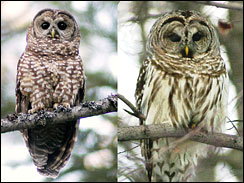
Barn owls dying by thousands along I-84
Article Date: 2007-01-05 Source: http://www.ktvb.com Comments: 0
By Robbie Johnson
BOISE - If you drive down the interstate east of Boise you may spot some of the hundreds of dead owls that are being reported.
The owls are being hit by vehicles in unusually high numbers and so far no one is certain why such a large amount is dying.
Barn owl deaths are becoming extremely common along Interstate 84 in southern Idaho. It tends to occur all year long, but peaks in the wintertime. And in the past couple of years the situation has gotten worse.
The images of the dead owls in the video of this story may be disturbing to some.
Experts think the owls are hunting for prey at night along the interstate - flying low and in front of vehicles, and ultimately getting hit.
And the large number of deaths was enough of a concern that a Boise State University professor began a small study to find out just how many were dying. The numbers are startling.
"Thousands per year seem to be getting killed, and that suggests that there are probably a lot of barn owls in our area. But it also suggests it has the potential to be a really important mortality factor for them and start to effect their population, so there might be some conservation concern for them," said Jim Belthoff, BSU biology professor.
Boise State has three freezers full of dead owls that they've collected during the three-year study, which just wrapped up.
Most of them are young and were healthy when they died. Some even had rodents in their talons.
The next step will be to try to minimize the deaths.
One plan is to get a nest box program going.
Another is to seek money for highway signs that warn people about the owls - a lot like deer crossing signs.
Work is still being done to better determine why the birds are putting themselves in the path of vehicles in such large numbers. |
Jan. 21, 2007 5:11
10 dolphins stuck in NY creek die despite efforts
By ASSOCIATED PRESS
EAST HAMPTON, New York
The number of dolphins who have died since being trapped in a shallow creek off eastern Long Island has risen to 10, a rescue leader said.
About 20 of the "common dolphins" were first sighted about 11 days ago in the Northwest Harbor cove, which is north of East Hampton, about 100 miles (160 kilometers) east of New York City. Eight dolphins swam to safety earlier in the week after being coaxed out of the cove, and three were spotted Friday. Officials do not know how many are still alive.
|
More than 80 people have been involved in the rescue effort. The 10th dolphin's body was found midmorning Saturday, officials said.
THE BEE DILEMMA
Report links Bayer pesticide to bee deaths
A new French report has found a significant risk to bees from a Bayer product containing the active ingredient imidacloprid.
A report on bee-deaths, published by the French Comité Scientifique et Technique (CST), shows that the use of the pesticide Gaucho containing the active substance imidacloprid is jointly responsible for the death of hundreds of thousands of bee colonies. Environmental and beekeeper unions are calling for a ban on the agricultural toxin.
The summary of the report states: ‘The results of the examination on the risks of the seed treatment Gaucho are alarming. The treatment of seeds by Gaucho is a significant risk to bees in several stages of life.’ The 108-page report was made by order of the agricultural ministry of France, by the universities of Caen and Metz as well as by the Institut Pasteur.
The use of Gaucho on sunflowers was forbidden in France four years ago because of the high risk to bees. After this bee-deaths did not decrease noticeably – beekeepers are blaming this on the extensive use of agricultural toxins in maize cultivation. The concluding report of the CST backs up this theory: ‘Concerning the treatment of maize-seeds by Gaucho, the results are as alarming as with sunflowers. The consumption of contaminated pollen can lead to an increased mortality of caretaking bees, which can explain the persisting bee-deaths even after the ban of the treatment on sunflowers’.
The pesticide Gaucho is produced by the German Bayer group. With an annual turnover of more than 500 million Euros this is the group’s top selling agricultural agent. Critics assume that the high sales figures are the reason why the company is contesting a ban on its use.
The theory stated by bee institutes, that infestation by Varroa mites could be responsible for bee-deaths, is questioned by Fridolin Brandt of the Coalition against Bayer-Dangers: ‘We have been concerned with Varroa mites since 1977, and for decades they have not been a danger. It is the extensive use of pesticides and the accompanying weakening of the bees which is leading to the bee-deaths.’ Brandt has been a full-time beekeeper for more than 30 years.
Maurice Mary, spokesman of the French beekeepers-union Union National d'Apiculteurs (UNAF): ‘Since the first application of Gaucho we have had great losses in the harvest of sunflower honey. Since the agent is staying in the soil for up to three years, even untreated plants can contain a concentration which is lethal for bees.’ The UNAF, representing about 50,000 beekeepers is calling for a total ban of Gaucho, following the presentation of the CST report.
The Deutsche Berufsimkerbund (DBIB) and the Coalition against Bayer-Dangers are also calling for a ban on its use. In Germany, imidacloprid is used mainly in the production of rape, sugar beet and maize. The situation in German agriculture is comparable to the French: in the past few years almost half of the bee-colonies have died, which has led to a loss of output of several thousand tonnes of honey per year. Furthermore, because bees do the most pollination, there are also losses of output on apples, pears and oilseed rape.
Press release from Coalition against Bayer-Dangers, CBGnetwork@aol.com, http://www.cbgnetwork.org/. Contact CBG Network for copies of the 108-page report of the Comité Scientifique et Technique (in French) and a statement by the Coordination des Apiculteurs de France (in English). See also page 22.
[This article first appeared in Pesticides News No. 62, December 2003, page 17]
- Any information here in is for educational purpose only, it may be news related, purely speculation or someone's opinion, If health related always consult with a qualified health practitioner before deciding on any course of treatment, especially for serious or life-threatening illnesses.
**COPYRIGHT NOTICE**
In accordance with Title 17 U.S.C. Section 107,
any copyrighted work in this message is distributed under fair use without profit or payment to those who have expressed a prior interest in receiving the included information for non-profit research and educational purposes only. http://www.law.cornell.edu/uscode/17/107.shtml
-~----------~----~----~----~------~----~------~--~---
Subject: The "highly preliminary" results (bees)
A possibility --nothing more.....
http://www.ktvu.com/news/13202905/detail.html?rss=fran&psp=news
SAN FRANCISCO -- A fungus that killed bee colonies across Europe and Asia may be to blame for the current collapse of bee colonies in the U.S. and Canada, researchers said.
The sudden deaths of the buzzing insects, a condition called Colony Collapse Disorder, has disturbed beekeepers, scientists and farmers who depend on bees for pollination.
The "highly preliminary" results announced Wednesday showed evidence of the single-celled parasite called Nosema ceranae on a few hives taken from Merced County for testing, said Joe DeRisi, a biochemist at the University of California, San Francisco, who found the SARS virus in 2003.
DeRisi used a technique known as "shotgun sequencing," that allows rapid reading of a genetic code and then matches it to computerized libraries of known genes from thousands of germs.
Other scientists said Wednesday they had found the fungus in hives from around the country but were quick to point out the parasite also was found in healthy bees. Researchers found two other fungi and a half- dozen viruses in dead bees.
"By itself, (N. ceranae) is probably not the culprit," said entomologist Diana Cox-Foster of Pennsylvania State University. "But it may be one of the key players."
Cox-Foster and about 60 other researchers gathered this week in Washington, D.C., to discuss Colony Collapse Disorder.
Scientists have not ruled out other factors such as pesticides or inadequate food resources following a drought, she said.
Weather, pesticides and infestations have wiped out significant numbers of colonies in the past, but the current loss appears unprecedented. Worried agriculture officials estimate about a quarter of the 2.4 million commercial colonies across the U.S. have been lost since fall.
http://www.ktvu.com/news/13202905/detail.html?rss=fran&psp=news
MYSTERY Honeybee colonies around the nation are collapsing. Above, a beekeeper in Loxahatchee, Fla.
By ALEXEI BARRIONUEVO
April 24, 2007
BELTSVILLE, Md., April 23 - What is happening to the bees?
Multimedia Map
Disappearing Bees
Kalim A. Bhatti for The New York Times
SUSPECTS The volume of theories to explain the collapse of honeybee populations "is totally mind-boggling," said Diana Cox-Foster, an entomologist at Penn State.
More than a quarter of the country's 2.4 million bee colonies have been lost - tens of billions of bees, according to an estimate from the Apiary Inspectors of America, a national group that tracks beekeeping. So far, no one can say what is causing the bees to become disoriented and fail to return to their hives.
As with any great mystery, a number of theories have been posed, and many seem to researchers to be more science fiction than science. People have blamed genetically modified crops, cellular phone towers and high-voltage transmission lines for the disappearances. Or was it a secret plot by Russia or Osama bin Laden to bring down American agriculture? Or, as some blogs have asserted, the rapture of the bees, in which God recalled them to heaven? Researchers have heard it all.
The volume of theories "is totally mind-boggling," said Diana Cox-Foster, an entomologist at Pennsylvania State University. With Jeffrey S. Pettis, an entomologist from the United States Department of Agriculture, Dr. Cox-Foster is leading a team of researchers who are trying to find answers to explain "colony collapse disorder," the name given for the disappearing bee syndrome.
"Clearly there is an urgency to solve this," Dr. Cox-Foster said. "We are trying to move as quickly as we can."
Dr. Cox-Foster and fellow scientists who are here at a two-day meeting to discuss early findings and future plans with government officials have been focusing on the most likely suspects: a virus, a fungus or a pesticide.
About 60 researchers from North America sifted the possibilities at the meeting today. Some expressed concern about the speed at which adult bees are disappearing from their hives; some colonies have collapsed in as little as two days. Others noted that countries in Europe, as well as Guatemala and parts of Brazil, are also struggling for answers.
"There are losses around the world that may or not be linked," Dr. Pettis said.
The investigation is now entering a critical phase. The researchers have collected samples in several states and have begun doing bee autopsies and genetic analysis.
So far, known enemies of the bee world, like the varroa mite, on their own at least, do not appear to be responsible for the unusually high losses.
Genetic testing at Columbia University has revealed the presence of multiple micro-organisms in bees from hives or colonies that are in decline, suggesting that something is weakening their immune system. The researchers have found some fungi in the affected bees that are found in humans whose immune systems have been suppressed by the Acquired Immune Deficiency Syndrome or cancer.
"That is extremely unusual," Dr. Cox-Foster said.
Meanwhile, samples were sent to an Agriculture Department laboratory in North Carolina this month to screen for 117 chemicals. Particular suspicion falls on a pesticide that France banned out of concern that it may have been decimating bee colonies. Concern has also mounted among public officials.
"There are so many of our crops that require pollinators," said Representative Dennis Cardoza, a California Democrat whose district includes that state's central agricultural valley, and who presided last month at a Congressional hearing on the bee issue. "We need an urgent call to arms to try to ascertain what is really going on here with the bees, and bring as much science as we possibly can to bear on the problem."
So far, colony collapse disorder has been found in 27 states, according to Bee Alert Technology Inc., a company monitoring the problem. A recent survey of 13 states by the Apiary Inspectors of America showed that 26 percent of beekeepers had lost half of their bee colonies between September and March.
Honeybees are arguably the insects that are most important to the human food chain. They are the principal pollinators of hundreds of fruits, vegetables, flowers and nuts. The number of bee colonies has been declining since the 1940s, even as the crops that rely on them, such as California almonds, have grown. In October, at about the time that beekeepers were experiencing huge bee losses, a study by the National Academy of Sciences questioned whether American agriculture was relying too heavily on one type of pollinator, the honeybee.
Bee colonies have been under stress in recent years as more beekeepers have resorted to crisscrossing the country with 18-wheel trucks full of bees in search of pollination work. These bees may suffer from a diet that includes artificial supplements, concoctions akin to energy drinks and power bars. In several states, suburban sprawl has limited the bees' natural forage areas.
So far, the researchers have discounted the possibility that poor diet alone could be responsible for the widespread losses. They have also set aside for now the possibility that the cause could be bees feeding from a commonly used genetically modified crop, Bt corn, because the symptoms typically associated with toxins, such as blood poisoning, are not showing up in the affected bees. But researchers emphasized today that feeding supplements produced from genetically modified crops, such as high-fructose corn syrup, need to be studied.
The scientists say that definitive answers for the colony collapses could be months away. But recent advances in biology and genetic sequencing are speeding the search.
Computers can decipher information from DNA and match pieces of genetic code with particular organisms. Luckily, a project to sequence some 11,000 genes of the honeybee was completed late last year at Baylor College of Medicine in Houston, giving scientists a huge head start on identifying any unknown pathogens in the bee tissue.
"Otherwise, we would be looking for the needle in the haystack," Dr. Cox-Foster said.
Large bee losses are not unheard of. They have been reported at several points in the past century. But researchers think they are dealing with something new - or at least with something previously unidentified.
Globules in a bee's gut may indicate lethal pathogens.
Multimedia
Map
Cross-sections of a diseased bee thorax, left, and a healthy one.
"There could be a number of factors that are weakening the bees or speeding up things that shorten their lives," said Dr. W. Steve Sheppard, a professor of entomology at Washington State University. "The answer may already be with us."
Scientists first learned of the bee disappearances in November, when David Hackenberg, a Pennsylvania beekeeper, told Dr. Cox-Foster that more than 50 percent of his bee colonies had collapsed in Florida, where he had taken them for the winter.
Dr. Cox-Foster, a 20-year veteran of studying bees, soon teamed with Dennis vanEngelsdorp, the Pennsylvania apiary inspector, to look into the losses.
In December, she approached W. Ian Lipkin, director of the Greene Infectious Disease Laboratory at Columbia University, about doing genetic sequencing of tissue from bees in the colonies that experienced losses. The laboratory uses a recently developed technique for reading and amplifying short sequences of DNA that has revolutionized the science. Dr. Lipkin, who typically works on human diseases, agreed to do the analysis, despite not knowing who would ultimately pay for it. His laboratory is known for its work in finding the West Nile disease in the United States.
Dr. Cox-Foster ultimately sent samples of bee tissue to researchers at Columbia, to the Agriculture Department laboratory in Maryland, and to Gene Robinson, an entomologist at the University of Illinois. Fortuitously, she had frozen bee samples from healthy colonies dating to 2004 to use for comparison.
After receiving the first bee samples from Dr. Cox-Foster on March 6, Dr. Lipkin's team amplified the genetic material and started sequencing to separate virus, fungus and parasite DNA from bee DNA.
"This is like C.S.I. for agriculture," Dr. Lipkin said. "It is painstaking, gumshoe detective work."
Dr. Lipkin sent his first set of results to Dr. Cox-Foster, showing that several unknown micro-organisms were present in the bees from collapsing colonies. Meanwhile, Mr. vanEngelsdorp and researchers at the Agriculture Department lab here began an autopsy of bees from collapsing colonies in California, Florida, Georgia and Pennsylvania to search for any known bee pathogens.
At the University of Illinois, using knowledge gained from the sequencing of the bee genome, Dr. Robinson's team will try to find which genes in the collapsing colonies are particularly active, perhaps indicating stress from exposure to a toxin or pathogen.
The national research team also quietly began a parallel study in January, financed in part by the National Honey Board, to further determine if something pathogenic could be causing colonies to collapse.
Mr. Hackenberg, the beekeeper, agreed to take his empty bee boxes and other equipment to Food Technology Service, a company in Mulberry, Fla., that uses gamma rays to kill bacteria on medical equipment and some fruits. In early results, the irradiated bee boxes seem to have shown a return to health for colonies repopulated with Australian bees.
"This supports the idea that there is a pathogen there," Dr. Cox-Foster said. "It would be hard to explain the irradiation getting rid of a chemical."
Still, some environmental substances remain suspicious.
Chris Mullin, a Pennsylvania State University professor and insect toxicologist, recently sent a set of samples to a federal laboratory in Raleigh, N.C., that will screen for 117 chemicals. Of greatest interest are the "systemic" chemicals that are able to pass through a plant's circulatory system and move to the new leaves or the flowers, where they would come in contact with bees.
One such group of compounds is called neonicotinoids, commonly used pesticides that are used to treat corn and other seeds against pests. One of the neonicotinoids, imidacloprid, is commonly used in Europe and the United States to treat seeds, to protect residential foundations against termites and to help keep golf courses and home lawns green.
In the late 1990s, French beekeepers reported large losses of their bees and complained about the use of imidacloprid, sold under the brand name Gaucho. The chemical, while not killing the bees outright, was causing them to be disoriented and stay away from their hives, leading them to die of exposure to the cold, French researchers later found. The beekeepers labeled the syndrome "mad bee disease."
The French government banned the pesticide in 1999 for use on sunflowers, and later for corn, despite protests by the German chemical giant Bayer, which has said its internal research showed the pesticide was not toxic to bees. Subsequent studies by independent French researchers have disagreed with Bayer. Alison Chalmers, an eco-toxicologist for Bayer CropScience, said at the meeting today that bee colonies had not recovered in France as beekeepers had expected. "These chemicals are not being used anymore," she said of imidacloprid, "so they certainly were not the only cause."
Among the pesticides being tested in the American bee investigation, the neonicotinoids group "is the number-one suspect," Dr. Mullin said. He hoped results of the toxicology screening will be ready within a month.
Correction: April 26, 2007
An article in Science Times on Tuesday about efforts to solve the mystery of collapsing honeybee populations misstated the institution where a project to sequence honeybee genes was completed late last year. It is Baylor College of Medicine, not Baylor University. (The two became separate institutions in 1969.) And a map with the article, showing the extent of the problem in the United States, reversed the labels for Kansas and Nebraska, two states where collapsing populations have not been reported.
http://www.nytimes.com/2007/04/24/science/24bees.html?_r=1&oref=slogin
DISAPPEARING BEES! TAIWAN STUNG BY MILLIONS OF MISSING BEES ...
10,000,000 HAVE VANISHED THUS FAR! / WHY AREN'T THEY RETURNING HOME TO
THEIR BEEKEEPERS?! –
Thursday, April 26, 2007, 6:39 a.m. ET
TAIPEI (Reuters) – Taiwan's bee farmers are feeling the sting of lost business and possible crop danger after millions of the honey-making, plant-pollinating insects vanished during volatile weather, media and experts said on Thursday.
Over the past two months, farmers in three parts of Taiwan have reported most of their bees gone, the Chinese-language United Daily News reported. Taiwan's TVBS television station said about 10 million bees had vanished in Taiwan.
A beekeeper on Taiwan's northeastern coast reported 6 million insects missing "for no reason", and one in the south said 80 of his 200 bee boxes had been emptied, the paper said.
Beekeepers usually let their bees out of boxes to pollinate plants and the insects normally make their way back to their owners. However, many of the bees have not returned over the past couple of months.
Possible reasons include disease, pesticide poisoning and unusual weather, varying from less than 20 degrees Celsius (68 degrees Fahrenheit) to more than 30 degrees Celsius over a few days, experts say.
"You can see climate change really clearly these days in Taiwan," said Yang Ping-shih, entomology professor at the National Taiwan University. He added that two kinds of pesticide can make bees turn "stupid" and lose their sense of direction. As affected beekeepers lose business, fruit growers may lack a key pollination source and neighbors might get stung, he said.
Billions of bees have fled hives in the United States since late 2006, instead of helping pollinate $15 billion worth of fruits, nuts and other crops annually. Disappearing bees also have been reported in Europe and Brazil.
The mass buzz-offs are isolated cases so far, a Taiwan government Council of Agriculture official said. But the council may collect data to study the causes of the vanishing bees and gauge possible impacts, said Kao Ching-wen, a pesticides section chief at the council.
"We want to see what the reason is, and we definitely need some evidence," Kao said. "It's hard to say whether there will be an impact."
------------------------------------------
IMPORTANT RESOURCES:
WIKIPEDIA ON COLONY COLLAPSE DISORDER:
http://en.wikipedia.org/wiki/Colony_collapse_disorder
MAAREC COLONY COLLAPSE DISORDER WEB SITE:
http://maarec.cas.psu.edu/ColonyCollapseDisorder.html
MAP OF U.S. STATES REPORTING COLONY COLLAPSE DISORDER:
http://maarec.cas.psu.edu/pressReleases/CCDMap07FebRev1-.jpg
THE WAY BACK TO BIOLOGICAL BEEKEEPING (DEE LUSBY):
http://www.beesource.com/pov/lusby/index.htm
GENERAL BEE ARTICLES & REPORTS:
http://www.beesource.com/news/index.htm
ORGANIC & KILLER BEES SEEM RESISTANT TO 'COLONY COLLAPSE DISORDER'
(4/24/2007):http://groups.yahoo.com/group/nhnenews/message/12889
HONEY BEE DIE-OFF ALARMS BEEKEEPERS, CROP GROWERS & RESEARCHERS
(4/24/2007):http://groups.yahoo.com/group/nhnenews/message/12888
HONEY BEE EXPERTS GATHER TO POOL KNOWLEDGE (4/22/2007):
http://groups.yahoo.com/group/nhnenews/message/12880
HONEY BEE DIE-OFF RESOURCES (4/17/2007):
http://groups.yahoo.com/group/nhnenews/message/12857
ARE MOBILE PHONES WIPING OUT OUR BEES? (4/15/2007):
http://groups.yahoo.com/group/nhnenews/message/12851
BEE COLONIES ACROSS U.S. CONTINUE TO DIE (4/7/2007):
http://groups.yahoo.com/group/nhnenews/message/12825
ARE GM CROPS KILLING BEES? (3/23/2007):
http://groups.yahoo.com/group/nhnenews/message/12754
HONEYBEES VANISH, LEAVING KEEPERS IN PERIL (2/27/2007):
http://groups.yahoo.com/group/nhnenews/message/12647
U.S. BEE COLONIES DECIMATED BY MYSTERIOUS AILMENT (2/14/2007):
http://groups.yahoo.com/group/nhnenews/message/12588
PARASITE DEVASTATES U.S. BEES (5/2/2005):
http://groups.yahoo.com/group/nhnenews/message/9104
MAD BEE DISEASE (2/20/2001):
http://groups.yahoo.com/group/nhnenews/message/1181
FACTORY FARMING RESOURCE PAGE:
http://www.nhne.org/tabid/451/Default.aspx
FACTORY FARMING and CRUELTY TO ANIMALS NEWS STORIES:
http://tinyurl.com/hmy5k
------------------------------------------
© Reuters 2007. All Rights Reserved.
http://today.reuters.com/news/articlenews.aspx?type=scienceNews&storyid=2007-04-26T104754Z_01_TP162481_RTRUKOC_0_US-TAIWAN-BEES.xml&src=rss&rpc=22
SCIENCE IN THE NEWS
from Sigma Xi, The Scientific Research Society
Today's Headlines - April 26, 2007
Experts May Have Found What's Bugging the Bees
from the Los Angeles Times
A fungus that caused widespread loss of bee colonies in Europe and Asia may
be playing a crucial role in the mysterious phenomenon known as Colony
Collapse Disorder that is wiping out bees across the United States, UC San
Francisco researchers said Wednesday.
Researchers have been struggling for months to explain the disorder, and
the new findings provide the first solid evidence pointing to a potential
cause. But the results are "highly preliminary" and are from only a few
hives from Le Grand in Merced County, UCSF biochemist Joe DeRisi said. "We
don't want to give anybody the impression that this thing has been solved."
Other researchers said Wednesday that they too had found the fungus, a
single-celled parasite called Nosema ceranae, in affected hives from around
the country - as well as in some hives where bees had survived. Those
researchers have also found two other fungi and half a dozen viruses in the
dead bees.
To read more: http://www.latimes.com/news/science/la-sci-
bees26apr26,1,7929894.story
Or: http://tinyurl.com/3d5elk
http://www.nytimes.com/2007/04/24/science/24bees.html
BEES VANISH, AND SCIENTISTS RACE FOR REASONS FOR EMERGING GLOBAL FOOD
CRISIS! / MORE THAN 25% OF AMERICA's 2.4 MILLION BEE COLONIES HAVE BEEN
LOST ... BUT WHY?! –
By Alexei Barrionuevo, New York Times,
Thursday, April 26, 2007
BELTSVILLE, MD. – What is happening to the bees?
More than a quarter of the country's 2.4 million bee colonies have been
lost -- tens of billions of bees, according to an estimate from the
Apiary Inspectors of America, a national group that tracks beekeeping.
So far, no one can say what is causing the bees to become disoriented
and fail to return to their hives.
As with any great mystery, a number of theories have been posed, and
many
seem to researchers to be more science fiction than science. People have
blamed genetically modified crops, cellular phone towers and
high-voltage transmission lines for the disappearances.
Or was it a secret plot by Russia or Osama bin Laden to bring down
American agriculture? Or, as some blogs have asserted, the rapture of
the bees, in which God recalled them to heaven? Researchers have heard
it all.
The volume of theories "is totally mind-boggling," said Diana
Cox-Foster, an entomologist at Pennsylvania State University. With
Jeffrey S. Pettis, an
entomologist from the United States Department of Agriculture, Dr.
Cox-Foster is leading a team of researchers who are trying to find
answers to explain "colony collapse disorder," the name given for the
disappearing bee syndrome.
"Clearly there is an urgency to solve this," Dr. Cox-Foster said. "We
are trying to move as quickly as we can."
Dr. Cox-Foster and fellow scientists who are here at a two-day meeting
to discuss early findings and future plans with government officials
have been focusing on the most likely suspects: a virus, a fungus or a
pesticide.
About 60 researchers from North America sifted the possibilities at the
meeting today. Some expressed concern about the speed at which adult
bees are disappearing from their hives; some colonies have collapsed in
as little as two days. Others noted that countries in Europe, as well as
Guatemala and parts of Brazil, are also struggling for answers.
"There are losses around the world that may or not be linked," Dr.
Pettis
said.
The investigation is now entering a critical phase. The researchers have
collected samples in several states and have begun doing bee autopsies
and genetic analysis.
So far, known enemies of the bee world, like the varroa mite, on their
own at least, do not appear to be responsible for the unusually high
losses.
Genetic testing at Columbia University has revealed the presence of
multiple
micro-organisms in bees from hives or colonies that are in decline,
suggesting that something is weakening their immune system. The
researchers have found some fungi in the affected bees that are found in
humans whose immune systems have been suppressed by the Acquired Immune
Deficiency Syndrome or cancer.
"That is extremely unusual," Dr. Cox-Foster said.
Meanwhile, samples were sent to an Agriculture Department laboratory in
North Carolina this month to screen for 117 chemicals. Particular
suspicion falls on a pesticide that France banned out of concern that it
may have been decimating bee colonies. Concern has also mounted among
public officials.
"There are so many of our crops that require pollinators," said
Representative Dennis Cardoza, a California Democrat whose district
includes that state¹s central agricultural valley, and who presided
last month at a Congressional hearing on the bee issue. "We need an
urgent call to arms to try to ascertain what is really going on here
with the bees, and bring as
much science as we possibly can to bear on the problem."
So far, colony collapse disorder has been found in 27 states, according
to Bee Alert Technology Inc., a company monitoring the problem. A recent
survey of 13 states by the Apiary Inspectors of America showed that 26
percent of beekeepers had lost half of their bee colonies between
September and March.
Honeybees are arguably the insects that are most important to the human
food
chain. They are the principal pollinators of hundreds of fruits,
vegetables, flowers and nuts. The number of bee colonies has been
declining since the 1940s, even as the crops that rely on them, such as
California almonds, have grown.
In October, at about the time that beekeepers were experiencing huge bee
losses, a study by the National Academy of Sciences questioned whether
American agriculture was relying too heavily on one type of pollinator,
the honeybee.
Bee colonies have been under stress in recent years as more beekeepers
have
resorted to crisscrossing the country with 18-wheel trucks full of bees
in search of pollination work. These bees may suffer from a diet that
includes artificial supplements, concoctions akin to energy drinks and
power bars. In several states, suburban sprawl has limited the bees'
natural forage areas.
So far, the researchers have discounted the possibility that poor diet
alone could be responsible for the widespread losses. They have also set
aside for now the possibility that the cause could be bees feeding from
a commonly used genetically modified crop, Bt corn, because the symptoms
typically associated with toxins, such as blood poisoning, are not
showing up in the affected bees.
But researchers emphasized today that feeding supplements produced from
genetically modified crops, such as high-fructose corn syrup, need to be
studied. The scientists say that definitive answers for the colony
collapses could be
months away. But recent advances in biology and genetic sequencing are
speeding the search.
Computers can decipher information from DNA and match pieces of genetic
code
with particular organisms. Luckily, a project to sequence some 11,000
genes
of the honeybee was completed late last year at Baylor College of
Medicine
in Houston, giving scientists a huge head start on identifying any
unknown
pathogens in the bee tissue.
"Otherwise, we would be looking for the needle in the haystack," Dr.
Cox-Foster said.
Large bee losses are not unheard of. They have been reported at several
points in the past century. But researchers think they are dealing with
something new -- or at least with something previously unidentified.
"There could be a number of factors that are weakening the bees or
speeding
up things that shorten their lives," said Dr. W. Steve Sheppard, a
professor
of entomology at Washington State University. "The answer may already be
with us."
Scientists first learned of the bee disappearances in November, when
David
Hackenberg, a Pennsylvania beekeeper, told Dr. Cox-Foster that more than
50
percent of his bee colonies had collapsed in Florida, where he had taken
them for the winter.
Dr. Cox-Foster, a 20-year veteran of studying bees, soon teamed with
Dennis
vanEngelsdorp, the Pennsylvania apiary inspector, to look into the
losses. In December, she approached W. Ian Lipkin, director of the
Greene Infectious
Disease Laboratory at Columbia University, about doing genetic
sequencing of tissue from bees in the colonies that experienced losses.
The laboratory uses a recently developed technique for reading and
amplifying short
sequences of DNA that has revolutionized the science. Dr. Lipkin, who
typically works on human diseases, agreed to do the analysis, despite
not knowing who would ultimately pay for it. His laboratory is known for
its work in finding the West Nile disease in the United States.
Dr. Cox-Foster ultimately sent samples of bee tissue to researchers at
Columbia, to the Agriculture Department laboratory in Maryland, and to
Gene Robinson, an entomologist at the University of Illinois.
Fortuitously, she had frozen bee samples from healthy colonies dating to
2004 to use for comparison.
After receiving the first bee samples from Dr. Cox-Foster on March 6,
Dr. Lipkin¹s team amplified the genetic material and started
sequencing to separate virus, fungus and parasite DNA from bee DNA.
"This is like C.S.I. for agriculture," Dr. Lipkin said. "It is
painstaking,
gumshoe detective work."
Dr. Lipkin sent his first set of results to Dr. Cox-Foster, showing that
several unknown micro-organisms were present in the bees from collapsing
colonies. Meanwhile, Mr. vanEngelsdorp and researchers at the
Agriculture Department lab here began an autopsy of bees from collapsing
colonies in California, Florida, Georgia and Pennsylvania to search for
any known bee pathogens.
At the University of Illinois, using knowledge gained from the
sequencing of
the bee genome, Dr. Robinson¹s team will try to find which genes in
the collapsing colonies are particularly active, perhaps indicating
stress from exposure to a toxin or pathogen. The national research team
also quietly began a parallel study in January, financed in part by the
National Honey Board, to further determine if something pathogenic could
be causing colonies to collapse.
Mr. Hackenberg, the beekeeper, agreed to take his empty bee boxes and
other
equipment to Food Technology Service, a company in Mulberry, Fla., that
uses
gamma rays to kill bacteria on medical equipment and some fruits. In
early results, the irradiated bee boxes seem to have shown a return to
health for
colonies repopulated with Australian bees.
"This supports the idea that there is a pathogen there," Dr. Cox-Foster
said. "It would be hard to explain the irradiation getting rid of a
chemical."
Still, some environmental substances remain suspicious. Chris Mullin, a
Pennsylvania State University professor and insect toxicologist,
recently sent a set of samples to a federal laboratory in
Raleigh, N.C., that will screen for 117 chemicals. Of greatest interest
are
the "systemic" chemicals that are able to pass through a plant¹s
circulatory system and move to the new leaves or the flowers, where they
would come in
contact with bees.
One such group of compounds is called neonicotinoids, commonly used
pesticides that are used to treat corn and other seeds against pests.
One of the neonicotinoids, imidacloprid, is commonly used in Europe and
the United States to treat seeds, to protect residential foundations
against termites and to help keep golf courses and home lawns green.
In the late 1990s, French beekeepers reported large losses of their bees
and
complained about the use of imidacloprid, sold under the brand name
Gaucho. The chemical, while not killing the bees outright, was causing
them to be
disoriented and stay away from their hives, leading them to die of
exposure
to the cold, French researchers later found. The beekeepers labeled the
syndrome "mad bee disease."
The French government banned the pesticide in 1999 for use on
sunflowers,
and later for corn, despite protests by the German chemical giant Bayer,
which has said its internal research showed the pesticide was not toxic
to
bees. Subsequent studies by independent French researchers have
disagreed
with Bayer.
Alison Chalmers, an eco-toxicologist for Bayer CropScience, said at the
meeting today that bee colonies had not recovered in France as
beekeepers had expected. "These chemicals are not being used anymore,"
she said of imidacloprid, "so they certainly were not the only cause."
Among the pesticides being tested in the American bee investigation, the
neonicotinoids group "is the number-one suspect," Dr. Mullin said. He
hoped results of the toxicology screening will be ready within a month.
CORRECTION: April 26, 2007
An article in Science Times on Tuesday about efforts to solve the
mystery of
collapsing honeybee populations misstated the institution where a
project to sequence honeybee genes was completed late last year. It is
Baylor College of Medicine, not Baylor University. (The two became
separate institutions in 1969.)
And a map with the article, showing the extent of the problem in the
United States, reversed the labels for Kansas and Nebraska, two states
where collapsing populations have not been reported.
© 2007 The New York Tmes Company / Click below for "Printer Friendly
Version."
http://www.nytimes.com/2007/04/24/science/24bees.html?_r=1&oref=slogin&pagewanted=print
The great bee mystery; Ontario honeybees are dying off by the millions -
and no one knows why
Colin McKim / The Packet & Times
Local News - Wednesday, April 25, 2007 @ 09:00

Severn Township beekeeper Tom Morrisey lost one-third of his bee colonies this winter. In some parts of the province, beekeeping operations have been completely wiped out.
Photo: Submitted
|
Ontario's beekeepers, stung by alarming colony losses this winter, are asking the province to help them rebuild their businesses and investigate the causes of the massive die-offs.
"It's very disconcerting," said Severn Township beekeeper Tom Morrisey, who lost about one-third of his honeybees this winter.
"They don't know what's causing it - that's the troubling part."
Beekeepers in the Orillia area have fared better than other parts of the province, where some honey producers lost all of their bees.
The north shore of Lake Erie, including the fruit belt, where bees are critical to the pollination of orchards, has been hit the hardest, with losses between 50 and 100 per cent, said Morrisey.
He added it's been standard practice for years to truck colonies of domesticated bees to farms, where their activity can increase yields fivefold. The pollination value in Ontario has been estimated at $171 million.
"It has such a big impact on agriculture. People are just frantic." A frightening phenomenon called colony collapse disorder (CCD) has recently been devastating bee colonies in the United States.
"For years, we've been immune," said Morrisey.
At this point, the Ontario Beekeepers Association (OBA) has not made a direct connection to problems south of the border, where parasites, pesticides, excessive transportation of colonies and weather are all suspected of contributing to CCD.
The factors causing the Ontario die-offs may be quite different, said Morrisey, an OBA director.
He said the culprit here may be the weather, particularly the long, mild fall followed by a sudden and harsh freeze-up.
Bees are cold-blooded and stay warm by clustering together through the cold months.
Normally, a dormant period precedes the onset of winter as bees gradually adjust to the falling temperatures, said Morrisey.
"This year, all of a sudden, bang, it was deep and cold for a long time."
Area beekeeper Paul Gillett, who lost 12 of 50 hives, said he thinks the bees didn't store adequate honey in the fall.
The worker bees form a cluster around the queen, keeping her warm so she can lay eggs in the spring and repopulate the hive, said Gillett.
"If the queen dies, the hive dies."
The OBA directors decided Monday to ask the Ministry of Agriculture to fund field analysis of the colony deaths and to help beekeepers rebuild their bee colonies.
Morrisey said he will be able to rebound from a 30 per cent loss of his bees.
But beekeepers with higher losses will need financial help, he said: "You can't get a bank loan for bees."
– 1 of 2 –
'KILLER BEES' SEEM RESISTANT TO "COLONY COLLAPSE DISORDER!" –
By Dan Sorenson, Arizona Daily Star
Tuesday, April 24, 2007
http://www.azstarnet.com/allheadlines/176000
TUCSON, ARIZONA – Although experts are stumped about what's causing
the
colony-collapse disorder die-off in U.S. commercial beehives, there is
some
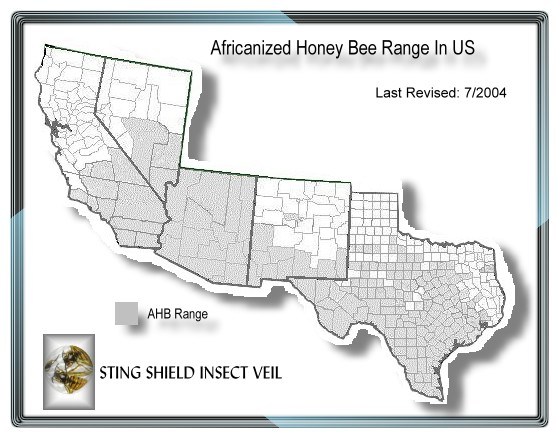
speculation that Arizona's famed Africanized -- or "killer bee" --
wild-bee
population is somehow immune.
------------------------------------------
– 2 of 2 –
HONEY BEE DIE-OFF ALARMS BEEKEEPERS, CROP GROWERS AND RESEARCHERS! –
Science Daily / Penn State: College Of Agricultural Sciences, Tuesday,
April 24, 2007
http://www.sciencedaily.com/releases/2007/04/070422190612.htm
An alarming die-off of honey bees has beekeepers fighting for commercial
survival and crop growers wondering whether bees will be available to
pollinate their crops this spring and summer. Researchers are scrambling
to
find answers to what's causing an affliction recently named Colony
Collapse
Disorder, which has decimated commercial beekeeping operations in
Pennsylvania and across the country.
"During the last three months of 2006, we began to receive reports from
commercial beekeepers of an alarming number of honey bee colonies dying
in the eastern United States," says Maryann Frazier, apiculture
extension associate in Penn State's College of Agricultural Sciences.
"Since the beginning of the year, beekeepers from all over the country
have been reporting unprecedented losses. This has become a highly
significant yet poorly understood problem that
threatens the pollination industry and the production of commercial
honey in
the United States," she says. "Because the number of managed honey bee
colonies is less than half of what it was 25 years ago, states such as
Pennsylvania can ill afford these heavy losses."
A working group of university faculty researchers, state regulatory
officials, cooperative extension educators and industry representatives
is working to identify the cause or causes of Colony Collapse Disorder
and to develop management strategies and recommendations for beekeepers.
Participating organizations include Penn State, the U.S. Department of
Agriculture, the agriculture departments in Pennsylvania and Florida,
and Bee Alert Technology Inc., a technology transfer company affiliated
with the University of Montana.
"Preliminary work has identified several likely factors that could be
causing or contributing to CCD," says Dennis vanEngelsdorp, acting state
apiarist with the Pennsylvania Department of Agriculture. "Among them
are mites and associated diseases, some unknown pathogenic disease and
pesticide
contamination or poisoning."
Initial studies of dying colonies revealed a large number of disease
organisms present, with no one disease being identified as the culprit,
vanEngelsdorp explains. Ongoing case studies and surveys of beekeepers
experiencing CCD have found a few common management factors, but no
common environmental agents or chemicals have been identified.
The beekeeping industry has been quick to respond to the crisis. The
National Honey Board has pledged $13,000 of emergency funding to the CCD
working group. Other organizations, such as the Florida State Beekeepers
Association, are working with their membership to commit additional
funds. This latest loss of colonies could seriously affect the
production of several important crops that rely on pollination services
provided by commercial beekeepers.
"For instance, the state's $45 million apple crop -- the fourth largest
in the country -- is completely dependent on insects for pollination,
and 90 percent of that pollination comes from honey bees," Frazier says.
"So the value of honey bee pollination to apples is about $40 million."
In total, honey bee pollination contributes about $55 million to the
value of crops in the state. Besides apples, crops that depend at least
in part on honey bee pollination include peaches, soybeans, pears,
pumpkins, cucumbers, cherries, raspberries, blackberries and
strawberries.
Frazier says to cope with a potential shortage of pollination services,
growers should plan well ahead. "If growers have an existing contract or
relationship with a beekeeper, they should contact that beekeeper as
soon as
possible to ascertain if the colonies they are counting on will be
available," she advises.
"If growers do not have an existing arrangement with a beekeeper but are
counting on the availability of honey bees in spring, they should not
delay but make contact with a beekeeper and arrange for pollination
services now.
"However, beekeepers overwintering in the north many not know the status
of
their colonies until they are able to make early spring inspections,"
she adds. "This should occur in late February or early March but is
dependent on weather conditions. Regardless, there is little doubt that
honey bees are going to be in short supply this spring and possibly into
the summer."
A detailed, up-to-date report on Colony Collapse Disorder can be found
on
the Mid-Atlantic Apiculture Research and Extension Consortium Web site
at:
http://maarec.org/
------------------------------------------
© 2007 Science Daily.com
http://www.sciencedaily.com/releases/2007/04/070422190612.htm
SCIENCE IN THE NEWS
from Sigma Xi, The Scientific Research Society
Today's Headlines - April 26, 2007
Experts May Have Found What's Bugging the Bees
from the Los Angeles Times (Registration Required)
A fungus that caused widespread loss of bee colonies in Europe and Asia may
be playing a crucial role in the mysterious phenomenon known as Colony
Collapse Disorder that is wiping out bees across the United States, UC San
Francisco researchers said Wednesday.
Researchers have been struggling for months to explain the disorder, and
the new findings provide the first solid evidence pointing to a potential
cause. But the results are "highly preliminary" and are from only a few
hives from Le Grand in Merced County, UCSF biochemist Joe DeRisi said. "We
don't want to give anybody the impression that this thing has been solved."
Other researchers said Wednesday that they too had found the fungus, a
single-celled parasite called Nosema ceranae, in affected hives from around
the country - as well as in some hives where bees had survived. Those
researchers have also found two other fungi and half a dozen viruses in the
dead bees.
To read more: http://www.latimes.com/news/science/la-sci-
bees26apr26,1,7929894.story
Or: http://tinyurl.com/3d5elk
"Analysis of the dissected bees turned up weakened immune systems and an alarmingly high number of foreign fungi, bacteria and other organisms"
http://www.cbc.ca/technology/story/2007/02/12/bee-deaths.html
That link to the story about several honeybee colony deaths was surprising because they actually mentioned "fungus and other organisms" , the "other" just might be MYCOPLASMA.
Mycoplasma is that common-chemtrail component, but it is also common problem for labs and contamination - it seems to be everywhere. Naturally or man made is the question, and there is lots of evidence that man-made mycoplasma is in chemtrails.
Chemtrails, or other distribution methods, just might be what is killing these bee colonies.
Hmmm, just a thought [I have several each day, ha ha ha].
Karlin
__._,_.___ 
|
The Bees Are Not Just Dying,
They're Freaking Out, Killing Animals, Swarming Wildly
|
Quote |
A cursory search has resulted in 4 bee swarm attacks in the last
24 hours... and many more in the last week or so...
Bees swarm the John Ball Zoo in Grand Rapids
[link
to www.wzzm13.com]
WZZM, MI -

Created: 5/15/2007
Grand Rapids - A swarm of bees decided to
set up shop inside the John Ball Zoo Tuesday
afternoon.
The bees were clumped around a Maple Tree
near the central part of the zoo.
A Zoo keeper noticed the bees buzzing this
afternoon and called in a bee keeper. He
sprayed them with sugar water causing them
to fall to the ground. The bee keeper
captured the queen bee and put her inside
another hive causing the rest of the bees to
follow her.
No one was stung by the bees.
In Napa, shelter for the swarm
[link
to www.napavalleyregister.com]
Napa Valley Register, CA
In Napa, shelter for the
swarm
By THOMAS S. KALBRENER
Tuesday, May 15, 2007
Two Thursdays ago, we came
home mid-afternoon to find
honey bees swarming in the
camellia bushes at the front
of our house. I was
concerned, because I have
had an allergic reaction to
wasp stings. We watched for
about half an hour, and then
I called the county Ag
Department.
They gave me a list of
beekeepers to call. Bees are
in short and decreasing
supply here in California,
suffering from a still vague
plague that has decimated
swarms necessary to
pollinate virtually
everything here. I wanted to
see if these bees could be
gathered. The third call on
the list got me to Rob
Keller, a local beekeeper
and instructor in
beekeeping. Rob was here in
about half an hour, sorry
that the bees, swarming when
I called, had taken up in a
hole in the front of our
house. The hole was the
result of undone work
performed by whoever
insulated this old house 25
years ago. Because the
bushes hide the front of the
house to about seven feet,
we had never noticed the
hole. The bees found it.
Rob was not optimistic about
recovering the swarm.
Nevertheless, he fashioned a
screen funnel with duct tape
and window screen and fixed
it over the hole on the
premise that bees leaving
could not return. His hope
was that they would swarm in
the bushes and he could
recover them in a few hours.
Partly successful, the
apparatus did keep some bees
out. He next hung a "hive"
in the bushes baited with a
honeycomb. This hive
resembled nothing so much as
a file box with small
bee-sized holes in both
ends. The intention here was
to bait the worker bees into
comb-building in the box
instead of our wall.
Each day, he has checked the
hive potential but could
still see the queen through
the house hole. That
Saturday, to encourage her
evacuation of the house, he
introduced a smelly manure
substance in the hole. It
did not drive out the queen,
but we are in consideration
of leaving. We are patient,
because saving a swarm of
bees is a good thing and Rob
is sincere and diligent
about recovering the swarm.
If he cannot recover the
queen, he will need to take
whatever bees he can recover
and introduce them to
another needy queen in
another hive. We would have
to do away with the queen
and plug the hole.
About 5:15 p.m. the next
Tuesday, Rob showed up to
check the hive development.
Not sure how or when, but
the queen had left the wall
and migrated to the box
hive. She has whipped the
worker bees into building a
comb on the inside cover of
the box. I think her plan is
to plant more little bees in
the comb, for starters. Last
week, in the cool night air,
Rob removed the hive box,
and we are bee free. I will
have to seal up the holes in
the house to be sure we
don't attract another swarm
or any holdover bees that
were not on the platform
when the bee train left. We
are delighted that Rob got a
complete swarm. He will keep
this swarm for probably a
year to assure its health
and then give it to a
student. Wonderful news for
the bees, Rob, his lucky
student, flowers everywhere
and us.
Thanks to the Napa County Ag
Department and a bunch of
local beekeepers this swarm
was saved.
(Kalbrener lives in Napa.)
Africanized bees kill three dogs
[link
to www.hesperiastar.com]
Hesperia Star, CA -

Africanized bees kill three dogs
By BEAU
YARBROUGH Staff Writer
May 14, 2007 -
Africanized bees swarmed and killed three dogs last
week, including a 100-pound female mastiff.
The bees, also known as "killer bees," are hybrids of
the African honeybee and more docile European breeds.
On Monday, May 7, a hive of Africanized bees killed
three mastiffs at a Hesperia residence near the
intersection of Pinon Avenue and Manzanita Street,
just two blocks south of Bear Valley Road.
"The female [mastiff], she was well over 100 pounds,"
Hesperia Animal Control Supervisor Tony Genovesi said
Monday. A 90-pound male dog and a 20-pound puppy were
also swarmed and killed. The dogs' owner was also
stung several times trying to save them, according to
a release issued by the city on Tuesday.
San Bernardino County Vector Control identified the
bees as Africanized honeybees.
"The difference with people versus animals,
obviously, is that these animals were chained and
didn't have the chance to run away," Genovese said.
"Even if they were in a yard, there obviously may not
be enough room to run away, because the key is to get
as much distance between you and the hive."
The hive of Africanized bees was located in a hollow
stucco wall of a home.
"Apparently, a branch from a tree branch broke and
fell right where the hive is, and that's what was
stirring them up," Genovesi said. "This is the first
[swarm] that I've heard of that's actually killed
animals like this, but I know we've dealt with other
hives before. A few people in the neighborhood would
get stung ... but it was not a massive swarm like
this."
African bees were originally brought to the western
hemisphere because they can better tolerate warmer
climates than European breeds and because they produce
more honey. Since 26 Tanzanian queen bees were
accidentally released into the wild in Brazil in 1957,
Africanized bees have been interbreeding with other
bees, and the more aggressive, more likely to swarm
new breed has been spreading northward ever since.
"If you have the hive, don't attempt to take care of
it yourself. You need to have someone who knows what
they're doing," Genovesi said. Assume "every colony is
Africanized. It's an assumption on safety, because we
know they're already here.
"If you have a hive at your house, you don't want it
there. It's very dangerous to have. Obviously, if they
were able to kill over a 100 pound animal, and you
[had] a child, that's a real danger there."
San Bernardino County Vector Control suggests the
following general precautions:
* Stay away from all honeybee swarms and colonies.
If bees are encountered, get away quickly. Try to
protect your face and eyes. Take shelter in a car or
building. Water or thick brush does not offer enough
protection. Do not stand and swat at bees; rapid
motions will cause them to sting.
* Use care when entering sheds or outbuildings where
bees may nest.
* Examine areas before tying up or penning pets or
livestock. Listen for buzzing indicating a nest or
swarm of bees.
* Be alert when participating in all outdoor sports
and activities.
* Don't disturb a nest or swarm: Contact a pest
control company or an emergency response organization.
* Teach children to be cautious and respectful of all
bees.
* Develop a safety plan for your home and yard.
* Remove possible nesting sites around your home and
yard.
* Inspect outside walls and eaves of home and
outbuildings.
* Seal openings larger that 1/8" in walls, around
chimneys and plumbing.
* Install fine screens (1/8" hardware cloth) over tops
of rainspouts, vents and openings in water
meter/utility boxes.
Residents who see a bee hive on their property are
advised to call an exterminator to remove it, except
in the case of a bee attack, when the San Bernardino
County Fire Department should be contacted via 911.
For other animal attacks, contact Hesperia Animal
Control at 760-1707.
"I've been stung by one bee at a time, and it hurts,"
Genovesi said. "I could not imagine hundreds of them."
Beau Yarbrough can be reached at 956-7108 or at beau@hesperiastar.com.
Workers attacked by bee swarm
[link
to www.kvbc.com] (link is gone)
KVBC, NV -
Two workers were attacked by a swarm of bees at construction
site Monday near Warm Springs and Edmund. The workers say they
apparently uncovered a swarm...
Bees swarm sapling in new Chandler subdivision
[link
to www.courierpress.com]
Henderson Gleaner, KY - May 14, 2007
 
Shawna Adams said she was worried about her children
playing within 10 feet of a maple sapling in her back
yard when her husband Kevin discovered the swarm of bees
there Sunday morning.She said that a neighbor
speculated a new Queen Bee looking for a nest had
stopped to rest. The remainder of the colony swarmed
around the Queen to protect her before she moved on.
Although her boxer pup was apparently stung in the
eye, none of Shawna Adams children were stung.
She said the bees did not appear aggressive and
she was able to get close to take this picture without
disturbing them.
The family discovered the bees about 8:15 a.m.
before they went to church. They were still there when
they returned home at noon but left early afternoon.
The Adams live on Taylor Street on the North Side
of Chandler.
Submitted by Shawna Adams, mother of Micheal, 15,
Brandon 12, Hannah, 7, Justin 4 and Caleb 8 months.
Buzz: Bee swarm descends on hospital's crabapple tree
[link
to www.magicvalley.com]
Twin Falls Times-News, ID - May 9, 2007

|
Photo courtesy of Sam Hutchins
Thousands of bees flocked to a crabapple tree
near a northeast entrance to St. Luke's Magic
Valley Regional Medical Center Wednesday
morning. The swarm congregated in the tree
for almost two hours, forming a mass about
10 inches thick and 3 feet long.
|
|
|
|
TWIN FALLS - Who says bees are disappearing?
Despite recent reports that bee populations in
the Americas and Europe are dwindling - a
phenomenon that's been dubbed Colony Collapse
Disorder - Magic Valley bee populations seem to
be stable, even thriving.
Ask anyone who was at the St. Luke's Magic
Valley Regional Medical Center campus Wednesday
morning. Just after 9 a.m., thousands of bees
flocked to a crabapple tree near one of the
hospital's northeast entrances, prompting
employees and visitors to ooh and aah the
pulsating swarm.
"It was the most wild thing," said hospital
spokeswoman Jodie Tremblay. "It was
unbelievable."
The swarm congregated in the tree for almost two
hours, huddling in a mass about 10 inches thick
and 3 feet long.
Hospital groundskeeper Sam Hutchins was among
the first to spot the bees after hospital
security contacted his department. "There was
quite a bit of alarm about it," he said. "We
thought about spraying them but decided not to
because we could have excited them."
Instead, Hutchins roped off the area with yellow
tape as security personnel kept observers at a
safe distance. Their efforts worked: No one was
stung.
As suddenly as the buzzing bees appeared they
were gone, dispersing in a massive cloud to the
east. Hutchins followed for about a block before
they disappeared.
That's natural honeybee behavior, said Ding
Johnson, head of the plant, soil and
entomological services department at the
University of Idaho. When bee colony populations
become large, he explained, the colony will
split. The queen leaves the hive to find a new
home, taking worker bees with her. The workers
swarm around the queen until she finds a
suitable spot to form a new hive.
A queen bee must have liked the hospital
crabapple tree, Johnson said, until she may have
been startled by the onlookers. Or one of the
worker bees may have found a better spot and
signaled to the swarm to follow.
Either way, the bees are gone now, and that's
just fine by Tremblay and Hutchins. They - and
the rest of the hospital - had enough buzz for
one day.
Times-News staff writer Matt Christensen covers
the environment. He welcomes comments at
735-3243 and at
matt.christensen@lee.net.
Bee swarm removed from school grounds
[link
to www.chieftain.com]
Pueblo Chieftain, CO - May 4, 2007
Students watched as
beekeeper Stan Dromey surveys the situation after a
swarm of bees descended on South Park Elementary
School Thursday. The school had to cancel its
science fair after the bees made their way into the
school's gymnasium. Dromey, who said he recently
lost 25 percent of his hives, was able to remove the
bees successfully.
By PETER ROPER
THE PUEBLO CHIEFTAIN
A swarm of honeybees looking for a new hive caused
excitement at South Park Elementary School on Thursday
afternoon - but they really weren't a threat to anyone,
according to the local beekeeper who boxed them up.
Stan Dromey, who has been a beekeeper for five years,
said school officials called him when they found a swarm
of about 10,000 honeybees in a ball on a juniper tree at
the school.
"It's the time of year when bees are swarming,
dividing up and looking for new hives," Dromey
explained. "This swarm was on a branch of a juniper
where it was pretty easy to just move them into a box
and close the lid. The swarm pretty much stays put while
scout bees go look for a new home."
But aren't 10,000 bees dangerous?
"Actually, they are probably at their tamest right
now because they gorge themselves on honey before they
swarm," he said. "As long as you capture the queen with
the other bees, they're happy to go where she goes."
Dromey said he took the bees back to his home and put
them in a new hive. "I think it was exciting for the
kids because they were looking out the windows
watching," he said. "Of course, bees are dangerous to
anyone who is allergic to their sting. But this ball was
pretty docile."
So what should someone do if they find a swarm of
bees?
"Be patient and leave them alone. They are on the way
to a new hive and will move on," Dromey advised. "If
they don't, call a beekeeper."
..Bloomington Pantagraph Bee swarm disrupts traffic downtown near
bar
[link
to www.pantagraph.com]
Bloomington Pantagraph, IL - May 1, 2007
Bloomington police blocked off the sidewalk and one lane of
Madison Street as they awaited a bee keeper to deal with the
swarm. (Pantagraph, David Proeber) ...

|
Bee swarm disrupts traffic downtown near
bar
|
BLOOMINGTON — Dave Johnson and Jim
Crowley of the city of Bloomington’s public service department
needed one sign they didn’t have when they were called to Madison
and Front streets to close a sidewalk because of a small natural
disaster Tuesday morning. |
Video
The sign would read: “Bee-ware.”
“The boss called and said, ‘We have a bee problem,’ ” Crowley
said. “I said, ‘Well, that’s a new one. What do we do about that?’
”
He knew the insects couldn’t be trusted to “bee-have.”
“If you look inside, there are about 3,000 bees,” said Bloomington
policeman Shad Waghoft who was flagged down by a passerby.
The swarm of bees showed no intention to be gone on their own. So,
a Pantagraph reporter on the scene suggested a call to Mackinaw
beekeeper Steven Mayes, whom the newspaper had used as an expert
on a bee story in the past. Mayes directed authorities to Normal
fireman Tom Elston, who raises bees for his Amber Bee Company in
rural Bloomington. Elston patiently swept and scraped the bees
into a section of beehive and took them away. The key is to
capture the queen. The others follow along, he said.
“They are in charge, you just kind of work with what’s best for
them. I make sure I have good condos for them, and they give me
honey. It’s a symbiotic relationship,” Elston said.
Mayes and Elston explained that spring is the time of year when
bee hives are at a peak in population. When their numbers grow too
large, the old queen leaves the hive with about half the total.
In this case, the majority of the swarm landed in a window well in
a building on the northeast corner of the intersection to wait for
scout bees to find them a new home.
During swarming, most bees are docile, Elston said. However, there
are stinging exceptions. Proof was the swollen knuckle on his
right hand.
“Some days are worse than others,” he said.
As Elston scraped bees into the hive he’d brought along, he waited
until the first ones had time to let off a scent to alert the
others that all was well and they could enter the hive, too. Over
the next few minutes, he repeated the process so more of them
would take flight and wind up inside. Observers could tell when
the queen had entered because the remainder calmed quickly and
joined her.
Elston said he usually removes a swarm for free because the
process is generally simple and he clams the bees for a new hive
to make honey. But, if bees get inside the exterior wall of a
house, a garage or somewhere else inconvenient, the job becomes
more work, and he charges a fee. Phone (309) 829-3006.
Bee Swarm Shuts Ark. Hospital's ER
[link
to www.chippewa.com] (link not working)
Chippewa Herald, WI - May 2, 2007
LITTLE ROCK, Ark. - A swarm of bees clustered outside the
University of Arkansas for Medical Sciences Medical Center shut
down the emergency room Monday, ...
KYOTO/Bee swarm blocks traffic signal
[link
to www.asahi.com]
Asahi Shimbun, Japan - May 2, 2007
Police received complaints that the green light was hard to see
due to the swarm. The crossing was blocked from around 11 am and a
contractor hired by the ...
This does seem bizarre...
KYOTO/Bee swarm blocks traffic
signal
05/03/2007
THE ASAHI SHIMBUN
Honeybees swarmed a traffic signal
at the Shijo-Karasuma zebra crossing in
Kyoto's Shimogyo Ward on Wednesday.
Police received complaints that the
green light was hard to see due to the
swarm.
The crossing was blocked from around
11 a.m. and a contractor hired by the city
health center finally removed the bees
with a vacuum cleaner.
Nobody was stung, police said.(IHT/Asahi:
May 3,2007)
|
[link
to www.cottongraphicdesign.com] |
|
Suddenly, the bees are simply vanishing
Scientists are at a loss to pinpoint the cause.
The die-off in 35 states has crippled beekeepers and threatened
many crops.
By Jia-Rui Chong and Thomas H. Maugh II, Times
Staff Writers
June 10, 2007
The dead bees under Dennis vanEngelsdorp's
microscope were like none he had ever seen.
He had expected to see mites or amoebas, perennial pests of
bees. Instead, he found internal organs swollen with debris and
strangely blackened. The bees' intestinal tracts were scarred,
and their rectums were abnormally full of what appeared to be
partly digested pollen. Dark marks on the sting glands were
telltale signs of infection.
"The more you looked, the more you found," said VanEngelsdorp,
the acting apiarist for the state of Pennsylvania. "Each thing
was a surprise."
VanEngelsdorp's examination of the bees in November was one of
the first scientific glimpses of a mysterious honeybee
die-off that has launched an intense search for a cure.
The puzzling phenomenon, known as Colony Collapse Disorder, or
CCD, has been reported in 35 states, five Canadian
provinces and several European countries. The die-off has cost
U.S. beekeepers about $150 million in losses and an
uncertain amount for farmers scrambling to find bees to
pollinate their crops.
Scientists have scoured the country, finding eerily abandoned
hives in which the bees seem to have simply left their honey
and broods of baby bees.
"We've never experienced bees going off and leaving brood
behind," said Pennsylvania-based beekeeper Dave Hackenberg.
"It was like a mother going off and leaving her kids."
Researchers have picked through the abandoned hives, dissected
thousands of bees, and tested for viruses, bacteria,
pesticides and mites.
So far, they are stumped.
According to the Apiary Inspectors of America,
24% of 384 beekeeping operations across the country lost more
than 50% of their colonies from September to March. Some have
lost 90%.
"I'm worried about the bees," said Dan Boyer, 52, owner of
Ridgetop Orchards in Fishertown, Pa., which grows apples. "The
more
I learn about it, the more I think it is a national tragedy."
At Boyer's orchard, 400 acres of apple trees — McIntosh, Honey
Crisp, Red Delicious and 11 other varieties — have just begun
to bud white flowers.
Boyer's trees need to be pollinated. Incompletely pollinated
blooms would still grow apples, he said, but the fruit would be
small
and misshapen, suitable only for low-profit juice.
This year, he will pay dearly for the precious bees — $13,000
for 200 hives, the same price that 300 hives cost him last year.
The scene is being repeated throughout the country, where
honeybees, scientifically known as Apis mellifera, are
required to pollinate a third of the nation's food crops,
including almonds, cherries, blueberries, pears, strawberries
and pumpkins.
Vanishing colonies
One of the earliest alarms was sounded by Hackenberg, who used
to keep about 3,000 hives in dandelion-covered fields near
the Susquehanna River in Pennsylvania.
In November, Hackenberg, 58, was at his winter base in Florida.
He peeked in on a group of 400 beehives he had driven down
from his home in West Milton, Pa., a month before. He went from
empty box to empty box. Only about 40 had bees in them.
"It was just the most phenomenal thing I thought I'd ever seen,"
he said.
The next morning, Hackenberg called Jerry Hayes, the chief of
apiary inspection at the Florida Department of Agriculture and
Consumer Services and president of the Apiary Inspectors of
America.
Hayes mentioned some bee die-offs in
Georgia that, until then, hadn't seemed significant.
Hackenberg drove back to West Milton with a couple of dead
beehives and live colonies that had survived. He handed
them
over to researchers at Pennsylvania State University.
With amazing speed, the bees vanished from his other
hives, more than 70% of which were abandoned by February.
Hackenberg, a talkative, wiry man with a deeply lined
face, figured he lost more than $460,000 this winter for
replacement bees, lost honey and missed pollination
opportunities.
"If that happens again, we're out of business," he said.
It didn't take researchers long to figure out they were
dealing with something new.
VanEngelsdorp, 37, quickly eliminated the most obvious
suspects: Varroa and tracheal mites, which have
occasionally wrought damage on hives since the 1980s.
At the state lab in Harrisburg, Pa., VanEngelsdorp checked
bee samples from Pennsylvania and Georgia. He washed bees
with soapy water to dislodge Varroa mites and cut the
thorax of the bees to look for tracheal mites; he found
that the number of
mites was not unusually high.
His next guess was amoebic infection. He scanned the bees'
kidneys for cysts and found a handful, but not enough to
explain the population decline.
VanEngelsdorp dug through scientific literature looking
for other mass disappearances.
He found the first reference in a 1869 federal report,
detailing a mysterious bee disappearance. There was only
speculation
as to the cause — possibly poisonous honey or maybe a hot
summer.
A 1923 handbook on bee culture noted that a "disappearing
disease" went away in a short time without treatment.
There
was a reference to "fall dwindle" in a 1965 scientific
article to describe sudden disappearances in Texas and
Louisiana.
He found other references but no explanations.
VanEngelsdorp traveled to Florida and California at the
beginning of the year to collect adult bees, brood,
nectar, pollen and comb for a more systematic study. He
went to 11 apiaries, both sick and healthy, and collected
102 colonies.
A number of the pollen samples went to Maryann Frazier, a
honeybee specialist at Penn State who has been
coordinating the pesticide investigation. Her group has
been testing for 106 chemicals used to kill mites,
funguses or other pests.
Scientists have focused on a new group of pesticides known
as neonicotinoids, which have spiked in popularity because
they are safe for people, Frazier said. Studies have shown
that these pesticides can kill bees and throw off their
ability to learn and navigate, she said.
Researchers have yet to collect enough data to come to any
conclusions, but the experience of French beekeepers casts
doubt on the theory. France banned the most commonly used
neonicotinoid in 1999 after complaints from beekeepers
that
it was killing their colonies. French hives, however, are
doing no better now, experts said.
Sniffing out the culprit
Entomologist Jerry J. Bromenshenk of the University of
Montana launched his own search for poisons, relying on
the
enhanced odor sensitivity of bees — about 40 times better
than that of humans.
When a colony is exposed to a new chemical odor, he said,
its sound changes in volume and frequency, producing a
unique audio signature.
Bromenshenk has been visiting beekeepers across the
country, recording hive sounds and taking them back to his
lab for analysis. To date, no good candidates have
surfaced.
If the cause is not a poison, it is most likely a
parasite.
UC San Francisco researchers announced in April that they
had found a single-celled protozoan called Nosema
ceranae in
bees from colonies with the collapse disorder.
Unfortunately, Bromenshenk said, "we see equal levels of
Nosema in CCD colonies and healthy colonies."
Infected swarms?
Several researchers, including entomologist Diana
Cox-Foster of Penn State and Dr. W. Ian Lipkin, a
virologist at Columbia University, have been sifting
through bees that have been ground up, looking for viruses
and bacteria.
"We were shocked by the huge number of pathogens present
in each adult bee," Cox-Foster said at a recent meeting of
bee researchers convened by the U.S. Department of
Agriculture.
The large number of pathogens suggested, she said, that
the bees' immune systems had been suppressed, allowing the
proliferation of infections.
The idea that a pathogen is involved is supported by
recent experiments conducted by VanEngelsdorp and USDA
entomologist Jeffrey S. Pettis.
One of the unusual features of the disorder is that the
predators of abandoned beehives, such as hive beetles and
wax moths, refuse to venture into infected hives for weeks
or longer.
"It's as if there is something repellent or toxic about
the colony," said Hayes, the Florida inspector.
To test this idea, VanEngelsdorp and Pettis set up 200
beehive boxes with new, healthy bees from Australia and
placed them
in the care of Hackenberg.
Fifty of the hives were irradiated to kill potential
pathogens. Fifty were fumigated with concentrated acetic
acid, a hive cleanser commonly used in Canada. Fifty were
filled with honey frames that had been taken from
Hackenberg's colonies before the collapse, and the last 50
were hives that had been abandoned that winter.
When VanEngelsdorp visited the colonies at the beginning
of May, bees in the untouched hive were clearly
struggling, filling
only about a quarter of a frame. Bees living on the reused
honeycomb were alive but not thriving. A hive that had
been
fumigated with acetic acid was better.
When he popped open an irradiated hive, bees were crawling
everywhere. "This does imply there is something
biological,"
he said.
If it is a pathogen or a parasite, honeybees are poorly
equipped to deal with it, said entomologist May Berenbaum
of the University of Illinois at Urbana-Champaign.
The honeybee genome has only half as many genes to
detoxify poisons and to fight off infections as do other
insects.
"There is something about the life of the honeybee that
has led to the loss of a lot of genes associated with
detoxification, associated with the immune system," she
said.
In the absence of knowledge, theories have proliferated,
including one that Osama bin Laden has engineered the
die-off to disrupt American agriculture.
One of the most pervasive theories is that cellphone
transmissions are causing the disappearances — an idea
that originated with a recent German study. Berenbaum
called the theory "a complete figment of the imagination."
|
The German physicist who conducted
the tiny study "disclaimed the connection to
cellphones," she said. "What they put in the colony
was a cordless phone. Whoever translated the story
didn't know the difference."
Another popular theory is that the bees have been
harmed by corn genetically engineered to contain the
pesticide B.t.
Berenbaum shot down the idea: "Here in Illinois,
we're surrounded by an ocean of B.t. pollen, and the
bees are not afflicted."
And so the search continues.
Many beekeepers have few options but to start
rebuilding. Gene Brandi, a veteran beekeeper based
in Los Banos, Calif., lost 40% of his 2,000 colonies
this winter.
Brandi knows plenty of beekeepers who sold their
equipment at bargain prices.
Scurrying around a blackberry farm near Watsonville,
Brandi, 55, was restocking his bees. In a white
jumpsuit and yellow bee veil, he pulled out a frame
of honeycomb from a hive that had so many bees they
were spilling out the front entrance.
"When it's going good like this, you forget CCD," he
said.
Hackenberg, who has spent his whole life in the
business, isn't giving up either. He borrowed money
and restocked with bees from Australia.
In April, the normally hale Hackenberg started
feeling short of breath. His doctor said he was
suffering from stress and suggested he slow down.
Not now, Hackenberg thought. "I'm going to go down
fighting."
jia-rui.chong@latimes.com
thomas.maugh@latimes.com
|
|
|
|
|
|
|
|
|
|
|
|
|
|
|
|
|
2-13-01 - DREAM - I spent a long
time looking up the news about Bigfoot, (which I really do)
and posting it on a page about the existence of the humanoid
...
www.greatdreams.com/eeyore/elecruel.htm |
I knew immediately the donkey
was named Eeyore as soon as I saw it. I was afraid of
large animals, but I was determined to see what was going on
in the ...
www.greatdreams.com/eeyore/eeyore.htm |
04/29/06 16:37 EDT. Copyright
2006 The Associated Press. ALL ABOUT WHALES · DOLPHINS IN THE
WILD · EEYORE SAYS · DREAMS OF THE GREAT EARTHCHANGES
MAIN INDEX.
www.greatdreams.com/eeyore/dolphins.htm |
...
www.greatdreams.com/animal_abuse.htm
EEYORE'S COMPLAINT -
ANIMAL ABUSE · ELEPHANTS IN CAPTIVITY · WHALES - DOLPHINS -
PORPOISES · CATS - DREAMS - AND MYTHOLOGY · PUPPY MILLS AND
DOG ABUSE ...
www.greatdreams.com/eeyore/save_the_endangered_manatees.htm |
www.greatdreams.com/eeyore/save_the_endangered_manatees.htm
... EEYORE EEYORE'S COMPLAINT EFG -
Environmental Fund for Georgia EFIEA - European Forum on
...
www.greatdreams.com/eeyore/birds-and-bees.htm
|
I knew immediately the donkey
was named Eeyore as soon as I saw it. ...
EEYORE EEYORE'S COMPLAINT EFG - Environmental Fund for
Georgia EFIEA ...
www.greatdreams.com/environ.htm |
EEYORE'S COMPLAINT -
ANIMAL ABUSE · ELEPHANTS IN CAPTIVITY · WHALES - DOLPHINS -
PORPOISES · CATS - DREAMS - AND MYTHOLOGY ...
www.greatdreams.com/eeyore/puppymls.htm
|
EEYORE'S COMPLAINT -
ANIMAL ABUSE · ELEPHANT ABUSE · PUPPY MILLS AND DOG ABUSE ·
ALL THEIR IS TO KNOW ABOUT WHALES · THE PLIGHT OF THE DOLPHINS
...
www.greatdreams.com/eeyore/goodall.htm
|
www.greatdreams.com/eeyore/
save_the_endangered_manatees.htm ... Among the Asian
elephants, ... www.greatdreams.com/eeyore/elecruel.htm
...
www.greatdreams.com/survival_database.htm
|
EEYORE'S COMPLAINT ·
ELEPHANTS IN CAPTIVITY · PUPPY MILLS AND DOG ABUSE · THE
PLIGHT OF THE CAPTIVE DOLPHINS · ALL ABOUT WHALES ...
www.greatdreams.com/eeyore/gecko.htm
|
... a second offense
provision, a violation is a High Misdemeanor. Misdemeanor.
Misdemeanor. $750. $1000. 6 months. 1 year. Return to
Eeyore's Complaints.
www.greatdreams.com/eeyore/anmlws.htm
|
Though several species of
dolphins and other whales are held in captivity, most of them
are bottlenose dolphins (Tursiops truncatus), and most of the
...
www.greatdreams.com/eeyore/dolphins2.htm
|
... avoid drought by
becoming dormant, shutting down some of their bodily
activities during dry periods. ... www.greatdreams.com/eeyore/gecko.htm
...
www.greatdreams.com/drought_database.htm
|
In past races, the birds, all of
which sport electronic identification ... www.greatdreams.com/eeyore/birds-and-bees.htm
- ...
www.greatdreams.com/weather/weather_anomalies.htm |
The death toll in the tsunami
disaster soared past 100000 today - and is ...
www.greatdreams.com/eeyore/birds-and-bees.htm ...
www.greatdreams.com/tsunami_database.htm |
Many also discuss the web of
violence in which they ... www.greatdreams.com/eeyore/eeyore.htm
- 56k - Cached - Similar pages ...
www.greatdreams.com/political/fear/fear_factor.htm |
Behind the door a white calf
came to the door and stuck it's nose out, and behind it was a
purple donkey I knew was named Eeyore as soon as I saw
it. ...
www.greatdreams.com/feb2001.htm |
www.greatdreams.com/ eeyore/save_the_endangered_manatees.htm
... www.greatdreams.com/eeyore/goodall.htm.
Dowsing with Your Pendulum ...
www.greatdreams.com/water-quality.htm
|
s of the
earth, Nilsson said. ... www.greatdreams.com/eeyore/birds-and-bees.htm
- ...
www.greatdreamwww.teacher.co.za/9903/cane.html. Johannesburg, South
Africa. ...
www.greatdreams.com/african-lucy.htm
<>www.greatdreams.com/eeyore/elecruel.htm.
DIRE MESSAGES FROM JESUS AND HIS MOTHER MARY Lose no time as
the flood gates of persecution are now opened by the ...
www.greatdreams.com/flood_database.htm
ss="j">So I turned the entire vending
apparatus over, sudenly happy to be able to get at now ...
www.greatdreams.com/eeyore/gecko.htm
www.greatdreams.com/moon_database.htm
... avoid drought by
becoming dormant, shutting down some of their bodily
activities during dry periods. ... www.greatdreams.com/eeyore/gecko.htm
- ...
www.greatdreams.com/drought_and_heat.htm
|
|
A record 35466 breeding pelis were tallied in 2000 ... www.greatdreams.com/eeyore/birds-and-bees.htm
- 61k - Cached - Similar pages ...
www.greatdreams.com/weather/winter_records-2004.htm |
www.greatdreams.com/eeyore/birds-and-bees.htm.
THE TRUTH ABOUT "SARS" ... Scientists have already ruled out a
link between SARS and bird flu, also a viral ...
www.greatdreams.com/birds.htm |
DREAMS OF THE GREAT
EARTHCHANGES - MAIN INDEX
|
|
|
|
|
|
|
|
|
|
|
|
|
|
BIRD REFERENCES ON THIS SITE
THE ENVIRONMENT
... BIOTEKT - Greening Houses BIOVIVA - Environmental board game BIRDING, BIRDWATCHING
AND WILDLIFE INFORMATION - in the Northern Adriatic BIRDS AUSTRALIA - Royal ...
www.greatdreams.com/environ.htm
THE SYMBOLISM AND SPIRITUAL SIGNIFICANCE OF THE NUMBER FIVE
... These, together with the two birds (the dove and the pigeon), made five in all,
marking it all as a perfect act of free-grace on the part of a sovereign God. ...
www.greatdreams.com/five/five.htm
THE SACRED BIRDS
ALEX. THE SACRED BIRDS. compiled by Dee Finney. ... SACRED BIRDS. The bird is an apt symbol of deity in various aspects, both macrocosmic and microcosmic. ...
www.greatdreams.com/alex/sacred-birds.htm
DREAMS OF SKY EVENTS
... As soon as I closed my eyes, I saw the white birds again ... and they flew to opposite sides of my vision. ... See: http://www.greatdreams.com/lessons/schldays.htm. ...
www.greatdreams.com/sky.htm
FREQUENCY SICKNESS - WHAT ARE THE CAUSES AND THE SYMPTOMS?
... HUMANS NOT THE ONLY VICTIMS THE EFFECTS OF TOWERS ON BIRDS. ... On clear nights, birds migrate at altitudes higher than most tower heights. ...
www.greatdreams.com/antenna.htm
THE SYMBOLISM AND SPIRITUAL SIGNIFICANCE OF THE NUMBER NINE
... So the Lord said, "I will blot out man whom I have created from the face of the ground, man and beast and creeping things and birds of the air, for I am sorry ...
www.greatdreams.com/nine/nine.htm
DREAMS AND VISIONS OF BIRDS
... sage. sage. "http://www.greatdreams.com/whenwhipporwillscall.mid". ****. HERE ARE THE LYRICS TO THE SONG. My Blue Heaven. day is ending. birds are wending. ...
www.greatdreams.com/birds.htm
ANIMALS, BIRDS, AND INSECTS AND THEIR MEANINGS
ANIMALS, BIRDS, INSECTS AND. REPTILES AND THEIR MEANINGS. AARDVARK
- a tendency to hide from problems. ABOMINABLE SNOWMAN - denotes ...
www.greatdreams.com/animals.htm
OTHER ANIMAL PAGES ON THIS SITE
EEYORE'S COMPLAINT - ANIMAL ABUSE
. . EEYORE'S COMPLAINT. ANIMAL ABUSE. ... Quotes from Eeyore. "They're funny things, Accidents. You never have them till you're having them.". ...
www.greatdreams.com/eeyore/eeyore.htm
ELEPHANTS IN CAPTIVITY
THE DREAM AND THE REALITY. by Dee Finney 2-13-01 - DREAM - I spent a long time looking up ...
www.greatdreams.com/eeyore/elecruel.htm
SAVE THE ENDANGERED MANATEE
... OTHER ANIMAL PAGES. THE PLIGHT OF THE CAPTIVE DOLPHINS. EEYORE'S COMPLAINT - ANIMAL ABUSE. ELEPHANTS IN CAPTIVITY. WHALES - DOLPHINS - PORPOISES. ...
www.greatdreams.com/eeyore/save_the_endangered_manatees.htm
CHIMPANZEES ARE AN ENDANGERED SPECIES
... Book Review: The Triumph of Evolution and the Failure of Creationism. EEYORE'S COMPLAINT - ANIMAL ABUSE. ELEPHANT ABUSE. PUPPY MILLS AND DOG ABUSE. ...
www.greatdreams.com/eeyore/goodall.htm
THE PLIGHT OF THE CAPTIVE DOLPHINS
... ALL ABOUT WHALES. DOLPHINS IN THE WILD. EEYORE SAYS.
www.greatdreams.com/eeyore/dolphins.htm
THE ENVIRONMENT
... EEYORE EEYORE'S COMPLAINT EFG - Environmental Fund for Georgia EFIEA - European Forum on Integrated Environmental Assessment EHSFREEWARE - Free environmental ...
www.greatdreams.com/environ.htm
Fighting Animal Abuse - State Laws and Fines
... offense provision, a violation is a High Misdemeanor. Misdemeanor. Misdemeanor. $750. $1,000. 6 months. 1 year. Return to Eeyore's Complaints.
www.greatdreams.com/eeyore/anmlws.htm
PUPPY MILLS - THEY MUST BE STOPPED
PUPPY MILLS (They Must Be Stopped). DOG ABUSE. compiled by Dee Finney. HELP THE ANIMAL RESCUE SITE. The Animal Rescue Site is having ...
www.greatdreams.com/eeyore/puppymls.htm
A MODIFIED GECKO
... TOKAY GECKO. OTHER ANIMAL PAGES. CHIMPANZEES ARE AN ENDANGERED SPECIES. EEYORE'S COMPLAINT. ELEPHANTS IN CAPTIVITY. PUPPY MILLS AND DOG ABUSE. ...
www.greatdreams.com/eeyore/gecko.htm
DEADLY PARVO IN PUPPIES
DEADLY PARVO IN PUPPIES. BREAKING NEWS IN SACRAMENTO AREA. PUPPY DYING OF PARVO IN STORE WINDOW ATTACKED BY LITTER MATES.
www.greatdreams.com/eeyore/parvo.htm
Dolphins -Free or Captive?
www.greatdreams.com/eeyore/dolphins2.htm
DEES DREAMS AND VISIONS - FEBRUARY, 2001
... Behind the door a white calf came to the door and stuck it's nose out, and behind it was a purple donkey I knew was named Eeyore as soon as I saw it. ...
www.greatdreams.com/feb2001.htm
AFRICAN LUCY
... planet. ... www.greatdreams.com/eeyore/elecruel.htm. UPLIFTING WOMEN - CRIMES OF VIOLENCE AGAINST WOMEN AROUND THE ... .. Africa ...
www.greatdreams.com/african-lucy.htm
DREAMS OF THE GREAT
EARTHCHANGES - MAIN INDEX |
|