|
The Wayland Smithy
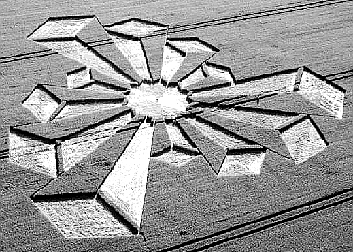
Formation
Crop Circle Formation at Wayland Smithy,
near Ashbury, Oxfordshire, 8 July 2006
|
|
Photo credit:
Lucy
Pringle
Site Search for New Jerusalem
The bride: Rev. 21:9
The New Jerusalem (See The
Spiritual - Heavenly New Jerusalem
9 Then one of the seven
angels who had the seven bowls filled with the seven last plagues came
to me[a]
and talked with me, saying, “Come, I will show you the bride, the
Lamb’s wife.”
The great city: Rev. 21:10
10
And he carried me away in the Spirit to a great and high mountain, and
showed me the great city, the holy[a]
Jerusalem, descending out of heaven from God,
Each “building” may represent a Tribe,
for the total of twelve. There will (symbolically) be 12,000 people from
each tribe, for a total of 144,000. The number 144 suggests a square as 12
x 12. The Tribes, of course, relate to the Zodiac signs, so this may
include all people.
The general form of the Wayland Smithy formation
resembles the
Triple
Julia Set formation that appeared at Windmill Hill, near
Avebury Trusloe, Wiltshire, around 30 July 1996:
A twelve-fold Koch snowflake fractal type crop
formation was reported the same day as the Wayland Smithy formation, 8
July 2006. It appeared at Boxley, near Maidstone, Kent:
Image credit:
Bertold Zugelder
http://www.lucypringle.co.uk/photos/2006/uk2006ar.shtml
http://www.cropcircleconnector.com/2006/boxley/boxley2006a.html
Snowflakes are considered as natural examples of
sacred geometry:
http://www.charlesgilchrist.com/SGEO/PCX4812.html
There is a similarity of the 2006 snowflake formation
to the Waylands Smithy formation, in that the underlying twelve-pointed
star pattern is within both formations. The four overlapping triangles or
double Star of David can be drawn within both. Interestingly, the inner
part of the Boxley snowflake formation indicates three overlapped boxes.
This may correspond to the three sets of "skyscraper buildings" of
Waylands Smithy.
The New Jerusalem is generally figured as four sets
of three. This is said to be based on the Twelve Tribes of Israel in their
camp positions given in Numbers 2, and the symbols of the tribes given in
Genesis 49. There are four main tribes and two minor tribes in each
quadrant. The four main tribes are the "Four Living Creatures" of Ezekiel,
that correspond to the solstices and equinoxes during the Age of Tarus.
The "Four Living Creatures" are lion, man, eagle, and ox, corresponding to
Leo, Aquarius, Scorpio, and Taurus.
This follows the idea of the "heavens" in the trigons
of the Zodiac.
Image credit: Trevor
The Trigons are fire signs, air signs, water signs,
and earth signs. The following table shows the relationships.
|
Sign Type |
Zodiac |
Celestial Position |
Tribe |
Living Creature |
|
Fire |
Leo |
Fall Equinox |
Judah |
Lion |
|
Air |
Aquarius |
Spring Equinox |
Reuben |
Man |
|
Water |
Scorpio |
Winter Solstice |
Dan |
Eagle |
|
Earth |
Tarus |
Summer Solstice |
Ephraim |
Ox |
The word, "equinox," means "equal nights." This
refers to the spring and fall equinoxes, when the hours of day and night
are equal. This seems to be illustrated in the above image as the small
spheres on the left and right, that are half white and half black. It
reminds me a bit of the "Monkey Face" type formations.
Interestingly, the set of four small outer circles,
along with the triangle of three small circles in the center, follow the
general form of the two twelve-fold (4 x 3 and 3 x 4) formations discussed
above.
The New Jerusalem is sometimes illustrated as a cube:
Scholars note that the cube has 12 edges, and that
the description given by Saint John in
Revelation 21:15-17 indicate a cube:
|
"And he who
talked to me had a measuring rod of gold to measure the city and its
gates and walls.
The city lies
foursquare, its length the same as its breadth; and he measured the
city with his rod, twelve thousand stadia; its length and breadth and
height are equal.
He also measured its
wall, a hundred and forty-four cubits by a man's measure, that is, an
angel's. " |
The 12 "skyscraper buildings" of the Wayland Smithy
formation, may figure as 12 cubic rectangles times 12 edges each, giving
the ancient Gematrian number 144, meaning Light. Note also, above, that
144 cubits is the measure of the wall of the New Jerusalem.
Symbolism in the Locations
Many crop circle formations may be located near
ancient site in order to transmit a more complete message. Wayland is a
figure in Norse mythology, the Saxon god of metal working:
|
Excerpt From
Wayland's Smithy
http://www.mysteriousbritain.co.uk/majorsites/waylands_smithy.html
Legends and Folklore The burial chamber is named
after Wayland (Weland, Volund, Volundr) the Saxon god of metal
working, although he is often seen as one of the elven race rather
than a god.
Wayland is the same as Volundr or Volund, who is
described in Norse myth, recorded from Iceland in the form of a poem.
Volundr is a smith of outstanding quality, his work is so prized that
a vain king called Niduth lames him and sets him to work on an island.
In revenge Volundr kills the King's two greedy sons, fashioning
goblets from their skulls.
He then rapes the King's daughter, and fashions
wings with which he escapes from the Island. Before he flies off to
Valhalla he lands on the archway of the palace and reveals the nature
of his revenge to the King and his subjects.
It is likely that this myth travelled with the
Anglo Saxons, and the tomb became associated with Wayland because of
its uncanny quality. It is well known that the art of the smith was
shrouded in secrecy, legend and magic, and many ancient monuments
became attributed to supernatural figures. Volundr is also associated
with labyrinths, and it has been suggested that the resemblance of the
dilapidated tomb to a labyrinth may have led to its association with
the smith god.
Traditionally, Wayland still inhabited the mound
and was ready to shoe a horse. The horse had to be left at the mound
alone for a short period, along with the payment of a silver coin. On
returning the horse would have been shod and the payment would have
disappeared. |
The symbolism of the craftsman - builder -smith is
universal, an archetype. The metal worker is a primary type. Wayland
sounds quite similar to the Greek Hephaistos, who is the Roman Vulcan. The
Biblical metal worker is said to be Tubal Cain, who fashioned the
sacrificial knife of Abraham.
We have discussed this type of symbolism in our work.
It seems to be related to the swastika and the
demiurge, who seems to represent the consciousness gestalt of
mankind. See:
|
Excerpt from
http://www.greatdreams.com/plpath6.htm
Prior to my study of ancient symbols, I had a dream
of a counterclockwise Swastika. Energy was flowing from the center,
out into the arms. A voice said,
"These are the forces going
out from the center to experience negative manifested events, in
order to learn. It is generally square, and you circle
counterclockwise."
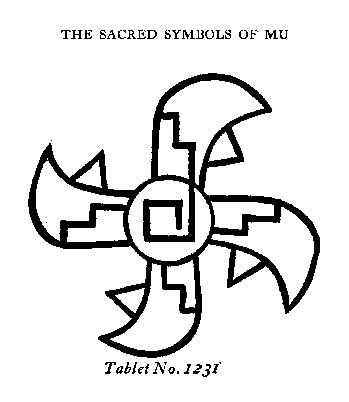
I later found Swastikas in The Sacred Symbols of
Mu. Five illustrations on page 78 show how the swastika evolved
from the cross. In this case, the Swastika is counterclockwise. James
Churchward wrote that the arms of the Swastika are formed by glyphs
called "Builder." These "L" - shapes are "two-sided squares," like the
tool used by carpenters, masons, and other craftsmen. It was called a
Mason's Square by the Masonic brotherhood. Four of the glyphs in the
form of the Swastika indicate "the Four Great Builders of the
Universe."
The two-sided square glyph is on many of Niven's
Mexican tablets. In ancient Egypt it became a symbol of justice and
uprightness. In the Book of the Dead and in various Egyptian papyrii,
the seats of the gods and goddesses are composed of the two-sided
square. It was a symbol of the god Ptah. Two of his titles were "The
Divine Artificer" and "The Divine Builder."
Another type of Swastika was composed of four
curved horn-like shapes. Two forms of this type are shown on page 225,
one from the Mound Builders and the other from
Niven's tablet number 1231.
These two are clockwise Swastikas, which indicate moving from west to
east. It is a "Good Luck" symbol.
My dreams and coincidences indicated that the
Demiurge god is symbolised by the Swastika, and represents the
consciousness gestalt of mankind. The Demiurge god is a deity
subordinate to the Supreme Deity, as creator of the physical world. He
is often symbolised by craftsmen. He can do "good or evil." My
experiences indicated that the counterclockwise Swastika symbolizes
negative, yet learning, experiences, and that the clockwise Swastika
symbolizes positive experiences. The Swastika can be formed by the "L"
- like shape, meaning "builder," or by curved horns.
I was astonished later, when I found the following
verses in Zechariah:
1:18 And I lifted my eyes
and saw, and behold, four horns! 19And I
said to the angel who talked with me, "What are these?" And he
answered me, "These are the horns which have scattered Judah,
Israel, and Jerusalem." 20Then the Lord
showed me four smiths. 21And I said, "What
are these coming to do?" He answered, "These are the horns which
scattered Judah, so that no man raised his head; and these have come
to terrify them, to cast down the horns of the nations who lifted up
their horns against the land of Judah to scatter it."
|
It may well be that the message of the Wayland Smithy
formation is about mankind reversing its negative cycle, and turning
toward a bright and abundant future, in terms of the symbolism of building
the New Jerusalem, the Order of the Heavens made apparent on earth.
The symbolism involved here is quite like the Masonic
tradition, which apparently connects back to the Knights Templar. This is
not the first crop formation that seemed to hint at such a connection.
These days, conspiracy theories tend to dominate when the Masonic subject
comes up. Perhaps some of the theories are justified, I do not know.
However, the basic symbolism, in my mind, is not a bad thing, as one might
surmise from the paragraph above.
The Boxley formation may have the same type of
connection in its location near the ruins of the12th century Cistercian
Abbey. The
Cistercian Monastic Order is said to have been greatly enhanced
by
Bernard Of
Clairvaux, a major figure among the Knights Templar
Is it a meaningless coincidence that the snowflake
formation at Boxley is near Maidstone?
I think not! The location meaning just could suggest the
Philosopher's Stone.
Several of the images within Kris's article also
connect well with Wayland's Smithy, such as the
1997
hexagon near stonehenge. There is an X type shape with a
vertical line through it, as parts of the Star of David, which may fit
with the symbolism of the Arrow of Ra, expressed in Trevor's insightful
article:
The location of Great Britain itself, as the primary
place of crop circles, may also carry symbolism. Part of this involves the
Lost Tribes, the legends of King Arthur and the Holy Grail. The Covenant
given to Abraham is said by some to have been fulfilled through the sons
of Joseph, the eleventh son of Jacob/Israel. The older son was Manasseh,
the younger son was Ephraim. The two became the great nations of the USA
and Great Britain.
A book, tracing the story Biblically and
historically-legendary was written in 1902 by J.H. Allen:
Judah's Sceptre and Joseph's Birthright
http://www.giveshare.org/israel/judah/
Ephraim, who was to become a company of nations, had
the ox as his symbol, indicating the association with the Earth sign
Zodiac sign of Tarus. It may be more than meaningless coincidence that
Wayland Smithy is located in Oxfordshire!
MORE FABULOUS GEOMETRY OF WAYLAN SMITHY
CROP CIRCLE AT:
http://www.greatdreams.com/crop/2006ccs/2006ccs.htm
Introduction
To Sacred Geometry
by Charles Gilchrist
Your (free)
Sacred Geometry Coloring Book
Double
Tetrahedron In Metatron's Cube
Metatron’s Cube
Knights Templar
Freemasonry
Knights
Templar (Freemason degree)

|
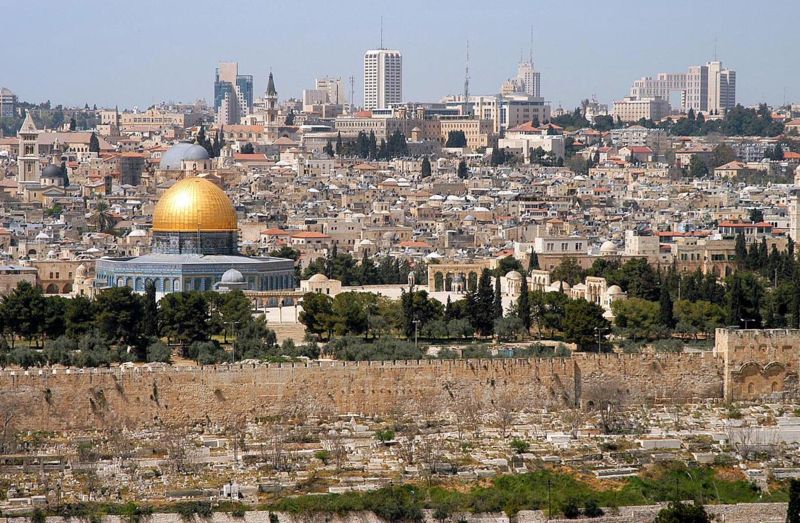
| THE PHYSICAL JERUSALEM
I KINGS
1 Kings 3:4 And the king went to Gibeon to
sacrifice there; for that [was] the great high place: a thousand burnt
offerings did Solomon offer upon that altar. 3:5 In Gibeon the LORD
appeared to Solomon in a dream by night: and God said, Ask what I shall
give thee. 3:6 And Solomon said, Thou hast shewed unto thy servant David
my father great mercy, according as he walked before thee in truth, and in
righteousness, and in uprightness of heart with thee; and thou hast kept
for him this great kindness, that thou hast given him a son to sit on his
throne, as [it is] this day.
1 Kings 3:13 And I have also given thee that
which thou hast not asked, both riches, and honour: so that there shall
not be any among the kings like unto thee all thy days. 3:14 And if thou
wilt walk in my ways, to keep my statutes and my commandments, as thy
father David did walk, then I will lengthen thy days. 3:15 And Solomon
awoke; and, behold, [it was] a dream. And he came to Jerusalem, and stood
before the ark of the covenant of the LORD, and offered up burnt
offerings, and offered peace offerings, and made a feast to all his
servants. 3:16 Then came there two women, [that were] harlots, unto the
king, and stood before him. 3:17 And the one woman said, O my lord, I and
this woman dwell in one house; and I was delivered of a child with her in
the house.
2 CHRONICLES
2 Chronicles 9:27 And the king made silver in
Jerusalem as stones, and cedar trees made he as the sycomore trees that
[are] in the low plains in abundance. 9:28 And they brought unto Solomon
horses out of Egypt, and out of all lands. 9:29 Now the rest of the acts
of Solomon, first and last, [are] they not written in the book of Nathan
the prophet, and in the prophecy of Ahijah the Shilonite, and in the
visions of Iddo the seer against Jeroboam the son of Nebat?
2 Chronicles 26:3 Sixteen years old [was]
Uzziah when he began to reign, and he reigned fifty and two years in
Jerusalem. His mother's name also [was] Jecoliah of Jerusalem. 26:4 And he
did [that which was] right in the sight of the LORD, according to all that
his father Amaziah did. And he sought God in the days of Zechariah, who
had understanding in the visions of God: and as long as he sought the
LORD, God made him to prosper.
2 Chronicles 32:30 This same Hezekiah also
stopped the upper watercourse of Gihon, and brought it straight down to
the west side of the city of David. And Hezekiah prospered in all his
works. Howbeit in [the business of] the ambassadors of the princes of
Babylon, who sent unto him to enquire of the wonder that was [done] in the
land, God left him, to try him, that he might know all [that was] in his
heart. 32:32 Now the rest of the acts of Hezekiah, and his goodness,
behold, they [are] written in the vision of Isaiah the prophet, the son of
Amoz, [and] in the book of the kings of Judah and Israel.
ISAIAH
Isaiah 1:1 The vision of Isaiah the son of
Amoz, which he saw concerning Judah and Jerusalem in the days of Uzziah,
Jotham, Ahaz, [and] Hezekiah, kings of Judah. 1:2 Hear, O heavens, and
give ear, O earth: for the LORD hath spoken, I have nourished and brought
up children, and they have rebelled against me.
JEREMIAH
Jeremiah 23:15 Therefore thus saith the LORD
of hosts concerning the prophets; Behold, I will feed them with wormwood,
and make them drink the water of gall: for from the prophets of Jerusalem
is profaneness gone forth into all the land. 23:16 Thus saith the LORD of
hosts, Hearken not unto the words of the prophets that prophesy unto you:
they make you vain: they speak a vision of their own heart, [and] not out
of the mouth of the LORD.
Jeremiah 23:25 I have heard what the prophets
said, that prophesy lies in my name, saying, I have dreamed, I have
dreamed. 23:26 How long shall [this] be in the heart of the prophets that
prophesy lies? yea, [they are] prophets of the deceit of their own heart;
23:27 Which think to cause my people to forget my name by their dreams
which they tell every man to his neighbour, as their fathers have
forgotten my name for Baal. 23:28 The prophet that hath a dream, let him
tell a dream; and he that hath my word, let him speak my word faithfully.
What [is] the chaff to the wheat? saith the LORD. 23:29 [Is] not my word
like as a fire? saith the LORD; and like a hammer [that] breaketh the rock
in pieces? 23:30 Therefore, behold, I [am] against the prophets, saith the
LORD, that steal my words every one from his neighbour. 23:31 Behold, I
[am] against the prophets, saith the LORD, that use their tongues, and
say, He saith. 23:32 Behold, I [am] against them that prophesy false
dreams, saith the LORD, and do tell them, and cause my people to err by
their lies, and by their lightness; yet I sent them not, nor commanded
them: therefore they shall not profit this people at all, saith the LORD.
23:33 And when this people, or the prophet, or a priest, shall ask thee,
saying, What [is] the burden of the LORD? thou shalt then say unto them,
What burden? I will even forsake you, saith the LORD.
Jeremiah 29:7 And seek the peace of the city
whither I have caused you to be carried away captives, and pray unto the
LORD for it: for in the peace thereof shall ye have peace. 29:8 For thus
saith the LORD of hosts, the God of Israel; Let not your prophets and your
diviners, that [be] in the midst of you, deceive you, neither hearken to
your dreams which ye cause to be dreamed.
EZEKIEL
Ezekiel 1:1 Now it came to pass in the
thirtieth year, in the fourth [month], in the fifth [day] of the month, as
I [was] among the captives by the river of Chebar, [that] the heavens were
opened, and I saw visions of God.
Ezekiel 7:2 The time is come, the day draweth
near: let not the buyer rejoice, nor the seller mourn: for wrath [is] upon
all the multitude thereof.
Ezekiel 7:13 For the seller shall not return
to that which is sold, although they were yet alive: for the vision [is]
touching the whole multitude thereof, [which] shall not return; neither
shall any strengthen himself in the iniquity of his life.
Ezekiel 7:24 Wherefore I will bring the worst
of the heathen, and they shall possess their houses: I will also make the
pomp of the strong to cease; and their holy places shall be defiled. 7:25
Destruction cometh; and they shall seek peace, and [there shall be] none.
7:26 Mischief shall come upon mischief, and rumour shall be upon rumour;
then shall they seek a vision of the prophet; but the law shall perish
from the priest, and counsel from the ancients.
Ezekiel 8:2 Then I beheld, and lo a likeness
as the appearance of fire: from the appearance of his loins even downward,
fire; and from his loins even upward, as the appearance of brightness, as
the colour of amber. 8:3 And he put forth the form of an hand, and took me
by a lock of mine head; and the spirit lifted me up between the earth and
the heaven, and brought me in the visions of God to Jerusalem, to the door
of the inner gate that looketh toward the north; where [was] the seat of
the image of jealousy, which provoketh to jealousy. 8:4 And, behold, the
glory of the God of Israel [was] there, according to the vision that I saw
in the plain.
Ezekiel 11:22 Then did the cherubims lift up
their wings, and the wheels beside them; and the glory of the God of
Israel [was] over them above. 11:23 And the glory of the LORD went up from
the midst of the city, and stood upon the mountain which [is] on the east
side of the city. 11:24 Afterwards the spirit took me up, and brought me
in a vision by the Spirit of God into Chaldea, to them of the captivity.
So the vision that I had seen went up from me. 11:25 Then I spake unto
them of the captivity all the things that the LORD had shewed me.
Ezekiel 13:5 Ye have not gone up into the
gaps, neither made up the hedge for the house of Israel to stand in the
battle in the day of the LORD. 13:6 They have seen vanity and lying
divination, saying, The LORD saith: and the LORD hath not sent them: and
they have made [others] to hope that they would confirm the word. 13:7
Have ye not seen a vain vision, and have ye not spoken a lying divination,
whereas ye say, The LORD saith [it]; albeit I have not spoken? 13:8
Therefore thus saith the Lord GOD; Because ye have spoken vanity, and seen
lies, therefore, behold, I [am] against you, saith the Lord GOD
Ezekiel 13:15 Thus will I accomplish my wrath
upon the wall, and upon them that have daubed it with untempered [morter],
and will say unto you, The wall [is] no [more], neither they that daubed
it; 13:16 [To wit], the prophets of Israel which prophesy concerning
Jerusalem, and which see visions of peace for her, and [there is] no
peace, saith the Lord GOD.
Ezekiel 40:1 In the five and twentieth year of
our captivity, in the beginning of the year, in the tenth [day] of the
month, in the fourteenth year after that the city was smitten, in the
selfsame day the hand of the LORD was upon me, and brought me thither.
40:2 In the visions of God brought he me into the land of Israel, and set
me upon a very high mountain, by which [was] as the frame of a city on the
south. 40:3 And he brought me thither, and, behold, [there was] a man,
whose appearance [was] like the appearance of brass, with a line of flax
in his hand, and a measuring reed; and he stood in the gate. Afterward he
brought me to the gate, [even] the gate that looketh toward the east:
ACTS
Acts 2:16 But this is that which was spoken by
the prophet Joel; 2:17 And it shall come to pass in the last days, saith
God, I will pour out of my Spirit upon all flesh: and your sons and your
daughters shall prophesy, and your young men shall see visions, and your
old men shall dream dreams: Acts 2:18 And on my servants and on my
handmaidens I will pour out in those days of my Spirit; and they shall
prophesy:
Acts 9:8 And Saul arose from the earth; and
when his eyes were opened, he saw no man: but they led him by the hand,
and brought [him] into Damascus. Acts 9:9 And he was three days without
sight, and neither did eat nor drink. Acts 9:10 And there was a certain
disciple at Damascus, named Ananias; and to him said the Lord in a vision,
Ananias. And he said, Behold, I [am here], Lord. Acts 9:11 And the Lord
[said] unto him, Arise, and go into the street which is called Straight,
and enquire in the house of Judas for [one] called Saul, of Tarsus: for,
behold, he prayeth, Acts 9:12 And hath seen in a vision a man named
Ananias coming in, and putting [his] hand on him, that he might receive
his sight. Acts 9:13 Then Ananias answered, Lord, I have heard by many of
this man, how much evil he hath done to thy saints at Jerusalem:
Acts 10:15 And the voice [spake] unto him
again the second time, What God hath cleansed, [that] call not thou
common. Acts 10:16 This was done thrice: and the vessel was received up
again into heaven. Acts 10:17 Now while Peter doubted in himself what this
vision which he had seen should mean, behold, the men which were sent from
Cornelius had made enquiry for Simon's house, and stood before the gate,
Acts 10:18 And called, and asked whether Simon, which was surnamed Peter,
were lodged there. Acts 10:19 While Peter thought on the vision, the
Spirit said unto him, Behold, three men seek thee.
Acts 11:4 But Peter rehearsed [the matter]
from the beginning, and expounded [it] by order unto them, saying, Acts
11:5 I was in the city of Joppa praying: and in a trance I saw a vision, A
certain vessel descend, as it had been a great sheet, let down from heaven
by four corners; and it came even to me:
Acts 12:7 And, behold, the angel of the Lord
came upon [him], and a light shined in the prison: and he smote Peter on
the side, and raised him up, saying, Arise up quickly. And his chains fell
off from [his] hands. Acts 12:8 And the angel said unto him, Gird thyself,
and bind on thy sandals. And so he did. And he saith unto him, Cast thy
garment about thee, and follow me. Acts 12:9 And he went out, and followed
him; and wist not that it was true which was done by the angel; but
thought he saw a vision.
Acts 16:8 And they passing by Mysia came down
to Troas. Acts 16:9 And a vision appeared to Paul in the night; There
stood a man of Macedonia, and prayed him, saying, Come over into
Macedonia, and help us. Acts 16:10 And after he had seen the vision,
immediately we endeavoured to go into Macedonia, assuredly gathering that
the Lord had called us for to preach the gospel unto them. Acts 16:11
Therefore loosing from Troas, we came with a straight course to
Samothracia, and the next [day] to Neapolis;
Acts 18:7 And he departed thence, and entered
into a certain [man's] house, named Justus, [one] that worshipped God,
whose house joined hard to the synagogue. Acts 18:8 And Crispus, the chief
ruler of the synagogue, believed on the Lord with all his house; and many
of the Corinthians hearing believed, and were baptized. Acts 18:9 Then
spake the Lord to Paul in the night by a vision, Be not afraid, but speak,
and hold not thy peace:
Acts 26:17 Delivering thee from the people,
and [from] the Gentiles, unto whom now I send thee, Acts 26:18 To open
their eyes, [and] to turn [them] from darkness to light, and [from] the
power of Satan unto God, that they may receive forgiveness of sins, and
inheritance among them which are sanctified by faith that is in me. Acts
26:19 Whereupon, O king Agrippa, I was not disobedient unto the heavenly
vision:
2 CORINTHIANS
2 Corinthians 12:1 It is not expedient for me
doubtless to glory. I will come to visions and revelations of the Lord.
12:2 I knew a man in Christ above fourteen years ago, (whether in the
body, I cannot tell; or whether out of the body, I cannot tell: God
knoweth;) such an one caught up to the third heaven. 12:3 And I knew such
a man, (whether in the body, or out of the body, I cannot tell: God
knoweth;) 12:4 How that he was caught up into paradise, and heard
unspeakable words, which it is not lawful for a man to utter.
REVELATION
Note: Beginning with Revelations 1:10 the entire book of REVELATIONS
is one entire vision. John begins by saying I was in the spirit on the
Lord's day..... meaning that this was not a dream but a conscious
vision.... to clarify his description of "being in the spirit" as indeed
being a VISION, in Revelations 9:20 he refers to this experience as being
a vision.
Revelation 1:10 I was in the Spirit on the
Lord's day, and heard behind me a great voice, as of a trumpet,
Revelation 9:17 And thus I saw the horses in
the vision, and them that sat on them, having breastplates of fire, and of
jacinth, and brimstone: and the heads of the horses [were] as the heads of
lions; and out of their mouths issued fire and smoke and brimstone.
-
|
JERUSALEM
(September 16) - About 1500 Palestinians, many supporters of
Hamas, marched in a Gaza Strip refugee camp Friday, burning
Israeli flags and . ...
www.greatdreams.com/hamas_database.htm
|
Jerusalem (Hebrew:
יְרוּשָׁלַיִם
(audio) (help·info),
Yerushaláyim;
Arabic: القُدس
(audio) (help·info),
al-Quds)[ii]
is the
capital[iii]
of
Israel and its largest city in both population and area, with
732,100 residents in an area of 125.1 square
kilometers (49 sq mi)
if
disputed
East Jerusalem is included.[1][4][iv]
Located in the
Judean Mountains, between the
Mediterranean Sea and the northern tip of the
Dead Sea, modern Jerusalem has grown up outside the
Old City.The city has a history that goes back to
the
4th millennium BCE, making it one of the
oldest cities in the world. Jerusalem has been the holiest
city in
Judaism and the spiritual center of the
Jewish people since the 10th century BCE,contains a number of
significant ancient
Christian sites, and is considered the
third-holiest city in
Islam.
Despite having an area of only 0.9 square kilometer (0.35 square
mile), the Old City is home to sites of key religious importance,
among them the
Temple Mount, the
Western Wall, the
Church of the Holy Sepulchre, the
Dome of the Rock and
al-Aqsa Mosque. The old walled city, a World Heritage site,
has been traditionally divided into four quarters, although the
names used today — the
Armenian,
Christian,
Jewish, and
Muslim Quarters — were introduced in the early 19th century.
The Old City was nominated for inclusion on the
List of World Heritage Sites in danger by Jordan in 1982. In
the course of its history, Jerusalem has been destroyed twice,
besieged 23 times, attacked 52 times, and captured and recaptured
44 times.
Today, the
status of Jerusalem remains one of the core issues in the
Israeli-Palestinian conflict. Israel's
annexation of occupied
East Jerusalem has been repeatedly condemned by the United
Nations and related bodies, and
Palestinians foresee East Jerusalem as the capital of
their future state In the wake of
United Nations Security Council Resolution 478, most foreign
embassies moved out of Jerusalem.
"Yerushalayim" means the "perfect city," or "the city
of he who is perfect". The ending -im indicates the
plural in Hebrew grammar and -ayim the dual,
possibly referring to the fact that the city sits on two
hills. The pronunciation of the last syllable as -ayim
appears to be a late development, which had not yet
appeared at the time of the
Septuagint.Some believe that a city called
Rušalimum or Urušalimum which appears in
ancient
Egyptian records is the first reference to Jerusalem.
The Greeks added the prefix hiero ("holy") and
called it Hierosolyma. To the Arabs, Jerusalem is
al-Quds ("The Holy"). It was called Jebus (Yevus)
by the Jebusites. "Zion" initially referred to part of the
city, but later came to signify the city as a whole. Under
King David, it was known as Ir David (the City of
David).
Temple periods
According to Hebrew scripture, King David reigned
until 970 BCE. He was succeeded by his son
Solomon, who built the
Holy Temple on
Mount Moriah.
Solomon's Temple (later known as the First Temple),
went on to play a pivotal role in
Jewish history as the repository of the
Ark of the Covenant. For over 600 years, until the
Babylonian conquest in 587 BCE, Jerusalem was the
political capital of the
Kingdom of Judea and a religious center of the
Israelites.This period is known in history as the
First Temple Period.[37]
Upon Solomon's death (c. 930 BCE), the
ten northern tribes split off to form the
Kingdom of Israel. Under the leadership of the House
of David and Solomon, Jerusalem remained the capital of
the
Kingdom of Judah.
When the
Assyrians conquered the Kingdom of Israel in 722 BCE,
Jerusalem was strengthened by a great influx of refugees
from the northern kingdom. The First Temple period ended
around 586 BCE, as the Babylonians conquered Judah and
Jerusalem, and laid waste to Solomon's Temple. In 538 BCE,
after fifty years of
Babylonian captivity,
Persian
King
Cyrus the Great invited the Jews to return to Judah to
rebuild Jerusalem and the Temple. Construction of the
Second Temple was completed in 516 BCE, during the
reign of
Darius the Great, seventy years after the destruction
of the First Temple. Jerusalem resumed its role as capital
of Judah and center of Jewish worship. When Greek ruler
Alexander the Great conquered the
Persian Empire, Jerusalem and Judea fell under Greek
control, eventually falling to the
Ptolemaic dynasty under
Ptolemy I. In 198 BCE,
Ptolemy V lost Jerusalem and
Judea to the
Seleucids under
Antiochus III. The Seleucid attempt to recast
Jerusalem as a
Hellenized
polis came to a head in 168 BCE with the successful
Maccabean revolt of
Mattathias the
High Priest and his five sons against
Antiochus Epiphanes, and their establishment of the
Hasmonean Kingdom in 152 BCE with Jerusalem again as
its capital.
Jewish-Roman wars
As
Rome became stronger it installed
Herod as a Jewish
client king. Herod the Great, as he was known, devoted
himself to developing and beautifying the city. He built
walls, towers and palaces, and
expanded the Temple Mount, buttressing the courtyard
with blocks of stone weighing up to 100 tons. Under Herod,
the area of the Temple Mount doubled in size. In 6 CE, the
city, as well as much of the surrounding area, came under
direct Roman rule as the
Iudaea Province and Herod's descendants through
Agrippa II remained client kings of Judea until 96 CE.
Roman rule over Jerusalem and the region began to be
challenged with the first
Jewish-Roman war, the
Great Jewish Revolt, which resulted in the destruction
of the Second Temple in 70 CE. In 130 CE
Hadrian Romanized the city, and renamed it
Aelia Capitolina. Jerusalem once again served as the
capital of Judea during the three-year rebellion known as
the
Bar Kochba revolt. The Romans succeeded in recapturing
the city in 135 CE and as a punitive measure Hadrian
banned the Jews from entering it. Hadrian renamed the
entire
Iudaea Province
Syria Palaestina after the biblical
Philistines in an attempt to de-Judaize the country.[45][46]
Enforcement of the ban on Jews entering
Aelia Capitolina continued until the 4th century CE.
In the five centuries following the Bar Kokhba
revolt, the city remained under
Roman then
Byzantine rule. During the 4th century, the
Roman Emperor
Constantine I constructed Christian sites in Jerusalem
such as the
Church of the Holy Sepulchre. Jerusalem reached a peak
in size and population at the end of the Second Temple
Period: The city covered two square kilometers (0.8 sq
mi.) and had a population of 200,000 From the days of
Constantine until the 7th century, Jews were banned from
Jerusalem.
Roman-Persian wars
Within the span of a few decades, Jerusalem shifted
from Roman to Persian rule and returned to Roman dominion
once more. Following
Sassanid
Khosrau II's early seventh century push into
Byzantine, advancing through Syria, Sassanid Generals
Shahrbaraz and
Shahin attacked the Byzantine-controlled city of
Jerusalem (Persian:
Dej Houdkh).
In the
Siege of Jerusalem (614), after 21 days of relentless
siege warfare, Jerusalem was captured and the Persian
victory resulted in the territorial annexation of
Jerusalem. After the
Sassanid army entered Jerusalem, the holy "True
Cross" was stolen and sent back to the
Sassanian capital as a battle-captured holy relic. The
conquered city and the Holy Cross would remain in Sassanid
hands for some fifteen years until the Byzantine Emperor
Heraclius recovered them in 629.
Islamic rule
In 638, the
Islamic
Caliphate extended its dominion to Jerusalem. At this
time, Jerusalem was declared Islam's third holiest city
after Mecca and Medina, and referred to as al Bait al-Muquddas.
Later, it was known as al-Quds al-Sharif. With the
Arab conquest, Jews were allowed back into the
city.The
Rashidun caliph
Umar ibn al-Khattab signed a treaty with
Monophysite Christian Patriarch
Sophronius, assuring him that Jerusalem's Christian
holy places and population would be protected under Muslim
rule. Umar was led to the
Foundation Stone on the
Temple Mount, which he cleared of refuse in
preparation for building a mosque. According to the
Gaullic bishop
Arculf, who lived in Jerusalem from 679-688, the
Mosque of Umar was a rectangular wooden structure
built over ruins which could accommodated 3,000
worshipers.The
Umayyad caliph
Abd al-Malik commissioned the construction of the
Dome of the Rock in the late 7th century.The 10th
century historian El Muqadasi writes that Abd al-Malik
built the shrine in order to compete in grandeur of
Jerusalem's monumental churches.Over the next four hundred
years, Jerusalem's prominence diminished as Arab powers in
the region jockeyed for control.
Crusaders, Saladin and
the Mamluks
In 1099, Jerusalem was
conquered by the
Crusaders, who massacred most of its Muslim
inhabitants and the remnants of the Jewish inhabitants.
The Christians having been expelled and most of the Jewish
inhabitants having already fled, by early June 1099,
Jerusalem’s population had declined from 70,000 to less
than 30,000. The surviving Jews were sold into slavery in
Europe or ransomed to the Jewish community of Egypt.
Christian Arab tribes brought to Jerusalem settled in the
Old City.]
In 1187, the city was wrested from the Crusaders by
Saladin who permitted Jews and Muslims to return and
settle in the city.
In 1244, Jerusalem was sacked by the Kharezmian
Tartars, who decimated the city's Christian population
and drove out the Jews, some of whom resettled in
Nablus. From 1250-1517, Jerusalem was ruled by the
Mamluks, who imposed a heavy annual tax on the Jews
and destroyed Christian holy places on
Mount Zion.
Ottoman rule
In 1517, Jerusalem and environs fell to the
Ottoman Turks, who remained in control until 1917.
With the occupation of Jerusalem by
Muhammad Ali of Egypt in 1831, foreign missions and
consulates began to establish a foothold in the city. In
the 1860s, new neighborhoods began to go up outside the
Old City walls to house pilgrims and relieve the intense
overcrowding and poor sanitation inside the city. The
Russian Compound and
Mishkenot Sha'ananim were founded in 1860.
According to the Prussian consul, the population
in 1845 was 16,410, with 7,120 Jews, 5,000 Muslims, 3,390
Christians, 800 Turkish soldiers and 100 Europeans. The
volume of Christian pilgrims increased under the Ottomans,
doubling the city's population around Easter time.
In 1836, Ibrahim Pasha allowed the Jews to
restore four major synagogues, among them the
Hurva. Turkish rule was reinstated in 1840, but many
Egyptian Muslims remained in Jerusalem. Jews from Algiers
and North Africa began to settle in the city in growing
numbers. At the same time, the Ottomans built tanneries
and slaughterhouses near Christian and Jewish holy places
"so that an evil smell should ever plague the infidels."
In the 1840s and 1850s, the international powers began a
tug-of-war in Palestine as they sought to extend their
protection over the country's religious minorities, a
struggle carried out mainly through consular
representatives in Jerusalem.
British Mandate and 1948 War
- Further information:
British Mandate of Palestine, 1947-1948
Civil War in Mandatory Palestine, and 1948
Arab-Israeli War
In 1917 after the
Battle of Jerusalem, the
British Army, led by
General Edmund Allenby, captured the city. and in
1922, the
League of Nations at
Conference of Lausanne entrusted the
United Kingdom to administer the Mandate for
Palestine.
From 1922 to 1948 the total population of the city
rose from 52,000 to 165,000 with two thirds of Jews and
one-third of Arabs (Muslims and Christians).. The
situation between Arabs and Jews in Palestine was not
quiet. At Jerusalem, in particular
riots occurred in 1920 and
in 1929. Under the British, new garden suburbs were
built in the western and northern parts of the city and
institutions of higher learning such as the
Hebrew University were founded.
As the British Mandate for Palestine was expiring,
the
1947 UN Partition Plan recommended "the creation of a
special international regime in the City of Jerusalem,
constituting it as a
corpus separatum under the administration of the
United Nations." The international regime was to
remain in force for a period of ten years, whereupon a
referendum was to be held in which the residents of
Jerusalem were to decide the future regime of the city.
However, this plan was not implemented, as the
1948 war erupted while the British withdrew from
Palestine and
Israel declared its independence.
The war led to displacement of Arab and Jewish
populations in the city. The 1,500 residents of the
Jewish Quarter of the Old City were expelled and a few
hundred taken prisoner when the Arab Legion captured the
quarter on 28 May. Residents of many Arab villages and
neighborhoods west of the Old City left with the approach
of the war, but some remained and were driven out or
killed, as at
Lifta or
Deir Yassin.
Division and
controversial reunification
- Further information:
Positions on Jerusalem
- See also:
UN General Assembly Resolution 194 and
Occupation of the West Bank and East Jerusalem by Jordan
The war ended with Jerusalem divided between
Israel and
Jordan (then
Transjordan). The
1949 Armistice Agreements established a
ceasefire line that cut through the center of the city
and left
Mount Scopus as an Israeli
exclave. Barbed wire and concrete barriers separated
east and west Jerusalem, and military skirmishes
frequently threatened the ceasefire. After the
establishment of the State of Israel, Jerusalem was
declared its capital. Jordan formally annexed East
Jerusalem in 1950, subjecting it to Jordanian law, in a
move that was recognized only by
Pakistan.
Jordan assumed control of the holy places in the Old
City. Contrary to the terms of the agreement, Israelis
were denied access to Jewish holy sites, many of which
were desecrated, and only allowed very limited access to
Christian holy sites. During this period, the
Dome of the Rock and al-Aqsa Mosque underwent major
renovations.
During the 1967
Six-Day War, Israel captured East Jerusalem and
asserted sovereignty over the entire city. Jewish access
to holy sites was restored, while the
Temple Mount remained under the jurisdiction of an
Islamic
waqf. The
Moroccan Quarter, which was located adjacent to the
Western Wall, was vacated and razed to make way for a
plaza for those visiting the wall. Since the war, Israel
has expanded the city's boundaries and established a ring
of Jewish neighbourhoods on vacant land east of the
Green Line.
However, the takeover of East Jerusalem was met with
international criticism. Following the passing of Israel's
Jerusalem Law, which declared Jerusalem, "complete and
united", the capital of Israel, the
United Nations Security Council passed
a resolution that declared the law "a violation of
international law" and requested all member states to
withdraw all remaining embassies from the city.
The status of the city, and especially its holy
places, remains a core issue in the Israeli-Palestinian
conflict. Jewish settlers have taken over historic sites
and built on land confiscated from Palestinians in order
to expand the Jewish presence in East Jerusalem, while
prominent Islamic leaders have insisted that Jews have no
historical connection to Jerusalem. Palestinians envision
East Jerusalem as the capital of a
future Palestinian state and the city's borders have
been the subject of bilateral talks.
Jerusalem is situated on the southern spur of a
plateau in the
Judean Mountains, which include the
Mount of Olives (East) and
Mount Scopus (North East). The elevation of the Old
City is approximately 760 m (2,500 ft). The whole of
Jerusalem is surrounded by valleys and dry
riverbeds (wadis).
The
Kidron,
Hinnom, and
Tyropoeon Valleys intersect in an area just south of
the Old City of Jerusalem. The
Kidron Valley runs to the east of the Old City and
separates the
Mount of Olives from the city proper. Along the
southern side of old Jerusalem is the
Valley of Hinnom, a steep ravine associated in
biblical
eschatology with the concept of
Gehenna or
Hell.The Tyropoeon valley commenced in the northwest
near the
Damascus Gate, ran south-southeasterly through the
center of the Old City down to the
Pool of Siloam, and divided the lower part into two
hills, the Temple Mount to the east, and the rest of the
city to the west (the lower and the upper cities described
by
Josephus). Today, this valley is hidden by debris that
has accumulated over the centuries.In biblical
times, Jerusalem was surrounded by forests of almond,
olive and pine trees. Over centuries of warfare and
neglect, these forests were destroyed. Farmers in the
Jerusalem region thus built stone terraces along the
slopes to hold back the soil, a feature still very much in
evidence in the Jerusalem landscape.
Water supply has always been a major problem in
Jerusalem, as attested to by the intricate network of
ancient aqueducts, tunnels, pools and cisterns found in
the city.
Jerusalem is 60 kilometers (37 mi) east of
Tel Aviv and the
Mediterranean Sea. On the opposite side of the city,
approximately 35 kilometers (22 mi) away, is the
Dead Sea, the
lowest body of water on Earth. Neighboring cities and
towns include
Bethlehem and
Beit Jala to the south,
Abu Dis and
Ma'ale Adumim to the east,
Mevaseret Zion to the west, and
Ramallah and
Giv'at Ze'ev to the north.
In May 2007, Jerusalem had a population of 732,100—64%
were
Jewish, 32%
Muslim, and 2%
Christian. At the end of 2005, the
population density was 5,750.4 inhabitants per square
kilometer (14,893.5/sq mi).According to a study published
in 2000, the percentage of Jews in the city's population
had been decreasing; this was attributed to a higher
Palestinian birth rate, and Jewish residents leaving. The
study also found that about nine percent of the Old City's
32,488 people were Jews.In 2005, 2,850 new
immigrants settled in Jerusalem, mostly from the
United States,
France and the former
Soviet Union. In terms of the local population, the
number of outgoing residents exceeds the number of
incoming residents. In 2005, 16,000 left Jerusalem and
only 10,000 moved in. Nevertheless, the population of
Jerusalem continues to rise due to the high
birth rate, especially in the Arab and
Haredi Jewish communities. Consequently, the
total fertility rate in Jerusalem (4.02) is higher
than in Tel Aviv (1.98) and well above the national
average of 2.90. The average size of Jerusalem's 180,000
households is 3.8 people.
In 2005, the total population grew by 13,000 (1.8%)
— similar to Israeli national average, but the religious
and ethnic composition is shifting. While 31% of the
Jewish population is made up of children below the age
fifteen, the figure for the Arab population is 42%.This
would seem to corroborate the observation that the
percentage of Jews in Jerusalem has declined over the past
four decades. In 1967, Jews accounted for 74 percent of
the population, while the figure for 2006 is down nine
percent. Possible factors are the high cost of housing,
fewer job opportunities and the increasingly religious
character of the city. Many people are moving to the
suburbs and coastal cities in search of cheaper housing
and a more secular lifestyle.
Demographics and the Jewish-Arab population divide
play a major role in the dispute over Jerusalem. In 1998,
the Jerusalem Development Authority proposed expanding
city limits to the west to include more areas heavily
populated with Jews.
Political status
On
December 5,
1949, the State of Israel's first
Prime Minister,
David Ben-Gurion, proclaimed Jerusalem as Israel's
capital and since then all branches of the
Israeli government —
legislative,
judicial, and
executive — have resided there. At the time of the
proclamation, Jerusalem was divided between Israel and
Jordan and thus only West Jerusalem was considered
Israel's capital. Immediately after the 1967 Six-Day War,
however, Israel annexed
East Jerusalem, making it a
de facto part of the Israeli capital. Israel
enshrined the status of the "complete and united"
Jerusalem — west and east — as its capital, in the 1980
Basic Law: Jerusalem, Capital of Israel.
The status of a "united Jerusalem" as Israel's
"eternal capital" has been a matter of immense controversy
within the international community. Although some
countries maintain consulates in Jerusalem, and two
maintain embassies in Jerusalem suburbs, all
embassies are located outside of the city proper,
mostly in
Tel Aviv.
The
non-binding
United Nations Security Council Resolution 478, passed
on August 20, 1980, declared that the Basic Law was "null
and void and must be rescinded forthwith." Member states
were advised to withdraw their diplomatic representation
from the city as a punitive measure. Most of the remaining
countries with embassies in Jerusalem complied with the
resolution by relocating them to
Tel Aviv, where many embassies already resided prior
to Resolution 478. Currently there are no embassies
located within the city limits of Jerusalem, although
there are embassies in
Mevaseret Zion, on the outskirts of Jerusalem, and
four consulates in the city itself. In 1995, the United
States Congress had planned to move its embassy from Tel
Aviv to Jerusalem with the passage of the
Jerusalem Embassy Act.
However,
U.S. President
George W. Bush has argued that Congressional
resolutions regarding the status of Jerusalem are merely
advisory. The Constitution reserves foreign relations as
an executive power, and as such, the US embassy is still
in Tel Aviv.
Israel's most prominent governmental institutions,
including the
Knesset, the
Supreme Court, and the official residences of the
President and
Prime Minister, are located in Jerusalem. Prior to the
creation of the State of Israel, Jerusalem served as the
administrative capital of the British Mandate, which
included present-day Israel and Jordan. From 1949 until
1967, West Jerusalem served as Israel's capital but was
not recognized as such internationally because
UN General Assembly Resolution 194 envisaged Jerusalem
as an
international city. As a result of the Six-Day War in
1967, the whole of Jerusalem came under Israeli control.
On June 27, 1967, the government of
Levi Eshkol extended Israeli law and jurisdiction to
East Jerusalem, but agreed that administration of the
Temple Mount compound would be maintained by the Jordanian
waqf, under the Jordanian Ministry of Religious
Endowments. In 1988, Israel ordered the closure of
Orient House, home of the Arab Studies Society, but
also the headquarters of the
Palestine Liberation Organization, for security
reasons. The building reopened in 1992 as a Palestinian
guesthouse. The
Oslo Accords stated that the final status of Jerusalem
would be determined by negotiations with the
Palestinian National Authority, which regards East
Jerusalem as the capital of a future Palestinian state.
Religious significance
-
Jerusalem plays an important role in
Judaism,
Christianity, and
Islam. The 2000 Statistical Yearbook of Jerusalem
lists 1204
synagogues, 158
churches, and 73
mosques within the city. Despite efforts to maintain
peaceful religious coexistence, some sites, such as the
Temple Mount, have been a continuous source of friction
and controversy.
Jerusalem has been sacred to the Jews since King
David proclaimed it his capital in the 10th century BCE.
Jerusalem was the site of
Solomon's Temple and the Second Temple. Synagogues
around the world are traditionally built with the Holy Ark
facing Jerusalem, and Arks within Jerusalem face the
"Holy of Holies".
As prescribed in the
Mishna and codified in the
Shulchan Aruch, daily prayers are recited while
facing towards Jerusalem and the Temple Mount. Many Jews
have "Mizrach"
plaques hung on a wall of their homes to indicate the
direction of prayer.
Christianity reveres Jerusalem not only for its
Old Testament history but for its significance in the
life of
Jesus. According to the
New Testament, Jesus was brought to Jerusalem soon
after his birth and later in his life cleansed the Second
Temple. The
Cenacle, believed to be the site of Jesus'
Last Supper, is located on
Mount Zion in the same building that houses the
Tomb of King David. Another prominent Christian site
in Jerusalem is
Golgotha, the site of the
crucifixion. The
Gospel of John describes it as being located outside
Jerusalem, but recent archaeological evidence suggests
Golgotha is a short distance from the Old City walls,
within the present-day confines of the city. The land
currently occupied by the
Church of the Holy Sepulchre is considered one of the
top candidates for Golgotha and thus has been a Christian
pilgrimage site for the past two thousand years.
Jerusalem is considered the
third-holiest city in Islam. For approximately a year,
before it was permanently switched to the
Kabaa in
Mecca, the
qibla (direction of
prayer) for Muslims was Jerusalem. The city's lasting
place in Islam, however, is primarily due to
Muhammad's
Night of Ascension (c. 620 CE). Muslims believe
Muhammad was miraculously transported one night from
Mecca to the Temple Mount in Jerusalem, whereupon he
ascended to
Heaven to meet previous
prophets of Islam. The first verse in the
Qur'an's
Surat al-Isra notes the destination of
Muhammad's journey as al-Aqsa (the farthest)
mosque, in reference to the location in Jerusalem. Today,
the Temple Mount is topped by two Islamic landmarks
intended to commemorate the event —
al-Aqsa Mosque, derived from the name mentioned in the
Qur'an, and the
Dome of the Rock, which stands over the
Foundation Stone, from which Muslims believe Muhammad
ascended to Heaven.
Although Jerusalem is known primarily for its
religious significance, the city is also home to many
artistic and cultural venues. The
Israel Museum attracts nearly one million visitors a
year, approximately one-third of them tourists.[153]
The 20 acre museum complex comprises several buildings
featuring special exhibits and extensive collections of
Judaica, archaeological findings, and Israeli and European
art. The
Dead Sea scrolls, discovered in the mid-twentieth
century in the
Qumran caves near the Dead Sea, are housed in the
Museum's
Shrine of the Book.[154]
The Youth Wing, which mounts changing exhibits and runs an
extensive art education program, is visited by 100,000
children a year. The museum has a large outdoor sculpture
garden, and a scale-model of the Second Temple was
recently moved from the Holyland Hotel to a new location
on the museum grounds. The
Rockefeller Museum, located in East Jerusalem, was the
first archaeological museum in the Middle East. It was
built in 1938 during the British Mandate. The Islamic
Museum on the Temple Mount, established in 1923, houses
many Islamic artifacts, from tiny
kohl flasks and rare manuscripts to giant marble
columns.
Yad Vashem, Israel's national memorial to the victims
of
the Holocaust, houses the world's largest library of
Holocaust-related information, with an estimated 100,000
books and articles. The complex contains a
state-of-the-art museum that explores the genocide of the
Jews through exhibits that focus on the personal stories
of individuals and families killed in the Holocaust and an
art gallery featuring the work of artists who perished.
Yad Vashem also commemorates the 1.5 million Jewish
children murdered by the Nazis, and honors the
Righteous among the Nations. The Museum on the Seam,
which explores issues of
coexistence through art is situated on the road
dividing eastern and western Jerusalem.
|
PROPHECY
|
The Two Witnesses
Revelation 11:1-14
1. I was given a reed like a measuring rod and was told, "Go
and measure the temple of God and the altar, and count the worshipers
there. 2. But exclude the outer court; do not measure it, because it
has been given to the Gentiles. They will trample on the holy city for
42 months. 3. And I will give power to my two witnesses, and they will
prophesy for 1,260 days, clothed in sackcloth." 4. These are the two
olive trees and the two lampstands that stand before the Lord of the
earth. 5. If anyone tries to harm them, fire comes from their mouths
and devours their enemies. This is how anyone who wants to harm them
must die. 6. These men have power to shut up the sky so that it will
not rain during the time they are prophesying; and they have power to
turn the waters into blood and to strike the earth with every kind of
plague as often as they want.
7. Now when they have finished their testimony, the beast that
comes up from the Abyss will attack them, and overpower and kill them.
8. Their bodies will lie in the street of the great city, which is
figuratively called Sodom and Egypt, where also their Lord was
crucified. 9. For three and a half days men from every people, tribe,
language and nation will gaze on their bodies and refuse them burial.
10. The inhabitants of the earth will gloat over them and will
celebrate by sending each other gifts, because these two prophets had
tormented those who live on the earth.
11. But after the three and a half days a breath of life from God
entered them, and they stood on their feet, and terror struck those
who saw them. 12. Then they heard a loud voice from heaven saying to
them, "Come up here." And they went up to heaven in a cloud, while
their enemies looked on. 13. At that very hour there was a severe
earthquake and a tenth of the city collapsed. Seven thousand people
were killed in the earthquake, and the survivors were terrified and
gave glory to the God of heaven.
14. The second woe has passed; the third woe is coming soon. |
Question:- In
Revelation 11, the Gentiles are given the power to trample the
city of Jerusalem
under foot for 42 months
This event has already happened. It started in Spring of AD 67
to September AD 70. that is exactly 42 months. It was the Roman seige of
Jerusalem.
Question: Revelation 11:15 ...15The
seventh angel sounded his trumpet, and there were loud voices in heaven,
which said: The kingdom of the world has become the kingdom of our Lord
and of his Christ, and he will reign for ever and ever.”...
I was wondering where in the sequence of events this happens in
Daniel's seventieth week. If it is in the middle of the week then how has
"The kingdom of the world become the kingdom of our Lord" I always
believed that the Kingdom of the world became Gods when Jesus returns. If
this passage is talking about the return of Christ then is there
scriptural evidence to support this...
Answer
We need to consider that Daniel 9:24 is seventy WEEKS (as it is written).
| Dan 9:24-27 - "Seventy weeks" are
decreed for your people and for your holy city: Then transgression
will stop and sin will end, guilt will be expiated, Everlasting
justice will be introduced, vision and prophecy ratified, and a most
holy will be anointed. (25) Know and understand this: From the
utterance of the word that Jerusalem was to be rebuilt With streets
and trenches in time of affliction. (26) After the seventy-two weeks,
all annointed shall be cut down, when he does not possess the city;
and the people of a leader who will come shall destroy the sanctuary.
Then the end shall come like a torrent, until the end there shall be
war, the desolation that is decreed. (27) For one week he shall make a
firm compact with the many, Half the week he shall abolish sacrifice
and oblation; On the temple wing shall be the horrible abomination
until the ruin that is decreed is poured out upon the horror."
From:
http://www.greatdreams.com/sacred/132.htm |
All end time Biblical prophetic time frames are in actual (literal) time,
in other words, a day is a day, a year is a year, an hour is an hour, as
it is “written”
Daniel 9:24's Seventy WEEKS are just that – 70 weeks x 7 days per week =
490 DAYS.
The 490 (literal) DAYS will be fulfilled/completed at the Seventh Trumpet
ascension (1 Thess.4:16-17).
| 1 Thessalonians
4:16
View commentary related to this passage
16 For the Lord
Himself will descend from heaven with a shout, with the voice of an
archangel, and with the trumpet of God. And the dead in Christ will
rise first. |
Seventy WEEKS (Dan.9:24) are determined upon thy people (within thy
holy city, Jerusalem - Zech.14:2 )
Zech.
14:2
For I will gather all the
nations to battle against Jerusalem;
The city shall be taken,
The houses rifled,
And the women ravished.
Half of the city shall go into captivity,
But the remnant of the people shall not be cut off from the city.
AND upon thy holy city (Jerusalem), to finish the transgression
(against the saints of the most High – Matt.24:9
Matt. 24: 9
9
“Then they will deliver you up to tribulation and kill you, and you will
be hated by all nations for My name’s sake.
Dan.7:21
21
“I was watching; and the same horn was making war against the saints, and
prevailing against them,
Dan.7:25
25
He shall speak pompous words against the Most High,
Shall persecute[a]
the saints of the Most High,
And shall intend to change times and law.
Then the saints shall be given into his hand
For a time and times and half a time.
Footnotes:
-
Daniel 7:25
Literally wear out
Dan.8:24
24
His power shall be mighty, but not by his own power;
He shall destroy fearfully,
And shall prosper and thrive;
He shall destroy the mighty, and also the holy people.
Rev.12:17
17
And the dragon was enraged with the woman, and he went to make war
with the rest of her offspring, who keep the commandments of God and
have the testimony of Jesus Christ.Footnotes:
-
Revelation
12:17 NU-Text and M-Text omit Christ.
Rev.13:7
7
It was granted to him to make war with the saints and to overcome
them. And authority was given him over every tribe,[a]
tongue, and nation.Footnotes:
-
Revelation
13:7 NU-Text and M-Text add and people.
Rev.13:15
15
He was granted power to give breath to the image of the beast, that
the image of the beast should both speak and cause as many as would not
worship the image of the beast to be killed.
Rev.16:6
6
For they have shed the blood of saints and prophets,
And You have given them blood to drink.
For[a]
it is their just due.”
Footnotes:
-
Revelation 16:6 NU-Text and M-Text
omit For.
Rev.17:6
6
I saw the woman, drunk with the blood of the saints and with the blood of
the martyrs of Jesus. And when I saw her, I marveled with great amazement.
Dan.12:6-7
6
And one said to the man clothed in linen, who was above the
waters of the river, “How long shall the fulfillment of these wonders
be?” 7 Then I heard
the man clothed in linen, who was above the waters of the river,
when he held up his right hand and his left hand to heaven, and swore by
Him who lives forever, that it shall be for a time, times, and half
a time; and when the power of the holy people has been completely
shattered, all these things shall be finished.
|
THE BEAST
Comments by Dee:
Notice that the beast (Anti-Christ) in the book of Revelation is
compared to a leopard, a bear and a lion. He will combine the ferocity
and the characteristics of the three world powers that have proceeded
him. The Greek empire struck like a leopard, the Media-Persian had the
power of a bear, and the Babylonian Empire was known for its splendor.
But all this power and authority is Given to him by the dragon, Satan,
who will control his every move. Now when we compare this with the
beast that Daniel saw in Daniel 7
1 The first was like a lion Verse 4
2 The
second, like to a bear Verse 5
3 Like a leopard Verse 6
Compare what Daniel saw to what John saw - in order- first a
leopard, then a bear, and finally a lion - just in the opposite order
of what Daniel saw. Why is this? Daniel was looking ahead in time and
John was looking back!
I find it interesting that I saw the bear first, two days ago
and then the lion, though I've had many dreams about the lion over
time and did a web page about it some times ago.
THE
LIONS
I can only wonder if I'll see the Leopard next.
I also find it interesting that the Lion is seen as part of the
Anti-christ AND as Christ:
Christ is the conquering Lion (Rev: 5:5), KI of KIs. Four
horsemen = aggression, violence, famine, bloodshed. Apocalypse: from a
Greek word meaning ‘revelation’, made to a seer by God or by an angel
acting in his name.
See my page on a dream about the "Third Fire"
http://www.greatdreams.com/sacred/third-fire.htm This
page contains charts of comparisons between Daniel and Revelation |
The most Holy (Dan.9:24) are the remnant
(144,000) seen in the city at Revelation 11:13, below, giving glory to God
just prior to the ascension.
Dan.9:24 Seventy WEEKS are determined upon thy people AND upon thy holy
city, to FINISH THE TRANSGRESSION, and to make an end of sins, and to make
reconciliation for iniquity, and to bring in everlasting righteousness,
and TO SEAL UP THE VISION AND PROPHECY, and to anoint the most Holy.
Zech.14:2 For I will gather ALL NATIONS against Jerusalem to battle; and
the city shall be taken, and the houses rifled, and the women ravished;
and HALF the city shall go forth into captivity, and THE RESIDUE OF THE
PEOPLE SHALL NOT BE CUT OFF FROM THE CITY.
Re.11:13 And the same hour was there a great earthquake, and the tenth
part of the city fell, and in the earthquake were slain of men seven
thousand: and the remnant were affrighted, and gave glory to the God of
heaven.
FROM:
http://en.allexperts.com/q/Bible-Studies-1654/revelation-plauges.htm
Revelation 18
The Fall of Babylon the Great
1
After these things I saw another angel coming down from heaven, having
great authority, and the earth was illuminated with his glory.
2 And he cried mightily
with a loud voice, saying, “Babylon the great is fallen, is fallen,
and has become a dwelling place of demons, a prison for every foul
spirit, and a cage for every unclean and hated bird!
3 For all the nations have
drunk of the wine of the wrath of her fornication, the kings of the
earth have committed fornication with her, and the merchants of the
earth have become rich through the abundance of her luxury.”
4 And I heard another
voice from heaven saying, “Come out of her, my people, lest you share
in her sins, and lest you receive of her plagues.
5 For her sins have
reached to heaven, and God has remembered
her iniquities. 6 Render
to her just as she rendered to you,[c]
and repay her double according to her works; in the cup which
she has mixed, mix double for her.
7 In the measure that she
glorified herself and lived luxuriously, in the same measure give her
torment and sorrow; for she says in her heart, ‘I sit as queen,
and am no widow, and will not see sorrow.’
8 Therefore her plagues
will come in one day—death and mourning and famine. And she will be
utterly burned with fire, for strong is the Lord God who judges
her.
The World Mourns Babylon’s Fall
9 “The kings of the earth
who committed fornication and lived luxuriously with her will weep and
lament for her, when they see the smoke of her burning,
10 standing at a distance
for fear of her torment, saying, ‘Alas, alas, that great city Babylon,
that mighty city! For in one hour your judgment has come.’
11 “And the merchants of
the earth will weep and mourn over her, for no one buys their
merchandise anymore: 12
merchandise of gold and silver, precious stones and pearls, fine linen
and purple, silk and scarlet, every kind of citron wood, every kind of
object of ivory, every kind of object of most precious wood, bronze,
iron, and marble; 13 and
cinnamon and incense, fragrant oil and frankincense, wine and oil,
fine flour and wheat, cattle and sheep, horses and chariots, and
bodies and souls of men. 14
The fruit that your soul longed for has gone from you, and all the
things which are rich and splendid have gone from you,
and you shall find them no more at all.
15 The merchants of these
things, who became rich by her, will stand at a distance for fear of
her torment, weeping and wailing,
16 and saying, ‘Alas, alas, that great city that was clothed in
fine linen, purple, and scarlet, and adorned with gold and precious
stones and pearls! 17 For
in one hour such great riches came to nothing.’ Every shipmaster, all
who travel by ship, sailors, and as many as trade on the sea, stood at
a distance 18 and cried
out when they saw the smoke of her burning, saying, ‘What is
like this great city?’
19 “They threw dust on
their heads and cried out, weeping and wailing, and saying, ‘Alas,
alas, that great city, in which all who had ships on the sea became
rich by her wealth! For in one hour she is made desolate.’
20 “Rejoice over her, O
heaven, and you holy apostles
and prophets, for God has avenged you on her!”
Finality of Babylon’s Fall
21
Then a mighty angel took up a stone like a great millstone and threw
it into the sea, saying, “Thus with violence the great city
Babylon shall be thrown down, and shall not be found anymore.
22 The sound of harpists,
musicians, flutists, and trumpeters shall not be heard in you anymore.
No craftsman of any craft shall be found in you anymore, and the sound
of a millstone shall not be heard in you anymore.
23 The light of a lamp
shall not shine in you anymore, and the voice of bridegroom and bride
shall not be heard in you anymore. For your merchants were the great
men of the earth, for by your sorcery all the nations were deceived.
24 And in her was found
the blood of prophets and saints, and of all who were slain on the
earth.”
Mathew 23: 34-35
34
Therefore, indeed, I send you prophets, wise men, and scribes: some
of them you will kill and crucify, and some of them you will
scourge in your synagogues and persecute from city to city,
35 that on you may come all
the righteous blood shed on the earth, from the blood of righteous Abel to
the blood of Zechariah, son of Berechiah, whom you murdered between the
temple and the altar.
Compare:
Rev. 17:4 (Jerusalem) the Harlot
4
The woman was arrayed in purple and scarlet, and adorned with gold and
precious stones and pearls, having in her hand a golden cup full of
abominations and the filthiness of her fornication.
to:
Exodus 28:5-6 - the ritual dress of the high priest - the colors
that decorate the temple.
The Ephod
5
“They shall take the gold, blue, purple, and scarlet thread,
and the fine linen, 6 and
they shall make the ephod of gold, blue, purple, and scarlet
thread, and fine woven linen, artistically worked.
Rev. 17:1-3 - the great harlot
The Scarlet Woman and the Scarlet Beast
1
Then one of the seven angels who had the seven bowls came and talked
with me, saying to me,[a]
“Come, I will show you the judgment of the great harlot who sits on
many waters, 2 with whom
the kings of the earth committed fornication, and the inhabitants of
the earth were made drunk with the wine of her fornication.”
3 So he carried me away in
the Spirit into the wilderness. And I saw a woman sitting on a scarlet
beast which was full of names of blasphemy, having seven heads
and ten horns.
Revelation 20:10
And the devil that deceived them was cast into the lake of fire and
brimstone, where the beast and the
false prophet are, and shall be
tormented day and night for ever and ever.
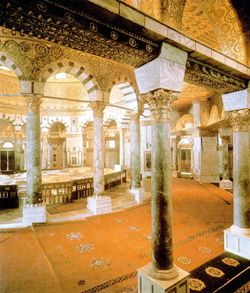
| Built by the Umayyad Caliph 'Abd el
Malik in AD 691-692, it houses a rock which is believed by the
Muslims to be the spot where prophet Muhammad ascended to
heaven. |
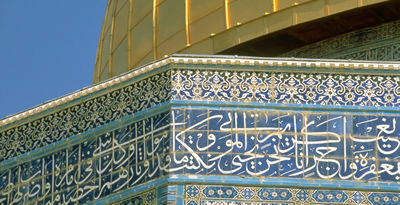
Around the octagonal structure is a
long classical Arabic inscription that says that God has no
begotten son, thus denying that Jesus is the Son of God:
South: In the name of God
the Merciful, the Compassionate. There is no god but God
alone, without partner. Say:
He is God, One, God, the Everlasting,
who has not begotten and has not
been begotten. He is without equal. [Qur'an 112]
Muhammad is God's messenger, may God bless him.
SouthWest: In the name of
God the Merciful, the Compassionate. There is no god but
God alone, without partner.
Muhammad is God's messenger. God and His angels send
blessings on the Prophet.
West: 0 you who believe,
send blessings on him and salute him with all respect.
[Qur'an 33:56] In the name of God the Merciful, the
Compassionate. There is no god but God alone. Praise
NorthWest:
to God who has not taken a son and
who doesn't have any partner in dominion nor any
protector out of humbleness. Magnify Him greatly. [Qur'an
17:111] Muhammad is God's messenger.
North: May God, His angels
and His messengers bless him and God grant him peace and
mercy. In the name of God the Merciful, the Compassionate.
There is no god but God alone,
without partner.
NorthEast: To Him belongs
dominion and to Him belong praise. He gives life and He
makes to die; He is powerful over all things. [conflation
of Qur'an 64:1 and 57.2] Muhammad is God's messenger, may
God bless him and accept his intercession on the day of
resurrection for his community.
East: In the name of God
the Merciful, the Compassionate. There is no god but God
alone, without partner.
Muhammad is God's messenger, may God bless him. There
built this dome the servant of God
SouthEast: 'Ab[d al-Malik,
commander] of believers, in the year seventy-two, may God
accept [it] from him and be pleased with him. Amen. Lord
of the worlds. Praise to God.
(Source:
www.rippin.ca/history455/dome.htm) |
Another long inscription is
found on the inside walls of the octagonal structure. It
also denies Jesus as the Son of God, His resurrection as
well as the Trinity:
South: In the name of God
the Merciful, the Compassionate. There is no god but God
alone, without partner. To
Him belongs dominion and to Him belongs praise. He gives
life and He makes to die; He is powerful over all things.
[conflation of Qur'an 64:1 and 57:2] Muhammad is God's
servant and His messenger.
SouthEast: God and His
angels send blessings on the Prophet. 0 you who believe,
send blessings on him and salute him with all respect.
[Qur'an 33:56] May God bless him and grant him peace and
mercy. 0 people of the book, do not go beyond the bounds
in your religion,
East: nor say anything but
the truth about God. The Messiah
Jesus son of Mary, was only God's messenger, His
word that He committed to Mary, and a spirit proceeding
from Him. So believe in God and His messengers.
Do not say 'three'. Refrain,
NorthEast: it is better for
you. For God is one god. Glory he to Him --
that He should have a son! To
Him belongs all that is in the heavens and in the earth.
God suffices for a guardian [Qur’an 4:171]. The Messiah
will not disdain to be
North: God's servant; nor
will the angels who are stationed near to Him. Whoever
disdains to serve him and waxes proud, He will muster them
to Him, all of them. [Qur'an 4:172] 0 God,
bless your messenger and servant,
Jesus
NorthWest: son of Mary.
Peace be upon him the day he was
born, the day he dies, and the day he is raised up alive.
That is Jesus son of Mary, in word of truth, about which
they are doubting. It is not for God
to take a son. Glory be to Him.
West: When He decrees a
thing, he only says to it 'Be' and it is. God is my lord
and your lord. So serve Him. This is a straight path.
[Qur'an 19:34-36 paraphrased] God, His angels, and men
possessed of knowledge and upholding justice bear witness
that there is no god but He. There is no god but He
SouthWest: the all-mighty,
the all-wise. The true religion with God is Islam. Those
who were given the book did not dissent except after
knowledge came to them, when they became envious of each
other. Whoever disbelieves in God's-signs, God will
swiftly call to account. [Qur'an 3:18-19].
(Source:
www.rippin.ca/history455/dome.htm) |
Excerpted from:
http://www.angelfire.com/journal2/dome_images/ |
|
Jerusalem lights to go out so Bush can enjoy sunrise
Jan 8, 2008
JERUSALEM (AFP) — Lights in the Old City of Jerusalem will be
turned off before dawn this week so visiting US President George W.
Bush can get a better view of the sun rising over its ancient walls.
Bush, who arrives in the Middle East on Wednesday for a visit
lasting more than a week, had made a request to watch the sun rise
over the Old City from his suite at the King David Hotel, a
municipal spokesman said on Tuesday.
To make the scene more dramatic, the authorities have decided
to turn off the lights illuminating the limestone walls before dawn
on Thursday and Friday, the spokesman told reporters.
The gesture is just one of several that Bush's Israeli hosts
will extend to the president of their main ally during his landmark
three-day visit this week -- the first by a sitting US president to
Israel and the Palestinian territories in nine years.
Awaiting Bush at his King David suite -- reportedly costing
2,600 dollars a night -- will be a white terry bathrobe embroidered
with his name in gold, local media have reported.
Israeli television broadcast footage of the garment throughout
the day on Tuesday.
And the main highway leading into Jerusalem from the west --
already plagued by traffic problems -- will be completely closed in
one direction for an hour on Wednesday after Bush arrives to allow
the unhindered passage of the convoy containing his hundreds-strong
entourage.
6-28-08 - DREAM - I had this dream twice, the first time in a
school, the second time in an office.
In the dream, in the school, we were older - more than kids, more
like college age. It was the end of the school year, and we were all
happy to be finished and getting ready to leave school. We were all in a
celebratory mood.
All of a sudden, George Bush came into the room with a big smile on
his face and grabbed me by the hand and pulled me with him out of the
room.
Everyone's faces looked shocked and stunned. They all looked like
they were asking themselves questions - like "Where is he taking her? Why
did he choose her instead of me?
I didn't know the answers to those questions any more than they
did. I was just as shocked.
George continued to pull me along with him outside - no secret
service was tagging along.
He was running now and he pulled me with him as he ran up some green
metal stairs two at a time. I could hardly keep up with him.
I saw that we were on a foot-bridge - the whole thing was painted
bright green. It was a really high bridge and on the far end, the stairs
down were very steep and thin so that we had to almost slide down -
hanging onto the railing. It seemed that it would be almost impossible to
climb those stairs back up once we reached the bottom even if we had
wanted to.
We were now in what looked like a park with green grass and sparse
half-grown trees.
I could see a river off to our right.
George was still pulling me with him and all of a sudden he stopped
and a look of fear came over his face and he looked across the river to
our right.
My eyes followed his eyes to see what he was looking at.
Someone across the river was lighting the bottom end of a rocket or
missile which was about to take off across the sky in our direction.
Was it the fourth of July?
SEE:
http://www.greatdreams.com/political/july-rocket.htm
IS THIS HOW THE WAR WILL START?
JEFF RENSE INTERVIEWS JEFF SKOUSEN
http://www.youtube.com/watch?v=0q12hLOC7XA&feature=related
THE POWER HOUR - INTERVIEWS JEFF SKOUSEN
PART 1 - PREMPTIVE STRIKE TO START IRAN WAR
http://www.youtube.com/watch?v=wYGa1-zB8so&feature=related
PART II -
http://www.youtube.com/watch?v=yjhIoJHSUq0&feature=related
PART III
http://www.youtube.com/watch?v=djwQJkW-huM&feature=related
PART IV
http://www.youtube.com/watch?v=zEIB6SfOs4k&feature=related
|

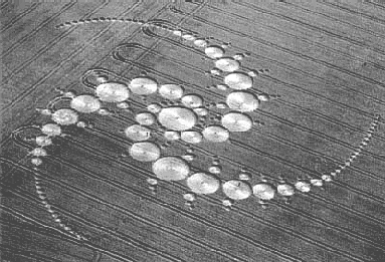
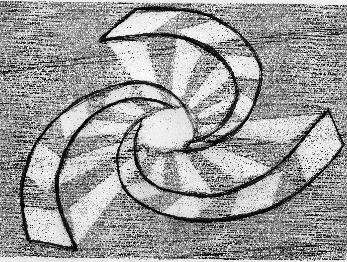

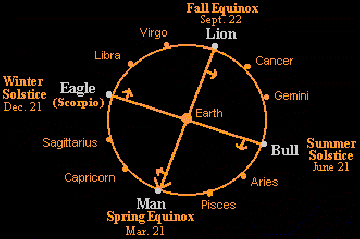
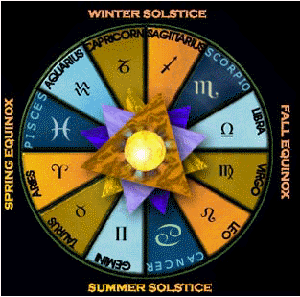
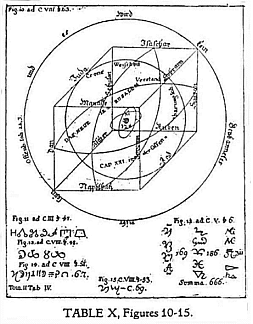
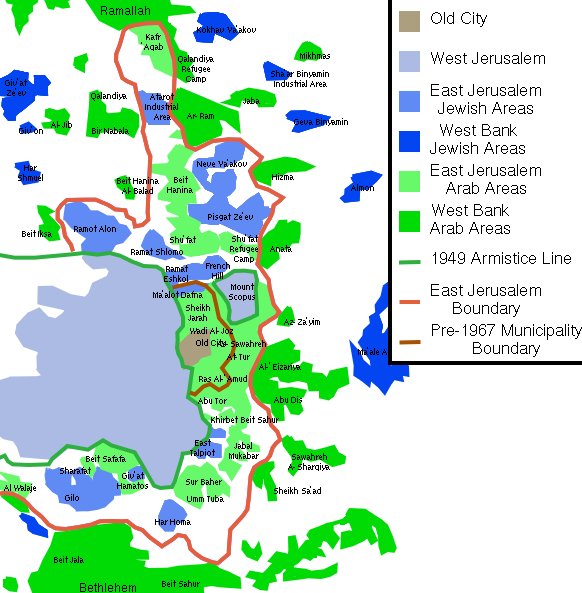
 =
Audio file (requires
=
Audio file (requires