|
Iraq Pipeline Watch
.
.
.
.
Attacks on Iraqi pipelines, oil installations, and oil personnel:
2003
1. June 12 — attack along the 600 mile (960km) pipeline that carries crude oil from Iraq's northern fields near Kirkuk to Turkey's port of Ceyhan on the Mediterranean Sea
2. June 19 — explosion in Bayji refinery complex about 125 miles (200km) north of Baghdad
3. June 22 — explosion in natural gas line near Hit, a city about 95 miles (152 km) northwest of Baghdad
4. June 23 - gas pipeline explosion outside the town of Abidiyah Gaarbiga, near the Syrian border in western Iraq
5. June 24 — explosion near Barwanah pipeline carries crude to al-Dawrah refinery in Baghdad
6. June 26 — explosion near Al-Fatha near the River Tigris
7. July 29 — attack on pipeline near Basra
8. July 31 - saboteurs blew up part of a pipeline near Bayji
9. August 12 — attack near al-Taji near Baghdad
10. August 15 - explosion near Bayji
11. August 16 - explosion near Bayji
12. September 8 — attack on pipeline from the Jabour oil field 20 miles (32 km) southeast of Kirkuk to the main pipeline that originates there
13. September 18 - attack on pipeline from Kirkuk to Ceyhan
14. October 11 - attack on pipeline from Zab to Kirkuk
15. October 16 - pipeline explosion near the city of Hadeetha, 125 miles (200 km) northwest of Baghdad
16. October 23 - explosion near natural gas pipeline 30 miles (48 km) south of Mosul
17. October 23 - bombing attack on an oil pipeline 150 miles (240 km) north of Baghdad
18. November 1 - explosion at oil pipeline about 9 miles (15 km) north of Tikrit
19. November 4 - explosion at a pipeline plant in Zumar, 38 miles (60 km) northwest of Mosul
20. November 10 - Mohammed al-Zibari, distribution manager for the Oil Distribution Company was shot and wounded in the northern city of Mosul in what seems to be the first assassination attempt on officials from an Iraqi oil firm. Zibari's son was killed in the attack. Zibari told Reuters, "Three people opened fire with AK-47s. My driver saw them and so did my bodyguard," adding "Definitely foreign regime loyalists are responsible for this. I have no personal enemies, no tribal or family problems, and I'm not a member of any political party."
21. November 17 - blast 1.2 miles (2 km) east of the Bayji refinery, at a pipeline taking fuel oil to the Daura refinery, in the southern suburb of Baghdad. Resulting damage on the power supply line to the 300,000 barrels per day Bayji refinery, located 156 miles (250 km) north of Baghdad, forced a 2 day electricity shutdown.
22. November 18 - explosion on oil pipeline in the region of Mashruh al-Therthar, south-west of the city of Samarra. The feeds the Daura refineries in Baghdad.
23. November 22 - Abdel Salam Qanbar, an Iraqi police colonel in charge of security for oil installations in the northern city of Mosul was shot and killed by unknown attackers in a vehicle.
24. November 22 - club inside the Iraqi Northern Oil Company compound in Kirkuk, 150 miles (240 km) north of Baghdad, was hit during the night by mortar shells wounding three foreign nationals.
25. November 23 - blast on a pipeline transporting gas from the Jambur oil field to the Bayji refinery caused fire so huge its glow at night is visible from Kirkuk, 19 miles (30 km) north of Jambur.
26. November 26 - oil pipeline linking oilfields in northern Iraq to the Bayji refinery on fire near the village of Sharqat, about 30 miles (48 km) north of Bayji.
27. December 9 - explosion on a gas pipeline that runs from Kirkuk to a bottled gas factory north of Baghdad.
28. December 10 - explosion at point 84 miles (135 km) west of Kirkuk on oil pipeline linking the Bayji and Daura refineries.
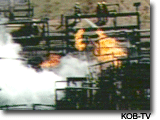
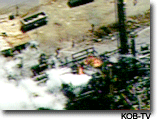
Watch video
29. December 19 - blaze on a pipeline south of Baghdad causing significant leakage.
30. December 20 - rocket-propelled grenades hit storage tanks in southern Baghdad on Saturday; resulting fires burned about 2.6 million gallons of gasoline.
31. December 20 - rocket-propelled grenades cause pipeline explosion in the al-Mashahda area 15 miles (24 km) north of Baghdad.
32. December 21 - explosion on pipeline in the al-Mashahda region, 30 miles (50 km) north Baghdad.
33. December 21 - pumping station near Bayji refinery attacked with mortars.
34. December 22 - explosion at 3:30 pm (1230 GMT) in Riad about 28 miles (45 km) west of Kirkuk, on fuel pipeline between Kirkuk's oilfields and Iraq's biggest refinery in Bayji, parallel to the crucial pipeline between Kirkuk and the Turkish Mediterranean port of Ceyhan.
35. December 22 - fire on pipeline supplying Bayji refinery with crude from the oil fields of Kirkuk at point about 30 miles (50 km) northeast of refinery.
2004
36. January 7 - explosion holes pipeline connecting oil fields to a pumping station in the area around Hassiba, 85 miles (135 km) west of Kirkuk, Northern Oil Company director general Adel Kazzaz said "The fuel line was used for domestic market needs and filling up tankers that export crude."
37. January 30 - explosion on pipeline carrying crude oil from Kirkuk to Bayji refinery.
38. February 22 - explosion and fire on the Kirkuk-Baghdad-Basra pipeline near Al-Hare, a small town west of Karbala, about 70 miles (110 km) south of Baghdad. This is reported to be the first attack against a pipeline in southern Iraq since the ousting of Saddam Hussein.
39. February 26 - explosion apparently caused by homemade bomb thrown under oil and gas pipes damaged part of an oil pipeline about 60 miles (96 km) north of Baghdad.
40. March 2 - large explosion on oil pipeline near the northern city of Kirkuk causing a huge fire but no casualties. The blast hit the main oil line leading to the Bayji refinery 125 miles (200 km) north of Baghdad igniting a huge fire police chief Turhan Yussef said. "The explosion happened at 11.15am (0615 AEDT). An explosive device was placed under the pipeline at Al-Riad, 21 miles (35 km) west of Kirkuk," he said.
41. March 10 - fire on an oil pipeline south of Baghdad, leading from southern fields to the Daura refinery outside Baghdad. Firefighter Saleh Jabbar said it appeared to be the result of sabotage.
42. March 12 - oil pipeline blown up west of Tikrit on Friday, resulting in a fire on the line. The pipeline links northern oil fields in Kirkuk with the Daura refinery on the edge of Baghdad.
43. March 24 - Northern Oil Company oil well in the Khabaz area, about 55 miles (88 km) west of Kirkuk, was bombed at night. The resulting fire was extinguished late the following day. Gen. Mohammed Amin, the Iraqi Civil Defense Corps chief in Kirkuk said the well was not being tapped at the time of the blast nor was it closely guarded. "This is a terrorist act. This is the first time an oil well has come under attack in Kirkuk." Amin said.
44. March 25 - blast on a main oil well in northern Iraq that feeds exports through Turkey. Adel Qazzaz, director-general of the Northern Iraqi Company (NOC) said, "The explosion occurred at 3:30 pm (1230 GMT) because of an explosive charge planted by unknown individuals inside the well, located 47 miles (75 km) west of Kirkuk." He added, "It inflicted massive damage in the well, and firefighters are having a hard time extinguishing it because the explosion occurred inside the well and not in the pipelines." Qazzaz said firemen would need two days to put out the fire, and noted "the well is a principal producer for oil exports through the Iraqi-Turkish pipeline and for covering local market demands."
45. March 26 - pipeline in the southern Basra oil facilities on fire, said an official from Iraq's State Oil Marketing Organization. Iraqi guards on duty at Shuaiba, near the southern city of Basra, said saboteurs ignited crude oil that leaked from the pipeline. A British military spokesman disagreed with the report, saying "It was not the result of an explosion. We understand that a pipeline valve failed and fire broke out from the resultant spillage."
46. April 4 - attack on oil pipeline in southern Iraq which links Basra with Faw port on the Persian Gulf. ruptured it and set the oil ablaze.
47. April 8 - mortar round hit natural gas tank and another hit a pipeline at a plant north of Kirkuk operated by the Northern Iraqi Company (NOC) Jumaa Ahmad, head of the fire fighting brigade, said.
48. April 21 - bombing on pipeline north of Baghdad.
49. April 24 - suicide bombers in three boats blew themselves up in and around the Basra terminal zone, one of the most heavily guarded facilities of its kind in the world.
50. May 8 - bomb 35 miles (56 km) south of Basra damaged an 18-foot section of one of two pipelines running from Basra to the Faw peninsula on the Gulf. U.S. Army Corps of Engineers Spokesman Steve Wright said oil exports from the Basra and Khor al-Amaya offshore southern terminals, through which about 90% of Iraq's oil exports flow, were stopped as a result: "Pumping has stopped. They attacked in the vicinity where the manifold goes into the sea." According to Iraqi officials exports were still flowing from Basra albeit at a reduced rate of 1.2 million barrels per day (bpd) compared with 1.6 million bpd prior to the attack as oil from the damaged pipeline is flowing through the parallel pipeline. Ali Nasr al-Rubaie, director of the main port terminal said exports had been halved following the attack: "We have dropped from an average of 80,000 barrels per hour to 40,000 barrels per hour."
51. May 8 - attack on oil pipeline taking crude northwards from the country’s southern oilfields at point 25 miles (40 km) south of Baghdad, oil ministry spokesman Assem Jihad said on Saturday, noting it would take several days to start pumping oil again.
52. May 9 - blast near a strategic oil pipeline network linking north and south Iraq, by the town of Musayyib, about 56 miles (90 km) south of Baghdad. Unclear what caused the explosion or whether the pipeline itself was damaged.
53. May 13 - rocket landed in a gas plant at the Daura oil refinery in Baghdad, injured a worker and caused a fire.
54. May 24 - explosion badly damaged the Northern pipeline at around 7pm local time on a section between the Kirkuk oilfields and the Dibis pumping installations. A security official of Iraq's Northern Oil Company, Juma Ahmad, said pumping had to be stopped to fight the fire. Another security official for Northern Oil, Issam Muhammad, said while the fire had been put out it would take 12 days to repair the damage.
55. May 26 - explosion on Kirkuk-Ceyhan pipeline near Kirkuk.
56. May 26 - explosion on southern pipeline through which oil flows to the Persian Gulf.
57. June 6 - attack on Kirkuk-Ceyhan pipeline. Iraq's Northern Oil Company (NOC) chief Ghazi Talabani said "Assailants detonated sound grenades on the pipeline Sunday at dawn (local time), 120 km (75 miles) east of Kirkuk, causing damage, and a loss of a huge quantity of oil." He said "The oil loss has been stopped and a group of technical experts are repairing the pipeline and the damage could be repaired by Tuesday night. Restarting production depends on the decision of the coalition and the oil ministry." NOC project manager Abdullah al-Rubai had earlier denied the attack.
58. June 6 - explosion on oil pipeline that feeds the Basra terminal near Basra on the Faw Peninsula's southern end. The blast slowed oil flow from 80,000 barrels per hour to 40,000.
59. June 9 - blast on oil pipeline near Bayji 155 miles (250 km) north of Baghdad cut supplies to the Bayji electric power station and according to Iraq Oil Ministry spokesman Assem Jihad forced a reduction of 400 megawatts, amounting to a 10% output cut on the national power grid.
60. June 9 - blast on Kirkuk-Ceyhan oil pipeline. Anwar Hamed Amin, chief of Iraqi Civil Defence Corps, said "A bomb placed 80 km (50 miles) west of Kirkuk exploded at 8:20am [local time] on the main pipeline to the Ceyhan terminal."
61. June 15 - Explosion in the morning on a pipeline through which oil flows from the Zubeir 1 pumping station to a depot in Faw, 40 miles southeast of Basra.
62. June 15 - Another explosion, during the evening, on a southern pipeline. Together with the attack on the pipeline to Basra, the attack on this 48-inch pipeline through which oil flows to Khor al-Amaya port cut oil exports from the south by over half according to the Iraqi Southern Oil Company.
63. June 15 - ``An oil pipeline connecting the fields in Kirkuk and a processing station in Bajwan, 20 km (12 miles) north of the city, was sabotaged and a fire broke out,'' said Adel Kazaz, a North Oil Company director. The pipeline supplied oil to domestic refineries.
64. June 16 - 42-inch Pipeline to Basra terminal, the key terminal from which most of Iraq's 1.6 million bpd of Basra Light were exported, attacked again. Iraqi Southern Oil Company's spokesman said: "Due to the damage inflicted on the two pipelines, the pumping of oil to the Basra oil terminal has completely stopped," adding that southern exports have "come to halt." A Iraqi oil official reported "There are no exports from Basra oil terminal or Khor al-Amaya and it is unclear when they will restart," adding, "Both pipelines feeding the terminals have been destroyed."
65. June 16 - Chief of security for Iraq's Northern Oil Company, Ghazi Talabani, 70, was shot and killed in Kirkuk as he was being driven to work. His driver was badly wounded. The assassins escaped.
66. June 21 - blast on pipeline transporting crude oil from the northern town of Bayji to Daura refinery at point near al-Mashahidah, 20 miles north of Baghdad. The explosion interrupted supplies to the refinery, that provides the domestic Iraqi market with gasoline, kerosene and liquefied petroleum gas.
67. June 26 - explosion near Latifiyah, about 30 miles south of Baghdad, on small pipeline that feeds crude oil to storage tanks in Latifiyah.
68. June 29 - another blast on pipeline near Latifiyah.
69. July 3 - Fire in Al-Maqalai, southeast of the Az-Zubayr oil fields, on one of the two pipelines that feed the southern terminals resulted in a drop by half of Iraqi oil exports to 960,000 barrels per day. Exports in the South fell from 84,000 barrels per hour to 40,000. While one Iraqi oil official said, "Fire is raging in the 42-inch pipeline on the Faw Peninsula. It was sabotage," an official from the Southern Iraqi Oil Company said "News that one of the key oil export pipeline in the Faw peninsula was attacked by saboteurs are baseless."
70. July 4 - attack on pipeline that carries oil from the northern oil fields to the south at point near Musayyib, about 50 miles (80 km) southwest of Baghdad.
71. July 6 - blast on gas pipeline that feeds multiple power plants in
the center and north of Iraq and a gas canister factory in Taji, north
of Baghdad, that provides gas for many homes. Head of the Northern Gas
Company, Huner Hassan, said "A device exploded along the pipeline
about 90 km (56 miles) south of Kirkuk, sparking a fire." He noted
"This is going to affect electricity production for the country and
the production of gas for domestic use."
72. July 10 - explosion at approximately 6:30am local time about 55
miles (88 km) west of Kirkuk in the Safra area on a gas pipeline that
runs from the gas fields in Kirkuk to a power station in Bayji sparked a
fire on, according to the Northern Gas Co. head of security, Ahmed al-Hassan,
less than a meter of the pipeline.
73. July 14 - Northern Oil Company police officer was shot to death
while manning a checkpoint near a pipeline in Riyad, approximately 80 km
southwest of Kirkuk.
74. July 15 - explosion on pipeline running from the northern oil fields
to the Beiji refinery.
75. July 15 - holes were drilled on a major southern pipeline that runs
to offshore export terminals. The damage occured in the al-Askari
district, 20 km south-west of Basra, according to head of the Iraqi
Border Police, Staff Brigadier General Ali al-Mousawi. It appears this
may be the work of looters.
76. July 15 - explosion near Fatha, some 55 miles (90 km) west Kirkuk,
at about 8:40 a.m. (0440 GMT) on oil pipeline that runs from the major
oil fields in Kirkuk and the Turkish port Ceyhan. The resulting fire has
been extinguished and repairs on the pipeline are expected to begin July
17.
77. July 16 - attempted mortar attack on northern oil pipeline that runs
from Kirkuk to Ceyhan failed. According to a security official at the
Northern Oil Company, Ahmad Hassan Afif, "A mortar round was thrown
at about 8:10 am (0410 GMT) on the pipeline near to Riad, 35 kilometres
west of Kirkuk, causing a fire in a pool of oil created by leaks, but
failing to cause any other damage."
78. July 17 - attempt to blow up natural gas pipeline failed as saboteur's bomb exploded prematurely, killing him but not damaging the pipeline.
79. July 19 - explosion on oil pipeline that runs through al-Debis region northwest of Kirkuk, supplying oil for domestic use in refineries and power plants.
80-83. July 23 - two blasts on 125 mile (200 km) long oil pipeline that runs from al-Daura refinery in Baghdad to Beiji, at point about 12 miles (20 km) south of Samarra.
84. July 24 - explosion southwest of the town of Samarra, 60 miles (100 km) north of Baghdad, sparked a fire on pipeline that carries oil from Beiji refinery to Baghdad.
85. July 24 - blast in the vicinity of Tharthar Lake, 100 miles (160 km) southeast of Kirkuk, on oil pipeline that runs from the oil fields around Kirkuk to Al-Dura power station, south of Baghdad.
86. July 28 - premature explodulation killed two saboteurs who tried to place a bomb on an oil pipeline near Kirkuk. The pipeline was not damaged.
87. August 3 - explosion about 75 miles (120 km) west of Kirkuk at Al-Fateha on critical pipeline juncture caused a huge fire and road closure between the Beiji refineries and Kirkuk and halted exports through the northern pipeline to Ceyhan.
88. August 5 - bomb on oil pipeline in Kirkuk area found by Northern Oil
Company security personnel exploded as Task Force Danger troops were
investigating it. No injuries.
89. August 5 - blast on the Kirkuk to Ceyhan oil pipeline sparked a fire
that was swiftly contained since oil flow was halted on the pipeline as
a result of the Aug. 3 attack.
90. August 5 - attack sparked fire on gas pipeline that feeds both the
Bayji power station and a propane factory in Taji 12 miles (20 km) north
of Baghdad. Northern Oil Company's gas division director, Honer Najib,
said "Firefighters are trying to contain the blaze but the sabotage
is going to effect the production of electricity in Iraq."
91. August 9 - attack halted oil flow on the major pipeline that feeds
the southern terminals, reducing exports from 1.9 mbd to the about 1 mbd,
fed through the smaller 42-inch pipeline.
92. August 14 - attack on domestic oil pipeline near the town of
Mussayyib south of Baghdad sparked fire, and has caused shortages in the
domestic supply of gasoline.
93. August 15 - rocket-propelled grenades were fired on an oil well 25
miles (40 km) east of the southern town of Amra setting it ablaze.
94. August 18 - Northern Iraqi oil company security officer was killed and 2 others wounded 6 miles (10 km) from Kirkuk.
95. August 19 - attackers infiltrated the Basra headquarters of the Iraqi Southern Oil Company setting a fire that obliterated warehouses containing drilling equipment, among other items, spread to the firm's offices, and cut electricity. "They came in droves, surrounded the building and looted it before setting it on fire," said a company official. Firefighters arriving at the compound were shot at and fled.
96. August 20 - attack apparently perpetuated by al-Sadr loyalists sparked fire on pipeline through which oil flows from the Bezergan oil field in the south to a refinery in Amarah, 180 miles (290 km) southeast of Baghdad.
97. August 20 - explosion at 8:30am on domestic pipeline through which oil flows from Kirkuk to Baiji refinery at point 19 miles (30 km) west of Kirkuk.
98. August 21 - blast near pipeline valve at Berjisiya, 20 miles (32 km) southwest of Basra, sparks fire on oil pipeline connecting the Rumeila oilfields with export storage tanks in the Faw peninsula. Another bomb was found nearby and defused. The pipeline was shut for a week due to sabotage threats. Lt. Mohammed al-Mousawi of the Iraqi National Guard explained "The aim behind attack is to damage the pipeline in case it is turned on again."
99. August 25 - attack on the reversible Strategic Pipeline linking oil fields in the north and south of Iraq sparked fire 19 miles (30 km) west of Babylon.
100. August 25 - explosion at 7:00 am near Al Madhatiya in Aawazel area, about 18 miles (30 km) south of Hilla, on gas pipeline which transports gas from Basra to other southern towns set the pipeline ablaze.
101. August 25 - eight parallel pipelines that link the Rumaila oilfields to the Zubayr 1 pumping station were hit in Berjasiya, 20 miles (32 km) southwest of Basra, when a bomb exploded under a bridge at 9:00pm and caused it to collapse, reducing exports from the south.
102. August 27 - attack on the 36 inch in diameter oil pipeline that
connects the South Rumaila oilfield to storage tanks at the Zubair One
station near Basra.
103. August 27 - attack on the 48 inch oil pipeline that connects the
North Rumaila field to storage tanks in the West Qorna oilfield.
104. August 27 - blast on oil pipeline that feeds the Daura refinery;
section on fire 19 miles (30 km) north of Baghdad.
105. August 27 - attack on oil pipeline in the West Qurna oilfield, 90
miles (144 km) north of Basra.
106. August 29 - blast on oil pipeline that links the Rumaila oilfields
with export storage tanks in the Faw peninsula in al-Radgha, 30 miles
(48 km) southwest of Basra.
106. August 27 - attack on oil pipeline in the West Qurna oilfield, 90
miles (144 km) north of Basra.
107. August 29 - blast on oil pipeline that links the Rumaila oilfields
with export storage tanks in the Faw peninsula in al-Radgha, 30 miles
(48 km) southwest of Basra.
108. August 30 - blast on internal oil pipeline in the southeast New
Baghdad district.
109. September 1 - explosion on Kirkuk-Ceyhan oil pipeline on section
between Kirkuk and Bayji at 6:30 pm near Riyadah 30 miles (50 km) south
of Kirkuk sparked a huge fire halting exports on the line.
110. September 4 - blast on 14-inch line carrying crude from the Al-Khabaz
field to the Bayji refinery.
111-112. September 4 - attack at 8:30am at Hartha, 19 miles (33kms)
north of Basra, on southern pipeline that supplies oil to the Hartha
electrical plant. Simultaneous attack on parallel pipeline that pumps
15,000 barrels of crude oil a day from oil fields near Nahr Omar to the
storage tanks at Zubayr 1.
113. September 6 - attack at point 12 miles (20 km) south of Kirkuk on
natural gas pipeline connecting the Janbur fields to the Bayji power
plant, which produces 400 megawatts a day and provides electricity to
northern Iraq, sparked fire.
114. September 6 - at 9:30am, a day after the fire on the Kirkuk-Ceyhan
pipeline was extinguished, attackers set fire to the leaking oil and
re-ignited it.
115. September 11 - at 3:15pm attackers damaged the 14 inch oil pipeline
that links a Kirkuk oilfield to the Havana refinery located 37 miles (60
km) from Kirkuk with fire from automatic weapons.
116. September 11 - gunfire attack at 3:30am near Hatin, 18 miles (30
km) north of Kirkuk, injured three Northern Oil Company security guards,
one of them seriously.
117. September 12 - gunfire attack at 1am 25 miles (40 km) northeast of
Kirkuk on security forces guarding the Dibis oil fields wounded three of
them.
118. September 12 - driveby gunfire injured two security officers on
patrol near the Jambouz oilfields 30 miles (42 km) west of Kirkuk.
119. September 13 - attack on oil pipeline in the Rumaila oilfield.
120. September 14 - 2am blast on junction where pipelines cross the
Tigris River, at point near the 676-MW Beiji power plant set ablaze
three oil pipelines, stopping the flow of oil from the Kirkuk oilfields
to Beiji refinery and to Ceyhan. The heat melted a 400-KV transmission
line that ran almost 300 ft above the area, causing a power loss of 750
MW within a second, which caused the country's 5,000 MW grid to short
circuit stopping electricity supply to all of Iraq. Just two days prior
Northern Oil Company engineers finished replacing critical valves
destroyed by an earlier attack.
121. September 16 - attack on oil pipeline near Baqouba that runs from
the Khanaqin oilfields to the Al Daura refinery.
122. September 18 - attempt to assassinate director of oil products for
the Northern Oil Company, Muhammad Zibari, by attackers with machine
guns and grenades who ambushed his convoy in Mosul missed him but
resulted in the death of eight people and injury of four.
123. September 23 - assassins shot and killed the deputy director of the
Northern Oil Company's oil product department, Sana Toma Sulaiman,
riding in a taxi in Mosul on his way to work.
124. September 23 - explosion on oil pipeline near al-Fahhama village,
15 miles (25 km) north of Baghdad, causing extensive damage.
125. September 23 - saboteurs blew up part of the East Baghdad oil
field. The well, capacity 5,000 barrels a day, supplies refineries in
nearby Taji and Baghdad's Daura refinery.
126. September 23 - blast on oil pipeline at Angour, 50 miles (80 km)
east of Fallujah.
127. September 23 - explosion on oil pipeline in Najaf stopped flow from
oil fields near the city to a refinery in Basra.
128. September 24 - private pipeline security company found explosive
device along a major oil pipeline west of Balad. Oil flow remained
uninterrupted.
129. October 3 - saboteurs blew up a section of the pipeline near the
city of Karbala in central Iraq.
129. October 5 - rocket fired at the Oil Ministry in Baghdad.
130. October 5 - blast on oil pipeline west of Baghdad.
131. October 18 - blast on oil pipeline 8 miles (12 km) from Bayji.
132. October 19 - blast on oil pipeline 6 miles (10 km) north of the
Bayji refinery.
133. October 19 - explosion at 2:10pm on oil pipeline 87 miles (140 km)
south of Kirkuk.
134. October 21 - saboteurs hit a section of the northern oil export
network.
135. October 22 - blast in the Mashahdeh area, some 30 miles (48 km)
north of Baghdad, on an oil pipeline that feeds the Daura refinery.
136. October 23 - blast on the Khana oil pipeline northeast of Baghdad
sparked fire which damaged 150 meters of the pipeline. Another bomb was
found along the same line and safely defused.
137. October 25 - saboteurs blew up a section of a pipeline about 15
miles (25 km) southwest of Kirkuk feeding the Bayji refinery. A fire
later broke out in another pipeline and witnesses said it was caused by
a blast.
138. October 29 - explosion at about 6:00am on oil pipeline near the
Havice district of Kirkuk.
139. November 1 - explosion on Kirkuk-Ceyhan oil pipeline in Riyad,
southwest of Kirkuk.
140. November 1 - attack on a oil pipeline that feeds the Kirkuk-Ceyhan
pipeline and is connected to the Bai Hassam oilfield in Qoshqaya.
141. November 1 - attack on pipeline connected to the Khabbaz oilfield,
22 miles (35 km) south of Kirkuk.
142-143. November 2 - two bombs exploded against oil pipeline connecting
oil fields in Kirkuk to the refinery in Bayji, one at 10am.
144. November 2 - blast on refined products pipeline in Hatin north of
Kirkuk.
144. November 2 - attack at 7:20pm near Sheikh Mizher al-As on a
pipeline network connecting the Khubbaz oil wells, 24 miles (40 km) west
of Kirkuk with refineries in Bayji and Baghdad.
145. November 3 - assassins shot to death the director general of the
Iraqi oil ministry's oil byproducts distribution company, Hussein Ali
al-Fattal, as he left his home in the Yarmouk area of Baghdad to go to
work.
146. November 5 - explosion damaged a gas pipeline which connects the
Baba Gurgur fields near Kirkuk with the Northern Gas Company.
147. November 9 - explosion on oil pipeline near the Safa, 44 miles (70
km) southwest of Kirkuk.
148. November 10 - attack on gas pipeline connecting the Khubbaz fields
to the Northern Gas Company.
149. November 13 - attack at Taji, 12 miles (19km) north of Baghdad on
oil pipeline that runs to the Daura refinery in Baghdad.
150-153. November 14 - four oil wells set afire in the Khubbaz oilfield
west of Kirkuk. The wells had been pumping 10-15,000 bpd of oil a piece.
154. November 15 - blast on oil pipeline from Kirkuk to Ceyhan in Safra
37 miles (50 km) west of Kirkuk.
155. November 15 - gunmen set ablaze a storage depot and pumping station
along the oil pipeline to Ceyhan near Ain al Jahish, 60 miles (96 km)
south of Mosul.
156. November 15 - explosion at 11pm near Sarai, 47 miles (75 km) west
of Kirkuk, on oil pipeline that feeds the Bayji refinery.
157. November 15 - explosion at 11pm near Riyadh, 25 miles (40 km) west
of Kirkuk, on gas pipeline that feeds the power station in Bayji.
158. November 17 - blast at 1am on oil pipeline from the Bai Hassan
field, 30 miles (42 km) west of Kirkuk, to storage facilities in Dibis,
20 miles (32 km) west of Kirkuk.
159. November 17 - bomb on oil well in Barajwan, 20 miles (32 km)
northwest of Kirkuk.
160. November 17 - blast at 8am 2.5 miles (4 km) west of Samarrah on
pipeline from Bayji to the Daura refinery in Baghdad.
161. November 21 - an oil well was set afire in the Khubbaz oilfield.
162. November 21 - sabotage attempt on a well in the Khubbaz oilfield
thwarted by Iraqi security guards. One would-be saboteur was killed and
another wounded.
163. November 22 - blast at 9am on the 42 inch pipeline to Basra
terminal stopped flow of oil through the pipeline.
164. November 25 - attack on two oil wells near the Himreen Mountains,
75 miles (120 km) south of Kirkuk.
165. November 25 - an early morning explosion in the Fatha area, 9 miles
(15 km) north of Bayji, on the oil pipeline that runs from Kirkuk to
Bayji. A 2,000 person Iraqi security force was assigned to guard oil
infrastructure two days prior.
166-167. November 29 - two blasts, one at 8:40 am and the other at
8:50am, on the oil pipeline that runs from Bayji to Daura refinery.
168. November 30 - blast on the oil pipeline that connects Daura
refinery and the Musayyib power station south of Baghdad, cutting power
to the Babil area.
169. December 1 - gunmen opened fire on a pipeline repair team working
in the Safrah area, 50 miles (80km) southwest of Kirkuk. One man was
injured.
170. December 6 - attack 10 miles (16 km) south of Samarra on oil
pipeline that runs from Bayji to Daura refinery.
171. December 6 - attack on a pipeline that runs inside an underground
oil storage tank 50 miles (80 km) southwest of Kirkuk.
172. December 7 - attack on pipeline supplying oil from northern Iraq to
Baghdad.
173. December 10 - late night attack on the 48 inch oil export pipeline
in the Riyad area southwest of Kirkuk.
174. December 11 - ten armed men kidnapped the Northern Oil Company's
head of security for the Bayji region while he was in the Samarra area
examining damage to a pipeline that had been attacked.
175. December 13 - arsonists set on fire oil, which had leaked and
pooled due to prior pipeline attacks, 43 miles (27 km) southwest of
Kirkuk, raising concern that the blaze could damage nearby pipelines.
176. December 17 - attack on pipeline supplying oil from Basra to
Baghdad's Daura refinery, halted the flow of refined products which, oil
ministry spokesman Jihad Assem said, had just resumed following a 17 day
stoppage after the previous sabotage.
177. December 17 - attack on pipeline supplying refined products from
Bayji refinery to Baghdad. A statement circulated in Bayji said that Abu
Musab al-Zarqawi had blown up a pipeline, following orders from
''supreme commander Osama bin Laden''.
178. December 17 - attack on the northern pipeline near Fatha, 53 miles
(85 km) west of Kirkuk.
179. December 18 - 7:30am attack on pipeline supplying oil from Kirkuk
to the IT-1A storage tanks near Bayji.
180. December 18 - 8:30am blast on oil pipeline between Bayji and Daura
refinery at Dilja, 12 miles (20 km) north of Samarra.
181. December 21 - 10:25 pm attack on a pipeline hub in Fatha.
182. December 23 - attack on pipeline from Bayji to a storage facility
in Baghdad.
183. December 26 - attack on the northern pipeline near Fatha.
184. December 28 - 0:30am attack on a gas pipeline in Barjisiyah,
southwest of Basra. The pipeline, which links Iraq's second largest
refinery in Shueiba to the storage units of South Oil Company, was blown
up by a single attacker using a gas cylinder.
185. December 30 - mortar attack set fire in the Daura refinery, which
provides fuel for Baghdad's main power plant.
2005
186. January 1 - attack on a pipeline from Kirkuk to Bayji.
187. January 1 - attack on a pipeline linking the southern cities of
Karbala and Hillah, 46 miles south of Baghdad near the Musabayb power
station.
188. January 7 - attack on gas pipeline 9 miles north of Tikrit.
189. January 8 - attack on an oil pipeline running from northern fields
to Bayji in the Safra area, 43 miles southwest of Kirkuk. Two guard
posts for an oil protection force were also blown up around the area and
one guard was wounded.
190. January 8 - attack on a gas pipeline in the Fatha area near Bayji.
191. January 11 - 2:00am rocket attack on a gas pipeline that runs to
Bayji near the Fatha production station.
192. January 11 - 6:30am attack on an oil pipeline that runs to Bayji in
the Zegheitoun area, 35 miles southwest of Kirkuk. The pipeline had just
been brought online on January 9th.
193. January 13 - 10:30pm attack on oil pipeline near Fatha.
194. January 14 - improvised explosive device detonated after midnight
damaging an oil pipeline near Bayji and sparking a large fire.
195. January 14 - attack on a pipeline linking Kirkuk and the Daura
refinery, near Samarra.
196. January 14 - rocket attack on pipeline complex near Fatha sparked
large blaze.
197. January 17 - a bomb blew off a section of a pipeline in Fatha.
198. January 21 - 07:00am attack on pipeline in the al-Tharthar region
12 miles south of Samarra interrupted the flow of oil to the Bayji
refinery.
199. February 2 - attack on oil pipeline connecting Bayji refinery to
Daura refinery. The attack took place near Samarra.
200. Fabruary 5 - attack on a cluster of eight pipelines west of Samarra
connecting the Bayji and Daura refineries.
201. February 6 - attack on pipeline carrying crude oil from Kirkuk to
Bayji.
202. February 9 - attack on a gas pipeline before dawn in Fatha, about
15 miles north of Bayji.
203. February 9 - rocket attack on a pipeline linking Kirkuk to Bayji.
204. February 13 - 10:00pm attack on oil pipeline at the al-Dibbis oil
field 31 miles north of Kirkuk.
205. February 14 - another attack on oil pipeline at al-Dibbis.
206. February 16 - attack on pipeline carrying crude from Kirkuk to
Bayji near Fatha.
207. February 16 - attack on pipeline carrying crude from Kirkuk to
Daura refinery.
208. February 16 - another attack on pipeline near Fatha.
209. February 16 - attack on pipeline in the Bajwan area, northwest of
Kirkuk.
210. February 16 - gunmen killed Colonel Ibrahim Ahmed in charge of
pipeline security. The killing took place at Ajeel west of Kirkuk.
211. February 25 - late night attack on a pipeline connecting the Dibbis
oil fields with Kirkuk.
212. March 2 - 10pm attack on gas pipeline to Bayji near Al-Safra 30
miles west of Kirkuk caused the shutdown of two of the Bayji power
station's four turbines.
213. March 3 - attack on a gas pipeline that links Kirkuk to Dibbis.
214. March 7 - attack on pipeline near Samarra, 60 miles northwest of
Baghdad.
215. March 8 - 1pm attack on oil pipeline feeding Al-Daura refinery near
Jorf al-Sakhr, 35 miles south of Baghdad.
216. March 9 - attack on oil pipeline feeding the Daura refinery in Jorf
al-Sakhr, 46 miles south of Baghdad.
217. March 12 - attack on oil pipeline connecting Bayji and Daura in Al-Tharthar,
near Samarra.
218. March 12 - Rocket-propelled grenades were launched at a pipeline
running from Kirkuk to Daura.
219. March 15 - attack on oil pipeline in Fatha which carries crude from
Kirkuk to Bayji.
220. March 25 - attack on oil pipeline which connects Iraq northern
oilfields with the Daura refinery.
221. March 27 - 9:00am attack on oil pipeline which carries crude from
Kirkuk to Bayji. Repairs on the line had just been completed the day
before.
222. April 4 - attack on pipeline running through the Riyad area near
Bayji.
223. April 13 - bomb on oil pipeline near Kirkuk killed an Iraqi oil
security chief and eight of his men, who were in the process of defusing
another explosive device, and sparked a fire on the pipeline.
224. April 17 - attack near Fatha on oil pipeline from Kirkuk to the
Bayji refinery.
225. April 18 - twin blasts at an internal oil pipeline near Kirkuk.
226. April 25 - insurgents blew up pumps used for domestic supplies near
Bay Hassam, 19 miles west of Kirkuk.
227. May 4 - attack on an oil pipeline that links northern Kirkuk oil
fields to Baghdad. The attack took place near Balad.
228. May 10 - attack on an oil pipeline complex near Kirkuk.
229. May 11 - a mortar round struck the Iraqi Oil Ministry complex in
Baghdad.
230. May 11 - three bombs were planted on different parts of the oil
pipeline in Kirkuk's Dibiz district. Two of the three exploded, heavily
damaging the pipeline.
231. May 11 - attack on an oil pipeline near Bayji.
232. May 11 - a bomb exploded at Iraq’s largest fertilizer plant in
Basra, killing one person and wounding 23. The blast set fire to a gas
pipeline.
233. May 11 - a bomb was planted near the oil ministry in central
Baghdad.
234. May 12 - an insurgent blew himself up as he tried to sabotage an
oil pipeline near Kirkuk.
235. May 13 - attack on the Athana pumping station that feeds the
northern pipeline.
236. May 27 - attack on pipeline in the western outskirts of Baghdad.
237. June 3 - 8 a.m. attack on pipeline between Kirkuk and the Dibis
refinery, about 30 miles west.
238. June 8 - saboteurs blew up a main oil pipeline near Kirkuk.
239. June 8 - saboteurs opened connections between two pipelines near
the Bayji refinery causing oil spill.
240. June 9 - 8:00 p.m. saboteurs blew up a major oil pipeline five
miles east of the Bayji refinery.
241. June 15 - insurgents blew up a pipeline near Baghdad that
transports crude oil between Bayji and Daura.
242. June 23 - attack on pipeline carrying crude from Kirkuk to Bayji,
near al-Fathah.
243. June 25 - attack on oil pipleline leading from Kirkuk to Ceyhan.
244. June 24 - pipeline linking the southern fields around Basra to
Daura. The attack took place near Yusifiyah.
245. June 28 - attack on pipeline in southwestern Baghdad.
246. June 29 - attack on a natural gas pipeline linking storage
facilities in Yousfiyah, south of Baghdad, to a plant in Baghdad.
247. July 3 - attack on a key feeder pipeline that leads to the Daura
refinery.
248. July 8 - mortar attack on the Daura oil refinery hit a pipeline
attached to one of the reservoirs.
249. July 20 - attack on an oil pipeline that connects Bayji and
Baghdad.
250. July 20 - 6:00 a.m. a roadside bomb exploded under the pipeline
that goes from Kirkuk to the Daura refinery.
251. July 20 - late night attack on oil pipeline between Mahmoudiyeh and
Latifiyehin in southern Iraq.
252. July 21 - insurgents incinerated an oil pipeline west of Samarra.
253. July 26 - two Iraqi security personnel were killed and three
wounded by mortar fire near Bayji while guarding an oil pipeline.
254. July 28 - a bomb hit an oil pipeline conecting Bayji and Kirkuk. A
gas pipeline that supplies Bayji power station was also damaged during
the attack.
255. July 28 - a bomb on a railway line hit a train carrying oil
products near Baghdad, causing a huge fire.
256. August 3 - an explosion damaged a pipeline used for shipping fuel
to a Baghdad power plant north of the capital.
257. August 4 - 5:00a.m. three explosions set ablaze a pipeline near
Kirkuk.
258. August 20 - attack on a major line between Bayji and Baghdad
stopped electricity supply to the capital.
259. August 26 - Insurgents sabotaged an exporting oil well north of
Kirkuk.
260. August 27 - bomb beneath an oil pipeline supplying the Daura oil
refinery in Baghdad, causing an hour-long fire.
261. August 26 - Insurgents sabotaged an exporting oil well north of
Kirkuk.
262. August 27 - bomb beneath an oil pipeline supplying the Daura oil
refinery in Baghdad, causing an hour-long fire.
263. August 29 - Rebels fired a mortar at Iraq's oil ministry building
in Baghdad.
264. August 30 - Lt. Colonel Mohammed Rashad, commander of a unit
protecting Iraq's oil pipeline network, was assassinated in front of his
home in Kirkuk as he was leaving for work.
265. Sept 3 - an explosion on oil pipeline 2.5 miles from Fatha, between
Kirkuk and Bayji, stopping oil flow from Kirkuk to Ceyhan after
insurgents ignited an oil leak.
266. Sept. 5 - oil pipeline connecting Bayji and Baghdad was set on fine
west of Samarra.
267. Sept. 7 - an explosion on the line from Khanaqin to the al-Daura
refinery. The attack took place in Thiaa Thiaa village, east of the city
Baqouba which is 35 miles north of Baghdad.
268. Sept. 19 - two policemen were killed when a bomb targeted a vehicle
for the north oil pipeline protection forces.
269. Sept. 22 - attack on a cluster of pipelines north of Kirkuk near
Dibis. The attack was followed by fire in the valves complex.
270. Sept. 23 - attack on an oil tanker carrying fuel to the US Army.
271. Sept. 26 - attack on pipeline from Kirkuk to Ceyhan.
272. Sept. 27 - fire broke out in an oil pipeline that carries oil from
Daura refinery to Latifyia.
273. Sept. 28 - attack on an oil pipeline near al-Daura.
274. October 3 - a bomb attack in Baghdad on the motorcade of Iraq's oil
minister Ibrahim Bahr al-Uloum, who was heading to Bayji.
275. October 5 - attack on an oil pipeline near the Kirkuk refinery.
276. October 5 - bomb attack wounded six oil ministry guards.
277. October 6 - gunmen shot dead five oil ministry security guards.
278. October 15 - major power cuts have caused intermittent suspension
of oil production from oil fields in the south of the country.
279. October 19 - attack on an oil pipeline at Al-Ishaqi village south
of Samarra.
280. October 20 - attack on a major pipeline that links Kirkuk to Bayji.
The bombing took place less than 24 hours after th epipeline was
reopened.
281. October 24 - 10:00a.m. mortar attack on on a network of oil and gas
pipelines 40 miles west of Kirkuk. 16 pipelines caught fire.
282. October 24 - insurgents blew up a bomb under the oil pipeline at
al-Malha village east of Hemrin mountains, near Bayji.
283. December 21 - the Bayji refinery was shut after insurgents
threatened truck drivers transporting petrol.
284. December 24 - attack on a pipeline in Jurf Sakher area on the
outskirts of Hillah, 60 miles south of Baghdad.
285. December 24 - blast on oil pipeline south of Samarra, 60 miles
north of Baghdad.
2006
286. January 1 - a bomb exploded near a gas station near Daura. Three
civilians were injured.
287. January 1 - attack on pipeline supplying petroleum products to a
power plant near the Daura refinery cut capacity at the plant to 30%.
288. January 1 - riots broke out in Kirkuk. Hundreds of demonstrators,
protesting fuel shortages, set two gas stations and offices belonging to
the national oil company on fire.
289. January 4 - a rocket-propelled grenade attack destroyed 20 fuel
tankers in a convoy of 60 heading to Baghdad from Bayji. "Islamic
Army" claims responsiblity.
290. January 4 - Rahim Ali Sudani, a director-general at the oil
ministry, and his son were killed in a drive-by attack on their car.
291. January 4 - nighttime mortar attack on gas pipeline in Bagwan,
about 16 miles northwest of Kirkuk.
292. January 5 - a bomb exploded on an oil pipeline in Bagwan, about 16
miles northwest of Kirkuk.
293. January 15 - Insurgents attacked a checkpoint installed to monitor
an oil pipeline, killing one guard and injuring three others south of
Baghdad.
294. January 25 - a bomb exploded under a pipeline linking an oilfield
near Kirkuk with the terminal at Ceyhan, causing a fire and a partial
reduction in pumping.
295. January 25 - security forces defused two bombs that had been placed
under pipeline in the Dibis area north of Kirkuk.
296. February 1 - attack on an oil pipeline in Muhwailha, 40 miles south
of Baghdad.
297. February 2 - attack on oil pumping station feeding one of two
export pipelines from Kirkuk to Ceyhan.
298. February 3 - mortar shells hit an oil facility near Kirkuk.
299. February 17 - insurgents blew up the main pipeline feeding crude
oil from Kirkuk to a refinery in Daura.
300. February 24 - An explosion set fire to an oil pipeline south of
Samarra.
301. February 25 - attack on a pipeline near Bayji.
302. March 1 - attack on pipeline near Taji.
303. March 1 - an oil pipeline was burning in Musayyib, following a
rocket-propelled grenade attack. Gunmen shot at firefighters as they
rushed to the scene, wounding two of them. Arriving a short time later,
police engaged the insurgents in an hour-long gunbattle.
304. March 2 - guards with Iraq's oil protection service killed one man
and detained three others as they were trying to plant bombs under a
pipeline west of Kerbala, south of Baghdad.
305. March 2 - attack on an oil pipeline connecting the Al-Daura
refinery and Al-Musayyib power plant, in southern Baghdad, causing a
fire.
306. March 8 - 9:00am explosion at the Basra headquarters of the
Southern Oil Company damaged the fuel section's building; unclear if
caused by bomb or mortar.
307. March 30 - insurgents blew up a pipeline transporting oil from
Kirkuk to the Bayji refinery, at a point near a village 30 miles
southwest of Kirkuk.
308. March 31 - Blast underneath oil pipeline that runs from Bayji to
Daura.
309. April 1 - roadside bomb blast near oil pipeline 44 miles (70 km)
south of Basra kills two members of Iraq's Facility Protection Services
(FPS); no damage to the pipeline.
310. March 8 - 9:00am
explosion at the Basra headquarters of the Southern Oil Company damaged
the fuel section's building; unclear if caused by bomb or mortar.
311. March 14 - insurgents launched an attack on an oil pipeline near
Hawijah.
312. March 18 - iocket attack against oil installation near Kirkuk.
313. March 18 - rocket was fired against the North Oil Company HQ.
314. March 19 - Raad Al Asali, the director of an oil products company in
Mosul was killed as he left his home.
315. March 21 - insurgents attacked an natural gas pipeline northeast of
Tikrit with an IED resulting in breeching of the pipeline and ignition of
the gas.
316. March 21 - two oil workers were shot and killed in Bayji.
317. March 25 - insurgents mounted a mortar attack on Bayji oil refinery
during a VIP visit.
318. March 30 - insurgents blew up a pipeline transporting oil from Kirkuk
to the Bayji refinery, at a point near a village 30 miles southwest of
Kirkuk.
319. March 30 - insurgents shot dead eight workers at Iraq's largest oil
refinery in Bayji. Another man was wounded when the gunmen ambushed the
workers' minibus at a roadblock as it drove out of the refinery.
320. March 31 - Blast underneath oil pipeline that runs from Bayji to
Daura.
321. April 1 - roadside bomb blast near oil pipeline 44 miles (70 km)
south of Basra kills two members of Iraq's Facility Protection Services
(FPS); no damage to the pipeline.
322. April 10 - three Oil Protection Force workers were injured when an
IED detonated in a Toyota Caprice vehicle which they were investigating.
The incident occurred to the north of Az Zubayr near the Al Swadi Gas
Station.
323. April 12 - an attempt to shoot the director of the Northern Gas
Company Director failed.
324. April 26 - two Iraqi army soldiers, who were guarding an oil
pipeline, were shot dead by armed men in two vehicles near the town of
Balad.
325. April 29 - the Northern Gas Company was attacked with rockets. The
attack targeted three critical Oil and Gas plants in Kirkuk. These are at
present under reconstruction and refurbishment. Initial assessments
indicate that up to 16 rounds of 57mm were received from two separate
firing points. There was no damage reported and no loss of operational
capability. The firing point was believed to have been a white pick up
truck, located to the SW of the plant.
326. April 30 - Iraqi Police discovered a Katyusha rocket near Kirkuk. The
rocket had been placed on a pile of rocks at an angle with a timer
attached, possibly targeting the Northern Oil Company. Iraqi EOD disarmed
the rocket without incident.
327. May 6 - six engineers working for Iraq's state-owned Northern Oil
Company were kidnapped while they were returning from a meeting in Kirkuk.
328. May 8 - insurgents attacked an oil pipeline with an IED at 45 km
south from Baghdad. There were no casualties in the attack, but the oil
pipeline had to be closed due to the blast. The pipeline carries oil from
Dora refinery in Baghdad to Musayyib power station.
328. May 10 - attack on an oil pipeline pipeline carrying oil from Daura
refinery to Mussayyib power station.
329. May 15 - attack on pipeline in the Daura refinery.
330. May 16 - insurgents assaulted a car park in northeast Baghdad,
killing 18 people and injuring at least 37. Iraqi police said the gunmen
shot five guards who were looking after the garage in the Shaab
neighbourhood. They then detonated an IED on a parked oil tanker. The bomb
killed 13 people.
331. May 20 - a member of the Facilities Protection Service was killed
having been shot by two unknown gunmen in the Hayy ar Risalah district of
Basrah.
332. May 21- gunmen killed two policemen working in the Oil Protection
Facilities in the town of Ar Riyad 40 miles southwest of Kirkuk.
333. May 21 - in al yusufiyah, insurgents detonated an IED on an oil
pipeline, starting a massive blaze.
334. May 21 - two Oil Protection Service officers were killed in a
drive-by shooting in Tikrit.
335. May 28 - a local government worker who works in an oil refinery was
murdered. He was shot twice in the neck in the Abu Al Khasib region of
Basra Province by four unknown males on two motorbikes.
336. May 31 - insurgents carried out a rocket attack against an oil
pipeline in Riyadh.
337. May 31 - a three vehicle convoy was escorting a pipeline repair team
from the Ministry of Oil when it was ambushed with an IED in the Rasheed
District in south-western Baghdad. After the initial explosion insurgents
then engaged the convoy with small arms fire from a plantation near the Al
Taji Gas Factory. Two Iraqi police officers were wounded in the attack.
338. May 31 - a security patrol was ambushed with two IEDs the Ad Daura
Oil Refinery in southern Baghdad. It is reported that one security officer
was wounded in the attack. 339. June 1 - in northern Iraq gunmen opened
fire on Col. Ziyad Tariq, deputy-commander of the oil protection force in
Kirkuk, killing him and a bodyguard and wounding another bodyguard as they
left a restaurant. Also, a maintenance unit from the oil protection force
was attacked by gunmen southwest of Kirkuk and two members were wounded.
340. June 6 - four Northern Oil Company employees were kidnapped on their
way to the Ajeel oil site.
341. June 8 - Gunmen in Baghdad kidnapped the director general of the
State Company for Oil Projects, Muthana al-Badri in Aazamiya, northern
Baghdad.
342. June 9 - in Kirkuk gunmen attacked soldiers guarding a pipeline,
wounding three of them and killing one civilian. also on the road between
the oil-refinery town of Baiji and Tikrit, gunmen killed three oil
engineers.
343. June 12 - six people have been killed in a roadside bomb attack in
the southern Daura district in Baghdad. The blast targeted a bus carrying
workers to Baghdad's main oil refinery and comes a day after al-Qaeda in
Iraq vowed to carry out large-scale after the killing of its leader, Abu
Musab al-Zarqawi.
344. June 16 - an employee of the Northern Gas Company was similarly shot
dead near the oil city of Kirkuk.
345. June 27 - a suicide car bomb exploded at a gas station in Kirkuk,
killing at least three civilians and wounding 14 people who were lined up
to get fuel.
346. June 27 - three Iraqi policemen from a unit assigned to protect oil
facilities in northern Iraq were injured by a roadside IED. A security
source said the three men were injured when a bomb exploded as their
patrol passed by in an area north of Kirkuk.
347. July 3 - early morning attack section of Yumurtalik pipeline in the
city of Hassan about 40 miles southeast of Kirkuk.
348. July 9 - a sabotage attack along Iraq's vital northern oil export
route to Turkey fractured both pipelines and repairs will take at least
two weeks.
349. July 11 - insurgents killed an engineer working for the North Oil
Company, along with his driver, while he was heading to work in Kirkuk.
350. July 11 - insurgents attacked a convoy carrying security personnel
tasked with protecting oil facilities south of Mosul, killing at least 10
troops and injuring scores of others. The troops had been ambushed while
on a routine inspection of oil pipes in the region. 351. July 13 - attack
on a security patrol of the Northern Oil Company in Kirkuk killed three
policemen and wounded six civilians.
352. July 16 - the head of Iraq's North Oil Company, Adel Qazaz, was
kidnapped in northern Baghdad.
353. July 28 - attack near Samarra on a pipeline connecting Bayji and the
Daura refinery.
354. July 31 - Iraq’s northern pipeline carrying crude from the northern
oilfields to Turkey's Ceyhan port was sabotaged and ruptured, delaying the
restart of export from a previous attack on 9 July 2006.
355. August 13 - insurgents shot and killed a colonel in the Oil
Protection Facilities, a security body charged with guarding Iraq's oil
infrastructure. He was shot while waiting at gas station north of Tikrit,
110 miles north of Baghdad.
356. August 13 - approximately 63 Iraqis were killed and another 140
wounded when bombs exploded in the vicinity of a building, rupturing a gas
pipeline and causing a gas explosion near the Hawra market in southeast
Baghdad.
357. September 1 - an IED attack targeting
an oil pipeline
on the outskirts of Musayyib south of Baghdad cut supply to a major
electricity station. The pipeline feeds Musayyib's electricity station,
which provides power to the cities of Karbala, Najaf, Hillah and
Diwaniyah.
358. September 3 - attack on an oil pipeline near Kirkuk.
359. Septmebr 10 - a shooting attack near Bayji. Gunmen in two cars
ambushed a bus carrying oil employees, killing four people and wounding
one.
360. September 13 - an oil installation guard was wounded in a clash with
gunmen who tried to blow up an oil pipeline in al-Fatha using an IED,in an
area 20 miles south of Kirkuk.
361. September 17 - an oil pipeline was damaged by an IED in the town of
Balad, 55 miles north of Baghdad. 362. September 18 - two militants
who attempted an attack a gas tanker were arrested in the area of Shuwan,
eastern Kirkuk. The attackers were attempting to hijack the tanker.
363. September 20 - a suicide truck bomb detonated at a police checkpoint
at the entrance of a Baghdad oil refinery in southern Baghdad, killing
three people and wounding 13 others.
364. September 22 - a pipeline carrying crude oil from the fields around
Kirkuk to the refinery in Baiji was ruptured during a mortar attack.
365. September 26 - an IED ruptured gas pipeline at Bayji. No one was hurt
when insurgents blew up the pipeline, which connects the Bayji refinery
and a gas field.
366. September 29 - two fuel tankers were hit with roadside IEDs southwest
of Samarra.
367. October 5 - an IED planted under an oil pipeline was detonated near
the village of Ishaqi north of Baghdad. The explosion set fire to the
pipeline linking the refinery in Bayji and the refinery in al-Daura.
368. October 7 - a roadside IED hit a fuel tanker being escorted by
American troops near Samarra, sending plumes of black smoke into the air.
369. October 28 - a roadside IED targeting security forces guarding an oil
industry facility wounded two police officers in eastern Baghdad.
370. October 30 - gunmen attacked a police centre assigned to oil,
facilities protection in the city of Bayji, killing two policemen and
destroying a police car.
371. November 1 - a roadside IED detonated near the convoy of the security
advisor of the Governor of Salah ad Din Province in Bayji. He was unharmed
but two of his guards were wounded.
372. November 2 - Gunmen killed a guard of the Northern Oil Company in
Kirkuk.
373. November 2
- Sarkot Hikmat Shawkat, an officer with the city's Oil Protection Police,
was killed in a drive-by shooting.
374. November 2 - insurgents set up a fake security checkpoint and killed
the drivers of two fuel trucks and kidnapped three other people near
Baquba.
375. November 13 - Five employees of the state-owned North Oil Company,
one of them a women, were ambushed and killed in a small arms attack in
the northern outskirts of Baghdad as they drove into the capital.
376. November 21 - In east Baghdad, a roadside IED detonated near an Oil
Ministry convoy, killing four people.
377. November 25 - In Kirkuk, police found the bullet-riddled body of a
pipeline security guard.
378. November 27 - Two mortar bombs hit the North Oil Co.
pipeline-filtering facility northwest of Kirkuk. The resultant fire was
burning out of control, and the flow of oil from all of Kirkuk's fields
had been shut down to the Baiji refinery to the southwest.
379. November 27 - An IED detonated under an oil pipeline and set it on
fire today 20 miles south of Baghdad, and Iraqi andUS forces were sent to
secure the area. The pipeline carries crude oil from storage tanks in
nearby Latifiyah to the Daura refinery in Baghdad.
380. November 27 - The corpses of two Oil Ministry employees were
discovered in the town of Khalis.
381. November 29 - Police colonel ahmed izdeen from the ministry of oil
was assassinated by unknown gunmen in Baghdad.
382. December 10 - in 'Rabi`ah, a suicide bomber driving a pick-up
truck rammed his vehicle into a parking area full of fuel trucks, setting
four oil trucks on fire.
383. December 11 - major fire broke out at an oil storage facility after
explosions night in a volatile area south of Baghdad.
384. December 13 - the Daurah oil refinery was hit by mortar bombs which
damaged the installation and started a fire.
385. December 13 - Two suicide trucks forced entry into a base of Iraq's
oil infrastructure protection force, killing 10 soldiers and wounding six
and wounding three civilians. One after another, the trucks ploughed into
the military base near the town of Ar Riyad, 50km from the oil centre of
Kirkuk and along the pipelines carrying crude to the Baiji refinery. The
Strategic Infrastructure Brigade, an army unit formed out of local
tribesmen, is tasked with protecting the northern oil fields and the
hundreds of miles of pipeline that cross the flat plains of northern Iraq.
386. December 30 - insurgents shot dead two oil company employees in
Mosul, northwest of Baghdad.
2007
387. January 10 - Up to 50 Iraqi militants armed with RPG-7 as well as
light and medium weapons ambushed a large force of the Oil Protection
Force, whom were transporting security equipment. Sources indicated that
more than 20 of the Oil Protection Force personnel were killed and more
than 20 injured.
388. January 11 - An oil pipeline of the Northern Oil Company was
sabotaged and breached near Kirkuk and the oil spill set ablaze.
389. January 21 - Insurgents assaulted guards protecting an oil facility,
seized their weapons and vehicles and set an oil well on fire in the town
of Dibs.
390. January 22 - An oil technician - an employee of the Northern Oil
Company Ltd - was shot to death in the northern city of Mosul.
391. January 23 - A roadside IED detonated near a minibus carrying workers
of the Northern Oil Company Ltd while travelling to the oil-refinery city
of Baiji, 112 miles north of Baghdad. There were no casualties.
392.February 11 - Gunmen killed Lieutenant Colonel Jamal Mohammad, the
chief of serious crimes office of the Oil Protection Force at Bayji and
wounded two of his guards. Reports claimed that two of the attackers were
also killed.
393. February 12 - Insurgents placed two IEDs on a well of the Northern
Oil Company near Kirkut. The explosions destroyed the well and set the oil
ablaze.
394. February 13 - Insurgents attacked and destroyed a road tanker with of
the National Guard on the highway near Al Buwarah. The driver was killed
and a passenger wounded.
395. February 19 - Iraqi insurgents deployed a suicide bomber in a road
tanker north of Baghdad.
396. February 20 - Six people were killed and 105 injured after a suicide
IED detonated his device in a fuel tanker in the town of At Taji, north of
Baghdad.
397. February 23 - A VBIED incorporated into a road fuel tanker exploded
in a market in the town of Buhayrat al Habbaniyah in the province of Anba.
The explosion killed 40 people and injured 64.
398. February 25 - Two labourers of an oil company were killed and one
wounded by a roadside bomb in Kirkuk.
399. February 27 - A convoy of four road tankers carrying oil products was
stopped shortly after it left the Bayji refinery by Iraqi militants. The
militants shot and killed the drivers and burned the vehicles and the
cargo.
400. March 25 - Insurgents killed Ali Amin, director of a gas company,
near his house in a drive-by shooting in Mosul.
401. March 26 - A roadside IED destroyed a fuel tanker killing the vehicle
crew.
402. March 26 - Insurgents detonated an IED beneath an oil pipeline near
Bayji. The attack started an oil fire that burned for several hours before
it could be extinguished.
403. April 1 - Insurgents attacked a road tanker contracted to carry fuel
to the US military. The incident occurred near a fertilizer factory in the
middle of the Muhafazat Salah ad Din province. The vehicle was destroyed
in the ensuing fire and both the driver and guard was injured.
404. April 4 - Fuel outlet guard shot dead, Insurgents attacked a petrol
station in al Kut, 100 miles southeast of Baghdad, killing one guard and
wounding another.
405. April 5 - Insurgents ruptured an oil pipeline with an IED near the
border with Kuwait, cutting off supplies from surrounding fields to
storage tanks in Basra. The attack occurred just north of Safwan on a
pipeline operated by the South Oil Company. The explosion started a major
fire which took several hours to extinguish.
406. April 5 - A road tanker supplying coalition forces with fuel was
attacked near al-Rayashia in Bayji city with a roadside IED which
destroyed the tanker and killed the driver and escort.
407. April 6 - Insurgents detonated an IED under an oil pipeline in
southern Kirkut which carries oil from Kirkuk to the Baiji refineries,
starting a major fire. The incident occurred near the main road linking
Kirkuk to the district of al-Huweija.
408. April 9 - An oil protection guard was killed in a IED attack north of
Basra. Two Iraqi soldiers were also killed in the same attack.
409. April 10 - Militants wounded seven employees working in the North Oil
Company when they attacked their vehicle.
410. April 14 - A convoy of road tankers from Iran was ambushed and the
drivers, five Iranians and one Iraqi, were abducted near the town of Qada'
Khanaqin. The following day an Iraqi National Guard patrol found the
bodies of the drivers.
411. April 14 - A road tanker supplying fuel to coalition forces near
Hadithah was destroyed by a roadside IED. The driver and escort were
killed.
412. April 15 - A roadside IED destroyed a fuel tanker supplying fuel to
the coalition forces. The incident occurred on the highway near the
Japanese bridge in the al-Saklaweya region. The driver and escort was
killed in the attack.
413. April 15 - A vehicle of the Oil Ministry was attacked by insurgents
in al-Tamah quarter but the passengers escaped.
414. April 15 - Insurgents attacked an Iraqi military base in Mosul with
VBIEDs constructed from hijacked fuel tankers. Six Iraqi soldiers were
killed in the attack.
415. April 17 - One person was killed and four others were wounded when a
suicide bomber detonated his IED that was incorporated into a fuel tanker
near an Iraqi army base in the city of Mosul.
416. April 19 - An insurgent suicide VBIED bomber rammed his car into a
fuel tanker, killing 10 people and wounding 21 in the southern Jadidah
district of Baghdad.
417. April 24 - A suicide VBIED, constructed from a hi-jacked fuel tanker,
was detonated on the outskirts of ar-Ramadi City killing six people and
wounding another 25.
418. April 29 - An oil pipeline was ruptured near al-Musayyib, about 30
miles south of Baghdad, sending up a large plume of black smoke. The
pipeline carries oil from Daura refinery in Baghdad to al- Musayyib power
station.
419. April 29 - Insurgents abducted in Bayji the commander of the
Facilities Protection Service (FPS) of the Bayji refinery and his driver.
420. April 29 - A large group of insurgents travelling in about 30
vehicles attacked a convoy of 16 fuel tankers and kidnapped the drivers
and escorts on a main road near the city of Samarra. The vehicles and
their loads were were set alight and destroyed.
421. April 30 - A stolen fuel tanker laden with explosives and chlorine
gas was detonated by a suicide bomber near a restaurant west of ar-Ramadi,
killing six people and wounding 10 more.
422. May 2 - Suspected Sunni insurgents hijacked four fuel tanker near
al-Fallujah, 40 miles west of Baghdad. The insurgents killed the four
drivers and took the tankers wither cargo intact.
423. May 4 - Armed insurgents attacked a convoy of 51 fuel tankers and set
them on fire on the highway between Bayji and Samarra. The tankers were
loaded with oil products from the country’s main refinery complex in Bayji
and were reported to be on their way to Ramadi west of Baghdad. The two
cities are on the route between the refineries and the Turkish borders.
The fate of the divers is currently not known.
424. May 4 - A roadside IED detonated as a road tanker was passing,
wounding the driver and setting the vehicle on fire in Mosul. The vehicle
and its load were destroyed.
425. May 7 - Four Iraqi insurgents were arrested after Iraqi troops found
a large IED planted under an oil pipeline in northern Iraq that carries
crude oil to Turkey. About 350 kilograms of TNT were discovered under a
stretch of the pipeline in the al-Kasak area, some 80 kilometres west of
Mosul. The explosives were removed and safely destroyed.
426. May 12 - A suicide VBIED, constructed from a road tanker, detonated
at a police checkpoint on a bridges in a Shi'ite area south of Baghdad,
killing 22 people and wounding 60.
427. May 14 - Insurgents abducted nine people from a mini-bus on their way
to work at the Bayji oil refinery.
428. May 17 - Three fuel tanker drivers were killed after they were
attacked on a road between Mosul and Kirkuk.
429. May 18 - An engineer of the Northern Oil Company was wounded along
with two other civilians in a bombing targeting his residence in Kirkuk.
430. May 19 - A roadiside IED in Hawijah wounded four oil employees who
were driving past as it detonated.
431. May 20 - A suicide VBIED constructed from a hijacked road tanker
killed at least two police officers near a checkpoint outside an open
market in ar-Ramadi. Nine other nine officers were wounded. Police opened
fire on the vehcile as it approached the checkpoint but the bomber still
managed to initiate the device.
432. May 20 - Militants attacked the Oil Protection Force (OPF) patrol
while others detonated an IED under an oil pipeline in a complex attack
near Kirkuk. The attack targeted a patrol of the 1st Infrastructure
Brigade (Oil Protection) during the early hours of 20 May near the village
of al-Safra on the Kirkuk-Baiji highway, (65 km) southwest of Kirkuk.
Whilst engaged in an exchange of SAF, a second insurgent group placed an
explosive charge under the pipeline which detonated, rupturing it over a
2m segment.
433. May 20 - Insurgents ruptured an oil by-products pipeline on fire when
they detonated an IED beneath it in the village of Safra, 65 km (40 miles)
southwest of Kirkuk. The pipeline is utilized by the Northern Oil Company
Ltd.
434. May 21 - Insurgents sabotaged a disused oil well in northern Iraq
early in the morning of 24 May, causing a significant fire. The well is
owned by the Northern Oil Company Ltd. An IED attached to to the well
functioned at about 04:00hrs LT in the Hanjira area, about 25 kilometres
(12 miles) northwest of Kirkuk.
435. May 28 - Three soldiers of the Oil Protection Force (OPF) guarding an
oil pipeline in Kirkuk were injured.
436. June
1 - An unconfirmed number of security personnel from the Oil Protection
Force (OPF) were ambushed and kidnapped by insurgents on the main road to
the south-west of Kirkuk.
437. June 4 - A roadside IED detonated while a road tanker was passing it
in centre (financial district) of western Mosul. The tanker caught fire
and was destroyed and the driver was injured.
438. June 4 - One civilian was killed and another wounded when a guard
assigned to protect oil establishments in Kut opened fire on masses of
people gathered in front of a new petrol station.
439. June 5 - A fuel tanker was damaged beyond repair and a fuel retail
outlet damaged near the US Forward Operating Base at al-Mahmudiyah. An
IED, estimated to incorporate about 5Kg of explosives, detonated in the
cab of the vehicle.
440. June 5 - Insurgents attacked an oil pipeline near Bayji.The device
ruptured the pipeline, setting fire to the resulatant oil spill.
441. June 9 - A suicide vehicle constructed using a road tanker detonated
at an Iraqi army checkpoint outside in the town of al-Iskandariyah,
killing at least Iraqi 13 soldiers.
442. June 11 - Ten people died in an explosion after a fuel tanker loaded
with gasoline, was deliberately crashed into the Tikrit police command,
destroying its two-storey building.
443. June 16 - Three men belonging from the Oil Protection Force (OPF)were
wounded when a roadside IED detonated near their patrol vehicle on the
Riadh-Kirkuk road.
444. June 20 - Insurgents attacked and ruptured a domestic gas pipeline
that feeds power stations in northern Iraq.
445. June 21 - A suicide truck constructed from a oil tanker was detonated
south Kirkuk, killing 12 people and wounding 70, including policemen and
local politicians.
446. June 22 - In southern Baghdad, US soldiers on a routine patrol
searched a suspicious fuel tanker and discovered it had been converted
into a VBIED. The explosive charge consisted of 14 x 155 mm artillery
shells.
447. June 23 - Two officers of the Oil protection Force (OPF), assigned to
protect oil pipelines were wounded during an attack on their post 25 miles
west of Kirkuk.
448. June 25 - Fifteen people were killed when a suicide bomber ploughed a
VBIED constructed from a fuel tanker into the police headquarters of the
northern Iraqi town of Bayji. Another 50 people, mostly civilians, were
wounded in the attack.
449. June 29 - An IED detonated under an oil pipeline in the al-Mowehlah
area of Abu Haswah south of Baghdad, spilling crude oil and sparking a
large fire.
450. July 1 - Insurgents attacked a fuel outlet with multiple IED's which
resulted in total destruction. The incident occurred in the small Sunni
town of Tall al Mishayah, north of Baghdad. There were no casualties.
451. July 1 - in Kirkuk, an Iraqi soldier assigned to bolster local Oil
Protection Force (OPF) personnel was fatally shot by insurgents.
452. July 1 - Coalition forces neutralised an IED that had been intended
to sabotage an oil pipeline southwest of Kirkuk.
453. July 3 - Insurgents hijacked four oil tanker trucks that were
carrying gasoline to Baghdad on the highway north of Hilla.
454. July 6 - Insurgents detonated a roadside IED near an Iraqi Oil
Protection Force (OPF) patrol vehicle near Kirkuk, killing one soldier and
injuring another three, including an officer.
455. July 11 - Oil Protection Force (OPF) guards clashed with smugglers
and confiscated four tankers full of crude oil near a pipeline connecting
the Luhais and Rumaylah North oil fields (50 km west of Basrah). There
were no casualties in the incident.
456. July 11 - A coast guard was wounded during clashes with armed oil
smugglers in the Shatt Al-Arab waterway near the port of Abu Al-Khasib (20
km south east of Basrah).
457. July 12 - In Mosul, the body of an Oil Protection Force (OPF) guard
was found on 12 July. Yassin Mohasen Aayed, was killed by gunmen in
al-Jesr al-Khames in western Mosul.
458. July 14 - An Iraqi oil tanker was destroyed during a US airstrike in
the Shiite area of al-Ubaidi in east Baghdad.
459. July 17 - Just outside the northern town of Bayji, a Turkish truck
driver died when a roadside IED targeted his vehicle. The vehicle was
destroyed in the ensuing fire.
460. July 18 - In al-Latifiya insurgents hijacked a convoy of three tanker
trucks carrying crude oil to the ad-Daura refinery. They killed the
drivers took the vehicles wither cargo.
461. July 23 - three employees of Iraqi Oil Ministry were killed and
another injured in a small-arms attack on their vehicle in Baghdad.
462.
September 18 - Iraq's northern oil export pipeline to Turkey was badly
damaged in a sabotage attack.
463. October 19 - insurgents blew up a pipeline near Kirkuk that carried
oil to the Bayji refinery.
644. Nov. 11 - An explosion damaged a pipeline near the northern city of
Kirkuk.
The Iraq Pipeline Watch has been discontinued. We will continue to update
the list occasionally but we no longer maintain the capability to varify
the information. Please feel free to send us information about attacks to
info@iags.org and we promise to update the list. We apologize to our
readers for the inconvenience.
Note: Permanent URL for this page is
http://www.iags.org/iraqpipelinewatch.htm
HURRICANE
KATRINA IN NEW ORLEANS
8-25-05 through 8-31-05
Energy Secretary Samuel Bodman said the White House will
tap the U.S. Strategic Petroleum Reserve to help ease
concerns about the disaster's effect on the nation's fuel
supplies. Katrina on U.S. oil production and refinery
capabilities may be worse than initial reports estimated and
could lead to a national gas crisis in the short-term,
analysts warned Tuesday. (Full
story)
- Consumers can expect retail gas prices to rise to $4 a
gallon in the near future, Ben Brockwell, director of
pricing at the Oil Price Information Service, said
Wednesday. "There's no question gas will hit $4 a
gallon," he said. "The question is how high
will it go and how long will it last?"
- One of two pipeline companies supplying gasoline to
the eastern seaboard of the United States said Wednesday
it hopes to be back in partial operation soon. The other
pipeline is still waiting for an indication on when
electricity to pumps can be restored.
- The U.S. Navy was dispatching ships to the area,
including the SNS Comfort, a floating hospital based in
Baltimore, and an amphibious ready group led by the
aircraft carrier USS Iwo Jima.
Gasoline prices hit record high -- again
By Clarke Canfield, Associated Press Writer
| August 16, 2005
PORTLAND, Maine --Gasoline prices
hit a record high for the fourth straight day Tuesday with prices just
shy $2.50 a gallon in Maine, which boasted the dubious distinction of
having the region's highest gas prices.
The average price for regular unleaded was 3 cents
a gallon higher than on Monday and a dime higher than Friday in Maine,
according to AAA, which tracks gasoline prices nationwide.
The sharp rise can be blamed on worries about oil
supplies from the Middle East, along with reduced refinery capacity
due to a refinery fire in Philadelphia last week, said Matthew
McKenzie, public affairs of director of AAA-Northern New England.
But even with prices that are more than 50 cents higher than a
year ago, people don't seem to be altering their driving habits much,
McKenzie said.
"I think it'll have to be over $3 a gallon for
people to modify their driving patterns," he said.
Nationally, gasoline prices rose Tuesday to a new
high of more than $2.52 a gallon, according to AAA's gasoline survey
of 60,000 self-serve stations. That's 20 cents higher than a month ago
and 67 cents higher than a year ago.
In northern New England, the average gasoline price
was $2.49 a gallon in Maine, $2.48 in New Hampshire and $2.44 in
Vermont.
McKenzie said he's not convinced Americans are
willing to change their driving styles. America's top-three automakers
reported record vehicle sales in July, with the bulk being full-sized
pickup trucks and sport utility vehicles, he said.
"It tells me people want a larger vehicle,
they want the utility that they bring and are willing to pay the price
of poor fuel mileage," he said.
Diesel fuel also reached a record high on Tuesday.
Diesel now averages about $2.56 a gallon in Maine,
which was 3 cents higher than Monday and 66 cents higher than a year
ago.
Dale Hanington, president of the Maine Motor
Transport Association, said trucking companies are having to adjust
shipping costs upward and trying to do what they can to better
conserve fuel.
"Fuel is 37 percent higher this week than the
same week a year ago," he said.
AAA: http://www.aaa.com
© Copyright 2005 Associated Press. All rights reserved.
Thousands Flee as Fire Rages in Gas Field
From Times Wire Reports
Thousands of frightened villagers evacuated their homes in
northeastern Bangladesh as firefighters struggled to control a blaze at
a nearby gas field, officials said.
A hissing column of fire rose nearly 200 feet and spewed mud and rocks
despite driving rain at the Tengratila Gas Field in Sunamganj district,
a remote area about 110 miles northeast of the capital, Dhaka, said
Kalim Uddin, a local lawmaker.
The fire broke out Friday when engineers of the state-owned
Bangladesh Petroleum Exploration and Production Co. and Niko Resources
Ltd., a Canadian exploration company, resumed drilling at Tengratila.
~~~~~
Parker Drilling Says Rig Damaged in
Fire
06.24.2005, 01:21 PM
Parker Drilling Co. on Friday said it expects
fire damage to one of its rigs in Bangladesh to be covered by insurance.
The offshore drilling company said the rig,
under contract to Canadian exploration company Niko Resources Ltd. in
Bangladesh, suffered damage to a substantial portion of its operations,
but all personnel were evacuated and no injuries were reported.
Parker said it is working with Niko to control
the incident. In a separate statement, Niko said the incident was
sparked when a well released an uncontrolled amount of gas.
Niko said the drilling rig was damaged beyond
repair and another rig was being brought to the site to stop the gas
flow and resume operations. But the company said the site is secure.
Shares of Parker fell 9 cents to $6.80 in
afternoon trading on the New York Stock Exchange.
washingtonpost.com
Oil sets new record at $58.60
By Bernie Woodall
Reuters
Friday, June 17, 2005; 4:13 PM
NEW YORK (Reuters) - Oil prices set a new record of $58.60 a
barrel on Friday, after the United States and other Western
nations shut consulates in oil-producing Nigeria following a
terrorist threat.
Concerns about the ability of U.S. refiners to cope with
strong U.S. demand, despite rising fuel costs, also helped
propel prices above the record of $58.28 set in April.
U.S. crude hit the record near the end of Friday's trading
session on the New York Mercantile Exchange.
In London, Brent crude also hit an all-time high of $57.95 a
barrel on the International Petroleum Exchange, breaking the former record of $57.65 set in April.
U.S. crude settled at $58.47 a barrel, up $1.89. Brent
settled at $57.76 a barrel, up $1.54.
The new records are for nearest-month futures, which are July
delivery for U.S. crude and August delivery for Brent. U.S.
December crude futures hit a record of $60.40 a barrel, the
all-time high for any monthly contract.
Worries about security of supply were highlighted by the
closure in Nigeria of the U.S., German and British consulates in Lagos, after a warning of a terrorist threat.
Nigeria is the world's eighth-largest crude exporter and the
fifth-biggest exporter oil to the United States. Its exports to the United States have risen to 1.1 million barrels per day in
the most recent government statistics -- about 10 percent of
U.S. crude imports.
While there was concern about Nigeria as an oil source, the
country continued to produce and export crude on Friday.
U.S. authorities shut their consulate after a threat
involving foreign Islamic militants, U.S. military and
diplomatic sources said.
Intelligence information from foreign Islamic militant
channels indicated a specific threat to the U.S. presence in
Nigeria and its Lagos consulate, a diplomatic source said.
Nigeria has been named by Islamic militant leader Osama bin
Laden as a candidate for "liberation" and the United States said last month it had uncovered links between his al
Qaeda network and Nigerians.
In a survey of industry executives this week in Boston, more
than half considered "political upheaval in a strategic country" as the most likely cause of a disruption in oil
supply.
DEMAND STRENGTH
Demand strength also supported prices.
U.S. data this week showed brisk consumption of transport
fuels, renewing concerns about refiners' ability to meet peak summer gasoline demand and to build heating OIL and diesel FUEL
inventories for later in the year.
"There's still high demand, despite the fact that oil's
been quite expensive," said Sam Tilley, head of research at brokerage Sucden UK Ltd. "If there is bigger demand than
currently, especially later in the year, will the refineries be
able to handle it?"
Demand for gasoline over the past four weeks is up 3 percent
from a year ago, while consumption of distillates -- diesel,
heating oil and jet fuel -- has risen by 6.5 percent, U.S.
government data showed this week.
The strength of demand in the face of high prices has
surprised some analysts, but a recent study showed that U.S. retail fuel prices have not risen as much in the past 20 years
as many other consumer goods have.
While gasoline is up 67 percent since 1984, all consumer
goods are up 92 percent, according to the study by consultancy John S. Herold.
"Even for unleaded regular selling for well over $2 a
gallon, gasoline expenditures represent less than 15 percent of the average yearly cost of operating a full-size passenger
car," the study said.
U.S. crude inventories are 9 percent up year-on-year. But
dealers are worried that spare world production capacity is limited now to heavy-sulfur crude from Saudi Arabia, which needs
the type of advanced refinery technology that is already fully
employed.
The Organization of Petroleum Exporting Countries this week
agreed to raise its production limits by 500,000 barrels per day
from July, and put another 500,000 bpd on the market soon if
prices remained high.
But Saudi Arabia, the only OPEC member with significant
production capacity to spare, said it is already meeting
demand
for as much as it can sell.
© 2005 Reuters
|
Insurgents Blow Up an Iraqi Oil Pipeline
By Edward Wong
The New York Times
Wednesday 03 November 2004
BAGHDAD, Iraq - Insurgents blew up a northern
oil export pipeline on Tuesday, dealing a severe blow to the
national economy, even as car bombs and gun battles across the
country left at least 12 Iraqis dead, Iraqi officials said.
The sabotage of the northern oil pipeline
forced a shutdown of crude oil exports to a port in Turkey,
Iraqi officials said. The pipeline pumps out 400,000 barrels a
day of crude oil and is the frequent target of sabotage.
Hours after the explosion, firefighters were
still battling the pipeline blaze near the city of Kirkuk, where
pipelines run from oil fields west to the country's largest
refinery in Bayji and north to Turkey.
An Iraqi oil official in Baghdad told The
Associated Press that the amount of crude oil in storage at the
port of Ceyhan in Turkey was down to four million barrels, half
of the port's storage capacity.
The attacks on oil pipelines near Kirkuk and
around Basra in the south, where the oil fields are much more
extensive, have sharply cut into Iraq's main economic hope.
American and Iraqi officials are relying on steady oil exports
to help revive the stagnant economy in a country where the
unemployment rate hovers at 60 percent.
The Arab news network Al Jazeera reported
Tuesday night that it had received a new videotape in which the
kidnappers of a British-Iraqi aid official, Margaret Hassan,
threaten to turn her over to the group led by the Jordanian
militant Abu Musab al-Zarqawi within 48 hours if Britain does
not withdraw its troops from Iraq.
In the first of the bombings on Tuesday,
insurgents drove a car bomb up to the Ministry of Education
offices in northwestern Baghdad in the morning, killing at least
six people and wounding dozens more, said Col. Adnan Abdul-Rahman,
an Interior Ministry spokesman.
The blast took place in the Adhamiya
neighborhood a Sunni-dominated area generally hostile to the
Americans. People at the scene said two ministry guards in the
parking lot, a father and his son, died immediately in the
blast.
In the volatile northern city of Mosul, a car
bomb aimed at a military convoy near the police academy killed
one person and wounded at least seven security officers,
hospital officials said. The target appeared to be Maj. Gen.
Rashid Flayeh, the commander of a special security force who had
arrived in the city just days ago to assist the local police. He
was unhurt in the blast, police officials said.
At 1 p.m., another car bomb exploded by a
convoy of Iraqi National Guardsmen in Mosul, killing two
civilians and wounding seven others, hospital officials said.
Clashes between insurgents and Iraqi guardsmen in the city's
Widha neighborhood left three civilians dead, the officials
said.
The latest attacks came about halfway through
the Islamic fasting month of Ramadan. During the holiday, the
number of attacks in Iraq per day has spiked by 30 percent, and
suicide car bombs appear to be an increasingly common weapon,
American military officials say.
Since April, when a two-front uprising
convulsed the country, American-led forces have been unable to
dampen what appears to be a growing insurgency, much of it led
by disenfranchised Sunni Muslims ousted from power with the
toppling of Saddam Hussein.
In recent weeks, American military officials
have been gathering their troops for a planned invasion of the
insurgent stronghold of Falluja, 35 miles west of the capital,
in the hopes that crushing that sanctuary will break the
backbone of the insurgency. Thousands of rebels are believed to
have dug into positions in the city, awaiting the assault.
Prime Minister Ayad Allawi has said he is
ready to call for a sweeping offensive in order to bring Falluja
into his fold before elections scheduled for January. But Iraq's
president, Sheik Ghazi al-Yawar, a leader of one of the largest
Sunni tribes in the country, said in an interview with a Kuwaiti
newspaper on Monday that he absolutely opposed any military
action.
|
Stocks Fall on Record Oil
Prices
10.25.2004, 09:44 AM
Record oil prices and a decline
in the dollar have stocks dropping. The Dow Jones
Industrial Average is down 20 points in today's early
going. Losing issues on the New York Stock Exchange hold a
9-5 lead over gainers.
The Nasdaq
Composite Index is off 5 points and the Standard &
Poor's 500 Stock Index is down 3 points.
In pre-market electronic trading,
crude-oil futures continue above $55 per barrel. As the
opening bell rang on Wall Street, a barrel of crude was up
26 cents at $55.43.
BellSouth reported its quarterly
results before the opening bell. The local phone
giant says its earnings fell 15 percent amid
hurricane-related expenses and a decline in advertising
and publishing revenue. Overall revenue slipped less than
one percent.
On the economic front, the
National Association of Realtors is due to release data on
September existing-home sales at ten o'clock Eastern time.
Crude
Oil Prices Surge To $55.67
Associated Press
- 10/25/04 6:26:05 AM ET
Crude oil
prices Monday surged to a new high of $55.67 on supply
concerns ahead of the winter.
PowerLess
NZ - The 2007 Peak Oil date explained
Tuesday,
5 October 2004, 12:48 pm
Press Release: Powerless New Zealand
|
The 2007 Peak Oil date explained
The real point is not so much the exact date of
peak but the statement that the First Half of the Oil
Age, which was characterised by growing production, is
about to be followed by the Second Half when oil
production is set to decline along with all that depends
upon it. Colin Campbell, Sept 2004.
As peak oil theory begins to break in Governments
and the mainstream media around the world there is some
confusion as to how we have arrived at the 2007 date.
The following explains in simple terms the 2007
peak date.
It first must be acknowledged that reliable
reserve data is difficult to access. Furthermore the
process of refining and adjusting the date based on new
data is merely part of the scientific process and is not
an argument against peak oil or depletion. The fact that
global oil production will peak is a fact already
evidenced in many large oil-producing countries for
example the US, the UK, Venezuela and Norway.
Factors that influence the peak date include
world-wide recession which will dampen demand. Military
or political factors may curb supply with similar
consequences. According to Campbell’s calculations it
is a fairly flattish peak which indicates minor
adjustments to the input data could shift the peak a few
years either way.
One of the most influential industry energy
statistics report to come out in recent months is BP's
Statistical Review of World Energy. This report served
to support a 2007 peak date. Some of the findings are
summarised below.
Nine major oil producers have clearly moved beyond
peak since 1998 including the UK and Norway (Norway is
the 3rd largest OECD producer). Prior to this many other
major producers including United States all peaked.
Cumulative depletion amongst this group is now
about 1.5 Million barrels per day (Mbpd). Depletion is
currently running at 4.91% compounding. In other words
declining nations are running out of oil at 4.91% per
year.
The remainder of world oil is coalescing around
the OPEC nations and the FSU. Combined production
increases in these nations increased over 3.66% in the
year 2002-2003. Some nations Iran, UAE, Qatar, Kuwait
and Saudi Arabia have all increased production over 10%.
This level of production increase has been necessary to
meet the extraordinary demand, particularly from
industrialising nations such as China and India. It is
unlikely that these levels of production increase will
be maintained even with massive new investment.
Thus, presently we have a situation where the
current demand for oil is growing at about 3.5%. We have
a combined 3.66% increase in production (we are
currently just keeping ahead of demand). The world
consumes 82 odd Mbpd. This year supply security has
raised it's head as the issue of the day, unsurprising
with such a tight supply demand gap.
The clear conclusion to be drawn from the BP
statistics is that depletion is now a significant
influence and that rapid production increases are
sustainable only in a very limited number of nations
with high levels of further investment required.
Based on the best currently available reserves
data known the peak production is unlikely to be
significantly above 90Mbpd. The International Energy
Agency (IEA) as well as the OECD authorities claim that
production can exceed 110Mbpd within the next 10-14
years however these claims make the assumption that
future discovery will be as significant as it was during
the 1960s and that major non-conventional reserves
(shale oil, oil sands etc.) can be bought on board very
quickly. Furthermore the IEA currently underestimate
demand growth by about 1.5%.
It is considered probable by many analysts that
increasing depletion in some nations will offset much of
the non-conventional oil production and discovery taking
into consideration long lead in times and levels of
investment required.
Nevertheless there is wide acceptance by industry
and analysts that about another 4-8Mbpd of conventional
oil is possible based on currently available data. Given
current demand growth rates this meets demand for
another 2-3 years.
Hence we come to the 2007 peak date based on
current demand growth, and expectations of production
increases offset by existing depletion statistics.
After this date the most likely scenario is that
supply will begin to increasingly falter. A global
annual decline of 2-3% initially is expected with that
figure accelerating a few years later. One thing is
certain, after the peak date a mad scramble to maintain
current levels of production will ensue, supply will
become increasingly erratic with massive investment
required to maintain something of a semblance of
normality.
Calculations don’t typically take into account
political, military or security of supply issues which
are already dogging the industry. Minor hiccups in
supply from now on are likely to result in supply
disturbances further down the chain.
Nobody currently knows where (or if) the oil to
meet growing demand beyond 2007/08 is located? In prior
world energy reports the IEA have referred to the
shortfall as “unidentified non-conventional
reserves”.
Current discovery trends typically throw up low
yield fields and much of the remaining Middle East oil
in increasingly heavy and sulphur laden requiring higher
levels of refining. These factors alone point clearly
toward an uncertain future in regard to oil production.
Nevertheless the UN, IEA, USGS, the New Zealand
Government and the AA all argue that there is enough oil
to meet demand until 2030. None of these groups however
can say exactly where that oil is. It's just assumed to
be there, somewhere, over the rainbow.
To put the problem into perspective consider the
following. Saudi Arabia currently produces about 10% of
the world’s oil. Almost half of that coming from the
Ghawar oil field alone. Ghawar was discovered in the
1940’s and nothing of its size has ever been
discovered since. It produces about 5% of the world’s
current oil. ExxonMobil argue that beyond 2020 an extra
65-85 Million barrels of oil per day will be needed to
meet demand. This is almost double the current
consumption. Exactly how much is 65-85 Million barrels
per day? It’s in the range of 8-10 times Saudi
Arabia’s total oil production.
We suggest this amount of oil simply doesn’t
exist on the planet in quantities that are exploitable
to meet demand. However, if we are to continue living
the fossil fuel driven lifestyles we have all become
accustomed to, if we are to continue experiencing robust
growing economies quite simply this is what is required.
It is clear then that there is a problem.
The actual date year of “peak oil” is largely
academic but we can be sure that serious problems will
emerge long before 2020. The symptoms of emerging
dysfunction are already manifestly evident. The current
rising price of oil, OPEC’s lost ability to control
prices with large supply backstops. Increasing concern
about the economy it’s relation to oil prices as well
as growing worry about supply security. It has recently
been expressed that New Zealand may have less than 10
days of on the ground oil reserves. At anytime we are
potentially a week away from shortages.
Ref: BP Statistical Review of World Energy, 2003.
Powerless NZ 5 October 2004 PowerLess NZ is a
growing group of scientists, energy analysts and
concerned citizens whose principle objectives are to
alert both Government and the general public to New
Zealand’s looming energy crisis. Our aim is to support
development of renewable energy resources at both a
private and public level, as well as encourage a firm
move away from dependence upon fossil fuels. More
information about global peak oil and resource depletion
can be found at http://www.oilcrash.com/
|
| Crude Oil Rises as Hurricane
Ivan Threatens U.S. Gulf Supply
Sept. 10, 2004 (Bloomberg) -- Crude oil rose,
heading toward the second straight weekly gain, on
speculation Hurricane Ivan may disrupt tanker shipments or
curtail Gulf of Mexico oil output.
Ivan, with winds of 145 miles per hour, is on a
track to reach southwestern Florida Monday and would
threaten oil supply if it veers farther west. Platforms in
the Gulf provide a quarter of U.S. oil and gas output.
Prices rose almost $2 yesterday after the Energy
Department said U.S. crude oil inventories fell for a
sixth week in a row.
``Ivan could become a big deal if it hits the Gulf
of Mexico and shuts down platforms,'' said Peter Luxton,
an oil analyst at Informa Global Markets in London. ``It
would only have a temporary effect, but right now, any
glitch to supply will keep prices well supported.''
Brent crude for October settlement added 16 cents at
$42.38 a barrel on London's International Petroleum
Exchange at 3:15 p.m. local time, after surging $1.83, or
4.5 percent yesterday. London futures are 6 percent below
the all-time high of $45.15 a barrel set Aug. 20.
On the New York Mercantile Exchange, October crude
oil was up 28 cents, or 0.6 percent, to $44.89 a barrel in
electronic trading. Floor trading in New York was delayed
an hour, until 11 a.m. New York time, to commemorate the
victims of the Sept. 11, 2001, terrorist attacks.
Yesterday, October crude gained $1.84, or 4.3
percent, to $44.61, the highest closing price for New York
futures since Aug. 24.
Supplies Shrink
The U.S. Energy Department yesterday said crude oil
supplies fell 1.4 million barrels to 285.7 million in the
week ended Sept. 3, which was more than the 1 million
barrel decline expected based on the median forecast of 14
analysts surveyed by Bloomberg News. Gasoline inventories
fell 2.5 million barrels, about triple the median
forecast.
``We had a big drop in supply and now of course
we've got this hurricane coming,'' said David Aleman, the
managing director of Axis Trading Co. in Beverly Hills,
California. ``If it proves to be as strong as they say it
is, or could be, we could go back up one or two dollars
Monday.''
Hurricane Ivan is advancing west on a path that will
take it through the Caribbean Sea, across Jamaica and
Cuba, to the eastern edge of the Gulf of Mexico this
weekend. Ivan is a Category 4 storm, the second-most
severe on the five-tier Saffir- Simpson scale, the
National Hurricane Center in Miami said.
Ivan damaged 90 percent of the buildings on the
island of Grenada and may reach southwestern Florida by
Monday.
Farther West
Most of the U.S. offshore oil and gas production
platforms in the gulf are south of Louisiana and Texas.
Those parts would be threatened if the storm veered
farther west than the path it's currently expected to
take.
In any case, tanker deliveries may still be delayed,
said George Gaspar, an energy analyst with Robert W. Baird
& Co. in Milwaukee. ``Even Venezuela tanker runs to
the U.S. could be held until Ivan's eventual path is
determined.''
Venezuela exports about 2.2 million barrels a day of
oil and oil products, of which more than half goes to the
U.S. The country lifted a ban on tanker movements
yesterday morning.
State-owned Petroleos de Venezuela said its La Isla
refinery in Curacao should be back to full production by
the weekend. Valero Energy Corp. is resuming operations at
its biggest refinery, located on the neighboring island of
Aruba.
OPEC Meets
Oil futures may fall next week as rising production
from the Organization of Petroleum Exporting Countries
helps replenish global inventories, according to a
Bloomberg News survey of traders and analysts Thursday.
Nineteen of 37 respondents, or 51 percent, predicted
a decline in New York oil futures. Eleven forecast an
increase and seven said prices would be little changed.
``I don't think this market is ready to drop back
down to sub-$40 levels,'' Axis's Aleman said. ``You still
have the terror threat in the Middle East. And that's not
going to go away any time soon.''
A car bomb outside the Australian Embassy in
Jakarta, the capital of OPEC-member Indonesia, yesterday
killed at least nine people and injured more than 180,
leaving a three-meter crater in the road. Jemaah Islamiyah,
a Southeast Asian group linked to the al-Qaeda terrorist
network, claimed responsibility for the bombing, Agence
France-Presse reported.
OPEC meets next week in Vienna to discuss oil
production and prices. The group's actual output rose to
29.92 million barrels a day in August, reaching a 25-year
high for a second month, according to Bloomberg data.
OPEC's 11 members are Saudi Arabia, Iran, Venezuela,
Iraq, United Arab Emirates, Kuwait, Nigeria, Libya,
Indonesia, Algeria and Qatar.
|
To contact the reporter on this story:
Stephen Voss in London
or sev@bloomberg.net
To contact the editor for this story:
Robert Dieterich at rdieterich@bloomberg.net.
|
|
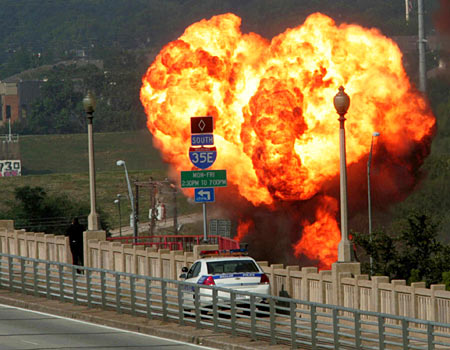
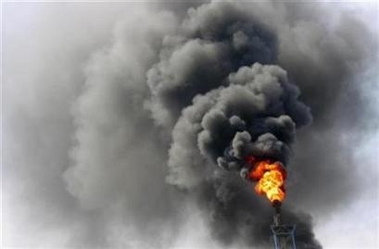


 We heard an explosion and the whole house shook