| Posted on Wed, Jan. 26, 2005
|
Commuter train derails in Glendale; killing nine and injuring
more than 100
DAISY NGUYEN
Associated Press
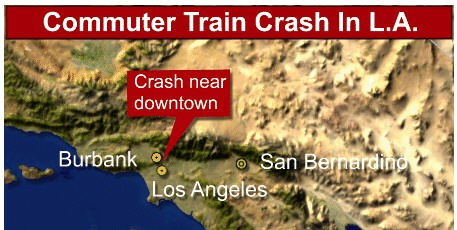
GLENDALE, Calif.
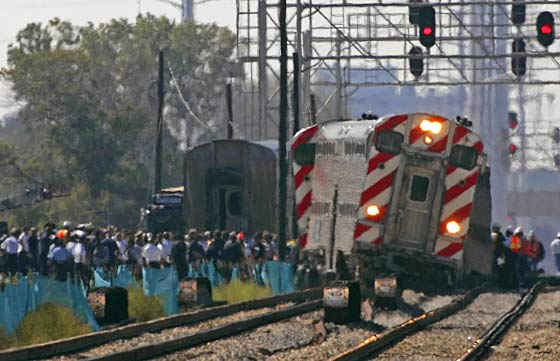
Nine people were killed and more than 100 injured when
a Metrolink commuter train crashed into an SUV parked at a crossing,
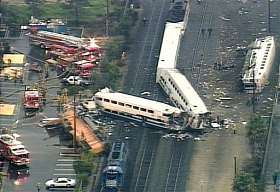
derailed and sideswiped another commuter train early Wednesday,
authorities said.
Los Angeles Sheriff Lee Baca said
authorities were speaking with the driver of Jeep Cherokee and
believe he intentionally parked it on the tracks and then left the
vehicle.
"It didn't appear that the vehicle
had stalled," Baca said. "It appears that it was
deliberately placed there."
NOTE: CNN calling it an attempted
suicide who changed his mind and jumped out of the vehicle.
(Yeah right!)
The exact circumstances of the crash were still under
investigation and the National Transportation Safety Board was
headed to the scene.
Firefighters picked through twisted wreckage scattered across the
tracks in the suburb north of downtown Los Angeles and carried
wounded passengers from the trains to a triage center set up in a
nearby parking lot.
"At this time we believe we have nine fatalities," Los
Angeles Fire Chief William Bamattre said. More than 100 were
transported to hospitals, he said.
One commuter train was headed from Los Angeles' Union Station to
downtown Burbank, and the other was bound to Union Station from
Moorpark, Metrolink officials said. Passengers were sent tumbling
down the aisles as the trains derailed.
"I heard a noise. It got louder and louder," said
passenger Diane Brady, 56, of Simi Valley. "And next thing I
knew the train tilted, everyone was screaming and I held onto a pole
for dear life. I held on for what seemed like a week and a half it
seemed. It was a complete nightmare."
After the train headed to Union Station struck the SUV, one of
the trains was propelled into a Union Pacific car parked on a side
track, said Kathryn Blackwell, a spokeswoman for Union Pacific in
Omaha, Neb.
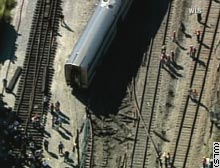
In a light rain, more than 300 firefighters climbed ladders into
windows of a battered train tipped onto its side. Los Angeles fire
spokesman Brian Humphrey said firefighters freed about six people
from the wreckage and no others were trapped.
Sheriff's Deputy James Tutino, on his way into work from his home
in Simi Valley, was killed in the crash, Baca said. He said Tutino
had been with the department for more 23 years.
Dazed passengers, some limping, gathered at tables in a nearby
store while the injured sprawled on mats before being whisked away
to hospitals by more than 35 ambulances.
"For me this is the worst train accident that I have ever
seen. I've never seen anything like it," Los Angeles fire Capt.
Rex Vilaubi told KNBC-TV.
One Metrolink car was sent twisting backward by the force of the
crash, which occurred after 6 a.m. near the intersection of San
Fernando Road and Chevy Chase Boulevard. A small fire that erupted
in the crash was quickly extinguished by firefighters, Humphrey
said.
Passenger Paul Konkirati, 28, of Burbank, said he was in a front
car that broke in two.
"I felt the train sliding so I braced myself and put my foot
on the chair next to me and held onto a bar. We hit and then
somebody's head landed on my thigh."
Konkirati, his jeans covered in blood, said he tried to comfort
the woman, "then it got really smoky, so smoky that I had to
leave. I don't know what happened to her."
Workers at a Costco store near the accident ran out to help after
the accident, which occurred in an industrial area with no homes
nearby. There were no evacuations.
George Touma, 19, of Burbank, said he was called by his mother,
who was on one of the commuter trains.
"She told me she was bleeding in the head and her arm was
really hurting," said Touma, who was near the scene of the
accident searching for her. "I'm really worried because she has
vertigo and when I tried to call back she wouldn't answer.
"She said she remembered hearing sequential loud noises and
then somebody pulled her out of the train while it was burning. She
was in a panicked mode and now she's not picking up."
Union Pacific spokesman John Bromley said the track on which the
crash occurred is owned and operated by Metrolink.
Metrolink began service in 1992 and operates seven lines, part of
a multibillion-dollar transportation network aimed at reducing
pollution and congestion in Southern California.
~~~~~
UPDATE:
Thursday,
January 27, 2005
Man
who caused Glendale
train wreck could face
death penalty
The Los Angeles
District Attorney says
the suicidal man who
caused yesterday's chain
reaction train
derailment could face
the death penalty.
Eleven people were
killed when a commuter
train slammed into Juan
Alvarez's Jeep Cherokee
in Glendale.
There are now names
and faces to put to the
numbers. Eleven victims
have been pulled from
the train wreckage all
but one have been
identified. Firefighters
have searched with dogs
and under crushed rail
cars and are turning the
site over to
investigators.
"We
believe we have
recovered everyone that
could possibly have been
a victim on this
train," said Tom
Lorenz with the Glendale
Police Department.
Murder charges have
been filed against
25-year-old Juan Manuel
Alvarez. He faces eleven
counts with special
circumstances, making
him eligible for the
death penalty.
"The mere fact
that you create a train
wreck and people died
can support murder
charges under California
law," said Los
Angeles District
Attorney Steve Cooley.
State of mind will be
an issue. Alvarez lived
in a converted garage
with his wife until she
threw him out several
months ago. Relatives
say he was despondent
and had a history of
drug abuse.
“He was in drug
rehab but to my
knowledge never finished
it,” said Alvarez’
brother-in-law, Ruben
Ochoa.
Before parking his
SUV on the tracks,
Alvarez had stabbed
himself and tried to
slash his wrists but as
he saw the train
approaching, he ran from
the car, watching as the
commuter train hit it
and slammed into a
freight train before
clipping another
commuter train.
There have been more
than 40 fatal crashes
involving Metrolink
trains, but this is the
worst in its 12 year
history. Officials now
will try to assess
whether there was anyway
to prevent it.
Juan Alvarez, will be
arraigned tomorrow. He's
being held without bail
in a hospital ward.
All
content © Copyright
2002 - 2005 WorldNow and
KESQ. All Rights
Reserved
UPDATE
- 2-18-05
Man deliberately
caused L.A. train wreck:
police
CTV.ca News Staff
California police say
they no longer believe a
man who caused a fatal
train wreck near Los
Angeles was attempting to
kill himself.
Juan Manuel Alvarez,
charged with the deaths
of 11 people on a
commuter train last month
by allegedly parking a
truck in its path, wanted
to create a
"horrific
tragedy," according
to police.
The crash also injured
at least 180 people.
Authorities initially
said Alvarez, 25, was
planning to commit
suicide; and it was
believed he lost his
nerve and fled the truck
before the Metrolink
train hit it and
derailed.
"The investigation
has revealed that his
actions are not
consistent with that of
an individual who is
attempting to follow
through with that
act," said Police
Chief Randy Adams.
"Although Mr.
Alvarez may have
contemplated suicide, his
actions were deliberate
with the intent of
causing a horrific
tragedy."
Adams stated that
Alvarez had poured
gasoline on both the
outside and inside of his
SUV.
Police spokesman Sgt.
Tom Lorenz added another
strange detail, saying
Alvarez wanted to gain
the attention of his
wife, Carmelita.
The couple had
separated and Alvarez's
wife had obtained a
restraining order against
him.
Alvarez's lawyer calls
the police statements
vicious, callous and
"a reckless
distortion of the
facts."
"If they want to
make this case about, as
they say, Juan Alvarez's
intent to cause a
horrific tragedy, I hope
they can back it
up," said Defense
attorney Eric Chase.
"Apparently the
Glendale police have not
seen enough blood and are
hungry for more."
Alvarez pleaded not
guilty Tuesday to 11
counts of murder and a
charge of arson causing
great bodily injury in
the crash and subsequent
fire.
Prosecutors have not
decided whether to seek
the death penalty,
reports the Associated
Press.
Alvarez was jailed
without bail pending a
March 16 preliminary
hearing, which will
determine whether there
is sufficient evidence to
try him.
Relatives and friends
of the 11 victims
gathered at the crash
site earlier this week
for the first time since
the disaster. They prayed
and left flowers on the
tracks. Fire officials
and grief counsellors
were on hand to provide
support.
Some of the family
members say they're angry
that the train lacked
seat belts and other
safety mechanisms that
could have prevented the
deaths.
With files from
the Associated Press
|
Eight killed, 240 treated in South Carolina train
wreck that released chlorine gas
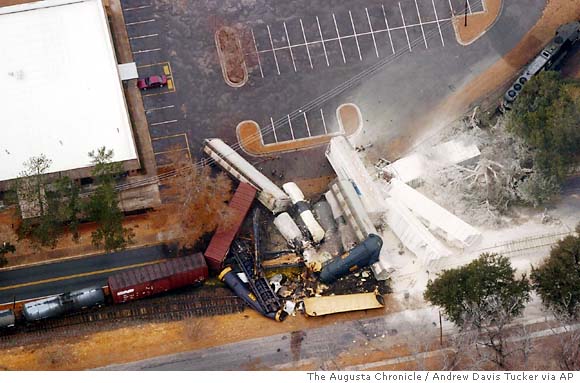
PAMELA HAMILTON, Associated Press Writer
Friday, January
(01-07) 07:22 PST GRANITEVILLE, S.C. (AP) --
Margie West didn't want to leave her cats or comfy home, so she
thought about waiting out the toxic chlorine cloud that was released
after a train wreck.
Eight people died from the fumes, and sheriff's deputies persuaded
West to spend the night elsewhere when they asked for her next-of-kin in
case she died. "If anything happened I didn't want to die in the
night," she said.
The air in Graniteville remained too dangerous for people to breathe
Friday morning, 24 hours after a Norfolk Southern train carrying the
chlorine crashed into a parked train near an Avondale Mills Inc. plant.
About 75 people found shelter at the University of South
Carolina-Aiken on Thursday night, and shelter operators said the
displaced residents were planning for a three-day stay.
More than 240 people sought treatment for respiratory and other
ailments, and authorities said late Thursday that about 45 were admitted
to hospitals.
Five victims, all men, were found at a mill near the wreck. Another
man died in a vehicle, and one died in his home. The engineer of the
moving train died at a hospital.
Autopsies were planned, but authorities said all appeared to have
died from inhaling the chlorine gas.
Mill worker Rodney Johnson told the Aiken Standard that he smelled a
strong chlorine odor around 2:35 a.m. "When I opened the door I saw
a green mist coming toward me. I stepped up to see what it was and ran
to my supervisor. He said to get them out."
Johnson said he piled several of his fellow workers in his truck and
rushed them to Aiken Regional Medical Centers.
"It tore me all up," Johnson said. "My eyes burned and
lungs hurt. I couldn't breathe at all. All I could think about was
breathing and getting to rescue."
The wreck is the second in two months in the small textile mill town
near the Georgia state line. In November, five people were killed when
their car was hit by a train at a rail crossing.
The toxic gas kept investigators from reaching the site and officials
don't know how the two trains ended up on the same track, National
Transportation Safety Board spokesman Keith Holloway said.
The leak had slowed considerably Thursday night as Norfolk Southern
workers prepared to remove rail cars from the track, said state
Department of Health and Environmental Control spokesman Thom Berry.
Berry said Friday that officials would begin deciding how best to
unload the chlorine.
There were at least three hazardous chemicals on the train, but
officials were most concerned about the chlorine gas, which affects
respiratory and central nervous systems.
Most of the 5,400 residents living within a mile of the site were
evacuated about 12 hours after the early morning wreck. Until then,
residents had been told by authorities to stay inside homes and turn off
their ventilation systems.
By the time the evacuation order was issued, some had already
experienced the skin- and eye-burning sensations associated with
chlorine contact.
Cindy Britt, 39, said her throat had begun feeling clogged early in
the day, and it took little persuading from deputies to get her out of
her home. She sat Thursday in donated clothes on a blue cot in a
makeshift shelter at the University of South Carolina-Aiken. She had
turned the clothes and shoes she was wearing in to authorities.
"She forced me out," said Cindy's husband Randy Britt.
"I was just going to shut the car in the garage and watch TV."
|
|
Two Trains Collide in Thick Fog in Northern Italy, Killing 14 and Injuring Dozens
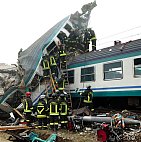
BOLOGNINA DI CREVALCORE, Italy Jan 7, 2005 — A
passenger train and a freight train collided in thick fog Friday in
northern Italy, killing 14 people and injuring dozens, rescue officials
said.
The crash, on a line between Bologna and Verona, left several train
cars in a wreck of buckled metal. At least one carriage was lifted high
into the air by the force of the collision.
The crash happened at 12:50 p.m. in a rural area of Bolognina di
Crevalcore, 25 miles north of Bologna.
Workers pulled bodies from the wreckage and laid them in body bags in a
misty field. Eight bodies had been recovered, according to police in the
nearby town of San Giovanni in Persiceto, who were overseeing the efforts.
Officials in Rome said 14 people were killed and 80 injured, several
seriously.
The Civil Defense department said around 100 people were on board the
passenger train, which was a local train traveling south from Verona to
Bologna. The freighter was headed north from Rome to San Zeno Falzano.
The cause of the crash was not known, but officials said there was
thick fog at the time of the collision. The Transport Ministry said it was
opening an investigation.
A helicopter was sent from Rome, the ANSA news agency reported, while
several ambulances rushed to the scene.
Several seriously injured people were taken to a hospital in Bologna,
and about 50 people were being treated on-site for minor injuries, the
report said.
Italy has few deadly train crashes, but a train from Palermo to Messina
derailed in northeastern Sicily, killing at least eight people in July
2002.
Copyright 2005 The Associated Press. All rights reserved
|
Metro Trains Collide on Red Line
Updated: Wednesday, Nov. 3, 2004 - 3:00 PM
WASHINGTON (AP) - Two witnesses to Wednesday afternoon's train crash at
the Woodley Park Metro station are describing a harrowing scene. Nick
Harnice and his girlfriend, Deana Clingerman, both of Alexandria, were on
board the train that was hit at around 12:49 p.m.
Harnice says just as their train pulled into the station and stopped, the
conductor began screaming for people to get off the train, and the
passngers started running.
In a matter of seconds, Clingerman says a second train hit their train
head-on and went on top of the first train, sending debris flying.
Both described a lot of smoke and debris in the station.
The train that was hit was bound for Shady Grove. The second train was
reportedly empty.
D.C. Fire Department spokesman Alan Etter says four people have been
injured in the collision.
Etter says the injured are three passengers and the operator of one of the
trains involved.
He says none of the injuries are life-threatening.
But he says damage to the trains is "significant." He describes
the scene in the underground station as one of cars accordioned together,
like "sardines in a can."
Etter says Metro Transit police are on the scene, talking to witnesses and
collecting information about what happened.
The crash has closed a portion of the Red Line.
Service is shut down between the Van Ness and Dupont Circle stations. On
its web site, Metro is advising customers to find alternate ways home for
Wednesday afternoon's commute.
Shuttle bus service will be provided between Dupont Circle and Van Ness.
www.wtop.com
|
| FROM: http://www.stevequayle.com/index1.html
COMMENT:
Mainstream news articles are reporting eyewitness accounts of dry runs
on aircraft by Middle Eastern groups (6-14 men) scouting out specific
flights to and from L.A. and New York. Also today, Amtrak was stopped
and searched for explosives based on specific intel that there will be
a major East Coast train bombing on the order of Madrid. As we get
closer to the anniversary date of 9-11, it appears that the jihad
forums are becoming more frequent in their postings to the "Big
Day". I would strongly urge everyone reading this to be extra
diligent and if you MUST travel from the East Coast to the West Coast,
introduce stopovers into your schedule. Terrorist training manuals
indicate the number of terrorists will be increased on the flights
with the idea of over powering air marshalls and U.S. citizens.
Extreme caution is advised.
Flood of Non-Speaking Middle Eastern
Males Crossing Border
July 23, 2004
From Chris Simcox
The Tombstone Tumbleweed
Border Patrol field agents have shared some disturbing information with
the Tumbleweed as well as other civilian sources with the hope the
information will make it to the general public.
The Tumbleweed has verified information that a flood of middle-eastern
males have been caught entering the country illegally east of Douglas,
Arizona. The increased patrols in the Huachuca Mountains area of Cochise
County, seems to have diverted the flow of OTM's, "other than
Mexicans" east to the Chiricahua Mountains. In the last month, the
Tumbleweed has confirmed at least two documented accounts of Border Patrol
agents encountering large groups of non-Spanish speaking males in the
Chiricahua foothills and on trails along the high mountain areas.
On or about the early morning hours of June 13, 2004 Border patrol agents
from the Wilcox station encountered a large group of suspected illegal
border crossers, estimated to be around 100, just east of the Sanders
Ranch near the foothills of the Chiricauha Mountains. 71 suspected illegal
aliens were apprehended; among them were 53 males of middle-eastern
decent.
According to a Border Patrol field agent, the men were suspected to be
Iranian or possibly Syrian nationals. "One thing's for sure, these
guys didn't speak Spanish and after we questioned them harder we
discovered they spoke poor English with a middle-eastern accent, then we
caught them speaking to each other in Arabic…this is ridiculous that we
don't take this more seriously, and we're told not to say a thing to the
media, but I have to," said the agent, whose name will obviously
remain anonymous.
The agent stated the men were wearing the traditional uniform of migrants
- baseball caps, tennis shoes, some had work boots, denim jeans and many
had t-shirts with patriotic American flags and slogans. The agent added
the following description "A curious thing I noticed was that they
all had brand new clothing and they looked as if they had just been to the
barber shop, you know, new haircuts. They were clean cut and they all had
almost the exact cut of mustaches."
The information was corroborated by a local rancher in the area who
reports that sightings of groups similar to these are on the rise. The
rancher also reports that groups of heavily armed paramilitary drug
smugglers have also been seen in the same area.
"We've had groups in the hundreds coming through again. They were
gone for awhile but now they're back. And of course we have the drug mules
again and many are carrying automatic weapons. Many other ranchers in the
area have been frustrated with the lack of response from Border Patrol.
After calling over and over again, to the Wilcox headquarters, we might
get a response a few hours later. We call them in to the Border Patrol, we
only have the Wilcox station, and they're so darned far away. By the time
they send in the helicopters these groups are long gone. I don't know how
many they catch but they're coming through here heavy right now."
On or about the evening of June 21, 2004, agents from the Wilcox Border
Patrol station apprehended 24 members of a larger group of Arabic speaking
males located just east of the Pierce/Sunsites area of Cochise County. At
least half of the males escaped capture and disappeared into the United
States.
http://www.tombstonetumbleweed.com/tombstone/default.asp#iframe1
|
Amtrak Train Stopped For Arabic-Looking Graffiti
Officials Question Passengers, Search Station
POSTED:
6:13 pm EDT July 3, 2004
WASHINGTON -- An Amtrak train on its way from
Miami to New York was stopped at Union Station on Saturday after
Arabic-looking graffiti was spotted on its side, News4 reported.
News4 was told the graffiti possibly said "die," "July
Fourth" and "D.C."
Transportation Security Administration officials questioned everybody on
the train and used K-9 dogs to search the station.
No one was detained or arrested.
The train arrived in New York City Saturday evening, about four hours
behind schedule.
Copyright 2004 by nbc4.com.
All rights reserved.
|
|
TUESDAY
13/07/2004
Lurgan train bomb attack
A train carrying members of the
loyal orders was petrol bombed by nationalist youths in Lurgan, Co
Armagh today.
By:Press Association
No-one was injured as around six petrol bombs and at least one
paint bomb were hurled at the train on the outskirts of the town,
near the nationalist Kilwilkee estate, shortly after 10am.
The attack followed a parade by members of the Royal Black
Preceptory in the William Street area of the town.
The members traditionally march to the town`s train station before
boarding the train to Bangor, Co Down.
A police spokeswoman confirmed that several windows in the train
were broken, adding that the area was now quiet.
This year, a Parades Commission ruling meant that the parade
dispersed 300 metres from the station and members had to walk
along the footpath to catch the train.
The parade itself passed off peacefully.
Suspect is held in train bomb threats
By Kevin Murphy
Correspondent for The Capital Times
July 10, 2004
Before making the 911 bomb threat calls, Michael Dean Conwill called
AT&T and asked that the name of his cell phone account be changed to
the name of his previous employer, he told FBI agents this week.
He said he did so to prevent anyone from tracing the bomb threats back
to him.
It didn't work.
Conwill, 35, of Anchorage, Alaska, made an initial appearance Friday in
federal court in Chicago, where he was ordered to be delivered to federal
authorities in Madison.
He had previously admitted to the FBI that he made telephone bomb
threats while a passenger on the Seattle-to-Chicago Amtrak train
authorities stopped in Portage this week, according to documents filed
Friday in federal court.
He is expected to be transferred in federal custody to Madison by
Tuesday or Wednesday, said Assistant U.S. Attorney Grant Johnson.
According to an affidavit by FBI Agent Peter Freitag in Madison:
|
Train
bomb threat exposes security gap
8:40
PM 7/07/04
Though no bomb was found on a cross-country Amtrak train
evacuated Tuesday in south-central Wisconsin, the incident exposes
a real threat: America's rail system is terribly vulnerable to
attack. <
About 300 passengers were evacuated at the Portage Amtrak
station following bomb threats called in to 911 centers in
neighboring counties. Authorities spent nearly six hours searching
the Chicago-bound train, turning up only fireworks and an
illegally concealed weapon. <
By all accounts, local and federal authorities worked well
together. Nevertheless, the incident reminds us that more than two
years after the Sept. 11 attacks, American mass transit -
railways, subways and buses - still desperately need a major
security upgrade.
The Bush administration, intelligence agencies and
Congressional leaders continue to devote most attention and
federal resources to airport security, underestimating the threat
to other transportation such as regional and cross-country
passenger trains.
Those priorities should change now. In contrast to already
tightly controlled airports, the open access essential to rail,
subway and bus travel make these forms of public transit much
easier to attack and harder to defend. The recent railway bombings
in Madrid, where 10 bombs planted on four commuter trains killed
191 people during the morning rush, show that terrorists are able
and willing to carry out public transit attacks coordinated to
maximize murder and mayhem. <
In fact, our preoccupation with air travel may
|
Spain probe of Madrid train bombings gets under way
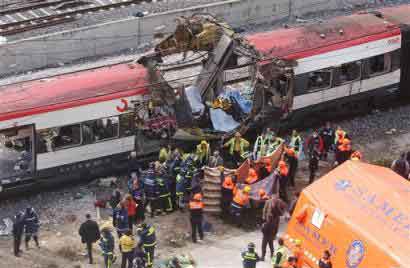
Parliament's investigation of the Madrid train bombings opened
yesterday with a witness account of three young men wearing wool caps on a
warm spring day, and with handkerchiefs covering their faces, at the
station that was the starting point of the attacks.
One walked quickly toward the train carrying a bag while the other
two stayed behind at a parked van.
"My blood ran cold. I thought it was a robbery," Luis
Garrudo, a doorman in the town of Alcala de Henares, said.
Garrudo told the commission what he told authorities on March 11: He
directed police to the suspicious van that was found to contain a cassette
tape with verses from the Quran, detonators and traces of explosives of
the kind used in the attack.
It was the first big break in the case.
In all, 10 backpacks stuffed with dynamite and shrapnel exploded on
four crowded trains heading to Madrid during the morning rush hour,
killing 190 passengers and bystanders, and wounding more than 2,000.
The attack is blamed on Islamic militants with possible ties to the
international terrorist group al-Qaeda.
Of the 50 people arrested, 16 remain in jail, including two believed
to have put the explosives on the trains.
Garrudo, his face electronically blanked for security reasons on the
live cable TV broadcast of the hearing, was the first of at least 35
people scheduled to testify before the 16-member commission of the
Congress of Deputies.
The commission will interview witnesses and officials, and examine
police documents and other material, to review what happened on March 11
and the following days.
On March 14, the Popular Party was upset in elections that brought
the Socialists to power.
The aim is to determine whether the threat of Islamic terrorism
might have been foreseen and counteracted; whether Spain is safer now that
greater security steps have been taken; and what impact Spain - and
Europe's - worst terror attack had on the election.
Thirteen people, most of them police officials, were due to appear
before the panel this week.
The investigation, similar to the September 11 commission in the
United States, is expected to last at least a month.
While declassifying some documents, the government of Prime Minister
Jose Luis Rodriguez Zapatero refused to declassify others, notably an
intelligence report from October 2003.
It reportedly cautioned that a threat from Osama bin Laden to target
Spain and other countries which deployed troops in Iraq during or after
last year's US-led invasion should be taken seriously.
The government won't declassify these documents because they contain
information from foreign intelligence agencies, the public disclosure of
which might provoke them to not cooperate with Spain's intelligence
agencies.
The Popular Party sent 1,300 peacekeeping troops to Iraq despite
massive opposition by Spanish voters. One of Zapatero's first policies was
to remove them.
Testimony from key politicians was left for the final stage of the
probe. It is not yet known if former Prime Minister Jose Maria Aznar will
testify. He has not been subpoenaed. His Popular Party says he will
testify willingly if requested.
The probe is politically charged. Socialists seem bent on
highlighting the previous government's initial insistence that Basque
separatists - not Islamic militants - were the main suspects, in a bid
influence the election.
AP
Madrid train bombers had more targets lined up-media
30 Jun 2004
|
MADRID, June 30 (Reuters) - The Madrid train bombers were planning
other attacks on targets including a British school and two Jewish
centres, Spanish media said on Wednesday, quoting a police report.
Investigators found documents detailing the targets in the
wreckage of a suburban apartment where seven prime suspects in the
train attacks blew themselves up on April 3 when police cornered
them, the reports said.
Police have handed the information to a parliamentary commission
investigating the bombings that killed 191 people and injured
1,900 on packed commuter trains on March 11, news agency Europa
Press said.
As well as a British infant school in a suburb of Madrid, targets
included a Jewish hostel and a recreation centre used by Jewish
families, the agency said.
A parliamentary spokeswoman said she had no information on the
police report.
Investigators say Islamic militants acting in the name of al Qaeda
carried out the train bombings. They say most of the key suspects
either died in the April 3 suicide blast or are under arrest. A
judge has formally accused 25 people, most of them Moroccan.
|
The Madrid Train Bombing Was a Primer
They are using the example of the Madrid train bombing as a kind of overlay to
reinforce the likelihood in people's mind that this is going to happen.
The individuals who carried
out that attack had closer links to the Spanish government than they did
to Al-Qaeda. The man who provided the explosives was in contact with the
Spanish security services days before the attack, as BBC
reported . And of course the Boston
Globe reported that the Al-Qaeda group blamed for the attack was
non-existent.
They've already been laying
the groundwork for the pre-attack propaganda. A plane which was carrying
the governor of Kentucky to the Reagan funeral which strayed into
restricted airspace forced the capitol building to be evacuated
. This story didn't get much attention but there were police running
around screaming at people to run because a plane was about to hit in two
minutes. So those members of Congress who aren't in on the loop have
already been prepared.
Even if the election isn't
cancelled, Homeland Security may raise the color code to a red alert and
it will a martial law drill which will make a lot of people in the big
cities stay in their homes and not vote, which again conditions them that
voting is some kind of privilege afforded to them by the government
FROM: http://www.infowars.com/print/ps/postpone_election.htm
4-29-04 - ALERT
I am currently listening to a radio interview by Steve Quayle. at: http://www.realityradionetwork.com/thursday.shtml
He is saying that short trains pulling box cars with handcuffs on
the walls inside have been going through Bozeman, Montana on a nightly
basis. They only move at night. They were heading west.
Another guy in Wyoming reporting the same thing.
He also said there is a railroad yard in Portland, Oregon is where these
cars are stored.
He also said it is expected that there will be a civil war in the US
between Christians and Islamists.
It'll be horrible if that happens.
Dee
xxx
Another area rife with rumor
concerns secret concentration camps or "detention centers" which
reportedly are being built -- or are already constructed -- throughout the
country for the incarceration of American patriots. Usually these are said
to be under the control of the Federal Emergency Management Agency (FEMA).
Now, a police state is one big concentration camp or "gulag";
but, as in the Soviet Union, there were (and still are) gulags within the
gulag. And if the police state toward which we are headed eventuates,
America will have many Treblinkas, Vorkutas, Auschwitzes, and Kolymas. So
it is entirely possible that the police statists who are leading us into
the totalitarian vortex have indeed established and/or are building
prisons, concentration camps, re-education camps, and detention
facilities.
Some reliable sources have
provided THE NEW AMERICAN with photographs of, and information on, what
are reportedly secret prison facilities. We are investigating these
through both official and unofficial channels. We take them seriously, as
we do many of the issues mentioned throughout this article, even though
the enormous number of fraudulent, fanciful, exaggerated, and speculative
stories makes it more and more difficult to do so.
FROM: THE
NEW AMERICAN
ITS MORE THAN JUST 'TRAINS'
In an American information newsletter "The
Spotlight" which is issued from a Washington address, there appeared
an article quoting from a copy of an army manual known as FM-41-10 which
outlines army contingency operations designed to round up American
civilians and detain them in concentration camps. This manual has a
distribution restriction to government agency only and contains
instructions to destroy it to prevent disclosure of contents. Reprinted in
"The Spotlight" is a plan of a concentration camp complete with
wire fence and tower lights, with barracks for families, unescorted
children, unattached males and unattached females. The manual is designed
to be used in conjunction with national emergencies when units of the army
will be used to support the Federal Emergency Management Agency orders.
This organization is commonly known as FEMA and was
in charge of the murderous assault on David Koresh and his followers.
Incidentally, during the recent scare about the crash of the Russian Mars
space vehicle was the first time that I had heard mention of our own
Emergency Management Agency. How much more don't we know and need to find
out?
But to continue the "Spotlight" article.
"Included in the manual are illustrations of
the FEMA chain of command and the boundaries of the regions which will
become the governmental subdivisions supplanting state authority."
Here again we have a parallel with Australia with the
recent amalgamation of local councils into larger onees. Our former
Premier, Wayne Goss was correct, I believe, in assuming that this was a
prelude to the phasing out of State Governments and the Federal Government
dealing directly with local councils who are much closer to the people.
But to continue. "The manual includes details
on the methods of rounding up civilians and placing them in detention
centres. The newspaper also outlines the officials in the Pentagon charged
with facilitating "Civil Affairs" operations. Handling the
operation is Assistant Secretary of Defence, Henry A. Holmes who heads
something called "Special Operations Command" with General Wayne
A. Downing under him.
In addition to civil affairs planning, Holmes and
Downing handle special operations for all services, as well as
"Psychological Operations" and "Special Aviation"
units. Included in the Special Aviation Units are uniquely equipped
fixed-wing and rotary aircraft, some of which are for low-flying ground
surveillance.
The use of unmarked black military helicopters
flying low over civilian areas recently has raised rumours and fears that
surveillance is now being conducted against the civilian population."
Now if you are sitting there thinking to yourself
that this is pure speculation and a load of rubbish, just remember that
the German people under Hitler saw what was happening and closed their
eyes, but it was all too real anyway.
I often wonder if the now accepted practice in
Australia of emptying our mental hospitals and institutions and forcing
mentally incompetent people to fend for themselves in the community is so
arranged that those facilities might be used to house our dissident
population. Three or four years ago, the local mental hospital in my home
town of Toowoomba was extended at the same time that patients were being
sent out into the community. Seems odd to me.
HERE IS A FURTHER QUOTE FROM METRO FORCE BY SERGE
MONAST
"That everything is in readiness for the total
control of the U.S. population can be further affirmed by the presence of
"Rainbow" Highway Code Markers now appearing on certain U.S.
highways, where it is believed that inactivated army bases are to be used
as concentration camps. In January 1995 it was reported by residents in
Montana, that the area had been quietly invaded by U.N. Troops. A local
blacksmith reported that he had just returned from the north western part
of the state, and said the area was crawling with Belgian troops and some
Austrian troops.
Also he counted no less than 114 barges loaded with
U.N. equipment coming in from Canada. Montana, North Dakota, Minnesota and
Wisconsin and a few states below them are to be policed by Belgian troops.
This man was told that at the town of Kalisfel in Montana, the government
had bought a ranch and fenced it, the fence going inwards at the top to
keep people in - not out!
A massive new crematorium has recently been
completed in Indianapolis, Indiana, at the now disused Amtrak railroad
terminal, and an investigator has reported that he has received
information from some of those who helped to build the facility that
guillotines have been installed for those who arrive alive instead of
dead. Others say new gas lines have been installed - and not for heating
purposes. Pictures of this facility bear this out.
Three other such crematoriums are known to exist.
They are Oklahoma City, Oklahoma; Kansas City. Missouri; and Bay City,
Michigan. The Blue Highway Markers on the back of the highway signs lead
to them. The Indianapolis Crematorium is a blue arrival point. As blue is
the colour indicating in hospitals that the subject has died, we believe
that this is a destination for those who are already dead, that is those
shot by the police and military forces of the New World Order.
On the same grounds is a Red Zone arrival point. As
red signifies death, we believe that this is a destination point for those
yet living who are destined for either the gas chambers or the guillotine.
An aerial picture was taken of the gas chambers being constructed at the
same Amtrak facility. Newly installed gas pipes lead to every chamber.
There are revolving steel gates by which admissions are made of the
living, who arrive in the Red Zone. The symbols of the New World Order
appear above the entrance gates; this is the all-seeing-eye of Satan atop
the Pyramid as appears on the back of the U.S. 1 dollar bill.
Parked at the facility is a locomotive decked out in
blue which patrols the old Amtrak railway station. It has U.S. Air Force
on its side. Blue Highway Code Markers are as I said before,
representative of death. Green represents life, and it is speculated that
these signs lead to detention facilities where people will be sorted out
for commitment to concentration camps, to work camps, either death or
release. Perhaps these will be sites for micro-chipping all those brought
to the facility.
The micro-chip is a means of keeping track of and
controlling you wherever you may be. Orange Highway Markers lead to
confiscation targets such as factories, smaller airports, gravel pits and
private lands. (Maybe the gravel pits are to be mass graves, as gravel
pits also have the blue markers.)
Red markers are death and lead to crematoriums.
Brown markers lead to materials to be seized and used; brown markers have
been noted to lead to building materials companies, seed companies, pig
farms and butchering facilities. Yellow markers are areas to be secured or
confiscated. White markers are areas used for holding seized material like
firearms; these white markers lead to military bases, National Guard
Armories, and certain warehouses.
These highway markers are ominous and can be found
in the U.S., Canada, Russia and other countries. They are obviously U.N.
ordained. U.N. troops who are stationed in a foreign country and who do
not speak the language of the country they are in can be guided to
destinations by these markers.
On 13th January 1994, traffic at a railroad crossing
in Tulsa,
Oklahoma, was held up by an extremely long train of
over 100 cars that were south west bound from that location. The next
major city on that route was Oklahoma City. The train however, could
continue on to Arizona and California.
The train was described as consisting of brand new
totally black boxcars, all probably empty due to the fact that a single
engine pulled the number of cars involved. There were no markings on the
cars other than a bar code and a serial number. When interviewed, a
railway security officer said he knew of such train cars being stored
"up north" in either Minnesota or Michigan or Wisconsin.
He was told they were boxcars that preceded the
"white" trains. He was then asked `What do you guys do with
those boxcars that have shackles and handcuffs bolted to the inside
walls?' Without hesitation he stated "Oh those must be the
"white" trains. We supposedly use those to precede any
transportation of nuclear weapons or material. When we move a nuc. train
we don't stop for anyone. If there are any demonstrators on the tracks, a
security force in the lead train rounds them up and sticks them in the
boxcars until they can be dealt with later.
The more reasonable explanation, I think, is that
these cars, especially in this quantity, are not being built and
maintained for simply preceding nuclear shipments". These boxcars are
obviously being readied for future civilian detainee transportation. You
may be asking yourself, why aren't we seeing this here? My theory is this.
We have a vastly smaller population, and America has a much greater
proportion of Christians who are likely to resist, whereas Australia has
few strong, born-again Christians in comparison, in fact, several years
ago, the U.N. itself designated Australia as a pagan country. I pondered
whether to include the seven rainbow classification of the New World Order
prisoners, due to their horrific nature, but have decided to do so, as I
believe we need to know.
MORE: http://www.despatch.cth.com.au/Transcripts/d_dart.htm
|
http://www.freep.com/news/latestnews/pm19475_20040422.htm
Reports: Explosion kills thousands in North Korean train station
Thursday, April 22, 2004
BY SANG-HUN CHOE
ASSOCIATED PRESS
SEOUL, South Korea - Two fuel trains collided and exploded in a
North Korean train station near the Chinese border Thursday, according to
South Korean media, which reported large numbers of casualties. One
television station said 3,000 people were believed killed or injured.
The North Korean leader, Kim Jong Il, reportedly had passed through
the station as he returned from China nine hours earlier. It was not clear
what caused the crash, or if it was related to Kim's journey. The trains
were carrying oil and liquefied petroleum gas, media reported.
The crash reportedly took place about 1 p.m. in Ryongchon, a town 12
miles from China. North Korean authorities declared a ``state of
emergency'' in the area, South Korea's Yonhap news agency reported.
In another sign of the accident's magnitude, the secretive North
Korean government cut international phone lines to prevent news of the
collision from leaking across its borders, Yonhap said, citing no sources.
The number killed or injured could reach 3,000, South Korea's
all-news cable channel, YTN, reported, citing unidentified sources on the
Chinese side of the border.
``The area around Ryongchon station has turned into ruins as if it
were bombarded,'' Yonhap quoted witnesses as saying. ``Debris from the
explosion soared high into the sky and drifted to Sinuju,'' a North Korean
town on the border with China, it said.
Cho Sung-dae, a Yonhap correspondent in Beijing, said his reports
were based on Chinese sources in the Chinese border town of Dandong who
had talked with their relatives in Ryongchon.
They described a massive explosion involving a large number of
casualties but could not give figures, Cho told The Associated Press in a
telephone interview. Cho also said North Korean authorities appeared to be
shutting down the border with China after the incident.
Subsequent attempts by his Chinese sources to contact people in
Ryongchon failed because the phone lines had been severed.
North Korea is one of the world's most isolated countries and rarely
allows visits by outside journalists. News events within its borders are
difficult to confirm independently.
North Korea's state-controlled media is unlikely to provide quick
confirmation of such an accident. The communist country's infrastructure
is dilapidated and accident-prone. Its passenger trains are usually
jam-packed with people, but defectors say they are seldom punctual and
frequently break down.
Sometimes, trains are stranded for hours at stations until their
electricity supply is restored enabling them to continue on their journey,
some defectors say.
YTN, citing an unidentified South Korean government official, said
the government in Seoul confirmed a huge explosion in the Ryongchon train
station. The official told YTN he believed the incident was an accident,
not politically motivated.
Yang Jong-hwa, a spokeswoman of South Korea's Unification Ministry,
said her organization could not immediately confirm the reports. The
ministry is in charge of relations with North Korea.
The Defense Ministry could not comment, and the Foreign Ministry
could immediately be reached.
YTN reported that the casualties included Chinese living in the
North Korean border region, and that Chinese in Dandong - a bustling
industrial city on Yalu River - were desperate to learn about their
relatives.
Some of the injured were evacuated to hospitals in Dandong, it said.
Chinese and North Korean traders frequently cross the border at
Dandong.
The accident resembled a disaster in Iran on Feb. 18, when runaway
train cars carrying fuel and industrial chemicals derailed in the town
Neyshabur, setting off explosions that destroyed five villages. At least
200 people were killed.
North Korea's state-run news agency on Thursday confirmed that Kim
made a secretive trip to China on Monday through Wednesday, but carried no
comments on the reported explosion.
China, which also confirmed Kim's visit, is North Korea's last major
ally, and the two countries' ruling communist parties boast of close ties.
But while China's experiments with capitalism have transformed it into an
economic dynamo, North Korea suffers chronic food shortages and depends on
its larger neighbor for aid.
Kim met with President Hu Jintao and other Chinese leaders and
agreed to ``push ahead'' with a peaceful resolution to the standoff over
its nuclear weapons programs, the North's official KCNA news agency and
central television network reported earlier Thursday.
The broadcast added that Kim said his government ``will continue to
be patient and flexible and actively participate in the process of
six-nation talks and contribute to making progress at the talks.''
The comments were likely to be encouraging to the United States and
other countries, who want China to use its leverage as North Korea's
leading supplier of food and energy aid to get the country to disarm.
Washington wants Pyongyang to dismantle its nuclear facilities, but
North Korea has said it doesn't trust the United States not to invade and
wants a security guarantee.
The last round of six-nation talks - involving China, the two
Koreas, the United States, Japan and Russia - ended in February in Beijing
without a settlement.
|
| MADRID, Spain (March 11) -- Ten terrorist bombs blasted three Madrid
train stations at the height of the morning rush hour Thursday, killing
more than 170 people and wounding at least 600 before this weekend's
general elections. Officials blamed Basque separatists for the worst
terror attack in Spanish history.
Blasts Strike Madrid; 173 Dead
Basque Separatist Group ETA Suspected, but Party Leader Denies
Responsibility
by MAR ROMAN, AP
MADRID, Spain - Ten terrorist bombs blasted three Madrid train
stations at the height of the morning rush hour Thursday, killing more
than 170 people and wounding at least 600 before this weekend's general
elections. Officials blamed Basque separatists for the worst terror attack
in Spanish history.
Rush Hour Shattered
''This is a massacre,'' government spokesman Eduardo Zaplana said.
A total of 10 bombs exploded, killing 173 people and injured more
than 600, Interior Minister Angel Acebes said. Police found and detonated
three others.
Before the Thursday bombings, the Basque separatist group ETA had
been blamed for more than 800 deaths in its decades-old campaign to carve
an independent Basque homeland from territory straddling northern Spain
and southwest France.
Largest Terror-Related Death Toll
Blast Blamed on Separatists
Aftermath of the Bombing
''ETA had been looking for a massacre in Spain,'' Acebes said after
an emergency cabinet meeting, citing recent thwarted attacks.
''Unfortunately, today it achieved its goal.''
He said security services knew ETA was responsible because the group
tried a similar attack on Christmas Eve, placing bombs on two trains bound
for a station that was not hit Thursday. He also noted the Feb. 29 police
interception of a Madrid-bound van packed with more than 1,100 pounds of
explosives. Authorities blamed ETA.
''Therefore, it is absolutely clear and evident that the terrorist
organization ETA was looking to commit a major attack,'' Acebes said.
''The only thing that varies is the train station that was targeted.''
A top Basque politician, Arnold Otegi, denied the separatists were
behind the blasts and blamed ''Arab resistance.'' Many al-Qaida-linked
terrorists were captured in Spain or were believed to have operated from
there.
Thursday's bombs exploded about 7:30 a.m. on trains or at platforms
on the commuter line running to the Atocha station, a bustling
transportation hub in the capital. At least two of the bombs went off in
trains that were in the Atocha station.
Otegi told Radio Popular in San Sebastian that ETA always phones in
warnings before it attacks. Acebes said there was no warning before
Thursday's attack.
''The modus operandi, the high number of victims and the way it was
carried out make me think, and I have a hypothesis in mind, that yes it
may have been an operative cell from the Arab resistance,'' Otegi said,
noting that Spain's government backed the Iraq war.
Until now, the highest death toll in ETA-linked attacks was 21
killed in a supermarket blast in Barcelona in 1987.
People streamed away from the Atocha station in tears Thursday as
rescue workers carried bodies covered in sheets of gold fabric. The
wounded, faces bloodied, sat on curbs and used mobile phones to tell loved
ones they were alive. Hospitals appealed for blood donations. Buses were
pressed into service as ambulances.
Rescue workers were overwhelmed, said Enrique Sanchez, an ambulance
driver who went to Santa Eugenia station, about six miles southeast of
Atocha station.
''There was one carriage totally blown apart. People were scattered
all over the platforms. I saw legs and arms. I won't forget this ever.
I've seen horror,'' Sanchez said.
Shards of twisted metal were scattered by rails in the Atocha
station at the spot where an explosion severed a train in two.
''I saw many things explode in the air ... it was horrible,'' said
Juani Fernandez, 50, a civil servant who was on the platform waiting to go
to work.
''People started to scream and run, some bumping into each other and
as we ran there was another explosion. I saw people with blood pouring
from them, people on the ground,'' Fernandez said.
''Those responsible for this tragedy will be arrested and they will
pay very dearly for it,'' Acebes said at Atocha station.
The attacks traumatized Spain on the eve of Sunday's general
election.
The campaign was largely dominated by separatist tensions in regions
like the Basque country, with both the ruling conservative Popular Party
and the opposition Socialists ruling out talks with ETA.
The government convened anti-ETA rallies nationwide for Friday
evening and announced three days of mourning.
''What a horror,'' said the Basque regional president, Juan Jose
Ibarretxe, who insisted ETA does not represent the Basque people. ''When
ETA attacks, the Basque heart breaks into a thousand pieces,'' he said in
the Basque capital Vitoria.
''This is one of those days that you don't want to live through,''
said opposition Socialist party spokesman Jesus Caldera. ''ETA must be
defeated,'' referring to the group as ''those terrorists, those animals.''
"I won't forget this ever. I've seen horror."
-Ambulance driver Enrique Sanchez
In London, British Foreign Secretary Jack Straw called the attacks
terrorist atrocities and a ''disgusting assault on the very principle of
European democracy.''
Straw said that Britain stood ''shoulder to shoulder'' with Spain
and was ready to send any kind of material help needed.
Elsewhere, European Parliament President Pat Cox said the bomb
attacks amounted to ''a declaration of war on democracy.''
''No more bombs, no more dead,'' Cox said in Spanish before a hushed
legislature in Strasbourg, France. ''It is an outrageous, unjustified and
unjustifiable attack on the Spanish people and Spanish democracy.''
Spanish officials had said ETA was against the ropes following the
arrest last year of more than 150 members or collaborators in Spain and
France, including the leaders of ETA's commando network. Last year, ETA
killed three people, compared with 23 in 2000 and 15 in 2001.
03-11-04 09:32 EST
Copyright 2004 The Associated Press.
~~~~~~~~~~~~~~~
Spain Announces Five Arrests in Bombings
MADRID, Spain - Spain's interior minister
Saturday announced the arrest of five suspects in the Madrid bombings,
including three Moroccans.
The other two suspects had Indian passports, a ministry spokesman said.
The five were arrested in connection with a cell phone inside an
explosives-packed gym bag found on one of the bombed commuter trains.
The suspects "could be related to Moroccan extremist groups,"
the minister said. "But we should not rule out anything. Police are
still investigating all avenues. This opens an important avenue."
The 10 bombings on Thursday, which killed 200 people on Madrid commuter
trains, amounted to the worst terror attack in Spanish history.
Families began burying their dead Saturday as a cold drizzle fell on
Madrid on the eve of parliamentary elections.
In a show of national unity, massive crowds gathered in Barcelona,
Seville, Valencia and even in Spain's Canary Islands off western Africa on
Friday night to protest the attack. State TV said nationwide, more than 11
million marched — one-quarter of Spain's 42 million people.
In Madrid, black bows of mourning dotted the city, on shop windows, on
flags draped from balconies, and on lapels.
Madrid's biggest funeral home, Tanatorio Sur, was so overcrowded that
some coffins were placed in a room normally used for staff meetings.
Outside, hearses carried coffins in and out all morning.
Investigators were focusing on a stolen white van found in the town of
Alcala de Henares outside Madrid hours after the blasts. Police found
detonators and an Arabic-language cassette tape with Quranic verses
inside. Alcala de Henares is the town where three of the four bombed
trains originated.
A doorman told police he saw three young men carrying knapsacks toward
the station in Alcala de Henares, a senior police official said Saturday
on condition of anonymity. Officials have said the bombs used in the train
attacks were concealed in knapsacks.
The doorman saw the men get out of the van and "walk toward the
train carrying backpacks and he was struck by the fact that they were
wearing ski masks when the weather was not suited for that kind of
clothing," the official said.
"It is one of the main focuses of the investigation," the
official said. "It is very important."
A London-based Arabic newspaper also received a claim of responsibility
in al-Qaida's name that called the attack "part of settling old
accounts with Spain, the crusader, and America's ally in its war against
Islam."
The attack's lethal coordination and timing — 10 explosions within 15
minutes — suggested al-Qaida. But the compressed dynamite used in the
backpack bombs is an explosive favored by the Basque separatist group ETA.
ETA issued an apparently unprecedented denial Friday, saying it had
nothing to do with the bombings. It has claimed responsibility for more
than 800 deaths since 1968 in its fight for an independent state in the
northern Basque region.
Debate on who is behind the attacks could sway voters in Sunday's
election.
If ETA is deemed responsible, that could boost support for Mariano
Rajoy, Prime Minister Jose Maria Aznar's hand-picked candidate to succeed
him as prime minister. Both have supported a crackdown on ETA, ruling out
talks and backing a ban on ETA's political wing, Batasuna.
However, if Thursday's bombings are seen by voters as the work of
al-Qaida, that could draw their attention to Aznar's vastly unpopular
decision to endorse the U.S.-led invasion of Iraq and deploy Spanish
troops there.
Opinion polls have put Rajoy 3-5 percentage points ahead of
Socialist candidate Jose Luis Rodriguez Zapatero. No surveys have been
released since the attacks.
Aznar, in power since 1996, is honoring a pledge not to seek a third
term, saying he wants renewal in government and his party.
Spanish radio station Cadena Ser broadcast a 12-second recording of
an unidentified woman who had called a colleague's voice mail after an
initial blast on a train at the Atocha station.
The woman, who survived, was in the process of fleeing as she
frantically says: "I'm in Atocha. There's a bomb on the train! We had
to _" and then two more blasts are heard.
|
309 Confirmed Dead in Iran Train Blast
Wyoming News - WY,USA
... Hashemabad resident Zahra Rezaie, 41, said the she thought the blast
was an earthquake. "It knocked down and broke some dishes. ...
<http://www.casperstartribune.net/articles/2004/02/19/ap/Headlines/d80q9n700.txt>
Train explosion kills more than 200
By ALI AKBAR DAREINI
Associated Press writer Thursday, February 19, 2004
NEYSHABUR, Iran -- Runaway train cars
carrying a lethal mix of fuel and chemicals derailed, caught fire and then
exploded hours later Wednesday in northeast Iran, killing more than 200
people, injuring at least 400 and leaving dozens trapped beneath crumbled
mud homes.
Most of those reported dead were firefighters and rescue workers who had
extinguished the blaze outside Neyshabur, an ancient city of 170,000
people in a farming region 400 miles east of the capital, Tehran.
The dead also included top city officials -- including Neyshabur's
governor, mayor and fire chief as well as the head of the energy
department and the director-general of the provincial railways -- who had
all gone to the site of the derailment, the official Islamic Republic News
Agency reported.
The explosion devastated five villages, where authorities rushed in blood
supplies and appealed through loudspeakers for donors. Hardest hit was
Hashemabad, where 41-year-old Zahra Rezaie, whose mud home was near the
tracks, was cooking lunch for her family when she heard the explosion and
felt the ground shake. Then the ceiling collapsed.
"It knocked down and broke some
dishes. I was sure it was an earthquake, and my first thought was to rush
to the school and save my children," Rezaie told The Associated
Press. Her children were safe.
An AP photographer who arrived in Dehnow, one of the severely damaged
villages close to the train tracks some 500 yards from the blast, said the
village's homes were flattened.
"The houses are all built of clay, and nearly every one has been
destroyed, like they had collapsed in an earthquake," Hassan
Sarbakhshian said. "Everyone appears to have been evacuated," he
said, adding he could see thick, black smoke billowing about 500 yards
ahead.
Rescue workers, aided by cranes and giant floodlights, worked into the
night shrouded in toxic fumes, as they searched for dozens of people
thought to be trapped in their clay homes devastated by the blast.
The blast was so powerful that windows were shattered as far as six miles
away. In an apparent indication of the explosion's force, Iranian
seismologists recorded a 3.6-magnitude tremor in the area, IRNA reported.
Many of the buildings that collapsed in a Dec. 26 earthquake in Bam, in
southeast Iran, also were mud-brick structures. That tragedy killed more
than 41,000 people.
Authorities were investigating what caused the 51 cars to roll out of the
Abu Muslim train station, outside Neyshabur, at 4 a.m. Forty-eight of the
cars derailed on reaching the next stop at Khayyam, about 12 miles away,
and caught fire.
Iranian TV showed footage of black plumes of smoke and orange flames
billowing into the sky from the cars, 17 of which were loaded with sulfur,
six with gasoline, seven with fertilizer and 10 with cotton. Dozens of
people, some wearing face masks to protect themselves from the smoke, were
seen walking around or putting out flames on the scene.
Firefighters -- apparently with little experience in handing industrial
chemicals -- had extinguished 90 percent of the fire when the cars
exploded at 9:37 a.m., Mohammad Maqdouri, head of the local emergency
operations headquarters, told Tehran television.
More than 400 people were injured, said Vahid Bakechi, a senior official
in Khorasan Province's Emergency Headquarters.
Eighty percent of them were injured when their homes collapsed, and the
rest were either burned or hurt from the force of the explosion, said Syed
Majid Taqizadeh, head of the 22 Bahman hospital. The hospital is named
after the date in the Iranian calendar that coincides with Iran's 1979
Islamic Revolution.
The bulk of the injured were from the village of Hashemabad, Taqizadeh
said. Other victims were found in surrounding villages, particularly
Dehnow and Abdolabad.
Dozens of people remained buried under the rubble of their homes, said
Saeed Kaviani, editor of the Sobh-e-Neyshabur newspaper. Iranian
paramilitary Revolutionary Guards closed the immediate area, fearing more
explosions.
After finding her children safe at the Hashemabad school, which was
unscathed by the explosion, Rezaie went to a hospital.
"That's when I saw them bringing in many injured people ... wearing
uniforms that firefighters or rescue workers wear," she said.
"They told me there had been an explosion," she said.
|
| Thirty Killed as Train Hits German Coach in Hungary
Thu May 8, 2003
By Krisztina Than
SIOFOK, Hungary (Reuters) - At least 30 people died on Thursday when a
passenger train plowed into a German tourist coach in central Hungary, slicing
it in half and dragging it down the track, police said.
Police spokesman Laszlo Gelencser said the coach was hit by the Budapest
to Nagykanizsa train just after 8:30 a.m. (2:35 a.m. EDT) as it crossed a
railway line near Siofok on the shores of Lake Balaton, Hungary's leading
tourist area.
Gyorgy Heizler, head of the local disaster unit, said the coach had been
carrying 38 passengers. Twenty-eight people were killed in the crash, two
died later in hospital, and nine were injured, he said. The driver was among
the dead.
'The train, which was going full speed, practically slit the bus in two
and flattened one half, pushing it around 200 meters (yards) down the track,'
Heizler said.
Gelencser said the coach had tried to cross the railway line even though
hazard lights had warned of an oncoming train.
'The scene is just horrible,' he said.
The bodies of some of the dead, pulled out from under the train, were
laid out beside the tracks while emergency services brought in wooden
coffins.
Torn bus seats, wiring and debris littered the tracks.
Thirty ambulances and four emergency service helicopters ferried the injured
to nearby hospitals.
Germany's Foreign Ministry said the passengers were believed to have come
from the north German states of Lower Saxony and Schleswig-Holstein, but
had no further details.
The German coach travel association said the passengers had booked their
trip with travel operator Maxim Reisen in Cloppenburg, northern Germany.
That firm had then chartered a coach from Ursel Reisen in Loehne near
Bielefeld.
Ursel Reisen confirmed it had been operating the coach, but declined to
give details of the passengers other than to say they were of mixed ages.
TOURIST REGION
Emergency service officials told Reuters at the scene they thought the
Germans were staying at a hotel in Siofok, around 65 miles southwest of the
capital and a popular destination for tourists from Hungary's ex-communist
neighbors.
Hungarian Prime Minister Peter Medgyessy, due to visit the scene later
on Thursday, expressed his shock.
'This is maybe the most horrific bus accident in Hungary's history,' he
said, adding he had contacted German Chancellor Gerhard Schroeder about the
crash.
Last July, 19 Poles were killed and 32 injured in the same part of Hungary
when a bus taking them on a pilgrimage to Bosnia plowed into a roundabout
and overturned.
In September 1992, 16 German holidaymakers died in a bus crash in
Hungary.
Medgyessy said his government would now look into whether more safety
barriers should be installed at rail crossings.
|
| 5-8-03
Woman struck, killed by Metrolink train
UPLAND — Street and rail traffic was held up for several hours Wednesday
morning after a Metrolink train struck a woman who was standing on the tracks,
police said.
The 50-year-old woman, whose name was withheld because her death appears
to have been a suicide, was seen at 7:27 a.m. standing on the east side of
Euclid Avenue about one quarter mile west of the train station, said Upland
police Sgt. Jeff Mendenall.
Witnesses told police the woman stepped in front of an oncoming train
as it approached. The train was traveling about 25 mph at the time.
She was pronounced dead at the scene, Mendenhall said.
The train had just left the Upland station and was headed toward Los
Angeles.
- Jannise Johnson, (909) 483-8552
Pedestrian train death in Upland believed to be suicide
Wednesday, May 7, 2003
UPLAND, Calif. (AP) --
A Metrolink commuter train bound for Los Angeles from San Bernardino fatally
struck a pedestrian Wednesday in what was apparently a suicide, police said.
Witnesses said the 50-year-old woman put down a bag and stepped in front
of the train at 7:25 a.m. at the Euclid Avenue rail crossing, according to
a police statement. She died at the scene.
The death was considered a suicide, said Sgt. Jeff Mendenhall.
The approximately 400 passengers on the train stayed aboard until the
tracks reopened about 8:30 a.m., said Metrolink spokeswoman Sharon Gavin.
The woman's name was withheld, pending notification of relatives. The
Upland resident tried to commit suicide at least once before. She tried to
drive off a Mount Baldy cliff in 1994, Mendenhall said.
Upland is about 40 miles east of Los Angeles.
|
5/7/2003
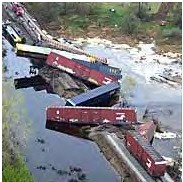
Flooding aids messy train wreck
HOLLY TOWNSHIP, Mich. (AP) — Bulldozers and semi-trailers rumbled
down a subdivision street more accustomed to sport utility vehicles and sedans,
headed for the wreckage of a freight train that derailed early Wednesday.
"It's just a big mess," North Oakland County (Mich.) Fire Authority spokesman
Jeremy Lintz said of Wednesday's wreck.
By David Coates, AP via Detroit News
The train crashed into two ponds and a stream swollen by spring rains
that also saturated and weakened the embankment on which the track lay. Diesel
fuel spilled from the locomotives, but no hazardous cargo spilled, said Lt.
Jeremy Lintz of the North Oakland County Fire Authority.
The engineer and conductor walked away from the wreck and were treated
for apparently minor injuries. The accident severed nearby fiber optic cables,
briefly interrupting local telephone service.
"All I can say is, 'Wow.' It's just a big mess," Lintz said.
Crews were working Wednesday to remove the wreckage. Repairs to the CSX
Corp. track were expected to be completed sometime Thursday, spokeswoman
Jane Covington said from CSX headquarters in Jacksonville, Fla.
The track is built over a culvert through which Swartz Creek runs. Normally
a quiet stream that meanders through this community 50 miles northwest of
Detroit and 15 miles south of Flint, days of occasionally heavy rains had
made Swartz Creek fast-moving.
"The foundation of the tracks, for whatever reason, (had a) high build-up
of water on the east side," Lintz said. The volume of water soaked and softened
the embankment and the track bed it carried, he said.
A break in a beaver dam also may have contributed.
"Apparently, there was a beaver dam in the area that was backing up water
in a field. For whatever reason it gave and the water rushed out," said Greg
Hansmeier, police chief in the nearby Village of Holly.
CSX notified the Federal Railroad Administration about the accident, Covington
said. The railroad would not speculate on its cause, she said.
The train originated in Saginaw and was on its way to Walbridge, Ohio,
with a 22-car load consisting mainly of auto parts and finished automobiles
when it derailed at 1:13 a.m. ET, Covington said.
The two locomotives rolled onto their sides, one on each side of the track.
Seven railcars immediately behind them also derailed, Lintz said.
The first emergency responders reached the scene about 1:30 a.m., Lintz
said.
"It was pitch black — there wasn't any sound," he said. "Basically
we took out our flashlights and started walking down the tracks until we
saw the locomotives. All you could see was the shadow of these steel cars
piled on top of one another."
The engineer and conductor were "walking toward us, a little dazed and
confused and cut up," Lintz said. The two crew members — the only people
aboard — were taken to a local hospital. Covington declined to identify
them or discuss the extent of their injuries.
Steve and Beth Rahn, who live several hundred feet away, slept through
the crash. They awoke to find an assortment of fire trucks, state police
cruisers and volunteer firefighters' cars and pickup trucks clogging their
cul-de-sac subdivision street and television news helicopters buzzing overhead.
"We got up to the alarm and looked out the window and we're like, 'Oh,
my God, there was a party and they didn't invite us?' " laughed Beth Rahn,
who took the day off from her job as a secretary in Sterling Heights.
Steve Rahn, a frozen foods salesman, called his office to say he was missing
work because the emergency vehicles blocked his driveway.
"My boss said, 'If I hadn't seen it on TV, I wouldn't have believed you.'
"
Fifteen undamaged cars, including four tank cars containing propane gas,
were pulled away from the scene by another locomotive.
Derailment contractors hauled heavy equipment down the Rahns' streut and
to the accident site on a road bulldozed through a rolling field and a lightly
wooded area.
Telephone service to the villages of Byron and Fenton was restored after
SBC Communications completed repairs to fiber optic cables buried in the
railroad right of way, SBC spokeswoman Denis Koenig said.
Copyright 2003 The Associated Press. All rights reserved
Article Published: Wednesday, May 07, 2003 -
Dam collapse likely derails train
The southbound CSX train, going from Saginaw to Walbridge, Ohio, went
off its tracks about 1:15 a.m., according to CSX spokeswoman Jane
Covington.
The engineer and conductor suffered minor injuries.
It had been raining heavily in the area, and a surge of water washed out
the culvert running beneath the railbed, causing the soil and tracks to give
way, said Lt. Jeremy Lintz of the North Oakland County Fire Authority.
"All I can say is, 'Wow.' It's just a big mess,' Lintz said.
Police Chief Greg Hansmeier said beavers may share the blame with the
rainstorm.
"Apparently, there was a beaver dam in the area that was backing up water
in a field,' Hansmeier said. "For whatever reason, it gave and the water
rushed out.'
The torrent left water standing 2 feet deep on a road. Residents of two
or three homes were evacuated but allowed to return later in the morning.
The two locomotives rolled onto their sides, one on each side of the tracks.
The seven railcars immediately behind them also derailed, Lintz said. The
cars carried auto parts and vehicles, he said. Fifteen undamaged cars were
pulled away from the scene by another locomotive.
Some diesel fuel leaked from the locomotives, Wiegand said.
Contractors were sent to the scene with heavy equipment to start the cleanup,
Covington said. She said it was too early to estimate how long that will
take.
Janet Crittenden was sleeping when the train derailed near her home.
"So I didn't know what it was,' said Crittenden, 52. "Was I dreaming?
In a half-hour, the fire department contacted us.'
Crittenden said the road to her home was washed out along with the
tracks.
"It looks like a toy train someone set up,' she said. "The gravel and
everything is gone.'
Holly Township is about 50 miles northwest of Detroit.
|
| One killed in train accident
By:Patrick Donahue , Executive editor 05/07/2003
Amtrak train, lumber truck collide in McIntosh community. Most on train
are not hurt.
By Patrick Donahue
Coastal Courier (Hinesville, GA) Executive Editor
pdonahue@coastalcourier.com
The driver of a tractor-trailer was killed when his rig collided with
an Amtrak passenger train Tuesday morning at a crossing in the McIntosh
community.
The accident occurred around 7:20, not far from the U.S. 84 overpass,
built years ago to go over the CSX rail lines. The driver, Boyd James Van
Horn, 41, of Richmond Hill, was killed. The train's engineer was badly injured
and flown by LifeStar to Memorial Medical Center Health University in Savannah.
He was listed in critical condition.
The 10 cars and locomotive derailed, but remained upright. The train,
the Silver Star, was bound for Miami from New York City. Its next scheduled
stop was Jacksonville, FL.
The truck was demolished, shredded into bits and pieces along the rails.
The train cars were damaged and strewn in a zig-zag pattern across the
tracks.
"We were shocked," said passenger Iona Locke of Detroit. "The car between
us was crushed."
There were 150 passengers and 14 crew on the train, said Amtrak spokeswoman
Karina VanVeen. Nineteen passengers were hurt and taken to area hospitals.
The other 131 were taken to the Charles Shuman Gymnasium.
The train crew was just starting to make breakfast for the passengers
when the tractor-trailer crossed its path.
"We were in our bedroom, we just got dressed when the train put on its
brakes," said passenger Richard Swetits of Bay Head, NJ. "My wife was holding
a toothbrush, brushing her teeth. I grabbed her and held on to her. The train
rocked from one end to the other."
The truck, loaded with plywood and with a forklift device attached to
the rear, belonged to Heritage Forest Products.
Mark Foster, who lives within yards of the rail lines, was getting his
son Ryan ready to go to school at Joseph Martin Elementary. Ryan said he
saw the truck headed toward the crossing on Cassels Road.
"I heard the impact," Foster said. "About a second before, I heard the
horn blow. Then I heard an explosion. My son said, 'I wonder if that was
that truck?' It was pretty loud."
Foster, who moved back to the area a month and a half ago after spending
the last 10 years in Phoenix, AZ, called 911. Emergency crews were on the
scene in 2-3 minutes, he said.
Foster worked with AirEvac, an air ambulance service akin to LifeStar,
in Phoenix.
"I'm surprised there are no guard arms," he said. "I don't know why this
(crossing) is even still here. It's just used as a shortcut instead of going
over McIntosh Mountain."
"When it hit, I didn't know what happened," said Derrick Thompson, 15,
who also lives near the tracks. "I heard a thump and the house started shaking.
Then I heard an explosion and the house started shaking again. I couldn't
believe it. (The driver's) body was all mangled up and hanging out of the
truck. That freaked me out."
R.V. Sikes, the former longtime Liberty County sheriff, got to his office
alongside the tracks about 40 minutes after the accident. Pieces of the
demolished tractor-trailer were resting against the side of his Sikes Chevron
Oil building.
"I saw one like this about 20 years ago," Sikes said of the accident.
His son, Steve Sikes, got a call from a friend who works with the railroad,
wondering if the Sikeses were at their office at the time of the accident.
CSX owns the rail lines and crews were dispatched to begin cleaning up
the wreckage. There has been one other accident at the crossing in the last
five years, according to CSX spokesman Gary T. Sease. In the August 2000
incident, there were no injuries.
Workers started clearing wreckage early Tuesday afternoon and Sease said
the railroad hopes to have one of the three lines open by this morning.
"If it goes smoothly," he said.
Work to repair the tracks will be done concurrently with the removal of
the debris, Sease said.
"That's always a good sign when the cars stay upright," Sease added.
The only warning sign at the crossing is a sign.
"The states determine the level of warning signage at each crossing,"
Sease said. "We construct those to the state's dictates, based on traffic
counters."
The uninjured passengers will be bussed to their destination, VanVeen
said, with their luggage. The crew is being interviewed by CSX, Amtrak and
Federal Railroad Administration officials as part of the investigation.
The Georgia Emergency Management Agency is in charge of the clean up at
the wreck site and the National Transportation Safety Board will supervise
the investigation.
©Hinesville Coastal Courier 2003
|
| Posted on Wed, May. 07, 2003
Alcohol found in organs of driver in Burbank train wreck
Associated Press
LOS ANGELES - Traces of alcohol were found in the organs of a man killed
when his truck was struck by a Metrolink commuter train in Burbank earlier
this year, officials said.
Jacek Wysocki, 63, had a 0.09 percent alcohol level in his liver and 0.02
in his stomach at the time of the Jan. 6 crash that killed him and injured
more than 30 people aboard the train, the coroner's office said Tuesday.
One of those passengers later died of crash-related injuries.
Wysocki drove his Ford F-350 truck onto the tracks at San Fernando Boulevard
and Buena Vista Street, authorities said.
It couldn't be determined, however, if his driving might have been impaired
by alcohol, said Joe Muta, a coroner's toxicologist.
"What it means is at the time of the accident, he had some alcohol in
his system," Muta said. "The question is: Does the .09 accurately reflect
bloodstream levels? In this particular case, you can make a case it doesn't
necessarily."
By law, a blood-alcohol level of 0.08 percent defines a driver as legally
intoxicated.
Burbank police Detective Paul Orlowski refused to comment on the test
results, pending the completion of his investigation.
|
| Fire Engine, Train Collide
One Firefighter Injured In Accident
POSTED: 6:33 p.m. PDT May 6, 2003
LOS ANGELES -- A firefighter was injured Tuesday when the engine he was
in collided with a train in Hawthorne.
The fire engine, responding to a call, collided with the slow-moving freight
train near Broadway and Oxford Avenue was reported at 4:22 p.m., said county
fire Inspector Roland Sprewell.
The crash resulted in a knee injury to one county firefighter, an official
said.
The three-person truck was headed to assist other crews with a van fire
at 120th Street and Oxford, fire officials said.
An ambulance team sent to the collision scene took the injured firefighter
to a hospital to be examined, said Inspector Ed Osorio.
The truck was "not driveable," Osorio said, so it had to be towed. The
train, meanwhile, resumed its journey about 5 p.m., according to reports.
The cause of the crash was under investigation.
Copyright 2003 by NBC4.tv. All rights reserved.
|
| Train derails; flooding blamed
By Randy Conat
Holly Twp. — (05/07/03)-- An engineer and conductor are safe after
the train they were operating plunged into flood waters in northwestern Oakland
County.
It happened about 1:30 this morning about three miles north of Holly near
Holly Road. ABC12 reporter Randy Conat covered the story since it broke,
this morning.
Two train engines and seven freight cars are in a jumbled pile after they
derailed this morning. The two employees on the train are lucky to be alive.
The cars and engines lay in a swampy mess.
CSX officials say there were 22 cars in the train that was on its way
to Ohio, from Saginaw. The rail bed is built on an embankment that holds
back a large pond. The water somehow breached the embankment and opened a
60-foot gap. When the train arrived, the rails sagged and the two engines
and seven cars plunged into the flood waters.
(Lt. Jeremy Lintz, North Oakland Fire Authority) The engineer and conductor
had to be rescued from the rising flood waters. Environmental clean up crews
have been brought in to handle diesel fuel that spilled from the engines.
No hazardous materials were involved in the cars that came off the tracks.
They were carrying automotive parts and new cars.
CSX officials have brought in heavy equipment to begin removing the wreckage.
(Thomas Drake, CSX)
On board the engines are black boxes that may help investigators as they
piece together what happened.
It could be weeks before the embankment is rebuilt and the rail line restored.
The derailment has caused phone problems for Some residents in Fenton
and Fenton Township.
The derailment cut a fiber optic cable and repair crews can't yet get
to the damage.
Ameritech and 911 officials are urging those who are having trouble to
use cell phones or pay phones if they need to call 911. The exchanges affected
are 629, 714, and 750.
Ameritech isn't sure when full phone service will be restored.
Last Updated: May 7, 2003
Crews work to clean up derailment mess
Flooding caused train to lose control
By Courtney Chamberlin
Holly Township — (05/07/03)--Crews are working all though the night
to clean up an early morning train derailment. It all happened when water
flooded tracks in Oakland County's Holly Township.
For CSX crews, the derailment is especially tough to clean up. ABC12's
Courtney Chamberlin had more from the scene. The thing that makes this so
tough is that crews needed to find a way to get to the derailment to clean
it up.
The solution: constructing a 15-foot wide 1,500-foot road to get to the
scene. It's a neighborhood turned construction zone. The goal is to clean
up the mess. Once the crews are able to get all of the machinery back to
the scene, they can clear away the wreckage.
We're told it could take a couple of days and nights, but it's clear everyone
is in it for the long haul. Fire crews say CSX hopes to have trains up and
running again on the tracks by Saturday. The cause of the derailment is still
under investigation.
|
| Two Women Killed In Separate Train Accidents
Accidents Happen 2 Hours Apart
May 5, 2003
WINCHESTER, Ind. -- Two women were killed and a third was critically injured
in two separate accidents in eastern Indiana involving freight trains, police
said.
Julie Parks, 27, of Union City, was struck and killed by a CSX train about
2:20 a.m. Sunday at the crossing in the town of Harrisville, Randolph County
sheriff's authorities said.
Coroner Duane Petry's preliminary investigation indicated Parks was walking
across the tracks when she was hit by the train.
Parks apparently disregarded the crossing lights and train whistle and
entered the train's path, Petry said.
Sheriff Jay Harris said there was no reason to believe the death was a
suicide.
Six hours later, about 8:30 a.m., a van was struck by another CSX train
in downtown Winchester about 60 miles east of Indianapolis (pictured, right).
Carolyn J. Phenis, 58, of Winchester was pronounced dead at the scene.
A passenger in her van, Pam Lacy of Winchester, was thrown from the vehicle.
Lacy, who is Phenis' sister, suffered multiple fractures and internal
injuries. She was listed in critical condition Sunday night at Methodist
Hospital in Indianapolis.
A witness told Winchester police said the collision occurred as the van
was maneuvering around the activated crossing gates.
The CSX train engineer told police the train, pulling 48 cars, was traveling
about 55 mph when the collision occurred.
Police said the train was hauling hazardous materials, but there was no
derailment and no spills.
Phenis and Lacy had been on their way to church at the time of the accident,
police said.
Copyright 2003 by The Associated Press. All rights reserved.
|
| Monday, May 5, 2003 ·
Elderly woman and her gardener dead in train-pickup crash
THE ASSOCIATED PRESS
VANCOUVER, Wash. -- An elderly woman who lived nearby and a man who worked
for her as a gardener have been identified as the victims of a collision
between a pickup truck and a train.
The engineer of an eastbound Burlington Northern Santa Fe freight train
saw the older Chevrolet pickup rolling slowly over a private rail crossing
Friday evening, sounded the whistle and threw the emergency brake, but it
was too late to avoid the collision, railroad spokesman Gus Melonas said.
The pickup was thrown 200 feet and both people inside were pronounced
dead at the scene.
On Saturday police identified the two as Barbara Luray, 77, who lived
nearby in a house along the Columbia River, and Magdaleno Martinez Ortis,
33, address unknown, who did gardening and handy work for her.
All of Ortis' relatives apparently live in Mexico, police said.
Information from: The Columbian
|
|
| Presentation Seems Unlikely to Sway Washington or Paris
Fri Feb 14, 2003
By TIMOTHY L. O'BRIEN The New York Times
UNITED NATIONS (news - web sites), Feb. 14 - In a mixed report to the
Security Council today, Hans Blix, the United Nations' chief weapons inspector,
said that his teams had found no weapons of mass destruction in Iraq.
His words seemed unlikely to change any member's firm opinions, with
France calling once again for more inspections and the United States saying
the issue was not inspections but disarmament.
Mr. Blix confirmed that an Iraqi missile called Al Samoud 2 exceeded
its 93-mile range and said that only a small number of empty chemical munitions,
``which should have been declared and destroyed,'' had been discovered.
But he added: ``Another matter, and one of great significance, is that
many proscribed weapons and items are not accounted for. One must not jump
to the conclusion that they exist. However, that possibility is also not
excluded.''
The French foreign minister, Dominique de Villepin, repeated the official
Paris position that ``the use of force is not justified at this time,'' adding
that the alternative was ``disarming Iraq via inspections.''
Inspectors, Mr. de Villepin said, should be allowed ``the time they need
for their mission to succeed.'' A premature recourse ``to the military option
would be fraught with risks,'' he added.
Secretary of State Colin L. Powell, who presented a laundry list of
accusations against Baghdad to the Council last week, said today that the
Council had not seen the level of compliance called for in Resolution 1441
and that Iraq continued to play tricks with the United Nations.
``Resolution 1441 was not about inspections,'' Mr. Powell declared. ``Let
me say that again. Resolution 1441 was not about inspections. Resolution
1441 was about the disarmament of Iraq.''
Mr. Powell said a variety of biological and chemical weapons had not
been accounted for by Iraq, and that as reluctant as Council members might
be to confront the issue, now was the time to consider ``whether or not is
is time to consider ``serious consequences of the kind intended by 1441.''
In a report that was considered crucial in determining whether the Security
Council gives its support to the United States and Britain, which are urging
military action against Baghdad, Mr. Blix said inspectors were free to visit
any site of their choosing, including presidential palaces and private
homes.
If banned materials exist, he said, Iraq should turn them over for
destruction. He said it was not the job of the inspectors to find the evidence
of banned material, but Iraq's job to turn it over.
Mr. Blix also referred to one of the points brought up at the council
last week by Secretary Powell.
Mr. Powell used satellite photographs that he said showed Iraq had moved
and evacuated materials from about 30 chemical weapons and other munition
before weapons inspectors arrived.
``The reported movement of munitions at the site could just as easily
have been a routine activity'' as one designed to hide banned materials before
inspections. Mr. Blix declared.
``In no case have we seen convincing evidence that the Iraqi side knew
in advance that the inspectors were coming,'' Mr. Blix asserted.
Later the Council was told by the head of the International Atomic Energy
Agency, Mohammed ElBaradei: ``We have to date found no evidence of ongoing
prohibited nuclear or nuclear-related activities in Iraq,''
``However,'' he added, ``a number of issues are still under
investigation.''
Mr. Powell's accusations against Baghdad last week also included mobile
weapons laboratories, ties to Al Qaeda terrorists, storehouses of deadly
nerve agents and unmanned planes capable of sprinkling chemical toxins on
enemies.
Prime Minister Tony Blair (news - web sites) of Britain, a staunch ally
of the United States in its campaign to convince the world that Iraq must
be brought to heel immediately or face war, said Thursday that Baghdad could
be guilty of a ``serious breach'' by deploying Al Samoud.
``It would be not just a failure to declare and disclose information,
but a breach of Resolution 1441,'' said Mr. Blair, making reference to a
United Nations resolution adopted last fall that required Baghdad to comply
with inspections aiming to show that Saddam Hussein (news - web sites)'s
regime no longer possesses weapons of mass destruction. For its part, the
White House, which said on Wednesday that it had begun work on a resolution
authorizing military action against Iraq, labeled disclosure of the al-Samoud's
range as ``serious and troubling.''
But Russia, which occupies a permanent seat on the Security Council along
with Britain, France, China and the United States, said that Baghdad had
disclosed Al Samoud's existence and that analysis of the missile's capabilities
merely proved that inspectors were ferreting out valuable data and should
be given more time to do so. President Vladimir V. Putin of Russia was quoted
in the French press on Thursday as saying that his country would veto any
war resolution by the Security Council.
``If it is necessary, we will use our veto, but I do not think it is
helpful to get into debate about this at the moment,'' Mr. Putin said. China,
France and Russia have all opposed a military strike against Iraq, while
the United States and Britain have adopted a much more hawkish stance. Deputy
Prime Minister Tariq Aziz of Iraq told reporters in Italy on Thursday that
Baghdad was ``still within limits that are decided by the United Nations.''
Once again, as he did on Jan. 27, Mr. Blix waded into the middle of this
tug of war. When he last appeared before the Security Council, Mr. Blix offered
a scathing critique of Iraq, saying that Baghdad had not fully complied with
his inspection team and had not fully accounted for what may be stockpiles
of chemical arms. His presentation buttressed the United States' argument
for war, especially after Mr. Blix declined to ask for more time for his
team to carry out its duties.
Mr. Powell said on Wednesday that he would ask French and German
representatives at the meeting if they opposed military action because they
want to let Baghdad ``off the hook and no disarmament.'' So, with peace in
the balance, Mr. Blix, who cited Al Samoud as a potential problem when he
made his last report, was forced to navigate a very fine line in today's
presentation.
John Ruggie, a former United Nations official who now is a professor
of international affairs at Harvard University's Kennedy School of Government,
described the ongoing United Nations debate as a ``bloody
train wreck'' but said there might still be backroom diplomatic efforts
under way to avert a war.
Other items under consideration today were Baghdad's recent acceptance
of reconnaissance flights over Iraq conducted by U-2 spy planes as well as
French Mirage and Russian Antonov aircraft. Iraq's previous unwillingness
to permit such flyovers had been another complaint lodged by United Nations
weapons inspectors.
Meanwhile, NATO (news - web sites) postponed a meeting on Thursday intended
to resolve a brewing crisis at the 54 year-old European military alliance.
Earlier in the week, France, Germany and Belgium halted efforts by NATO's
16 other member nations to send military defense assistance to Turkey, asserting
that such aid amounts to hasty, and still unnecessary, preparation for war
with Iraq.
The United States, which has warned that the split may lead to NATO's
collapse, said on Thursday that other NATO members were looking for ways
to circumvent France, Germany and Belgium by defending Turkey outside of
normal NATO channels.
|
TRAIN NEWS
Alcohol May Be Factor In Fatal Train Crash
Tue Jan 28, 4:35 AM ET
Police say alcohol may have caused a man to drive his van into a train
on Friday.
Two 25-year-old Romulus, Mich., men in a 1989 Chevrolet van traveling
at Shook and Tobine roads in Romulus slammed into a train around 3 a.m.,
according to Romulus police.
Witnesses told Local 4 it was as if the driver didn't even see the train
moving across the intersection.
The northbound train reportedly carried the van across the tracks until
it tore apart.
Emergency crews transported one man to Annapolis Hospital in Wayne and
he was pronounced dead at around 4 a.m., police said. The other man, who
was ejected from the vehicle during the crash, was airlifted to the University
of Michigan Hospital with serious injuries.
Seven tanker cars on the 70-car-train reportedly derailed, but were not
punctured so it did not become a hazmat situation, according to Local 4 reports.
The tanks were reportedly empty except for residue.
The engineer said he didn't feel the impact of the van and was not aware
there was a crash until after the train had derailed, Local 4 reported.
The derailment was in the area of Van Born and Wayne roads in Wayne, Mich.
The fire chief closed off access to nearby businesses, including the GM
Distribution Plant, Environmental Quality and a lumber company, Local 4 reported.
Employees of those businesses and other nearby businesses were told to contact
their employers.
Sgt. Clifford West of the Romulus Police Department said cranes would
come in from Ohio from CSX, the railroad involved, to lift the cars back
onto the track.
Van Born Road, between Wayne and Hannan Road remains closed as crews work
to remove the debris and repair the train track that was damaged.
Motorist dies in collision at crossing with commuter train bound
for Los Angeles
Mon Jan 27, 2:45 PM ET
GLENDALE, California - A driver was struck and killed at a railroad crossing
Monday, apparently after trying to beat a commuter train across.
The Metrolink commuter train slammed into the sport utility vehicle. One
passenger aboard the Los Angeles-bound train was treated at the scene for
shoulder pain, Metrolink spokeswoman Sharon Gavin said.
The driver of the SUV was not immediately identified.
"According to witnesses, the driver tried to go over the tracks as the
barriers were going down," police spokeswoman Leticia Chang said.
Earlier this month, a Metrolink train hit a pickup at a crossing in nearby
Burbank, killing the truck driver and injuring 33 train passengers.
Last week, an Amtrak train collided with an SUV at an intersection 300
yards (meters) from Monday's crash, Chang said. A 53-year-old woman escaped
from her car in time, and no one was hurt.
Elderly Couple Pulled to Safety Before Train Hits Their Car
Mon Jan 27, 9:23 AM ET
(Beltsville, Md.) - An elderly couple has two Good Samaritans to thank
for pulling them to safety, just before a train ploughed into their stranded
car.
Witnesses say Sunday's rescue was like something from a movie.
Shawn Meyers and his wife Eunice were stopped at a traffic light in
Beltsville, when they saw an 80-year-old man lose control of his car, go
through a guard rail on Route 1 and land on a CSX railroad track.
The Meyers and another motorist worked quickly to get the elderly couple
out of the car before the train hit it.
"We took about two steps and had to dive into the embankment and the train
hit the car at that time," said Eunice Meyers.
The elderly woman was flown to MedStar with a broken leg.
© Copyright 2003 WJLA-TV
Nine dead in Sydney train wreck
31.01.2003 2.45pm
UPDATE - SYDNEY - Nine people were killed and approximately 12 seriously
injured when a train derailed in rugged Australian bushland south of Sydney
this morning, trapping other passengers.
The driver is believed to be among the deceased.
About 70 people were on the four-carriage train when it derailed at about
7.30am (9.30am NZDT) near Waterfall station, 40km south of Sydney.
Two carriages overturned after the front carriage apparently hit stanchions,
rail officials said.
Helicopter pilots reported seeing several bodies lying on the railway
line.
Steve Leahy, from the Life Helicopter Service, said a pilot described
"a most amazing scene" with people lying on the tracks.
"We have winched in two doctors, two paramedics already, we are about
to put more medical personnel ... all indications are at this stage are that
there will be numerous fatalities... there are numerous," he told ABC Radio
a short time after the crash.
The train was travelling to Port Kembla. The passenger load would have
been much greater if it had been travelling north, towards central Sydney.
Access to the accident site has been difficult.
"The pilot quite graphically says Granville was a walk in the park to
what they are seeing here," said Mr Leahy.
The Granville train disaster claimed 83 lives when a commuter train struck
an overhead bridge during peak hour on the morning of January 18, 1977.
Train wreck kills 46
Death toll mounts in African disaster
By Angus Shaw
Associated Press
Published Monday, February 3, 2003
HARARE, Zimbabwe -- The death toll in the head-on collision between a
packed passenger train and a freight train in northwestern Zimbabwe rose
to 46, police said Sunday.
A railway worker who might have given a wrong signal was arrested and
tested for alcohol, media reports said.
Rudo Muchemenyi of the western Matabeleand province police department
told state television four more bodies were retrieved from the wreckage
Sunday.
Police had reported 42 people killed in the crash Saturday and 64 injured,
many seriously. All the dead were found in the charred wreckage that was
gutted by fire.
Only 11 of the dead have been positively identified, the Zimbabwe Broadcasting
Corp. said in its nightly news.
The transport ministry blamed the crash on human error. State television
reported the signals on that stretch of rail line -- the busiest in the country
-- had been reported faulty since November. It said the state railroad company,
troubled by shortages of equipment, also reported outages of electrically
powered signals across the country, forcing some signalers to revert to handing
written information cards to train crews on their scheduled stops.
About 1,100 people traveling on the passenger train were headed for the
resort town of Victoria Falls.
Both locomotive crews died instantly when the trains collided on a curve
in the track near the coal mining center of Hwange, about 190 miles from
the western city of Bulawayo.
At the time of the accident, the freight train was at full throttle, while
the passenger train was picking up speed after a recent stop, the state Sunday
Mail reported.
The newspaper said a trackside signal official was arrested and his blood
alcohol level was tested. The results of the test were not immediately
known.
© Associated Press 2003
2-10-2003 Hundreds evacuated after southern Illinois train wreck
Tamaroa, Illinois-AP -- People in the southern Illinois town of Tamaroa
hope they can go home soon.
As many as a thousand people were evacuated when a freight train derailed
and spilled its dangerous cargo.
The train was carrying vinyl chloride, formaldehyde and hydrochloric acid
when it overturned near the center of town yesterday morning.
The chemicals are hazardous to breathe and can be fatal in high
concentrations.
Some of the vinyl chloride caught fire -- but the fire is out.
One resident taking shelter in a local community center says emergency
workers told her it could be three days before she and her family will be
allowed to return home.
Copyright 2003 Associated Press.
|
|
| Train symbolism is related to enmasse belief systems, social life,
destiny, journey, and fatalism.
Jung believed that to dream of taking a public vehicle often means that
the dreamer is not finding his own way forward and is behaving like everyone
else. From: The Hidden Meaning of Dreams (Hamilton-Parker)
|
| DREAM EXCERPT FROM THE INTERNET: . I got my daughter on a small
small kids train like an amusement ride. We rode to the house I grew up in;
except all it had was a huge stone fireplace no windows in the front.
The dream analyst says: The train is a symbol for a physical
organizational body. This could be a club, a church, a school, a governmental
body, etc. The symbolism of the train being small and something from a child's
amusement park suggests that this is something you do not take seriously
and may have outgrown. It may be that you have turned to an organizational
body for guidance, learning, support or knowledge that you have outgrown
and that is no longer productive for you.
Train
From:
http://www.dreammoods.com/dreamdictionary/t3.htm
To see a train in your dream, represents conformity and go along with
what everyone else is doing. You have the need to do things in an orderly
and sequential manner. In particular, if you see a freight train, then it
refers to the burdens and problems that you are hauling around.
To dream that you are on a train, is symbolic of your life's journey
and suggests that you are on the right track in life and headed for the right
direction. Alternatively, you have a tendency to worry needlessly over a
situation that will prove to work out in the end.
To see or dream that you are in a train wreck, suggests chaos. The path
to goals are not going according to the way you planned it out. Or you may
be lacking self-confidence and having doubt in your ability to reach your
goals.
To dream that you are the engineer, signifies that you are in complete
control of a particular situation in your waking life.
To dream that you miss a train, denotes missed opportunities or nearly
escaping your death.
|
| DEES MAGNIFICENT
DREAM
A man came and asked me for help. He said he needed a train engine to
perform a particular task. I told him that all the trains we had were too
old for the task, but I'd get him a new modern engine to handle the job.
At that moment, I knew why I had spent the last 11 years learning how
to problem solve, because no matter what the problem was, I knew how to find
the solution to it. I asked the man to bring me the yellow pages from the
phone book, intending to find a train engine manufacturer, to make a new
engine for the man.
DEES JAPANESE TRAIN CRASH
PROPHECY |
FROM:
DREAM
INTERPRETATION
Over time, working with my dreams, I witnessed the birth of the latter,
of a more appropriate male Anima This Anima was born as twins, who, in the
dreams that followed, grew from small infants into women of wisdom and strength.
I recall getting on a train with the two of them, who were by then young
children. I was especially protective of them, encompassing them in my arms
as the crowd pressed upon us and as the train hurtled along. As my dreaming
progressed, the Anima grew into a young woman, who I found to be sensually
seductive. In later dreams, this anima manifest in the faces of mature women
whose balanced perspectives on life, whose humour and whose personal maturity
I admired.
|
| FROM: A
DREAM IS A WISH YOUR HEART MAKES
Beth’s Dream Age: 36
When I was little I had a dream that my grandma was giving me a piggyback
ride through a pine grove at night. I remember it being very dark, except
for the glow of the moon. We were walking along train tracks and I remember
dogs barking. It had to be a summer night because it was very warm. I remember
feeling happy because I was with my grandma. I remember the train’s
horn and feeling the vibration of it going by.
Real Interpretation
Now:
Your grandma was always your protector and always watched out for you.
The things that you have down in the past cannot be changed only del with.
You must forgive yourself for your faults. You have matured into a young
woman and have moved farther up the ladder to success.
Future:
The insecure feelings and guilt that you feel should be addressed and
dealt with during the day when you are awake. Otherwise you will be emotional
and moody towards others and yourself. There will be changes in your life
that will lead to wealth and good luck. Something or someone wants to harm
you in some way to be alert on the things around you.
Fake Interpretation
Now:
Your grandmother is very close to you and you think of her as somewhat
of a mother figure. She paid a lot of attention to you and you felt happiness
in her presence. Darkness is a sign that points to fear, but your grandmother
made you feel safe.
Future:
There is an upcoming journey that means you will have to leave something
behind. Something will be taken away from you and you will have to learn
how to deal with that.
|
| House of Seven Gables
Hawthorne uses the railroad to symbolize a "microcosm of society" (Arac
15). It is through the railroad that Clifford and Hepzibah try to escape
into society. Clifford yearns to become part of life, and his transfusion
into the life of the train seems to renew him (Arac 15). Upon entering
the train Clifford tells Hepzibah, "Let you and I be happy! As happy as that
youth, and those pretty girls, at their game of ball!" (Hawthorne 258). For
a short time, Clifford tries to be like the others on the train. However,
his attempts are in vain, because Clifford cannot join the train while he
is still tied to the house.
Instead, he holds conversations that continue to return to the topic
of the house. Clifford’s mind is fixated on the house which arouses
suspicion from his train companions. Eventually after prattling on, Clifford
realizes that he can never really leave the house and join society. Thus,
he gets Hepzibah, and they separate from the bustling life of the train at
a station only to return to the dismal confines of solitude (Arac 16). Clifford
once disassociated from life, the train, loses his vivacity and energy,
and he no longer leads Hepzibah. Instead, he slumps down and needs
help to find his way (Erlich 142). Hawthorne uses the entire railroad
excursion to symbolize another attempt and failure by Hepzibah and Clifford
to escape into life, but they end up only lonely with no where to turn but
back to the dreaded house (Arac 16).
From:
http://members.tripod.com/essayz/English/gables.html |
READER COMMENTS
From: Jan@xxx
To: Dee777@aol.com
Dee~Back in the mid-late '80s I had many transmissions about the 'train'
that was on a 'routing home'..and gathering the souls that were ready
to catch the train. Some got on the 'caboose' at the last moments..It's a
'synching' with a fast track train of cosmic energy to bring this world
again to 'track' with the universal systems. Pathways are established for
this transport that were not available in ages past. It has been being
prepared for the release through a cloudy system in illusion. It's called
'catch the wave'..or 'get your butt on this train!' :)
Luvs,Jan
From: Sheila@xxx
To: Dee777@aol.com
I found the dream -- the train in the dream was where I grew up -- Booneville,
which is a smaller town near Van Meter and they have no school and have to
go to school in Van Meter (Iowa). They have school buses to pick up the kids
on the roads around the town. A lot of people move out there now from Des
Moines to avoid taxes. Booneville was where a kid a couple of years older
than me -- Randy F lived. He was killed in Vietnam and before I found that
out by finding his name on the Wall I didn't know why I kept dreaming that
I was trying to get back to Booneville. I'd try to cross the highway which
had an electric fence that he couldn't cross (but I didn't see who was with
me and didn't know it was him), wade across the river which was really scary
when it got deep and I thought it was a puddle at first with a fountain in
the middle in a beautiful courtyard. The train track in Booneville goes right
along the highway (highway 90) to Des Moines and there used to be big turkey
ranches there in the late 60s. But in the dream Booneville looked sort of
like London with tea shops. Alice Engel, my mother's grandmother used to
have tea every day.
8/31/01 Ace of Cups(R) I meet an actor named Hungwa; he has another character
he plays--Grant W. Picture on the video box is blue and pink words in a circle
on a black box. A voice keeps prompting me to look at the box with his other
name and I see it written Grant W. Reminds me of Tony Clifton/Andy Kaufman
but I don't see the actor. If I'm over there she'll sign out and go to her
room. She went to pick up her kid. ... I'm working on an idea. I'm standing
on some railroad tracks and the train goes right through me or over me. On
the train are supplies for Leprechauns--the supplies I'm surprised, remark
are Tupperware containers and something else that is brick red in color.
The train goes over me and then a boat comes back the other way up the highway.
It has a wood, carved Leprechaun about 6 inches tall carved in it. The Leprechaun
is also rowing. "Oh, my gosh, it's Li or Ling." Blond woman tells me something
is wrong. The Leprechauns have a dead body they're escorting; I make up a
title The Leprechaun Train or The Leprechauns on the Train. "Bride she may
be; couldn't have been out of bed more than a few minutes." "Herman Laughling
or Lawthling." So the train stops and a shadowy man says to seize something;
that's when I see the boat. I see a fish that is shiny green like a snake.
Man says, "Don't fool with me, I'm going to give you a black eye." "See"
gives you something (you are supposed to demand a gift from dream
characters).
Date: 1/27/2003
From: TM@xxx
To: Dee777@aol.com
Dee
To me the train coming is unstoppable and what shall be shall be. The
people on bicycles represent the tunability to what shall happen and they
shall be accordingly overwhelmed by the circumstances.
|
|
| A CHANNELING BY BASHAR
Date: 1/27/2003
A Symbol Is What You Make Of It
Q: I have a couple of different things I wanted to discuss. First of all,
on my way over here tonight, the lights on my car have almost gone out. And
I'm wondering what, on another level, this really means as far as my life
goes. And you know…
B: First of all understand that everything in your reality, yes, is an
extension of your consciousness, and can form a symbolic representation of
an idea that you are willing to explore about yourself. But recognize that
since it is an extension of your consciousness, then your imagination should
be able to supply you readily with the idea you are exploring.
Simply extend yourself into the idea of the symbol you have created, and
see what it brings to you. If you cease to judge and invalidate what comes
to your imagination first, without needing to analyze, but simply feel it
and act upon it, then you can know that you are always giving yourself accurate
information to represent the idea that you are symbolizing and reflecting
to yourself in your physical reality. Now, what for you was the first idea
that came to your mind without judgment?
Q: Well, just that I've been lax about taking my car to the garage.
B: All right. It can be as simple as that. But the idea of being lax about
anything that you have created then reflects the idea that you are exploring
laxness within yourself.
Q: Mhmm.
B: Now, it also may be that you could, on a positive note, simply know
that you no longer need to depend upon artificial illumination to allow yourself
to know that you can move easily through what you previously considered to
be abject darkness. Because now you can know that your senses can extend
themselves in ways that will always allow you to know exactly where you are
standing, exactly where you are stepping, exactly where you are walking,
without the idea of outside illumination needing to provide something to
support you. That all illumination comes from within, and even in the environment
of absolute darkness, as you would call it, there is still the ability for
you to know, to sense, exactly where you are at any given moment of time
as you create time to exist. It can also be a symbol of that idea. What do
you think? Which one do you prefer?
Q: Well, I prefer that I get home in one piece tonight, so I prefer that
my senses will take me there without any problem.
B: All right. Very good! Now, this is simply to illustrate that a symbol
is what you make of it. Recognize that many times you will create a symbol
to reflect something which is already in your mind. But that does not mean
you cannot allow yourself to change the meaning of the symbol even as you
recognize it. For you are an unlimited creator and can allow any reflection
to transform into positive effect the moment you conceive of it. You follow
me?
Q: Um... well, not too well.
B: All right. Simply stated: when you give yourself a symbol, there is
no need first of all to separate the idea of the symbol from you and wonder,
wonder, wonder. Simply go into the center of your being and know that you
can sense what the symbol may mean as you have already created it. Conversely,
allow yourself to know that even as you perceive that a symbol exists, you
can then recognize that, like any other symbol in your life, it is a reflection
simply of the opportunity to create at any moment whatever type of reality
you wish.
Thus you can use the symbol for whatever you desire to use it for. And
your desire, the direction and indication of the type of method that you
are willing to apply to the symbol, will change the symbol into one that
reflects the positive attitude you have decided to create.
Thus any symbol that you give yourself is always going to contain the
polarity. You can either use it for the negative idea within yourself, and
that will be true, or for the positive idea within yourself, and that will
be true. Because you have ultimate choice, and all choices, positive and
negative, are equal. Therefore, in whatever way you decide to filter the
symbol through you, will be the way in which it serves you.
So make your choice. How do you wish to look at the symbol? As you have
already said, in a positive way. Then simply know that you can trust the
higher conscious you that allowed you to create that idea, and the physiological
conscious you that perceived the physiological symbol. You can trust that
they are working in tandem, to give you symbols and messengers, and messages,
that always serve you and do not interrupt you. Because you cannot be
interrupted.
Q: Also I've been feeling lately that I'm searching so, and I'm looking
so, for answers. And it seems that the more I search and the more I come
here and the more I find out, the more confused I get about everything.
B: All right. Now, on one level that is very good and very creative, because
the idea you call confusion to us is not negative. It is co-fusion, fusion
with the idea of more possibilities. You are unlocking and disorienting yourself
from the reality you have for so long allowed to be your habitual ritual.
And now you are confused because you are unlocking and disorienting yourself.
This means you are opening up the possibility to reorient to something that
represents more of what you are.
Do not let depression and confusion be negative. Confusion is simply the
recognition of more of yourself, and depression is simply a meditation where
you go to the center of yourself to find the answers that you know do not
exist outside. Because there is no outside, and as long as you continue to
search outside, you will always allow yourself to feel that you are stumbling
in the dark. You follow me?
Q: Yes.
B: Therefore, if the lights on the outside have gone out, turn on the
one within.
Q: We were talking last week, and you said about our purposes... I stated
last week that I'm doing a performance, and I need to have some help with
it. I brought some cards tonight and would like to put them out if that's
all right with everyone. If anyone is interested in participating in a
performance, which has to do with spiritual involvement, I would appreciate
your help.
B: Very good, for being bold enough to have the conviction to know that
you can rely on the sources of information and interaction that are available
to you upon your own planet within your own civilization. Very good. Thank
you for sharing.
Q: Thank you.
BASHAR CHANNELINGS |
EVENTS COMING
1-25-2003 - COMET
C/2002 X5 COMING IN TOWARDS SUN
WILL IT SURVIVE?
updated 1-18-2003 - THE
TUNING
updated 1-18-2003 -
THE
COMING POLE SHIFT
1-16-2003 -
MORE LARGE QUAKES OFF COAST
OF OREGON
updated 1-16-2003 -
THE ELECTION
2000
IS THE PRESIDENT FACING DEATH THE DAY HE DECLARES WAR????
updated 1-20-2003 -
THE PLUM TREE AND THE
PALM TREE
ANOTHER TERRORISM THREAT???
1 -8-2003
PRINCE WILLIAM GROWS UP - WHAT WILL BECOME OF HIM?
SOME
SHIFTING HAS ALREADY OCCURRED
PTAAH -
HOW TO CHANGE YOUR FUTURE TOWARDS THE POSITIVE
updated 12-22-2002 -
NATIONAL
SECURITY - TERRORISM -
|
|
|