|
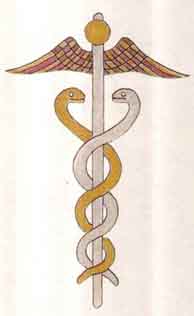
| CADUCEUS (Thoth Symbol)
The energies of the caduceus will help you find the real cause of health
problems and tackle it for yourself.
|
METHODS OF HEALING
THE DREAM AND THE REALITY
compiled by Dee Finney
|
| CADUCEUS (Thoth Symbol)
The energies of the caduceus will help you find the real cause of health
problems and tackle it for yourself.
|
| 11-2-2002 - DREAM #1 - Everything was in black line drawings and far away like I was observing at a distance. Then at the end I was told that I was practicing alleopathic medicine. |
| 11-2-2002 - DREAM #2 - This seemed to be a repeat of the first
dream, but now I was 'in' the dream.
We were in a large empty garage doing the same thing - practicing alleopathic medicine, but there were strange effects going on at the same time. I had a baseball bat and when I swung it to hit a worn and torn baseball that was tossed to me, the bat moving in the air made a noise in the air and felt like it was moving energy - or the 'force' like the sword wands in the movie Star Wars. I wasn't very good at hitting the ball, though my stance and swing looked good, but then a man was testing me by hanging a big ball of ice on a invisible string and when I touched it with the bat, it split in half. We all went outside then and when we went down the street, we saw that someone had drilled holes of various sizes all along the curb. Some were small that looked like they might be for planting flowers in, but others were large and deep enough to break a leg in and some large enough for a car or bus to fall into and none of us know what they were for. We went home then, and my friend Mary said that her neck was hurting, so I held my hands on either side of her neck and did an energy healing on her - not touching her at all. We stayed that way 5 minutes. We we were done, she said she felt fine, and that made me really happy. I woke up for a moment and thought about writing down the dreams, but fell asleep and found myself back in the garage. |
| DREAM #3 - I spread newspapers out on the garage floor and was
writing down the dream with green paint on the newspaper with the baseball
bat as a pen. At the same time I was reading out loud the words as I wrote
them on the newspaper - to some teenage boys who were watching me do
this.
Again I said I had been practicing alleopathic medicine. When I was done, we had to clean up from a part and there were a lot of beer and wine bottles standing around. I picked them all up by the heck and put them into the cases. One of the wine bottles had a tall cork in it even though it was empty. I saw that there was a beautiful etching on the side of the bottle and decided to save it - because now that we had moved, I room to keep whatever I wanted. NOTE: In a dream yesterday - I dreamed I was moving into a house that had a brand new empty house attached to it, and the attic was large enough to hold everything I owned in just one small corner. On 11-7-2002, I dreamed about quantum physics particles and I realized that the ball in this dream was really what this was about. In this dream I was shown the rules for movement of quantum particles. It was no wonder I couldn't hit the ball straight - that's not the way quantum particles go. Joe Mason told me that this dream also shows me 'stepping up to the plate' and trying to hit a home run, which makes sense too. See http://www.greatdreams.com/baseball.htm Particle rules: It would seem that any localized particle of finite mass should be unstable, since the decay into several smaller particles provides many more ways to distribute the energy, and thus would have higher entropy. This idea is even stated as a principle called the "totalitarian principle" which might be stated as "every process that is not forbidden must occur". From this point of view, any decay process which is expected but not observed must be prevented from occuring by some conservation law. This approach has been fruitful in helping to determine the rules for particle decay. NOTE: The ice ball broke into two parts when I touched it. The baseball was torn and coming apart at the seams. The flight of the ball was not a straight line, but very curvy and wavering. Conservation laws for parity, isospin, and strangeness have been developed by detailed observation of particle interactions. The combination of charge conjugation (C), parity (P) and time reversal (T) is considered to be a fundamental symmetry operation - all physical particles and interactions appear to be invariant under this combination. Called CPT invariance, this symmetry plumbs the depths of our understanding of nature. Another part of the high energy physicist's toolkit in anticipating what interactions can be expected is "crossing symmetry". Any interaction which is observed can be used to predict other related interactions by "crossing" any particle across the reaction symbol and turning it into it's antiparticle. FROM: hyperphysics.phy-astr.gsu.edu/ hbase/particles/parint.html
|
.
WHAT IS THE FORCE?
|
| The Tao of Star Wars: May the Force be with you. Utter this famous
line and there's no mistaking it. You're referring to the driving force behind
the Star Wars world of exploding planets and intergalactic wars. But what
exactly is it? In the words of the character Obi-wan Kenobi, a Jedi knight:
"The Force is what gives the Jedi his power. It's an energy field created by all living things. It surrounds us and penetrates us. It binds the galaxy together." But, as synonymous as the Force is with the make-believe world of Star Wars, some of its basic principles can be found in a real-life, ancient Chinese philosophy called Taoism. The Tao is a force that pervades the universe. It is the source of the universe, but it also IS the universe. Tao, often translated as the way or the path, is the ineffable, eternal, creative reality that is the source and end of all things. Te refers to the manifestation of Tao within all things. Thus, to fully possess Te, one must be in perfect harmony with one's original nature. The Tao can be understood in three ways. It is the nature of the universe. It is also your true essence. And it is the way to lead your life. This meaning ties the other two together, because the way to lead your life is to get your personal Tao in touch with the Tao of the whole universe. "Be one with the force, Luke," advises his teacher Obi-wan Kenobi, as he learns the "ways of the Force". A key principle in becoming a master Taoist, is wu-wei, sometimes translated as creative inaction. It literally means getting things done without doing anything. It's better described as an action that is so well in accordance with things, that there is no evidence of the action. To the Taoist, any deliberate intervention in the natural order of things will eventually turn into the opposite of what was intended and result in failure. One poem in the Tao-te Ching describes the Tao like this:
The Tao is like a bellows: it is empty yet infinitely capable.
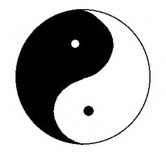
In Taoism, the yin yang symbol represents the unity of apparent opposites
in the universe. The Force is also expressed as two opposites - good vs. evil, dark vs. light. And on a superficial level, it has a parallel in Taoism. One of its icons is the yin yang symbol. A circle divided in two, it represents the unity of apparent opposites. The Yin represents the dark, death, winter and female side of the universe, while the Yang symboilizes the light, life, summer and male side. But unlike the theme of the positive energy of the Force overcoming the Dark Side in Star Wars, the two sides are inseparable in Taoism. Exerpted from: www.exn.ca/starwars/taoism.cfm
The use of hands in conjunction with gemstones has produced intensified contact of the unique energies of gemstones and the universal healing energy force. The stones assist in connecting with the energy flow within the patient by directing the vital flow to remove and melt energy blocks. This process can stimulate the immune system by activating the primary physical line of the defense system. It assists in recognizing the impact that the emotional and psychological states have upon ones state of well being, and it also helps with bringing one into balance. An example of using this energy is Reike: ? Reiki (ray`-kee) is a system of energy healing based on the theory that a universal healing energy or life force permeates and infuses the universe, and that this energy can be channeled into someone so that their own life force is enhanced From: Alice Bailey and Djwhal Khul: When we come to work as a group with individuals whom we shall seek to aid, we shall then learn to use the various types of energy according to the need of the individual to be healed. It would serve a real group purpose if all of you would study what is said by Rama Prasad in his book, Nature's Finer Forces, and by Patanjali in The Light of the Soul on the subject of the pranas with which and within which we work; you should be somewhat familiar with the matter. To answer the question specifically: An initiate or even a low-grade clairvoyant can easily distinguish between soul and personality healing energies, but the average intelligent aspirant as yet cannot. The initiate knows the source from which any type of healing energy may come. He senses its vibration and can follow it to its emanating source by an effort of the will, directed by the intuition. The clairvoyant can see the center from which the healing energy can flow, and the center then indicates the type and quality of the projected force. All energy is from the soul in the secondary instance, but in the primary sense all energy is simply life, functioning under direction of some kind. As to the part love has to play in the healing process: Love is the life expression of God Himself; love is the coherent force which makes all things whole (I would have you ponder upon this phrase), and love is all that is. The main characteristic of the distinction between soul energy and personality force, as applied to healing, lies in the region of the application and the expression of love. Personality force is emotional, full of feeling, and - when in use - the personality is ever conscious of itself as the healer, and is the dramatic center of the stage upon which are two players, the healer and the one to be healed. Soul energy functions unconsciously and is wielded by those who are in contact with their souls and who are consequently decentralized; they are "off the stage" themselves, if I might use that expression, and they are completely occupied with group love, group activity and group purpose. ~~~~~~~~~~~~~~~~~~ The ancient science of Pranic healing is the art of subtle energy healing that utilizes prana or vital life force to balance, harmonize and transform the body’s energy processes is very active in over 30 countries and numerous healing centers around the world. The Pranic Healing applications in health and in disease situations has significantly helped millions of people globally as they apply proper and intelligent use of this pranic energy in their lives. Pranic Healing is a simple yet powerful and effective no-touch energy healing. It is based on the fundamental principle that the body is a "self-repairing" living entity that possesses the innate alaility to heal itself. Pranic healing works on the principle that the healing process is accelerated by increasing the life force or vital energy on the affected part of the physical body Pranic healing influences this natural life force to bring about a healthier physical body. Pranic healing is applied on the bio-electromagnetic field known as the aura, which contains the mold and blueprint of the physical body. This bloplasmic body absorbs life energy and distributes it to the organs and glands. Diseases first appear as energetic disruptions in the energy field before manifesting as ailments in the physical body. The prana is a vital physical force, that exists universally, which underlies all physical actions of the body. It causes the circulation of the blood, movement of cells, and all motions which life of the body depends. It is a force sent forth from the nervous system by an effort of the will to direct healing. Prana also is known by different names such as ch’I in Chinese medicine and ki in Japanese medicine; the Japanese call healing by touch "giving seiki." The individual receives prana from the food eaten, water drank, and air breathed. All force or energy received comes from one primal source, and everyone can increase their supply and give it as a "gift" to others through healing. By the act of living each receives this gift and therefore can freely share it with others. Correct breathing establishes an equilibrium between positive and negative currents. It calms the nervous system, regulates and slows heart activity, reduces blood pressure, and stimulates digestion. ~~~~~~~~~~~~~~~~~~~~
FROM:
http://www.chioshealing.com/HealingLevel1/ChannelEnergy/PDF_Files/pdf_files.htm Every living thing tht exists ispermeated by a universal energy that connects and nourishes all life. This energy has been called by many different names, such as prana and chi. An "invisible" energy field composed of this life energy surrounds each human being. It is this energy field around each person which integrally suppors the life process in all its aspects - the material operations of the physical body, the functions of the emotions and mind, and even the spiritual life The energy in this field is not lifeless or inert - it is active and intelligent. It is conscious energy, a manifestation of the universal consciousness that is the source of each of us and the entire universe. the energy is one of the important expressions of the realm of pure consciousness, the spiritual source of life, in the manifested pysical world. The energy field acts as a bridge, a connection, between the realm of pure spirit and the manifested world. It is both an indicator and a regulator of the manner in which th elife force and higher potentials that exist within this higher realm are expressed in wordly life. If this enregy field is clear, healthy and free from defects, the living person will likewise exhibit good health, in all its physical, emotional, mental and spiritual aspects. Innate health and harmony in body and mind, spiritual awarenss and higher human potentials will all manifest in the person and in their life. Many times, however, dysfunctinal energetic patterns are present in the energy field. When the flow of energy within this energy field becomes weeak, impure, unbalanced, or blocked, the energetic defects prevent the pure connectin to the higher spiritual reality - the realm of pure consciousness and the true self of the person. this prevents the full and healthy expression of the living potential of the whole person and removes the natural condition of energetic health that is a requirement for physical, emotiional, mental and spiritual well-being. |
.
TYPES OF HEALING MODALITIES Alleopathic (allopathic) Practicing medicine is defined as treatment with "allopathic" treatments, which by definition excludes holistic, natural, non-medical, non-drug, non-surgical forms of treatment. (Childbirth is not considered a disease and is not included) Allopathic practice of medicine is covered by laws and the Medical Board AMA. Definition: Commonly used to define traditional medicine which uses therapeutic modalities to treat symptoms. ¹The term allopathic (in Greek "allo" means other) medicine was coined by Samuel Hahnemann, MD, in the late 18th century. (Opposite of homeopathic, also coined by Hahnemann.) Licensed massage therapists, certified aromatherapists, certified or licensed naturopathic physicians, and other natural practitioners of the healing arts are not considered to be practicing medicine. The roots are Greek and mean "other suffering," or "other illness." Hahnemann was pointing out that standard medicine attempts to combat symptoms by producing other symptoms to cancel the original symptoms. His point was that this is a relatively fruitless endeavor in that this balance is almost never achieved. All this becomes less obscure when you think of, for example, the patient who has high blood pressure and is prescribed a medication which tends to produce the opposite condition, low blood pressure. However, in the process it also produces other symptoms, for example nausea, headache, dizziness, "brain fog," etc. Standardized allopathic medicine does not attempt to actually cure disease, but rather to simply suppress the expression of disease symptoms. For example, if you have a headache, and you take a pill for it — aspirin, ibuprofen, acetaminophen, etc. — the cause of the headache, perhaps a congested colon badly in need of a cleanse, an allergic condition, environmental toxin, or whatever, has not been dealt with. If you have a runny nose and take an antihistamine, you may suppress the runny nose, but whatever caused the problem in the first place has not been diagnosed or treated. If you are nervous, and the doctor prescribes a tranquilizer, you may not be nervous anymore but the cause of the nervousness remains unknown. If you have gallstones, the doctor cuts them out, but you never know what went wrong with your body to produce gallstones. Abhyanga: Ayurvedic "rejuvenating cure" that is a secondary part of panchakarma. Abhyanga is a "very complete massage" with a medicated ("herbalized") oil. Practitioners supposedly gear the medicated oil to one's "constitutional type" (see "Ayurvedic nutrition"). Abjad: Sufi system of numerology. Aboukra: Purportedly, an ancient Egyptian "healing art" that strengthens and balances the body's "natural energy fields" and "meridians." Absent healing (absentee healing, distance healing, distant healing, remote healing, teleotherapeutics): 1. Alleged treatment of a patient not in the practitioner's vicinity through magic, meditation, prayer, "spirit doctors," or telepathy. 2. A form of faith healing that supposedly involves the projection of "positive healing energy." ACCESS (Access Energy Transformation): "Energy technique" that supposedly works with the "creative force" to free it and connect it to the "Light" ("us"). Allegedly, Novian, a "Being of Light," channeled the method to Gary Douglas through the Russian monk Grigori Efimovich Rasputin (1872?-1916). ACCESS theory posits: (a) 32 "Bars," points on the head that are a means of allowing the flow of bodily "energies"; (b) a "Soul"; (c) "Implants," electrical devices (e.g., a "False Immune System") inserted in another lifetime and attached "electrically" to the Soul's "energy"; and (d) "Entities," disembodied beings or "thought forms." Purportedly, ACCESS removes "energetic blocks" at cellular and "etheric" levels and enables one to reclaim "awareness as an eternal being." Acro-sage: A "combination of massage, yoga, and gymnastics," according to an edition of the TV magazine Strange Universe aired on UPN on November 29, 1996. Former circus performer Benjamin Marantz created the method. Apparently, it is a purported way to "reverse aging." Active imagery: Form of imagery (see below) that involves concentrating on a preselected image to control a particular symptom. Actualism (Actualism Lightwork, agni yoga, Fire Yoga, lightwork): Stepwise form of yoga developed over a quarter-century by Russell Paul Schofield, a clairvoyant with doctorates in divinity, naturopathy, and psychology. It involves "the laying-on of lighted hands." Its theory posits a human "divine mind," whose "scope" is infinite, and ki (a human life force). Actualism bodywork: Component of Actualism supposedly designed to assist awakening the body and its consciousness to the "indwelling Creator" and to the love of this alleged entity. It includes "nerve work," which purportedly helps to deepen one's enjoyment of "life-energies." Acu-ball pressure self-treatment: Form of self-applied acupressure characterized by the use of soft balls of solid rubber. Acu-diet (Dr. Bahr's Acu-diet): Subject of Dr. Bahr's Acu-diet: Weight Loss at Your Fingertips (William Morrow & Company, Inc.), by Munich-born Frank R. Bahr, M.D. The Acu-diet is a combination of diets, exercises, and self-applied acupressure. According to Acu-diet theory, one can influence the "compulsive eating center" in one's brain simply by massaging specific "acupressure points." Acu-meridian energy transmission bodywork: Component of the Er Mei Qi Gong Therapy External Energy Diagnosis and Treatment system. Acupoint bloodletting: Form of bloodletting characterized by puncturing acupoints with needles. Its common usage reportedly has various purposes, including activation of blood, clearance of channels (meridians), and reduction of hotness. Acu-point therapy: Mode of counseling psychology based partly on acupuncture theory and promoted by Mitchell J. Rabin, M.A. Acu-Powder (Acupowder treatment): One of the "clinic services" offered by the School of Classical Taoist Herbology, in Manhattan (New York City). It involves application of a "remarkable" herbal powder to acupoints. Acupressure (G-jo [GEE-joh]): Any treatment that allegedly involves the surface stimulation of acupoints digitally, manually, or with tools held in the hand. Practitioners may be called "acupressurists." "G-jo" is Chinese for "first aid." Acupressure: Methods used to tone or sedate acupuncture "Points or Locations" without the use of needles. Acupressure point: Eastern term for a specific point that usually correlates with a neurological motor point. Acupressure massage: Acupressure in the form of a massage (An Mo). Apparently, it is the equivalent of amma. Acupressure massage purportedly is usable to promote the flow of Qi (chi) through the "meridian system." Acupressure touch: Gentle form of acupressure. A type of Oriental healing art based on ancient Japanese and Chinese medicine. A practitioner puts pressure on specific points on the body with his or her fingers in order to relieve pain and discomfort, prevent tension-related ailments, and promote good health. The purpose of acupressure is to promote the body's own healing power. When key acupressure points on the surface of the skin are pressed, muscular tension is released, and the circulation of blood and the body's vital life energy, which the Chinese call chi, is promoted. Acupressure can be used to treat numerous conditions. Among them are effects of daily stress, headaches, neck and shoulder pain, aches and pains, allergies, menstrual difficulties, fatigue, anxiety, insomnia, digestive problems, nausea, and back pain. Acupuncture (acupuncture therapy, Zhenjiu): Generally, any treatment that allegedly involves subcutaneous stimulation of acupoints, which supposedly enable direct influence of the flow of Qi (chi). It typically involves the insertion of needles of various shapes into the skin. Practitioners may be called "acupuncturists" or "acupuncture therapists." Most forms of acupuncture are unnaturalistic. Neuro-electric acupuncture and New Scientific ElectroAcupuncture-and, apparently, osteopuncture-are naturalistic. Acupuncture anesthesia (acupuncture analgesia, acupuncture assisted anesthesia, anesthetic acupuncture): Use of acupuncture to relieve pain during surgery wherein the patient is conscious, either in conjunction with or instead of analgesics or chemical anesthetics. It was introduced in 1958 in the People's Republic of China. Acupuncture cupping method: Combination of acupuncture and cupping. acupuncture energetics (core acupuncture energetics): Practice of acupuncture with the intention of treating acupoints so that they "resonate" with "archaic pathways" of the "bodymind." It involves acupuncture imaging. Acupuncture imaging: Part of acupuncture energetics wherein the practitioner simultaneously palpates an acupuncture "zone" and describes it to the client in "energetic" terms. Joint focusing on "affected" zones supposedly enables channeling of the client's "true healing intention" to "appropriate" zones, which purportedly effects "bodymind integration." "Acupuncture Osteopathy": A purported "meridian acupuncture" approach to releasing myofascial "body constitutions," advanced by author Mark D. Seem, Ph.D. Acuscope therapy (Electro-Acuscope therapy): Form of energy medicine (vibrational medicine) that allegedly speeds healing of virtually any injury. Its centerpiece is the Acuscope (also called the Electro-Acuscope), a computerized device that purportedly balances the body's electrical current. Acu-Stop 2000: "Acupressure method" promoted by mail in 1993. It was a purported sure-fire way to lose at least thirty pounds, fast, and without exercise, pills, or much willpower. Acu-Stop 2000 involved keeping an "acupressure-like device" of the same name in one's right ear for a few minutes daily. Allegedly, stimulation of this "ear piece": (a) stimulates "points" in the body that regulate appetite and (b) "suppresses their activity." Acutherapy: Form of touch therapy developed by Jim Foster and taught by the Myotherapy Institute Research Center, in Salt Lake City, Utah. Foster reportedly discovered that gentle touching of specific areas of the body removed pain almost magically. Acutherapy purportedly uses the body's "reflex system" and "energy flows." Acu-yoga: Combination of self-applied acupressure and a group of yogic postures and stretches. It supposedly activates the points and "energy pathways" of acupuncture. Advanced dowsing: Radiesthesia without an "instrument" (e.g., a pendulum). Advanced Energy Healing (Robert Jaffe Advanced Energy Healing): Alleged "journey" into "higher realms" of understanding whereby one supposedly connects with one's "divine self." Taught by Robert T. Jaffe, M.D., D.D., the method encompasses aura analysis, the Awareness Release Technique, clairvoyant diagnosis, "magnetic/radiatory healing," "soul merging," and "third eye awakening." Advanced Ingham Method: Comprehensive form of the Original Ingham Method. Advanced Kum Nye: Apparently, an alleged means of promoting confidence, power, and endurance through stimulation and transformation of bodily and mental "energies." Advanced pranic healing: Subject of a "serious reference work" of the same name, written by chemical engineer and "Grandmaster Pranic Healer" Choa Kok Sui. The method includes chakral pranic healing and color pranic healing. Advanced Rolfing: Form of Rolfing purportedly geared to clients who have undergone the basic Rolfing series of ten sessions. African holistic health (African holistics, African holistic science, African medicine): Subject of African Holistic Health, whose fourth edition was published in 1993. The paperback's author, herbalist and massage therapist Dr. Llaila [la-ee-la] O. Afrika, developed this ethnic variation of naturopathy. Its purported design is to treat the physical, mental, and spiritual causes of "dis-ease." Agape Quest Program: Form of kinesiology that encompasses more than twenty "modalities," including acupressure and, apparently, Agartha Personal Life Balancing Program (Agartha Program): Thirty-five-day audiotape program created by author Meredith Lady Young. Its purported design is to reduce stress and promote "complete health." Each of the seven "harmonic" tapes combines sounds reportedly "developed" to alter "energy currents" within specific chakras. These sounds supposedly "massage" chakras and thereby improve the flow of life force through the body. Agni Dhatu Therapy© (Agni Dhatu, Samadhi Yoga): "Hands-on" form of spiritual healing that purportedly enables the conscious to experience the "Super-Conscious" by lulling and healing the subconscious. Its theory posits "energies of bliss," "energies of joy," and "Psychic Energy Channels." Agni Dhatu Therapy includes "OMEGA Pattern Clearing work." Practitioner Cherry N. Manning has defined "agni dhatu" as "experiencing the limitlessness of your inner fires." Aikido: Spiritual discipline and self-defense method that uses grappling, throws, and "nonresistance" to debilitate opponents. The name "aikido" combines three Japanese words: ai ("union" or "harmony"), ki ("breath," "spirit" or "life force"), and do ("way"). Proponents translate aikido as "the way of unifying ki" or "the way of harmony with the spirit of the universe (or universal energy)." Morihei Ueshiba (1883-1969), a Japanese farmer and master martial artist, founded aikido sometime between 1922 and 1931, supposedly after a divine revelation. Ueshiba claimed supernatural power. (His surname is also spelled "Oyeshiba" and "Uyeshiba.") Practitioners may be called "aikidoists." Air pumping cupping method: Form of cupping that requires a suction device, such as an "air pumping cup." AK/NOT program (Ferreri program): Combination of the Ferreri Technique and the Neural Organization Technique (NOT). "AK" stands for "applied kinesiology." Alchemia: Form of channeling that allegedly involves activating "Universal Fifth Dimensional Energy." Alchemia Breathwork: System that allegedly transforms "karmic situations" and, through "focused use" of the "Breath" and the life force, frees "suppressed energy." It includes Alchemia heart breath. Alchemia® heart breath: Component of Alchemia Breathwork that practitioners reportedly use as an initial step toward discovering "energy blockages." Alchemical Bodywork: Combination of Alchemical Hypnotherapy and various forms of bodywork. Its postulate is that "emotion" can become "stuck" in the body and is locatable. Alchemical Hypnotherapy (Alchemical work): "Powerful transformative process" developed by David Quigley. Its purported design is to assist clients in working with their "Inner Guides" ("archetypes"). It apparently borrows from Ericksonian Hypnosis, Gestalt, Jungian psychology, NLP, psychosynthesis, regression therapy, shamanism, Transpersonal Hypnotherapy, and transpersonal psychology. Its theory posits a collective unconscious, "past-life memories" therein, "etheric plane communication," an "inner child," an "inner mate," and karma. Alchemical Hypnotherapy appears identical to, a variation of, or the successor to Transformational Hypnotherapy. Alchemical Synergy®: Form of hypnotherapy whose purported goal is to develop the "optimum potential" of individuals by connecting them with their respective "inner master." Alchemical weight management: Purported means of working with the subconscious causes of "weight release" and body image. It includes Emotional Clearing and inner child work. Alexander Technique® (Alexander method, F.M. Alexander Technique™): A purported means of integrating one's mental, physical, and spiritual "aspects." According to its theory, maintaining alignment of the head, neck, and back leads to optimum overall physical functioning. Frederick Matthias Alexander (1869-1955), an Australian Shakespearean actor, developed the method at the turn of the century and wrote The Resurrection of the Body. Although his original purpose was to assist voice projection, Alexander concluded that faulty posture was responsible for diverse symptoms. He posited that habitual unbalanced movement affects the functioning of the entire body, implying that postures entail behavior patterns and that bad postural habits can distort one's personality. Alexander further posited that all proper bodily movements flowed from one basic movement, the maximum lengthening of the spine, which he termed the "primary control." He stated that, in a sense, his method embraced all religions, and he posited an "all-wise" invisible "Authority" within the "soul of man." Practitioners ("teachers") of the Alexander Technique convey it by pressing manually on various parts of the student's body and simultaneously repeating key phrases. Alliance method ("traditional" Reiki, Usui System of Natural Healing; called "Hayashi" in Japan): The Usui System of the Reiki Alliance; a form of Reiki training that traces to Dr. Chujiro Hayashi, a retired naval officer who became a student of Mikao Usui. Hayashi theory posits three levels of "Reiki energy." Alphabiotic Alignment/Unification Process: A "hands-on" procedure of Alphabiotics that proponents have described as a "necessary crutch." According to its theory, those who experience discomfort the first time they undergo "the Process" especially need to undergo it. Alphabiotics: Brainchild of Dr. V.B. Chrane, who began practicing it in the 1920s near Abilene, Texas. His son, Dr. Virgil Chrane, Jr., founded Alphabiotics as a "profession" on December 28, 1971. Its theory posits a "lesser self," a "Greater Self," and "Life energy." Practitioners are called "alphabioticists." (See "Alphabiotic Alignment/Unification Process.") Alpha Calm Therapy: Combination of guided imagery and Ericksonian Hypnosis. It purportedly can cause a freeing of "energy" from the subconscious. alternative nutrition (alternative nutritional treatments, alternative nutrition strategies, alternative nutrition therapies): Ill-defined group of methods that apparently encompasses Chinese herbal medicine, the Chinese System of Food Cures, and nutrient pharmaco-therapy--administration of specific micronutrients in pharmacologic doses. Alternative 12 Steps: Nontheistic derivative of the Twelve Steps, expounded by Martha Cleveland, Ph.D., and "Arlys G." in The Alternative 12 Steps: A Secular Guide To Recovery (1992). Three of their "Steps" affirm "spiritual resources" or "spiritual energy." Ama Deus: Reportedly, a system of healing, magic, and divination used for millennia by Guarani "shamen" in Brazil. The Guaranis are a South American Indian people. Amanae transformational bodywork: Purportedly, a unique "Multi-dimensional healing process" that helps in "shifting out" trauma "held" in the body. American macrobiotics: Approach to macrobiotics developed by Tonia Porter-Hugus. amma (anma, General Massage, Pu Tong An Mo): General form of Chinese Qigong massage. Its theory posits 361 "energy points" (tsubos). An means press, mo means rub, and an mo means massage. The purported goals of amma include relaxation, improvement of blood circulation, and prevention of illness. AMMA Therapy®: A derivative of amma and the alleged "grandparent of massage." Korean-born Tina Sohn developed AMMA Therapy in the 1960s. It involves bodywork, diet, vitamin supplements, and herbs. Supposedly, AMMA Therapy: uses "powerful energetic points" discovered by Sohn; treats the "physical body," "bio-energy," and the emotions; and frees the mind and spirit. Amplified Energy Therapy: Form of energy healing promoted by Richard Gordon. Its postulate is that people can learn to maneuver their "life-force energy" toward following the body's "innate intelligence." Angelic healing: Apparently, any form of channeling, intercessory prayer, meditation, or visualization that purportedly involves the therapeutic assistance of angels. Its postulate is that angels invisibly guide, protect, and heal people. Anthroposophical medicine (anthroposophically-extended medicine, anthroposophical therapeutics): Medical phase of anthroposophy, the occult philosophy of Rudolf Steiner (1861-1925). Anthroposophical medicine, a purported "extension of practical medicine," encompasses curative eurythmy. According to anthroposophy, the human organism consists of a physical body, a vegetal "etheric" body, an animalistic "astral" or "soul" body, and an "ego" or "spirit." Anthroposophical "remedies" supposedly smooth the interaction of these components. Apitherapy (bee sting therapy, bee venom therapy): Administration of honeybee stings to treat a wide variety of illnesses. Apitherapy allegedly "unleashes" the body's "healing power." According to one theory, the "energetics" of bees and their venom is key to the method. Apple diet (apple-cleansing regimen, apple-diet cleansing routine, apple-diet regimen, apple-diet therapy): Alleged purificatory "reducing aid" inspired by the "readings" of "religious seer" Edgar Cayce. The three-day regimen includes enemas and restricts food intake to raw apples (especially Delicious and Jonathan, and peeled unless they are organic), black coffee, and olive oil. Cayce recommended the diet for numerous ailments, including anemia, debilitation, and "subluxations." Applied kinesiology (AK, kinesiology): Elaborate system of ostensible diagnosis and treatment whose centerpiece is muscle testing . Detroit chiropractor George J. Goodheart, Jr., developed the first AK procedure (the origin and insertion technique) in 1964. He theorized that muscle groups share "energy pathways" with internal organs and that, therefore, every organ dysfunction is discoverable in a related muscle. Testing muscles for relative strength and tone supposedly taps the body's "innate intelligence" and enables practitioners to detect specific dysfunctions. AK encompasses: "clinical nutrition"; CranioSacral Therapy; "dietary management"; homeopathy, including classical homeopathy; meridian therapy (see "Ching Lo"), especially acupressure and acupuncture; and reflexology. Aqua acupuncture (aqua acupuncture therapy, aquapuncture, the injection therapy): Form of acupuncture that involves the hypodermic injection of substances (e.g., vitamin preparations or liquid herbal extracts) at acupuncture points, purportedly to "stimulate" them by pressure from the injected substance. Arhatic YogaSM (Arhatic Yoga System): Syncretic form of yoga developed by Choa Kok Sui, an exponent of Kriyashakti, Pranic Healing, and pranic psychotherapy. Its purported design is to activate and align chakras, safely awaken "the 'sacred fires' of the body," and increase longevity. Its theory posits "golden energy," kundalini, and physical and spiritual "bodies." The Center for Pranic Healing, in New York City, defines "arhatic" as "a highly integrated human being equipped with very developed intuition, advanced mental powers, highly refined emotions and engaged in a great contribution to the Divine Plan." Arica®: Spiritual movement founded by Oscar Ichazo, in Arica, a city of northern Chile. It includes bodywork and various breathing and meditational "techniques." The Arica School was founded in New York in 1971. Aroma Behavior Conditioning (ABC): Combination of aromatherapy and NLP. The Myotherapy Institute Research Center (see "Acutherapy") offered a program in ABC but discontinued it before early June 1996. Aroma-spa therapy: Subject of a textbook of the same name (Anessence Inc., 1996), by massage therapist Anne Roebuck, of Toronto, Canada. Apparently, aroma-spa therapy is the practice of aromatherapy as a part of spa therapy, which Roebuck describes in the introduction as "therapeutic face and body treatments at a spa location." Aromatherapy (aromatic medicine, conventional aromatherapy, holistic aromatherapy): "Branch" of herbal medicine that centers on using fragrant substances, particularly oily plant extracts, to alter mood or to improve individuals' health or appearance. The alleged benefits of aromatherapy range from stress relief to enhancement of immunity and the unlocking of "emotions from past experiences." Although aromatherapy has ancient roots, proponents did not call it "aromatherapy" before the 1930s. The expression "aromatherapy" is an umbrella used by the cosmetics, fragrance, and alternative-medicine industries. It derives from the French word aromathérapie, coined by René Maurice Gattefossé, a French chemist whose book of the same name was published in 1928. After a lab explosion Gattefossé conveniently plunged his badly burned hand into a vat of lavender oil. He noticed how well it healed, and thus began the development of modern aromatherapy, which French homeopaths Dr. and Mme. Maury revived in the 1960s. In the aromatherapy industry the odorous substances of choice are essential oils (oils that are volatile, aromatic, and flammable) from flowers, fruits, grasses, leaves, roots, and wood resins. Manners of use of such oils include sniffing, ingestion, addition to bathwater, and application to the skin (typically with massage). One of aromatherapy's postulates is that essential oils have a "spiritual dimension" and can restore "balance" and "harmony" both to one's body and to one's life. One of its principles, the "doctrine of signatures," holds that a plant's visible and olfactory characteristics reveal its "secret" qualities. For example, because the configuration of the violet suggests shyness, aromatherapists hold that its scent engenders calmness and modesty. Some proponents have characterized essential oils as the soul or spirit of plants. "Aromatherapie" is the word coined by Henri Maurice Gattefosse in France in 1928 to describe the science he was beginning to explore: that of using the aromatic components of plants to facilitate healing. The story goes that Gattefosse burned his hand in his laboratory and thrust it into a container of Lavender oil; it apparently healed much more quickly than expected, and with minimal scarring. These aromatic oils had been used for healing for millennia before Gattefosse 's dramatic experience; in fact, there are records of their use by Babylonian physicians as early as 5000 BC. Similarly, there are records in Chinese and Ayurvedic Medicine from 2000 BC, as well as passages of the Bible that speak of their healing properties. They have been part of folk medicine for millennia, but Gattefosse is acknowledged as the "father" of modern Aromatherapy because he started the process of scientific documentation of the components of essential oils and their healing abilities. Ayurveda originates from ancient India and is from the words Ayus meaning "life" and Veda meaning "knowledge". It dates back about 5000 years and has a very detailed History . Ayurveda is practiced today and uses herbs, breathing, meditation and diet together for the over all wellness. It is based on rebalancing and maintaining the 5 elements of the body being earth, water, air, fire and ether. These 5 elements are balanced in relation to 7 different body types and 3 other variables called doshas. Astanga yoga (Ashtanga Yoga, Raja Yoga): Putative prototype of hatha yoga. It involves ujaya breathing (see "ujjayi"), which purportedly helps to purify the cells and organs of the body. The Sanskrit word "raja" means king. Aston Movement: Mode of bodywork developed by Judith Aston, the founder of Aston-Patterning. One of its postulates is that bodily "patterns"--ways of moving, areas of ease, and areas of discomfort--reveal everyone's history of attitude, injury, and physical activity. Aston-Patterning®: Form of "movement reeducation" developed by Judith Aston. Its purported design is to teach people how to live optimally in their bodies. One of its postulates is that the body wants to move in an asymmetrical spiral. With one hand, practitioners, called "Aston-Patterners," thus move connective tissue. Astrological diagnosis: Purported means of determining one's constitutional tendencies and "potential destiny." Its major considerations include the time and place of birth, the site of one's upbringing, and current astrological and astronomic "conditions." Astrologic medicine (astral healing, astrological healing, astromedicine, medical astrology, medicinal astrology): System based on "cosmobiology," an alleged science whose postulate is that specific mental and physical conditions correspond to the relative positions of celestial bodies. Astrologic medicine involves horoscopic astrology and the "zodiacal man" doctrine. The postulate of horoscopic astrology--also called genethliacal astrology, horoscopy, natal astrology, popular astrology, and sun sign astrology--is that the relationship between the positions of planets and stars and the moment of one's birth determines lifelong personality. According to the "zodiacal man" doctrine, each of the twelve signs ("houses") of the zodiac--constellations named Aries, Taurus, etc.--governs a different part of the human body. Proponents associate these zodiacal signs ("sun signs") with bodily parts (e.g., organs) and systems and with predisposition to disease in different bodily parts. Certain "planetary configurations" supposedly can trigger disease in susceptible persons. Some proponents further posit a correlation of (a) sun signs and particular herbs, and (b) sun signs and the twelve "cell salts" of the Schuessler biochemic system of medicine. Astrologic medicine includes astrodiagnosis (see "astrological diagnosis"), prognosis, selection and timing of treatments (especially homeopathic "remedies"), and alleged preventive medicine. Attitudinal healing: Purported regulation or maintenance of physical, mental, and/or spiritual health by taking up "proper" mental attitudes or a particular worldview. Attitudinal healing encompasses Buddhist psychology, Christian Science, A Course in Miracles, transpersonal psychology, and yogic meditation. Aura analysis (aura reading, auric diagnosis): Supposed direct or indirect examination of the "vital energy" that allegedly envelops each human. Proponents claim that this "aura" is perceptible to clairvoyants or psychics. "Nonpsychics" purportedly can analyze it through Kirlian photography or a Kilner screen. Dr. Walter J. Kilner (1847-1920) of St. Thomas's Hospital, in London, invented this screen: two plates of glass, an eighth of an inch apart, containing an alcoholic solution of a dye (usually carmine or a coal-tar dye). "Auric" colors supposedly reveal the personal traits of the subject, such as impressionableness and "spiritual arrogance." Proponents also associate "auric" colors with glands, organs, organ systems, and psychological states such as anger and boredom. Auricular acupuncture (auricular acupuncture therapy): Alleged stimulation of acupoints on the auricle (the outer portion of the ear). Practitioners may base their choice of points on clinical experience, "modern medicine," the site of the disease, or the TCM theories of "Organs" and meridians. Auricular moxibustion: Component of Chinese auricular therapy whose forms include (a) burnt match moxibustion, in which the practitioner taps one or two auricular acupoints rapidly with the head of a burnt match; (b) indirect moxibustion, a form of indirect moxabustion; (c) thread incense moxibustion, a variation of direct moxabustion; and (d) warm needle moxibustion, wherein the practitioner heats an inserted needle with a match or lighter. Ayurveda (Ayurveda Medicine, Ayurvedic healing, Ayurvedic healthcare, Ayurvedic medicine, ayurvedism, Indian medicine, Science of Longevity, traditional Ayurveda, traditional Indian medicine, Vedic medicine): The medical phase of Hinduism. Promoters applaud it as the "most ancient" and "most complete" system of "natural medicine" and as the "mother of all healing arts." Ayurvedic theory posits a "subtle anatomy" that includes: (a) nadis, "canals" that carry prana ("cosmic energy") throughout the body; (b) chakras, "centers of consciousness" that connect body and soul; and (c) marmas, points on the body beneath which "vital structures" (physical and/or "subtle") intersect. Ayurvedic "diagnosis" involves examination of the eyes, face, lips, tongue, nails, and pulse. Ayurvedists associate parts of the lips and tongue, for example, with internal organs and maintain that discolorations, lines, cracks, and irritability in various areas indicate disorders in "corresponding" organs. The pulse is important because, supposedly, the heart is the seat of the underlying intelligence of nature: human consciousness. Ayurvedic Acupuncture (Bhedan Karma, traditional Indian acupuncture): Subject of The Lost Secrets of Ayurvedic Acupuncture: An Ayurvedic Guide to Acupuncture (1994), by Frank Ros, "A.M.D." (probably "Doctor of Ayurvedic Medicine"), D.Ac. Ayurvedic Acupuncture is a form of Marma Chikitsa. The basis of Ayurvedic Acupuncture is the Suchi Veda. "Bhedan Karma" means "piercing-through therapy." Ayurvedic nutrition (Ayurvedic diet): Nutritional phase of Ayurveda. It involves eating according to (a) one's "body type" and (b) the "season." The alleged activity of the doshas--three "bodily humors," "dynamic forces," or "spirits that possess"--determines one's "body type." In Ayurveda, "body types" number seven, eight, or ten, and "seasons" traditionally number six. Each two-month season corresponds to a dosha; for example, the two seasons that correspond to the dosha named "Pitta" (see "Raktamoksha") constitute the period of mid-March through mid-July. But some proponents enumerate three seasons: summer (when pitta predominates), autumn, and winter (the season of kapha); or Vata season (fall and winter), Kapha season (spring), and Pitta season (summer). According to Ayurvedic theory, one should lessen one's intake of foods that increase ("aggravate") the ascendant dosha. Bach flower therapy (Bach flower essence method, Bach flower essence system): Quasi-homeopathic system of ostensible diagnosis and treatment developed in the 1930s by British physician Edward Bach (1886-1936). Bach put forth his philosophy in Heal Thyself: An Explanation of the Real Cause and Cure of Disease, first published in 1931. Therein he described five "fundamental truths," in sum: (1) Souls, invincible and immortal sparks of the Almighty, are the "real," "Higher" selves of humans. (2) Humanity's purpose is to develop virtues and wipe out all intrapersonal wrongs. Souls know what circumstances conduce to the perfection of human nature. (3) One's lifetime is a minuscule part of one's evolution. (4) When one's "Soul" and personality are "in harmony," one is healthy and happy. The straying of the personality from the dictates of the "Soul" is the "root cause" of disease and unhappiness. (5) The "Creator of all things" is "Love," and everything of which humans are conscious manifests the "Creator." Bach held that disease was essentially beneficial and that its design was to subject the personality to the "Divine will" of the "Soul." Supposedly, he "psychically" discovered the specific "healing" effects of 38 wildflowers. The life force ("soul quality" or "energy wavelength") of each of these flowers allegedly is transferable to water and thence to humans. Each of the so-called Bach flower remedies is a liquid that supposedly contains a "soul quality" with an affinity to a human "soul quality"; and each vegetable "soul quality" allegedly harmonizes its human counterpart with the "Soul." The bases of classical "diagnosis" are conversation and intuition. Administration of the "remedies" is usually oral but may be external. Bach flower therapy and/or flower essence therapy. The program allegedly "unlock[s] blockages." Behavioral kinesiology (BK): Brand of applied kinesiology developed by psychiatrist John Diamond, M.D., author of Behavioural Kinesiology: How to Activate Your Thymus and Increase Your Life Energy (Harper and Row, 1979). Therein, he defined BK as "an integration of psychiatry, psychosomatic medicine, kinesiology, preventive medicine and the humanities." B.E.S.T. (Morter Bio Energetic Synchronization Technique, Morter B.E.S.T., Morter B.E.S.T. Technique; originally called "bio energetics"): Chiropractic variation of self-healing and Polarity Therapy developed in 1974 by M.T. Morter, Jr., M.A., D.C., developed the method in 1974. Its theory posits "Innate Intelligence": an "internal force" that totally regulates health. Bi-Digital O-Ring Test Molecular Identification Method (Bi-Digital O-Ring Test, O-Ring technique): Means of determining internal-organ "representation areas" on the human tongue. Theoretically, this enhances tongue acupuncture and TCM tongue diagnosis. Yoshiaki Omura, M.D., Sc.D., developed the method in New York City. It includes the Direct Bi-Digital O-Ring Test Method and the Indirect "Bi-Digital O-Ring Test." Omura has promoted the method worldwide, and there are "O-ring societies" in Europe and Japan. Biodynamic psychology (Biodynamic therapy): "Therapeutic approach" developed by Gerda Boyesen, a clinical psychologist and physiotherapist of Norwegian birth. It is related to bioenergetics. One of its postulates is that, when bodily fluids do not circulate efficiently or tissues are not "properly cleansed," "emotional tensions or blockages" show up and prevent "bioenergy" from vitalizing the body. Bioelectronic diagnosis: Form of "diagnosis" exemplified by radionic diagnosis. It involves using: (a) a tissue sample (e.g., blood, hair, or saliva), purportedly to "tune into" the patient's "vibrational state" ("rhythm"); and (b) "special instruments" that allegedly concentrate "the energy field." Bio-energetic healing: Apparently, the mode of "healing" practiced by Zev Kolman, a native of Tel Aviv, Israel. Its apparent postulate is that "body energy" brought to one's hands can often cure others. Bioenergetics 1. (Bioenergetic Analysis, bioenergetic method): Offshoot of Reichian Therapy developed by psychiatrist Alexander Lowen (b. 1910), author of Language of the Body (1958). Its theory posits "bioenergy" ("life energy"), and its postulate is that all bodily cells record emotional or "energetic" reactions. Proponents hold that such cellular "memories" are adaptable to healing and consciousness-raising, and that patients can release them by crying, screaming, and kicking. Practitioners may be called "bioenergeticists." 2. "Science" practiced by former boxing instructor Yefim Shubentsov, called "The Russian" and "The Mad Russian." It is a treatment for phobias, addiction, bulimia, overeating, pain, migraines, and hearing deficiency. According to its theory, such problems are remediable through effects on the patient's force fields. Bio-iridology: Mode of "treatment" selection based on the color of the iris and iris markings. One of its underlying purported purposes is to balance body, mind, and spirit. Bio-iridology's "treatment" options encompass chiropractic, "deep yoga breathing exercises," dietary modification, dietary supplements, and herbs. Biomagnetic therapy (magnetic therapy): Method taught by Michael Tierra (see "Planetary Herbology"), author of Biomagnetic and Herbal Therapy. Biomagnetic therapy centers on using magnets to treat pain and disease. According to its theory, a magnet's north pole causes contraction and its south pole dissipates "energy." Biomagnetic therapy is purportedly usable to move Qi and to balance bodily "energy." It appears identical to magnet therapy. Biorhythm: Allegedly scientific method developed separately by Viennese psychology professor Dr. Herman Swoboda (1873-1963) and Berlin physician William Fliess (1859-1928). It is a purported means of predicting human conditions and susceptibilities. Its postulate is that three fundamental biological cycles (biorhythms) are calculable from the date of one's birth. Swoboda and Fliess posited two cycles: (1) a "physical" cycle of 23 days, supposedly predictive of one's level of strength, coordination, immunity, and self-confidence; and (2) a "sensitivity" cycle of 28 days, allegedly predictive of emotional changes. In the 1920s, Austrian engineer Dr. Alfred Teltscher posited a third cycle, 33 days long and supposedly predictive of intellectual performance. According to proponents, "vital energy" is high on "positive" days and relatively low on "negative" days. George S. Thommen popularized biorhythm in Is This Your Day? (1973). Black Hat Tantric Buddhist Feng Shui (Black Hat Sect Feng Shui): Form of feng shui promoted by Nancy SantoPietro, a psychotherapist specializing in the "psycho-spiritual healing process." SantoPietro has claimed that, when one's environment is "aligned," one's chi can flow and all things are possible. The Black Hat Sect is an "esoteric" school of feng shui that emphasizes YI: "the powerful use of blessings." Bleeding manipulation (bloodletting therapy): Component of Chinese auricular therapy that is a form of acupoint bloodletting. Blue Water technique: Mode of meditation advanced by Lawrence LeShan, Ph.D., in Meditating to Attain a Healthy Body Weight (Doubleday, 1994). It supposedly involves using one's "consciousness" to search one's body for the source of hunger or pain. The meditator purportedly locates the source and, three times, visualizes blue water slowly filling the area and then draining from it. Body Mapping Technique (Body Mapping System): Method advanced, and apparently originated and named, by Marcia Mae, an "intuitive transformational bodyworker" (see "transformational bodywork" and "transformation-oriented bodywork"). Apparently, the Body Mapping Technique is a purported way to release "cellular memories" and to "recode" the body with messages of unconditional love. Body-Mind Centering®: Form of somatic therapy promoted by The School for Body-Mind Centering, in Amherst, Massachusetts. It involves guided imagery. Apparently, Bonnie Bainbridge Cohen, who founded the school in 1973, originated the method. Cohen is the author of Sensing, Feeling and Action. Body reflexology: System of reflexology or acupressure that encompasses pressing, pulling, massaging, and clamping "reflex points" on the face, tongue, ears, scalp, nape, hands, crotch, buttocks, shins, and feet. These so-called reflex points, also termed "reflexes" and "reflex buttons," include about a hundred pinnal acupoints. Body Reflexology: Healing at Your Fingertips (1994) defines "reflex points" as "energy junctions that relay and reinforce energy along meridian lines of the body, passing energy toward the organs and the nervous system." The book states that the palm of the right hand is "positive" and "stimulates energy," and that the palm of the left hand is "negative," sedative, and "cleaning." Bodywork (Bodywork Therapy, bodywork therapies): A potpourri of methods typified by exercising, manipulating, and/or manually (especially digitally) touching the body. It overlaps with energy field work. The expression "bodywork" is generally interchangeable with "hands-on healing" and "hands-on health." The major categories of bodywork are: (a) massage therapy, (b) body-centered psychotherapy, and (c) touch therapy. Its major foci are: (a) body structure (e.g., chiropractic), (b) "body armor" (e.g., Reichian Therapy), (c) chi or "vital energy" (e.g., acupressure massage, acupuncture, and jin shinn), (d) relaxation (e.g., lomi-lomi and Swedish massage), and (e) the alleged "subtle body" (e.g., Reiki and Therapeutic Touch). The word "bodyworkers" apparently refers to practitioners of any form of bodywork that is not categorizable as acupuncture, chiropractic "adjustments," osteopathy, body-centered psychotherapy, touch therapy, or energy field work. Bowen Technique (Bowen therapeutic technique, Bowen Therapy): Form of bodywork and vibrational healing (see "vibrational medicine") originated by Australian engineer Tom Bowen (d. 1982) in the early 1950s, developed by Oswald Rentsch (an osteopath) and Elaine Rentsch (who holds a diploma in Bach flower therapy) in Australia, and introduced in the United States in 1990. Its theory posits chi ("universal life energy") and human "energy vortexes." ("Bowen System" and "Bowen Technique" may be synonymous.) Breatharianism (breatharian): "Dietary practice" advocated in the 1980s by Wiley Brooks, author of Man's Higher Consciousness. Brooks claimed that food is a "poison" and that breathing is sufficient for life. Breathwork (Breath Work, conscious breathing): Multiform "healing modality" characterized by stylized breathing. Its purported design is to effect physical, emotional, and spiritual change. Breathwork allegedly: (a) can dissolve "limiting programs" that are "stored" in the mind and body; and (b) increases one's ability to handle "more energy." Modes of breathwork include rebirthing, "Essential Breathing," "Middendorf," and "Vivation." Buddhist Medicine: A method that encompasses moxibustion and shiatsu massage. Chinese herbalism is about 3500 years old and of course, founded by ancient spiritual leaders. It is still widely practiced today. According to Rodale's Illustrated Encyclopedia of Herbs, it "is widely acclaimed as one of the most complete and effective herbal traditions today". Perhaps it is since I see some activities on regulating the Chinese herbal practice . Chinese herbalism is practiced in conjunction with acupuncture, massage, diet and Tai Chi the art of movement and breathing. Chiropractic - Chiropractic is a health care system that focuses on the structure of the body. Maintaining proper body structure can help the body function well. Likewise, if a body area is not functioning well, optimizing the body's structure can cause improvement to that body area. In addition, chiropractic believes that the body has an inherent ability to stay well. We try to enhance that ability by optimizing the body's structure especially at the spine and extremities. Chiropractic focuses on the neuro-musculo-skelatal system. Therefore commonly seen conditions are strains/sprains, bursitis, headaches, disc problems, leg pain (sciatica), and arthritis to name just a few. Colostrum therapy - Colostrum is a truly miraculous substance produced by mothers for their newborn that supports their fragile immunity and ensures healthy growth. Among colostrum’s many perfectly balanced nutrients is a substance called IGF-1 (Insulin-like Growth Factor), which helps the body grow, regenerate and repair bone, muscle, and cartilage cells. Now colostrum supplementation shows exciting promise for adults interested in helping the body return to its natural state of vibrant health and vitality. This ability to help the body regenerate itself is an especially attractive benefit as we grow older, and to sports and exercise enthusiasts who may overtax muscles and connective tissue. Doctor's Trust Colostrum comes from cows that graze in America's grain-belt land in Minnesota and South Dakota. The active ingredient in this supplement is bovine growth hormone, which is abbreviated as IgG on the label, which stands for immunoglobulin G. The immune-boosting, age-defying benefits attributed to Colostrum are associated with this natural growth hormone. Because the Colostrum is processed to a powder, it does not require refrigeration. It is processed at under 250 Fahrenheit degrees to prevent protein degradation, and for sufficient length of time to ensure purity. It is processed within 4-5 hours after the gathering of the milk. Cranial-sacral therapy - CranioSacral Therapy (cranial balancing, cranial osteopathy, cranial sacral manipulation, cranial technique, cranial work, craniopathy, craniosacral balancing, Craniosacral Osteopathy, Cranio-Sacral work): Method whose purported goal is to remove impediments to a patient's "energy." It supposedly involves manually aligning skull bones. Dr. William Garner Sutherland, a student of the founder of osteopathy, developed cranial osteopathy in the early 1900s. According to its theory, movements of the skull bones cause movements of the sacrum and vice versa. John E. Upledger, D.O., developed CranioSacral Therapy, a derivative of Sutherland's work. Color therapy - color breathing: Specifically, a variation of color therapy that includes affirmations, meditation, prayer, and visualization. It involves imagining breathing one or several colors associated with: diseases; pain; cosmetic problems; artistic, intellectual, or material benefits; personality; and/or "spiritual attunement." The method apparently stems from a booklet titled Colour Breathing, by Mrs. Ivah Bergh Whitten, which was published in England in 1948. Generally, "color breathing" refers to imagining oneself surrounded by a cloud of a desired color, breathing deeply, and imagining the color filling the lungs and flowing throughout the body or to a particular spot thereof. Chakra breathing: Subject of Chakra Breathing: A Guide to Energy, Harmony and Self Healing, by Helmut Sieczka. Chakra breathing is a group of "breathing techniques" purportedly designed to "clean" and "charge" chakras (the "energy centers" of the "subtle body") and to restore "natural energy balances." Its postulate is that the breath is "the bridge" between body and soul. Chakra yoga: Combination of "focused" hatha yoga, "sounding techniques," and visualization advanced by Jason Kanter. One of its postulates is that each of seven chakras ("wheels of consciousness") corresponds to a "major aspect" of the "psyche." The purported design of the method is to maximize one's ability to use "vital life energies" for healing and "integration." Cherokee healing (Cherokee Medicine): Traditional medicine of the Cherokees, a Native American people. Its apparent postulate is that, if one holds back the "light" in one's "being," one causes: (a) occlusion of one's "meridians" and "rivers of life" and (b) suffering of "mother" Earth. Cherokee Medicine includes crystal healing, Eagle Medicine, Mental Medicine, the Natural Medicine Path, the Physical Medicine Path, and the Spiritual Medicine Path. Chinese auricular therapy (Chinese auricular acupuncture, traditional Chinese auricular acu-points therapy, traditional Chinese auricular acupuncture, traditional Chinese auricular therapy): Group of TCM "techniques" whose "channel theory" differs from that of body acupuncture. Its apparent postulate is that several areas and more than a hundred acupoints on the auricle (the outer portion of the ear) interactively relate to other areas or to diseases. The fetuslike contour of the auricle inspired the distribution of points thereon. Chinese auricular therapy, which differs from auriculotherapy, includes: auricular analgesia, auricular diagnosis, auricular magnetic therapy, auricular massage, auricular moxibustion, auricular point injection, the auricular point laser-stimulating method, bleeding manipulation, and the seed-pressure method. Chinese dietotherapy: Alleged preventive and therapeutic system that involves: (a) prescribing "medicinal foods" and mixtures of foods and drugs, and (b) proscribing intake of particular foods. Supposedly, the curative effect of a food or food-drug mixture depends on its "nature" and "flavor." The "natures" are: cold, hot, warm, and cool. The "flavors" are: salty, sour, sweet, bitter, and pungent. Practitioners purportedly seek to neutralize illness by prescribing foods and food-drug mixtures whose "nature" and "flavor" antagonize the "nature" and "flavor" of the disease. Chinese medicine (Traditional Chinese Medicine, TCM): Ancient "holistic" system whose basics include herbology, nutrition, and the concepts of acupuncture meridians, the Five Elements (Five Phases), and yin and yang. TCM theory posits both "Organs" (the Triple Burner, for example) and "Substances" (such as Shen, or "Spirit") for which scientific evidence is absent. Variations and hybrids of Chinese medicine include Korean medicine, Tibetan medicine, and Vietnamese traditional medicine. Chirognomy (cheirognomy, chirognosy, chiromancy, chirosophy): Ostensible diagnosis based on the overall shape of hands, the shapes of parts of the hand (palms, fingers, and nails), the size of the mounts (cushions) of the palm, and skin texture. For example, small, flat nails supposedly indicate a predisposition to heart disease, particularly if their "moons" are barely visible; and nails with furrows allegedly indicate weakness of the lungs, especially if the nails are long, wide, and curved. Chi-Therapy™(Gestalt energy work): Apparent mixture of bioenergetics, Ericksonian Hypnosis, Gestalt psychotherapy, inner child work, NLP, and tai chi promoted by John Mastro, C.S.W., and Robin Mastro, M.F.A. Its postulate is that when chi ("life energy") flows "more freely," belief systems, emotions, memories, and messages from one's "true self" can emerge into consciousness. Core energetics (Core Energetic Therapy): Form of body-centered psychotherapy developed by John C. Pierrakos, M.D., the cofounder of bioenergetic therapy. Core energetics draws from: (a) bioenergetics, (b) Reichian Therapy, and (c) lectures supposedly transmitted through Eva Pierrakos (d. 1979) by "the Guide," a "spirit entity" (see "Pathwork"). Its theory posits bodily "energy centers" ("energy organs") similar to chakras and a human "core": a glowing mass from which life force emerges. Creative visualization: Subject of the bestseller of the same name, written by Shakti Gawain in 1978. (Gawain adopted the Sanskrit name "Shakti" in the 1970s and has defined it as "the feminine aspect of the god Shiva.") In creative visualization, one clearly imagines whatever one wants to "manifest" (see "manifesting"); then one (supposedly) gives the idea, image, or feeling "positive energy," by focusing on it regularly, until it becomes reality. Creative visualization's theory posits a "spiritual source": a "supply" of infinite energy, love, and wisdom discoverable in the "inner beings" of humans. Terms for methods identical or similar to creative visualization include: active imagination, creative imaging, directed day-dream, directed waking dream, dynamic imaging, guided fantasy, guided imagery, guided visualization, imagery, imaginal medicine, imaging, initiated symbol projection, inner guide meditation, led meditation, magickal visualization, mental imagery, pathworking, Positive Imaging, positive thinking, positive visualization, visualization, visualization therapy, waking dream therapy, and willed imagination. For example, willed imagination, also called "creative visualization," is the "magickal art" of imagining the result one desires of one's "magick" (the word for Wiccan magic) in order to cinch that result. Crude herb moxibustion (automatic moxibustion, cold moxibustion): Variation of moxibustion involving placement on the skin of particular herbs that cause blisters and scars. Crystal healing (crystal therapeutics, crystal therapy, crystal work): Multiform use of crystals (especially quartz crystals) and gemstones to treat such conditions as blindness, bursitis, cancer, depression, forgetfulness, tension headaches, hemorrhages, indigestion, insomnia, Parkinson's disease, rheumatism, and thrombosis. Its postulate is that crystals draw light and color into the body's "aura," thus raising its frequency and allowing the emergence of "lower frequency energies," which are healthful. Crystal healing sometimes is adjunctive to, or a form of: acupressure, aura balancing, chakra healing, color therapy, pendular diagnosis, prayer, and self-healing. Cupping (cupping method, cupping therapy; called the "horn method" in ancient China): Variable method akin to moxabustion. The practitioner may use a cup made of glass, metal, or wood (notably bamboo) and burn alcohol, alcohol-soaked cotton wool, herbs, paper, or a taper therein. Before or after the burning is complete, the practitioner applies the cup upside-down to a relatively flat body surface and leaves it in this position for five to ten minutes. Results include erythema (reddening of the skin due to capillary expansion), edema (excessive fluid accumulation in tissue spaces), and ecchymoses (purple discoloration of the skin due to rupture of blood vessels). The above description relates to fire cupping (the fire cupping method), which has several forms. Other forms of cupping include the acupuncture cupping method, the air pumping cupping method, and the water cupping method. Detoxification practices and therapies; - Detoxification is the process of eliminating or neutralizing toxins in the body. Purpose Detoxification therapy seeks to rid the body of harmful toxins and therefore enable the body to heal itself and return to health. Precautions Unsupervised detoxification should not be carried out by anyone who is underweight, pregnant, recovering from substance abuse, nor by those suffering from diabetes mellitus, thyroid problems, or an eating disorder. Description Detoxification, which is the attempt to cleanse the body's internal systems and organs by natural means, is one of the oldest known medical treatments. Historically, it was achieved simply by fasting, or deliberately abstaining from taking in food for a certain period of time. In modern times however, with the growing concern over environmental contaminants of all types, detoxification is advocated by some as a necessary means of staying healthy. Naturopaths who hold that illness can be healed by the natural processes of the body are the most vigorous supporters of detoxification, since they believe that the primary cause of disease is the accumulation of uneliminated wastes. http://www.ehendrick.org/healthy/00045180.html Diagnostic acupressure (acupressure diagnosis, acupuncture diagnosis): Procedure whose postulate is that digitally "stimulating" key "diagnostic acupuncture points" can reveal a problem's source. (See "kyo-jitsu" and "oriental channel diagnosis.") Diamond Approach (Diamond Approach to inner realization): Variation of "the Work" that borrows from depth psychology (which Freudian and Jungian systems of psychoanalysis exemplify). The expression "the Work" refers to the (purported) endeavor to retrieve "essence": one's "true nature" or "true master," the "force of life." Work of A.H. Almaas. Direct moxabustion (direct moxibustion, festering moxibustion, open moxibustion, scarring moxibustion): Form of moxabustion that requires placing small cones of moxa (a dried herb) on specific acupoints and burning the cones almost to the skin. Distant pulse diagnosis: Form of remote diagnosis that is a variation of Nadi Vigyan (pulse diagnosis). The practitioner places his or her fingers on someone's wrist, thinks of someone else, and allegedly diagnoses the latter person. Do-In [dough-in] (Dao-In, Tao-In, Taoist Conducting and Attuning Energy Practice, Taoist yoga, Taoist hatha yoga, Tao Yin): Ancient system of stretching, bodily postures, and movements, comparable to hatha yoga. Michio Kushi (see "macrobiotics") introduced Do-In in the United States in 1968. Its theory posits "Chi energy flow" and the "energy meridians" of acupuncture and shiatsu. Apparently, it also posits a human ability to absorb "nutrition" from the air and from "surrounding energy." With each Do-In posture, one supposedly inhales ki ("life source energy") and exhales jaki ("harmful toxins"). Although Do-In is a discipline of self-healing, its "ultimate goal" is "spiritual harmony" with the universe. Dowsing (divining, questing, water witching): Purported means of gaining insight into the diagnosis and treatment of physical and emotional health problems (see "radiesthesia."). It encompasses forms of remote diagnosis: one involving a recent photograph of the subject, another a stand-in ("proxy") for the subject. Elementary dowsing tools include the forked branch (divining rod) and the pendulum. Dowsing's postulate is that human thoughts "transcend" human bodies, species, and spacetime as usually conceived. Eagle Medicine: Mode of Cherokee healing. Eagle Medicine includes the vision quest--a spiritual search. ear reflexology: Form of reflexology that involves rubbing "reflex points" on the ear, holding part of the ear between the index finger and thumb, and/or pressing a "reflex point" with a fingernail. Eastern medicine: Apparently, a group of methods that encompasses Chinese medicine, shiatsu, and relaxation techniques. Eastern psychology: Group of "psychological therapies" of Eastern origin, notably those psychological methods that are parts of Ayurveda, TCM, or Tibetan medicine. One of the "primary tools" of Eastern psychology is meditation. Electroacupuncture (electric acupuncture, electric acupuncture therapy, electrical acupuncture): 1. Application of electricity to acupoints, with or without needles. 2. Application of electricity to acupoints through needles. Electroacupuncture According to Voll (EAV): Method named after Reinhold Voll, M.D., of Germany. In the 1970s, Voll invented the Dermatron™, a galvanometric device. EAV is a purported means of diagnosis and treatment whose postulate is that a deviation of electrical resistance at any of over two thousand acupoints indicates a problem in the organ that "corresponds" to the acupoint. Practitioners treat "imbalances" by applying electricity to acupoints and/or with homeopathic "remedies." Electrodiagnosis (bioelectric testing, electrodermal screening, electrodermal testing): Localizing of "imbalances" along acupuncture meridians with galvanometric devices. Energetic bodywork: Approach to bodywork that purportedly involves assessment and treatment of the human "energy field" and spirit. Enneagram system (Enneagram, Enneatype system): System of "spiritual psychology" based on an ancient Sufi typology of nine ("ennea" in Greek) personality types or primary roles: (1) the achiever (reformer)--orderly, rational, and self-righteous; (2) the helper--generous, manipulative, and possessive; (3) the "succeeder" (motivator, status-seeker)--ambitious, hostile, and pragmatic; (4) the individualist (artist)--intuitive, self-absorbed, and sensitive; (5) the observer (thinker)--analytic, original, and provocative; (6) the guardian (loyalist)--defensive, engaging, and responsible; (7) the dreamer (generalist)--accomplished and manic; (8) the confronter (leader)--combative, dominating, and self-confident; and (9) the preservationist (peacemaker)--easygoing and receptive. Each type has a "prime psychological addiction" ("fixation" or "blind spot"), respectively: anger, pride, deceit, envy, greed, fear, gluttony, lust for life and power, and laziness. These "addictions" include Christianity's "seven deadly sins." Recognition of one's type supposedly is tantamount to "spiritual awakening." Purportedly, in the process of neutralizing the "prime addiction": achievers become pathfinders, helpers become partners, succeeders become motivators, individualists become builders, observers become explorers, guardians become "stabilizers," dreamers become "illuminators," confronters become philanthropists, and preservationists become universalists. Ericksonian Hypnosis (Ericksonian Hypnotherapy): "Non-directive" form of hypnotism originated by Milton H. Erickson, M.D. It is a purported access to the "unlimited resources" of the unconscious. Essene way of self-healing: Purported means of tapping alleged psychic and healing powers of the universe. It reportedly encompasses affirmations, visualizations, "color therapies," and communion with the angels of the "Earthly Mother" and "Heavenly Spirit." (The Essenes, also called "Physicians," were a Jewish sect that preceded Christianity. Their specialty was faith healing.) Eutony (eutonic therapy, Eutony therapy, Eutony training, Eutony treatment, Gerda Alexander method): "Holistic" form of body-centered psychotherapy created by Gerda Alexander. The prefix eu means good; tony means muscle tone. Eutony somewhat resembles the Alexander Technique. Eutony theory posits "blocked energy" and a collective unconscious. Eutonists categorize patients (called "pupils") as hypertonic, normotonic, and hypotonic. Facial diagnosis: Mode of macrobiotic diagnosis whose postulate is that cheeks, nostrils, ears, and other parts of the head represent the conditions of different internal organs. Faith healing (spiritual healing): 1. Any method wherein one makes an appeal to God or a spirit to participate in healing others, typically a combination of intercessory prayer, meditation, and utilization of faith in God. 2. An ill-defined group of methods that encompasses absent healing, Christian Science, the laying on of hands, mesmerism, and shamanism. Feldenkrais Method® (Feldenkrais technique): Mode of bodywork originated in Israel by physicist and engineer Moshe Feldenkrais, D.Sc. (1904-1984). It is a form of "movement reeducation" whose alleged results include "increased levels of vital energy" ("renewed inner vitality"). The method has two "aspects": (1) private, one-on-one instruction (Functional Integration), and (2) group instruction (Awareness Through Movement). Feng shui [foong shway, fung shway]: Ancient Chinese "art" of situating or orienting objects and towns to promote a "healthy" flow of chi ("vital energy"). Its postulate is that all areas, large and small, have a distinctive "energy" that is guidable by rearranging objects (e.g., removing an ornament from an apartment, or adding one to a particular corner of a room). No-noes include clutter, dark corners, gloomy colors, low ceilings, and sharp, pointed objects. "Feng shui" literally means "wind and water" and is translatable as "vital energy" or "geomancy." Five Rites of rejuvenation (Five Rites, The Five Tibetans, Tibetan Five Rites): Subject of Peter Kelder's Ancient Secret of the Fountain of Youth, first published in 1939, published by Harbor Press Inc. in 1989, and published by Doubleday-with "The Lost Chapter"-in 1998. The "Rites" are bodily movements, reportedly of Tibetan origin, that resemble those of hatha yoga. Practicing them supposedly: accelerates the flow of "vital energy" through chakras and encourages these alleged centers or vortices of "psychic energy" to function optimally. The Five Rites are also the subject of The Five Tibetans: Five Dynamic Exercises for Health, Energy, and Personal Power (Inner Traditions International Ltd., 1994), by Christopher S. Kilham. Foot Reflexology: An ancient "cousin" of acupuncture. It involves pressing "reflex areas" on the feet. Its postulate is that these areas correspond to organs and systems of the body. Purportedly, Foot Reflexology "really cleanses" the mind and body and "revitalizes energy." A common theory of reflexology holds that massaging certain areas of the feet restores health by breaking up and dispersing "crystals." Functional Integration®: Form of the Feldenkrais Method that involves private, one-on-one instruction. Gerson therapy - The idea is to stimulate the body's own defense system (the immune system) to do what it usually does in a health body - overcome cancer. By supplying the body with an overabundance of fresh, live enzymes (found in salads and fresh fruit and their juices), nutrients found in cooked foods, various digestive enzymes, vitamin B3 (niacin), liver capsules, iodine, thyroid extract, potassium compound, and crude liver and vitamin B12 injections, the necessary nutrition is provided. However, once the immune system starts to work again, it begins breaking down the tumor and releasing stored toxins from the tissues, causing high levels of toxins to be released into the blood stream. These have to be constantly removed by the detoxification organs, which need to be stimulated to work harder than normal. To do this, the intensive Therapy requires up to five coffee enemas each day and castor oil by mouth and enema on alternate days. The caffeine in the coffee enemas is taken to the liver, which is stimulated to excrete the toxins it filters from the blood. These toxins are passed to the bile duct which in turn empties into the intestines and are expelled naturally. The castor oil travels from the mouth through the whole of the gastro-intestinal tract (including the small intestine) and, as the body tries to reject the castor oil, it also rejects the toxins, which exist in the G.I. tract. http://healthplusweb.com/alt_directory/gerson_therapy.html Gestalt therapy (Gestalt, Gestalt Psychotherapy): "Holistic approach" cofounded by psychiatrist Fritz (Frederick) Perls (1893-1970), M.D., and Laura Perls. It shares little with Gestalt psychology (configurationism). Its theory posits five "personality layers." According thereto, one reaches the "death layer" when "blocked feelings" and "psychic energy" condense and knot, and the "life layer" through the release of "blocked energies." The purported aim of Gestalt therapy, which includes dreamwork, is to help clients achieve "wholeness." Glandular therapy: Method whose philosophy is: "Like cell helps like cells." According thereto, intake of a glandular substance quickly results in its use as nourishment for a similar gland. Gnosis: The "philosophy of the universe," as old as the world, according to the Gnostic Association of Anthropology and Scientific Studies (AGEACAC), a bilingual (Spanish/English) organization whose National Center is in Elmhurst, New York. AGEACAC holds that humans cannot develop their faculties if they lose "sexual energy" in any way (e.g., masturbation), that religious principles are eternal and universal truths, that there are no false religions, and that "Cosmic Religion" vibrates in every atom. Gnosis supposedly permits the "harmonious" development of "infinite human possibilities." Hakomi (Hakomi body-centered psychotherapy, Hakomi Body-Mind Process, Hakomi Body-Oriented Psychotherapy, Hakomi Method, Hakomi Method of Body/Mind Therapy, Hakomi Therapy, Hakomi work): "Refinement" of Reichian Therapy developed by Ron Kurtz in the mid-1970s. The Hakomi Method supposedly uses the "mind/body connection" to elicit nonverbal "core beliefs." It is based partly on bioenergetics, Buddhism, and Taoism. "Hakomi" is a Hopi word that means: "How do you stand in relation to these many realms?" (loosely, "Who are you?"). Hatha yoga (hatha, yoga): One of the major Hindu disciplines. Akin to kundalini yoga, hatha yoga involves pranayama and the adoption of various bodily postures (asanas). The word "hatha" combines two Sanskrit words: ha, which means "the breath of the sun" (prana), and tha, "the breath of the moon" (apana). Healing Science (Barbara Brennan Healing Science): "Spiritual" system concocted by Barbara Ann Brennan, author of the bestseller Hands of Light: A Guide to Healing Through the Human Energy Field and Light Emerging: The Journey of Personal Healing, both published by Bantam. Brennan, who holds a master's degree in atmospheric physics, founded The Barbara Brennan School of Healing, in East Hampton, New York, in 1982. Her system is a form of energy field work that includes "Core Star healing" and "Hara healing." "Hara" is a Japanese word that some alternativists use to denote the tanden, the alleged seat of ki (supernatural "energy") in humans, slightly below the navel. The name of Brennan's "guide," whom she purportedly channels, is "Heyoan." Hellerwork: Combination of massage, "movement education," and dialogue invented in 1978 by aerospace engineer Joseph Heller, the first president of the Rolf Institute (see "Rolfing"). It stems largely from Rolfing and Aston-Patterning. Its theory posits "masculine energy" and holds that the body is a "vehicle," "hologram," or channel for "life energy" through which "self-expression" can "radiate." Hemi-Sync®: "Brain-integrating" audiotape system developed by Robert A. Monroe (author of Journeys Out of the Body, Far Journeys, and Ultimate Journey) and promoted by The Monroe Institute, in Faber, Virginia. The institute claims that particular Hemi-Sync tapes can control pain, increase strength, lower blood pressure, reduce appetite, weaken addictive behavior, hasten recovery from illness or surgery, enhance recovery of speech and motor skills after a stroke, and control the metabolism of food by either maximizing or minimizing "the caloric value retained." Hippocrates health program (Hippocrates program): Variation of Nature Cure developed by "wholistic health educator" Dr. Ann Wigmore (1904-1994), author of Be Your Own Doctor, The Healing Power Within, The Hippocrates Diet and Health Program, Hippocrates Live Food Program, Recipes for Longer Life, The Sprouting Book, The Wheatgrass Book, and Why Suffer?. Wigmore founded the Hippocrates Health Institute in 1957. The Hippocrates program encompasses brushing the skin, deep breathing, enemas, food combining, the Hippocrates Diet (see "Living Foods Lifestyle"), and exercises such as squatting. According to its theory, "integration of body/mind/spirit" is central to health. In Belief: All There Is (1991), Brian R. Clement, codirector of the Hippocrates Health Institute, in West Palm Beach, Florida, asserted: "[B]elief can bring you anything that you desire" (p. 41). He further stated that death is a "sham" Holistic dentistry (biological dentistry, holistic general dentistry): Form of general dentistry that may include acupuncture, biofeedback, CranioSacral Therapy, and/or homeopathy. Holistic medicine: 1. Alternative medicine. 2. That form of alternative medicine which focuses on (a) personal accountability for one's health; (b) the human body's ability to heal itself; and (c) balancing the body, mind, and "spirit" with the environment. Holistic medicine encompasses acupuncture, biofeedback, faith healing, folk medicine, meditation, megavitamin therapy, and yoga. Holistic nursing (wholistic nursing): Form of nursing that exalts intuition and may include AMMA Therapy, biofeedback, guided imagery, Healing Touch, homeopathy, iridology, massage therapy, Oriental medicine (especially acupuncture), psychic healing, tai chi, and/or Therapeutic Touch. Its purported goal is integration of body, mind, and spirit. Holotropic Breathwork™(Grof breathwork, holonomic breathwork, holonomic therapy, holotropic breath therapy, holotropic therapy): Psychotherapeutic technique developed in the 1970s by Czechoslovakian-born psychiatrist Stanislav Grof, M.D., and his wife, Christina Grof, author of The Thirst for Wholeness. It involves breathwork (hyperventilation), sound technology (mainly loud music), and the drawing of mandalas (aids to meditation), and it may include "focused bodywork." Holotropic Breathwork is an alleged access to one's "natural healing energies." It purportedly can induce "transpersonal experiences," which, according to Dr. Grof, can provide information about any "aspect" of the universe in the present, past, and future. Homeopathy - 'Homeopathy' means a system of medicine employing substances of animal, vegetable or mineral origin which are given in microdosage and prepared according to homeopathic pharmacology, in accordance with the principle that a substance which produces symptoms in a healthy person can cure those symptoms in an ill person. The practice of homeopathy includes acupuncture, neuromuscular integration, orthomolecular therapy, nutrition, chelation therapy, pharmaceutical medicine and minor surgery." Homoeopathy is a system of medicine which is able to address both acute and chronic disease. This system is based on the theory that "like cures like". This law was discovered Dr Samuel Hahnemann in 1796, who was a German scientists. For the last 200 or so years this law has been verified both clinically and experimentally, although the scientific community is still out to lunch on a final call! Homoeopathy is a safe, gentle, and an effective system of medicine. Its remedies are derived from natural substances to a precise standard and work by invigorating and stimulating the body's own healing powers. Homeopathy (homeopathic medicine, homeotherapeutics, homoeopathy): Form of energy medicine developed by German physician Christian Friedrich Samuel Hahnemann (17551843), who coined its original name. The major homeopathic theories include five that Hahnemann either hatched, or embraced and expounded: ? The law of similars ("like cures like"): According to this principle, the most effective potential remedy for a particular disease is that substance which in healthy persons has effects similar to the symptoms of the disease if the substance is applied in quantities that render it bioactive. ? The doctrine of individualization (the rule of the single remedy): According to this principle, the ideal potential homeopathic remedy for a particular ill person is that substance which induces in healthy persons all the health problems, mannerisms, and dispositions the ill person has related if it is applied in quantities that render it bioactive. ? The doctrine of the minimum dose ("less is more"): According to this principle, peculiarly selected substances trigger healing without side effects when they are applied in quantities that render them nonbioactiveor even when they are only seemingly, spiritually applied. ? The doctrine of potentization ("dynamization"): According to this principle, successively diluting and vigorously shaking a potentially therapeutic liquidor successively thinning and vigorously grinding a potentially therapeutic solidspiritualizes the substance, thus increases its curativeness, and detoxifies it. ? The doctrine of the vital force: According to this principle, the alleged vital force (for which Hahnemann coined the word "dynamis") is the source of all biological phenomena, it becomes deranged during illness, and homeopathic "remedies" work by restoring it. Hahnemann also developed "the theory of the chronic miasms," which holds that all chronic diseases resistant to homeopathic treatment stem from three alleged hereditary propensities: "psoric," "sycotic" (gonorrheal), and syphilitic "miasms." According to the "miasmatic" or "miasmic" theory, "psora," the alleged original miasm, manifests itself as scabies and other skin diseases. Hoshino Therapy (Hoshino Therapy® Art): System of bodywork developed by Tomezo Hoshino, an acupuncture diplomate and onetime pedicurist who was born in 1910 in Atsugi, Japan. Hoshino Therapy includes a manual form of acupressure that uses 250 "vital points." The Human Ecology Program: Purported synthesis of aerobics, biochemistry, homeopathy, naturopathy, orthomolecular medicine, philosophy, and "psycho-cybernetics" developed by artist and "research physician" Da Vid, M.D. Its theory depicts God as "The Life Force": an eternal, fundamental, omnipotent, and omnipresent--yet mysterious (indeed, indefinable)--"Power" immanent in humans. A "fundamental component" of the program is, in effect, the endeavor to become identical to "The Power." The Human Ecology Program apparently embraces: Artainment; bodywork (especially chiropractic); "communion," meditation, and/or prayer; dietary supplementation; The Freedom Aerobic Exercise Program™ (a videotape program); homeovitics; and radionics. Imagery (mental imagery): Method expounded by general practitioner Martin L. Rossman, M.D., in Healing Yourself: A Step-by-Step Program for Better Health Through Imagery (1987). Therein, Rossman recommended consulting "inner advisors" or a "small voice within" regarding such matters as attitude, emotions, environment, exercise, faith, illness, nutrition, and posture. He stated that such "advisors" come in the form of angels, animals, deceased relatives, fairies, gremlins, leprechauns, long-lost friends, the ocean, Buddha, Winston Churchill, Mahatma Gandhi, Jesus, John F. Kennedy, Moses, Eleanor Roosevelt, and the "Star Wars" character Yoda. Moreover, Rossman distinguished between "inner advisors" and "impostor advisors" ("inner figures" who are heavily judgmental, punitive, and hostile). Indirect moxabustion: Form of moxabustion that requires burning moxa (a dried herb) that is not in contact with skin. Forms of indirect moxabustion include: burning moxa cones on a slice of garlic or ginger, or on a layer of salt; manipulating burning moxa sticks over the "affected" area; burning pieces of moxa sticks on needles inserted into acupoints; and burning moxa on a grill in a box over the "affected" area. Inner child work (Inner Child, inner child therapy): Form of psychotherapy pioneered and popularized by Texas-born theologian John Bradshaw, a former aspirant to the Roman Catholic priesthood. Bradshaw is the author of: (a) Bradshaw On: The Family; (b) Healing the Shame That Binds You; (c) Homecoming: Reclaiming and Championing Your Inner Child; and (d) Creating Love: The Next Stage of Growth. In Homecoming, first published in 1990, Bradshaw states that all children of dysfunctional families lose their "I AMness": their assurance that their parents or guardians are healthy, able, and eager caregivers. He recommends that victims of this loss or "spiritual wound" reclaim their "inner child" by reliving their developmental stages and finishing "unfinished business." He terms such reclamation a Zenlike experience. Toward this end, he suggests having conversations with one's "inner infant," writing letters to it and reading them aloud, and writing letters to oneself--with the nondominant hand--as if the infant were writing them. Through such methods, the "wounded inner child" supposedly evolves into a "wonder child," which Bradshaw describes as one's "Imago Dei--the part of you that bears a likeness to your creator." In late 1996, Bradshaw hosted The Bradshaw Difference, a talk show on UPN. Integral counseling psychology: Form of psychotherapy taught at the California Institute of Integral Studies, in San Francisco. It encompasses bioenergetics, Gestalt therapy, holotropic therapy (see "Holotropic Breathwork"), Integral Yoga, psychosynthesis, "spiritual mind healing," Taoism, and "Theosophical Therapy." One of its postulates is that one can help humans to contact and activate their "inner organizing center for holistic living." Integrative Therapy: Apparently, a psychospiritual method based on Jungian psychology and psychosynthesis. One of its "core values" is "body-mind-spirit integration." Integral Yoga® (Purna-Yoga): System founded by Sri Ghose Aurobindo (1872-1950) and promoted by Rev. Sri Swami Satchidananda (Sri Gurudev). (The Sanskrit word sri, or shri, is translatable as "majesty," "eminent one," or "venerable one." It is an honorific for both humans and deities. The English equivalents of "Sri" as a title for humans are "Esquire" and "Sir.") Integral Yoga includes hatha yoga, Raja Yoga (astanga yoga), and other forms of yoga. Iridology (eye analysis, iridiagnosis, irido-diagnosis, iris diagnosis): Ostensibly diagnostic system whose postulate is that every bodily organ corresponds to a location on the iris (the colored portion of the eye surrounding the pupil). According to iridology theory, the iris serves as a map of the body and gives warning signs of physical, mental, and spiritual problems. Proponents ascribe modern iridology to Hungarian physician Ignatz von Peczely (1822-1911), author of The Discovery in Natural History and Medical Science, a Guide to the Study and Diagnosis from the Eye (1881). Supposedly, von Peczely discovered the "iris-body" connection in his childhood, when he broke the leg of an owl and a black stripe spontaneously appeared on the owl's iris. Probably the leading proponent of iridology in the United States is author and nutritionist J. Bernard Jensen, D.C., Ph.D. Iroquois medical botany: Traditional medical usage of herbs in the culture of the six Native American peoples that constitute the Iroquois League. According to the Iroquois theory of disease, symptoms are manifestations of a disturbance of the "vital principle" (life force) within an individual and result from any of four acts: (1) violating a divine guideline, (2) self-denial, (3) interacting with entities or events that give off "negative power" or evil, and (4) offending someone who has access to "great knowledge" regarding the manipulation of "spirit forces." Iroquois herbal "medicines" include "antighost" plants, "anti-witching remedies," and "cures" for "bad luck" and even death. Iyengar Yoga (Iyengar-style yoga): Form of hatha yoga founded by B.K.S. Iyengar, who first came to the United States in 1974. Jin Shin Do® (Jin Shin Do® Bodymind™Acupressure, "The Way of the Compassionate Spirit"): Combination of acupressure and Taoist yogic breathing methods developed in the 1970s by psychotherapist Iona Marsaa Teeguarden, author of The Acupressure Way of Health: Jin Shin Do (Japan Publications, Inc., 1978) and The Joy of Feeling: Bodymind Acupressure (Japan Publications, Inc., 1987). It borrows from Reichian Therapy and allegedly moves "stagnant energy" through the body. According to Jin Shin Do theory, stressful experiences increase tension at certain acupoints. Practitioners decide on which parts of the body are "tense." Then, purportedly to "balance" the "energy" of the body, they hold the "tense" part with one hand and supposedly stimulate a series of acupoints with the other. "Jin shin do" means "way of the compassionate spirit" in Japanese. Jin Shin Jyutsu® (jin shin jitsu): Subject of The Touch of Healing: Energizing Body, Mind, and Spirit with the Art of Jin Shin Jyutsu (Bantam Books, 1997). Jin Shin Jyutsu is a non-massage form of shiatsu developed by Jiro Murai in Japan. It uses only 26 "pressure points," termed "energy locks." According to its theory, fatigue, tension, or illness can trap "energy" in these "safety energy locks." The purported design of Jin Shin Jyutsu is to "harmonize" the flow of "energy" through the body. Jin Shin Jyutsu involves either: (a) prolonged, gentle, manual pressing of these points; or (b) movements of the practitioner's hands over such areas without contact. The practitioner's hands supposedly function like booster cables. "Jin shin jyutsu" literally means "the creator's art through knowing and compassionate man." Kahuna healing: The medical phase of Huna, which is a religion or esoteric magical tradition native to the Hawaiian Islands. The word huna literally means "secret" or "that which is hidden, or not obvious." Kahuna literally means "keeper of the secret." Kahunas are Hawaiian witch doctors. Kahuna healing encompasses "colon cleansing," "energy field manipulation," Ho'oponopono (spiritual counseling), lomi-lomi, and the use of amulets. Its theory posits an "etheric body" (aka), a godhead (Kumulipo), and mana (the life force). Some proponents use the expressions "kahuna healing," "Huna," and "Hawaiian Huna" interchangeably. Kinesiology: "Kinesiology (kin-easy-ology), literally the study of body movement, encompasses holistic health disciplines which uses gentle muscle testing to monitor information about a person's well being. It originated in the 1960's combining Western techniques and Eastern wisdoms to promote physical, emotional and spiritual health. Kinesiology identifies factors which block the body's natural healing processes. These dysfunctions are rectified by attention to reflex and acupressure points, the use of specific body movements and nutritional support. Kinesiology can relieve pain, stress, muscular and nervous disorders, detect allergies and nutritional deficiencies, assist with psychological and learning problems, stimulate energies and release untapped potential." Kneipping (Kneipp cure, Kneipp therapies, Kneipptherapie): Hydropathy-centered system of "natural healing" founded by Bavarian almoner and Dominican priest Sebastian Kneipp (1821-1897), author of My Water Cure and So Sollt Ihr Leben ("Thus Thou Shalt Live"), and promoted by the Kneipp Institute, in Germany. Herbalism is one of its major components. Lemonade diet (lemon cleansing, master cleanser): One of the three major components of a theistic system of self-healing developed by Stanley Burroughs and expounded by him in Healing for the Age of Enlightenment (1976). Lemon cleansing is a mono-diet variation wherein one ingests daily, for ten to 40 or more days, nothing except 60 to 120 ounces of a drink that consists of lemon (or lime) juice, maple syrup, cayenne pepper (red pepper), and water. Its main postulate is that lemons and ripe limes have unique "anionic properties" to create the "energy" necessary for health maintenance. Another of its postulates is that "Nature" creates infections to assist in "burning" one's "surplus wastes." Living Foods Lifestyle® (Hippocrates Diet): Dietetic variation of self-healing originated by Ann Wigmore (1904-1994). It is the centerpiece of the Hippocrates health program. The Hippocrates Diet comprises seven categories of uncooked ("living") foods: (1) specific fruits; (2) specific vegetables; (3) fresh juices extracted from fruits, vegetables, and sprouts; (4) specific sprouts; (5) nuts and seeds; (6) fermented foods such as sauerkraut and miso; and (7) unfiltered honey. In The Hippocrates Diet and Health Program (1984), Wigmore stated that "life energy" is the "active agent" of enzymes and claimed that the diet "stops unnecessary wastage of enzyme energy." Lymphasizing (The Art of Lymphatic System Activation, The Art of Lymphasizing, The Fine Art of Lymphasizing, The Science of Lymphasizing): "Healing system" apparently originated by chemist and lymphologist Dr. C. Samuel West, author of The Golden Seven Plus One. According to the system's theory, the human body is essentially a confluence of electrical fields, and health, strength, and endurance depend on the "structural integrity" of the "energy currents" that run through it. Advocates of Lymphasizing include clairvoyant naturopath William J. "Walks Sacred" Martin, of Detroit, Michigan, and acupuncturist Philip L. Gruber, a teacher of "Sacred Geometrical Healing." Macrobiotics (the macrobiotic way; formerly called "Zen Macrobiotics"): Quasireligious movement and health-centered lifestyle whose centerpiece is a mystical form of vegetarianism. The thrust of macrobiotic nutrition is regulation of the intake of two alleged elementary forms of energy: yin and yang. Categorizing a food as yin or yang depends largely on characteristics directly cognizable by the senses and is unrelated to nutrient content. Proponents ascribe the modern version of macrobiotics either to Ishizuka Sagen (1850-1910), a Japanese physician and author of A Chemical Nutritional Theory of Long Life, or to George Ohsawa (1893-1966), whose names included: Georges Ohsawa, Nyoichi (also spelled "Nyoiti") Sakurazawa, and Yukikazu Sakurazawa. The leading exponent of macrobiotics is Michio Kushi. Magnet therapy (biomagnetics, biomagnetic therapeutics, biomagnetic therapy, biomagnetism, Electro-Biomagnetics, electro-biomagnetics therapy, magnetic energy therapy, magnetic field therapy, magnetic healing, magnetics, magnetic therapies, Magnetic Therapy, magnetotherapy): Variation of self-healing purportedly based on "natural laws." Magnet therapy allegedly "reestablishes" order in the "human energy system." Its theory posits "life energy" and "meridians" and depicts magnets as sources of "nature's healing energy." Some proponents equate "magnetic energy," "energy," life force, chi, and prana. Maharishi Ayur-Ved (Ayur-Ved, Maharishi Ayurveda; formerly called "Maharishi Ayur-Veda"): Brand of Ayurveda founded in 1980 by Maharishi Mahesh Yogi. The word "maharishi" literally means "great (maha-) seer (sage, saint)." Maharishi Ayur-Ved encompasses Gandharv Ved, Jyotish (Vedic Astrology), panchakarma, Primordial Sound Meditation, Psychophysiological Integration, pulse diagnosis, Transcendental Meditation, TM-Sidhi, and yagya. Its postulate is that violation of "natural law" is the fundamental cause of "imbalance" and disease. Medical graphology (grapho-diagnostics): Purported means of revealing physical and mental illness, or of pinpointing disease, by examination of handwriting. The nine basic graphological considerations are: (1) letter shapes, (2) the shapes and locations of breaks in letters, (3) the shading of loops in letters or of the central part, (4) ambiguous letters, (5) extra letters, (6) omission of letters, (7) relative letter sizes, (8) unconnected letters in the middle of a word, and (9) variation in the shapes of particular letters within a text. For example, the letter "f" might represent the small and large intestines, which might symbolize the "Minister of Finance": The small intestine sorts out waste and the large intestine either eliminates or retains it. Thus, an ink-filled lower loop of the lowercase letter "f" supposedly is strong evidence of constipation due to a desire to hoard. Graphologists also consider the height, width, and slant of letters and the spacing between words and lines. Medical herbalism - "herbalism is any system of medicine or health-care that relies on plants as the source of remedies; as seen principally: (1) in almost all cultures prior to the impact of the Industrial Revolution, mostly as a self-help therapy but exemplified in the hands of locally-trained rural practitioners; and (2) as a substantial modern alternative to conventional drug-based medicine. In most countries traditional and modern usages coexist; thus herbalism today's is based on remedies and techniques tried and tested through generations of use, but increasingly re-evaluated in the light of modern medical refinements. A key feature of herbalism is that remedies are used to support and modify disturbed body functions, rather than to directly attack the symptoms of disease." Medical palmistry: Palmistry with the purported goal of determining the condition of specific organs. An offshoot of fortunetelling, palmistry comprises chirognomy (cheirognomy) and chiromancy (cheiromancy). The foci of chirognomy are: (a) the overall shape of hands (the type of hand); (b) the shapes of fingers, nails, and palms; (c) the size of the mounts (cushions) of the palm; and (d) skin texture. Chiromancy centers on the lines of the palm. Palmists (also called "hand analysts") also examine the hands for other marks and for colors. Proponents use the terms "chiromancy," "hand analysis," "palmistry," and "palm-reading," interchangeably. Meridian therapy: 1. Method that involves rhythmic breathing, visualization, and moving one's hands along meridians (see "tracing"), lines that represent alleged channels through which chi ("universal life-force energy") flows. Meridian therapy is related to etheric touch, and its theory posits chakras. 2. Ching Lo. Morter HealthSystem: Mode of chiropractic that includes B.E.S.T, Baby B.E.S.T., a videocassette stress-management program called "The Twelve Steps to Stress Less," and nutritional supplementation whose purported design is to restore the body to its "natural alkaline state." Moxabustion: Adjunct to acupuncture characterized by the burning of moxas--preparations of dried leaves from the common mugwort (Artemisia vulgaris) or the wormwood tree (Artemisia chinensis)--at acupoints to stimulate chi. Practitioners attach moxas to acupuncture needles, place them directly on the skin in the form of small cones, or place the cones on a layer of ginger. moxibustion (Jiu, Jiu therapy, moxibustion therapy): 1. Moxabustion. 2. Application of heat to acupoints either in the manner of moxabustion or with an electrical heat source. Muscle testing {manual muscle testing, Muscle Response Testing (M.R.T.) technique, "Muscle Response Test" technique, M.R.T., M.R.T. system, M.R.T. technique, muscle-testing procedure}: Variety of procedures used with the supposed aim of tapping the body's "innate intelligence" and thereby determining the "energy levels" of "life forces" that control the body. Muscle testing is a component of every form of kinesiology (see above) and a purported means of discovering "imbalances." Natural Hygiene (Hygienic Health System, Life Science): Variation of Nature Cure represented by proponents as the legacy of Sylvester Graham (1794-1851). Graham, the originator of the graham cracker, began his career as a Presbyterian minister and temperance lecturer. He professed the following. (a) Frequent involuntary discharges of semen presage debility. (b) Ingestion of "improper" foods or overeating cause seminal discharges. (c) Masturbation brings on pimples and potentially fatal sores. (d) Digestion entails an expenditure of vital force. (e) Diet is a means of economizing the vital force. (f) A diet is healthful if it narrowly prompts the digestive organs to function normally. According to "Hygienic" literature, the first "hygienic doctor" was Isaac Jennings, M.D. (1788-1874), who taught that obedience to "physical law" facilitates obedience to "moral law." Natural Hygiene's postulate is that disease is a process of "purification" and repair. The major "Hygienic" practices are fasting, food combining, and a form of veganism that emphasizes uncooked foods. Some "Professional Natural Hygienists" do not subscribe to food combining. Naturopathy - Naturopathic medicine is a distinct system of healing - a philosophy, science, art and practice which seeks to promote health by stimulating and supporting the body's inherent power to regain harmony and balance. Although the term naturopathy was first used at the turn of the century, the philosophical basis and many of the methods of naturopathic medicine are ancient, some dating back at least to 400B.C., when Hippocrates became famous for his treatment of disease in accordance with natural laws. In fact, although Hippocrates is called the Father of Medicine, modern medical science completely ignores the self-evident laws of health laid down by him, which state: Only nature heals, providing it is given the opportunity to do so; Let food be your medicine and let medicine be your food; Disease is an expression of purification; All disease is one. (natural healing, natural health, natural medicine, natural therapies, nature cure, naturology, naturopathic healing, naturopathic health care, naturopathic medicine): Miscellany that encompasses auriculotherapy (ear acupuncture), Ayurveda, balneotherapy, bioelectronic diagnosis, biofeedback, cupping, electroacupuncture, fasting, the Grape Cure (and other mono-diets), hair analysis, herbalism, homeopathy, hypnotherapy, internal hydrotherapy (e.g., colonic irrigation), iridology, Jin Shin Do, Jungian psychology, macrobiotics, moxibustion, Oriental medicine, Ortho-Bionomy, orthomolecular psychiatry, thalassotherapy, Tuina, and zone therapy. Naturopathy originated in the latter half of the nineteenth century, in Germany. Dr. John H. Scheel, a German-born homeopath, coined the word "naturopathy" in 1895, when he opened the Sanitarium Badekur in New York. Vitalism is fundamental to naturopathy. Network Spinal Analysis (Network, Network Chiropractic, Network Chiropractic Spinal Analysis): Conspicuously vitalistic form of chiropractic founded in 1983 by Donald M. Epstein, D.C. It embraces the following principles. (a) An innate or "resident" intelligence ("inborn wisdom") governs all human biological processes through the nervous system and never harms the body. (b) This "intelligence" directs the life force ("vital life energy" or "vital life force"), which bestirs every cell. (c) Malposition of the spinal cord, nerves, and vertebrae can cause mechanical tension that may impede the "vital life force." (d) Mental and chemical stress can cause such mechanical tension. (e) Removing mechanical impediments to the "vital life force" heightens the operation of "innate intelligence" naturally. (f) The universe and society are intrinsically good. Nichiren Buddhism (Nichirenism, Nichiren Shoshu, NS, Nichiren Shoshu Buddhism): Mystical Japanese religion named after Nichiren Daishonin (1222-1282), founder of nichiren-shu ("School of the Lotus of the Sun"). Daishonin was a militant Japanese patriot and a supposed incarnation of an early disciple of the Buddha. Chanting the Japanese expression "Namu myoho renge-kyo" (which literally means "Veneration to the sutra [scriptural discourse] of the lotus of the good law [i.e, the Lotus Sutra]") is the core of NS worship. NS chanting is an alleged means of gaining anything one wants, notably health, influence, and material assets. Nine Star Ki: System of "directionology" and futuristic astrology based on the oriental theory of the Five Elements. Supposedly, it is a "profound science" and the most comprehensive astrological system. Members of the macrobiotic community reportedly use Nine Star Ki to determine the best directions in which to travel and which directions to avoid. Neuromuscular therapy: Is a scientific technique used to bring about structural homeostasis (balance) between the musculoskeletal and nervous systems. In order to achieve this, the physiological principles that govern the performance of both systems are analyzed. The five principals of Neuromuscular Therapy are: Ischemic (lack of blood vessels), Trigger points (low neurological activity, when stimulated or stressed become high activity, accompanied by tingling, burning/cold sensations), Nerve Compression/Entrapment, Postural Distortion, and Biochemical Dysfunction. Neural therapy: Form of energy medicine (vibrational medicine) akin to acupuncture, developed in Germany circa 1930 by two brothers, Ferdinand and Walter Huneke (also spelled "Huehneke"). The Hunekes, both medical doctors, maintained that injections of local anesthetics into areas of "energy" disturbance ("interference fields") could relieve pain, immobility, and dysfunction. Injection sites include acupoints, scars, and the sites of old fractures or past infection. Purportedly, neural therapy energizes "short-circuited" cells and helps to regulate "biological energy." Proponents recommend it for hundreds of health problems North American Native Indian herbalism is also one of the major roots of herbalism still being practiced in America. Herbal practices can be broken down by tribe but it appears they agree on many of the uses. Plant knowledge and uses depended on what part of the country they lived in. Numerology: The study of the magical meanings of numbers and of their supposed influence on human life. It is a purported calculative means of obtaining information about one's personality, capabilities, and future. The basis of numerology is that numbers have an "inner nature" and "vibration." Numerological considerations include an individual's full name, birthplace, and birth date. (Numerological interpretation of one's name is called "onomatomancy.") For example, the number eleven is connectable with the eleven loyal apostles of Jesus Christ; the number twelve with the entire group of apostles, the twelve divisions of the zodiac, and the twelve months of the year; and the number thirteen with covens (groups of thirteen witches). Nutritional medicines - Nutritional medicine, rejects the use of synthetic drugs on the basis that nature makes better pharmaceuticals than the lab of man can ever make. The first natural pharmaceuticals we concern ourselves with are the foods and liquids which are ingested. Averaged out over your life, food, air and water are the most powerful medicines you will take, and an adequate intake of healthy food is the beginning of nutritional health. For many people, especially those under the age of forty, this is all that is required for a healthy body. Most disease, in the view of the nutritional doctor, is an outcome of many years of unbalanced nutrition. It is possible that many diseases represent starvation states of specific enzyme systems in the body. Aging may have a lot to do with a progressive loss of enzyme systems which leaves the body with a limited repertoire of pathways to produce the energy required of living processes. This loss of enzyme systems may be due to suboptimal levels of vitamins and minerals in the body, ingestion of chemical-laced, processed food, or the taking of synthetic drugs, all over a long period of time. Nvwoti (Cherokee herbal medicine): Native American form of botanical "healing" that purportedly treats all human components: emotional, physical, societal, and spiritual. Organismic psychotherapy (humanistic body psychotherapy): Spinoff of Reichian Therapy developed by Malcolm Brown, Ph.D., and Katherine Ennis Brown, in Europe. Its theory divides human anatomy into four "dynamic Being Centers" of the "embodied soul": (1) The Agape-Eros Being Center consists of the upper frontal portion of the body and purportedly mediates feelings of openness toward others. (2) the Hara Being Center, the abdominal portion of the body, supposedly permits self-love. (3) The Logos Being Center, the upper dorsal portion of the body, allegedly has unfathomable intuitive faculties. (4) The Phallic-Spiritual Warrior Being Center, which consists of the lower back and the limbs, supposedly enables resoluteness (perseverance). Orgone therapy (medical orgone therapy, medical orgonomy, orgonomic medicine, orgonomic medicine therapy): System developed by psychoanalyst Wilhelm Reich (1897-1957), who coined the word "orgone" to refer to a hypothetical fundamental, omnipresent, life-sustaining, intelligent radiation. Orgone therapy encompasses the Reich Blood Test and Reichian Therapy. The professional activities of medical orgonomists include administering "orgone charged" water and applying peculiar devices: The orgone field meter and the vacor tube contribute to ostensible diagnosis. The meter allegedly shows the extent and strength of the patient's "orgone energy field." The vacor tube is an "orgone charged" glass vacuum tube that supposedly glows under the influence of the patient's "orgone energy field." The "medical dor-buster" purportedly siphons a toxic form of orgone"dor" (an acronym for "deadly orgone")from the patient's body. Oriental channel diagnosis (CD): Manual "technique" of Oriental medicine that centers on the alleged reactivity of acupoints termed "diagnostic." According to CD theory, one may infer from "abnormal sensitivity" at such an acupoint that the supposed channel governing the acupoint is "unbalanced" and that there is pathology along the channel. (See "kyo-jitsu" "diagnostic acupressure.") Orthomolecular medicine (orthomolecular nutritional medicine, orthomolecular therapy): Approach to therapy whose centerpiece is megavitamin therapy. Orthomolecular medicine encompasses hair analysis, orthomolecular nutrition (a form of megavitamin therapy), and orthomolecular psychiatry. Linus Carl Pauling, Ph.D. (19011994), coined the word "orthomolecular." The prefix "ortho-" means "straight," and the implicit meaning of "orthomolecular" is "to straighten (correct) concentrations of specific molecules." The primary principle of orthomolecular medicine is that nutrition is the foremost consideration in diagnosis and treatment. Its purported focus is "normalizing" the "balance" of vitamins, minerals, amino acids, and "similar" substances in the body. Panchakarma (Pancha Karma therapy, rejuvenation therapy): Ayurvedic group of five "purificatory steps" or "elimination therapies." Panchakarma comprises: (1) emesis therapy ("therapeutic vomiting"); (2) purgation therapy--evacuation of the bowels with a laxative; (3) errhine therapy (nasal insufflation therapy)--intranasal application of "decongestants" such as medicated oils, powdered herbs, and ghee (fat derived from butter of cow or buffalo origin); (4) oily enema therapy; and (5) decoction (watery) enema therapy. Some Ayurvedists regard the two types of enema therapy as one step and bloodletting therapy (Raktamoksha) as the fifth. Pendular diagnosis (radiesthetic diagnosis): Ostensibly diagnostic form of radiesthesia. It involves holding a pendulum over the patient. Its postulate is that diseased organs emit radiation different from that of unaffected organs. According to its theory, when the pendulum is above a diseased organ, the organ repels it, and the more diseased the organ, the larger the loop the pendulum makes. Phoenix Rising Yoga Therapy (Phoenix Rising): Derivative of Kripalu Yoga. Phoenix Rising is a form of body-centered psychotherapy that encompasses breathwork, energy balancing, visualization (see "creative visualization"), and a variation of hatha yoga. Its postulate is that unresolved emotional experiences are "stored" in the body--concealed from consciousness--and suppress the body's "natural freedom." The method supposedly establishes "inner balance" by "awakening" the "healing life force." Planetary Herbology (Planetary Herbalism): Integrative system of herbalism forged by Michael Tierra, C.A., N.D., O.M.D., author of the bestseller The Way of Herbs and Planetary Herbology. Tierra dedicated the latter book to "all green, growing, flowering ones of this beautiful planet, who embody the universal creative healing energy." In it, he describes herbs partly in terms of "energetics" and which "acupuncture meridian pathways" the herbs supposedly affect. "Energetics" is based on the concepts of: (a) "energies"--e.g., "heating," "cooling," "slightly warm," and neutral; and (b) "flavors" ("tastes")--e.g., bland (mildly sweet) and salty. These concepts stem from TCM and Ayurveda (specifically, tridosha), respectively. Plant alchemy (spagyrics): Form of herbalism based on astrologic and alchemic ("parachemical") principles. One of the major goals of alchemy, a mystical "art," was to find the "elixir of life": a panacea that could make humans immortal or semidivine. Plant alchemy holds that three "essentials"--termed Sulfur, Mercury, and Salt--constitute the basis of all matter. Supposedly, "Sulfur" is the masculine "world soul," "Mercury" the feminine "vital power" (prana), and "Salt" the material "vehicle." Spagyrists purportedly seek to extract these "essentials" from plants for use as remedies. Pleiadian Lightwork: A means of opening "ka channels," alleged pullers of "energy" from "multidimensional holographic selves" into the "physical" body. According to Pleiadian theory, alignment of one's "divine self" and one's "physical" body increases one's "vibratory rate," restores youthfulness, quickens "spiritual evolution," and stimulates "emotional healing." A major promoter of the method is "psychic" Amorah Quan Yin, author of The Pleiadian Workbook: Awakening Your Divine Ka (Bear & Company, 1995) and Pleiadian Perspectives on Human Evolution (Bear & Company, 1996). In the late 1970s, Yin reportedly experienced "cellular awakening" ("the soul's remembrance of itself") triggered by "light beings" from the Pleiades (a cluster of stars in Taurus). "The Pleiadian Emissaries" purportedly work through her. (The Egyptian expression "ka" means "astral body" or "double.") Polarity Therapy (Polarity, polarity balancing, Polarity Energy Balancing, Polarity Energy Balancing system, polarity energy healing, polarity healing, polarity system, Polarity techniques, Polarity Wellness®): Eclectic "natural health care system" originated by Austrian-born Randolph Stone, D.C., D.O., N.D. (1890-1982), and based primarily on Ayurvedic principles. It includes basic Polarity counseling, cranial balancing (see "CranioSacral Therapy"), guided imagery, hydrotherapy, Polarity bodywork, Polarity dream counseling, Polarity evaluation, Polarity nutrition, Polarity reflexology, Polarity Yoga, and spinal balancing. Its postulate is that "balancing" the flow of "energy" in the body is the foundation of health. According to its theory, the top and right side of the body have a positive charge, and the feet and the left side of the body have a negative charge. Thus, practitioners place their right hand on "negatively charged" parts of the client's body, and their left hand on "positively charged" parts. Polarity theory also posits a cleanable "cellular memory." Pranic Healing (bioplasmic healing, radiatory healing): Purported ancient science and art whose "modern founder" is Choa Kok Sui. Pranic Healing supposedly uses ki, prana, or "vital energy" to heal the "whole physical body." It allegedly involves manipulation of ki and "bioplasmic matter." Pranic Healing theory posits acupoints, chakras, meridians ("bioplasmic channels"), and a three-layered "energy body." Primal therapy (primal scream therapy): Mode of psychotherapy developed by child psychologist Arthur Janov, author of The Primal Scream (1970). Primal therapists dispense with analysis and, through a process of painful catharsis, purportedly attempt to resolve neuroses. Janov maintained that, to be effective, psychotherapy must uncover repressed "primal pains"unpleasant events undergone not only during childhood and infancy, but even in the fetal and embryonic stages. According to Janov, patients can dispel "primal pains" only by re-experiencing them and giving them physical expression (e.g., by screaming). The crux of primal therapy is rebirthing. Variations of primal therapy include Bio Scream Psychotherapy and the New Identity Process (NIP). Psionic medicine (psionics): Derivative of medical radiesthesia and radionics developed by physician George Laurence. It is a variation of telediagnosis. Its theory embraces the homeopathic concept of "miasms": three hereditary sources of all diseases resistant to homeopathic "treatment." Miasms supposedly hinder "vital energy flow" in the body. "Psionic medical practitioners" place: a sample of blood from the patient on one part of a chart below the pendulum; "samples" (in "homeopathic potency") of tissues, organs, and "diseases" in another part; and proposed homeopathic "remedies" in another. The way in which the pendulum moves determines whether such a "remedy" is appropriate. The word "psionics" also refers to radionics and to applied psi (applied parapsychology), a field whose focus is the application of "psychic abilities" to ordinary living. Psychic healing: A psychic receives information from Spirit, and in accordance with universal permission, and the permission of the recipient, is able to provide information and guidance to the recipient. There are also occasions where the psychic can also be a catalyst for the stimulation of the innate healing energy within the recipient. The psychic healer is also able to receive information from spirit about the causes of a person's challenges in life, be it physical, emotional or spiritual. Normally, it is the healer's intent to assist the recipients to utilize and maximize their own innate healing potential. Psychic surgery (etheric surgery): Alleged means of healing tissue, or removing diseased tissue, with bare hands or common instruments, painlessly and uninjuriously. Practitioners are called "psychic surgeons" or "etheric surgeons." Some claim that they operate only on an individual's "etheric body" or "perispirit." Psychogenetics: Method founded by "psycho-spiritual consultant" Gayatri Rein Reich, author of Psychogenetics. Psychogenetics allegedly: (a) "cracks" and "reprograms" genetic codes related to birth, aging, and death; and (b) dissolves "lineage chains." Its theory posits a "powerful program" on one's "psychogenetic computer" that determines: (a) when one is born, marries, and gives birth; (b) the nature of one's relationships; (c) the state of one's career and finances; and (d) the quality of one's physical and mental health. QiGong: A Chinese system of physical training, philosophy, and preventive and therapeutic health care that combines aerobic conditioning, isometrics, isotonics, meditation, and relaxation. Medical qigong combines breathing exercises with meditation. Medical qigong stimulates circulation of blood and the life force, improves the delivery of oxygen to the cells, reduces stress, and improves bowel function. Practitioners believe qigong will help the body functions of a person who is sick return to normal. Chinese doctors use qigong to treat allergies, arthritis, asthma, bowel problems, diabetes, gastritis, gout, headaches, heart disease and hypertension, kidney disease, liver disease, low back pain, Meniere's disease, neurasthenia, obesity, paralysis, rheumatism, sciatic neuralgia, sleeplessness, substance abuse, ulcers, cancer, aphasia, cerebral palsy, multiple sclerosis, Parkinson's disease, and chronic pain. Reflexology: Reflexology is the study of reflex points in different parts of the body.which mirror another for example the feet (it could as easily be the nose or the ears) Reflextherapy is a natural harmonisation of diverse functions in the organism which are none other than nerve boundless of action/reaction which respond to stimulation by retroacion/reaction to attain a better equilibrium of different systems in the body. Reflex treatment helps to clean the organism by stimulating the natural emunctories : intestines, kidneys, lungs, sinuses, skin… Reflexology is under the Hering law (American homeopathe): "The natural healing of an illness, seen through symptoms which evolve from the interior to the exterior, from above to below and from the present towards the past." In this way cures for elimination attacks can be established the next day or shortly thereafter which are of either a physical or psycho-emotional order. These treatments are always followed by a great vitality and relaxation. Reiki: Reiki is the Japanese phrase for "Universal life energy" or, in Takata Sensei's words, "God-power." The word "Reiki" is sometimes used to refer to the Usui System of Reiki Healing. The word "Reiki" is often used interchangeably for the energy and in speaking of the System without distinction. The symbols of the Usui System are energetic keys that access levels of communion with self, others and the mystery of life. While the symbols may have power of their own, it is in the relationship created by initiation, instruction, and use that they have their meaning and power in the Usui System of Reiki Healing. Through the use of these symbols, deeper healing, understanding and growth occur Sacral/spinal energy balancing: Form of bodywork whose apparent main premise is that, when the "sacrum or 'sacred bone'" and the spine ("the 'tree of life'") align, the cranium "opens like a flower." Sacred psychology: "Experiential psychology" developed by psychologist Jean Houston, former president of the Association for Humanistic Psychology. Its theory posits three realms of experience: ordinary reality, a collective unconscious, and "the realm of God," which purportedly is immanent in the "High Self." Scalp acupuncture therapy (head acupuncture): Puncture of specific areas on the scalp that supposedly are externalizations of acupuncture meridians (alleged routes of Qi). Schuessler biochemic system of medicine (biochemic medicine, biochemic system of medicine, biochemic system of medicines, tissue salts therapy): Quasi-homeopathic system founded in the late nineteenth century by German physician Wilhelm Heinrich Schuessler (also spelled "Schussler"). Schuessler held that all curable diseases were curable with minuscule "doses" of one or more of a dozen inorganic compounds, called "cell salts" or "tissue salts": the fluoride, phosphate, and sulfate salts of calcium; the chloride, phosphate, and sulfate salts of sodium and potassium; the phosphate salts of iron and magnesium; and silicon dioxide. Scientific palmistry: Variation of medical palmistry practiced by Nathaniel Altman, author of Discover Palmistry, Medical Palmistry, Palmistry for Lovers, The Palmistry Workbook, and Sexual Palmistry. Supposedly, it involves "analysis" of the consistency and flexibility of the client's hands and reveals "detailed" information about health and spirituality. Sclerology (sclera diagnosis): Ostensibly diagnostic method whose main assumption is that markings in the sclera (white of the eyeball), according to their shape and location, signify various health problems. Self-healing: Purported approach to health, or alleged process of attainment thereof, that typically involves using affirmations, prayer, and/or visualization techniques (see "creative visualization") to tap one's "innate healing potential" or vital force. Its apparent postulate is that anyone who does not have congenital or hereditary defects, has not had exposure to "damaging" radiation, has not ingested alcohol or other drugs excessively, has a "nourishing" diet, and genuinely wants to enjoy good health, can do so because each of his or her "basic systems" is perfect. Shabda Yoga: An ancient method that involves chanting, devotional music, and simple hatha-yoga and kundalini-yoga postures and "techniques." Shabda Yoga is a purported means of dissolving "blockages," increasing vitality, and merging with the "divine energy" of the cosmos. The Sanskrit word "shabda" literally means "sound." Shadow sound therapy© (SST, shadow therapy): "Modality" developed by Elidé M. Solomont, Ph.D., composer, Jungian psychotherapist, "sound healer," and author of One Day We'll All Be Together and You Are Who You Hate--The Alchemy of Dissonance: History, Theory, Self Reports, Practice for Therapeutic Purpose (Vantage Press, Inc., 1995). SST is a combination of guided imagery and music therapy. According to its theory, (a) if one listens to unfamiliar, unstructured, or inharmonic music, one will face one's "shadow" (a "dark side" that disappoints); and (b) interpreting "images of the unconscious" can effect healing. Shamanic Counseling: Derivative of shamanism that encompasses power animal retrieval and listening to prerecorded chanting and drumming. Its theory posits wise, helpful spirits. shamanic extraction healing (extraction method of healing): Method that purportedly involves sensing and removing "localized spiritual illness and pain." Shamanic healing: Group of methods including power animal retrieval, soul retrieval, and soul part integration. Shiatsu (acupressure, schiatsu, shiatsu massage therapy, shiatsu therapy, shiatzu): "Healing art" whose major types are acupressure, shiatsu massage, and Zen Shiatsu. Its theory posits ki ("vital energy"), meridians ("energy pathways"), and tsubos: "vital" points or "holes" on the body that are susceptible to healthful stimulation. "Shiatsu" is the abbreviation of a Japanese word that literally means "finger-pressure treatment" (shi means finger, or fingers, and atsu means pressure). Practitioners may be called "shiatsuists." Shinkiko {Shinkiko (true ki) Energy Flow, true ki energy flow}: Allegedly the ultimate "healing art" from Japan. Shinkiko is an "intuitive medical science" founded by Masato Nakagawa, Ph.D. Somewhat similar to Qigong, it purportedly involves application of "Shin-ki" ("healing-energy"). Supposedly, Shinkiko "therapists" can tap a "limitless universal energy source." The Japanese word "shin" refers to an alleged soul-like "divine spirit." ("Kiko" means Qigong.) Shirodhara: Ayurvedic "treatment" in which warm sesame oil, or a warm "herbal oil," streams onto the forehead of a recumbent person. Its purported design is to purify the "mind-body" and relax the nervous system. Siddha (Saiva school of medicine, Siddha medicine, Siddha system, Siddha system of medicine): Tamil system related to Ayurveda and supposedly of divine origin. "Tamil" refers to an ancient tradition of southern India and northern Sri Lanka. Siddha theory posits five mahabhutas (see "prakrtika cikitsa"). The Sanskrit word "Siddha" literally means "perfect, complete." Silva Mind Control (Silva Mental Dynamics, Silva Method, Silva Method of mind development, Silva Mind Control method, Silva Mind Control Method of Mental Dynamics, Silva Mind Control program of Mental Dynamics, Silva Mind Control system, Silva mind method): Brainchild of José Silva codeveloped by Burt Goldman. Silva, an unschooled electronics engineer born in Texas in 1914, expounded his method with different coauthors in The Silva Mind Control Method (1978) and The Silva Mind Control Method of Mental Dynamics (1988). Silva Mind Control is a "positive thinking philosophy" of meditative "self-help" that purportedly effects alpha rhythm, a brain wave that occurs in humans during wakeful relaxation. Proponents have claimed that the method enables telepathy. One of its principles ("universal rules") is that the universe is a "mental creation" of God. Another is that "vibration" is the root of health, illness, success, and failure. Simonton method: Form of guided imagery developed by radiation oncologist Oscar Carl Simonton, M.D., and his former wife, psychologist Stephanie Matthews-Simonton. Dr. Simonton is coauthor of the bestseller Getting Well Again and its sequel, The Healing Journey: The Simonton Center Program for Achieving Physical, Mental, and Spiritual Health. Apparently, the "basic premise" of the Simonton method is that cancer is a message of love and an invitation to become "who we truly are." Soaring Crane Qigong (crane style chi gong, Soaring Crane): Simplified and allegedly fast-acting form of Qigong developed by Zhao Jin-Xiang before 1980. Shen Rong-er introduced it in the United States with her husband, Wu Yi. Soaring Crane Qigong purportedly clears "meridians." Somatic therapy (somatic disciplines, somatic methods, somatics, somatic techniques, somatic therapies): Field that encompasses aikido, the Alexander Technique, applied kinesiology, Arica, Aston-Patterning, Awareness Through Movement, bioenergetics, Body-Mind Centering®, "Capoeria," "Continuum," CranioSacral Therapy, Eutony, Focusing, Functional Integration, Hakomi, Hellerwork, judo, karate, kundalini yoga, kung fu, "Lomi" (see "lomi-lomi" and "Lomi work"), "Oki yoga" (see "Oki-Do"), Process-Oriented Psychotherapy (process psychology), rebirthing, reflexology, Resonant Kinesiology, Rolfing, "Rosen work" (see "Rosen Method"), "sensory awareness," SHEN, somasynthesis, tai chi, Touch for Health, Trager, "Trans Fiber," yoga therapy, and Zero Balancing. "Subtle-energy elements" are a commonality of somatic therapies. Thomas Hanna, founder of the journal Somatics, coined the word "somatics." Sotai (Sotai Therapy): "Natural" system of bodywork developed by Keizo (Keiji) Hashimoto, M.D., in Japan, and endorsed by Kenzo Kase, D.C. It purportedly enables one to adapt to one's environment by "harmonizing" breathing, eating, thinking, and moving. Sotai uses a "sensitive point" on the "liver meridian" (an alleged channel or pathway for "vital energy"). The word "Sotai" combines two Japanese characters: So, which means "to manipulate," and Tai, which means "body." Soul-centered psychology: Afrocentric mode of psychotherapy advanced by John Bolling, M.D. Its theory posits: (a) "soul perception" and (b) "archetypal energies of the psyche" that are susceptible to harmonization. Soul retrieval: Form of spiritual healing promoted by Sandra Ingerman, M.A., and Christina Pratt. In soul retrieval, the shamanic healer purportedly "journeys" to "other realms" to retrieve the client's "soul parts" and restore the client's "vital lifeforce." Spiritual healing: Form of channeling and energy medicine (vibrational medicine) that allegedly involves the "transference" (commonly through the hands) of "healing energy" from its spiritual source to one who needs help. Its theory posits a "spiritual body." Spiritual midwifery: Childbearing philosophy expounded by Ina May Gaskin in her book of the same name. It posits God; indivision of humanity ("We are all One"); shakti (divine female "energy"); and "spiritual energy" that is "Holy." Moreover, it euphemizes contractions as "energy rushes" and holds that "pregnant and birthing mothers" are "elemental forces" and that a husband and wife form a "single energy unit." Spiritual psychology: "Healing modality" that stems from anthroposophy, archetypal psychology, and Jungian psychology. Sufi healing: Tradition of faith healing based on Sufism, an Islamic form of mysticism that developed mainly in Persia (Iran). It is based particularly on the teachings of one of the largest Sufi orders, the Chishti order. Sufi healing includes abjad, breathwork, fasting, and prayer. According to its theory--which posits devils, ghosts, and jinn (genies)--disbelief in God is the most severe "imbalance." Tai chi (tai chi chuan, Tai Ji, tai ji chuan, Tai Ji Juan, tai ji quan, Taiqi): Variation of self-healing. Tai chi is an ancient, yoga-like Chinese system of ballet-like exercises designed for health, self-defense, and spiritual development. Practicing tai chi supposedly facilitates the flow of chi ("life energy") through the body by dissolving blockages both within the body and between the body and the environment. Traditional tai chi prescribes about 108 to 128 postures, including repetitions. The difficulty lies in concatenating the postures into circular movements. Quan means "boxing." Tamang shamanism: Form of shamanism practiced by the Tamangs, a group of Tibetan Buddhists in Nepal. It borrows from Buddhism and Hinduism and includes karga puja. Reportedly, Tamang shamans always impute the disorders they treat to evil spirits. TCM acupuncture (New Acupuncture): Form of acupuncture that arose in the People's Republic of China during the Cultural Revolution. Symptoms or syndromes ("patterns of disharmony") are its focus. "TCM" stands for "Traditional Chinese Medicine." Tensegrity: Series of twelve movements advanced by author Carlos Castaneda, Ph.D., reportedly born Carlos Cesar Arana Castaneda in 1925, in Peru. Castaneda supposedly learned these movements from his teacher, Juan Matus (Don Juan), a reputed Yaqui sorcerer (brujo). ("Don" is a courtesy title that means "nobleman" or "gentleman.") The purported design of Tensegrity is to "gather energy" and promote well-being. Its theory posits an "energy body." (According to Castaneda, his teacher was born in 1891) Therapeutic Touch (TT, Krieger-Kunz Method of Therapeutic Touch): Derivative of the laying on of hands, initiated in 1972 by Dolores Krieger, Ph.D., R.N., and Dora van Gelder Kunz, a clairvoyant born in the Dutch East Indies (Indonesia). Nursing professor emerita Dolores Krieger is the author of Accepting Your Power to Heal: The Personal Practice of Therapeutic Touch (Bear and Company), Living the Therapeutic Touch, and the Therapeutic Touch Inner Workbook: Ventures in Transpersonal Healing (1997). TT theory posits chakras and manually transmittable "human energies." Thought Field Therapy (TFT, Callahan Techniques™): "The study of the structure of thought fields and the body's energy system as they pertain to the diagnosis and treatment of psychological problems," according to psychologist Dr. Roger J. Callahan, quoted in the November 1996 issue of Visions Magazine. Callahan originated TFT in the 1980s. It involves sequentially tapping specific "acupuncture meridian energy points" with fingertips. Tibetan Ayurveda: Subject of Health for Life: Tibetan Ayurveda, by Robert Sachs. Tibetan Ayurveda encompasses meditation and "spiritual practices." Tibetan herbal medicine: Tibetan herbalism. Its theory posits "humoural imbalances." Tibetan medicine (Emchi): Largely allopathic system that stems from Ayurveda, Bon (see "Bon shamanic practices"), Chinese medicine, and Unani. Tibetan medicine encompasses acupuncture and moxibustion and purportedly heals both the physical and the psychic "being." Its theory posits reincarnation, evil spirits, tutelary gods, and three physiological principles ("bodily energies"): "wind," "bile" ("gall"), and "phlegm." According to Tibetan medical theory, karma strongly influences 101 disorders caused by afflictive emotions (e.g., desire or hatred); another 101 disorders caused by such emotions involve spirits (harmful "unseen forces"); and it is appropriate to expose certain medical substances to the light of the full moon. The terms "Tibetan medicine" and "Tibetan Buddhist Medicine" appear synonymous. Tibetan Pulsing Healing (Tibetan Pulsing): Modern approach to an ancient Tibetan technique. It is a form of bodywork whose postulate is that sound and the pulse are usable to dissolve "blockages" in the nervous system. Its theory posits (a) a "'cool' healing fire" created by the heart, and (b) the hara, an alleged controller of the immune system wherein sexual "energy" often is "locked." Tibetan Pulsing includes a system of "eye-reading" whose purported design is to determine which organs need attention. Tongue acupuncture: Tongue-focused form or variation of needle acupuncture. Tongue diagnosis: Mode of ostensible diagnosis whose theory posits Qi (pronounced "chee"). Supposedly, Qi--often called "energy," "life-force," and "vitality"--is that which defines life. Chinese-medicine theory assigns areas of the tongue to internal organs, and various lingual conditions to visceral conditions. For example, lateral tooth marks allegedly signify a "Spleen Qi deficiency." Toning: Vocal method expounded and developed by American "healer" Laurel Elizabeth Keyes. It is an alleged means of bringing "new life energy" to "inhibited" or "unbalanced" parts of the body. Toning involves standing with eyes closed, relaxing the jaws, and expressing feelings with vocal sounds. Traditional acupuncture (Traditional Chinese acupuncture): Form of acupuncture based on the meridian theory of, and usually practiced in the context of, TCM. Traditional Chinese Medicine (TCM): The dominant style of Chinese medicine in the People's Republic of China. traditional Dhanur Veda diagnosis: Ostensibly diagnostic method whose purported goal is identification of "marma blockages." Allegedly, this requires "deep inner concentration" and can happen by phone and with minimal conversation. Traditional herbal diagnosis: Apparently, a purported means of making "appropriate" dietary and herbal recommendations. It includes pulse diagnosis (traditional Chinese pulse diagnosis) and tongue diagnosis. Traditional Indian medicine: 1. (TIM, American Indian Healing, Indian Medicine, Native American Healing Ways, Traditional Native American Medicine Ways) Native American shamanism. 2. Ayurveda. Trager (psychophysical integration, Trager approach, Trager bodywork, Tragering, Trager method, Trager Psychophysical Integration®, Tragerwork): "Movement education approach" developed by Milton Trager, M.D., a former boxer and acrobat who, in 1958, became one of the first eight initiates of Maharishi Mahesh Yogi (see "Maharishi Ayur-Ved") in the United States. Practitioners supposedly work in a meditative state termed "hook-up" (see "Trager Mentastics"). Transpersonal psychology (transpersonal counseling, transpersonal counseling psychology): Combination of Jungian psychology, psychosynthesis, and Eastern mysticism. It emphasizes meditation, prayer, and self-transcendence. Carl Jung (see "Jungian psychology") apparently was the first to use the expression "transpersonal" (ueberpersoenlich), in 1917. Psychiatrist Stanislav Grof, the codeveloper of Holotropic Breathwork, coined the name "transpersonal psychology." Upledger CranioSacral Therapy: Apparently, the brand of CranioSacral Therapy promoted by the International Alliance of Healthcare Educators, which shares an address in Palm Beach Gardens, Florida, with The Upledger Institute, Inc. Urine therapy (amaroli, auto-urine-therapy, shivambu kalpa, uropathy): Subject of The Water of Life (1937), by English urine therapist John W. Armstrong. "Urine therapy" refers to any "healing" method characterized by the application of an individual's urine to that individual. Forms of urine therapy include ingestion of urine, application to the skin, enemas, and injection. Some proponents claim that urine is a God-given panacea. Vedic Astrology (Jyotish, jyotisha): Ancient system that allegedly helps to resolve doubts concerning children, health, "spiritual growth," and other subjects. Suggestions regarding donations, gemstones, herbs, mantras, yantras (mystic "diagrams"), and rituals are integral to the system. Vibrational medicine (energetic medicine, energetics medicine, energy medicine, subtle-energy medicine, vibrational healing, vibrational therapies): "Healing philosophy" whose main "tenet" is that humans are "dynamic energy systems" ("body/mind/spirit" complexes) and reflect "evolutionary patterns" of "soul growth." Its postulates include the following. (a) Health and illness originate in "subtle energy systems." (b) These systems coordinate the "life-force" and the "physical body." (c) Emotions, spirituality, and nutritional and environmental factors affect the "subtle energy systems." Vibrational medicine embraces acupuncture, aromatherapy, Bach flower therapy, "chakra rebalancing," channeling, color breathing, color therapy, crystal healing, absent healing, Electroacupuncture According to Voll (EAV), etheric touch, flower essence therapy, homeopathy, Kirlian photography, laserpuncture, the laying on of hands, meridian therapy, mesmerism, moxibustion, orthomolecular medicine, Past-life Regression, Polarity Therapy, psychic healing, psychic surgery, radionics, the Simonton method, sonopuncture, Toning, Transcendental Meditation, and Therapeutic Touch. The expressions "energy healing," "energy work," and "energetic healing work" appear synonymous with "vibrational medicine." Water therapy: (Aquatic) Definition of Aquatic Therapy: A therapeutic procedure which attempts to improve function through the application of aquatic therapeutic exercises. These procedures require constant attendance of a therapist educated in performing aquatic therapeutic exercises. [1, 2] Common synonyms: Aquatic Rehabilitation, Aqua Therapy, Pool Therapy, Water Therapy, Hydrotherapy (outside the USA). First, notice that aquatic therapy is considered a therapeutic procedure, not a modality. There are many technical and practical distinctions between the practice of aquatic therapy and the application of therapeutic modalities. Definition of Therapeutic Modality: Any physical agent applied to produce therapeutic changes to biologic tissue; including but not limited to, thermal, acoustic, light, mechanical, or electrical energy. Whirlpool for wound care, or hydrotherapy, is considered a modality by the American Medical Association (AMA). Definition of Therapeutic Procedure: A manner of effecting change through the application of clinical skills and/or services that attempt to improve function. The physician or therapist is required to have direct (one-on-one) patient contact. A procedure typically requires patient participation. It undeniable that water has been used throughout our history as a modality to elicit the passive transmission of heat, cold, chemicals, friction, pressure or a combination of the same by immersing the body or body part. It is, however, an important distinction to describe the difference between the use of water as a passive modality and the use of water for an active procedure. The term aquatic therapy should be reserved for the latter as is evident by the manner in which the AMA has chosen to define it. Wise woman healing (WiseWoman Healing Ways, Wise Woman tradition, wisewoman ways): Variation of Nature Cure. It emphasizes empiricism and intuition and includes herbalism, meditation, ritual, spirit healing, and "spirit work with plants." One of its postulates is that the moon guides women's bodies. Wu Ming Qigong (Wu Ming Qigong system, Taoist Wu Ming Qigong): Millennia-old "self-healing practice" taught by the American Taoist Healing Center, Inc., in New York City. It allegedly helps users connect body, mind, and spirit. Its theory posits a transfer, from teacher to student, of "energy" that heals and guides the student. Proponents use the Chinese expression "wu ming," which literally means "no name," to refer to the "original natural force" from which everything's "essence" flows. Yagya: Vedic (Hindu) ceremony purportedly designed to engage at least one deity in promoting health and restoring "environmental balance." Yantra Yoga (Tibetan Yantra Yoga, Yantra Tibetan Yoga): Tibetan Buddhist variation of hatha yoga. The purported benefits of practicing Yantra Yoga include "balanced energy" and "spiritual development." Zazen: Ancient form of meditation that purportedly enables touching the "source of life." Apparently, Zazen supposedly also helps to "awaken" jariki, a form of "spiritual energy." Zen Macrobiotics: Early form of macrobiotics, endorsed by Herman Aihara (1920-1998) and Cornelia Aihara. The Aiharas were students of George Ohsawa (see "macrobiotics") and founded, in 1974, the Vega Study Center, in Oroville, California. The school teaches Zen Macrobiotics. Zone therapy (Reflex Zone Therapy, reflex zone massage): Early form of Western reflexology introduced in the United States in 1913 by William H. Fitzgerald, M.D., a specialist in diseases of the ear, nose, and throat. Fitzgerald, author of Zone Therapy, or Relieving Pain at Home (1917), divided human anatomy into ten zones and professed that "bioelectrical" energy flowed through these zones to "reflex points" in the hands and feet. His method, which was also called "zonotherapy," included the fastening of wire springs around toes. Fitzgerald's associate, Edwin F. Bowers, M.D., coined the name "zone therapy." Today, zone therapy may include the attachment of clothespins to fingertips and the use of pencils and aluminum combs. Zang-fu Japanese therapy meridian balanacing energetics - Diagnosis is a combination of information from the pulse, tongue and symptom presentation. Used with permission from HEALL's website Some definitions from: http://hbotofaz.org/ |
THE PERFECT DIET - HEALTH - IT ALTERNATIVE HEALTH LINK DATABASE HAVE YOUR WATER TESTED - CHROMIUM 6 SMALL POX - THE DREAM AND THE REALITY
FREQUENCY SICKNESS -
WHAT ARE THE CAUSES AND THE SYMPTOMS? THE AIR YOU BREATHE IS MAKING YOU SICK SOY PRODUCTS A SIGNIFICANT HEALTH RISK SCIENTIFIC HEALING AFFIRMATIONS DIET, AND HEALTH AND IT'S RELATION TO SUGAR THE RAINBOW OF CREATION - CHAKRAS MEDICAL TEAMS' ADVICE FOR PROTESTERS UPLIFTING WOMEN - CRIMES OF VIOLENCE AGAINST WOMEN AROUND THE WORLD NATIONWIDE CHEMTRAILS - VIRULENT BIO-TOXIN SOUP ARE OUR CHILDREN WIRED INCORRECTLY? BIOLOGICAL WARFARE AND TERRORISM PREPAREDNESS HEALTH WORLD ONLINE - NATUROPATHIC MEDICINE - BUILD IMMUNITY NOW COINCIDENCES ON THE TOPIC OF WATER - 6-30-2001 DEE'S VISION OF SPIRITUAL LAW AND MORAL ORDER DRUGS - THE CONTROVERSY - THE DREAM AND THE REALITY THE ULTIMATE DREAM - THE ELECTION AND MIND CONTROL LIST OF SURVIVAL FOOD and KITCHEN SUPPLIES FOR USE IN EMERGENCIES THE MAGNETIC FIELD - A CROP CIRCLE UNDER SCRUTINY FOR MEANING A NEW PERSPECTIVE ON SELF-SUFFICIENCY WHAT IS A WALK-IN AND WHAT DO THEY DO? THE THEORY AND PRACTICE OF ALCHEMY - INCLUDING ORMUS LIFE BEFORE AND AFTER - A VISION
|