| 8-16-05 - DREAM - I was in the parking lot of a large
place - it looked rather mall-like.
It was a holiday of some kind. I didn't know if it was Easter or Thanksgiving, but a holiday that most everyone celebrated with a big meal. I was sitting on the back of a flat-bed trailer with a bowl of something that looked like macaroni and cheese piled high. I hadn't started to eat it yet. There was a white sheet hanging up between me and the mall entrance so I couldn't whether people were going in and out, or how many, but I heard footsteps coming towards me from the mall from the other side of this sheet. All of a sudden, a bum-like character showed up from the other side of the white sheet and saw what I was about to eat. I had plenty to share, but I only had one fork. I didn't want to share germs with the man, so I said he could eat first and then I'd wipe off the fork and eat what was left. The man ate and ate and ate, and finally all that was left for me to eat was the dried out cheese sauce at the bottom of the bowl. While I was contemplating the share that was left for me, this cheese turned dark blue and started a process of pulsing and pixilating and each time it flashed there was less and less left. Finally, I saw the number " 7 TRILLION ' and then the initials ' U.N. ' NOTE: In the list of 'low development countries below, there are
34 countries. Some of them I never heard of. |
|||||||||||||||||||||||||
|
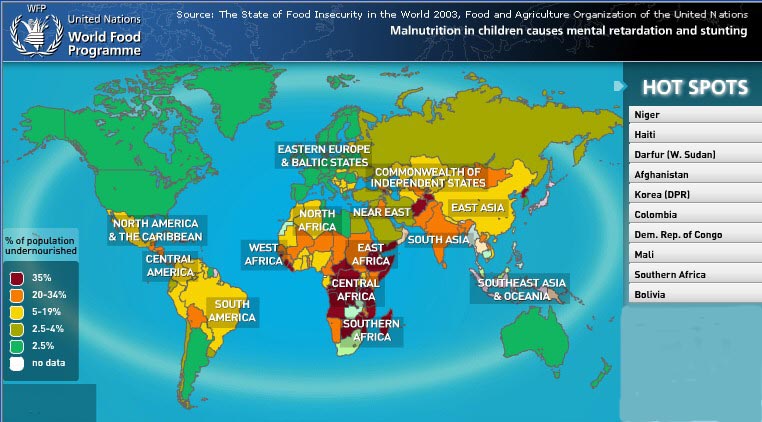
FROM: http://www.wfp.org/ Malawi facing serious food crisisMore than 4.2 million people in need of assistance11 August 2005, Rome - Malawi is facing its worst food crisis
in more than a decade, the result of a combination of factors, including
drought, floods, consecutive poor harvests, endemic poverty and the
effects of the HIV/AIDS pandemic, FAO said today.
Mission to Yemen reveals extent of tsunami damageLosses estimated at $2.2 million - FAO proposes project to help 2 000 families10 August 2005, Rome - Fishing communities in Yemen
were much more seriously affected by the December 2004 tsunami than had
been originally thought, with damages totalling around US$2.2 million and
2 000 families affected, a fact-finding mission carried out jointly by FAO
and the Yemeni Government has reported. FROM: http://www.fao.org/
$9.978 Billion Transferred to Development Fund for Iraq Transfers of $1 billion each were made on 28 May, 31 October and 18 November 2003 from the United Nations Iraq escrow account, at the request of the Security Council contained in paragraph 17 of resolution 1483 (2003) of 22 May 2003. Another $2.6 billion was transferred on 31 December 2003, a further $2 billion on 31 March and $0.5 billion on 19 April 2004. Three more transfers, totalling $1.128 billion, were made in 2004 and three transfers totalling $0.75 billion have been made in 2005. UN Secretary-General Praises Work of Oil-for-Food Programme
United Nations Secretary-General Kofi Annan has praised the Oil-for-Food Programme for accomplishing one of the largest, most complex and unusual tasks ever entrusted to the Secretariat.
In a statement to the Security Council (20 November 2003), he noted that the Programme, which closed on 21 November was the only humanitarian programme ever to have been funded entirely from resources belonging to the nation it was designed to help.
He said that in nearly seven years of operation, the Programme had been required to meet "an almost impossible series of challenges", using some $46 billion of Iraqi export earnings on behalf of the Iraqi people. Under the Programme, nine different United Nations agencies, programmes and funds developed and managed humanitarian operations in Iraq, meeting the needs of the civilian population across some 24 economic and social sectors.
The Secretary-General paid tribute to the national and international staff of the Programme and said that in accordance with Security Council resolutions, the UN would hand operational responsibilities, together with remaining funds and assets ranging from schools to electrical power stations and some $8.2 billion worth of food, medicines and other essential supplies – to the Coalition Provisional Authority.
He noted that the actual delivery of these items would continue well into next year and that any unspent or undispersed amounts would be transferred to the Development Fund for Iraq after the Programme closes. He said that although the UN was closing the Oil-for-Food Programme, it "remained determined to continue helping Iraq's long-suffering people" in whatever ways were still open to it. (Posted 22 November)
Oil-for-Food Programme Ready for 21 November Handover
The Executive Director of the Oil-for-Food Programme, Mr. Benon Sevan, updated the Security Council today (19 November) on arrangements for the handover of programme operations and responsibilities to the Coalition Provision Authority (CPA) on Friday. Termination of the Programme is effective as of midnight 21 November, 2003.
Mr. Sevan said that the CPA should ensure that appropriate arrangements are in place from 22 November for the effective management of the billions of dollars worth of supplies and equipment destined for Iraq from the Programme’s delivery pipeline and for authenticating the arrival of these goods to facilitate payment to the suppliers.
Mr Sevan noted that the CPA has been in close discussions with the UN independent inspection agent, Cotecna with a view to the retention of its services for a limited period after termination of the Programme and has given assurances that a final decision in that regard will soon be taken, thus ensuring the continuation of authentication arrangements beyond 21 November 2003.
Goods and supplies in the pipeline currently total some $8.2 billion and will continue to be delivered to Iraq well into 2004. (Posted 19 November 2003)
The Office of the Iraq Programme regrets that it is unable to respond to requests for information from companies or their representatives. The primary point of contact for companies is the Permanent Mission of their respective countries to the United Nations. _____________________________________________ Iraqi Oil Sales Fund Humanitarian Action The
Oil-for-Food Programme was established by the Security Council on
14
April 1995.
Some 3.4 billion barrels of Iraqi oil valued at about $65 billion were
exported under the Programme between December 1996 and 20 March 2003. Of
this amount, 72 per cent of the total was allocated towards humanitarian
needs nationwide after December 2000. The balance went to: Gulf War
reparations through a Compensation Fund (25 per cent since December 2000);
UN administrative and operational costs for the programme (2.2 per cent)
and costs for the weapons inspection programme (0.8 per cent).
FROM: http://www.foxnews.com/story/0,2933,132832,00.html Ex-U.N. official admits taking bribesSeparate oil-for-food probe also accuses former contracts officerFrom Phil Hirschkorn Paul Volcker announces the latest findings Monday of the oil-for-food investigation. UNITED NATIONS (CNN) -- A former U.N. official pleaded guilty to corruption charges Monday in the first case involving a U.N. staff member stemming from investigations into the defunct Iraq oil-for-food program. Alexander Yakovlev, a former senior contracts officer, admitted he received several hundred thousand dollars in bribes from companies that sought to do business with the world body. Yakovlev, a 52-year-old Russian, pleaded guilty to three counts in U.S. District Court in Manhattan -- conspiracy to commit wire fraud, wire fraud and money laundering. The bribes came from three unidentified companies -- all U.N. vendors -- between 2001 and 2005, prosecutors said. His attorney, Arkady Bukh, said Yakovlev agreed to plead guilty in the hopes of receiving a more lenient sentence. Bukh would not say whether Yakovlev is cooperating with investigators. Yakovlev surrendered to authorities Monday after the United Nations lifted the diplomatic immunity that protects its employees from prosecution. He has no prior criminal record. The move by prosecutors came just as a panel appointed by the United Nations to probe the oil-for-food program issued a harsh report on Yakovlev's actions. (Full story) The Independent Inquiry Committee investigation, led by former U.S. Federal Reserve Chairman Paul Volcker, found that more than $1.3 million was wired into an account for a dummy firm called Moxyco that Yakovlev established in 2000 in the Caribbean island of Antigua. Volcker reported that "more than $950,000 of these payments came from various companies or persons affiliated with such companies that collectively won more than $79 million in United Nations contracts and purchase orders." Volcker told CNN in an interview, "Mr. Yakovlev received bribes." He said the payments were not necessarily associated with oil-for-food business. A law enforcement source said the timing of Volcker's report and the plea was "coincidental," noting that Volcker was originally going to report Tuesday. Yakovlev was initially investigated for soliciting a bribe from a French company that bid for a key U.N. contract to monitor Iraqi oil exports made under the oil-for-food program, which supplied Iraq with food and medicine during years of international sanctions. That company, Societe General de Surveillance, did not win the contract; it went instead to Saybolt, which bid slightly less. Nor did the Volcker committee find evidence that the company paid a bribe. Prosecutors, meanwhile, said Yakovlev's illicit funds landed in bank accounts he controlled in New York City and Yonkers, the city in New York's Westchester County where he lives. Yakovlev resigned his U.N. job in June amid allegations that he helped his son get a job with a firm doing business with the world body. U.N. officials lifted Yakovlev's diplomatic immunity Monday afternoon at prosecutors' request, said Mark Malloch Brown, chief of staff for Secretary-General Kofi Annan. Brown said the United Nations brought the allegations to the U.S. attorney's office in New York "more than a month ago" and has been sharing information with prosecutors as part of efforts to reform the world body. Yakovlev was released on $400,000 bail after pleading guilty. No sentencing date has been set. Federal and state prosecutors also are investigating Benon Sevan, who ran the oil-for-food program for seven years. Volcker's panel said Monday that Sevan received more than $147,000 in kickbacks from oil sold under the program. (Full story) Sevan resigned Sunday from the United Nations. In his resignation letter, he called his management of the program "transparent" and denied any wrongdoing. (Full story) One company involved in oil-for-food probes, Texas-based Bayoil, and three of its officers were indicted previously on charges they paid illegal kickbacks to the Iraqi regime, which controlled who could buy its oil. Two other people have been indicted on charges of illegally lobbying for Iraq. One of them, Samir Vicent, pleaded guilty. |
|||||||||||||||||||||||||
Recently, David Walker, the Comptroller General of the United States, noted that the official debt of the United States is more than $7 trillion, which is about $24,000 for every man, woman, and child in America. Mr. Walker told the National Press Club, however, that if you count the unfunded liabilities--in other words, the promised benefits of entitlement programs, including the new $8 trillion unfunded liability on the prescription drug benefit alone--you are talking about $42 trillion, equal to about $140,000 for every man, woman, and child in America.
|
|||||||||||||||||||||||||
| THE WTO - WORLD TRADE ORGANIZATION
In Seattle, it seemed as if the WTO had become the bte noire for all manner of Western interest groups, including environmentalists, trade unions, animal rights activists, food nationalists, and some who simply oppose the notion of market liberalisasion. These groups took to the streets en masse, and, to the dismay of the negotiators, the "battle in Seattle" garnered enormous media attention throughout the meetings, and the notion also arose that their stand against the WTO in Seattle's streets had somehow induced the collapse of the talks. . Protesters were enormously successful in conveying the idea that civil society had been both locked out from the talks and systematically denied the benefits of globalisation. Since Seattle, moreover, an argument has arisen that trade liberalization has had no benefits for those on the lowest rung of the world's economies. The problem with this claim is that it is impossible to establish a positive correlation between trade and the numbers of those living in absolute poverty; indeed war, natural disaster, bad governance and corruption are the more likely culprits. In addition, trade actually appears to have greatly benefited those developing countries that have adopted liberal structures and reasonable standards of governance. According to the WTO, developing countries' merchandise exports in 1999 rose 8.5% faster than world trade as a whole. The overall share of world manufactured exports of the non-OECD countries has doubled from 10% to 20% since 1980, and over a third of foreign direct investment now flows into less developed countries. The World Bank projects that the non-OECD share of world trade and output could double to 50% and 30% respectively by 2020. According to one economist, "Although it is occurring somewhat gradually and patchily, there seems to be rising awareness and appreciation of globalisation's advantages allowing national economies to allocate resources more efficiently through specialization and exchange (in static terms) and (in dynamic terms) to reap productivity gains and higher growth through widening the geographic range of markets and increasing exposure to world class competition and technology transfer, among other things...On the trade front, for instance, the fastest growing developing and transition countries are clearly those with the highest degree of openness to imports and exports". The WTO Director General Mike Moore concurs with these arguments recently writing that "trade alone may not be enough to eradicate poverty, but it is essential if poor people are to have any hope of a brighter future". It is nonetheless true that only a relatively small percentage of the less developed countries have liberalized their trade regimes sufficiently to capture the benefits free trade generates, and in some cases, the combination of partial liberalization, continued controls, and corruption has proven economically disastrous. Finally, since the mid-1980s, much of the process of liberalization in the developing world has been unilateral; in other words, governments in those countries have decided that liberal trade regimes are in their best interest and have acted accordingly. Beyond communicating quite clearly that the WTO needs to improve transparency, and governments need enhanced dialogue with their societies about the potential virtues of free trade, the street protesters and the sub-group that engaged in rioting (it should be noted that the union movements and many other protesters did not participate in the ugly violence that shut down the city centre) provided convenient and easily conveyed symbols for the fiasco that was unfolding inside the meeting rooms. Outstanding differences between the United States and Europe, of course, were also very much part of the failure at Seattle. These transatlantic trade disputes are rooted in a series of structural, political, cultural, and economic differences, which seem increasingly difficult to contain. Clearly the much-evolved relationship between the United States and Europe is an important part of the story. The vision the Americans held for Europe in the immediate post-war is now a reality. Europe is ever more united, confident, prosperous and secure. It is also, not surprisingly, more assertive, and this is evident in many multilateral fora, including the WTO. In structural terms, where trade between the United States and Europe was in balance in the early 1990s, America's trade deficit with Europe, and indeed with the world, has mushroomed since 1994. Through June of this year, the US trade deficit totalled $177.6 billion, up from $116 billion for the same period in 1999. This puts the United States on track for a $355 billion trade deficit, far exceeding the record year of 1999 when the deficit hit $265 billion. Moreover, the US trade deficit is not a function of global protectionism, as is often maintained in American political circles. Rather, it reflects underlying macro-economic conditions, a huge inflow of foreign capital and indeed, the very structure of the US economy. In fact, the United States long laboured under a rather high propensity to import. Growth in the American model has therefore typically been accompanied by large trade deficits. Since the mid-1980s, the United States has moved from being a net international creditor nation to being a net debtor with a balance of payments deficit that could exceed $2,000 million this year, 80% of which is financing consumption as opposed to investment. The IMF projects continued record deficits at least until 2001, and these cannot be reduced without having an unwelcome impact on European and Asian exports. The US trade deficit proved politically acceptable when American growth was relatively moderate, but that trade deficit has been expanding at a remarkably high rate in recent years. Whereas the normal pattern had been for large US trade deficits to trigger currency depreciation, which, in turn, depressed import levels and boosted US exports, today the United States, with its highly dynamic equities markets, continues to attract enormous capital inflows that have helped sustain growth and consumption, boost the dollar's purchasing power, and thus underwrite ever mounting imports. As a result, the current account short-fall in the United States is approaching 4% of GDP, and there is no sign of an impending correction. Many economists maintain that this pattern is unsustainable over the longer term, particularly once foreign investors, who have poured money into the dynamic US economy over the last decade, begin to feel jittery about US equities markets. It is nevertheless worth noting that the combination of American growth and high import propensity has made the American economy an engine of world growth and a critical factor, for example, in limiting the impact of the recent Asian financial crisis. America's high propensity to import combined with the falling value of Asian currencies precipitated a new Asian export boom which, in turn, fostered a rapid recovery in countries which, months before, had been in the midst of financial collapse. Undoubtedly, the United States has also been an important catalyst for Europe's impressive growth over the last several years. Thus, to characterize American deficits as an entirely negative phenomenon is misleading, particularly from a global perspective.
Nevertheless, soaring trade deficits have unleashed
protectionist forces in the United States, despite the fact
that unemployment is very low and the country is enjoying
its longest continuous economic expansion in history. The US
Congress and Presidential aspirants alike confront enormous
pressure to shield well-organised import competing
industries from all manner of "unfair" trade
practices which, broadly defined, apparently include low
wages, depreciated currency and inadequate environmental
standards in exporting countries. Moreover, the United
States has preserved the right to do so with tools that US
trade partners sometimes see as unilateral in nature. They
argue, for example, that the use of "Section 301"
countervailing duties reflect both an American tendency to
disregard multilateral solutions to bilateral trade disputes
and an unwillingness to accept the consequences of the
declining competitiveness of certain US industries. The
United States leads the world in imposing anti-dumping
duties with over 300 currently in place, and in Seattle, US
negotiators insisted that these practices should not creep
onto the agenda despite widespread opposition to their use
among other countries. The WTO's dispute settlement mechanism (DSM) can fairly be called the backbone of the new system. The DSM represents an enormous improvement over old GATT rules, under which disputes were frequently left unsettled. Under the old GATT system, panel rulings could not be issued without unanimous consent - that is, without the agreement of the country that had lost the case. Needless to say, such an arrangement hardly commanded respect for the rules of the game. New WTO procedures have closed this loophole by allowing rulings to stand unless there is unanimous opposition. The WTO has also established a permanent appellate body. With a few exceptions, the system is working well. More than 180 cases have been brought to the WTO since January 1995 - most by either the United States or Europe. Importantly, developing countries have also brought cases against much larger developed countries and won. Agriculture has become a perpetual thorn in the side of US-European relations. Yet, according to the OECD, agriculture accounts for only 2% of the EU's and 1.7% of the US' total output. And out of about $6/7 trillion of world trade in goods and services, agriculture accounted for $0.5 trillion or 8% of the total The United States argues that 85% of the world's agricultural subsidies originate in the EU and that these subsidies not only undermine American farmers but those in developing countries as well. Agricultural exporting nations have called for an end to a special concession agreed during the last round called the "blue box", which permitted countries to pay aid directly to farmers to compensate for price cuts based on the amount of crops they plant or the number of animals in their possession. There are currently no limits on blue book trade distorting expenditures and according to US Agricultural Secretary Dan Glickman, "the EU has exploited this loophole to the tune of $25 billion per year while US blue box expenditures remain at zero". The United States government recently tabled new proposals for agriculture talks. It is calling for substantial reductions or elimination of tariffs, expansion of remaining tariff rate quotas, elimination of export subsidies, disciplined use of export restrictions on agricultural products, limits on state trading enterprises, simplification of rules for domestic support and a ceiling on trade-distorting support. The US government is particularly focused on eradicating what it calls trade-distorting support measures, but it has recognized that national support systems that are not trade distorting should be permitted. The European Commissioner for Agriculture Franz Fischler counters that the agriculture reforms outlined in the EU's Agenda 2000 reform plan have frozen expenditures on agriculture and shifted support to less trade-distorting forms while its trade partners are moving in the opposite direction. Indeed, EU export refunds fell to 9.4% of the total value of exports in 1998 from 55% in the early 1990s. One should note as well that the US Administration contends that the billions of dollars it has paid to farmers over the last two years to compensate for the effects of draughts and floods were not trade distorting. In June, the US Congress passed, and the President signed, a disaster relief bill providing $15 billion to farmers. The EU calls this trade distortion by other means. Commissioner Fischler points out that in America, "direct support to farming has increased by roughly 700% since 1996 and the U.S. government is now granting three times more support per farmer than Europe despite a more favourable geography É". Fischle Her also notes that Europe is the largest importer of agricultural products in the world. On the face of it, therefore, the foundation for agricultural trade liberalisation does not seem particularly solid. Yet, the EU agrees that agriculture should be the subject of negotiations and even that some of its direct and indirect subsidies should be reduced. Europe's governments, however, are generally not in a hurry to advance this politically sensitive set of talks, and the EU accordingly is seeking a broad "multi-functional" framework for agricultural talks which, by their sheer breadth, are likely to slow down the talks to a snail's pace. Article 20 of the Agreement on Agriculture permits certain agricultural issues not directly related to international trade to be taken into account in trade talks, and the Europeans are intent on doing so. Franz Fischler recently noted that, "We have to strike the right balance between progressive reductions in support and protection and non-trade concerns...if the European Union will play a constructive role, this does not ...mean that the EU would be prepared to sacrifice the European model of agriculture on the altar of liberalisation." In documents presented at a special session of the Agriculture Committee meeting of the WTO held in Geneva this past June, the Europeans sought to off-set the US push for liberalisation by insisting that a new trade regime in agriculture incorporate strong considerations for environment, health, social standards, food safety and quality, animal welfare, rural-urban population balances and cultural diversity. The Cairns Group and the United States, in turn, submitted papers in Geneva that revealed their intention to push for the end of direct Union aid and export refunds. Another factor in European agricultural reform relates to the imminent enlargement of the European Union. Enlargement will not be possible without key changes in the CAP. To include a country such as Poland in the current system would cause a financial haemorrhage in the EU budget and thus the pressures for change are coming not only from the United States, Canada and the Cairns Group, but also from within Europe itself. European banana import policy has been the most notorious transatlantic agricultural trade dispute in recent years and illustrates the kinds of transatlantic tension that agricultural matters perennially provokes. Although WTO panels have ruled seven times that the EU's banana regime is illegal, the EU continues to extend certain privileges to ACP countries within the framework of the Lomé Agreements. This has raised questions regarding the WTO's capacity to monitor compliance with panel rulings. The United States and a number of Latin American countries continue to challenge these concessions, and the United States and Ecuador recently won a landmark ruling granting them compensation for lost markets due to the EU's preferential system. There are signs, however, that both sides are moving to patch up differences over EU banana import policy. The EU is under intense pressure from European companies to settle the dispute because the United States and Ecuador have implemented sanctions with the WTO's blessing; damages to US producers were estimated at $191.4 million. In May, the American Congress introduced legislation, subsequently signed by the President, which introduced revolving sanctions. The EU claims that this "carousel" approach, which over time would spread the impact of sanctions more widely across European exports industries, will prove particularly costly to EU producers. This list of sanction imports is to be changed every 180 days, and those companies originally targeted, will invariably have difficulty rebuilding market share once their products have been removed from the list. The United States Administration has delayed implementing the carousel as it has been very concerned about the WTO's ruling on Foreign Sales Corporations (see below) and may be looking for room to cut a deal. In September, the Administration unveiled $308.2 million in tariffs on previously unsanctioned products. But a direct appeal from British Prime Minister Tony Blair, who was acutely concerned that cashmere had been targeted, has led to another delay until 1 October in implementation. Prohibitive tariffs of 100% might have created serious political problems for the UK government in Scotland. Pascal Lamy has vowed to challenge the carousel approach in the WTO, but he has also promised to find a solution to the ongoing banana and hormone-treated beef disputes. In July EU foreign ministers proposed a new system for distributing import licences for bananas that would grant those licences on a first come first served basis - in other words, the first ships in the port would be granted that month's licence. The proposed system would most likely comply with WTO rules. The United States is seeking a timetable for a European transition from a quota-based system to a tariff-only scheme. France, Portugal, Ireland and Spain do not want to go to a non-discriminatory tariff-only system on banana imports while most northern EU states simply want this dispute to be solved as quickly as possible. But the new EU proposal could mark a path to a resolution of the dispute. EXCERPTED FROM: http://www.nato-pa.int/archivedpub/comrep/2000/at-253-e.asp THE SEATTLE WTO PROTESTS WTO
(WORLD TRADE ORGANIZATION) SEATTLE PROTEST |
|||||||||||||||||||||||||
| The need for Globalization?
In February 2002, the ILO (International Labour Organization is the UN specialized agency which seeks the promotion of social justice) established an independent World Commission on the Social Dimension of Globalization, co-chaired by President Tarja Halonen of Finland and President Benjamin Mkapa of Tanzania and comprising 26 eminent commissioners from a wide range of walks of life and different parts of the world, each serving in their individual capacity. Its broad goals were: to identify policies for globalization that reduce poverty, foster growth and development in open economies, and widen opportunities for decent work; to explore ways to make globalization inclusive, so that the process can be seen to be fair for all, both between and within countries; to promote a more focused international dialogue on the social dimension of globalization; to build consensus among key actors< and stakeholders on appropriate policy responses; and to assist the international community forge greater policy coherence in order to advance both economic and social goals in the global economy. The report of the World Commission, A fair globalization: Creating opportunities for all, was released on 24 February 2004. It is available on the Commission’s website: http://www.ilo.org/public/english/wcsdg/index.htm EXCERPTED FROM: http://www.ilo.org/public/english/bureau/ integration/download/publicat/4_3_285_wcsdg-wp-27.pdf
TAMPERE JUNE 3, 2005 Peter Rossman, Communications Director for the IUF Good afternoon Sisters and Brothers. My name is Peter Rossman, I am the Communications Director for the IUF and also responsible for much of the international solidarity work we do at the secretariat. On behalf of our members around the world, organized in 356 unions in 125 countries, I bring solidarity greetings to SEL members and participants in this seminar, and apologies for his absence from our general secretary Ron Oswald, who was called to take part in urgent negotiations involving our North American affiliates and deeply regrets that he is unable to be here with you. I've been asked to speak about globalization, its impact on food unions and how unions can respond. It's an enormous question. I think the best way to address it is to first ask what we mean by globalization, particularly in the agrifood sectors which is where the IUF has most of its members, because getting the answer right from a trade union point of view depends on how we frame the question. Is globalization about global trade as the dominant economic force? The industrial revolution of the nineteenth century, which permanently changed the way we live and work, was built on global imports and global exports - think of the British textile industry, for example. Is it about global finance? Developments on global stock exchanges and commodity markets have been shaping events thousands of kilometers away for decades and even centuries. When the major financial markets crashed between the two world wars, the whole world was dragged into global depression, in part because the banks were so closely interrelated. Is it about mass migration, which is such a big part of the discussion around globalization, and not only in Europe? The biggest migrations in human history took place over a century ago, making it possible, for example, for the United States to build its industrial strength on the basis of an immigrant workforce. Is it about the migration of jobs? Global shifts in manufacturing and services have been a constant feature of modern capitalism at least since the industrial revolution. England lost its manufacturing supremacy long before anyone talked about globalization. The discussion then was about loss of markets, industrial decline, loss of competitive advantage and loss of national identity - all very familiar themes. Industries, investment capital, people and jobs have been continuously on the move for centuries now. While it is true that they move further and faster today, we have to look elsewhere to see what is new and distinct about globalization. If we look more closely at trade over the past two decades, the striking thing is not the growth in the volume of world trade, but the relationship between trade and investment. In 1999, the value of total global exports was some 7 trillion US dollars. But the value of total sales by the foreign components of the world's transnational corporations was over 13.5 trillion US dollars. Over the two previous decades, there was a significant and lasting shift in the ratio of TNC sales to global exports. These sales increased many times faster than exports rose. The figures show the process by which the TNCs extended their reach through mergers and acquisitions. The biggest percentage of world trade by far is now trade within transnational companies. Behind these statistics is an enormous process of corporate concentration. Two TNCs now control 80% of the global grain trade, 4 TNCs the production of global starches, 5 TNCs the global banana trade, 2 TNCs close to half the global trade in roasted and instant coffees, 3 control 83% of global cocoa processing. The dairy, meat, brewing and beverage sectors all tell a similar story. A handful of companies dominate seeds and agri-chemicals, the key agricultural inputs. An even smaller number control the key commercial patents which enable them to dominate their markets and collect royalties and licensing fees. A similar process of concentration is now at work in the retail and fast food sectors, with tremendous impact back along the supply chain because supermarkets and fast food restaurants are now the biggest buyers of food products and powerful enough to influence prices and conditions of production. Even water is being privatized and brought under corporate control, and agriculture consumes nearly three-quarters of global water resources. The essence of globalization in food and agriculture is growing corporate control at every stage of the food we all depend on. Globalization is therefore not about trade as such. It's about a shift of resources to the TNCs and the transfer of resources within those companies. Globalization is about TNCs, concentration and investment. The direct consequence of this concentration has been, for workers, growing competition and downward pressure on wages and working conditions. Global supply chains, global marketing strategies, global branding, induced competition within the individual components of company operations, all give companies a greater capacity to place workers in competition with one another. Deregulating national labour markets in the name of flexibility gives employers additional tools to dilute union bargaining power and increase the competition even further through casualization, outsourcing and the other mechanisms we've become so familiar with. The downward limits of this global competition are ultimately set by repression. Banana production, for example, is shifting away from unionized parts of Central America and Colombia to Ecuador, where destroying unions is national policy. Increasing competition within TNCs and their suppliers means that the corporations ultimately strive to dispense with a permanent salaried workforce, just as they seek to minimize their fixed assets. This is the formula behind the Coca-Cola success. The parent company actually has very few workers, and operates through a network of franchises and "anchor bottlers." This is the globalization we're experiencing, something very different from the universal prosperity the WTO, the corporations and their politicians have been trying to sell us. The truth is that inequality, both between and within nations, has increased over the last ten years. There are, according to United Nations figures, 20 million more hungry women and men in the world today than there were two years ago, and it has nothing to do with the weather. There is more hunger and more insecurity. None of this is the inevitable result of autonomous economic forces. It is the product of a conscious political and social project, driven by transnational investors. It is a project of global deregulation which embeds investor rights in a global set of rules and a global system which reduces rights for the rest of us. It is about power in society, including of course the power relationship between the labour movement and the employers. It is about a new institutionalized hierarchy of rights, in which corporate rights outweigh all other rights at the level of enforcement. This system of power is codified and given enforcement authority through the WTO, and reinforced through the actions of international lending institutions like the World Bank and the IMF which are also instruments of corporate policy. The rules are backed up with economic sanctions administered by the WTO, so they are enforceable in a world where the other international institutions, like the ILO, or international Conventions on human rights, have little or no enforcement capacity. What do these new rules mean for food workers? Let's take a concrete situation, the poultry industry. IUF members in West Africa now tell us (and trade statistics back them up) that in their countries locally produced chickens have virtually disappeared, along with many other food products that were produced locally until very recently. Poultry farmers, unable to compete with low-cost foreign suppliers, have simply stopped producing, and have therefore lost their major source of livelihood. Chickens in West Africa are now being supplied primarily by French companies who benefit from EU subsidies, either direct export subsidies or subsidies through the artificially low price of their feed, which is sold below the price of production under the Common Agricultural Policy. This is the meaning of dumping food products on world markets. At home, these companies are speeding up production, closing plants, fighting unions, crippling workers through repetitive strain injuries as a result of the excessive line speeds, and producing poultry of questionable quality and safety, due to the high rate of salmonella and other forms of contamination. The leading French poultry TNC, Doux, is now demanding that its workers perform 39 hours of work in exchange for 36 hours paid. Many French poultry workers are in fact immigrants from countries where migration is the only option when local agriculture has been destroyed and there are no jobs in the cities. Here we see very concretely how the food system is failing workers, consumers and farmers both in France and in Africa. What are the rules which make this possible? First we have the WTO Agreement on Agriculture, which legalizes the dumping of subsidized agricultural products at prices below the cost of production, sets food safety and quality requirements below the standards previously established in many countries, imposes minimum import requirements, and deprives countries of the right to defend local and national food production systems. This has helped bring about a surge in the import of basic food staples by countries which were formerly self-sufficient in these areas. What the export figures don't show is the shattered lives and livelihoods in the food importing countries, the further growth in the power and size of the inflated agrifood exporting companies which are largely, though not entirely, based in the North, and the pressure on our members in the North and in the South. We have the WTO agreement on trade in services, the GATS, which among other things limits the ability of states to regulate retail commerce. While the basic element of the GATS is the deregulation of what were previously thought of as public goods and public services like health care, water, and even education and environmental protection, the GATS agreement is also the international treaty force behind the growth in transnational supermarket chains. Another "pillar" of the global investment regime, to use the language of the WTO, is the Agreement on Trade Related Intellectual Property Rights, or TRIPS. This agreement gives the agrofood, biotech and seed companies the ability to impose patent-protected genetically-modified seeds which have to be purchased every year, rather than being saved as farmers have done for thousands of years. These seeds require massive applications of pesticides. In many cases the pesticides are produced by the same companies which modified and patented the seeds, in other cases the seed and pesticide companies work together with the grain processors and traders through de facto cartels. WTO rules make it illegal to distinguish between GM and non-GM seeds and foods as soon as they enter into international trade. Even labeling requirements are being challenged at the WTO as "barriers to trade". The companies literally wrote these rules, and the rules are there to help them gain monopoly control of agricultural inputs. The TRIPS agreement is the same treaty that recently obliged India to change its patent laws to effectively outlaw the manufacture of low-cost generic drugs to fight HIV/AIDS. India has the second highest number of AIDS sufferers in the world, and was a major source of low-cost generic medicine for Africa. The WTO regime demands that profits take precedence over the right to health. Some 700,000 HIV/AIDS patients in developing countries are now denied access to affordable retroviral drugs in the name of WTO compliance. Finally, we have the new investment rules. Global capital mobility is sometimes presented as if it were a natural consequence of technological change, like advances in electronic communications. But it is the result of conscious political changes, specifically the removal of nationally imposed limits and conditions on foreign investment. Between 1991 and 1999, there were over 1035 changes worldwide to countries' laws on foreign investment. 94 % of these changes gave more operating freedom to foreign investors and reduced government regulation. This wasn't the product of an abstract process called "globalization". It was a conscious, directed political process. When we're told that we need "rules-based" trade, we have to ask: whose rules? who benefits? Current investment rules in the WTO already outlaw such tools as limits on the repatriation of profits by foreign investors, local content requirements, technology transfer requirements and so on. All these regulatory policy instruments are now considered barriers to trade and the WTO makes them illegal. But these don't go far enough for the companies, who keep pushing for even more room to operate without constraints. This is why new investment rules keep reappearing on the WTO agenda, and around it, in a process designed to ratchet up pressure on the WTO, in regional and bilateral trade and investment agreements, including the EU's Economic Partnership Agreements. These new rules are best defined in the investment rules contained in the North American Free Trade Agreement, NAFTA, which are also the model for the regional and bilateral agreements. NAFTA outlaws the imposition of virtually all regulatory requirements for foreign investors by giving investors the right to demand compensation for actual or even potential future loss of earnings, in which case the individual corporation can bring a lawsuit against the offending state and demand compensation. These rules redefine the meaning of regulation. Policies, measures and laws which restrict, guide or limit the activities of foreign investors are now considered to have "taken away" the real and imagined property of the corporations. This applies equally to public heath, consumer and worker health and safety and environmental requirements. In one case a US chemical manufacturer of a toxic product successfully argued in its lawsuit to overturn a Canadian national ban that parliamentary debate in Canada about the product's safety was itself a form of expropriation. Driving this project is the search for hyper profits. The growth of international money market funds and the unprecedented capital mobility which is driving and benefiting from global deregulation has brought about the financialization of manufacturing, services and even agriculture. Investors in these sectors now demand rates of return equal to what they can get in global financial and stock markets, rates unthinkable even a decade ago. The head of Deutsche Bank recently stated that return rates of 20% on investment should be the eventual target for investors. The example of Danone - a company which recognizes the IUF - is typical. The company invested a considerable part of its considerable profits last year in buying back its own stock, an operation designed for no other purpose than to boost its share price. These unprecedented rewards for investors are the flip side of "jobless growth". It is now highly profitable to close profitable units. Here we have the essential elements in the globalization we have to fight if we're going to survive as organizations for defending our members and sustaining the wider labour movement as a vehicle for social progress. Financialization and deregulation not only mean that workers are being squeezed in ways which traditional bargaining strategies have found difficult to resist. They mean that jobs are being systematically destroyed along the food chain by favoring a hyper-intensive, export-dependent system of food production. The destruction of small and medium enterprises, the transportation of primary, processed and semi-processed foodstuffs over long road and air routes, and the destruction of local food systems under the impact of cheap, subsidized imports are destroying employment in both developed and developing countries. We have to fight back, and we have to fight back by confronting the employment-destroying nature of the system as a whole, which is not the same thing as fighting individual plant closures. In the first place, we fight back by doing what unions have always done: we organize to limit competition among workers. We can do this in the first instance by organizing to stop the outsourcing and casualization which are now rampant in the leading agrifood TNCs. The IUF has many examples of successful organizing to gain permanent status for casual workers. We need to extend this kind of best practice through the operations of each company in which we have members, and that is virtually all of the agrifood transnationals. We need to organize to ensure full respect for trade union rights, and we need to use these struggles to build up our strength, plant by plant, company by company, to get the corporations to the bargaining table. We need international recognition, not "codes", "compacts" and "social responsibility" exercises, so that when we get these companies to the table - and some of them, but not enough, are already there - we can broaden the agenda to begin to roll back the kinds of policies that are destroying our members' jobs. We need to give life and substance to international organizing, with the resources we have, to bring the isolated struggles our members are engaged in into a more coherent and effective global force. In short, we need to build the IUF, which means greater involvement and greater commitment to our work on the part of each and every affiliated union. We need you, because you are the IUF. At another level, we need to struggle for a new global regulatory framework to affirm our rights and to put in place the kinds of social and environmental safeguards which the WTO is undermining. That is a challenge which is fundamentally political. Union "lobbying" of the WTO and the international financial institutions, if we are to be honest, has not slowed down the companies. We've been confined to tinkering with a program which is fundamentally, radically anti-democratic and designed to lock workers and the poor into a position of permanent inferiority vis-à-vis the transnationals. Significant change has never come about by tacking a wish list on to the employers' program. Unions must regain the coherent vision and the independence of thought and action which have always been the force behind genuine reforms. We need to develop a political response to
the corporate program, and we need to link
this program to our members' day-to-day
struggles in ways which can effectively
challenge the enormous shift in the balance of
power which is what globalization is
fundamentally about. While the challenge is
enormous, we must never forget that the
historic gains of the labour movement - gains
which profoundly transformed the world we live
- seemed scarcely realizable when we first
began to fight for them. We fought and we won.
There was nothing inevitable about the
corporate advances of the last two decades. We
were simply out-organized at all levels, or,
failed to organize because we didn't
appreciate the significance of what was taking
place. Thank you very much.
|
|||||||||||||||||||||||||
|
Zim
asks donors for US$109m Dec. 12, 2003 CRISIS-RIDDEN Zimbabwe has implored aid agencies to solicit US$109 million from donors to meet outstanding funding requirements for next year, it has been learnt. The figure represents about 10% of the $7,7 trillion 2004 budget presented last month. The agencies have appealed for donations to help President Mugabe's embattled government to breathe new life into almost every sector of the economy. According to recent figures by the United Nations Humanitarian Appeal 2004 report, Zimbabwe needs funding to boost the agricultural sector, resuscitate the crumbling economy, and revive the health delivery system. The report also indicates that a big chunk of the money (US$42,8 million) would go towards "economic recovery and infrastructure". Mugabe has blasted the same donors - especially Britain and the United States - accusing them of sabotaging the country's economy. The two countries have been Zimbabwe's biggest financiers in food assistance. The agencies are also appealing for international donors to pour in US$24,2 million to cater for the health sector which is crumbling due to the perennial shortages of medicines and intermittent strikes by doctors and nurses. A further US$2,9 million is required for "protection, human rights and rule of law". For coordination and support services, the UN said Zimbabwe needed US$3,3 million. In July this year Minister of Finance Herbert Murerwa appealed through the United Nations Development Programme for food and medicinal drugs worth US$142 million. Zimbabwe needs to import over 700 000 tones of maize to make up for the deficit caused by the chaotic land reform programme and drought conditions in the region. High on Murerwa's priority list were health requirements to cater
for malaria and Aids.
" Analysts doubt whether donors will be forthcoming with their money following President Mugabe's decision last week to unilaterally withdraw Zimbabwe's membership of the Commonwealth after the country's suspension was extended indefinitely in Abuja. Much aid from Britain and Australia was premised on close Commonwealth ties. FROM: http://www.theindependent.co.zw/news/2003/December/Friday12/1627.html
|
|||||||||||||||||||||||||
|
|||||||||||||||||||||||||
|
August 8, 2005 Globalization hurts the poor June 10, 2002 - Globalization isn't necessarily a bad thing,
says Ricardo Acuña.
|
|||||||||||||||||||||||||
| From USA Today October 2, 2003 Globalization hurts USA By John Sweeney John Sweeney is president of the AFL-CIO, which represents 13 million workers. Let's face it. Globalization under the old rules -- reflected in current trade policies -- just isn't working. It's not working for American workers, who have lost millions of family-supporting jobs due to flawed trade policies such as NAFTA and the one that created the World Trade Organization (WTO). It's not working for state and local governments, which are finding that common-sense policies to protect workers, public health or the environment are increasingly being challenged by obscure trade rules. And it's certainly not working for developing countries, which are seeing poverty and inequality grow even as trade and investment increase. Here in the U.S., poverty is up, incomes are down, and we are losing more jobs than at any time since the Great Depression, especially in the manufacturing sector. America is saddled with a half-trillion-dollar trade deficit. We've let multinational corporations write our trade policies for too many years. The result is a set of agreements that grease the skids for our jobs to go overseas, while doing too little to protect human rights, workers' rights and the environment. Given this reality, President Bush certainly should keep his 2002 steel safeguards in place so the domestic industry can continue to recover and adjust. The safeguards have stabilized steel prices. Bankruptcies and layoffs have slowed, and steel companies are more profitable now than they were before the safeguards took effect. The fact is that a majority of Americans do not support unregulated free trade; 54% say the United States needs to focus on keeping American jobs for American workers, while only 35% say companies must operate in worldwide markets, according to a recent poll conducted for NBC and The Wall Street Journal. U.S. policy needs to address growing public concerns, not ignore them. Trade, tax and health care policies need to put jobs first. The Democratic presidential candidates have all vowed to reshape globalization so it really works for working people -- with enforceable protections of workers' rights and safeguards for domestic regulations and our trade laws. Until we achieve this goal, workers here and abroad will continue to fall behind. |
|||||||||||||||||||||||||
| "NAFTA.. is the
constitution of an emerging continental economy that recognizes one
citizen--the business corporation. It gives corporations extraordinary
protections from government policies that might limit future profits,
and extraordinary rights to force the privatization of virtually all
civilian public services. Disputes are settled by secret tribunals... At
the same time, NAFTA excludes protections for workers, the environment
and the public...
"Average real wages in Mexican manufacturing are actually lower than they were ten years ago. Two and a half million farmers and their families have been driven out of their local markets and off their land by heavily subsidized US and Canadian agribusiness... In the U.S. "at least a half-million jobs have been lost" (Jeff Faux. "NAFTA at 10: Where Do We Go From Here?" The Nation, Feb. 2, 2004, 11).
|
|||||||||||||||||||||||||
|
|||||||||||||||||||||||||
Let Them Drink Coke
|
|||||||||||||||||||||||||
|
GLOBALIZATION LINKS
and
part II. LINKS COURTESY OF: http://www.accd.edu/pac/lrc/globalization.htm
|
|||||||||||||||||||||||||
|
WTO AND GLOBALIZATION LINKS ON THIS SITE |
|||||||||||||||||||||||||
|
THE
NEW WORLD ORDER -WHAT IS IT? BLACK
AND WHITE - THE PROBLEMS IN GUATEMALA THE
ELECTRIC OCTOPUS CHINA
SHIP MISHAP - ACCUSED OF LINING UP 100 MISSILES Medical
Teams' Advice for Protesters Carter
to Clinton - The Becoming DEES
DREAMS AND VISIONS BILDERBERGS
AND MUSIC A
NEW PERSPECTIVE ON SELF-SUFFICEINCY - A dream and links NATIONAL
SECURITY - HOLIDAY TERRORISM EARTHDAY
- 2000 concentrationcamplocations CABAL
OF CABALA - PART III BILL
CLINTON DIASPORA
and RACE RIOTS THOMAS
PAINE FEAR
FACTOR ANTI WATER
QUALITY IN THE UNITED STATES NEW
WORLD ORDER ASIA
REVEALS ITS DARK SIDE POPULATION
EXPLOSION - A PROBLEM TO SURVIVAL OF HUMAN EXISTENCE THE
PUPPETMASTER CABAL
OF CABALA - PART I WAR
WITH IRAN ANTI-BUSH
PROTESTS REPUBLICAN CONVENTION 2004 288 arrested and the ... WHAT
WOULD YOU DO IF THE ELECTRICITY WENT OFF? DC Police Crack Down on Anti-Capitalist Protests
Anti-War Global rallies protest possible US war on Iraq - Oct. 26 ...
THE LAW - DISENFRANCHISED WOMEN
UPLIFTING WOMEN - CRIMES OF VIOLENCE AGAINST WOMEN AROUND THE WORLD
UN Millennium Assembly celebrates arrival of global governance
EVIDENCE FOR THE NEED OF A GLOBAL PEACE VIGIL
NATIONAL SECURITY - HOLIDAY TERRORISM
SUSPICIONS OF THE SEPTEMBER 11, 2001 EVENTS AT THE WORLD TRADE CENTER
RED LINE - BLUE LINE - THE DREAM AND THE REALITY
HOW THE GOVERNMENT BLEW UP MANHATTAN - 9-11-2001
THE LADY IN GREY - DEATH IN THE OFFICE!!!!
THE PRESIDENTIAL CABINET - HILARY CLINTON VS CLONING - THE DREAM ...
THREE FOR THE PRICE OF ONE - SATAN'S RETURN
BOMBING OF THE WORLD TRADE CENTER - 9-11-2001 - DAY 5
ANTI-BUSH PROTESTS REPUBLICAN CONVENTION 2004 288 arrested and the ...
THE ELECTION - 2000 - DREAMS AND VISIONS
THE REPO MAN - PRESIDENT CLINTON
BECHTEL - THE CHENEY CONNECTION
DREAMS OF THE GREAT EARTHCHANGES - MAIN INDEX
|