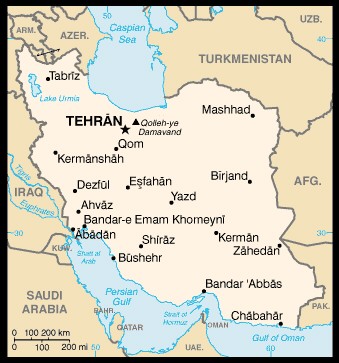
Preparing the Battlefield
The Bush Administration steps up its secret
moves against Iran.
Operations outside the knowledge and
control of commanders have eroded “the coherence of military
strategy,” one general says.
L ate last year, Congress agreed to a
request from President Bush to fund a major escalation of covert
operations against Iran, according to current and former
military, intelligence, and congressional sources. These
operations, for which the President sought up to four hundred
million dollars, were described in a Presidential Finding signed
by Bush, and are designed to destabilize the country’s religious
leadership. The covert activities involve support of the
minority Ahwazi Arab and Baluchi groups and other dissident
organizations. They also include gathering intelligence about
Iran’s suspected nuclear-weapons program.
Clandestine operations against Iran are not new. United
States Special Operations Forces have been conducting
cross-border operations from southern Iraq, with Presidential
authorization, since last year. These have included seizing
members of Al Quds, the commando arm of the Iranian
Revolutionary Guard, and taking them to Iraq for interrogation,
and the pursuit of “high-value targets” in the President’s war
on terror, who may be captured or killed. But the scale and the
scope of the operations in Iran, which involve the Central
Intelligence Agency and the Joint Special Operations Command (JSOC),
have now been significantly expanded, according to the current
and former officials. Many of these activities are not specified
in the new Finding, and some congressional leaders have had
serious questions about their nature.
Under federal law, a Presidential Finding, which is highly
classified, must be issued when a covert intelligence operation
gets under way and, at a minimum, must be made known to
Democratic and Republican leaders in the House and the Senate
and to the ranking members of their respective intelligence
committees—the so-called Gang of Eight. Money for the operation
can then be reprogrammed from previous appropriations, as
needed, by the relevant congressional committees, which also can
be briefed.
“The Finding was focussed on undermining Iran’s nuclear
ambitions and trying to undermine the government through regime
change,” a person familiar with its contents said, and involved
“working with opposition groups and passing money.” The Finding
provided for a whole new range of activities in southern Iran
and in the areas, in the east, where Baluchi political
opposition is strong, he said.
Although some legislators were troubled by aspects of the
Finding, and “there was a significant amount of high-level
discussion” about it, according to the source familiar with it,
the funding for the escalation was approved. In other words,
some members of the Democratic leadership—Congress has been
under Democratic control since the 2006 elections—were willing,
in secret, to go along with the Administration in expanding
covert activities directed at Iran, while the Party’s
presumptive candidate for President, Barack Obama, has said that
he favors direct talks and diplomacy.
The request for funding came in the same period in which
the Administration was coming to terms with a National
Intelligence Estimate, released in December, that concluded that
Iran had halted its work on nuclear weapons in 2003. The
Administration downplayed the significance of the N.I.E., and,
while saying that it was committed to diplomacy, continued to
emphasize that urgent action was essential to counter the
Iranian nuclear threat. President Bush questioned the N.I.E.’s
conclusions, and senior national-security officials, including
Secretary of Defense Robert Gates and Secretary of State
Condoleezza Rice, made similar statements. (So did Senator John
McCain, the presumptive Republican Presidential nominee.)
Meanwhile, the Administration also revived charges that the
Iranian leadership has been involved in the killing of American
soldiers in Iraq: both directly, by dispatching commando units
into Iraq, and indirectly, by supplying materials used for
roadside bombs and other lethal goods. (There have been
questions about the accuracy of the claims; the Times,
among others, has reported that “significant uncertainties
remain about the extent of that involvement.”)
Military and civilian leaders in the Pentagon share the
White House’s concern about Iran’s nuclear ambitions, but there
is disagreement about whether a military strike is the right
solution. Some Pentagon officials believe, as they have let
Congress and the media know, that bombing Iran is not a viable
response to the nuclear-proliferation issue, and that more
diplomacy is necessary.
A Democratic senator told me that, late last year, in an
off-the-record lunch meeting, Secretary of Defense Gates met
with the Democratic caucus in the Senate. (Such meetings are
held regularly.) Gates warned of the consequences if the Bush
Administration staged a preëmptive strike on Iran, saying, as
the senator recalled, “We’ll create generations of jihadists,
and our grandchildren will be battling our enemies here in
America.” Gates’s comments stunned the Democrats at the lunch,
and another senator asked whether Gates was speaking for Bush
and Vice-President Dick Cheney. Gates’s answer, the senator told
me, was “Let’s just say that I’m here speaking for myself.” (A
spokesman for Gates confirmed that he discussed the consequences
of a strike at the meeting, but would not address what he said,
other than to dispute the senator’s characterization.)
The Joint Chiefs of Staff, whose chairman is Admiral Mike
Mullen, were “pushing back very hard” against White House
pressure to undertake a military strike against Iran, the person
familiar with the Finding told me. Similarly, a Pentagon
consultant who is involved in the war on terror said that “at
least ten senior flag and general officers, including combatant
commanders”—the four-star officers who direct military
operations around the world—“have weighed in on that issue.”
The most outspoken of those officers is Admiral William
Fallon, who until recently was the head of U.S. Central Command,
and thus in charge of American forces in Iraq and Afghanistan.
In March, Fallon resigned under pressure, after giving a series
of interviews stating his reservations about an armed attack on
Iran. For example, late last year he told the Financial Times
that the “real objective” of U.S. policy was to change the
Iranians’ behavior, and that “attacking them as a means to get
to that spot strikes me as being not the first choice.”
Admiral Fallon acknowledged, when I spoke to him in June,
that he had heard that there were people in the White House who
were upset by his public statements. “Too many people believe
you have to be either for or against the Iranians,” he told me.
“Let’s get serious. Eighty million people live there, and
everyone’s an individual. The idea that they’re only one way or
another is nonsense.”
When it came to the Iraq war, Fallon said, “Did I bitch
about some of the things that were being proposed? You bet. Some
of them were very stupid.”
The Democratic leadership’s agreement to commit hundreds
of millions of dollars for more secret operations in Iran was
remarkable, given the general concerns of officials like Gates,
Fallon, and many others. “The oversight process has not kept
pace—it’s been coöpted” by the Administration, the person
familiar with the contents of the Finding said. “The process is
broken, and this is dangerous stuff we’re authorizing.”
Senior Democrats in Congress told me
that they had concerns about the possibility that their
understanding of what the new operations entail differs from the
White House’s. One issue has to do with a reference in the
Finding, the person familiar with it recalled, to potential
defensive lethal action by U.S. operatives in Iran. (In early
May, the journalist Andrew Cockburn published elements of the
Finding in Counterpunch, a newsletter and online
magazine.)
The language was inserted into the Finding at the urging
of the C.I.A., a former senior intelligence official said. The
covert operations set forth in the Finding essentially run
parallel to those of a secret military task force, now operating
in Iran, that is under the control of
JSOC. Under the Bush Administration’s interpretation of
the law, clandestine military activities, unlike covert C.I.A.
operations, do not need to be depicted in a Finding, because the
President has a constitutional right to command combat forces in
the field without congressional interference. But the borders
between operations are not always clear: in Iran, C.I.A. agents
and regional assets have the language skills and the local
knowledge to make contacts for the JSOC
operatives, and have been working with them to direct personnel,
matériel, and money into Iran from an obscure base in western
Afghanistan. As a result, Congress has been given only a partial
view of how the money it authorized may be used. One of
JSOC’s task-force missions, the
pursuit of “high-value targets,” was not directly addressed in
the Finding. There is a growing realization among some
legislators that the Bush Administration, in recent years, has
conflated what is an intelligence operation and what is a
military one in order to avoid fully informing Congress about
what it is doing.
“This is a big deal,” the person familiar with the Finding
said. “The C.I.A. needed the Finding to do its traditional
stuff, but the Finding does not apply to
JSOC. The President signed an Executive Order after
September 11th giving the Pentagon license to do things that it
had never been able to do before without notifying Congress. The
claim was that the military was ‘preparing the battle space,’
and by using that term they were able to circumvent
congressional oversight. Everything is justified in terms of
fighting the global war on terror.” He added, “The
Administration has been fuzzing the lines; there used to be a
shade of gray”—between operations that had to be briefed to the
senior congressional leadership and those which did not—“but now
it’s a shade of mush.”
“The agency says we’re not going to get in the position of
helping to kill people without a Finding,” the former senior
intelligence official told me. He was referring to the legal
threat confronting some agency operatives for their involvement
in the rendition and alleged torture of suspects in the war on
terror. “This drove the military people up the wall,” he said.
As far as the C.I.A. was concerned, the former senior
intelligence official said, “the over-all authorization includes
killing, but it’s not as though that’s what they’re setting out
to do. It’s about gathering information, enlisting support.” The
Finding sent to Congress was a compromise, providing legal cover
for the C.I.A. while referring to the use of lethal force in
ambiguous terms.
The defensive-lethal language led some Democrats,
according to congressional sources familiar with their views, to
call in the director of the C.I.A., Air Force General Michael V.
Hayden, for a special briefing. Hayden reassured the legislators
that the language did nothing more than provide authority for
Special Forces operatives on the ground in Iran to shoot their
way out if they faced capture or harm.
The legislators were far from convinced. One congressman
subsequently wrote a personal letter to President Bush insisting
that “no lethal action, period” had been authorized within
Iran’s borders. As of June, he had received no answer.
Members of Congress have expressed skepticism in the past
about the information provided by the White House. On March 15,
2005, David Obey, then the ranking Democrat on the
Republican-led House Appropriations Committee, announced that he
was putting aside an amendment that he had intended to offer
that day, and that would have cut off all funding for
national-intelligence programs unless the President agreed to
keep Congress fully informed about clandestine military
activities undertaken in the war on terror. He had changed his
mind, he said, because the White House promised better
coöperation. “The Executive Branch understands that we are not
trying to dictate what they do,” he said in a floor speech at
the time. “We are simply trying to see to it that what they do
is consistent with American values and will not get the country
in trouble.”
Obey declined to comment on the specifics of the
operations in Iran, but he did tell me that the White House
reneged on its promise to consult more fully with Congress. He
said, “I suspect there’s something going on, but I don’t know
what to believe. Cheney has always wanted to go after Iran, and
if he had more time he’d find a way to do it. We still don’t get
enough information from the agencies, and I have very little
confidence that they give us information on the edge.”
None of the four Democrats in the Gang of Eight—Senate
Majority Leader Harry Reid, House Speaker Nancy Pelosi, Senate
Intelligence Committee chairman John D. Rockefeller IV, and
House Intelligence Committee chairman Silvestre Reyes—would
comment on the Finding, with some noting that it was highly
classified. An aide to one member of the Democratic leadership
responded, on his behalf, by pointing to the limitations of the
Gang of Eight process. The notification of a Finding, the aide
said, “is just that—notification, and not a sign-off on
activities. Proper oversight of ongoing intelligence activities
is done by fully briefing the members of the intelligence
committee.” However, Congress does have the means to challenge
the White House once it has been sent a Finding. It has the
power to withhold funding for any government operation. The
members of the House and Senate Democratic leadership who have
access to the Finding can also, if they choose to do so, and if
they have shared concerns, come up with ways to exert their
influence on Administration policy. (A spokesman for the C.I.A.
said, “As a rule, we don’t comment one way or the other on
allegations of covert activities or purported findings.” The
White House also declined to comment.)
A member of the House Appropriations Committee
acknowledged that, even with a Democratic victory in November,
“it will take another year before we get the intelligence
activities under control.” He went on, “We control the money and
they can’t do anything without the money. Money is what it’s all
about. But I’m very leery of this Administration.” He added,
“This Administration has been so secretive.”
One irony of Admiral Fallon’s departure
is that he was, in many areas, in agreement with President Bush
on the threat posed by Iran. They had a good working
relationship, Fallon told me, and, when he ran
CENTCOM, were in regular
communication. On March 4th, a week before his resignation,
Fallon testified before the Senate Armed Services Committee,
saying that he was “encouraged” about the situations in Iraq and
Afghanistan. Regarding the role played by Iran’s leaders, he
said, “They’ve been absolutely unhelpful, very damaging, and I
absolutely don’t condone any of their activities. And I have yet
to see anything since I’ve been in this job in the way of a
public action by Iran that’s been at all helpful in this
region.”
Fallon made it clear in our conversations that he
considered it inappropriate to comment publicly about the
President, the Vice-President, or Special Operations. But he
said he had heard that people in the White House had been
“struggling” with his views on Iran. “When I arrived at
CENTCOM, the Iranians were
funding every entity inside Iraq. It was in their interest to
get us out, and so they decided to kill as many Americans as
they could. And why not? They didn’t know who’d come out ahead,
but they wanted us out. I decided that I couldn’t resolve the
situation in Iraq without the neighborhood. To get this problem
in Iraq solved, we had to somehow involve Iran and Syria. I had
to work the neighborhood.”
Fallon told me that his focus had been not on the Iranian
nuclear issue, or on regime change there, but on “putting out
the fires in Iraq.” There were constant discussions in
Washington and in the field about how to engage Iran and, on the
subject of the bombing option, Fallon said, he believed that “it
would happen only if the Iranians did something stupid.”
Fallon’s early retirement, however, appears to have been
provoked not only by his negative comments about bombing Iran
but also by his strong belief in the chain of command and his
insistence on being informed about Special Operations in his
area of responsibility. One of Fallon’s defenders is retired
Marine General John J. (Jack) Sheehan, whose last assignment was
as commander-in-chief of the U.S. Atlantic Command, where Fallon
was a deputy. Last year, Sheehan rejected a White House offer to
become the President’s “czar” for the wars in Iraq and
Afghanistan. “One of the reasons the White House selected Fallon
for CENTCOM was that he’s known
to be a strategic thinker and had demonstrated those skills in
the Pacific,” Sheehan told me. (Fallon served as
commander-in-chief of U.S. forces in the Pacific from 2005 to
2007.) “He was charged with coming up with an over-all coherent
strategy for Iran, Iraq, and Afghanistan, and, by law, the
combatant commander is responsible for all military operations
within his A.O.”—area of operations. “That was not happening,”
Sheehan said. “When Fallon tried to make sense of all the overt
and covert activity conducted by the military in his area of
responsibility, a small group in the White House leadership shut
him out.”
The law cited by Sheehan is the 1986 Defense
Reorganization Act, known as Goldwater-Nichols, which defined
the chain of command: from the President to the Secretary of
Defense, through the chairman of the Joint Chiefs of Staff, and
on to the various combatant commanders, who were put in charge
of all aspects of military operations, including joint training
and logistics. That authority, the act stated, was not to be
shared with other echelons of command. But the Bush
Administration, as part of its global war on terror, instituted
new policies that undercut regional commanders-in-chief; for
example, it gave Special Operations teams, at military commands
around the world, the highest priority in terms of securing
support and equipment. The degradation of the traditional chain
of command in the past few years has been a point of tension
between the White House and the uniformed military.
“The coherence of military strategy is being eroded because
of undue civilian influence and direction of nonconventional
military operations,” Sheehan said. “If you have small groups
planning and conducting military operations outside the
knowledge and control of the combatant commander, by default you
can’t have a coherent military strategy. You end up with a
disaster, like the reconstruction efforts in Iraq.”
Admiral Fallon, who is known as Fox, was aware that he
would face special difficulties as the first Navy officer to
lead CENTCOM, which had always
been headed by a ground commander, one of his military
colleagues told me. He was also aware that the Special
Operations community would be a concern. “Fox said that there’s
a lot of strange stuff going on in Special Ops, and I told him
he had to figure out what they were really doing,” Fallon’s
colleague said. “The Special Ops guys eventually figured out
they needed Fox, and so they began to talk to him. Fox would
have won his fight with Special Ops but for Cheney.”
The Pentagon consultant said, “Fallon went down because,
in his own way, he was trying to prevent a war with Iran, and
you have to admire him for that.”
In recent months, according to the
Iranian media, there has been a surge in violence in Iran; it is
impossible at this early stage, however, to credit
JSOC or C.I.A. activities, or to
assess their impact on the Iranian leadership. The Iranian press
reports are being carefully monitored by retired Air Force
Colonel Sam Gardiner, who has taught strategy at the National
War College and now conducts war games centered on Iran for the
federal government, think tanks, and universities. The Iranian
press “is very open in describing the killings going on inside
the country,” Gardiner said. It is, he said, “a controlled
press, which makes it more important that it publishes these
things. We begin to see inside the government.” He added,
“Hardly a day goes by now we don’t see a clash somewhere. There
were three or four incidents over a recent weekend, and the
Iranians are even naming the Revolutionary Guard officers who
have been killed.”
Earlier this year, a militant Ahwazi group claimed to have
assassinated a Revolutionary Guard colonel, and the Iranian
government acknowledged that an explosion in a cultural center
in Shiraz, in the southern part of the country, which killed at
least twelve people and injured more than two hundred, had been
a terrorist act and not, as it earlier insisted, an accident. It
could not be learned whether there has been American involvement
in any specific incident in Iran, but, according to Gardiner,
the Iranians have begun publicly blaming the U.S., Great
Britain, and, more recently, the C.I.A. for some incidents. The
agency was involved in a coup in Iran in 1953, and its support
for the unpopular regime of Shah Mohammed Reza Pahlavi—who was
overthrown in 1979—was condemned for years by the ruling mullahs
in Tehran, to great effect. “This is the ultimate for the
Iranians—to blame the C.I.A.,” Gardiner said. “This is new, and
it’s an escalation—a ratcheting up of tensions. It rallies
support for the regime and shows the people that there is a
continuing threat from the ‘Great Satan.’ ” In Gardiner’s view,
the violence, rather than weakening Iran’s religious government,
may generate support for it.
Many of the activities may be being carried out by
dissidents in Iran, and not by Americans in the field. One
problem with “passing money” (to use the term of the person
familiar with the Finding) in a covert setting is that it is
hard to control where the money goes and whom it benefits.
Nonetheless, the former senior intelligence official said,
“We’ve got exposure, because of the transfer of our weapons and
our communications gear. The Iranians will be able to make the
argument that the opposition was inspired by the Americans. How
many times have we tried this without asking the right
questions? Is the risk worth it?” One possible consequence of
these operations would be a violent Iranian crackdown on one of
the dissident groups, which could give the Bush Administration a
reason to intervene.
A strategy of using ethnic minorities to undermine Iran is
flawed, according to Vali Nasr, who teaches international
politics at Tufts University and is also a senior fellow at the
Council on Foreign Relations. “Just because Lebanon, Iraq, and
Pakistan have ethnic problems, it does not mean that Iran is
suffering from the same issue,” Nasr told me. “Iran is an old
country—like France and Germany—and its citizens are just as
nationalistic. The U.S. is overestimating ethnic tension in
Iran.” The minority groups that the U.S. is reaching out to are
either well integrated or small and marginal, without much
influence on the government or much ability to present a
political challenge, Nasr said. “You can always find some
activist groups that will go and kill a policeman, but working
with the minorities will backfire, and alienate the majority of
the population.”
The Administration may have been willing to rely on
dissident organizations in Iran even when there was reason to
believe that the groups had operated against American interests
in the past. The use of Baluchi elements, for example, is
problematic, Robert Baer, a former C.I.A. clandestine officer
who worked for nearly two decades in South Asia and the Middle
East, told me. “The Baluchis are Sunni fundamentalists who hate
the regime in Tehran, but you can also describe them as Al
Qaeda,” Baer told me. “These are guys who cut off the heads of
nonbelievers—in this case, it’s Shiite Iranians. The irony is
that we’re once again working with Sunni fundamentalists, just
as we did in Afghanistan in the nineteen-eighties.” Ramzi
Yousef, who was convicted for his role in the 1993 bombing of
the World Trade Center, and Khalid Sheikh Mohammed, who is
considered one of the leading planners of the September 11th
attacks, are Baluchi Sunni fundamentalists.
One of the most active and violent anti-regime groups in
Iran today is the Jundallah, also known as the Iranian People’s
Resistance Movement, which describes itself as a resistance
force fighting for the rights of Sunnis in Iran. “This is a
vicious Salafi organization whose followers attended the same
madrassas as the Taliban and Pakistani extremists,” Nasr told
me. “They are suspected of having links to Al Qaeda and they are
also thought to be tied to the drug culture.” The Jundallah took
responsibility for the bombing of a busload of Revolutionary
Guard soldiers in February, 2007. At least eleven Guard members
were killed. According to Baer and to press reports, the
Jundallah is among the groups in Iran that are benefitting from
U.S. support.
The C.I.A. and Special Operations communities also have
long-standing ties to two other dissident groups in Iran: the
Mujahideen-e-Khalq, known in the West as the M.E.K., and a
Kurdish separatist group, the Party for a Free Life in
Kurdistan, or PJAK.
The M.E.K. has been on the State Department’s terrorist
list for more than a decade, yet in recent years the group has
received arms and intelligence, directly or indirectly, from the
United States. Some of the newly authorized covert funds, the
Pentagon consultant told me, may well end up in M.E.K. coffers.
“The new task force will work with the M.E.K. The Administration
is desperate for results.” He added, “The M.E.K. has no C.P.A.
auditing the books, and its leaders are thought to have been
lining their pockets for years. If people only knew what the
M.E.K. is getting, and how much is going to its bank
accounts—and yet it is almost useless for the purposes the
Administration intends.”
The Kurdish party, PJAK,
which has also been reported to be covertly supported by the
United States, has been operating against Iran from bases in
northern Iraq for at least three years. (Iran, like Iraq and
Turkey, has a Kurdish minority, and PJAK
and other groups have sought self-rule in territory that is now
part of each of those countries.) In recent weeks, according to
Sam Gardiner, the military strategist, there has been a marked
increase in the number of PJAK
armed engagements with Iranians and terrorist attacks on Iranian
targets. In early June, the news agency Fars reported that a
dozen PJAK members and four
Iranian border guards were killed in a clash near the Iraq
border; a similar attack in May killed three Revolutionary
Guards and nine PJAK fighters.
PJAK has also subjected Turkey, a
member of NATO, to repeated
terrorist attacks, and reports of American support for the group
have been a source of friction between the two governments.
Gardiner also mentioned a trip that the Iraqi Prime
Minister, Nouri al-Maliki, made to Tehran in June. After his
return, Maliki announced that his government would ban any
contact between foreigners and the M.E.K.—a slap at the U.S.’s
dealings with the group. Maliki declared that Iraq was not
willing to be a staging ground for covert operations against
other countries. This was a sign, Gardiner said, of “Maliki’s
increasingly choosing the interests of Iraq over the interests
of the United States.” In terms of U.S. allegations of Iranian
involvement in the killing of American soldiers, he said,
“Maliki was unwilling to play the blame-Iran game.” Gardiner
added that Pakistan had just agreed to turn over a Jundallah
leader to the Iranian government. America’s covert operations,
he said, “seem to be harming relations with the governments of
both Iraq and Pakistan and could well be strengthening the
connection between Tehran and Baghdad.”
The White House’s reliance on
questionable operatives, and on plans involving possible lethal
action inside Iran, has created anger as well as anxiety within
the Special Operations and intelligence communities.
JSOC’s operations in Iran are believed to be modelled on
a program that has, with some success, used surrogates to target
the Taliban leadership in the tribal territories of Waziristan,
along the Pakistan-Afghanistan border. But the situations in
Waziristan and Iran are not comparable.
In Waziristan, “the program works because it’s small and
smart guys are running it,” the former senior intelligence
official told me. “It’s being executed by professionals. The
N.S.A., the C.I.A., and the D.I.A.”—the Defense Intelligence
Agency—“are right in there with the Special Forces and Pakistani
intelligence, and they’re dealing with serious bad guys.” He
added, “We have to be really careful in calling in the missiles.
We have to hit certain houses at certain times. The people on
the ground are watching through binoculars a few hundred yards
away and calling specific locations, in latitude and longitude.
We keep the Predator loitering until the targets go into a
house, and we have to make sure our guys are far enough away so
they don’t get hit.” One of the most prominent victims of the
program, the former official said, was Abu Laith al-Libi, a
senior Al Qaeda*
commander, who was killed on January 31st, reportedly in a
missile strike that also killed eleven other people.
A dispatch published on March 26th by the Washington
Post reported on the increasing number of successful strikes
against Taliban and other insurgent units in Pakistan’s tribal
areas. A follow-up article noted that, in response, the Taliban
had killed “dozens of people” suspected of providing information
to the United States and its allies on the whereabouts of
Taliban leaders. Many of the victims were thought to be American
spies, and their executions—a beheading, in one case—were
videotaped and distributed by DVD as a warning to others.
It is not simple to replicate the program in Iran.
“Everybody’s arguing about the high-value-target list,” the
former senior intelligence official said. “The Special Ops guys
are pissed off because Cheney’s office set up priorities for
categories of targets, and now he’s getting impatient and
applying pressure for results. But it takes a long time to get
the right guys in place.”
The Pentagon consultant told me, “We’ve had wonderful
results in the Horn of Africa with the use of surrogates and
false flags—basic counterintelligence and counter-insurgency
tactics. And we’re beginning to tie them in knots in
Afghanistan. But the White House is going to kill the program if
they use it to go after Iran. It’s one thing to engage in
selective strikes and assassinations in Waziristan and another
in Iran. The White House believes that one size fits all, but
the legal issues surrounding extrajudicial killings in
Waziristan are less of a problem because Al Qaeda and the
Taliban cross the border into Afghanistan and back again, often
with U.S. and NATO forces in hot
pursuit. The situation is not nearly as clear in the Iranian
case. All the considerations—judicial, strategic, and
political—are different in Iran.”
He added, “There is huge opposition inside the
intelligence community to the idea of waging a covert war inside
Iran, and using Baluchis and Ahwazis as surrogates. The leaders
of our Special Operations community all have remarkable physical
courage, but they are less likely to voice their opposition to
policy. Iran is not Waziristan.”
A Gallup poll taken last November,
before the N.I.E. was made public, found that seventy-three per
cent of those surveyed thought that the United States should use
economic action and diplomacy to stop Iran’s nuclear program,
while only eighteen per cent favored direct military action.
Republicans were twice as likely as Democrats to endorse a
military strike. Weariness with the war in Iraq has undoubtedly
affected the public’s tolerance for an attack on Iran. This mood
could change quickly, however. The potential for escalation
became clear in early January, when five Iranian patrol boats,
believed to be under the command of the Revolutionary Guard,
made a series of aggressive moves toward three Navy warships
sailing through the Strait of Hormuz. Initial reports of the
incident made public by the Pentagon press office said that the
Iranians had transmitted threats, over ship-to-ship radio, to
“explode” the American ships. At a White House news conference,
the President, on the day he left for an eight-day trip to the
Middle East, called the incident “provocative” and “dangerous,”
and there was, very briefly, a sense of crisis and of outrage at
Iran. “TWO MINUTES FROM WAR” was
the headline in one British newspaper.
The crisis was quickly defused by Vice-Admiral Kevin
Cosgriff, the commander of U.S. naval forces in the region. No
warning shots were fired, the Admiral told the Pentagon press
corps on January 7th, via teleconference from his headquarters,
in Bahrain. “Yes, it’s more serious than we have seen, but, to
put it in context, we do interact with the Iranian Revolutionary
Guard and their Navy regularly,” Cosgriff said. “I didn’t get
the sense from the reports I was receiving that there was a
sense of being afraid of these five boats.”
Admiral Cosgriff’s caution was well founded: within a
week, the Pentagon acknowledged that it could not positively
identify the Iranian boats as the source of the ominous radio
transmission, and press reports suggested that it had instead
come from a prankster long known for sending fake messages in
the region. Nonetheless, Cosgriff’s demeanor angered Cheney,
according to the former senior intelligence official. But a
lesson was learned in the incident: The public had supported the
idea of retaliation, and was even asking why the U.S. didn’t do
more. The former official said that, a few weeks later, a
meeting took place in the Vice-President’s office. “The subject
was how to create a casus belli between Tehran and Washington,”
he said.
In June, President Bush went on a
farewell tour of Europe. He had tea with Queen Elizabeth II and
dinner with Nicolas Sarkozy and Carla Bruni, the President and
First Lady of France. The serious business was conducted out of
sight, and involved a series of meetings on a new diplomatic
effort to persuade the Iranians to halt their uranium-enrichment
program. (Iran argues that its enrichment program is for
civilian purposes and is legal under the Nuclear
Non-Proliferation Treaty.) Secretary of State Rice had been
involved with developing a new package of incentives. But the
Administration’s essential negotiating position seemed
unchanged: talks could not take place until Iran halted the
program. The Iranians have repeatedly and categorically rejected
that precondition, leaving the diplomatic situation in a
stalemate; they have not yet formally responded to the new
incentives.
The continuing impasse alarms many observers. Joschka
Fischer, the former German Foreign Minister, recently wrote in a
syndicated column that it may not “be possible to freeze the
Iranian nuclear program for the duration of the negotiations to
avoid a military confrontation before they are completed. Should
this newest attempt fail, things will soon get serious. Deadly
serious.” When I spoke to him last week, Fischer, who has
extensive contacts in the diplomatic community, said that the
latest European approach includes a new element: the willingness
of the U.S. and the Europeans to accept something less than a
complete cessation of enrichment as an intermediate step. “The
proposal says that the Iranians must stop manufacturing new
centrifuges and the other side will stop all further sanction
activities in the U.N. Security Council,” Fischer said, although
Iran would still have to freeze its enrichment activities when
formal negotiations begin. “This could be acceptable to the
Iranians—if they have good will.”
The big question, Fischer added, is in Washington. “I
think the Americans are deeply divided on the issue of what to
do about Iran,” he said. “Some officials are concerned about the
fallout from a military attack and others think an attack is
unavoidable. I know the Europeans, but I have no idea where the
Americans will end up on this issue.”
There is another complication: American Presidential
politics. Barack Obama has said that, if elected, he would begin
talks with Iran with no “self-defeating” preconditions (although
only after diplomatic groundwork had been laid). That position
has been vigorously criticized by John McCain. The Washington
Post recently quoted Randy Scheunemann, the McCain
campaign’s national-security director, as stating that McCain
supports the White House’s position, and that the program be
suspended before talks begin. What Obama is proposing,
Scheunemann said, “is unilateral cowboy summitry.”
Scheunemann, who is known as a neoconservative, is also
the McCain campaign’s most important channel of communication
with the White House. He is a friend of David Addington, Dick
Cheney’s chief of staff. I have heard differing accounts of
Scheunemann’s influence with McCain; though some close to the
McCain campaign talk about him as a possible national-security
adviser, others say he is someone who isn’t taken seriously
while “telling Cheney and others what they want to hear,” as a
senior McCain adviser put it.
It is not known whether McCain, who is the ranking
Republican on the Senate Armed Services Committee, has been
formally briefed on the operations in Iran. At the annual
conference of the American Israel Public Affairs Committee, in
June, Obama repeated his plea for “tough and principled
diplomacy.” But he also said, along with McCain, that he would
keep the threat of military action against Iran on the table. ♦
*Correction,
August 7, 2008: Abu Laith al-Libi was a senior Al Qaeda
commander, not a senior Taliban commander, as originally stated.
FROM:
http://www.newyorker.com/reporting/2008/07/07/080707fa_fact_hersh
WATCH CNN VIDEO ON SAME TOPIC
http://www.youtube.com/watch?v=81G6MpHwSf0
SEYMOUR HERSH VIDEO ON THE MIDDLE EAST
http://www.youtube.com/watch?v=c3lgm0fsJ6Q&feature=related
WHAT DID ISRAEL BOMB IN SYRIA?
http://www.youtube.com/watch?v=FZi2NaxjOjM&NR=1
JEWISH MONEY CONTROLS PRESIDENTIAL CANDIDATES
http://www.youtube.com/watch?v=X4ZDabT6r3w&feature=related
U.S IS FUNDING AL-QUEADA TO COUNTER IRAN PART 1
http://www.youtube.com/watch?v=OnUWcjXvdlo&feature=related
IRAN PART 2
http://www.youtube.com/watch?v=mmk9FbGZC7U&feature=related
|
During his exile, Khomeini coordinated an upsurge of opposition--first
from Iraq and then from France, after 1978--demanding the Shah's abdication.
On January 16, 1979, in what was officially described as a "vacation," the
Shah fled Iran.
The Regency and Supreme Army Councils established for the Shah's absence
proved unable to function, and Prime Minister Shahpur Bakhtiar was unable
to effect compromise with his former National Front colleagues or with Khomeini.
Crowds in excess of 1,000,000 demonstrated in Tehran, proving the wide appeal
of Khomeini, who arrived in Iran amid wild rejoicing on February 1, 1979.
Ten days later Bakhtiar went into hiding, eventually to find exile in
Paris.
The republic ... On April 1, after a landslide victory in a national
referendum (in which only one choice was offered and the balloting was not
secret), Khomeini declared an Islamic republic, subsequently invested with
a new constitution reflecting his ideals of Islamic government. Fundamentalist
measures followed, and revolutionary committees patrolled the streets enforcing
Islamic codes of behaviour and dress. Efforts were made to suppress Western
influence, and many of the Western-educated elite fled the country.
Anti-American sentiment was strong, and the Shah's admission to the United
States for medical treatment touched off a huge demonstration in Tehran demanding
his extradition. On November 4, 1979, supporters of the revolution took control
of the U.S. embassy in Tehran, seized 66 U.S. citizens there and at the foreign
ministry, and, with the exception of 14 who were granted early release and
despite the death of the Shah on July 27, 1980, held them hostage until January
20, 1981. Also in November 1979, the republic's first prime minister, Mehdi
Bazargan, resigned. The republic's first president, Abolhassan Bani-Sadr,
opposed the holding of the U.S. embassy. He was impeached by the Majles and
forced to flee to France, together with opposition leader Massoud Rajavi
of the outlawed Mujahedin-e Khalq (Fighters for the People) faction, with
whom he formed the National Council of Resistance for the overthrow of the
Khomeini regime. The Mujahedin stepped up a campaign of sporadic and highly
demoralizing bombing throughout the country that killed many clerics and
government leaders, including the bombing on June 28, 1981, of the headquarters
of the ruling Islamic Republican Party, in which 73 people were killed.
Bani-Sadr's successor, former prime minister Mohammad Ali Rajai, and his
prime minister were killed in another bombing on August 30. Hojatolislam
Sayyed Ali Khamenei was elected to succeed him in October and was reelected
in 1985. The early years of the revolutionary government were marked by the
virtual elimination of political opposition and the consolidation and
regularization of revolutionary organizations. Unrelenting executions on
sometimes trivial allegations, rumours of torture, persecution of Baha'is,
arbitrary arrests, bad prison conditions, and the denial of basic rights
tarnished the reputation of the republic's leaders...
The cease-fire redirected attention to long-standing factional conflicts
within the government between "conservatives," "pragmatists," and "leftists"
over economic, social, and foreign policy objectives. These conflicts were
underscored in November 1986 when, denunciations of the "Great Satan" aside,
it was revealed that, with Khomeini's consent, Iran had accepted arms shipments
from the United States in exchange for Iranian assistance in the release
of American hostages held in Lebanon by Shi'ite extremists. The factionalism
only served to further increase disillusionment among the Iranian population,
whose decimated numbers suffered high unemployment, inflation, and shortages
brought on primarily by the war.
Ayatollah Khomeini died of a heart attack on June 3, 1989. The transition
of power was surprisingly smooth, orderly, and quick. The Assembly of Experts
met in emergency session on June 4 and elected President Khamenei the new
faqih, or spiritual leader, simultaneously promoting him to the status of
ayatollah. Presidential elections and a referendum on constitutional amendments
were moved up to July 28, and Hojatolislam Ali Akbar Hashemi Rafsanjani,
speaker of the Majles since 1980, was elected with 95 percent of the vote;
he ran virtually unopposed.
|
| The Iranian Revolution 1978-1979
State Entry Exit Combat
Forces Population
Losses
Iran 1979 1987
305000 43000000
70000
Rebels 1979 1987 50000
10000000
20000
The Islamic republic... Revolution of 1978-79... The sense that in both
the agricultural and industrial spheres too much had been attempted too rapidly
and that mistakes had been made and expectations disappointed was manifested
in demonstrations against the government in 1978; many people were killed,
and martial law was imposed in the major cities in September. This ended
the relaxation of government controls, begun in 1977, that had encouraged
protests and that had led to the emergence of religious activists allied
with extremist "Dedicated Fighter" groups, the Mujahedin; these groups were
opposed to the influx of foreigners, particularly Americans, and to a
westernization they saw as threatening to those traditional values subsumed
under the cloak of Shi'ite Islam.
Upon the approval by the Majles of all of his ministerial nominations
(representing a healthy balance of the factions), Rafsanjani began the process
of rebuilding the war-torn economy. Considered a "pragmatist," or "moderate,"
Rafsanjani favoured a policy of economic liberalization, privatization of
industry, and a rapprochement with the West that would encourage much-needed
foreign investment. A move toward the latter was facilitated with the resumption
of diplomatic ties between Iran and the United Kingdom on September 27, 1990,
despite the fatwa (religious edict) issued by Khomeini 18 months earlier
calling for the death of the British author Salman Rushdie, whose novel The
Satanic Verses (1988) was considered blasphemous to Islam.
FROM:
http://www.onwar.com/aced/data/india/iran1978.htm |
| FROM:
http://www.acig.org/artman/publish/article_19.shtml
I Persian Gulf War (Iraq-Iran War), 1980-1988
By Tom Cooper & F. Bishop
Jan 10, 2003, 05:25
The Mother of all Build-Ups
During the 1970s, both Iran and Iraq invested heavily on their air forces,
creating not only two of the largest and most powerful air arms in the Middle
East, but also worldwide. The circumstances and the results of these investments
remain largely unnoticed, just like the details about the deployment and
operations of both air forces in the long and bloody war of attrition between
the two countries, fought between 1980 and 1988.
In 1960s and 1970s, Iran was a firm US ally; consequently, the Imperial
Iranian Air Force (IIAF) was developed along the USAF lines, and relied on
US threat perceptions, doctrine, strategies, tactics, purchasing, production,
as well as training policies. Everything in the IIAF, its air power doctrine
and capabilities, was tailored for supporting a joint US-Iranian operation
against a possible Soviet invasion of Iran from the north. Even the traditions
and markings of the IIAF strongly resembled those of the US Air Force (USAF).
A chain of huge air bases and a widespread early warning system were erected
against the USSR. Consequently, the self-sufficient structure of the IIAF
was weak during the 1970s, and was planned to be developed during the 1980s.
Instead, during the 1970s, Iran was turned into a huge forward base for local
as well as the US forces, where huge stocks of spare parts and weapons were
piled. Partially, such a policy was also influenced by the fact that after
learning about Israeli problems in 1973, the Iranians began to order additional
amounts of equipment, spare parts and weapons, which could enable them to
fight an intensive war for many months without any external help. The
IIAF’s strategic stocks, managed by the costly Peacelog automated inventory
system, became so huge that even in 1986 the emerging Islamic Republic of
Iran Air Force (IRIAF) was still using bombs and missiles purchased during
the 1970s – even if expired shelf-lives of most items caused operating
difficulties.
By constantly taking part in joint exercises with the USAF, USN, RAF and
the Turkish and Pakistani air forces, in addition to sending its best crews
and pilots for training courses to the US and Israel, the IIAF honed the
skills of its chain of command, pilots, and technical personnel to highest
possible degrees. Iranian reconnaissance assets were also involved in constant
monitoring operations along the Soviet borders, together with USAF/CIA personnel
and equipment. The IIAF was trained to function as a member of a team with
large and far-reaching objectives, and so had to keep the pace. There were
some problems, like lack of proper EW systems and gaps in radar coverage
of the Iranian airspace, as well as a lack of effective anti-shipping systems,
but they were recognized and measures were taken to rectify them. During
the late 1960s and through 1970s, the IIAF took delivery from the USA up
to 104 Northrop F-5A/Bs Freedom Fighters, and then continued with purchases
of 32 McDonnell Douglas F-4Ds, 177 F-4Es, 165 F-5E/Fs, at least 20 RF-4Es
(only 16 of which were delivered “officially”), and 80 Grumman
F-14As, as well as a large fleet of Boeing 707-3J9C tankers, Lockheed C-130E/H
Hercules transports, and a number of Boeing 747-2J9C strategic transports.
By 1979, up to 300 F-16A/Bs, seven Boeing E-3A AWACS aircraft and other assets
were on order, negotiations for 75 more F-14As were due to start, and the
IIAF was also to build the most comprehensive training installations outside
the USA, very similar to those used for the Red Flag exercises. Training
began with a fast pace, in the US, and young Iranian officers started undergoing
F-16 flying and AWACS control courses.
Despite having only 450 combat aircraft, and planning to get around 400
more by 1982, bases and facilities built in Iran could easily accommodate
and support as many as 3,000 fighter and support aircraft. For comparison,
when the US deployed its forces to the region after the Iraqi invasion of
Kuwait, in late 1990, it stationed around 2,400 aircraft on various air bases
– spread in five countries in the region – as well as on aircraft
carriers, within six months. Interestingly this number peaked at 2,790 aircraft
(very close to the 3,000 number) on February 24, 1991. The infrastructure
for such an operation was not available, however, and had to be hastily
improvised: on most air bases, the US, British, and French aircraft initially
stood exposed to a harsh climate, and even if after several months a large
number of makeshift shelters were built, most of the aircraft were not properly
protected for the duration of their deployment in the area, while most airfields
were simply overtaxed. No such problems would be encountered, if bases in
Iran were available to the Gulf alliance.
Iraq, to the contrary, could not count on any such support. Although the
Iraqi Air Force (IrAF) is the oldest Arab air force (established already
in 1924), the policies of the country’s leadership increasingly isolated
it from the outside world. For more than 30 years, the IrAF was organized,
trained, and equipped by the British, and the British influenced every aspect
of the Iraqi air force structure and operations, including the “air
policing” of Kurdish areas in northern Iraq. After the fall of the monarchy,
in 1958, the IrAF began to increasingly equip itself with Soviet-built aircraft.
To many observers, it was “logical” therefore to describe the
IrAF as an entity “operating according to the Soviet doctrine,”
while the fact was that after purchasing over 60 Hawker Hunters during the
early 1960s, the Iraqis were never satisfied with what they had got from
the Soviets, and tried hard to get more hardware from the West. For different
reasons, however, deals for SEPECAT Jaguars, BAe Hawks, and Dassault Mirage
5s were all spoiled, and it was not before 1977 that Iraq finally ordered
its first large numbers of Western combat aircraft and helicopters - from
France.
The isolation from the outside was felt also in training, operations,
and capabilities of the IrAF. Under constant observation and heavy pressure
by the ruling regimes, the IrAF became at least as much a victim of the usual
tendency of its officers to mix into the politics, as it suffered from being
equipped with second-class hardware supplied by the USSR, which simply would
not make it more capable of defending the huge Iraqi airspace. This was one
of the reasons why the IrAF leaned heavily on Indian Air Force (IAF) –
instead on the Soviets – for training during the 1970s and a better
part of 1980s. This changed only to a slight degree in 1979, when a massive
contract was signed with Moscow, covering delivery of over 200 combat aircraft
and helicopters, including the first Mi-25 Hinds and MiG-25 Foxbats. The
purchase of the latter, namely, was conditioned by the Soviets on the presence
of a large number of their advisors, which were to keep the Foxbats –
stationed at the Shoaibah AB, near Basrah – under control for a number
of years to come.
The IrAF had also some limited combat experiences from a few wars against
Israel, and the continuous low intensity fighting against the Kurdish insurgency.
The Iraqis barely learned any important lessons from the war in 1967, but
very closely observed the October War of 1973, in which several IrAF squadrons
took part as well. The Iraqis understood very well that under given
circumstances, they did not have any choice but to form an air defense command
along the Soviet lines, equipped with almost 100 Mikoyan MiG-21s, over two
hundred SA-2, SA-3 and SA-6 SAM sites, and a large number of anti aircraft
guns. Despite the size of their country, and the long borders with their
neighbors, however, the Iraqis could merely concentrate their SAM sites and
point defense interceptors around the vital installations: between such areas,
over 90% of the Iraqi airspace was not permanently defended. The rest of
the air force, was equipped with MiG-23s – which were a huge disappointment
for the Iraqis – limited-capability Sukhoi Su-7s (mainly used for training)
and Su-20/-22 attack planes, while a single bomber wing flew Ilyushin Il-28s,
and Tupolev Tu-16s and Tu-22s.
Thus, while by 1979 the IIAF was an excellent force on the verge of becoming
a power of strategic proportions equipped with first-class weapons and systems,
the IrAF was still a small tactical asset, the most modern combat aircraft
of which was MiG-23.
The Iraqi Invasion
The chain of events, which finally led to the Iraqi invasion of its eastern
neighbor, was directly initiated by the Islamic revolution in Iran, in February
1979, which followed a series of unrests throughout the country, starting
in 1978. The demise of the Shah’s regime had tremendous consequences
for the IIAF, which not only lost its name, but also its whole command staff.
Constant purges through 1979 and 1980, and plans by the new regime to
“cleanse” the air force – suspected of being
“royalist” and “disloyal to Islam” – not only caused
hundreds of the air force officers to be purged, imprisoned or executed,
but finally threatened even the bare existence of the whole service. This
was certainly one of the most influential reasons for the Iraqis to attack
Iran; it was clear, namely, that the IrAF had no chances against an intact
and fully operational Iranian air force.
Although the combat operations during the First Persian Gulf War were
“officially” started on the afternoon of September 22, 1980, intensive
fighting along the central sector of the Iraqi-Iranian border erupted already
on September 4, and until today, Iraqis consider this date as the starting
point of the war. During most of September, both the IrAF and the IRIAF supported
ground forces with a large number of reconnaissance and combat sorties. Far
better equipped and trained Iranians caused extensive losses to the Iraqis,
even if their operations were hampered by technical problems, and also by
the need to simultaneously fight an Iraqi-supported Kurdish revolt in the
northwest Iran – which was costly in terms of helicopters, aircraft,
and crews lost. Despite losses, the lack of any powerful Iranian response
during early skirmishes, the reports on the dreadful condition of the Iranian
armed forces, and the clandestine support from the US (which delivered blueprints
of the Iranian air defense system to Baghdad), Saudi Arabia, and Kuwait,
ensured Iraqis that a war against Iran could be successfully initiated and
quickly concluded probably with the crushing of the new regime in Tehran
itself.
Therefore, on the afternoon of September 22, 1980, the Iraqis initiated
a war against Iran with a massive armored onslaught into the southwestern
province of Khuzestan, and a simultaneous two-wave attack by the IrAF against
most important IRIAF air bases in western and central Iran. The air offensive
– flown by heavily armed aircraft but lacking the needed capabilities,
and pilots who lacked proper training – turned into a complete failure,
and not even another try, on the following morning, could preclude the IRIAF
to respond in full power. Only four hours after the first Iraqi attack, namely,
four Iranian F-4 Phantoms bombed the Rashid AB, in southern Baghdad, and
– utilizing IIAF-era contingency plans – on the morning of September
23, no less than 140 Iranian F-4D/E Phantoms, F-5E/Fs and F-14s – responded
by an aerial onslaught against Iraq. Thus a relative “aerial siege”
of Iraq was initiated, which was to last for almost a week, and during which
the IRIAF continued to put large formations of fighter-bombers over Iraq
each morning, systematically destroying Iraqi oil-production and war-fighting
capabilities, and also forcing most of the IrAF into exile, in Jordan and
Saudi Arabia. Equipped with ECM pods, BL.755 CBUs, and the Mk.80 series of
bombs, and using specially reconnoitered ingress corridors, the Iranians
had not much problems in flying almost completely undisturbed deep into Iraq.
If the IrAF managed to intercept any formation, its fighters were usually
detected in time, and shot down in large numbers. On September 25, for example,
no less than five MiG-21s and MiG-23s were shot down in a single air combat
near Baghdad, in exchange for two damaged Phantoms
When the IrAF tried to attack deep into Iran, even if flying along
„blind spots“ of the Iranian early warning radar system - the Iraqi
formations were frequently intercepted, and several times shot down to the
last plane. Especially units equipped with the MiG-23s suffered severely.
After almost a week of intensive attacks against Iraqi targets, the IRIAF
had to change its strategy, as the Iraqi Army was now driving almost 60km
deep into southern Iran putting several Iranian cities and important air
bases under threat, while the list of the targets in Iraq was almost exhausted,
and bad weather hampered many of the operations. Consequently, the Iranians
threw the whole power of their air force to stop the Iraqis. This task was
completed by late October 1980, albeit at a very heavy price, as a lack of
proper EW systems, and even chaff and flare dispensers, became evident. The
Iraqi invasion, however, saved the lives of numerous Iranian unattached officers,
who were released from Islamic regime’s prisons, in order to help in
the fighting. Together with other skilled personnel, these pilots were to
become the most important asset at the hands of the IRIAF for the rest of
the war.
See More about this war and photos at:
http://www.acig.org/artman/publish/article_19.shtml |
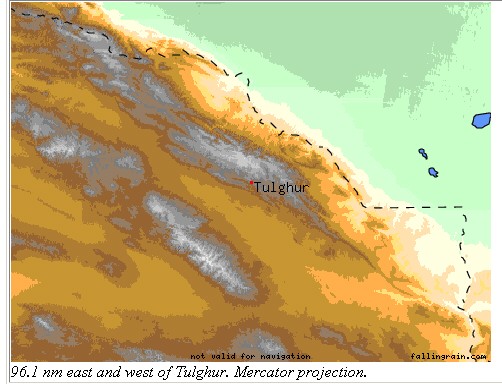
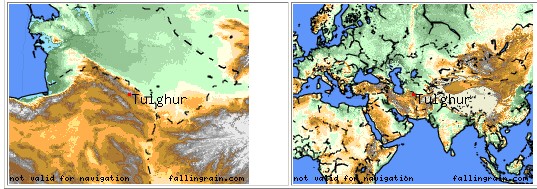
Tulghur, Iran
| Latitude |
36.8167 |
Longitude |
Altitude (feet) |
5748 |
| Lat (DMS) |
36° 49' 0N |
Long (DMS) |
Altitude (meters) |
1751 |
| Weather |
| Location:
Middle East, bordering the Gulf of Oman, the Persian Gulf, and the Caspian
Sea, between Iraq and Pakistan
| AVN based WAPF forecast for Tulghur. Not valid for navigation. |
| Time |
Cloud Cover |
Altimeter |
Rain or Snow |
Winds & Temperature |
| Surface (5748') |
| 1415Z (now) |
Overcast |
1020.3/30.21" |
Lots (3.2 cm) |
|
331@11 -4°C |
| 215Z (+12h) |
Scattered |
1023.6/30.31" |
None |
|
332@15 -5°C |
|
|
|
|
| 1415Z (+24h) |
Scattered |
1018.5/30.16" |
None |
|
303@5 1°C |
| 215Z (+36h) |
Scattered |
1017.5/30.13" |
None |
|
238@9 2°C |
| 1415Z (+48h) |
Scattered |
1008.8/29.87" |
Some |
|
216@10 13°C |
| 215Z (+60h) |
Overcast |
1009.0/29.88" |
Some |
|
225@18 9°C |
| 1415Z (+72h) |
Overcast |
1006.7/29.81" |
Lots (1.3 cm) |
|
256@12 16°C |
| 215Z (+84h) |
Overcast |
1010.9/29.93" |
Lots (3.8 cm) |
|
17@0 10°C |
| 1415Z (+96h) |
Overcast |
1010.4/29.92" |
Lots (4.7 cm) |
|
210@14 12°C |
|
|
|
|
|
|
|
|
|
|
 |
|
FAST/Alltheweb
images for Tulghur FAST/Alltheweb
images for Tulghur, Iran
IRAN DAILY NEWSPAPER
NETIRAN
IRAN CULTURAL CENTER
MEDIA AND
MEDES
Facts taken from the CIA page on Iran:
http://www.cia.gov/cia/publications/factbook/geos/ir.html
Known as Persia until 1935, Iran became an Islamic republic in 1979 after
the ruling shah was forced into exile. Conservative clerical forces subsequently
crushed westernizing liberal elements. Militant Iranian students seized the
US Embassy in Tehran on 4 November 1979 and held it until 20 January 1981.
During 1980-88, Iran fought a bloody, indecisive war with Iraq over disputed
territory. Key current issues affecting the country include the pace of accepting
outside modernizing influences and reconciliation between clerical control
of the regime and popular government participation and widespread demands
for reform.
Population:
66,622,704 (July 2002 est.)
Area:
total: 1.648 million sq km
land: 1.636 million sq km
water: 12,000 sq km
Area - comparative: slightly larger than Alaska
Land boundaries:
total: 5,440 km
Border countries: Afghanistan 936 km, Armenia 35 km, Azerbaijan-proper
432 km, Azerbaijan-Naxcivan exclave 179 km, Iraq 1,458 km, Pakistan 909 km,
Turkey 499 km, Turkmenistan 992 km
Coastline : 2,440 km; note - Iran also borders the Caspian
Sea (740 km)
Terrain: rugged, mountainous rim; high, central basin with deserts,
mountains; small, discontinuous plains along both coasts
Elevation extremes: lowest point: Caspian Sea -28 m
highest point: Kuh-e Damavand 5,671 m
Natural resources: petroleum, natural gas, coal, chromium, copper,
iron ore, lead, manganese, zinc, sulfur
Land use: arable land: 10.17% permanent crops: 1.16%
other: 88.67% (1998 est.)
Irrigated land: 75,620 sq km (1998 est.)
Natural hazards: periodic droughts, floods; dust storms, sandstorms;
earthquakes along western border and in the northeast
Environment - current issues:
air pollution, especially in urban areas, from vehicle emissions, refinery
operations, and industrial effluents; deforestation; overgrazing;
desertification; oil pollution in the Persian Gulf; wetland losses from drought;
soil degradation (salination); inadequate supplies of potable water; water
pollution from raw sewage and industrial waste; urbanization
Environment - international agreements: party to: Biodiversity,
Climate Change, Desertification, Endangered Species, Hazardous Wastes, Marine
Dumping, Nuclear Test Ban, Ozone Layer Protection, Wetlands
signed, but not ratified: Environmental Modification, Law of the Sea,
Marine Life Conservation
Geography - note: strategic location on the Persian Gulf and Strait of
Hormuz, which are vital maritime pathways for crude oil transport
NEWS
FROM:
http://seattletimes.nwsource.com/cgi-bin/PrintStory.pl?document_id=134677184&zsection_id=268774049&slug=iran17&date=20030417
Thursday, April 17, 2003, 12:00 a.m. Pacific
Iran to oppose any U.S. effort to rule in Iraq
By Ali Akbar Dareini
The Associated Press
TEHRAN, Iran - Iranian President Mohammad Khatami said yesterday his country
will not recognize a U.S.-installed interim administration in Iraq and will
support Syria if it is attacked.
It was the first time a senior official had defined Iran's already well-known
stance on a postwar Iraq.
"We will not recognize any administration other than an all-Iraqi government.
However, we are not seeking tension or confrontation with anybody," Khatami
told reporters after a Cabinet meeting.
On Tuesday, retired U.S. Gen. Jay Garner, chosen by the United States
to lead the interim administration, opened a conference in Ur, Iraq, with
the goal of shaping Iraq's postwar government.
"The Iraqi nation will not accept any foreign rule," Khatami said. "It
is in the interests of morality, civility and international law that an
administration representing all Iraqi ethnic, religious groups take over
in Iraq, and in the long term a government is elected on the basis of one
vote for each Iraqi citizen."
In the first official Iranian comment on U.S. claims that Syria was hosting
officials of Saddam Hussein's regime, Khatami said the rhetoric was a "bluff"
and that Iran would support Syria if attacked.
"Syria is on the front line against Zionist pressures, defending the cause
of the Palestinian nation, freedom and peace in the region," he said. "We
will defend Syria, but it doesn't mean we will engage in military
confrontation.
"We have big problems with America," he said. "But we don't welcome tensions
either. If we feel they are changing their behavior, then a new situation
may emerge (in our relations)."
Meanwhile, Iran's supreme leader, Ayatollah Ali Khamenei, said the failure
of the Iraqi Republican Guards in defending their country against U.S.-led
coalition forces would remain "an eternal disgrace."
"The world always pays tribute to defenders who resist, even if they are
defeated by the enemy, but is ashamed of their humiliating surrender," state-run
Tehran television quoted Khamenei as saying.
Iran is reportedly developing a nuclear-weapons program and still supports
terrorist groups. But Iran is no Iraq: It is not dominated by a single, brutal
dictator. It has held elections. And while the country is ruled by Islamic
clerics, it has a strong reformist element that openly challenges
authority.
Iran's Shiite majority does not see eye to eye with those in Iraq, who
are less supportive of the Iranian model of rule by an Islamic council and
may participate in an Iraqi government that is more democratic than Iran's.
Such division among Shiites makes the Iranian rulers particularly nervous.
Iraq's regime change and the presence of U.S. troops could cause a greater
relaxation of control by the clerics in Iran, said Juan Cole, an Iranian
expert and political-science professor at the University of Michigan. That
would give the reform movement more clout.
Religious scholars are talking openly about the prospect of an invigorated,
more moderate center of Shiite Islam developing in Najaf, an ancient center
of Shiism in Iraq, that would vie with Qom, the current center of authority
in the Shiite world.
Arab Shiites have gone to Qom in recent decades because Najaf was isolated
by Saddam and tainted by association with his regime. But many are tired
of seeing their faith dominated by Iranians, a majority of whom are Persian
rather than Arab.
Information from The Chicago Tribune and Los Angeles Times is included
in this report.
Copyright ? 2003 The Seattle Times Company

Latest earthquake
CNN.com
- Death toll rising in northern Iran quake - June 22, 2002.
... CNN's Lisa Mirando has more on a powerful earthquake that hit Northwestern
Iran and has caused hundreds of deaths
http://www.cnn.com/2002/WORLD/meast/06/22/quake.iran/
Death toll rising in northern Iran quake
June 22, 2002
Villagers look on and pray for the wrapped body of a victim following
an earthquake that destroyed the Iranian village of Changoleh.
From Journalist Shirzad Bozorgmehr
TEHRAN, Iran (CNN) -- Hundreds of people were killed or injured as an
earthquake and a series of aftershocks rocked northern Iran Saturday, Iranian
media reports said.
In Boinzahra, a town in Qazvin province, at least 500 people have been
killed and at least 1,500 have been injured, according to Islamic Republic
of Iran Broadcasting, a TV network.
IRNA said some 60 villages around Avaj had been razed to the ground or
lost at least half of their buildings, with a pair of early strong aftershocks
inflicting more damage.
The Red Crescent, which mobilized to aid the residents of the region,
expects more casualties, news reports said.
The National Earthquake Information Center in Golden, Colorado, said the
quake's magnitude was 6.3.
Don Blakeman, a geophysicist at the National Earthquake Information Center
in Colorado in the United States said the quake took place at 7:28 a.m. local
time.
He said the epicenter of the quake was between the cities of Hamadan and
Qazvin, around 220 kilometers (140 miles) west of Tehran, and that the terrain
in the region is mountainous and has many villages.
Major aftershocks, infrastructure devastated
Major aftershocks were reported for hours after the main quake.
Bou'in-Zahra Gov. Ali Mousavi said the quake devastated the villages'
water and power infrastructure, IRNA reported, according to The Associated
Press.
Buildings in the region are made of mud and are very susceptible to this
type of natural catastrophe.
"Usually with this kind of building we lose a lot of people," Professor
Fariborz Nateghi, a government advisor on earthquake engineering, told the
Reuters news agency. "You lose the walls and the ceiling collapses. They
are major killers."
IRNA was quoted by Reuters as saying 80 people had been killed in one
village alone near Avaj, a town of 3,600 people close to the top of a high
pass through the rugged Nobaran Mountains.
Iranian military forces have airdropped blankets, food, and medicine to
people in the region and are helping residents set up shelters.
Iran lies on a major seismic line and is prone to quakes. Moderate tremors
are reported in various parts of the country almost daily.
President Bush, in a written statement Saturday, said he was "saddened"
to learn about the "tragic event" and sent his condolences to the families
of the victims.
"Human suffering knows no political boundaries," Bush said, extending
a hand to a country he has labeled part of an "axis of evil."
A woman carries supplies in Abdareh village, which was destroyed by an
earthquake that killed more than 50 in the village.
"We stand ready to assist the people of Iran as needed and as desired,"
the president said.
Earthquakes in northern Iran -- where the Arabian tectonic plate, pushed
northward by the African plate, collides with the Eurasian plate -- tend
to be especially strong.
A June 1990, magnitude 7.7 earthquake centered near the Caspian Sea, destroyed
three cities and more than 700 villages, killing 40,000 people. Another quake
of about the same magnitude in the same area nearly 30 years earlier killed
12,000 people.
President Mohammad Khatami issued a message of condolence to the Iranian
nation, AP reports, quoting local television.
Khatami also instructed the Interior Ministry to cooperate with other
agencies to act quickly in offering assistance to the victims. Three days
of mourning have also been declared in the provinces, according to the same
report.
Over
500 Dead, 1,200 Injured in Iran Earthquake
... Last updated at: (Beijing Time) Sunday, June 23, 2002. Over 500
Dead,
1,200 Injured in Iran Earthquake. More than 500 people were ...
http://english.peopledaily.com.cn/200206/ 23/eng20020623_98369.shtml -
Over 500 Dead, 1,200 Injured in Iran Earthquake
More than 500 people were killed andat least 1,200 others injured in a
strong earthquake early Saturdayin Iran, the state IRNA news agency
reported.
More than 500 people were killed andat least 1,200 others injured in a
strong earthquake early Saturdayin Iran, the state IRNA news agency
reported.
The quake, which hit Iran's northern, central and western provinces of
Gilan, Tehran, Kurdestan, Qazvin, Zanjan and Hamedan at around local time
7:30 a.m. (0300 GMT), was succeeded by several aftershocks between 8:10 a.m.
(0340 GMT) and 15:11 p.m. (1041 GMT) with the magnitudes between 4.1 and
5.2 degrees on the open-ended Richard scale.
The Seismological Institute of Geophysics Center of the Tehran University
said the tremor was of 6.0 degrees on the open-ended Richard scale. It located
the epicenter of the tremor at Bouin Zahra in Qazvin Province.
Majid Shalviri, head of the Red Crescent Society of the Qazvin province,
said that "in the village of Kisse-Jin only, 80 people have been killed."
Following the devastating tremor, Iranian President Mohammad Khatami ordered
Interior Minister Abdolvahed Mousavi Lari to personally take "the grave
responsibilities" in this tragic event.
The Iranian president asked Lari to use all means of the country with
the coordination of other state apparatus to rapidly assist those affected
by the quake.
Iran embraces a number of quake-prone zones. Tens of thousands of people
were killed in Bouin Zahra in a strong earthquake in September, 1984.
In 1990, a seven plus Richter-degree earthquake hit northern provinces
of Zanjan and Gilan, in which tens of thousands of people lost their lives.
Official reports have said that as of 1991 over 950 earthquakes have jolted
Iran, claiming 17,600 lives and injuring 53,300 others.
FROM:
http://www.newsmax.com/archives/articles/2001/10/1/93327.shtml
Muslim Viet Cong
John LeBoutillier
Monday, Oct. 1, 2001
Three weeks ago tomorrow were the attacks on the World Trade Center and
the Pentagon. Since then we have had a torrent of loud rhetoric from
the administration – and no retaliation.
We read that we have an "evolving" plan.
But lost in the 24-7 coverage of this disaster is a subtle – but
huge – change in the goals of this effort.
Originally, President Bush and his War Cabinet all said, "We will target
the terrorists and the states that harbor them."
Colin Powell changed that last week when he was asked about Deputy Defense
Secretary Paul Wolfowitz's urging to go after Saddam Hussein's regime in
Iraq. Powell said, "We will go after terrorism. I'll leave it at that."
Suddenly we are not going after the "states" that harbor the terrorists.
There can be no victory if we leave the very governments that arm, finance
and support Osama bin Laden in power.
Thus, even before our response has been delivered, we have undergone severe
mission creep. The administration had originally ratcheted up the rhetoric
to a fevered pitch, promising that "those who did this will hear from us
soon."
Clearly, what has happened since then is that our so-called coalition
partners have leaned on Powell to back off any thoughts of widespread
bombing/invasion of other countries other than Afghanistan. And even there,
we have resorted to nothing but Special Ops and – hold your breath because
it is right out of our failed Vietnam effort – defoliating the poppy
fields!
Of course the specter of Vietnam hovers over all that we do militarily.
The popular phrase has always been "If we do that, a lot of body bags are
going to be coming home."
On Sept. 11, 6,000 body bags were filled – right here in our back
yard! War was declared that day, and yet many – Powell and this useless
coalition – still want a 'measured response.'
Back in World War II – the last real war the USA won – we didn't
believe in 'measured responses.' We believed in killing the enemy –
all of them.
Korea – fought under U.N. auspices – was a 'tie' precisely because
we did not fight to defeat and kill the enemy.
The situation on the ground in Vietnam in the early 1960s is a perfect
analogy to this post-Sept. 11 world. There we fought against a state-supported
guerrilla organization – the Viet Cong – which disguised its suicidally
devoted followers in civilian clothes and infiltrated them into the everyday
life of South Vietnam. From "inside" these Viet Cong soldiers then waged
a war against soldiers, civilians and the South Vietnamese infrastructure.
We never effectively defeated the Viet Cong for one reason: We never cut
off its support, its supplies and its direction by invading North Vietnam
and taking control of enemy territory. Had we done this, the Viet Cong would
have ceased to be a threat.
In this present-day war we need to define a few things:
1) Who exactly is the enemy here? Is it merely 'fundamental Islam'?
2) Is this a War on Terrorism?
The answers to both questions are simple: No.
The enemy here is more than 'fundamental Islam.' And this is not a War
on Terrorism.
This is a war on all those who declared war on us by killing 6,000 Americans.
That means we must kill everyone in any way involved in waging war on
America. And we'd better kill them soon – before they unleash an even
more horrendous attack on us.
If our enemies are going to use a suitcase nuke or biological/chemical
agents, those weapons do not come from a cave in the mountains of Afghanistan.
They come from secret government research facilities – most likely either
in Iraq or Iran.
These nations have declared war on the USA. Only they have cleverly disguised
it by hiding behind the veil of Osama bin Laden. He is their Viet Cong.
He does the dirty work – but if Saddam and the ayatollahs and their
political parties and supporters are eliminated, then the Osama bin Laden
threat is largely defused.
We'd better be prepared to kill – or be killed.
Listening to 'coalition partners' is a prescription for another Vietnam-like
failure.
Sadly, we can already see the 'mission creep' and lack of clear focus
that have caused us to lose most wars and conflicts since 1945.
Is it going to take yet another, even more horrendous, attack to get the
American government mad enough to kill our enemies – before millions
of American civilians are killed?
War on Terrorism
From Wikipedia, the free encyclopedia.
Immediately following and in response to the September 11, 2001 Terrorist
Attack, the United States government announced its intentions to begin a
"War on Terrorism" (or "War on Terror"), a protracted struggle against terrorists
and states that aid terrorists. US-led military forces invaded both Afghanistan
and Iraq under the rubric of the War on Terrorism.
Many governments have pledged their support for the initiative. The US
has received military help from the United Kingdom, Canada, Germany, India
the Netherlands, Spain, Australia, Japan, Pakistan, and France, among others.
The "War on Terrorism" quickly became the dominant framework in which
international relations were analyzed, supplanting the old Cold War and in
some cases the War on Drugs. Many pre-existing disputes were re-cast in terms
of the War on Terrorism, including Plan Colombia and the Colombian civil
war; the United States' diplomatic and military disputes with Iraq, Iran,
and North Korea; the war between Russia and Chechnya; and the Israeli-Palestinian
conflict. The two largest campaigns undertaken as part of the War have been
the Afghanistan and Iraq campaigns. Although many countries are involved,
making arrests of suspected terrorists, freezing bank accounts and participating
in military action, the war is overwhelmingly viewed as an American initiative.
Some even view it as George Bush's personal war. There was a previous War
on Terrorism declared during the 1980s, by U.S. President Ronald Reagan,
though that one never gained as widespread support or traction as the later
one.
Overall Strategy
The United States has based its counter-terrorist strategy on several
steps:
Denial of safe havens in which terrorists can train and equip members
Restriction of funding of terrorist organizations
Degradation of terrorist networks by capturing and/or killing intermediate
leaders
Detention of suspected and known terrorists. See the section below for
further details
Obtaining information, through various techniques, allegedly including
torture, from captured terrorists of other members of their organization,
training sites, methods, and funding
Expanding and improving efficiency of intelligence capabilities and foreign
and domestic policing
In doing so, the strategy is not very different from successful
counter-guerrilla operations, such as Malaysia in the 1950s. There is a fine
distinction between guerrilla operations and terrorist operations. Many guerrilla
organizations, such as the Zionist terrorist group known as the Irgun in
British-Mandated Palestine, and the Algerian National Liberation Front (FLN)
during the Algerian Civil War, and the Viet Cong, included urban terrorism
as part of their overall strategy.
Denial of safe havens involves a fairly large military force; however,
as in Afghanistan in 2002, once the major safe haven areas are overrun, the
large-scale forces can be withdrawn and special forces, such as U.S. Special
Operations Forces or the British Special Air Service (SAS), operate more
effectively.
In addition, the U.S. Army is involved in increasingly large civil affairs
programs in Afghanistan to provide employment for Afghans and to reduce sympathy
in the civilian population for parties the United States has designated as
terrorist.
The U.S. strategy faces several obstacles:
Terrorist groups can continue to operate, albeit at a less-sophisticated
scale
The strengths of American intelligence gathering are signal intelligence
and photo intelligence gathering. Organizations that avoid use of cellular
phones and radios and rely on couriers have a lower profile. On the other
hand, such organizations also have a slower planning and reaction time.
Political opposition to American policies inside countries in which terrorists
operate, as in Pakistan, where al Queda and the Taliban have supporters who
share religious or ethnic affiliations.
Legal opposition to American methods of detaining suspected terrorists.
Interrogation methods
A Washington Post investigation published on December 26, 2002 quotes
anonymous CIA and other government officials who claim that US military and
CIA personnel employ physical coercion during their interrogation of suspects
and that US officials believe these practices are necessary and unavoidable
in light of the September 11th terrorist attacks. They state that CIA is
using "stress and duress" techniques at Bagram Air Base, Afghanistan, a base
leased from Britain at Diego Garcia Island in the Indian Ocean, and numerous
other secret facilities worldwide.
The CIA reportedly transfers suspects, along with a list of questions,
to foreign intelligence services of countries routinely criticized by the
US Department of State for torturing suspects, where they are alleged to
be severely tortured with the assent and encouragement of the United States.
These countries include Egypt, Jordan, Morocco, and Syria. One official stated,
"We don't kick the [expletive] out of them. We send them to other countries
so they can kick the [expletive] out of them."
Anonymous sources quoted in the Washington Post article have stated that
those held in the CIA detention center "are sometimes kept standing or kneeling
for hours, in black hoods or spray-painted goggles," and are duct-taped to
stretchers for transport. The Post continues that according to Americans
with direct knowledge and others who have witnessed the treatment, that suspects
are often beat-up and confined in tiny rooms and are also blindfolded and
handcuffed following arrest. Later, suspects are sometimes "held in awkward,
painful positions and deprived of sleep with a 24-hour bombardment of lights"
and loud noises. The Post article goes on to say that national security officials
suggested that pain killers, on at least one occasion, were "used selectively"
to treat a detainee that was shot in the groin during apprehension.
Nevertheless, the Post admits that there is no direct evidence that the
US government is mistreating prisoners. Additionally, as reported by Reuters,
the U.S. military denied these allegations and stated that the Post's article
was "false on several points".
National security officials interviewed for the investigation defended
the use of such techniques as necessary to prevent further terrorist attacks.
As one official put it, "If you don't violate someone's human rights some
of the time, you probably aren't doing your job."
The human rights organization Human Rights Watch called on the United
States to respond to these reports by publicly denouncing the use of torture.
In response to reports that some of the evidence that Colin Powell intended
to present against Iraq to the United Nations was derived from torture, Human
Rights Watch sent a letter to Powell, asking him to use that speech as an
opportunity to condemn any use of torture to gather intelligence.
The techniques reported to be used are similar to techniques that have
been used by the Soviet Union on captured CIA operatives, according to accounts
by retired CIA agents. In addition, similar techniques were used by French
security services in the Algerian War of Independence and in the suppression
of the Secret Army Organization in the 1960s. Ethically, such techniques
are seen by human rights advocates as deplorable, but interrogators see them
as necessary when information must be gained from a reluctant subject.
Article taken from the cached copy of
www.wikipedia.org/wiki/War_on_Terrorism
which was not responding.
WEBSITES ABOUT IRAN RELATING TO GREATDREAMS.COM
TERRORISM - WORLD
TRADE CENTER - DAY 2 - 9-12-2001
... Born in Saudi Arabia in 1957, bin Laden drew inspiration from Iran's
Islamic revolution in 1979. He had dreams of similar revolts in other Muslim
countries. ...
TERRORISM - WORLD
TRADE CENTER. 9-11-2001. PAGE 3.
TERRORISM - WORLD
TRADE CENTER. SEPTEMBER 11, 2001. ...
BOMBING OF THE WORLD TRADE CENTER - 9-11-2001 - DAY 4
... And they enjoy the support and sponsorship in close cooperation with
such sovereign states as Iraq and Iran, havens in Afghanistan and other Middle
Eastern
BOMBING OF THE WORLD
TRADE CENTER - 9-11-2001 - DAY 5
... NUMBER OF MISSING REDUCED TO 4717 THEN INCREASED TO 4972. IRAN CLOSES
ITS BORDER TO PREVENT AFGHANISTAN REFUGEES FROM FLOODING IN.
BOMBING OF THE WORLD
TRADE CENTER 9-11-2001 - PAGE 6
... USSR. To stem that process - and also in fear of Khomeini's 1979 Islamic
revolution in Iran - the Soviet Union invaded Afghanistan. ...
BOMBING OF THE WORLD
TRADE CENTER - 9-11-2001 - PAGE 7
... at the Redstone Arsenal and adjoining facilities - US Missile Command
etc - now exceed the volumes of money and egregious conduct of Iran-Contra
itself. ...
BOMBING OF THE WORLD
TRADE CENTER - 9-11-2001 - PAGE 8
... taking control of most of Afghanistan in 1996, the Taliban have declared
holy wars against the northern-based anti-Taliban alliance, Russia and Iran,
but never
TERRORISM - WORLD
TRADE CENTER - 9-11-2001 - PAGE 10
... Afghanistan is bounded by Turkmenistan, Uzbekistan and Tajikistan
to the north, Iran to the west, China to the east and Pakistan to the south.
...
TERRORISM - WORLD
TRADE CENTER - 9-11-2001 - PAGE 11
... The two Hercules could not fly over Iran, but Turkmenistan, the third
ex-Soviet state bordering Afghanistan granted permission. ...
NATIONAL SECURITY - HOLIDAY
TERRORISM
. -- Radical states with reputations for supporting terror, such as Iran
and Libya, are seeking germ weapons. -- Terrorists ...
BOMBING OF THE
WORLD TRADE CENTER - 9-11-2001 - NUMBER SYMBOLISM
... 11. After September 11th there are 111 days left to the end of the
year. 119 is the area code to Iraq/Iran. 1 + 1 + 9 = 11. Twin ...
The American
Tragedy: A Symbolic Event, Manifest Revelation
... This is the area of ancient Persia, and present day Iran. The ...
ruin.
The American
Tragedy: A Symbolic Event, Part One
... Humanity On The Pollen Path
http://www.greatdreams.com/plpath1.htm.
...
The history of Persian Jews dates back to ancient Iran marked by the emancipation
of the ...
TERRORISM - WORLD
TRADE CENTER - 9-11-2001 - MILITARY PAGE
... military support to the Northern Alliance fighters, and those plans
intensified yesterday with meetings in
Tajikstan that were also attended by Iran and India. ...
TERRORISM - WORLD
TRADE CENTER - 9-11-2001 - MILITARY PAGE 2
... Afghanistan is bounded by Turkmenistan, Uzbekistan and Tajikistan
to the north, Iran to the west, China to the east and Pakistan to the south.
...
SUSPICIONS OF THE SEPTEMBER
11, 2001 EVENTS AT THE WORLD TRADE ...
... Afghanistan borders Iran, India, and even China but, more importantly,
the Central Asian Republics of the former
Soviet Union, Uzbekistan, Turkmenistan and
TERRORISM AT THE WORLD
TRADE CENTER, PENTAGON, AND PENNSYLVANIA
... British Airways also canceled flights to Islamabad in Pakistan while
Italy's Alitalia said it canceled flights to
Egypt, Syria, Jordan, Lebanon and Iran. ...
9-11 Attack on America
... politicsandprotest.org/. BOMBING OF THE WORLD TRADE CENTER - 9-11-2001
http://www.greatdreams.com/trade_day7.htm. Sept 11:...
PAKISTAN HISTORY AND
PROPHECY
... Cuba and Iran led nonaligned nations in seeking to fix blame on the
United States, which shocked fellow negotiators at the start of the four-week
round of ...
RED LINE - BLUE LINE
- THE DREAM AND THE REALITY
... The government had two sets of relevant information--foreign intelligence,
gathered by the CIA from watching terrorist states such as Iran and Iraq,
and ...
NOAM CHOMSKY
- AMERICAN DISSIDENT
... Some media issues - an incomplete November 2000 interview. Iran: Things
you'll never hear - June 2000. Institutional violence -- undated interview.
...
EARTHQUAKE IN INDIA -
1-26-2001
... The other was in 1990 in Iran. Perhaps ... bonding. Dee had a dream
about "Lady Liberty" this morning (http://www.greatdreams.com/freedom.htm).
...
Net Talk
- David Icke's E~Magazine Article
... France, Germany, Austria, Hungary, Romania, Black Sea, Turkey, Iraq,
Iran, Pakistan and ... is about the crash of Flight 111:
http://www.greatdreams.com/crash.htm
...
11 Eleven Theme
in September 11, 2001 Terrorist Attack
... See also
GreatDreams.com >
Terrorism - World Trade Center - list of elevens and discussion of ...
The country code for Iraq and Iran is 119; New York was the 11th ...
FLIGHT 111 - PLANE CRASH
- NOVA SCOTIA
... Others were from Britain, Canada, Germany, Italy, Greece, Saudi Arabia,
Yugoslavia, Afghanistan, Iran, Spain, St. Kitts and Russia. ...
A PROPHET IN OUR OWN
TIME - DR. JOHN COLEMAN
... These are the people who through their surrogates find ways to protect
huge shipments of heroin from
Hong Kong, Turkey, Iran, Pakistan, and to ensure that ..
Transcript
of President Bush's Speech
... Dozens of Pakistanis, more than 130 Israelis, more than 250 citizens
of India, men and women from
El Salvador, Iran, Mexico and Japan, and hundreds of British ...
Freedom Activist
Network's Guide To Conspiracies
... Great Dreams Earthchanges' Illuminati
www.greatdreams.com/consp.htm#ILLUMINATI
Project
X Newsletter, 16th issue - June the 5th, 1999
... people / bad weather, http://www.greatdreams.com,
http://www.greatdreams.com/radar.htm ...
City, the British Isles, central Europe, the Iraq-Iran border, Pakistan ...
SOLAR ECLIPSE 1999 - FINAL
QUEST FOR THE HOLY GRAIL
... major upheavals. Perhaps Iraq will be revisited, but Iran and the
Pan-Islamic movement should likewise be on the march. And within ...
THE DARK SIDE OF
THE MOON
... to the court testimony, the meetings were to sabotage President Jimmy
Carter's reelection campaign
by delaying the release of American hostages in Iran. ...
THE KOREAN LEADER - ATTACK
ON AMERICA?
... Dick Cheney repeated the promise to prevent Iraq, Iran and North Korea
from threatening America ...
http://www.greatdreams.com/dreams_and_prophecy_of_iraq.htm.
...
UFO Links
... Area51/Corridor/1341/ricardo.html 1976: Sep 19: The Tehran, Iran/F-4
... Area51/Nova/8874
UFOs and Extraterrestrials (20000918)
http://www.greatdreams.com/ufos.htm
...
World
War 3
... when the Medo-Persian empire took over(persia is modern day Iran).
...
Disaster;
http://www.baproducts.com/552000.htm
http://www.greatdreams.com/poleshift.htm
...
! Gerardus' Grist ! Numbers
and Numerology !
119 is the area code to Iraq/Iran. ... Gerardus =====
For more see:
http://www.greatdreams.com/trade_numbers.htm
http://www.iran-embassy.org.uk/stoppress/130602khatami.htm.
RAYELAN:...***TWO
powerful "FACTIONS"----
... Many people have speculated that Iran was behind the bombing. If Argentina
forces a Swiss bank to give them bank records, they might ...
BOMB DOWNED EGYPTAIR SAY
CRASH INVESTIGATORS
... possible. "Let's say they know it was a surrogate from Iran that was
responsible. ... Donaldson. "Iran is a very tough nut to screw with. ...
THE DOGS OF WAR - BLOWBACK
AND THE MARBLE GAME
... Afghanistan from Iranian rule, and then went on to acquire territory
from the deteriorating empires to the west and east---
the Safavi dynasty in Iran and the ...
1999
predictions
... In a clear warning to countries such as Iran, Iraq, Afghanistan and
Libya, he said that those who harboured or helped terrorists ...
http://www.greatdreams.com/prophecy.htm
. ...
6 Seals of
Revelation
... The Hezbollah are stationed in Lebanon, Syria and Iran Will the MidEast
War ...
http://www.greatdreams.com/plans.htm
Cheops, the Great Pyramid
COINCIDENCE AND 11:11
- PART III
... I covered a few of them here:
http://www.greatdreams.com/hallfire.htm.
...
98/03/14 19:40:30 30.08N 57.61E 33.0 6.9Ms A NORTHERN IRAN. ...
PEACE
... provided additional US-origin food assistance for displaced persons
in Afghanistan and refugees in neighboring countries,
including Pakistan, Iran and Central
EARTHWATCH - TAKING CARE
OF THE EARTH
... May 10, 1997 - IRAN - Up to 2,000 people were killed and thousands
injured when an earthquake measuring 7.1
rocked rural areas of eastern Iran. ...
gilnotes.HTML
... 4th millennia = 3999 to 3000 BC, 3rd 2999-2000 BC They are
historical epics that tell of relations between Mesopotamia and Iran. ...
www.greatdreams.com/gil1.htm.
...
THE ELECTION - 2000
- DREAMS AND VISIONS
... http://www.greatdreams.com/separate.htm. POLITICAL DREAMS - YEAR 2000.
... ... All 50 Senate Republicans, plus eight ...
http://www.greatdreams.com/pol2000.htm.
...
DREAM OF 33
... in a series of hawkish comments by senior figures in the Bush
administration following the president's characterization of
North Korea, Iraq and Iran as an ...
D-DAY - HISTORICAL OR
FUTURE?
... Hoon, testifying before a parliamentary defense committee, identified
Iraq, Iran, North Korea and Libya as "states of concern" and warned that
"they can be ...
DREAMS OF THE GRID
SHIFT
... of my article about the solar eclipse
(http://www.greatdreams.com/eclipse.htm
...
Germany, Austria, Hungary, Romania, Black Sea, Turkey, Iraq, Iran, Pakistan
THE TRINITY
- THE CROP CIRCLE THEME OF 2001
... NUMBERS.
http://www.greatdreams.com/gem1.htm
The ... Persia. The Magis of long ago have nothing to do presently with the
Shah of Iran... and ...
A CALL TO ACTION
TO PREVENT THE WEAPONIZATION OF SPACE
... Mr. Sheehan has a long and distinguished history as public interest
counsel in milestone cases, such as the Pentagon Papers,
Iran-Contra, Three Mile Island ...
NOTES 19
... when the us wanted the 'butcher of baghdad' to use the nasties on
iran...and now ...
http://www.greatdreams.com/smallpox.htm
SMALL POX - THE DREAM AND THE REALITY. ...
THE COVENANT
http://www.greatdreams.com/covenant.htm
...
The Iran-Contra Scandal (Morgana's Observatory) ... ...
Also, Adnan Khashoggi's name has been associated with
http://www.greatdreams.com/crash.htm
Archives: Daniel ...
DREAMS
AND PROPHECY OF IRAQ
... an attack on Iraq by saying: "We decide for ourselves what we're going
to do."
Vice-President Dick Cheney repeated the promise to prevent Iraq, Iran and
North ...
HEZBOLLAH
... Hezbollah's more than 5,000 members, subsidized and trained by Iran,
are concentrated in the southern slums of
Beirut and al - Biqa (Bekaa) Valley; they become ...
HOPES IN BELARUS - A
PROPHECY
... They present solid evidence that Libya, Iraq, and Iran have each expressed
interest in both ingredients and advice. ...
Matrix
Messages
... in Eastern Turkey near the Iran border. (Morton, 2000, Internet).
...
http://hometown.aol.com/marscode/homepage1.html.
http://www.greatdreams.com/gem1.htm.
Matrix
Messages
... remains of the Ark of Ziusudra, in eastern Turkey, near the Iran border
SYPHILIS AND THE MILITARY
MAN
The Forgotten Afghan Refugees. ... The refugees are dispersed throughout
Iran. ...
11:11 AND IT'S CONNECTION
TO REVELATION 11:11
... 98/03/14 19:40:30 30.08N 57.61E 33.0 6.9Ms A NORTHERN IRAN. ...
PROPHECIES
BY REGULAR PEOPLE LIKE YOU AND ME
... 3/24/2002 Dee777 writes: New page for today:
http://www.greatdreams.com/biologics.html
...
nuclear) in the Middle East between 2003 - 2004 - with Iran/Iraq and ...
A NEW LOOK AT
2012......2039?
... This started out with the Iran hostages, the huge Nuclear War scare,
the massive exploitation of Reaganomics,
the dominance of the corporate greed mentality
KENT STATE - PROTEST - A
DREAM
... The State of the Union address, in which Bush called Iran, Iraq, and
North Korea an ''axis of evil'' that was threatening to the United States,
seemed to ...
Star Wars: The Next
Generation
... The 1998 report asserted that, within five years of deciding to do
so, a rogue state such as North Korea or Iran
could acquire a ballistic missile capable of ...
DREAMS, VISIONS, PROPHECY
AND COINCIDENCES ABOUT PRINCESS DIANA
... Dodi Fayed, beloved of Lady Diana, is a cousin of Adnan Khashoggi,
a CIA asset involved in sales of arms to Iran -- he and Oliver North. ...
MINNIE MOUSE
& MICKEY MOUSE - DREAMS, CROP CIRCLES AND SYMBOLISM
Famous Sheep: Mohd. Ali, The Shah of Iran, Barbara Walters, Billy Jean
King and King George IV. monkey Year ...
WJKM AM 1090 / CMR -
BLASTED OFF THE AIR
... The phenomenon was seen from two aircraft approaching Mehrabad Airport
in Teheran, Iran on June 17, 1966
and reported by their pilots. ...
THE HORRORS OF WAR
- PEACE AT ANY PRICE?
... We have never seen anything like it. Not in eight years of war with
Iran," she said as she tried to console her son, Rami, who was crying
uncontrollably. ...
PORTENTS IN THE SKY
... called it ``clearly the most urgent threat to US interests.'' It has
a strong presence in Pakistan and Afghanistan and is
developing a presence in Iran and Iraq ...
http://lists.econ.utah.edu/pipermail/rad-green/2001-October.txt
... various manifestoes, including PLO, Al Fatah, armed struggle in Iran
The Globalization ... Michael Pugliese
http://www.greatdreams.com/nwo.htm
THE NEW WORLD ORDER ...
THE NEW WORLD ORDER
- A GOOD THING?
H. Irano-Afghan race (predominant in Iran and Afghanistan, primary element
in Iraq, common [25%] in Turkey). ...
DEATH CALLS ON THE
PHONE - THE POPE?
... the assassin's trail to Rome, beginning with his dramatic escape from
prison in Turkey in November 1979,
and following his passage through Iran,, Bulgaria
THE BLUE
MAN
... About 15,000 BC increasing population pressure throughout Turkestan
and Iran occasioned
the first really extensive Andite movement toward India. ...
THE PRESIDENTIAL CABINET
- HILARY CLINTON VS CLONING - THE DREAM ...
... He recently headed a panel that concluded countries such as North
Korea and Iran
could eventually have the capacity to launch ballistic missiles at the
United
ARTIFICIAL INTELLIGENCE
- JAIR FARM
... Since 1996, she has been saying that several nations, including Iraq
and Iran,
were helping plan a major terrorist attack in lower Manhattan, specifically
...
DIASPORA and RACE
RIOTS
... The Iranians were not an urban people, and the way of life which these
expatriates followed appears to have
reflected that of Iran itself, with the nobles ...
POPULATION EXPLOSION
- A PROBLEM TO SURVIVAL OF HUMAN EXISTENCE
... Anderson, United States (pollution) Ilyas Bayar, Turkey (agriculture)
William W.Behrens III,
United States (resources) Farhad Hakimzadeh, Iran (population)
CAT FACTS AND WHAT
FAMOUS PEOPLE SAY ABOUT CATS
... throughout Europe. (Long-haired cats came considerably later from
Turkey, Iran and Afghanistan.),
SEKHMET. THE CAT GODDESS BAST. ...
Baffling Lunar
Illusion
... [Vedic, also Vedism; ancient Indo-European speaking peoples who entered
India 1500BC from the Persian/Iran region;
the name was taken from sacred texts known ...
THE WAR WE WATCHED ON
TV - THE FACTS AND MORE
... In 1979 the president, Ahmad Hassan al-Bakr, was replaced by Saddam
Hussein,
and once more the political situation flared into hostilities with Iran.
...
DEES DREAMS AND VISIONS
- MARCH, 2002
... Iran and Iraq suffer large, deadly quakes every few years. Iran had
a 7.7 magnitude quake in 1990. For more than 1,000 years Iran ...
THE UNITED NATIONS -
A VISION AND THE REALITY
... United Nations Member Flags - M - R United Nations Member Flags -
S - Z. China, India, Iran, Iraq, Israel, Korea North, Korea Sourth, Libya,
Pakistan, ...
RELIGIONS AND
CULTURES OF MOON WORSHIP
... keep their souls alive. Discs are clearly depicted in the 2,500 year
old palace of Darius at Perseopolis in Iran.
HOW THE GOVERNMENT
BLEW UP MANHATTAN - 9-11-2001
... Will it be Iran, Iraq, the Red Chinese (fat chance, the Government
is setting us up to be attacked
by them at a latter date via Nuclear weapons)
TERRORISM AROUND
THE GLOBE 2002
... He said he believed Palestinian militants have been trying to get
shoulder-held missiles from Iran
and the Lebanese guerrilla group Hezbollah. ...
THE WACO FIRE
INVESTIGATION
... Department in recent days were two former Republican senators, Warren
Rudman of New Hampshire
and Jack Danforth of Missouri, and former Iran-Contra prosecutor ...
WTO (WORLD TRADE ORGANIZATION)
SEATTLE PROTEST -- 186
updated 12-8-99 noon WTO (WORLD TRADE ORGANIZATION) SEATTLE PROTEST .
IT IS NOW ILLEGAL TO POSSESS, OWN, SELL, OR CONVEY A GAS MASK IN THE CITY
LIMITS OF SEATTLE!!!!
SPECIAL WTO COVERAGE FROM SEATTLE LISTEN TO LIVE POLICE SCANNER FROM
SEATTLE
DREAMS OF THE GREAT EARTHCHANGES
- MAIN INDEX