| The Dream: 9-24-06 - I was in a house taking care of my many
children. I was in the midst of getting ready to do laundry.
I
walked out onto the balcony where it overlooked the valley below, and on
the balcony, getting ready to fall off was a young boy, a similar age to
my own sons. He was dressed in a heavy sweater over a light shirt and dark
pants. He looked hungry and ill and he intimated he had run away from
home. He had been on the road a long time, and he needed clean
clothes, so I asked him if he wanted to take a bath or shower and took him
to our shower room.
Meanwhile, I went to my son's closet to find him
something clean to wear, and the closet was empty - just empty hangars
hung there.
So I went to my own room and opened the sweater drawer, which
was full of beautiful sweaters. I thought to give him my best sweater,
which was light blue with a complicated knitted pattern, but I knew it was
too large for him.
The scene switched and I was now in a place that looked like a
nightclub - many years had past and this young boy was now an old man with
white hair. He came out onto the stage, singing a song like Dean
Martin. He sang, "I dreamed I was a kitten, standing 6 feet tall,"
and the beautiful dancers came out onto the dance floor between him and
me, and all I could see was the beautiful swirling gowns of the women.
The dream then went pixelated like a digital camera does when its
deleting a photo, and the whole dream evaporated and I woke up.
5-11-04 - DREAM - I was working in a huge underground
garage. My Supervisor was the 'Onan" (the second son of Judah) who rode a
huge white horse and a beautiful steed. He had a boss with an even bigger
title
{Onan was the second son of Judah. After his elder
brother, Er, had died an unnatural premature death, Onan married Er's
widow, Tamar. Onan failed to carry out his obligation of siring children
in his brother's name, and died suddenly, his death being attributed to
God's action. Genesis 38.4, 8-10; 46.12; Numbers 26.19; 1
Chronicles 2.3 . Judah, left his brothers and family home after they
sold Joseph and told their Jacob that he was killed. He `went down’ (Gen.
38:1) to Adullam and marries a Canaanite woman (like his Uncle Esau).
Given his feelings of guilt perhaps his father’s excessive mourning was
more than he could bear. He becomes the father of three sons. The eldest
Er (1) marries Tamar, but God makes him die for an unstated offense. Then
Judah has his second son Onan (2) marry Tamar as is his duty under ancient
law to his brother’s childless widow. (is a Levirite marriage available to
a non Jewish women?) `But Onan, knowing that the line would not count as
his, spilled his seed on the ground every time he slept with his brother's
wife to avoid providing offspring for his brother’ (38:9) a dereliction of
family duty. God then makes him die. Nothing is said of Judah mourning
these sons – perhaps a reaction to his own father’s excessive mourning. He
is however protective of his youngest and last remaining son, Shelah.
Judah, leery of Tamar, suggests that she wait to marry the third son until
Shelah, a young boy, matures. Tamar understands why Onan died and perhaps
also why Er died, but out of respect for Judah does not tell him. Thus she
allows him to believe the deaths are her fault and not his children’s.
Judah sends her home to her father. }
NOTE: Joe Mason knew immediately what this was about, and he told me
the story of Tamar of the Bible and her two sons, Pharez and Zerah, who
were the sons of Judah. Then he told me the story of Joseph, the son of
Jacob. Joseph was the 11th son and Benjamin was the last son and was
the only full blood brother to Joseph. His mothers name was Tamar
Pharez and Zerah born to Judah,
The name "Zarah" appears in two King James Bible verses:
Gen. 38:30;
46:12.
In other Bible translations this name is spelled "Zerah."
Tephi, queen of Tara and Gibraltar.
(daughter of king Zedekiah of Jerusalem,
from the line of king David who slew
Goliath)
Teia Tephi became the queen of Ireland on the 21st of June in 583
B.C. and was later wrongfully deified as a mythical goddess called Bo /
Bovinda, which is why over the passage of time she became lost in the
realms of myth and fantasy, ceasing to be remembered as the real flesh
and blood queen, who came to
Ireland
from Jerusalem, that she really was. She was, like the Irish people,
descended from the Jacob who had his name changed by God to
Israel
at Bethel, where he set up a stone pillar he had used as a pillow, that
he anointed with oil and also named Bethel (House of God) along with the
place where it happened, as is recorded in the Book of Genesis in the
Bible.
Jacob-Israel had twelve sons, who fathered the
Twelve Tribes of Israel,
the fifth of whom was called Dan and he fathered the
Tuatha de Danaan
(the Tribe of Dan), from whom the Irish and Danish people are descended.
The eleventh of Jacob’s twelve sons was called
Joseph,
to whom Jacob/Israel gave the famous "Coat of Many Colours". Israel’s
fourth son, Judah from whom the Jews claim descent and who sold his
brother Joseph into slavery in Egypt, had twin sons called Zarah and
Pharez, as is recorded in The Old Testament Book of Genesis chapter
38:27-30 of The Holy Bible.
When Judah’s twins were about to be born, the midwife; who knew that
there were twins in the womb; had prepared herself with a scarlet cord
to mark the firstborn. Today the same thing is done with a plastic
name-tag placed around a baby’s wrist. Zarah (meaning ‘Scarlet’ in
Hebrew) put his hand out of the womb first and the midwife tied the
scarlet cord around his wrist to identify him as the firstborn. He then
pulled his hand back into the womb and his twin brother Pharez was born
first, thereby breaching his brother Zarah’s birthright and so he was
named Pharez which means ‘Breach’ in Hebrew.
Contrary to the commonly-held belief that all Israelites are Jews and
before anyone jumps to the wrong conclusion that therefore the Danites
are Jews, I must explain that the word Jew and Israelite are not
synonymous and do not mean the same or refer to the same people, no
matter what your dictionary might say. They refer to two related but
different peoples, as any honest and well-informed
rabbi.
will admit and studying a Bible will confirm.
Long before the birth of Teia Tephi; back in 997 B.C. under David’s
grandson Rehoboam, the son of Solomon; the twelve tribes of Israel
fell-out with each other and split-up into two separate kingdoms, with
two separate kings and they lived side by side but in two separate
countries, called Israel and Judaea. The twelve tribes divided into the
ten-tribed "House of Israel" who lived in Israel in the northern section
of the Holy Land under king Jeroboam and the two-tribed "House of Judah"
who lived in Judaea, in the South of the Holy Land, under the
sovereignty of Solomon’s son, king Rehoboam.
The Northern kingdom was called Israel and its capital city was
Samaria. The Southern kingdom was called Judaea and its capital was
Jerusalem. The tribe of Dan was one of the ten tribes of the northern
ten-tribed kingdom called Israel and those ten tribes are the same
tribes who later became the
"Ten Lost Tribes of Israel",
so the Danites are therefore Israelites who are not Jewish.
The Jewish people claim their descent from the two-tribed "House of
Judah" (Jew-dah), hence their name Jew. All true racial Jews are
Israelites but not all Israelites are Jews. Just as, for example, all
Scottish people are British but not all of the British people are
Scottish.
Returning now to the story; Pharez, having taken the birthright from
his brother Zarah, carried the tribal (family) name of Judah, from which
came king David, the shepherd boy who slew the giant Goliath with a
stone from his sling and became king of Israel. The Royal line of David
descends from Pharez and their emblem is an amber/golden lion, rampant,
with a crown on its head.
The descendants of his brother, Zarah of the ‘Red Hand’, having lost
the Birthright, went into exile and migrated to Heberia (now known as
Iberia or Spain). There they built the city of Zaragoza. Zaragoza
(originally Zarah-gassa) means the "Stronghold of Zarah" and the city is
still called Zaragoza today, even though the Israelites’ traditional
enemy, Babylon and Rome, invaded Heberia and drove the Zarahites out to
the northern coastlands of Spain. From there many of them fled across
the water to Ireland (Hebernia – the Hebrews’ new-land and the Hebrides
- Hebrew’s Isles). Some of their descendants migrated from Ireland to
Scotland, and, once there, decided to use their own Judah Zarah version
of the Judahite emblem, which is the red lion rampant, just as Judah
Pharez use the amber lion rampant (rampant is a word used in
heraldry.
and it means that an animal is shown standing-up on its back legs, on a
coat-of-arms).
FROM:
http://www.eaglemountainministries.org/TIA.htm
"Judah is a lion's whelp." - Gen. 49:9
"Every man of the children of Israel shall pitch by his own standard,
with the ensign of his father's house." - Num. 2:2
"In the first place went the standard of the camp of the children of
Judah." - Num. 10:14.
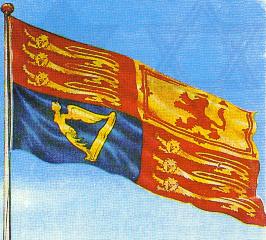
 The
Red Lion The
Red Lion
The Royal Standard of England, from "Symbols of
our Celto-Saxon Heritage" by W.H. Bennett, published by Canadian
British-Israel Association, 1361 Ouelette Avenue, Windsor, Ontario N8X
1J7, Canada.
F.R.A. Glover: It will not have escaped
the attention of the least observant, that, in the National Flag, called
the Royal Standard, which is the Blazon of the National Arms, in the upper
and outer quartering of that Ensign, there is a Lion Rampant, red, on a
Golden Ground.
That Lion is the Lion of Scotland, incorporated, according to the Rules
of Heraldry, into the Arms and Standard of England from the time that
James VI. of Scotland, inheriting by his English Descent the Realm of
England, united the Two Crowns.
How that Eastern Tropical Beast, a Lion, came to be the Blazon of a
Country lying so far West as Scotland, and in the Icy North, the following
extract from Campion's Historie of Ireland, p. 32, in Spenser's
Publication, will declare,-
First therefore came from Ireland Fergusius, the Son of Ferchardus; a
man very famous for his skill in blazoning of armes. Himselfe bore the Red
Lyon, rampant in a Golden Field (John Major, lib. 2, cap.1 ). There was in
Ireland a monument of marble, fashioned like a throne; and .. because he
deemed the finding thereof to be ominous to some kingdome, he brought it
along with him and layde it up in the country for a Jewell. This marble
Fergusius obtained towards the prospering of his voyage, and in Scotland
he left it, which they used many years after, in Coronation of their kings
at Scone."
Thus, it will be seen, that the Lion of Scotland was, in reality, the
Lion of Ireland: and, as the Lion is no more an Irish than a Scottish wild
beast, it is evidently an importation to that Country from the East:
further, as having been associated, as is seen above, by Fergus with the
National and Family Stone, it is clear that he must have considered it
equally as the Family and National Standard.
The Harp became the National Standard of Ireland, only from the time of
Henry VIII (Ledwich, 232), in order to commemorate his election as king of
Ireland by the common assent of the Irish Princes. They were no less glad
than the English, to be rid of the unseemly intrusions of the Bishop of
Rome; and they thus expressed their gratitude to the doughty king. However
deservedly reprobated for his tyranny in other matters, the king was a
great favourite with the Chief Princes in Ireland; who willingly
recognized his authority and kingship, and did homage to him, accordingly,
as King of Ireland.
Up to this time it would seem that the Irish had no common or
National Standard; for, "in an ancient Roll of Arms preserved by Leland (Collectanea
616), of the age of Hen. III., giving the bearings of most European
Princes, we find the Arms of Wales, of Scotland, and the little Isle of
Man, but not a word of Ireland." (Ledwich's Antiquities, p.232).
The cause of this might have been, that the English considered
their Arms as the Arms of the English Pale; and would have felt it to
be untrue as well as impolitic, to give any blazon of any of the then
existing Irish kings, as the Arms of Ireland.
But, as Fergus had taken the Lion Rampant with him to Scotland as a
proper accompaniment to the National Stone, which he, possibly, held to
have had some talismanic virtue, it is evident that he thought that that
Standard was the Standard of his Race; and we may, therefore, very well
believe that he felt it to be the Standard of his nationality also.
That this Irish Lion was the Lion of the Tribe of Judah,
introduced into Ireland by the Prophet Jeremiah at the same time that the
Stone from the East and the Seed Royal were introduced, there is no need
to affirm. Of the probability of such a deed on the part of the
Prophet, others are as well capable of judging as he who writes. It is
very evident, that an Eastern Beast, never indigenous to these countries,
was once the Standard of Ireland, or of the Reigning Family of Ireland;
and that that goes to establish the fact of a connexion of that Family
with the East: and further, that this Figure of a Lion Rampant, is the
Ensign of the Hebrew Tribe of Judah; which concurrence tends much to show
the likelihood of a Hebrew connexion between Ireland and the
East. Certainly, whatever be the ancient facts of the case, this Irish
connexion has been the means of introducing and maintaining, in constant
display, on the National Keep of Royalty, over the anointed Head of this
United Empire, the Blazon identical with the Standard of the
Tribe of Judah. This may indicate what has been suggested, or it
may mean nothing. It may be accident, and not Providence. It
certainly ties Ireland to the East, .. to those of the East who bad a Lion
Rampant for their Standard. And the son of Jesse had a Lion Rampant for
his Standard. And if there be any reason to imagine that Jeremiah, in the
exercise of his office and mission "to plant and to build" the kingdom of
Judah, for the perpetuation of the Sceptre thereof, and the continuation
of the Throne of David, set up any mark of Jewish Nationality and Descent,
what badge would he have brought and left as the mark and sign of that
Monarchy, but the old well-known and prophetically inspired Standard of
the Race he represented?
Go to Previous Chapter
Go to Next Chapter
Go to First Chapter
From: "England, the Remnant of Judah, and the Israel of Ephraim",
written by F.R.A. Glover, M.A., Chaplain to the Consulate at Cologne.
Published by Rivingtons, London, 1861. Based on research commenced in
1844.
|
Judah's Sceptre and Joseph's
Birthright
PART THIRD
The Veil Lifted from the Abrahamic Nations
Chapter 8
Egypt-Israelitish and Anglo-Saxon Emblems
"Now Israel loved Joseph more than all
his children, because he was the son of his old age, and he made him
a coat of many colors." (Gen. 37:3)
A souvenir of this coat of many colors
which Jacob made for Joseph is still found in the many-colored plaid,
as worn by the Scotch Highlanders, not only at home, but by Highlander
societies, which exist in nearly every large Anglo-Saxon city. The use
of this van-colored plaid, and the custom of wearing it, can be traced
as far back as the Scottish people have any history, and yet its
origin among them is unknown; that is, it was unknown until they began
to know that they were the descendants of Joseph.
Also, once upon a time, the Gileadites
were at war with Ephraim-Israel,
"and the Gileadites took the passages
of Jordan before the Ephraimites; and it was so, that when those
Ephraimites which were escaped said, Let me go over; that the men of
Gilead said unto them, Art thou an Ephraimite? If he said, Nay; then
said they unto him, Say now Shibboleth, and he said, Sibboleth;
for he could not frame to pronounce it right. " (Judges
12:5-6)
The Ephraimites seem to have had
trouble to pronounce the letter h, and many of Ephraim's people
still have trouble with their h's, especially the modern
"Cockney."
|
The Gileadites seem to have
worsted Israel in this war to which we have referred, but,
according to prophecy, there was to come a time when Ephraim would
nevermore be conquered by a Gentile nation. And it must have been
to this end that the Lord told the islands to keep silent, "until
my people renew their strength." For of this same people, this
Israel that is dwelling in the isles, the Lord says:
"Behold, all that were incensed
against thee shall be ashamed and confounded; they that strive
against thee shall perish; they shall be as nothing. Thou shalt
seek them, even them that contended with thee; they that war
against thee shall be as nothing, and as a thing of naught. For
I, the Lord thy God, will hold thy right hand, saying unto thee,
Fear not; I will help thee. Fear not, thou worm Jacob, and ye
men of Israel; I will help thee, saith the Lord," (Isa.
41:11-14).
When Balak, the king of Moab, hired
Balaam to curse Israel, and he could not, but was compelled by the
Lord to bless Israel, he said:
"God brought him forth out of
Egypt; he [Israel] hath, as it were, the strength of an
UNICORN; he shall eat up the nations his enemies, and shall
break their bones, and pierce them through with his ARROWS. He
crouched, he lay down as a lion, and as a GREAT LION. Who shall
stir him up? Blessed is he that blesseth thee, and cursed is he
that curseth thee," (Num. 24:8-9).
Now, it is a most remarkable fact
that two of these racial emblems, the LION and the UNICORN, which
were given to Israel with that compulsory blessing, are in the
coat-of-arms of Great Britain. This insignia, or national seal,
is, in part, the "Harp of David," which was brought to the isles
by Dan and Simeon, with the Unicorn reared on one side and
the Great Lion on the other. The Lion is both Judah's and
Israel's, so also is the Unicorn not only Israel's, but Joseph's,
and yet in a special sense it belongs to Ephraim, because he had
the precedence in birthright. Thus Moses, on the day of his death,
while he was reiterating and enlarging upon the prophecies and
promises made by Jacob to each of the tribal heads, said,
concerning the blessings of Joseph:
"His glory is like the firstling
of his Bullock, and his horns are like the horns of Unicorns;
with them he shall push the people together to the ends of the
earth; and they are the tens of thousands of Ephraim
(the thousands of each of the ten tribes) and the thousands
(of the one tribe) of Manasseh." (Deut. 33:17)
The English have not only the lion
and the unicorn, but they have also that which to them may mean
only a circle divided into four quarters. Still it is really a
reproduction of Ephraim's cake, for the four quarterings are made
by a cross. ( See Below) In one of these
quarterings is David's harp, and in each of the other three are
young lions.

Ephraim's Cake (Lion/Unicorn)
That Manasseh was a separate tribe
is known from the following: "There was also a lot of the tribe
of Manasseh, for he was the first-born of Joseph," (Joshua
17:1). Also the following:
"For the children of Joseph were
two tribes, Manasseh and Ephraim; therefore, they gave no part
unto the Levites in the land, save cities to dwell in, with
their suburbs," (Joshua 14:4).
Thus was the land divided by lot as
the Lord commanded,
"But unto the tribe of Levi
(the priests) Moses gave not any inheritance; the Lord God of
Israel was their inheritance." (Jos. 13:33)
Thus with Joseph's two tribes,
which was his promised "double portion," there were
thirteen tribes in Israel, and only twelve divisions of the
land, so the Levites could have no land inheritance; but they had
the Lord, which was far better, and they were allowed to eat the
meat of sacrifice from off the holy altar.
But Manasseh was not only a
separate tribe, but as a partaker of the birthright blessing, he
and Ephraim were to grow together until they became a multitude in
the midst of the earth; then he was to be separated from his
brethren, and become a great nation. This is the
reason of the prophecy,
"Joseph is a fruitful bough, even
a fruitful bough by a well [literally by the water],
whose branches run over the wall." (Gen. 49:22).
Thus God said:
"Let the blessing come upon the
top of the head of him that was separated from his brethren."
(Deut. 33:16)
Since there are thirteen tribes in
Israel, and since Ephraim and Manasseh were adopted after all the
rest were born, and Ephraim is counted for Joseph, or rather that
they are counted interchangeably, there is no other chance for
Manasseh, numerically speaking, but that he is number thirteen.
Now, it is a significant fact, that when Manasseh separated from
Ephraim -- when the people who have become a great nation
separated from those who have become a company of nations,
because their branches have continued to run over the wall -- he,
Manasseh, or America, had just thirteen states, and that thirteen
is the prominent number in all the emblems and heraldry of the
land.

National Seal of the United States of America
"He also shall become a People, and he also shall be Great"
Genesis 48:19
The first national flag of those
original United States had thirteen Stars and thirteen
Bars. The bars symbolize the Union, and the constellation of
thirteen stars was intended to symbolize the nation formed of
thirteen independent states.
In this, the Great Seal of our
country, as represented above, we have the arms and crest of the
United States of America. We would first call your attention to
the fact that the eagle is holding in what is called the "Dexter"
talon an Olive Branch. In the fourteenth chapter of Hosea, that
prophet, who has so much to say about lost Ephraim-Israel, we have
the following:
"O Israel, return unto the Lord
thy God; I will heal their backslidings; I will love them
freely; for mine anger is turned away from him . . . I will be
as the dew to Israel; he shall grow like the lily [the
national flower of Egypt], and cast forth his roots as
Lebanon [royal cedar]. His branches shall spread,
and his beauty shall be as the OLIVE tree. Ephraim will say,
What have I to do any more with idols?" (Hosea 14:1, 4-6, 8)
Ephraim is the representative of
the house of Joseph, and we have placed this Scripture before our
readers that they may see that the Olive tree is among the
insignia of the birthright family, and that it is here represented
as belonging to one of the Branches of the birthright
kingdom, and since the birthright is Joseph's, it is the Olive
Branch of Joseph which has been placed in the "Coat of Arms"
of Manasseh, the thirteenth tribe in Israel, who has now fulfilled
the prophecy of becoming a great nation.
Still this fact, if it stood alone,
might not mean so much, but in the other talon, which is called
the "Sinister," is a "Bundle of thirteen Arrows,"
which represents the nation individually and collectively prepared
for war. It is marvelous that the Olive Branch should have
been made our official insignum of Peace, and that the
Arrows should have been made by law to represent the War Power
of the country, for the Arrows were in the heraldry of
Israel, as well as the Unicorn and Lion, when Balaam was compelled
to bless instead of curse them. Also, the Josephites were Bow-men,
and Jacob, after speaking of Joseph and his branches, said,
"The archers have sorely grieved
him, and shot at him, and hated him. But his Bow (munitions
of war) abode in strength, and the Arms of his hands
were made strong by the hands of the mighty God of Jacob,"
(Gen. 49:23-24).
It is a well-known, and
much-rejoiced-over fact that the Bow of the United States,
which has sent her Arrows into the ranks of her enemies,
has always abode in strength, and that both her chief men
and people have always said: "God has helped us."
When Israel marched through the
wilderness, she had four standards that were called "Camp
Standards." One of these was on the north, one on the east, one on
the south, and one on the west. But there were, besides these, a
family standard or ensign for each tribe. Hence the Lord commanded
saying:
"Every man of the children of
Israel shall pitch by his own standard, with the ensign of their
father's house; afar off about the tabernacle shall they pitch,"
(Num. 2:2).
The object of the camp standards
was, that when the time came to camp or pitch their tents for the
night, the three tribes which belonged to each of these four camp
standards might gather to them. The compilers of our reference
Bibles understood this, hence they have given the references to
the four living creatures of Ezekiel 1:10 as follows:
"As for the likeness of their
faces, they four had the face of a Man (Num. 2:10)
and the face of a Lion (Num. 2:3), on the right
side;
and they four had the face of an Ox (Num. 2:18)
on the left side;
they four also had the face of an Eagle," (Num.
2:25.)
The reference to the Lion reads:
"And on the east side, toward the
rising of the sun, shall they of the standard of the camp of
Judah pitch throughout their armies." (Num. 2:3)
It was dying Jacob who gave the
Lion to Judah as the ensign of his royal house, in the following:
"Judah is a lion's whelp; from
the prey, my son, thou art gone up; he stooped down, he crouched
as a lion, and as an old [Lawbee -- old, great, stout]
lion, who shall rouse him up?" (Gen. 49:9)
Oh! this is truly wonderful, for,
mark this, when his race was young Judah as a Lion's Whelp
took a leap with Dan from Palestine to the isles, and now he is
there as an Old Lion, and the question is, "Who shall
rouse him up?
The fact that we find Judah's Lion
with the Unicorn of Ephraim-Israel in the national seal of the
Brith-ish, or covenant, people is another evidence that the royal
remnant of the Judo-Davidic house found their way to
Ephraim-Israel at the time of the uprooting of the Pharez line,
who was then, as now, living in the isles of the northwest. And it
is also another evidence that the Saxon nations are the nations of
Israel upon whom "lighted" the Divine word, who is also "The
Lion of the Tribe of Judah."
The reference from the Ox in
Ezekiel is as follows: "On the west side shall be the standard
of the camp of Ephraim according to their armies." (Num.
2:18). Here again we have the representative of Joseph, the
birthright holder, of whom Moses said: "His glory is like the
firstling of his Bullock." (Deut. 33:17). The Hebrew
word that is here translated bullock is the same as that in
Ezekiel 1:10, which is rendered Ox. In fact, there is but
one word in the Hebrew (shur, or shour) for ox,
bull, or cow. But the above shows us that the family ensign of
Joseph was a bovine. This is the reason for such expressions as, "Ephraim
is an heifer that is taught," (Hosea 10:11) and "Israel
slideth back as a backsliding heifer." (Hosea 4:16). It was
also because of this fact that, when Jeroboam, of the house of
Joseph, wanted to make idols which would be attractive to
Ephraim-Israel, he made two calves; i.e., a bullock and a heifer.
The Unicorn of Israel is now in the national insignia of that
people, but the family ensign still clings to them as a national
nickname; i.e., "John Bull."
Thus far it is clear that the
Lion of Ezekiel's vision was the camp standard of Judah, which
was on the east; and that the Ox of his vision was the
ensign of the family of Joseph, which was with Ephraim in the
west. As we continue to investigate the signification of these
four living creatures we find that the reference to the Eagle
reads as follows: "The standard of the camp of Dan shall be on
the north side of their armies" (Num. 2:25). We have already
shown, while explaining Ezekiel's riddle concerning the pulling
down of him that was high, and the exaltation of him
that was low, that the Eagle was, at that time, the
ensign of the tribe of Dan; but since that time they have used the
Leaping Lion's Whelp, with the serpent's tail, and the
Eagle, like everything else that pertains to national Israel,
has fallen to the birthright family, and is now the national
ensign of the thirteenth tribe of Israel, the people of which are
not only the descendants of Manasseh, the first-born of Joseph,
but they also compose the firstborn nation out of the "MANY
NATIONS," which were promised to Abraham, Isaac, Jacob, and
Joseph, and whose ensign Eagle holds in his beak a scroll upon
which is written their national motto, "E Pluribus Unum,"
which has thirteen letters, and means "One out of MANY."
Therefore, concerning a certain
land which is in-dwelt by a portion of Israel, we have the
following:
"Ho (or Hail, not Woe,
as in the King James version of the Scriptures) to the land
shadowing with wings, which is beyond the rivers of Ethiopia:
that sendeth ambassadors by the sea, even in vessels of
bulrushes upon the waters, saying: Go, ye swift messengers, to a
nation scattered and peeled, to a people terrible from their
beginning [note that] hitherto a nation meted out
[measured out by a time of prophecy, which is called the
times of the Gentiles] and trodden down, whose [home,
or ancient] land the RIVERS [ "Now, therefore, behold
the Lord bringeth upon them (Israel) the WATERS of
the RIVER, strong and many, even the king of Assyria, and
all his glory; and he shall come up over all his (Israel's)
channels, and go over all his banks," (Isaiah 18:8-7) ]
have spoiled! All ye inhabitants of the world, and dwellers on
the earth, see ye, when he [that nation shadowed with wings]
lifteth up an ensign." (Isaiah 18:8-7, 18:1-3)
We have thus parenthesized Isa.
18:8-7 with Isa. 18:1-3, that our readers may know that this land
which had set up an ensign of outstretched wings was a land in
which Israelites were dwelling, for it was the king of Assyria,
who came up against Ephraim-Israel, overflowed his land, and led
him into captivity. Prior to this, Moab had once held Israel in
derision, and the Lord, in condemning their arrogance, said:
"He [Israel] shall fly as
an Eagle, and spread his wings over Moab," (Jer.
48:40).
No wings except those which are
spread out can be shadowing wings, and the Shadowing wings
of Israel's Spread Eagle are in the ensign of the United
States of America. Hence, America is the land shadowed by wings of
which Isaiah wrote, whose ambassadors cross the sea in vessels of
bulrushes, or, literally, of caldrons which absorb water; i.
e., the modern steamship.
The Shield, or escutcheon,
which is borne on the breast of the Spread Eagle, has thirteen
pieces, called pales, or paleways, which comes from the same word
as palings or pickets. These thirteen paleways are united by one
at the top. The Lord said to Abraham: "I am thy Shield."
(Gen. 15:1)
On the national seal of America,
the "Great People," above the shadowing wings and the scroll, is a
Cloud emitting rays of Glory. "Aaron spake unto
the whole congregation of the children of Israel . . . and behold
the Glory of the Lord appeared in the Cloud."
(Ex. 16:10). To our fathers that glory Cloud was
significant of the presence of Jehovah. That Glory Cloud, which
hung over Israel, guided those who had but just escaped from the
Egyptian bondage, and it stood between them and their enemies. But
this is not all, for this Cloud of our American heraldry surrounds
what is called "The Constellation."

The Great Pyramid
(Reverse Side of America's National Seal)
This constellation is a group of
thirteen stars, or planets, on a field of azure sky, which is
exactly the same number of planets that appeared on the azure sky
in the dream of Joseph, which drove him into separation from his
brethren.
Any one of these features in the
blazonry of our nation might have been a coincidence, but when we
see that there is not a single feature, but that which is Josephic
and Israelitish, it is simply astounding. But when we turn our
face upon the reverse side of that great national seal we are
overwhelmed, for there stands the Great Pyramid of Egypt, which is
one of the two great monuments of Egypt, the birthplace of Ephraim
and Manasseh, the Egypto-Israelitish sons of Joseph, the son of
Jacob, the son of Isaac, the son of Abraham. And, marvel of
marvels! The national Crest of England has that other great
monument of Egypt, the Sphinx, on its reverse side. Thus do the
people of Great Britain and the United States of America, the
Brother nations, by that which speaks louder than words, for signs
are arbitrary, say that they are the offsprings of the
Egypto-Israelitish holders of the Abrahamic birthright.
The people of the United States
made this declaration by that which was made a law on Thursday,
June 20, 1782, for on that day the ensign which bears those
shadowing wings of Israel, together with the Heraldry of Joseph,
became a law among us. Also over the pyramid on the reverse side
of the Great Seal of America is another thirteen-lettered motto,
which, of course is not only lawful, but also national; i.e., "Annuit
Coeptis," -- "He [the Lord] hath prospered
our undertakings." This also is Josephic, for we read,
"The Lord was with Joseph, and he
was a prosperous man." (Gen. 39:2)
"The Lord was with him
[Joseph], and that which he did the Lord made it to prosper"
(Gen. 39:23).
Those who understand the Cabala and
the arith mography of the Scriptures, it is known that the number
thirteen is significant of rebellion, but all that we can
say about it here is that the first time this number occurs in the
Bible it is with reference to Rebellion (Gen. 14:4). Surely
that people whose characteristic number is thirteen did
rebel in 1776, and prospered in it, too. They also
prospered in 1814, in another little affair concerning the
acquisition of a vast stretch of territory known as Louisiana.
This people have also had rebellion
within their own borders, and it is a remarkable fact that,
although thirteen was not the number of states in the Confederacy,
the Confederate Congress, in 1863, formally adopted a battle flag
for the Confederacy, and also a Confederate flag. The Battle
Flag was a white field with a blue cross of this (X)
shape, in which there were thirteen stars. The flag for the
Confederacy was white, with a red field in the Dexter chief
corner, bearing this same (X) cross with its thirteen
stars. Here again is both rebellion and the birthright cross of
the house of Joseph. In his struggle the government also
prospered, and it was essential that it should thus prosper, not
only in this case, but also in the others of which we have spoken,
in order to fulfill a prophecy concerning one feature of their
history, namely:
"Shew my people their
transgression, and the house of Jacob their sins. . . . Is not
this the fast that I have chosen? to undo the heavy burdens, and
let the OPPRESSED GO FREE, and that YE break every yoke?"
(Isaiah 58:1, 6).
These are the reasons for which
Our Race go to war. England freed her slaves in 1838 and
America freed hers in 1861.
It has often been said that
brothers would quarrel. Judah and Ephraim did, and so have Ephraim
and Manasseh; and the troubles to which we have thus far alluded
have been family affairs. When it comes to these family
difficulties, that one will always conquer which must do so in
order to fulfill the word of God. But when it comes to war with
non-Israelitish nations, whether it be to undo heavy burdens,
to let the oppressed go free, to break the
yoke of slavery, or for whatever reason, then the Israel
of which we speak will always succeed. For it is of literal,
fleshly, Joseph Israel, of whom also is spiritual Israel, of whom
it is said: "No weapon that is formed against thee shall
prosper." (Isaiah 54:17). And also the following:
"The remnant of Jacob shall be
among the Gentiles in the midst of many people as a lion among
the beasts of the forest, as a young lion among the sheep
[margin: goats]; who, if he go through, both treadeth
down, and teareth in pieces, and none can deliver. Thine hand
shall be lifted up upon thine adversaries, and all thine enemies
shall be cut off," (Micah. 5:8-9).
It was in fulfillment of these
promises that Napoleon, the hitherto victor, bit the dust at
Waterloo. It was in fulfillment of these promises that the
American fleet entered Manila Bay, and destroyed tile enemy's
fleet with the loss of only seven men. It was in fulfillment of
these words of Divine truth that the American fleet destroyed the
Spanish fleet in Cuban waters and lost only one man. It was that
these promises might be fulfilled that Sam Houston, with only
seven hundred and fifty raw recruits, fought the decisive battle
against the Mexican army at San Jacinto, April 21st, 1836, in
which he annihilated the Mexicans at one blow, killing six hundred
and fifty, capturing three hundred and fifty, and putting the rest
to flight, and yet losing only eight men and twenty-five wounded.
But space forbids to tell of the many similar cases.
When the children of Israel were
singing unto the Lord over the victory he had given them by
destroying the armies of Pharaoh, they said:
"Thou didst blow with thy
wind, the sea covered them they sank as lead in the mighty
waters. Who is like unto thee, O Lord, among the mighty ones?
Who is like thee, glorious in holiness, fearful in praise, doing
wonders?" (Ex. 15:10-11)
In the forty-first chapter of
Isaiah, where the Lord says to Israel in the isles, "They that
WAR against thee shall be as nothing, and as a thing of naught,"
(Isaiah 41:12) he also says:
"Thou shalt fan them, and the
wind shall carry them away, and the whirlwind shall scatter
them." (Isaiah 41:16)
One fulfillment of this promise was
the destruction of the "Invincible Spanish Armada," when they went
against the English in 1588, concerning which the American
Cyclopedia gives the following:
"The Spanish Armada sailed May 29,
but a storm compelled it to return; and it was not till
the end of July that the two fleets met and joined in battle
near the English coast. After a series of actions that lasted
several days, the Spaniards were utterly routed, the elements
assisting the English."
The underscores are ours, as we
wish to call your attention to how the Lord helped. This Armada
consisted of 130 vessels all told, and was unequaled in its time.
Israel in the isles had not yet fully renewed their strength. The
history continues,
"Having left Lisbon for Corunna for
stores, May 29, 1588, the fleet was dispersed by a violent
storm, and, though all the ships joined at Corunna with the
exception of four, they were considerably shattered, and had to
be repaired. Reports having reached England that the armament
was completely disabled, the government ordered its own ships to
be laid up; but Lord Howard, the admiral, opposed this order,
set sail for Corunna, learned the truth, and on his return
continued warlike preparations. Soon after, being informed that
the Armada had hove in sight, he weighed anchor, and as it
passed Plymouth, July 31, stood out in its rear and opened a
destructive fire. "
" Having the windward position,
and being greatly superior in speed, he was able to inflict
serious damage without loss to himself. All the way along the
channel the English followed the Armada with the same tactics,
taking advantage of the changing winds, harassing the
Spaniards, capturing two or three of their best vessels, and yet
keeping all the while virtually out of reach. The Spaniards
proceeded toward the coast of Flanders, keeping as close
together as possible . . . Off Calais the Armada cast anchor,
waiting for the Duke of Parma's fleet to come out of the Flemish
harbors; but Parma had nothing but unarmed barges, and could not
come out until the Armada had beaten off the Anglo-Dutch
blockading squadron. Driving the Spaniards out of Calais roads
by means of fire ships, Aug. 8, Howard and Drake now forced them
toward the Flemish coast, with the purpose of getting them into
the North Sea and cutting off their communications with Dunkirk.
"
" The battle began at daybreak
off Gravelines, and lasted till dark. The Spaniards were
completely defeated. Several of their largest ships were lost,
and 40,000 men were killed, and probably at least as many were
wounded. It was impossible either to return to Calais or to
reach the Duke of Parma. Their provisions were nearly exhausted,
and the English fleet, apparently little injured, still
hovered on their weather beam. It was imperative that they
should return to Spain for fresh stores. The passage through the
channel being closed by the English fleet, the Spaniards, now
counting 120 vessels, undertook to round Scotland and Ireland.
But in the neighborhood of the Orkneys they were dispersed by
a storm. Some of them foundered. About thirty were afterward
wrecked on the west coast of Ireland. Those of the crews who
escaped to shore were generally killed, and it was calculated
that about 14,000 thus perished. "
Remember, these historic and
cyclopedic writers are not supposed to know that God has said
that, in order to defend his birthright people, he would send a
wind to carry away this so-called "Invincible Armada," and a
whirlwind to scatter them. Hence their testimony is all the more
striking. Surely the people of modern Israel, who dwell in the
Isles, might also sing unto the Lord, saying:
"Thou didst blow with thy wind,
and carried them (their enemies) away, and the whirlwind
did scatter them. Who is like the Lord, glorious in holiness,
fearful in praise, doing wonders?" (Isaiah 41:16).
Truly, Jesus has well said:
"If I have told you of earthly
things, and ye believe not, how shall ye believe if I tell you
of heavenly [spiritual] things." (John
3:12)
CONCESSIONAL
Still we call to our
God of old;
God of the "far off" Isaac line;
Our God, whose word doth make us bold
To claim our heritage divine.
The Lord of hosts is with us yet,
Doth He forget? Doth He forget?
It cannot be that
Isaac dies;
His people and his kings depart;
Before his God the Saxon lies,
Glad and brave, but with contrite heart
The Lord of hosts is with him yet,
Doth He forget? Doth He forget?
Called in Him we are
today
No longer passing through the fire;
Altho' we were but yesterday
As one of Nineveh and Tyre.
The Lord of nations guides us yet.
Doth He forget? Doth He forget?
When battles rage we
cannot lose,
God makes all men to stand in awe
Of Saxons, now that He doth use
The race to whom He gave his law.
His "Battle ax" we are, as yet,
Doth He forget? Doth He forget?
Our fathers once did
idols trust,
Also their strength and iron shard;
Now, though we number as the dust,
We call on thee, Lord God, to guard
For Thou hast proved Thy holy word,
Shown mercy to Thy people, Lord! |
Benjamin Netanyahu
"The Man of My Dream"
From Wikipedia, the free encyclopedia
Photo Album
Book - Durable
Peace
"Terrorism: How the West
Can Win" (1995)
Articles by
Binyamin Netanyahu (English)
Speeches by Prime
Minister Netanyahu

1996-1999
Inteviews Speeches
and Lectures with Binyamin Netanyahu (Since 2000)
The Realization of
Herzl's Dream
- Zionizm
Benjamin Netanyahu
(help·info)
(Hebrew:
בִּנְיָמִין נְתַנְיָהוּ (without
niqqud:
בנימין נתניהו), Hebrew transliteration written in English:
Binyamin Netanyahu, nicknamed Bibi) (born
October 21,
1949,
Tel
Aviv) was the 9th
Prime Minister of Israel and is a leading figure in the
Likud
party.
As leader of the conservative
Likud
party, he was Prime Minister from June, 1996 to July, 1999. He is the
first (and to date only)
Prime Minister of Israel to be born after the State of Israel's
foundation. He was Finance Minister of Israel until
August
9, 2005,
when his resignation letter came into force. He resigned in protest at
the Gaza
Disengagement Plan advocated by Prime Minister
Ariel Sharon. Netanyahu retook the Likud leadership on
December 20,
2005. As of
May 4,
2006, he is
the official leader of the Opposition in the Knesset.
Family and personal background
Netanyahu was born in
Tel
Aviv, to Zila and Ben-Zion Netanyahu (original name Milikowsky).
Netanyahu's relatives were Jews from
Lithuania. Netanyahu's father is a
professor of
Jewish history, a former editor of the
Hebrew Encyclopedia, and a former senior aide to
Zeev Jabotinsky. His elder brother
Yonatan was killed during
Operation Entebbe in 1976. His younger brother
Iddo is a radiologist and writer. All three brothers served in the
elite
Sayeret Matkal reconnaissance unit. When Binyamin Netanyahu was 14
years old, his family moved to the
United States and settled in
Cheltenham Township, Pennsylvania, a
Philadelphia suburb, where he graduated from
Cheltenham High School. He holds a
B.Sc in Architecture from the
Massachusetts Institute of Technology, and an
MBA from the
MIT Sloan School of Management, and has studied political science at
Harvard
and MIT. After graduate school, Netanyahu returned to
Israel.
Netanyahu has a daughter, Noa, from his first marriage to Micki Weizman.
Netanyahu's second marriage was to Fleur Cates, who converted to Judaism
for his sake since only her father was a Jew. He is now married to his
third wife, Sarah, with whom he has two children - Yair and Avner.
After a brief career in business, Netanyahu was appointed Deputy
Chief of Mission at the Israeli Embassy in
Washington, D.C. in 1982. Subsequently, he became Israel's
Ambassador to the
United Nations, serving from 1984 to 1988. He was elected to the
Knesset
in 1988 and served in the governments led by
Yitzhak Shamir from 1988 to 1992. Shamir retired from politics
shortly after Likud's defeat in the 1992 elections. In 1993, for the
first time, the party held a primary election to select its leader, and
Netanyahu was victorious, defeating
Binyamin Ze'ev Begin, son of the late Prime Minister
Menachem Begin, and veteran politician
David Levy. (Ariel
Sharon initially sought the Likud leadership as well, but quickly
withdrew when it was evident that he was attracting minimal support.
Prime minister (1996-1999)
In 1996, for the first time, Israelis elected their Prime Minister
directly. Netanyahu was elected in 1996 after a wave of suicide bombings
against Israelis. On March 3 and 4, 1996, Palestinians carried out two
suicide bombings, killing 32 Israelis. Those attacks were the main
catalyst in the downfall of Peres, who eventually lost the election due
to his inability to stop
attacks against Israelis although early opinion polls during the
campaign had appeared favourable. Unlike Peres, Netanyahu did not trust
Yasser Arafat and conditioned any progress at the peace process on
the
Palestinian Authority fulfilling its obligations - mainly fighting
terrorism. His campaign slogan was "Netanyahu - making a safe peace".
Netanyahu hired American Republican political operative
Arthur Finkelstein to run his campaign. Although the American style
of sound bites and sharp attacks elicited harsh criticism from inside
Israel, it proved effective and Netanyahu's
Likud Party took control. In 1999,
Ehud Barak would choose a similar style to challenge Netanyahu by
bringing in
Bill Clinton's former campaign manager,
James Carville, as well as American consultant
Bob
Shrum and pollster
Stanley Greenberg.
As Prime Minister, Netanyahu negotiated with
Yasser Arafat in the form of the
Wye River Accords (1998). No progress was made in peace talks with
the Palestinians, and Netanyahu failed to implement the agreed steps of
the Oslo Accords. In 1996, Netanyahu and
Jerusalem's mayor
Ehud Olmert decided to open an exit for the
Western Wall Tunnel. This sparked three days of riots by
Palestinians, resulting in both Israelis and Palestinians being killed.
Netanyahu was opposed by the political
left
wing in Israel and also lost support from the right because of his
concessions to the Palestinians in
Hebron
and elsewhere and due to his negotiations with Arafat generally. After a
long chain of scandals (including gossip regarding his marriage) and an
investigation opened against him on charges of corruption (later
acquitted), Netanyahu lost favor with the Israeli public.
After being defeated by
Ehud Barak in the 1999 Israeli general elections, Netanyahu
temporarily retired from politics.
Political activity after 2000
In 2002, after the
Israeli Labor party left power and vacated the position of foreign
minister, Prime Minister
Ariel Sharon appointed Netanyahu as Foreign Minister. Netanyahu
challenged Sharon for the leadership of the
Likud
party, but failed to oust Sharon. After the 2003 elections, Netanyahu
accepted the post of Finance Minister in a newly formed Sharon
coalition. Netanyahu did not support the concept of a future Palestinian
state, though on two occasions in 2001, he indicated willingness to
consider the idea
[1].
As Finance Minister, Netanyahu undertook an economic plan in order to
restore Israel's economy from its low point during the
al-Aqsa Intifada. The plan involved a move toward more
liberalized markets, although it had been seen by many opponents as
controversial. Netanyahu succeeded to pass several long-in-the-queue
reforms, including an important reform in the banking system that
followed with a significant increase in the GDP growth rate.
Netanyahu threatened to resign in 2004 unless the Gaza pullout plan
was put to a referendum, but later lifted the ultimatum. He submitted
his resignation letter on August 7, 2005, shortly before the Israeli
cabinet voted 17 to 5 to approve the initial phase of withdrawals of the
Gaza
Disengagement Plan. Netanyahu's resignation went into effect August
9, 2005, two days after he submitted his letter. Shortly thereafter he
revealed he had rejected an invitation to serve as Italy's finance
minister, allegedly extended to him by Italian billionaire businessman
Carlo De Benedetti, who later said it was a joke.
Following the withdrawal of Ariel Sharon from the Likud, Netanyahu
was one of several candidates who vied for the Likud leadership. His
most recent attempt prior to this was in September 2005 when he tried to
hold early primaries for the position of the head of the
Likud
party, while the party held the office of Prime Minister - thus
effectively pushing Ariel Sharon out of office. The party rejected this
initiative. Netanyahu retook the leadership on December 20, 2005, with
47% of the primary vote. In the
March 2006 Knesset elections Likud shared the third and the fourth
places with
Shas, behind
Kadima
and
Labor.
Controversy
In July 2006, Israelis including Binyamin Netanyahu attended a 60th
anniversary celebration, organized by the
Menachem Begin Centre, of the
King David Hotel bombing. The British Ambassador in Tel Aviv and the
Consul-General in Jerusalem complained, saying "We do not think that
it is right for an act of terrorism, which led to the loss of many
lives, to be commemorated.".[1]
According to Begin, the British had been warned of the bombing three
times but refused to evacuate the building because "We don't take orders
from the Jews"
[2]. However, according to
Shmuel Katz, in his book Days of Fire, "The Haganah radio later
broadcast a report that on receiving the warning Sir John Shaw, the
Chief Secretary of the British administration, had said: "I give orders
here. I don't take orders from Jews," and that he had insisted that
nobody leave the building. This version may be dismissed. It probably
developed from the fact that while some of Shaw's close colleagues and
subordinates were killed, he himself went unscathed, and gained credence
when Shaw was transferred from Palestine a month later. It's more likely
that the British did not take the warning seriously because they didn't
believe Etzel
could infiltrate their HQ that was guarded so well" (Katz, 1966:94)
Books and articles
Books:
- A Durable Peace: Israel and Its Place Among the Nations
(Warner Books, 2000)
ISBN 0-446-52306-2
- Fighting Terrorism: How Democracies Can Defeat Domestic And
International Terrorism (Diane Pub Co, 1995)
ISBN 0-7881-5514-8
- A Place Among the Nations (Bantam, 1993)
ISBN 0-553-08974-9
- Terrorism: How the West Can Win (Farrar Straus & Giroux,
1986)
ISBN 0-374-27342-1
Articles:
References
- [1] Ned Parker and Stephen Farrell,"British
anger at terror celebration",
The
Times,
July 20,
2006
- [2]
James Taranto,
"Best of the Web Today",
Wall Street Journal,
February 4,
2004
- Clinton, Bill (2005). My Life. Vintage.
ISBN 1-4000-3003-X.
- Katz, Shmuel (1966). Days of Fire.
External links
|
Some Comments on Netanyahu's Election
in Israel:
A Prelude to Coming Disaster?Commentary from the Jewish
perspective
While the upset victory of Benjamin Netanyahu
may astonish, shock or delight one faction or another, what
significance can it hold in effecting any real change in
Israel's perilous situation? Sufficient ground has already been
conceded to Israel's intractable enemies through the conditions
of the Oslo agreements as to make them irreversible. In fact,
any attempt now to offset them or even delay the 'peace process'
by a more conservative and wary prime minister and cabinet might
actually more quickly precipitate the inevitable violence.
Netanyahu's already-announced intention of pursuing terrorists
into the safe haven provided by territories under the
sovereignty of the Palestinian Authority, will inevitably bring
about an armed clash with the 30,000 'police' that constitute a
formidable military presence within Israel's own borders. Even
without that, the Palestinian leadership might conclude that
only violence, the resumption of a threatened and extended
Intifada or worse, is the only answer for the obtainment of
the goals of statehood and the possession of Jerusalem that
failed negotiations cannot now be expected to deliver. A front
page article in the Jerusalem Post International Edition (June
15, 1996) cites Palestinian Authority ministers as warning that
"any policy statement by the incoming government denying a
Palestinian state, refusing a Palestinian role in Jerusalem, or
rejecting withdrawal from the Golan would be considered a
declaration of war."
It may be that the Lord's intention in
allowing the coming to power of the Likud is to demonstrate to
the nation that its salvation cannot be expected from any
political quarter, that its situation is humanly insoluble, that
the nation's predicament is the logic of its own sin and that of
its fathers, the ultimate consequence of turning from its own
God, and that its only remedy lies exclusively and equally in
its return! That such a return cannot Biblically be expected
before a final time of terror and despair [called 'The time of
Jacob's trouble' (Jer. 30:7) that must necessarily take place in
the Land, and culminate in the Lord's return (Zech.14)] is made
abundantly clear from numerous prophetic Old and New Testament
texts. Yet that there are segments of the Church that continue,
despite that word, to hope for political resolution with
an intractable enemy resolutely bent upon Israel's destruction,
is a statement of a condition that perhaps borders upon willful
deception (and if in that, what then in anything?).
So even now, are events not building toward a
dread and final crisis which is still future in present Israel's
experience and for which the time of Jacob’s trouble may
itself be the conclusion? Indeed, the crisis grows out of
desperate secular-humanistic schemings for 'peace' that must
inevitably fail, and will likely precipitate a preliminary
violence of such a kind as to usher in the antichrist treaty
leading to the final calamity of Jacob’s trouble itself!
Were the present state of Israel that 'Israel' now, the nation
would be seeking God at its own authentic altar of worship, and
displaying that limp of utter dependency toward God (Gen.
32:24-32; 33:19-20) that distinguishes a 'Jacob' from an
'Israel.' This is exactly what will characterize the
nation millennially after its final distress in order
that it might 'bless all the families of the earth' in contrast
to that Jacob confidence in itself that is the tragic and
present disposition of the nation. That 'Peniel' is yet to be
crossed but is impending. To see present Israel romantically as
anything other than a 'Jacob' is simply not to see. Such a
projection is more the statement of our own unrealistic
spiritual condition that may itself be rudely remedied in
nothing less than the shock of unexpected disaster. That
Israel's long-standing hardness as a nation (though individuals
as a remnant of grace continue to be saved) will not be altered
till then is itself a judgment ordained of God:
Then said I, Lord how long [will Israel remain in
this condition] and He answered, "Until the cities be
wasted without inhabitant, and the houses without man, and the
land be utterly desolate, and the Lord have removed men far
away, and there be a great forsaking in the midst of the
land." (lsa. 6: l l-12).
Though there have been previous and partial
fulfillments in Israel's history of defeat and expulsion, a
full and final fulfillment is yet future as the text itself
indicates. Clearly, the 'heart of this people is [remains]
fat and their ears heavy and their eyes shut' evidently waiting
for the 'until' of a devastation of 'great forsaking in the
midst of the land.’ This then requires a presence in the
Land (in my opinion obtained in the establishment of the
state of Israel since 1948) 'and it shall be a tenth, and it
shall return’ (v. 13) - not necessarily a literal
tenth, but a tithe which is expressive of, and stands for, the
entire nation. Our mistake, and indeed, tragic in its
implications, is to interpret that preliminary presence
[i.e., present political Israel] as constituting already the
redeemed nation rather than the necessary remnant that 'shall
be eaten’ 1
[Isa.6:13, i.e., 'given, up to destruction' or as it is rendered
in the NIV, 'again be laid waste']. Were this the only text
indicating a future devastation in the Land before a
final restoration, we could perhaps be excused for refusing to
consider so painful a scenario. But the truth is that there is a
plenitude of prophecies that speak of a final
return to a land made desolate. Consider this text from
Ez.36:33-38:
Thus says the Lord God; in the day that I shall have
cleansed you from all your iniquities I will also cause you to
dwell in the cities, and the wastes shall be builded and the
desolate land shall be tilled...and they shall say, This land
that was desolate is become like the garden of Eden; and the
waste and desolate and ruined cities are become fenced and
inhabited...
That this, in my opinion, does not refer to
the cities of antiquity but present Haifa, Tel Aviv,
Jerusalem and all the cities of contemporary Israel, is shown by
the reference that follows. In it God is revealed in His
intervention indicating a time that is clearly future:
Then the heathen that are left round about you
[suggesting a regional disaster of probably a nuclear kind]
shall know that I the Lord build the ruined places and plant
that that was desolate...
That this violence concludes with Israel's
millennial blessings indicates a transformed people who at last
come to know their God, is stated in the concluding verse of the
text:
As the holy flock, as the flock of Jerusalem in her
solemn feasts; so shall the waste cities be filled with flocks
of men: and they shall know that I am the Lord (See also
Joel 2:26-27).
For confirmation elsewhere in the prophetic
Scriptures, consider Amos 9:13-15, "And I will bring again
the captivity of my people Israel, and they shall build the
waste cities and inhabit them..." Isa. 44:26; 49:19
reiterate the same, 'For thy waste and thy desolate places,
and the land of thy destruction shall even now be too narrow by
reason of the inhabitants, and they that swallowed thee up shall
be far away’ (cp. Isa.64:4, etc.). Is it not this to which
Jesus Himself refers (Matt. 24:15-22) in describing the 'sign of
[His] Coming and of the end of the world'?
When ye therefore shall see the abomination of
desolation, spoken of by Daniel the prophet [Dan. 9:26-27],
stand in the holy place...then shall be great tribulation,
such as was not since the beginning of the world to this time,
no nor ever shall be and except those days be shortened, there
should no flesh be saved:
Is Jesus not echoing the alarm of Jeremiah 30:7, Daniel 12:1,
and Joel 2:2?
'Alas! for that day is great, so that none is like it:
it is even the time of Jacob’s trouble; but he shall be saved
out of it’... 'And there shall be a time of trouble, such as
never was since there was a nation even to that time'...
'There has never been anything like it, nor will there be
again after it...’
If that is the description of the time of the
Nazi Holocaust now past, how do we explain what follows in v.10
'and Jacob shall return, and shall be in rest, and be
quiet, and none shall make him afraid’? Is this not exactly
opposite to Israel's present apprehensive
condition and plight? One that will not likely be relieved until
after the prophesied devastation comes? That this
was not the consequence of Israel's previous disasters is
evident from the still-unchanged condition of ourselves as a
people.
To assure Israel that it has come when
it is yet future, and indeed impending, is to leave her wholly
unprepared for both the suddenness and extent of the
catastrophe. To warn of its imminence is to encourage as many,
as will, into the Ark of Safety which the knowledge of the
Messiah and Deliverer in Himself provides. It is to make
practical physical preparations for refuge and flight in
anticipation of a disaster, which when it comes, will come
suddenly. Remarkably, certain 'friends' of Israel,
antagonistic to this account, assert that to hold this view is
to "place an unwarranted curse on the nation and its people"!
Indeed, as lovers of Israel, but also of God's word, we are
faced with a hard choice that we must not evade. Even as a Jew,
who desires the best for my own people, I must stand for the
evident truth of God's word no matter how offensive. 'For thus
saith the Lord, we have heard a voice of trembling, of fear, and
not of peace’ (Jer. 30:5).
No summary of this end time scenario, however
brief, should omit some references of the prolific testimony
found in the prophet Isaiah. In chapters 49-51 we find continual
reference to the 'desolate heritages' to 'those who are bound'
'who are in darkness,' His afflicted. Zion is
understandably disconsolate, 'the Lord has forsaken me' (49:14),
nevertheless His assurance to her is 'Your destroyers and
devastators will depart from you' (17)...those who
swallowed you will be far away' (19), 'who made you barren,
an exile and a wanderer' (21), and the prey of the tyrant
will be rescued...'and I will contend with the one who contends
with you (25), 'and all flesh will know that I, the Lord, am
your savior, and Four redeemer, the mighty one of Jacob’
(26) - never before the result of a divine deliverance! See the
judgment to be visited upon Egypt and Edom 'because of the
violence done to the sons of Judah in whose land they have shed
innocent blood' (Joel 3:19; See also Jer. 30:11,16.). 'But Judah
will be inhabited forever, and Jerusalem for all generations'
(v.20) indicates that what is spoken here is future.
Does this 'all flesh will know' then
correspond to any previous deliverance? Could it not be
more clear than what is being described here is a statement of
Israel's (Jacob's) future experience? The note of
contemporary Islamic spite and spirit of vengeance leaps up at
us from Isa.51:23 'Bow down that we may go over: and thou hast
laid thy body as the ground, and as the street, to them that
went over.' 'Now therefore, what have I here, saith the Lord,
‘that my people is taken away for naught? They that rule
over them make them to howl"...(52:5). 'Therefore my people
shall know my name: therefore they shall know in
that day that I am He that doth speak: behold it is I'
(52:6). The eschatological refrain, 'in that day,' repeats
itself in Jer.30:8 'in that day, saith the Lord of hosts,
that I will break off his yoke from off thy neck, and will burst
thy bonds, and strangers will no more serve themselves of him:
but they shall serve the Lord their God, and David [Jesus] their
King, whom I will raise up unto them' (vs.8-9).
How can these words be strained to refer to
the Holocaust of the Nazi time, or to any previous
disaster in the history of Israel? That 'Moab' and 'Ammon'
(present day Jordan) is to be made as desolate as Sodom and
Gomorra - 'a perpetual desolation' for their excessive brutality
and taunting (Zeph.2:9-11), takes place at the close of the age
when 'I will avenge their blood which I have not avenged, for
the Lord [now millennially, theocratically] dwells in
Zion' (Joel 3:20-21). In the light of these Scriptures, and
that only a small sampling, is it not a false comfort to
encourage Israel to believe now for an ultimate security,
in the Land? Do we not as the Church, have a prophetic
responsibility to sound a warning of impending disaster that
would otherwise leave the unsuspecting (both Christian and Jew)
devastated? Should it not impel us to that active gospel witness
in Israel, which we have been loath to make? Is this not a mercy
of love that might move to jealousy those who will undoubtedly
at the first be indignant in the hearing? Have we not reason to
fear the judgment of Ez.33:1-17 for being watchmen on the wall
who fail to sound the warning?
To believe for a progressive improvement of
present Israel's character is a humanistic presumption,
predicated upon premises contrary to the whole tenor of
Scripture. It forfeits the necessary apocalyptic dealing of God
with the nation that is alone calculated to reveal Him to their
joy. Such a view is cross-avoiding, it prefers what is gradual
and evolutionary rather than violent and apocalyptic, humanly
improvable rather than divinely supernatural; it shrinks from
the necessity of a suffering and trial in a final distress for
which His Coming is their deliverance and our glorification. For
only,
Then shall the virgin rejoice in the dance, both young
men and old together: for 1 will turn their mourning unto joy,
and will comfort them, and make them rejoice from their sorrow
(Jer. 31:13). Then 'the redeemed of the Lord shall
return, and come with singing unto Zion; and everlasting joy
shall be upon their head: they shall obtain gladness and joy;
and sorrow and mourning shall flee away’ (Isa.
51:11).
A Church that shrinks from such an
apocalyptic view makes itself a candidate for apostasy when the
disillusionment and disappointment of unexpected calamity falls.
The crisis of Israel is, therefore, among other things, God's
provision to wake the Church from its own escapist sleep and
unpreparedness; to compel it to a return to the apostolic
consciousness of the suffering that precedes the glory
that makes the church the Church. And finally, to a
cross-centered lifestyle in the present, intrinsic to the faith
and called for in these Last Days! Saying 'yes' to God's view
releases Him for that necessary, preparatory work in us by which
we are alone fitted to be ‘saviors’ for the people Israel in
their final extremity.
Of this final and future capstone of Israel's
redemptive history, the renowned Hebrew-Christian scholar, David
Baron writes,2
When once this great but godly sorrow shall have
accomplished its blessed end in working a repentance never to
be repented of, He shall pour His consolations into their
broken hearts, and give unto them the "oil of joy for
mourning, the garment of praise for the spirit of heaviness.
"...The ultimate literal fulfillment of it lies yet in the
future, in the day for which we watch and pray, when our Lord
Jesus shall, according to His promise, appear in His glory,
and the Jewish nation shall literally look upon Him whom they
have pierced and be, as it were, “born in a day.”
May we have the patience to wait that day and
the courage to bear what must precede it.
l The translation from the Hebraist F.C. Jennings
in his Studies in Isaiah, Loizeaux Brothers, p.70.
2 Commentary on Zechariah, Kregel
Publications, p.454
FROM:
http://www.benisrael.org/articles/netanyahu.htm
|
From
The Encyclopedia Britannica - online
Jerusalem
is the proclaimed capital of Israel (since Jan. 23, 1950) and
the actual seat of government, but recognition has generally
been withheld by the international community.
Chief of state: President Ezer
Weizman
Head of government: Prime Minister
Benjamin Netanyahu
The year 1997 began with a major
agreement between Israel and the Palestinians. After months of
procrastination, Israeli Prime Minister Benjamin Netanyahu
finally agreed on January 15 to withdraw Israeli troops from
most of the West Bank town of Hebron. The pullback marked the
completion of a key phase in the Oslo peace process--the
handover by Israel of seven major West Bank towns to
Palestinian rule.
The move was hailed as a historic
watershed. Netanyahu, who in opposition had led a vehement
campaign against the Oslo accords, now seemed to recognize
their necessity. He agreed to additional Israeli pullbacks
from the West Bank, and there were hopes that he would have
the authority to reconcile most of the disaffected right-wing
Israelis to the peacemaking process with the Palestinians.
Within weeks, however. Netanyahu,
under right-wing pressure from within his government
coalition, announced his intention to build a new Jewish
settlement in the East Jerusalem site Har Homa (known as Jabal
Abu Ghneim to Palestinians) on land claimed by the
Palestinians. The decision sparked Palestinian protests and
accusations of bad faith. Palestinian mistrust of Israeli
motives was compounded on March 7 when the Israeli government
announced that in the first phase of further withdrawal from
the West Bank, Israel would hand over only 2% of "area C,"
land controlled exclusively by Israel, and 7% of "area B,"
land controlled jointly, to the Palestinian Authority (PA).
The Palestinians, who had expected some 30%, spurned the
Israeli offer, and the peace process faltered. It broke down
completely when a terrorist bomb ripped through the Apropos
Cafe in Tel Aviv on March 21, killing three young women.
Although the suicide bomber was a member of the Hamas
fundamentalists, who were opposed to accommodation with
Israel, Netanyahu accused Palestine Liberation Organization
Chairman Yasir `Arafat of giving a "green light" to terrorism.
Mutual recrimination and growing mistrust led to a breakdown
in security cooperation.
To revive the peace process,
Netanyahu postponed deadlocked interim negotiations and
proposed moving directly to "final status" talks on the key
issues of borders, Jewish settlements, Palestinian refugees,
and Jerusalem. His final status proposals, however, fell far
short of minimal Palestinian aspirations. Although never
precisely articulated, his plan offered the Palestinians about
50% of the West Bank, in five separate areas cut off from each
other by "strategic roads" that would remain under Israeli
control.
On July 30 two more suicide bombers
blew themselves up in the Mahane Yehuda fruit and vegetable
market in Jerusalem, killing 16 people. Netanyahu declared
that there would be no further land transfers to the
Palestinians until the terrorism stopped, a statement seen by
some as signaling the end of the Oslo process. The situation
deteriorated further when at least four more Israelis were
killed in a triple suicide bombing in Jerusalem at the Ben
Yehuda pedestrian mall on September 4.
Netanyahu responded to the terror by
closing off Palestinian areas and holding back some $40
million in Palestinian tax payments, measures that exacerbated
economic hardship and drew widespread international
condemnation. The Egyptians, Europeans, and Americans
spearheaded mediation efforts to break the deadlock. The
American plan was based on a simple formula: the Palestinians
needed to show determination in word and deed to crack down on
terror, and the Israelis had to refrain from further
unilateral actions like the construction at Har Homa.
In September, U.S. Secretary of State
Madeleine Albright (see
BIOGRAPHIES) visited Israel and urged Netanyahu to
accept a "time-out" on settlement activity for the duration of
peace negotiations. The Israelis insisted that both the scope
and the duration of the time-out be more closely defined. In
early November, Israeli Foreign Minister David Levi met
Palestinian deputy leader Mahmoud Abbas (Abu Mazen) in
Washington, D.C., but failed to establish a basis for final
status talks. Meanwhile, in December Netanyahu said that the
West Bank up to the Jordan River would always belong to
Israel.
As the peace process with the
Palestinians floundered, relations between Israel and other
Arab countries suffered, including those with its closest
peace partner, Jordan. After the decision to build at Har
Homa, Jordan's King Hussein wrote an angry letter to Netanyahu
accusing him of endangering regional stability. A few days
later, on March 13, a Jordanian soldier opened fire on a group
of Israeli schoolgirls visiting a border tourist site, killing
seven. Hussein, showing both compassion and courage, visited
the bereaved families in Israel, a gesture that did much to
restore confidence in the resilience of the Israel-Jordan
peace.
The close strategic relations between
the two countries frayed in late September, however, after
Israeli Mossad intelligence agents tried to kill a
fundamentalist Hamas leader on Jordanian soil. Hussein, who
only weeks before had been host to Mossad Chief Dani Yatom,
felt betrayed. It was, he said, as if a guest he had invited
into his home had raped his daughter. To assuage the king's
wrath, Netanyahu was forced to release the jailed Hamas
spiritual leader, Sheikh Ahmad Yassin, whom Hussein had hoped
to use as a lever to boost his influence on the West Bank. The
key questions, though, were whether the ailing 61-year-old
Yassin, after eight years in Israeli imprisonment, retained
his influence over the militant wing of Hamas and, if he did,
whether he would use it to curb or promote terror.
Relations between Israel and Egypt,
the other Arab country with which Israel had a formal peace
treaty, also soured in the wake of the Israeli-Palestinian
deadlock and sank to their lowest ebb in years when an Israeli
businessman, `Azzam `Azzam, was sentenced in Cairo on August
31 to 15 years on charges of spying for Israel. Israeli
government and opposition leaders assured the Egyptians of
`Azzam's innocence, but Egyptian Pres. Hosni Mubarak refused
to intervene on `Azzam's behalf, arguing that Netanyahu had
made this impossible by criticizing the Egyptian legal system.
The most volatile of Israel's borders
remained that with Lebanon. Fighting between Israel and the
Iranian- and Syrian-backed Hezbollah troops in southern
Lebanon took a heavy toll. In a helicopter crash in February,
73 Israeli military personnel were killed on their way to
Israel's self-declared security zone. In September, 12 more
Israeli soldiers died in an abortive naval commando raid near
Sidon, and calls for a unilateral Israeli pullback from
Lebanon mounted. On November 9 former deputy foreign minister
Yossi Beilin, of the Labor Party, placed himself at the head
of a popular movement for withdrawal. In response, Maj. Gen.
Antoine Lahad, commander of the Israeli-backed South Lebanese
Army (SLA), warned that if Israel abandoned him and his men,
they might join the Hezbollah. Israeli spokesmen insisted that
a unilateral pullback would put Israeli towns and villages at
risk. They argued that a withdrawal was possible only in the
context of a wider peace deal with Syria, the one power in the
area that could control the Hezbollah. Peace talks between
Israel and Syria remained frozen, however, as Netanyahu
refused to continue the negotiations begun by the previous
Labor government.
As he seemed to stumble from one
controversy to the next, Netanyahu's standing as prime
minister was seriously compromised. His appointment in January
of Roni Bar-On, a Likud Party functionary, as attorney general
sparked a police inquiry. After an investigation that lasted
nearly three months, during which the prime minister was
interrogated, Elyakim Rubinstein, the new attorney general,
decided not to press charges against him.
At one time during the year, it
seemed as if his government might fall over the question of
religious conversions to Judaism, after Conservative and
Reform Jews petitioned the Supreme Court, challenging the
monopoly of the Orthodox Jews on this practice. The Orthodox
parties demanded that Netanyahu push through legislation that
would enshrine their position on this issue and threatened to
bring his government down if he did not do so. Netanyahu's
secular coalition partners threatened to bring the government
down if he did.
American Jews, most of them
Conservative or Reform, warned of a schism if the proposed
legislation was enacted and threatened to reduce their
fund-raising for Israel in that event. Netanyahu set up a
committee to work out a compromise, and when its proposals
were rejected by the Orthodox in October, all sides agreed to
allow an additional three months for devising a solution.
On June 3 the Labor Party elected
former army chief of staff Ehud Barak to become its new
leader. In a bid to break the mold of Israeli politics, he
apologized to the Jews who had moved to Israel in large waves
during the late 1940s and early '50s from Arab countries, many
of whom supported the Likud Party, for any slights they may
have received at the hands of the Labor movement.
The year was not a good one for the
Israeli economy. Growth was down to 2.1% after a 4% rise in
1996. Another concern was the rise in unemployment, up from
6.7% to about 8%. There were some positive signs, however.
Inflation declined from 10% to about 8%, and foreign currency
reserves rose to a staggering $19 billion as abnormally high
interest rates and an intensive privatization campaign
attracted foreign investors.
LESLIE D. SUSSER
|
|
The Stone and the Rock
More specifically, the "stone" that is Jerusalem will cut
them to pieces. This reminds us of the language found in Deuteronomy
32, the Song of Moses. This is the epic of Israel’s latter-day
deliverance.
Five times in this chapter, we find the word, "Rock." All
five times, it is capitalized as a proper noun. It is one of the
titles of our Lord.
"He is the Rock, his work is perfect: for all his ways are
judgment: a God of truth and without iniquity, just and right is He"
(Deuteronomy 32:4).
As can be witnessed in this verse, the Lord is prophesied in these
verses as moving forth in righteous judgment. He takes vengeance upon
Israel’s enemies.
All this would be just fine, but unfortunately, Israel
"...lightly esteemed the Rock of his salvation" (v. 15).
Of Israel, Moses writes, "Of the Rock that begat thee thou are
unmindful, and hast forgotten God that formed thee" (v. 18).
Throughout history, Israel has gone through various cycles of
apostasy, downfall, captivity and regathering. Somehow, they always
seem to forget that the Lord is their Rock and protector.
Verses 30 and 31 show that the Rock is the real reason for Israel’s
victory in battle:
"How should one chase a thousand, and two put ten thousand to
flight, except their Rock had sold them, and the Lord had shut them
up?
"For their rock is not as our Rock, even our enemies themselves
being judges."
The Lord - Jesus - is the real Rock. Ironically, He is the
power behind Israel. For this reason, those who come against His plan
for Mount Zion are doomed to failure. This holy mountain has a
foreordained destiny - a cup. Those who try to drink it will be
destroyed. To them, it will literally be a cup of poison.
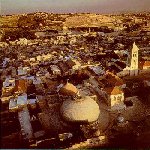 Jerusalem
is a city of grim ironies. And in the midst of this dispute, there
lies yet another incredible irony. The ‘rock" of Islam is encapsulated
beneath a profane golden dome, called the Mosque of Omar. It is
sometimes referred to as the "Dome of the Rock." Jerusalem
is a city of grim ironies. And in the midst of this dispute, there
lies yet another incredible irony. The ‘rock" of Islam is encapsulated
beneath a profane golden dome, called the Mosque of Omar. It is
sometimes referred to as the "Dome of the Rock."
If there is a needle-sharp point of contention in the world today,
this rock certainly marks the spot. Moslems say that it is the place
from which Mohammed vaulted to heaven on a flying white steed. They
even show off certain depressions in the rock that are said to be the
footprints that mark his departure.
This same rock is claimed by the Jews as Mt. Zion, the place where
Abraham took Isaac for sacrifice, in obedience to the command of God.
Some archaeologists say that it is the very location of the Holy of
Holies in the first two temples. The archaeologist Dr. Leen Rittmeyer
even says that a carved-out rectangle atop the rock was once the
resting place of the holy Ark of the Covenant.
The fight is on. Who will claim this rock? Without a doubt, that’s
the big question.
A Fiery Deliverance, in the Language of Psalm 97
Concerning the answer to this question, Zechariah’s language is
unequivocal. Jerusalem and the Jews will be delivered from those who
lay false claim to its sacred precincts. Chapter 12, verses 4 through
9 clearly tell us the outcome of the battle:
"In that day, saith the LORD, I will smite every hose with
astonishment, and his rider with madness: and I will open mine eyes
upon the house of Judah, and will smite every horse of the people with
blindness.
"And the governors of Judah shall say in their heart, ‘The
inhabitants of Jerusalem shall be my strength in the LORD of hosts
their God.’
"In that day will I make the governors of Judah like an hearth of
fire among the wood, and like a torch of fire in a sheaf; and they
shall devour all the people round about, on the right hand and on the
left: and Jerusalem shall be inhabited again in her own place, even in
Jerusalem.
"The LORD also shall save the tents of Judah first, that the
glory of the house of David and the glory of the inhabitants of
Jerusalem do not magnify themselves against Judah.
"In that day shall the LORD defend the inhabitants of Jerusalem;
and he that is feeble among them at that day shall be as David; and
the house of David shall be as God, as the angel of the LORD before
them.
"And it shall come to pass in that day, that I will seek to destroy
all the nations that come against Jerusalem."
Here, the scene is just as we see it in the Song of Moses, in
which the Rock delivers His people. Zechariah shows the Lord taking
fiery vengeance upon pretenders to His throne. The language here
strongly suggests that the Lord will use the Jews to launch a fiery
war. Many have speculated that Israel’s nuclear arsenal will at last
be set in motion. But whatever the case, Jerusalem will at last be
given to the Jews.
We see precisely this kind of rhetoric being used in Psalm 97. One
would have to completely lack discernment not to see that the world is
soon to be subjected to a horrible period of fiery (almost certainly,
nuclear) warfare.
"The LORD reigneth; let the earth rejoice; let the multitude of
isles be glad thereof.
"Clouds and darkness are round about him: righteousness and
judgment are the habitation of his throne.
"A fire goeth before him, and burneth up his enemies round about.
"His lightnings enlightened the world: the earth saw, and trembled.
"The hills melted like wax at the presence of the LORD, at the
presence of the Lord of the whole earth" (Psalm 97:1-5).
It is not a question of whether these things will happen, but when?
Psalm 97 speaks in general terms of the Lord’s vengeance. Perhaps this
has already begun in what to us might seem an insignificant way. To
those of faith, the Lord now reigns. However, many events must unfold
before His visible and present sovereignty upon the throne of David in
Jerusalem.
Until Jesus comes, the world will continue to fight over Jerusalem.
Each group has its own delusions about why it should be the entity in
control of the ancient city.
As we continue to read warped and slanted stories in the world’s
newspapers, let us rejoice and be glad that man’s schemes will not
decide the final disposition of the matter. Global authorities may
think they can control the ancient spiritual capital, but they have
not yet seen the fire of the Lord.
In the meantime, remember Psalm 122:6: "Pray for the peace of
Jerusalem: they shall prosper that love thee."
FROM:
http://christianactionforisrael.org/battle.html
|
Netanyahu: Putting politics aside

Sunday, January 8, 2006
Opposition leader
Benjamin Netanyahu says Sharon's illness is a time to
put politics aside.
JERUSALEM (CNN) -- Israeli Prime
Minister Ariel Sharon's chief rival in the March elections has
told CNN he is not campaigning or focusing on politics as Sharon
lies in a medically induced coma following a severe stroke.
"This is one of the moments you have to put politics aside,
however briefly. You do what is right and decent for the
country," said former prime minister Benjamin Netanyahu on
Sunday, in his first interview since Sharon's stroke last week.
Netanyahu also denied reports that he has expressed support
for a possible pre-emptive strike on Iran.
Instead, he insisted he supports "diplomatic and other ways"
to prevent Israel's neighbor from posing a nuclear threat that
could endanger Israel's future.
Netanyahu was part of Sharon's cabinet, but quit in anger
over the prime minister's unilateral pull-out of Israeli
settlers and troops from Gaza.
In November, Sharon left the Likud Party to form a new
centrist party called Kadima. With Sharon at the helm, the party
attracted other major Israeli figures and was expected to easily
win March elections.
Now it's unclear what the future holds, although a poll
suggests Kadima would get the most votes even without Sharon.
Netanyahu said for now, he is focusing on Sharon's health,
and "we are all united in prayer that he succeeds." He touted
Sharon's military feats as a top Israeli general, and cited his
"resolve, courage, and determination."
Netanyahu would not say whether he has changed his mind about
the Gaza withdrawal, but said that in the end "I don't think
time will judge Sharon harshly. ... I think history will judge
him as the great leader that he is, notwithstanding the
differences of opinion that existed."
"You see the strength and resilience of Israeli democracy,"
he said, adding that rivals shelve their differences at such
times.
Strike denial
The Israeli daily newspaper Maariv reported last month that
Netanyahu expressed support for a possible pre-emptive strike on
Iran.
The paper said he referred to a 1981 attack ordered by
then-Prime Minister Menachem Begin that destroyed a nuclear
reactor in Iraq.
"I will continue the tradition established by Menachem Begin,
who did not allow Iraq to develop such a nuclear threat against
Israel, and by a daring and courageous act gave us two decades
of tranquility," Netanyahu was quoted as saying. "I believe that
this is what Israel has to do."
But Netanyahu told CNN he has not said Israel should consider
a pre-emptive strike.
Instead, Netanyahu said he has argued that "Iran's
acquisition of nuclear weapons is something that is dangerous to
Israel and dangerous, in fact, to the world. And I think we have
to find the ways -- which could include diplomatic and other
ways -- to prevent that from happening."
Iran has fought to restart its nuclear reactors, but insists
it is not trying to build nuclear weapons. The United States and
others have expressed concern that Tehran is trying to operate a
covert nuclear weapons program under the guise of a nuclear
energy program.
Iran's president Mahmoud Ahmadinejad has also issued a series
of statements calling for the end of Israel's existence, setting
off a series of condemnations from international leaders
including U.N. Secretary General Kofi Annan.
"Not only does he (Ahmadinejad) want to erase Israel, he
wants to erase 3,000 years of Jewish history and our presence
and our belonging to this particular land. I mean, where is the
Bible coming from, where is the whole of Jewish history, what is
it all about? Yet we're supposed to be this foreign implantation
that has no connection to this land," Netanyahu said.
Iran does not subscribe to the view that Israel and its
neighbors must find a way to live in peace, he said.
Netanyahu said if Iran were to acquire nuclear weapons, it
would endanger not only Israel, but also the West and moderate
Arab regimes as well. Steps should be taken to "prevent that
danger from materializing," he said.
|
|
Netanyahu: Israel Will Prevail
in Mideast
Tuesday, July 18, 2006

This is a partial transcript
from "Hannity & Colmes," July 17,
2006, that has been edited for clarity.
SEAN HANNITY, CO-HOST:
We turn now to the former prime minister of Israel, Benjamin
Netanyahu.
HANNITY: We
know Iran and Syria are behind these terror attacks. We know
that they have supported these terror groups from the very
beginning. Can you win the War on Terrorism without regime
change — more specifically -- these two terrorist regimes?
BENJAMIN NETANYAHU, FORMER ISRAELI
PRIME MINISTER: Well,
ultimately, I think there's a far bigger terror threat
hanging over all our heads, and that is if Iran acquires the
weapon of ultimate mass terror, that is atomic weapons, this
will create a sea change in the world, certainly in the
Middle
East but in the world.
And I think that
President Bush's intention, announced intention that
he would not let that happen is very important.
I n the interim, I think knocking out a
Hezbollah
stronghold in Lebanon can do a great deal to push back
Iran's aggressive designs. Iran and, of course, Syria, which
is a way station for Iran in supplying rockets and other
deadly weapons to Hezbollah or to their other proxy,
Hamas,
in the South.
Israel is now girded
with Iranian enclaves, Iranian-supported enclaves, Iranian
directed enclaves, and Syria takes a part in helping both
Hamas and Hezbollah with logistics and with weapons.
But the important thing I think is to show
the kind of resolve that the people of Israel are showing
right now. They're united. They're withstanding horrific
assaults on our cities. We're losing civilians, but the
people are strong.
The opposition is now united with the
coalition. We stand together, and we say we're not going to
let you win. We're going to prevail.
HANNITY: Mr.
Prime Minister, I want to talk about the urgency and the
significance of this from a number of different perspectives
here. No. 1, the missiles and the rockets that are being
fired, as you point out, on Israeli citizens are getting
deeper into Israel than they ever have.
The rhetoric,
Hitler-style
rhetoric, is getting more shrill and more bitter and more
talk of, quote, "the annihilation of Israel."
You couple that with the desire and the
pursuit of these weapons of mass destruction. Is there an
urgency? Is there a difference? Has this taken on a new
meaning for Israel in terms of finishing the job and getting
to the root cause of all of this?
NETANYAHU:
Well, I think so. And I think the root cause is first the
desire to destroy Israel. After all, we left every square
inch of Lebanon. So they have no reason to attack us. We
left every square inch of
Gaza. So
they have no reason to attack us.
But if you listen to what they say,
they're quite open about it. They don't want Israel to
exist, period, in any border, regardless of where we are.
And that's just the first target. We're the — remember we're
the small Satan for the Islamic terror octopus.
Its center is in Iran. But it has these
arms, these octopus arms in Hezbollah, in Lebanon, in Hamas,
in Gaza and elsewhere. And it really sees you [the United
States] as the great Satan.
Iran is arming itself with nuclear weapons
right now and with the long-range rockets, long-range
rockets that far exceed Israel and ultimately are destined
to reach the Eastern Seaboard of the United States.
You're the great Satan. We're just merely
your little brother here. We're the little Satan. And
Europe, though it doesn't know it, is the middle-sized
Satan.
ALAN COLMES, CO-HOST:
Mr. Prime Minister, it's Alan Colmes. Thank you so much for
coming on our show. We appreciate it very much.
You have Italy, France, you even have the
Vatican
urging restraint. The president of the United States says
Israel has to be aware of its consequences. Should there be
no limit to Israel's reaction to Hezbollah and Hamas?
NETANYAHU:
There is a limit. We're not using even a fraction of our
firepower
and we're taking pains as best we
can to minimize civilian casualties, which are all
incidental and none deliberate.
Obviously, we're showing restraint.
Look, when the United States was attacked by
terrorists they went and obliterated a regime in
Afghanistan and rightly so. And they did other
actions and rightly so.
No country can allow its
citizens in its cities, its main cities to be
rocketed. Imagine what would happen if Chicago,
which is like
Haifa,
you know, our third largest city, Chicago would be
rocketed by a terrorist enclave, a state within a
state across the border in Canada. Do you think
the U.S. would show restraint?
COLMES:
The Lebanese prime minister on the FOX News
Channel earlier today called Israel "killers",
reiterated his desire for a cease-fire, said the
attacks are destabilizing his nation's democracy
and will lead to further extremism in that region.
What's your reaction to that comment?
NETANYAHU:
Well, with all due respect, I think the Lebanese
prime minister probably cannot say on FOX what he
is probably saying to his closest confidants, that
he hopes that Israel will win the war against
Hezbollah, because his government has no meaning
unless it does.
There is no Lebanese sovereignty
as long as there is Hezbollah sovereignty in
Lebanon. Because, in fact, they are doing anything
they want, supported by two foreign powers, Iran
and Syria. The Lebanese army doesn't do a damn
thing to dismantle them. And in fact, they are
running the show there.
So we can speak of the Lebanese
government in perhaps in all but name. It's not a
government. It is subservient to Hezbollah, and
Israel's action to dismantle Hezbollah would not
only serve the cause of security for Israeli
citizens, it would also serve the cause of
Lebanese sovereignty for millions of Lebanese.
COLMES:
You say Israel is united. I understand 2,000 took
to the streets of
Tel Aviv on Sunday in a very big peace
demonstration. Is that accurate?
NETANYAHU:
Gee, I didn't notice. I have to tell you that, you
know, if you look at all the people I talked to
and all the opinion polls, this is overwhelming
support for a powerful response.
How would you feel if, for no
reason, your homes would be rocketed, your
neighbors murdered, maybe your relatives, maybe
your own son or your grandmother or grandmother
and her grandson? For nothing, absolutely --- not
only for nothing, but for declared -- the declared
purpose of wiping out your state and your country.
I mean, this is a very -- this tends to unite
people, believe me.
COLMES:
Much has been written, Mr. Prime Minister, about
the captured Israeli soldier, which is what
touched this off. But the international press has
also been reporting that there was a killing of
seven family members on a Gaza beach on June 9,
after which Hamas called off its cease-fire. Which
in your view is the precipitating event here?
NETANYAHU:
I think that the tragic loss of a family in Gaza
was a projectile that had been there that probably
took off. It was not actually an offensive Israeli
action or even a defensive Israeli action from all
examinations that we took.
But I think there is an
asymmetry here. Israel left Gaza. Israel left
Lebanon. Why are they fighting us? You
ask what is precipitating this? The answer is
nothing that Israel does. It's just Israel being
there, breathing.
The fact that I'm standing in
front of you right now breathing, speaking, as an
Israeli citizen, as a citizen of a Jewish state in
the heart of the Middle East, that's for them an
unacceptable provocation.
And they say that they will --
as they deny the previous
Holocaust -- they're preparing a new
Holocaust for six million Jews. Now that cannot
happen.
HANNITY:
Mr. Prime Minister, I think one of the questions
for the United States is are we, the United
States, going to have to in the future, near
future, perhaps in the distant future, be at war
with Islamic fascist terror regimes like Syria,
like Iran?
And if the answer to that
question is yes, we're going to have to be at war
and that they're at war with us, that they
attacked us on
9/11,
you're dealing with these terror groups today.
Isn't it better to make the
decision -- for the United States to engage them
before they have nuclear weapons?
NETANYAHU:
I think that's the crucial passage point. I think
all of this, what you see now, is the prelude.
It's the promo to the real show.
The fact that Israel is now
being rocketed with no provocation by -- right
into our cities by these proxies of Iran tells you
that, if they had nuclear weapons, these people
would have no restraint whatsoever.
They would use that deadly
power, the power of mass death, to intimidate and
to threaten and probably to kill a lot of people,
not only in Israel, but far and wide.
And I think that is a very
dangerous development. It is a watershed
development that we must not reach.
And therefore, the American
official policy that says Iran shall not be
allowed to arm itself with nuclear weapons is
really the right approach to prevent the greatest
terror of them all, something that would make the
kind of things we see today pale by comparison.
HANNITY:
Yes.
NETANYAHU:
So it is important indeed for the future of the
world, for the future of America, for the future
of peace, for the future of Lebanese, Israelis,
Palestinians, you name it, for our common future
to avoid -- to prevent Iran, which is the genesis
of so much of what you're seeing today, from
acquiring atomic bombs.
HANNITY:
With the constant call for Israel to restrain
itself, do you see similarities? Do you see an
analogy with past instances of world appeasement,
World War II, totalitarianism, et cetera?
NETANYAHU:
Yes, I do. Because I think this unbridled
fanaticism is similar in many ways. It's a new
Nazism. It's a new form of Nazism. It doesn't put
race, but a twisted view of the Islamic religion
as its credo. And it's willing to just go to any
lengths and to throw out, just jettison any moral
restraints and use the most extreme, barbaric
force to achieve its twisted goals.
So yes, I see a similarity
there, and yes, I see a similarity in the tepid
response from some quarters.
Copy: Content and Programming
Copyright 2006 Fox News Network, LLC. ALL RIGHTS
RESERVED. Transcription Copyright 2006 Voxant,
Inc. (www.voxant.com),
which takes sole responsibility for the accuracy
of the transcription. ALL RIGHTS RESERVED
|
Netanyahu Tops List of Preferred PMs in Israel
September 22, 2006
- Israelis place a former prime minister as the most suitable
person for the country’s top political job, according to a poll
by the Dahaf Institute published in Yediot Ahronot. 27
per cent of respondents would like Likud leader Benjamin
Netanyahu to head the government.
Israel Our Home leader
Avigdor Lieberman is second with 15 per cent, followed by
current foreign minister Tzipi Livni with 14 per cent, and
former prime minister Shimon Peres with 12 per cent.
Support is lower for current head of government Ehud Olmert
of the Kadima party, current transport minister Shaul Mofaz,
former prime minister and Labour leader Ehud Barak, and current
Labour leader and defence minister Amir Peretz.
In March, Israeli voters renewed the Knesset. Kadima, founded
by former prime minister Ariel Sharon and led by Olmert, secured
29 seats. Labour, the Retired People’s Party (Gil) and the
International Organization of Torah-observant Sephardic Jews
(Shas) joined Kadima in a coalition.
On Jul. 12, Hezbollah militants based in Lebanon killed eight
Israeli soldiers and captured two more in a cross-border attack.
The Israeli armed forces launched air strikes inside Lebanese
territory to fight Hezbollah, targeting the country’s
infrastructure and its airport. Hezbollah retaliated by firing
rockets into several Israeli towns.
A ceasefire brokered by the United Nations (UN) came into
effect on Aug. 14. Security Council Resolution 1701 calls for "a
full cessation of hostilities" from both sides and allows
Lebanese government troops and a 15,000-member peacekeeping
force to enter into southern Lebanon during the withdrawal of
Israeli forces, but sets no timetable for the disarmament of
Hezbollah or the return of the two abducted Israeli soldiers.
On Sept. 17, Netanyahu expressed confidence in an eventual
return to power, saying, "The Likud is on the right path. It is
just a matter of short time until the country is on the right
path." Netanyahu served as prime minister from June 1996 to July
1999, and resigned from the previous cabinet after opposing
Sharon’s "Disengagement Plan."
Polling Data
Who is the most suitable person to be head the government?
| Benjamin Netanyahu |
27% |
| Avigdor Lieberman |
15% |
| Tzipi Livni |
14% |
| Shimon Peres |
12% |
| Ehud Olmert |
7% |
| Shaul Mofaz |
5% |
| Ehud Barak |
3% |
| Amir Peretz |
1% |
Source: Dahaf Institute / Yediot Ahronot
Methodology: Interviews with 499 Israeli adults, conducted on
Sept. 19, 2006. Margin of error is 3.7 per cent.
|
| Netanyahu confident Likud will
regain power
Bibi says warnings that unilateral withdrawals threaten
Israel's security have been proven true, as evident in
latest attack in Gaza and along northern border
Shmulik Haddad
| Published: |
09.17.06, 22:16 |
Opposition leader and Likud Chairman Benjamin
Netanyahu told party members on Sunday that he is
confident the party will regain power.
"The Likud is on the right path. It is just a matter of
short time until the country is on the right path," he
said.
|
Global Threat |
| |
| Bibi:
Iran president more dangerous than
Hitler / Yaakov Lappin |
| |
|
Likud chairman tells international
counter terrorism conference ‘Hitler
went out on global campaign first, and
then tried to get nuclear weapons.
Iran is trying to get nuclear arms
first - therefore it is much more
dangerous’
|
|
Full Story |
| |
|
|
Last week Likud party members held a toast to the party
and northern communities who suffered during 34 days of
fighting against
Hizbullah.
On Sunday, a similar toast was held in Sderot to show
support with communities affected by rocket attacks from
the Gaza Strip.
Netanyahu said the gatherings were held to "salute
residents in both places. Likud is returning to
development towns, we will assist these municipalities
and we are capable of a revolution. I am optimistic that
only we are capable of changing the regime in the
country."
Likud MKs who took to the podium sounded upbeat over the
party's chances of regaining power in the next
elections.
MK Yuval Steinitz said: "The Egyptians are not trust
worthy. They are allowing the smuggling of arms to Hamas
as Syria is assisting Hizbullah in the north."
Netanyahu said the public is becoming more aware of the
security threats facing Israel. "We said that a policy
of unilateral withdrawals brings terror closer to us and
unfortunately it has become clear that we were right,"
he said.
He lauded the party's members, saying "Likud is the
party with the fullest transparency. Our ranks are open
to all," he said.
MK Moshe Kahlon said that a social forum will be
launched in Likud to discuss the country's endemic
poverty.
|
|
| | | |


