| 7-17-05 - I had just been reading Kitty Kelly's book,
"The Family, The Real Story of the Bush Dynasty." where
William H. Russell goes to Yale and starts the Skull & Bones Club in
1832. Later on George W. Bush' ancestors Rev.
James Smith Bush entered Yale in the class of 1844, and his maternal
uncle Robert E. Sheldon, Jr. class of 1904, and Prescott Sheldon Bush,
class of 1917 go to Yale as well. Prescott Bush's
grandmother had written to her daughter, Prescott's mother, that she
hopes he gets over his 'pernicious fooling." Prescott Bush
was definitely a BMOC (Big Man On Campus) He belonged to most of
the social organizations, sports teams, and particularly the singing
groups. We was a fabulous singer and sang close harmony all his life in
public venues.
All totaled, 35 Bush relatives attended Yale University, starting in 1844 - all the way through 2004 when George W. Bush's daughter Barbara graduated there. They all graduated except one, James Wear Walker. Prescott's big claim to fame besides getting his "Y" for playing baseball at Yale, he later joined the National Guard and along with some Yale buddies in his group, went to a Native American graveyard to do a big 'crook' event for his Skull & Bones death room. The wanted to dig up Geronimo's skull and steal it, but nobody knew where Geronimo's grave was as the graveyard wasn't taken care of at all and was covered with weeds. They dug up a grave, and found some leather horse gear and dug out a skull from the bottom of the grave and took it back to Yale where it was put in a glass case after cleaning and displayed as Geronimo's skull. It was the most highly prized 'crook' event of all time for Skull & Bones. Later, DNA tests were done on the skull because a lawsuit had been issued by the Native Americans and they wanted the skull back, and it was found to be the skull of a 10 year old boy and the Skull & Bones group were allowed to keep the skull, but they still brag that its the skull of Geronimo. DREAM: I was in the White house and George W. Bush said something really dumb to me, which I can't remember, and then Laura came into the room with George H. W. Bush, President #41. He overheard what his son George had said and looked rather embarrassed. The younger George saw Laura and got a gleam in his eye and grabbed her by the hand and started pulling her down the hall to go upstairs to do what comes naturally. I thought she would protest and tell him that they had guests, but she surprised me, and instead started running ahead of George, practically dragging him with her, and giggling like a teenager. I thought that was amusing but George #41 had a rather glum look on his face and he came over and sat on the sofa next to me and came close to me and whispered, "You aren't going to write about that are you?" I said with a smile," Oh! Yes I am." He said glumly, "You know, they've written all kinds of bad books about us." I said, "I know! I have them all", and laughed. George #41 got up off the sofa, turned around and got on his knees on the cushion, putting his head down on the back of the sofa, he pretended to cry really fake and said, "You can't write more bad stuff about us. There's already enough bad stuff written about us." It was so pathetic and funny, I just laughed at him and he got up and left the room, knowing I would do exactly what I said I would do. While I was still sitting there, a young 15 year old boy who was studying to be a reporter, came in and sat at a side desk by the wall and started writing something. I said to him, "Guess who was just here!" He said, "Who?" and I responded, "George #41!" He said, "You lie!" and kept on writing. He didn't believe what I said and he was too focused on his own writing to want to hear about a real event. I went outside then and sat on a bench in front of the Whitehouse and my friend G came up to me and sat down. She seemed all depressed about something. There was a lot of snow on the ground, though it was sunny out. There was a lot of traffic and the snow wasn't yet plowed and cleared from the curb. A station wagon pulled up to the curb. It was full of young kids in the back. The driver got half lway out of the car and I recognized him as George Castanza from the Seinfeld show. He yelled over at me, "Hey! Can you tell me how to get to Pennsylvania?" I laughed and waved at the kids and said to G, "He was just on the Seinfeld show last night. That's how I know who he is." G said to me, "I wish I was brave enough to just get in a car and go somewhere!" I just replied, "Yeah!" All of a sudden, George Castanza came up behind us. He was wearing a over-orangish, over-bright, over-shiny, over-large Hawaiian shirt, eating out of a bag of pretzels. He said, "How's it going?" and I woke up suddenly.
|
||||||||||||||||||||||||||||||||||||||||||||
|
THE LIST OF BOOKS ABOUT
GEORGE W. BUSH Supreme Injustice - How the High Court Hijacked Election 2000, by Alan Dershowitz - 2001 "In the course of writing
this book, I have spoken to dozens of highly successful lawyers - lawyers
who win because they understand judges. Virtually every one of them,
Democrat or Republican, agrees with me that the majority justices in the
Florida election case fail the 'shoe-on-the-other-foot test. As one
usually cautious lawyer who practices extensively before the high court
told me, "It insults our intelligence to suggest
otherwise." Many agree with the characterization
"cheating." Some disagree, arguing that what the justices
did here is on a continuum with what many judges routinely do in criminal
cases in which they believe the defendant did it but also that the police
violated the defendant's rights. They find ways to reach the result they
favor (conviction of the factually guilty) even though the law demands a
result they disfavor (release of the bad guy). Others believe that nearly
all the judges in this highly politicized case - the Supreme Court
dissenters, the Florida Supreme Court majority, and the lower court judges
- would fail the shoe-on-the-other-foot test, and they contend that it is
wrong to single out the majority justices for criticism. This is one heck
of a commentary on the current status of our judiciary. "I, ______________ do
solemnly swear (or affirm) that I will administer justice without The irony is that if the
majority justices in Bush v. Gore had not violated that oath by deciding
the case with respect to the persons
and political parties involved, George W. Bush might not have been the
president." (pgs 171-172) Bushwhacked - Life In George W. Bush's America, by Molly Ivins and Lou Dubose - 2003 "Judicial appointments,
faith-based social-welfare program, and restrictions on stem-cell research
all fall into the category that one watchdog of the religious right in
Austin calls "throwing red meat and green dollars to the wolves in
the fundamentalist Christian pack." It keeps them in line, said
Samantha Smot ofo the Texas Freedom Network. "But it's dangerous
because they can never be satisfied." The Lies of George W. Bush - Mastering the Politics of Deception, by David Corn - 2003 "Iraq is harboring a terrorist network, headed by a senior al Qaeda terrorist planner." "..."the secretary
of State appeared at the Security Council and laid out the government's
best case against Iraq. It was the culmination of the administration's
yearlong effort to persuiade the public to support war in Iraq. Finally
the administration was going to supply proof that Saddam Hussein had
terrible weapons and was working with al Queda. Yet while Powell - the
senior Bush official with the most credibility at the United Nations --
offered specific pieces of evidence, he also served up embellished
evidence. And he commingled truth with half-truth. Dude, Where's My Country - Leave No Billionaire Behind, By Michael Moore -2003 "When things were good at
Enron, they were very, very, very good. Lay and other high-ranking honchos
took home huge paychecks and enjoyed generous expense accounts nad lavish
perks. The sweet life at Enron helped them afford to make significant
donations to politicians in both major parties-politicians who were able
to ensure that the regulatory climate stayed very, very sympathetic to
Enron's interests. According to the Center for Responsive Politics, Enron
gave nearly $6 million to the Republican and Democratic parties since
1989, with 74 percent going to the Republicans. This meant that when
Congress began investigating Enron at the beginning of 2002, 212 of the
248 members of the House and Senate on the investigating committees had
taken campaign contributions from Enron or its crooked accountant, Arthur
Anderson. NOTE: Gonzales Recuses Self from Enron TrialsNewsMax.com WiresHOUSTON - 4-8-2005 -- U.S. Attorney General Alberto Gonzales has recused himself from the Enron Corp. criminal prosecutions, his office said Thursday. Justice Department spokesman Bryan Sierra would not say why Gonzales made that decision. But the attorney general did legal work for Enron when he was practicing law in Houston. And while he was a Texas judge, he accepted a campaign contribution from an Enron political committee. Former U.S. Attorney General John Ashcroft also recused himself from overseeing the Enron prosecutions because he accepted campaign funds from the company when he was running for the U.S. Senate. With the recusal, the Enron Task Force prosecutors will not report all the way up the chain of command to Gonzales. Gonzales did legal work for Enron in the early 1990s while at Vinson & Elkins law firm in Houston. Enron was that law firm's largest client for several years. © 2005 The Associated Press Q. What were the main accusations here? (Regarding Enron's connection to Blockbuster) A. There were two sets of charges involving deception to inflate Enron's bottom line in its Internet division. Three higher level guys -- Joe Hirko, Scott Yeager and Rex Shelby -- were accused of making false statements in press releases and at analyst conferences to pump up the market's perception of the value of Enron's Internet business. Prosecutors said they did this in part so they could cash in on rising stock prices by selling their own shares. The trio sold about $160 million in stock in 2000 and 2001. These three were accused of fraud, conspiracy, insider trading and money laundering. Two midlevel guys -- Kevin Howard and Michael Krautz -- landed in trouble for their roles in the Blockbuster Video deal that the government said generated $111 million in false earnings through a series of maneuvers dubbed Project Braveheart. Prosecutors said the pair helped make it appear that Enron sold investors expected future profits of its movies-on-demand business, but the transactions amounted to nothing more than a disguised loan because Enron guaranteed its investors wouldn't lose money on the deal.Howard and Krautz were accused of fraud and conspiracy. How long will these Enron trials drag on? A. Enron fell in late 2001, and the criminal cases should be over by late 2006. Still scheduled are at least two more trials - one against Lay related to his personal banking and the big one against Lay, Skilling and Causey that's scheduled for next year. There are also three ex-bankers fighting extradition from England who could be tried here on Enron - related charges. Though 14 former Emrpm employees and one former Arthur Andersen employee have pleaded guilty to criminal charges, only one from Enron has been found guilty in a trial. That was former Vice President Dan Boyle, convicted in last year's Nigerian barge trial. The other four convicted in that trial were former Merrill Lynch executives. In a 2002 trial, Enron accountant Arthur Andersen was convicted of obstruction of justice, but the U.S. Supreme Court threw out that conviction in 2005.
Lies and The Lying Liars Who Tell Them - A Fair and Balanced Look at The Right, by Al Franken -2003 "By Far the Vast Majority
of My Tax Cuts Go to Those at the Bottom" Boy Genius - Karl Rove, the Brains Behind the Remarkable Political Triumph of George W. Bush, by Lou Dubose, Jan Reid, and Carl M. Cannon - 2004 "At the Republican
convention, the GOP's most skillful speech-writer, Peggy Noonan got the
speech of his life out of Bush (GHWB) Nobody knew what Bush meant by
a thousand points of light, but he seemed to imagine and believe in them,
and he at last emerged from the shadow of Ronald Reagan as his own man.
Dukkakis' seventeen point lead in the polls evaporated, and the rout was
on. (pg 50)
Worse Than Watergate -The Secret Presidency of George W. Bush, by John W. Dean - 2004 "Because of Watergate, no
president has been so foolhardy as to openly initiate a program like
Nixon's to screw those with whom he or his top aides are unhappy and to
blatantly help friends - that is, until the Bush II administration.
Although I was not looking for this type of Watergate behavior with Bush
and Cheney, it jumped ou tat me when surveying their secrecy - and soon
jumped out at everyone else when they attacked Ambassador Joe Wilson's
wife, a cover CIA agent, blowing her cover in an effort to seek revenge
against him - every bit as stupid an action as the Watergate break-in that
was the beginning of the end of a presidency, except the Bush-Cheney
attack was worse because it was immediately life-threatening and damaging
to national security and thus a far more serious crime than foolishly
planting a bug in an opponent's office. Before examining the Wilson case,
a passing glance at the Bush and Cheney "responsiveness" program
is fitting. " The Bush-Cheney actions are
"a reversal of a decades-long trend of openness i government,"
and the administration is "making increasing amounts of information
unavailable to taxpayers who pay for its collection." The Family, The Real Story of The Bush Dynasty, by Kitty Kelley - 2004 "Laura Bush spoke to her
husband like a schoolteacher scolding a wayward child for not performing
up to his potential. "You let him do this to you," she said.
"You let John McCain talk down to you. You've got to fight
back." Bush On The Couch - Inside The Mind of the President, by Justin A Frank - 2004 "Bush has continued to
cite divine instruction to explain his actions since assuming office. As
reported in Israel's Haarets News, Bush said, "God told me to strike
at al Qaida and I struck them, and then he instructed me to strike at
Saddam, which I did." Though his administration insists that the war
on Iraq is not a religious war, at least one high-ranking official say
otherwise. Lieutenant General William Boykin, the deputy undersecretary of
defense, who share the president's views on Bush's divine destiny,
"He's in the White House because God put him there," Boykin said
after claiming that our "spiritual enemy will only be defeated if we
come against them in the name of Jesus." Boykin is also reported to
have described the war as a struggle between Christianity and Satan."
(pg 72) Bushworld - Enter At Your Own Risk, by Maureen Dowd - 2004 "Former president Bush
swats away talk about what he dismissively calls "this dynasty
stuff" or "this legacy crud." House of Bush-House of Saud, The Secret Relationship between the World's Two Most Powerful Dynasties, by Craig Unger -2004 "...Dubya had one political
advantage over his father. The elder Bush so embodied the image of a spoiled
and privileged son of the Eastern aristocracy that in 1988 when Ann
Richards, who was soon to become governor of Texas, delivered her famous
sound bite about the elder Bush at the Democratic National Convention, the
words resonated throughout the United States and made Richards a national
figure. "Poor George," she had drawled, "he can't help it. He
was born with a silver foot in his mouth."
According to the book,
"House of Bush, House of Saud' by Craig Unger, on page 3 we read,
"For decades the House of Saud had somehow maintained control of Saudi
Arabia and the world's richest oil reserves by performing a seemingly
untenable balancing act with two parties who had vowed to destroy each
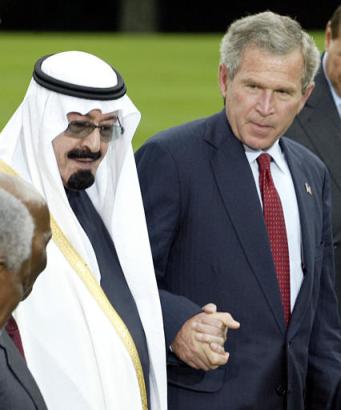
other. Keeping the photograph above in mind read further: But those Bush-bin Laden
relationships were indirect - two degrees of separation, perhaps - and as
times have been overstated. Critics have asserted that money may have gone
from Khalid bin Mahfouz and Salem bin Laden through James Bath into Arbusto
Energy, the oil company started by George W. Bush, but no hard evidence has
ever been found to back up that charge. Note: and that was just the beginning. American Dynasty, Aristocracy Fortune and the Politics of Deceit in the House of Bush, by Kevin Phillips - 2004 Armageddon, Prophecy, and Politics The historiography of American
presidential reference to Armageddon is limited but instructive. Theodore
Roosevelt's famous 1912 comment about standing with the Lord at Armageddon
was merely dramatics. The possible events i the Holy Land were not a
discussion point. Britain had yet to capture Palestine and Foreign
Secretary Arthur Ballour had yet to promise it to Zionists as a Jewish
homeland. The purported ultimate battlefield itself - at the ancient ruins
of Megiddo, north of Jerusalem - was still ahalf century removed from
parking lots crowded with tourist buses. ABOUT 9/11
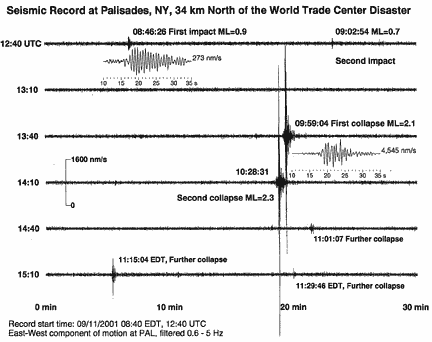
Location of the World Trade Center is 40.71°N and 74.01°W. Giuliani comment broadcast on 9/11:“I went down to the scene and we set up headquarters at 75 Barkley Street, which was right there with the police commissioner, the fire commissioner, the head of emergency management, and we were operating out of there when we were told that the World Trade Center was going to collapse. And it did collapse before we could actually get out of the building, so we were trapped in the building for 10, 15 minutes, and finally found an exit and got out, walked north, and took a lot of people with us.” 9/11 - Synthetic Terror - Made in the USA - by Webster Griffin Tarpley - 2005 "So far we have heard
little of Hani Hanjour who is accused by the FBI of piloting American
Airlines Flight 77 into the Pentagon. According to press reports, Hanjour
had visited Bowie's Maryland Freeway Airport just north of Washington,
D.C. three times since mid-August 2001 as he attempted to get
permission to use one of the airport's planes. But Hani Hanjour was simply
too clumsy, too inept. The question is crucial, because the plane that hit
the Pentagon performed a stunning maneuver of which many a seasoned pilot
would have been rpoud. Instead Hani Hanjour turns out to have been a
pathetic misfit. (pg 182) 9/11 - The Big Lie - challenges the entire official version of the Sept. 11 attacks. by Thierry Meyssan "The plane was stopped
dead, without its wings having struck the facade. There is no visible
trace of any impact except that from the Boeing's nose. 9-11 - by Noam Chomsky - 2001 The New Pearl Harbor - Disturbing Questions About The Bush Administration and 9/11, by David Ray Griffin -2004 Problems for a coincidence
theory: 9/11 Commission - Cover Up - What the Government is Still Hiding About the War on Terror - by Peter Lance - 2004 " Fire Marshal Ronnie
Bucca, who perished on the 78th floor of the South Tower on Sept. 11, was
working as a terrorism liaison to the FDNY at Metrotech, the fire
department's headquarters, in 1998 when he uncovered evidence that Ahmed
Amin Refai, an Egyptian a naturalized citizen working as an accountant for
the FDNY, had obtained the blueprints of the World Trade center from the
FDNY prior to the 1993 bombing. Further, Fire Marshal Bucca discovered that
Mr. Refair was an intimate of blind Sheikh Omar Abdel Rahman and had been
photographed on the Sheikh's arm acting as his bodyguard in the months prior
to the WTC bombing. "9:24 a.m. The
FAA notifies NORAD that AA Flight 77 appears to be headed toward Washing
D.C. Inside Job - Unmasking the 9/11 Conspiracies, by Jim Marrs - 2004 "Many have wondered about
the witnesses who claim to have heard multiple explosions within the
buildings. One such witness was the head of WTC security, John O'Neill,
who states shortly before he himself became a victim that he had helped
dig out survivors on the 27th floor before the building collapsed. Since
the aircraft crashed into the 80th floor, what heavily damaged the 27th
floor? (pg 33) Plan of Attack, by Bob Woodward - 2004 "On Friday, January 31,
Bush was scheduled to meet again with Tony Blair at Camp David, but a mix
of rain and ice kept them at the White House. 102 Minutes - The Untold Story of the Fight to Survive Inside the Twin Towers - by Jim Dwyer and Kevin Flynn - 2005 [Tom McGinnis called his wife on
the phone] "..... the
moment of death, particularly for those at the top of the north tower, the
1,000 or so people who survived the crash of Flight 11 at 8:;36 but have not
been able to find an open staircase. Their fate was sealed nearly four
decades earlier, when the stairways were clustered in the core of the
building, and fire stairs were eliminated as a wasteful use of valuable
space. The top floors of the north tower, weakened by the unabated,
uncontained fire now crater in a tremendous rush. "In stairway B, among the
firefighters who have taken on the cause of Josephine Harris and her fallen
arches, there is a prayer or two for a swift end. The impossible collisions
of floor, steel, glass are belting towards them. Even stronger than the
noise is the wind. Sal D'Agostino tries to open a door to leave the
stairwell, but it flies out, and throws him against the wall. The wind lifts
the engine's chauffeur, Mike Meldrum off his feet and heaves him one floor
down; it carries Matt Komorowski down three floors. Against All Enemies - Inside America's War on Terror, by Richard A Clarke - 2004 "Iran, the fourth ofo
the Priority Countries, is as important as the others in the war on
terrorism. When the Bush administration talked about Iraq is a nation that
supported terrorism, including al Qaeda, and was developing weapons of mass
destruction, those comments perfectly suited Iran, not Iraq. It was Tehran
that had funded and directed Hezbollah since its inception. It was Hezbollah
that had killed hundreds of Americans in Lebanon the Marine barracks and
Saudi Arabia, (Khobar Towers). Hezbollah, with Iranian support has also
killed hundreds of Israelis. While the "ties" and
"links" between Saddam and al Qaeda were minimal, al Qaeda
regularly used Iranian territory for transit and sanctuary prior to
September 11. Al Qaeda's Egyptian branch, Egyptian Islamic Jihad operated
openly in Tehran. It is no coincidence that many of the al Qaeda management
team, or Shura Council, moved across the border into Iran after U.S. forces
finally invaded Afghanistan. Constitutional Chaos - What Happens When the Government Breaks Its Own Laws, by Judge Andrew P. Napolitano - 2004 "The Constitution
provides for a strong chief executive - not a king - but an executive who is
not subject to either of the two branches. What do I mean by this? In
the modern European system, the head of the government is the prime
ministers. The prime minister is also the head of the political party that
dominates the legislative branch. The prime minister of most modern European
countries is not elected in a popular vote. His parties' representatives are
elected to parliament and, if they have a majority in parliament, they
choose him as the leader of their party to become the leader of the
government. The prime minister's name does not appear on a national ballot
as a candidate for that office. [Editor's note: the 2004 election is still hotly debated as well] "Nevertheless, the Constitution gives us a strong chief executive, not one whose powers derive from the legislature, but one whose powers derive from the Constitution. If a British prime minister loses a vote of confidence, that is, if Parliament rejects one of his proposals, he can be swept from office and forced to stand for re-election, not so with the American president. Not only may he lose a vote in the Congress and still keep his job, but he doesn't even have to be in the same party as that which dominates Congress, and frequently that has been the case. (pgs 192-193) Also see: THE ELECTION - 2000 - DREAMS AND VISIONS
THE ULTIMATE DREAM - THE ELECTION AND MIND CONTROL
America Alone - The Neo-Conservatives and The Global Order- , by Stefan Halper & Jonathan Clarke - 2004 "Rising
Anti-Americanism The Neocon Reader, edited by Irwin Stelzer - includes multiple writers, including Tony Blair - 2005 Trouble Ahead "Beyond the
axis of evil, there are other rogue states intent on acquiring weapons of
mass destruction - particularly biological weapons. Given our vulnerability
to attack from biological agent, as evidenced recently in the anthrax
releases, it is important to carefully assess and respond to potential
proliferators. Today, I want to discuss three other state sponsors of
terrorism that are pursuing or that have the potential to pursue weapons of
mass destruction or have the capability to do so in violation of their
treaty obligations. While we will continue to use diplomatic efforts and
multilateral regimes with these countries, it is important to review the
challenges we face and to underline the issues that these states must
address. As the President has said, "America will do what is necessary
to ensure our nation's security. We'll be deliberate. Yet time is not on our
side. I will not wait on events while dangers gather. I will not stand by as
peril draws closer and closer.' First Libya.
|
||||||||||||||||||||||||||||||||||||||||||||
|
SKULL & BONES The story of George W Bush is not complete without Skull & Bones as his ancestor Rev. James Smith Bush entered Yale in the class of 1844, and his maternal uncle Robert E. Sheldon, Jr. class of 1904, and Prescott Sheldon Bush, class of 1917. The Order has not changed since its inception in 1832. One cannot ask to be in it - they must be chosen. You can accept or reject the offer - that is the only choice. Since its inception, there have been about 2500 Yale graduates who were members of Skull & Bones as only 15 members are chosen per year, in their Junior year and are members while they are Seniors. About 500 members are alive at any one time. They are very powerful members of society and support each other in business, social life and political life. To be chosen, one must be 'male' and excel in sports and be a team player. An individualist or a loner would certainly not be chosen. The most likely potential member is from a 'Bones family' who is energetic, resourceful, political and an amoral team player - a man who will sacrifice himself for the good of the team. If you remember the 2000 election, you saw Skull & Bones member John F. Kerry sacrifice himself for George W. Bush to be President even though there were widespread questions of the honesty of the election in several states. John F. Kerry bit the bullet and went quietly away even though his supporters wanted the election to be investigated, particularly in states where electronic voting was used. America's Secret Establishment - An Introduction to the Order of Skull & Bones, by Antony C Sutton - 1983 Out of the 2500+ members of Skull & Bones, Most members are from the Eastern seaboard United States. As late as 1930 only three members resided in Los Angeles, California but 28 members resided in New Haven Connecticut. (pg 18) Members are 'all' males and almost all WASPS (White Anglo Saxon Protestant). In great part they descended from English Puritan families, their ancestors arrived in North america in the 1630 - 1660 period. (pg 18) These Puritan families either intermarried with financial power or invited in some of money moguls e.g. Rockefellers, Davisons, and Harrimans, whose sons became members of the Order. (pg 18) PHELPS FAMILY
(1630, Boston, Mass.) In the 1930's W.A. Harriman &
Company merged with Brown Brothers. This was an older financial house whose
partner were also members of the Order. Alexander Brown was founded 1809 in
New York and Philadelphia. (pg 20) To
make it more interesting, Prescott Bush, father of President George H.
W. Bush (both in the Order) was a partner in Brown Brothers, Harriman for
over 40 years (pg 20). Secret Societies of America's Elite - From the Knights Templar to Skull and Bones - by Steven Sora - 2003 "One of the stranger buildings on the Yale Campus resembles a mausoleum. Inside, a young man, one of fifteen juniors chosen each year, lies naked in a coffin. He is not dead, he is reciting a sexual autobiography of his life before being 'tapped' for the Skull & Bones. The ceremony is called Connubuial Bliss, and it no doubt helps the bonding process that will last a lifetime. Standing around are the fourteen other initiates and the current membership who are all seniors at Yale. The goings-on get stranger, and it is said that if one would climb to the top of nearby Weir Hall, one 'could hear strange cries and moans coming from the bowels of the tomb. Unlike a normal fraternity, no one actually resides in the building, it only conducts rituals there. Also, unlike a fraternity, the Skull and Bones initiates emerge wealtheir and with connections that can ensure a lifetime of success. Former President George H. W. Bush is one of those who has lain in the coffin. He is not the only famous member, his son George W. Bush is another. A third president, William Howard Taft, was a "Bonesman", and his father Alphonso Taft, was one of the founders. The odds of three presidents coming out of the same fifteen-member-a-year fraternity are infinitesimal. Then again, the support from fellow Bonesmen means they have clout - enough clout to get to the White House. The membership list of Skull and Bones is one of the greatest concentrations power in the United States. Names like Pillsbury, Kellogg, Weyerhaeuser, Phelps, and Whitney abound. They rule in the business world and they rule in the political arena. (pg 290) Other names listed are: Senator
John Chafee (R - Rhode Island (died 1999 of heart failure at age 77) The Secret Behind Secret Societies, by Jon Rappoport - 2003 "As
early as 1979, how could one avoid shaking his head at the potential power
of an organization, Bilderberg, whose steering committee alone consisted of, Going back even earlier,
President Kennedy, "vircually staffed the State Department with ...
Beilderberg alumni " Furthermore, many of the trilateral Commissioners in the Carter Administrator [were] also Bilderbergers, including Vice-President Mondale, Secretary of State Vance, National Security Advisor Brzezinski, and Tresury Secretary Blumenthal. (pg 245) See: http://www.greatdreams.com/nwo.htm for more information
|
||||||||||||||||||||||||||||||||||||||||||||

|
||||||||||||||||||||||||||||||||||||||||||||
|
||||||||||||||||||||||||||||||||||||||||||||
|
||||||||||||||||||||||||||||||||||||||||||||
 Aides to Texas Governor George W. Bush visited the Air National Guard archives at Camp Mabry in 1997 and possibly altered Bush's military service records to conceal Bush's grounding from flight in 1972 and subsequent missed duty, according to a former senior official of the Texas National Guard. Bill Burkett, a Lt. Colonel who was the State Plans Officer of the Texas National Guard at the time, said Bush operative Dan Bartlett headed a high-level operation to "scrub" Bush's Air National Guard record, to make sure it was in synch with the biography that the campaign was preparing. The book, "A Charge to Keep," was authored by Bush and his principal spokeswoman, Karen Hughes. Hughes was recently exposed during the DUI sidebar involving reporter Wayne Slater as the person who strictly controls what Bush is allowed to say. At the time, Bartlett was Governor Bush's liaison to the Texas National Guard. Bartlett is now the campaign spokesman who has provided misleading information to the press on several occasions about Bush's military service. In "A Charge to Keep," Bush briefly mentioned his National Guard service. After completing flight training in June 1970, Bush wrote, "I continued flying with my unit for the next several years." In fact, according to reports by the Boston Globe, Democrats.com and TomPaine.com, Bush stopped flying only 22 months later in April 1972. He was subsequently grounded from flight on August 1, 1972 because he "failed to accomplish his annual physical." There is no mention of the grounding in Bush's biography, which falsely implies that Bush continued flying until he left the National Guard. When questioned by the press, Bush spokesman Dan Bartlett has offered several different reasons for this grounding. Initially Bartlett said that Bush could not get to Houston for his physical, but this was proved wrong when it was shown that Bush could have visited flight surgeons stationed in Alabama. Bartlett then said the F-102 fighter that Bush was trained to fly was removed from service, but this was proved wrong when it was shown that the F-102 remained in service in Bush's unit for two more years. Democrats.com has speculated that Bush skipped his annual physical in 1972 because the Pentagon that year imposed random drug testing for the first time, and Bush feared he would fail the exam. Bush has admitted drinking heavily at the time, and has refused to deny using cocaine before 1974. Similar allegations have been reported in the Times of London and the New York Post. Democrats.com has stressed the significance of Bush's grounding. Bush's pilot training cost the government nearly $1 million, and this was a huge investment that the Pentagon would not lightly abandon with two years remaining of a pilot's obligation. Moreover, pilots were badly needed at the time because of the war in Vietnam. According to Democrats.com, Bush's grounding would normally have been reviewed by a Flight Inquiry Board of three senior officers, but there is no record that such a board was convened in Bush's case. Democrats.com has called for Bush to reveal his full military records, to put these and other charges to rest. Moreover, Democrats.com and TomPaine.com have revealed that Bush did not report for duty for at least a year after he stopped flying, and possibly two years. Bush's official record shows no duty after April 1972, and his superior officers in both Alabama and Texas say they never saw him after that. An official report issued on April 30, 1973 says "Lt. Bush has not been observed at this unit during the period of this report," from May 1 1972 to April 30, 1973. Rewards for proof that Bush reported for duty have been offered in Alabama and Texas and on the Internet, but no one has claimed the rewards. During the campaign, Bush has attempted to fend off charges that he did not report for duty. When charges were raised about the time he spent in Alabama in the fall of 1972, Bush insisted that he reported for duty. "I can't remember what I did. I just - I fulfilled my obligation," he said. Bush has specifically disputed the recollection of ret. Brig. Gen. William Turnipseed, who says he is "dead-certain" that Bush did not report for duty in Alabama. ''I read the comments from the guy who said he doesn't remember me being there, but I remember being there," Bush said. Internet activists led by Iowa farmer Martin Heldt and retired Air National Guard pilot Bob Rogers have been campaigning to expose Bush's failure to report for duty since May 23, 2000, when the Boston Globe first reported on a "one-year gap" in Bush's military duty. Heldt created a discussion board at Salon Magazine charging that Bush was "AWOL", which spurred an explosion of grassroots Internet activism. Heldt and Rogers filed a Freedom of Information Act request for Bush's military records, which provided overwhelming evidence of Bush's missed duty, and served as the basis of the articles in Democrats.com and TomPaine.com. On Thursday, Congressional Medal of Honor recipients Bob Kerrey and Daniel Inouye brought these charges to the attention of the national media, which has almost entirely ignored the work of Heldt and Rogers. "The question is where were you, Governor Bush?," said Inouye. "During my service, if I missed training for two years, at the least, I would have been court-martialed. I would have been placed in prison," he said. To rebut this charge, the Bush campaign has relied on two mysterious documents. The documents are neither dated nor signed, which makes their legitimacy entirely questionable. Moreover, the document that the campaign claims covers the year from May 1972 to May 1973 is badly torn and can only be linked to Lt. George W. Bush by the letter "W". Finally, these documents are directly contradicted by Bush's official record, several signed memoranda, and the testimony of several witnesses. Still, both the New York Times and George Magazine have used these mysterious documents as the basis for dismissing all of the other documents and witnesses which overwhelmingly show that Bush did not report for duty. Thus, the assertion by Bill Burkett that Dan Bartlett and his operatives may have modified Bush's Air National Guard records takes on exceptional significance. Bartlett's "scrubbing" operation in 1997 could have inserted these mysterious documents, or removed significant information from the torn document. In addition, Bartlett's operation could have removed or altered other revealing documents. Indeed, there is corroborating evidence that Bush campaign operatives have devoted considerable effort to "scrubbing" public records to conceal other evidence of Bush's wrongdoing. For example, Bush got a new driver's license after he was elected Governor, which appears to be completely unprecedented. This prevented reporters from discovering Bush's DUI arrest in Maine in 1976. This new license may also be concealing a prior DUI or drug arrest in 1972 or 1973, when Bush went to work with an inner-city community service group in Houston called Project PULL. There has been considerable speculation that Bush performed this work as a form of alternative sentencing for a DUI or drug arrest, but reporters have been stymied by the fact that Bush's 1995 driver's license contains no prior information. Moreover, Newsweek reported on July 9, 2000 that the Bush campaign "launched a secretive research operation designed to scour all records relating to his Vietnam-era service" during preparation for Bush's 1998 re-election campaign. They paid "hard-nosed Dallas lawyer named Harriet Miers" $19,000 to review the records. According to Newsweek, one result of her work was to deflect charges that former Texas House Speaker Ben Barnes helped Bush get into the Texas Air National Guard despite low qualifications and a long waiting list. Barnes was later forced to testify under oath that he helped Bush. The same Newsweek article also discusses the absence of evidence that Bush fulfilled his orders to report for duty in Alabama in the fall of 1972. According to the article, "Dan Bartlett conceded that the records 'were either lost or misplaced... we are not sure.'" If Burkett's charges are true, Bartlett may have had a hand in losing or misplacing these records. Burkett stops short of directly accusing Bartlett of "doctoring" Bush's records. Instead, Burkett faults the Bush campaign and senior officials of the Texas National Guard for incompetence in failing to release two key documents that would answer questions about Bush's absence from duty - but not his grounding from flight. Burkett boils it down to a simple question: "Why didn't Governor Bush simply release his military pay files and retirement points accounting records, which are the only official records that will show that he satisfactorily and honorably completed his service commitment?" The simple answer may be that these records would prove the opposite - that Bush never reported for duty after April 1972, and was simply "given" the points he needed for discharge by senior officerswho wanted to preserve his "political viability" then - and now. FROM: http://www.globalnewsmatrix.com/modules.php?name=News&file=article&sid=2835
|
||||||||||||||||||||||||||||||||||||||||||||
|
Another Web Bot hit
Scandal
Rising?
While we were pondering why
the news day has turned so slow, a curious note
from the web bot project landed in my inbox.
It makes apparent reference to stories that have
been
floating around the the internet to infer that the
the marriage of George & Laura Bush may be in
trouble.
It has also become
a topic on various blogs,
We've been aware of it for some weeks, but have
chosen to let it simmer out of respect for the
parties involved.
But while we have
let the story pass by, the latest data coming in
for the current web bot run has started to show
some real "heating up" in emotional
terms related to the story among the media aware
general public, such that regardless of whether
it's true or not, people are starting to get
"riled up." Thus, emotional values
are rising on the rumors. Here, with
exclusive permission, is the advisory that www.halfpasthuman.com
sent out to its subscribers today:
While we don't have an
interest in covering the private lives of our
Nation's Leaders, the potential for a huge
emotional reaction as the story becomes more
widely reported could certainly fit temporally
with what seems like severe weakness in the US
dollar, and perhaps the stock markets immediately
in the days and few weeks ahead.
Quiet
Monday?
The futures are tending
upward this morning, on what looks like a very
quiet - one could almost say boring - news
day so far. Most of the news is either
rehash/rewrite/recycled stories that on a busy
news day wouldn't be worth the ink. The
markets ought to drift higher today and maybe into
tomorrow. A reader email of interest says in
part:
Korea
Mongering
There are headlines all
over the place about North Korea today. Not
only does North
Korea threaten to "mercilessly wipe out"
US forces
should they ever engage us in war, but they are
also claiming to be near ready to test fire a
missile which could reach the US. Of course,
the reaction of the yen was predictable, it
dropped to a record low versus the Euro.
War
Coverage
Again, predictable stuff.
Prosecution
is going for the death penalty against Saddam
Hussein.
No surprise there. And Australia
will leave its forces in Iraq for now, but Japan
is considering withdrawal of theirs.
Don't
Wake 'em
We notice that the House
has removed accused CONgressman
William Jefferson from the Ways and Means
Committee.
Are these guys in the District of Corruption all
asleep, or what?
|


 John
Bolton
John
Bolton I.
Lewis Libby
I.
Lewis Libby Dov
Zakheim
Dov
Zakheim Stephen
Cambone
Stephen
Cambone