|
DREAM: 7-20-04 -
I was living in a house with a large picture window at the
front. It looked rather like the rolling dry hills of
California. Suddenly, it looked like
someone was dropping bombs on something on the other side of that
hill.
Suddenly, I saw a group of Arab guys
coming along the side of the field. They were wearing large
wrap-around turbans and long robes against the heat. These weren't
uniforms - they were all drab colors, yet different from each other
as well. They weren't walking in the road - they were walking along
the edge of the field. They disappeared into a hole in the
side of the hill they walked into.
I was rather stunned by their
disappearance, but when we got up next to where they disappeared, I
could see into a cave-like aperture - covered over by dry corn
stalks as a shade. Inside the Arab men had chairs and tables and
were partying.
"And men shall enter
the caves of the rocks and the holes of the ground, from
before the terror of the LORD, and from the glory of his majesty,
when he rises to terrify the earth. In that day men will cast forth
their idols of silver and their idols of gold, which they made for
themselves to worship, to the moles and to the bats, to
enter the caverns of the rocks and the clefts of the cliffs,
from before the terror of the LORD, and from the glory of his
majesty, when he rises to terrify the earth. (Isaiah 2:10:22)
I asked Joe what they were doing. He
said that they were partying and waiting for what was coming. It had
something to do with the 4 and the 5.
This happened several more times. The men were always in
small groups - I didn't count the men- it seemed like there was 11
or 12 of them in each group.
Joe and I went back home and I saw what Joe was writing on the
table. He had outlined a paper - on the list he had the words
"pollen
path 6", a few separate words, and "the day of the
bright 11"
It was followed by a couple more words. I didn't know what
that meant - "the day of the bright 11"
|
Rev
4:5 And out of the throne proceeded
lightnings and thunderings and voices: and [there were]
seven lamps of fire burning before the throne, which are the
seven Spirits of God.
THE
FOURTH SEAL --
A
Pale Horse.....
“And
when he had opened the fourth seal, I heard the voice of
the fourth beast say, Come and see. And I looked,
and behold, a pale horse: and his name that sat on him was
Death, and hell followed with him. And power was
given unto them over the fourth part of the earth, to kill
with sword, and with hunger, and with death, and with the
beasts of the earth.”
THE
FIFTH SEAL
“And when he had
opened the fifth seal, I saw under the altar the souls
of them that were slain for the word of God, and for the
testimony which they held: and they cried with a loud
voice, saying, How long, O Lord, holy and true, dost
thou not judge and avenge our blood on them that dwell
on the earth? And white robes were given unto
every one of them; and it was said unto them, that they
should rest yet for a little season, until their
fellow-servants also and their brethren, that should be
killed as they were, should be fulfilled.”
|
http://quantumfuture.net/signs/signs38.htm
The Pollen Path
A Collection of Navajo Myths

Retold by Margaret Schevill Link
"The pollen path is the way
between gods and men, and it expresses the harmony that should exist
between them," writes Link. She illustrates this stories translated directly
from Navajo medicine men.
|
GLOBAL
TERROR ALERT UPDATES Archived
Alerts Archived
Alerts
NOTE:
All
information is provided for your prayerful and careful consideration
|
|
ISSUE
DATE *
|
LOCATION
|
ATTACK
TYPE
|
TARGET
|
INTEL
SOURCE
|
ATTACK
PROBABILITY*
|
|
| July 22 |
Los Angeles;
NYC;
Washington, DC
|
Aircraft
used as missiles |
NYC
— UN building
LA
— downtown area
DC
— Pentagon, White House
|
military
intel, jihadi websites, civilian intel |
High |
| COMMENT:
Mainstream news articles are reporting eyewitness accounts of dry runs
on aircraft by Middle Eastern groups (6-14 men) scouting out specific
flights to and from L.A. and New York. Also today, Amtrak was stopped
and searched for explosives based on specific intel that there will be
a major East Coast train bombing on the order of Madrid. As we get
closer to the anniversary date of 9-11, it appears that the jihad
forums are becoming more frequent in their postings to the "Big
Day". I would strongly urge everyone reading this to be extra
diligent and if you MUST travel from the East Coast to the West Coast,
introduce stopovers into your schedule. Terrorist training manuals
indicate the number of terrorists will be increased on the flights
with the idea of over powering air marshalls and U.S. citizens.
Extreme caution is advised. |
|
|
* NOTE:
Attack Probabilities are rated Threat Specific, High,
Extremely High or In Progress
|
Flood of Non-Speaking Middle Eastern
Males Crossing Border
July 23, 2004
From Chris Simcox
The Tombstone Tumbleweed
Border Patrol field agents have shared some disturbing information with
the Tumbleweed as well as other civilian sources with the hope the
information will make it to the general public.
The Tumbleweed has verified information that a flood of middle-eastern
males have been caught entering the country illegally east of Douglas,
Arizona. The increased patrols in the Huachuca Mountains area of Cochise
County, seems to have diverted the flow of OTM's, "other than
Mexicans" east to the Chiricahua Mountains. In the last month, the
Tumbleweed has confirmed at least two documented accounts of Border Patrol
agents encountering large groups of non-Spanish speaking males in the
Chiricahua foothills and on trails along the high mountain areas.
On or about the early morning hours of June 13, 2004 Border patrol agents
from the Wilcox station encountered a large group of suspected illegal
border crossers, estimated to be around 100, just east of the Sanders
Ranch near the foothills of the Chiricauha Mountains. 71 suspected illegal
aliens were apprehended; among them were 53 males of middle-eastern
decent.
According to a Border Patrol field agent, the men were suspected to be
Iranian or possibly Syrian nationals. "One thing's for sure, these
guys didn't speak Spanish and after we questioned them harder we
discovered they spoke poor English with a middle-eastern accent, then we
caught them speaking to each other in Arabic…this is ridiculous that we
don't take this more seriously, and we're told not to say a thing to the
media, but I have to," said the agent, whose name will obviously
remain anonymous.
The agent stated the men were wearing the traditional uniform of migrants
- baseball caps, tennis shoes, some had work boots, denim jeans and many
had t-shirts with patriotic American flags and slogans. The agent added
the following description "A curious thing I noticed was that they
all had brand new clothing and they looked as if they had just been to the
barber shop, you know, new haircuts. They were clean cut and they all had
almost the exact cut of mustaches."
The information was corroborated by a local rancher in the area who
reports that sightings of groups similar to these are on the rise. The
rancher also reports that groups of heavily armed paramilitary drug
smugglers have also been seen in the same area.
"We've had groups in the hundreds coming through again. They were
gone for awhile but now they're back. And of course we have the drug mules
again and many are carrying automatic weapons. Many other ranchers in the
area have been frustrated with the lack of response from Border Patrol.
After calling over and over again, to the Wilcox headquarters, we might
get a response a few hours later. We call them in to the Border Patrol, we
only have the Wilcox station, and they're so darned far away. By the time
they send in the helicopters these groups are long gone. I don't know how
many they catch but they're coming through here heavy right now."
On or about the evening of June 21, 2004, agents from the Wilcox Border
Patrol station apprehended 24 members of a larger group of Arabic speaking
males located just east of the Pierce/Sunsites area of Cochise County. At
least half of the males escaped capture and disappeared into the United
States.
http://www.tombstonetumbleweed.com/tombstone/default.asp#iframe1
|
|
Terror in the Skies, Again?
By Annie Jacobsen
A WWS Exclusive Article
Note from the E-ditors: You are about to read an account of what happened during a domestic flight that one of our writers, Annie Jacobsen, took from Detroit to Los Angeles. The WWS Editorial Team debated long and hard about how to handle this information and ultimately we decided it was something that should be shared. What does it have to do with finances? Nothing, and everything. Here is Annie's story.
On June 29, 2004, at 12:28 p.m., I flew on Northwest Airlines flight #327 from Detroit to Los Angeles with my husband and our young son. Also on our flight were 14 Middle Eastern men between the ages of approximately 20 and 50 years old. What I experienced during that flight has caused me to question whether the United States of America can realistically uphold the civil liberties of every individual, even non-citizens, and protect its citizens from terrorist threats.
On that Tuesday, our journey began uneventfully. Starting out that morning in Providence, Rhode Island, we went through security screening, flew to Detroit, and passed the time waiting for our connecting flight to Los Angeles by shopping at the airport stores and eating lunch at an airport diner. With no second security check required in Detroit we headed to our gate and waited for the pre-boarding announcement. Standing near us, also waiting to pre-board, was a group of six Middle Eastern men. They were carrying blue passports with Arabic writing. Two men wore tracksuits with Arabic writing across the back. Two carried musical instrument cases - thin, flat, 18" long. One wore a yellow T-shirt and held a McDonald's bag. And the sixth man had a bad leg -- he wore an orthopedic shoe and limped. When the pre-boarding announcement was made, we handed our tickets to the Northwest Airlines agent, and walked down the jetway with the group of men directly behind us.
My four-year-old son was determined to wheel his carry-on bag himself, so I turned to the men behind me and said, "You go ahead, this could be awhile." "No, you go ahead," one of the men replied. He smiled pleasantly and extended his arm for me to pass. He was young, maybe late 20's and had a goatee. I thanked him and we boarded the plane.
Once on the plane, we took our seats in coach (seats 17A, 17B and 17C). The man with the yellow shirt and the McDonald's bag sat across the aisle from us (in seat 17E). The pleasant man with the goatee sat a few rows back and across the aisle from us (in seat 21E). The rest of the men were seated throughout the plane, and several made their way to the back.
As we sat waiting for the plane to finish boarding, we noticed another large group of Middle Eastern men boarding. The first man wore a dark suit and sunglasses. He sat in first class in seat 1A, the seat second-closest to the cockpit door. The other seven men walked into the coach cabin. As "aware" Americans, my husband and I exchanged glances, and then continued to get comfortable. I noticed some of the other passengers paying attention to the situation as well. As boarding continued, we watched as, one by one, most of the Middle Eastern men made eye contact with each other. They continued to look at each other and nod, as if they were all in agreement about something. I could tell that my husband was beginning to feel "anxious."
The take-off was uneventful. But once we were in the air and the seatbelt sign was turned off, the unusual activity began. The man in the yellow T-shirt got out of his seat and went to the lavatory at the front of coach -- taking his full McDonald's bag with him. When he came out of the lavatory he still had the McDonald's bag, but it was now almost empty. He walked down the aisle to the back of the plane, still holding the bag. When he passed two of the men sitting mid-cabin, he gave a thumbs-up sign. When he returned to his seat, he no longer had the McDonald's bag.
Then another man from the group stood up and took something from his carry-on in the overhead bin. It was about a foot long and was rolled in cloth. He headed toward the back of the cabin with the object. Five minutes later, several more of the Middle Eastern men began using the forward lavatory consecutively. In the back, several of the men stood up and used the back lavatory consecutively as well.
For the next hour, the men congregated in groups of two and three at the back of the plane for varying periods of time. Meanwhile, in the first class cabin, just a foot or so from the cockpit door, the man with the dark suit - still wearing sunglasses - was also standing. Not one of the flight crew members suggested that any of these men take their seats.
Watching all of this, my husband was now beyond "anxious." I decided to try to reassure my husband (and maybe myself) by walking to the back bathroom. I knew the goateed-man I had exchanged friendly words with as we boarded the plane was seated only a few rows back, so I thought I would say hello to the man to get some reassurance that everything was fine. As I stood up and turned around, I glanced in his direction and we made eye contact. I threw out my friendliest "remember-me-we-had-a-nice-exchange-just-a-short-time-ago" smile. The man did not smile back. His face did not move. In fact, the cold, defiant look he gave me sent shivers down my spine.
When I returned to my seat I was unable to assure my husband that all was well. My husband immediately walked to the first class section to talk with the flight attendant. "I might be overreacting, but I've been watching some really suspicious things..." Before he could finish his statement, the flight attendant pulled him into the galley. In a quiet voice she explained that they were all concerned about what was going on. The captain was aware. The flight attendants were passing notes to each other. She said that there were people on board "higher up than you and me watching the men." My husband returned to his seat and relayed this information to me. He was feeling slightly better. I was feeling much worse. We were now two hours into a four-and-a-half hour flight.
Approximately 10 minutes later, that same flight attendant came by with the drinks cart. She leaned over and quietly told my husband there were federal air marshals sitting all around us. She asked him not to tell anyone and explained that she could be in trouble for giving out that information. She then continued serving drinks.
About 20 minutes later the same flight attendant returned. Leaning over and whispering, she asked my husband to write a description of the yellow-shirted man sitting across from us. She explained it would look too suspicious if she wrote the information. She asked my husband to slip the note to her when he was done.
After seeing 14 Middle Eastern men board separately (six together, eight individually) and then act as a group, watching their unusual glances, observing their bizarre bathroom activities, watching them congregate in small groups, knowing that the flight attendants and the pilots were seriously concerned, and now knowing that federal air marshals were on board, I was officially terrified. Before I'm labeled a racial profiler or -- worse yet -- a racist, let me add this. A month ago I traveled to India to research a magazine article I was writing. My husband and I flew on a jumbo jet carrying more than 300 Hindu and Muslim men and women on board. We traveled throughout the country and stayed in a Muslim village 10 miles outside Pakistan. I never once felt fearful. I never once felt unsafe. I never once had the feeling that anyone wanted to hurt me. This time was different.
Finally, the captain announced that the plane was cleared for landing. It had been four hours since we left Detroit. The fasten seat belt light came on and I could see downtown Los Angeles. The flight attendants made one final sweep of the cabin and strapped themselves in for landing. I began to relax. Home was in sight.
Suddenly, seven of the men stood up -- in unison -- and walked to the front and back lavatories. One by one, they went into the two lavatories, each spending about four minutes inside. Right in front of us, two men stood up against the emergency exit door, waiting for the lavatory to become available. The men spoke in Arabic among themselves and to the man in the yellow shirt sitting nearby. One of the men took his camera into the lavatory. Another took his cell phone. Again, no one approached the men. Not one of the flight attendants asked them to sit down. I watched as the man in the yellow shirt, still in his seat, reached inside his shirt and pulled out a small red book. He read a few pages, then put the book back inside his shirt. He pulled the book out again, read a page or two more, and put it back. He continued to do this several more times.
I looked around to see if any other passengers were watching. I immediately spotted a distraught couple seated two rows back. The woman was crying into the man's shoulder. He was holding her hand. I heard him say to her, "You've got to calm down." Behind them sat the once pleasant-smiling, goatee-wearing man.
I grabbed my son, I held my husband's hand and, despite the fact that I am not a particularly religious person, I prayed. The last man came out of the bathroom, and as he passed the man in the yellow shirt he ran his forefinger across his neck and mouthed the word "No."
The plane landed. My husband and I gathered our bags and quickly, very quickly, walked up the
jetway. As we exited the jetway and entered the airport, we saw many, many men in dark suits. A few yards further out into the terminal, LAPD agents ran past us, heading for the gate. I have since learned that the representatives of the Federal Bureau of Investigation (FBI), the Los Angeles Police Department
(LAPD), the Federal Air Marshals (FAM), and the Transportation Security Association
(TSA) met our plane as it landed. Several men -- who I presume were the federal air marshals on board -- hurried off the plane and directed the 14 men over to the side.
Knowing what we knew, and seeing what we'd seen, my husband and I decided to talk to the authorities. For several hours my husband and I were interrogated by the FBI. We gave sworn statement after sworn statement. We wrote down every detail of our account. The interrogators seemed especially interested in the McDonald's bag, so we repeated in detail what we knew about the McDonald's bag. A law enforcement official stood near us, holding 14 Syrian passports in his hand. We answered more questions. And finally we went home.
Home Sweet Home
The next day, I began searching online for news about the incident. There was nothing. I asked a friend who is a local news correspondent if there were any arrests at LAX that day. There weren't. I called Northwest Airlines' customer service. They said write a letter. I wrote a letter, then followed up with a call to their public relations department. They said they were aware of the situation (sorry that happened!) but legally they have 30 days to reply.
I shared my story with a few colleagues. One mentioned she'd been on a flight with a group of foreign men who were acting strangely -- they turned out to be diamond traders. Another had heard a story on National Public Radio (NPR) shortly after 9/11 about a group of Arab musicians who were having a hard time traveling on airplanes throughout the U.S. and couldn't get seats together. I took note of these two stories and continued my research. Here are excerpts from an article written by Jason Burke, Chief Reporter, and published in The Observer (a British newspaper based in London) on February 8, 2004:
Terrorist bid to build bombs in mid-flight: Intelligence reveals dry runs of new threat to blow up airliners
"Islamic militants have conducted dry runs of a devastating new style of bombing on aircraft flying to Europe, intelligence sources believe.
The tactics, which aim to evade aviation security systems by placing only components of explosive devices on passenger jets, allowing militants to assemble them in the air, have been tried out on planes flying between the Middle East, North Africa and Western Europe, security sources say.
...The... Transportation Security Administration issued an urgent memo detailing new threats to aviation and warning that terrorists in teams of five might be planning suicide missions to hijack commercial airliners, possibly using common items...such as cameras, modified as weapons.
...Components of IEDs [improvised explosive devices] can be smuggled on to an aircraft, concealed in either clothing or personal carry-on items... and assembled on board. In many cases of suspicious passenger activity, incidents have taken place in the aircraft's forward lavatory."
So here's my question: Since the FBI issued a warning to the airline industry to be wary of groups of five men on a plane who might be trying to build bombs in the bathroom, shouldn't a group of 14 Middle Eastern men be screened before boarding a flight?
Apparently not. Due to our rules against discrimination, it can't be done. During the 9/11 hearings last April, 9/11 Commissioner John Lehman stated that "...it was the policy (before 9/11) and I believe remains the policy today to fine airlines if they have more than two young Arab males in secondary questioning because that's discriminatory."
So even if Northwest Airlines searched two of the men on board my Northwest flight, they couldn't search the other 12 because they would have already filled a government-imposed quota.
I continued my research by reading an article entitled Arab Hijackers Now Eligible For Pre-Boarding from Ann Coulter
(www.anncoulter.com):
"On September 21, as the remains of thousands of Americans lay smoldering at Ground Zero, [Secretary of Transportation Norman] Mineta fired off a letter to all U.S. airlines forbidding them from implementing the one security measure that could have prevented 9/11: subjecting Middle Eastern passengers to an added degree of pre-flight scrutiny. He sternly reminded the airlines that it was illegal to discriminate against passengers based on their race, color, national or ethnic origin or religion."
Coulter also writes that a few months later, at Mr. Mineta's behest, the Department of Transportation (DOT) filed complaints against United Airlines and American Airlines (who, combined, had lost 8 pilots, 25 flight attendants and 213 passengers on 9/11 - not counting the 19 Arab hijackers). In November 2003, United Airlines settled their case with the DOT for $1.5 million. In March 2004, American Airlines settled their case with the DOT for $1.5 million. The DOT also charged Continental Airlines with discriminating against passengers who appeared to be Arab, Middle Eastern or Muslim. Continental Airlines settled their complaint with the DOT in April of 2004 for $.5 million.
From what I witnessed, Northwest Airlines doesn't have to worry about Norman Mineta filing a complaint against them for discriminatory, secondary screening of Arab men. No one checked the passports of the Syrian men. No one inspected the contents of the two instrument cases or the McDonald's bag. And no one checked the limping man's orthopedic shoe. In fact, according to the TSA regulations, passengers wearing an orthopedic shoe won't be asked to take it off. As their site states, "Advise the screener if you're wearing orthopedic shoes...screeners should not be asking you to remove your orthopedic shoes at any time during the screening process. "
I placed a call to the TSA and talked to Joe Dove, a Customer Service Supervisor. I told him how we'd eaten with metal utensils moments in an airport diner before boarding the flight and how no one checked our luggage or the instrument cases being carried by the Middle Eastern men. Dove's response was, "Restaurants in secured areas -- that's an ongoing problem. We get that complaint often. TSA gets that complaint all the time and they haven't worked that out with the FAA. They're aware of it. You've got a good question. There may not be a reasonable answer at this time, I'm not going to BS you."
At the Detroit airport no one checked our IDs. No one checked the folds in my newspaper or the contents of my son's backpack. No one asked us what we'd done during our layover, if we bought anything, or if anyone gave us anything while we were in the airport. We were asked all of these questions (and many others ) three weeks earlier when we'd traveled in Europe -- where passengers with airport layovers are rigorously questioned and screened before boarding any and every flight. In Detroit no one checked who we were or what we carried on board a 757 jetliner bound for America's largest metropolis.
Two days after my experience on Northwest Airlines flight #327 came this notice from SBS TV, The World News, July 1, 2004:
"The U.S. Transportation and Security Administration has issued a new directive which demands pilots make a pre-flight announcement banning passengers from congregating in aisles and outside the plane's toilets. The directive also orders flight attendants to check the toilets every two hours for suspicious packages."
Through a series of events, The Washington Post heard about my story. I talked briefly about my experience with a representative from the newspaper. Within a few hours I received a call from Dave Adams, the Federal Air Marshal Services
(FAM) Head of Public Affairs. Adams told me what he knew:
There were 14 Syrians on NWA flight #327. They were questioned at length by
FAM, the FBI and the TSA upon landing in Los Angeles. The 14 Syrians had been hired as musicians to play at a casino in the desert. Adams said they were "scrubbed." None had arrest records (in America, I presume), none showed up on the FBI's "no fly" list or the FBI's Most Wanted Terrorists List. The men checked out and they were let go. According to Adams, the 14 men traveled on Northwest Airlines flight #327 using one-way tickets. Two days later they were scheduled to fly back on jetBlue from Long Beach, California to New York -- also using one-way tickets.
I asked Adams why, based on the FBI's credible information that terrorists may try to assemble bombs on planes, the air marshals or the flight attendants didn't do anything about the bizarre behavior and frequent trips to the lavatory. "Our FAM agents have to have an event to arrest somebody. Our agents aren't going to deploy until there is an actual event," Adams explained. He said he could not speak for the policies of Northwest Airlines.
So the question is... Do I think these men were musicians? I'll let you decide. But I wonder, if 19 terrorists can learn to fly airplanes into buildings, couldn't 14 terrorists learn to play instruments?
To receive any follow-up articles about Annie's experience, click HERE to register to become a member. You will receive an e-mail notifying you of any subsequent articles on this subject.
Do you have any thoughts about this article that you'd like to share with our
editors? Send them an email by clicking HERE. editors@womenswallstreet.com
WomensWallStreet.com is the leading online source of financial news and information for women.
|
Part II: Terror in the Skies, Again?
By Annie Jacobsen
A WWS Exclusive Opinion Piece
Last Tuesday morning, WomensWallStreet.com (WWS) published my first-person account of a recent Northwest Airlines flight that I took from Detroit to Los Angeles called "Terror in the Skies, Again?" A heads up about this article went out in our Daily Cents email -- our subscriber newsletter which primarily features financial tips and information for women.
On Wednesday morning, the WWS page views were unusually high, something like 10 times the normal amount. Apparently our readers had been emailing the article to their friends, family and colleagues and everyone was reading it.
By Thursday morning, that number had again multiplied ten-fold. It felt like the shampoo commercial from my youth: they told two friends, then they told two friends, then they told two friends. We sat in the WWS offices reading through your emails, taking stock of what you had to say. As the afternoon went on, the number of people reading the article continued to increase and the telephone was ringing off the hook.
And then a powerful thing happened. The mainstream media started calling.
The following statement was made by Daniel Drezner, an Assistant Professor of Political Science at the University of Chicago, on his website danieldrezner.com:
"I received a mass email linking to this disturbing first-person account by Annie Jacobsen... I can say that the e-mail sent to me and other bloggers was cc-ed to movers and shakers in the mediaspere -- Bill Keller, David Ignatius, George Will, Anne Applebaum, and Nicholas D. Kristoff. So they're certainly aware of the story... I'd like to see real journalists dig deeper into this."
Dig they did. NBC was the first major news outlet to contact WomensWallStreet. The producer I spoke with on the telephone said the FBI had confirmed that 14 Syrians were on the flight, they confirmed the details about what happened upon landing in Los Angeles, and they said that the accounts from the flight attendants regarding what happened during the flight matched the accounts given by me and my husband to the FBI after we landed.
Then I spoke with a producer from ABC. She explained that she could not get Dave Adams, Head of Public Affairs of the Federal Air Marshal Services (FAM), on the phone. So she asked me some of the questions that she had wanted to ask him: Where exactly did this band of 14 musicians play? What was the name of the band? Who booked the band and what kind of music did they play? Did anyone follow up and actually witness these 14 men performing at their desert casino gig? I had none of the answers, even though I had asked Adams these exact questions myself when we spoke last week. The ABC producer also asked me other questions which had crossed my mind after hanging up with Adams. Did I know anything about their return flight on jetBlue? Did the men go back to Syria? Did I believe FAM's story?
And I now have another important question... Is there a link between my experience on flight #327 and the arrest of Ali Mohamed Almosaleh by customs agents at the Minneapolis Airport on July 7 (approximately one week after my flight)? Almosaleh was traveling from Damascus, Syria, to Minneapolis on KLM/Northwest Airlines. According to CNN.com, "Agents found Almosaleh to be carrying what they described as a suicide note and DVDs containing anti-American material."
It was initially reported by CNN.com that the man "is not known to the intelligence community, and that his name was not on any terrorist watch list." The following day, on TwinCities.com, the St. Paul Pioneer Press reported that Almosaleh "had something with him indicating a connection with at least one known terrorist." So, did a more thorough check of the man reveal this critical new information? Remember, according to Adams, FAM checked the 14 Syrian men on my flight against the terrorist watch lists. They found no match, so they let them go. I wonder what might have happened if the 14 Syrians on my flight had been looked into more thoroughly?
Since publishing the first article, I have received dozens of emails from people in the airline industry, including flight attendants, captains and pilots, some of whom I have also spoken with on the telephone. As of Sunday morning, to my knowledge, WWS had received no emails from anyone in the airline industry suggesting that the incident described in my first article did not happen. Here is what some of them are saying, all of it on the record.
Jeanne M. Elliott, Security Coordinator for the Professional Flight Attendants Association (PFAA), which represents the flight attendants of Northwest Airlines, said, "By the uneducated eye, and to those who don't walk in our shoes, it may have been perceived that we were doing nothing, when indeed we were putting the safety and security of those passengers as our first priority."
In a letter sent to WWS, she also states, "...the needs of this nation's flight attendants to adequately perform aviation security functions have been delayed and/or ignored." (Click here to read Elliot's letter in its entirety.)
Gary Boettcher, Member, Board of Directors, Allied Pilots Association, said, "Folks, I am a Captain with a major airline. I was very involved with the Arming Pilots effort. Your reprint of this airborne event is not a singular nor isolated experience. The terrorists are probing us all the time."
During a later phone conversation I had with Boettcher, he told me that based on his experience, it was his opinion that I was likely on a dry run. He said he's had many of these experiences and so have many of his fellow captains. They've been trying to speak out about this but so far their words have been falling on deaf ears.
According to Mark Bogosian, B-757/767 pilot for American Airlines, "The incident you wrote about, and incidents like it, occur more than you like to think. It is a 'dirty little secret' that all of us, as crew members, have known about for quite some time."
Rand K. Peck, captain for a major U.S. airline, sent the following email: "I just finished reading Annie Jacobsen's article, TERROR IN THE SKIES, AGAIN? I only wish that it had been written by a reporter from The Washington Post or The New York Times. My response would have been one of shock as to how insensitive of them to dare write such a piece. After all, citizens or not, don't these people have rights too?
"But the piece was in The [Wall Street] Journal, a publication that I admire and read daily. I'm deeply bothered by the inconsistencies that I observe at TSA. I've observed matronly looking grandmothers practically disrobed at security check points and five-year-old blond boys turned inside out, while Middle Eastern males sail through undetained.
"We have little to fear from grandmothers and little boys. But Middle Eastern males are protected, not by our Constitution, but from our current popular policy of political correctness and a desire to offend no one at any cost, regardless of how many airplanes and bodies litter the landscape. This is my personal opinion, formed by my experiences and observations."
This brings us to the heart of the matter -- political correctness. Political correctness has become a major road block for airline safety. From what I've now learned from the many emails and phone calls that I have had with airline industry personnel, it is political correctness that will eventually cause us to stand there wondering, "How did we let 9/11 happen again?"
During a follow-up phone conversation, one flight attendant told me that it is her airline's policy not to refer to people as "Middle Eastern men." In addition, many emails have come in calling me a racist for referring to 14 men with Syrian passports as Middle Eastern men. For the record, the Middle East is a geographical region called just that: The Middle East. If you refer to people who come from countries in this region (including Syria, Jordan, Israel, Egypt, Saudi Arabia, Lebanon, Yemen, Oman, United Arab Emirates, Qatar, Bahrain, Kuwait, Iran, Iraq) as "Middle Easterners," you are being geographically correct. We call people Americans and Canadians and English and French. I call my relatives who live in Norway Norwegians. So really, what is the hang-up?
The fact that I quoted Ann Coulter seems to have many people up in arms. I want to be clear -- there is no political agenda here. I quoted Ann Coulter for the information she had, not for who she is. Read the quote again and pretend Joe or Jane Doe wrote it. She states the facts. The facts she states are that 10 days after 9/11, Secretary of Transportation Norman Mineta sternly reminded airlines that it was illegal to discriminate against passengers based on their race, color, national or ethnic origin or religion.
Perhaps the title of Michael Smerconish's new book sums it up: "Flying Blind. How Political Correctness Continues to Compromise Airline Safety Post 9/11." On June 24, Smerconish testified before the U.S. Senate about the role political correctness plays in protecting airline security in a post-9/11 world. Click here to read his full testimony.
I keep thinking back to a photograph I saw in the Los Angeles Times called "Falling" by Pulitzer Prize winning AP photographer Richard Drew. It's a photograph of a man, his body is stretched out, one knee at a right angle, as if he's lying on a couch, watching television in the living room, relaxing and enjoying life. But he's not. It's a photograph of a man falling from one of the top floors of the World Trade Center on September 11, 2001. This man jumped to his death, most likely because it seemed a less painful way to die than being engulfed in flames.
This picture is haunting. For a long time I kept it in my office. I still think about this picture and I wonder about this man -- his daily life, what he did for work, what he did for play, what his thoughts were about the world. I think about this person. I think about the meaning of "dry run." And then I think about what it means to be politically correct. And I keep coming up blank.
The above article is based on the opinions of the author and does not necessarily reflect the opinions of
www.womenswallstreet.com
editors@womenswallstreet.com
|
Friday, July 23, 2004 |
|
|
Update: Terror in the Skies, Again? |
|
Last night (Thursday, July 22), MSNBC's Scarborough Country
featured another follow-up segment on Annie Jacobsen's article
"Terror in the Skies, Again?"
The transcripts from that segment are below and are worth a read.
SCARBOROUGH: Hey, we've been discussing Northwest Flight
327 all week.
The behavior of 14 Middle Eastern men was enough to make one
couple fear the worst. Fortunately, the flight landed safely
and was met by federal authorities.
But, as WNBC's investigative reporter Scott Weinberger
discovered, in questioning the 14 men, the federal officers failed
to uncover a key piece of information.
Here's Scott's recap of the story and his shocking discovery.
(BEGIN VIDEOTAPE)
SCOTT WEINBERGER, WNBC REPORTER (voice-over): Ann
Jacobsen and her husband, Kevin, along with their 4 1/2-year-old
son, were on that flight. And before the gate even left the gate,
she says her husband already had an uneasy feeling.
ANNIE JACOBSEN, JOURNALIST: Kevin turned me to me and
said, I think we should get off this flight. And we didn't.
WEINBERGER: But at that point, the couple felt like their
concerns could have just been nerves. But that reasoning
would not last long.
KEVIN JACOBSEN, ABOARD NORTHWEST AIRLINES FLIGHT: Well, I
noticed when the gentleman went to the restroom with a yellow
T-shirt, passes his seat. And when he gets to the middle of the
flight, he gives the thumbs up to two or three other Middle
Eastern men sitting behind him, and then continues back to the
rear of the flight. There was one of the Middle Eastern
sitting in first class, and he was wearing sunglasses. He was also
always standing right in front of the cockpit door.
A. JACOBSEN: I said, honey, I think you should talk to
the flight attendant.
K. JACOBSEN: She said, we are aware of it. The
pilot is aware of it.
She said that, we are passing notes to each other.
Then, when they were passing drinks, the flight attendant came
over to me and she leaned down and she whispered and she said that
there are air marshals sitting all around you.
WEINBERGER: But sources say the federal air marshals
chose not to act, maintaining their undercover role, but prepared
if the men made a move to hijack the aircraft.
But that would not happen. The plane would land safely in
Los Angeles, and the men questioned by the FBI and the U.S.
immigration authorities. Sources say they told investigators they
were a group of musicians from Syria traveling to a gig near Los
Angeles. Agents, we're told, ran the men through every
possible data bank and terrorist watch list.
But nothing came back, so they were released. Several
sources tell News Channel 4 that all 14 men were traveling with
expired visas. And sources say federal agents who spent
several hours with the men failed at one of the most simple of
tasks, just checking the date.
(END VIDEOTAPE)
SCARBOROUGH: With me now is WNBC reporter investigative
report Scott Weinberger.
Scott, FBI member and immigration people sat down with these
men. They questioned them. And, of course, afterwards
they said, hey, everything checked out. But everything
didn‘t really check out. These people missed something as
simple as visas that were expired. How did that happen?
WEINBERGER: Well, Joe, let's talk about what we know
happened right before the plane landed. We know that several
of the passengers talked to the flight attendants and gave them
information. That information was then given to the pilot.
The pilot called ahead and told authorities that when the plane
lands, they need help. They need people to come to the
aircraft and take care of the situation.
When the aircraft landed in Los Angeles, it was met by several
agents of the JTTF, joint terrorism task force, as well as ICE,
which is Immigration Customs Enforcements. They took the
gentleman off the plane. They did what they called an interview.
It was not an interrogation. There was no criminal activity, not a
reason to do the interrogation part of it. But they
interviewed them all individually.
And it went on, Joe, for probably almost two hours. Now,
they looked at the big picture. Is this a situation of
terrorism? Are these people at all possibly connected with
any form or links of terrorism? They went through various
lists that they have in a database which is stored in all the
major law enforcement computer.
After going through all those things, now, Joe, looking at the
big picture of terrorism, something like a visa would be an easy
question to ask. We know and my sources are telling me that
each individual member that they talked to, these 12 people
or so, the 14, they took their visa and made copies of them and
put them as part of an investigative file.
But my sources are telling me that the investigators never
looked down to check the date. The expiration was three
weeks prior to the flight ever taking off.
SCARBOROUGH: That's remarkable. So you have
immigration officials there. You have FBI officials there.
WEINBERGER: That's right. CARBOROUGH: Law enforcement people swarming around these
men. And the most basic of questions, "Are you in the
United States legally?" was a question that they botched.
These guys -- I have been talking about Inspector Clouseau as it
relates to Sandy Berger and his bumbling in classified documents.
It looks they're like a bunch of Inspector Clouseaus around
here that couldn't even answer the basic question of whether these
14 Syrians who are suspected of terrorism were in the United
States legally. I would guess the FBI and the immigration
authorities have to be very embarrassed by what you've uncovered.
WEINBERGER: Well, red-faced to say the least, Joe, for
sure. But, at this point, really what they have to look at
is what is the level of concern when these men come to shore, when
they make it to Los Angeles?
And I guess at this point, from what my sources are telling me,
is, they wanted to go first and look at the bigger picture.
Are these gentlemen involved in terrorism? And, at the end
of the day, they let them go without ever checking the expiration
date on the visa.
SCARBOROUGH: Unbelievable. I would say one of the
biggest issues would be, are these men in the country legally?
I can't believe they bobbled that one.
I want to bring in right now, though, Michael Smerconish.
He's a radio talk show host. He is also the author of the
upcoming book, "Flying Blind: How Political Correctness
Continues to Compromise Airline Safety Post 9/11." And
I also want to bring in flight attendant Deborah Volpe.
Let's start with you, though, Michael.
Are you surprised by what you're hearing about this flight,
where 14 Syrians are allowed to run around the plane? And
I'm just going to come out and say it. If 14 Anglo-Saxon
high school students from Kansas who were on a band trip to
Los Angeles did the same thing, the flight attendants would go
back and tell them to sit down and put their seat belts on.
Do you think political correctness played into the fact that they
let these 14 Syrians run around the plane and break all the rules?
MICHAEL SMERCONISH, RADIO TALK SHOW HOST: Absolutely.
Absolutely, Joe.
It is a no-brainer. And it is symptomatic of what's going
on with regard to airline security. The fact of the matter
is, we are in a war against Arab religious extremists. And
nobody wants to face that fact. And, instead, we walk around
literally flying blind to the fact that the 19 hijackers on 9/11
had a variety of commonalities.
And those commonalities were their country of origin or
countries of origin.
They were all from the Northeast. They are all follower
of Islam. Dare I say, they all look alike. And people
just don't want to these factors into consideration. And I
think it is insanity. I‘m for this administration, but
it's the Bush administration that will not come to terms with the
reality of the enemy that we face.
SCARBOROUGH: OK, what are the dangers here, though, that
you -- by making these overgeneralizations, a lot of civil
libertarians are saying, hey, you are sounding just like FDR in
1942 when he started throwing Japanese into interment camps.
How do you separate those two activities, the rights of
Arab-Americans to move freely across the United States and the
needs of this country to protect itself from some people that, you
know -- you can narrow it down, the people that want to blow
up American targets, the chances are good, they are going to be
Islamic extremists.
They are going to be males. They are going to be like 20 to
45 years old. How do you balance those conflicting needs?
SMERCONISH: I have to tell, Joe, that when you put civil
liberties in one hand and when you put the common good and protecting Americans in the other, I think that that
balance tips in favor of protecting America.
I flew to Florida recently and my 8-year-old son was singled out
for secondary questioning. Now, that's insanity. And
in the words of John Lehman of the 9/11 Commission, we have got to
stop the process of pulling out of line 85-year-old women with
aluminum walkers. I am simply saying what your audience is
thinking. And no one else wants to have this conversation.
And if I might add, having perused the 500-plus pages of that
report today, unfortunately, they failed to deal with this issue.
SCARBOROUGH: And I don't know why people can't say what
you've come out and said. The fact is, we are at war
right now with Islamic terrorists. Does that mean all Arabs are
bad? No. But it means that we are at war right now
with Islamic terrorists who want to destroy our way of life.
(CROSSTALK)
SCARBOROUGH: Go ahead.
SMERCONISH: If you'll pardon me this, I'm not saying that
you pull out of line and give the rubber hose and the stack of
phone books to everybody who is of Arab descent.
But common sense dictates that if a group of 14 Arab males in
that age group are flying together, before they get on that plane
in Detroit headed for L.a., they are the ones who need to be
subject to secondary screening.
SCARBOROUGH: And not your 8-year-old son.
Deborah, let me bring you in here.
What is a flight attendant's role? I know you responded
to our show with an e-mail after you saw the original interview
with the Jacobsens. Have you seen similar incidents on your
flights?
DEBORAH VOLPE, FLIGHT ATTENDANT: We're really concerned
about erratic behavior by any passenger, irregardless of their
ethnic background.
And we have seen different types of situations occur. And
it runs the gamut from if it is one particular religious group or
one ethnic background. So, flight attendants are very
concerned that we don‘t have specific airline security training
that address these issues. The flight deck, some pilots have
guns. We have some air marshals, but the flight attendants,
the last line of defense, we have nothing.
SCARBOROUGH: Why not?
VOLPE: Ask our politicians.
SCARBOROUGH: Why not?
VOLPE: Well, it's really -- it was mandated that we
were supposed to get airline security training. The TSA has
left this up to the individual airline management teams to come up
with these security programs, these training programs, which are
not effective. Some run anywhere from a six-minute video to
maybe two hours.
And, at this point, we're waiting for the TSA to mandate this.
They mandate certain things, but not the most basic things that
can be taken care of that won't cost the airline a dime.
SCARBOROUGH: And, you know, you're exactly right,
Deborah. Flight attendants are the last line of defense.
Thanks for being with us.
Michael, thank you.
Scott, we greatly appreciate it. Great report.
We'll be right back in SCARBOROUGH COUNTRY in a second.
(COMMERCIAL BREAK)
SCARBOROUGH: You know we want to hear from you. If
you were on Northwest Flight 327, please e-mail us at Joe@MSNBC.com.
We want to talk to you and we want to get you on our show.
For all things financial, visit www.WomensWallStreet.com.
Because it's your money.
Daily Cents is researched and written by the
WomensWallStreet editorial team. We receive no monetary
compensation from any of the products or people mentioned in Daily
Cents.
|
|
AIR MARSHALS SAY PASSENGER OVERREACTED
By ERIC LEONARD
KFI NEWS
LOS ANGELES | July 22, 2004 – Undercover federal air marshals on board a June 29 Northwest airlines flight from Detroit to LAX identified themselves after a passenger, “overreacted,” to a group of middle-eastern men on board, federal officials and sources have told KFI NEWS.
The passenger, later identified as Annie Jacobsen, was in danger of panicking other passengers and creating a larger problem on the plane, according to a source close to the secretive federal protective service.
Jacobsen, a self-described freelance writer, has published two stories about her experience at womenswallstreet.com, a business advice web site designed for women.
“The lady was overreacting,” said the source. “A flight attendant was told to tell the passenger to calm down; that there were air marshals on the plane.”
The middle eastern men were identified by federal agents as a group of touring musicians travelling to a concert date at a casino, said Air Marshals spokesman Dave Adams.
Jacobsen wrote she became alarmed when the men made frequent trips to the lavatory, repeatedly opened and closed the overhead luggage compartments, and appeared to be signaling each other.
“Initially it was brought to [the air marshals] attention by a passenger,” Adams said, adding the agents had been watching the men and chose to stay undercover.
Jacobsen and her husband had a number of conversations with the flight attendants and gestured towards the men several times, the source said.
“In concert with the flight crew, the decision was made to keep [the men] under surveillance since no terrorist or criminal acts were being perpetrated aboard the aircraft; they didn’t interfere with the flight crew,” Adams said.
The air marshals did, however, check the bathrooms after the middle-eastern men had spent time inside, Adams said.
FBI agents met the plane when it landed in Los Angeles and the men were questioned, and Los Angeles field office spokeswoman Cathy Viray said it’s significant the alarm on the flight came from a passenger.
“We have to take all calls seriously, but the passenger was worried, not the flight crew or the federal air marshals,” she said. “The complaint did not stem from the flight crew.”
Several people were questioned, she said, but no one was detained.
Jacobsen’s husband Kevin told KFI NEWS he approached a man he thought was an air marshal after the flight had landed.
“You made me nervous,” Kevin said the air marshal told him.
“I was freaking out,” Kevin replied.
“We don’t freak out in situations like this,” the air marshal responded.
Federal agents later verified the musicians’ story.
“We followed up with the casino,” Adams said. A supervisor verified they were playing a concert. A second federal law enforcement source said the concert itself was monitored by an agent.
“We also went to the hotel, determined they had checked into the hotel,” Adams said. Each of the men were checked through a series of databases and watch-lists with negative results, he said.
The source said the air marshals on the flight were partially concerned Jacobsen’s actions could have been an effort by terrorists or attackers to create a disturbance on the plane to force the agents to identify themselves.
Air marshals’ only tactical advantage on a flight is their anonymity, the source said, and Jacobsen could have put the entire flight in danger.
“They have to be very cognizant of their surroundings,” spokesman Adams confirmed, “to make sure it isn’t a ruse to try and pull them out of their cover.”
KFI reporter Jessica Rosenthal contributed to this report.
Copyright 2004 KFI NEWS. All rights reserved.
|
Date: 7/20/2004 8:33:04 PM
Name: 2much2remember
Subject: Maybe the answer begins with the passengers
Comment:
After watching the Jacobsens on MSNBC and reading the article. I wonder if maybe the answer to this problem lies with the passengers and not the airlines.
The airlines are limited because of profiling and lawsuits, but the passengers are not. If someone would have gotten up and stood in line for the bathroom along with the suspicious passengers then the attendant could have said "We are landing you all need to sit down." Passengers could say in a tactful way, "Do you realize that your actions are making everyone nervous, would you mind not congregating at the restrooms?"
Perhaps we need to be more outspoken on the airplanes about suspicious behavior. I know that if the profile was of a 40 year old, American white woman with brown hair I would be doing my best not to seem suspicious and if I were confronted by someone concerned about my actions I would bend over backward to make them feel at ease. I don't think I'm alone on this. It would seem to me that if these men were aboveboard they would make a conscientious effort to put people at ease. If they don't, then I think the passengers would then have to make an effort, despite their own fears, of making sure they were also in line for the bathrooms, asking specfic questions about what the men were carrying in their bags and such. I know others from foreign countries call us "Ugly Americans" but this situation is ugly and sometimes trying to be polite and looking the other way is not the answer.
|
Clearing the skies
Interactive documentary: How 4,500 planes landed in four hours
Part I: A drastic decision
Part II: Searching the skies for hijackers
Part I: Terror attacks brought drastic decision: Clear the skies
By Alan Levin, Marilyn Adams and Blake Morrison, USA TODAY
Capt. Jim Hosking is stunned as he reads the message from the cockpit printer aboard United Flight 890. On most days, messages sent to the Boeing 747 are ordinary: maintenance items or reports of bad weather. On this day, Sept. 11, before sunrise over the Pacific Ocean, the warning is unlike any he has seen. Hijackings? Terrorist attack? Taking off from Narita, Japan, just hours before, Hosking, 56, looked forward to heading home to Los Angeles, where his wife would be waiting. But reading the message, sent at 9:37 a.m. Eastern Time, the pilot of 34 years wonders: What the hell happened down there? And then, even more chilling: What's going to happen up here?
In this two-part series, USA TODAY reconstructs how the unprecedented order to clear the skies on Sept. 11 played out.
"SHUT DOWN ALL ACCESS TO FLIGHT DECK." In the cabin behind him sit 243 passengers — all of them strangers to Hosking. He turns toward first officer Doug Price. "Get out the crash ax," Hosking tells him.
At the Federal Aviation Administration's command center in Herndon, Va., air traffic managers also struggle to make sense of what's happening.
Already, terrorists have deliberately flown two jets into the World Trade Center. The hijackings are unlike anything anyone has seen. In the past, hijackers commandeered passenger jets for political reasons. Pilots were told to cooperate with them, to take the hijackers wherever they wanted to go.
Today, the hijackers don't want to go anywhere. They just want the jets.
At the FAA's command center, managers can think of only one way to stop them. Minutes after another jet smashes into the Pentagon at 9:38 a.m., the managers issue an unprecedented order to the nation's air traffic controllers:
Empty the skies.
Land every flight.
Fast.
By Robert Hanashiro, USA TODAY
On Sept. 11, 2001, United Airlines Captain Jim Hosking received a message during a flight from Japan to LAX. The message read, "There has been a terrorist attack against United Airlines and American Airlines aircraft. We are advised there may be additional hijackings in progress. Shut down all access to the flight deck. Unable to elaborate further."
No one can be certain how difficult this task will prove.
But for an air traffic control system sometimes paralyzed by a patch of bad weather, the order seems overwhelming. Almost 4,500 planes will have to land within hours, many at airports hundreds of miles from where they were headed.
The situation could be worse. On this day, the weather is pristine over most of the nation. And the early hour means most West Coast flights haven't even taken off.
Still, the skies have never been emptied before, and controllers, pilots and aviation officials have never faced such pressure. Rerouting so many flights seems a logistical nightmare with no margin for error.
And no one knows how many terrorists might still be in the air. During these hours, those who run the nation's aviation system will come to believe as many as 11 flights have been hijacked.
This is the story of the four most critical hours in aviation history — an ordeal that began at 8:15 a.m., when the first indication that something was wrong came during a telephone call to American Airlines.
8:15 a.m.: 3,624 planes in the sky
Intruders in the cockpit
The call doesn't make any sense. Not at first.
Key times
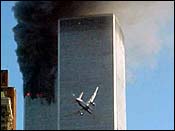
8:46 — American Airlines Flight 11 hits the north tower of the World Trade Center.
9:03 — United Airlines Flight 175 hits the south tower.
9:03-9:07 — New York and Boston regions' air traffic control officials stop takeoffs and landings. The New York Port Authority closes Newark International Airport.
9:08-9:11 — Departures are stopped nationwide for aircraft heading to or through New York and Boston regions' airspace.
9:25 — Federal Aviation Administration stops takeoffs nationwide.
9:35 — United Airlines Flight 93 begins unauthorized climb, raising concerns it has been hijacked.
9:38 — American Airlines Flight 77 crashes into the Pentagon.
9:45 — FAA orders all aircraft to land as soon as possible.
9:59 — Trade Center's south tower collapses.
10:06 — United Airlines Flight 93 crashes in Shanksville, Pa.
10:29 — North tower collapses.
At American Airlines' operations center in Fort Worth, manager Craig Marquis talks to a reservations agent in North Carolina. The agent isn't sure what to do.
On another line, the agent is speaking with a flight attendant who's in the air but can't reach the pilots on her jet. The agent wants to transfer the call to Marquis but the phone system won't let her. So she begins to relay messages coming from the back of American Flight 11, a Boeing 767 heading from Boston to Los Angeles.
Aboard, flight attendant Betty Ong tells what's unfolding.
Marquis, a blunt-spoken veteran, isn't sure what to make of the call. Is the woman even a flight attendant? he wonders. He checks his computer as he listens on the phone. There she is. Betty Ong. And she is on that flight.
Ong can't contact the pilots, the agent says. That's why she's calling. Why doesn't she just walk up to the cockpit and bang on the door? But as he listens — as Ong, in hushed tones, tells of a passenger dead and a crewmember dying, of the jet's erratic path and intruders in the cockpit — Marquis realizes that Ong can do little.
The flight has been hijacked.
As Marquis, 45, considers what he can do, air traffic controllers at the FAA's Boston Center reach the same conclusion. Flight 11 has stopped talking. Its pilots don't respond to calls; its transponder signal has disappeared. Worse, controllers report hearing a man with a strange accent in the cockpit.
"We have some planes," he says through an open mike. "Just stay quiet and you will be OK."
Could more hijackers be out there?
In the FAA's command center in Herndon, Ben Sliney learns of the radio transmission. The words will haunt him all morning. "We have some planes."
Some? How many?
Sept. 11 is Sliney's first day on the job as national operations manager, the chess master of the air traffic system. The New Yorker, a lawyer who once sued the FAA on behalf of air traffic controllers, now walks the floor of the center — a room that resembles NASA's Mission Control.
By Tim Dillon, USA TODAY
Ben Sliney, the national operations manager at the FAA's command center in Herndon, Va., was on duty at the center on Sept. 11.
Loud and forceful, Sliney fits the mold of others there. After managers at the center were criticized for not taking enough action to prevent record flight delays in 1999, the specialists were urged to speak freely during crises. That way, those in charge would have the information they needed to make sound decisions. On this day, that policy will be put to the test, and the center is deafening, like the New York Stock Exchange when everyone's trying to sell.
"We have some planes..."
Sliney can't shake the words. Are there more hijackers out there?
8:30 a.m.: 3,786 planes
"Wow, look at that!"
In the FAA's largest air traffic facility in New York state — a warehouse-like structure on Long Island, an hour east of Manhattan — manager Mike McCormick rushes to the banks of radar screens where controllers are trying to track Flight 11.
The former Marine presses his cordless phone to one ear as he talks to officials at other facilities in the New York area. But the other ear is doing most of the listening — to the radio reports of pilots who are watching the jet's progress.
Over New York, Flight 11 has begun to descend. Not into JFK or LaGuardia or Newark International Airport but into the city itself.
It must have electrical problems, he thinks. That's probably why the transponder is off. McCormick calls another air traffic center that hands off flights to New York's three major airports. Flight 11, he warns, might try an emergency landing.
In Fort Worth, Gerard Arpey, American Airline's executive vice president for operations, hears about the Ong call and the strange transmissions from Flight 11. In his 20 years with American, Arpey, 43, has grown used to stories about misbehaving passengers — the drunks and disorderlies that airlines encounter. But this, he thinks, this seems more than that. This sounds real.
He tries to reach his boss, CEO Don Carty, but Carty isn't in yet. Then he heads to the airline's command center, where top operations officials gather only in the event of an emergency. They're all here, Arpey thinks as he walks through the door.
All but Craig Marquis.
Just down the hall, in the airline's operations center, Marquis hasn't left the phone. Still listening to the relayed words of Ong, he works to calculate how much fuel the jet carries. That way, he may be able to predict where the hijackers will take the flight. But at 8:46 a.m., the North Carolina agent abruptly loses Ong's call. Marquis' calculations no longer matter.
At Newark's tower, just across the Hudson River from Manhattan, controller Rick Tepper, 41, stands at a console behind a group of other controllers.
By Eileen Blass, USA TODAY
Air traffic controller Rick Tepper works in the control tower at Newark International Airport. On Sept. 11, Tepper saw a mushroom cloud at the World Trade Center.
There, he answers phones and troubleshoots problems. He and the other controllers often wear jeans and polo shirts. The attire belies their intense work ethic.
When Tepper looks past the controllers, he sees it out the window: a mushroom cloud rising from the World Trade Center's north tower.
"Wow! Look at that," he says to no one in particular. Flames shoot from the building. "How are they going to put that out?"
He didn't see what caused the explosion, but on the chance that it was a plane, he begins calling airports nearby.
"Did you lose anybody?" he asks over and over. No one has.
Then, a phone rings: the "shout line," set up for speedy calls among controllers in the region. Tepper answers. "We've lost an aircraft over Manhattan," someone at the New York center says. "Can you see anything out your window?"
"No, I don't see anything ... " Tepper pauses. "But one of the towers, one of the trade towers, is on fire.
"I'll call you back."
9 a.m.: 4,205 planes
"This is not a drill!"
At the New York center, McCormick struggles to keep up with the barrage of information, most of it annoyingly vague.
That must have been American 11, McCormick thinks. Could it be terrorism?
Just three days before, celebrating his 45th birthday, he had taken his 8-year-old son Nicholas to the Trade Center. There they stood, toes touching one tower, peering toward the sky.
Now he tries to figure out why an airliner would've hit the building. Just before American disappeared, controllers heard an emergency beacon. From what? McCormick wonders. And controllers can't find a helicopter that has disappeared from radar over the city. Did it hit the Trade Center, too?
In Herndon, national operations manager Sliney receives word from officials in New York: A small plane has crashed into the Trade Center. One of the room's 10-by-14-foot TV monitors comes to life with CNN. Black smoke gushes from the north tower. The hole is huge. And the smoke!
That was no small plane, Sliney thinks.
At United Airlines headquarters outside Chicago, Andy Studdert rushes to the airline's crisis center, a windowless room with a large screen on one wall. To those who work there, the room resembles the bridge on Star Trek's starship Enterprise.
"Confirm American into the Trade Center!"
Workers don't need to look up to recognize the booming baritone of Studdert, 45, the airline's chief operating officer.
Ten days earlier, he had popped a surprise drill on the staff. He told them a flight over the Pacific had suffered a potentially disastrous engine failure and radio contact had been lost. For 30 minutes, workers believed the story. Then Studdert told them the truth.
On this day, he makes certain everyone knows the stakes. "This is not a drill!" he shouts, but the staff already knows.
What they are about to tell Studdert is even worse than what brought their boss to the crisis center. Controllers have lost radio contact with a second flight — a United jet that, like American Flight 11, took off from Boston bound for Los Angeles.
On the giant screen at the front of the room, airline workers can only watch as United Flight 175, northwest of New York, heads toward Manhattan.
Then ... it vanishes.
"There was another one!"
In the Newark tower, the shout line rings again.
Where's United Flight 175? "Can you see him out the window?" the caller asks Tepper, the Newark controller.
Beyond the New Jersey shipyards, Tepper spots the jet flying north, up the Hudson River. His eyes track it toward the Manhattan skyline. It's moving fast. Too fast. And rocking. Its nose points down in a dive and now it's banking left and then right and moving as Tepper has never seen a jet move and then it starts to level and ....
"Oh my God! He just hit the building," Tepper tells the caller.
In Herndon, a shout: "There was another one!" and the giant TV monitor glows orange from the fireball. Scores of workers gasp, as if sucking the air from the room.
It can't be a second one. At the New York control center, McCormick's deputy, Bruce Barrett, sits incredulous at the watch desk, the facility's nerve center.
For a moment, Barrett can think only of his daughter, Carissa, who works in lower Manhattan. Could she be visiting someone at the Trade Center? Then he sweeps the thought from his mind. Stay calm, he tells himself.
By H. Darr Beiser, USA TODAY
As Bruce Barrett gave the order for "ATC Zero" in the Northwest, he worried about his daughter working in Manhattan.
Someone has to. Controllers who had been watching TV in the break room are rushing onto the floor. They saw the jet hit the other tower. Is there really any question what he should do?
"We're declaring ATC zero," he tells air traffic managers. McCormick approves the order. Clear the skies over the region.
If they have overreacted, the decision could ruin both their careers. But after what they just witnessed, they give little thought to asking for permission. A call to Washington could take minutes, and they aren't sure they have that long. They aren't certain of anything, except that they need to do something.
A handful of managers spread the word to controllers. It doesn't seem like enough, Barrett thinks, but it's the most he can do.
The time: 9:03 a.m.
A radical decision
On its face, the order seems incredible. Not a single flight in or out of New York? Some of the nation's biggest airports shut down?
Controllers had gone to "air traffic control zero" before, but only when their radar shut down or their radio transmitters went silent. The planes kept flying then, and controllers in other centers guided them.
This time, ATC zero means something far more drastic. It means emptying the skies — something that has never been attempted. And not just the skies over Manhattan. Controllers must clear the air from southern New England to Maryland, from Long Island to central Pennsylvania — every mile of the region they control.
The move reverberates through almost every part of the nation. Controllers from Cleveland to Corpus Christi must reroute jets headed to the region and put some in holding patterns.
In the windowless room of the New York control center, Barrett, at 56 one of the facility's most senior managers, scans the faces of the other managers. Most pride themselves on their macho, can-do attitudes. Cool under pressure. Calm during the worst. But this ... who has prepared for this? In the dim light, Barrett sees that they're looking at him strangely, as though they can't believe what he's saying.
One controller begins to sob and shake. "I don't understand how come I'm reacting like this," the controller says. It reminds Barrett of the traumatized troops he saw as a photojournalist in Vietnam.
You're scared, Barrett thinks, but he can't afford to be. He needs to concentrate. To focus. But his phone! It won't stop ringing. Everyone wants to know what's going on, including his wife, Denise. She asks about their daughter.
"I don't have time to talk to you," Barrett tells her. "Just call and find out if she's OK."
The white board
At the FAA's command center in Herndon, attention shifts from the weather maps and the radar displays.
The new focus: a white dry-erase board propped at the front of the room.
On it, staffers have begun to scribble the call letters of every flight that controllers around the nation fear might be in the hands of hijackers.
Weather experts and the specialists who normally work on reducing flight delays have been drafted to investigate. They badger airlines to find out whether anyone knows what's happening aboard a number of flights. On this day, the routine glitches of the air traffic system — a missed radio call, even a pilot who seems uncooperative — raise suspicions. Unless a controller or airline official can assure them the glitch is simply routine — that the captain is responding and everyone is safe — the flight's letters won't be crossed out.
The phone bridges between air traffic facilities have become emergency hotlines of sorts, and the reports of possible hijackings — many of them sketchy — flow at a frenetic pace.
As Sliney, the operation's manager, moves around the room, a handful of air traffic specialists follow. Together, they have decades of experience, and no one hesitates to share an opinion. But without good information, Sliney knows that any decision might be risky. Amid the shouts and chatter and conflicting reports, he reminds himself: Don't jump to conclusions. Sort it out.
Now, during a massive conference call among air traffic facilities, officials in Herndon learn about a third jet that might be in the hands of hijackers: American Airlines Flight 77, bound for Los Angeles.
The jet departed from Washington's Dulles International Airport. It stopped talking to controllers somewhere near the Ohio-Kentucky border. Moments later, it disappeared from radar. Its call letters join the list on the white board — a list that will eventually swell to 11.
But why? What is this about? Across the nation, controllers and airline and aviation officials struggle to understand.
These weren't typical hijackings. Terrorists weren't seeking political asylum or a trip to Havana. They were using the two jets as guided missiles. They meant to hit the World Trade Center. No question about that.
Most of the pilots in the air don't know what has happened. Or why. How could they? Officials on the ground are still trying to make sense of it.
Pilots have always been trained to cooperate with terrorists, to do whatever they want in order to save lives. That means a crew probably won't fight back, at least not at first. And who knows how many other flights have terrorists aboard?
Again, Sliney hears them: the words that came from Flight 11.
"We have some planes."
9:15 a.m.: 4,360 planes
Unprecedented decisions
From the moment air traffic managers McCormick and Barrett start to clear the airspace over New York, government and airline officials across the nation — almost in unison — begin to take similar, unprecedented steps.
In Fort Worth, American operations managers huddle, talking breathlessly about their options. They already have lost one flight. And now, Flight 77 has disappeared. Do they have a choice?
Manager Marquis' voice booms over the loudspeaker. "Anything that hasn't taken off in the Northeast," he says, "don't take off."
At the FAA's command center in Herndon, officials worry about what might be unfolding. Maybe there's another wave of hijacked jets coming off the West Coast. And what about the international flights?
The center halts takeoffs of all flights bound for New York and New England. Then officials stop takeoffs for any flight headed to Washington, D.C. Moments later, they freeze takeoffs headed to Los Angeles, the destination of the two hijacked flights that crashed into the Trade Center. Then to San Francisco.
The orders will keep hundreds of flights on the ground. As in surgery, each step clamps shut another artery of the air traffic system.
But the moves aren't strong enough for some of the air traffic specialists at the center, who bombard Sliney with advice.
"Just stop everything! Just stop it!"
The words ring true to Sliney. It doesn't matter who said them — with the noise in the room, it's hard even to know. But stopping everything, he thinks. That makes sense.
At 9:25 a.m., with Flight 77 still unaccounted for, Sliney issues another order that no one has ever given: full groundstop. No commercial or private flight in the country is allowed to take off.
The decision is sweeping, but Sliney has no doubt he has made the right call. And if he's wrong? At least he has erred on the side of safety. If higher-ups want to second-guess him, so be it. He has left the agency before to practice law, and he knows if he has to depart again — if someone thinks he's screwed up — he can leave with no regrets.
What he doesn't know — what no one knows — is how crucial this order to ground planes will prove when controllers are asked later to clear the skies.
9:25 a.m.: 4,452 planes
Watch and wait
In the New York control center, Bruce Barrett wonders what lies ahead. Scores of overseas flights are heading to New York. Though many are hours from landing, rerouting them from the now-closed airspace will be far more difficult than clearing the skies over the area had been.
About this report
On Sept. 11, the nation's aviation system quickly and safely landed almost 4,500 planes that were in the air when the terrorist attacks took place. How was this accomplished? What was it like inside air traffic control centers and at airline headquarters? How was the decision made to land all the planes? And how did controllers execute it?
USA TODAY reporters Alan Levin, Marilyn Adams and Blake Morrison spent seven months interviewing more than 100 people involved in key decisions that day. Among them: air traffic controllers, pilots, flight attendants, airline executives, federal officials and other aviation system workers. The reporters traveled to New York, Washington, Nashua, N.H., Chicago, Fort Worth, Atlanta and Halifax, Nova Scotia. Morrison wrote the stories.
The scenes, thoughts and quotes in the stories are based on interviews with participants or with sources who had access to tape recordings. Characters' thoughts are highlighted in italic type throughout the stories. Accounts of the day's events were verified with other participants. Reporters and editors also scrutinized hundreds of pages of records, including transcripts of radio calls with the four hijacked jets and a log kept by the Federal Aviation Administration.
USA TODAY compiled and analyzed data from several sources. A key source was FAA radar data from the Traffic Situation Display. The system tracks all aircraft in the United States and Canada that have filed flight plans: commercial jets, private planes, cargo jets and military aircraft. It also estimates the location of planes over the Atlantic and Pacific oceans flying to and from North America. USA TODAY examined data from 8 a.m. to 1 p.m. on Sept. 11. Aircraft totals were adjusted to eliminate military flights and several hundred domestic flights over Europe that had been included.
USA TODAY also used a database from Flight Dimensions International (www.flightexplorer.com) to analyze flights that were rerouted by controllers. A few rerouted flights were not recorded. The data allowed USA TODAY to determine when specific flights were rerouted and where they landed.
Separate software from the same firm allowed an analysis of the number of planes in the air and the airline to which those planes belonged. This analysis was done by Paul Overberg, database editor, and Lee Horwich, national editor.
Over land, controllers can see jets on radar and reach them by radio. But those tools are useless beyond a 200-mile band near the shoreline. The New York center's oceanic controllers must use a complicated system to guide jets. They estimate a jet's position and issue commands to a private company, which relays them to the jet. If the jet doesn't follow a command, controllers might never know.
Barrett already has told the oceanic supervisor to turn every jet away from U.S. airspace. The primary option: Canada.
"Are you sure this is where we want to go?" the supervisor asked.
Yes, he was certain. But now, he learns that Canadian authorities are not. An official there tells the supervisor that Canada cannot accept all the arrivals streaming across the North Atlantic.
"Just be emphatic," Barrett tells the supervisor, "and tell them they're not coming here."
In Herndon, Sliney considers his options. Do something. Make a decision. That's the credo of the air traffic controller. Make a decision.
But what? What should he do? Already, they have stopped takeoffs nationwide. What else can they do? Land every plane?
Throughout the morning, few had agreed what the right move was. Officials in Herndon initially questioned whether managers in New York had overstepped their authority when they cleared the airspace there. But all of the moves had proved right. And now, a consensus is building: They should land every plane.
Then, just before 9:30 a.m., a report comes from a controller at Washington Dulles International Airport. She has a jet on radar, heading toward Washington and without a transponder signal to identify it. It's flying fast, she says: almost 500 mph. And it's heading straight for the heart of the city. Could it be American Flight 77?
The FAA warns the Secret Service. Fighter jets from Langley Air Force Base in Virginia race toward Washington. They won't get there in time.
'Get to the nearest airport'
On his way to the office in Fort Worth, Don Carty, American's CEO, talks on his cell phone. Flight 77 has vanished, he is told.
He was at home when Flight 11 hit the Trade Center. The TV in the kitchen was on. "Could that be your airplane?" his wife asked. Her face went pale.
Carty, 55, told her no. No, of course not; it couldn't have been. But even he didn't believe what he was saying. By the time Carty reaches the office, a jet is bearing down on Washington. Is it Flight 77? A groundstop will keep flights from taking off. But what about the ones in the air? he wonders.
At the airline's operations center in Fort Worth, vice president Arpey takes charge. "I think we better get everything on the deck," Arpey says. What the hell am I doing? he thinks, but Carty concurs when he arrives minutes later.
"Do it," he says, and Arpey puts the order out to land every American plane.
At United headquarters in Elk Grove, Ill., operations head Studdert issues a similar order: "Tell them to get to the nearest airport they can."
Before this day, no airline has ordered all of its planes from the sky.
'Where's it going?'
At FAA headquarters, less than a half-mile from the White House and Capitol, Dave Canoles paces before a speakerphone.
The head of air traffic investigations, Canoles has set up phone connections with air traffic facilities. As different regions come on the line, the reports of suspicious planes accumulate. We might be at war by afternoon, Canoles thinks. The FAA had better be ready. Already, some air traffic centers had considered evacuating. Canoles told them to stay put.
Now, about 9:35 a.m., he and others on the conference call listen as an official watching a radarscope tracks the progress of the jet heading for Washington.
Canoles sends an investigator who works for him to an adjoining office with a view to the west. "See if you can spot it," he tells him.
"Six miles from the White House," a voice on the phone says.
Canoles glances outside, through a window facing north. He wonders if he and his co-workers are in danger. At 500 mph, the jet is traveling a mile every seven seconds.
"Five miles from the White House."
No way the FAA is a target, Canoles thinks. It can't be.
"Four miles from the White House."
They'd never choose to hit us. No way.
"The aircraft is circling. It's turning away from the White House."
Where? Where's it going?
Then: "It's gone."
In the adjoining office, the investigator spots smoke to the west of the city.
The jet has hit the Pentagon. The time: 9:38 a.m.
'Order everyone to land'
For the last 30 minutes, since the second Trade Center tower was hit, Sliney has considered bringing every flight down. Now, the manager in charge of the nation's air traffic system is certain.
He has no time to consult with FAA officials in Washington.
The skies are filled with guided missiles, he thinks. Filled with them. The words he cannot shake have proved true. The hijackers did have more planes.
"Order everyone to land! Regardless of destination!" Sliney shouts.
Twenty feet away, his boss, Linda Schuessler, simply nods. She had organized the command center earlier that day, trying to create order from the chaos so Sliney could focus on what had to be done.
"OK, let's get them on the ground!" Sliney booms.
Within seconds, specialists pass the order on to facilities across the country. For the first time in history, the government has ordered every commercial and private plane from the sky.
9:45 a.m.: 3,949 planes
A misunderstanding
In Washington, FAA Administrator Jane Garvey and her deputy, Monte Belger, have been moving back and forth between a secret operations center and their offices.
Throughout the morning, staffers have kept Garvey and Belger apprised of Sliney's decisions.
By Paul Whyte, USA TODAY
FAA Administrator Jane Garvey approved the order to clear the skies.
Now, they tell them of the order to clear the skies. With little discussion, the FAA leaders approve.
Minutes later, Transportation Secretary Norman Mineta calls from a bunker beneath the White House, where he has joined Vice President Cheney. Belger explains that the FAA plans to land each plane at the closest airport, regardless of its destination.
Mineta concurs. FAA staffers, following the conversation over the speakerphone with Belger, pump their fists. Then the conversation sours.
Mineta asks exactly what the order means.
Belger says pilots will retain some discretion. All the FAA deputy means is that under long-standing aviation regulations, pilots always have some discretion in the event of an emergency aboard their aircraft. But the secretary assumes the FAA is not being tough enough. "F—- pilot discretion," Mineta says. "Monte, bring down all the planes."
Ready for a fight
Aboard United Flight 890 over the Pacific, Capt. Hosking and another pilot, Doug Price, wait anxiously for news.
A third pilot, "Flash" Blackman, sleeps in the bunkroom in the cockpit of the 747, unaware of what's unfolding.
"Why don't we just let him sleep?" Hosking suggests. Price, set for the next break, agrees.
"I couldn't go to sleep if I wanted to," Hosking says.
The message about the hijackings arrived only minutes ago, but the two already have decided: Hijackers are aboard their flight.
They don't know that for sure. But they decide to believe it, if only to keep the jet safe. For years, they had been instructed to cooperate with hijackers. No longer. This time, they won't give up without a fight, not when they know someone might try to hijack the jet.
Quickly, they wedge their bags between a jump seat and the flimsy cockpit door. The door opens inward and, with the suitcases there, no one can budge it. Not without a lot of effort.
And if someone does manage to get through the cockpit door?
Price will be waiting as Hosking flies the jet. He has the cockpit's hatchet-sized crash ax in hand, along with orders to use it.
"If someone tries to come in that door, I don't want you to hurt him," Hosking says. "Kill him."
Tuesday: Searching for more hijackers
© Copyright 2004 USA TODAY, a division of Gannett Co. Inc.
|
Countering terror in the skies
July16, 2004
FROM: straitstimes.asia1.com.sg/ commentary/story/0,4386,261736,00.html
(no longer available)
Protecting commercial planes from surface-to-air missiles gains urgency as terrorists enter the market for these SAMs. A laser-based system now being installed in 32 aircraft operated by Israeli national carrier El Al seems to have surmounted some of the serious technical difficulties plaguing other such defence systems.
By Anthony Paul
AS HE took his Boeing 757-300 off the tarmac at Mombasa airport in Kenya, Captain Rafi Marik felt the plane shake suddenly. He first thought the chartered airliner, packed with Israeli tourists en route to Tel Aviv, had hit a bird. Then he spotted two vapour trails passing a metre or so from his plane's left side.
In the wrong hands, surface-to-air missiles like these recovered in Afghanistan, could be real terror threats. -- REUTERS
'Only a minor technical mishap,' he reassured puzzled passengers. But Capt Marik realised what had happened: He and the other 270 people aboard had had the narrowest of escapes from an attack by terrorists armed with shoulder-fired, surface-to-air missiles (SAMs).
The near catastrophe in November 2002 may turn out to have been a godsend for all air travellers, however. Within hours, Rafael - the Hebrew acronym for Israel's Armament Development Authority - launched a crash programme to improve the country's existing anti-missile device for aircraft.
A laser-based system now being installed in 32 airliners operated by Israeli national carrier El Al, and announced last month, is the result. If SAMs can be neutralised, airlines everywhere may eventually be able to counter this new terror threat. And though the cost of the new equipment is high, at least some of the serious technical difficulties plaguing other systems may have been solved.
Other nations are eyeing the Israeli advance. Earlier this year, American and British firms embarked on crash catch-up programmes.
RACE TO FIND PERFECT SYSTEM
THE French are said to have been the most provocative in their industrial espionage efforts. In May, French air force jets were reported to have dangerously manoeuvred several times around an El Al passenger plane in an apparent effort to inspect it for anti-missile systems. Paris is said to take the view that anti-missile flares may well be weapons requiring a licence. The French are also thought to have their own R&D programme.
Rafael and an Israeli avionics firm, Elbit Systems, have developed El Al's installation. Marketed under the trade name, Britening, the system carries the technical description 'Commercial Aircraft Protection Suite'. The airline expects all its aircraft to have the equipment by the end of next year.
The system works in three stages:
# It detects an oncoming missile;
# Tracks it;
# Then, laser beam jams the missile's target-seeking electronics, causing the warhead to miss the aircraft and blow up from afar.
High costs and some very stubborn technical problems have hindered development of civilian anti-SAM equipment.
Until now, aircraft in serious risk of missile attack - mostly military aircraft - have depended on systems that spew out flares when a hostile missile approaches.
The missile's electronics, programmed to seek out the heat from the target jet's exhaust, are suddenly confused by many heat sources. With a little luck, the warhead will chase a flare, not the target.
This system has obvious drawbacks for use on civilian aircraft. If the airliner was attacked in places most favoured by terrorists - take-off and landing paths up to a 30km-radius from airports - flares could either hit other aircraft or set fire to nearby buildings or foliage.
These possibilities, explained Mr Peter Harbison, managing director of the Sydney-based Centre for Asia Pacific Aviation, 'raise questions about airline insurance costs, already running at prohibitive levels for third party damage. An aircraft-generated fireball near a major airport would be a frightening prospect'.
Because of the danger, the Federal Aviation Administration (FAA) in Washington refuses to allow civilian planes operating in the United States to be equipped with the flare-based system.
In the wake of the Kenya incident, some Israeli aircraft were fitted with an interim anti-SAM system, also locally developed: Flight Guard by Elta Systems. However, its active radar-emitting warning system has been suspected of interfering with ground radars. This system also uses the problematic flares.
Cost is another serious inhibitor in civilian anti-SAM development. Currently available flare-based anti-SAM systems used aboard a limited number of aircraft (the American president's Air Force One, for example, and Israeli jets operating in the Middle East) reportedly cost about US$3 million (S$5.1 million) per aircraft to install.
'That sum equates to around US$300 million for anti-missile equipment for the Qantas fleet,' said Mr Harbison, referring to the Australian national airline. 'That is not much less than Qantas' best-ever annual profit.'
For Singapore Airlines (SIA), the cost of equipping its 83 aircraft in operation, 33 on order and 83 on option, could be as much as US$600 million. The Elbit System is reportedly cheaper - about US$1 million per plane - but that will still amount to swingeing totals for the inflation-plagued airline industry.
Asked to comment on the advent in Israel of the Britening system, an SIA spokesman invoked security needs.
'The safety and security of all our passengers and crew is of paramount importance to SIA and we keep our security measures under constant review.
'However, due to the sensitive nature of airline security, we are unable to provide further details,' she said.
Instead of using flares, the Britening system's laser beam addles the missile's electronic brain. To use a well-worn military euphemism, 'collateral damage' is still possible wherever the missile detonates, but it's unlikely to be as disastrous as a downed aircraft.
Three other companies' R&D teams are racing to compete. America's Northrop Grumman and United Airlines and Britain's BAE Systems have been cooperating on something currently known as the 'Directional Infrared Countermeasures (DIRCM) anti-missile protection turret'. The US-British team plans to be in the prototype-developing stage for another 12 to 18 months.
Other companies are expected to join in: Anti-missile protection is about to become a major branch of the aerospace industry. A section of the US$32 billion Homeland Security Bill passed by the US House of Representatives last month authorises fresh spending on civilian anti-SAM R&D.
A PAST AND PRESENT THREAT
SOME specialists are optimistic that hostile missiles can be rendered more or less harmless by confusing their targeting electronics. General Hal Hornburg, commander of the US Air Force Air Combat Command, recently told Aviation Week magazine: 'I look forward to the day when we can convince any surface-to-air missile it is a washing machine in a rinse cycle.'
Nevertheless, all this activity comes none too soon. After all, the Kenya incident was nothing new. Aviation safety authorities believe that over the past 30 years or so, and mostly in Africa, shoulder-fired missiles have hit at least 43 civilian aircraft, downing 30, and killing more than 900 passengers and crew.
The most recent attack on a civilian aircraft occurred at Baghdad airport last November when a SAM hit a DHL A300 freighter during take off. The left wing caught fire, forcing the crew to return for a successful emergency landing.
Earlier this month, the Geneva-based Graduate Institute of International Studies released a survey that estimated about 100,000 SAMs capable of blowing a civilian aircraft out of the sky are in circulation around the world. The institute said up to 27 'non-state groups, some of which have been identified as terrorist organisations, possess the weapons'. Some of these groups are known to be Al-Qaeda-linked.
Sometimes called Manpads (man-portable air defence systems), the shoulder-fired missiles were produced by the two Cold War blocs during the 1960s and 1970s.
The most abundant of these weapons, the Russian-developed SA-7, carries an infrared homing system that steers the missile towards the heat from a jet's tailpipe. The missiles were first used in combat by North Vietnamese forces during their 1972 Easter Offensive.
At Saigon's Tan Son Nhut airport in the remaining three years of the Vietnam War, commercial aircraft changed approach procedures in order to minimise SAM encounters. At about 1.5km, maximum height of the missile's 'kill zone', pilots would bank into a tight spiral above the tarmac and land as rapidly as possible.
During the Indochina War, I found myself in several nervous situations in which SA-7 alerts were issued while an aircraft in which I was travelling approached Tan Son Nhut. However, I cannot find any report of a Vietnamese missile striking a normal commercial jet.
The first recorded SA-7 attack on an airliner came in 1978 when Zimbabwean freedom fighters using a weapon similar to that used in Mombasa shot down an Air Rhodesia Viscount turboprop airliner carrying 52 passengers and four crew.
Although many Soviet-made SA-7s may be past their use-by date, other threats remain. A far more dangerous shoulder-fired SAM is the Stinger, developed by the US Army. This missile's encounter in 1985 to 1989 with the Soviets' Mi-24 helicopter gunship was the Afghanistan war's defining episode.
The Mi-24 was capable of carrying up to eight soldiers. In the war's early stages, the Afghan resistance had no answer to this heavily armed and armoured gunship's ability to attack with cannon and rocket and rapidly deploy counter-force. But in 1985, in the face of desperate appeals from the Afghans, US Congress authorised the Central Intelligence Agency (CIA) to distribute 1,000 or so Stingers to the guerillas.
URGENCY IN FACE OF TERROR
THE weapon transformed the battle field. According to one analysis, 269 of the 340 Soviet aircraft fired at by Stingers (about 80 per cent) were destroyed. On the Afghanistan-Pakistan border in 1985, I watched enterprising Pathan tribesmen develop overnight a thriving trade in Mi-24 scrap metal. Their best customer: a North Atlantic Treaty Organisation spy charged with reassembling one complete gunship in the hope of detecting its secrets.
CIA agents returned to Afghanistan after the Soviet withdrawal in an attempt to buy back as many of the missiles as they could. The agents had a US$55 million budget, but only a relatively small number were ever retrieved.
The agency has estimated that Al-Qaeda and other terrorist groups may still hold a few hundred Stingers. Some are also being offered on the black market, reportedly for about US$100,000 a missile.
In November 2002, a US Federal Bureau of Investigation sting operation picked up two Pakistanis and an India-born American Muslim who allegedly used Hong Kong as a venue to negotiate the purchase of four Stinger missiles for Al-Qaeda.
The implications of all this for the world aviation industry are more than a little disturbing. So what is to be done?
Rafael's anti-missile project director, Dr Patrick Bar-Avi, has spoken of the 150 or so aircraft used by heads of state as part of the market's first stage. When full production resulted in economies of scale, he said, installation in all or most commercial aircraft may become economically feasible - perhaps by the end of this decade.
Of course, events may accelerate these development plans. We could soon have a very different view of their urgency. As Israeli Finance Minister Benjamin Netanyahu has put it: 'Once planes start falling from the sky, we're going to live in a very different world.'
# The writer, a member of the International Institute for Strategic Studies in London, was a war correspondent in Indochina and Afghanistan. |
| The Other Side of the Story?
FROM: http://www.scrappleface.com/MT/archives/001766.html
Terror in Skies: Muslim Man Recounts 4 Hours of Fear
(2004-07-17) -- A harrowing story of one man's experience with "terror in the skies" reached a global audience this week, as web surfers and bloggers circulated it, commented on it and challenged its authenticity.
The first-person account starts before the unnamed man and 13 of his friends boarded Northwest Airlines flight #327, bound from Detroit the Los Angeles, on June 29.
"We were just going about our business during the flight," said the man who was born in an unnamed, predominantly Muslim country. "You know, we were just reading the Koran aloud, carrying objects about the cabin and gathering near the restrooms to chat in our native tongues about the ultimate peace we'll find in Allah. Suddenly, I noticed this white woman staring at me. It really freaked me out. It made me and my friends so nervous that we had to use the restroom more, and of course take our digital cameras and other objects in there with us."
The anonymous victim said he began to receive unwanted attention from the flight crew, and saw people passing notes to each other and exchanging glances.
"My legs were like rubber," he said. "I don't know how we endured four hours of this kind of fear. Me and my whole cell group--you know, my friends--finally understood how the great martyr Mohammed Atta must have felt during his final hours."
The unnamed man said his only comfort came from knowing that he had "official permission from the U.S. Transportation Security Administration to be aboard that plane. I knew that they respect our religion and were protecting us."
by Scott Ott |
Spencer: Jihad TV Comes to Canada | | How the Supreme Court’s “enemy combatant” and “Guantanamo detainee” decisions give aid and comfort to terrorists »
July 20, 2004
Terror in the Skies Part II
FROM: http://www.jihadwatch.org/archives/002583.php
Annie Jacobsen's harrowing piece "Terror in the Skies, Again?" came under fire from many quarters, including from some who claimed it was a hoax. But it was anything but, and Jacobsen provides more information in a follow-up piece in WomensWallStreet.com(thanks to Kemaste for the link):
And I now have another important question... Is there a link between my experience on flight #327 and the arrest of Ali Mohamed Almosaleh by customs agents at the Minneapolis Airport on July 7 (approximately one week after my flight)? Almosaleh was traveling from Damascus, Syria, to Minneapolis on KLM/Northwest Airlines. According to CNN.com, "Agents found Almosaleh to be carrying what they described as a suicide note and DVDs containing anti-American material."
It was initially reported by CNN.com that the man "is not known to the intelligence community, and that his name was not on any terrorist watch list." The following day, on TwinCities.com, the St. Paul Pioneer Press reported that Almosaleh "had something with him indicating a connection with at least one known terrorist." So, did a more thorough check of the man reveal this critical new information? Remember, according to Adams, FAM checked the 14 Syrian men on my flight against the terrorist watch lists. They found no match, so they let them go. I wonder what might have happened if the 14 Syrians on my flight had been looked into more thoroughly?
Since publishing the first article, I have received dozens of emails from people in the airline industry, including flight attendants, captains and pilots, some of whom I have also spoken with on the telephone. As of Sunday morning, to my knowledge, WWS had received no emails from anyone in the airline industry suggesting that the incident described in my first article did not happen. Here is what some of them are saying, all of it on the record.
Jeanne M. Elliott, Security Coordinator for the Professional Flight Attendants Association (PFAA), which represents the flight attendants of Northwest Airlines, said, "By the uneducated eye, and to those who don't walk in our shoes, it may have been perceived that we were doing nothing, when indeed we were putting the safety and security of those passengers as our first priority."
This is just a small excerpt. Read it all.
Posted at July 20, 2004 06:34 AM
Comments
(Note: Comments on articles are unmoderated, and do not necessarily reflect the views of Jihad Watch or Robert Spencer. Comments that are off-topic, offensive, slanderous, or otherwise annoying may be summarily deleted. However, the fact that particular comments remain on the site IN NO WAY constitutes an endorsement by Robert Spencer of the views expressed therein.)
"During a later phone conversation I had with Boettcher, he told me that based on his experience, it was his opinion that I was likely on a dry run."
Thank heavens we are seeing some follow-up to this story. However, how much of a bigger picture are we not seeing? For example, are the recent power outages at airports listed below also part of a "dry run?"
I have noticed reports in the press of power outages at the following US airports over the past month. In several instances, passengers were allowed to board, having been screened only with hand-held devices. In the instance of Houston Hobby, 80 bags without any screening at all were allowed on board a flight.
Houston Hobby: 6/21/04
Sea-Tac (Washington state): 6/30/04
Boston Logan: 7/6/04
Chicago O'Hare: 7/12/04
Minnesota: 7/14/04
Near Dulles (equipment failure at substation knocks out power to vicinity of Dulles): 7/15/04
There were also several instances where LAX lost power in April.
We are all aware that al-Qaeda continues to be interested in our air transportation system as well as our power grids. Is it possible that these power outages at airports are somehow connected to Annie Jacobsen's experience, as well as the man arrested at Minneapolis the week before... all part of a big "dress rehearsal?"
Posted by: al-Canine at July 20, 2004 08:18 AM
Just after making my post, I realized that the one common thread between Annie Jacobsen's experience, the arrested Middle Eastern man the week prior, and the power outage at the Minneapolis airport is NORTHWEST AIRLINES.
Posted by: al-Canine at July 20, 2004 08:28 AM
I've posted about this before, but at the risk of repeating myself, I will!
Two years ago in May, both in the gate area and on a Northwest flight, a middle eastern guy was acting extremely suspiciously. I alerted the flight crew about what I had observed and they kept a close eye on him during the entire flight. (I was seated nearby and could observe.) I called the FBI the next day but since I hadn't seen an actual crime committed, they wouldn't follow up. This was before the Patriot Act was passed.
I recently called again after seeing the guy's picture on the "Most Wanted" list. Two years too late, but this time an agent called me back and they were interested, wanted to know seat numbers, etc. I'm hoping that at least a check of the flight manifest yielded an alias that they could subsequently track over time.
Posted by: CGW at July 20, 2004 10:00 AM
Looks like Minnesota has their share of terrorist activity...
Zacarius Moussaoui, 36, was arrested in August 2001 after he aroused suspicion at a Minnesota flight school when he arrived for 747 simulator training without holding a pilot's license.
From Fox News
Saturday, June 26, 2004
A Lebanese national with ties to Abu Musab al-Zarqawi , the most wanted terrorist in Iraq, was picked up in Minnesota and charged Friday in a New York court with lying to the FBI about his ties to terrorists, Fox News has learned.
According to a federal complaint obtained by Fox, Mohamad Kamal Elzahabi attended jihad training camps in Afghanistan in 1988 and ‘89, where he first met Zarqawi — who is believed to be directing the current attacks against U.S. and coalition troops in Iraq.
Officials say that more serious charges, such as material support to terrorism, may follow.
----------------
From Associated Press
Wednesday, June 30, 2004
Terror Suspect Received Haz-Mat License
MINNEAPOLIS — A man who authorities believe may have been part of an Al Qaeda (search) "sleeper cell" obtained a license to haul hazardous materials months after he was identified as a suspected terrorist by the FBI (search), officials said.
The FBI identified Mohamad Kamal Elzahabi as a suspected terrorist before the attacks of 2001, the Star Tribune reported in Wednesday's editions, citing unidentified law enforcement officials.
Yet Minnesota Department of Public Safety officials said they did not know that Elzahabi was suspected of having Al Qaeda connections when he applied in early 2002 for a commercial license to drive a school bus and haul hazardous materials.
Posted by: al-Canine at July 20, 2004 10:15 AM
If we as Americans have abdicated our safety to the likes of Norman Mineta and Department of Homeland Security, then we can be assured that another 911 type attack is inevitable.
After notifying the flight attendant that something was terribly wrong, Annie Jacobson's husband was reassured, "There were people on board higher up than you and me watching the men" and "There were federal air marshals sitting all around us."
This complacency is so disturbing in light of the commitment these jihadists have to fulfilling their mission. It's no joke. What is more upsetting is even though it was evident to everyone something was terribly wrong, no one said or did anything -- not even the Federal Air Marshals! That FAM's are unable to respond to this overtly suspicious behavior until an actual "event" occurs is ridiculous. Do they mean the kind of 'event' where poor souls sitting closest to the aisle get pulled out of their seat and have their throat slit?
Do we have to accept the possibility of calamity because sick political correctness demands we care more about the cost of someone's 'feelings' than properly defending ourselves? Doesn't every passenger flying have a right to be reasonably protected without the suicidal nonsense of airlines or TSA avoiding crucial security measures because someone may feel 'uncomfortable?'
What a laugh they must be having at our terrified citizen's expense as they boldly run through their 'exercise' while passengers, crew and FAM's sit paralyzed in their seats.
Our liberal policy makers are sending us the message that it's better for America to experience another 911 than be sued or 'offend' our enemy before they kill us.
It is unacceptable that this is what our airline safety boils down to!
There needs to be legislation that permits racial profiling without risk of litigation against anyone involved in securing the flights. America must be allowed to do whatever is necessary to protect the flying public.
How do we mere mortals make something like this happen?
Posted by: Kemaste at July 20, 2004 10:32 AM
I am personally upset that the PC gurus are still endangering civilian lives in this country. The whole phenomena of profiling has recieved a poor stigma in our society to what end? Protecting the rights of criminals to injure, maim and kill those who have done nothing to warrant such actions. I would like to share a personal experience of why profiling works and how I became such a fan of spotting the enemy first.
Two years ago I was given the opportunity to work with the Israeli government and study counter-terrorism techniques. In order to get over there I had to take a commercial flight on El Al. Upon arriving at the ticket counter in Newark, a very beautiful girl came up to me, smiled and then began the most rigorious questioning I have ever recieved. She wanted to know why I was traveling on her airline, what my business was, why my passport had no stamps, how long I would be in Israel and a host of other questions. After about 5 minutes of rapid fire questons, she told me I would check in and then go to a designated room where my luggage would be waiting for me in half an hour. I went to this room and they asked me to open my baggage, explain certain articles I had in my posession (including documents related to counter-terrorism) and then they told me to wait until I was called to board the flight. An hour went past and I was called to collect my bags, when I entered the room an armed Israeli Air Martial was waiting next to my bags and informed me that he would be escorting me to my seat and that if I did not sit where I was told until after takeoff, I would not be allowed to travel that day and my ticket fare would be forfeit.
Well the flight went off without a hitch and upon landing in Ben Gurion Airport, I had the opportunity of talking with a friend of mine who had traveled to Israel several times and he told me that it was standard proceedure all that that happened (not just to me but to most of the 22 students that had traveled with me). He also said that is why El Al has never had a successful hijacking because they take security VERY SERIOUSLY, they have to, they are at war. It then occurred to me, that this is the very nature of security that our society needs to adopt because we are in fact at war! I was profiled and subject to intense search and scrutiny and to what end? To ensure that I was not going to endanger the lives of anyone aboard. I realized that if I had been treated like that and I was one of the "good guys" then I feel sorry for anyone who is up to no good under that system.
We need to accept the fact that profiling does work, even if it is not racially based, if it is just a system based on vigilance and attention to detail the system has been provent to work. The simple fact is that when terrorist are aware that they no longer have soft targets, they will be foreced to expend more resources hitting other, less valuable targets and more innocent lives will be spared in the long-run.
Posted by: Carlisle at July 20, 2004 10:50 AM
Al-Canine:
I have the very same list. I was going to post the arrest of the Syrian man, but you beat me to it. I too, believe these are related incidents and part of the bigger picture.
Kemaste:
I thought the very same thing. Let all know this...civilians are not bound by the same PC rules as the attendants and marshalls. We CAN do something...there were over 180 passengers on the plane. Instead of sitting there "terrified", waiting to be "saved" by the government, realize that we have indeed been "deputized" in this war on terror. The 14 should have been confronted, if not by the attendants then by the passengers, to sit down. Do you really care if someone calls you a profiler? Actions can be taken, especially if it can be claimed that actions were a result of self defense. That is to say, defensive measures can be taken if one feels their "life is in jeopardy". I'll take my chances in court. Time to stop being afraid and time to stop allowing ourselves to be "cowed" into submission.
Posted by: jawa at July 20, 2004 11:21 AM
One keeps trying to understand the logic of a policy that endangers lives; one tries, but fails, to find some reason for this. Could it really be that the government is afraid to do what it should, because it might then have to inform people -- or cease to misinform them -- about the nature of Islam, and why anyone believed to adhere to its beliefs becomes automatically suspect as a potential supporter of violent Jihad (all, of course, are supporters of Jihad through conversion and demographic conquest -- if they were not, they would no longer be full-fledged Believers).
Passengers have a right to know what the basis for this policy is. Will the Airline Passengers Association please make this its order of business, and not the amount of head-room, nor the quality of the meals, nor anything else -- except whether passengers can be assured that everything is being done to assure that they will arrive --- alive.
It is not enough to tell us to put our souls in an upright position. We want to stay alive.
Posted by: Hugh at July 20, 2004 11:47 AM
I don't know how many of you saw it, but you should check out the post by ATPPILOT on the comments thread from the first "Terror in the Skies . . ." article, toward the very end of the thread.
Posted by: CGW at July 20, 2004 12:16 PM
I too had the opportunity to fly on El Al and experience their security measures first hand right after the shooting at LAX in July of 2002.
A very attractive Israeli woman approached me with a clipboard and proceeded to ask me questions about my faith, which synagogue I attended and the name of my rabbi. She asked me why I was going to Israel, where was I going in Israel, who packed my bags, the location of my bags over the last 24 hours and those who had access to them. She then asked if I spoke Hebrew. ( Native Arab speakers have difficulty pronouncing the letter 'P')
My attempt to joke around went ignored. She was hard-core serious.
Why can't we be the same?
Posted by: Kemaste at July 20, 2004 12:38 PM
More and more I am thinking that they will try a duplicate of 9-11...partly because alot of people think they wont do the same thing twice...and partly because what a victory it would be for them to get away with the same thing twice...and I swear after the next 9-11 the first person I hear say Islam is the religion of peace with be getting an unpeaceful punch in the face.
Posted by: USAgirl at July 20, 2004 01:08 PM
Profiling? The nature of profiling is that subjects in a pool have a higher probability of being searched, suggesting that subjects are merely being "sampled" at a higher rate than their true proportion in a population. I would suggest that airport security inspectors should inspect a census of the suspect population. That's right, every single muslim air traveller gets the full treatment. If they complain, too bad, that's just the price they have to pay for looking like potential terrorists. While it is true that not every single muslim is a terrorist, most (if not all) terrorists are muslims.
Posted by: Buck at July 20, 2004 01:26 PM
To USAgirl:
I agree with you... and so do these contributors to the Wall Street Journal article from July 12, 2004, "U.S. Tries to Divine al Qaeda's Next Move"
Excerpts:
"...Intelligence officials say groups such as al Qaeda have a penchant for returning to the same targets."
"Al Qaeda has remained very interested in aviation attacks," the U.S. intelligence official said. "We know that it is a consistent focus of their efforts, as we saw in 9/11. But since 9/11, and despite the numerous security enhancements that have been made, al Qaeda continues to pursue capabilities that can use aircraft, either as a weapon or to target."
Posted by: al-Canine at July 20, 2004 02:51 PM
Maybe it is just me and my personality but had I been on that plane I would have been up asking them what they were doing and checking the restroom, now dont get me wrong I would probably end up deplanining in shackles headed to the nearest county graybar hotel care of the FEDS.
We live by a large Military Installation and I ride my motorcycle around the outskirts often looking for anything, I have identified potential targets in my area as well that I frequently check.
I find myself becoming very intolerable to people of "middle eastern descent" and they do not get my business and when we have to cross paths they absolutely understand my position on everything and tend to finish with me quite KWIK.
My attitude is not with the race of the people but rather the ignorance of the moslems.
Check out a web site called zionist apparel and proudly display your thats to our arabic enemies
Posted by: Chuck at July 20, 2004
|
Amtrak Train Stopped For Arabic-Looking Graffiti
Officials Question Passengers, Search Station
POSTED:
6:13 pm EDT July 3, 2004
WASHINGTON -- An Amtrak train on its way from
Miami to New York was stopped at Union Station on Saturday after
Arabic-looking graffiti was spotted on its side, News4 reported.
News4 was told the graffiti possibly said "die," "July
Fourth" and "D.C."
Transportation Security Administration officials questioned everybody on
the train and used K-9 dogs to search the station.
No one was detained or arrested.
The train arrived in New York City Saturday evening, about four hours
behind schedule.
Copyright 2004 by nbc4.com.
All rights reserved.
|
Syrians flew with expired
visas


By Audrey Hudson
THE WASHINGTON TIMES
Almost all of the Syrian musicians who were questioned by
law-enforcement officials after exhibiting suspicious behavior aboard a
Northwest Airlines flight were traveling on expired visas.
The 14 men in the band were questioned by several
agencies that make up the Joint Terrorism Task Force after the pilot
aboard Flight 327 from Detroit to Los Angeles on June 29 radioed for
law-enforcement assistance.
A spokesman for the Immigration and Customs Enforcement (ICE)
confirmed that 13 of the 14 musicians entered the country May 30 and the
visas expired June 10, but the men were not detained. The 14th musician is
a U.S. resident and citizen.
The backup band was hired to play with Nour Mehana,
widely referred to as Syria's Wayne Newton, and were flying on one-way
tickets with a return trip on JetBlue.
"The bottom line is there should have been an
ICE agent called in to participate in the questioning, but there
wasn't," spokesman Dean Boyd said. "We believe if an ICE agent
were there, they could have detected the visas had expired."
The Washington Times reported last week that
flight crews and air marshals say terrorists are testing airline security
and conducting probes, and cited several incidents including the one
involving the musicians that set off alarms with security officials.
Since the report, several other pilots and
marshals have come forward and confirmed that groups of men are conducting
what looks like dry runs for a terrorist attack.
"We are being constantly surveiled and
probed" by terrorists, one air marshal said.
A spokesman for Homeland Security disputed reports
from crews and marshals and said they had "no intelligence that
terrorists are conducing test flights on airlines."
"We are aware of suspicious incidents around
the country and all sectors of the economy, each of these incidents are
being examined," spokesman Brian Roehrkasse said.
The musicians, whose in-flight antics caused alarm
among the flight crew and drew the suspicion of air marshals, had P3
entertainment visas and performed at a number of different venues across
the country. They departed the United States on dates between July 10 and
July 15.
"Everything that we and other agencies have
found indicates, and we are very confident in saying, these individuals
were not terrorists by any means," Mr. Boyd said.
The legality of the band and travel dates has not
eased the concerns of air marshals, pilots and some plane passengers, who
saw their behavior.
Before September 11, the hijackers were
"just flight students," said one U.S. air marshal.
"Everything boils down to creativity and resources. And the more
creative you are, the less resources you need."
None of the 19 hijackers who carried out September 11 attacks were
on terrorism watch lists and all had legally entered the country on
tourist or student visas. Three overstayed their one-year visas.
The September 11 commission report criticized the
CIA for not placing hijackers Khalid Almihdhar and Nawaf Alhazmi on the
watch list prior to the attack even after the men were linked to the
August 1998 bombing of two U.S. embassies in East Africa.
Similar activity was reported by flight attendants
on American Airlines Flight 1732 from San Juan, Puerto Rico, on Feb. 15 to
New York's John F. Kennedy Airport. The six men involved worked for a
cruise ship and were carrying musician's cases with instruments.
"The best way to travel is in large groups,
no one would give it a second look," the marshal said.
However passengers and the flight crew aboard
Flight 327 were closely watching the Syrian musicians.
According to passengers Annie and Kevin Jacobsen,
the men sat throughout the plane pretending to be strangers, then stood
nearly the entire flight in congregations of two and three and
consecutively fielded in and out of bathrooms at intervals.
One took a McDonald's bag into the lavatory,
then passed it to another Syrian. The musicians also carried cameras and
cellular phones to the bathroom.
When the pilot announced the landing and to fasten
safety belts, seven of the men jumped up in unison and went to the
bathroom. Upon returning to his seat, one man mouthed the word
"no" as he ran his finger across his throat.
Syria is one of seven countries designated as
state sponsors of terrorism by the State Department, but Damascus has
cooperated with the United States in the fight against al Qaeda, according
to the State Department report for 2003, issued April 29.
"They came from a country known to support
terrorism and no one noticed their visas had expired?" one pilot
asked.
Air marshals and pilots say terrorists are
actively testing airline security and the behavior of the musicians
mirrors a test run.
"Organized terrorists have been and are doing
probes," a second air marshal said. The Jacobsens' account is
credible "because it is eerily similar to previous incidents that
have happened on planes."
The Jacobsens have become the subject of ridicule
on some blogs and criticized in one media report by an unnamed government
source, but the Federal Air Marshals Association (FAMA) issued a statement
Sunday backing the family.
FAMA also called on the government to release the
recording of the pilot's call to air traffic control for law-enforcement
assistance.
The unnamed source suggested Mrs. Jacobsen was
hysterical and was the reason that law-enforcement officials were called
to the airport.
Pilots and marshals say the flight crew and
onboard marshals were obviously concerned and the Joint Terrorism Task
Force would not be deployed in routine cases of upset or unruly
passengers.
"Dealing with upset plane passengers is
not exactly new," the pilot said.
The second air marshal said the Jacobsens did
exactly what President Bush and Homeland Security chief Tom Ridge have
asked U.S. citizens to do: Be vigilant and report suspicious behavior.
FROM: http://www.washtimes.com/national/20040727-123853-7608r.htm
|
"Mother of a Martyr"
Nour Mehana's Greatest Hits
|
By Heather Wilhelm
www.heatherwilhelm.com
July 27, 2004
Nour Mehana, the "Syrian Wayne Newton," has finally
hit the big time. After
days of fevered speculation, Mehana has been outed as the
mysterious Syrian
music-maker who, along with his band, set Northwest Airlines
Flight 327 into a
tizzy over a feared terrorist "dry run."
For many, this discovery was a massive relief. In fact,
one look at Mehana's
publicity photos set many minds at ease. This man, a
terrorist? A man who
sings with a goofy Syrian band, plays in shady casinos, and
has a cheesy
porn-style mustache? That silly woman Annie Jacobsen!
Aren't we all so silly
and paranoid?
Mr. Mehana has a nice little song on his recent CD, by the
way. It's
called "Um El Shaheed."
In English, that's "Mother of a Martyr."
I noticed "Um El Shaheed" on Nour Mehana's web site.
"Shaheed," I knew,
meant "martyr," but that was as far as my Arabic
could go. Since
martyrdom seemed an odd topic for a casino crooner, I called
the Middle East
Media Research Institute. I spoke with Aluma Dankowtiz, who is
fluent in
Arabic, to find out exactly what Mr. Mehana has to say.
"Mother of a Martyr" glorifies the death of a young
Palestinian. Mehana sings
to a grieving mother that she should not be sad, because her
son, who died as
a martyr, is a hero. She should be happy that her son is
gone, Mehana croons,
because freeing Palestine and the Golan Heights are heroic
goals. The song,
which starts slow and solemn, ends with a triumphant chorus,
celebrating the
martyr's glorious death: "Allahu Akbar...Allahu
Akbar...Allahu Akbar!"
Feel better? Somehow, after "Mother of a
Martyr," that Wayne Newton porn-
style mustache becomes slightly less comforting. Hey, is
anyone ready to jump
onto a plane with Mr. Mehana and his wacky band?
Come on, don't be shy!
Nour Mehana is, apparently, a religious man; according to one
website
biography, he spent his pre-singing years reciting the Holy
Koran. And
if "Mother of a Martyr" is any indication, Mehana
also supports the Palestinian intifada--and, along with it, martyrdom doctrines.
"Mother of a Martyr" does not, in any sense, prove
that Mr. Mehana is involved
with terrorists. It does not mean that he was making a
dry run on Flight 327.
However, it does suggest that Mr. Mehana embraces certain
ideals of
martyrdom--similar to the very ideals that drove the 19
hijackers into the
World Trade Center.
Break out those tambourines!
Contrary to the protestations of America's chattering classes,
the ideals of
martyrdom and jihad do not exist only on the Islamic fringe.
Rather, these ideals
have generated a surprising amount of support in some regions
of the Muslim world.
This support is broadcast loud and clear on Al Jazeera, in
dozens of newspapers, and by
singers like Nour Mehana, whose glorification of martyrdom
somehow doesn't
seem to bother those monitoring our friendly skies.
Johnelle Bryant, an official with the U.S. Department of
Agriculture, met up
with Mohammed Atta several times before September 11.
After Atta threatened
to slit her throat, talked about blowing up major United
States cities and
landmarks, and came back to her in a disguise pretending to be
someone else,
Ms. Bryant had this to say: "I felt that he was
trying to make the cultural
leap from the country that he came from. I was
attempting, in every manner I
could, to help him make his relocation into our country as
easy for him as I
could."
Doesn't the condescending reaction to the "cheesy"
Syrian band seem
disturbingly similar? Of course those Syrian band
members were milling
about the plane--they didn't know any better! Plus, they
play at casinos--they
must be truly clueless! In the blink of a news
cycle, Nour Mehana was
transformed into a cartoonish, hapless non-threat, despite the
fact that
his support for martyrdom doctrines is literally broadcast to
the world.
American authorities say they checked Nour Mehana and his band
out. But
as recent news reports have announced, authorities couldn't
even catch the
fact that almost every single member of this travelin' band
had fishy paperwork.
Thirteen of the Syrians who boarded Flight 327 has expired
visas. No one
seemed to notice. Something is seriously wrong with this
picture, and it goes
far beyond some questionable lyrics.
I traveled to Turkey about seven months after September 11,
2001. While
wandering through Istanbul's grand bazaar (where my husband,
regrettably,
decided to wear an Indiana Jones-style hat, subjecting us to
countless "Hey
Cowboy! Hey American!" catcalls), I found a beautiful
bracelet for my mother.
"What does the writing on the bracelet mean?" I
asked the man behind the
crowded counter.
He pulled an English-speaking colleague over to help me.
The man handed
me the bracelet, smiling. "Ah," he said, as I smiled
back. "It is beautiful,
isn't it?" He grinned even wider. "It
says that there is no god but Allah…and that
he shall lead us to the victory!"
I dropped the bracelet back into his hands, shaking my head.
He laughed.
"Ah! You," he said, pointing at me, "are
not ready for the victory!" His smile
was wry. I laughed with him, agreed that I
certainly was not ready for the
victory, and headed back into the bazaar.
My discussion with the vendor in Istanbul was a joke. We
laughed together,
recognizing the absurdity of the situation. We were
both, it turns out, on the
same page. I had a wonderful experience in Turkey.
Sadly, however, our
joke could just as easily have been a sincere conversation.
Britain and France have recently started to deport
controversial Islamic clerics.
A town in Michigan recently held a vote as to whether a mosque
could play its call
to prayer over the city. The Nour Mehana saga has sliced
open a problem that
will challenge America for years to come. America is,
after all, a country of free
speech. We celebrate diversity. Essentially, because of
what America stands for,
we have to let foreign musicians who sing about the glory of
Palestinian martyrs
onto our airplanes, no questions asked.
Or do we?
It's worth thinking over. Whether it was a dry run or not, I
still believe Annie
Jacobsen's story. Many strange things occurred on that
flight, and one
of the strangest was that no one had the guts to ask the
harmless Partridge
Family to sit down.
Nour Mehana, despite his affinity for Palestinian martyrs, may
happen to be
a really nice guy. But it shouldn't be controversial to
check him carefully, enforce
the rules, and make his band sit down when the "Fasten
Seatbelt" sign turns on.
If I'm right, the implications are huge. If I'm wrong,
I've insulted Syria's Wayne
Newton. I'm willing to take that risk.
|
|
Now Boarding, Cultural Misperceptions
By JOE SHARKEY
They were musicians, which explains a lot," said Kinan
Azmeh, a Syrian clarinetist and composer. Mr. Azmeh, a
Juilliard graduate and a Syrian national who travels
frequently in Europe, the Middle East and the United
States on concert tours, was discussing a perplexing issue
reported here last week.
He was speculating about questions, including the
purchase of one-way tickets, involving the travel
logistics of a group of 13 or 14 Syrian musicians whose
presence and demeanor created a case of anxiety on Northwest
Airlines Flight 327 from Detroit to Los Angeles on
June 29.
Alerted by reports from the cockpit that some
passengers and crew believed the musicians to be behaving
like potential terrorists, officers from three federal
agencies and the Los Angeles Police Department met the
plane at the gate.
As reported here last week, the officers questioned the
men for about two hours and released them, having
determined that they were who they said they were and
posed no threat.
Still, bolstered by credible reports from other pilots
and flight attendants that they are being told by airlines
that terrorists have staged dry runs on planes to test and
monitor security, the report - based on a long and
harrowing account published online by a freelance writer
named Annie Jacobsen - created a furor online, on cable
television and on radio talk-show programs.
As lingering questions get answered, however, the
impression grows that Flight 327 was an example of how, in
a general atmosphere of fear, cultural misperceptions can
create big trouble.
It might help to understand that ethnic musicians
flying from the Detroit area (a center of Arab-American
culture) to back up an Arab pop singer at some shows in
Southern California do not exactly travel like Jennifer
Lopez. They fly coach. They tote big McDonald's
bags. They speak in a language that is incomprehensible to
many fellow passengers. Being a band, they tend to be both
cohesive and restless, meaning that on an airplane they
are likely to get up and gather in small groups, just as
Ms. Jacobsen and her husband noticed with increasing alarm
during the flight.
"Sometimes, fear can cause you to look at things
the way you want to believe them to be," said Mr.
Azmeh, who often plays with an internationally known
Syrian band called Kulna Sawa. Kulna Sawa, by the way, has
been incorrectly identified in several online accounts as
being the band on Flight 327.
"There are some Web articles that presumed it was
myself and Kulna Sawa, a band that I play with at home, on
that flight," he said. "Really, the only way is
to laugh at these things. Some people are really
narrow-minded; they go with the first name that pops up on
the Internet under 'Syrian musicians.' "
Who was this band at the center of such attention in
the skies, then?
They are members of a shifting group of musicians who
sometimes are hired to back up an Arab pop singer named
Nour Mehanna, who is a popular act at casinos and
nightclubs in areas with sizable Middle Eastern ethnic
populations.
Mr. Mehanna himself was not on Flight 327. Besides
backing him up in a show at Sycuan, a tribal casino near
San Diego, the Syrian musicians accompanied him during a
show at the Embassy Suites Hotel in Garden Grove, Calif.,
before flying back East on JetBlue.
That flight was uneventful.
One other strange note sounded on the trip. The
musicians were all traveling with Syrian passports and
special United States visas issued for cultural visits. On
arrival at the Los Angeles Airport, the men were
questioned by federal air marshals and by the F.B.I., but
not by Immigration and Customs Enforcement officials who
might have noticed, as the F.B.I. says it did not, that at
least some of the visas had expired in June.
Visas for entertainers from Syria, a nation defined as
a state that supports terrorism by the United States
government, are notoriously difficult and time-consuming
to arrange and keep valid, according to Syrian musicians.
The musicians left the country this month, and attempts to
reach any of them so far have been unsuccessful.
Meanwhile, federal officials familiar with Flight 327
have not questioned the gist of Ms. Jacobsen's narrative,
just her interpretation.
Others openly question that interpretation. "What
was the motive for people to look at them like that?"
asked Ali Rayes, owner of Transtour Express, a travel
agency in Anaheim, Calif., that booked the trip. He said
the men were unsophisticated and thus not inclined to be
acting like wise guys egging on terrified passengers.
"They were innocent people who have families to feed,
and that's why they're doing all this traveling."
Ms. Jacobsen's account included an assertion, which
federal officials have not refuted, that seven of the men
got up from their seats seemingly as a group during the
final approach into Los Angeles.
At that stage, even the flight attendants are strapped
in. Under almost any circumstances, that could be
reasonably interpreted as an overtly provocative gesture.
But cultural differences can suggest an explanation.
"Have you ever been on a bus in Damascus when it gets
near the stop?" asked someone who e-mailed me to
protest the implications that these men were being
deliberately intimidating.
Ms. Jacobsen's accounted suggested that Middle Eastern
men routinely receive a slide at security. Not according
to Mr. Azmeh.
When traveling internationally, "I usually go to
the airport six hours before my flight" in the
expectation of a thorough going-over, he said.
Damien Cave contributed reporting for this column.
On the Road appears each Tuesday. E-mail: jsharkey@nytimes.com.
|
| July 29, 2004
Syrian music star
sings praise of suicide bombers
By Audrey Hudson
THE WASHINGTON TIMES
The Syrian singer of a band that was detained by the
FBI's Terrorism Task Force for suspicious activity during
a recent flight to Los Angeles has written about the
"glorification" of suicide bombers to liberate
Palestine.
Singer Nour Mehana's latest
album includes the song "Um El Shaheed," or
"Mother of a Martyr," said Aluma Dankowitz of
the Middle East Media Research Institute.
The song tells the story of a woman who mourned her son's
death until she realized that "he died for a good
cause and he should be glorified for what he did,"
said Miss Dankowitz, who translated the song for The
Washington Times.
Mr. Mehana, widely known as the
Syrian Wayne Newton, sings to the mother that her son's
goals are heroic and she should be happy he is dead.
"The song opens with the
depiction of a mother crying over her son. He has said
goodbye to his friends and family and is not going to come
back. He went with a weapon in one palm and his heart in
another palm and he's not going to come back," Miss
Dankowitz said. "He went to fight to free Palestine,
Golan Heights and South Lebanon."
The song ends with chants of "Allahu akbar," or
"God is great," a common Muslim expression.
Those were the last words shouted by a September 11
hijacker before the plane crashed into a Pennsylvania
field and have been the last words of many suicide bombers
in Israel.
Mr. Mehana's 14 Syrian band
members were detained by officials June 29 upon deplaning
Northwest Flight 327 from Detroit to Los Angeles, for
acting in a suspicious manner that concerned the flight
crew and air marshals on board.
Meanwhile, federal officials were
summoned to Capitol Hill yesterday to brief Senate and
House Judiciary Committee staff in response to reports of
the incident, and the Federal Air Marshals Association
requested a meeting with top officials in the Homeland
Security Department.
Passenger Annie Jacobsen reported earlier this month in
Women's Wall Street that the Syrians consecutively filed
in and out of restrooms, stood nearly the entire flight in
congregations of two and three, carried a McDonald's bag
into the lavatory and passed it to another Syrian, and
carried cameras and cellular phones to the restroom.
Just before landing, seven of the
men jumped up in unison and went inside the restrooms.
Upon returning to his seat, one man mouthed the word
"no" as he ran his finger across his throat.
The men were flying on a one-way
ticket via Northwest, and returning on a one-way ticket
aboard JetBlue.
An Immigration Customs Enforcement
official said Monday the men had overstayed their visit
and should have returned on June 10, but a Homeland
Security Department spokesman said they learned late
Tuesday that an extension had been granted through July
15.
Officials called to Capitol Hill
included Randy Beardsworth, director of Homeland
Security's Operations, Border and Transportation Security
Office; Thomas Quinn, director of the Federal Air Marshals
Service; and Willie Hulon, deputy assistant director of
the FBI's counterterrorism division.
One staffer who attended the
briefing said officials were "very cagey" on
details, which he described as "very
frustrating."
However, the officials confirmed
air marshals found the activities unusual and suspicious.
"They are trying to have it
both ways and say yes, our people are smart enough to see
something and that's why they called for authorities, but
they deny it was as scary as it has been portrayed,"
the staffer said.
Homeland Security officials say
they have no intelligence that terrorists are conducting
dry runs on airplanes.
Federal air marshals and pilots
also back Mrs. Jacobsen's account as similar to other
incidents, and say terrorists constantly are probing
security.
The Federal Air Marshals
Association yesterday requested a meeting with top
Homeland Security officials to discuss the issue of
terrorist dry runs.
"A test run for terrorism is
not to be ignored," said Bob Flamm, director of the
association. "When a citizen stands up and speaks out
in regard to air safety, it is the responsibility of
law-enforcement officials involved to seek out the truth
and not bury it."
|
| Part
III: Terror in the Skies, Again? |
By
Annie Jacobsen
A WWS Exclusive Article
7/30/2004
It's been two-and-a-half weeks since the first
"Terror in the Skies, Again?" article was
posted on WomensWallStreet.com and subsequently set
off an international debate. From the cockpit
to the coffee shop, from the water coolers to the
halls of Congress, countless numbers of people have
been talking -- and shouting -- about this article.
It seems that anyone who reads the article develops
a strong opinion, which in turn creates more
questions. Flight #327 has opened Pandora's
box.
Last week, when the name of the band was revealed
(Syrian singer Nour Mehana) one side shouted: See,
we told you so! Then, when we learned
that 13 of the 14 Syrian musicians were traveling on
expired visas (which no one from the FBI, the TSA,
the LAPD, or the JTTF noticed), the other side
shouted: No, we told you so!
I watched the two sides rally back and forth all
week until finally, to borrow columnist Michelle
Malkin's words, Flight 327 Landed on Capitol
Hill. And this is exactly where it should
be. This week, I spoke at length with the
United States House of Representatives Judiciary
Committee on the matter. It was an honor and a
privilege, and I believe things are finally in the
right hands. It seems to me that the
highest-ups don't like having to get information
that involves national security from articles
written by yours truly -- and I don't blame them.
Thanks to all of you from both sides of the argument
who have been so boisterous, the heart of the matter
-- which is to investigate exactly what happened
on flight #327, how it was handled or mishandled,
and how to improve airline security in the future
-- has gotten to members of Congress.
I've kept quiet about numerous matters that have
surfaced over the past few weeks. But there is
something I must share because I find it so telling.
Yesterday, I had a conversation with Dr. Imad
Moustapha, the United States Ambassador of Syria.
Earlier in the week, Dr. Moustapha wrote this letter
to the Editor of The Washington Times.
"I am responding to Audrey Hudson's
article 'Scouting jetliners for new attacks' (Page
1, Thursday). We are shocked by this
article. It only reflects paranoia verging on the
point of hysterics. The woman mentioned most
prominently in this article, Annie Jacobsen, is an
advocate of ethnic profiling who survived a
horrendous ordeal: a flight with 14 harmless
Syrian musicians.
"After this ordeal, and
despite the fact that she reached her
destination safe and sound, she 'spread 3,000
bigoted and paranoid words across the Internet,'
as Salon.com put it.
"Your reporter failed to mention that
the only 'crimes' these professional musicians
were accused of committing were going to the
lavatory, eating McDonald's food and talking to
one another.
"The fact that they have performed in
the past six months in places such as the
Kennedy Center, the Lincoln Center and the
Juilliard School did not prevent Mrs. Jacobsen
from saying, 'Couldn't 14 terrorists learn to
play instruments?'
"The reporter for The Washington
Times should have informed her readers that
the whole story was a case of a group of
talented musicians going to Los Angeles to play
music, as simple as that."
IMAD MOUSTAPHA
Ambassador of Syria
I called Dr. Moustapha to ask him if he had some
kind of specific information about the
"harmless" men on my flight.
Perhaps, he, of all people, could clear some
things up. What an opportunity! I thought.
I've always maintained that if these 14 Syrians
showed up on my doorstep and serenaded me, I'd
still have some serious questions about their
behavior at 30,000 feet. Remember, they
themselves admitted to law enforcement in Los
Angeles that they "acted suspiciously."
Maybe Dr. Moustapha -- of all people in the
United States -- with his long list of credentials
and his diplomatic pull, might actually be able to
get me in touch with these 14 members of Nour
Mehana's back-up band. Maybe he could help
put the lid back on Pandora's box.
I mean, could it all really be as simple as
reporter Joe Sharkey from The New York Times
says it is -- that these Syrian individuals simply
confused how to act on a 757 jet in America with
how one might act on a bus in Damascus? The same
way that someone from the North Pole might think
it's OK to wear a ski mask into an American
bank? Certainly Dr. Moustapha, a member of
the Syrian team responsible for drafting reform
strategies for the ministries of Culture,
Education, and Higher Education, might be able to
account for the behavior that I, other passengers,
the flight crew and the federal air marshals found
so disturbing.
After introductory pleasantries, I asked Dr.
Moustapha why his letter suggested that these 14
Syrians played at the Lincoln Center, the Kennedy
Center, and the Julliard School, when according to
my research, that's not at all the case.
Dr. Moustapha said Nour Mehana and his back-up
band had not played there, but
that other Syrian musicians had. I told Dr.
Moustapha that his letter to The Washington
Times was at best misleading, and at worst,
completely misrepresenting the facts. I
added that I didn't consider doing so either
diplomatic or fair.
Dr. Moustapha told me that I was a paranoid
racist.
I asked Dr. Moustapha if, by suggesting that
all Syrian musicians are innocent (not to mention
talented) just because they are Syrian, wasn't
that the same kind of gross generalization he'd
accused me of?
Dr. Moustapha told me again that I was a
paranoid person and that the men did nothing
wrong.
I reminded him that it was the in-flight
behavior of the men (which has now been
corroborated by other passengers) which caused
alarm, not their Syrian heritage.
(To read email from two other individuals with
information about flight #327, click here.)
He said a few more things that aren't fit to
print.
I suggested to Dr. Moustapha that we focus on a
diplomatic solution, that perhaps he himself could
help to locate the 14 Syrian musicians in question
so that they could share their side of the
story. I waited for an answer, but instead,
Dr. Moustapha hung up on me.
Sounds like Dr. Moustapha won't be helping us
find the band. Sounds like this matter is
going to be left up to The Hill.
|
http://www.womenswallstreet.com/WWS/Images/media/Off_the_AP_Wire.pdf
|
Second passenger saw
suspicious behavior
By Audrey Hudson
THE WASHINGTON TIMES
Government officials are questioning a passenger's
account of alarming and suspicious behavior by Syrian
musicians aboard a recent flight to Los Angeles, although
a second passenger has corroborated the events.
The second passenger, a frequent
business traveler who asked not to be identified, provided
a copy of her itinerary confirming she was on the June 29
Northwest Airlines Detroit-to-Los Angeles Flight 327,
which was disrupted by 14 Syrian passengers later
identified as musicians.
The passenger, who was riding in
first class, said the constant foot traffic and strange
behavior she witnessed in the front cabin frightened her
as much as it did Annie Jacobsen, the first passenger who
publicly reported the incident.
"I thought I was going to
die," the second passenger told The Washington Times.
"And that makes me furious because that's the whole
point of terrorism, to make people afraid. It makes me mad
that they achieved that. But I'm not letting it stop me
from taking other trips."
The incident on Flight 327
highlighted concerns that terrorists have been making
"dry runs" on commercial jets in preparation for
attacks.
Homeland Security and FBI
officials briefed Senate Judiciary Committee staffers
Wednesday. The House Judiciary Committee also is
conducting an oversight review of what happened on the
flight.
Federal officials agreed the
activity was suspicious but doubted the account by Mrs.
Jacobsen and her husband, said one staffer who attended
the briefing.
"They emphasized repeatedly
there were material discrepancies between what the two
[passengers] reported and what the flight attendants and
federal air marshals observed," the staffer said.
Air marshals, pilots and flight
attendants, however, back the passenger's account because
they say such events are happening regularly.
"Flight attendants see these
dry runs and are very concerned," one attendant who
praised Mrs. Jacobsen for going public said yesterday.
"We, as employees, do not have as much freedom as
passengers when it comes to speaking out."
The Homeland Security Department
did not return a call for comment, but has said it has no
intelligence on such activities.
The 14 passengers on Flight 327
were detained by the FBI's Terrorism Task Force after the
flight and were determined to be a Syrian band booked to
play a gig near San Diego with singer Nour Mehana.
Homeland Security officials
described the 14 as "just musicians," but
freelance writer Heather Wilhelm discovered that Mr.
Mehana had recorded a song, "Um El Shaheed,"
("Mother of a Martyr") in which he sang the
"glorious" praise of a suicide bomber.
The second passenger on Flight 327
said the men were "up and down the aisles of the
plane the entire time," and that one of the men
pushed other passengers as he rushed toward the front
lavatory. She said the man did not appear to be ill, and
remained in the lavatory during her entire meal.
Mrs. Jacobsen said the Syrians
consecutively filed in and out of restrooms, and stood
during most of the flight. Just before landing, seven of
the men jumped up in unison and left their seats. Upon
returning to his seat, one man mouthed the word
"no" as he ran his finger across his throat.
"There was more activity up
and down the aisle through first class than I have ever
experienced on any flight, including international
flights," the second passenger said. "The most
unusual part was that the flight attendants seemed to
ignore what was going on."
The second passenger said she did
not share her concerns with the flight attendants because
"I thought I was just crazy, and I didn't want to be
the crazy person on the flight that stands up and says
something is wrong, but I will now in the future. I praise
Annie for what she did, because I didn't have the guts
to."
|
Terrorists'
'Probing Attacks' Said to Be Happening Nationwide
Scott
Wheeler and Heather Wier, CNSNews.com
Monday, Aug.
9, 2004
The terrifying account of a Northwest Airlines
passenger, detailing how the suspicious activities of a
group of Middle Eastern men aboard the plane had convinced
her that it was being hijacked, is one of hundreds, if not
thousands, of similarly scary events reported to U.S.
authorities since the 9/11 attacks.
Counter-terrorism experts interviewed by CNSNews.com say
these incidents, many of which were "probing
attacks" by terrorists methodically casing locations
for an assault in the future, indicate the extent to which
the United States currently finds itself threatened.
"What we have seen all across the country - at
military bases, at critical infrastructure facilities, at
soft civilian targets such as schools, shopping malls
[and] sports arenas, and domestic and international
airline flights - are probing attacks" said Peter
Leitner, co-founder of Higgins Counter Terrorism Research
Center in Arlington, Va.
"Probing attacks are designed to elicit a
response in an effort to map out patterns of reactions by
law enforcement, the ease of approaching and withdrawing
from a target and to test the reaction of the civilian
population to a potential attack situation," Leitner
told CNSNews.com.
Leitner said the Northwest Airlines flight on June
29 from Detroit to Los Angeles, involving the suspicious
activities of 14 Syrian male passengers, "was
undoubtedly a probing attack."
Journalist Annie Jacobsen, a passenger on the
flight, described the frightening events for
Women'sWallStreet.com in an article headlined "Terror
in the Skies, Again?"
"After seeing 14 Middle Eastern men board
separately (six together, eight individually) and then act
as a group, watching their unusual glances, observing
their bizarre bathroom activities, watching them
congregate in small groups, knowing that the flight
attendants and the pilots were seriously concerned, and
now knowing that federal air marshals were on board, I was
officially terrified," Jacobsen wrote.
Government and aviation officials have confirmed the
events, indicating that the Northwest Airlines pilot
radioed to the ground that there was potential trouble and
that upon landing the 14 men were detained, questioned and
then released. Authorities confirmed the men were all
Syrian.
In another example, the Washington Times quoted an
airline pilot describing an incident in which a "man
of Middle Eastern descent" locked himself in a
lavatory for a long period of time before an air marshal
forced his way in. The pilot told the Times that the air
marshal found "the mirror had been removed and the
man was attempting to break through the wall. The cockpit
was on the other side."
Many incidents of suspicious videotaping have also
been reported. Last month, two security guards at Iran's
mission to the United Nations were expelled by the U.S.
State Department after they were caught taping landmarks
and infrastructure in New York City. The Iranians,
according to State Department officials, were expelled on
a technicality related to their official capacity, but
most individuals caught videotaping are simply questioned
and released.
Another videotaping involved a Jewish girls' school
near Baltimore last October. The Baltimore Jewish Times
reported that outside Bais Yaakov School for Girls,
"a man described as Middle Eastern in physical
appearance was observed videotaping the school."
"A parent chased the man's car, wrote down the
license plate and informed the FBI, whose agents later
questioned the man," the newspaper reported. The man
was not on any terrorist watch lists, and no arrests were
made.
Shortly after Sept. 11, 2001, a Washington Times
article reported that the U.S. Navy was
"investigating 11 incidents in which 'Arab' or
'Middle Eastern' males appeared to be conducting
surveillance of naval bases, and, on one occasion, a truck
loaded with munitions."
The Naval Criminal Investigative Service issued a
press release stating that Arabic males near Whidbey
Island Naval Air Station in Washington state "were on
the beach with fishing gear; however, [they] did not do
any fishing and their gear was not appropriate.
"The same individuals had been ordered out of a
restricted area by park rangers earlier in the day where
they were observed videotaping the Deception Pass
Bridge," the Naval Criminal Investigative Service
stated.
On Aug. 1, Department of Homeland Security Secretary
Tom Ridge announced that the national, color-coded terror
threat was being elevated from yellow to orange for
specific areas on the East Coast based on "new and
unusually specific information about where al Qaeda would
like to attack."
According to press accounts and sources interviewed
by CNSNews.com, the information was gleaned from the
computer used by two al-Qaida suspects who were arrested
in Pakistan last month. The computer contained logs of
surveillance conducted by terrorists at the Citigroup
Center Building and New York Stock Exchange in New York
City, the Prudential Building in Newark, N.J., and the
International Monetary Fund and World Bank in Washington,
D.C.
It's believed that the author of the surveillance
logs, which reportedly referred to the security,
construction and other details of the financial buildings,
was Abu Eisa al-Hindi, a top al-Qaida operative arrested
in Great Britain last week in a raid that netted 11 other
suspects.
Leitner said the information on the computer used by
the al-Qaida suspects confirms "that these probing
attacks are well planned, systematic and increasingly
provocative."
Jason Korsower of the Washington, D.C.,
counter-terrorism think tank The Investigative Project
told CNSNews.com that "these events could be dry runs
or decoys designed to divert the intelligence community's
attention to planes while the next attack might be
maritime or a truck bomb."
Another counter-terrorism official, who spoke with
CNSNews.com on condition of anonymity, said air passengers
must take steps to ensure their own safety in situations
similar to the one involving the Northwest Airlines flight
from Detroit to Los Angeles.
"The only real line of defense in isolated
situations such as on airlines is intentional chaos. Being
a compliant hostage in the post 9-11 period will not buy
you safety," the official said. "You have a gun
at both temples, one wielded by the terrorists aboard the
plane and the other by the U.S. Air Force scrambling
fighter jets to prevent another disaster on the ground
such as on September 11th."
'That's the Reality' Indeed
Ibrahim Hooper, spokesman for Council on
American-Islamic Relations, dismissed the reports of
suspicious behavior on the part of Middle Eastern
individuals.
"In these kinds of situations if the people had
not looked - quote - Middle Eastern, I doubt the same
behavior would have attracted any attention
whatsoever," Hooper told CNSNews.com. "Going to
the restrooms or other activity somehow becomes suspicious
when the person looks Middle Eastern. That's the reality
we live in today."
Copyright CNSNews.com
Editor's note:
"CATASTROPHE"
Reveals the Secret Story Behind 9/11
Read more on this subject in related Hot Topics:
Homeland/Civil
Defense
War on Terrorism
|
| MORE
FROM THIS COLUMN |
Gentlemen, Why Can’t We Get it
Right?
This is Part VII of the
ongoing series entitled "Terror in the Skies,
Again?"
By Annie Jacobsen
9/15/2004
Federal Air Marshals have become an integral
weapon in America's war on terror. Until recently,
the highly secretive, pistol-packing sky-marshals
were portrayed as America's silent heroes:
"unseen, unheard, unafraid." But a spate
of recent articles about the beleaguered Federal Air
Marshals Service (FAMS) have many Americans
rethinking the reality behind the agency façade. It
seems that a more appropriate motto for the FAMS
might be "easily identifiable, not allowed to
speak up, and concerned about their safety."
As legitimate questions surface, primarily
regarding FAMS policies, upper management within the
organization continues to deny that any problems
exist. But a little digging, and I mean a little,
revealed a number of obvious policy and procedural
problems.
No Coat, No Collared Shirt, No Service
In early June, an American Airlines passenger on
a Chicago-Miami flight publicly outed two Federal
Air Marshals. As the passenger walked by two men
dressed as if auditioning for Men In Black, he
announced, "Oh, I see we have Air Marshals
on board!"
The incident was widely reported in the press,
leaving millions of Americans wondering: if the goal
of an Air Marshal is to be undercover and
inconspicuous -- and it is -- why do they dress
like that? But instead of acknowledging that a
dress code problem exists, the FAMS boldly announced
that it was considering taking legal action against
the passenger who spoke up. Dress code,
screamed the FAMS, is Sensitive Security
Information (SSI)!
The public cried foul play and questioned, is the
dress code really SSI -- or is it simply BS?
One doesn't have to be a counter surveillance
expert to realize the problem wasn't the passenger,
but the policy. It's true, Air Marshals stick out
like sore thumbs. It's no secret that Air Marshals
are required to wear a sports coat, collared shirt,
dress slacks and dress shoes on every flight.
A closer look reveals that the Air Marshal's
dress code issue is hardly new. This from a USA
TODAY article two years ago (August 2002):
"Marshals say making them dress and look
alike threatens their cover. 'This is really
dangerous,' says one Marshal who left the Justice
Department for the Air Marshal program five months
ago. 'We are so obvious, the terrorists don't need
to bring guns on the plane anymore. They just need
to gang up on us and take our guns.'"
So why wasn't this dangerous policy dealt with --
and changed -- two years ago? Thomas Quinn, Director
of the FAMS, didn't think the policy needed
changing. He told USA TODAY that a good Air Marshal
"would clearly understand, respect and
appreciate the policy," adding that Marshals
who provided details to the press were "putting
us all at risk."
With Director Quinn playing the SSI
card, the issue faded from the public eye. But rank
and file Air Marshals demanded change. In a
complaint to Congress last year, the Federal Law
Enforcement Officers Association stated that Air
Marshals are as easy to identify as a
"uniformed police officer." And a
congressional General Accounting Office study of a two-year period (from 2001-2003)
found an average of about one case a week in which
Air Marshals reported their cover was blown. But the
dress code policy remained unchanged.
With the issue back in the spotlight this past
summer, the question remains the same: why do Air
Marshals have a dress code that threatens their
anonymity and puts them -- not to mention a plane
full of passengers -- at risk? The knee-jerk
reaction of FAMS to shout SSI and blame the
passenger didn't work this time, so they tried a
different approach. Dave Adams, FAMS Head of Public
Affairs, told MSNBC that "we need to instill
confidence and respect from passengers and crew
especially if an emergency arises at 30,000
feet."
Seriously Dave, in the event of a hijacking, is
anyone really going to care -- let alone notice --
what an Air Marshal is wearing?
Here's what Adams told the Los Angeles Times:
"If a guy pulls out a gun and he's got a tattoo
on his arm and is wearing shorts, I'm going to
question whether he's a law enforcement
officer."
Adams might ask that question, but would you? As
long as the Air Marshal is pointing the gun at the
right person, do you really care how many tattoos
he's got?
So what's the real reason? The Airline
Pilots Security Alliance (APSA) sees the dress code
as representative of a deadly problem --
bureaucracy. "The dress requirement is just one
more example of career bureaucrats ignoring the
pleas of frontline operators," said APSA
Spokesperson Brian Darling. "A lot of these
managers have been off the frontlines too long. At
some point, someone's got to shake them and say,
'Another airplane is going to hit a building!'"
Bob Flamm, Spokesperson for the Federal Air
Marshals Association (FAMA), has another explanation
as to why these critical problems aren't dealt with
head on. "Director Tom Quinn is a 20 year
veteran of the U.S. Secret Service. He is not, and
most of the management of the FAMS, are not Air
Marshals. They haven't been through the training.
They're not trained in aviation security and their
policies prove it."
After all my research, I have yet to hear or read
a logical explanation for the dress code. Why?
Because there isn't one. And yet despite all the
attention given to dress code woes, nothing is being
done to change it. Just last month, two Air Marshals
were pulled off a flight for violating dress code
rules (an airport supervisor 'caught' them). The
Southwest flight took off without Air Marshals on
board. When asked about the incident, Adams again
tried to play the SSI card, saying the information
is classified. "Those who disclose this
information do themselves and our organization an
injustice," he added.
Tom Jones, Federal Air Marshal, Here to Check
In
Dress code isn't the only dangerous FAMS policy
that threatens Air Marshals in the field. Just last
week it came to light that our
"undercover" Air Marshals have to reveal
themselves to budget hotel clerks by asking for the
air marshal discount when checking in. Upset by yet
another opportunity for their cover to be blown, a
group of Air Marshals recently sent a letter to the
Department of Homeland Security asking that the
policy be changed. Adams response? "These
allegations are grossly inaccurate. Yes, the
Marshals have to identify themselves, but
discretely."
The way in which Air Marshals enter airport
secure zones and board aircraft pose additional
opportunities for a blown cover. Because they carry
firearms, Air Marshals can't go through security
screening with other passengers. But instead of
being able to pass through these areas incognito,
Air Marshals often walk into security areas through
exit lanes -- marching against the flow of
passengers and drawing attention to
themselves.
Shortly after I wrote about a group of Middle
Eastern men who preboarded a flight that I described
in my first article, "Terror
In The Skies, Again?", the article was
being hotly debated on talk-radio. During a show on
KVI 570 Seattle with John Carlson, a Northwest
Airlines pilot called in to share his thoughts about
why the men on my flight preboarded.
"Terrorists preboard to potentially identify
Air Marshals," the pilot explained.
The subject of Air Marshals preboarding was one
of two issues I'd been specifically instructed by
Adams not to discuss with the media. I was told
preboarding was a matter of national security. And
yet a one-click Google search revealed the
information is available to with anyone who cares to
read up on it. This from a U.S Department of Transportation
Federal Aviation Administration Memo dated
November 26, 2003:
"Often, FAMs are boarded only minutes
before or during the general boarding process,
greatly hampering their inconspicuous airport
movement."
An Air Marshal's View of the Cockpit Door
The second issue I was told by Adams not to
discuss with the media under any circumstance was
where Air Marshals sit on airplanes -- something I
had first hand information about from my experience
on Northwest Flight 327. In every conversation I had
with Adams I was told never to discuss where FAMs
sit because it was a matter of national security. At
the time, Adams' request seemed reasonable and in
the hundreds of interviews I did, I didn't mention
it once. But just a few clicks of the button and
anyone can learn exactly
where FAMs sit, in first class only.
By putting the Air Marshals only in first class,
we have made it impossible for them to see what's
happening in the coach cabin. We've also made it
about 10 times easier for terrorists to determine
who they are. Let's think about even just a few of
the tip-offs...We know they preboard, we know they
sit in first class, and we know how they're dressed.
Out of a plane of 300 passengers, anyone could
narrow the field of potential Air Marshals down to a
handful within minutes.
All of these security-compromising issues,
compounded with a moving-target dress code,
underscore the drastic need for change. National
security is not compromised when we talk
about ridiculous policies that anyone can learn
about in less than 60 seconds. National security is
compromised when we don't talk about these
policies.
We need to implement policies immediately
that allow our Air Marshals to conduct stealth
operations, where they are dressed to mix in with
the locals, allowed to enter hotels and airports
inconspicuously and board the plane alongside other
passengers.
Why we don't we take our cue from El Al is beyond
me. Despite receiving multiple threats every
day, El Al hasn't had an incident on one of their
planes since 1968. According to a July 5, 2002
article
on CNN.com, "At least two undercover
air marshals are on board every El Al flight. They
sit among the passengers dressed in plain
clothes."
Hanging on to policy for policy sake is a
dangerous habit of bureaucracy. It lacks imagination
and it defies common sense. It also puts every Air
Marshal, not to mention countless Americans, at
great risk. One has to ask, how can an agency
effectively fight a war on terror when they refuse
to acknowledge and change their own dangerous
policies?
Each time I read about the absurd policies that
upper management is so intent on enforcing, I think
back to my 8th grade education on the
Revolutionary War. Here's a refresher: British
hubris (read: management) kept soldiers adorned in
bright red coats and tricorne hats, marching along
in formation and shooting only on fife-and-drum
command. Meanwhile, their American adversaries wore
brown and green clothing and laid silently in-wait
in the forests around the British troops. We all
know who won that war.
Annie Jacobsen writes about business, finance
and terrorism for a variety of national and
international magazines and webzines. A graduate of
Princeton University, she lives in Los Angeles,
California with her husband and son.
To receive updates about
future "Terror in the Skies, Again"
articles, click HERE
to register.
It’s free, it’s easy, and you will automatically
receive an e-mail notifying you of any subsequent
articles on this subject.
|
|
|
|
| |
|
BOMBING
OF THE WORLD TRADE CENTER 9-11-2001
... 2001. 10-11-2001 - REVERSE SPEECH ON REMARKS BY
PERSONALITIES SINCE
THE WTC EVENT. 10-14-2001 - SUSPICIONS ON THE WTC EVENTS.
JACK ...
www.greatdreams.com/trade.htm
TERRORISM
- WORLD TRADE CENTER - DAY 2 - 9-12-2001
... NUMBER SYMBOLISM OF THE WTC BOMBING. ...
. Carl Cunneff, 36, an oil broker who works
at the World Financial Center, located across the street from the WTC.
...
www.greatdreams.com/trade_day2.htm
TERRORISM
- WORLD TRADE CENTER - 9-11-2001 - PAGE 3
... Jared Israel [Start report from Russia]
“Generally it is impossible to carry
out an act of terror on the scenario which was ... Reason is
the enemy of terror. ...
www.greatdreams.com/trade_day3.htm
BOMBING
OF THE WORLD TRADE CENTER - 9-11-2001 - DAY 4
... evidence, including communications between bin
Laden supporters discussing Tuesday's
attacks, indicated the attacks were tied to the suspected terror
mastermind ...
www.greatdreams.com/trade_day4.htm
BOMBING
OF THE WORLD TRADE CENTER - 9-11-2001 - DAY 5
... Bin Laden's is hardly the first terrorist group
to operate well beyond
home base, but it is the first truly global terror operation. ...
www.greatdreams.com/trade_day5.htm
BOMBING
OF THE WORLD TRADE CENTER 9-11-2001 - PAGE 6
... NOTE: I didn't find it, but you can watch all
the others. WTC rebuilding planned ... WTC
Attack and the Conspiracy Theory: Did we do it to ourselves? ...
www.greatdreams.com/trade_day6.htm
BOMBING
OF THE WORLD TRADE CENTER - 9-11-2001 - PAGE 7
... NUMBER SYMBOLISM OF THE WTC BOMBING. US
DETENTION CENTERS. 9-17-2001 - MISSING
NUMBER RAISED TO 5422. 201 BODIES RECOVERED. 135 BODIES IDENTIFIED. ...
www.greatdreams.com/trade_day7.htm
BOMBING
OF THE WORLD TRADE CENTER - 9-11-2001 - PAGE 8
... NUMBER SYMBOLISM OF THE WTC BOMBING.
MISSING 5422. BODIES FOUND 218. ... Japan
had 31 companies in the WTC, including Fuji Bank and Asahi Bank. ...
www.greatdreams.com/trade_day8.htm
TERRORISM
- WORLD TRADE CENTER - 9-11-2001 - PAGE 9
... 9-19-2001 - UA PILOT OUT OF MIAMI DISAPPEARS.
FLEW TO BUENOS AIRES TWO DAYS BEFORE
WTC. ... Alice In Wonderland and the WTC. l ...
www.greatdreams.com/trade_day9.htm
TERRORISM
- WORLD TRADE CENTER - 9-11-2001 - PAGE 10
... 4000 Israeli Employees in WTC
Absent the Day of the Attack. ... WTC Landlord
Envisions 4 New Towers By Adam Geller. ...
www.greatdreams.com/trade_day10.htm |
TERRORISM
- WORLD TRADE CENTER - 9-11-2001 - PAGE 11
... http://www.newsmax.com/archives/articles/2001/10/11/61421.shtml.
Rebuilding NY:
WTC Still Smoking One Month Later. NewsMax.com Wires Thursday,
October 11, 2001. ...
www.greatdreams.com/trade_day11.htm |
TERRORISM
AT THE WORLD TRADE CENTER, PENTAGON, AND PENNSYLVANIA 9 ...
... THE OTHER PLANES IN THE AIR AND WHERE THEY
WENT. 9-11-2001. WTC PAGE
1. WTC PAGE 2. WTC MILITARY. Wednesday September 12 06:56 PM
EDT ...
www.greatdreams.com/passengers.htm
SUSPICIONS
OF THE SEPTEMBER 11, 2001 EVENTS AT THE WORLD TRADE ...
... on this attack to overcome their lack of
legitimacy, to shift the blame for the
encroaching recession from capitalism to the September 11th terror
attack, to ...
www.greatdreams.com/suspicion.htm
TERRORISM
- WORLD TRADE CENTER - 9-11-2001 - MILITARY PAGE
... TALIBAN. NUMBER SYMBOLISM OF THE WTC
BOMBING. 9-16 ... UNDERWAY. 9-19-2001
- FIGHTER JETS WERE 8 MINUTES AWAY WHEN PLANES CRASHED INTO THE WTC.
9 ...
www.greatdreams.com/trade_military.htm
BOMBING
OF THE WORLD TRADE CENTER - 9-11-2001 - NUMBER SYMBOLISM
... ANAGRAMS OF WORLD TRADE CENTER WERT A CREDENT
LORD, LET RED RENT A CROWD, TERROR
DANCE DWELT. DECANT LEWD TERROR, TEN DRACO DWELT ERR, TOWER LENT
RED CARD. ...
www.greatdreams.com/trade_numbers.htm
TERRORISM
- WORLD TRADE CENTER - DREAM PAGE
... Subj: Re: FULL NEWS OF WTC AT http://www.greatdreams.com/trade.htm.
... I didn't feel
pain but much anguish and terror and I must have been screaming for
my husband ...
www.greatdreams.com/trade_dreams.htm
Transcript
of President Bush's Speech
'Justice Will Be Done' Transcript of President Bush's
Speech To Joint Congress
After the World Trade Center and Pentagon Bombings. Sept. 20, 2001. ...
www.greatdreams.com/bush_speech_92001.htm
The
American Tragedy: A Symbolic Event, Part One
... More 9-11 Disaster Links.
Nostradamus Prophecies And WTC - Separating False From Real
By John Hogue http://www.rense.com/general14/nostradamus.htm. ...
www.greatdreams.com/Events/9_11_01/Amertrag.htm |
The American Tragedy: A Symbolic Event, Manifest Revelation
... By now most people in the free world have heard
about the disaster at
the WTC and have seen TV reports and pictures from the disaster. ...
www.greatdreams.com/Events/9_11_01/Amtrgrev.htm
|
| http://www.thetruthseeker.co.uk/article.asp?ID=206
TWO
STREAMS OF FUTURE PROBABILITY
... The "skeksis" embodied power and
ruled through the Crystal, but in
the absence of compassion they could only reign through terror. ...
www.greatdreams.com/streams.htm
THE
DOGS OF WAR - BLOWBACK AND THE MARBLE GAME
... officials in a Washington car park. See:
http://www.flora.org/library/wtc/foden.html.
'Blowback' During the 1980s, resistance fighters ...
www.greatdreams.com/blowback.html
DREAM
OF 33
... will make the bold reforms needed to restore
growth and opportunity, which will
benefit the people of both our nations." 'World beyond terror'
After leaving ...
www.greatdreams.com/33drm.htm
TERROR
ALERT INFORMATION
... In light of the recent "Terror
Alerts" issued by the government, we provide
the following information links. ... http://www.greatdreams.com/survival.htm.
...
www.michiganmilitia.com/info.htm
9-11
Attack on America
... W. Bush personally make millions (if not
billions) from the War on Terror? ... OF THE
WORLD TRADE CENTER - 9-11-2001 http://www.greatdreams.com/trade_day7.htm.
...
www.apfn.org/apfn/WTC.htm
Above
Top Secret - ATSNN.com TerrorAnalysis.com - TA-ANALYSIS ...
... Ref: http://www.nvisible.com/1111/1111Doorway.html
http://www.greatdreams.com/11coin.htm ... since
11 September, 2001, the thousandth day of global terror will be ...
www.abovetopsecret.com/forum/thread38879/pg1
Alexa
Web Search - Subjects > Society > Future > Millennialism
... www.greatdreams.com - Site
Info. ... Our Final Hour: A Scientist's Warning: How
Terror,... 2. Our Final Hour: A Scientist's Warning: How Terror,...
...
www.alexa.com/browse/ general?catid=29150&mode=general
New
Page 20
... http://www.lampholderpub.com/new_page_73.htm.
The 1000th Day of Terror, The Black
Wind of Death, The Yellowstone Caldera ... http://www.greatdreams.com/venus.htm.
...
www.lampholderpub.com/
Earth,%20Space%20and%20Beyond,%20new_page_20.html
JEWS
AGAINST ZIONISM: Goyim's GLOBAL Sacrifice
... Christian Testimonies have been inspired by the
so-called War on Terror? ... Machinations?:
http://www.ukar.org/gore10.html http://www.greatdreams.com/treeol.htm
...
www.apfn.net/messageboard/
05-25-04/discussion.cgi.9.html
The
Great New Madrid Earthquake
... Amidst their terror, a third shock hit. ...
www.hsv.com/genlintr/newmadrd/ or http://folkworm.ceri.memphis.edu/recenteqs/
or http://www.greatdreams.com/madrid.htm. ...
www.tuppenceworth.ie/biglife/quake.html
SkeptiNews
... Jordan Indicts 28 of Bin Laden's Followers in
Alleged Terror Plot; Western ... gnomon.html
@ Humanity On The Pollen Path: http://www.greatdreams.com/plpath6.htm
...
web.pitas.com/skeptinews/29_03_2000.html
2012
Unlimited philosophy
... whether we are focusing on the horror, pain,
grief, fear and terror of September ... co.uk/new.htm
Many more links available at http://www.greatdreams.com/2012.htm
...
_allaboutlife.homestead.com/
files/2012_Unlimited_philosophy.htm
Mind
control
... out by Roosevelt and Churchill purely as a
clinical experiment in mass terror, keeping
records of ... Lotsa mind control links http://www.greatdreams.com/consp.htm.
...
members.austarmetro.com.au/~hubbca/mind_control.htm
Israel
Hasbara Committee
... Either way, terror as a strategy pays
off well for them and yet there ... pilot committed
suicide when downing EGYPTAIR 990 http://www.greatdreams.com/plane990.htm
...
www.infoisrael.net/cgi-local/ text.pl?source=2/a/i/archives/071120021
WTC-running
notes page 9
... For a well-researched report on symbolism see:
http://www.greatdreams.com/trade_numbers.htm. ... the
call for blood to avenge those who died in the terror attacks. ...
www.cyberspaceorbit.com/warrant9.htm
Threesology
Research Journal
... than the information that led to the nationwide
terror alert issued ... Number Symbolism
of the World Trade Center --- http://www.greatdreams.com/trade_numbers.htm.
...
cenocracy.topcities.com/cro313c.html
Threesology
Research Journal
... than the information that led to the nationwide
terror alert issued ... Number Symbolism
of the World Trade Center --- http://www.greatdreams.com/trade_numbers.htm.
...
cenocracy.topcities.com/cro313c.html
Numerology
Master number 11
... http://www.greatdreams.com/eleven/num11.htm
1-2-3 free ... http://www.decoz.com/september11_2001.htm
9/11 WTC Terror & The Illuminati's 'Master Number' WTC and the ...
www.destiny-tarot.co.uk/
71/Numerology-Master-number-11.html
numerology
master number eleven
... http://www.greatdreams.com/500-trumpets.htm
"The Number Eleven" the number eleven
- mykel ... www.astrology-numerology.com/num-intro.html 9/11 WTC Terror
& The ...
www.destiny-tarot.co.uk/71/
numerology-master-number-eleven.html
[ More
results from www.destiny-tarot.co.uk ]
Environmental
health: a low priority?
... http://www.greatdreams.com/trade_day2.htm>>.
... 2003; 93: 400-406. (8) US State Department,
http://usinfo.state.gov/topical/pol/terror/01100304.htm October 3,
2001. ...
www.neha.org/9-11%20report/index-Environm-3.html
Solstice
Meditation Focus: Connecting With Our Destiny
... Christos --- The attainment of Cosmic
Consciousness From: http://www.greatdreams.com/2012.htm ...
focusing
on the horror, pain, grief, fear and terror of September ...
www.earthrainbownetwork.com/ FocusArchives/Dec2001SolsticeFocus.htm
NOTES
19
... the United States can rob these people of their
most desired goal, your terror.. ... http://www.greatdreams.com/smallpox.htm
SMALL POX - THE DREAM AND THE REALITY. ...
www.cyberspaceorbit.com/warrant19.htm
Abenaki
... .. http://www.greatdreams.com/native.htm
- 77% Result found by: Yahoo!, Teoma, FAST
Search (alltheweb.com ... the Chenoo Howls: Native American Tales
of Terror ... ...
saint-johns-brunswick.pvt.k12.me.us/
student/projects/Indians/abenaki.htm
TWO
STREAMS OF FUTURE PROBABILITY
... The "skeksis" embodied power and
ruled through the Crystal, but in
the absence of compassion they could only reign through terror. ...
www.greatdreams.com/streams.htm
DREAM
OF 33
... will make the bold reforms needed to restore
growth and opportunity, which will
benefit the people of both our nations." 'World beyond terror'
After leaving ...
www.greatdreams.com/33drm.htm
ON
THE BEACH - IT'S JUST A MOVIE - RIGHT?
... 12 Another movie to cash-in on the early
atomic mystique was Shadow of Terror (1945),
featuring a scientist traveling to Washington with the formula for a new
...
www.greatdreams.com/atomic.htm
POLITICAL
INTRIGUE
... TERRORISM - 2001. 10-3-2001 - AN ACT OF TERROR
OR A LONE KOOK? BUS DRIVER
THROAT CUT IN TENNESSEE. 10-2-2001 - ANTHRAX WHAT TO DO IN AN EMERGENCY.
...
www.greatdreams.com/political_dreams.htm
THE
NEW WORLD ORDER - A GOOD THING?
... The tactics of terror lead nowhere. ...
The first nine years were not only without freedom,
but also witnessed real terror and I was always surrounded by
fear. ...
www.greatdreams.com/nwo_good.htm
THE
KING OF TERROR COMES TO SALT LAKE CITY?
THE KING OF TERROR COMES TO SALT LAKE CITY?
August 11, 1999, 12:47 pm.
A funnel ... this. The King of Terror was said to be Jesus
Christ. Jesus ...
www.greatdreams.com/terror.htm
THE
LADY IN GREY - DEATH IN THE OFFICE!!!!
... htm. TERRORISM - WORLD TRADE CENTER - DREAM
PAGE. ... Subj: Re: FULL
NEWS OF WTC AT http://www.greatdreams.com/trade.htm ... Who knew ...
www.greatdreams.com/political/lady-grey.htm
NATIONAL
SECURITY - HOLIDAY TERRORISM
... 4-22-2001 US On Alert For Smallpox Terror
Attack. ... - Radical states with reputations
for supporting terror, such as Iran and Libya, are seeking germ
weapons. ...
www.greatdreams.com/wacovst.htm
LATEST
EARTHCHANGES NEWS -
... 10-03-2001 - IS THIS AN ACT OF TERROR
OR A LONE KOOK? BUS ACCIDENT IN TENNESSEE. ... WARM
MINERAL SPRINGS - SAVE OUR SPRING http://www.greatdreams.com/wms1.htm.
...
www.greatdreams.com/chgnews.htm
Sylvester
the Cat and Speedy Gonzales - May 5, 2003
... Regarding the famous Quatrain 10.72 (King of Terror
quatrain): My viewpoint is that
"Mars reigns by good fortune ... http://www.greatdreams.com/eleven/num11.htm.
...
www.greatdreams.com/sylvester.htm
DREAMS
AND MYTHOLOGY OF CATS AND OTHER FELINES
... Great Po, great evil will be received through
Gauls, Vain terror to the maritime
Lion: People will pass by the sea in infinite numbers, Without a quarter
of a ...
www.greatdreams.com/cats/cats.htm
POLE
SHIFT - CATACLYSMS
... Is Mars Facing A Comet Hit In May? 3-15-00 -
NEW ANALYSIS OF NOSTRADAMUS KING
OF TERROR? ... King of Terror refers to a
now-famous Nostradamus quatrain. ...
www.greatdreams.com/lostland/pole2.htm
The
Symbolism and Spiritual Significance of the Number Three
... trefot would share in that symbolism.
ÆgishjalmaR: Literally, the
"Helm or Awe (in its meaning as "terror")".
The Helm of Awe is ...
www.greatdreams.com/three/three.htm
STRUGGLING
WITH 11:11
... The King of Terror Comes to Salt Lake
City? We thought that if the
11:11 was what we thought previously, people would stop seeing ...
www.greatdreams.com/brigid-11-11.htm
SMALL
POX - THE DREAM AND THE REALITY
... You can e-mail him at joncohen45@hotmail.com.
UN'S SMALLPOX TERROR ALERT
Anthony Browne, health editor. The Observer. Sunday October 21, 2001. ...
www.greatdreams.com/smallpox.htm
MY
FATHER COMES TO VISIT - A DREAM AND PROPHECY- 5-30-99
... (8): Terror will seize them, pain and
anguish will grip them, they will writhe like
a woman in labor. They will look aghast at each other, their faces
aflame. ...
www.greatdreams.com/father.htm
COINCIDENCE
AND 11:11 - PART IV
... numbers. High regards,. Joe Mason.
http://www.greatdreams.com. PS ... Q72: Nostradamus
& the King of Terror - Franks Casket, by William Henry. This ...
www.greatdreams.com/11coin4.htm
THE
PYRAMID AT GIZA AND THE MAGNETIC NULL ZONE
... 8-11-99. KING OF TERROR - 7-30-99. ...
~~~~~. the url of
this page is: http://www.greatdreams.com/null.htm BACK TO
MAIN INDEX.
www.greatdreams.com/null.htm
SOME
SHIFTING HAS ALREADY OCCURRED
... with the move from a "free world"
to a "policed world" where fear of terrorism has
created an air of terror along with a ... http://www.greatdreams.com/walkin.htm.
...
www.greatdreams.com/shifting.htm
Pole
Shift - When, Where, and How
POLE SHIFT. WHEN, WHERE, AND HOW. compiled by Dee
Finney. updated 10-15-03.
The globe above is not an optical illusion or trick of the eye. ...
www.greatdreams.com/poleshift.htm
THE
COMING GLOBAL SUPERSTORM
... www.greatdreams.com/terror.htm.
Tidal Waves. - Dreams - Unsolved Mysteries ... I
have had tornado dreams before but nothing as realistic feeling as this
one. ...
www.greatdreams.com/superstorm.htm
RED
LINE - BLUE LINE - THE DREAM AND THE REALITY
... security agencies is such that the
latter--and thus national security itself gets
very short shrift when it comes to dealing with terror incidents
perpetrated ...
www.greatdreams.com/redline.htm
THE
11:11 COINCIDENCES
... Byron's 12-12 Dream - MESSAGE FROM HEAVEN -
3-23-98 http://www.greatdreams.com/heaven.htm ...
In
the Islands north of here people ran inside in terror as they saw
...
www.greatdreams.com/11coin5.htm
THE
GRAND CROSS OF AUGUST 17-18, 1999
... The year 1999, in the seventh month There
will appear in the heavens the sign of
the King of Terror When the great leader of the Mongols (Orient)
is reborn ...
www.greatdreams.com/grand.htm
THE
TRUTH ABOUT "SARS"
... Clearly, what you are witnessing is a well
organized terror campaign carried
out by mostly well-meaning, yet grossly ignorant, 'authorities'
medically ...
www.greatdreams.com/sars.htm
HOW
THE GOVERNMENT BLEW UP MANHATTAN - 9-11-2001
... Insiders reveals plans by Feds to use neutron
bombs in US, provoking terror, Martial
Law and purges of Patriots and militia leaders who would defend the ...
www.greatdreams.com/trade_blew_up.htm
LION
POWER
... Sekhmet. To Chaos She brings terror
and a swathe of destruction. ... together.
Notice that Masters says `to Chaos She brings terror'. ...
www.greatdreams.com/lion.htm
DREAMS
OF BASEBALL GAMES WITH INTERPRETATION
... meaning of the "King of Terror"
in Nostradamus C10, Q72, about "1999 and seven months."
The King of Terror is Jesus. ... http://www.greatdreams.com/soleclps.htm.
...
www.greatdreams.com/baseball.htm
KIARA
WINDRIDER - YEAR OF TRUTH - A GLOBAL CALL
... The planetary initiation began in that very
week, with the events of
September 11, and the reign of global terror that has followed. ...
www.greatdreams.com/kiara5.htm
ANOTHER
PEARL HARBOR IN OUR FUTURE?
... Along with a host of civilian emergency
specialists, these specialized troops braced
for a biological, chemical or nuclear terror attack on the GOP
and its ...
www.greatdreams.com/land_forces.htm
EEYORE'S
COMPLAINT - ANIMAL ABUSE
... dragged inside. A closer look at the animals
still conscious reveals
sheer terror, indicated by their fur standing on end. Once ...
www.greatdreams.com/eeyore/eeyore.htm
TULGHUR,
IRAN - ANOTHER WAR?
... -- Radical states with reputations for
supporting terror, such as Iran and Libya ... ..
Humanity On The Pollen Path http://www.greatdreams.com/plpath1.htm.
... ...
www.greatdreams.com/war/tulghur-iran.htm
MARS
LINKS - DATABASE OF MARS INFORMATION
... .. This intensive essay can be found at
http://www.greatdreams.com/eclipse.htm
... ... .. --- The Sphinx is The Father of Terror. ...
www.greatdreams.com/mars/mars-links.htm
45
Prophecies on the end of the millennium - on 1999-2000
... In that period of terror, there will
be great spiritual poverty. (... Many
kings will lose the throne and some kings will recover the throne. ...
www.greatdreams.com/prophen.htm
SYPHILIS
AND THE MILITARY MAN
... BRUTALITY AND TERROR. For Hitler terror,
brutality and violence were favorite
tools, and he admired brutality in others, even in his enemies. ...
www.greatdreams.com/syphilis.htm
BARRY
CHAMISH - UFO WAVE IN ISRAEL
... bouncing head in their apartment garden for
twenty minutes before the appearance
of a seven foot giant in the adjacent parking lot sent them scurrying in
terror ...
www.greatdreams.com/chamish.htm
US
and Islamic Holidays 2002 - 2004 - Dream of Terrorism
... Well heres what I think , we can first and
foremost forget 2003, 2004, 2005, 2006
those are times meant for other things not terror , yet we do
have this year ...
www.greatdreams.com/holidays_2002_2004.htm
THE
RED HEIFER
... http://www.greatdreams.com. ...
three years old, in the midst, which were for entering
into a covenant, a deep sleep fell upon Abraham, and behold a terror
of great ...
www.greatdreams.com/sacred/red-heifer.htm
BLUE
BEAR
... However, his temper was so violent that soon
every creature in the world lived
in terror of him. ... .. ALSO SEE: http://www.greatdreams.com/chems.htm.
...
www.greatdreams.com/sacred/blue-bear.htm
THE
KING'S LANCE - 7-30-99
THE KING'S LANCE!!! 7-30-99. FIERCE MAGNETIC JOLT SPEARS
EARTH. ARE WE ABOUT TO SEE
THE KING OF TERROR? ... WHAT'S IN THE PICTURE BELOW? IS
THIS THE KING OF TERROR? ...
www.greatdreams.com/sun73099.htm
11:11
COINCIDENCES - DREAMS - EXPERIENCES
... Number was 1. I went to Dee's site just now
(http://www.greatdreams.com/eleven/num11 ...
years....and
the crash only 3 years ago.....but the initial terror that i ...
www.greatdreams.com/11coin6.htm
Fake
Homeland Security Inspection at Chemical Plant
... Despite those threats, Roehrkasse said the
department had no plans to raise the nation's
terror alert level from yellow, or elevated risk of terrorist
attack. ...
www.greatdreams.com/homeland-security.htm
THE
BLACK SUN
... There is great terror, the day ...
Humanity On The Pollen Path - Part Five ... http://www.greatdreams.com/crop/mexsun.gif
(Tablet 988). Note that Tablet 988 ... ...
www.greatdreams.com/solar/black-sun.htm
THE
TREE OF LIFE
... the Coming One... the Great King of Terror,
which is always the most
hated man in the world when he comes in the flesh!!! :). It is ...
www.greatdreams.com/treelife.htm
NEW
PROPHECIES FROM JUST REGULAR PEOPLE
... There will be earthquakes, tsumanis,
tornadoes! Sympathy will be widespread,
but will not dull the terror of those involved in these
incidents. ...
www.greatdreams.com/regular_prophecy.htm
11:11
- POSITIVE OR NEGATIVE?
... http://www.greatdreams.com/sacred/eighth-gate.htm.
... they terrify them when at the same
time they hear of hell and eternal damnation; but that terror
soon vanishes ...
www.greatdreams.com/11-11-positive-negative.htm
BLACK
AND WHITE - THE PROBLEMS IN GUATEMALA
... United Nations insignia in order to spread
propaganda rumours regarding the actual
source of this state terror. ... FROM: http://www.greatdreams.com/1090wjkm.htm.
...
www.greatdreams.com/guatemala.htm
IRAQ
- PART 2
... 'The deadly combination of outlaw regimes, terror
networks and weapons of
mass murder is a peril that cannot be ignored or wished away,'' he said. ...
www.greatdreams.com/iraq-part2.htm
Transcript
of President Bush's Speech
... Al Qaeda is to terror what the Mafia is
to crime. ... (APPLAUSE). Our
war on terror begins with Al Qaeda, but it does not end there. ...
www.greatdreams.com/bush_speech_92001.htm
D-AY
- HISTORICAL OR FUTURE?
... centre and Shi'ia in the south. What the
outside world calls terror,
Saddam calls expediency. Some years ago a European interviewer ...
www.greatdreams.com/d-day.htm
Revelation
19 - War of Armegeddon
... In January 1984, a terror cell was
arrested while trying to scale the walls around
Al-Aqsa carrying arms and explosives. ... http://www.greatdreams.com/greatest.htm
...
www.greatdreams.com/sacred/rev-19.htm
TE
Lawrence (Lawrence of Arabia) | British Soldier and Author
... Terror weapons have not yet been found
in Iraq, nor have links to
Al Qaeda. ... .. WAR PAGES ON GREATDREAMS.COM.
ANTI-WAR PROTESTS. ...
www.greatdreams.com/political/lawrence.htm
THE
ULTIMATE DREAM - THE ELECTION AND MIND CONTROL
... Many years later, however, investigative
reporters discovered that Japan's germ
warfare specialists (who had wreaked incalculable terror on the
conquered ...
www.greatdreams.com/mind.htm
CYBOR-TERRORISM
- HACKING
Clinton Unveils Cyber-Terror Plan. .c The
Associated Press. WASHINGTON
(Jan. 7, 00) - Saying technology has brought with it too much ...
www.greatdreams.com/cybor.htm
COINCIDENCE
AND 11:11 - PART III
... Just reading your web page greatdreams.com/1111.htm
... The year 1999, seventh month,
From the sky will come a great King of Terror: To bring back to
life the great ...
www.greatdreams.com/11coin3.htm
THE
ELECTRIC OCTOPUS
... BANGKOK, Thailand (AP) - Linking the threat of terror
to their economic futures,
Pacific Rim leaders heeded US warnings on Saturday and agreed to tough
controls ...
www.greatdreams.com/political/electric-octopus.htm
PROPHECIES
ABOUT THE NEW MILLENIUM
... Titanic was a woman. 1999-JUL: Nostradamus
predicted that a great king
of terror will come from the skies. This has been interpreted ...
www.greatdreams.com/proph.htm
DREAMS
OF ALIENS AND UFOS
... board a mother ship. I would be overcome with terror
and tell each
person that I didn't want to go and see the Greys. All of the ...
www.greatdreams.com/alien.htm
DREAM
GATES - THE IMPORTANCE OF DREAMS
... It was the absolute recall upon awakening that
got to me, plus what the children
told me about the way they died and the terror they felt as they
sank in the ...
www.greatdreams.com/dream-gates.htm
THE
TRAIN IS COMING - THE DREAM AND PROPHECY
... and counteracted; whether Spain is safer now
that greater security steps have been
taken; and what impact Spain - and Europe's - worst terror attack
had on the ...
www.greatdreams.com/train-coming.htm
PORTENTS
IN THE SKY
... Shalom. -----. Subj: Terror Alert 2.7.03
- NATIONAL
THREAT LEVEL INCREASED. ... US authorities brace for worst after terror
warning. ...
www.greatdreams.com/portents.htm
PEAS,
BEANS, AND BARLEY ... OHHHH!
... And anti-terror chiefs begged anyone who
saw anything suspicious to come forward. ... REDLINE
BLUE LINE. Clinton Unveils Cyber-Terror Plan. Project MEGIDDO. ...
www.greatdreams.com/peasbns.htm
TERRORISTS
COMING FROM THE NORTH IN CROP DUSTING PLANES?
... feel are necessary," Johndroe said. Terror
Alert Remains Elevated. The
information points toward a Sept. 11-style attack using hijacked ...
www.greatdreams.com/north.htm
THE
CHANGING OF THE GUARD - Part Two: Illuminati Revealed
... preparing a military takeover. Her revelations
cast "the war on terror"
and "homeland security" in a new light. "Svali" is the
pseudonym ...
www.greatdreams.com/political/media02.html
HEZBOLLAH
... Hezbollah Proud to Be on Terror List
NewsMax.com Wires Sunday, November
4, 2001. ... It was the deadliest Mideast terror attack in
five years. ...
www.greatdreams.com/hezbollah.htm
THE
BLACKENED WHITEHOUSE
... There are days when our fellow citizens do not
hear news about the war on terror. ... Our
war against terror is a contest of will in which perseverance is
power. ...
www.greatdreams.com/political/blackened-whitehouse.htm
PROPHECIES
BY REGULAR PEOPLE LIKE YOU AND ME
... As people are gripped by terror, they
will turn to a source of answers. ... 3/24/2002
Dee777 writes: New page for today: http://www.greatdreams.com/biologics.html
...
www.greatdreams.com/regular_prophecy2.htm
KENT
STATE - PROTEST - A DREAM
... States, seemed to awaken activists who had been
in line with military strategy thus
far, believing that attacks on the Taliban and Al Qaeda terror
network were ...
www.greatdreams.com/kent.htm
DREAMS
AND VISIONS OF THE GARDEN AND HARVEST TO COME
... 8: Terror will seize them, pain and
anguish will grip them, they will writhe like
a woman in labor. They will look aghast at each other, their faces aflame.
...
www.greatdreams.com/harvest.htm
MARRIAGE
OF THE SUN AND MOON - ECLIPSES - JUNE, 2002
... without a body. In Tibet he is the Buddhist
lord of the nine planets,
and one of the Krodhadevatas (terror-inspiring gods). There he ...
www.greatdreams.com/marriage_of_sun_and_moon.htm -
THE
SYMBOLISM AND SPIRITUAL SIGNIFICANCE OF THE NUMBER 72
... 72 = 75 and is regarded to be the same)
http://www.greatdreams.com/gem1.htm ... heaven
and earth and inspires the very angels with astonishment and terror."2.
"The ...
www.greatdreams.com/72.htm
THE
PUPPETMASTER
... Armitage gave the officials a list of the
assistance the United States wants from
Pakistan, which includes information on terror networks, and a
number of ...
www.greatdreams.com/puppetmaster.htm
THE
CUT AND BANDED TREE
... Joe Mason Humanity On The Pollen Path
http://www.greatdreams.com/plpath1.htm. ... TOKYO
(Reuters) - World stock markets plunged on Wednesday as terror
attacks in ...
www.greatdreams.com/cut_and_banded_tree.htm
Star
Wars: The Next Generation
... Israel's National Security Council has also
warned the government to expect "mega-terror"
attacks by Palestinians in the near future against the country’s ...
www.greatdreams.com/war/starwars.htm
DREAMS
AND VISIONS OF EARTHCHANGES
... Sincerely. Syncho sage sage. "http://www.greatdreams.com/whenwhipporwillscall.mid".
****. ... Underneath Jesus was printed the words: "King of Terror".
...
www.greatdreams.com/erthdrms.htm
BUS
CRASH - TENNESSEE
... 11 terror attacks against the US
However, many Croats are Muslim and Osama bin Laden
did provide both money and manpower for fighting in the region some years ...
www.greatdreams.com/bus_crash.htm
DIRE
MESSAGES FROM JESUS
... with your Triune God you are attaining. My
children, you have seen
new terror, new destruction. I tell you, Heaven weeps, for this ...
www.greatdreams.com/sacred/dire_jesus5.htm
DIRE
MESSAGES FROM JESUS AND HIS MOTHER MARY - PAGE 4
... The power of prayer has accomplished miracles
in Russia and Lepanto. You
again are facing terror from the militant Moslems as in years ago. ...
www.greatdreams.com/sacred/dire_jesus4.htm
THE
DAUGHTERS OF ZION
... of us, and pain, as of a woman in travail.' 25
- Go not forth into the field, nor
walk by the way; for there is the sword of the enemy, and terror on
every side ...
www.greatdreams.com/sacred/daughters_of_zion.htm
DIRE
JESUS MESSAGES - PART 7 - FEBRUARY, 2002
... At the first blow of His thundering sword, the
mountains and all nature will tremble
in terror, for the disorders and crimes of men have pierced the
vault of ...
www.greatdreams.com/sacred/dire_jesus7.htm
PLANETARY
INITIATION - by Kiara Windrider
... this drama as well. The role of the American
CIA in fostering terror
and instability around the world is well known. It is a sad ...
www.greatdreams.com/planetary_initiation.htm
THE
SYMBOLISM AND SPIRITUAL SIGNIFICANCE OF THE NUMBER NINE
... Mother, in these Mysteries manifesting as
Sekhmet. To Chaos She brings
terror and a swathe of destruction. By means of Love She comes ...
www.greatdreams.com/nine/nine.htm
JOHN
JOE #2 - WHO IS HE?
... OKC BOMBING FALLOUT 'The resurrection of
President Clinton' Ambrose Evans-Pritchard's
stunning investigative reports on Oklahoma terror ...
www.greatdreams.com/john-doe-2.htm -
UNARMED
... became allies in the international campaign
against the al Qaeda terror network
and the Taliban militia in Afghanistan. ... www.greatdreams.com/brigid-11-11
...
www.greatdreams.com/political/unarmed.htm
DREAMS
OF PLANES CRASHING AND MILITARY GOGGLES
... The music is also playing on this page:
http://www.greatdreams.com/father.htm. COINCIDENCES. ...
`The
ghosting is a complete terror for the air traffic controllers ...
www.greatdreams.com/52planes.htm
THE
BLUE MAN
... His Horus name was Ka-Waf-Taw (Bull who
conquers the land) and his
"Two Ladies" name was Aa-nerw (He who inspires great terror).
...
www.greatdreams.com/myth/blue_man.htm
DEES
DREAMS AND VISION - AUGUST, 1999
... The King of Terror is Jesus Christ, but
it is not an individual person but a consciousness
change for ... NOTE: See: http://www.greatdreams.com/lostland/pole2.htm.
...
www.greatdreams.com/aug99.htm
DEATH
CALLS ON THE PHONE - THE POPE?
... She then conducted her own inquiry, drawing on
high-level sources in Italian intelligence
she had used for her last book, "The Terror Network." Her
article ...
www.greatdreams.com/death-calls.htm
THE
HORRORS OF WAR - PEACE AT ANY PRICE?
... soon changed that. He said: "I've seen men
crouch in terror shouting
'mother'. We were only kids and we were terrified. "If no-one ...
www.greatdreams.com/war_peace.htm
DREAMS
OF INDIANS
... The King of Terror is Jesus Christ, but
it is not an individual person but a consciousness
change for mankind. ... See: http://www.greatdreams.com/luv/luvhrts.htm.
...
www.greatdreams.com/indiandrms.htm
CRAZY
HARRY
... How could he have known that if his wish was
granted, it would become
such terror? These questions had been plaguing him like a disease. ...
www.greatdreams.com/harry.htm
The
Changing of the Guard Part Four: Secrets of Skolnick
... CBS has a division creating and testing
military games strategies, such as how to
control domestic or foreign insurgencies through created terror
squads, even ...
www.greatdreams.com/political/media04.html
WJKM
AM 1090 / CMR - BLASTED OFF THE AIR
... government troops would be disguised with mock
United Nations insignia in order to
spread propaganda rumours regarding the actual source of this state terror.
...
www.greatdreams.com/1090wjkm.htm
MORE
SITES ON TERROR
DREAMS OF THE GREAT
EARTHCHANGES -MAIN INDEX
|
|